EP0585604B1 - Wärmeempfindliches Farbstoffübertragungsempfangselement - Google Patents
Wärmeempfindliches Farbstoffübertragungsempfangselement Download PDFInfo
- Publication number
- EP0585604B1 EP0585604B1 EP19930112076 EP93112076A EP0585604B1 EP 0585604 B1 EP0585604 B1 EP 0585604B1 EP 19930112076 EP19930112076 EP 19930112076 EP 93112076 A EP93112076 A EP 93112076A EP 0585604 B1 EP0585604 B1 EP 0585604B1
- Authority
- EP
- European Patent Office
- Prior art keywords
- dye
- molecular weight
- polycarbonate
- image
- terminal hydroxy
- Prior art date
- Legal status (The legal status is an assumption and is not a legal conclusion. Google has not performed a legal analysis and makes no representation as to the accuracy of the status listed.)
- Expired - Lifetime
Links
- 229920005862 polyol Polymers 0.000 claims description 53
- MTHSVFCYNBDYFN-UHFFFAOYSA-N diethylene glycol Chemical compound OCCOCCO MTHSVFCYNBDYFN-UHFFFAOYSA-N 0.000 claims description 50
- 150000003077 polyols Chemical class 0.000 claims description 50
- IISBACLAFKSPIT-UHFFFAOYSA-N bisphenol A Chemical compound C=1C=C(O)C=CC=1C(C)(C)C1=CC=C(O)C=C1 IISBACLAFKSPIT-UHFFFAOYSA-N 0.000 claims description 46
- 229920000515 polycarbonate Polymers 0.000 claims description 43
- 239000004417 polycarbonate Substances 0.000 claims description 43
- 125000002887 hydroxy group Chemical group [H]O* 0.000 claims description 27
- 125000001931 aliphatic group Chemical group 0.000 claims description 18
- 239000012948 isocyanate Substances 0.000 claims description 16
- 150000002513 isocyanates Chemical class 0.000 claims description 16
- 239000000203 mixture Substances 0.000 claims description 15
- 238000006243 chemical reaction Methods 0.000 claims description 12
- ISWSIDIOOBJBQZ-UHFFFAOYSA-N phenol group Chemical group C1(=CC=CC=C1)O ISWSIDIOOBJBQZ-UHFFFAOYSA-N 0.000 claims description 12
- 229920006037 cross link polymer Polymers 0.000 claims description 9
- 238000000034 method Methods 0.000 claims description 9
- 230000008569 process Effects 0.000 claims description 7
- IQPQWNKOIGAROB-UHFFFAOYSA-N isocyanate group Chemical group [N-]=C=O IQPQWNKOIGAROB-UHFFFAOYSA-N 0.000 claims description 6
- 238000010438 heat treatment Methods 0.000 claims description 3
- 239000000975 dye Substances 0.000 description 50
- YMWUJEATGCHHMB-UHFFFAOYSA-N Dichloromethane Chemical compound ClCCl YMWUJEATGCHHMB-UHFFFAOYSA-N 0.000 description 47
- 239000010410 layer Substances 0.000 description 40
- XEKOWRVHYACXOJ-UHFFFAOYSA-N Ethyl acetate Chemical compound CCOC(C)=O XEKOWRVHYACXOJ-UHFFFAOYSA-N 0.000 description 39
- 229920000642 polymer Polymers 0.000 description 18
- -1 i.e. Polymers 0.000 description 16
- ZMANZCXQSJIPKH-UHFFFAOYSA-N Triethylamine Chemical compound CCN(CC)CC ZMANZCXQSJIPKH-UHFFFAOYSA-N 0.000 description 12
- 239000007787 solid Substances 0.000 description 12
- 150000002009 diols Chemical class 0.000 description 11
- LRHPLDYGYMQRHN-UHFFFAOYSA-N N-Butanol Chemical compound CCCCO LRHPLDYGYMQRHN-UHFFFAOYSA-N 0.000 description 9
- XKRFYHLGVUSROY-UHFFFAOYSA-N Argon Chemical compound [Ar] XKRFYHLGVUSROY-UHFFFAOYSA-N 0.000 description 8
- JUJWROOIHBZHMG-UHFFFAOYSA-N Pyridine Chemical compound C1=CC=NC=C1 JUJWROOIHBZHMG-UHFFFAOYSA-N 0.000 description 8
- 238000007639 printing Methods 0.000 description 8
- 238000007651 thermal printing Methods 0.000 description 8
- XLYOFNOQVPJJNP-UHFFFAOYSA-N water Chemical compound O XLYOFNOQVPJJNP-UHFFFAOYSA-N 0.000 description 8
- MMWCQWOKHLEYSP-UHFFFAOYSA-N BisPhenol A bis(chloroformate) Chemical compound C=1C=C(OC(Cl)=O)C=CC=1C(C)(C)C1=CC=C(OC(Cl)=O)C=C1 MMWCQWOKHLEYSP-UHFFFAOYSA-N 0.000 description 7
- 238000000576 coating method Methods 0.000 description 7
- 229920005906 polyester polyol Polymers 0.000 description 7
- 238000003756 stirring Methods 0.000 description 7
- OKKJLVBELUTLKV-UHFFFAOYSA-N Methanol Chemical compound OC OKKJLVBELUTLKV-UHFFFAOYSA-N 0.000 description 6
- YXFVVABEGXRONW-UHFFFAOYSA-N Toluene Chemical compound CC1=CC=CC=C1 YXFVVABEGXRONW-UHFFFAOYSA-N 0.000 description 6
- 238000005227 gel permeation chromatography Methods 0.000 description 6
- YKYONYBAUNKHLG-UHFFFAOYSA-N propyl acetate Chemical compound CCCOC(C)=O YKYONYBAUNKHLG-UHFFFAOYSA-N 0.000 description 6
- XFSAZBKSWGOXRH-UHFFFAOYSA-N 2-(2-carbonochloridoyloxyethoxy)ethyl carbonochloridate Chemical compound ClC(=O)OCCOCCOC(Cl)=O XFSAZBKSWGOXRH-UHFFFAOYSA-N 0.000 description 5
- IJGRMHOSHXDMSA-UHFFFAOYSA-N Atomic nitrogen Chemical compound N#N IJGRMHOSHXDMSA-UHFFFAOYSA-N 0.000 description 5
- VEXZGXHMUGYJMC-UHFFFAOYSA-N Hydrochloric acid Chemical compound Cl VEXZGXHMUGYJMC-UHFFFAOYSA-N 0.000 description 5
- 239000004698 Polyethylene Substances 0.000 description 5
- 239000011248 coating agent Substances 0.000 description 5
- 229910001873 dinitrogen Inorganic materials 0.000 description 5
- 239000000178 monomer Substances 0.000 description 5
- 229920000728 polyester Polymers 0.000 description 5
- 229920000573 polyethylene Polymers 0.000 description 5
- 238000002360 preparation method Methods 0.000 description 5
- 239000002904 solvent Substances 0.000 description 5
- FAPWRFPIFSIZLT-UHFFFAOYSA-M Sodium chloride Chemical compound [Na+].[Cl-] FAPWRFPIFSIZLT-UHFFFAOYSA-M 0.000 description 4
- GWEVSGVZZGPLCZ-UHFFFAOYSA-N Titan oxide Chemical compound O=[Ti]=O GWEVSGVZZGPLCZ-UHFFFAOYSA-N 0.000 description 4
- 229910052786 argon Inorganic materials 0.000 description 4
- 239000002245 particle Substances 0.000 description 4
- BWHMMNNQKKPAPP-UHFFFAOYSA-L potassium carbonate Chemical compound [K+].[K+].[O-]C([O-])=O BWHMMNNQKKPAPP-UHFFFAOYSA-L 0.000 description 4
- UMJSCPRVCHMLSP-UHFFFAOYSA-N pyridine Natural products COC1=CC=CN=C1 UMJSCPRVCHMLSP-UHFFFAOYSA-N 0.000 description 4
- 239000011877 solvent mixture Substances 0.000 description 4
- LYCAIKOWRPUZTN-UHFFFAOYSA-N Ethylene glycol Chemical compound OCCO LYCAIKOWRPUZTN-UHFFFAOYSA-N 0.000 description 3
- PEDCQBHIVMGVHV-UHFFFAOYSA-N Glycerine Chemical compound OCC(O)CO PEDCQBHIVMGVHV-UHFFFAOYSA-N 0.000 description 3
- KFZMGEQAYNKOFK-UHFFFAOYSA-N Isopropanol Chemical compound CC(C)O KFZMGEQAYNKOFK-UHFFFAOYSA-N 0.000 description 3
- ALQSHHUCVQOPAS-UHFFFAOYSA-N Pentane-1,5-diol Chemical compound OCCCCCO ALQSHHUCVQOPAS-UHFFFAOYSA-N 0.000 description 3
- 239000011230 binding agent Substances 0.000 description 3
- 230000015572 biosynthetic process Effects 0.000 description 3
- YHWCPXVTRSHPNY-UHFFFAOYSA-N butan-1-olate;titanium(4+) Chemical compound [Ti+4].CCCC[O-].CCCC[O-].CCCC[O-].CCCC[O-] YHWCPXVTRSHPNY-UHFFFAOYSA-N 0.000 description 3
- 239000003054 catalyst Substances 0.000 description 3
- 238000004132 cross linking Methods 0.000 description 3
- 238000001723 curing Methods 0.000 description 3
- DWNAQMUDCDVSLT-UHFFFAOYSA-N diphenyl phthalate Chemical compound C=1C=CC=C(C(=O)OC=2C=CC=CC=2)C=1C(=O)OC1=CC=CC=C1 DWNAQMUDCDVSLT-UHFFFAOYSA-N 0.000 description 3
- 239000000463 material Substances 0.000 description 3
- 239000008029 phthalate plasticizer Substances 0.000 description 3
- 239000013047 polymeric layer Substances 0.000 description 3
- 238000003786 synthesis reaction Methods 0.000 description 3
- ZWEHNKRNPOVVGH-UHFFFAOYSA-N 2-Butanone Chemical compound CCC(C)=O ZWEHNKRNPOVVGH-UHFFFAOYSA-N 0.000 description 2
- CSCPPACGZOOCGX-UHFFFAOYSA-N Acetone Chemical compound CC(C)=O CSCPPACGZOOCGX-UHFFFAOYSA-N 0.000 description 2
- CSNNHWWHGAXBCP-UHFFFAOYSA-L Magnesium sulfate Chemical compound [Mg+2].[O-][S+2]([O-])([O-])[O-] CSNNHWWHGAXBCP-UHFFFAOYSA-L 0.000 description 2
- 240000007930 Oxalis acetosella Species 0.000 description 2
- 235000008098 Oxalis acetosella Nutrition 0.000 description 2
- 239000004743 Polypropylene Substances 0.000 description 2
- KYPYTERUKNKOLP-UHFFFAOYSA-N Tetrachlorobisphenol A Chemical compound C=1C(Cl)=C(O)C(Cl)=CC=1C(C)(C)C1=CC(Cl)=C(O)C(Cl)=C1 KYPYTERUKNKOLP-UHFFFAOYSA-N 0.000 description 2
- XLOMVQKBTHCTTD-UHFFFAOYSA-N Zinc monoxide Chemical compound [Zn]=O XLOMVQKBTHCTTD-UHFFFAOYSA-N 0.000 description 2
- 238000004458 analytical method Methods 0.000 description 2
- FZFAMSAMCHXGEF-UHFFFAOYSA-N chloro formate Chemical compound ClOC=O FZFAMSAMCHXGEF-UHFFFAOYSA-N 0.000 description 2
- AOGYCOYQMAVAFD-UHFFFAOYSA-N chlorocarbonic acid Chemical class OC(Cl)=O AOGYCOYQMAVAFD-UHFFFAOYSA-N 0.000 description 2
- BGTOWKSIORTVQH-UHFFFAOYSA-N cyclopentanone Chemical compound O=C1CCCC1 BGTOWKSIORTVQH-UHFFFAOYSA-N 0.000 description 2
- 229920001971 elastomer Polymers 0.000 description 2
- 238000005516 engineering process Methods 0.000 description 2
- AJDUTMFFZHIJEM-UHFFFAOYSA-N n-(9,10-dioxoanthracen-1-yl)-4-[4-[[4-[4-[(9,10-dioxoanthracen-1-yl)carbamoyl]phenyl]phenyl]diazenyl]phenyl]benzamide Chemical compound O=C1C2=CC=CC=C2C(=O)C2=C1C=CC=C2NC(=O)C(C=C1)=CC=C1C(C=C1)=CC=C1N=NC(C=C1)=CC=C1C(C=C1)=CC=C1C(=O)NC1=CC=CC2=C1C(=O)C1=CC=CC=C1C2=O AJDUTMFFZHIJEM-UHFFFAOYSA-N 0.000 description 2
- 229920000139 polyethylene terephthalate Polymers 0.000 description 2
- 239000005020 polyethylene terephthalate Substances 0.000 description 2
- 229920001155 polypropylene Polymers 0.000 description 2
- 229910000027 potassium carbonate Inorganic materials 0.000 description 2
- 239000002244 precipitate Substances 0.000 description 2
- 239000000047 product Substances 0.000 description 2
- AOJFQRQNPXYVLM-UHFFFAOYSA-N pyridin-1-ium;chloride Chemical compound [Cl-].C1=CC=[NH+]C=C1 AOJFQRQNPXYVLM-UHFFFAOYSA-N 0.000 description 2
- 239000011780 sodium chloride Substances 0.000 description 2
- 239000004094 surface-active agent Substances 0.000 description 2
- 239000004408 titanium dioxide Substances 0.000 description 2
- JOXIMZWYDAKGHI-UHFFFAOYSA-N toluene-4-sulfonic acid Chemical compound CC1=CC=C(S(O)(=O)=O)C=C1 JOXIMZWYDAKGHI-UHFFFAOYSA-N 0.000 description 2
- 239000001043 yellow dye Substances 0.000 description 2
- ALVZNPYWJMLXKV-UHFFFAOYSA-N 1,9-Nonanediol Chemical compound OCCCCCCCCCO ALVZNPYWJMLXKV-UHFFFAOYSA-N 0.000 description 1
- ALCMUUWXKLWGLT-UHFFFAOYSA-N 1-carbonochloridoyloxybutyl carbonochloridate Chemical compound CCCC(OC(Cl)=O)OC(Cl)=O ALCMUUWXKLWGLT-UHFFFAOYSA-N 0.000 description 1
- WWCSTJWKTAXUGJ-AVQSHMDHSA-N 4,4'-(octahydro-4,7-methano-5h-inden-5-ylidene)bisphenol Chemical compound C1=CC(O)=CC=C1C1(C=2C=CC(O)=CC=2)[C@@H]([C@H]2[C@@H]3CCC2)C[C@@H]3C1 WWCSTJWKTAXUGJ-AVQSHMDHSA-N 0.000 description 1
- GZPBVLUEICLBOA-UHFFFAOYSA-N 4-(dimethylamino)-3,5-dimethylphenol Chemical compound CN(C)C1=C(C)C=C(O)C=C1C GZPBVLUEICLBOA-UHFFFAOYSA-N 0.000 description 1
- MXELMTWUFGWKPA-UHFFFAOYSA-N 4-[4-(diethylamino)phenyl]imino-2,5-diphenylpyrazol-3-one Chemical compound C1=CC(N(CC)CC)=CC=C1N=C1C(C=2C=CC=CC=2)=NN(C=2C=CC=CC=2)C1=O MXELMTWUFGWKPA-UHFFFAOYSA-N 0.000 description 1
- GFDSVOCOLWMDEU-UHFFFAOYSA-N 4-[4-(diethylamino)phenyl]imino-5-methyl-2-phenylpyrazol-3-one Chemical compound C1=CC(N(CC)CC)=CC=C1N=C1C(=O)N(C=2C=CC=CC=2)N=C1C GFDSVOCOLWMDEU-UHFFFAOYSA-N 0.000 description 1
- HGEQWIVEBBKEHH-UHFFFAOYSA-N C1=CC(O)=CC=C1C1(C=2C=CC(O)=CC=2)C2C(C3)CCC3C2CC1 Chemical group C1=CC(O)=CC=C1C1(C=2C=CC(O)=CC=2)C2C(C3)CCC3C2CC1 HGEQWIVEBBKEHH-UHFFFAOYSA-N 0.000 description 1
- 229920008347 Cellulose acetate propionate Polymers 0.000 description 1
- JOYRKODLDBILNP-UHFFFAOYSA-N Ethyl urethane Chemical compound CCOC(N)=O JOYRKODLDBILNP-UHFFFAOYSA-N 0.000 description 1
- 239000005057 Hexamethylene diisocyanate Substances 0.000 description 1
- 239000000020 Nitrocellulose Substances 0.000 description 1
- DTQVDTLACAAQTR-UHFFFAOYSA-N Trifluoroacetic acid Chemical class OC(=O)C(F)(F)F DTQVDTLACAAQTR-UHFFFAOYSA-N 0.000 description 1
- FJWGYAHXMCUOOM-QHOUIDNNSA-N [(2s,3r,4s,5r,6r)-2-[(2r,3r,4s,5r,6s)-4,5-dinitrooxy-2-(nitrooxymethyl)-6-[(2r,3r,4s,5r,6s)-4,5,6-trinitrooxy-2-(nitrooxymethyl)oxan-3-yl]oxyoxan-3-yl]oxy-3,5-dinitrooxy-6-(nitrooxymethyl)oxan-4-yl] nitrate Chemical compound O([C@@H]1O[C@@H]([C@H]([C@H](O[N+]([O-])=O)[C@H]1O[N+]([O-])=O)O[C@H]1[C@@H]([C@@H](O[N+]([O-])=O)[C@H](O[N+]([O-])=O)[C@@H](CO[N+]([O-])=O)O1)O[N+]([O-])=O)CO[N+](=O)[O-])[C@@H]1[C@@H](CO[N+]([O-])=O)O[C@@H](O[N+]([O-])=O)[C@H](O[N+]([O-])=O)[C@H]1O[N+]([O-])=O FJWGYAHXMCUOOM-QHOUIDNNSA-N 0.000 description 1
- UKLDJPRMSDWDSL-UHFFFAOYSA-L [dibutyl(dodecanoyloxy)stannyl] dodecanoate Chemical compound CCCCCCCCCCCC(=O)O[Sn](CCCC)(CCCC)OC(=O)CCCCCCCCCCC UKLDJPRMSDWDSL-UHFFFAOYSA-L 0.000 description 1
- 238000005299 abrasion Methods 0.000 description 1
- 125000002777 acetyl group Chemical group [H]C([H])([H])C(*)=O 0.000 description 1
- 230000009471 action Effects 0.000 description 1
- 239000000654 additive Substances 0.000 description 1
- 230000000996 additive effect Effects 0.000 description 1
- 125000003118 aryl group Chemical group 0.000 description 1
- 230000008901 benefit Effects 0.000 description 1
- FDQSRULYDNDXQB-UHFFFAOYSA-N benzene-1,3-dicarbonyl chloride Chemical compound ClC(=O)C1=CC=CC(C(Cl)=O)=C1 FDQSRULYDNDXQB-UHFFFAOYSA-N 0.000 description 1
- CDQSJQSWAWPGKG-UHFFFAOYSA-N butane-1,1-diol Chemical compound CCCC(O)O CDQSJQSWAWPGKG-UHFFFAOYSA-N 0.000 description 1
- 239000004203 carnauba wax Substances 0.000 description 1
- 235000013869 carnauba wax Nutrition 0.000 description 1
- 239000007809 chemical reaction catalyst Substances 0.000 description 1
- 239000003795 chemical substances by application Substances 0.000 description 1
- 239000000084 colloidal system Substances 0.000 description 1
- 239000003086 colorant Substances 0.000 description 1
- 150000001875 compounds Chemical class 0.000 description 1
- 229920001577 copolymer Polymers 0.000 description 1
- 239000003431 cross linking reagent Substances 0.000 description 1
- 239000012975 dibutyltin dilaurate Substances 0.000 description 1
- 239000002270 dispersing agent Substances 0.000 description 1
- 239000012153 distilled water Substances 0.000 description 1
- 230000007717 exclusion Effects 0.000 description 1
- 238000001914 filtration Methods 0.000 description 1
- 238000005755 formation reaction Methods 0.000 description 1
- 230000009477 glass transition Effects 0.000 description 1
- 231100001261 hazardous Toxicity 0.000 description 1
- 238000013007 heat curing Methods 0.000 description 1
- RRAMGCGOFNQTLD-UHFFFAOYSA-N hexamethylene diisocyanate Chemical compound O=C=NCCCCCCN=C=O RRAMGCGOFNQTLD-UHFFFAOYSA-N 0.000 description 1
- 239000005457 ice water Substances 0.000 description 1
- 238000003384 imaging method Methods 0.000 description 1
- 230000001771 impaired effect Effects 0.000 description 1
- 239000000314 lubricant Substances 0.000 description 1
- 229910052943 magnesium sulfate Inorganic materials 0.000 description 1
- 235000019341 magnesium sulphate Nutrition 0.000 description 1
- 230000007246 mechanism Effects 0.000 description 1
- 230000007935 neutral effect Effects 0.000 description 1
- 229920001220 nitrocellulos Polymers 0.000 description 1
- FVXBCDWMKCEPCL-UHFFFAOYSA-N nonane-1,1-diol Chemical compound CCCCCCCCC(O)O FVXBCDWMKCEPCL-UHFFFAOYSA-N 0.000 description 1
- 230000035515 penetration Effects 0.000 description 1
- WXZMFSXDPGVJKK-UHFFFAOYSA-N pentaerythritol Chemical compound OCC(CO)(CO)CO WXZMFSXDPGVJKK-UHFFFAOYSA-N 0.000 description 1
- UWJJYHHHVWZFEP-UHFFFAOYSA-N pentane-1,1-diol Chemical compound CCCCC(O)O UWJJYHHHVWZFEP-UHFFFAOYSA-N 0.000 description 1
- 230000000704 physical effect Effects 0.000 description 1
- 239000000049 pigment Substances 0.000 description 1
- 229920000233 poly(alkylene oxides) Polymers 0.000 description 1
- 229920002285 poly(styrene-co-acrylonitrile) Polymers 0.000 description 1
- 229920001610 polycaprolactone Polymers 0.000 description 1
- 239000005056 polyisocyanate Substances 0.000 description 1
- 229920001228 polyisocyanate Polymers 0.000 description 1
- 229920000098 polyolefin Polymers 0.000 description 1
- 229920001296 polysiloxane Polymers 0.000 description 1
- 229920001343 polytetrafluoroethylene Polymers 0.000 description 1
- 229920002635 polyurethane Polymers 0.000 description 1
- 239000004814 polyurethane Substances 0.000 description 1
- 229920000915 polyvinyl chloride Polymers 0.000 description 1
- 125000001501 propionyl group Chemical group O=C([*])C([H])([H])C([H])([H])[H] 0.000 description 1
- 238000003847 radiation curing Methods 0.000 description 1
- 238000011084 recovery Methods 0.000 description 1
- 238000002310 reflectometry Methods 0.000 description 1
- 239000011347 resin Substances 0.000 description 1
- 229920005989 resin Polymers 0.000 description 1
- 230000004044 response Effects 0.000 description 1
- 239000000523 sample Substances 0.000 description 1
- 239000012488 sample solution Substances 0.000 description 1
- 238000000926 separation method Methods 0.000 description 1
- LXEJRKJRKIFVNY-UHFFFAOYSA-N terephthaloyl chloride Chemical compound ClC(=O)C1=CC=C(C(Cl)=O)C=C1 LXEJRKJRKIFVNY-UHFFFAOYSA-N 0.000 description 1
- 150000004072 triols Chemical class 0.000 description 1
- 239000011787 zinc oxide Substances 0.000 description 1
Classifications
-
- B—PERFORMING OPERATIONS; TRANSPORTING
- B41—PRINTING; LINING MACHINES; TYPEWRITERS; STAMPS
- B41M—PRINTING, DUPLICATING, MARKING, OR COPYING PROCESSES; COLOUR PRINTING
- B41M5/00—Duplicating or marking methods; Sheet materials for use therein
- B41M5/50—Recording sheets characterised by the coating used to improve ink, dye or pigment receptivity, e.g. for ink-jet or thermal dye transfer recording
- B41M5/52—Macromolecular coatings
- B41M5/5263—Macromolecular coatings characterised by the use of polymers obtained otherwise than by reactions only involving carbon-to-carbon unsaturated bonds
- B41M5/5281—Polyurethanes or polyureas
-
- Y—GENERAL TAGGING OF NEW TECHNOLOGICAL DEVELOPMENTS; GENERAL TAGGING OF CROSS-SECTIONAL TECHNOLOGIES SPANNING OVER SEVERAL SECTIONS OF THE IPC; TECHNICAL SUBJECTS COVERED BY FORMER USPC CROSS-REFERENCE ART COLLECTIONS [XRACs] AND DIGESTS
- Y10—TECHNICAL SUBJECTS COVERED BY FORMER USPC
- Y10S—TECHNICAL SUBJECTS COVERED BY FORMER USPC CROSS-REFERENCE ART COLLECTIONS [XRACs] AND DIGESTS
- Y10S428/00—Stock material or miscellaneous articles
- Y10S428/913—Material designed to be responsive to temperature, light, moisture
-
- Y—GENERAL TAGGING OF NEW TECHNOLOGICAL DEVELOPMENTS; GENERAL TAGGING OF CROSS-SECTIONAL TECHNOLOGIES SPANNING OVER SEVERAL SECTIONS OF THE IPC; TECHNICAL SUBJECTS COVERED BY FORMER USPC CROSS-REFERENCE ART COLLECTIONS [XRACs] AND DIGESTS
- Y10—TECHNICAL SUBJECTS COVERED BY FORMER USPC
- Y10S—TECHNICAL SUBJECTS COVERED BY FORMER USPC CROSS-REFERENCE ART COLLECTIONS [XRACs] AND DIGESTS
- Y10S428/00—Stock material or miscellaneous articles
- Y10S428/914—Transfer or decalcomania
-
- Y—GENERAL TAGGING OF NEW TECHNOLOGICAL DEVELOPMENTS; GENERAL TAGGING OF CROSS-SECTIONAL TECHNOLOGIES SPANNING OVER SEVERAL SECTIONS OF THE IPC; TECHNICAL SUBJECTS COVERED BY FORMER USPC CROSS-REFERENCE ART COLLECTIONS [XRACs] AND DIGESTS
- Y10—TECHNICAL SUBJECTS COVERED BY FORMER USPC
- Y10T—TECHNICAL SUBJECTS COVERED BY FORMER US CLASSIFICATION
- Y10T428/00—Stock material or miscellaneous articles
- Y10T428/31504—Composite [nonstructural laminate]
- Y10T428/31507—Of polycarbonate
-
- Y—GENERAL TAGGING OF NEW TECHNOLOGICAL DEVELOPMENTS; GENERAL TAGGING OF CROSS-SECTIONAL TECHNOLOGIES SPANNING OVER SEVERAL SECTIONS OF THE IPC; TECHNICAL SUBJECTS COVERED BY FORMER USPC CROSS-REFERENCE ART COLLECTIONS [XRACs] AND DIGESTS
- Y10—TECHNICAL SUBJECTS COVERED BY FORMER USPC
- Y10T—TECHNICAL SUBJECTS COVERED BY FORMER US CLASSIFICATION
- Y10T428/00—Stock material or miscellaneous articles
- Y10T428/31504—Composite [nonstructural laminate]
- Y10T428/31551—Of polyamidoester [polyurethane, polyisocyanate, polycarbamate, etc.]
Definitions
- This invention relates to dye-receiving elements used in thermal dye transfer, and more particularly to polymeric dye image-receiving layers for such elements.
- thermal transfer systems have been developed to obtain prints from pictures which have been generated electronically from a color video camera.
- an electronic picture is first subjected to color separation by color filters.
- the respective color-separated images are then converted into electrical signals.
- These signals are then operated on to produce cyan, magenta and yellow electrical signals.
- These signals are then transmitted to a thermal printer.
- a cyan, magenta or yellow dye-donor element is placed face-to-face with a dye-receiving element.
- the two are then inserted between a thermal printing head and a platen roller.
- a line-type thermal printing head is used to apply heat from the back of the dye-donor sheet.
- the thermal printing head has many heating elements and is heated up sequentially in response to one of the cyan, magenta or yellow signals, and the process is then repeated for the other two colors. A color hard copy is thus obtained which corresponds to the original picture viewed on a screen. Further details of this process and an apparatus for carrying it out are contained in U.S. Patent No. 4,621,271.
- Dye donor elements used in thermal dye transfer generally include a support bearing a dye layer comprising heat transferable dye and a polymeric binder.
- Dye receiving elements generally include a support bearing on one side thereof a dye image-receiving layer.
- the dye image-receiving layer conventionally comprises a polymeric material chosen from a wide assortment of compositions for its compatibility and receptivity for the dyes to be transferred from the dye donor element.
- the polymeric material must also provide adequate light stability for the transferred dye images.
- Many of the polymers which provide these desired properties often lack the desired strength and integrity to stand up to the rigors of thermal printing. For example, a significant problem which can be encountered during thermal printing is sticking of the dye donor to the receiver. Gloss and abrasion resistance may also be marginal with many receiving layer polymers.
- Tg glass transition temperatures
- crosslinking may be achieved in a variety of different ways, including reaction curing, catalyst curing, heat curing, and radiation curing.
- a crosslinked polymer receiver layer may be obtained by crosslinking and curing a polymer having a crosslinkable reaction group with an additive having a crosslinkable reaction group, as is discussed in EPO 394 460.
- This reference e.g., discloses receiving layers comprising polyester polyols crosslinked with multifunctional isocyanates. While such crosslinked polyester receiving layers are generally superior in resistance to sticking compared to non-crosslinked polyesters, light stability for transferred image dyes may still be a problem.
- a dye-receiving element for thermal dye transfer comprising a support having on one side thereof a dye image-receiving layer, wherein the dye image-receiving layer primarily comprises a crosslinked polymer network formed by the reaction of multifunctional isocyanates with a polycarbonate polyol having two terminal hydroxy groups and an average molecular weight of about 1000 to about 10,000, and a polycarbonate polyol having three or higher terminal hydroxy groups and an average molecular weight of about 1000 to about 10,000.
- the crosslinked polymer network formed by the reaction of multifunctional isocyanates with polycarbonate polyols may be represented by the following formula: where JD and JT together represent from 50 to 100 mol% polycarbonate segments derived from polycarbonate polyols having an average molecular weight of from about 1000 to about 10,000, and ID and IT represent aliphatic, cycloaliphatic, araliphatic, or aromatic radicals of multifunctional isocyanate units.
- JD represents polycarbonate segments derived from difunctional polycarbonate polyols, i.e., polycarbonate polyols having only two terminal hydroxy groups.
- JT represents polycarbonate segments derived from tri and higher functional polycarbonate polyols, i.e., polycarbonate polyols having additional hydroxy groups in addition to two terminal hydroxy groups.
- a combination of different polycarbonate segments JD and JT of similar or different molecular weights may be used.
- JD and JT may represent segments derived from polyols having a molecular weight of less than about 1000, including monomeric diols (e.g., bisphenol A bis(hydroxy ethyl) ether) and triols (e.g., glycerol) or higher functional polyols (e.g., pentaerythritol).
- monomeric diols e.g., bisphenol A bis(hydroxy ethyl) ether
- triols e.g., glycerol
- higher functional polyols e.g., pentaerythritol
- IT represents the radical of a multifunctional isocyanate containing at least three isocyanate groups, such as Desmodur N-3300 (Mobay Corp.). Higher functionality isocyanates, such as polydisperse extensions of monomeric isocyanates may also be used to create additional crosslinks.
- ID represents the radical of a difunctional isocyanate, such as hexamethylene diisocyanate, which may be included to extend the network without creating additional crosslinks.
- at least 10 mol%, more preferably at least 50 mol%, of the isocyanate units are at least trifunctional.
- Polycarbonate polyols may be represented by the following general formula: where R and R' may be the same or different and represent divalent aliphatic or aromatic radicals.
- the polycarbonate polyols may be formed by the reaction of a bis(chloroformate) with a diol.
- One of the monomers is used in excess to limit and control the molecular weight of the resulting polycarbonate polyol.
- the diol is in excess and becomes the end group.
- the bis(chloroformate) could be in excess to give a chloroformate-terminated oligomer which is then hydrolyzed to form a hydroxyl end group. Therefore, polyols can be prepared from these monomers with either R or R' in excess.
- bis(chloroformates) which can be used include diethylene glycol bis(chloroformate), butanediol bis(chloroformate), and bisphenol A bis(chloroformate).
- diols which can be used are bisphenol A, diethylene glycol, butanediol, pentanediol, nonanediol, 4,4'-bicyclo(2,2,2)hept-2-ylidenebisphenol, 4,4'-(octahydro-4,7-methano-5H-inden-5-ylidene) bisphenol, and 2,2',6,6'-tetrachlorobisphenol A.
- the above monomers and other aliphatic and aromatic diols may be combined to form a variety of compositions, chain lengths and end groups.
- the polyol could have terminal aliphatic hydroxyl groups (e.g., diethylene glycol ends) or phenolic terminal groups (e.g., bisphenol A ends).
- terminal aliphatic hydroxyl groups e.g., diethylene glycol ends
- phenolic terminal groups e.g., bisphenol A ends.
- One such structure based on bisphenol A and diethylene glycol with aliphatic hydroxyl end groups is as follows.
- the chain length shown is 5 which would give a molecular weight of 2,040.
- a reasonable working range is from about 1000 to about 10,000, more preferably from about 1000 to about 5,000.
- Polyols of shorter chain length, or the monomers themselves, may also be incorporated into the crosslinked network.
- the polycarbonate polyol is then formulated with a multifunctional isocyanate such as Desmodur N-3300 to give a crosslinked network of the general structure shown.
- a multifunctional isocyanate such as Desmodur N-3300
- Conventional urethane formation reaction catalysts such as dibutylin dilaurate, may be used to facilitate the crosslinking reaction.
- the support for the dye-receiving element of the invention may be a polymeric, a synthetic paper, or a cellulosic paper support, or laminates thereof.
- a paper support is used.
- a polymeric layer is present between the paper support and the dye image-receiving layer.
- a polyolefin such as polyethylene or polypropylene.
- white pigments such as titanium dioxide, zinc oxide, etc., may be added to the polymeric layer to provide reflectivity.
- a subbing layer may be used over this polymeric layer in order to improve adhesion to the dye image-receiving layer. Such subbing layers are disclosed in U.S. Patent Nos. 4,748,150, 4,965,238, 4,965,239, and 4,965241.
- the receiver element may also include a backing layer such as those disclosed in U.S. Pat. Nos. 5,011,814 and 5,096,875.
- the invention polymers may be used in a receiving layer alone or in combination with other receiving layer polymers.
- Receiving layer polymers which may be used with the polymers of the invention include polycarbonates, polyurethanes, polyesters, polyvinyl chlorides, poly(styrene-co-acrylonitrile), poly(caprolactone) or any other receiver polymer and mixtures thereof.
- the dye image-receiving layer may be present in any amount which is effective for its intended purpose. In general, good results have been obtained at a receiver layer concentration of from about 0.5 to about 10 g/m 2 .
- the receiving layer of the invention comprising a crosslinked polymer network formed by the reaction of multifunctional isocyanates with polycarbonate polyols inherently provides resistance to sticking during thermal printing, sticking resistance may be even further enhanced by the addition of release agents to the dye receiving layer, such as silicone based compounds, as is conventional in the art.
- Dye-donor elements that are used with the dye-receiving element of the invention conventionally comprise a support having thereon a dye containing layer. Any dye can be used in the dye-donor employed in the invention provided it is transferable to the dye-receiving layer by the action of heat. Especially good results have been obtained with sublimable dyes.
- Dye donors applicable for use in the present invention are described, e.g., in U.S. patent nos. 4,916,112, 4,927,803 and 5,023,228.
- dye-donor elements are used to form a dye transfer image.
- Such a process comprises imagewise-heating a dye-donor element and transferring a dye image to a dye-receiving element as described above to form the dye transfer image.
- a dye-donor element which comprises a poly(ethylene terephthalate) support coated with sequential repeating areas of cyan, magenta and yellow dye, and the dye transfer steps are sequentially performed for each color to obtain a three-color dye transfer image.
- a monochrome dye transfer image is obtained.
- Thermal printing heads which can be used to transfer dye from dye-donor elements to the receiving elements of the invention are available commercially. Alternatively, other known sources of energy for thermal dye transfer may be used, such as lasers.
- a thermal dye transfer assemblage of the invention comprises (a) a dye-donor element, and (b) a dye-receiving element as described above, the dye-receiving element being in a superposed relationship with the dye-donor element so that the dye layer of the donor element is in contact with the dye image-receiving layer of the receiving element.
- the above assemblage is formed on three occasions during the time when heat is applied by the thermal printing head. After the first dye is transferred, the elements are peeled apart. A second dye-donor element (or another area of the donor element with a different dye area) is then brought in register with the dye-receiving element and the process repeated. The third color is obtained in the same manner.
- a 2-liter three-necked, round-bottomed flask equipped with an argon inlet, a mechanical stirrer, and an addition funnel was charged with diethylene glycol bis(chloroformate) (115.5g, 0.5 mole), bisphenol A (137.0 g, 0.6 mole), ethyl acetate (800 ml) and cooled to 5-10°C with an ice bath.
- a solution of triethylamine (111.3 g, 1.1 mole) in ethyl acetate (250 ml) was slowly added over a 45 min period while stirring under an argon flow.
- the mixture was filtered from the white precipitate, rinsed with 500 ml ethyl acetate, the combined ethyl acetate solutions were washed with 1l of water containing 15 ml of concentrated hydrochloric acid, washed three times with 1l sodium chloride solutions, and dried over anhydrous potassium carbonate.
- the solution was filtered, condensed on a rotary evaporator to 50 to 60% solids, and precipitated into 3l of a 50/50 methanol/ice water mixture.
- the soft taffy was ground in a blender with water to a hardened solid, filtered and air dried.
- a 1-liter three-necked, round-bottomed flask equipped with an argon inlet, a mechanical stirrer, and an addition funnel was charged with diethylene glycol bis(chloroformate) (55.4 g, 0.24 mole), bisphenol A (45.7 g, 0.2 mole), ethyl acetate (325 ml) and cooled to 5-10°C with an ice bath.
- a solution of triethylamine (40.48 g, 0.4 mole) in ethyl acetate (75 ml) was slowly added over a 45 min period while stirring under an argon flow.
- the mixture was filtered from the white precipitate, rinsed with ethyl acetate, the combined ethyl acetate solutions were treated with 20 ml water and 50 ml acetone followed by 12 g of pyridine to hydrolyze the chloroformate end groups.
- the solution was washed with 600 ml of water containing 6 ml of concentrated hydrochloric acid, washed three times with a 600 ml sodium chloride solution, and dried over anhydrous potassium carbonate.
- the solid polymer was isolated as in example C1.
- the molecular weight by F-NMR is derived from a count of the end groups assuming two hydroxyls per chain. The hydroxyl ends are converted to trifluoroacetates and assayed by F-NMR.
- GPC gel permeation chromatography
- Dye-receiver elements were prepared by coating the following layers in order on white-reflective supports of titanium dioxide pigmented polyethylene overcoated paper stock:
- Dye receiving layer crosslinked coatings of the polycarbonate polyols C1-C13 and polyester polyols E1-E2 were prepared with Desmodur N-3300 (Mobay Corp.) as the polyisocyanate.
- Desmodur N-3300 was adjusted such that the equivalents of polyol hydroxyl groups were 80% of the equivalents of isocyanate groups.
- higher and lower hydroxyl/isocyanate percentages of 100% (C1-100) and 60% (C1-60) were also prepared in addition to 80% (C1-80).
- the catalyst for the isocyanate-polyol reaction was dibutyltin dilaurate at a level of 2 wt% based on Desmodur N-3300. In all cases, 10 wt% of diphenyl phthalate plasticizer and 0.125 wt% of FC431 (3M Co.) surfactant were added based on the dry solids. The overall solids content of the coating solution was 20%, the wet laydown was 25 microns, and the dry laydown was 0.54 to 0.65 g/m 2 . The films were dried in an oven at 70°C for 1 day.
- the high molecular weight polycarbonate analogs H1-H4 (described below) were coated with no catalyst or crosslinking agent, but the coatings did contain the same level of diphenyl phthalate plasticizer and FC431 (3M Co.) surfactant. Due to the high viscosity, the solutions were prepared at 5% solids and coated at a wet laydown of 100 microns to achieve a dry laydown of 0.54 to 0.65 g/m 2 .
- Polyester polyol E2
- the main chain of the polyester is shown below:
- the end groups are aliphatic hydroxyls.
- the molecular weights by end group analysis and gel permeation chromatography were similar (2,353 and 1,720, respectively).
- Table II High Molecular Weight Polycarbonates DIOL 1 (mol%) DIOL 2 (mol%) DIOL 3 (mol%)
- GPC MW H1 BPA 50 DEG 50 196,000 H2 BPA 65 DEG 35 260,000 H3 BPA 25 GK 25 DEG 50 96,100 H4 BPA 25 GJ 25 DEG 50 100,000 GJ is 4,4'-bicyclo(2,2,2)hept-2-ylidenebisphenol; the remaining acronyms are as defined for Table I.
- polycarbonate polyols (C1-C13) relative to the high-molecular weight polycarbonates (H1-H4) and the polyester polyols (E1-E2) is their solubility in ethyl acetate, a much less hazardous solvent than dichloromethane. As a result, handling and solvent recovery during the coating operation are greatly simplified. Furthermore, the low-molecular weight polyols can be coated at much higher solids contents (24%) than their high-molecular weight analogs (5%). As can be seen in Table III, the solution viscosity of the polyols is low compared to that of the polymers even though the solids contents are higher.
- a dye donor element of sequential areas of cyan, magenta and yellow dye was prepared by coating the following layers in order on a 6 ⁇ m poly(ethylene terephthalate) support:
- the dye side of the dye-donor element approximately 10 cm x 13 cm in area was placed in contact with the polymeric receiving layer side of the dye-receiver element of the same area.
- the assemblage was fastened to the top of a motor-driven 56 mm diameter rubber roller and a TDK Thermal Head L-231, thermostated at 22°C, was pressed with a spring at a force of 36 Newtons against the dye-donor element side of the assemblage pushing it against the rubber roller.
- the imaging electronics were activated and the assemblage was drawn between the printing head and roller at 7.0 mm/sec.
- the resistive elements in the thermal print head were pulsed in a determined pattern for 29 ⁇ sec/pulse at 129 ⁇ sec intervals during the 33 msec/dot printing time to create an image.
- a stepped density image was generated by incrementally increasing the number of pulses/dot from 0 to 255.
- the voltage supplied to the print head was approximately 24.5 volts, resulting in an instantaneous peak power of 1.27 watts/dot and a maximum total energy of 9.39 mjoules/dot.
- each dye image nearest a density of 1.0 was then subjected to exposure for 1 week, 50 kLux, 5400°K, approximately 25% RH.
- the Status A red, green and blue reflection densities were compared before and after fade and the percent density loss was calculated. The results are presented in Table IV.
- the quality of the final image is to a great extent determined by the density and the stability of the image under high intensity light conditions.
- the crosslinked polycarbonate polyols are superior to the crosslinked polyester polyols for fade. In all cases the Dmax is more than adequate.
- Sticking of donor to receiver is a problem that is most evident in the mid scale of a neutral step chart. Sticking can be felt as a tugging of the donor as it is pulled from the receiver or, in severe cases, it can be seen as actual donor particles transferred to the receiver. Sticking can be quantified by attaching a force measuring device to the donor and recording the force needed to peel it from the receiver.
- a peel rig for a thermal sensitometer was fabricated to measure the peel force required to remove a donor from a receiver immediately after the third color printing of a yellow, magenta, cyan sequence.
- the leading edge of the donor web was attached to a take-up or torque tube.
- the tube had the same diameter as the printing drum and was attached to a 1.8 kg-cm (25 oz-in) Himmelstein torque gauge.
- the drive mechanism was the same as that used to drive the printer, i.e. a stepper motor attached to a drive box.
- the same signal was used to drive both the print drum and the take-up drum such that they both moved in synchronization.
- the signal from the torque gauge was processed and recorded.
- the crosslinked polyols are far superior to their high molecular weight analogs.
- H1 to H4 samples actual transfer of specks of donor to receiver occurred.
- polyol examples no donor specks were found.
- the crosslinked films of low-molecular weight polycarbonate polyols are much less prone to sticking during printing.
- the polyols are soluble in ethyl acetate and have coatable solution viscosities at much higher solids contents than do the linear analogs. Relative to crosslinked polyester polyols, these materials provide superior light stability for transferred dye images.
Landscapes
- Chemical & Material Sciences (AREA)
- Chemical Kinetics & Catalysis (AREA)
- Thermal Transfer Or Thermal Recording In General (AREA)
Claims (10)
- Farbstoff-Empfangselement für die thermische Farbstoff-Übertragung mit einem Träger, auf dessen einer Seite sich eine Farbbild-Empfangsschicht befindet, wobei die Farbbild-Empfangsschicht primär ein quervernetztes Polymer-Netzwerk aufweist, das erzeugt wurde durch Umsetzung von multifunktionellen Isocyanaten mit einem Polycarbonatpolyol mit zwei endständigen Hydroxygruppen und einem mittleren Molekulargewicht von etwa 1000 bis etwa 10.000 sowie einem Polycarbonatpolyol mit drei oder mehr endständigen Hydroxygruppen und einem mittleren Molekulargewicht von etwa 1000 bis etwa 10.000.
- Element nach Anspruch 1, dadurch gekennzeichnet, daß das Polymer-Netzwerk der Formel entspricht:
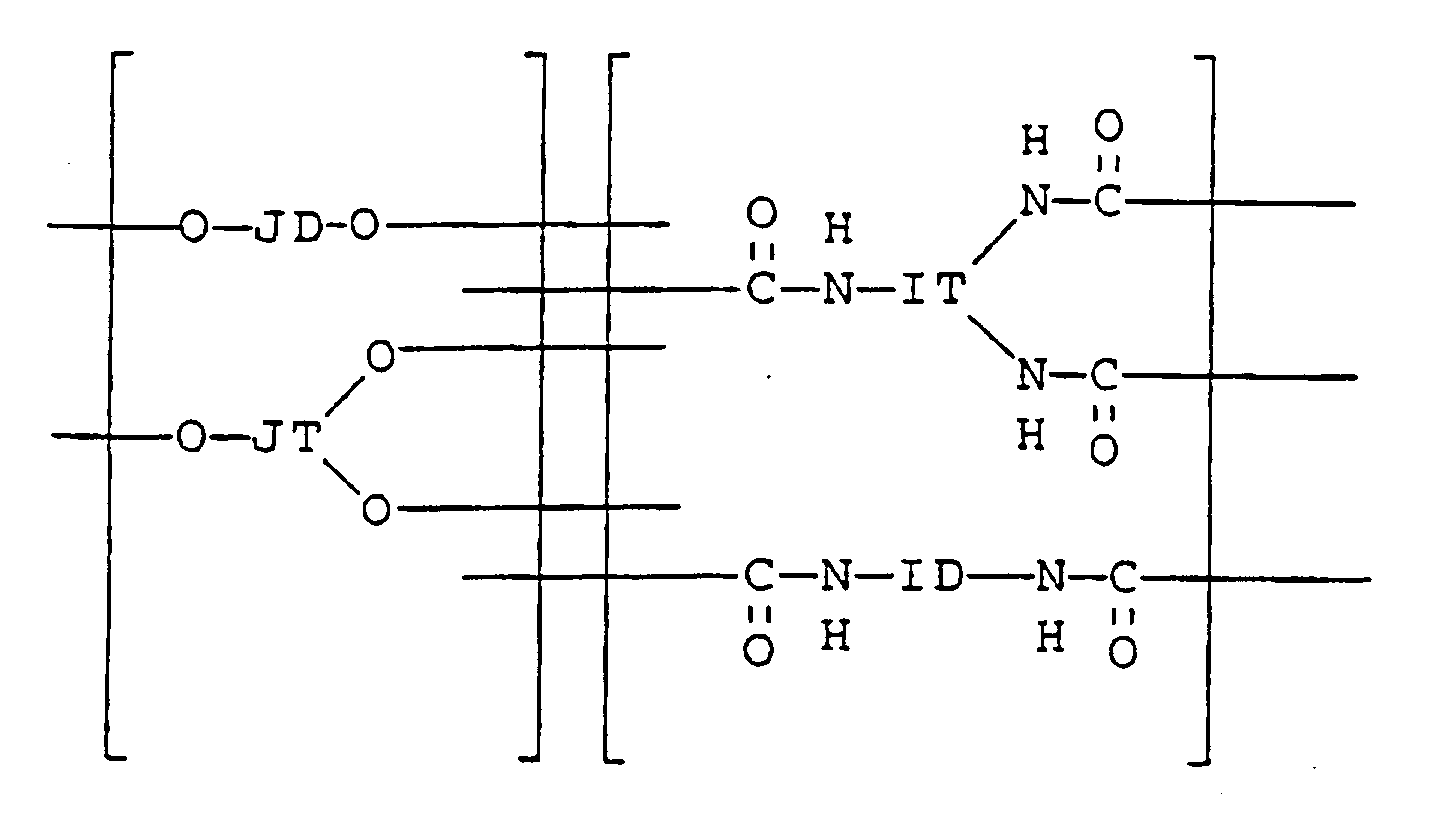 JD und JT gemeinsam 50 bis 100 Mol-% Polycarbonatsegmente darstellen, die sich ableiten von Polycarbonatpolyolen mit einem mittleren Molekulargewicht von etwa 1000 bis etwa 10.000 und 0 bis 50 Mol-% Segmenten, die sich ableiten von Polyolen mit einem Molekulargewicht von weniger als etwa 1000, undID und IT aliphatische, cycloaliphatische, araliphatische oder aromatische Reste von multifunktionellen Isocyanateinheiten darstellen.
 - Element nach Anspruch 1, dadurch gekennzeichnet, daß die Polycarbonatpolyole Einheiten aufweisen, die sich von Bisphenol-A- ableiten und von Diethylenglykol.
- Element nach Anspruch 1, dadurch gekennzeichnet, daß die endständigen Hydroxygruppen der Polycarbonatpolyole aliphatische Hydroxygruppen aufweisen.
- Element nach Anspruch 1, dadurch gekennzeichnet, daß die endständigen Hydroxygruppen der Polycarbonatpolyole phenolische Gruppen aufweisen.
- Element nach Anspruch 1, dadurch gekennzeichnet, daß die endständigen Hydroxygruppen der Polycarbonatpolyole eine Mischung aus phenolischen Gruppen und aliphatischen Hydroxygruppen aufweisen.
- Element nach Anspruch 1, dadurch gekennzeichnet, daß mindestens 50 Mol-% der multifunktionellen Isocyanate mindestens trifunktionell sind.
- Element nach Anspruch 1, dadurch gekennzeichnet, daß die Polyole und multifunktionellen Isocyanate umgesetzt werden unter Erzeugung des quervernetzten Polymer-Netzwerkes in Mengen derart, daß die Äquivalente von Polyolhydroxygruppen bei 60 bis 100 % der Äquivalente von Isocyanatgruppen liegen.
- Verfahren zur Herstellung eines Farbstoff-Übertragungsbildes, bei dem man ein Farbstoff-Donorelement mit einem Träger, auf dem sich eine Farbstoffschicht befindet, bildweise erhitzt und ein Farbstoffbild auf ein Farbstoff-Empfangselement unter Erzeugung des Farbstoff-Übertragungsbildes überträgt, wobei das Farbstoff-Empfangselement einen Träger aufweist, auf dem sich eine Farbbild-Empfangsschicht befindet, wobei die Farbbild-Empfangsschicht primär ein quervernetztes Polymer-Netzwerk aufweist, das erzeugt wurde durch Umsetzung von multifunktionellen Isocyanaten mit Polycarbonatpolyolen mit zwei endständigen Hydroxygruppen und einem mittleren Molekulargewicht von etwa 1000 bis etwa 10.000 sowie einem Polycarbonatpolyol mit drei oder mehr endständigen Hydroxygruppen sowie einem mittleren Molekulargewicht von etwa 1000 bis etwa 10.000.
- Zusammenstellung für die thermische Farbstoff-Übertragung mit: (a) einem Farbstoff-Donorelement mit einem Träger, auf dem sich eine Farbstoffschicht befindet, und (b) einem Farbstoff-Empfangselement mit einem Träger, auf dem sich eine Fabbild-Empfangsschicht befindet, wobei das Farbstoff-Empfangselement sich in übergeordneter Beziehung zu dem Farbstoff-Donorelement befindet, derart, daß die Farbstoffschicht in Kontakt mit der Farbbild-Empfangsschicht gelangt; wobei die Farbbild-Empfangsschicht primär ein quervernetztes Polymer-Netzwerk aufweist, das erzeugt wurde durch Umsetzung von multifunktionellen Isocyanaten mit Polycarbonatpolyolen mit zwei endständigen Hydroxygruppen und einem mittleren Molekulargewicht von etwa 1000 bis etwa 10.000, sowie einem Polycarbonatpolyol mit drei oder mehr endständigen Hydroxygruppen und einem mittleren Molekulargewicht von etwa 1000 bis etwa 10.000.
Applications Claiming Priority (2)
| Application Number | Priority Date | Filing Date | Title |
|---|---|---|---|
| US07/923,757 US5266551A (en) | 1992-08-03 | 1992-08-03 | Thermal dye transfer receiving element with polycarbonate polyol crosslinked polymer dye-image receiving layer |
| US923757 | 1992-08-03 |
Publications (3)
| Publication Number | Publication Date |
|---|---|
| EP0585604A2 EP0585604A2 (de) | 1994-03-09 |
| EP0585604A3 EP0585604A3 (de) | 1994-12-28 |
| EP0585604B1 true EP0585604B1 (de) | 1997-11-05 |
Family
ID=25449216
Family Applications (1)
| Application Number | Title | Priority Date | Filing Date |
|---|---|---|---|
| EP19930112076 Expired - Lifetime EP0585604B1 (de) | 1992-08-03 | 1993-07-28 | Wärmeempfindliches Farbstoffübertragungsempfangselement |
Country Status (4)
| Country | Link |
|---|---|
| US (1) | US5266551A (de) |
| EP (1) | EP0585604B1 (de) |
| JP (1) | JP2807148B2 (de) |
| DE (1) | DE69315023T2 (de) |
Families Citing this family (17)
| Publication number | Priority date | Publication date | Assignee | Title |
|---|---|---|---|---|
| US5411931A (en) | 1994-06-24 | 1995-05-02 | Eastman Kodak Company | Thermal dye transfer receiving element with polycarbonate polyol crosslinked polymer |
| US5618773A (en) * | 1996-03-21 | 1997-04-08 | Eastman Kodak Company | Stabilizers for dye-donor element used in thermal dye transfer |
| EP0756944B1 (de) * | 1995-07-24 | 1999-05-19 | Eastman Kodak Company | Stabilisatoren für Farbstoff-gebendes Element, dass bei der thermischen Farbstoffübertragung verwendet wird |
| US6096685A (en) * | 1998-12-02 | 2000-08-01 | Eastman Kodak Company | Cross-linked receiving element for thermal dye transfer |
| US6291396B1 (en) | 1999-12-15 | 2001-09-18 | Eastman Kodak Company | Plasticized cross-linked receiving element for thermal dye transfer |
| US6998072B2 (en) * | 2001-11-01 | 2006-02-14 | Transitions Optical, Inc. | Photochromic polymerizable compositions |
| US6916537B2 (en) * | 2001-11-01 | 2005-07-12 | Transitions Optical Inc. | Articles having a photochromic polymeric coating |
| JP2007237652A (ja) | 2006-03-10 | 2007-09-20 | Fujifilm Corp | 感熱転写受像シート |
| EP1980409A3 (de) | 2007-03-29 | 2010-09-29 | FUJIFILM Corporation | Wärmeempfindliche Übertragungsfolie zur Verwendung in wärmeempfindlichen Übertragungssystemen und Bilderzeugungsverfahren mit wärmeempfindlichem Übertragungssystem |
| EP1974948A3 (de) | 2007-03-29 | 2012-02-08 | FUJIFILM Corporation | Bildgebendes Verfahren mit einem wärmeempfindlichen Übertragungssystem |
| JP2008273641A (ja) | 2007-04-25 | 2008-11-13 | Fujifilm Corp | 感熱転写受像シート用紙管、感熱転写受像シートのロール形態加工物、及び画像形成方法 |
| US7993559B2 (en) | 2009-06-24 | 2011-08-09 | Eastman Kodak Company | Method of making thermal imaging elements |
| US8377846B2 (en) | 2009-06-24 | 2013-02-19 | Eastman Kodak Company | Extruded image receiver elements |
| US8258078B2 (en) | 2009-08-27 | 2012-09-04 | Eastman Kodak Company | Image receiver elements |
| US8435925B2 (en) | 2010-06-25 | 2013-05-07 | Eastman Kodak Company | Thermal receiver elements and imaging assemblies |
| MX2013000557A (es) | 2010-07-16 | 2013-05-30 | Amcor Ltd | Rebaba de base controlada que forma un anillo de pie. |
| US8345075B2 (en) | 2011-04-27 | 2013-01-01 | Eastman Kodak Company | Duplex thermal dye receiver elements and imaging methods |
Family Cites Families (4)
| Publication number | Priority date | Publication date | Assignee | Title |
|---|---|---|---|---|
| GB8815423D0 (en) * | 1988-06-29 | 1988-08-03 | Ici Plc | Receiver sheet |
| JP2564616B2 (ja) * | 1988-07-25 | 1996-12-18 | ユニチカ株式会社 | 被熱転写シート |
| DE68928514T2 (de) * | 1988-08-13 | 1998-08-20 | Dainippon Printing Co Ltd | Wärmeempfindliches speichermedium |
| US5178953A (en) * | 1990-01-12 | 1993-01-12 | Ampex Media Corporation | Magnetic recording media having a binder comprising a low molecular weight high glass transition temperature vinyl polymer |
-
1992
- 1992-08-03 US US07/923,757 patent/US5266551A/en not_active Expired - Lifetime
-
1993
- 1993-07-28 EP EP19930112076 patent/EP0585604B1/de not_active Expired - Lifetime
- 1993-07-28 DE DE69315023T patent/DE69315023T2/de not_active Expired - Fee Related
- 1993-08-03 JP JP19233693A patent/JP2807148B2/ja not_active Expired - Fee Related
Also Published As
| Publication number | Publication date |
|---|---|
| EP0585604A3 (de) | 1994-12-28 |
| JP2807148B2 (ja) | 1998-10-08 |
| DE69315023T2 (de) | 1998-03-05 |
| JPH06155933A (ja) | 1994-06-03 |
| DE69315023D1 (de) | 1997-12-11 |
| EP0585604A2 (de) | 1994-03-09 |
| US5266551A (en) | 1993-11-30 |
Similar Documents
| Publication | Publication Date | Title |
|---|---|---|
| EP0585604B1 (de) | Wärmeempfindliches Farbstoffübertragungsempfangselement | |
| EP0295485B1 (de) | Überzug für Farbbildempfangsschicht, die bei der thermischen Farbstoffübertragung verwendet wird | |
| EP0691212B1 (de) | Empfangselement für die thermische Farbstoffübertragung, das ein Polycarbonat-polyol vernetztes Polymer enthalt | |
| EP0603570B1 (de) | Farbstoffempfangselement für thermische Übertragung | |
| EP0395094B1 (de) | Empfangsschicht aus Polycarbonat mit nichtaromatischem Diol für die thermische Farbstoffübertragung | |
| EP0545407B1 (de) | Empfangselement für die thermische Farbstoffübertragung mit Polyester-Farbbild-Empfangsschicht | |
| EP0604858B1 (de) | Empfangselement für die thermische Farbstoffübertragung mit einen in Wasser dispergierbaren Polyester enthaltender Bildempfangsschicht | |
| EP0348989A2 (de) | Phthalatester in Empfangsschicht zum Zwecke einer verbesserten Farbstoffdichte-Übertragung | |
| US6096685A (en) | Cross-linked receiving element for thermal dye transfer | |
| US6291396B1 (en) | Plasticized cross-linked receiving element for thermal dye transfer | |
| EP0603578B1 (de) | Gleitschicht für ein bei der thermischen Farbstoffübertragung verwendetes Farbstoffdonorelement | |
| EP0699543B1 (de) | Druckpapier | |
| EP1518702B1 (de) | Bildempfangsblatt für die thermische Übertragung | |
| EP0936079B1 (de) | Thermisches Farbstoffübertragungsempfangselement | |
| EP0812703B1 (de) | Schutzschicht für thermisches Farbstoffübertragungsempfangselement | |
| JP3401952B2 (ja) | 昇華型熱転写記録用印画紙 | |
| EP0756944B1 (de) | Stabilisatoren für Farbstoff-gebendes Element, dass bei der thermischen Farbstoffübertragung verwendet wird | |
| EP0550876A1 (de) | Bildempfangelement für thermische Übertragung | |
| JPH0872422A (ja) | 印画紙 |
Legal Events
| Date | Code | Title | Description |
|---|---|---|---|
| PUAI | Public reference made under article 153(3) epc to a published international application that has entered the european phase |
Free format text: ORIGINAL CODE: 0009012 |
|
| AK | Designated contracting states |
Kind code of ref document: A2 Designated state(s): BE CH DE FR GB IT LI NL |
|
| PUAL | Search report despatched |
Free format text: ORIGINAL CODE: 0009013 |
|
| AK | Designated contracting states |
Kind code of ref document: A3 Designated state(s): BE CH DE FR GB IT LI NL |
|
| 17P | Request for examination filed |
Effective date: 19950308 |
|
| 17Q | First examination report despatched |
Effective date: 19960708 |
|
| GRAG | Despatch of communication of intention to grant |
Free format text: ORIGINAL CODE: EPIDOS AGRA |
|
| GRAH | Despatch of communication of intention to grant a patent |
Free format text: ORIGINAL CODE: EPIDOS IGRA |
|
| RBV | Designated contracting states (corrected) |
Designated state(s): DE FR GB |
|
| GRAH | Despatch of communication of intention to grant a patent |
Free format text: ORIGINAL CODE: EPIDOS IGRA |
|
| GRAA | (expected) grant |
Free format text: ORIGINAL CODE: 0009210 |
|
| AK | Designated contracting states |
Kind code of ref document: B1 Designated state(s): DE FR GB |
|
| REF | Corresponds to: |
Ref document number: 69315023 Country of ref document: DE Date of ref document: 19971211 |
|
| ET | Fr: translation filed | ||
| PGFP | Annual fee paid to national office [announced via postgrant information from national office to epo] |
Ref country code: FR Payment date: 19980707 Year of fee payment: 6 |
|
| PLBE | No opposition filed within time limit |
Free format text: ORIGINAL CODE: 0009261 |
|
| STAA | Information on the status of an ep patent application or granted ep patent |
Free format text: STATUS: NO OPPOSITION FILED WITHIN TIME LIMIT |
|
| 26N | No opposition filed | ||
| PG25 | Lapsed in a contracting state [announced via postgrant information from national office to epo] |
Ref country code: FR Free format text: THE PATENT HAS BEEN ANNULLED BY A DECISION OF A NATIONAL AUTHORITY Effective date: 19990731 |
|
| REG | Reference to a national code |
Ref country code: FR Ref legal event code: ST |
|
| PGFP | Annual fee paid to national office [announced via postgrant information from national office to epo] |
Ref country code: DE Payment date: 20000727 Year of fee payment: 8 |
|
| REG | Reference to a national code |
Ref country code: GB Ref legal event code: IF02 |
|
| PG25 | Lapsed in a contracting state [announced via postgrant information from national office to epo] |
Ref country code: DE Free format text: LAPSE BECAUSE OF NON-PAYMENT OF DUE FEES Effective date: 20020501 |
|
| PGFP | Annual fee paid to national office [announced via postgrant information from national office to epo] |
Ref country code: GB Payment date: 20050614 Year of fee payment: 13 |
|
| PG25 | Lapsed in a contracting state [announced via postgrant information from national office to epo] |
Ref country code: GB Free format text: LAPSE BECAUSE OF NON-PAYMENT OF DUE FEES Effective date: 20060728 |
|
| GBPC | Gb: european patent ceased through non-payment of renewal fee |
Effective date: 20060728 |