EP0586012A2 - Equipement de prélèvement d'échantillons et de traitement analytique de PAH et autres composés organiques et fluorhydrique et oxyde de soufre - Google Patents
Equipement de prélèvement d'échantillons et de traitement analytique de PAH et autres composés organiques et fluorhydrique et oxyde de soufre Download PDFInfo
- Publication number
- EP0586012A2 EP0586012A2 EP93202501A EP93202501A EP0586012A2 EP 0586012 A2 EP0586012 A2 EP 0586012A2 EP 93202501 A EP93202501 A EP 93202501A EP 93202501 A EP93202501 A EP 93202501A EP 0586012 A2 EP0586012 A2 EP 0586012A2
- Authority
- EP
- European Patent Office
- Prior art keywords
- equipment
- equipment according
- sampling
- adsorption
- adsorption device
- Prior art date
- Legal status (The legal status is an assumption and is not a legal conclusion. Google has not performed a legal analysis and makes no representation as to the accuracy of the status listed.)
- Granted
Links
Images

Classifications
-
- G—PHYSICS
- G01—MEASURING; TESTING
- G01N—INVESTIGATING OR ANALYSING MATERIALS BY DETERMINING THEIR CHEMICAL OR PHYSICAL PROPERTIES
- G01N33/00—Investigating or analysing materials by specific methods not covered by groups G01N1/00 - G01N31/00
- G01N33/0004—Gaseous mixtures, e.g. polluted air
- G01N33/0009—General constructional details of gas analysers, e.g. portable test equipment
- G01N33/0027—General constructional details of gas analysers, e.g. portable test equipment concerning the detector
- G01N33/0036—General constructional details of gas analysers, e.g. portable test equipment concerning the detector specially adapted to detect a particular component
- G01N33/0047—Organic compounds
-
- G—PHYSICS
- G01—MEASURING; TESTING
- G01N—INVESTIGATING OR ANALYSING MATERIALS BY DETERMINING THEIR CHEMICAL OR PHYSICAL PROPERTIES
- G01N1/00—Sampling; Preparing specimens for investigation
- G01N1/02—Devices for withdrawing samples
- G01N1/22—Devices for withdrawing samples in the gaseous state
- G01N1/2247—Sampling from a flowing stream of gas
-
- G—PHYSICS
- G01—MEASURING; TESTING
- G01N—INVESTIGATING OR ANALYSING MATERIALS BY DETERMINING THEIR CHEMICAL OR PHYSICAL PROPERTIES
- G01N30/00—Investigating or analysing materials by separation into components using adsorption, absorption or similar phenomena or using ion-exchange, e.g. chromatography or field flow fractionation
-
- G—PHYSICS
- G01—MEASURING; TESTING
- G01N—INVESTIGATING OR ANALYSING MATERIALS BY DETERMINING THEIR CHEMICAL OR PHYSICAL PROPERTIES
- G01N1/00—Sampling; Preparing specimens for investigation
- G01N1/02—Devices for withdrawing samples
- G01N1/22—Devices for withdrawing samples in the gaseous state
- G01N1/2202—Devices for withdrawing samples in the gaseous state involving separation of sample components during sampling
- G01N1/2214—Devices for withdrawing samples in the gaseous state involving separation of sample components during sampling by sorption
-
- G—PHYSICS
- G01—MEASURING; TESTING
- G01N—INVESTIGATING OR ANALYSING MATERIALS BY DETERMINING THEIR CHEMICAL OR PHYSICAL PROPERTIES
- G01N1/00—Sampling; Preparing specimens for investigation
- G01N1/02—Devices for withdrawing samples
- G01N1/22—Devices for withdrawing samples in the gaseous state
- G01N1/24—Suction devices
-
- G—PHYSICS
- G01—MEASURING; TESTING
- G01N—INVESTIGATING OR ANALYSING MATERIALS BY DETERMINING THEIR CHEMICAL OR PHYSICAL PROPERTIES
- G01N1/00—Sampling; Preparing specimens for investigation
- G01N1/02—Devices for withdrawing samples
- G01N1/22—Devices for withdrawing samples in the gaseous state
- G01N1/2247—Sampling from a flowing stream of gas
- G01N2001/225—Sampling from a flowing stream of gas isokinetic, same flow rate for sample and bulk gas
-
- G—PHYSICS
- G01—MEASURING; TESTING
- G01N—INVESTIGATING OR ANALYSING MATERIALS BY DETERMINING THEIR CHEMICAL OR PHYSICAL PROPERTIES
- G01N30/00—Investigating or analysing materials by separation into components using adsorption, absorption or similar phenomena or using ion-exchange, e.g. chromatography or field flow fractionation
- G01N30/02—Column chromatography
- G01N30/26—Conditioning of the fluid carrier; Flow patterns
- G01N30/28—Control of physical parameters of the fluid carrier
- G01N30/30—Control of physical parameters of the fluid carrier of temperature
-
- G—PHYSICS
- G01—MEASURING; TESTING
- G01N—INVESTIGATING OR ANALYSING MATERIALS BY DETERMINING THEIR CHEMICAL OR PHYSICAL PROPERTIES
- G01N30/00—Investigating or analysing materials by separation into components using adsorption, absorption or similar phenomena or using ion-exchange, e.g. chromatography or field flow fractionation
- G01N30/02—Column chromatography
- G01N30/60—Construction of the column
- G01N30/6091—Cartridges
-
- Y—GENERAL TAGGING OF NEW TECHNOLOGICAL DEVELOPMENTS; GENERAL TAGGING OF CROSS-SECTIONAL TECHNOLOGIES SPANNING OVER SEVERAL SECTIONS OF THE IPC; TECHNICAL SUBJECTS COVERED BY FORMER USPC CROSS-REFERENCE ART COLLECTIONS [XRACs] AND DIGESTS
- Y02—TECHNOLOGIES OR APPLICATIONS FOR MITIGATION OR ADAPTATION AGAINST CLIMATE CHANGE
- Y02A—TECHNOLOGIES FOR ADAPTATION TO CLIMATE CHANGE
- Y02A50/00—TECHNOLOGIES FOR ADAPTATION TO CLIMATE CHANGE in human health protection, e.g. against extreme weather
- Y02A50/20—Air quality improvement or preservation, e.g. vehicle emission control or emission reduction by using catalytic converters
Definitions
- the present invention concerns equipment for sampling and processing for analysis of PAH and other organic compounds, as well as hydrogen fluoride and oxides of sulphur.
- PAH stands for polycyclic aromatic hydrocarbons. Many of these compounds are carcinogenic. Other compounds which it is desirable to monitor because of their harmful effects include phenols, polychlorinated biphenyls (PCBs), and dioxins. All these compounds occur for example in tar and/or solvents.
- the above-mentioned compounds occur, for example, to a greater or lesser extent, in and around anode factories, in raw gas from electrolytic furnaces, in electrolysis halls, in and around incineration plants, in solvents and in places of work where chemicals containing such compounds are used or formed.
- the gas sample is extracted through a pipe filled with glass wool (the "Lurgi method").
- the gas is then conducted through two absorption flasks with toluene and one empty flask, and straight on into a pump with a gas clock.
- the flasks are not cooled, and the evaporation loss of the toluene is therefore high.
- the glass wool is boiled out with toluene, filtered and evaporated.
- the absorption sample in the flasks is also filtered and evaporated.
- the particles in the solution are extracted with hot toluene which is evaporated.
- the sum of the evaporation residues is specified as the total tar quantity.
- Tar contains a large number of components ranging from heavy to volatile compounds.
- the consumption of toluene with this method is 600-1000 ml per sampling.
- the boiling point of toluene is 110.6°C. This leads to great uncertainty in the method, inasmuch as the volatile compounds in tar will evaporate with the toluene.
- the evaporation of such quantities of toluene is undesirable because the toluene vapour is toxic.
- the European patent application publ. no. 42683 describes an apparatus for capturing gas components in low concentrations. They are captured on various adsorbents which are packed between sinters in an outside pipe.
- the technique described in the above-mentioned European patent application would not however be suitable for determining the tar flow in an anode factory and for similar tasks where the present invention can be used. If one used the apparatus described in EP-42683 for such purposes, problems would arise because the gas volume through the apparatus is too small for isokinetic sampling, and aerosols would not be captured quantitatively. In addition this technique would entail condensation of water vapour, and it would not be possible to change the adsorbent after sampling.
- the British patent application publ. no. 2083662 describes an apparatus where fluid is used as an absorption medium to capture gas components. This apparatus could not be used either to determine the tar flow in an anode factory, since the hydrophobic filter would quickly be clogged with tar and the fluid in the pipe would not absorb gaseous tar components quantitatively. Furthermore, the fluid would evaporate or water vapour would condense, depending on the temperature conditions, and this equipment cannot be extracted directly after the sampling.
- the object of the present invention is therefore to procure sampling and processing equipment for gas which can produce a product which can be analysed for content of PAH, other hydrocarbons, hydrogen fluoride and sulphur oxides in a simple, reliable manner, and which does not suffer from the above-mentioned disadvantages.
- the sampling equipment in accordance with the invention is based on solid adsorbents designed in a sandwich structure.
- This unit which for example could take the form of a cylinder of metal, plastic, teflon or glass, can further be connected with a special extractor without any kind of dismantling, for direct extraction of the organic compounds which have been captured.
- the specially designed extraction apparatus works on the soxhlet principle, i.e. several rinses with stripped solvent.
- the extraction agents used are organic solvents, mainly dichloromethane.
- the organic compounds can then be analysed by means of analytical methods such as chromatography or spectrometry, after a suitable processing procedure.
- the equipment as specified in the invention involves a processing procedure which is less labour-intensive and more accurate than the known technique.
- adsorbents For sampling hydrogen fluoride and sulphur oxides, special adsorbents are used, such as activated aluminum oxide, For extraction of inorganic compounds water-based solvents are used.
- composition and quantity of PAH/Tar from the anode furnaces in incoming and outgoing gas from the various parts of the purification plants can be determined by using this equipment.
- sampling equipment as in the present invention compared with the known technique is that it is more compact.
- the reason why such a compact design is possible is that solid adsorbents are used.
- For industrial hygiene purposes it may also be appropriate to make the sampling equipment portable. This can be done by means of simple modifications, by miniaturizing the equipment and integrating it in a cycle such that it can be carried as one unit.
- the equipment can also be further automated by means of a microprocessor.
- Another advantageous feature of using solid, dry adsorbents in the equipment is that there is thus no need to evaporate away quantities of organic solvents which are toxic, as is the case when absorption solutions are used.
- the adsorbents are regenerated during the extraction procedure, and can be used again.
- the adsorption agents used depend on the samples one wishes to take.
- the adsorption device which makes up an essential part of the sampler is built up from the required number of elements which are screwed together, and the adsorption agents which are placed in the various elements may be the same or different.
- Suitable adsorbents are aluminium oxide, silica gel and hydrophobic polymers - for example Tenax, XAD 2 and XAD 4.
- the adsorbent XAD 2 is preferred.
- Tenax which is also used as an adsorption material in chromatography columns, is a very good adsorption agent. However, it is much more expensive than for example XAD 2, but for special purposes it will be relevant to use this adsorption agent.
- aluminum oxide is preferred as the adsorption material.
- Adsorption materials which may contain organic compounds to begin with must be cleaned to remove these compounds before use in the sampling equipment. Such cleaning must be done by using XAD 2 for example as an adsorbent.
- the temperature in the adsorption equipment is kept so high that the gas will not cool down to room temperature and cause condensation of water vapour on the adsorbents.
- the adsorption capacity is not destroyed and prevents the extraction and analysis procedure becoming more complicated. Instead, the water is captured in a silica gel adsorbent which is connected to the adsorption device.
- the adsorption device can be placed directly in the extraction equipment after the sample has been taken, one avoids the several steps required for processing when using the previously-known techniques. This means that an analysis of the products procured by using the equipment as specified in the present invention involves less risk of error than does the use of equipment according to the prior art.
- toluene among other things, which has a boiling point of 110. 6°C, is used as an extraction agent during the processing.
- the preferred extraction agent is dichloromethane, with a boiling point of 40°C.
- the extraction agent is evaporated after extraction, one will have isolated the bulk of the organic compounds which have a higher boiling point than 40°C.
- toluene one loses the organic compounds which have lower boiling points than 110.6°C, and light organic compounds are expelled uncontrollably during the evaporation. These light compounds thus cannot be subjected to analysis either.
- Figure 1 is an overview of the equipment during sampling.
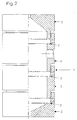
- Figure 2 is a schematic overview of the adsorption device in the equipment.
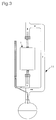
- Figure 3 is a sketch of the equipment during processing of the sample.
- the adsorption device 1 is layered, and is built up of the following elements: a bottom 2, one or more middle pieces 3, one or more middle pieces 4 furnished with a hole in the side, and a top 5. All the elements are cylindrical, and threaded at both ends, where the threads in the upper part of the top 5 and the lower part of the bottom 2 are inside, and the device 1 is built up such that the bottom 2, a required number of middle pieces 3, 4 placed in the required order, and the top 5 are screwed together. It may be necessary to use sealing devices between the elements to prevent leakage from the device 1.
- the layers in the device 1 are separated by netting or a grille 6. On one or more of the grilles 6, if required, filter paper or glass wool can be laid to collect particulate material.
- the middle pieces 3, 4 are filled with the required adsorption agents before the arrangement 1 is screwed together.
- the middle pieces 3, 4 are filled with the same or different adsorbents. Normally, however, only one middle piece 4 will be necessary, with the main adsorbent, and below it a middle piece 3 with an adsorbent which constitutes a control layer.
- an extra middle piece 3 filled with filtering filler material for rough separation over the middle piece 4 before the top 5 is screwed on.
- the hole in the middle piece 4 may be sealed with a thermoelement or a screw stopper.
- thermoelement When one is sampling, the temperature control in the adsorption device 1 will be important, and a thermoelement can then be placed in the hole. When one is processing the sample, the thermoelement can be replaced with a screw stopper, since the temperature is controlled by other means in this procedure.
- a sketch of the adsorption device is shown in Figure 2.
- the adsorption arrangement 1 is heated up by a heating element 7 such that water in the object to be sampled is not condensed out into the arrangement 1.
- the heating element 7 can for example consist of heating tape.
- the function of the gel box is to collect any water which may be present in the gas which is being sampled.
- the gel box 10 and the pump 9 are connected via an adjustment valve.
- the pump 9 can for example consist of a leak-proof membrane pump which is further connected to a gas clock 12 which contains a thermometer and flow meter.
- the isokinetic extraction of the sample will be set on the basis of the gas speed measurements carried out before the sampling.
- the adsorption device 1 is unscrewed from the probe 8 and gel box 10, and the thermoelement is replaced by a screw stopper.
- the adsorption device is attached to the extraction apparatus 11 as shown in Figure 3.
- the probe 8 is rinsed inside with extraction agent, for example dichloromethane, and the rinse liquid is transferred to the extraction apparatus 11.
- extraction agent for example dichloromethane
- extraction agent in a suitable quantity is added in the extraction apparatus 11.
- the extraction agent is then heated so that it evaporates.
- a cooler has been placed where the evaporated extraction agent will condense and run down into the adsorption device.
- the sample in the adsorption device will then be extracted.
- the extraction apparatus 11 works on the soxhlet principle, that is by means of several rinses with stripped solvent.
- the sample is collected in the flask at the bottom of the extraction apparatus 11 along with the extraction agent, and the adsorption device 1 contains regenerated adsorbents.
- the sample collected can now be handled in accordance with conventional techniques and analyses quantitatively and qualitatively by means of known chromatography and mass spectrometry methods.
- the tests were conducted in the exhaust gas from anode furnaces.
- the gas from these furnaces was cleaned by three different types of purification plant connected in series.
- the figure below shows a flow diagram for the purification plants with the sampling/ measurement points indicated.
- Three parallel sets of samples were taken (I, II and III) with the new equipment at measuring points 1, 2 and 3 to determine the tar content and the content of PAH.
- samples were taken in accordance with the "Lurgi method" to determine the content of tar at the measuring points 1 and 2, and once at the measuring points 2 and 3.
- Table 1 The results are shown in Table 1.
- the adsorption device in the equipment according to the invention consisted of two middle pieces plus top and bottom, where the upper middle piece contained the main adsorbent Tenax GC 60/80 mesh with glass wool above and below, and the lower middle piece functioned as a control layer and was filled with silica gel.
- Table 1 Determination of tar content (mg tar/Nm3 dry gas) and PAH content (mg PAH/Nm3 dry gas) Measuring point Sample No.
- New equipment, PAH indicates the quantity of PAH determined by the equipment as specified for the present invention, with methylene chloride used as an extraction agent.
- New equipment, tar (a) indicates that the tar content was determined with the equipment as specified for the present invention, with methylene chloride used as the extraction agent.
- New equipment, tar (b) indicates that the tar content was determined with the equipment as specified for the present invention, with methylene chloride used as the extraction agent, and toluene added to the extraction solution for evaporation.
- Lurgi method indicates that the tar content was determined by the Lurgi method, where the solvent used was toluene.
Landscapes
- Chemical & Material Sciences (AREA)
- Health & Medical Sciences (AREA)
- Life Sciences & Earth Sciences (AREA)
- Immunology (AREA)
- Analytical Chemistry (AREA)
- Biochemistry (AREA)
- General Health & Medical Sciences (AREA)
- General Physics & Mathematics (AREA)
- Physics & Mathematics (AREA)
- Pathology (AREA)
- Engineering & Computer Science (AREA)
- Combustion & Propulsion (AREA)
- Food Science & Technology (AREA)
- Medicinal Chemistry (AREA)
- Biomedical Technology (AREA)
- Molecular Biology (AREA)
- Sampling And Sample Adjustment (AREA)
- Investigating Or Analyzing Non-Biological Materials By The Use Of Chemical Means (AREA)
Applications Claiming Priority (2)
| Application Number | Priority Date | Filing Date | Title |
|---|---|---|---|
| NO923420A NO175834C (no) | 1992-09-02 | 1992-09-02 | Utstyr for prövetakning og opparbeiding til analyse av PAH og andre organiske forbindelser, samt hydrogenfluorid og svoveloksider |
| NO923420 | 1992-09-02 |
Publications (3)
| Publication Number | Publication Date |
|---|---|
| EP0586012A2 true EP0586012A2 (fr) | 1994-03-09 |
| EP0586012A3 EP0586012A3 (fr) | 1994-08-03 |
| EP0586012B1 EP0586012B1 (fr) | 2002-01-16 |
Family
ID=19895423
Family Applications (1)
| Application Number | Title | Priority Date | Filing Date |
|---|---|---|---|
| EP93202501A Expired - Lifetime EP0586012B1 (fr) | 1992-09-02 | 1993-08-26 | Equipement de prélèvement d'échantillons et de traitement analytique de PAH et autres composés organiques et fluorhydrique et oxyde de soufre |
Country Status (16)
| Country | Link |
|---|---|
| US (1) | US5571477A (fr) |
| EP (1) | EP0586012B1 (fr) |
| JP (1) | JP2677508B2 (fr) |
| AT (1) | ATE212127T1 (fr) |
| AU (1) | AU667934B2 (fr) |
| BR (1) | BR9303675A (fr) |
| CA (1) | CA2104409C (fr) |
| CZ (1) | CZ181093A3 (fr) |
| DE (1) | DE69331455T2 (fr) |
| DK (1) | DK0586012T3 (fr) |
| ES (1) | ES2171408T3 (fr) |
| NO (1) | NO175834C (fr) |
| NZ (1) | NZ248375A (fr) |
| RU (1) | RU2089869C1 (fr) |
| SK (1) | SK281617B6 (fr) |
| ZA (1) | ZA935811B (fr) |
Cited By (6)
| Publication number | Priority date | Publication date | Assignee | Title |
|---|---|---|---|---|
| KR100375205B1 (ko) * | 1999-12-21 | 2003-03-08 | 이병규 | 새로운 건성 및 습성침적 동시측정용 장비 |
| FR2910966A1 (fr) * | 2006-12-28 | 2008-07-04 | Commissariat Energie Atomique | Dispositif de mesures couplees permettant un suivi global et en continu de traces de goudrons presentes dans un flux gazeux |
| US7968055B2 (en) | 2006-12-28 | 2011-06-28 | Commissariat A L'energie Atomique | Device and method for continuous measurement of concentrations of tars in a gas flow |
| WO2012103249A1 (fr) * | 2011-01-26 | 2012-08-02 | Energy & Environmental Research Center | Mesure des multimétaux et des halogènes totaux dans un flux gazeux |
| CN105486817A (zh) * | 2015-12-30 | 2016-04-13 | 中国建材检验认证集团股份有限公司 | 一种材料对空气污染物非吸附净化性能的测定方法 |
| CN109358149A (zh) * | 2018-11-03 | 2019-02-19 | 浙江环境监测工程有限公司 | 一种地表水中多环芳烃的快速定量检测方法 |
Families Citing this family (12)
| Publication number | Priority date | Publication date | Assignee | Title |
|---|---|---|---|---|
| AU2003278594A1 (en) * | 2002-11-01 | 2004-05-25 | Pal Dharam | A new online service offering email, chat, people-location-in-a-dynamic-scenario, messaging, auctions and other services based upon real id of its subscribers |
| US8227648B2 (en) * | 2008-12-17 | 2012-07-24 | Uop Llc | Combined temperature controlled water adsorption and two stage heat pump process for fuel ethanol dehydration |
| US8936727B2 (en) * | 2009-03-06 | 2015-01-20 | Uop Llc | Multiple bed temperature controlled adsorption |
| US8067646B2 (en) * | 2008-12-17 | 2011-11-29 | Uop Llc | Combined temperature controlled adsorption and heat pump process for fuel ethanol dehydration |
| US8226746B2 (en) * | 2008-12-17 | 2012-07-24 | Uop Llc | Indirectly heated temperature controlled adsorber for sorbate recovery |
| US7795479B1 (en) | 2009-12-15 | 2010-09-14 | Uop Llc | Temperature controlled adsorption multi-step regeneration cycle |
| CN101915687B (zh) * | 2010-08-04 | 2012-03-28 | 聚光科技(杭州)股份有限公司 | 一种应用在分析仪器中的气体预处理方法及装置 |
| RU2510501C2 (ru) * | 2012-05-22 | 2014-03-27 | Глеб Борисович Лисовенко | Способ определения содержания труднолетучих органических соединений в газообразной среде, композиция в качестве сорбента, применение сорбента |
| CN103674615B (zh) * | 2013-12-17 | 2016-05-04 | 福建省邵武市永晶化工有限公司 | 一种无水氟化氢取样装置及取样方法 |
| JP6956023B2 (ja) * | 2017-03-23 | 2021-10-27 | 株式会社住化分析センター | 水素ガス分析用キット、水素ガス分析方法、及び水素ガスの品質管理方法 |
| RU2698476C1 (ru) * | 2018-04-25 | 2019-08-28 | Общество с ограниченной ответственностью "ИНЛАБ" | Способ анализа примесей малолетучих полярных веществ в жидких средах |
| CN114768300B (zh) * | 2022-04-22 | 2023-04-14 | 正大制药(青岛)有限公司 | 一种用于帕立骨化醇生产的制备方法 |
Family Cites Families (24)
| Publication number | Priority date | Publication date | Assignee | Title |
|---|---|---|---|---|
| US3336792A (en) * | 1964-01-31 | 1967-08-22 | Sinclair Research Inc | Method of analyzing soil gases |
| US3735562A (en) * | 1971-06-09 | 1973-05-29 | Gulf Research Development Co | Membrane gas extractor |
| US3758603A (en) * | 1972-05-12 | 1973-09-11 | Standard Oil Co | Process for separation of unsaturated hydrocarbons |
| US3847552A (en) * | 1973-11-23 | 1974-11-12 | Ibm | Environmental monitoring device and method |
| JPS5244787U (fr) * | 1975-09-25 | 1977-03-30 | ||
| DD140324A3 (de) * | 1977-03-29 | 1980-02-27 | Manfred Radtke | Vorrichtung und verfahren zur entnahme von bodenluft |
| US4133309A (en) * | 1977-05-13 | 1979-01-09 | Minnesota Mining And Manufacturing Company | Sorbent material and a respirator containing the sorbent material |
| JPS557629A (en) * | 1978-06-30 | 1980-01-19 | Cosmo Co Ltd | Sampling unit concentrating very small amount of component in air |
| US4249904A (en) * | 1979-07-27 | 1981-02-10 | Thermo Electron Corporation | Method and apparatus for extraction of airborne N-nitroso compounds without artifact formation |
| DE3012380C2 (de) * | 1980-03-29 | 1982-04-15 | Drägerwerk AG, 2400 Lübeck | An der Person getragener Probenehmer von organischen Lösungsmitteldämpfen |
| GB2083622B (en) * | 1980-06-23 | 1984-03-07 | Baldeck Charles M | Apparatus for collecting a component from a gas mixture |
| GB2078128B (en) * | 1980-06-24 | 1984-09-12 | Nat Res Dev | Monitoring gases |
| US4303529A (en) * | 1980-09-08 | 1981-12-01 | The United States Of America As Represented By The Secretary Of The Interior | Multi-chromatographic materials |
| SE452510B (sv) * | 1983-07-14 | 1987-11-30 | Knut Irgum | Sett att meta en halt av en forening, t ex en gas, i luft, fast adsorbent for utovande av settet samt anvendning av adsorbenten |
| USH255H (en) * | 1986-08-26 | 1987-04-07 | The United States Of America As Represented By The Secretary Of The Army | Charcoal adsorbent test apparatus and method using filter tubes |
| DK71987D0 (da) * | 1987-02-13 | 1987-02-13 | Nordiske Kabel Traad | Fremgangsmaade til rensning af olie- og kemikalieforurenet jord |
| US5087360A (en) * | 1990-04-19 | 1992-02-11 | Electric Power Research Institute, Inc. | Field-portable apparatus and method for analytical supercritical fluid extraction of sorbent materials |
| JPH0620548B2 (ja) * | 1988-05-23 | 1994-03-23 | 水澤化学工業株式会社 | 複合吸着剤 |
| US5147538A (en) * | 1990-04-19 | 1992-09-15 | Electric Power Research Institute, Inc. | Field-portable apparatus and method for analytical supercritical fluid extraction of sorbent materials |
| JP2651626B2 (ja) * | 1990-06-18 | 1997-09-10 | 信越化学工業株式会社 | 空気中に存在する有機ケイ素化合物の定量方法 |
| US5271903A (en) * | 1990-10-02 | 1993-12-21 | Dionex Corporation | Supercritical fluid extraction restrictor and collection system |
| US5135548A (en) * | 1991-05-08 | 1992-08-04 | Air Products And Chemicals, Inc. | Oxygen selective desiccants |
| US5205154A (en) * | 1991-11-01 | 1993-04-27 | Brigham Young University | Apparatus and method for simultaneous supercritical fluid extraction and gas chromatography |
| US5300138A (en) * | 1993-01-21 | 1994-04-05 | Semco Incorporated | Langmuir moderate type 1 desiccant mixture for air treatment |
-
1992
- 1992-09-02 NO NO923420A patent/NO175834C/no unknown
-
1993
- 1993-08-10 AU AU44525/93A patent/AU667934B2/en not_active Ceased
- 1993-08-10 ZA ZA935811A patent/ZA935811B/xx unknown
- 1993-08-11 SK SK871-93A patent/SK281617B6/sk unknown
- 1993-08-11 NZ NZ248375A patent/NZ248375A/en unknown
- 1993-08-19 CA CA002104409A patent/CA2104409C/fr not_active Expired - Fee Related
- 1993-08-26 DK DK93202501T patent/DK0586012T3/da active
- 1993-08-26 DE DE69331455T patent/DE69331455T2/de not_active Expired - Fee Related
- 1993-08-26 EP EP93202501A patent/EP0586012B1/fr not_active Expired - Lifetime
- 1993-08-26 ES ES93202501T patent/ES2171408T3/es not_active Expired - Lifetime
- 1993-08-26 AT AT93202501T patent/ATE212127T1/de not_active IP Right Cessation
- 1993-09-01 RU RU9393050372A patent/RU2089869C1/ru active
- 1993-09-01 BR BR9303675A patent/BR9303675A/pt not_active IP Right Cessation
- 1993-09-02 CZ CZ931810A patent/CZ181093A3/cs unknown
- 1993-09-02 JP JP5218847A patent/JP2677508B2/ja not_active Expired - Fee Related
- 1993-09-02 US US08/114,310 patent/US5571477A/en not_active Expired - Fee Related
Cited By (8)
| Publication number | Priority date | Publication date | Assignee | Title |
|---|---|---|---|---|
| KR100375205B1 (ko) * | 1999-12-21 | 2003-03-08 | 이병규 | 새로운 건성 및 습성침적 동시측정용 장비 |
| FR2910966A1 (fr) * | 2006-12-28 | 2008-07-04 | Commissariat Energie Atomique | Dispositif de mesures couplees permettant un suivi global et en continu de traces de goudrons presentes dans un flux gazeux |
| WO2008080987A1 (fr) * | 2006-12-28 | 2008-07-10 | Commissariat A L'energie Atomique | Dispositif et procede de mesures couplees permettant un suivi global et en continu de traces de goudrons presentes dans un flux gazeux |
| US7968055B2 (en) | 2006-12-28 | 2011-06-28 | Commissariat A L'energie Atomique | Device and method for continuous measurement of concentrations of tars in a gas flow |
| US8054082B2 (en) | 2006-12-28 | 2011-11-08 | Commissariat A L'energie Atomique | Device and method for coupled measurements for globally and continuously tracking traces of tars present in a gas flow |
| WO2012103249A1 (fr) * | 2011-01-26 | 2012-08-02 | Energy & Environmental Research Center | Mesure des multimétaux et des halogènes totaux dans un flux gazeux |
| CN105486817A (zh) * | 2015-12-30 | 2016-04-13 | 中国建材检验认证集团股份有限公司 | 一种材料对空气污染物非吸附净化性能的测定方法 |
| CN109358149A (zh) * | 2018-11-03 | 2019-02-19 | 浙江环境监测工程有限公司 | 一种地表水中多环芳烃的快速定量检测方法 |
Also Published As
| Publication number | Publication date |
|---|---|
| JPH06186148A (ja) | 1994-07-08 |
| EP0586012B1 (fr) | 2002-01-16 |
| NO175834B (no) | 1994-09-05 |
| JP2677508B2 (ja) | 1997-11-17 |
| ZA935811B (en) | 1994-03-10 |
| AU667934B2 (en) | 1996-04-18 |
| EP0586012A3 (fr) | 1994-08-03 |
| DK0586012T3 (da) | 2002-05-06 |
| CZ181093A3 (en) | 1994-03-16 |
| SK87193A3 (en) | 1994-04-06 |
| NO923420D0 (no) | 1992-09-02 |
| RU2089869C1 (ru) | 1997-09-10 |
| NZ248375A (en) | 1994-08-26 |
| SK281617B6 (sk) | 2001-05-10 |
| ES2171408T3 (es) | 2002-09-16 |
| CA2104409C (fr) | 1998-09-22 |
| BR9303675A (pt) | 1994-03-22 |
| US5571477A (en) | 1996-11-05 |
| NO175834C (no) | 1994-12-14 |
| DE69331455T2 (de) | 2002-08-08 |
| DE69331455D1 (de) | 2002-02-21 |
| NO923420L (no) | 1994-03-03 |
| AU4452593A (en) | 1994-03-10 |
| CA2104409A1 (fr) | 1994-03-03 |
| ATE212127T1 (de) | 2002-02-15 |
Similar Documents
| Publication | Publication Date | Title |
|---|---|---|
| US5571477A (en) | Equipment for sampling and work-up for analysis of PAH and other organic compounds, and hydrogen fluoride and sulphur oxides | |
| US5574230A (en) | Silica gel, Tenax, and carbon media adsorption tube for the sampling of a wide variety of organic compounds in air and gas streams | |
| CN103616484B (zh) | 一种基于颗粒物连续监测仪的大气颗粒物中持久性有机污染物监测方法 | |
| JP3893146B2 (ja) | 塩素化有機化合物の採取用フイルター | |
| JP3917031B2 (ja) | 塩素化有機化合物の採取用フイルターおよびその製造方法、塩素化有機化合物の採取器並びに塩素化有機化合物の採取方法 | |
| Jayanty | Evaluation of sampling and analytical methods for monitoring toxic organics in air | |
| DE69916083T2 (de) | Vorrichtung und verfahren zum sammeln von gasförmigem quecksilber und zur unterscheidung verschiedener quecksilberkomponenten | |
| Woolfenden | Optimising analytical performance and extending the application range of thermal desorption for indoor air monitoring | |
| EP0674167A1 (fr) | Echantillonneur d'émissions dans l'air réfrigéré pour la capture de contaminants entraînés | |
| Cox et al. | Determination of low levels of total nonmethane hydrocarbon content in ambient air | |
| JP3690489B2 (ja) | ダイオキシン簡易分析法および装置 | |
| JP2005189025A (ja) | 残留性有機汚染物質の採取方法および採取器 | |
| Verma et al. | Measurement of benzene in the workplace and its evolution process, part II: present methods and future trends | |
| WO1994001753A1 (fr) | Dispositif d'echantillonnage pour emissions de matieres particulaires ou de vapeurs en suspension dans l'air | |
| JP2001349810A (ja) | 塩素化有機化合物の採取器、塩素化有機化合物の採取方法および塩素化有機化合物の採取状況確認用チェッカー | |
| Knöppel | Sampling and analysis of organic indoor air pollutants | |
| AU675959B2 (en) | Sampling device for airborne particulate or vapour emissions | |
| JP2001269521A (ja) | 塩素化有機化合物の採取用フイルター、塩素化有機化合物の採取器および塩素化有機化合物の採取方法 | |
| RECOVERABLE | 1.0 SCOPE AND APPLICATION | |
| JPH08101102A (ja) | 環境中の試料採取装置 | |
| Luskus et al. | Field sampling and analysis of hydrazine and UDMH vapors in air: The firebrick method. | |
| JP2006275824A (ja) | 残留性有機汚染物質の採取用フイルターおよび採取器 | |
| Laws et al. | Air quality monitoring at toxic waste sites: A Hanford perspective | |
| JP2000338012A (ja) | 塩素化有機化合物の採取器および塩素化有機化合物の採取用フイルター | |
| Johnson et al. | Evaluation of a sampling method for acetonitrile emissions from stationary sources |
Legal Events
| Date | Code | Title | Description |
|---|---|---|---|
| PUAI | Public reference made under article 153(3) epc to a published international application that has entered the european phase |
Free format text: ORIGINAL CODE: 0009012 |
|
| AK | Designated contracting states |
Kind code of ref document: A2 Designated state(s): AT CH DE DK ES FR GB IT LI NL SE |
|
| PUAL | Search report despatched |
Free format text: ORIGINAL CODE: 0009013 |
|
| AK | Designated contracting states |
Kind code of ref document: A3 Designated state(s): AT CH DE DK ES FR GB IT LI NL SE |
|
| RAP1 | Party data changed (applicant data changed or rights of an application transferred) |
Owner name: NORSK HYDRO A/S |
|
| 17P | Request for examination filed |
Effective date: 19950124 |
|
| 17Q | First examination report despatched |
Effective date: 19970120 |
|
| RAP1 | Party data changed (applicant data changed or rights of an application transferred) |
Owner name: NORSK HYDRO ASA |
|
| GRAG | Despatch of communication of intention to grant |
Free format text: ORIGINAL CODE: EPIDOS AGRA |
|
| GRAG | Despatch of communication of intention to grant |
Free format text: ORIGINAL CODE: EPIDOS AGRA |
|
| GRAH | Despatch of communication of intention to grant a patent |
Free format text: ORIGINAL CODE: EPIDOS IGRA |
|
| GRAH | Despatch of communication of intention to grant a patent |
Free format text: ORIGINAL CODE: EPIDOS IGRA |
|
| GRAA | (expected) grant |
Free format text: ORIGINAL CODE: 0009210 |
|
| REG | Reference to a national code |
Ref country code: GB Ref legal event code: IF02 |
|
| AK | Designated contracting states |
Kind code of ref document: B1 Designated state(s): AT CH DE DK ES FR GB IT LI NL SE |
|
| REF | Corresponds to: |
Ref document number: 212127 Country of ref document: AT Date of ref document: 20020215 Kind code of ref document: T |
|
| REG | Reference to a national code |
Ref country code: CH Ref legal event code: EP |
|
| REF | Corresponds to: |
Ref document number: 69331455 Country of ref document: DE Date of ref document: 20020221 |
|
| REG | Reference to a national code |
Ref country code: CH Ref legal event code: NV Representative=s name: E. BLUM & CO. PATENTANWAELTE |
|
| REG | Reference to a national code |
Ref country code: DK Ref legal event code: T3 |
|
| PGFP | Annual fee paid to national office [announced via postgrant information from national office to epo] |
Ref country code: SE Payment date: 20020806 Year of fee payment: 10 |
|
| PGFP | Annual fee paid to national office [announced via postgrant information from national office to epo] |
Ref country code: FR Payment date: 20020808 Year of fee payment: 10 |
|
| PGFP | Annual fee paid to national office [announced via postgrant information from national office to epo] |
Ref country code: AT Payment date: 20020813 Year of fee payment: 10 |
|
| PGFP | Annual fee paid to national office [announced via postgrant information from national office to epo] |
Ref country code: DK Payment date: 20020814 Year of fee payment: 10 |
|
| PGFP | Annual fee paid to national office [announced via postgrant information from national office to epo] |
Ref country code: GB Payment date: 20020821 Year of fee payment: 10 |
|
| PGFP | Annual fee paid to national office [announced via postgrant information from national office to epo] |
Ref country code: ES Payment date: 20020826 Year of fee payment: 10 |
|
| PGFP | Annual fee paid to national office [announced via postgrant information from national office to epo] |
Ref country code: NL Payment date: 20020829 Year of fee payment: 10 |
|
| PGFP | Annual fee paid to national office [announced via postgrant information from national office to epo] |
Ref country code: CH Payment date: 20020831 Year of fee payment: 10 |
|
| PGFP | Annual fee paid to national office [announced via postgrant information from national office to epo] |
Ref country code: DE Payment date: 20020904 Year of fee payment: 10 |
|
| REG | Reference to a national code |
Ref country code: ES Ref legal event code: FG2A Ref document number: 2171408 Country of ref document: ES Kind code of ref document: T3 |
|
| PLBE | No opposition filed within time limit |
Free format text: ORIGINAL CODE: 0009261 |
|
| 26N | No opposition filed | ||
| PG25 | Lapsed in a contracting state [announced via postgrant information from national office to epo] |
Ref country code: GB Free format text: LAPSE BECAUSE OF NON-PAYMENT OF DUE FEES Effective date: 20030826 Ref country code: AT Free format text: LAPSE BECAUSE OF NON-PAYMENT OF DUE FEES Effective date: 20030826 |
|
| PG25 | Lapsed in a contracting state [announced via postgrant information from national office to epo] |
Ref country code: SE Free format text: LAPSE BECAUSE OF NON-PAYMENT OF DUE FEES Effective date: 20030827 Ref country code: ES Free format text: LAPSE BECAUSE OF NON-PAYMENT OF DUE FEES Effective date: 20030827 |
|
| PG25 | Lapsed in a contracting state [announced via postgrant information from national office to epo] |
Ref country code: LI Free format text: LAPSE BECAUSE OF NON-PAYMENT OF DUE FEES Effective date: 20030831 Ref country code: CH Free format text: LAPSE BECAUSE OF NON-PAYMENT OF DUE FEES Effective date: 20030831 |
|
| PG25 | Lapsed in a contracting state [announced via postgrant information from national office to epo] |
Ref country code: DK Free format text: LAPSE BECAUSE OF NON-PAYMENT OF DUE FEES Effective date: 20030901 |
|
| PG25 | Lapsed in a contracting state [announced via postgrant information from national office to epo] |
Ref country code: NL Free format text: LAPSE BECAUSE OF NON-PAYMENT OF DUE FEES Effective date: 20040301 |
|
| PG25 | Lapsed in a contracting state [announced via postgrant information from national office to epo] |
Ref country code: DE Free format text: LAPSE BECAUSE OF NON-PAYMENT OF DUE FEES Effective date: 20040302 |
|
| REG | Reference to a national code |
Ref country code: DK Ref legal event code: EBP |
|
| EUG | Se: european patent has lapsed | ||
| GBPC | Gb: european patent ceased through non-payment of renewal fee | ||
| REG | Reference to a national code |
Ref country code: CH Ref legal event code: PL |
|
| PG25 | Lapsed in a contracting state [announced via postgrant information from national office to epo] |
Ref country code: FR Free format text: LAPSE BECAUSE OF NON-PAYMENT OF DUE FEES Effective date: 20040430 |
|
| NLV4 | Nl: lapsed or anulled due to non-payment of the annual fee |
Effective date: 20040301 |
|
| REG | Reference to a national code |
Ref country code: FR Ref legal event code: ST |
|
| REG | Reference to a national code |
Ref country code: ES Ref legal event code: FD2A Effective date: 20030827 |
|
| PG25 | Lapsed in a contracting state [announced via postgrant information from national office to epo] |
Ref country code: IT Free format text: LAPSE BECAUSE OF NON-PAYMENT OF DUE FEES;WARNING: LAPSES OF ITALIAN PATENTS WITH EFFECTIVE DATE BEFORE 2007 MAY HAVE OCCURRED AT ANY TIME BEFORE 2007. THE CORRECT EFFECTIVE DATE MAY BE DIFFERENT FROM THE ONE RECORDED. Effective date: 20050826 |