EP0589155A1 - Traitement anaérobique de substrats à forte concentration en graisses - Google Patents
Traitement anaérobique de substrats à forte concentration en graisses Download PDFInfo
- Publication number
- EP0589155A1 EP0589155A1 EP93110569A EP93110569A EP0589155A1 EP 0589155 A1 EP0589155 A1 EP 0589155A1 EP 93110569 A EP93110569 A EP 93110569A EP 93110569 A EP93110569 A EP 93110569A EP 0589155 A1 EP0589155 A1 EP 0589155A1
- Authority
- EP
- European Patent Office
- Prior art keywords
- substances
- digester
- decomposed
- substrate
- chicken manure
- Prior art date
- Legal status (The legal status is an assumption and is not a legal conclusion. Google has not performed a legal analysis and makes no representation as to the accuracy of the status listed.)
- Granted
Links
- 239000000758 substrate Substances 0.000 title description 53
- 239000000126 substance Substances 0.000 abstract description 51
- QGZKDVFQNNGYKY-UHFFFAOYSA-N Ammonia Chemical compound N QGZKDVFQNNGYKY-UHFFFAOYSA-N 0.000 abstract description 36
- 238000000034 method Methods 0.000 abstract description 33
- 241000894006 Bacteria Species 0.000 abstract description 17
- 229910021529 ammonia Inorganic materials 0.000 abstract description 12
- 210000003608 fece Anatomy 0.000 description 38
- 239000010871 livestock manure Substances 0.000 description 38
- 239000000203 mixture Substances 0.000 description 33
- VNWKTOKETHGBQD-UHFFFAOYSA-N methane Chemical group C VNWKTOKETHGBQD-UHFFFAOYSA-N 0.000 description 31
- 230000029087 digestion Effects 0.000 description 29
- 239000003292 glue Substances 0.000 description 28
- 239000010985 leather Substances 0.000 description 28
- 241000287828 Gallus gallus Species 0.000 description 25
- 238000000354 decomposition reaction Methods 0.000 description 25
- 239000007787 solid Substances 0.000 description 21
- XLYOFNOQVPJJNP-UHFFFAOYSA-N water Substances O XLYOFNOQVPJJNP-UHFFFAOYSA-N 0.000 description 21
- 150000004665 fatty acids Chemical class 0.000 description 17
- 235000014113 dietary fatty acids Nutrition 0.000 description 15
- 239000000194 fatty acid Substances 0.000 description 15
- 229930195729 fatty acid Natural products 0.000 description 15
- 239000003925 fat Substances 0.000 description 14
- 239000007788 liquid Substances 0.000 description 14
- 238000004519 manufacturing process Methods 0.000 description 13
- 239000002253 acid Substances 0.000 description 10
- 239000007789 gas Substances 0.000 description 10
- 241000196324 Embryophyta Species 0.000 description 9
- 238000000855 fermentation Methods 0.000 description 8
- 230000004151 fermentation Effects 0.000 description 8
- 229910000069 nitrogen hydride Inorganic materials 0.000 description 6
- 239000012071 phase Substances 0.000 description 6
- 238000012545 processing Methods 0.000 description 6
- 230000015556 catabolic process Effects 0.000 description 5
- 239000000463 material Substances 0.000 description 5
- 238000002156 mixing Methods 0.000 description 5
- 238000004062 sedimentation Methods 0.000 description 5
- IJGRMHOSHXDMSA-UHFFFAOYSA-N Atomic nitrogen Chemical compound N#N IJGRMHOSHXDMSA-UHFFFAOYSA-N 0.000 description 4
- 230000015572 biosynthetic process Effects 0.000 description 4
- 230000007423 decrease Effects 0.000 description 4
- 238000006731 degradation reaction Methods 0.000 description 4
- 239000010802 sludge Substances 0.000 description 4
- 239000002699 waste material Substances 0.000 description 4
- 241000283690 Bos taurus Species 0.000 description 3
- 241001465754 Metazoa Species 0.000 description 3
- 239000001913 cellulose Substances 0.000 description 3
- 229920002678 cellulose Polymers 0.000 description 3
- 239000000356 contaminant Substances 0.000 description 3
- 239000013505 freshwater Substances 0.000 description 3
- 230000000696 methanogenic effect Effects 0.000 description 3
- 230000020477 pH reduction Effects 0.000 description 3
- 239000002245 particle Substances 0.000 description 3
- 239000011573 trace mineral Substances 0.000 description 3
- 235000013619 trace mineral Nutrition 0.000 description 3
- 239000002028 Biomass Substances 0.000 description 2
- CURLTUGMZLYLDI-UHFFFAOYSA-N Carbon dioxide Chemical compound O=C=O CURLTUGMZLYLDI-UHFFFAOYSA-N 0.000 description 2
- RWSOTUBLDIXVET-UHFFFAOYSA-N Dihydrogen sulfide Chemical compound S RWSOTUBLDIXVET-UHFFFAOYSA-N 0.000 description 2
- 150000007513 acids Chemical class 0.000 description 2
- QVGXLLKOCUKJST-UHFFFAOYSA-N atomic oxygen Chemical compound [O] QVGXLLKOCUKJST-UHFFFAOYSA-N 0.000 description 2
- 230000001580 bacterial effect Effects 0.000 description 2
- 238000006065 biodegradation reaction Methods 0.000 description 2
- 239000002361 compost Substances 0.000 description 2
- 238000010790 dilution Methods 0.000 description 2
- 239000012895 dilution Substances 0.000 description 2
- 230000000694 effects Effects 0.000 description 2
- 230000002349 favourable effect Effects 0.000 description 2
- 239000000835 fiber Substances 0.000 description 2
- 235000013305 food Nutrition 0.000 description 2
- 229910000037 hydrogen sulfide Inorganic materials 0.000 description 2
- 239000010806 kitchen waste Substances 0.000 description 2
- 239000007791 liquid phase Substances 0.000 description 2
- 238000006386 neutralization reaction Methods 0.000 description 2
- 229910052757 nitrogen Inorganic materials 0.000 description 2
- 239000003895 organic fertilizer Substances 0.000 description 2
- 239000010815 organic waste Substances 0.000 description 2
- 239000001301 oxygen Substances 0.000 description 2
- 229910052760 oxygen Inorganic materials 0.000 description 2
- 239000000047 product Substances 0.000 description 2
- 239000013049 sediment Substances 0.000 description 2
- 238000003860 storage Methods 0.000 description 2
- 239000002351 wastewater Substances 0.000 description 2
- 241000251468 Actinopterygii Species 0.000 description 1
- VHUUQVKOLVNVRT-UHFFFAOYSA-N Ammonium hydroxide Chemical compound [NH4+].[OH-] VHUUQVKOLVNVRT-UHFFFAOYSA-N 0.000 description 1
- 206010040844 Skin exfoliation Diseases 0.000 description 1
- 244000061456 Solanum tuberosum Species 0.000 description 1
- 235000002595 Solanum tuberosum Nutrition 0.000 description 1
- 240000006001 Thymus serpyllum Species 0.000 description 1
- 241000209140 Triticum Species 0.000 description 1
- 235000021307 Triticum Nutrition 0.000 description 1
- 230000002378 acidificating effect Effects 0.000 description 1
- 239000000654 additive Substances 0.000 description 1
- 230000002411 adverse Effects 0.000 description 1
- 235000011114 ammonium hydroxide Nutrition 0.000 description 1
- 238000007664 blowing Methods 0.000 description 1
- 235000008429 bread Nutrition 0.000 description 1
- 150000001720 carbohydrates Chemical class 0.000 description 1
- 235000014633 carbohydrates Nutrition 0.000 description 1
- 239000001569 carbon dioxide Substances 0.000 description 1
- 229910002092 carbon dioxide Inorganic materials 0.000 description 1
- 239000007795 chemical reaction product Substances 0.000 description 1
- 238000003776 cleavage reaction Methods 0.000 description 1
- 238000009264 composting Methods 0.000 description 1
- 230000006735 deficit Effects 0.000 description 1
- 238000011161 development Methods 0.000 description 1
- 230000007613 environmental effect Effects 0.000 description 1
- 235000011389 fruit/vegetable juice Nutrition 0.000 description 1
- 239000010921 garden waste Substances 0.000 description 1
- 239000011521 glass Substances 0.000 description 1
- 230000005484 gravity Effects 0.000 description 1
- -1 herb residues Substances 0.000 description 1
- 238000000265 homogenisation Methods 0.000 description 1
- 239000012535 impurity Substances 0.000 description 1
- 238000009533 lab test Methods 0.000 description 1
- 238000012423 maintenance Methods 0.000 description 1
- 238000005360 mashing Methods 0.000 description 1
- 230000002503 metabolic effect Effects 0.000 description 1
- 239000002184 metal Substances 0.000 description 1
- VUZPPFZMUPKLLV-UHFFFAOYSA-N methane;hydrate Chemical compound C.O VUZPPFZMUPKLLV-UHFFFAOYSA-N 0.000 description 1
- 235000019645 odor Nutrition 0.000 description 1
- 150000007524 organic acids Chemical class 0.000 description 1
- 235000005985 organic acids Nutrition 0.000 description 1
- 235000015277 pork Nutrition 0.000 description 1
- 238000004886 process control Methods 0.000 description 1
- 102000004169 proteins and genes Human genes 0.000 description 1
- 108090000623 proteins and genes Proteins 0.000 description 1
- 238000004064 recycling Methods 0.000 description 1
- 230000007017 scission Effects 0.000 description 1
- 239000010801 sewage sludge Substances 0.000 description 1
- 150000004666 short chain fatty acids Chemical class 0.000 description 1
- 235000021391 short chain fatty acids Nutrition 0.000 description 1
- 239000002002 slurry Substances 0.000 description 1
- 239000002689 soil Substances 0.000 description 1
- 239000000243 solution Substances 0.000 description 1
- 239000010902 straw Substances 0.000 description 1
- 231100000331 toxic Toxicity 0.000 description 1
- 230000002588 toxic effect Effects 0.000 description 1
- 238000012546 transfer Methods 0.000 description 1
- 241001148471 unidentified anaerobic bacterium Species 0.000 description 1
- 229960005486 vaccine Drugs 0.000 description 1
- 239000003981 vehicle Substances 0.000 description 1
Images
Classifications
-
- C—CHEMISTRY; METALLURGY
- C12—BIOCHEMISTRY; BEER; SPIRITS; WINE; VINEGAR; MICROBIOLOGY; ENZYMOLOGY; MUTATION OR GENETIC ENGINEERING
- C12P—FERMENTATION OR ENZYME-USING PROCESSES TO SYNTHESISE A DESIRED CHEMICAL COMPOUND OR COMPOSITION OR TO SEPARATE OPTICAL ISOMERS FROM A RACEMIC MIXTURE
- C12P5/00—Preparation of hydrocarbons or halogenated hydrocarbons
- C12P5/02—Preparation of hydrocarbons or halogenated hydrocarbons acyclic
- C12P5/023—Methane
-
- C—CHEMISTRY; METALLURGY
- C02—TREATMENT OF WATER, WASTE WATER, SEWAGE, OR SLUDGE
- C02F—TREATMENT OF WATER, WASTE WATER, SEWAGE, OR SLUDGE
- C02F3/00—Biological treatment of water, waste water, or sewage
- C02F3/28—Anaerobic digestion processes
- C02F3/286—Anaerobic digestion processes including two or more steps
-
- C—CHEMISTRY; METALLURGY
- C02—TREATMENT OF WATER, WASTE WATER, SEWAGE, OR SLUDGE
- C02F—TREATMENT OF WATER, WASTE WATER, SEWAGE, OR SLUDGE
- C02F3/00—Biological treatment of water, waste water, or sewage
- C02F3/34—Biological treatment of water, waste water, or sewage characterised by the microorganisms used
- C02F3/343—Biological treatment of water, waste water, or sewage characterised by the microorganisms used for digestion of grease, fat, oil
-
- C—CHEMISTRY; METALLURGY
- C12—BIOCHEMISTRY; BEER; SPIRITS; WINE; VINEGAR; MICROBIOLOGY; ENZYMOLOGY; MUTATION OR GENETIC ENGINEERING
- C12M—APPARATUS FOR ENZYMOLOGY OR MICROBIOLOGY; APPARATUS FOR CULTURING MICROORGANISMS FOR PRODUCING BIOMASS, FOR GROWING CELLS OR FOR OBTAINING FERMENTATION OR METABOLIC PRODUCTS, i.e. BIOREACTORS OR FERMENTERS
- C12M21/00—Bioreactors or fermenters specially adapted for specific uses
- C12M21/04—Bioreactors or fermenters specially adapted for specific uses for producing gas, e.g. biogas
-
- C—CHEMISTRY; METALLURGY
- C12—BIOCHEMISTRY; BEER; SPIRITS; WINE; VINEGAR; MICROBIOLOGY; ENZYMOLOGY; MUTATION OR GENETIC ENGINEERING
- C12M—APPARATUS FOR ENZYMOLOGY OR MICROBIOLOGY; APPARATUS FOR CULTURING MICROORGANISMS FOR PRODUCING BIOMASS, FOR GROWING CELLS OR FOR OBTAINING FERMENTATION OR METABOLIC PRODUCTS, i.e. BIOREACTORS OR FERMENTERS
- C12M41/00—Means for regulation, monitoring, measurement or control, e.g. flow regulation
- C12M41/26—Means for regulation, monitoring, measurement or control, e.g. flow regulation of pH
-
- Y—GENERAL TAGGING OF NEW TECHNOLOGICAL DEVELOPMENTS; GENERAL TAGGING OF CROSS-SECTIONAL TECHNOLOGIES SPANNING OVER SEVERAL SECTIONS OF THE IPC; TECHNICAL SUBJECTS COVERED BY FORMER USPC CROSS-REFERENCE ART COLLECTIONS [XRACs] AND DIGESTS
- Y02—TECHNOLOGIES OR APPLICATIONS FOR MITIGATION OR ADAPTATION AGAINST CLIMATE CHANGE
- Y02E—REDUCTION OF GREENHOUSE GAS [GHG] EMISSIONS, RELATED TO ENERGY GENERATION, TRANSMISSION OR DISTRIBUTION
- Y02E50/00—Technologies for the production of fuel of non-fossil origin
- Y02E50/30—Fuel from waste, e.g. synthetic alcohol or diesel
-
- Y—GENERAL TAGGING OF NEW TECHNOLOGICAL DEVELOPMENTS; GENERAL TAGGING OF CROSS-SECTIONAL TECHNOLOGIES SPANNING OVER SEVERAL SECTIONS OF THE IPC; TECHNICAL SUBJECTS COVERED BY FORMER USPC CROSS-REFERENCE ART COLLECTIONS [XRACs] AND DIGESTS
- Y02—TECHNOLOGIES OR APPLICATIONS FOR MITIGATION OR ADAPTATION AGAINST CLIMATE CHANGE
- Y02P—CLIMATE CHANGE MITIGATION TECHNOLOGIES IN THE PRODUCTION OR PROCESSING OF GOODS
- Y02P20/00—Technologies relating to chemical industry
- Y02P20/10—Process efficiency
-
- Y—GENERAL TAGGING OF NEW TECHNOLOGICAL DEVELOPMENTS; GENERAL TAGGING OF CROSS-SECTIONAL TECHNOLOGIES SPANNING OVER SEVERAL SECTIONS OF THE IPC; TECHNICAL SUBJECTS COVERED BY FORMER USPC CROSS-REFERENCE ART COLLECTIONS [XRACs] AND DIGESTS
- Y02—TECHNOLOGIES OR APPLICATIONS FOR MITIGATION OR ADAPTATION AGAINST CLIMATE CHANGE
- Y02W—CLIMATE CHANGE MITIGATION TECHNOLOGIES RELATED TO WASTEWATER TREATMENT OR WASTE MANAGEMENT
- Y02W30/00—Technologies for solid waste management
- Y02W30/40—Bio-organic fraction processing; Production of fertilisers from the organic fraction of waste or refuse
Definitions
- the invention relates to a method for the disposal of high-fat substances, such as machine glue leather in particular.
- high-fat in particular essentially consisting of fats substances such as z. B. with fat separators in food processing plants have since been deposited in landfills, which is associated with high costs and, although these are organic substances, pollutes the environment to a not inconsiderable degree.
- malodorous odors and gases are released, which should be known to everyone from rancid fat. Decomposition at the landfill is also a lengthy process.
- the invention is therefore based on the object of specifying a disposal method for high-fat substances which can be carried out inexpensively and which pollutes the environment to a lesser extent than is the case when such substances are deposited in landfills.
- the environmental impact resulting from disposal is reduced according to the invention to a practically insignificant extent.
- Part of the biogas produced as a metabolic end product is methane gas; this opens up the possibility of generating energy by burning this part in air, that is to say by means of oxygen, to carbon dioxide and water in the method according to the invention.
- a sludge-like residue resulting from the decomposition can be recycled as organic fertilizer.
- the disposal method according to the invention is therefore residue-free. H. can be carried out without solid substances which cannot be processed further and which would have to be deposited.
- the fat-splitting bacteria and the biogas or methane-producing bacteria could originate from an anaerobic decomposition process of any substances known to be anaerobically decomposable; in this case, the substances with a high fat content could be introduced into a digester containing known substances and, at the same time, be decomposed with them or after their decomposition, taking over the existing bacterial strains. It would also be conceivable to provide fat-splitting and biogas-producing bacteria by mixing the fatty substances with sewage sludge or by adding pig or cattle slurry.
- Pork or cattle manure contains ammonia, which acts as a basic buffer, but to an extent that is inadequate for the sufficient neutralization of the fatty acids produced during the decomposition.
- ammonia water for example, could be added to "re-sharpen" the basic buffer contained in the liquid manure, in order to prevent acidification of the medium.
- chicken manure is added to the fatty substances to be decomposed anaerobically.
- the chicken manure which is advantageously obtained in large quantities in the course of industrial chicken production or husbandry, contains both ammonia and fat-splitting and biogas-producing bacteria to an extent suitable for carrying out the process according to the invention. So it can e.g. B. by mixing chicken manure with machine glue leather, which is characterized by its rapid decomposability and associated enormously high acid production, a substrate mixture which is excellently suitable for anaerobic decomposition can be obtained.
- the anaerobic decomposition of chicken manure is, as already mentioned at the beginning, known per se; for example, the business patent DD 254 377 A1 deals with the possibility of increasing the biogas yield in the decomposition of organic substances, in particular those with a high cellulose content, such as, for. B. Chicken manure.
- the method described in this document focuses on increasing the effectiveness of the step of cellulose cleavage preceding the methane fermentation, which is achieved by adding bovine manure, which contains cellulose-splitting bacteria in sufficient quantity, as vaccine material to the chicken manure to be treated anaerobically.
- bovine manure which contains cellulose-splitting bacteria in sufficient quantity, as vaccine material to the chicken manure to be treated anaerobically.
- a reference to the possibility of anaerobic treatment of substances with a high fat content cannot be found in this document.
- the substances to be decomposed could therefore be mixed with fresh water, for example, and then introduced into the digester via lines.
- fresh water for example
- fermentation water taken from a fermentation tank as the liquid medium to be added to the substances to be decomposed, whereby fermentation water contained in a fermentation tank is understood to be liquid.
- digestion water is removed from the digestion tank, its dry matter content is preferably reduced by separating off solids. If the substances to be decomposed are mixed with warm digester water removed from the digester, the substrate mixture produced in this way does not need to be heated before being introduced into the digester in order to avoid undesirable temperature drops within the digester, which can have an adverse effect on the process conditions.
- the liquid medium which is admixed with the substances to be decomposed consists at least in part of, in particular, fresh chicken manure. If, for a predeterminable amount of a certain substance, the amount of chicken manure required or preferred for its decomposition is known, it proves to be advantageous in terms of the continuous maintenance of favorable process conditions to supply the substrate mixture in its preferred composition to the digester.
- Chicken manure is preferably added to the substances to be decomposed to such an extent that the amount of these substances that can be processed per time can be increased in such a way that fatty acid concentrations of up to 12,000 mg of acid per liter are formed within the digester.
- an ammonia-containing buffer is added to the substances to be decomposed, in particular by adding chicken manure
- the fatty acid or fatty acid residue concentration of approximately 17,000 or approximately 12,000 mg / formed by the decomposition of machine glue leather and chicken manure is mentioned in the two aforementioned.
- trace elements required by the methane bacteria to build up biomass are preferably added; these are sufficiently present in chicken manure.
- ammonia concentration Another parameter influencing the decomposition process is the ammonia concentration (NH3), which has already been mentioned several times.
- NH3 ammonia concentration
- maximum NH3 concentrations of 0.3 mass percent are given in the literature, and in the pH range of approx. 7.5 - approx. 8.0 even 0.12 percent by mass falling. Theoretically, this would have to exceed this toxic limit concentration in the decomposition of pure chicken manure, since chicken manure consists of 0.6% by mass of nitrogen present in the form of NH3.
- the optimal dry matter content of the substrate mixture to be decomposed is considered to be 5 to 8 percent by mass. Since machine glue leather has dry matter contents of more than 20 mass percent, a thinning is necessary. If large amounts of machine glue leather are processed per time, ie if the continuous or discontinuous addition of machine glue leather into the digestion tank and therefore also the amount of digestion water and / or sludge to be removed in accordance with the addition is large, the average is Dwell time of the machine glue leather to be decomposed in the digester is short, and the decomposition is incomplete, ie the reduction of the dry matter content in the digester caused by the substrate degradation is correspondingly short, which is why the substance to be decomposed is fed to the digester with a relatively low dry matter content at a higher throughput.
- a dry matter content of approx. 10% is preferred, which further decreases in the course of the substrate degradation within the digester.
- the substrate or substrate mixture with a correspondingly higher dry substance content can be fed to the digester.
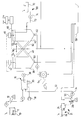
- the drawing schematically shows the structure of a biogas plant as it is currently operated by the applicant, and is intended to serve as a flowchart to describe the method according to the invention.
- the biogas plant shown comprises a substrate receiving container 10 with a mixing device 11 for receiving and mixing raw manure, in particular chicken manure, silosicker juice, solid manure and fat separators, which can be summarized under the term coarse organic substrate, which is, however, free of contaminants.
- raw manure in particular chicken manure, silosicker juice, solid manure and fat separators
- coarse organic substrate which is, however, free of contaminants.
- the coarse materials to a large extent springs introduced with the chicken manure, are separated by vibrating tappet sieves 12 and mixed with additives such as e.g. B. garden waste, soil, chopped material, bark waste or the like, mixed and fed to composting.
- additives such as e.g. B. garden waste, soil, chopped material, bark waste or the like
- the biodegradation of the organic substances to be decomposed begins in an optional anaerobic manner to organic acids, such as, in particular, short-chain fatty acids.
- the residence time of the substrate mixture in the first digestion stage is between two and ten days and is selected so that a targeted pre-digestion is achieved depending on the substrate used and on the temperature (summer, winter).
- a nozzle device 20 operated by means of a pump 18 Blowing air into the substrate mixture in the first digestion stage on the one hand, homogenization of the mixture and an oxygen supply are achieved, and on the other hand, hydrogen sulfide, which arises as a result of the decomposition process, is expelled.
- the latter leads to a significant reduction in the hydrogen sulfide content of the biogas produced in a subsequent process step, which has an advantageous effect on gas utilization.
- the biogas plant comprises an acceptance device 21 for such a contaminated organic substrate.
- This acceptance device 21 comprises a first substrate acceptance trough 22 and a 5 m 3 material solver 26. From the first substrate acceptance trough 22, the organic substrate containing the contaminants is conveyed into the material solver 26 via a conveying path 24. After adding liquid manure or digested water, the substrate introduced into the pulper 26 is broken up by means of a striking mechanism 28, whereby mashing is achieved.
- Liquid manure or digested water is added to such an extent that the resulting pumpable substrate mixture is brought to a dry matter content of preferably approximately 8%.
- This mixture of substrates can then flow out of the pulper 26, whereby foreign bodies, such as e.g. B. metal parts, broken glass, plastic residues and the like, separated and then deposited, and is fed via a line 32 with a pump 34 of the underground pit 16, that is, the first digestion stage.
- the fact that in this first foul stage, non-agricultural, quite different organic substances are mixed with the substrate described in the first place, substrate differences (fats / protein / carbohydrates / trace elements) are compensated for, and there are therefore no major substrate fluctuations in the subsequent obligatory anaerobic process.
- the pre-acidified substrate mixture is fed by means of a metering pump 36 to a first and a second digester 38, 40, each comprising 740 m3, whereby it is previously heated to 35 ° C. by heat exchangers 42 and 46. Since large quantities of machine glue leather are processed in the second digester 40 in a manner still to be explained, most of the substrate mixture (approx. 90%) is fed to the first digester 38. Corresponding to the respective amount of substrate fed to the digesters 38, 40, the rotten substrate is displaced via sedimentation tubes 48 and 50 in overflow boxes 52 and 54, respectively.
- Biodegradation in the digesters 38 and 40 takes place in an anaerobic manner in the mesophilic temperature range between 30 and 37 ° C, preferably at 35 ° C, by means of anaerobic bacteria producing biogas or methane, which are introduced into the digester with the substrate to be decomposed and multiplied there will.
- the so-called biomass return through sedimentation within the sedimentation tubes 48, 50 and slipping back of the sedimented solid particles into the digester 38, 40 ensures a high bacterial population in this anaerobic or methanogenic process stage.
- the solids content within the digesters can also be controlled; if the dry matter content in the digestion tanks 38, 40 is to be increased, the phase with low dry matter content is passed into the storage basin 58; if it is to be lowered, it is used to dilute the substrate mixture to be supplied to the digestion tanks 38, 40; in addition, discharge devices 60 and 62 in the bottom area of the digesters 38 and 40, dry matter-rich basic sludge is removed from the digesters and mechanically dewatered by means of a solid matter separator 64 and used as an organic fertilizer.
- the resulting liquid in the drainage can, for. B. supplied for agricultural recycling or used for compost moistening or for dilution purposes in the substrate acceptance.
- the digesters 38, 40 each include a device for gentle circulation of the substrate mixture and a temperature control device, both of which are known in the prior art and therefore do not require any description or illustration.
- the biogas produced in the course of the anaerobic decomposition is continuously drawn off from the upper region of the digesters 38, 40 via suitable line systems 66 and then used to generate thermal or electrical energy.
- the biogas plant comprises a second substrate receiving device 68 for an organic substrate free of impurities, which, however, in contrast to the coarse organic substrate which is provided for the substrate receiving container 10, cannot be shredded and therefore leads to dislocations in the pipelines leading away from the first substrate receiving container 10 and in would lead the pumps.
- a foreign substance-free organic substrate is machine glue leather, it is high in fat and coarse, but due to its fiber structure it can hardly be mechanically shredded.
- the machine glue leather delivered in container vehicles is first tipped into a second acceptance trough 70; by adding chicken manure and digestion water from the overflow boxes 52 and 54 of the digestion tanks 38 and 40, a pumpable solid / liquid mixture is generated which is already warmed since the digestion water leaves the digestion tanks 38, 40 at a temperature of 35 ° C.
- a pumpable solid / liquid mixture is generated which is already warmed since the digestion water leaves the digestion tanks 38, 40 at a temperature of 35 ° C.
- trace elements, bacteria required for anaerobic degradation and ammonia are metered in, so that the solid / liquid mixture already has approximately the composition of the anaerobic phase and thus, when this mixture is introduced into the second digester 40, there are no undesirable fluctuations in the composition of the mixture to be decomposed within the digester 40 and thus there are no disturbances in the optimal process conditions.
- the solid / liquid mixture is conveyed via a pipeline 72 of sufficiently large diameter by means of a roller screw pump 74 into the upper part of the reactor
- processed amount of glue leather Gas production CH4 content Fatty acid conc. PH value kg / d kg oTS / d m3 / d m3 / kg oTS % mg / l 2000 400 680 1.7 72 1500 8.2 5000 1000 1400 1.4 68 4800 8.2 10,000 2000 2200 1.1 65 7900 8.4 20000 4000 2500 0.62 60 12100 7.9 30000 6000 2050 0.34 50 17300 7.6
- the amount of machine glue leather introduced into the digester 40 per day is indicated, as well as the amount of organic dry matter (OT) contained therein.
- the third and fourth column from the left is the absolute or specific gas production in m3 based on one kilogram of organic dry matter per day or per kilogram of oTS.
- the fifth column shows the methane content of the biogas produced.
- the sixth column shows the fatty acid concentration or residual fatty acid concentration that occurs at the different throughputs, since most of the fatty acids formed react with the ammonia contained in the fermentation water, which can be seen from the pH value of the substrate mixture in the fermentation tank 40 listed in the last column .
Landscapes
- Life Sciences & Earth Sciences (AREA)
- Chemical & Material Sciences (AREA)
- Engineering & Computer Science (AREA)
- Organic Chemistry (AREA)
- Health & Medical Sciences (AREA)
- Microbiology (AREA)
- Wood Science & Technology (AREA)
- Zoology (AREA)
- Bioinformatics & Cheminformatics (AREA)
- Genetics & Genomics (AREA)
- General Health & Medical Sciences (AREA)
- Biotechnology (AREA)
- Biochemistry (AREA)
- General Engineering & Computer Science (AREA)
- Water Supply & Treatment (AREA)
- Molecular Biology (AREA)
- Biodiversity & Conservation Biology (AREA)
- Hydrology & Water Resources (AREA)
- Environmental & Geological Engineering (AREA)
- General Chemical & Material Sciences (AREA)
- Oil, Petroleum & Natural Gas (AREA)
- Sustainable Development (AREA)
- Biomedical Technology (AREA)
- Chemical Kinetics & Catalysis (AREA)
- Analytical Chemistry (AREA)
- Treatment Of Sludge (AREA)
- Processing Of Solid Wastes (AREA)
- Purification Treatments By Anaerobic Or Anaerobic And Aerobic Bacteria Or Animals (AREA)
- Cosmetics (AREA)
- Medicines Containing Material From Animals Or Micro-Organisms (AREA)
Applications Claiming Priority (2)
| Application Number | Priority Date | Filing Date | Title |
|---|---|---|---|
| DE4229986A DE4229986A1 (de) | 1992-09-08 | 1992-09-08 | Anaerobe Behandlung stark fetthaltiger Substanzen |
| DE4229986 | 1992-09-08 |
Publications (2)
| Publication Number | Publication Date |
|---|---|
| EP0589155A1 true EP0589155A1 (fr) | 1994-03-30 |
| EP0589155B1 EP0589155B1 (fr) | 1999-10-06 |
Family
ID=6467492
Family Applications (1)
| Application Number | Title | Priority Date | Filing Date |
|---|---|---|---|
| EP93110569A Expired - Lifetime EP0589155B1 (fr) | 1992-09-08 | 1993-07-02 | Traitement anaérobique de substrats à forte concentration en graisses |
Country Status (4)
| Country | Link |
|---|---|
| EP (1) | EP0589155B1 (fr) |
| AT (1) | ATE185374T1 (fr) |
| DE (2) | DE4229986A1 (fr) |
| DK (1) | DK0589155T3 (fr) |
Cited By (5)
| Publication number | Priority date | Publication date | Assignee | Title |
|---|---|---|---|---|
| WO2003097560A1 (fr) * | 2002-05-21 | 2003-11-27 | Preseco Oy | Procede et equipement pour traiter une matiere organique |
| EP1529850A1 (fr) * | 2003-11-07 | 2005-05-11 | Mizuse Leather MFG. Co., Ltd. | Procédé pour le traitement des déchets de cuir tanné et dispositif correspondant |
| WO2005044743A1 (fr) * | 2003-11-11 | 2005-05-19 | Preseco Oy | Procede et appareil pour traiter une matiere organique |
| DE102011054298A1 (de) * | 2011-10-07 | 2013-04-11 | Jürgen Beck | Methanerzeugungseinheit und Biomasse-Vergärungsanlage |
| WO2019042548A1 (fr) * | 2017-08-30 | 2019-03-07 | Helmholtz-Zentrum Für Umweltforschung Gmbh - Ufz | Procédé pour ajuster la teneur en acides organiques volatils (fos) dans un réacteur à biogaz équipé d'un substrat organique, et pellets chargés en micro-organismes |
Families Citing this family (6)
| Publication number | Priority date | Publication date | Assignee | Title |
|---|---|---|---|---|
| DE4340058A1 (de) * | 1993-11-24 | 1995-06-01 | Aamot Haldor | Verfahren zum Aufarbeiten gebrauchter Entfettungs- und Reinigungslösungen |
| DE19511734A1 (de) * | 1995-03-31 | 1996-10-02 | Horst Prof Dr Bannwarth | Biotechnische Erzeugung nutzbarer elektrischer Energie mit gekoppelter Biogasproduktion, energetischer Verwertung von Biomasse und fossilen Energieträgern und gleichzeitiger Entgiftung und Entsorgung von Abfallstoffen |
| DE19627875A1 (de) * | 1996-07-11 | 1998-01-15 | Bsbg Bremer Sonderabfall Berat | Verfahren zur Behandlung von Schlämmen mit organischen Anteilen, insbesondere Klärschlämmen |
| DE19717669B4 (de) * | 1997-04-26 | 2007-02-01 | Wabio Biotechnik Gmbh | Verfahren zur Schwermetallentfrachtung von biogen-organischen Substraten |
| DK1251311T3 (da) | 2001-04-17 | 2003-11-03 | Suedfleisch Gmbh | Fremgangsmåde til forsyning af et slagteri med energi |
| DE102008038065A1 (de) * | 2008-08-16 | 2010-02-18 | Rajib Pal Chowdhury | Biogasanlagen-Fermenter |
Citations (2)
| Publication number | Priority date | Publication date | Assignee | Title |
|---|---|---|---|---|
| JPS56139200A (en) * | 1980-03-31 | 1981-10-30 | Matsushita Electric Works Ltd | Methane fermentation process |
| WO1989000548A1 (fr) * | 1987-07-14 | 1989-01-26 | Niels Lang Mathiesen | Procede pour la production de biogas |
Family Cites Families (4)
| Publication number | Priority date | Publication date | Assignee | Title |
|---|---|---|---|---|
| GB1208273A (en) * | 1967-02-22 | 1970-10-14 | British Petroleum Co | Improvements in or relating to the cultivation of micro-organisms |
| DE3818398A1 (de) * | 1988-05-31 | 1989-12-14 | Xenex Ges Zur Biotechnischen S | Verfahren und anlage zur rekultivierungsbehandlung von xenobiotisch-kontaminiertem erdreich mittels mikroorganismen |
| DE3920827C1 (en) * | 1989-06-24 | 1990-05-03 | Peter Dipl.-Biol. Harborth | Decontamination of earth - by covering with foil pref. insulated and spraying earth with water and air under controlled conditions |
| DE4009806C1 (en) * | 1990-03-27 | 1991-11-14 | Gruenbeck Wasseraufbereitung Gmbh, 8884 Hoechstaedt, De | Removing fat and oil in commercial kitchen - by reacting with lipollastic bacteria and pptn. with cation |
-
1992
- 1992-09-08 DE DE4229986A patent/DE4229986A1/de not_active Withdrawn
-
1993
- 1993-07-02 EP EP93110569A patent/EP0589155B1/fr not_active Expired - Lifetime
- 1993-07-02 DE DE59309822T patent/DE59309822D1/de not_active Expired - Fee Related
- 1993-07-02 DK DK93110569T patent/DK0589155T3/da active
- 1993-07-02 AT AT93110569T patent/ATE185374T1/de not_active IP Right Cessation
Patent Citations (2)
| Publication number | Priority date | Publication date | Assignee | Title |
|---|---|---|---|---|
| JPS56139200A (en) * | 1980-03-31 | 1981-10-30 | Matsushita Electric Works Ltd | Methane fermentation process |
| WO1989000548A1 (fr) * | 1987-07-14 | 1989-01-26 | Niels Lang Mathiesen | Procede pour la production de biogas |
Non-Patent Citations (1)
| Title |
|---|
| DATABASE WPI Section Ch Week 8150, Derwent World Patents Index; Class D16, AN 81-91721D * |
Cited By (8)
| Publication number | Priority date | Publication date | Assignee | Title |
|---|---|---|---|---|
| WO2003097560A1 (fr) * | 2002-05-21 | 2003-11-27 | Preseco Oy | Procede et equipement pour traiter une matiere organique |
| US7160456B2 (en) | 2002-05-21 | 2007-01-09 | Preseco Oy | Method and equipment for processing organic material |
| CN100390106C (zh) * | 2002-05-21 | 2008-05-28 | 普雷塞科有限责任公司 | 处理有机原料的方法和设备 |
| EP1529850A1 (fr) * | 2003-11-07 | 2005-05-11 | Mizuse Leather MFG. Co., Ltd. | Procédé pour le traitement des déchets de cuir tanné et dispositif correspondant |
| WO2005044743A1 (fr) * | 2003-11-11 | 2005-05-19 | Preseco Oy | Procede et appareil pour traiter une matiere organique |
| US7582467B2 (en) | 2003-11-11 | 2009-09-01 | Preseco Oy | Method and apparatus for processing organic material |
| DE102011054298A1 (de) * | 2011-10-07 | 2013-04-11 | Jürgen Beck | Methanerzeugungseinheit und Biomasse-Vergärungsanlage |
| WO2019042548A1 (fr) * | 2017-08-30 | 2019-03-07 | Helmholtz-Zentrum Für Umweltforschung Gmbh - Ufz | Procédé pour ajuster la teneur en acides organiques volatils (fos) dans un réacteur à biogaz équipé d'un substrat organique, et pellets chargés en micro-organismes |
Also Published As
| Publication number | Publication date |
|---|---|
| ATE185374T1 (de) | 1999-10-15 |
| DK0589155T3 (da) | 2000-04-10 |
| DE59309822D1 (de) | 1999-11-11 |
| EP0589155B1 (fr) | 1999-10-06 |
| DE4229986A1 (de) | 1994-03-10 |
Similar Documents
| Publication | Publication Date | Title |
|---|---|---|
| DE2621524C3 (de) | Verfahren und Vorrichtung zur anaeroben Aufbereitung von Abfall | |
| DE19615551C2 (de) | Verfahren zur mehrstufigen anaeroben Behandlung von Biomassen zur Erzeugung von Biogas sowie Vorrichtung zur Durchführung des Verfahrens | |
| DE69200918T2 (de) | Prozess und ausstattung zur biologischen behandlung von festen organischen materialien. | |
| EP1929024B1 (fr) | Procédé de production de biogaz utilisant un substrat à haute teneur en solides et en azote | |
| DE3108923A1 (de) | Anaerobes aufschlussverfahren | |
| DE102008015609A1 (de) | Biogasanlage und Verfahren zur Erzeugung von Biogas | |
| EP2346997A2 (fr) | Procédé de production de méthane à partir d'eaux industrielles et d'un matériau biogène | |
| EP2137316A1 (fr) | Procédé de fermentation de matière première renouvelable ensilée | |
| DE102005054323B4 (de) | Fermenter zur Erzeugung von Biogas aus organischem Material | |
| EP0589155B1 (fr) | Traitement anaérobique de substrats à forte concentration en graisses | |
| EP3548626B1 (fr) | Procédé de production de biogaz à partir d'un substrat fibreux | |
| EP2215241B1 (fr) | Procédé de production de biogaz utilisant un substrat de fermentation à concentration d'azote ammonium ajustée | |
| EP0022120B1 (fr) | Procédé pour scinder et traiter des émulsions huileuses et grasses | |
| EP0286100B1 (fr) | Procédé et dispositif de traitement et digestion anaérobique de matières biogéniques | |
| EP2998386A2 (fr) | Procede destine au fonctionnement d'une installation de biogaz | |
| DE19719895C1 (de) | Verfahren zur Optimierung und Erhöhung der Raumbelastung von Vergärungsreaktoren | |
| DE4419795A1 (de) | Verfahren zur Verwendung von Schiffen zur Erzeugung von Wertstoffen und Anlage dazu | |
| DE102010033442A1 (de) | Verfahren zur Aufkonzentration von Mikroorganismen in wässrigen Substraten | |
| EP0730031B1 (fr) | Procédé pour la dégradation microbienne de substrats chargés de matières organiques | |
| DE29605625U1 (de) | Anlage zur Vergärung von organischen Abfallstoffen | |
| WO2007014717A1 (fr) | Procede de production de biogaz | |
| WO1997034851A1 (fr) | Procede et installation de valorisation de dechets organiques et nouvelle installation de biogaz appropriee | |
| DE102017206190B4 (de) | Verfahren zur Nutzung von Gülle und Biogasanlage zur Durchführung des Verfahrens | |
| DE102014001910A1 (de) | Verfahren zur stofflichen und energetischen Verwertung biogener Reststoffe der Kartoffelverarbeitung und Anordnung zur Durchführung des Verfahrens | |
| EP3066205B1 (fr) | Procédé de production de biogaz comprenant une réduction de la concentration en ammonium en utilisant l'anammox |
Legal Events
| Date | Code | Title | Description |
|---|---|---|---|
| PUAI | Public reference made under article 153(3) epc to a published international application that has entered the european phase |
Free format text: ORIGINAL CODE: 0009012 |
|
| AK | Designated contracting states |
Kind code of ref document: A1 Designated state(s): AT BE CH DE DK FR LI LU NL |
|
| 17P | Request for examination filed |
Effective date: 19940304 |
|
| 17Q | First examination report despatched |
Effective date: 19961008 |
|
| GRAG | Despatch of communication of intention to grant |
Free format text: ORIGINAL CODE: EPIDOS AGRA |
|
| GRAG | Despatch of communication of intention to grant |
Free format text: ORIGINAL CODE: EPIDOS AGRA |
|
| GRAH | Despatch of communication of intention to grant a patent |
Free format text: ORIGINAL CODE: EPIDOS IGRA |
|
| GRAH | Despatch of communication of intention to grant a patent |
Free format text: ORIGINAL CODE: EPIDOS IGRA |
|
| GRAA | (expected) grant |
Free format text: ORIGINAL CODE: 0009210 |
|
| AK | Designated contracting states |
Kind code of ref document: B1 Designated state(s): AT BE CH DE DK FR LI LU NL |
|
| REF | Corresponds to: |
Ref document number: 185374 Country of ref document: AT Date of ref document: 19991015 Kind code of ref document: T |
|
| REG | Reference to a national code |
Ref country code: CH Ref legal event code: EP |
|
| REF | Corresponds to: |
Ref document number: 59309822 Country of ref document: DE Date of ref document: 19991111 |
|
| REG | Reference to a national code |
Ref country code: CH Ref legal event code: NV Representative=s name: ISLER & PEDRAZZINI AG |
|
| ET | Fr: translation filed | ||
| REG | Reference to a national code |
Ref country code: DK Ref legal event code: T3 |
|
| PLBE | No opposition filed within time limit |
Free format text: ORIGINAL CODE: 0009261 |
|
| STAA | Information on the status of an ep patent application or granted ep patent |
Free format text: STATUS: NO OPPOSITION FILED WITHIN TIME LIMIT |
|
| 26N | No opposition filed | ||
| PGFP | Annual fee paid to national office [announced via postgrant information from national office to epo] |
Ref country code: BE Payment date: 20020611 Year of fee payment: 10 |
|
| PGFP | Annual fee paid to national office [announced via postgrant information from national office to epo] |
Ref country code: LU Payment date: 20020627 Year of fee payment: 10 |
|
| PGFP | Annual fee paid to national office [announced via postgrant information from national office to epo] |
Ref country code: FR Payment date: 20020704 Year of fee payment: 10 |
|
| PG25 | Lapsed in a contracting state [announced via postgrant information from national office to epo] |
Ref country code: LU Free format text: LAPSE BECAUSE OF NON-PAYMENT OF DUE FEES Effective date: 20030702 |
|
| PG25 | Lapsed in a contracting state [announced via postgrant information from national office to epo] |
Ref country code: BE Free format text: LAPSE BECAUSE OF NON-PAYMENT OF DUE FEES Effective date: 20030731 |
|
| BERE | Be: lapsed |
Owner name: *ENTSORGUNGS- UND AUFBEREITUNGSGESELLSCHAFT M.B.H. Effective date: 20030731 |
|
| PG25 | Lapsed in a contracting state [announced via postgrant information from national office to epo] |
Ref country code: FR Free format text: LAPSE BECAUSE OF NON-PAYMENT OF DUE FEES Effective date: 20040331 |
|
| REG | Reference to a national code |
Ref country code: FR Ref legal event code: ST |
|
| PGFP | Annual fee paid to national office [announced via postgrant information from national office to epo] |
Ref country code: AT Payment date: 20050616 Year of fee payment: 13 |
|
| PGFP | Annual fee paid to national office [announced via postgrant information from national office to epo] |
Ref country code: DK Payment date: 20050715 Year of fee payment: 13 |
|
| PGFP | Annual fee paid to national office [announced via postgrant information from national office to epo] |
Ref country code: CH Payment date: 20050727 Year of fee payment: 13 |
|
| PGFP | Annual fee paid to national office [announced via postgrant information from national office to epo] |
Ref country code: NL Payment date: 20050728 Year of fee payment: 13 |
|
| PG25 | Lapsed in a contracting state [announced via postgrant information from national office to epo] |
Ref country code: AT Free format text: LAPSE BECAUSE OF NON-PAYMENT OF DUE FEES Effective date: 20060702 |
|
| PG25 | Lapsed in a contracting state [announced via postgrant information from national office to epo] |
Ref country code: LI Free format text: LAPSE BECAUSE OF NON-PAYMENT OF DUE FEES Effective date: 20060731 Ref country code: DK Free format text: LAPSE BECAUSE OF NON-PAYMENT OF DUE FEES Effective date: 20060731 Ref country code: CH Free format text: LAPSE BECAUSE OF NON-PAYMENT OF DUE FEES Effective date: 20060731 |
|
| PGFP | Annual fee paid to national office [announced via postgrant information from national office to epo] |
Ref country code: DE Payment date: 20060824 Year of fee payment: 14 |
|
| PG25 | Lapsed in a contracting state [announced via postgrant information from national office to epo] |
Ref country code: NL Free format text: LAPSE BECAUSE OF NON-PAYMENT OF DUE FEES Effective date: 20070201 |
|
| REG | Reference to a national code |
Ref country code: DK Ref legal event code: EBP |
|
| REG | Reference to a national code |
Ref country code: CH Ref legal event code: PL |
|
| NLV4 | Nl: lapsed or anulled due to non-payment of the annual fee |
Effective date: 20070201 |
|
| PG25 | Lapsed in a contracting state [announced via postgrant information from national office to epo] |
Ref country code: DE Free format text: LAPSE BECAUSE OF NON-PAYMENT OF DUE FEES Effective date: 20080201 |