EP0589588B2 - Procédé de préparation de phénol, d'acétone et d'alpha-méthylstyrène - Google Patents
Procédé de préparation de phénol, d'acétone et d'alpha-méthylstyrène Download PDFInfo
- Publication number
- EP0589588B2 EP0589588B2 EP93307016A EP93307016A EP0589588B2 EP 0589588 B2 EP0589588 B2 EP 0589588B2 EP 93307016 A EP93307016 A EP 93307016A EP 93307016 A EP93307016 A EP 93307016A EP 0589588 B2 EP0589588 B2 EP 0589588B2
- Authority
- EP
- European Patent Office
- Prior art keywords
- chp
- decomposition
- acetone
- accordance
- reactor
- Prior art date
- Legal status (The legal status is an assumption and is not a legal conclusion. Google has not performed a legal analysis and makes no representation as to the accuracy of the status listed.)
- Expired - Lifetime
Links
- CSCPPACGZOOCGX-UHFFFAOYSA-N Acetone Chemical compound CC(C)=O CSCPPACGZOOCGX-UHFFFAOYSA-N 0.000 title claims description 156
- ISWSIDIOOBJBQZ-UHFFFAOYSA-N Phenol Chemical compound OC1=CC=CC=C1 ISWSIDIOOBJBQZ-UHFFFAOYSA-N 0.000 title claims description 45
- XYLMUPLGERFSHI-UHFFFAOYSA-N alpha-Methylstyrene Chemical compound CC(=C)C1=CC=CC=C1 XYLMUPLGERFSHI-UHFFFAOYSA-N 0.000 title claims description 40
- 238000000034 method Methods 0.000 title claims description 35
- 238000004519 manufacturing process Methods 0.000 title description 7
- FRIBMENBGGCKPD-UHFFFAOYSA-N 3-(2,3-dimethoxyphenyl)prop-2-enal Chemical group COC1=CC=CC(C=CC=O)=C1OC FRIBMENBGGCKPD-UHFFFAOYSA-N 0.000 claims description 116
- 238000000354 decomposition reaction Methods 0.000 claims description 82
- 239000000047 product Substances 0.000 claims description 40
- 238000006243 chemical reaction Methods 0.000 claims description 37
- 239000003054 catalyst Substances 0.000 claims description 36
- RWGFKTVRMDUZSP-UHFFFAOYSA-N cumene Chemical compound CC(C)C1=CC=CC=C1 RWGFKTVRMDUZSP-UHFFFAOYSA-N 0.000 claims description 34
- XMNIXWIUMCBBBL-UHFFFAOYSA-N 2-(2-phenylpropan-2-ylperoxy)propan-2-ylbenzene Chemical compound C=1C=CC=CC=1C(C)(C)OOC(C)(C)C1=CC=CC=C1 XMNIXWIUMCBBBL-UHFFFAOYSA-N 0.000 claims description 31
- QGZKDVFQNNGYKY-UHFFFAOYSA-N Ammonia Chemical group N QGZKDVFQNNGYKY-UHFFFAOYSA-N 0.000 claims description 22
- 230000002378 acidificating effect Effects 0.000 claims description 17
- JESIHYIJKKUWIS-UHFFFAOYSA-N 1-(4-Methylphenyl)ethanol Chemical compound CC(O)C1=CC=C(C)C=C1 JESIHYIJKKUWIS-UHFFFAOYSA-N 0.000 claims description 16
- 239000000203 mixture Substances 0.000 claims description 16
- XLYOFNOQVPJJNP-UHFFFAOYSA-N water Substances O XLYOFNOQVPJJNP-UHFFFAOYSA-N 0.000 claims description 12
- 239000007795 chemical reaction product Substances 0.000 claims description 11
- 150000001412 amines Chemical class 0.000 claims description 9
- 229910021529 ammonia Inorganic materials 0.000 claims description 9
- 239000003377 acid catalyst Substances 0.000 claims description 7
- WWILHZQYNPQALT-UHFFFAOYSA-N 2-methyl-2-morpholin-4-ylpropanal Chemical group O=CC(C)(C)N1CCOCC1 WWILHZQYNPQALT-UHFFFAOYSA-N 0.000 claims description 2
- 238000003776 cleavage reaction Methods 0.000 description 32
- QAOWNCQODCNURD-UHFFFAOYSA-N Sulfuric acid Chemical compound OS(O)(=O)=O QAOWNCQODCNURD-UHFFFAOYSA-N 0.000 description 24
- 230000007017 scission Effects 0.000 description 23
- 238000002156 mixing Methods 0.000 description 11
- KWOLFJPFCHCOCG-UHFFFAOYSA-N Acetophenone Chemical compound CC(=O)C1=CC=CC=C1 KWOLFJPFCHCOCG-UHFFFAOYSA-N 0.000 description 10
- 239000000463 material Substances 0.000 description 10
- 239000006227 byproduct Substances 0.000 description 5
- 230000001965 increasing effect Effects 0.000 description 5
- VHUUQVKOLVNVRT-UHFFFAOYSA-N Ammonium hydroxide Chemical compound [NH4+].[OH-] VHUUQVKOLVNVRT-UHFFFAOYSA-N 0.000 description 4
- 239000002253 acid Substances 0.000 description 4
- BIGPRXCJEDHCLP-UHFFFAOYSA-N ammonium bisulfate Chemical group [NH4+].OS([O-])(=O)=O BIGPRXCJEDHCLP-UHFFFAOYSA-N 0.000 description 4
- 235000011114 ammonium hydroxide Nutrition 0.000 description 4
- 238000005259 measurement Methods 0.000 description 4
- NLXLAEXVIDQMFP-UHFFFAOYSA-N Ammonium chloride Substances [NH4+].[Cl-] NLXLAEXVIDQMFP-UHFFFAOYSA-N 0.000 description 3
- 238000009835 boiling Methods 0.000 description 3
- 230000003247 decreasing effect Effects 0.000 description 3
- 238000001704 evaporation Methods 0.000 description 3
- 230000003647 oxidation Effects 0.000 description 3
- 238000007254 oxidation reaction Methods 0.000 description 3
- OAKJQQAXSVQMHS-UHFFFAOYSA-N Hydrazine Chemical compound NN OAKJQQAXSVQMHS-UHFFFAOYSA-N 0.000 description 2
- MKYBYDHXWVHEJW-UHFFFAOYSA-N N-[1-oxo-1-(2,4,6,7-tetrahydrotriazolo[4,5-c]pyridin-5-yl)propan-2-yl]-2-[[3-(trifluoromethoxy)phenyl]methylamino]pyrimidine-5-carboxamide Chemical compound O=C(C(C)NC(=O)C=1C=NC(=NC=1)NCC1=CC(=CC=C1)OC(F)(F)F)N1CC2=C(CC1)NN=N2 MKYBYDHXWVHEJW-UHFFFAOYSA-N 0.000 description 2
- 230000000052 comparative effect Effects 0.000 description 2
- 230000002708 enhancing effect Effects 0.000 description 2
- 230000008020 evaporation Effects 0.000 description 2
- 238000009434 installation Methods 0.000 description 2
- 238000002360 preparation method Methods 0.000 description 2
- LLQHSBBZNDXTIV-UHFFFAOYSA-N 6-[5-[[4-[2-(2,3-dihydro-1H-inden-2-ylamino)pyrimidin-5-yl]piperazin-1-yl]methyl]-4,5-dihydro-1,2-oxazol-3-yl]-3H-1,3-benzoxazol-2-one Chemical compound C1C(CC2=CC=CC=C12)NC1=NC=C(C=N1)N1CCN(CC1)CC1CC(=NO1)C1=CC2=C(NC(O2)=O)C=C1 LLQHSBBZNDXTIV-UHFFFAOYSA-N 0.000 description 1
- LSNNMFCWUKXFEE-UHFFFAOYSA-N Sulfurous acid Chemical compound OS(O)=O LSNNMFCWUKXFEE-UHFFFAOYSA-N 0.000 description 1
- 150000008062 acetophenones Chemical class 0.000 description 1
- -1 acidic salt ammonium hydrogen sulfate Chemical class 0.000 description 1
- 150000003973 alkyl amines Chemical class 0.000 description 1
- 230000004075 alteration Effects 0.000 description 1
- 150000007514 bases Chemical class 0.000 description 1
- 230000009286 beneficial effect Effects 0.000 description 1
- 230000015572 biosynthetic process Effects 0.000 description 1
- 229910052799 carbon Inorganic materials 0.000 description 1
- 125000004432 carbon atom Chemical group C* 0.000 description 1
- 239000003426 co-catalyst Substances 0.000 description 1
- 238000001816 cooling Methods 0.000 description 1
- 238000005260 corrosion Methods 0.000 description 1
- 230000007797 corrosion Effects 0.000 description 1
- 230000001419 dependent effect Effects 0.000 description 1
- 239000000539 dimer Substances 0.000 description 1
- 230000000694 effects Effects 0.000 description 1
- 230000007613 environmental effect Effects 0.000 description 1
- 239000007788 liquid Substances 0.000 description 1
- 150000007522 mineralic acids Chemical class 0.000 description 1
- 230000003472 neutralizing effect Effects 0.000 description 1
- 150000007524 organic acids Chemical class 0.000 description 1
- 235000005985 organic acids Nutrition 0.000 description 1
- XDTRNDKYILNOAP-UHFFFAOYSA-N phenol;propan-2-one Chemical compound CC(C)=O.OC1=CC=CC=C1 XDTRNDKYILNOAP-UHFFFAOYSA-N 0.000 description 1
- 239000000376 reactant Substances 0.000 description 1
- 239000012429 reaction media Substances 0.000 description 1
- 239000011541 reaction mixture Substances 0.000 description 1
- 238000004064 recycling Methods 0.000 description 1
- 238000010992 reflux Methods 0.000 description 1
- 239000002904 solvent Substances 0.000 description 1
Images
Classifications
-
- C—CHEMISTRY; METALLURGY
- C07—ORGANIC CHEMISTRY
- C07C—ACYCLIC OR CARBOCYCLIC COMPOUNDS
- C07C45/00—Preparation of compounds having >C = O groups bound only to carbon or hydrogen atoms; Preparation of chelates of such compounds
- C07C45/51—Preparation of compounds having >C = O groups bound only to carbon or hydrogen atoms; Preparation of chelates of such compounds by pyrolysis, rearrangement or decomposition
- C07C45/517—Preparation of compounds having >C = O groups bound only to carbon or hydrogen atoms; Preparation of chelates of such compounds by pyrolysis, rearrangement or decomposition involving transformation of peroxy-compounds to >C = O groups
-
- C—CHEMISTRY; METALLURGY
- C07—ORGANIC CHEMISTRY
- C07C—ACYCLIC OR CARBOCYCLIC COMPOUNDS
- C07C1/00—Preparation of hydrocarbons from one or more compounds, none of them being a hydrocarbon
- C07C1/20—Preparation of hydrocarbons from one or more compounds, none of them being a hydrocarbon starting from organic compounds containing only oxygen atoms as heteroatoms
-
- C—CHEMISTRY; METALLURGY
- C07—ORGANIC CHEMISTRY
- C07C—ACYCLIC OR CARBOCYCLIC COMPOUNDS
- C07C15/00—Cyclic hydrocarbons containing only six-membered aromatic rings as cyclic parts
- C07C15/40—Cyclic hydrocarbons containing only six-membered aromatic rings as cyclic parts substituted by unsaturated carbon radicals
- C07C15/42—Cyclic hydrocarbons containing only six-membered aromatic rings as cyclic parts substituted by unsaturated carbon radicals monocyclic
- C07C15/44—Cyclic hydrocarbons containing only six-membered aromatic rings as cyclic parts substituted by unsaturated carbon radicals monocyclic the hydrocarbon substituent containing a carbon-to-carbon double bond
-
- C—CHEMISTRY; METALLURGY
- C07—ORGANIC CHEMISTRY
- C07C—ACYCLIC OR CARBOCYCLIC COMPOUNDS
- C07C37/00—Preparation of compounds having hydroxy or O-metal groups bound to a carbon atom of a six-membered aromatic ring
- C07C37/08—Preparation of compounds having hydroxy or O-metal groups bound to a carbon atom of a six-membered aromatic ring by decomposition of hydroperoxides, e.g. cumene hydroperoxide
-
- C—CHEMISTRY; METALLURGY
- C07—ORGANIC CHEMISTRY
- C07C—ACYCLIC OR CARBOCYCLIC COMPOUNDS
- C07C45/00—Preparation of compounds having >C = O groups bound only to carbon or hydrogen atoms; Preparation of chelates of such compounds
- C07C45/51—Preparation of compounds having >C = O groups bound only to carbon or hydrogen atoms; Preparation of chelates of such compounds by pyrolysis, rearrangement or decomposition
- C07C45/53—Preparation of compounds having >C = O groups bound only to carbon or hydrogen atoms; Preparation of chelates of such compounds by pyrolysis, rearrangement or decomposition of hydroperoxides
-
- C—CHEMISTRY; METALLURGY
- C07—ORGANIC CHEMISTRY
- C07C—ACYCLIC OR CARBOCYCLIC COMPOUNDS
- C07C2527/00—Catalysts comprising the elements or compounds of halogens, sulfur, selenium, tellurium, phosphorus or nitrogen; Catalysts comprising carbon compounds
- C07C2527/02—Sulfur, selenium or tellurium; Compounds thereof
- C07C2527/053—Sulfates or other compounds comprising the anion (SnO3n+1)2-
- C07C2527/054—Sulfuric acid or other acids with the formula H2Sn03n+1
-
- Y—GENERAL TAGGING OF NEW TECHNOLOGICAL DEVELOPMENTS; GENERAL TAGGING OF CROSS-SECTIONAL TECHNOLOGIES SPANNING OVER SEVERAL SECTIONS OF THE IPC; TECHNICAL SUBJECTS COVERED BY FORMER USPC CROSS-REFERENCE ART COLLECTIONS [XRACs] AND DIGESTS
- Y02—TECHNOLOGIES OR APPLICATIONS FOR MITIGATION OR ADAPTATION AGAINST CLIMATE CHANGE
- Y02P—CLIMATE CHANGE MITIGATION TECHNOLOGIES IN THE PRODUCTION OR PROCESSING OF GOODS
- Y02P20/00—Technologies relating to chemical industry
- Y02P20/50—Improvements relating to the production of bulk chemicals
- Y02P20/52—Improvements relating to the production of bulk chemicals using catalysts, e.g. selective catalysts
Definitions
- DMBA dimethylbenzyl alcohol
- AP acetophenone
- AMS alphamethylstyrene
- AMS alphamethylstyrene
- This particular set of reactions is known to be kinetically fast and is generally run at a reasonably high temperature in order to obtain the fastest reaction, including the particularly high temperature of the conversion of DCP to AMS, phenol and acetone.
- the present invention provides increased yield and selectivity to CHP reaction products in the first portion of the deavage reaction by utilizing, inter alia, excess acetone, additional recycle materials and multiplicity of reactors.
- the DCP prepared in the first reaction scheme of the decomposition of CHP is then selectively decomposed in an additional reactor to AMS, phenol and acetone with particular selectivity to AMS. Either of these reactions can be coupled with the known prior art synthetic procedures. It is preferred to combine these to form a new and highly efficient decomposition of CHP to final products of phenol, acetone and AMS.
- a further aspect of the invention is a method for preparing phenol and acetone from the decomposition of CHP with an acidic catalyst which comprises;
- step (b) is carried out at a temperature of from 80 to 110°C.
- the acidic catalyst for step (b) preferably comprises the reaction product of an amine with an acidic catalyst used to catalyze the decomposition of CHP.
- a further aspect of the invention is a method for maintaining the control of an add catalyzed CHP decomposition in a multiplicity of sequential reactors which comprises passing a portion of the outlet stream of the last sequential reactor into a reactor of plug flow design and a smaller size compared to the CHP decomposition reactors wherein the delta T°C of the inlet temperature and the outlet temperature of said plug flow reactor is from about 4 to 16°C.
- Another aspect of the invention is a method for enhancing the decomposition of CHP and producing CHP decomposition products therefrom which comprises recycling the CHP decomposition products to a CHP feedstream in the quantity of from about 10-25 times the weight of the CHP feedstream.
- a further aspect of the invention is a method in which the acetone generated is recycled to the cumene hydroperoxide decomposition reactor by the steps of
- a further aspect of the invention is CHP decomposition mass produced from the reaction of CHP with an acid catalyst in a non-isothermal manner having an acetone to phenol molar ratio of 1.1:1 to 1.5:1.
- the cleavage reaction in the manufacture of phenol and acetone from cumene is well known.
- a feed stream of cumene is oxidized to cumene hydroperoxide. It is then passed into a cleavage unit wherein an acid catalyst is added and the CHP is then decomposed to phenol, acetone and other by-products.
- the acidic catalyst employed can be any acidic material. Generally, since corrosion can be a factor, the heavily corrosive inorganic acids such as hydrochloric and hydrobromic are not employed. Certain adds such as phosphoric, sulfuric and SO 2 can be employed. Generally sulfuric acid is preferred in this particular reaction as a catalyst.
- the CHP decomposition reaction is known to be extremely fast and because of its heavily exothermic nature is carried out over a short time period and essentially to completion in most processes. In fact it is common to use a constant boiling or refluxing type system for the isothermal cleavage reaction. This is generally the constant boiling temperature of the CHP feed stream and product mixture present in the deavage reactor at a given moment. Generally this can vary from 70 to 90°C. Since this is the general CHP feed stream as well as the reactant product, the phenol to acetone molar ratio is essentially 1 to 1 throughout the course of the reaction.
- This quantity of cumene should be from about 1 to about 20 weight percent of the cleavage reactor composition more preferably 10 to 18%.
- This quantity of cumene should be from about 1 to about 20 weight percent of the cleavage reactor composition more preferably 10 to 18%.
- the temperature can vary from 45°C to 75°C.
- Pressure is not unduly significant with respect to the chemistry.
- pressure can vary from one atmosphere to five atmospheres.
- These reactors are generally shell-in-tube heat exchangers and a specific heat exchange surface not less than 30 to 35 meter 2 per metric ton of 100% CHP per hour.
- CHP conversion in a three reactor sequence preferably having 30 to 60% in the first, 25 to 50% in the second and 30 to 10% in the third.
- the acetone fed to the reactors is on the basis of one metric ton of technical CHP according to the algorithm wherein:
- the temperature of the reactions among the three sequentially placed reactors are 50 to 62°C first, 62 to 57°C second, and 57 to 50°C third. These temperatures are below the constant boiling temperature of the CHP decomposition mass thereby decomposing the CHP in a non-isothermal manner. It is preferred to have the reactors controlled by a plug-flow mini-reactor which is located by-pass after the third sequential reactor and through which a portion of the products emitted from the last sequential reactor passes.
- This mini-reactor has a product residence time of generally not more than 3 minutes with a measurement of temperature difference at the inlet and outlet ( ⁇ T), of the mini-reactor maintained at about 4 to 16°C, preferably 5 to 15°C.
- This mini-reactor helps to produce products of optimal compositon. Its primary function is to decompose essentially all of the CHP remaining in the effluent passed through the mini-reactor so as to be an analytical indication of the completeness of the CHP decomposition reaction.
- the quantity of catalyst which is present can vary substantially.
- the catalyst quantity is generally from 50 to 750 parts per million of the reactor composition, preferably 150 to 600 ppm.
- the reaction is of relatively short duration throughout the sequential reactors. Generally anywhere from 30 seconds to 3 minutes is appropriate. However optimal conditions when coupled with other optimized parameters are from 45 seconds to 2 minutes.
- One of the significant parameters is the quantity of CHP decomposition product produced in these sequential reactors which is recycled to the CHP feed stream. This recycle stream can vary in amount from 10 to 25 times the mass flow of the CHP feed stream. Not only does this recycle bring about higher selectivity but it also provides a significant safety factor to the process.
- Another factor is the presence of additional water in the CHP decomposition reactors. This is water above the usual amount of water produced in the CHP decomposition reaction. Such water can initially be added in the recycle stream.
- the level of water in the decomposition reactors should not be higher than 3 wt.% of the CHP decomposition mass, preferably no greater than 2 wt.%, more preferably not greater than 1.5 wt.% and is most preferably in the range of 0.8 to 1.2 wt.%.
- the ammonia is added as aqueous ammonia of relatively low concentration, from 0.15 to 10 wt.% ammonia. Generally 10 to 99 wt.% of the original acid catalyst is neutralized, preferably the quantity of catalyst neutralized is from 30 to 70 wt.%.
- H 2 SO 4 is employed as the catalyst or when a specific catalyst such as SO 2 or SO 3 which can react with water present in the reactor and thereby form a sulfurous or sulfuric acid is present, it is preferred to use ammonia as the material to react with the sulfurous or sulfuric add.
- the reaction product is the weakly acidic salt ammonium hydrogen sulfate. In this particular case it is believed that the ammonium hydrogen sulfate functions as a co-catalyst.
- the invention temperature range is 80-110°C, preferably from 85 to 105°C for a period of 20 to 60 minutes at a pressure range from 0.3 to 5 atmospheres.
- a cooling of the cleavage products by evaporation of acetone in a separate vessel.
- the evaporated acetone condenses under vacuum for example, 0.25 to 0.9 of one atmosphere and an operating temperature of 80-110°C and at least a portion, preferably all of that is returned to the CHP decomposition reactor sequence.
- Generation of at least a portion of the recycle acetone in this manner increases overall plant energy usage through the more efficient usage of steam, utilizes equipment more efficiently and debottlenecks equipment.
- the water concentration in the recyding acetone can be more accurately controlled since the overall cleavage product is constant in composition and the quantity of water present in the evaporator overhead stream, recycle acetone, is a function of the operating temperature and pressure of the evaporator vapor-liquid equilibrium. As long as the temperature and pressure are held constant, the water concentration of the overhead vapor remains constant and self-controlling.
- Cumene is oxidized to CHP.
- the stream of CHP primarily having cumene hydroperoxide therein but also containing DMBA, acetophenone, and various organic acids as well as other materials is brought to a cleavage reactor having a sulfuric add catalyst in the quantity of about 250 parts per million of sulfuric acid per weight of composition mass.
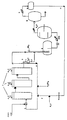
- This CHP decomposition and process is conducted in 1 to 2 minutes in 3 sequentially installed reactors of the shell and tube heat exchangers as shown at 1. These reactors have a specific surface not less than about 30 to 35 meter squared per ton of 100% CHP per hour.
- CHP conversion in the reactors in one pass is 30 to 35%, 30 to 40%, 30 to 15%, respectively.
- the feed line, 2 the acetone is fed to mixer, 3, in line prior to the first CHP decomposition reactor.
- the amount of fed acetone when CHP flow rate is decreased is increased to a higher ratio of acetone to phenol.
- the circulation ratio of CHP cleavage products to CHP feedstream on a weight basis through the 3 sequentially installed reactors is 20 to 1, see reaction circulation loop, 4.
- the three decomposition temperatures in the sequential reactors are respectively 50 to 62°C, 62 to 57°C, and 57 to 50°C, respectively.
- Following the third sequential reactor, is a plug-flow mini-reactor, 5.
- This mini-reactor funtions as a calorimeter with respect to the three sequentially placed reactors. Only a small portion of the effluent of the reactor passes through this mini-reactor. The term mini only refers to the size of the unit in comparison to the three previous reactors.
- This plug-flow mini-reactor has a product residence time of generally not more than 3 minutes and with a measurement of temperature difference at the inlet and outlet of the mini-reactor maintained at about 5 to 15°C.
- an aqueous ammonia solution is introduced into the cleavage products at a weight ratio of sulfuric acid (catalyst) to ammonia of (11-23:1) in holding tank, 6.
- Decomposition of technical CHP containing cumene 12.16 wt. %, acetophenone 0.40 wt.%, DMBA 3.64 wt.%, CHP 83.80 wt.% was conducted an installation similar to that shown in Fig. 1. It was conducted in equimolar mixture of phenol and acetone containing 0.03 wt.% of H 2 SO 4 and additionally introduced acetone in amount of 14.96 wt.% relatively on the basis of fed technical CHP. The temperature in each of three sequentially installed reactors was maintained non-isothermal in a range of 50-62°C, 62-57°C, 57-50°C, respectively with a pressure of about 1 to 5 atmospheres. Product recycle circulation weight ratio was 17 to 1. Flow mixing and mini-reactor for T measurement were installed in the scheme. The delta T value was 9°C. CHP decomposition time was 2 minutes.
- Aqueous ammonia solution was introduced into plug-flow reactor in amount which is necessary to translate 50% weight of H 2 SO 4 into NH 4 HSO 4 .
- the temperature in DCP plug-flow reactor was maintained at 93°C, pressure 1.5 atm.
- Product residence time in the plug-flow reactor was varied from 35 min. to 60 min.
- Examples 9-11 demonstrate the production of good results as shown by the yield of AMS at various ranges of CHP conversions in one pass in three sequentially installed reactors wherein acetone is additionally fed and mole ratio acetone/phenol of 1.15-1.5 is maintained.
- the delta T values varies dependent upon the unreacted CHP remaining in the flow through the mini-reactor.
- Example 7 demonstrates the low yield of AMS without acetone introduction into CHP decomposition reactors.
- the delta T value of 0°C shows that the CHP is depleted.
- Example 12 illustrates the influence of acetone fed to CHP decomposition unit above the preferred molar ratio.
- the high delta T value at the mini-reactor reflects the presence of significant levels of nonconverted CHP in the flow to the mini-reactor. Such levels of CHP can be a safety issue.
- Decomposition of technical CHP of the same composition as in example 1-4 was conducted in the same installation as Examples 1-4 but without preliminary flow mixing, without introduction of extra acetone quantity to CHP decomposition unit, i.e. in equimolar acetone-phenol mixture.
- Aqueous ammonia solution was not fed to plug-flow reactor wherein the temperature was maintained at 93°C.
- CHP conversion in three sequentially installed reactors was 80, 20, and 0% respectively.
- Delta T value was 0°C.
- the yield of AMS was 52 mol.% on the basis of DMBA present in the technical CHP (compare to 75-80 mole% in Examples 9-11).
- the sum of by-product which were components of phenol tar was 2.96g (compare to 1.22g of Examples 1-4).
- the high level of phenol tar is evidence that some of the CHP is actually converted to additional DMBA under the comparative example process conditions. Additional yield loss arises from such conversion.
Landscapes
- Chemical & Material Sciences (AREA)
- Organic Chemistry (AREA)
- Organic Low-Molecular-Weight Compounds And Preparation Thereof (AREA)
- Low-Molecular Organic Synthesis Reactions Using Catalysts (AREA)
Claims (22)
- Procédé pour améliorer la décomposition de l'hydropéroxyde de cumène (HPC) en phénol et en acétone par un catalyseur acide, qui comprend la décomposition de l'hydropéroxyde de cumène de manière non-isotherme, en présence d'acétone en excès, le rapport molaire de l'acétone au phénol dans un réacteur de décomposition étant de 1,1:1 à 1,5:1 et la quantité de HPC restant après décomposition représentant 0,3 à 1,5% en poids du poids total des produits de décomposition.
- Procédé selon la revendication 1, dans lequel on mélange intimement l'acétone avec le courant d'alimentation en HPC.
- Procédé selon la revendication 1 ou 2, dans lequel l'acétone en excès est ajoutée couramment à la relation suivante : G acétone = Ghpc (0,17) ([HPC]) + 40/(Ghpc [HPC]) dans laquelle G acétone désigne la quantité d'acétone introduite, en tonne métrique par heure, GHPC désigne la quantité de HPC technique introduite dans l'unité, en tonne métrique par heure, et [HPC] désigne la concentration du HPC dans le HPC technique, exprimée en pourcentage en poids.
- Procédé selon l'une quelconque des revendications précédentes, dans laquelle la température de décomposition du HPC est comprise dans l'intervalle allant de 45 à 75°C.
- Procédé selon l'une quelconque des revendications précédentes, dans lequel la réaction de décomposition du HPC a lieu dans plusieurs réacteurs successifs séparés, dont chacun opère dans un domaine de température réglée.
- Procédé selon la revendication 5, dans lequel on fait fonctionner un premier réacteur dans un domaine de température d'environ 50 à 62°C, un second réacteur dans un domaine de température allant de 62 à 57°C, et le troisième et dernier réacteur dans un domaine de température allant de 57 à 50°C.
- Procédé selon la revendication 6, dans lequel on fait passer une partie du courant de sortie du dernier réacteur en série dans un réacteur du type à écoulement à bouchons et de taille petite par rapport à celle du réacteur de décomposition, la différence de température ΔT en °C entre la température à l'entrée et la température à la sortie dudit réacteur à écoulement à bouchons étant de 4 à 16°C.
- Procédé selon l'une quelconque des revendications précédentes, qui comprend le recyclage des produits de décomposition du HPC dans un courant d'alimentation en HPC, en une quantité représentant 10 à 25 fois le poids du courant d'alimentation en HPC.
- Procédé selon l'une quelconque des revendications précédentes, dans lequel on ajoute de l'eau supplémentaire aux produits de décomposition du HPC, en une proportion ne dépassant pas 3% en poids de la masse de décomposition du HPC.
- Procédé selon la revendication 9, dans lequel la proportion ne dépasse pas 2% en poids.
- Procédé selon la revendication 9, dans lequel la proportion ne dépasse pas 1,5% en poids.
- Procédé selon l'une quelconque des revendications précédentes, dans lequel du cumène est présent dans le réacteur de décomposition en une proportion représentant 10 à 18% en poids de la composition du réacteur.
- Procédé selon l'une quelconque des revendications précédentes, dans lequel le catalyseur acide est l'acide sulfurique.
- Procédé selon l'une quelconque des revendications précédentes, dans lequel le catalyseur est présent à une concentration de 150 à 500 ppm par rapport au poids des produits de décomposition du HPC.
- Procédé selon l'une quelconque des revendications précédentes, qui comprend les étapes consistant à :(a) réaliser la décomposition de l'hydropéroxyde de cumène en présence d'un catalyseur acide et selon l'excès, pour produire du phénol, de l'acétone et du péroxyde de dicumyle qui est obtenu par réaction de l'hydropéroxyde de cumène avec l'alcool diméthylbenzylique; et(b) amener le péroxyde de dicumyle pendant l'étape (a) à un réacteur d'écoulement à bouchons, dans lequel la décomposition du péroxyde de dicumyle a lieu à une température plus élevée que celle utilisée dans l'étape (a), et en présence d'un catalyseur acide à une concentration plus faible que la concentration du catalyseur dans l'étape (a).
- Procédé selon la revendication 15, dans lequel on réalise l'étape (b) à une température comprise dans l'intervalle allant de 80° à 110°C.
- Procédé selon la revendication 15 ou 16, dans lequel le catalyseur acide de l'étape (b) comprend le produit de réaction d'une amine et d'un catalyseur acide utilisé pour catalyser la décomposition de l'hydropéroxyde de cumène.
- Procédé selon la revendication 17, dans lequel l'amine est l'ammoniaque.
- Procédé selon la revendication 17, dans lequel le produit de réaction est l'hydrogénosultate d'ammonium.
- Procédé selon l'une quelconque des revendications 15 à 19, dans lequel, dans l'étape (a), la température est de 45 à 75°C et la concentration du catalyseur est de 50 à 750 ppm par rapport à la masse de décomposition, et, dans l'étape (b), la température est de 80 à 110°C et 10 à 99% en poids du catalyseur de l'étape (a) ont été neutralisés.
- Procédé selon l'une quelconque des revendications 15 à 20, dans lequel l'acétone produite est envoyée pour recyclage au réacteur de décomposition de l'hydropéroxyde de cumène suivant la succession de l'étape suivante :(a) décomposition du péroxyde de dicumyle en phénol, acétone et α-méthylstyrène;(b) introduction d'au moins une partie des produits de décomposition pour l'étape (a) dans un récipient séparé où la température de travail est plus élevée que celle de l'étape (a), et/ou la pression de travail est inférieure à celle de l'étape (a), ce qui permet à l'acétone de s'évaporer; et(c) l'envoi d'au moins une partie de l'acétone recueillie dans l'étape (b ) au réacteur de décomposition de l'hydropéroxyde de cumène.
- Masse de décomposition du HPC, produite par la réaction de manière non-isotherme du HPC, dont le rapport molaire de l'acétone au phénol est compris dans l'intervalle allant de 1,1:1 à 1,5:1.
Priority Applications (3)
| Application Number | Priority Date | Filing Date | Title |
|---|---|---|---|
| EP96202123A EP0738698B1 (fr) | 1992-09-14 | 1993-09-06 | Procédé de décomposition de l'hydropéroxyde de cumène |
| EP98112218A EP0873983B1 (fr) | 1992-09-14 | 1993-09-06 | Procédé de décomposition de l'hydropéroxyde de cumène |
| EP01112781A EP1142855B1 (fr) | 1992-09-14 | 1993-09-06 | La décomposition de l'hydropéroxyde de cumène |
Applications Claiming Priority (2)
| Application Number | Priority Date | Filing Date | Title |
|---|---|---|---|
| US07/944,688 US5254751A (en) | 1992-09-14 | 1992-09-14 | Method for the decomposition of cumene hydroperoxide by acidic catalyst to phenol and acetone |
| US944688 | 1992-09-14 |
Related Child Applications (2)
| Application Number | Title | Priority Date | Filing Date |
|---|---|---|---|
| EP96202123A Division EP0738698B1 (fr) | 1992-09-14 | 1993-09-06 | Procédé de décomposition de l'hydropéroxyde de cumène |
| EP98112218A Division EP0873983B1 (fr) | 1992-09-14 | 1993-09-06 | Procédé de décomposition de l'hydropéroxyde de cumène |
Publications (3)
| Publication Number | Publication Date |
|---|---|
| EP0589588A1 EP0589588A1 (fr) | 1994-03-30 |
| EP0589588B1 EP0589588B1 (fr) | 1999-01-20 |
| EP0589588B2 true EP0589588B2 (fr) | 2002-03-13 |
Family
ID=25481882
Family Applications (4)
| Application Number | Title | Priority Date | Filing Date |
|---|---|---|---|
| EP01112781A Expired - Lifetime EP1142855B1 (fr) | 1992-09-14 | 1993-09-06 | La décomposition de l'hydropéroxyde de cumène |
| EP96202123A Expired - Lifetime EP0738698B1 (fr) | 1992-09-14 | 1993-09-06 | Procédé de décomposition de l'hydropéroxyde de cumène |
| EP93307016A Expired - Lifetime EP0589588B2 (fr) | 1992-09-14 | 1993-09-06 | Procédé de préparation de phénol, d'acétone et d'alpha-méthylstyrène |
| EP98112218A Expired - Lifetime EP0873983B1 (fr) | 1992-09-14 | 1993-09-06 | Procédé de décomposition de l'hydropéroxyde de cumène |
Family Applications Before (2)
| Application Number | Title | Priority Date | Filing Date |
|---|---|---|---|
| EP01112781A Expired - Lifetime EP1142855B1 (fr) | 1992-09-14 | 1993-09-06 | La décomposition de l'hydropéroxyde de cumène |
| EP96202123A Expired - Lifetime EP0738698B1 (fr) | 1992-09-14 | 1993-09-06 | Procédé de décomposition de l'hydropéroxyde de cumène |
Family Applications After (1)
| Application Number | Title | Priority Date | Filing Date |
|---|---|---|---|
| EP98112218A Expired - Lifetime EP0873983B1 (fr) | 1992-09-14 | 1993-09-06 | Procédé de décomposition de l'hydropéroxyde de cumène |
Country Status (8)
| Country | Link |
|---|---|
| US (2) | US5254751A (fr) |
| EP (4) | EP1142855B1 (fr) |
| JP (3) | JP3268082B2 (fr) |
| KR (1) | KR0161540B1 (fr) |
| CN (3) | CN1071293C (fr) |
| CA (1) | CA2105187A1 (fr) |
| DE (4) | DE69323140T3 (fr) |
| ES (3) | ES2127253T5 (fr) |
Families Citing this family (61)
| Publication number | Priority date | Publication date | Assignee | Title |
|---|---|---|---|---|
| US7166752B2 (en) * | 1989-01-17 | 2007-01-23 | Sunoco, Inc. (R&M) | Decomposition of cumene oxidation product |
| US5371305A (en) * | 1992-12-31 | 1994-12-06 | Hercules Incorporated | Process for producing phenol from cumene |
| RU2108318C1 (ru) * | 1994-03-01 | 1998-04-10 | Закошанский Владимир Михайлович | СПОСОБ ПОЛУЧЕНИЯ ФЕНОЛА, АЦЕТОНА И α МЕТИЛСТИРОЛА |
| CA2143578A1 (fr) * | 1994-03-01 | 1995-09-02 | Vladimir Mikhailovich Zakoshansky | Methode pour le clivage, par un acide, d'hydroperoxyde de cumene technique, en phenol, acetone et alpha-methylstyrene |
| US5457244A (en) * | 1994-10-04 | 1995-10-10 | General Electric Company | Phenol tar waste reduction process |
| TW318174B (fr) * | 1994-11-04 | 1997-10-21 | Gen Electric | |
| CA2161995A1 (fr) * | 1994-11-23 | 1996-05-24 | Arkady S. Dyckman | Procede pour reduire la teneur en sel de goudrons phenoliques |
| US5510543A (en) * | 1994-12-09 | 1996-04-23 | General Electric Company | Removal and neutralization of acid catalyst from products of cumene hydroperoxide cleavage |
| US5463136A (en) * | 1994-12-22 | 1995-10-31 | Shell Oil Company | Cumene hydroperoxide cleavage process |
| JP3769050B2 (ja) * | 1995-07-07 | 2006-04-19 | 三井化学株式会社 | フェノールの製造方法 |
| US5672774A (en) * | 1995-10-24 | 1997-09-30 | General Electric Company | Phenol tar processing method |
| US5962751A (en) * | 1996-04-26 | 1999-10-05 | General Electric Company | Phenol tar desalting method |
| RU2125038C1 (ru) * | 1996-09-24 | 1999-01-20 | Закошанский Владимир Михайлович | Безотходный экономичный способ получения фенола и ацетона |
| RU2141938C1 (ru) | 1996-12-15 | 1999-11-27 | ООО "Илла Интернешнл", Лтд. | Энергосберегающий и высокоселективный способ получения фенола и ацетона (процесс иф-96) |
| RU2114816C1 (ru) * | 1997-02-13 | 1998-07-10 | Открытое акционерное общество "Казаньоргсинтез" | Способ разложения гидроперекиси кумола кислотным катализатором на фенол и ацетон |
| RU2142932C1 (ru) * | 1997-11-03 | 1999-12-20 | Закошанский Владимир Михайлович | Высокоселективный способ получения фенола и ацетона (процесс фан-98) |
| AU6135999A (en) * | 1998-09-04 | 2000-03-27 | Illa International L.L.C. | High selective method of phenol and acetone production |
| DE19858770A1 (de) * | 1998-12-18 | 2000-06-21 | Phenolchemie Gmbh & Co Kg | Verfahren zur Herstellung von Phenol und Aceton durch säurekatalysierte Spaltung von Cumolhydroperoxid |
| DE19911024B4 (de) | 1999-03-12 | 2005-09-08 | Phenolchemie Gmbh & Co. Kg | Verfahren zum Anfahren von Schlaufenreaktorsystemen, in denen zumindest eine exotherme Reaktion durchgeführt werden soll |
| US6201157B1 (en) | 2000-01-10 | 2001-03-13 | Sunoco, Inc. (R&M) | Method for production of phenol and acetone by decomposition of cumene hydroperoxide |
| DE10021482A1 (de) * | 2000-05-03 | 2001-11-08 | Phenolchemie Gmbh & Co Kg | Verfahren zur thermischen Nachbehandlung von Spaltprodukt aus der säurekatalysierten Spaltung von Cumolhydroperoxid |
| RU2179167C1 (ru) * | 2000-09-29 | 2002-02-10 | Открытое акционерное общество "Всероссийский научно-исследовательский институт органического синтеза" | СПОСОБ ПОЛУЧЕНИЯ ФЕНОЛА, АЦЕТОНА И α-МЕТИЛСТИРОЛА |
| DE10051581A1 (de) * | 2000-10-18 | 2002-06-20 | Phenolchemie Gmbh & Co Kg | Verfahren zur Spaltung von Alkylarylhydroperoxiden |
| DE10111889A1 (de) * | 2001-03-13 | 2002-10-02 | Phenolchemie Gmbh & Co Kg | Verfahren zur säurekatalysierten Spaltung von Cumolhydroperoxid |
| RU2231045C2 (ru) * | 2002-05-20 | 2004-06-20 | Общество с ограниченной ответственностью "Еврохим-СпбТрейдинг" | Способ измерения концентрации гидропероксидов алкилароматических углеводородов в жидких промышленных потоках |
| US7312365B2 (en) * | 2003-02-14 | 2007-12-25 | Shell Oil Company | Process for low temperature cleavage of an oxidation mixture comprising hydroperoxides |
| US7141703B2 (en) * | 2003-02-14 | 2006-11-28 | Shell Oil Company | Process for producing phenol and ketone using neutralizing base |
| US7282613B2 (en) * | 2003-02-14 | 2007-10-16 | Shell Oil Company | Process for producing phenol and methyl ethyl ketone |
| US7626060B2 (en) * | 2003-07-11 | 2009-12-01 | INEOS Phenol GmbH & Co., KG | Process for the preparation of phenolic compounds, for separating phenol from cleavage product mixtures, and an apparatus |
| US7109385B2 (en) * | 2004-03-31 | 2006-09-19 | General Electric Company | Process for producing phenol |
| US7141701B1 (en) * | 2005-08-19 | 2006-11-28 | Uop Llc | Decomposition of cumene hydroperoxide |
| US7141700B1 (en) * | 2005-08-19 | 2006-11-28 | Uop Llc | Decomposition of cumene hydroperoxide |
| WO2007137020A2 (fr) * | 2006-05-16 | 2007-11-29 | Shell Oil Company | Procédé de décomposition de di(phénylalkyl)peroxydes pour former des hydroxybenzènes et des phénylalcènes en utilisant des catalyseurs solides |
| WO2007137021A2 (fr) * | 2006-05-16 | 2007-11-29 | Shell Oil Company | Catalyseurs comprenant une combinaison de métaux oxydés et procédé de clivage d'hydropéroxydes de phénylalkyle faisant intervenir lesdits catalyseurs |
| US7888537B2 (en) * | 2006-12-29 | 2011-02-15 | Uop Llc | Solid acid catalyst and process for decomposition of cumene hydroperoxide |
| JP5486010B2 (ja) | 2008-10-10 | 2014-05-07 | エクソンモービル・ケミカル・パテンツ・インク | フェノールの製造方法 |
| CN105732304A (zh) | 2009-02-26 | 2016-07-06 | 埃克森美孚化学专利公司 | 苯酚的制备方法 |
| US9321710B2 (en) | 2010-01-25 | 2016-04-26 | Exxonmobil Chemical Patents Inc. | Process for producing phenol |
| US20110306800A1 (en) * | 2010-06-09 | 2011-12-15 | Scott Roy Keenan | Method for the decomposition of cumene hydroperoxide |
| SG10201509481UA (en) | 2010-09-14 | 2015-12-30 | Exxonmobil Chem Patents Inc | Processes for producing phenol |
| KR101583895B1 (ko) | 2010-09-14 | 2016-01-08 | 엑손모빌 케미칼 패턴츠 인코포레이티드 | 페놀의 제조 방법 |
| EP2616422A1 (fr) | 2010-09-14 | 2013-07-24 | ExxonMobil Chemical Patents Inc. | Procédés de production de phénol |
| WO2012036824A1 (fr) | 2010-09-14 | 2012-03-22 | Exxonmobil Chemical Patents Inc. | Oxydation d'alkylbenzènes et de cycloalkylbenzènes |
| WO2012067711A1 (fr) | 2010-11-16 | 2012-05-24 | Exxonmobil Chemical Patents Inc. | Procédé de production de phénol |
| KR101579359B1 (ko) | 2011-04-19 | 2015-12-21 | 엑손모빌 케미칼 패턴츠 인코포레이티드 | 페놀 및/또는 시클로헥사논의 제조 방법 |
| US9388102B2 (en) | 2011-04-19 | 2016-07-12 | Exxonmobil Chemical Patents Inc. | Process for producing phenol |
| JP5793792B2 (ja) | 2011-04-19 | 2015-10-14 | エクソンモービル ケミカル パテンツ インコーポレイテッド | フェノールの製造方法 |
| US9469589B2 (en) | 2011-06-30 | 2016-10-18 | Exxonmobil Chemical Patents Inc. | Process for producing phenol and/or cyclohexanone |
| IN2014CN02698A (fr) * | 2011-09-19 | 2015-07-03 | Kellogg Brown & Root Llc | |
| US9067870B2 (en) | 2011-09-23 | 2015-06-30 | Exxonmobil Chemical Patents Inc. | Process for producing phenol |
| US9388103B2 (en) | 2011-09-23 | 2016-07-12 | Exxonmobil Chemical Patents Inc. | Process for producing phenol |
| WO2013052217A2 (fr) | 2011-10-07 | 2013-04-11 | Exxonmobil Chemical Patents Inc. | Catalyseurs à base d'oxydes métalliques mixtes et leur utilisation |
| US8865957B2 (en) | 2012-03-09 | 2014-10-21 | Honeywell Intenational Inc. | Method for producing alpha-methyl styrene from cumene |
| SG11201509522UA (en) | 2013-06-28 | 2015-12-30 | Exxonmobil Chem Patents Inc | Process for producing phenol and/or cyclohexanone |
| US9890099B2 (en) | 2014-04-23 | 2018-02-13 | Dow Global Technologies Llc | Neutralization of acidic catalysts in the production of phenol |
| CN104151144A (zh) * | 2014-07-16 | 2014-11-19 | 常州大学 | 一种过氧化氢异丙苯分解制苯酚/丙酮的方法 |
| RU2565764C1 (ru) | 2014-08-08 | 2015-10-20 | Общество с ограниченной ответственностью "Научно-производственное объединение ЕВРОХИМ" | Способ получения фенола и ацетона |
| KR102040059B1 (ko) * | 2016-11-14 | 2019-11-05 | 주식회사 엘지화학 | 페놀의 정제 방법 |
| CN110818536A (zh) * | 2019-11-13 | 2020-02-21 | 中国石油化工股份有限公司 | 一种采用微反应器装置催化分解过氧化氢异丙苯的方法 |
| CN114426463B (zh) * | 2020-10-13 | 2024-05-28 | 中国石油化工股份有限公司 | 制备间苯二酚的方法 |
| CN114981232A (zh) | 2020-12-21 | 2022-08-30 | 株式会社Lg化学 | 制备α-甲基苯乙烯的方法 |
Citations (1)
| Publication number | Priority date | Publication date | Assignee | Title |
|---|---|---|---|---|
| US2904592A (en) † | 1953-07-30 | 1959-09-15 | California Research Corp | Production of acetone |
Family Cites Families (49)
| Publication number | Priority date | Publication date | Assignee | Title |
|---|---|---|---|---|
| CA482145A (fr) | 1952-04-01 | Harold Hall Reginald | Decomposition des peroxydes organiques | |
| NL138783B (nl) * | 1947-02-13 | Vorkauf Heinrich | Heetwaterketel. | |
| IT486308A (fr) * | 1949-12-30 | |||
| US2668180A (en) * | 1950-07-01 | 1954-02-02 | Hercules Powder Co Ltd | Preparation of aryldialkyl peroxides |
| US2757209A (en) * | 1951-04-26 | 1956-07-31 | Allied Chem & Dye Corp | Recovery of phenol and alphamethylstyrene from cumene oxidation reaction mixtures |
| US2761877A (en) | 1951-05-17 | 1956-09-04 | Rhone Poulenc Sa | Production of phenols and carbonyl compounds |
| FR1109297A (fr) * | 1953-07-30 | 1956-01-24 | California Research Corp | Procédé de fabrication de l'acétone |
| GB864486A (en) * | 1957-05-27 | 1961-04-06 | It Resine Soc | Process for manufacturing phenol and acetone from cumene hydro-peroxide |
| US2957921A (en) | 1958-03-31 | 1960-10-25 | California Research Corp | Processes for separating hydroperoxides into phenol and other products |
| DE1443329B1 (de) * | 1962-01-10 | 1970-01-02 | It Resine S P A Soc | Verfahren und Vorrichtung zum kontinuierlichen katalytischen Spalten von Alkylarylhydroperoxyden,besonders Cumolhydroperoxyd,mit Schwefelsaeure |
| GB1202687A (en) * | 1968-03-28 | 1970-08-19 | Sir Soc Italiana Resine Spa | Process for preparing phenol and acetone |
| US4207264A (en) | 1969-10-29 | 1980-06-10 | The Goodyear Tire & Rubber Company | Rearrangement of aralkyl hydroperoxides to form phenols and carbonyl compounds |
| US3927124A (en) | 1970-03-05 | 1975-12-16 | Goodyear Tire & Rubber | Process for the neutralization of alkyl aromatic hydroperoxide rearrangement reaction products |
| US3899538A (en) | 1970-12-14 | 1975-08-12 | Sun Ventures Inc | Acid-catalyzed decomposition of aliphatic hydroperoxides |
| US4016213A (en) * | 1971-05-03 | 1977-04-05 | Allied Chemical Corporation | Recovery of phenol, acetone and dimethyl phenyl carbinol from cumene oxidation product |
| SU537066A1 (ru) * | 1974-01-25 | 1976-11-30 | Казанский Ордена Октябрьской Революции Завод Органического Синтеза | Способ получени фенола и ацетона |
| GB1499666A (en) | 1974-05-06 | 1978-02-01 | Burmah Oil Trading Ltd | Production of phenols |
| GB1503508A (en) | 1974-07-19 | 1978-03-15 | Burmah Oil Trading Ltd | Production of phenols |
| JPS5289609A (en) | 1976-01-21 | 1977-07-27 | Sumitomo Chem Co Ltd | Prpduction of aromatic hydroxides and alifatic ketones |
| US4173587A (en) | 1977-11-18 | 1979-11-06 | Gulf Research And Development Company | Decomposition of cumene hydroperoxide with a heterogeneous catalyst |
| US4297518A (en) | 1977-11-18 | 1981-10-27 | Gulf Research & Development Company | Decomposition of cumene hydroperoxide with a homogeneous catalyst |
| SU721395A1 (ru) | 1977-12-01 | 1980-03-15 | Омское специальное конструкторское бюро Научно-производственного объединения "Нефтехимавтоматика" | Способ автоматического регулировани процессом разложени гидроперекиси изопропилбензола |
| DD149857A3 (de) | 1978-05-26 | 1981-08-05 | Bernd Haase | Verfahren zur herstellung von phenol-und aceton aus cumolhydroperoxid |
| CA1098916A (fr) | 1978-08-18 | 1981-04-07 | Max M. Wirth | Procede d'obtention d'un phenol et d'un compose a base de carbonyle par decomposition sur un catalyseur d'hydroperoxydes aromatiques |
| US4267379A (en) | 1978-12-04 | 1981-05-12 | Gulf Research & Development Company | Decomposition of cumene hydroperoxide and recovery of boron trifluoride catalyst |
| JPS5583723A (en) * | 1978-12-20 | 1980-06-24 | Mitsui Petrochem Ind Ltd | Recovery of resorcinol |
| US4262153A (en) | 1978-12-26 | 1981-04-14 | The Standard Oil Company | Decomposition of hydroperoxides using metal complex catalysts |
| DE3063046D1 (en) | 1979-04-20 | 1983-06-16 | Ici Plc | Process for the production of phenol, acetone and alpha methylstyrene |
| US4210606A (en) | 1979-06-15 | 1980-07-01 | Gulf Research And Development Company | Decomposition of cumene hydroperoxide with a halogen-substituted thiophenol catalyst |
| US4210607A (en) | 1979-06-20 | 1980-07-01 | Gulf Research And Development Company | Decomposition of cumene hydroperoxide using a stable nitrosonium or nitronium salt as the catalyst |
| US4209465A (en) * | 1979-06-20 | 1980-06-24 | Gulf Research And Development Company | Decomposition of cumene hydroperoxide using a stable carbonium, tropylium or oxonium salt as the catalyst |
| US4267380A (en) | 1979-06-25 | 1981-05-12 | Gulf Research & Development Company | Decomposition of cumene hydroperoxide using a Lewis acid catalyst |
| US4238417A (en) * | 1979-08-15 | 1980-12-09 | Gulf Research & Development Company | Decomposition of cumene hydroperoxide and recovery of boron trifluoride catalyst |
| US4358618A (en) * | 1981-06-22 | 1982-11-09 | Allied Corporation | Decomposition of cumene oxidation product |
| JPS5889609A (ja) * | 1981-11-24 | 1983-05-28 | Canon Inc | 硬化性樹脂組成物 |
| US4490566A (en) | 1983-05-06 | 1984-12-25 | Mobil Oil Corporation | Production of phenol |
| US4490565A (en) | 1983-05-06 | 1984-12-25 | Mobil Oil Corporation | Production of phenol |
| US4482757A (en) | 1983-06-24 | 1984-11-13 | Phillips Petroleum Company | Cleavage of hydroperoxides |
| SU1131865A1 (ru) | 1983-07-07 | 1984-12-30 | Предприятие П/Я А-1748 | Способ получени фенола и ацетона |
| IT1187662B (it) | 1985-04-23 | 1987-12-23 | Enichem Sintesi | Catalizzatore per la decomposizione selettiva del cumilidroperossido e procedimento utilizzante lo stesso |
| JPH0251408A (ja) * | 1988-08-12 | 1990-02-21 | Toshiba Tungaloy Co Ltd | 炭化タングステンを過飽和に含有してなる固溶体組成物及びその製造方法 |
| US5017729A (en) | 1988-09-30 | 1991-05-21 | Mitsui Petrochemical Industries, Ltd. | Phenol preparation process and propylene recovery therefrom |
| US4876397A (en) | 1988-10-24 | 1989-10-24 | Texaco Chemical Company | Method for production of phenol/acetone from cumene hydroperoxide |
| US4898995A (en) | 1988-10-24 | 1990-02-06 | Texaco Chemical Company | Method for production of phenol/acetone from cumene hydroperoxide |
| US4898987A (en) | 1989-03-17 | 1990-02-06 | Texaco Chemical Company | Method for production of phenol/acetone from cumene hydroperoxide |
| US4870217A (en) | 1988-10-24 | 1989-09-26 | Texaco Chemical Company | Method for production of phenol/acetone from cumene hydroperoxide |
| RU1839668C (ru) | 1988-11-28 | 1993-12-30 | МИЦУИ ПЕТРОКЕМИКАЛ ИНДАСТРИЗ, Лтд (JP) | Способ получени фенола |
| EP0492807A3 (en) * | 1990-12-27 | 1992-08-12 | Texaco Chemical Company | Method for production of phenol/acetone from cumene hydroperoxide |
| US5245090A (en) | 1992-09-11 | 1993-09-14 | Aristech Chemical Corporation | Two-stage cleavage of cumene hydroperoxide |
-
1992
- 1992-09-14 US US07/944,688 patent/US5254751A/en not_active Ceased
-
1993
- 1993-08-19 CA CA002105187A patent/CA2105187A1/fr not_active Abandoned
- 1993-09-06 ES ES93307016T patent/ES2127253T5/es not_active Expired - Lifetime
- 1993-09-06 EP EP01112781A patent/EP1142855B1/fr not_active Expired - Lifetime
- 1993-09-06 DE DE69323140T patent/DE69323140T3/de not_active Expired - Lifetime
- 1993-09-06 DE DE69331564T patent/DE69331564T2/de not_active Expired - Lifetime
- 1993-09-06 ES ES98112218T patent/ES2172063T3/es not_active Expired - Lifetime
- 1993-09-06 EP EP96202123A patent/EP0738698B1/fr not_active Expired - Lifetime
- 1993-09-06 DE DE69329300T patent/DE69329300T2/de not_active Expired - Lifetime
- 1993-09-06 DE DE69333863T patent/DE69333863T2/de not_active Expired - Lifetime
- 1993-09-06 ES ES96202123T patent/ES2148669T3/es not_active Expired - Lifetime
- 1993-09-06 EP EP93307016A patent/EP0589588B2/fr not_active Expired - Lifetime
- 1993-09-06 EP EP98112218A patent/EP0873983B1/fr not_active Expired - Lifetime
- 1993-09-11 CN CN93117275A patent/CN1071293C/zh not_active Expired - Lifetime
- 1993-09-13 KR KR1019930018372A patent/KR0161540B1/ko not_active Expired - Lifetime
- 1993-09-14 JP JP22882993A patent/JP3268082B2/ja not_active Expired - Fee Related
-
1995
- 1995-10-19 US US08/545,092 patent/USRE40668E1/en not_active Expired - Lifetime
-
1997
- 1997-11-25 JP JP32255697A patent/JP3281587B2/ja not_active Expired - Fee Related
-
1999
- 1999-04-30 CN CN99105393A patent/CN1101371C/zh not_active Expired - Lifetime
- 1999-04-30 CN CN99105392A patent/CN1088051C/zh not_active Expired - Lifetime
-
2001
- 2001-10-24 JP JP2001325724A patent/JP3797914B2/ja not_active Expired - Fee Related
Patent Citations (1)
| Publication number | Priority date | Publication date | Assignee | Title |
|---|---|---|---|---|
| US2904592A (en) † | 1953-07-30 | 1959-09-15 | California Research Corp | Production of acetone |
Non-Patent Citations (3)
| Title |
|---|
| B. KRUSHALOV et al, Combined method production of phenol and acetone, Goschemizdat, 1963, pp. 63-77, 78-79, 127-130 † |
| G. MESSINA et al, La Chimica e l'Industria, vol 65, no. 1, 1983, pp. 10-17 † |
| J. Org. Chem., 15, 753, 1950 † |
Also Published As
Similar Documents
| Publication | Publication Date | Title |
|---|---|---|
| EP0589588B2 (fr) | Procédé de préparation de phénol, d'acétone et d'alpha-méthylstyrène | |
| US7282613B2 (en) | Process for producing phenol and methyl ethyl ketone | |
| US6057483A (en) | High selective method of phenol and acetone production | |
| RU2108318C1 (ru) | СПОСОБ ПОЛУЧЕНИЯ ФЕНОЛА, АЦЕТОНА И α МЕТИЛСТИРОЛА | |
| RU2141938C1 (ru) | Энергосберегающий и высокоселективный способ получения фенола и ацетона (процесс иф-96) | |
| EP1042264B1 (fr) | Procede hautement selectif de production de phenol and d'acetone | |
| JP3769050B2 (ja) | フェノールの製造方法 | |
| US7312365B2 (en) | Process for low temperature cleavage of an oxidation mixture comprising hydroperoxides | |
| JP2009504750A (ja) | クメンヒドロペルオキシドの分解 | |
| US7141701B1 (en) | Decomposition of cumene hydroperoxide | |
| EP0432876B1 (fr) | Procédé de production d'acide cyanhydrique à partir d'acétonitrile | |
| JP2002371020A (ja) | フェノールの製造方法 | |
| JP4472271B2 (ja) | フェノールの製造方法 | |
| RU2098398C1 (ru) | Способ получения изопрена | |
| JPS59184136A (ja) | イソプレンの製造法 |
Legal Events
| Date | Code | Title | Description |
|---|---|---|---|
| PUAI | Public reference made under article 153(3) epc to a published international application that has entered the european phase |
Free format text: ORIGINAL CODE: 0009012 |
|
| AK | Designated contracting states |
Kind code of ref document: A1 Designated state(s): DE ES FR GB IT NL |
|
| 17P | Request for examination filed |
Effective date: 19940930 |
|
| 17Q | First examination report despatched |
Effective date: 19960126 |
|
| GRAG | Despatch of communication of intention to grant |
Free format text: ORIGINAL CODE: EPIDOS AGRA |
|
| GRAG | Despatch of communication of intention to grant |
Free format text: ORIGINAL CODE: EPIDOS AGRA |
|
| GRAG | Despatch of communication of intention to grant |
Free format text: ORIGINAL CODE: EPIDOS AGRA |
|
| GRAH | Despatch of communication of intention to grant a patent |
Free format text: ORIGINAL CODE: EPIDOS IGRA |
|
| GRAH | Despatch of communication of intention to grant a patent |
Free format text: ORIGINAL CODE: EPIDOS IGRA |
|
| GRAA | (expected) grant |
Free format text: ORIGINAL CODE: 0009210 |
|
| AK | Designated contracting states |
Kind code of ref document: B1 Designated state(s): DE ES FR GB IT NL |
|
| DX | Miscellaneous (deleted) | ||
| PG25 | Lapsed in a contracting state [announced via postgrant information from national office to epo] |
Ref country code: NL Free format text: LAPSE BECAUSE OF FAILURE TO SUBMIT A TRANSLATION OF THE DESCRIPTION OR TO PAY THE FEE WITHIN THE PRESCRIBED TIME-LIMIT Effective date: 19990120 |
|
| REF | Corresponds to: |
Ref document number: 69323140 Country of ref document: DE Date of ref document: 19990304 |
|
| ET | Fr: translation filed | ||
| ITF | It: translation for a ep patent filed | ||
| REG | Reference to a national code |
Ref country code: ES Ref legal event code: FG2A Ref document number: 2127253 Country of ref document: ES Kind code of ref document: T3 |
|
| PG25 | Lapsed in a contracting state [announced via postgrant information from national office to epo] |
Ref country code: DE Free format text: LAPSE BECAUSE OF FAILURE TO SUBMIT A TRANSLATION OF THE DESCRIPTION OR TO PAY THE FEE WITHIN THE PRESCRIBED TIME-LIMIT Effective date: 19990421 |
|
| PLBQ | Unpublished change to opponent data |
Free format text: ORIGINAL CODE: EPIDOS OPPO |
|
| PLBI | Opposition filed |
Free format text: ORIGINAL CODE: 0009260 |
|
| PLBF | Reply of patent proprietor to notice(s) of opposition |
Free format text: ORIGINAL CODE: EPIDOS OBSO |
|
| 26 | Opposition filed |
Opponent name: KELLOGG BROWN & ROOT, INC. Effective date: 19991019 |
|
| NLR1 | Nl: opposition has been filed with the epo |
Opponent name: KELLOGG BROWN & ROOT, INC. |
|
| PLBF | Reply of patent proprietor to notice(s) of opposition |
Free format text: ORIGINAL CODE: EPIDOS OBSO |
|
| PLAW | Interlocutory decision in opposition |
Free format text: ORIGINAL CODE: EPIDOS IDOP |
|
| PLAW | Interlocutory decision in opposition |
Free format text: ORIGINAL CODE: EPIDOS IDOP |
|
| PGFP | Annual fee paid to national office [announced via postgrant information from national office to epo] |
Ref country code: NL Payment date: 20010821 Year of fee payment: 9 |
|
| REG | Reference to a national code |
Ref country code: GB Ref legal event code: IF02 |
|
| PUAH | Patent maintained in amended form |
Free format text: ORIGINAL CODE: 0009272 |
|
| STAA | Information on the status of an ep patent application or granted ep patent |
Free format text: STATUS: PATENT MAINTAINED AS AMENDED |
|
| 27A | Patent maintained in amended form |
Effective date: 20020313 |
|
| AK | Designated contracting states |
Kind code of ref document: B2 Designated state(s): DE ES FR GB IT NL |
|
| NLR2 | Nl: decision of opposition | ||
| NLV1 | Nl: lapsed or annulled due to failure to fulfill the requirements of art. 29p and 29m of the patents act | ||
| ET3 | Fr: translation filed ** decision concerning opposition | ||
| REG | Reference to a national code |
Ref country code: ES Ref legal event code: DC2A Kind code of ref document: T5 Effective date: 20020530 |
|
| REG | Reference to a national code |
Ref country code: DE Ref legal event code: 8570 |
|
| PGFP | Annual fee paid to national office [announced via postgrant information from national office to epo] |
Ref country code: ES Payment date: 20031008 Year of fee payment: 11 |
|
| PG25 | Lapsed in a contracting state [announced via postgrant information from national office to epo] |
Ref country code: ES Free format text: LAPSE BECAUSE OF NON-PAYMENT OF DUE FEES Effective date: 20040907 |
|
| PG25 | Lapsed in a contracting state [announced via postgrant information from national office to epo] |
Ref country code: IT Free format text: LAPSE BECAUSE OF NON-PAYMENT OF DUE FEES;WARNING: LAPSES OF ITALIAN PATENTS WITH EFFECTIVE DATE BEFORE 2007 MAY HAVE OCCURRED AT ANY TIME BEFORE 2007. THE CORRECT EFFECTIVE DATE MAY BE DIFFERENT FROM THE ONE RECORDED. Effective date: 20050906 |
|
| REG | Reference to a national code |
Ref country code: ES Ref legal event code: FD2A Effective date: 20040907 |
|
| REG | Reference to a national code |
Ref country code: GB Ref legal event code: 732E |
|
| PGFP | Annual fee paid to national office [announced via postgrant information from national office to epo] |
Ref country code: FR Payment date: 20080915 Year of fee payment: 16 |
|
| PGFP | Annual fee paid to national office [announced via postgrant information from national office to epo] |
Ref country code: GB Payment date: 20080910 Year of fee payment: 16 |
|
| REG | Reference to a national code |
Ref country code: FR Ref legal event code: TQ |
|
| GBPC | Gb: european patent ceased through non-payment of renewal fee |
Effective date: 20090906 |
|
| REG | Reference to a national code |
Ref country code: FR Ref legal event code: ST Effective date: 20100531 |
|
| PG25 | Lapsed in a contracting state [announced via postgrant information from national office to epo] |
Ref country code: FR Free format text: LAPSE BECAUSE OF NON-PAYMENT OF DUE FEES Effective date: 20090930 |
|
| PG25 | Lapsed in a contracting state [announced via postgrant information from national office to epo] |
Ref country code: GB Free format text: LAPSE BECAUSE OF NON-PAYMENT OF DUE FEES Effective date: 20090906 |
|
| PGFP | Annual fee paid to national office [announced via postgrant information from national office to epo] |
Ref country code: DE Payment date: 20120829 Year of fee payment: 20 |
|
| REG | Reference to a national code |
Ref country code: DE Ref legal event code: R071 Ref document number: 69323140 Country of ref document: DE |
|
| REG | Reference to a national code |
Ref country code: DE Ref legal event code: R071 Ref document number: 69323140 Country of ref document: DE |
|
| PG25 | Lapsed in a contracting state [announced via postgrant information from national office to epo] |
Ref country code: DE Free format text: LAPSE BECAUSE OF EXPIRATION OF PROTECTION Effective date: 20130907 |