EP0590280A1 - Verfahren und Einrichtung zur Ultraschall-Leckage-Ortung - Google Patents
Verfahren und Einrichtung zur Ultraschall-Leckage-Ortung Download PDFInfo
- Publication number
- EP0590280A1 EP0590280A1 EP93112654A EP93112654A EP0590280A1 EP 0590280 A1 EP0590280 A1 EP 0590280A1 EP 93112654 A EP93112654 A EP 93112654A EP 93112654 A EP93112654 A EP 93112654A EP 0590280 A1 EP0590280 A1 EP 0590280A1
- Authority
- EP
- European Patent Office
- Prior art keywords
- ultrasound
- sound
- bar
- determined
- processing system
- Prior art date
- Legal status (The legal status is an assumption and is not a legal conclusion. Google has not performed a legal analysis and makes no representation as to the accuracy of the status listed.)
- Granted
Links
Images
Classifications
-
- G—PHYSICS
- G01—MEASURING; TESTING
- G01M—TESTING STATIC OR DYNAMIC BALANCE OF MACHINES OR STRUCTURES; TESTING OF STRUCTURES OR APPARATUS, NOT OTHERWISE PROVIDED FOR
- G01M3/00—Investigating fluid-tightness of structures
- G01M3/02—Investigating fluid-tightness of structures by using fluid or vacuum
- G01M3/04—Investigating fluid-tightness of structures by using fluid or vacuum by detecting the presence of fluid at the leakage point
- G01M3/24—Investigating fluid-tightness of structures by using fluid or vacuum by detecting the presence of fluid at the leakage point using infrasonic, sonic or ultrasonic vibrations
- G01M3/243—Investigating fluid-tightness of structures by using fluid or vacuum by detecting the presence of fluid at the leakage point using infrasonic, sonic or ultrasonic vibrations for pipes
-
- G—PHYSICS
- G01—MEASURING; TESTING
- G01M—TESTING STATIC OR DYNAMIC BALANCE OF MACHINES OR STRUCTURES; TESTING OF STRUCTURES OR APPARATUS, NOT OTHERWISE PROVIDED FOR
- G01M3/00—Investigating fluid-tightness of structures
- G01M3/02—Investigating fluid-tightness of structures by using fluid or vacuum
- G01M3/04—Investigating fluid-tightness of structures by using fluid or vacuum by detecting the presence of fluid at the leakage point
- G01M3/24—Investigating fluid-tightness of structures by using fluid or vacuum by detecting the presence of fluid at the leakage point using infrasonic, sonic or ultrasonic vibrations
Definitions
- the invention relates to a method for ultrasound leak detection, in which the sound levels measured at different measurement locations along a measurement path are shown in a bar chart and in which the intersection of two compensation lines for identifying the leak location is determined.
- the invention further relates to a device for performing this method.
- the method for acoustic leakage monitoring considered here is based on the fact that liquids, vapors or gases that leak and relax generate structure-borne noise. These noises spread in the affected components (e.g. pipes, containers, pumps, valves) and are measured by sound transducers or sound recorders. The latter are attached to the surface of the monitored components at certain intervals.
- affected components e.g. pipes, containers, pumps, valves
- sound transducers or sound recorders are attached to the surface of the monitored components at certain intervals.
- the effective or RMS value of the high-frequency transducer signals is used as the measurement variable.
- the flow noises cause one during normal operation Background signal level E o .
- the total noise level E L, o at location x i of a converter is created by superimposing the leakage noise and the operating noise according to the following formula:
- the proportion that is determined by the leak noise must first be determined for each measuring location x i from the measured sound levels of the transducers. As is known, this is done by subtracting the background noise E 2nd O according to the system
- the net sound level E 2nd L at the i different locations x i along the measuring section are represented logarithmically in a bar chart, and - if there is a leakage - the intersection of two then equalizing lines is used to identify the leakage location x L.
- the operating sound level (RMS value) is raised with several permanently installed transducers in the ultrasound range abnormal changes are monitored.
- the frequency range is selected so that the high-frequency components of the leak noise above the operating sound level are detected, but that the low-frequency, mechanically excited sound waves are filtered out.
- the RMS values of the individual transducers are largely constant; Leakages on the other hand cause an increase in the values.
- the proportion attributable exclusively to the leakage is determined from this for each transducer; it decreases legally with increasing distance from the leak.
- this portion is represented logarithmically as a function of the individual sensor locations x i in the form of a bar chart. Longer or branching pipelines are divided into monitoring sections and such a bar chart is created for each section. Annular structures are "separated", ie the separation point is regarded as the start and end point of a linear structure.
- the object of the invention is therefore to improve the method mentioned at the outset in such a way that a more precise leakage location is possible in the case of annular structures. Furthermore, a device for carrying out this method is to be specified.
- a first solution to the problem regarding the method is according to the invention characterized in that the same bar chart is used again on the bar chart, that the sound level is selected which has the highest value and is furthest in the middle of the bar charts placed next to one another, that a section with a complete sentence is located around the associated transducer position is picked out from transducer positions, and that for this set the two best-fit lines are determined, the intersection of which is determined to identify the leakage position.
- a second solution to the problem with regard to the method is characterized according to the invention in that at least that sound level whose position is essentially opposite the leakage position is provided with a correction value.
- a device for carrying out the first-mentioned method is characterized according to the invention in that a stacked display of two bar diagrams is carried out by the data processing system.
- Another device for carrying out the second-mentioned method is characterized according to the invention in that the data processing system contains correction values for the sound levels stored and corrects the sound levels accordingly.
- the invention is therefore based on the consideration that it is expedient to achieve an improvement in the determination of the best-fit line according to the first-mentioned method.
- the second method is based on the consideration that correction values can be used to correct the Superposition of sound that runs from a leak in the opposite sense over the ring-shaped structure to a transducer can be compensated.
- the logarithmic sound levels E are present in FIG 2nd L entered at each measuring position x i in the form of a bar.
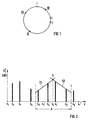
- the bar chart B1 determined again has the same bar chart in the form of the diagram B2 is scheduled. This procedure is particularly useful when the separation point T is in the vicinity of the leak L. Because then a particularly significant improvement in the location of the leak can be achieved.
- the sound level which has the highest value and which is as close as possible to the center of the illustration shown is now advantageously found with the aid of a computer system.
- this is the sensor position x ' 1 .
- a section A is now selected around this sensor position, which contains a complete set of sensor positions x i .
- these are the recording positions x3, x ' 4th , x ' 1 and x ' 2nd .
- this section A it is now possible with relatively great accuracy to determine the best-fit lines G1 and G2 by calculation. The intersection S of these two best-fit lines G1, G2 is then determined. It describes the leak position X L.
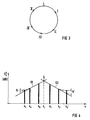
- FIG. 1 A further annular structure is shown in FIG. This comprises a total of five ultrasound sensors I to V. It is noteworthy here that a separation was not carried out. The leak is again labeled L here.
- FIG. 4 shows the bar diagram belonging to FIG. 3. It should be noted here that in the area of the ultrasound transducer III there is an excess of the leakage noise level, ie a large deviation from the respective compensation line G1 or G2. This exaggeration is due to an undesired superimposition of the leak noise, which is on the way to the right and on the way to the left to the ultrasound transducer III have arrived. In other words: Such an undesirable overlay is particularly noticeable in those transducers that lie opposite the leak point L.
- the sound level is compensated for by means of a correction value K for each transducer in which such an excess occurs due to leakage noise superposition. If such a compensation is carried out, the leakage location x L can be determined with particular accuracy through the intersection point S.
- the correction values K and K ' are entered at the positions x and x'.
- correction values K and K 'etc. mentioned are expediently stored in a computing system and are used for the correction when calculating the best-fit lines G1 and G2. Such correction values K and K 'can be determined by calculation; however, it is also possible to determine them experimentally.
Landscapes
- Physics & Mathematics (AREA)
- General Physics & Mathematics (AREA)
- Examining Or Testing Airtightness (AREA)
- Measurement Of Levels Of Liquids Or Fluent Solid Materials (AREA)
- Length Measuring Devices Characterised By Use Of Acoustic Means (AREA)
Abstract
Description
- Die Erfindung bezieht sich auf ein Verfahren zur Ultraschall-Leckage-Ortung, bei dem die an verschiedenen Meßorten entlang einer Meßstrecke gemessenen Schallpegel in einem Balkendiagramm dargestellt werden und bei dem der Schnittpunkt zweier Ausgleichsgeraden zur Kennzeichnung des Leckage-Ortes ermittelt wird. Die Erfindung bezieht sich weiterhin auf eine Einrichtung zur Durchführung dieses Verfahrens.
- Ein Verfahren und eine Einrichtung der eingangs genannten Art sind aus der EP-C-0 140 174, insbesondere Figur 5, und aus dem Prospekt "ALÜS Akustisches Leck-Überwachungssystem", Bestell-Nr. A19100-U653-A212, April 1990, der Siemens AG, Bereich Energieerzeugung, D-8520 Erlangen, bekannt.
- Das hier betrachtete Verfahren zur akustischen Leckage-Überwachung basiert auf der Tatsache, daß durch ein Leck ausströmende und sich entspannende Flüssigkeiten, Dämpfe oder Gase Körperschall erzeugen. Diese Geräusche breiten sich in den betroffenen Komponenten (z. B. Rohrleitungen, Behältern, Pumpen, Ventilen) aus und werden von Schallwandlern oder Schallaufnehmern gemessen. Letztere sind an der Oberfläche der überwachten Komponenten in gewissen Abständen angebracht.
- Als Meßgröße wird dabei der Effektiv- oder RMS-Wert der hochfrequenten Schallwandler-Signale benutzt. Während des Normalbetriebes verursachen die Strömungsgeräusche einen Untergrund-Signalpegel Eo. Das plötzliche Auftreten eines Lecks erzeugt einen Leckage-Geräuschpegel EL am Ort xi des Schallwandlers (i = 1, 2, ...), dessen Höhe von der Größe der Leckage und ihrer Entfernung vom Schallwandler abhängt. Der Gesamtgeräuschpegel EL,o am Ort xi eines Wandlers entsteht durch eine Überlagerung des Leckage-Geräusches und des Betriebs-Geräusches nach folgender Formel:

- Das bedeutet, daß eine Leckage, die am Ort xi des Schallaufnehmers den gleichen Geräuschpegel wie das Betriebsgeräusch erzeugt, den Gesamtgeräuschpegel um etwa 40 % erhöht; das ist ein Anstieg, der gut meßbar ist.
- Für die Ortung des Lecks ist zunächst für jeden Meßort xi aus den gemessenen Schallpegeln der Aufnehmer der Anteil zu bestimmen, der durch das Leckgeräusch bestimmt wird. Das geschieht bekanntermaßen durch Subtraktion des Untergrundgeräusches E


- Die Netto-Schallpegel E

- Mit anderen Worten: Bei dem hier betrachteten Verfahren wird mit mehreren fest installierten Aufnehmern im Ultraschallbereich der Betriebs-Schallpegel (RMS-Wert) auf anomale Veränderungen überwacht. Der Frequenzbereich ist so gewählt, daß die über dem Betriebs-Schallpegel liegenden hochfrequenten Anteile des Leckgeräusches erfaßt werden, daß die niederfrequenten, mechanisch angeregten Schallwellen jedoch ausgefiltert werden. Im Normalbetrieb sind die RMS-Werte der einzelnen Aufnehmer weitgehend konstant; Leckagen dagegen verursachen einen Anstieg der Werte. Gemäß dem bekannten Verfahren wird hieraus für jeden Aufnehmer der ausschließlich auf die Leckage zurückgehende Anteil bestimmt; er nimmt mit zunehmendem Abstand vom Leck gesetzmäßig ab.
- Wie bereits erwähnt, wird dieser Anteil logarithmisch als Funktion der einzelnen Aufnehmerorte xi in Form eines Balkendiagramms dargestellt. Längere oder sich verzweigende Rohrleitungen werden in Überwachungs-Abschnitte aufgeteilt, und für jeden Abschnitt wird ein solches Balkendiagramm erstellt. Ringförmige Strukturen werden "aufgetrennt", d. h. die Auftrennstelle wird als Anfangs- und Endpunkt einer linearen Struktur betrachtet.
- Es hat sich gezeigt, daß sich bei ringförmigen Strukturen Ungenauigkeiten in der Bestimmung des Leckageortes ergeben können. Dies kann verschiedene Ursachen haben. Es besteht daher der Wunsch, auch bei solchen ringförmigen Strukturen eine möglichst genaue Leckortung durchzuführen.
- Aufgabe der Erfindung ist es demnach, das eingangs genannte Verfahren dahingehend zu verbessern, daß eine genauere Leckage-Ortung bei ringförmigen Strukturen möglich ist. Weiterhin soll eine Einrichtung zur Durchführung dieses Verfahrens angegeben werden.
- Eine erste Lösung der Aufgabe bezüglich des Verfahrens ist erfindungsgemäß dadurch gekennzeichnet, daß an das Balkendiagramm dasselben Balkendiagramm noch einmal angesetzt wird, daß derjenige Schallpegel herausgesucht wird, der den höchsten Wert besitzt und am weitesten in der Mitte der aneinander gesetzten Balkendiagramme liegt, daß um die zugehörige Aufnehmerposition herum ein Abschnitt mit einem vollständigen Satz von Aufnehmerpositionen herausgesucht wird, und daß für diesen Satz die beiden Ausgleichsgeraden bestimmt werden, deren Schnittpunkt zur Kennzeichnung der Leckageposition ermittelt wird.
- Eine zweite Lösung der Aufgabe bezüglich des Verfahrens ist erfindungsgemäß dadurch gekennzeichnet, daß zumindest derjenige Schallpegel, dessen Position der Leckageposition im wesentlichen gegenüberliegt, mit einem Korrekturwert versehen wird.
- Eine Einrichtung zur Durchführung des erstgenannten Verfahrens zeichnet sich erfindungsgemäß dadurch aus, daß eine aneinander gesetzte Darstellung zweier Balkendiagramme von der Datenverarbeitungsanlage durchgeführt wird.
- Eine weitere Einrichtung zur Durchführung des zweitgenannten Verfahrens zeichnet sich erfindungsgemäß dadurch aus, daß die Datenverarbeitungsanlage Korrekturwerte für die Schallpegel gespeichert enthält und die Schallpegel entsprechend korrigiert.
- Die Erfindung basiert somit auf der Überlegung, daß es zweckmäßig ist, gemäß dem erstgenannten Verfahren eine Verbesserung bei der Ermittlung der Ausgleichsgeraden zu erzielen. Und das zweitgenannte Verfahren basiert auf der Überlegung, daß sich mittels Korrekturwerten die Überlagerung vom Schall, der von einem Leck in entgegengesetztem Sinne über die ringförmige Struktur zu einem Aufnehmer läuft, kompensiert werden kann.
- Ausführungsbeispiele der Erfindung werden im folgenden anhand von vier Figuren näher erläutert. Es zeigen:
- Figur 1 eine ringförmige Struktur mit vier Ultraschall-Aufnehmerpositionen, einer Auftrennstelle und einer Leckstelle;
- Figur 2 zwei aneinandergesetzte gleiche Balkendiagramme, bei denen die genannten RMS-Werte über der Ortskoordinate xi dargestellt sind;
- Figur 3 eine ringförmige Struktur mit fünf Ultraschall-Aufnehmern und einer Leckstelle; und
- Figur 4 ein zugehöriges Balkendiagramm, in dem überhöhte Ultraschallpegel bei demjenigen Aufnehmer eingetragen sind, der der Leckstelle gegenüber liegt.
- Bei Figur 1 ist der Einfachheit halber davon ausgegangen, daß Ultraschall-Aufnehmer I, II, III, IV entlang einer ringförmigen Überwachungsstrecke auf einer druckführenden Anlage (z. B. Primärkreis eines Kernkraftwerkes) an nur vier Meßpositionen oder Meßstellen x₁, x₂, x₃ und x₄ angebracht sind. In der Praxis werden aber z. B. 5 bis 10 solcher Meßpositionen überwacht. Eine Auftrennstelle ist mit T, eine Leckstelle mit L bezeichnet.
- Vorliegend sind in Figur 2 die logarithmierten Schallpegel E

- Bemerkenswert ist, daß an das ermittelte Balkendiagramm B1 noch einmal dasselbe Balkendiagramm in Form des Diagramms B2 angesetzt ist. Diese Vorgehensweise ist insbesondere dann zweckmäßig, wenn die Trennstelle T sich in der Nähe des Lecks L befindet. Denn dann läßt sich eine besonders bedeutsame Verbesserung der Leckortung erzielen.
- Bei den beiden aneinander gesetzten Balkendiagrammen B1, B2 wird nun, zweckmäßigerweise mit Hilfe einer Rechenanlage, derjenige Schallpegel herausgesucht, der den höchsten Wert besitzt und der möglichst in der Mitte der gezeigten Darstellung liegt. Im vorliegenden Fall ist dies die Aufnehmerposition x


- In Figur 3 ist eine weitere ringförmige Struktur dargestellt. Diese umfaßt insgesamt fünf Ultraschall-Aufnehmer I bis V. Bemerkenswert ist hier, daß eine Auftrennung nicht vorgenommen wurde. Das Leck ist auch hier wieder mit L bezeichnet.
- In Figur 4 ist das zu Figur 3 gehörende Balkendiagramm dargestellt. Anzumerken ist hier, daß im Bereich des Ultraschall-Aufnehmers III eine Überhöhung des Leckgeräuschpegels auftritt, d. h. eine starke Abweichung von der jeweiligen Ausgleichsgeraden G1 bzw. G2. Diese Überhöhung ist auf eine unerwünschte Überlagerung der Leckgeräusche zurückzuführen, die auf dem Wege rechts herum und auf dem Wege links herum zu dem Ultraschall-Aufnehmer III gelangt sind. Mit anderen Worten: Eine solche unerwünschte Überlagerung macht sich insbesondere bei denjenigen Aufnehmern nachteilig bemerkbar, die der Leckstelle L gegenüberliegen.
- Gemäß der Erfindung ist nun vorgesehen, daß mittels eines Korrekturwertes K bei jedem Aufnehmer, bei dem eine solche auf Leckgeräuschüberlagerung zurückführende Überhöhung auftritt, der Schallpegel kompensiert wird. Wenn eine solche Kompensation durchgeführt ist, läßt sich der Leckageort xL mit besonderer Genauigkeit durch den Schnittpunkt S ermitteln. Vorliegend sind die Korrekturwerte K und K' bei den Positionen x und x' eingetragen.
- Es soll demzufolge noch angemerkt werden, daß - je nach Einzelfall - durchaus auch eine Korrektur bei den benachbarten Aufnehmern, im vorliegenden Fall also bei den Aufnehmern II und IV, in Betracht kommt.
- Die genannten Korrekturwerte K und K' etc. werden zweckmäßigerweise in einer Rechenanlage gespeichert und bei der Berechnung der Ausgleichsgeraden G1 und G2 zur Korrektur herangezogen. Solche Korrekturwerte K und K' lassen sich rechnerisch ermitteln; es ist aber auch möglich, sie experimentell zu ermitteln.
Claims (5)
- Verfahren zur Ultraschall-Leckage-Ortung, bei dem die Schallpegel an verschiedenen Meßorten entlang einer Meßstrecke in einem Balkendiagramm dargestellt werden und bei dem der Schnittpunkt zweier Ausgleichsgeraden zur Kennzeichnung der Leckage-Position ermittelt wird, dadurch gekennzeichnet, daß an das Balkendiagramm (B1) dasselben Balkendiagramm (B2) noch einmal angesetzt wird, daß derjenige Schallpegel herausgesucht wird, der den höchsten Wert besitzt und am weitesten in der Mitte der aneinander gesetzten Balkendiagramme (B1, B2) liegt, daß um die zugehörige Aufnehmerposition (xI) herum ein Abschnitt (A) mit einem vollständigen Satz von Aufnehmerpositionen (xi) herausgesucht wird, und daß für diesen Satz die beiden Ausgleichsgeraden (G1, G2) bestimmt werden, deren Schnittpunkt (S) zur Kennzeichnung der Leckageposition (xL) ermittelt wird (Fig. 2).
- Verfahren zur Ultraschall-Leckage-Ortung, bei dem die Schallpegel an verschiedenen Meßorten entlang einer Meßstrecke in einem Balkendiagramm dargestellt werden und bei dem der Schnittpunkt zweier Ausgleichsgeraden zur Kennzeichnung der Leckage-Position ermittelt wird, dadurch gekennzeichnet, daß zumindest derjenige Schallpegel, dessen Position (xIII) der Leckageposition (xL) im wesentlichen gegenüberliegt, mit einem Korrekturwert (K) versehen wird (Fig. 4).
- Verfahren nach Anspruch 2, dadurch gekennzeichnet, daß der Korrekturwert (K) aus einem Datenspeicher abgerufen wird.
- Einrichtung zur Ultraschall-Leckage-Ortung mit einer Anzahl von Ultraschall-Aufnehmern entlang einer Meßstrecke, deren Ausgänge über Verstärker und den Effektivwert bildende Komponenten mit einer Datenverarbeitungsanlage in Verbindung stehen, dadurch gekennzeichnet, daß eine aneinander gesetzte Darstellung zweier Balkendiagramme (B1, B2) von der Datenverarbeitungsanlage durchgeführt wird (Fig. 2).
- Einrichtung zur Ultraschall-Leckage-Ortung mit einer Anzahl von Ultraschall-Aufnehmern entlang einer Meßstrecke, deren Ausgänge über Verstärker und den Effektivwert bildende Komponenten mit einer Datenverarbeitungsanlage in Verbindung stehen, dadurch gekennzeichnet, daß die Datenverarbeitungsanlage Korrekturwerte für die Schallpegel gespeichert enthält und die Schallpegel entsprechend korrigiert.
Applications Claiming Priority (2)
| Application Number | Priority Date | Filing Date | Title |
|---|---|---|---|
| DE4227459 | 1992-08-19 | ||
| DE4227459A DE4227459A1 (de) | 1992-08-19 | 1992-08-19 | Verfahren und Einrichtung zur Ultraschall-Leckage-Ortung |
Publications (2)
| Publication Number | Publication Date |
|---|---|
| EP0590280A1 true EP0590280A1 (de) | 1994-04-06 |
| EP0590280B1 EP0590280B1 (de) | 1997-10-29 |
Family
ID=6465886
Family Applications (1)
| Application Number | Title | Priority Date | Filing Date |
|---|---|---|---|
| EP93112654A Expired - Lifetime EP0590280B1 (de) | 1992-08-19 | 1993-08-06 | Verfahren und Einrichtung zur Ultraschall-Leckage-Ortung |
Country Status (9)
| Country | Link |
|---|---|
| US (1) | US5433104A (de) |
| EP (1) | EP0590280B1 (de) |
| JP (1) | JPH06186125A (de) |
| CA (1) | CA2104322A1 (de) |
| DE (2) | DE4227459A1 (de) |
| ES (1) | ES2108792T3 (de) |
| FI (1) | FI933659L (de) |
| RU (1) | RU2126537C1 (de) |
| SK (1) | SK86193A3 (de) |
Families Citing this family (16)
| Publication number | Priority date | Publication date | Assignee | Title |
|---|---|---|---|---|
| US6082193A (en) * | 1997-04-11 | 2000-07-04 | Pure Technologies Ltd. | Pipeline monitoring array |
| US5979239A (en) * | 1997-04-28 | 1999-11-09 | The United States Of America As Represented By The Administrator Of The National Aeronautics And Space Administration | Ultrasonic imaging system |
| US6128946A (en) * | 1997-06-26 | 2000-10-10 | Crane Nuclear, Inc. | Method and apparatus for on-line detection of leaky emergency shut down or other valves |
| US10013968B2 (en) * | 2003-06-18 | 2018-07-03 | Noiseout Inc. | Method of estimating path(s) of acoustic or thermal leakage of an object and method of estimating path(s) of transmission loss of an object, using a sound focusing mechanism |
| US7908924B2 (en) * | 2003-06-18 | 2011-03-22 | Schnitta Bonnie S | Sound focusing mechanism and method of estimating acoustic leakage of an object and method of estimating transmission loss of an object |
| US9146152B2 (en) | 2003-06-18 | 2015-09-29 | Noiseout Inc | Method of estimating acoustic or thermal leakage of an object and method of estimating transmission loss of an object, using a sound focusing mechanism |
| US20070068225A1 (en) | 2005-09-29 | 2007-03-29 | Brown Gregory C | Leak detector for process valve |
| US7698946B2 (en) | 2006-02-24 | 2010-04-20 | Caterpillar Inc. | System and method for ultrasonic detection and imaging |
| KR100798006B1 (ko) * | 2006-08-17 | 2008-01-24 | 한국원자력연구원 | 원전 기기의 통합 감시 및 진단 방법과 이를 이용한 시스템 |
| US8050875B2 (en) | 2006-12-26 | 2011-11-01 | Rosemount Inc. | Steam trap monitoring |
| WO2014043357A1 (en) | 2012-09-14 | 2014-03-20 | Robert Bosch Gmbh | Testing for defective manufacturing of microphones and ultralow pressure sensors |
| US10641412B2 (en) | 2012-09-28 | 2020-05-05 | Rosemount Inc. | Steam trap monitor with diagnostics |
| US9933327B2 (en) | 2015-08-20 | 2018-04-03 | General Electric Company | Method for detecting leaks in a fuel circuit of a gas turbine fuel supply system |
| RU2591752C1 (ru) * | 2015-09-07 | 2016-07-20 | Общество с ограниченной ответственностью "Нефтяные и газовые измерительные технологии", ООО "НГИТ" | Способ выявления аварийных протечек трубопровода для защиты окружающей среды |
| US10539480B2 (en) * | 2017-10-27 | 2020-01-21 | Mueller International, Llc | Frequency sub-band leak detection |
| RU2700740C1 (ru) * | 2018-11-13 | 2019-09-19 | Федеральное государственное казенное военное образовательное учреждение высшего образования "Военный учебно-научный центр Военно-воздушных сил "Военно-воздушная академия имени профессора Н.Е. Жуковского и Ю.А. Гагарина" (г. Воронеж) Министерства обороны Российской Федерации | Устройство для определения утечек топлива |
Citations (2)
| Publication number | Priority date | Publication date | Assignee | Title |
|---|---|---|---|---|
| FR2503363A1 (fr) * | 1981-03-31 | 1982-10-08 | Seba Mess Ortungstech | Procede pour localiser les defauts, notamment les points de fuites des tuyaux et appareil pour la mise en oeuvre de ce procede |
| EP0140174A1 (de) * | 1983-10-05 | 1985-05-08 | Siemens Aktiengesellschaft | Verfahren zum Ermitteln einer Leckstelle an druckführenden Behältern und Einrichtung dazu |
Family Cites Families (15)
| Publication number | Priority date | Publication date | Assignee | Title |
|---|---|---|---|---|
| GB1349120A (en) * | 1971-04-26 | 1974-03-27 | Osaka Gas Co Ltd | Method and apparatus for detecting leak of fluid from fluid containing means |
| DE2916158A1 (de) * | 1979-04-20 | 1980-10-30 | Siemens Ag | Geraet zur anzeige von haeufigkeitsverteilungen von messwerten o.dgl. ueber einen einstellbaren messbereich |
| DD152415A1 (de) * | 1980-07-25 | 1981-11-25 | Heinz Foerster | Verfahren zur ermittlung von lecks durch schallemissionsanalyse |
| JPS5834334A (ja) * | 1981-08-25 | 1983-02-28 | Toshiba Corp | 漏洩位置検出方式 |
| JPS58168934A (ja) * | 1982-03-31 | 1983-10-05 | Hitachi Ltd | 流体の漏洩検出方法とその装置 |
| DE3334252C2 (de) * | 1983-09-22 | 1985-08-01 | Fraunhofer-Gesellschaft zur Förderung der angewandten Forschung e.V., 8000 München | Einrichtung zum Anbringen eines Schallempfängers an einer Anschlußstelle einer Flüssigkeitsleitung |
| JPS6370139A (ja) * | 1986-09-12 | 1988-03-30 | Hitachi Ltd | 音圧レベル測定式流体漏えい検出装置 |
| SU1446554A1 (ru) * | 1987-04-27 | 1988-12-23 | Предприятие П/Я А-7615 | Способ определени координат дефектов в сварных соединени х по сигналам акустической эмиссии |
| DE3726585A1 (de) * | 1987-08-10 | 1989-02-23 | Seba Mess Ortungstech | Verfahren zum orten von leckgeraeuschen und vorrichtung zur ausuebung des verfahrens |
| DE3812101A1 (de) * | 1988-04-12 | 1989-11-02 | Martin Pfeil | Messgeraet fuer eine mehrzahl von messstellen |
| JP2575790B2 (ja) * | 1988-04-12 | 1997-01-29 | 株式会社東芝 | 漏水位置推定装置 |
| US4858462A (en) * | 1989-01-20 | 1989-08-22 | The Babcock & Wilcox Company | Acoustic emission leak source location |
| SU1710930A1 (ru) * | 1989-07-18 | 1992-02-07 | Всесоюзный научно-исследовательский институт по строительству магистральных трубопроводов | Способ определени места утечки в трубопроводе |
| JP2878804B2 (ja) * | 1989-09-19 | 1999-04-05 | 東京瓦斯株式会社 | 配管の異常監視装置 |
| US5058419A (en) * | 1990-04-10 | 1991-10-22 | Earl H. Ruble | Method and apparatus for determining the location of a sound source |
-
1992
- 1992-08-19 DE DE4227459A patent/DE4227459A1/de not_active Withdrawn
-
1993
- 1993-08-06 ES ES93112654T patent/ES2108792T3/es not_active Expired - Lifetime
- 1993-08-06 EP EP93112654A patent/EP0590280B1/de not_active Expired - Lifetime
- 1993-08-06 DE DE59307597T patent/DE59307597D1/de not_active Expired - Fee Related
- 1993-08-10 SK SK861-93A patent/SK86193A3/sk unknown
- 1993-08-17 RU RU93041765A patent/RU2126537C1/ru active
- 1993-08-18 JP JP5225224A patent/JPH06186125A/ja not_active Withdrawn
- 1993-08-18 CA CA002104322A patent/CA2104322A1/en not_active Abandoned
- 1993-08-19 US US08/109,387 patent/US5433104A/en not_active Expired - Fee Related
- 1993-08-19 FI FI933659A patent/FI933659L/fi unknown
Patent Citations (2)
| Publication number | Priority date | Publication date | Assignee | Title |
|---|---|---|---|---|
| FR2503363A1 (fr) * | 1981-03-31 | 1982-10-08 | Seba Mess Ortungstech | Procede pour localiser les defauts, notamment les points de fuites des tuyaux et appareil pour la mise en oeuvre de ce procede |
| EP0140174A1 (de) * | 1983-10-05 | 1985-05-08 | Siemens Aktiengesellschaft | Verfahren zum Ermitteln einer Leckstelle an druckführenden Behältern und Einrichtung dazu |
Non-Patent Citations (3)
| Title |
|---|
| DATABASE INSPEC NR. E007-7616-Y 1976, J.R. SABO: "DETECT BURIED STEAM LEAKS WITH ACOUSTICS" * |
| ELECTRICAL WORLD, vol. 186, no. 1, 1 July 1976 (1976-07-01), pages 40 * |
| P. JAX, E.A.: "NEUE LECK-DETEKTIONS- UND ORTUNGSVERFAHREN FÜR ROHRLEITUNGEN UND BEHÄLTER", VGB KRAFTWERKSTECHNIK, vol. 72, no. 6, June 1992 (1992-06-01), ESSEN DE, pages 514 - 517 * |
Also Published As
| Publication number | Publication date |
|---|---|
| FI933659A0 (fi) | 1993-08-19 |
| EP0590280B1 (de) | 1997-10-29 |
| ES2108792T3 (es) | 1998-01-01 |
| SK86193A3 (en) | 1994-03-09 |
| US5433104A (en) | 1995-07-18 |
| FI933659A7 (fi) | 1994-02-20 |
| JPH06186125A (ja) | 1994-07-08 |
| FI933659L (fi) | 1994-02-20 |
| DE4227459A1 (de) | 1994-02-24 |
| CA2104322A1 (en) | 1994-02-20 |
| DE59307597D1 (de) | 1997-12-04 |
| RU2126537C1 (ru) | 1999-02-20 |
Similar Documents
| Publication | Publication Date | Title |
|---|---|---|
| EP0590280B1 (de) | Verfahren und Einrichtung zur Ultraschall-Leckage-Ortung | |
| DE60016422T2 (de) | Vorhersage der groesse eines fehlers in einem druckwandler | |
| EP0590279A1 (de) | Verfahren und Einrichtung zur Ultraschall-Leckage-Ortung | |
| DE60123044T2 (de) | Erkennen elektrischer leckverluste in einem magnetischen durchflussmesser | |
| DE3036951C2 (de) | Verfahren zur Schallemissionsprüfung von aus Stahl bestehenden Behältern oder Rohrleitungen, insbesondere für Kernreaktoranlagen | |
| EP0140174A1 (de) | Verfahren zum Ermitteln einer Leckstelle an druckführenden Behältern und Einrichtung dazu | |
| DE4334380A1 (de) | Verfahren zur Kalibrierung eines Sensors | |
| DE3235113A1 (de) | Geraet zur erzeugung von bildern eines untersuchungsobjektes mit magnetischer kernresonanz | |
| DE3812474A1 (de) | Einrichtung zum vorhersagen von zerstoerung eines lagers | |
| DE102017118684A1 (de) | Verfahren zur Bestimmung einer Dichte eines Mediums in einem Tank eines Hybrid Tank Measurement System | |
| DE69517075T2 (de) | Gerät zur Diagnose von Schall- und Schwingungsquellen | |
| EP4680955A1 (de) | Verfahren zur inspektion eines metallischen betonspannelementes einer rohrleitung sowie inspektionsvorrichtung | |
| DE10321210B4 (de) | Drehmoment-Messverfahren für eine Wellengetriebevorrichtung | |
| DE2717301B1 (de) | Messumformer zur kapazitiven Fuellstandsmessung von Fluessigkeitsfuellungen | |
| DE4227460A1 (de) | Verfahren und Einrichtung zur Kalibrierung bei der Ultraschall-Leckage-Ortung | |
| DE19839286A1 (de) | Verfahren und Einrichtung zur Messung der Zugspannungsverteilung in einem Metallband | |
| DE19602811C1 (de) | Vefahren zur Ortung von Körperschallereignissen bei zu überwachenden Druckumschließungen in Kraftwerken | |
| DE2322085A1 (de) | Fluidgefuelltes elektrisches kabel | |
| DE3205598C2 (de) | ||
| DE3047570C1 (de) | Verfahren zur Ortung der Beschädigungen in einem Rohrleitungsdrucknetz | |
| DE10051506A1 (de) | Verfahren zur optimalen Bestimmung von Sensorpositionen für Schallpyrometrie | |
| DE19815342C2 (de) | Verfahren zur Verarbeitung von Meßsignalen in einer Magnetfeldmeßvorrichtung und Meßvorrichtung zur Durchführung des Verfahrens | |
| DE3128168C2 (de) | Beschleunigungsdruckverfahren zur zeittaktgesteuerten Messung von Geschwindigkeit, Durchfluß und Ausflußmenge | |
| DE4207716A1 (de) | Verfahren zum ermitteln von tiefenwerten eines gewaesserbodenprofils | |
| BE1032901B1 (de) | Verfahren zur Inspektion eines metallischen Betonspannelements einer Rohrleitung sowie Inspektionsvorrichtung |
Legal Events
| Date | Code | Title | Description |
|---|---|---|---|
| PUAI | Public reference made under article 153(3) epc to a published international application that has entered the european phase |
Free format text: ORIGINAL CODE: 0009012 |
|
| AK | Designated contracting states |
Kind code of ref document: A1 Designated state(s): BE CH DE ES FR GB LI NL SE |
|
| 17P | Request for examination filed |
Effective date: 19940504 |
|
| 17Q | First examination report despatched |
Effective date: 19960304 |
|
| GRAG | Despatch of communication of intention to grant |
Free format text: ORIGINAL CODE: EPIDOS AGRA |
|
| GRAH | Despatch of communication of intention to grant a patent |
Free format text: ORIGINAL CODE: EPIDOS IGRA |
|
| GRAH | Despatch of communication of intention to grant a patent |
Free format text: ORIGINAL CODE: EPIDOS IGRA |
|
| GRAA | (expected) grant |
Free format text: ORIGINAL CODE: 0009210 |
|
| AK | Designated contracting states |
Kind code of ref document: B1 Designated state(s): BE CH DE ES FR GB LI NL SE |
|
| REG | Reference to a national code |
Ref country code: CH Ref legal event code: NV Representative=s name: SIEMENS SCHWEIZ AG Ref country code: CH Ref legal event code: EP |
|
| GBT | Gb: translation of ep patent filed (gb section 77(6)(a)/1977) |
Effective date: 19971111 |
|
| REF | Corresponds to: |
Ref document number: 59307597 Country of ref document: DE Date of ref document: 19971204 |
|
| REG | Reference to a national code |
Ref country code: ES Ref legal event code: FG2A Ref document number: 2108792 Country of ref document: ES Kind code of ref document: T3 |
|
| ET | Fr: translation filed | ||
| PGFP | Annual fee paid to national office [announced via postgrant information from national office to epo] |
Ref country code: GB Payment date: 19980721 Year of fee payment: 6 |
|
| PGFP | Annual fee paid to national office [announced via postgrant information from national office to epo] |
Ref country code: ES Payment date: 19980811 Year of fee payment: 6 |
|
| PGFP | Annual fee paid to national office [announced via postgrant information from national office to epo] |
Ref country code: BE Payment date: 19980818 Year of fee payment: 6 |
|
| PGFP | Annual fee paid to national office [announced via postgrant information from national office to epo] |
Ref country code: SE Payment date: 19980819 Year of fee payment: 6 |
|
| PGFP | Annual fee paid to national office [announced via postgrant information from national office to epo] |
Ref country code: NL Payment date: 19980825 Year of fee payment: 6 |
|
| PGFP | Annual fee paid to national office [announced via postgrant information from national office to epo] |
Ref country code: FR Payment date: 19980826 Year of fee payment: 6 |
|
| PLBE | No opposition filed within time limit |
Free format text: ORIGINAL CODE: 0009261 |
|
| PGFP | Annual fee paid to national office [announced via postgrant information from national office to epo] |
Ref country code: DE Payment date: 19981020 Year of fee payment: 6 |
|
| 26N | No opposition filed | ||
| PGFP | Annual fee paid to national office [announced via postgrant information from national office to epo] |
Ref country code: CH Payment date: 19981116 Year of fee payment: 6 |
|
| PG25 | Lapsed in a contracting state [announced via postgrant information from national office to epo] |
Ref country code: GB Free format text: LAPSE BECAUSE OF NON-PAYMENT OF DUE FEES Effective date: 19990806 |
|
| PG25 | Lapsed in a contracting state [announced via postgrant information from national office to epo] |
Ref country code: ES Free format text: LAPSE BECAUSE OF NON-PAYMENT OF DUE FEES Effective date: 19990807 |
|
| PG25 | Lapsed in a contracting state [announced via postgrant information from national office to epo] |
Ref country code: SE Free format text: THE PATENT HAS BEEN ANNULLED BY A DECISION OF A NATIONAL AUTHORITY Effective date: 19990830 |
|
| PG25 | Lapsed in a contracting state [announced via postgrant information from national office to epo] |
Ref country code: LI Free format text: LAPSE BECAUSE OF NON-PAYMENT OF DUE FEES Effective date: 19990831 Ref country code: CH Free format text: LAPSE BECAUSE OF NON-PAYMENT OF DUE FEES Effective date: 19990831 Ref country code: BE Free format text: LAPSE BECAUSE OF NON-PAYMENT OF DUE FEES Effective date: 19990831 |
|
| BERE | Be: lapsed |
Owner name: SIEMENS A.G. Effective date: 19990831 |
|
| PG25 | Lapsed in a contracting state [announced via postgrant information from national office to epo] |
Ref country code: NL Free format text: LAPSE BECAUSE OF NON-PAYMENT OF DUE FEES Effective date: 20000301 |
|
| GBPC | Gb: european patent ceased through non-payment of renewal fee |
Effective date: 19990806 |
|
| REG | Reference to a national code |
Ref country code: CH Ref legal event code: PL |
|
| PG25 | Lapsed in a contracting state [announced via postgrant information from national office to epo] |
Ref country code: FR Free format text: LAPSE BECAUSE OF NON-PAYMENT OF DUE FEES Effective date: 20000428 |
|
| EUG | Se: european patent has lapsed |
Ref document number: 93112654.4 |
|
| NLV4 | Nl: lapsed or anulled due to non-payment of the annual fee |
Effective date: 20000301 |
|
| PG25 | Lapsed in a contracting state [announced via postgrant information from national office to epo] |
Ref country code: DE Free format text: LAPSE BECAUSE OF NON-PAYMENT OF DUE FEES Effective date: 20000601 |
|
| REG | Reference to a national code |
Ref country code: FR Ref legal event code: ST |
|
| REG | Reference to a national code |
Ref country code: ES Ref legal event code: FD2A Effective date: 20000911 |