EP0590460B1 - Emulsions aqueuses très concentrés de poly(acrylonitrie) et procédé de leur préparation - Google Patents
Emulsions aqueuses très concentrés de poly(acrylonitrie) et procédé de leur préparation Download PDFInfo
- Publication number
- EP0590460B1 EP0590460B1 EP93115089A EP93115089A EP0590460B1 EP 0590460 B1 EP0590460 B1 EP 0590460B1 EP 93115089 A EP93115089 A EP 93115089A EP 93115089 A EP93115089 A EP 93115089A EP 0590460 B1 EP0590460 B1 EP 0590460B1
- Authority
- EP
- European Patent Office
- Prior art keywords
- acrylonitrile
- polymer
- emulsions
- polymers
- weight
- Prior art date
- Legal status (The legal status is an assumption and is not a legal conclusion. Google has not performed a legal analysis and makes no representation as to the accuracy of the status listed.)
- Expired - Lifetime
Links
Classifications
-
- D—TEXTILES; PAPER
- D01—NATURAL OR MAN-MADE THREADS OR FIBRES; SPINNING
- D01F—CHEMICAL FEATURES IN THE MANUFACTURE OF ARTIFICIAL FILAMENTS, THREADS, FIBRES, BRISTLES OR RIBBONS; APPARATUS SPECIALLY ADAPTED FOR THE MANUFACTURE OF CARBON FILAMENTS
- D01F6/00—Monocomponent artificial filaments or the like of synthetic polymers; Manufacture thereof
- D01F6/02—Monocomponent artificial filaments or the like of synthetic polymers; Manufacture thereof from homopolymers obtained by reactions only involving carbon-to-carbon unsaturated bonds
- D01F6/18—Monocomponent artificial filaments or the like of synthetic polymers; Manufacture thereof from homopolymers obtained by reactions only involving carbon-to-carbon unsaturated bonds from polymers of unsaturated nitriles, e.g. polyacrylonitrile, polyvinylidene cyanide
-
- C—CHEMISTRY; METALLURGY
- C08—ORGANIC MACROMOLECULAR COMPOUNDS; THEIR PREPARATION OR CHEMICAL WORKING-UP; COMPOSITIONS BASED THEREON
- C08F—MACROMOLECULAR COMPOUNDS OBTAINED BY REACTIONS ONLY INVOLVING CARBON-TO-CARBON UNSATURATED BONDS
- C08F20/00—Homopolymers and copolymers of compounds having one or more unsaturated aliphatic radicals, each having only one carbon-to-carbon double bond, and only one being terminated by only one carboxyl radical or a salt, anhydride, ester, amide, imide or nitrile thereof
- C08F20/02—Monocarboxylic acids having less than ten carbon atoms, Derivatives thereof
- C08F20/42—Nitriles
- C08F20/44—Acrylonitrile
Definitions
- the present invention relates to highly concentrated aqueous emulsions of polymers, containing 80 to 100% by weight of copolymerized acrylonitrile and a Process for their preparation and their use as raw materials for acrylic and Modacrylic fibers and as dye additives for adjusting the dye affinity of cationic dyes in conventional acrylic and modacrylic polymers and fiber materials made therefrom.
- PAN polyacrylonitrile
- Copolymers also containing sulfonic acid groups e.g. B. from acrylonitrile and sodium styrene sulfonate, have so far only formed stable Emulsions when the polymerization was stopped at low conversion and the monomer concentration was not higher than 5% by weight.
- the object of the invention is to provide highly concentrated aqueous emulsions of polymers provide with acrylonitrile fractions of 80 to 100 wt .-%, and this after a simple and easy to perform emulsion polymerization process to produce directly with solids contents of 10 to 55 wt .-%.
- Emulsifiers of the general formulas (I) or (II) in emulsion polymerization of monomer mixtures containing acrylonitrile stable aqueous emulsions of acrylonitrile (co) polymers with acrylonitrile contents of 80 to 100% by weight and can be produced with solids contents of up to approx. 55% by weight.
- the invention also relates to the aqueous emulsions thus obtained.
- the emulsifiers used according to the invention can be mixtures act in which preferably> 80%, particularly preferably> 90%, based on the Mixture, structural units (I) in addition to the structural units (II) are present. It can also as polymeric emulsifier alone the polymer corresponding to formula (I) be used. The amount of polymeric emulsifier is based on that polymerizing monomers, 2 to 25% by weight, preferably 2 to 20% by weight.
- the polymeric emulsifiers of the general formulas (I) and (II) are reaction products of alternating copolymers of maleic anhydride and ⁇ -olefins or styrene. You can proceed as follows to manufacture them:
- Alternating or random copolymers of maleic anhydride are preferred and e.g. Ethylene, styrene, ⁇ -methylstyrene, propylene, isobutylene, butene-1, Diisobutylene, Dodecen-1, Hexadecen-1 and Octadecen-1, the molar Ratio between maleic anhydride and the monomers to be copolymerized is between 1: 1 and 1: 4.
- the production of such copolymers is known and is e.g. in Houben-Weyl, Methods of Organic Chemistry, Vol. E20 / T1.2, Georg Thieme Verlag, Stuttgart, 1987, pp. 1237 ff.
- Acrylonitrile alone and mixtures thereof with n-butyl acrylate are preferred, Methyl acrylate and vinyl acetate, the latter preferably in amounts of 2.5 to 20.0% by weight, particularly preferably 2.5 to 10.0% by weight.
- Acrylonitrile or its mixtures with other monomers can be polymerized in the presence of compounds of the formulas I and II in an aqueous emulsion in a manner known per se with the aid of various initiators.
- Suitable initiators are potassium persulfate, sodium persulfate, ammonium persulfate, organic peroxides, hydrogen peroxide and redox systems, such as. B. H 2 O 2 / rongalite, ammonium persulfate / rongalite, sodium or potassium persulfate / rongalite, t-butyl hydroperoxide / ascorbic acid, persulfate / sulfite / Fe 2+ etc.
- the polymerization requires temperatures from 20 to 100 ° C., preferably from 40 to 100 ° C.
- emulsifier, initiator and monomers separated and continuous add and initially only add water It is also possible, to work discontinuously: emulsifier, monomer (mixture) and initiator submitted together, heated to the desired polymerization temperature and 2 to Maintained at this temperature for 10 hours.
- a finely divided aqueous polymer emulsion is obtained, which is free of excretions.
- Laser correlation spectroscopy determined average particle diameter in the emulsions are 60 to 500 nm, preferably 80 to 200 nm.
- the size of the particles can be up to to a certain extent by the amount of polymeric emulsifier used being controlled; the particle size decreases with increasing amount of emulsifier.
- the polymers obtained have K values according to H. Fikentscher (cellulose chemistry 15 (1932) pp. 58 ff) from 60 to 150, preferably - especially for the production of Textile fibers - from 70 to 90.
- the K values of the polymers can largely by the concentration of the initiator or by regulator substances, e.g. Thioglycol, n-Dodecyl mercaptan, nitro compounds, adjusted to the desired values will. (The K value is a measure of the molecular weight.)
- the polymer emulsions contain Polymerization used acrylonitrile and / or its mixtures with others Monomers also have proportions of graft polymer of the monomers used the polymeric emulsifiers.
- the polymer emulsions according to the invention can either be prepared as such of films and fibers used as coloring additives for fibers, or they can be worked up to obtain the solid polymers, which then other ways use in the above Can find application areas. Furthermore the polymer emulsions according to the invention in precipitation polymerization of acrylonitrile can be used as a substitute for the coloring comonomer.
- the invention also relates to the use of the emulsions according to the invention for the production of fibers or coloring additives for acrylic fibers.
- the emulsions must first be in spinning solutions be transferred. You can do this by precipitation, washing and Dry or isolate by spray drying the powder and then in one dissolve suitable solvent. You can also put the emulsion directly into a "Soles" spinnable solution, i.e. distill off water at the same time and a for Add typical solvent to acrylic polymers, e.g. Dimethylformamide or Dimethylacetamide. Spray drying and redissolution is preferred.
- the polymers according to the invention can also be used as dyeing additives for fibers.
- This is understood to mean substances with color-affine groups, ie, in the case of acrylic fibers, as a rule strongly acidic groups which are present in a concentration of 40 to 60 meq / kg.
- This concentration of color-affine groups can be introduced through the starter system, for example persulfate / NaHSO 3 , and acidic comonomers, such as, for example, methallylsulfonic acid, styrene sulfonic acid or 2-acrylamido-2-methylpropanesulfonic acid.
- acidic comonomers such as, for example, methallylsulfonic acid, styrene sulfonic acid or 2-acrylamido-2-methylpropanesulfonic acid.
- the polymeric emulsifiers used in the emulsion polymerization according to the invention act as polymeric color additives in the production of acrylic fibers, ie the absorption of cationic dyes by the fibers, because of their high content of sulfonate groups, which can be between 80 and 500 meq / kg depending on the use of polymeric emulsifier (Potential and speed) can be adjusted to the desired level by suitable dosing of these emulsion polymers.
- the polymer is isolated by evaporation from a 30% by weight aqueous emulsion of a copolymer of 92.5% by weight of acrylonitrile and 7.5% by weight of n-butyl acrylate and dried to constant weight in a vacuum drying cabinet at 70 ° C.
- the copolymer has a K value of 100.8 measured in dimethylformamide with the addition of electrolyte (3 g NaNO 3 / l). The K value was determined according to H. Fikentscher, Cellulosechemie 15 (1932), p. 58.
- a spinning solution is formed by dissolving the copolymer in dimethylformamide a solids content of 23% by weight and a solution viscosity of 120 Pa.s, measured at 30 ° C.
- This acrylic polymer has the following composition: Acrylonitrile 93.5% by weight Acrylic acid methyl ester 5.8% by weight Na methallyl sulfonate 0.5% by weight and has a K value of 84.2 and the concentration of strongly acidic groups is 59 meq / kg.
- Table 1 compares the properties of the fibers obtained according to Example 1 with those of the fibers spun from the commercially available polymer: example 1 comparison Titer (single thread) [dtex] 4.30 6.70 Strength [cN / dtex] 3.46 2.72 Elongation (HZKD) [%] 20.3 45.3 Boiling shrink 6.0 1.0 Effective staining groups, strongly acidic [mVal / kg] 92.0 59.0
- Example 1 clearly shows that fibers with a high content of color-affinity groups can be obtained by using the emulsion polymers according to the invention. Such values can otherwise only be achieved by polymerizing sulfonate coloring comonomers into the acrylic copolymers.
- Acrylic polymer from Example 1 Commercial ACN unipolymer Spinning conditions: Solution conc. [%] 26.0 24.5 Viscosity b. 30 ° C [Pa.s] 96 134 Shaft temperature [° C] 200 200 200 200 Air temperature [° C] 250 250 Nozzle [hole / diam.
Landscapes
- Chemical & Material Sciences (AREA)
- Chemical Kinetics & Catalysis (AREA)
- Health & Medical Sciences (AREA)
- Polymers & Plastics (AREA)
- General Chemical & Material Sciences (AREA)
- Engineering & Computer Science (AREA)
- Textile Engineering (AREA)
- Medicinal Chemistry (AREA)
- Toxicology (AREA)
- Organic Chemistry (AREA)
- Addition Polymer Or Copolymer, Post-Treatments, Or Chemical Modifications (AREA)
- Polymerisation Methods In General (AREA)
- Artificial Filaments (AREA)
- Emulsifying, Dispersing, Foam-Producing Or Wetting Agents (AREA)
- Compositions Of Macromolecular Compounds (AREA)
- Coloring (AREA)
Claims (7)
- Procédé pour la préparation d'émulsions aqueuses de produits de (co)polymérisation d'acrylonitrile avec des parts en acrylonitrile de 80 à 100% en poids dans le produit de (co)polymérisation, caractérisé en ce que l'on polymérise en émulsion aqueuse en présence d'initiateurs radicalaires des mélanges monomères qui contiennent au moins 80% en poids d'acrylonitrile, en présence d'un émulsionnant polymère constitué d'un produit de polymérisation contenant des unités de structure des formules générales (I) et/ou (II)
 dans lesquelles
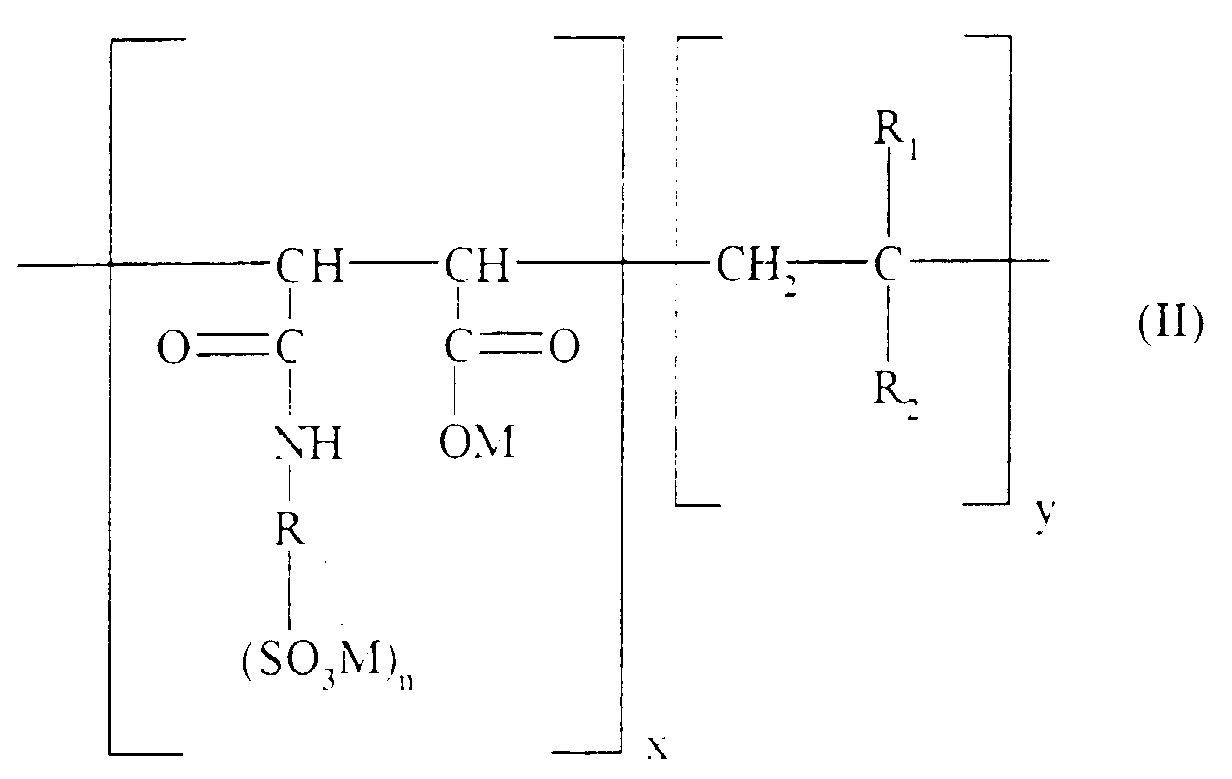 M représente un reste formant des cations,n est égal à 1 ou 2,R représente un reste -(CH2)2NH(CH2)2-,R1 représente H,-CH3,R2 représente H, un groupe alkyle en C1-C16 ou un groupe phényle,x, y sont choisis de telle sorte que le poids moléculaire moyen en poids Mw des produits de polymérisation (I) ou (II) est de 2 000 à 500 000 et le rapport de x : y = 1:4 à à 1:1.
- Procédé selon la revendication 1, caractéristé en ce que l'on utilise comme émulsionnant polymère un produit de polymérisation avec des unités de structure selon les formules (I) et (II), dans lequel >80% d'unités de structure (I) sont présents.
- Procédé selon les revendications 1 et 2, caractérisé en ce que l'on utilise comme mélanges monomères de l'acrylonitrile et du styrène (dérivés) ou du (méth)acrylate.
- Procédé selon la revendication 1, caractérisé en ce que l'initiateur est un initiateur Redox de peroxyde d'hydrogène et de Rongalite ou de persulfate d'ammonium et de Rongalite.
- Emulsions aqueuses de produits de polymérisation qui contiennent de 80 à 100% en poids d'acrylonitrile copolymérisé avec une teneur en matières solides de 10 à 55% en poids, dans lesquelles le produit de polymérisation présente des valeurs K selon Fikentscher de 60 à 150, disponibles selon le procédé selon les revendications 1 à 4.
- Utilisation des émulsions selon la revendication 5 pour la préparation de fibres selon le procédé de filage à sec.
- Utilisation des émulsions selon la revendication 5 pour la préparation d'additifs de teinture pour des fibres acryliques.
Applications Claiming Priority (2)
| Application Number | Priority Date | Filing Date | Title |
|---|---|---|---|
| DE4233026A DE4233026A1 (de) | 1992-10-01 | 1992-10-01 | Hochkonzentrierte wäßrige Poly(acrylnitril)-Emulsion und Verfahren zu ihrer Herstellung |
| DE4233026 | 1992-10-01 |
Publications (3)
| Publication Number | Publication Date |
|---|---|
| EP0590460A2 EP0590460A2 (fr) | 1994-04-06 |
| EP0590460A3 EP0590460A3 (fr) | 1995-07-05 |
| EP0590460B1 true EP0590460B1 (fr) | 1998-08-05 |
Family
ID=6469392
Family Applications (1)
| Application Number | Title | Priority Date | Filing Date |
|---|---|---|---|
| EP93115089A Expired - Lifetime EP0590460B1 (fr) | 1992-10-01 | 1993-09-20 | Emulsions aqueuses très concentrés de poly(acrylonitrie) et procédé de leur préparation |
Country Status (5)
| Country | Link |
|---|---|
| US (1) | US5356985A (fr) |
| EP (1) | EP0590460B1 (fr) |
| JP (1) | JP3248795B2 (fr) |
| DE (2) | DE4233026A1 (fr) |
| ES (1) | ES2118865T3 (fr) |
Families Citing this family (17)
| Publication number | Priority date | Publication date | Assignee | Title |
|---|---|---|---|---|
| DE4429318A1 (de) * | 1994-08-18 | 1996-02-22 | Bayer Ag | Superabsorbierende Polymere aus vernetzten Polyacrylnitril-Emulsionen |
| DE19732032A1 (de) * | 1997-07-25 | 1999-01-28 | Bayer Ag | Weißgetönte Polymerisate sowie ihre Verwendung in Streichmassen für die Beschichtung von Substraten |
| DE19805447A1 (de) | 1998-02-11 | 1999-08-12 | Bayer Ag | Modifizierte Superabsorber auf Basis von Polyacrylnitril-Emulsionen |
| US6143835A (en) * | 1998-04-03 | 2000-11-07 | Solutia Inc. | Polyacrylonitrile polymer treatment |
| US6277933B1 (en) | 1998-04-03 | 2001-08-21 | Solutia Inc. | Polyacrylonitrile particles by surfmer polymerization and sodium removal by chemical exchange |
| US6048955A (en) * | 1999-02-02 | 2000-04-11 | Solutia Inc. | Modacrylic copolymer composition |
| DE10019756A1 (de) | 2000-04-20 | 2001-10-25 | Bayer Ag | Verfahren zur Herstellung von superabsorbierenden Polymeren aus Polyacrylnitrilen |
| DE10019757A1 (de) | 2000-04-20 | 2001-10-25 | Bayer Ag | Verfahren zur Herstellung von superabsorbierenden Polymeren aus Polyacrylnitril-Fällungspolymerisaten |
| DE10029876A1 (de) | 2000-06-16 | 2001-12-20 | Bayer Ag | Verfahren zur kontinuierlichen Herstellung von superabsorbierenden Polymerisaten aus PAN-Emulsionen |
| DE102005003262A1 (de) * | 2005-01-24 | 2006-08-03 | Albert-Ludwigs-Universität Freiburg | Verwendung antimikrobieller Polymere als Emulgatoren und Emulgatoren enthaltende antimikrobielle Polymer-Dispersionen |
| EP1905787B1 (fr) * | 2006-09-27 | 2011-05-18 | FUJIFILM Corporation | Précurseur de plaque d'impression utilisant un latex en polymère riche en acrylonitrile |
| RU2393173C2 (ru) * | 2008-04-01 | 2010-06-27 | Александр Олегович Терентьев | Способ получения полиакрилонитрила |
| JP5618112B2 (ja) * | 2011-02-25 | 2014-11-05 | 株式会社豊田自動織機 | 硫黄変性ポリアクリロニトリルおよびその評価方法ならびに硫黄変性ポリアクリロニトリルを用いた正極、非水電解質二次電池、および車両 |
| JP5614786B2 (ja) * | 2013-05-09 | 2014-10-29 | 株式会社Adeka | 新規重合体及び該重合体を用いた非水電解液二次電池 |
| CN104558391B (zh) * | 2013-10-22 | 2018-03-02 | 中国石油化工集团公司 | 一种聚丙烯腈乳液的制备方法 |
| EP2960967B1 (fr) | 2014-06-25 | 2016-11-02 | VARTA Microbattery GmbH | Procédé de fabrication d'un composite électrodes-électrolyte solide |
| DE102015222585A1 (de) | 2015-11-16 | 2017-05-18 | Fraunhofer-Gesellschaft zur Förderung der angewandten Forschung e.V. | Verfahren zur Herstellung von thermisch stabilen schmelzspinnbaren PAN-Copolymeren, PAN-Copolymere, hieraus gebildete Formkörper sowie Verfahren zur Herstellung dieser Formkörper |
Family Cites Families (6)
| Publication number | Priority date | Publication date | Assignee | Title |
|---|---|---|---|---|
| US2140048A (en) * | 1931-01-17 | 1938-12-13 | Ig Farbenindustrie Ag | Production of polymerization products |
| US4339371A (en) * | 1980-10-02 | 1982-07-13 | American Cyanamid Company | High concentration water-soluble polymers in water-in-oil emulsions |
| JPH0635564B2 (ja) * | 1985-05-29 | 1994-05-11 | 日本ペイント株式会社 | 水性塗料組成物 |
| US5200448A (en) * | 1986-01-03 | 1993-04-06 | Exxon Chemical Patents Inc. | Freeze-thaw stable polyacrylamide emulsions |
| DE3807097A1 (de) * | 1988-03-04 | 1989-09-14 | Bayer Ag | Polymerisate |
| DE4019798A1 (de) * | 1990-06-21 | 1992-01-02 | Bayer Ag | Leimungsmittel fuer papier |
-
1992
- 1992-10-01 DE DE4233026A patent/DE4233026A1/de not_active Withdrawn
-
1993
- 1993-09-20 ES ES93115089T patent/ES2118865T3/es not_active Expired - Lifetime
- 1993-09-20 DE DE59308840T patent/DE59308840D1/de not_active Expired - Fee Related
- 1993-09-20 EP EP93115089A patent/EP0590460B1/fr not_active Expired - Lifetime
- 1993-09-20 US US08/123,256 patent/US5356985A/en not_active Expired - Fee Related
- 1993-09-28 JP JP26312393A patent/JP3248795B2/ja not_active Expired - Fee Related
Non-Patent Citations (1)
| Title |
|---|
| CHEMICAL PROCESSING OF SYNTHETIC FIBERS AND BLENDS, Keshav v. Datye, John Wiley Verlag, 1984, S. 13-14. * |
Also Published As
| Publication number | Publication date |
|---|---|
| ES2118865T3 (es) | 1998-10-01 |
| DE4233026A1 (de) | 1994-04-07 |
| JP3248795B2 (ja) | 2002-01-21 |
| EP0590460A2 (fr) | 1994-04-06 |
| DE59308840D1 (de) | 1998-09-10 |
| US5356985A (en) | 1994-10-18 |
| EP0590460A3 (fr) | 1995-07-05 |
| JPH06206916A (ja) | 1994-07-26 |
Similar Documents
| Publication | Publication Date | Title |
|---|---|---|
| DE920206C (de) | Verfahren zur Herstellung von formbaren Massen auf der Grundlage von Acrylsaeurenitrilpolymerisaten | |
| EP0590460A2 (fr) | Emulsions aqueuses très concentrés de poly(acrylonitrie) et procédé de leur préparation | |
| DE1221019B (de) | Verfahren zur Herstellung von Acrylnitril-Copolymerisaten | |
| DE2749533C2 (fr) | ||
| DE959059C (de) | Verfahren zur Herstellung von faser- oder filmbildenden Acrylsaeurenitrilmischpolymerisaten | |
| DE3243902C2 (fr) | ||
| DE1292310B (de) | Verfahren zur Herstellung von Fasern und Faeden aus Acrylnitrilpolymerisaten | |
| DE1921362A1 (de) | Verfahren zur Herstellung von sauer anfaerbbaren Polyacrylnitril-Polymerisatmischungen | |
| DE2851644C2 (de) | Acrylnitrilpolymermasse | |
| DE2154676B2 (de) | Modacryl-Fasern und Verfahren zu deren Herstellung | |
| DE3120593C2 (fr) | ||
| DE2624081A1 (de) | Verfahren zur herstellung flammfester acrylharzfasern | |
| DE2454323A1 (de) | Modacrylfaeden mit verbesserten coloristischen eigenschaften | |
| DE2845774A1 (de) | Modacryl-textilfasern | |
| DE2846923A1 (de) | Acrylfaser und verfahren zu ihrer herstellung | |
| DE2633592C2 (de) | Verfahren zur kontinuierlichen Herstellung von Acrylnitril-Vinylchlorid- Copolymerisaten | |
| DE1494667A1 (de) | Verfahren zur Verbesserung der Anfaerbbarkeit von Faeden oder Fasern aus synthetischen linearen Polymerisaten,insbesondere Acrylpolymerisaten,durch basische Farbstoffe | |
| DE2821614A1 (de) | Modacrylfasern und verfahren zur herstellung von modacrylfasern | |
| DE1234028C2 (de) | Verfahren zur Herstellung von direkt verspinn-baren Polyacrylnitrilmischpolymerisatloesungen | |
| DE932161C (de) | Verfahren zur Herstellung von ternaeren Mischpolymerisaten auf Acrylsaeurenitrilbasis, die 1-Vinylimidazole enthalten | |
| DE1301531B (de) | Verfahren zur Herstellung von Acrylnitrilhomo- oder -mischpolymerisaten | |
| DE2454322A1 (de) | Modacrylfaeden mit verbesserten coloristischen eigenschaften | |
| DE2164918A1 (de) | Modacrylfaeden und -fasern, die beim kontakt mit heissem wasser glaenzend und transparent bleiben, sowie verfahren zu ihrer herstellung | |
| DE1807781A1 (de) | Verfahren zum Herstellen von Akrylnitril-Synthese-Fasern | |
| DE2402957A1 (de) | Stabilisierung halogenhaltiger acrylnitrilpolymerer |
Legal Events
| Date | Code | Title | Description |
|---|---|---|---|
| PUAI | Public reference made under article 153(3) epc to a published international application that has entered the european phase |
Free format text: ORIGINAL CODE: 0009012 |
|
| AK | Designated contracting states |
Kind code of ref document: A2 Designated state(s): DE ES FR GB IT |
|
| PUAL | Search report despatched |
Free format text: ORIGINAL CODE: 0009013 |
|
| AK | Designated contracting states |
Kind code of ref document: A3 Designated state(s): DE ES FR GB IT |
|
| 17P | Request for examination filed |
Effective date: 19951215 |
|
| 17Q | First examination report despatched |
Effective date: 19960402 |
|
| GRAG | Despatch of communication of intention to grant |
Free format text: ORIGINAL CODE: EPIDOS AGRA |
|
| GRAG | Despatch of communication of intention to grant |
Free format text: ORIGINAL CODE: EPIDOS AGRA |
|
| GRAH | Despatch of communication of intention to grant a patent |
Free format text: ORIGINAL CODE: EPIDOS IGRA |
|
| GRAH | Despatch of communication of intention to grant a patent |
Free format text: ORIGINAL CODE: EPIDOS IGRA |
|
| GRAA | (expected) grant |
Free format text: ORIGINAL CODE: 0009210 |
|
| AK | Designated contracting states |
Kind code of ref document: B1 Designated state(s): DE ES FR GB IT |
|
| ITF | It: translation for a ep patent filed | ||
| REF | Corresponds to: |
Ref document number: 59308840 Country of ref document: DE Date of ref document: 19980910 |
|
| REG | Reference to a national code |
Ref country code: ES Ref legal event code: FG2A Ref document number: 2118865 Country of ref document: ES Kind code of ref document: T3 |
|
| GBT | Gb: translation of ep patent filed (gb section 77(6)(a)/1977) |
Effective date: 19981103 |
|
| ET | Fr: translation filed | ||
| PLBE | No opposition filed within time limit |
Free format text: ORIGINAL CODE: 0009261 |
|
| 26N | No opposition filed | ||
| REG | Reference to a national code |
Ref country code: GB Ref legal event code: IF02 |
|
| PGFP | Annual fee paid to national office [announced via postgrant information from national office to epo] |
Ref country code: DE Payment date: 20040817 Year of fee payment: 12 |
|
| PGFP | Annual fee paid to national office [announced via postgrant information from national office to epo] |
Ref country code: ES Payment date: 20040903 Year of fee payment: 12 |
|
| PGFP | Annual fee paid to national office [announced via postgrant information from national office to epo] |
Ref country code: FR Payment date: 20040906 Year of fee payment: 12 |
|
| PGFP | Annual fee paid to national office [announced via postgrant information from national office to epo] |
Ref country code: GB Payment date: 20040915 Year of fee payment: 12 |
|
| PG25 | Lapsed in a contracting state [announced via postgrant information from national office to epo] |
Ref country code: IT Free format text: LAPSE BECAUSE OF NON-PAYMENT OF DUE FEES;WARNING: LAPSES OF ITALIAN PATENTS WITH EFFECTIVE DATE BEFORE 2007 MAY HAVE OCCURRED AT ANY TIME BEFORE 2007. THE CORRECT EFFECTIVE DATE MAY BE DIFFERENT FROM THE ONE RECORDED. Effective date: 20050920 Ref country code: GB Free format text: LAPSE BECAUSE OF NON-PAYMENT OF DUE FEES Effective date: 20050920 |
|
| PG25 | Lapsed in a contracting state [announced via postgrant information from national office to epo] |
Ref country code: ES Free format text: LAPSE BECAUSE OF NON-PAYMENT OF DUE FEES Effective date: 20050921 |
|
| PG25 | Lapsed in a contracting state [announced via postgrant information from national office to epo] |
Ref country code: DE Free format text: LAPSE BECAUSE OF NON-PAYMENT OF DUE FEES Effective date: 20060401 |
|
| GBPC | Gb: european patent ceased through non-payment of renewal fee |
Effective date: 20050920 |
|
| PG25 | Lapsed in a contracting state [announced via postgrant information from national office to epo] |
Ref country code: FR Free format text: LAPSE BECAUSE OF NON-PAYMENT OF DUE FEES Effective date: 20060531 |
|
| REG | Reference to a national code |
Ref country code: FR Ref legal event code: ST Effective date: 20060531 |
|
| REG | Reference to a national code |
Ref country code: ES Ref legal event code: FD2A Effective date: 20050921 |