EP0590555B1 - Verfahren zur Herstellung von aromatischen Harnstoffen, die eine Thioeter-oder Sulfonylgruppe aufweisen - Google Patents
Verfahren zur Herstellung von aromatischen Harnstoffen, die eine Thioeter-oder Sulfonylgruppe aufweisen Download PDFInfo
- Publication number
- EP0590555B1 EP0590555B1 EP93115520A EP93115520A EP0590555B1 EP 0590555 B1 EP0590555 B1 EP 0590555B1 EP 93115520 A EP93115520 A EP 93115520A EP 93115520 A EP93115520 A EP 93115520A EP 0590555 B1 EP0590555 B1 EP 0590555B1
- Authority
- EP
- European Patent Office
- Prior art keywords
- formula
- alkyl
- preparation
- thioether
- ureas
- Prior art date
- Legal status (The legal status is an assumption and is not a legal conclusion. Google has not performed a legal analysis and makes no representation as to the accuracy of the status listed.)
- Expired - Lifetime
Links
- 0 C*C1(*23)C(N(*)*N)=CC2(*)C=CC3(C)C=C1 Chemical compound C*C1(*23)C(N(*)*N)=CC2(*)C=CC3(C)C=C1 0.000 description 2
Classifications
-
- C—CHEMISTRY; METALLURGY
- C07—ORGANIC CHEMISTRY
- C07C—ACYCLIC OR CARBOCYCLIC COMPOUNDS
- C07C323/00—Thiols, sulfides, hydropolysulfides or polysulfides substituted by halogen, oxygen or nitrogen atoms, or by sulfur atoms not being part of thio groups
- C07C323/23—Thiols, sulfides, hydropolysulfides or polysulfides substituted by halogen, oxygen or nitrogen atoms, or by sulfur atoms not being part of thio groups containing thio groups and nitrogen atoms, not being part of nitro or nitroso groups, bound to the same carbon skeleton
- C07C323/39—Thiols, sulfides, hydropolysulfides or polysulfides substituted by halogen, oxygen or nitrogen atoms, or by sulfur atoms not being part of thio groups containing thio groups and nitrogen atoms, not being part of nitro or nitroso groups, bound to the same carbon skeleton at least one of the nitrogen atoms being part of any of the groups, X being a hetero atom, Y being any atom
- C07C323/43—Y being a hetero atom
- C07C323/44—X or Y being nitrogen atoms
-
- C—CHEMISTRY; METALLURGY
- C07—ORGANIC CHEMISTRY
- C07C—ACYCLIC OR CARBOCYCLIC COMPOUNDS
- C07C317/00—Sulfones; Sulfoxides
- C07C317/26—Sulfones; Sulfoxides having sulfone or sulfoxide groups and nitrogen atoms, not being part of nitro or nitroso groups, bound to the same carbon skeleton
- C07C317/28—Sulfones; Sulfoxides having sulfone or sulfoxide groups and nitrogen atoms, not being part of nitro or nitroso groups, bound to the same carbon skeleton with sulfone or sulfoxide groups bound to acyclic carbon atoms of the carbon skeleton
Definitions
- the present invention relates to a new process for the preparation of N-phenyl or N-naphthylureas which have a thioether or sulfonyl group in the molecule, an unsubstituted N-phenyl or N-naphthylurea having an amine which is a thioether or has sulfonyl group in the molecule.
- the object of the present invention was to provide a new process for the preparation of aromatic ureas which have a thioether or sulfonyl group in the molecule.
- the new process should be simple to carry out and deliver the target products in good yield and high purity.
- the starting materials used should be easily accessible.
- R1, R2, R3, R4 and R5 are, for example, methyl, ethyl, propyl, isopropyl, butyl, isobutyl or sec-butyl.
- R1, R2 and R3 are further e.g. Methoxy, ethoxy, propoxy, isopropoxy, butoxy, isobutoxy, sec-butoxy, fluorine, chlorine, bromine, acetylamino, propionylamino, butylrylamino, isobutyrylamino, methoxycarbonylamino, ethoxycarbonylamino, propoxycarbonylamino, isopropoxycarbonylamino or butoxycarbonylamino.
- Residues L are e.g. Ethylene, 1,2- or 1,3-propylene, 1,2-, 1,3-, 1,4- or 2,3-butylene, 3-oxa-1,4-butylene, 3-aza-1, 4-butylene, 3-aza-3-methyl-1,4-butylene or 3-aza-3-ethyl-1,4-butylene.
- the radical Z stands, inter alia, for a group which can be split off under alkaline reaction conditions.
- groups are, for example, chlorine, bromine, C1-C4-alkylsulfonyl, phenylsulfonyl, OSO3H, SSO3H, OP (O) (OH) 2, C1-C4-alkylsulfonyloxy, optionally substituted phenylsulfonyloxy, C1-C4-alkanoyloxy, C1-C4-dialkylamino or a residue of the formula where Q1, Q2 and Q3 independently of one another each have the meaning of C1-C4-alkyl or benzyl and An ⁇ each have the meaning of one equivalent of an anion.
- Anions that can be used here are, for example, fluoride, chloride, bromide, iodide, mono-, di- or trichloroacetate, methanesulfonate, benzenesulfonate or 2- or 4-methylbenzenesulfonate.
- Suitable inert diluents that can be used in the process according to the invention are e.g. Water or organic solvents, such as toluene, xylene, nitrobenzene, chlorobenzene, dichlorobenzene, N, N-dimethylformamide, N, N-dimethylacetamide or N-methylpyrrolidinone.
- the new process is carried out at a temperature of 80 to 180 ° C, preferably 95 to 150 ° C, which is usually carried out under atmospheric pressure.
- a procedure in which the reaction is carried out in the presence of an inert diluent is preferred.
- an inert diluent usually 100 to 500% by weight, preferably 150 up to 300 wt .-%, each based on the weight of phenylurea II, diluent for use.
- Particularly suitable diluents are e.g. Toluene, xylene or N, N-dimethylacetamide.
- Preferred is a process for the preparation of ureas of the formula I in which the ring A is not benzo-fused.
- ureas of the formula I in which R1 is nitro, acetylamino or methoxycarbonylamino and R2 is hydrogen, C1-C4-alkyl, C1-C4-alkoxy, chlorine, hydroxysulfonyl or carboxyl.
- ureas of the formula I in which L is C2-C4-alkylene, which is optionally interrupted once by oxygen.
- the process according to the invention is advantageously carried out by initially introducing phenylurea II, amine III and, if appropriate, the inert diluent and heating to the temperature according to the invention with stirring.
- the reaction mixture is cooled and worked up by methods known per se.
- the diluent that may be present can be distilled off, or if it is an organic, water-miscible diluent, the reaction mixture can be diluted with water, the target product obtained as a precipitate can be separated off and, if necessary, washed and dried.
- n and Z different manufacturing variants can be carried out. For example, one can first react an amine III which has a thioether group with the phenylurea II and, if appropriate, subsequently carry out an oxidation to the sulfonyl group, for example using hydrogen peroxide. But it is also possible React amine III, which already has a sulfonyl group in the molecule, with the phenylurea II.
- an amine III which has a hydroxylethyl group can be reacted and the group which can be split off under alkaline reaction conditions is then optionally introduced.
- Phenylureas of the formula II and the amines of the formula III are generally compounds known per se.
- Phenylureas of formula II are e.g. from Houben-Weyl "Methods of Organic Chemistry", Volume 8, pages 149 to 163, or can be obtained by the methods described there.
- Amines of formula III are e.g. in JP-A-24900/1969 or can e.g. from ethyleneimine and 2-mercaptoethanol by methods known per se, as mentioned in Houben-Weyl "Methods of Organic Chemistry", Volume 9, page 135.
- the target products are obtained in a simple manner and in good yield and high purity.
- ureas of the formula I obtainable by means of the process according to the invention are valuable intermediates for the preparation of reactive dyes, as are described, for example, in US Pat. No. 4,841,028, US Pat. No. 5,091,016, EP-A-503 385 or in the older one Patent application EP-A-515 844 are described.
Landscapes
- Chemical & Material Sciences (AREA)
- Organic Chemistry (AREA)
- Organic Low-Molecular-Weight Compounds And Preparation Thereof (AREA)
Description
- Die vorliegende Erfindung betrifft ein neues Verfahren zur Herstellung von N-Phenyl- oder N-Naphthylharnstoffen, die über eine Thioether- oder Sulfonylgruppe im Molekül verfügen, wobei man einen unsubstituierten N-Phenyl- oder N-Naphthylharnstoff mit einem Amin, das eine Thioether- oder Sulfonylgruppe im Molekül aufweist, zur Reaktion bringt.
- In der US-A-5 091 016 sind aromatische Harnstoffe, die eine Thioether- oder Sulfonylgruppe aufweisen, beschrieben. Ihre Herstellung ist jedoch umständlich, da sie über aromatische Isocyanate abläuft.
- Ein Verfahren zur Herstellung von Harnstoffen ist auch in EP-A-531689 beschrieben; die Zielprodukte besitzen aber keine Thioether- oder Sulfonylgruppe und das Verfahren wird abgebrochen bevor Nebenprodukte entstehen.
- Aufgabe der vorliegenden Erfindung war es nun, ein neues Verfahren zur Herstellung von aromatischen Harnstoffen, die eine Thioether- oder Sulfonylgruppe im Molekül aufweisen, bereitzustellen. Das neue Verfahren sollte auf einfache Weise durchführbar sein und die Zielprodukte in guter Ausbeute und hoher Reinheit liefern. Außerdem sollten die zur Anwendung gelangenden Edukte auf einfache Weise zugänglich sein.
- Es wurde gefunden, daß die Herstellung von Harnstoffen der Formel I

in der - n
- 0 oder 2,
- R¹,R² und R³
- unabhängig voneinander jeweils Wasserstoff, C₁-C₄-Alkyl, C₁-C₄-Alkoxy, Halogen, Hydroxy, Hydroxysulfonyl, Carboxyl, Cyano, Nitro, C₂-C₄-Alkanoylamino oder C₁-C₄-Alkoxycarbonylamino
- R⁴ und R⁵
- unabhängig voneinander jeweils Wasserstoff, C₁-C₄-Alkyl oder Phenyl,
- L
- C₂-C₄-Alkylen, das gegebenenfalls einmal durch Sauerstoff, Imino oder N-(C₁-C₄-Alkyl)imino unterbrochen ist, oder NR⁵ und L zusammen den Rest der Formel

- Z
- Hydroxy oder eine unter alkalischen Reaktionsbedingungen abspaltbare Gruppe bedeuten und
- Alle in den obengenannten Formeln auftretenden Alkyl- und Alkylengruppen können sowohl geradkettig als auch verzweigt sein.
- Reste R¹, R², R³, R⁴ und R⁵ sind z.B. Methyl, Ethyl, Propyl, Isopropyl, Butyl, Isobutyl oder sec-Butyl.
- Reste R¹, R² und R³ sind weiterhin z.B. Methoxy, Ethoxy, Propoxy, Isopropoxy, Butoxy, Isobutoxy, sec-Butoxy, Fluor, Chlor, Brom, Acetylamino, Propionylamino, Butylrylamino, Isobutyrylamino, Methoxycarbonylamino, Ethoxycarbonylamino, Propoxycarbonylamino, Isopropoxycarbonylamino oder Butoxycarbonylamino.
- Reste L sind z.B. Ethylen, 1,2- oder 1,3-Propylen, 1,2-, 1,3-, 1,4- oder 2,3-Butylen, 3-Oxa-1,4-butylen, 3-Aza-1,4-butylen, 3-Aza-3-methyl-1,4-butylen oder 3-Aza-3-ethyl-1,4-butylen.
- Der Rest Z steht u.a. für eine unter alkalischen Reaktionsbedingungen abspaltbare Gruppe. Solche Gruppen sind z.B. Chlor, Brom, C₁-C₄-Alkylsulfonyl, Phenylsulfonyl, OSO₃H, SSO₃H, OP(O)(OH)₂, C₁-C₄-Alkylsulfonyloxy, gegebenenfalls substituiertes Phenylsulfonyloxy, C₁-C₄-Alkanoyloxy, C₁-C₄-Dialkylamino oder ein Rest der Formel

wobei Q¹, Q² und Q³ unabhängig voneinander jeweils die Bedeutung von C₁-C₄-Alkyl oder Benzyl und An⊖ jeweils die Bedeutung eines Äquivalents eines Anions besitzen. Als Anionen können dabei z.B. Fluorid, Chlorid, Bromid, Iodid, Mono-, Di- oder Trichloracetat, Methansulfonat, Benzolsulfonat oder 2- oder 4-Methylbenzolsulfonat in Betracht kommmen. - Geeignete inerte Verdünnungsmittel, die im erfindungsgemäßen Verfahren zur Anwendung gelangen können, sind z.B. Wasser oder organische Lösungsmittel, wie Toluol, Xylol, Nitrobenzol, Chlorbenzol, Dichlorbenzol, N,N-Dimethylformamid, N,N-Dimethylacetamid oder N-Methylpyrrolidinon.
- Das neue Verfahren wird bei einer Temperatur von 80 bis 180°C, vorzugsweise 95 bis 150°C, durchgeführt, wobei man in der Regel unter atmosphärischem Druck arbeitet.
- Je Mol Phenylharnstoff der Formel II kommen im allgemeinen 1 bis 1,5 mol, vorzugsweise 1 bis 1,2 mol, Amin der Formel III zur Anwendung.
- Bevorzugt ist eine Verfahrensweise, in der man die Umsetzung in Gegenwart eines inerten Verdünnungsmittels durchführt. In diesem Fall kommen üblicherweise 100 bis 500 Gew.-%, vorzugsweise 150 bis 300 Gew.-%, jeweils bezogen auf das Gewicht an Phenylharnstoff II, Verdünnungsmittel zur Anwendung.
- Besonders geeignete Verdünnungsmittel sind z.B. Toluol, Xylol oder N,N-Dimethylacetamid.
- Bevorzugt ist ein Verfahren zur Herstellung von Harnstoffen der Formel I, in der der Ring A nicht benzoanelliert ist.
- Bevorzugt ist weiterhin ein Verfahren zur Herstellung von Harnstoffen der Formel I, in der R³ Wasserstoff bedeutet.
- Bevorzugt ist weiterhin ein Verfahren zur Herstellung von Harnstoffen der Formel I, in der R¹ Nitro, Acetylamino oder Methoxycarbonylamino und R² Wasserstoff, C₁-C₄-Alkyl, C₁-C₄-Alkoxy, Chlor Hydroxysulfonyl oder Carboxyl bedeuten.
- Bevorzugt ist weiterhin ein Verfahren zur Herstellung von Harnstoffen der Formel I, in der R⁴ Wasserstoff und R⁵ Wasserstoff oder Methyl bedeuten.
- Bevorzugt ist weiterhin ein Verfahren zur Herstellung von Harnstoffen der Formel I, in der L C₂-C₄-Alkylen, das gegebenenfalls einmal durch Sauerstoff unterbrochen ist, bedeutet.
- Bevorzugt ist weiterhin ein Verfahren zur Herstellung von Harnstoffen der Formel I, in der Z Hydroxy bedeutet.
- Hervorzuheben ist eine Verfahrensweise zur Herstellung von Harnstoffen der Formel Ia

in der - n
- 0 oder 2,
- R¹
- Nitro oder Acetylamino,
- R²
- Wasserstoff, Methyl, Methoxy, Chlor, Hydroxysulfonyl oder Carboxyl und
- L
- C₂-C₄-Alkylen, das gegebenenfalls einmal durch Sauerstoff unterbrochen ist, bedeuten,
- Das erfindungsgemäße Verfahren wird zweckmäßig so durchgeführt, daß man Phenylharnstoff II, Amin III und gegebenenfalls das inerte Verdünnungsmittel vorlegt und unter Rühren auf die erfindungsgemäße Temperatur erhitzt.
- Nach einer Reaktionsdauer, die in der Regel 2 bis 40 Stunden beträgt, wird das Reaktionsgemisch abgekühlt und nach an sich bekannten Methoden aufgearbeitet. Beispielsweise kann man das gegebenenfalls vorhandene Verdünnungsmittel abdestillieren oder aber wenn es sich um ein organisches, wassermischbares Verdünnungsmittel handelt, das Reaktionsgemisch mit Wasser verdünnen, das als Niederschlag anfallende Zielprodukt abtrennen und gegebenenfalls waschen und trocknen.
- Abhängig von der Bedeutung von n und Z können verschiedene Herstellvarianten durchgeführt werden. Beispielsweise kann man zunächst ein Amin III, das eine Thioethergruppe aufweist mit dem Phenylharnstoff II zur Reaktion bringen und gegebenenfalls anschließend eine Oxidation zur Sulfonylgruppe, beispielsweise mit Wasserstoffperoxid, vornehmen. Es ist aber auch möglich, ein Amin III, das bereits eine Sulfonylgruppe im Molekül aufweist, mit dem Phenylharnstoff II umzusetzen.
- Außerdem kann man ein Amin III zur Reaktion bringen, das über eine Hydroxylethylgruppe verfügt, und die unter alkalischen Reaktionsbedingungen abspaltbare Gruppe gegebenenfalls anschließend einführen. Es ist aber auch möglich, ein Amin III, das bereits eine unter alkalischen Reaktionsbedingungen abspaltbare Gruppe im Molekül aufweist, direkt mit dem Phenylharnstoff II umzusetzen. In beiden Fällen kann wie oben ausgeführt, das Amin III entweder über eine Thioether- oder Sulfonylgruppe verfügen.
- Bei den Phenylharnstoffen der Formel II und den Aminen der Formel III handelt es sich im allgemeinen um an sich bekannte Verbindungen. Phenylharnstoffe der Formel II sind z.B. aus Houben-Weyl "Methoden der Organischen Chemie", Band 8, Seiten 149 bis 163, bekannt oder können nach den dort beschriebenen Methoden erhalten werden. Amine der Formel III sind z.B. in der JP-A-24900/1969 beschrieben oder können z.B. aus Ethylenimin und 2-Mercaptoethanol nach an sich bekannten Methoden, wie in Houben-Weyl "Methoden der Organischen Chemie", Band 9, Seite 135, genannt, erhalten werden.
- Mittels des erfindungsgemäßen Verfahrens, das sowohl in kontinuierlicher als auch diskontinuierlicher Arbeitsweise vorgenommen werden kann, werden die Zielprodukte auf einfache Weise und in guter Ausbeute und hoher Reinheit erhalten.
- Die mittels des erfindungsgemäßen Verfahrens erhältlichen Harnstoffe der Formel I sind wertvolle Zwischenprodukte für die Herstellung von Reaktivfarbstoffen, wie sie beispielsweise in der US-A-4 841 028, US-A-5 091 016, EP-A- 503 385 oder in der älteren Patentanmeldung EP-A-515 844 beschrieben sind.
- Die folgenden Beispiele sollen die Erfindung näher erläutern.
-
- a) 770 g eines wasserfeuchten Nutschgutes (Trockengehalt: 47 Gew.-%) von 3-Nitrophenylharnstoff wurden mit 860 g Xylol (Isomerengemisch) und 290,4 g 2-Aminoethyl-2'-hydroxyethyl-sulfid versetzt und zum Sieden erhitzt. Das bei 95°C siedende Xylol-Wasser-Azeotrop wurde abdestilliert und anschließend das Reaktionsgemisch zur Entfernung des restlichen Xylols auf 140°C erhitzt. Nach Beendigung der Umsetzung (DC-Kontrolle) verblieben 495 g der Verbindung der Formel

- ¹H-NMR(d⁶-DMSO):
- δ = 2,55(m, 4H,CH₂-S-CH₂); 3,30 (q, 2H, CH₂); 3,53 (q, 2H, CH₂); 4,82 (bs, 1H, OH); 6,50(t,1H, NH); 7,50-7,75(m,3H, Aromaten-H); 8,53 (s,1H, Aromaten-H); 9,22 (s, 1H, NH)ppm.
- b) 542 g der unter a) beschriebenen Verbindung wurden mit 2 g Wolframsäure und 1600 ml Wasser (Temp.:80°C) versetzt und mit 565 g 30 gew.-%igem wäßrigem Wasserstoffperoxid bei einer Temperatur von 90 bis 95°C oxidiert. Nach Beendigung der Peroxidzugabe wurde das Reaktionsgemisch bis zur Kristallisation bei 90°C getempert. Anschließend wurde auf Raumtemperatur abgekühlt und der entstandene Niederschlag abgesaugt. Es verblieben 586 g eines gelb gefärbten Feststoffes der Formel

- Zu einem Gemisch aus 500 g Eis und 56,3 g konz. Schwefelsäure wurden 121 g 2-Aminoethyl-2'-hydroxyethylsulfid und 1,0 g Natriumwolframat x 2 H₂O gegeben und auf 80°C erwärmt. Der Thioether wurde bei obiger Temperatur mit 227 g 30 gew.-%igem wäßrigem Wasserstoffperoxid zum Sulfon oxidiert. Nach Beendigung der Reaktion wurde das Reaktionsgemisch auf Raumtemperatur abgekühlt, mit 25 gew.%iger Natronlauge ein pH-Wert von 7 eingestellt und mit 385 g wasserfeuchtem Nutschguts (Trockengehalt: 44 Gew.-%) von 3-Nitrophenylharnstoff versetzt. Nach Zugabe von 300 ml N,N-Dimethylacetamid wurde das Reaktionsgemisch zum Sieden erhitzt und das Wasser weitestgehend abdestilliert. Zur vollständigen Umsetzung wurde das Reaktionsgemisch im Anschluß noch 4 Stunden bei 140°C getempert. Nach Beendigung der Reaktion wurde auf Raumtemperatur abgekühlt und das Reaktionsprodukt durch Zugabe von 1500 ml Wasser ausgefällt, abgesaugt, gewaschen und getrocknet. Es verblieben 195 g der in Beispiel 1b beschriebenen Verbindung.
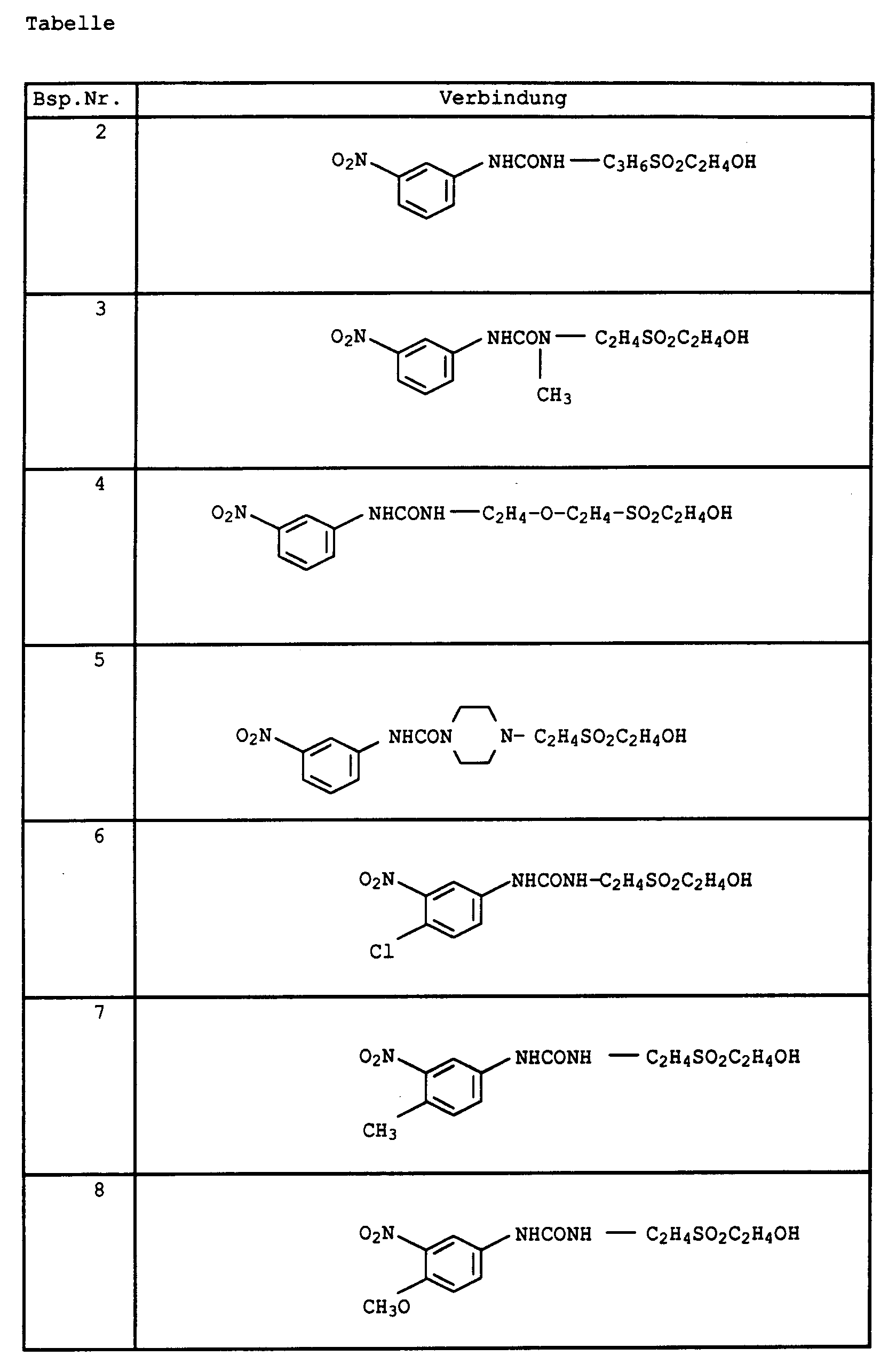
- Die in der Tabelle angeführten Verbindungen sind ebenfalls nach dem in Beispiel 15 beschriebenen Weg erhältlich.
- 285 g der Verbindung der Formel

wurden mit 408 g Acetanhydrid auf 95°C erhitzt. Nach beendeter Umsetzung (DC-Kontrolle) wurde das überschüssige Acylierungsmittel mit Wasser zerstört und der sich bildende Niederschlag bei Raumtemperatur abgesaugt. Es wurden 323 g der Verbindung der Formel
erhalten. Schmp.: 161-163°C - In analoger Weise können die folgenden Derivate hergestellt werden:


in der R¹, R², R³, R⁴ und der Ring A jeweils die obengenannte Bedeutung besitzen, mit einem Amin der Formel III

in der n, R⁵, L und Z jeweils die obengenannte Bedeutung besitzen, bei einer Temperatur von 80 bis 180°C gegebenenfalls in Gegenwart eines inerten Verdünnungsmittels umsetzt.
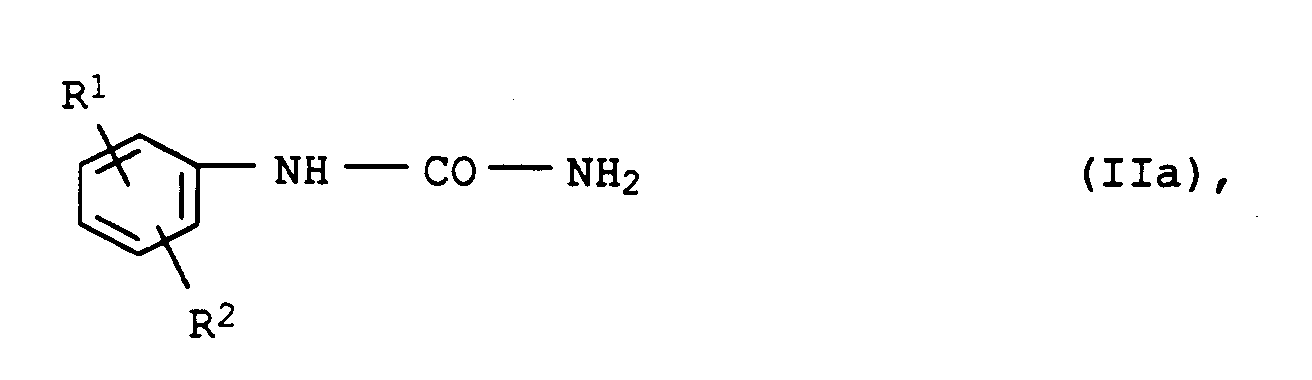
in der R¹ und R² jeweils die obengenannte Bedeutung besitzen, mit einem Amin der Formel IIIa
H₂N―L―S(O)n―C₂H₄―OH (IIIa),
in der n und L jeweils die obengenannte Bedeutung besitzen, umsetzt.

Claims (3)
- Verfahren zur Herstellung von Harnstoffen der Formel I
 n 0 oder 2,R¹,R² und R³ unabhängig voneinander jeweils Wasserstoff, C₁-C₄-Alkyl, C₁-C₄-Alkoxy, Halogen, Hydroxy, Hydroxysulfonyl, Carboxyl, Cyano, Nitro, C₂-C₄-Alkanoylamino oder C₁-C₄-AlkoxycarbonylaminoR⁴ und R⁵ unabhängig voneinander jeweils Wasserstoff, C₁-C₄-Alkyl oder Phenyl,L C₂-C₄-Alkylen, das gegebenenfalls einmal durch Sauerstoff, Imino oder N-(C₁-C₄-Alkyl)imino unterbrochen ist, oder NR⁵ und L zusammen den Rest der Formel
 Z Hydroxy oder eine unter alkalischen Reaktionsbedingungen abspaltbare Gruppe bedeuten undder Ring A benzoanelliert sein kann,
dadurch gekennzeichnet, daß man einen Phenylharnstoff der Formel II

- Verfahren nach Anspruch 1, dadurch gekennzeichnet, daß man die Umsetzung in Gegenwart eines inerten Verdünnungsmittels durchführt.
- Verfahren nach Anspruch 1, dadurch gekennzeichnet, daß man die Umsetzung bei einer Temperatur von 95 bis 150°C durchführt.
Applications Claiming Priority (2)
| Application Number | Priority Date | Filing Date | Title |
|---|---|---|---|
| DE4233033 | 1992-10-01 | ||
| DE4233033A DE4233033A1 (de) | 1992-10-01 | 1992-10-01 | Verfahren zur Herstellung von aromatischen Harnstoffen, die eine Thioether- oder Sulfonylgruppe aufweisen |
Publications (2)
| Publication Number | Publication Date |
|---|---|
| EP0590555A1 EP0590555A1 (de) | 1994-04-06 |
| EP0590555B1 true EP0590555B1 (de) | 1996-01-24 |
Family
ID=6469399
Family Applications (1)
| Application Number | Title | Priority Date | Filing Date |
|---|---|---|---|
| EP93115520A Expired - Lifetime EP0590555B1 (de) | 1992-10-01 | 1993-09-25 | Verfahren zur Herstellung von aromatischen Harnstoffen, die eine Thioeter-oder Sulfonylgruppe aufweisen |
Country Status (4)
| Country | Link |
|---|---|
| US (1) | US5380941A (de) |
| EP (1) | EP0590555B1 (de) |
| JP (1) | JPH06211778A (de) |
| DE (2) | DE4233033A1 (de) |
Families Citing this family (2)
| Publication number | Priority date | Publication date | Assignee | Title |
|---|---|---|---|---|
| DE4234900A1 (de) * | 1992-10-16 | 1994-04-21 | Basf Ag | Reaktivfarbstoffe auf Formazanbasis, die mindestens zwei reaktive Gruppen aufweisen, sowie Aminophenole |
| CA2298617A1 (en) * | 1997-07-31 | 1999-02-11 | Yetunde Olabisi Taiwo | Acyclic metalloprotease inhibitors |
Family Cites Families (6)
| Publication number | Priority date | Publication date | Assignee | Title |
|---|---|---|---|---|
| BE791449A (fr) * | 1971-11-17 | 1973-05-16 | Roussel Uclaf | Nouvelles urees substituees et procede de |
| EP0174909B1 (de) * | 1984-08-30 | 1991-10-16 | Ciba-Geigy Ag | Reaktivfarbstoffe, deren Herstellung und Verwendung |
| US5091016A (en) * | 1988-04-11 | 1992-02-25 | Serv-Tech, Inc. | Method for dispersing sediment contained in a storage tank |
| DE4107692A1 (de) * | 1991-03-09 | 1992-09-17 | Basf Ag | Verdoppelte phenylazo- oder naphthylazobenzole mit mehreren reaktiven gruppen sowie deren zwischenprodukte |
| DE4116785A1 (de) * | 1991-05-23 | 1992-11-26 | Basf Ag | Phenylazo- oder naphthylazobenzole mit mehreren reaktiven ankern |
| AT397384B (de) * | 1991-08-16 | 1994-03-25 | Chemie Linz Gmbh | Verfahren zur herstellung reiner n,n'-unsymmetrisch substituierter phenylharnstoffe |
-
1992
- 1992-10-01 DE DE4233033A patent/DE4233033A1/de not_active Withdrawn
-
1993
- 1993-09-25 DE DE59301502T patent/DE59301502D1/de not_active Expired - Fee Related
- 1993-09-25 EP EP93115520A patent/EP0590555B1/de not_active Expired - Lifetime
- 1993-09-29 JP JP5242546A patent/JPH06211778A/ja active Pending
- 1993-10-01 US US08/130,176 patent/US5380941A/en not_active Expired - Fee Related
Also Published As
| Publication number | Publication date |
|---|---|
| DE59301502D1 (de) | 1996-03-07 |
| EP0590555A1 (de) | 1994-04-06 |
| US5380941A (en) | 1995-01-10 |
| JPH06211778A (ja) | 1994-08-02 |
| DE4233033A1 (de) | 1994-04-07 |
Similar Documents
| Publication | Publication Date | Title |
|---|---|---|
| EP0590555B1 (de) | Verfahren zur Herstellung von aromatischen Harnstoffen, die eine Thioeter-oder Sulfonylgruppe aufweisen | |
| EP0311969B1 (de) | Verfahren zur Herstellung von Triphendioxazinen | |
| EP0375617B1 (de) | Verfahren zur Herstellung von Pyrimidinderivaten | |
| EP0711754B1 (de) | Verfahren zur Herstellung von 2-Chlor-6-nitrophenyl-alkylsulfanen und neue 2-Chlor-6-nitrophenyl-alkyl-sulfane | |
| EP0731089B1 (de) | Anilinderivate | |
| EP0437699B1 (de) | Phenylazo- oder Naphthylazobenzole mit mehreren reaktiven Gruppen sowie deren Zwischenprodukte | |
| EP0252350B1 (de) | 3-Cyanochinolinderivate | |
| EP0146007B1 (de) | Verfahren zur Herstellung von 5-Oxethylsulfonyl-2-amino-phenol(-ethern) | |
| EP0587030B1 (de) | Reaktivfarbstoffe auf Formazanbasis sowie Hydrazone | |
| EP0570780B1 (de) | Chlorethylsulfonylbenzaldehyde | |
| EP0552605A1 (de) | Gemischte Oxalsäurediamide | |
| EP0299329A2 (de) | Verfahren zur Herstellung von 2-Arylthiobenzoesäuren | |
| DE3828824A1 (de) | Wasserloesliche triphendioxazin-verbindungen und deren sulfonylgruppenhaltigen vorprodukte, verfahren zu deren herstellung und verwendung der triphendioxazine als farbstoffe | |
| DE4405056A1 (de) | Verfahren zur Herstellung von Harnstoffen, die eine Thioether- oder Sulfonylgruppe aufweisen | |
| EP0680951A2 (de) | Schwefelhaltige Verbindungen | |
| EP0630947A1 (de) | Phenylazo- oder Naphthylazobenzole mit Thioethergruppen | |
| DE4234900A1 (de) | Reaktivfarbstoffe auf Formazanbasis, die mindestens zwei reaktive Gruppen aufweisen, sowie Aminophenole | |
| DE4404743A1 (de) | Verfahren zur Herstellung von Harnstoffen, die eine Thioether- oder Sulfonylgruppe aufweisen | |
| EP0489299B1 (de) | Arylsulfonylverbindungen, die ungesättigte Reste aufweisen | |
| EP0327981B1 (de) | Verfahren zur Herstellung von 2-Cyano-3-aminoacrylnitril-Derivaten | |
| EP0274353B1 (de) | Verfahren zur Herstellung von Benzoinsulfonaten | |
| EP0306869B1 (de) | Verfahren zur Herstellung von Halogenisatosäureanhydriden | |
| EP0712841A1 (de) | Verfahren zur Herstellung von 3-(N-Aryl-amino)-propyl-2'-sulfatoethyl-sulfonyl-Verbindungen | |
| US5393913A (en) | N-formylanilines | |
| CH631442A5 (de) | Verfahren zur herstellung von 2-hydroxycarbazolen. |
Legal Events
| Date | Code | Title | Description |
|---|---|---|---|
| PUAI | Public reference made under article 153(3) epc to a published international application that has entered the european phase |
Free format text: ORIGINAL CODE: 0009012 |
|
| 17P | Request for examination filed |
Effective date: 19940104 |
|
| AK | Designated contracting states |
Kind code of ref document: A1 Designated state(s): BE CH DE FR GB IT LI |
|
| 17Q | First examination report despatched |
Effective date: 19950329 |
|
| GRAA | (expected) grant |
Free format text: ORIGINAL CODE: 0009210 |
|
| AK | Designated contracting states |
Kind code of ref document: B1 Designated state(s): BE CH DE FR GB IT LI |
|
| REF | Corresponds to: |
Ref document number: 59301502 Country of ref document: DE Date of ref document: 19960307 |
|
| GBT | Gb: translation of ep patent filed (gb section 77(6)(a)/1977) |
Effective date: 19960221 |
|
| ITF | It: translation for a ep patent filed | ||
| ET | Fr: translation filed | ||
| PLBE | No opposition filed within time limit |
Free format text: ORIGINAL CODE: 0009261 |
|
| 26N | No opposition filed | ||
| PGFP | Annual fee paid to national office [announced via postgrant information from national office to epo] |
Ref country code: FR Payment date: 19970814 Year of fee payment: 5 |
|
| PGFP | Annual fee paid to national office [announced via postgrant information from national office to epo] |
Ref country code: BE Payment date: 19970909 Year of fee payment: 5 |
|
| PGFP | Annual fee paid to national office [announced via postgrant information from national office to epo] |
Ref country code: GB Payment date: 19970915 Year of fee payment: 5 |
|
| PG25 | Lapsed in a contracting state [announced via postgrant information from national office to epo] |
Ref country code: GB Free format text: LAPSE BECAUSE OF NON-PAYMENT OF DUE FEES Effective date: 19980925 |
|
| PG25 | Lapsed in a contracting state [announced via postgrant information from national office to epo] |
Ref country code: BE Free format text: LAPSE BECAUSE OF NON-PAYMENT OF DUE FEES Effective date: 19980930 |
|
| BERE | Be: lapsed |
Owner name: BASF A.G. Effective date: 19980930 |
|
| GBPC | Gb: european patent ceased through non-payment of renewal fee |
Effective date: 19980925 |
|
| PG25 | Lapsed in a contracting state [announced via postgrant information from national office to epo] |
Ref country code: FR Free format text: LAPSE BECAUSE OF NON-PAYMENT OF DUE FEES Effective date: 19990531 |
|
| REG | Reference to a national code |
Ref country code: FR Ref legal event code: ST |
|
| PGFP | Annual fee paid to national office [announced via postgrant information from national office to epo] |
Ref country code: DE Payment date: 20010706 Year of fee payment: 9 Ref country code: CH Payment date: 20010706 Year of fee payment: 9 |
|
| PG25 | Lapsed in a contracting state [announced via postgrant information from national office to epo] |
Ref country code: LI Free format text: LAPSE BECAUSE OF NON-PAYMENT OF DUE FEES Effective date: 20020930 Ref country code: CH Free format text: LAPSE BECAUSE OF NON-PAYMENT OF DUE FEES Effective date: 20020930 |
|
| PG25 | Lapsed in a contracting state [announced via postgrant information from national office to epo] |
Ref country code: DE Free format text: LAPSE BECAUSE OF NON-PAYMENT OF DUE FEES Effective date: 20030401 |
|
| REG | Reference to a national code |
Ref country code: CH Ref legal event code: PL |
|
| PG25 | Lapsed in a contracting state [announced via postgrant information from national office to epo] |
Ref country code: IT Free format text: LAPSE BECAUSE OF NON-PAYMENT OF DUE FEES;WARNING: LAPSES OF ITALIAN PATENTS WITH EFFECTIVE DATE BEFORE 2007 MAY HAVE OCCURRED AT ANY TIME BEFORE 2007. THE CORRECT EFFECTIVE DATE MAY BE DIFFERENT FROM THE ONE RECORDED. Effective date: 20050925 |