EP0591232B1 - Sulfatierungsbeständiger oxidationskatalysator - Google Patents
Sulfatierungsbeständiger oxidationskatalysator Download PDFInfo
- Publication number
- EP0591232B1 EP0591232B1 EP92909637A EP92909637A EP0591232B1 EP 0591232 B1 EP0591232 B1 EP 0591232B1 EP 92909637 A EP92909637 A EP 92909637A EP 92909637 A EP92909637 A EP 92909637A EP 0591232 B1 EP0591232 B1 EP 0591232B1
- Authority
- EP
- European Patent Office
- Prior art keywords
- catalyst
- titania
- zirconia
- silica particles
- silica
- Prior art date
- Legal status (The legal status is an assumption and is not a legal conclusion. Google has not performed a legal analysis and makes no representation as to the accuracy of the status listed.)
- Expired - Lifetime
Links
Images

Classifications
-
- B—PERFORMING OPERATIONS; TRANSPORTING
- B01—PHYSICAL OR CHEMICAL PROCESSES OR APPARATUS IN GENERAL
- B01J—CHEMICAL OR PHYSICAL PROCESSES, e.g. CATALYSIS OR COLLOID CHEMISTRY; THEIR RELEVANT APPARATUS
- B01J21/00—Catalysts comprising the elements, oxides, or hydroxides of magnesium, boron, aluminium, carbon, silicon, titanium, zirconium, or hafnium
- B01J21/06—Silicon, titanium, zirconium or hafnium; Oxides or hydroxides thereof
- B01J21/066—Zirconium or hafnium; Oxides or hydroxides thereof
-
- B—PERFORMING OPERATIONS; TRANSPORTING
- B01—PHYSICAL OR CHEMICAL PROCESSES OR APPARATUS IN GENERAL
- B01D—SEPARATION
- B01D53/00—Separation of gases or vapours; Recovering vapours of volatile solvents from gases; Chemical or biological purification of waste gases, e.g. engine exhaust gases, smoke, fumes, flue gases, aerosols
- B01D53/34—Chemical or biological purification of waste gases
- B01D53/74—General processes for purification of waste gases; Apparatus or devices specially adapted therefor
- B01D53/86—Catalytic processes
- B01D53/8603—Removing sulfur compounds
- B01D53/8609—Sulfur oxides
-
- B—PERFORMING OPERATIONS; TRANSPORTING
- B01—PHYSICAL OR CHEMICAL PROCESSES OR APPARATUS IN GENERAL
- B01D—SEPARATION
- B01D53/00—Separation of gases or vapours; Recovering vapours of volatile solvents from gases; Chemical or biological purification of waste gases, e.g. engine exhaust gases, smoke, fumes, flue gases, aerosols
- B01D53/34—Chemical or biological purification of waste gases
- B01D53/92—Chemical or biological purification of waste gases of engine exhaust gases
- B01D53/94—Chemical or biological purification of waste gases of engine exhaust gases by catalytic processes
- B01D53/944—Simultaneously removing carbon monoxide, hydrocarbons or carbon making use of oxidation catalysts
-
- B—PERFORMING OPERATIONS; TRANSPORTING
- B01—PHYSICAL OR CHEMICAL PROCESSES OR APPARATUS IN GENERAL
- B01J—CHEMICAL OR PHYSICAL PROCESSES, e.g. CATALYSIS OR COLLOID CHEMISTRY; THEIR RELEVANT APPARATUS
- B01J21/00—Catalysts comprising the elements, oxides, or hydroxides of magnesium, boron, aluminium, carbon, silicon, titanium, zirconium, or hafnium
- B01J21/06—Silicon, titanium, zirconium or hafnium; Oxides or hydroxides thereof
- B01J21/063—Titanium; Oxides or hydroxides thereof
-
- B—PERFORMING OPERATIONS; TRANSPORTING
- B01—PHYSICAL OR CHEMICAL PROCESSES OR APPARATUS IN GENERAL
- B01J—CHEMICAL OR PHYSICAL PROCESSES, e.g. CATALYSIS OR COLLOID CHEMISTRY; THEIR RELEVANT APPARATUS
- B01J23/00—Catalysts comprising metals or metal oxides or hydroxides, not provided for in group B01J21/00
- B01J23/38—Catalysts comprising metals or metal oxides or hydroxides, not provided for in group B01J21/00 of noble metals
- B01J23/40—Catalysts comprising metals or metal oxides or hydroxides, not provided for in group B01J21/00 of noble metals of the platinum group metals
- B01J23/42—Platinum
Definitions
- the present invention relates to an oxidation catalyst which is resistant to sulfur oxides.
- the present invention is directed to an oxidation catalyst useful in purifying exhaust and waste gases and, more specifically, to an oxidation catalyst capable of converting carbon monoxide and hydrocarbons to carbon dioxide and water with high efficiency even in the presence of sulfur oxides.
- the present invention also relates to a process for converting carbon monoxide and hydrocarbons such as contained in exhaust or waste gas streams to carbon dioxide and water even when the exhaust or waste gas streams contain sulfur oxide components.
- the invention is also directed to a process for converting sulfur dioxide to sulfur trioxide using the novel sulfur-resistant oxidation catalyst of the present invention.
- Hydrocarbon and CO abatement in various waste and exhaust gas streams may be accomplished by reacting the waste or exhaust gas with air over a platinum-containing catalyst.
- a catalyst similar to the auto exhaust catalyst which is comprised of platinum supported on alumina supports or alumina-containing supports which are often deposited over a ceramic honeycomb.
- WO-A-90/00439 discusses the use of such catalysts for treating diesel exhausts.
- Such catalysts are effective oxidation catalysts and deactivation of such catalysts is minimal when the waste or exhaust gas is devoid of sulfur oxides, to be referred to as SO x , including SO 2 .
- oxidation catalysts which contain catalytic metals on refractory oxide supports other than alumina.
- supports comprising silica, titania, zirconia and mixtures of these oxides are known and such supports including the binary and ternary mixtures of the above oxides are known to be resistant to SO x .
- a precious metal such as platinum on a silica support.
- the weak interaction between silica and precious metals results in severe precious metal sintering at very moderate conditions drastically reducing the surface area and, thus, activity of the precious metal catalyst.
- titania and zirconia interact with precious metals to significantly reduce sintering of the precious metal
- the high initial surface area of both zirconia and titania is drastically reduced after calcination at 500°C.
- the loss in surface area of zirconia and titania at typical reactive oxidation conditions is unfavorable inasmuch as the loss in surface area results again in the sintering of the precious metal and deactivation of the catalyst.
- WO-A-90/05579 discloses a process for the oxidative removal of carbon monoxide and hydrocarbons from waste gases, which may possibly contain sulfur oxides, which process comprises contacting the waste gas in an oxidizing atmosphere at a temperature below 500°C in the presence of a catalyst comprising at least one platinum-group metal (e.g. platinum, palladium or rhodium) supported on at least one of silica, zirconia, titania, zeolite and alpha alumina.
- platinum-group metal e.g. platinum, palladium or rhodium
- WO-A-91/18832 which includes the designations DE and GB and which was published on 12 December 1991, discusses the use of a silica-based monolithic catalyst which includes a compound of titanium or zirconium, with platinum, for the conversion of SO 2 to SO 3 .
- Yet another object of the present invention is to utilize a sulfur-resistant carbon monoxide oxidation catalyst in a process for purifying waste and exhaust gas streams of hydrocarbons and carbon monoxide.
- Yet still another object of the present invention is to provide a process for effectively oxidizing SO 2 to SO 3 in the presence of a stabilized oxidation catalyst.
- an oxidation catalyst which is resistant to deactivation by sulfur oxides and which is useful in the oxidation of carbon monoxide and hydrocarbons such as are present in waste and exhaust gas streams which further contain SO x .
- the catalyst of this invention is also useful in oxidizing SO 2 to SO 3 .
- the present invention provides a sulfur-resistant oxidation catalyst comprising silica particles, a coating of titania or zirconia or a mixture thereof or precursors of said oxides on said silica particles and at least one precious metal supported on said coated silica particles.
- the present invention also provides a process for purifying a waste or exhaust gas stream of carbon monoxide, hydrocarbons or both, wherein said waste or exhaust gas stream also contains SO x components, comprising contacting said waste or exhaust gas stream with an O 2 -containing gas at a temperature sufficient to cause oxidation of said carbon monoxide and/or hydrocarbons and in the presence of a sulfur-resistant oxidation catalyst, said oxidation catalyst comprising silica particles coated with titania or zirconia or a mixture thereof or precursors of said oxides and at least one precious metal supported on said coated silica particles.
- the present invention also provides a process for oxidizing gaseous sulfur-containing compounds to SO 2 , SO 3 or mixtures thereof comprising contacting said gaseous sulfur-containing compounds in an O 2 -containing gas at a temperature sufficient to oxidize said sulfur-containing compounds and in the presence of a sulfur-resistant oxidation catalyst, said catalyst comprising silica particles, a coating of titania or zirconia or a mixture thereof or precursors of said oxides and at least one precious metal supported on said coated silica particles.
- the catalyst of this invention comprises refractory silica particles which have been coated with titania, zirconia or mixtures thereof and upon which coated silica particles there is supported a Group VIII precious metal including but not limited to platinum, palladium and rhodium.
- the coated particulate catalyst is then coated on a ceramic honeycomb support as a washcoat for use.
- An important feature of the invention is the coating of titania or zirconia on the refractory silica particles.
- the titania and zirconia coating is achieved by adding a titanium or zirconium salt to coat and/or impregnate the silica particles, and calcining in air to convert the metal salt to the respective oxide.
- the precious metal is subsequently added to the coated silica by known means.
- the precious metal can be applied to silica particles which have been coated with titania or zirconia precursors, i.e. precipitated Ti or Zr salts, that will be converted to the respective oxides during calcination after the precious metal is applied or during use of the catalyst.
- titania or zirconia precursors i.e. precipitated Ti or Zr salts
- the coating of titania or zirconia stabilizes the silica against sintering and provides a surface where precious metal sintering is minimized.
- the silica stabilizes the titania or zirconia coating against sintering at elevated temperatures.
- the washcoat of coated silica particles on the honeycomb is advantageous inasmuch as the precious metal is dispersed throughout the thickness of washcoat layer.
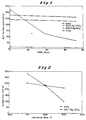
- Figure 1 is a graph illustrating the 800°C heat-aged stability of silica, zirconia and mixtures thereof.
- Figure 2 is a graph illustrating the two hour heat-aged stability of silica relative to mixtures of titania and silica.
- Figure 3 is a graph illustrating the 2% platinum dispersion on the catalyst of this invention relative to the amount of zirconia added to the silica support.
- Figure 4 is a graph comparing SO 2 oxidation using the catalysts of this invention relative to a catalyst comprising 2% Pt/SiO 2 .
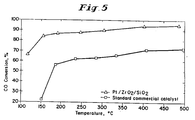
- Figure 5 is a graph illustrating the effectiveness of the catalyst of this invention in oxidizing CO upon aging of the catalyst with SO 2 compared to the effectiveness of a standard commercial catalyst.
- the oxidation catalyst of the present invention finds its preferred use in oxidizing carbon monoxide and hydrocarbons contained in exhaust and waste gas streams for conversion to CO 2 and water and wherein the waste and exhaust gas streams contain sulfur oxide compounds (SO x ).
- the catalyst of this invention is particularly useful in purifying exhaust gas from cogeneration units.
- the alumina refractory base typically used in commercially available oxidation catalysts is replaced with silica which is stabilized by the addition of titania or zirconia to yield a base which can effectively anchor the precious metal component and is resistant to SO x degradation and deactivation.
- the catalyst can also be used to oxidize gaseous sulfur-containing compounds to SO 2 , SO 3 or mixtures thereof which has particular importance in various commercial applications involving the formation of sulfur-containing compounds including sulfuric acid and in the formation of various surface active agents. Moreover, oxidation of SO 2 to SO 3 is valuable in cleaning exhaust and waste gas streams of sulfur as the SO 3 is substantially easier to remove than SO 2 .
- the silica substrate is in the form of a refractory particulate having a sufficient surface area to be catalytically active, e.g. > 10 m 2 /g, and is stabilized by coating the refractory silica particulate with titanium or zirconium oxide or a mixture thereof.
- the starting materials for the zirconia and titania coating are preferably in the form of metal salts which are coated onto the particulate silica surface and which are then converted to the oxide by calcination in an O 2 -containing gas such as air.
- Useful inorganic salts can include the chlorides, nitrates and sulfates of the respective metals.
- Organic acid salts such as the acetates, oxalates, etc. are also useful.
- the coated silica is calcined at a temperature typically above 500°C.
- the source for the zirconia and titania coating can be colloidal titania and zirconia.
- the silica particles can be slurried with a titanium or zirconium salt solution as described above and then treated to precipitate a titanium or zirconium oxide precursor salt onto the surface of the silica prior to the addition of the precious metal.
- the titanium and zirconium precursor salt can be converted to the oxide subsequent to the addition of the precious metal.
- this further alternative method involves the addition of any titanium and zirconium compound which is a precursor for titania or zirconia and which corresponding oxide can be formed prior to precious metal addition, subsequent to precious metal addition and even during the use of the catalyst.
- the titania and zirconia addition to the silica be in the form of coating and/or impregnated into the silica.
- methods of forming mixed gels or co-precipitates of zirconia and/or titania with silica are not believed to be sufficient to provide the improvements in catalyst stability which have been found using the catalyst as prepared by the coating processes as above described.
- methods of co-precipitating or co-gelling titania or zirconia with silica are not considered part of the present invention.
- the titania and zirconia should comprise greater than 5 wt.% of the stabilized silica. Coating weights of 10 to 25 wt.% are preferred to sufficiently provide the necessary stabilization. Coating weights above 25% are not believed to provide any substantial increase in stability although coating weights above 25% can be used as no detriment in catalyst stability or effectiveness is believed to occur at the higher coating loadings. Coating weights of greater than 5 wt.% to 25 wt.% correspond to 0.17 mg/m 2 of BET surface area to 0.83 mg/m 2 of BET surface area.
- the stabilized silica is coated with the precious metal component.
- precious metals for the oxidation catalyst of this invention include platinum, palladium, ruthenium, iridium, rhodium, or a mixture thereof.
- the precious metal component can be added to the stabilized silica by an impregnation method, a kneading method or the like conventionally used method. A method of impregnation is preferred. It is preferable to add the precious metal component on the stabilized silica in an amount of from about 0.1 to 3% by weight based on the weight of the catalyst.
- salts and complexes of precious metals such as chloroplatinic acid, platinum-amine complexes, as well as the chlorides and nitrates of the various precious metals.
- the catalyst of this invention containing the precious metal dispersed upon the titania- or zirconia-stabilized silica particulate itself is applied as a layer or multiple layers of coated silica particles on a carrier such as a refractory honeycomb carrier.
- a carrier such as a refractory honeycomb carrier.
- the catalyst is dispersed within a liquid wash coat which then impregnates the honeycomb carrier by methods well known in the art.
- This supported catalyst is preferred as the precious metal is highly dispersed throughout the washcoat and is not merely applied as a surface coating that is more readily damaged and deactivated.
- the coated particulate catalyst of this invention may also be molded such as by a tableting method, an extrusion method, a rolling granulated method and the like conventionally used method to form a catalyst having any desired shape such as cylinder, sheet, ribbing, corrugated sheet, donut, grid, etc. such instances, if desired, the catalyst of this invention can be supported on well known carriers such as alumina, silica, silica-alumina, bentonite, diatomaceous earth, silicon carbide, titania, zirconia, magnesia, pumice and active carbon.
- X-ray diffraction (XRD) of ZrO 2 /SiO 2 base as prepared by this invention shows that the zirconia produced on the silica surface yielded a diffraction pattern which matched tetragonal zirconia (beta zirconia).
- the beta phase is usually formed by calcining pure zirconia at temperatures of 1000°C or higher compared to monoclinic zirconia (baddeleyite) which is formed at lower temperatures. Stabilization of the zirconia by silica assures that the silica will remain covered with ZrO 2 , thus, minimizing the interaction of the precious metal such as platinum with the silica base.
- Titania (TiO 2 ) in the anatase phase is stable at temperatures less than 500°C. Surprisingly, it has been found that TiO 2 supported on SiO 2 was present in the anatase phase even after calcination in air at 900°C for several hours. The average titania crystallite size, measured by XRD, remained less than 40 ⁇ (4 nm) after calcination at 500°C. This clearly indicates that the titania, in the anatase phase, is highly dispersed and stabilized by the silica. It is interesting to note that the anatase titania is the least stable titania phase. On the contrary, a binary titania-silica prepared from a cogel, with similar chemical composition, was completely amorphous with no titania XRD pattern.
- the function of highly dispersed zirconia or titania coating on the silica is to anchor the precious metal. This minimizes precious metal sintering and, thus, allows the catalyst to retain high activity at reaction conditions.
- Silica is a neutral support for precious metals deposition. The weak interaction between SiO 2 and precious metal results in severe precious metal sintering at very moderate conditions. On the contrary, TiO 2 and ZrO 2 interact with precious metals to significantly reduce precious metal sintering.
- a major problem, however, in using zirconia or titania as a sole support for precious metals is the loss in support surface area at reaction conditions.
- covering the silica particulate with stable metal oxides such as ZrO 2 or TiO 2 using the preparation procedure as described above with respect to the present invention is very favorable relative to reducing precious metal sintering. Covering the silica surface with ZrO 2 or TiO 2 is therefore essential for higher precious metal dispersion and superior catalytic performance. The extent of the silica surface covered depends primarily on the preparation procedure as well as on the amount of Tio 2 or ZrO 2 used.
- Pt/TiO 2 /SiO 2 A catalyst was prepared by adding 635 g of Tyzor LA (A titania compound from Dupont containing 14.2% TiO 2 ) to 410 g of silica particles (SYLOID 74 from Davison), mixing well for 1 hour followed by drying and calcination at 700°C. 54.3 g of Pt amine salt was diluted with water to make approximately 8 g of Pt solution. The TiO 2 /SiO 2 was mixed with the Pt solution and the Pt fixed on the catalyst by addition of an acetic acid solution. Water was then added to make a 30% solid slurry and the slurry applied onto a honeycomb to give a final product of 38 g of Pt/cu. ft (1342 g/m 3 ). The catalyst was dried and calcined at 500°C. This catalyst was identified as Catalyst A.
- Catalysts A and B were tested fresh (virgin) for CO oxidation at several temperatures.
- the CO concentration was 250 ppm with a Gas Hourly Space Velocity of 600,000 hr -1 .
- the results of the test are given in Table 2.
- Catalysts A and B were tested for CO oxidation in the presence of 200 ppm of SO 2 . This experiment mimicked cogeneration unit operation. The CO light off temperature as well as the CO conversion at several reaction temperatures is given in Table 3. TABLE 3 Catalyst GHSV CO ppm SO 2 ppm Light Off T (°C) % CO Conversion @ Temp. (°C) 100 150 200 250 A 500,000 250 200 250 0 15 47 50 B 500,000 250 200 >260 0 7 25 45
- the non-alumina based support had lower light off temperature as well as higher CO conversion at all temperatures tested. This clearly indicates that in the presence of SO 2 , the catalyst per this invention is more active than catalyst B in converting CO and is less susceptible to sulfation.
- Alumina based catalyst sulfates forms aluminum sulfates which results in catalyst deactivation.
- Catalysts A and B were aged in SO 2 /steam at 950°F for 16 hours to determine the effect of sulfation on their performance.
- the catalysts were aged for 16 hours in 2% SO 2 , 88% air, and 10% steam.
- the catalysts were then tested for CO oxidation in the absence of SO 2 .
- the results in Table 4 clearly indicate that the TiO 2 /SiO 2 based catalysts have higher tolerance for the SO 2 /steam compared to the alumina supported catalyst.
- TABLE 4 Catalyst CO ppm Light Off T (°C) % CO Conversion @ Temp. (°C) 100 150 200 250 300 A 250 140 45 52 55 57 60 B 250 200 10 30 50 57 62
- This example illustrates the synthesis procedure for 2% Pt/25% ZrO 2 /SiO 2 .
- zirconyl nitrate 330 g was dissolved in 480 ml of hot water. 400 g of SiO 2 particles (SYLOID 74 from Davison) were mixed with the zirconyl nitrate solution for at least one hour to impregnate the silica. The mixture was dried at 120°C for 16 hours and calcined at 880°C.
- Fig. 5 shows the CO conversion of the above catalyst after exposure to SO x .
- the standard commercial catalyst used was catalyst B above. As can be seen, the catalyst of this invention had a substantially higher activity than the alumina-containing catalyst.
Landscapes
- Chemical & Material Sciences (AREA)
- Engineering & Computer Science (AREA)
- Chemical Kinetics & Catalysis (AREA)
- Environmental & Geological Engineering (AREA)
- Organic Chemistry (AREA)
- Materials Engineering (AREA)
- Health & Medical Sciences (AREA)
- Biomedical Technology (AREA)
- Analytical Chemistry (AREA)
- General Chemical & Material Sciences (AREA)
- Oil, Petroleum & Natural Gas (AREA)
- Combustion & Propulsion (AREA)
- Catalysts (AREA)
- Exhaust Gas Treatment By Means Of Catalyst (AREA)
- Organic Low-Molecular-Weight Compounds And Preparation Thereof (AREA)
- Low-Molecular Organic Synthesis Reactions Using Catalysts (AREA)
Claims (17)
- Gegen Schwefel beständiger Oxidationskatalysator, der umfaßt Siliciumdioxid-Teilchen, einen Überzug aus Titandioxid oder Zirkoniumdioxid oder einer Mischung davon oder Vorläufern der genannten Oxide auf den genannten Siliciumdioxid-Teilchen und mindestens ein Edelmetall, das auf die genannten beschichteten Siliciumdioxid-Teilchen als Träger aufgebracht ist.
- Katalysator nch Anspruch 1, worin der genannte Titandioxid- oder Zirkoniumdioxid-Überzug in einer Menge von mindestens 5 Gew.-%, bezogen auf die genannten beschichteten Siliciumdioxid-Teilchen, vorliegt.
- Katalysator nach Anspruch 2, worin der genannte Titandioxid- oder Zirkoniumdioxid-Überzug in einer Menge von mindestens 10 Gew.-%, bezogen auf die genannten beschichteten Siliciumdioxid-Teilchen, vorliegt.
- Katalysator nach Anspruch 3, worin der genannte Titandioxid- oder Zirkoniumdioxid-Überzug in einer Menge von 10 bis 25 Gew.-%, bezogen auf die genannten beschichteten Siliciumdioxid-Teilchen, vorliegt.
- Katalysator nach einem der Ansprüche 1 bis 4, worin der genannte Titandioxid- oder Zirkoniumdioxid-Überzug in Form eines Titan- oder Zirkoniumsalzes aufgebracht worden ist, das in einem Sauerstoff enthaltenden Gas calciniert worden ist unter Bildung des jeweiligen Metalloxids.
- Katalysator nach einem der Ansprüche 1 bis 5, worin das genannte Edelmetall Platin ist.
- Katalysator nach einem der Ansprüche 1 bis 6, der umfaßt einen wabenförmigen Keramik-Träger, der mit einem Glasurüberzug (Waschüberzug) beschichtet ist, der die genannten beschichteten Siliciumdioxid-Teilchen enthält.
- Verfahren zur Reinigung eines Abfallgas- oder Abgas-Stromes von Kohlenmonoxid, Kohlenwasserstoffen oder beiden, worin der Abfallgas- oder Abgas-Strom außerdem SOx-Komponenten enthält, das umfaßt das Kontaktieren des genannten Abfallgas- oder Abgas-Stromes mit einem O2 enthaltenden Gas bei einer Temperatur, die ausreicht, um eine Oxidation des genannten Kohlenmonoxids und/oder der genannten Kohlenwasserstoffe zu bewirken in Gegenwart eines gegen Schwefel beständigen Oxidationskatalysators, der umfaßt Siliciumdioxid-Teilchen, die mit Titandioxid oder Zirkoniumdioxid oder einer Mischung davon oder Vorläufern der genannten Oxide beschichtet sind, und mindestens ein Edelmetall, das auf die genannten beschichteten Siliciumdioxid-Teilchen als Träger aufgebracht ist.
- Verfahren zur Oxidation von gasförmigen, Schwefel enthaltenden Verbindungen zu SO2, SO3 oder Mischungen davon, das umfaßt das Kontaktieren der genannten gasförmigen, Schwefel enthaltenden Verbindungen mit einem O2 enthaltenden Gas bei einer Temperatur, die ausreicht, um die genannten Schwefel enthaltenden Verbindungen zu oxidieren in Gegenwart eines gegen Schwefel beständigen Oxidationskatalysators, der umfaßt Siliciumdioxid-Teilchen, einen Überzug aus Titandioxid oder Zirkoniumdioxid oder einer Mischung davon oder Vorläufern der genannten Oxide und mindestens ein Edelmetall, das auf die genannten beschichteten Siliciumdioxid-Teilchen als Träger aufgebracht ist.
- Verfahren nach Anspruch 8 oder 9, worin der genannte Titandioxid- oder Zirkoniumdioxid-Überzug in einer Menge von mindestens 5 Gew.-%, bezogen auf das genannte beschichtete Siliciumdioxid, vorliegt.
- Verfahren nach Anspruch 10, worin der Titandioxid- oder Zirkoniumdioxid-Überzug in einer Menge von mindestens 10 Gew.-%, bezogen auf das genannte beschichtete Siliciumdioxid, vorliegt.
- Verfahren nach Anspruch 11, worin der genannte Titandioxid- oder Zirkoniumdioxid-Überzug in einer Menge von 10 bis 25 Gew.-%, bezogen auf das genannte beschichtete Siliciumdioxid, vorliegt.
- Verfahren nach einem der Ansprüche 8 bis 12, worin der genannte Titandioxid- oder Zirkoniumdioxid-Überzug in Form eines Titan- oder Zirkoniumsalzes aufgebracht wird, das in einem O2 enthaltenden Gas calciniert wird unter Bildung des jeweiligen Metalloxids.
- Verfahren nach einem der Ansprüche 8 bis 13, worin das genannte Edelmetall Platin ist.
- Verfahren nach einem der Ansprüche 8 bis 14, worin der genannte Oxidationskatalysator einen wabenförmigen Keramik-Träger aufweist, der mit einem Glasurüberzug (Waschüberzug) beschichtet ist, der die genannten beschichteten Siliciumdioxid-Teilchen enthält.
- Verfahren nach Anspruch 15 und Anspruch 9, worin das SO2 zu SO3 oxidiert wird.
- Verfahren nach Anspruch 16, worin das genannte SO2 in einem Abgas- oder Abfallgas-Strom vorliegt, der mit dem genannten Katalysator in Kontakt gebracht wird.
Applications Claiming Priority (3)
| Application Number | Priority Date | Filing Date | Title |
|---|---|---|---|
| US682032 | 1984-12-12 | ||
| US07/682,032 US5145825A (en) | 1991-04-08 | 1991-04-08 | Oxidation catalyst resistant to sulfation |
| PCT/US1992/002372 WO1992017268A1 (en) | 1991-04-08 | 1992-03-24 | Oxidation catalyst resistant to sulfation |
Publications (2)
| Publication Number | Publication Date |
|---|---|
| EP0591232A1 EP0591232A1 (de) | 1994-04-13 |
| EP0591232B1 true EP0591232B1 (de) | 1997-06-11 |
Family
ID=24737911
Family Applications (1)
| Application Number | Title | Priority Date | Filing Date |
|---|---|---|---|
| EP92909637A Expired - Lifetime EP0591232B1 (de) | 1991-04-08 | 1992-03-24 | Sulfatierungsbeständiger oxidationskatalysator |
Country Status (11)
| Country | Link |
|---|---|
| US (1) | US5145825A (de) |
| EP (1) | EP0591232B1 (de) |
| JP (1) | JPH06505430A (de) |
| KR (1) | KR100207068B1 (de) |
| AT (1) | ATE154255T1 (de) |
| CA (1) | CA2101081C (de) |
| DE (1) | DE69220368T2 (de) |
| DK (1) | DK0591232T3 (de) |
| MX (1) | MX9201601A (de) |
| SG (1) | SG55180A1 (de) |
| WO (1) | WO1992017268A1 (de) |
Families Citing this family (54)
| Publication number | Priority date | Publication date | Assignee | Title |
|---|---|---|---|---|
| ATE190241T1 (de) * | 1991-11-26 | 2000-03-15 | Engelhard Corp | Ceroxid-aluminiumoxid enthaltender oxidationskatalysator und verfahren zur anwendung. |
| US6248684B1 (en) | 1992-11-19 | 2001-06-19 | Englehard Corporation | Zeolite-containing oxidation catalyst and method of use |
| AU669498B2 (en) * | 1992-11-19 | 1996-06-13 | Engelhard Corporation | Improved oxidation catalyst and method of use |
| IT1264423B1 (it) * | 1993-05-12 | 1996-09-23 | Eniricerche Spa | Catalizzatore bifunzionale utile nella idroisomerizzazione di cere e procedimento per la sua preparazione |
| US5451388A (en) * | 1994-01-21 | 1995-09-19 | Engelhard Corporation | Catalytic method and device for controlling VOC. CO and halogenated organic emissions |
| US5580535A (en) * | 1994-07-07 | 1996-12-03 | Engelhard Corporation | System and method for abatement of food cooking fumes |
| US5578283A (en) * | 1994-12-30 | 1996-11-26 | Engelhard Corporation | Catalytic oxidation catalyst and method for controlling VOC, CO and halogenated organic emissions |
| US6818254B1 (en) | 1995-01-20 | 2004-11-16 | Engelhard Corporation | Stable slurries of catalytically active materials |
| US6200542B1 (en) | 1995-01-20 | 2001-03-13 | Engelhard Corporation | Method and apparatus for treating the atmosphere |
| US6214303B1 (en) | 1995-01-20 | 2001-04-10 | Engelhard Corporation | Method and apparatus for treating the atmosphere |
| US5658541A (en) * | 1995-03-16 | 1997-08-19 | Monsato Company | Process for removal of divalent sulfur compounds from waste gases |
| US5705679A (en) * | 1996-04-02 | 1998-01-06 | Nicolau; Ioan | Honeycomb catalyst for vinyl acetate synthesis |
| US5849256A (en) * | 1996-04-26 | 1998-12-15 | Engelhard Corporation | Method for oxidizing carbon monoxide in a gas stream containing oxidizable sulphur compounds |
| JPH1071323A (ja) * | 1996-08-30 | 1998-03-17 | Aqueous Res:Kk | 空気浄化フィルタ及び自動車用空気浄化装置 |
| DE19749607C1 (de) * | 1997-11-10 | 1999-03-18 | Siemens Ag | Verfahren und Einrichtung zur Verminderung der Anzahl von Partikeln in einem Abgas |
| AU1930299A (en) * | 1997-12-24 | 1999-07-19 | Engelhard Corporation | Catalytic converter system for internal combustion engine powere d vehicles |
| DE69939011D1 (de) * | 1998-03-09 | 2008-08-14 | Osaka Gas Co Ltd | Verfahren zur entfernung von methan aus abgasen |
| US6156283A (en) | 1998-03-23 | 2000-12-05 | Engelhard Corporation | Hydrophobic catalytic materials and method of forming the same |
| US6037307A (en) * | 1998-07-10 | 2000-03-14 | Goal Line Environmental Technologies Llc | Catalyst/sorber for treating sulfur compound containing effluent |
| DE19854635A1 (de) * | 1998-11-26 | 2000-05-31 | Basf Ag | Trägerkatalysator und dessen Einsatz in der Hydrierung |
| US6669916B2 (en) | 2001-02-12 | 2003-12-30 | Praxair Technology, Inc. | Method and apparatus for purifying carbon dioxide feed streams |
| CN1193824C (zh) * | 2001-10-19 | 2005-03-23 | 松下电器产业株式会社 | 纯化催化剂、其制备方法和气体纯化装置 |
| JP3927038B2 (ja) * | 2001-12-21 | 2007-06-06 | 日本碍子株式会社 | Si含有ハニカム構造体及びその製造方法 |
| US20030194363A1 (en) * | 2002-04-12 | 2003-10-16 | Koripella Chowdary Ramesh | Chemical reactor and fuel processor utilizing ceramic technology |
| KR100499348B1 (ko) * | 2002-11-05 | 2005-07-04 | 주식회사 엔비켐 | 금속 모노리스형 촉매 모듈 제조를 위한 금속구조체 표면상에 금속-금속산화물 층상입자층의 피복방법 및 촉매부착방법 |
| WO2004045747A1 (en) * | 2002-11-20 | 2004-06-03 | Luigi Pellegrino | Device for reducing atmospheric pollution by exhaust gas |
| JP3944094B2 (ja) * | 2003-02-24 | 2007-07-11 | 株式会社サンデコール | 光触媒の製造方法、光触媒および気体浄化装置 |
| FI118418B (fi) | 2003-04-17 | 2007-11-15 | Ecocat Oy | Alumiinioksidipohjainen katalyytti poistekaasujen puhdistukseen |
| KR100542911B1 (ko) * | 2003-10-25 | 2006-01-11 | 한국과학기술연구원 | 연료전지 자동차에 이용되는 가솔린 개질용 저압차 촉매와 이의 제조방법 |
| US8076518B2 (en) | 2005-03-28 | 2011-12-13 | Albemarle Corporation | Chain extenders |
| US7964695B2 (en) * | 2005-03-28 | 2011-06-21 | Albemarle Corporation | Chain extenders |
| EP2143707B1 (de) * | 2005-03-28 | 2018-04-11 | Line-X LLC | Sekundäres Diamin |
| FR2887469B1 (fr) * | 2005-06-27 | 2008-01-04 | Rhodia Chimie Sa | Procede de traitement de gaz pour l'oxydation catalytique du monoxyde de carbone et des hydrocarbures utilisant une composition a base d'un metal et d'une zircone comprenant de la silice |
| US7740827B2 (en) * | 2005-09-23 | 2010-06-22 | Mecs, Inc. | Ruthenium oxide catalysts for conversion of sulfur dioxide to sulfur trioxide |
| US7506504B2 (en) * | 2005-12-21 | 2009-03-24 | Basf Catalysts Llc | DOC and particulate control system for diesel engines |
| KR100836059B1 (ko) * | 2006-03-31 | 2008-06-09 | 주식회사 엘지화학 | 점토를 포함하는 세라믹 필터 및 그 제조 방법 |
| JP2010515811A (ja) * | 2007-01-10 | 2010-05-13 | アルベマール・コーポレーシヨン | 反応射出成形および噴霧システムのための組成物 |
| JP2008188542A (ja) * | 2007-02-06 | 2008-08-21 | Mitsubishi Heavy Ind Ltd | 排ガス処理用触媒、その製造方法および排ガス処理方法 |
| JP2009174766A (ja) * | 2008-01-23 | 2009-08-06 | Miura Co Ltd | 燃焼装置 |
| JPWO2009157434A1 (ja) * | 2008-06-23 | 2011-12-15 | 日揮株式会社 | 二酸化炭素オフガスの浄化方法および浄化用燃焼触媒、並びに天然ガスの製造方法 |
| US20110113762A1 (en) * | 2009-11-16 | 2011-05-19 | Airflow Catalyst Systems | Use Of Powder Coated Nickel Foam As A Resistor To Increase The Temperature of Catalytic Converter Devices With The Use Of Electricity |
| KR101151835B1 (ko) * | 2010-02-12 | 2012-06-05 | 한국에너지기술연구원 | 고온 내열성 연소촉매를 이용한 매트형 연소촉매의 제조방법 |
| US9303096B2 (en) | 2010-04-20 | 2016-04-05 | Rhodia Operations | Expandable elastomeric material in the presence of water or oil |
| US9120077B2 (en) | 2010-10-01 | 2015-09-01 | Basf Corporation | Surface-coated zeolite materials for diesel oxidation applications |
| CA2818413C (en) * | 2010-11-16 | 2020-06-02 | Rhodia Operations | Sulfur tolerant alumina catalyst support |
| DE102011012472A1 (de) * | 2011-02-25 | 2012-08-30 | Biogents Ag | Verfahren und Vorrichtung zur Anlockung von blutsaugenden Gliederfüßern |
| US20140286855A1 (en) * | 2011-11-07 | 2014-09-25 | Solvay Sa | Catalyst for direct synthesis of hydrogen peroxide comprising zirconium oxide |
| WO2016135268A1 (en) * | 2015-02-25 | 2016-09-01 | Universiteit Utrecht Holding B.V. | Method for preparing a chemical compound using a ruthenium metal catalyst on a zirconium oxide support in the presence of a contaminant |
| US11130116B2 (en) | 2015-09-22 | 2021-09-28 | Basf Corporation | Sulfur-tolerant catalytic system |
| CN105964274B (zh) * | 2016-06-07 | 2018-11-20 | 东南大学 | 一种贵金属铂纳米催化剂及其制备方法和应用 |
| EP4252890A1 (de) | 2022-03-30 | 2023-10-04 | Dinex A/S | Katalysatorartikel für oxidations-, adsorptions- und desorptionsreaktionen |
| CN114768795A (zh) * | 2022-03-30 | 2022-07-22 | 安徽方信立华环保科技有限公司 | 一种用于处理烧结烟气中co的蜂窝型催化剂的制备方法 |
| CN116251586B (zh) * | 2023-02-24 | 2024-07-09 | 浙江大学 | 一种抗硫co氧化催化剂、制备方法及应用 |
| CN118594530B (zh) * | 2024-05-24 | 2025-12-26 | 中自科技股份有限公司 | 一种高热稳定性贵金属催化剂及其制备方法 |
Family Cites Families (35)
| Publication number | Priority date | Publication date | Assignee | Title |
|---|---|---|---|---|
| US1683694A (en) * | 1924-05-24 | 1928-09-11 | Silica Gel Corp | Method of manufacturing sulphuric acid |
| US2200522A (en) * | 1939-03-07 | 1940-05-14 | American Platinum Works | Catalyzer and method of preparing it |
| US2364949A (en) * | 1940-10-31 | 1944-12-12 | Standard Oil Dev Co | Conversion of hydrocarbon oils |
| US2408396A (en) * | 1943-04-29 | 1946-10-01 | Ici Ltd | Process for activating catalysts |
| US2708187A (en) * | 1951-03-02 | 1955-05-10 | Exxon Research Engineering Co | Method of stabilizing metal catalysts |
| US3067127A (en) * | 1960-01-06 | 1962-12-04 | Socony Mobil Oil Co Inc | Catalytic hydrocracking with the use of a silica-zirconia composite |
| US3068169A (en) * | 1960-02-26 | 1962-12-11 | Socony Mobil Oil Co Inc | Catalytic reforming with platinum on a silica-zirconia base |
| US3159569A (en) * | 1961-03-30 | 1964-12-01 | Union Oil Co | Hydrocracking process and catalysts |
| DE1135429B (de) * | 1969-06-16 | 1962-08-30 | Engelhard Ind Inc | Verfahren zur Reinigung von Abgasen, die Oxyde des Stickstoffs und Sauerstoff enthalten |
| US3873469A (en) * | 1972-04-12 | 1975-03-25 | Corning Glass Works | Support coatings for catalysts |
| CA979180A (en) * | 1972-04-12 | 1975-12-09 | Janice L. Stiles | Process for depositing noble metal catalysts |
| US4039478A (en) * | 1972-12-15 | 1977-08-02 | Exxon Research And Engineering Company | Flue gas desulfurization sorbent |
| DE2416753C3 (de) * | 1974-04-05 | 1980-02-14 | Deutsche Gold- Und Silber-Scheideanstalt Vormals Roessler, 6000 Frankfurt | Tragerkatalysator zur Abgasreinigung, Verfahren zu seiner Herstellung und Verwendung |
| JPS52122293A (en) * | 1976-04-08 | 1977-10-14 | Nippon Shokubai Kagaku Kogyo Co Ltd | Catalyst for purifying nox |
| US4080286A (en) * | 1976-10-20 | 1978-03-21 | Gulf Research & Development Company | Hydrodesulfurization process employing a Group IV-B promoted catalyst |
| SE7800987L (sv) * | 1977-02-04 | 1978-08-05 | Johnson Matthey Co Ltd | Katalysator |
| JPS53106682A (en) * | 1977-03-01 | 1978-09-16 | Hitachi Ltd | Supporting method for hydrated metal oxide on carrier |
| US4292288A (en) * | 1977-10-18 | 1981-09-29 | Exxon Research & Engineering Co. | Catalyst for CO removal from flue gas |
| US4171289A (en) * | 1977-12-02 | 1979-10-16 | Exxon Research & Engineering Co. | Selective automotive exhaust catalysts and a process for their preparation |
| US4191733A (en) * | 1978-07-03 | 1980-03-04 | Gulf Research And Development Company | Reduction of carbon monoxide in substoichiometric combustion |
| US4176089A (en) * | 1978-08-03 | 1979-11-27 | Exxon Research & Engineering Co. | Process for the preparation of silica-titania and catalysts comprising the same |
| US4240933A (en) * | 1979-02-26 | 1980-12-23 | E. I. Du Pont De Nemours And Company | Pd/SiO2 Hydrogenation catalyst suitable for H2 O2 manufacture |
| US4350670A (en) * | 1979-08-20 | 1982-09-21 | Hitachi, Ltd. | Process for treating flue gas |
| DE3166782D1 (en) * | 1980-04-23 | 1984-11-29 | Rhone Poulenc Spec Chim | Oxidation process of hydrogen sulfide and organic compounds of sulfur |
| US4465889A (en) * | 1982-07-02 | 1984-08-14 | Summit Gas Systems Pte. Ltd. | Catalytic conversion of methanol, dimethyl ether and mixtures thereof to a hydrocarbon product rich in iso-C4 compounds and new catalysts therefor |
| US4459372A (en) * | 1982-08-25 | 1984-07-10 | Uop Inc. | Surface-metallated refractory inorganic oxides, method of their preparation and catalyst supported on the oxides |
| EP0110449B1 (de) * | 1982-11-22 | 1986-08-13 | Shell Internationale Researchmaatschappij B.V. | Verfahren zur Herstellung eines Fischer-Tropsch-Katalysators, der auf diese Weise hergestellte Katalysator und seine Verwendung zur Herstellung von Kohlenwasserstoffen |
| CA1213875A (en) * | 1982-11-29 | 1986-11-12 | Shigeo Uno | Catalyst for catalytic combustion |
| CA1301964C (en) * | 1986-08-22 | 1992-05-26 | Kiichiro Mitsui | Method for treatment of waste water |
| US4759918A (en) * | 1987-04-16 | 1988-07-26 | Allied-Signal Inc. | Process for the reduction of the ignition temperature of diesel soot |
| WO1990000439A1 (en) * | 1988-07-13 | 1990-01-25 | Allied-Signal Inc. | Reduction of the ignition temperature of diesel soot |
| US4921830A (en) * | 1988-04-13 | 1990-05-01 | Phillips Petroleum Company | Catalyst for the oxidation of carbon monoxide |
| US4929586A (en) * | 1988-06-09 | 1990-05-29 | W. R. Grace & Co.-Conn. | Catalysts for selective catalytic reduction DeNOx technology |
| AU4527189A (en) * | 1988-11-14 | 1990-06-12 | Johnson Matthey Inc. | Oxidation process and catalyst |
| JP3061399B2 (ja) * | 1990-06-20 | 2000-07-10 | 株式会社日本触媒 | ディーゼルエンジン排ガス浄化用触媒および浄化方法 |
-
1991
- 1991-04-08 US US07/682,032 patent/US5145825A/en not_active Expired - Lifetime
-
1992
- 1992-03-24 WO PCT/US1992/002372 patent/WO1992017268A1/en not_active Ceased
- 1992-03-24 AT AT92909637T patent/ATE154255T1/de not_active IP Right Cessation
- 1992-03-24 DK DK92909637.8T patent/DK0591232T3/da active
- 1992-03-24 JP JP4509084A patent/JPH06505430A/ja active Pending
- 1992-03-24 EP EP92909637A patent/EP0591232B1/de not_active Expired - Lifetime
- 1992-03-24 DE DE69220368T patent/DE69220368T2/de not_active Expired - Lifetime
- 1992-03-24 CA CA002101081A patent/CA2101081C/en not_active Expired - Fee Related
- 1992-03-24 SG SG1996008980A patent/SG55180A1/en unknown
- 1992-03-24 KR KR1019930703046A patent/KR100207068B1/ko not_active Expired - Fee Related
- 1992-04-07 MX MX9201601A patent/MX9201601A/es not_active IP Right Cessation
Also Published As
| Publication number | Publication date |
|---|---|
| DK0591232T3 (da) | 1997-07-07 |
| JPH06505430A (ja) | 1994-06-23 |
| ATE154255T1 (de) | 1997-06-15 |
| WO1992017268A1 (en) | 1992-10-15 |
| EP0591232A1 (de) | 1994-04-13 |
| KR100207068B1 (ko) | 1999-07-01 |
| DE69220368T2 (de) | 1998-01-15 |
| CA2101081C (en) | 2003-07-29 |
| DE69220368D1 (de) | 1997-07-17 |
| MX9201601A (es) | 1992-10-01 |
| SG55180A1 (en) | 1998-12-21 |
| CA2101081A1 (en) | 1992-10-09 |
| US5145825A (en) | 1992-09-08 |
Similar Documents
| Publication | Publication Date | Title |
|---|---|---|
| US5145825A (en) | Oxidation catalyst resistant to sulfation | |
| US3993572A (en) | Rare earth containing catalyst composition | |
| EP0765189B1 (de) | Zusammengesetzter katalysator mit schichtstruktur | |
| EP0946291B1 (de) | Sauerstoffspeicherverbindung enthaltende katalytsche zusammensetzungen | |
| EP0885657B1 (de) | Katalysatorzusammensetzung | |
| US5981427A (en) | Catalyst composition | |
| US4171287A (en) | Catalyst compositions and the method of manufacturing them | |
| US6248688B1 (en) | Catalyst composition containing oxygen storage components | |
| JP2755937B2 (ja) | 触媒組成物の製造方法 | |
| US5948377A (en) | Catalyst composition | |
| EP0337809B1 (de) | Katalysator zur Abgasreinigung und sein Herstellungsverfahren | |
| EP1199096A1 (de) | Katalysator um Emission von organischen Verbindungen, Kohlenmonoxid und halogenierten organischen Verbindungen zu zersetzen | |
| US6022826A (en) | Composition for oxidizing carbon monoxide in the presence of sulfur compounds with reduced formation of SO3 from SO2 | |
| JPS637841A (ja) | 触媒組成物の製造方法 | |
| JPS63116741A (ja) | 排気ガス浄化用触媒 | |
| US20070098611A1 (en) | Stabilized flash calcined gibbsite as a catalyst support | |
| JP4088361B2 (ja) | 排ガス浄化方法 | |
| JPH10314593A (ja) | 排ガス浄化触媒 | |
| JPH10296086A (ja) | 排ガス浄化触媒 |
Legal Events
| Date | Code | Title | Description |
|---|---|---|---|
| PUAI | Public reference made under article 153(3) epc to a published international application that has entered the european phase |
Free format text: ORIGINAL CODE: 0009012 |
|
| 17P | Request for examination filed |
Effective date: 19930930 |
|
| AK | Designated contracting states |
Kind code of ref document: A1 Designated state(s): AT BE CH DE DK ES FR GB GR IT LI LU MC NL SE |
|
| 17Q | First examination report despatched |
Effective date: 19940603 |
|
| GRAG | Despatch of communication of intention to grant |
Free format text: ORIGINAL CODE: EPIDOS AGRA |
|
| GRAH | Despatch of communication of intention to grant a patent |
Free format text: ORIGINAL CODE: EPIDOS IGRA |
|
| GRAH | Despatch of communication of intention to grant a patent |
Free format text: ORIGINAL CODE: EPIDOS IGRA |
|
| GRAA | (expected) grant |
Free format text: ORIGINAL CODE: 0009210 |
|
| AK | Designated contracting states |
Kind code of ref document: B1 Designated state(s): AT BE CH DE DK ES FR GB GR IT LI LU MC NL SE |
|
| PG25 | Lapsed in a contracting state [announced via postgrant information from national office to epo] |
Ref country code: GR Free format text: LAPSE BECAUSE OF FAILURE TO SUBMIT A TRANSLATION OF THE DESCRIPTION OR TO PAY THE FEE WITHIN THE PRESCRIBED TIME-LIMIT Effective date: 19970611 Ref country code: ES Free format text: THE PATENT HAS BEEN ANNULLED BY A DECISION OF A NATIONAL AUTHORITY Effective date: 19970611 |
|
| REF | Corresponds to: |
Ref document number: 154255 Country of ref document: AT Date of ref document: 19970615 Kind code of ref document: T |
|
| REG | Reference to a national code |
Ref country code: CH Ref legal event code: NV Representative=s name: HEPP, WENGER & RYFFEL AG Ref country code: CH Ref legal event code: EP |
|
| REG | Reference to a national code |
Ref country code: DK Ref legal event code: T3 |
|
| REF | Corresponds to: |
Ref document number: 69220368 Country of ref document: DE Date of ref document: 19970717 |
|
| ET | Fr: translation filed | ||
| PGFP | Annual fee paid to national office [announced via postgrant information from national office to epo] |
Ref country code: MC Payment date: 19980219 Year of fee payment: 7 |
|
| PGFP | Annual fee paid to national office [announced via postgrant information from national office to epo] |
Ref country code: LU Payment date: 19980309 Year of fee payment: 7 |
|
| PLBE | No opposition filed within time limit |
Free format text: ORIGINAL CODE: 0009261 |
|
| 26N | No opposition filed | ||
| PG25 | Lapsed in a contracting state [announced via postgrant information from national office to epo] |
Ref country code: LU Free format text: LAPSE BECAUSE OF NON-PAYMENT OF DUE FEES Effective date: 19990324 |
|
| PG25 | Lapsed in a contracting state [announced via postgrant information from national office to epo] |
Ref country code: MC Free format text: LAPSE BECAUSE OF NON-PAYMENT OF DUE FEES Effective date: 19990930 |
|
| REG | Reference to a national code |
Ref country code: GB Ref legal event code: IF02 |
|
| PGFP | Annual fee paid to national office [announced via postgrant information from national office to epo] |
Ref country code: DK Payment date: 20040123 Year of fee payment: 13 |
|
| PGFP | Annual fee paid to national office [announced via postgrant information from national office to epo] |
Ref country code: NL Payment date: 20040229 Year of fee payment: 13 |
|
| PGFP | Annual fee paid to national office [announced via postgrant information from national office to epo] |
Ref country code: AT Payment date: 20040303 Year of fee payment: 13 |
|
| PGFP | Annual fee paid to national office [announced via postgrant information from national office to epo] |
Ref country code: SE Payment date: 20040319 Year of fee payment: 13 |
|
| PGFP | Annual fee paid to national office [announced via postgrant information from national office to epo] |
Ref country code: CH Payment date: 20040322 Year of fee payment: 13 |
|
| PGFP | Annual fee paid to national office [announced via postgrant information from national office to epo] |
Ref country code: BE Payment date: 20040511 Year of fee payment: 13 |
|
| PG25 | Lapsed in a contracting state [announced via postgrant information from national office to epo] |
Ref country code: AT Free format text: LAPSE BECAUSE OF NON-PAYMENT OF DUE FEES Effective date: 20050324 |
|
| PG25 | Lapsed in a contracting state [announced via postgrant information from national office to epo] |
Ref country code: SE Free format text: LAPSE BECAUSE OF NON-PAYMENT OF DUE FEES Effective date: 20050325 |
|
| PG25 | Lapsed in a contracting state [announced via postgrant information from national office to epo] |
Ref country code: LI Free format text: LAPSE BECAUSE OF NON-PAYMENT OF DUE FEES Effective date: 20050331 Ref country code: DK Free format text: LAPSE BECAUSE OF NON-PAYMENT OF DUE FEES Effective date: 20050331 Ref country code: CH Free format text: LAPSE BECAUSE OF NON-PAYMENT OF DUE FEES Effective date: 20050331 Ref country code: BE Free format text: LAPSE BECAUSE OF NON-PAYMENT OF DUE FEES Effective date: 20050331 |
|
| BERE | Be: lapsed |
Owner name: *ENGELHARD CORP. Effective date: 20050331 |
|
| PG25 | Lapsed in a contracting state [announced via postgrant information from national office to epo] |
Ref country code: NL Free format text: LAPSE BECAUSE OF NON-PAYMENT OF DUE FEES Effective date: 20051001 |
|
| EUG | Se: european patent has lapsed | ||
| REG | Reference to a national code |
Ref country code: CH Ref legal event code: PL |
|
| NLV4 | Nl: lapsed or anulled due to non-payment of the annual fee |
Effective date: 20051001 |
|
| REG | Reference to a national code |
Ref country code: DK Ref legal event code: EBP |
|
| BERE | Be: lapsed |
Owner name: *ENGELHARD CORP. Effective date: 20050331 |
|
| PGFP | Annual fee paid to national office [announced via postgrant information from national office to epo] |
Ref country code: IT Payment date: 20110323 Year of fee payment: 20 |
|
| PGFP | Annual fee paid to national office [announced via postgrant information from national office to epo] |
Ref country code: FR Payment date: 20110414 Year of fee payment: 20 Ref country code: GB Payment date: 20110331 Year of fee payment: 20 |
|
| PGFP | Annual fee paid to national office [announced via postgrant information from national office to epo] |
Ref country code: DE Payment date: 20110526 Year of fee payment: 20 |
|
| REG | Reference to a national code |
Ref country code: DE Ref legal event code: R071 Ref document number: 69220368 Country of ref document: DE |
|
| REG | Reference to a national code |
Ref country code: DE Ref legal event code: R071 Ref document number: 69220368 Country of ref document: DE |
|
| REG | Reference to a national code |
Ref country code: GB Ref legal event code: PE20 Expiry date: 20120323 |
|
| PG25 | Lapsed in a contracting state [announced via postgrant information from national office to epo] |
Ref country code: DE Free format text: LAPSE BECAUSE OF EXPIRATION OF PROTECTION Effective date: 20120327 |
|
| PG25 | Lapsed in a contracting state [announced via postgrant information from national office to epo] |
Ref country code: GB Free format text: LAPSE BECAUSE OF EXPIRATION OF PROTECTION Effective date: 20120323 |