EP0591380B1 - Immobilisierte lewis-säure-katalisatoren - Google Patents
Immobilisierte lewis-säure-katalisatoren Download PDFInfo
- Publication number
- EP0591380B1 EP0591380B1 EP92914043A EP92914043A EP0591380B1 EP 0591380 B1 EP0591380 B1 EP 0591380B1 EP 92914043 A EP92914043 A EP 92914043A EP 92914043 A EP92914043 A EP 92914043A EP 0591380 B1 EP0591380 B1 EP 0591380B1
- Authority
- EP
- European Patent Office
- Prior art keywords
- catalyst
- immobilized
- lewis acid
- polymer
- alkyl
- Prior art date
- Legal status (The legal status is an assumption and is not a legal conclusion. Google has not performed a legal analysis and makes no representation as to the accuracy of the status listed.)
- Expired - Lifetime
Links
- 239000011968 lewis acid catalyst Substances 0.000 title claims abstract description 75
- 239000000178 monomer Substances 0.000 claims abstract description 129
- 229920000642 polymer Polymers 0.000 claims abstract description 115
- 238000006243 chemical reaction Methods 0.000 claims abstract description 95
- 238000006116 polymerization reaction Methods 0.000 claims abstract description 71
- 239000002841 Lewis acid Substances 0.000 claims abstract description 53
- 150000007517 lewis acids Chemical class 0.000 claims abstract description 51
- 125000002877 alkyl aryl group Chemical group 0.000 claims abstract description 19
- 150000004820 halides Chemical class 0.000 claims abstract description 15
- 229910052783 alkali metal Inorganic materials 0.000 claims abstract description 13
- 125000001424 substituent group Chemical group 0.000 claims abstract description 11
- 150000001340 alkali metals Chemical group 0.000 claims abstract description 9
- 229910052784 alkaline earth metal Inorganic materials 0.000 claims abstract description 9
- 150000001342 alkaline earth metals Chemical class 0.000 claims abstract description 9
- 238000004519 manufacturing process Methods 0.000 claims abstract description 9
- 125000000732 arylene group Chemical group 0.000 claims abstract description 6
- 239000003054 catalyst Substances 0.000 claims description 151
- 239000003622 immobilized catalyst Substances 0.000 claims description 135
- 238000000034 method Methods 0.000 claims description 89
- 229920001577 copolymer Polymers 0.000 claims description 75
- -1 boron halides Chemical class 0.000 claims description 73
- 230000008569 process Effects 0.000 claims description 65
- VQTUBCCKSQIDNK-UHFFFAOYSA-N Isobutene Chemical compound CC(C)=C VQTUBCCKSQIDNK-UHFFFAOYSA-N 0.000 claims description 62
- WTEOIRVLGSZEPR-UHFFFAOYSA-N boron trifluoride Chemical compound FB(F)F WTEOIRVLGSZEPR-UHFFFAOYSA-N 0.000 claims description 59
- 229910015900 BF3 Inorganic materials 0.000 claims description 57
- 150000001336 alkenes Chemical class 0.000 claims description 42
- 239000000758 substrate Substances 0.000 claims description 37
- 239000002904 solvent Substances 0.000 claims description 36
- 239000002245 particle Substances 0.000 claims description 32
- VXNZUUAINFGPBY-UHFFFAOYSA-N 1-Butene Chemical compound CCC=C VXNZUUAINFGPBY-UHFFFAOYSA-N 0.000 claims description 30
- JRZJOMJEPLMPRA-UHFFFAOYSA-N olefin Natural products CCCCCCCC=C JRZJOMJEPLMPRA-UHFFFAOYSA-N 0.000 claims description 26
- 239000000203 mixture Substances 0.000 claims description 25
- 239000002168 alkylating agent Substances 0.000 claims description 20
- 229940100198 alkylating agent Drugs 0.000 claims description 20
- 125000006686 (C1-C24) alkyl group Chemical group 0.000 claims description 18
- 229910052782 aluminium Inorganic materials 0.000 claims description 18
- 229910052796 boron Inorganic materials 0.000 claims description 18
- 238000009826 distribution Methods 0.000 claims description 18
- 229920001169 thermoplastic Polymers 0.000 claims description 15
- 239000004416 thermosoftening plastic Substances 0.000 claims description 15
- 150000001993 dienes Chemical class 0.000 claims description 14
- 239000007787 solid Substances 0.000 claims description 14
- QQONPFPTGQHPMA-UHFFFAOYSA-N propylene Natural products CC=C QQONPFPTGQHPMA-UHFFFAOYSA-N 0.000 claims description 13
- 125000004805 propylene group Chemical group [H]C([H])([H])C([H])([*:1])C([H])([H])[*:2] 0.000 claims description 13
- 150000001350 alkyl halides Chemical class 0.000 claims description 12
- IAQRGUVFOMOMEM-UHFFFAOYSA-N but-2-ene Chemical compound CC=CC IAQRGUVFOMOMEM-UHFFFAOYSA-N 0.000 claims description 10
- 150000001335 aliphatic alkanes Chemical class 0.000 claims description 9
- 238000010438 heat treatment Methods 0.000 claims description 8
- VGGSQFUCUMXWEO-UHFFFAOYSA-N Ethene Chemical compound C=C VGGSQFUCUMXWEO-UHFFFAOYSA-N 0.000 claims description 7
- 239000005977 Ethylene Substances 0.000 claims description 7
- 238000001816 cooling Methods 0.000 claims description 6
- 150000001491 aromatic compounds Chemical class 0.000 claims description 4
- 230000002152 alkylating effect Effects 0.000 claims description 3
- 239000004411 aluminium Substances 0.000 claims description 3
- 230000009969 flowable effect Effects 0.000 claims description 3
- 230000000379 polymerizing effect Effects 0.000 claims description 3
- XNMQEEKYCVKGBD-UHFFFAOYSA-N dimethylacetylene Natural products CC#CC XNMQEEKYCVKGBD-UHFFFAOYSA-N 0.000 claims description 2
- 239000010936 titanium Substances 0.000 claims description 2
- 229910052719 titanium Inorganic materials 0.000 claims description 2
- MGDOJPNDRJNJBK-UHFFFAOYSA-N ethylaluminum Chemical compound [Al].C[CH2] MGDOJPNDRJNJBK-UHFFFAOYSA-N 0.000 claims 1
- 150000003440 styrenes Chemical class 0.000 claims 1
- 238000005804 alkylation reaction Methods 0.000 abstract description 19
- 101100294106 Caenorhabditis elegans nhr-3 gene Proteins 0.000 abstract 1
- VLKZOEOYAKHREP-UHFFFAOYSA-N n-Hexane Chemical compound CCCCCC VLKZOEOYAKHREP-UHFFFAOYSA-N 0.000 description 183
- YMWUJEATGCHHMB-UHFFFAOYSA-N Dichloromethane Chemical compound ClCCl YMWUJEATGCHHMB-UHFFFAOYSA-N 0.000 description 81
- YXFVVABEGXRONW-UHFFFAOYSA-N Toluene Chemical compound CC1=CC=CC=C1 YXFVVABEGXRONW-UHFFFAOYSA-N 0.000 description 57
- 229920002367 Polyisobutene Polymers 0.000 description 51
- 239000000243 solution Substances 0.000 description 39
- UORVGPXVDQYIDP-UHFFFAOYSA-N borane Chemical compound B UORVGPXVDQYIDP-UHFFFAOYSA-N 0.000 description 35
- 125000002887 hydroxy group Chemical group [H]O* 0.000 description 34
- 229920000098 polyolefin Polymers 0.000 description 30
- UHOVQNZJYSORNB-UHFFFAOYSA-N Benzene Chemical compound C1=CC=CC=C1 UHOVQNZJYSORNB-UHFFFAOYSA-N 0.000 description 23
- AMQJEAYHLZJPGS-UHFFFAOYSA-N N-Pentanol Chemical compound CCCCCO AMQJEAYHLZJPGS-UHFFFAOYSA-N 0.000 description 23
- VSCWAEJMTAWNJL-UHFFFAOYSA-K aluminium trichloride Chemical compound Cl[Al](Cl)Cl VSCWAEJMTAWNJL-UHFFFAOYSA-K 0.000 description 22
- 125000003118 aryl group Chemical group 0.000 description 21
- 230000008901 benefit Effects 0.000 description 21
- 229920001083 polybutene Polymers 0.000 description 19
- 229910000085 borane Inorganic materials 0.000 description 18
- 150000001875 compounds Chemical class 0.000 description 17
- 239000000047 product Substances 0.000 description 17
- 239000004743 Polypropylene Substances 0.000 description 16
- HEMHJVSKTPXQMS-UHFFFAOYSA-M Sodium hydroxide Chemical compound [OH-].[Na+] HEMHJVSKTPXQMS-UHFFFAOYSA-M 0.000 description 16
- 238000000576 coating method Methods 0.000 description 16
- YNLAOSYQHBDIKW-UHFFFAOYSA-M diethylaluminium chloride Chemical compound CC[Al](Cl)CC YNLAOSYQHBDIKW-UHFFFAOYSA-M 0.000 description 16
- 239000004711 α-olefin Substances 0.000 description 16
- 239000000460 chlorine Substances 0.000 description 15
- UAIZDWNSWGTKFZ-UHFFFAOYSA-L ethylaluminum(2+);dichloride Chemical compound CC[Al](Cl)Cl UAIZDWNSWGTKFZ-UHFFFAOYSA-L 0.000 description 15
- 229920001155 polypropylene Polymers 0.000 description 15
- 238000001228 spectrum Methods 0.000 description 15
- XLYOFNOQVPJJNP-UHFFFAOYSA-N water Substances O XLYOFNOQVPJJNP-UHFFFAOYSA-N 0.000 description 15
- 229910052751 metal Inorganic materials 0.000 description 14
- 239000002184 metal Substances 0.000 description 14
- 238000002360 preparation method Methods 0.000 description 14
- ZOXJGFHDIHLPTG-UHFFFAOYSA-N Boron Chemical compound [B] ZOXJGFHDIHLPTG-UHFFFAOYSA-N 0.000 description 13
- OKKJLVBELUTLKV-UHFFFAOYSA-N Methanol Chemical compound OC OKKJLVBELUTLKV-UHFFFAOYSA-N 0.000 description 12
- WYURNTSHIVDZCO-UHFFFAOYSA-N Tetrahydrofuran Chemical compound C1CCOC1 WYURNTSHIVDZCO-UHFFFAOYSA-N 0.000 description 12
- 239000003153 chemical reaction reagent Substances 0.000 description 12
- 125000000524 functional group Chemical group 0.000 description 12
- 239000007788 liquid Substances 0.000 description 12
- CSCPPACGZOOCGX-UHFFFAOYSA-N Acetone Chemical compound CC(C)=O CSCPPACGZOOCGX-UHFFFAOYSA-N 0.000 description 11
- 125000000217 alkyl group Chemical group 0.000 description 11
- 239000002270 dispersing agent Substances 0.000 description 11
- 238000004910 27Al NMR spectroscopy Methods 0.000 description 10
- IJGRMHOSHXDMSA-UHFFFAOYSA-N Atomic nitrogen Chemical compound N#N IJGRMHOSHXDMSA-UHFFFAOYSA-N 0.000 description 10
- KFZMGEQAYNKOFK-UHFFFAOYSA-N Isopropanol Chemical compound CC(C)O KFZMGEQAYNKOFK-UHFFFAOYSA-N 0.000 description 10
- 239000000843 powder Substances 0.000 description 10
- VOITXYVAKOUIBA-UHFFFAOYSA-N triethylaluminium Chemical compound CC[Al](CC)CC VOITXYVAKOUIBA-UHFFFAOYSA-N 0.000 description 10
- MZRVEZGGRBJDDB-UHFFFAOYSA-N N-Butyllithium Chemical compound [Li]CCCC MZRVEZGGRBJDDB-UHFFFAOYSA-N 0.000 description 9
- 230000029936 alkylation Effects 0.000 description 9
- PNEYBMLMFCGWSK-UHFFFAOYSA-N aluminium oxide Inorganic materials [O-2].[O-2].[O-2].[Al+3].[Al+3] PNEYBMLMFCGWSK-UHFFFAOYSA-N 0.000 description 9
- 229910052794 bromium Inorganic materials 0.000 description 9
- 230000000694 effects Effects 0.000 description 9
- 239000000463 material Substances 0.000 description 9
- 230000035484 reaction time Effects 0.000 description 9
- 230000009257 reactivity Effects 0.000 description 9
- XAGFODPZIPBFFR-UHFFFAOYSA-N aluminium Chemical compound [Al] XAGFODPZIPBFFR-UHFFFAOYSA-N 0.000 description 8
- 125000004432 carbon atom Chemical group C* 0.000 description 8
- 239000003795 chemical substances by application Substances 0.000 description 8
- 239000011248 coating agent Substances 0.000 description 8
- 239000000543 intermediate Substances 0.000 description 8
- 229920001748 polybutylene Polymers 0.000 description 8
- 230000008929 regeneration Effects 0.000 description 8
- 238000011069 regeneration method Methods 0.000 description 8
- 239000000725 suspension Substances 0.000 description 8
- VEXZGXHMUGYJMC-UHFFFAOYSA-N Hydrochloric acid Chemical compound Cl VEXZGXHMUGYJMC-UHFFFAOYSA-N 0.000 description 7
- 238000005481 NMR spectroscopy Methods 0.000 description 7
- 238000010538 cationic polymerization reaction Methods 0.000 description 7
- 125000000753 cycloalkyl group Chemical group 0.000 description 7
- 238000005227 gel permeation chromatography Methods 0.000 description 7
- 238000002156 mixing Methods 0.000 description 7
- 239000000126 substance Substances 0.000 description 7
- MHAJPDPJQMAIIY-UHFFFAOYSA-N Hydrogen peroxide Chemical compound OO MHAJPDPJQMAIIY-UHFFFAOYSA-N 0.000 description 6
- UFWIBTONFRDIAS-UHFFFAOYSA-N Naphthalene Chemical compound C1=CC=CC2=CC=CC=C21 UFWIBTONFRDIAS-UHFFFAOYSA-N 0.000 description 6
- 229910052801 chlorine Inorganic materials 0.000 description 6
- 238000001035 drying Methods 0.000 description 6
- 238000000921 elemental analysis Methods 0.000 description 6
- 239000007789 gas Substances 0.000 description 6
- 229930195733 hydrocarbon Natural products 0.000 description 6
- NNPPMTNAJDCUHE-UHFFFAOYSA-N isobutane Chemical compound CC(C)C NNPPMTNAJDCUHE-UHFFFAOYSA-N 0.000 description 6
- 150000005673 monoalkenes Chemical class 0.000 description 6
- YWAKXRMUMFPDSH-UHFFFAOYSA-N pentene Chemical compound CCCC=C YWAKXRMUMFPDSH-UHFFFAOYSA-N 0.000 description 6
- 230000000737 periodic effect Effects 0.000 description 6
- 239000012071 phase Substances 0.000 description 6
- 238000000425 proton nuclear magnetic resonance spectrum Methods 0.000 description 6
- 238000005406 washing Methods 0.000 description 6
- LIKMAJRDDDTEIG-UHFFFAOYSA-N 1-hexene Chemical compound CCCCC=C LIKMAJRDDDTEIG-UHFFFAOYSA-N 0.000 description 5
- KWKAKUADMBZCLK-UHFFFAOYSA-N 1-octene Chemical compound CCCCCCC=C KWKAKUADMBZCLK-UHFFFAOYSA-N 0.000 description 5
- FEJUGLKDZJDVFY-UHFFFAOYSA-N 9-borabicyclo[3.3.1]nonane Substances C1CCC2CCCC1B2 FEJUGLKDZJDVFY-UHFFFAOYSA-N 0.000 description 5
- KAKZBPTYRLMSJV-UHFFFAOYSA-N Butadiene Chemical compound C=CC=C KAKZBPTYRLMSJV-UHFFFAOYSA-N 0.000 description 5
- OKTJSMMVPCPJKN-UHFFFAOYSA-N Carbon Chemical compound [C] OKTJSMMVPCPJKN-UHFFFAOYSA-N 0.000 description 5
- 239000004215 Carbon black (E152) Substances 0.000 description 5
- VYPSYNLAJGMNEJ-UHFFFAOYSA-N Silicium dioxide Chemical compound O=[Si]=O VYPSYNLAJGMNEJ-UHFFFAOYSA-N 0.000 description 5
- 239000002253 acid Substances 0.000 description 5
- 230000015572 biosynthetic process Effects 0.000 description 5
- 229910052799 carbon Inorganic materials 0.000 description 5
- 125000004122 cyclic group Chemical group 0.000 description 5
- 230000008030 elimination Effects 0.000 description 5
- 238000003379 elimination reaction Methods 0.000 description 5
- 238000002474 experimental method Methods 0.000 description 5
- 150000002430 hydrocarbons Chemical class 0.000 description 5
- 238000011065 in-situ storage Methods 0.000 description 5
- 229910052740 iodine Inorganic materials 0.000 description 5
- 238000006317 isomerization reaction Methods 0.000 description 5
- 239000010687 lubricating oil Substances 0.000 description 5
- 229920002521 macromolecule Polymers 0.000 description 5
- 125000002496 methyl group Chemical group [H]C([H])([H])* 0.000 description 5
- 125000000325 methylidene group Chemical group [H]C([H])=* 0.000 description 5
- IJDNQMDRQITEOD-UHFFFAOYSA-N n-butane Chemical compound CCCC IJDNQMDRQITEOD-UHFFFAOYSA-N 0.000 description 5
- 229910052757 nitrogen Inorganic materials 0.000 description 5
- 229920005606 polypropylene copolymer Polymers 0.000 description 5
- 239000002244 precipitate Substances 0.000 description 5
- 238000000926 separation method Methods 0.000 description 5
- 238000003756 stirring Methods 0.000 description 5
- PRBHEGAFLDMLAL-GQCTYLIASA-N (4e)-hexa-1,4-diene Chemical compound C\C=C\CC=C PRBHEGAFLDMLAL-GQCTYLIASA-N 0.000 description 4
- IMNFDUFMRHMDMM-UHFFFAOYSA-N N-Heptane Chemical compound CCCCCCC IMNFDUFMRHMDMM-UHFFFAOYSA-N 0.000 description 4
- PXHVJJICTQNCMI-UHFFFAOYSA-N Nickel Chemical compound [Ni] PXHVJJICTQNCMI-UHFFFAOYSA-N 0.000 description 4
- PPBRXRYQALVLMV-UHFFFAOYSA-N Styrene Chemical compound C=CC1=CC=CC=C1 PPBRXRYQALVLMV-UHFFFAOYSA-N 0.000 description 4
- 229910010062 TiCl3 Inorganic materials 0.000 description 4
- 150000001298 alcohols Chemical class 0.000 description 4
- 125000002947 alkylene group Chemical group 0.000 description 4
- AZDRQVAHHNSJOQ-UHFFFAOYSA-N alumane Chemical compound [AlH3] AZDRQVAHHNSJOQ-UHFFFAOYSA-N 0.000 description 4
- 150000004945 aromatic hydrocarbons Chemical class 0.000 description 4
- 239000001273 butane Substances 0.000 description 4
- 235000013844 butane Nutrition 0.000 description 4
- 230000003197 catalytic effect Effects 0.000 description 4
- 125000002091 cationic group Chemical group 0.000 description 4
- 239000007795 chemical reaction product Substances 0.000 description 4
- 229910052731 fluorine Inorganic materials 0.000 description 4
- 229910052736 halogen Inorganic materials 0.000 description 4
- 150000002367 halogens Chemical group 0.000 description 4
- 229920001519 homopolymer Polymers 0.000 description 4
- 239000003446 ligand Substances 0.000 description 4
- 150000002739 metals Chemical class 0.000 description 4
- TVMXDCGIABBOFY-UHFFFAOYSA-N n-Octanol Natural products CCCCCCCC TVMXDCGIABBOFY-UHFFFAOYSA-N 0.000 description 4
- OFBQJSOFQDEBGM-UHFFFAOYSA-N n-pentane Natural products CCCCC OFBQJSOFQDEBGM-UHFFFAOYSA-N 0.000 description 4
- 239000003960 organic solvent Substances 0.000 description 4
- 239000004033 plastic Substances 0.000 description 4
- 229920003023 plastic Polymers 0.000 description 4
- 150000003839 salts Chemical class 0.000 description 4
- 125000004178 (C1-C4) alkyl group Chemical group 0.000 description 3
- CRSBERNSMYQZNG-UHFFFAOYSA-N 1-dodecene Chemical compound CCCCCCCCCCC=C CRSBERNSMYQZNG-UHFFFAOYSA-N 0.000 description 3
- 238000005160 1H NMR spectroscopy Methods 0.000 description 3
- FALRKNHUBBKYCC-UHFFFAOYSA-N 2-(chloromethyl)pyridine-3-carbonitrile Chemical compound ClCC1=NC=CC=C1C#N FALRKNHUBBKYCC-UHFFFAOYSA-N 0.000 description 3
- VEXZGXHMUGYJMC-UHFFFAOYSA-M Chloride anion Chemical compound [Cl-] VEXZGXHMUGYJMC-UHFFFAOYSA-M 0.000 description 3
- 229920000089 Cyclic olefin copolymer Polymers 0.000 description 3
- RTZKZFJDLAIYFH-UHFFFAOYSA-N Diethyl ether Chemical compound CCOCC RTZKZFJDLAIYFH-UHFFFAOYSA-N 0.000 description 3
- NINIDFKCEFEMDL-UHFFFAOYSA-N Sulfur Chemical compound [S] NINIDFKCEFEMDL-UHFFFAOYSA-N 0.000 description 3
- 150000001412 amines Chemical class 0.000 description 3
- MDFFNEOEWAXZRQ-UHFFFAOYSA-N aminyl Chemical compound [NH2] MDFFNEOEWAXZRQ-UHFFFAOYSA-N 0.000 description 3
- 238000004458 analytical method Methods 0.000 description 3
- 239000003849 aromatic solvent Substances 0.000 description 3
- 239000003518 caustics Substances 0.000 description 3
- 230000000052 comparative effect Effects 0.000 description 3
- 230000001419 dependent effect Effects 0.000 description 3
- 239000006185 dispersion Substances 0.000 description 3
- 238000004821 distillation Methods 0.000 description 3
- 230000002349 favourable effect Effects 0.000 description 3
- 238000001914 filtration Methods 0.000 description 3
- 239000002920 hazardous waste Substances 0.000 description 3
- 239000001282 iso-butane Substances 0.000 description 3
- 238000002844 melting Methods 0.000 description 3
- 230000008018 melting Effects 0.000 description 3
- 239000002808 molecular sieve Substances 0.000 description 3
- 230000000877 morphologic effect Effects 0.000 description 3
- 238000000465 moulding Methods 0.000 description 3
- 238000012856 packing Methods 0.000 description 3
- 238000010951 particle size reduction Methods 0.000 description 3
- 229920000768 polyamine Polymers 0.000 description 3
- 239000011541 reaction mixture Substances 0.000 description 3
- 238000004064 recycling Methods 0.000 description 3
- 239000000523 sample Substances 0.000 description 3
- 239000012047 saturated solution Substances 0.000 description 3
- URGAHOPLAPQHLN-UHFFFAOYSA-N sodium aluminosilicate Chemical compound [Na+].[Al+3].[O-][Si]([O-])=O.[O-][Si]([O-])=O URGAHOPLAPQHLN-UHFFFAOYSA-N 0.000 description 3
- 229940014800 succinic anhydride Drugs 0.000 description 3
- 239000011593 sulfur Substances 0.000 description 3
- 229910052717 sulfur Inorganic materials 0.000 description 3
- 238000003786 synthesis reaction Methods 0.000 description 3
- 125000000383 tetramethylene group Chemical group [H]C([H])([*:1])C([H])([H])C([H])([H])C([H])([H])[*:2] 0.000 description 3
- XJDNKRIXUMDJCW-UHFFFAOYSA-J titanium tetrachloride Chemical compound Cl[Ti](Cl)(Cl)Cl XJDNKRIXUMDJCW-UHFFFAOYSA-J 0.000 description 3
- 238000006276 transfer reaction Methods 0.000 description 3
- FAQYAMRNWDIXMY-UHFFFAOYSA-N trichloroborane Chemical compound ClB(Cl)Cl FAQYAMRNWDIXMY-UHFFFAOYSA-N 0.000 description 3
- 125000000391 vinyl group Chemical group [H]C([*])=C([H])[H] 0.000 description 3
- OJOWICOBYCXEKR-APPZFPTMSA-N (1S,4R)-5-ethylidenebicyclo[2.2.1]hept-2-ene Chemical compound CC=C1C[C@@H]2C[C@@H]1C=C2 OJOWICOBYCXEKR-APPZFPTMSA-N 0.000 description 2
- 125000004400 (C1-C12) alkyl group Chemical group 0.000 description 2
- PMJHHCWVYXUKFD-SNAWJCMRSA-N (E)-1,3-pentadiene Chemical compound C\C=C\C=C PMJHHCWVYXUKFD-SNAWJCMRSA-N 0.000 description 2
- PRBHEGAFLDMLAL-UHFFFAOYSA-N 1,5-Hexadiene Natural products CC=CCC=C PRBHEGAFLDMLAL-UHFFFAOYSA-N 0.000 description 2
- XWJBRBSPAODJER-UHFFFAOYSA-N 1,7-octadiene Chemical compound C=CCCCCC=C XWJBRBSPAODJER-UHFFFAOYSA-N 0.000 description 2
- 238000004607 11B NMR spectroscopy Methods 0.000 description 2
- HECLRDQVFMWTQS-RGOKHQFPSA-N 1755-01-7 Chemical compound C1[C@H]2[C@@H]3CC=C[C@@H]3[C@@H]1C=C2 HECLRDQVFMWTQS-RGOKHQFPSA-N 0.000 description 2
- YBYIRNPNPLQARY-UHFFFAOYSA-N 1H-indene Chemical compound C1=CC=C2CC=CC2=C1 YBYIRNPNPLQARY-UHFFFAOYSA-N 0.000 description 2
- FUDNBFMOXDUIIE-UHFFFAOYSA-N 3,7-dimethylocta-1,6-diene Chemical compound C=CC(C)CCC=C(C)C FUDNBFMOXDUIIE-UHFFFAOYSA-N 0.000 description 2
- WTQBISBWKRKLIJ-UHFFFAOYSA-N 5-methylidenebicyclo[2.2.1]hept-2-ene Chemical compound C1C2C(=C)CC1C=C2 WTQBISBWKRKLIJ-UHFFFAOYSA-N 0.000 description 2
- 229910015844 BCl3 Inorganic materials 0.000 description 2
- 125000006539 C12 alkyl group Chemical group [H]C([H])([H])C([H])([H])C([H])([H])C([H])([H])C([H])([H])C([H])([H])C([H])([H])C([H])([H])C([H])([H])C([H])([H])C([H])([H])C([H])([H])* 0.000 description 2
- CURLTUGMZLYLDI-UHFFFAOYSA-N Carbon dioxide Chemical compound O=C=O CURLTUGMZLYLDI-UHFFFAOYSA-N 0.000 description 2
- KZBUYRJDOAKODT-UHFFFAOYSA-N Chlorine Chemical compound ClCl KZBUYRJDOAKODT-UHFFFAOYSA-N 0.000 description 2
- LFQSCWFLJHTTHZ-UHFFFAOYSA-N Ethanol Chemical compound CCO LFQSCWFLJHTTHZ-UHFFFAOYSA-N 0.000 description 2
- DGAQECJNVWCQMB-PUAWFVPOSA-M Ilexoside XXIX Chemical compound C[C@@H]1CC[C@@]2(CC[C@@]3(C(=CC[C@H]4[C@]3(CC[C@@H]5[C@@]4(CC[C@@H](C5(C)C)OS(=O)(=O)[O-])C)C)[C@@H]2[C@]1(C)O)C)C(=O)O[C@H]6[C@@H]([C@H]([C@@H]([C@H](O6)CO)O)O)O.[Na+] DGAQECJNVWCQMB-PUAWFVPOSA-M 0.000 description 2
- CPLXHLVBOLITMK-UHFFFAOYSA-N Magnesium oxide Chemical compound [Mg]=O CPLXHLVBOLITMK-UHFFFAOYSA-N 0.000 description 2
- LSDPWZHWYPCBBB-UHFFFAOYSA-N Methanethiol Chemical compound SC LSDPWZHWYPCBBB-UHFFFAOYSA-N 0.000 description 2
- CTQNGGLPUBDAKN-UHFFFAOYSA-N O-Xylene Chemical compound CC1=CC=CC=C1C CTQNGGLPUBDAKN-UHFFFAOYSA-N 0.000 description 2
- 239000004793 Polystyrene Substances 0.000 description 2
- ATUOYWHBWRKTHZ-UHFFFAOYSA-N Propane Chemical compound CCC ATUOYWHBWRKTHZ-UHFFFAOYSA-N 0.000 description 2
- 229910003074 TiCl4 Inorganic materials 0.000 description 2
- 229910021627 Tin(IV) chloride Inorganic materials 0.000 description 2
- GWEVSGVZZGPLCZ-UHFFFAOYSA-N Titan oxide Chemical compound O=[Ti]=O GWEVSGVZZGPLCZ-UHFFFAOYSA-N 0.000 description 2
- HEDRZPFGACZZDS-MICDWDOJSA-N Trichloro(2H)methane Chemical compound [2H]C(Cl)(Cl)Cl HEDRZPFGACZZDS-MICDWDOJSA-N 0.000 description 2
- 238000006653 Ziegler-Natta catalysis Methods 0.000 description 2
- 239000002250 absorbent Substances 0.000 description 2
- 230000002745 absorbent Effects 0.000 description 2
- 125000002015 acyclic group Chemical group 0.000 description 2
- 239000003463 adsorbent Substances 0.000 description 2
- 150000004703 alkoxides Chemical class 0.000 description 2
- MWPLVEDNUUSJAV-UHFFFAOYSA-N anthracene Chemical compound C1=CC=CC2=CC3=CC=CC=C3C=C21 MWPLVEDNUUSJAV-UHFFFAOYSA-N 0.000 description 2
- 238000013459 approach Methods 0.000 description 2
- 239000012298 atmosphere Substances 0.000 description 2
- 239000002585 base Substances 0.000 description 2
- 238000010923 batch production Methods 0.000 description 2
- 125000002529 biphenylenyl group Chemical group C1(=CC=CC=2C3=CC=CC=C3C12)* 0.000 description 2
- 229910052810 boron oxide Inorganic materials 0.000 description 2
- 238000001897 boron-11 nuclear magnetic resonance spectrum Methods 0.000 description 2
- 150000001721 carbon Chemical group 0.000 description 2
- 235000011089 carbon dioxide Nutrition 0.000 description 2
- 239000011951 cationic catalyst Substances 0.000 description 2
- 239000000919 ceramic Substances 0.000 description 2
- HRYZWHHZPQKTII-UHFFFAOYSA-N chloroethane Chemical compound CCCl HRYZWHHZPQKTII-UHFFFAOYSA-N 0.000 description 2
- NEHMKBQYUWJMIP-UHFFFAOYSA-N chloromethane Chemical compound ClC NEHMKBQYUWJMIP-UHFFFAOYSA-N 0.000 description 2
- 239000008199 coating composition Substances 0.000 description 2
- 238000007796 conventional method Methods 0.000 description 2
- 238000013461 design Methods 0.000 description 2
- 239000003599 detergent Substances 0.000 description 2
- JKWMSGQKBLHBQQ-UHFFFAOYSA-N diboron trioxide Chemical compound O=BOB=O JKWMSGQKBLHBQQ-UHFFFAOYSA-N 0.000 description 2
- 125000004177 diethyl group Chemical group [H]C([H])([H])C([H])([H])* 0.000 description 2
- 238000000113 differential scanning calorimetry Methods 0.000 description 2
- 229940069096 dodecene Drugs 0.000 description 2
- 229920001971 elastomer Polymers 0.000 description 2
- 238000004070 electrodeposition Methods 0.000 description 2
- 230000007613 environmental effect Effects 0.000 description 2
- DNJIEGIFACGWOD-UHFFFAOYSA-N ethanethiol Chemical compound CCS DNJIEGIFACGWOD-UHFFFAOYSA-N 0.000 description 2
- 229960003750 ethyl chloride Drugs 0.000 description 2
- 238000011156 evaluation Methods 0.000 description 2
- 238000001704 evaporation Methods 0.000 description 2
- 239000010419 fine particle Substances 0.000 description 2
- 230000008014 freezing Effects 0.000 description 2
- 238000007710 freezing Methods 0.000 description 2
- 238000007306 functionalization reaction Methods 0.000 description 2
- 239000011521 glass Substances 0.000 description 2
- 229910002804 graphite Inorganic materials 0.000 description 2
- 239000010439 graphite Substances 0.000 description 2
- PYGSKMBEVAICCR-UHFFFAOYSA-N hexa-1,5-diene Chemical compound C=CCCC=C PYGSKMBEVAICCR-UHFFFAOYSA-N 0.000 description 2
- 229910052739 hydrogen Inorganic materials 0.000 description 2
- 125000004435 hydrogen atom Chemical group [H]* 0.000 description 2
- GPRLSGONYQIRFK-UHFFFAOYSA-N hydron Chemical compound [H+] GPRLSGONYQIRFK-UHFFFAOYSA-N 0.000 description 2
- 150000003949 imides Chemical class 0.000 description 2
- 239000012535 impurity Substances 0.000 description 2
- 239000007791 liquid phase Substances 0.000 description 2
- 229910052744 lithium Inorganic materials 0.000 description 2
- FPYJFEHAWHCUMM-UHFFFAOYSA-N maleic anhydride Chemical compound O=C1OC(=O)C=C1 FPYJFEHAWHCUMM-UHFFFAOYSA-N 0.000 description 2
- 238000005259 measurement Methods 0.000 description 2
- 239000000155 melt Substances 0.000 description 2
- VNWKTOKETHGBQD-UHFFFAOYSA-N methane Chemical compound C VNWKTOKETHGBQD-UHFFFAOYSA-N 0.000 description 2
- 229910052759 nickel Inorganic materials 0.000 description 2
- 125000003518 norbornenyl group Chemical class C12(C=CC(CC1)C2)* 0.000 description 2
- 125000001997 phenyl group Chemical group [H]C1=C([H])C([H])=C(*)C([H])=C1[H] 0.000 description 2
- 125000000843 phenylene group Chemical group C1(=C(C=CC=C1)*)* 0.000 description 2
- 230000000704 physical effect Effects 0.000 description 2
- PMJHHCWVYXUKFD-UHFFFAOYSA-N piperylene Natural products CC=CC=C PMJHHCWVYXUKFD-UHFFFAOYSA-N 0.000 description 2
- 239000002574 poison Substances 0.000 description 2
- 231100000614 poison Toxicity 0.000 description 2
- 239000002798 polar solvent Substances 0.000 description 2
- 239000002685 polymerization catalyst Substances 0.000 description 2
- 229920005862 polyol Polymers 0.000 description 2
- 229920002223 polystyrene Polymers 0.000 description 2
- 239000002243 precursor Substances 0.000 description 2
- 238000012545 processing Methods 0.000 description 2
- 238000010791 quenching Methods 0.000 description 2
- 239000000376 reactant Substances 0.000 description 2
- 239000011347 resin Substances 0.000 description 2
- 229920005989 resin Polymers 0.000 description 2
- 239000000377 silicon dioxide Substances 0.000 description 2
- 150000003384 small molecules Chemical class 0.000 description 2
- 239000011734 sodium Substances 0.000 description 2
- 229910052708 sodium Inorganic materials 0.000 description 2
- FVAUCKIRQBBSSJ-UHFFFAOYSA-M sodium iodide Chemical compound [Na+].[I-] FVAUCKIRQBBSSJ-UHFFFAOYSA-M 0.000 description 2
- 238000001179 sorption measurement Methods 0.000 description 2
- 238000005507 spraying Methods 0.000 description 2
- 150000005846 sugar alcohols Polymers 0.000 description 2
- NBRKLOOSMBRFMH-UHFFFAOYSA-N tert-butyl chloride Chemical compound CC(C)(C)Cl NBRKLOOSMBRFMH-UHFFFAOYSA-N 0.000 description 2
- HPGGPRDJHPYFRM-UHFFFAOYSA-J tin(iv) chloride Chemical compound Cl[Sn](Cl)(Cl)Cl HPGGPRDJHPYFRM-UHFFFAOYSA-J 0.000 description 2
- 229910052723 transition metal Inorganic materials 0.000 description 2
- 150000003624 transition metals Chemical class 0.000 description 2
- 229910052720 vanadium Inorganic materials 0.000 description 2
- 229920002554 vinyl polymer Polymers 0.000 description 2
- 239000008096 xylene Substances 0.000 description 2
- 239000011701 zinc Substances 0.000 description 2
- KEMUGHMYINTXKW-NQOXHWNZSA-N (1z,5z)-cyclododeca-1,5-diene Chemical compound C1CCC\C=C/CC\C=C/CC1 KEMUGHMYINTXKW-NQOXHWNZSA-N 0.000 description 1
- HFVMEOPYDLEHBR-UHFFFAOYSA-N (2-fluorophenyl)-phenylmethanol Chemical class C=1C=CC=C(F)C=1C(O)C1=CC=CC=C1 HFVMEOPYDLEHBR-UHFFFAOYSA-N 0.000 description 1
- RJUCIROUEDJQIB-GQCTYLIASA-N (6e)-octa-1,6-diene Chemical compound C\C=C\CCCC=C RJUCIROUEDJQIB-GQCTYLIASA-N 0.000 description 1
- 125000000008 (C1-C10) alkyl group Chemical group 0.000 description 1
- JHEPBQHNVNUAFL-AATRIKPKSA-N (e)-hex-1-en-1-ol Chemical compound CCCC\C=C\O JHEPBQHNVNUAFL-AATRIKPKSA-N 0.000 description 1
- RELMFMZEBKVZJC-UHFFFAOYSA-N 1,2,3-trichlorobenzene Chemical compound ClC1=CC=CC(Cl)=C1Cl RELMFMZEBKVZJC-UHFFFAOYSA-N 0.000 description 1
- VYXHVRARDIDEHS-UHFFFAOYSA-N 1,5-cyclooctadiene Chemical compound C1CC=CCCC=C1 VYXHVRARDIDEHS-UHFFFAOYSA-N 0.000 description 1
- 239000004912 1,5-cyclooctadiene Substances 0.000 description 1
- VFWCMGCRMGJXDK-UHFFFAOYSA-N 1-chlorobutane Chemical compound CCCCCl VFWCMGCRMGJXDK-UHFFFAOYSA-N 0.000 description 1
- MLRVZFYXUZQSRU-UHFFFAOYSA-N 1-chlorohexane Chemical compound CCCCCCCl MLRVZFYXUZQSRU-UHFFFAOYSA-N 0.000 description 1
- FUJQSNBYXCNHEW-UHFFFAOYSA-N 1-ethenylcyclododecene Chemical compound C=CC1=CCCCCCCCCCC1 FUJQSNBYXCNHEW-UHFFFAOYSA-N 0.000 description 1
- KTNBSFJZASJUKB-UHFFFAOYSA-N 1-ethenylcyclooctene Chemical compound C=CC1=CCCCCCC1 KTNBSFJZASJUKB-UHFFFAOYSA-N 0.000 description 1
- PPWUTZVGSFPZOC-UHFFFAOYSA-N 1-methyl-2,3,3a,4-tetrahydro-1h-indene Chemical compound C1C=CC=C2C(C)CCC21 PPWUTZVGSFPZOC-UHFFFAOYSA-N 0.000 description 1
- YXRZFCBXBJIBAP-UHFFFAOYSA-N 2,6-dimethylocta-1,7-diene Chemical compound C=CC(C)CCCC(C)=C YXRZFCBXBJIBAP-UHFFFAOYSA-N 0.000 description 1
- CMAOLVNGLTWICC-UHFFFAOYSA-N 2-fluoro-5-methylbenzonitrile Chemical compound CC1=CC=C(F)C(C#N)=C1 CMAOLVNGLTWICC-UHFFFAOYSA-N 0.000 description 1
- 229910000619 316 stainless steel Inorganic materials 0.000 description 1
- UFERIGCCDYCZLN-UHFFFAOYSA-N 3a,4,7,7a-tetrahydro-1h-indene Chemical compound C1C=CCC2CC=CC21 UFERIGCCDYCZLN-UHFFFAOYSA-N 0.000 description 1
- JLBJTVDPSNHSKJ-UHFFFAOYSA-N 4-Methylstyrene Chemical compound CC1=CC=C(C=C)C=C1 JLBJTVDPSNHSKJ-UHFFFAOYSA-N 0.000 description 1
- JXQRFPMCILPZGA-UHFFFAOYSA-N 5-(2-ethylhexyl)bicyclo[2.2.1]hept-2-ene Chemical compound C1C2C(CC(CC)CCCC)CC1C=C2 JXQRFPMCILPZGA-UHFFFAOYSA-N 0.000 description 1
- IZLXZVWFPZWXMZ-UHFFFAOYSA-N 5-cyclohexylidenebicyclo[2.2.1]hept-2-ene Chemical compound C1=CC2CC1CC2=C1CCCCC1 IZLXZVWFPZWXMZ-UHFFFAOYSA-N 0.000 description 1
- BDEXHIMNEUYKBS-UHFFFAOYSA-N 5-cyclopent-2-en-1-ylbicyclo[2.2.1]hept-2-ene Chemical compound C1=CCCC1C1C(C=C2)CC2C1 BDEXHIMNEUYKBS-UHFFFAOYSA-N 0.000 description 1
- INYHZQLKOKTDAI-UHFFFAOYSA-N 5-ethenylbicyclo[2.2.1]hept-2-ene Chemical compound C1C2C(C=C)CC1C=C2 INYHZQLKOKTDAI-UHFFFAOYSA-N 0.000 description 1
- QHJIJNGGGLNBNJ-UHFFFAOYSA-N 5-ethylbicyclo[2.2.1]hept-2-ene Chemical compound C1C2C(CC)CC1C=C2 QHJIJNGGGLNBNJ-UHFFFAOYSA-N 0.000 description 1
- PCBPVYHMZBWMAZ-UHFFFAOYSA-N 5-methylbicyclo[2.2.1]hept-2-ene Chemical compound C1C2C(C)CC1C=C2 PCBPVYHMZBWMAZ-UHFFFAOYSA-N 0.000 description 1
- VSQLAQKFRFTMNS-UHFFFAOYSA-N 5-methylhexa-1,4-diene Chemical compound CC(C)=CCC=C VSQLAQKFRFTMNS-UHFFFAOYSA-N 0.000 description 1
- CJQNJRMLJAAXOS-UHFFFAOYSA-N 5-prop-1-enylbicyclo[2.2.1]hept-2-ene Chemical compound C1C2C(C=CC)CC1C=C2 CJQNJRMLJAAXOS-UHFFFAOYSA-N 0.000 description 1
- UGJBFMMPNVKBPX-UHFFFAOYSA-N 5-propan-2-ylidenebicyclo[2.2.1]hept-2-ene Chemical compound C1C2C(=C(C)C)CC1C=C2 UGJBFMMPNVKBPX-UHFFFAOYSA-N 0.000 description 1
- ZCYVEMRRCGMTRW-UHFFFAOYSA-N 7553-56-2 Chemical compound [I] ZCYVEMRRCGMTRW-UHFFFAOYSA-N 0.000 description 1
- AMKGKYQBASDDJB-UHFFFAOYSA-N 9$l^{2}-borabicyclo[3.3.1]nonane Chemical compound C1CCC2CCCC1[B]2 AMKGKYQBASDDJB-UHFFFAOYSA-N 0.000 description 1
- 229910021630 Antimony pentafluoride Inorganic materials 0.000 description 1
- 229910017050 AsF3 Inorganic materials 0.000 description 1
- 229910017049 AsF5 Inorganic materials 0.000 description 1
- WKBOTKDWSSQWDR-UHFFFAOYSA-N Bromine atom Chemical compound [Br] WKBOTKDWSSQWDR-UHFFFAOYSA-N 0.000 description 1
- 239000007848 Bronsted acid Substances 0.000 description 1
- KCMZYCFSSYXEQR-UHFFFAOYSA-N CCCC[K] Chemical compound CCCC[K] KCMZYCFSSYXEQR-UHFFFAOYSA-N 0.000 description 1
- IRDQNLLVRXMERV-UHFFFAOYSA-N CCCC[Na] Chemical compound CCCC[Na] IRDQNLLVRXMERV-UHFFFAOYSA-N 0.000 description 1
- FLAKGKCBSLMHQU-UHFFFAOYSA-N CC[Mg] Chemical compound CC[Mg] FLAKGKCBSLMHQU-UHFFFAOYSA-N 0.000 description 1
- OYPRJOBELJOOCE-UHFFFAOYSA-N Calcium Chemical compound [Ca] OYPRJOBELJOOCE-UHFFFAOYSA-N 0.000 description 1
- UXVMQQNJUSDDNG-UHFFFAOYSA-L Calcium chloride Chemical compound [Cl-].[Cl-].[Ca+2] UXVMQQNJUSDDNG-UHFFFAOYSA-L 0.000 description 1
- QDHHCQZDFGDHMP-UHFFFAOYSA-N Chloramine Chemical compound ClN QDHHCQZDFGDHMP-UHFFFAOYSA-N 0.000 description 1
- ZAMOUSCENKQFHK-UHFFFAOYSA-N Chlorine atom Chemical compound [Cl] ZAMOUSCENKQFHK-UHFFFAOYSA-N 0.000 description 1
- RYGMFSIKBFXOCR-UHFFFAOYSA-N Copper Chemical compound [Cu] RYGMFSIKBFXOCR-UHFFFAOYSA-N 0.000 description 1
- SNRUBQQJIBEYMU-UHFFFAOYSA-N Dodecane Natural products CCCCCCCCCCCC SNRUBQQJIBEYMU-UHFFFAOYSA-N 0.000 description 1
- OTMSDBZUPAUEDD-UHFFFAOYSA-N Ethane Chemical compound CC OTMSDBZUPAUEDD-UHFFFAOYSA-N 0.000 description 1
- PXGOKWXKJXAPGV-UHFFFAOYSA-N Fluorine Chemical compound FF PXGOKWXKJXAPGV-UHFFFAOYSA-N 0.000 description 1
- GYHNNYVSQQEPJS-UHFFFAOYSA-N Gallium Chemical compound [Ga] GYHNNYVSQQEPJS-UHFFFAOYSA-N 0.000 description 1
- AVXURJPOCDRRFD-UHFFFAOYSA-N Hydroxylamine Chemical class ON AVXURJPOCDRRFD-UHFFFAOYSA-N 0.000 description 1
- 229910021578 Iron(III) chloride Inorganic materials 0.000 description 1
- 239000002879 Lewis base Substances 0.000 description 1
- WHXSMMKQMYFTQS-UHFFFAOYSA-N Lithium Chemical compound [Li] WHXSMMKQMYFTQS-UHFFFAOYSA-N 0.000 description 1
- FYYHWMGAXLPEAU-UHFFFAOYSA-N Magnesium Chemical compound [Mg] FYYHWMGAXLPEAU-UHFFFAOYSA-N 0.000 description 1
- ZOKXTWBITQBERF-UHFFFAOYSA-N Molybdenum Chemical compound [Mo] ZOKXTWBITQBERF-UHFFFAOYSA-N 0.000 description 1
- 229910019142 PO4 Inorganic materials 0.000 description 1
- ISWSIDIOOBJBQZ-UHFFFAOYSA-N Phenol Chemical compound OC1=CC=CC=C1 ISWSIDIOOBJBQZ-UHFFFAOYSA-N 0.000 description 1
- 229920003171 Poly (ethylene oxide) Polymers 0.000 description 1
- ZLMJMSJWJFRBEC-UHFFFAOYSA-N Potassium Chemical compound [K] ZLMJMSJWJFRBEC-UHFFFAOYSA-N 0.000 description 1
- VMHLLURERBWHNL-UHFFFAOYSA-M Sodium acetate Chemical compound [Na+].CC([O-])=O VMHLLURERBWHNL-UHFFFAOYSA-M 0.000 description 1
- QAOWNCQODCNURD-UHFFFAOYSA-N Sulfuric acid Chemical compound OS(O)(=O)=O QAOWNCQODCNURD-UHFFFAOYSA-N 0.000 description 1
- RTAQQCXQSZGOHL-UHFFFAOYSA-N Titanium Chemical compound [Ti] RTAQQCXQSZGOHL-UHFFFAOYSA-N 0.000 description 1
- 229910021552 Vanadium(IV) chloride Inorganic materials 0.000 description 1
- QYKIQEUNHZKYBP-UHFFFAOYSA-N Vinyl ether Chemical class C=COC=C QYKIQEUNHZKYBP-UHFFFAOYSA-N 0.000 description 1
- 229910021536 Zeolite Inorganic materials 0.000 description 1
- 239000011954 Ziegler–Natta catalyst Substances 0.000 description 1
- HCHKCACWOHOZIP-UHFFFAOYSA-N Zinc Chemical compound [Zn] HCHKCACWOHOZIP-UHFFFAOYSA-N 0.000 description 1
- QCWXUUIWCKQGHC-UHFFFAOYSA-N Zirconium Chemical compound [Zr] QCWXUUIWCKQGHC-UHFFFAOYSA-N 0.000 description 1
- 238000004847 absorption spectroscopy Methods 0.000 description 1
- 230000002378 acidificating effect Effects 0.000 description 1
- 230000009471 action Effects 0.000 description 1
- 239000000654 additive Substances 0.000 description 1
- 230000002411 adverse Effects 0.000 description 1
- 239000003513 alkali Substances 0.000 description 1
- 150000001341 alkaline earth metal compounds Chemical class 0.000 description 1
- 125000003342 alkenyl group Chemical group 0.000 description 1
- 125000005234 alkyl aluminium group Chemical group 0.000 description 1
- 125000001118 alkylidene group Chemical group 0.000 description 1
- XYLMUPLGERFSHI-UHFFFAOYSA-N alpha-Methylstyrene Chemical compound CC(=C)C1=CC=CC=C1 XYLMUPLGERFSHI-UHFFFAOYSA-N 0.000 description 1
- 229920005603 alternating copolymer Polymers 0.000 description 1
- 150000001414 amino alcohols Chemical class 0.000 description 1
- 229910052925 anhydrite Inorganic materials 0.000 description 1
- 239000007866 anti-wear additive Substances 0.000 description 1
- 229910052787 antimony Inorganic materials 0.000 description 1
- WATWJIUSRGPENY-UHFFFAOYSA-N antimony atom Chemical compound [Sb] WATWJIUSRGPENY-UHFFFAOYSA-N 0.000 description 1
- VBVBHWZYQGJZLR-UHFFFAOYSA-I antimony pentafluoride Chemical compound F[Sb](F)(F)(F)F VBVBHWZYQGJZLR-UHFFFAOYSA-I 0.000 description 1
- VMPVEPPRYRXYNP-UHFFFAOYSA-I antimony(5+);pentachloride Chemical compound Cl[Sb](Cl)(Cl)(Cl)Cl VMPVEPPRYRXYNP-UHFFFAOYSA-I 0.000 description 1
- 239000003963 antioxidant agent Substances 0.000 description 1
- 229910052785 arsenic Inorganic materials 0.000 description 1
- RQNWIZPPADIBDY-UHFFFAOYSA-N arsenic atom Chemical compound [As] RQNWIZPPADIBDY-UHFFFAOYSA-N 0.000 description 1
- YBGKQGSCGDNZIB-UHFFFAOYSA-N arsenic pentafluoride Chemical compound F[As](F)(F)(F)F YBGKQGSCGDNZIB-UHFFFAOYSA-N 0.000 description 1
- JCMGUODNZMETBM-UHFFFAOYSA-N arsenic trifluoride Chemical compound F[As](F)F JCMGUODNZMETBM-UHFFFAOYSA-N 0.000 description 1
- 125000003710 aryl alkyl group Chemical group 0.000 description 1
- 125000004429 atom Chemical group 0.000 description 1
- QVGXLLKOCUKJST-UHFFFAOYSA-N atomic oxygen Chemical compound [O] QVGXLLKOCUKJST-UHFFFAOYSA-N 0.000 description 1
- 229910052788 barium Inorganic materials 0.000 description 1
- DSAJWYNOEDNPEQ-UHFFFAOYSA-N barium atom Chemical compound [Ba] DSAJWYNOEDNPEQ-UHFFFAOYSA-N 0.000 description 1
- 229910052728 basic metal Inorganic materials 0.000 description 1
- 150000003818 basic metals Chemical class 0.000 description 1
- 230000006399 behavior Effects 0.000 description 1
- 230000009286 beneficial effect Effects 0.000 description 1
- 150000001555 benzenes Chemical class 0.000 description 1
- 125000002619 bicyclic group Chemical group 0.000 description 1
- 230000002902 bimodal effect Effects 0.000 description 1
- 239000011230 binding agent Substances 0.000 description 1
- 229910052797 bismuth Inorganic materials 0.000 description 1
- JCXGWMGPZLAOME-UHFFFAOYSA-N bismuth atom Chemical compound [Bi] JCXGWMGPZLAOME-UHFFFAOYSA-N 0.000 description 1
- 229920001400 block copolymer Polymers 0.000 description 1
- UORVGPXVDQYIDP-BJUDXGSMSA-N borane Chemical group [10BH3] UORVGPXVDQYIDP-BJUDXGSMSA-N 0.000 description 1
- 238000005885 boration reaction Methods 0.000 description 1
- 150000001638 boron Chemical class 0.000 description 1
- 150000001639 boron compounds Chemical class 0.000 description 1
- GDTBXPJZTBHREO-UHFFFAOYSA-N bromine Substances BrBr GDTBXPJZTBHREO-UHFFFAOYSA-N 0.000 description 1
- 230000001680 brushing effect Effects 0.000 description 1
- ANUZKYYBDVLEEI-UHFFFAOYSA-N butane;hexane;lithium Chemical compound [Li]CCCC.CCCCCC ANUZKYYBDVLEEI-UHFFFAOYSA-N 0.000 description 1
- 239000006227 byproduct Substances 0.000 description 1
- 229910052793 cadmium Inorganic materials 0.000 description 1
- BDOSMKKIYDKNTQ-UHFFFAOYSA-N cadmium atom Chemical compound [Cd] BDOSMKKIYDKNTQ-UHFFFAOYSA-N 0.000 description 1
- 229910052792 caesium Inorganic materials 0.000 description 1
- TVFDJXOCXUVLDH-UHFFFAOYSA-N caesium atom Chemical compound [Cs] TVFDJXOCXUVLDH-UHFFFAOYSA-N 0.000 description 1
- 229910052791 calcium Inorganic materials 0.000 description 1
- 239000011575 calcium Substances 0.000 description 1
- 239000001110 calcium chloride Substances 0.000 description 1
- 229910001628 calcium chloride Inorganic materials 0.000 description 1
- OSGAYBCDTDRGGQ-UHFFFAOYSA-L calcium sulfate Chemical compound [Ca+2].[O-]S([O-])(=O)=O OSGAYBCDTDRGGQ-UHFFFAOYSA-L 0.000 description 1
- 150000004649 carbonic acid derivatives Chemical class 0.000 description 1
- 150000007942 carboxylates Chemical class 0.000 description 1
- 150000001732 carboxylic acid derivatives Chemical class 0.000 description 1
- 230000015556 catabolic process Effects 0.000 description 1
- 238000004523 catalytic cracking Methods 0.000 description 1
- 238000006555 catalytic reaction Methods 0.000 description 1
- 230000008859 change Effects 0.000 description 1
- 238000012512 characterization method Methods 0.000 description 1
- 238000003889 chemical engineering Methods 0.000 description 1
- IAQRGUVFOMOMEM-ARJAWSKDSA-N cis-but-2-ene Chemical compound C\C=C/C IAQRGUVFOMOMEM-ARJAWSKDSA-N 0.000 description 1
- HGCIXCUEYOPUTN-UHFFFAOYSA-N cis-cyclohexene Natural products C1CCC=CC1 HGCIXCUEYOPUTN-UHFFFAOYSA-N 0.000 description 1
- 239000004927 clay Substances 0.000 description 1
- 229910052570 clay Inorganic materials 0.000 description 1
- 239000010941 cobalt Substances 0.000 description 1
- 229910017052 cobalt Inorganic materials 0.000 description 1
- GUTLYIVDDKVIGB-UHFFFAOYSA-N cobalt atom Chemical compound [Co] GUTLYIVDDKVIGB-UHFFFAOYSA-N 0.000 description 1
- 230000000536 complexating effect Effects 0.000 description 1
- 239000012141 concentrate Substances 0.000 description 1
- 239000000356 contaminant Substances 0.000 description 1
- 238000011109 contamination Methods 0.000 description 1
- 238000007334 copolymerization reaction Methods 0.000 description 1
- 229910052802 copper Inorganic materials 0.000 description 1
- 239000010949 copper Substances 0.000 description 1
- 238000004132 cross linking Methods 0.000 description 1
- 238000002425 crystallisation Methods 0.000 description 1
- 230000008025 crystallization Effects 0.000 description 1
- 125000000392 cycloalkenyl group Chemical group 0.000 description 1
- 125000002993 cycloalkylene group Chemical group 0.000 description 1
- 125000001995 cyclobutyl group Chemical group [H]C1([H])C([H])([H])C([H])(*)C1([H])[H] 0.000 description 1
- UVJHQYIOXKWHFD-UHFFFAOYSA-N cyclohexa-1,4-diene Chemical compound C1C=CCC=C1 UVJHQYIOXKWHFD-UHFFFAOYSA-N 0.000 description 1
- 125000000113 cyclohexyl group Chemical group [H]C1([H])C([H])([H])C([H])([H])C([H])(*)C([H])([H])C1([H])[H] 0.000 description 1
- 125000000640 cyclooctyl group Chemical group [H]C1([H])C([H])([H])C([H])([H])C([H])([H])C([H])(*)C([H])([H])C([H])([H])C1([H])[H] 0.000 description 1
- ZSWFCLXCOIISFI-UHFFFAOYSA-N cyclopentadiene Chemical compound C1C=CC=C1 ZSWFCLXCOIISFI-UHFFFAOYSA-N 0.000 description 1
- 125000001559 cyclopropyl group Chemical group [H]C1([H])C([H])([H])C1([H])* 0.000 description 1
- DIOQZVSQGTUSAI-NJFSPNSNSA-N decane Chemical compound CCCCCCCCC[14CH3] DIOQZVSQGTUSAI-NJFSPNSNSA-N 0.000 description 1
- 238000006731 degradation reaction Methods 0.000 description 1
- 210000003298 dental enamel Anatomy 0.000 description 1
- 230000006866 deterioration Effects 0.000 description 1
- 238000010586 diagram Methods 0.000 description 1
- CQYBWJYIKCZXCN-UHFFFAOYSA-N diethylaluminum Chemical compound CC[Al]CC CQYBWJYIKCZXCN-UHFFFAOYSA-N 0.000 description 1
- 239000003085 diluting agent Substances 0.000 description 1
- HNPSIPDUKPIQMN-UHFFFAOYSA-N dioxosilane;oxo(oxoalumanyloxy)alumane Chemical compound O=[Si]=O.O=[Al]O[Al]=O HNPSIPDUKPIQMN-UHFFFAOYSA-N 0.000 description 1
- 238000007598 dipping method Methods 0.000 description 1
- 238000005516 engineering process Methods 0.000 description 1
- 150000002148 esters Chemical class 0.000 description 1
- 125000005678 ethenylene group Chemical group [H]C([*:1])=C([H])[*:2] 0.000 description 1
- 125000001495 ethyl group Chemical group [H]C([H])([H])C([H])([H])* 0.000 description 1
- 229920001038 ethylene copolymer Polymers 0.000 description 1
- 230000008020 evaporation Effects 0.000 description 1
- 230000007717 exclusion Effects 0.000 description 1
- 238000001125 extrusion Methods 0.000 description 1
- 239000011152 fibreglass Substances 0.000 description 1
- 239000011737 fluorine Substances 0.000 description 1
- 229910052730 francium Inorganic materials 0.000 description 1
- KLMCZVJOEAUDNE-UHFFFAOYSA-N francium atom Chemical compound [Fr] KLMCZVJOEAUDNE-UHFFFAOYSA-N 0.000 description 1
- 229910052733 gallium Inorganic materials 0.000 description 1
- 150000002259 gallium compounds Chemical class 0.000 description 1
- 230000009477 glass transition Effects 0.000 description 1
- 229920000578 graft copolymer Polymers 0.000 description 1
- 125000005843 halogen group Chemical group 0.000 description 1
- 238000005658 halogenation reaction Methods 0.000 description 1
- 125000006038 hexenyl group Chemical group 0.000 description 1
- 229920006158 high molecular weight polymer Polymers 0.000 description 1
- 238000004128 high performance liquid chromatography Methods 0.000 description 1
- 125000001183 hydrocarbyl group Chemical group 0.000 description 1
- 239000001257 hydrogen Substances 0.000 description 1
- XLYOFNOQVPJJNP-UHFFFAOYSA-M hydroxide Chemical group [OH-] XLYOFNOQVPJJNP-UHFFFAOYSA-M 0.000 description 1
- 150000004679 hydroxides Chemical class 0.000 description 1
- 229910052738 indium Inorganic materials 0.000 description 1
- APFVFJFRJDLVQX-UHFFFAOYSA-N indium atom Chemical compound [In] APFVFJFRJDLVQX-UHFFFAOYSA-N 0.000 description 1
- 239000011261 inert gas Substances 0.000 description 1
- 239000012442 inert solvent Substances 0.000 description 1
- 239000003999 initiator Substances 0.000 description 1
- 238000001746 injection moulding Methods 0.000 description 1
- 238000003780 insertion Methods 0.000 description 1
- 230000037431 insertion Effects 0.000 description 1
- 239000011630 iodine Substances 0.000 description 1
- RBTARNINKXHZNM-UHFFFAOYSA-K iron trichloride Chemical compound Cl[Fe](Cl)Cl RBTARNINKXHZNM-UHFFFAOYSA-K 0.000 description 1
- 239000004922 lacquer Substances 0.000 description 1
- 239000011133 lead Substances 0.000 description 1
- 150000007527 lewis bases Chemical class 0.000 description 1
- 238000004811 liquid chromatography Methods 0.000 description 1
- DLEDOFVPSDKWEF-UHFFFAOYSA-N lithium butane Chemical compound [Li+].CCC[CH2-] DLEDOFVPSDKWEF-UHFFFAOYSA-N 0.000 description 1
- 150000002642 lithium compounds Chemical class 0.000 description 1
- 229910052749 magnesium Inorganic materials 0.000 description 1
- 239000011777 magnesium Substances 0.000 description 1
- 239000000395 magnesium oxide Substances 0.000 description 1
- 238000003760 magnetic stirring Methods 0.000 description 1
- 239000011159 matrix material Substances 0.000 description 1
- 239000012528 membrane Substances 0.000 description 1
- 238000001465 metallisation Methods 0.000 description 1
- 229940050176 methyl chloride Drugs 0.000 description 1
- 239000002480 mineral oil Substances 0.000 description 1
- 235000010446 mineral oil Nutrition 0.000 description 1
- 229910052750 molybdenum Inorganic materials 0.000 description 1
- 239000011733 molybdenum Substances 0.000 description 1
- DIOQZVSQGTUSAI-UHFFFAOYSA-N n-butylhexane Natural products CCCCCCCCCC DIOQZVSQGTUSAI-UHFFFAOYSA-N 0.000 description 1
- AFFLGGQVNFXPEV-UHFFFAOYSA-N n-decene Natural products CCCCCCCCC=C AFFLGGQVNFXPEV-UHFFFAOYSA-N 0.000 description 1
- 150000004780 naphthols Chemical class 0.000 description 1
- 125000001624 naphthyl group Chemical group 0.000 description 1
- 238000006386 neutralization reaction Methods 0.000 description 1
- 229910017464 nitrogen compound Inorganic materials 0.000 description 1
- 150000002830 nitrogen compounds Chemical class 0.000 description 1
- QJGQUHMNIGDVPM-UHFFFAOYSA-N nitrogen group Chemical group [N] QJGQUHMNIGDVPM-UHFFFAOYSA-N 0.000 description 1
- ZCYXXKJEDCHMGH-UHFFFAOYSA-N nonane Chemical compound CCCC[CH]CCCC ZCYXXKJEDCHMGH-UHFFFAOYSA-N 0.000 description 1
- SJYNFBVQFBRSIB-UHFFFAOYSA-N norbornadiene Chemical compound C1=CC2C=CC1C2 SJYNFBVQFBRSIB-UHFFFAOYSA-N 0.000 description 1
- BKIMMITUMNQMOS-UHFFFAOYSA-N normal nonane Natural products CCCCCCCCC BKIMMITUMNQMOS-UHFFFAOYSA-N 0.000 description 1
- 230000001590 oxidative effect Effects 0.000 description 1
- 239000001301 oxygen Substances 0.000 description 1
- 229910052760 oxygen Inorganic materials 0.000 description 1
- 230000035515 penetration Effects 0.000 description 1
- QYZLKGVUSQXAMU-UHFFFAOYSA-N penta-1,4-diene Chemical compound C=CCC=C QYZLKGVUSQXAMU-UHFFFAOYSA-N 0.000 description 1
- 150000002989 phenols Chemical class 0.000 description 1
- VYMDGNCVAMGZFE-UHFFFAOYSA-N phenylbutazonum Chemical compound O=C1C(CCCC)C(=O)N(C=2C=CC=CC=2)N1C1=CC=CC=C1 VYMDGNCVAMGZFE-UHFFFAOYSA-N 0.000 description 1
- 235000021317 phosphate Nutrition 0.000 description 1
- 150000003013 phosphoric acid derivatives Chemical class 0.000 description 1
- 239000000049 pigment Substances 0.000 description 1
- 239000003495 polar organic solvent Substances 0.000 description 1
- 229920000307 polymer substrate Polymers 0.000 description 1
- 230000037048 polymerization activity Effects 0.000 description 1
- 150000003077 polyols Chemical class 0.000 description 1
- 229920001451 polypropylene glycol Polymers 0.000 description 1
- 239000011148 porous material Substances 0.000 description 1
- 229910052700 potassium Inorganic materials 0.000 description 1
- 239000011591 potassium Substances 0.000 description 1
- 125000002924 primary amino group Chemical group [H]N([H])* 0.000 description 1
- 238000003672 processing method Methods 0.000 description 1
- 230000002035 prolonged effect Effects 0.000 description 1
- HJWLCRVIBGQPNF-UHFFFAOYSA-N prop-2-enylbenzene Chemical compound C=CCC1=CC=CC=C1 HJWLCRVIBGQPNF-UHFFFAOYSA-N 0.000 description 1
- 230000001902 propagating effect Effects 0.000 description 1
- 239000001294 propane Substances 0.000 description 1
- 238000010298 pulverizing process Methods 0.000 description 1
- 238000005086 pumping Methods 0.000 description 1
- 238000000746 purification Methods 0.000 description 1
- 230000000171 quenching effect Effects 0.000 description 1
- 230000005855 radiation Effects 0.000 description 1
- 229910052705 radium Inorganic materials 0.000 description 1
- HCWPIIXVSYCSAN-UHFFFAOYSA-N radium atom Chemical compound [Ra] HCWPIIXVSYCSAN-UHFFFAOYSA-N 0.000 description 1
- 229920005604 random copolymer Polymers 0.000 description 1
- 239000012429 reaction media Substances 0.000 description 1
- 238000011084 recovery Methods 0.000 description 1
- 230000009467 reduction Effects 0.000 description 1
- 239000013074 reference sample Substances 0.000 description 1
- 238000005057 refrigeration Methods 0.000 description 1
- 230000000717 retained effect Effects 0.000 description 1
- 238000012552 review Methods 0.000 description 1
- 238000005096 rolling process Methods 0.000 description 1
- 229910052701 rubidium Inorganic materials 0.000 description 1
- IGLNJRXAVVLDKE-UHFFFAOYSA-N rubidium atom Chemical compound [Rb] IGLNJRXAVVLDKE-UHFFFAOYSA-N 0.000 description 1
- 125000000467 secondary amino group Chemical group [H]N([*:1])[*:2] 0.000 description 1
- 238000012163 sequencing technique Methods 0.000 description 1
- 239000000741 silica gel Substances 0.000 description 1
- 229910002027 silica gel Inorganic materials 0.000 description 1
- BXSDMMPOQRECKB-UHFFFAOYSA-N sodium;chloro-(4-methylphenyl)sulfonylazanide;hydrate Chemical compound O.[Na+].CC1=CC=C(S(=O)(=O)[N-]Cl)C=C1 BXSDMMPOQRECKB-UHFFFAOYSA-N 0.000 description 1
- 239000011949 solid catalyst Substances 0.000 description 1
- 239000007790 solid phase Substances 0.000 description 1
- 238000000935 solvent evaporation Methods 0.000 description 1
- 238000004230 steam cracking Methods 0.000 description 1
- 229910052712 strontium Inorganic materials 0.000 description 1
- CIOAGBVUUVVLOB-UHFFFAOYSA-N strontium atom Chemical compound [Sr] CIOAGBVUUVVLOB-UHFFFAOYSA-N 0.000 description 1
- IIACRCGMVDHOTQ-UHFFFAOYSA-N sulfamic acid Chemical compound NS(O)(=O)=O IIACRCGMVDHOTQ-UHFFFAOYSA-N 0.000 description 1
- 150000003464 sulfur compounds Chemical class 0.000 description 1
- 150000003467 sulfuric acid derivatives Chemical class 0.000 description 1
- 229920006250 telechelic polymer Polymers 0.000 description 1
- PUGUQINMNYINPK-UHFFFAOYSA-N tert-butyl 4-(2-chloroacetyl)piperazine-1-carboxylate Chemical compound CC(C)(C)OC(=O)N1CCN(C(=O)CCl)CC1 PUGUQINMNYINPK-UHFFFAOYSA-N 0.000 description 1
- 238000012360 testing method Methods 0.000 description 1
- YLQBMQCUIZJEEH-UHFFFAOYSA-N tetrahydrofuran Natural products C=1C=COC=1 YLQBMQCUIZJEEH-UHFFFAOYSA-N 0.000 description 1
- YONPGGFAJWQGJC-UHFFFAOYSA-K titanium(iii) chloride Chemical compound Cl[Ti](Cl)Cl YONPGGFAJWQGJC-UHFFFAOYSA-K 0.000 description 1
- 150000003613 toluenes Chemical class 0.000 description 1
- 125000003944 tolyl group Chemical group 0.000 description 1
- IAQRGUVFOMOMEM-ONEGZZNKSA-N trans-but-2-ene Chemical compound C\C=C\C IAQRGUVFOMOMEM-ONEGZZNKSA-N 0.000 description 1
- 238000012546 transfer Methods 0.000 description 1
- IYQYZZHQSZMZIG-UHFFFAOYSA-N tricyclo[5.2.1.0(2.6)]deca-3,8-diene, 4.9-dimethyl Chemical compound C1C2C3C=C(C)CC3C1C=C2C IYQYZZHQSZMZIG-UHFFFAOYSA-N 0.000 description 1
- JLTRXTDYQLMHGR-UHFFFAOYSA-N trimethylaluminium Chemical compound C[Al](C)C JLTRXTDYQLMHGR-UHFFFAOYSA-N 0.000 description 1
- 238000005292 vacuum distillation Methods 0.000 description 1
- GPPXJZIENCGNKB-UHFFFAOYSA-N vanadium Chemical compound [V]#[V] GPPXJZIENCGNKB-UHFFFAOYSA-N 0.000 description 1
- JTJFQBNJBPPZRI-UHFFFAOYSA-J vanadium tetrachloride Chemical compound Cl[V](Cl)(Cl)Cl JTJFQBNJBPPZRI-UHFFFAOYSA-J 0.000 description 1
- 239000004034 viscosity adjusting agent Substances 0.000 description 1
- 239000002699 waste material Substances 0.000 description 1
- 239000003643 water by type Substances 0.000 description 1
- 238000004260 weight control Methods 0.000 description 1
- 125000005023 xylyl group Chemical group 0.000 description 1
- 239000010457 zeolite Substances 0.000 description 1
- 229910052725 zinc Inorganic materials 0.000 description 1
- 229910052726 zirconium Inorganic materials 0.000 description 1
- DUNKXUFBGCUVQW-UHFFFAOYSA-J zirconium tetrachloride Chemical compound Cl[Zr](Cl)(Cl)Cl DUNKXUFBGCUVQW-UHFFFAOYSA-J 0.000 description 1
Images



Classifications
-
- C—CHEMISTRY; METALLURGY
- C08—ORGANIC MACROMOLECULAR COMPOUNDS; THEIR PREPARATION OR CHEMICAL WORKING-UP; COMPOSITIONS BASED THEREON
- C08F—MACROMOLECULAR COMPOUNDS OBTAINED BY REACTIONS ONLY INVOLVING CARBON-TO-CARBON UNSATURATED BONDS
- C08F210/00—Copolymers of unsaturated aliphatic hydrocarbons having only one carbon-to-carbon double bond
- C08F210/04—Monomers containing three or four carbon atoms
- C08F210/08—Butenes
-
- C—CHEMISTRY; METALLURGY
- C08—ORGANIC MACROMOLECULAR COMPOUNDS; THEIR PREPARATION OR CHEMICAL WORKING-UP; COMPOSITIONS BASED THEREON
- C08F—MACROMOLECULAR COMPOUNDS OBTAINED BY REACTIONS ONLY INVOLVING CARBON-TO-CARBON UNSATURATED BONDS
- C08F10/00—Homopolymers and copolymers of unsaturated aliphatic hydrocarbons having only one carbon-to-carbon double bond
-
- C—CHEMISTRY; METALLURGY
- C08—ORGANIC MACROMOLECULAR COMPOUNDS; THEIR PREPARATION OR CHEMICAL WORKING-UP; COMPOSITIONS BASED THEREON
- C08F—MACROMOLECULAR COMPOUNDS OBTAINED BY REACTIONS ONLY INVOLVING CARBON-TO-CARBON UNSATURATED BONDS
- C08F210/00—Copolymers of unsaturated aliphatic hydrocarbons having only one carbon-to-carbon double bond
- C08F210/02—Ethene
-
- C—CHEMISTRY; METALLURGY
- C08—ORGANIC MACROMOLECULAR COMPOUNDS; THEIR PREPARATION OR CHEMICAL WORKING-UP; COMPOSITIONS BASED THEREON
- C08F—MACROMOLECULAR COMPOUNDS OBTAINED BY REACTIONS ONLY INVOLVING CARBON-TO-CARBON UNSATURATED BONDS
- C08F210/00—Copolymers of unsaturated aliphatic hydrocarbons having only one carbon-to-carbon double bond
- C08F210/04—Monomers containing three or four carbon atoms
- C08F210/06—Propene
-
- C—CHEMISTRY; METALLURGY
- C08—ORGANIC MACROMOLECULAR COMPOUNDS; THEIR PREPARATION OR CHEMICAL WORKING-UP; COMPOSITIONS BASED THEREON
- C08F—MACROMOLECULAR COMPOUNDS OBTAINED BY REACTIONS ONLY INVOLVING CARBON-TO-CARBON UNSATURATED BONDS
- C08F210/00—Copolymers of unsaturated aliphatic hydrocarbons having only one carbon-to-carbon double bond
- C08F210/04—Monomers containing three or four carbon atoms
- C08F210/08—Butenes
- C08F210/10—Isobutene
-
- C—CHEMISTRY; METALLURGY
- C08—ORGANIC MACROMOLECULAR COMPOUNDS; THEIR PREPARATION OR CHEMICAL WORKING-UP; COMPOSITIONS BASED THEREON
- C08F—MACROMOLECULAR COMPOUNDS OBTAINED BY REACTIONS ONLY INVOLVING CARBON-TO-CARBON UNSATURATED BONDS
- C08F212/00—Copolymers of compounds having one or more unsaturated aliphatic radicals, each having only one carbon-to-carbon double bond, and at least one being terminated by an aromatic carbocyclic ring
- C08F212/02—Monomers containing only one unsaturated aliphatic radical
- C08F212/04—Monomers containing only one unsaturated aliphatic radical containing one ring
- C08F212/06—Hydrocarbons
- C08F212/08—Styrene
-
- C—CHEMISTRY; METALLURGY
- C08—ORGANIC MACROMOLECULAR COMPOUNDS; THEIR PREPARATION OR CHEMICAL WORKING-UP; COMPOSITIONS BASED THEREON
- C08F—MACROMOLECULAR COMPOUNDS OBTAINED BY REACTIONS ONLY INVOLVING CARBON-TO-CARBON UNSATURATED BONDS
- C08F4/00—Polymerisation catalysts
- C08F4/06—Metallic compounds other than hydrides and other than metallo-organic compounds; Boron halide or aluminium halide complexes with organic compounds containing oxygen
- C08F4/08—Metallic compounds other than hydrides and other than metallo-organic compounds; Boron halide or aluminium halide complexes with organic compounds containing oxygen of alkali metals
-
- C—CHEMISTRY; METALLURGY
- C08—ORGANIC MACROMOLECULAR COMPOUNDS; THEIR PREPARATION OR CHEMICAL WORKING-UP; COMPOSITIONS BASED THEREON
- C08F—MACROMOLECULAR COMPOUNDS OBTAINED BY REACTIONS ONLY INVOLVING CARBON-TO-CARBON UNSATURATED BONDS
- C08F4/00—Polymerisation catalysts
- C08F4/06—Metallic compounds other than hydrides and other than metallo-organic compounds; Boron halide or aluminium halide complexes with organic compounds containing oxygen
- C08F4/10—Metallic compounds other than hydrides and other than metallo-organic compounds; Boron halide or aluminium halide complexes with organic compounds containing oxygen of alkaline earth metals, zinc, cadmium, mercury, copper or silver
Definitions
- the field of art to which this invention pertains is catalysts, in particular, immobilized Lewis Acid catalysts, and a process to prepare polymer using said catalysts as well as the polymer product.
- Lewis Acids have been widely used as catalysts in carbocationic polymerization processes to catalyze the polymerization of monoolefins.
- Lewis Acid catalysts include AlCl 3 , BF 3 , BCl 3 , TiCl 4 , Al(C 2 H 5 ) 3 , Al(C 2 H 5 ) 2 Cl, and Al(C 2 H 5 )Cl 2 .
- Such carbocationic polymerization catalysts have many advantages, including high yield, fast reaction rates, good molecular weight control, and utility with a wide variety monomers.
- conventional carbocationic polymerization processes typically employ Lewis Acid in unsupported form. Hence, these catalysts, typically, cannot be recycled or reused in a cost effective manner.
- a catalyst feedstream in a liquid or gaseous form and a monomer feedstream are fed simultaneously into a conventiona reactor.
- the streams are intermingle and contacted under process conditions such that a desired fraction of the monomer feedstream is polymerized.
- a discharge stream is withdrawn from the reactor.
- the discharge stream contains polymer, unreacted monomer and catalyst.
- the catalyst and unreacted monomer must be separated from this stream.
- the catalyst is typically quenched and neutralized. The quenching and neutralization steps tend to generate large quantities of waste which must typically be disposed of as hazardous waste.
- Lewis Acid catalysts used in polymer processes are difficult because of the chemical and physical characteristics of these catalysts. For example, most Lewis Acid catalysts are non-volatile and cannot be distilled off. Other catalysts are in a solid particulate form and must be separated from the polymer stream by physical separation means. Some Lewis Acid catalysts are gaseous, such as BF 3 . The gases can be recycled and reused, but with considerable difficulty, by utilizing gas-liquid separators and compressors.
- Lewis Acid catalysts can be characterized as falling into two basic classes; namely, those which rely on physical adsorption and those wherein the Lewis Acid chemically reacts with the support.
- U.S. Patent No. 3,925,495 discloses a catalyst consisting of graphite having a Lewis Acid intercalated in the lattice thereof.
- U.S. Patent No. 4,112,011 discloses a catalyst comprising gallium compounds on a suitable support such as aluminas, silicas and silica aluminas.
- U.S. Patent No. 4,235,756 discloses a catalyst comprising porous gamma alumina impregnated with an aluminum hydride.
- U.S. Patent Nos. 4,734,472 and 4,751,276 disclose a method for preparing functionalized (e.g., hydroxy functionalized) alpha-olefin polymers and copolymers derived from a borane containing intermediate.
- U.S. Patent No. 4,167,616 discloses polymerization with diborane adducts or oligomers of boron-containing monomers.
- U.S. Patent No. 4,698,403 discloses a process for the preparation of ethylene copolymers in the presence of selected nickel-containing catalysts.
- U.S. Patent No. 4,638,092 discloses organoboron compounds with strong aerobic initiator action to start polymerizations.
- U.S. Patent No. 4,342,849 discloses novel telechelic polymers formed by hydroborating diolefins to polyboranes and oxidizing the polymeric boranes to form the telechelic dihydroxy polymer. No use of the resulting polymer to support Lewis Acid catalysts is disclosed.
- U.S. Patent No. 4,558,170 discloses a continuous cationic polymerization process wherein a cocatalyst is mixed with a monomer feedstream prior to introduction of the feedstream to a reactor containing a Lewis Acid catalyst.
- U.S. Patent Nos. 4,719,190, 4,798,190 and 4,929,800 disclose hydrocarbon conversion and polymerization catalysts prepared by reacting a solid adsorbent containing surface hydroxyl groups with certain Lewis Acid catalysts in halogenated solvent.
- the only disclosed adsorbents are inorganic; namely, silica alumina, boron oxide, zeolite, magnesia and titania.
- U.S. Patent No. 4,605,808 discloses a process for producing polyisobutene using a complex of boron trifluoride and alcohol as catalyst.
- U.S. Patent No. 4,139,417 discloses amorphous copolymers of monoolefins or of monoolefins and nonconjugated dienes with unsaturated derivatives of imides. In the preparation of the polymer the imide is complexed with a Lewis Acid catalyst.
- Japanese Patent Application No. 188996/1952 (Laid Open No. J59080413A/1984) discloses a process for preparing a copolymer of an olefin and a polar vinyl monomer which comprises copolymerizing an olefin with a complex of the polar vinyl monomer and a Lewis acid.
- European Patent Application No. 87311534.9 discloses polyalcohol copolymers made using borane chemistry.
- U.S. Patent No. 4,849,572 discloses a process for preparing polybutenes having enhanced reactivity using a BF 3 catalyst.
- Polybutene is produced which has a number average molecular weight in the range of from 500 to 5,000.
- the polymer has a total terminal double-bond content of at least 40% based on total theoretical unsaturation of the polybutene.
- the polybutene contains at least 50% by weight isobutylene units based on the polybutene number average molecular weight.
- the process is accomplished by contacting a feed supply comprising at least 10% by weight isobutylene based on the weight of the feed with a BF 3 catalyst under conditions to cationically polymerize the feed in liquid phase to form polybutene.
- the polymer is immediately quenched with a quench medium sufficient to deactivate the BF 3 catalyst.
- One aspect of the present invention provides immobilized Lewis Acid catalyst, comprising polymer having at least one Lewis Acid immobilized within the structure therein, said polymer having repeating monomer units represented by the structural formula: --[A] a --[B] b --[C] c -- wherein
- the immobilized catalyst may be derived from: a functionalized copolymer having the formula -[A] a - [B] d -, wherein A, B and a are defined as above. "d" represents 1 to 99 mole percent and is equal to the sum of b plus c.
- the funtionalized copolymer has a number average molecular weight of from 300 to 10,000,000, preferably 3,000 to 10,000,000, more preferably 3,000 to 3,000,000, yet more preferably 3,000 to 100,000, yet more preferably greater than 5,000 to 10,000 and most preferably greater than 10,000 to 45,000 with a particularly useful and preferred functionalized copolymer having a number average molecular weight of about 35,000.
- a particularly preferred immobilized catalyst has a "b" of substantially zero mole percent, and R 2 which is a C 3 to C 6 alkylene group.
- the preferred immobilized catalyst is a solid having a particle size of from 0.001 to 1.0 millimeters and more preferably from 0.01 to 0.5 millimeters in average diameters.
- Another aspect of the present invention relates to a process for using the above immobilized Lewis Acid catalyst.
- the catalysts can be used to produce both high and low molecular weight polymer products, at relatively high reaction temperatures.
- At least one inlet stream comprising monomer feed to be polymerized is fed to a reactor having at least one discharge stream.
- the monomer feed is polymerized in the reactor in the presence of the above-described immoblized Lewis Acid catalyst.
- the resulting polymerized polymer product is removed from the reactor along with unreacted monomers in the discharge stream while the immobilized catalyst is retained in the reactor.
- the present invention includes cationically polymerized polymer product made using the immobilized catalyst of the present invention.
- Such polymers can be made at any suitable molecular weights with preferred ranges being from 300 to 1,000,000, more preferably 300 to 500,000 number average molecular weight.
- the polymer product preferably has a molecular weight distribution ranging from 1.1 to 8.0. However, narrower weight distributions of 1.8 to 3, and preferably 1.8 to 2.5 can be made.
- the molecular weight and molecular weight distribution can be tailored to particular uses.
- Useful polymers made using the immobilized catalyst can have number average molecular weights of from 300 to 5,000 and more preferably from 500 to 2500 for use to make materials such as dispersion aids for lubricating oil compositions. Higher molecular weight polymers having a molecular weight of from 10,000 to 100,000, and preferably from 20,000 to 80,000 are useful to prepare viscosity improvers for lubricating oil compositions.
- Yet another aspect of the present invention relates to a process for alkylating an organic substrate with alkylating agent by contacting a mixture of substrate and alkylating agent in the presence of the above described immobilized Lewis Acid catalyst under alkylation conditions.
- the substrate to be alkylated can be, for example, olefin, alkane, alkyl halides, aromatic, substituted aromatic or multi-substituted aromatic, and mixtures
- the alkylating agent can be olefin, alkane, alkyl halide, aromatic hydrocarbon, hydroxyaromatic hydrocarbon and mixtures; subject to the proviso that the alkylating agent is different from the substrate employed, e.g., if the substrate is an olefin, the alkylating agent is not an olefin.
- the present invention also includes a process for manufacturing the above-described immobilized Lewis Acid catalyst.
- functionalized copolymer having monomer units represented by the formula: -[A] a -[B] d - is reacted with Lewis Acid catalyst to produce the above-described immobilized Lewis Acid catalyst.
- A, B, a and d are defined above.
- the immobilized catalysts and processes of the present invention offer a number of advantages over conventional cationic catalysts and polymerization processes.
- immobilized catalysts can be reused. That is, they are usable for multiple polymerization cycles (in the context of a batch process) without regeneration, resulting in substantial cost savings, as well as the elimination of significant amounts of hazardous waste typically generated in conventional Lewis Acid processes.
- the immobilized Lewis Acid catalysts of the present invention' be employed for multiple polymerization cycles, or on a continuous basis for extended polymerization times, but they can also by easily regenerated after they have been deactivated from prolonged use.
- the catalyst life (before regeneration is required) will depend upon the reaction conditions, and in particular, contaminants present in the feed streams which may poison the immobilized catalyst. In theory, no regeneration should be needed; however, in practice, poisons are usually present.
- the immobilized catalysts are partially poisoned, they continue to operate at high efficiencies which are believed to exceed 70%. Not only does this result in significant cost savings, but the environmental impact of the process is minimized.
- cationic polymerization processes utilizing the immobilized catalysts
- conventional carbocationic polymerization processes for polybutene require temperatures in the range of -10°C to +10 °C, to produce polymers having Mn of 500 to 3,000 requiring extensive refrigeration systems which are costly to operate.
- the processes of the present invention can be run at +5°C to +35°C to produce similar molecular weight polymers.
- the immobilized Lewis Acid catalyst appears to be more efficient than catalyst of the prior art.
- gaseous catalysts such as BF 3 can now be immobilized. It is now possible to utilize BF 3 in a cationic process in a solid form by using the immobilized catalysts of the present invention. The benefits of BF 3 can now be realized without the hazards and environmental liabilities that are attendant with the use of gaseous BF 3 .
- a by-product of gaseous BF 3 in a cationic process is HF.
- the immobilized catalysts of the present invention are easy to dispose of in an environmentally advantageous manner.
- the Lewis Acid catalyst which typically contains metals, can be stripped from the immobilized catalyst leaving behind a functionalized copolymer, e.g., polyolefin thermoplastic copolymer.
- the polyolefin thermoplastic copolymer can then be disposed of substantially without metal contamination.
- Another advantage of the immobilized catalysts of the present invention is that they can be easily removed from reactors.
- One method of removal involves simply raising the temperature inside the reactor to a temperature above the melting point of the polymer in which the Lewis Acid is immobilized. The immobilized catalyst then melts and is easily withdrawn from the reactor.
- the novel structure of the immobilized catalysts of the present invention can result in enhanced activity for polymerization and alkylation processes when the Lewis Acid catalyst, represented by substituent E in the above formula, is separated by at least one carbon atom and preferably more than one carbon (e.g., 4) from the polymer backbone.
- the Lewis Acid catalyst represented by substituent E in the above formula
- orientation of the active catalyst sites is achieved (under the above situation), in such a manner as to facilitate contact of these sites with the monomer being polymerized.
- the favorable orientation is believed to result from increased mobility of the active catalyst sites when they are located at the end of a flexible carbon atom or carbon chain.
- Favorable orientation of catalyst sites enhances polymerization and alkylation activity.
- novel structure of the immobilized catalysts of the present invention is believed to render each such favorably oriented Lewis Acid catalyst site an active catalyst site. There is little or no interference between neighboring immobilized Lewis Acid catalyst sites. When such interference exists, it can cause the catalysts to effectively "shut-down".
- Lewis Acid catalysts of the present invention can be used in most polar or non-polar organic solvents.
- the immobilized catalysts do not require that their use be limited to specific solvents.
- Useful solvents can include: hexane, heptane, butane,C 3 - 24 hydrocarbyl, and halogenated solvents such as halogenetic hydrocarbons such as methylene chloride, dichloromethane, ethyl chloride and methyl chloride.
- Still yet another advantage of the immobilized catalysts of the present invention is that they may be regenerated in situ, e.g., in a reactor by washing with an acid and then treating with at least one Lewis Acid reagent.
- the regeneration process is quite simple and can be done at relatively low temperatures (even ambient temperatures) in the reactor vessel without having to remove the immobilized catalyst from the reactor vessel. It is believed that in situ regeneration is not practical with Lewis Acid catalysts supported on inorganic substrates because of the number and nature of steps involved.
- Yet another advantage of the immobilized Lewis Acid catalysts of the present invention is that minimal amounts of catalyst residues carry over to the polymer product. In comparison to a "once through" cationic catalyst process, the polymers produced using the immobilized catalysts and processes of the present invention are virtually free of catalyst residues.
- the present invention relates to an immobilized catalysts and process for preparing such a catalyst.
- the catalyst is particularly useful in the preparation of a variety of homopolymers and copolymers.
- the immobilized catalysts of the present invention can be used to polymerize a variety of monomers into homopolymers and copolymers, e.g., polyalkenes.
- the monomers include those having unsaturation which are conventionally polymerizable using carbocationic Lewis Acid catalyst polymerization techniques, and monomers which are the equivalents thereof.
- the terms cationic and carbocationic are used interchangeably herein.
- Polyolefinic monomers include cyclic or acryclic, conjugated or non-conjugated, dienes.
- polymerizable internal olefin monomers (sometimes referred to in the patent literature as medial olefins) characterized by the presence within their structure of the group can also be used to form polymer products.
- internal olefin monomers When internal olefin monomers are employed, they normally will be employed with terminal olefins to produce polyalkenes which are interpolymers.
- a particular polymerized olefin monomer when a particular polymerized olefin monomer can be classified as both a terminal olefin and an internal olefin, it will be deemed to be a terminal olefin.
- 1,3-pentadiene i.e., piperylene
- Preferred monomers used in the method for forming a polymer in accordance with the present invention are preferably selected from the group consisting of ethylene and alpha-olefins and typically C 3 -C 25 alpha olefins.
- Suitable alpha-olefins may be branched or straight chained, cyclic, and aromatic substituted or unsubstituted, and are preferably C 3 -C 16 alpha-olefins.
- Mixed olefins can be used (e.g., mixed butenes).
- monomers include styrene, and derivatives such as alpha methyl styrene, paramethyl styrene, vinyl toluene and its isomers.
- Exemplary of such X' substituents are aryl of 6 to 10 carbon atoms (e.g., phenyl and naphthyl), cycloalkyl of 3 to 12 carbon atoms (e.g., cyclopropyl, cyclobutyl, cyclohexyl, cyclooctyl, cyclodecyl and cyclododecyl), alkaryl of 7 to 15 carbon atoms (e.g., tolyl, xylyl, ethylphenyl, diethylphenyl and ethylnaphthyl).
- aryl of 6 to 10 carbon atoms e.g., phenyl and naphthyl
- cycloalkyl of 3 to 12 carbon atoms e.g., cyclopropyl, cyclobutyl, cyclohexyl, cyclooctyl, cyclodecyl
- bicyclic, substituted or unsubstituted, olefins such as indene and derivatives, and bridged alpha-olefins of which C 1 -C 9 alkyl substituted norbornenes are preferred (e.g., 5-methyl-2-norbornene, 5-ethyl-2-norbornen and 5-(2'ethylhexyl)-2-norbornene).
- alpha-olefins are propylene, 1-butene, 1-pentene, 1hexene, 1-octene, and 1-dodecene.
- Dienes suitable for purposes of the present invention can be straight chain, hydrocarbon di-olefins or cycloalkenyl-substituted alkenes, having about 6 to about 15 carbon atoms, for example:
- the polymer and copolymer product which can be manufactured by the process of the present invention are those which can be manufactured by a carbocationic polymerization process and include but are not limited to polyalkenes, such as polyisobutene, poly (1-butene), polyn-butene, polystyrene and ethylene alpha-olefin copolymers.
- copolymer as used herein is defined to mean a polymer comprising at least two different monomer units.
- the immobilized catalysts of the present invention are especially useful for manufacturing polyisobutene, poly(1-butene) and poly-n-butene from feedstreams containing butene monomers. It is especially preferred to use refinery feed streams containing C 4 monomers, commonly referred to as Raffinate I and Raffinate II.
- the Lewis Acids which can be immobilized as described herein to make the catalysts of the present invention are defined herein to include any of those Lewis Acids known in the art to be capable of cationically polymerizing olefins in accordance with conventional techniques, and equivalents thereof.
- Suitable Lewis Acids typically include the halides and alkyl compounds of the elements in Column III B and III A to VI A of the Periodic Table of the Elements including alkyl aluminum, aluminum halides, boron halides, transition metal halides, and combinations thereof.
- R is C 1 -C 12 alkyl or aryl and X is a halide, for example, Al(C 2 H 5 ) 3 , Al(C 2 H 5 ) 2 Cl, Al(C 2 H 5 )Cl 2 ,and AlCl 3 , BF 3 , BCl 3 , FeCl 3 , SnCl 4 , SbCl 5 , AsF 5 , AsF 3 , and TiCl 4 .
- the preferred catalysts are Lewis Acids based on metals from Group III A, IV B and V B of the Periodic Table of the Elements, including, but not limited to, boron, aluminum, gallium, indium, titanium, zirconium, vanadium, arsenic, antimony, and bismuth.
- the Group III A Lewis Acids have the general formula R n MX 3-n , wherein M is a Group III A metal, R is a monovalent hydrocarbon radical selected from the group consisting of C 1 to C 12 alkyl, aryl, alkylaryl, arylalkyl and cycloalkyl radicals; n is a number from 0 to 3; X is a halogen independently selected from the group consisting of fluorine, chlorine, bromine, and iodine.
- Non-limiting examples include aluminum chloride, aluminum bromide, boron trifluoride, boron trichloride, ethyl aluminum dichloride (EtAlCl 2 ), diethyl aluminum chloride (Et 2 AlCl) , ethyl aluminum sesquichloride (Et 1.5 AlCl 1.5 ), trimethyl aluminum, and triethyl aluminum.
- the Group IVB Lewis Acids have the general formula MX 4 , wherein M is a Group IVB metal and X is a ligand, preferably a halogen.
- Non-limiting examples include titanium tetrachloride, zirconium tetrachloride, or tin tetrachloride.
- the (group V B Lewis Acids have the general formula MXy, wherein M is a Group V metal, X is a ligand, preferably a halogen, and y is an integer from 3 to 5.
- Non-limiting examples include vanadium tetrachloride and antimony pentafluoride.
- the Lewis Acid immobilized in accordance with the present invention will preferably be used during immobilization in gaseous or liquid form, either neat or as a solution using organic solvents.
- the Lewis Acid may be used singly (i.e., one particular Lewis Acid catalyst) or in combination (i.e., two or more Lewis Acid catalysts).
- Lewis Acids useful as catalysts in carbocationic processes as well as carbocationically polymerizable monomers, and, the polymers produced from such processes are disclosed and described in the following publications: 1) Cationic Polymerization of Olefins: A Critical Inventory, Kennedy, Joseph P., John Wiley & Sons, New York (1975), and, 2) Carbocationic Polymerization . Kennedy, Joseph P., John Wiley, & Sons, New York (1982).
- the immobilized Lewis Acid catalysts of the present invention may be used singly or in combination with cocatalysts.
- the cocatalysts include materials known in this art such as water, alcohols, Bronsted Acids, for example, anhydrous HF or HCl, and alkyl halides, for example, benzyl chloride or tertiary butyl chloride.
- the immobilized catalysts of the present invetion are derived from polymers, preferably polyolefin thermoplastic copolymers, having functionalized monomers incorporated into the structure thereof.
- Such funtionalized copolymers can be represented by the following structural formula: (I) --[A] a --[B] d -- wherein "A" represents unfunctionalized monomer unit, and "B” represents the funtionalized monomer unit the copolymer wherein:
- the functionalized copolymers are typically prepared from borated copolymers which are then treated to replace the boron with functional groups represented by D in formula I in the following manner. More specifically, sufficient amounts (i.e., sufficient to eventually yield the desired amounts and ratios depicted by a, b, and c, in formula III below) of suitable alpha-olefin monomers (A) and suitable borane monomers (B) (as defined hereinafter) can be reacted in a suitable reactor using Ziegler-Natta catalysis under sufficient reaction conditions effective to form a borated, preferably thermoplastic, copolymer.
- the Ziegler-Natta polymerization may be catalyzed with conventional Ziegler-Natta catalysts or equivalents thereof such as TiCl 3 AA/Al(Et) 3 or a transition metal halide of Groups IV to VIII of the Periodic Table of the Elements and a cocatalyst which is an alkyl compound including alkyl halides of a metal of Groups I to III of the Periodic Table of the Elements and the like.
- AA used herein is defined to mean "alumina activated”. Activated aluminas are widely known and used in adsorption and catalysis because of their large surface area, pore structure, and surface chemistry. They are made by the controlled heating of hydrated aluminas. The activated alumina can be used as a catalyst support. The use of activated alumina as a catalyst support is optional.
- Non-limiting examples of the unfunctionalized monomer (A) alpha-olefin monomers which may be used to prepare the functionalized copolymer intermediates useful to make the immobilized catalysts of the present invention include ethylene and C 3 -C 24 alpha-olefin monomers, such as, propylene, 1-butene, 1-pentene, 1-hexene, oligomers, co-oligomers, and mixture thereof. Most preferred are propylene and 1-butene, the alpha-olefin monomers include any monomer, oligomer or co-oligomer polymerizable by Ziegler-Natta catalysis and equivalents thereof.
- diolefins include 1,7-octadiene, 1,5-hexadiene, and 1,4-pentadiene.
- dialkyl borane solutions include 9-borabicyclo [3,3,1] nonane (hereinafter abbreviated as "9-BBN") in tetrahydrofuran, ethyl ether and methylene chloride.
- borane monomers useful in the practice of the present invention, and methods of preparation, are disclosed in U.S. Patent Numbers 4,734,472 and 4,751,276.
- Non-limiting examples of borane monomers include B-7-octenyl-9-BBN, B-5-hexenyl-9-BBN and B-4-pentenyl-9-BBN with the most preferred being B-5-hexenyl-9-BBN.
- the borated copolymers preferably thermoplastic copolymers, are functionalized prior to reacting with a Lewis Acid catalyst in order to form the functionalized copolymer from which the immobilized catalysts of the present invention are derived.
- the borated copolymer may be reacted directly with Lewis Acid catalyst to form an immobilized catalyst.
- the functional groups include halides, hydroxyls, carboxylic acid, NH 2 and materials having the formula OR 4 and NHR 3 , wherein R 3 and R 4 are as defined in formula I. It is especially preferred to utilize primary functional groups such as hydroxide and halides.
- the preparation of the functionalized copolymers of the present invention is typically accomplished by replacement (referred to herein as conversion) of borane groups in the borated copolymer with the groups represented by substituent D in formula I by contact with a conversion agent.
- Suitable conversion agents include hydrogen peroxide/NaOH, NH 2 Cl, NH 2 SO 3 H, NaI/chloramine-t-hydrate/CH 3 CO 2 Na. It is particularly preferred to use hydrogen peroxide/NaOH when the desired functional group is hydroxyl, this latter embodiment being most preferred.
- the conversion agent and conversion conditions are selected to cleave the boron group from the borated thermoplastic and substitute a functional group in its place. The extent of conversion is determined by the eventual values of c and b of formula III sought to be impacted to the immobilized catalyst.
- the functionalized copolymer intermediates of the present invention may be further reacted with an alkyl alkali metal or alkyl alkaline-earth metal compounds to form an alternative functional group more easily reactable with certain Lewis Acids such as BF 3 , prior to reaction with a Lewis Acid catalyst.
- Lewis Acids such as BF 3
- alkyl alkali metal and alkyl alkaline-earth metal compounds include butyl lithium, butyl sodium, butyl potassium, and ethyl magnesium.
- the alkyl alkali metals will have the formula M'R' wherein M' is an alkali metal and R' is a C 1 -C 24 alkyl group.
- the alkali metals (Group I A of the Periodic Table) include lithium, sodium, potassium, rubidium, cesium and francium.
- the alkyl alkaline-earth metal compounds will have the formula M"R'' wherein M" is an alkaline-earth metal and R" is a C 1 -C 24 alkyl group.
- the alkaline-earth metals include calcium, barium, magnesium, strontium and radium.
- the term functionalized copolymer as used herein is intended to include functionalized copolymers which are further reacted with an alkyl alkali or alkaline-earth metal compounds.
- a stoichiometrically idealized reaction sequence for the preparation of a completely functionalized copolymer (i.e. b -> 0) from alpha-olefin monomers (A) and borane monomers (B), e.g., a functionalized copolymer derived from propylene and having a borane monomer having units completely reacted to have hydroxyl functionality or halide functionality, is as follows:
- AA has been previously defined to mean alumina activated.
- the functionalized copolymers are typically synthesized to be insoluble in common organic solvents at room temperature and stable under typical cationic polymerization conditions.
- the functionalized copolymers will typically have a number average molecular weight ( M ⁇ n) in the range between 300 to 10,000,000 preferably 3,000 to 3,000,000, more preferably 3,000 to 1,000,000, yet more preferably greater than 3,000 to 100,000, even more preferably greater than 5,000 to 50,000 and most preferably greater than 10,000 to 45,000, with a particularly useful and preferred functionalized copolymer having an ( M ⁇ n) of about 35,000.
- the immobilized catalysts of the present invention will typically be prepared from the functionalized copolymer in the following manner.
- a sufficient amount of at least one Lewis Acid catalyst, preferably in excess, is mixed with a sufficient amount of a functionalized copolymer in a suitable reactor vessel under suitable reaction conditions effective to react the functionalized copolymer with the Lewis Acid catalyst thereby producing the immobilized catalyst as defined in formula III.
- Excess is meant a molar ratio of Lewis Acid catalyst to functional groups of more than 1:1, preferably 5:1.
- the reaction is preferably carried out at a temperature of 20°C to 110°C although the reaction temperature may range for -50°C to 200°C.
- the reaction is preferably carried out by dissolving the Lewis Acid catalyst in a thoroughly dried, inert solvent selected from any suitable solvents including alkanes, aromatic solvents and alkyl halides; however, the Lewis Acid catalyst may be in the gas phase or liquid phase when reacted with the functionalized copolymer.
- a thoroughly dried, inert solvent selected from any suitable solvents including alkanes, aromatic solvents and alkyl halides; however, the Lewis Acid catalyst may be in the gas phase or liquid phase when reacted with the functionalized copolymer.
- the preferred solvents will be good solvents for the Lewis Acid catalyst and will also be relatively good solvents (swellable) for the polymer substrate to maximize the penetration of reagent into the polymer matrix. Immobilized catalysts are not readily extractable by the solvent and by reaction media.
- the resulting immobilized Lewis Acid catalysts of the present invention can be described as comprising polymer having at least one Lewis Acid immobilized within the structure thereof, said polymer having monomer units represented by the structural formula: (III) --[A] a --[B] b --[C] c -- wherein a + b + c represents the respective mole % of monomer units A, B, and C in said polymer with the sum of a+b+c being 100%, and wherein
- E is defined as being the residue of the reaction of a Lewis Acid Catalyst with the D functional group of monomer unit B. It will be appreciated by those skilled in the art that the precise formula for E will vary depending upon the Lewis Acid catalysts used and the functional groups present on the funtionalized copolymer.
- the ratio of a:c in formula III will typically be 1:1 to 100:1, more typically 5:1 to 100.1, and preferably 20:1 to 50:1.
- the ratio of b:c will typically be 0.1:1 to 20:1, more typically 0.1:1 to 10:1, and preferably 0.5:1 to 5:1. Where all of the D reacts to form E, than b becomes 0. In a preferred embodiment substantially all of the D is reacted to form E.
- the immobilized catalysts of the present invention comprise a Lewis Acid chemically reacted with and chemically bonded to a copolymer backbone
- the bond is a pi (x) complex.
- D is hydroxyl
- the Lewis Acid intended to replace D is BF 3
- the BF 3 will form a pi ( ⁇ ) bond with the copolymer backbone by complexing with hydroxyls contained in the copolymer.
- the immobilized Lewis Acid catalysts of the present invention will typically have, prior to any processing, a particle-like structure wherein each particle consists of an immobile copolymer backbone and substituent Lewis Acid. While not wishing to be bound to any particular theory, it is believed that the Lewis Acid tends to predominate on the surface of the particle, while the interior of the particle will tend to consist primarily of immobile crystalline copolymer. More specifically, when the borated copolymer intermediate is prepared prior to forming the functionalized copolymer, the difference in reactivity between the borane comonomer (lower activity) and olefin comonomer (higher activity) is believed to result in a predominantly block or sharply tapered copolymer.
- the non-boron containing block be crystalline, since as the block crystalizes, it forms a particle having a crystalline core.
- the boron monomer block migrates or orients at the particle surface, thereby ensuring eventual predominance of the Lewis Acid sites at the surface of the particle. This orientation phenomena is maintained even upon melt extrusion of the immobilized catalyst and becomes even more pronounced in the final catalyst due to the high polar character of the Lewis Acid.
- This structure results in catalysts having good polymerization activity and high surface area.
- Figure I showing the formula and speculated morphologic arrangement of hydroxylated polypropylene.
- the immobililzed catalysts of the present invention may be used for prolonged periods of time and then regenerated.
- the catalyst may even be regenerated in situ in reactor if so desired.
- the catalysts are easily regenerated.
- the regeneration process is preferably accomplished by first washing the immobilized catalyst while in the reactor vessel with any Bronsted acid such as HCl and H 2 SO 4 , and then treating the immobile, plastic phase of the immobilized catalyst with Lewis Acid reagents.
- the immobilized catalyst is treated with an alkyl alkali metal or an alkyl alkaline-earth metal compound to form an intermediate salt which is then treated with Lewis Acid catalyst reagent.
- these Lewis Acid reagents will consist of Lewis Acid catalyst solutions in organic solvents such as toluene and methylene chloride.
- the strengths of the Lewis Acid catalyst solution will range from 10 wt.% to 50 wt.%. It is preferred to use an excess of Lewis Acid catalyst reagent in the regeneration process.
- excess of Lewis Acid catalyst reagent is meant from two to five times the mole ratio of catalyst to functional groups.
- the Lewis Acid catalyst may be used in a liquid or gaseous form.
- the immobile thermoplastic is stable under cationic reaction conditions; it is insoluble in hydrocarbon solvents below 500°C and has high mechanical strength.
- One particularly preferred form of the immobilized catalyst is finely divided particles.
- the finely divided particles can be obtained using various particle size reduction processes including freezing and pulverising, and conventional particle size reduction processes.
- the polymer backbone of the immobilized catalysts of the present invention can exist as random copolymers, block copolymers, tapered copolymers, graft copolymers and alternating copolymers, it is particularly preferred to use immobilized catalysts of the present invention having a monomer distribution which is described as block or predominantly tapered. It will be appreciated by those skilled in the art that the monomer configuration of the copolymer will affect its chemical and physical properties.
- copolymer as used herein is defined to mean a polymer having two or more different monomeric units. The monomeric configuration in the polymer backbone is determined by a number of factors well know to those skilled in this art, including reactivity ratios, rates of monomer addition, sequencing, reactor design and reaction conditions.
- the immobilized catalysts of the present invention exhibit crystallinity.
- the degree of crystallinity is directly related to the molar amount "a" of the monomer component [A] of formula I. Because of the advantages of crystallinity, it is desired to select monomer type and polymerization conditions conducive to the formation of thermoplastic copolymer.
- the value of "a” will range from 1 to 99 mole %, more typically 25 to 99 mole %, and preferably 50 to 99 mole % of the immobilized catalyst backbone. It will be appreciated by those skilled in this art that the degree of crystallinity will increase with increasing mole % of [A]. It will also be appreciated that the physical characteristics of the immobilized catalysts of the present invention will be related, at least in part, to their degree of crystallinity. For examples, a mole % of [A] greater than 50% will typically result in a solid phase immobilized catalyst.
- One indirect method is to react the boron in the boron-containing copolymer (prior to functionalization) with a Lewis base. The weight increase is indicative of the amount of boron present and the amount of thermoplastic monomer units [A] present in the copolymer may then be calculated. As previously mentioned, when the mole % of [A] is 50% or greater, the immobilized catalysts will exhibit desired crystallinity.
- the crystallinity is a function of the amount of boron sites on the surface which can be functionalized to react with a Lewis Acid catalyst (i.e., an increase in the borated precursor of monomer unit B will decrease the amount of monomer unit A in the polymer).
- a Lewis Acid catalyst i.e., an increase in the borated precursor of monomer unit B will decrease the amount of monomer unit A in the polymer.
- the number of surface boron sites can be measured by a variety of conventional analytical techniques. It is preferred to use Boron NMR.
- most of the Lewis Acid catalyst reactable sites depicted by D in formula I will be on the surface of the functionalized thermoplastic copolymer.
- One particularly preferred method of determining crystallinity is to measure the DSC (Differential Scanning Calorimetry) curve of a sample of the immobilized Lewis Acid catalyst. This will give the melting point of the sample, and, from the intensity of the peak of the curve, the crystallinity can be calculated.
- DSC Different Scanning Calorimetry
- swellable solvent such as THF.
- solvents include methylene chloride and toluene.
- the crystalline segments of the immobilized catalysts of the present invention tend to form an inner immobile crystalline phase while the Lewis Acid sites and any other functionality which may be present tend to be oriented at the particle surface.
- the immobilized catalyst retains at least some of the original physical properties of a pure crystalline polymer.
- the crystallinity and thermal stability of an immobilized catalyst of the present invention will be similar to that of the purely thermoplastic crystalline copolymer.
- the immobilized catalyst of the present invention may be used in particle form.
- the particle size of the immobilized catalyst will be 0.001 mm to 20.0 mm, more typically 0.01 mm to 10.0 mm, and preferably 0.01 mm to 1.0 mm.
- the catalyst can be formed to fine particles by suitable means.
- the catalyst can be frozen by suitable means, such as liquefied compounds which are gaseous at ambient temperature such as nitrogen.
- the frozen catalyst can be comminuted to a fine particle size, preferably having a distribution of from 0.001 mm to 1.0 mm and more preferably from 0.01 mm to 0.5 mm. It has been found that the use of catalyst in the preferred range results in polymer of the present invention having greater terminal unsaturation and thereby greater reactivity.
- Particularly preferred polymer having greater terminal unsaturation are polybutenes including poly-n-butenes and polyisobutylene.
- the catalyst may be processed according to conventional thermoplastic processing techniques such as moulding, extruding, forming and coating to produce various catalyst structures having optimal surface areas.
- the catalysts may be moulded into various shapes such as column packing rings. It is contemplated that the catalysts of the present invention can be coated onto a variety of supporting substrates such as metal, ceramic, plastic including thermoplastic, glass, fiberglass, carbon, graphite and the like. It is further comtemplated that these catalysts can be extruded or moulded onto such substrates.
- the immobilized catalyst is fed to a moulding machine having a heating means and cooling means.
- the immobilised catalyst is heated to a state where it is flowable (e.g., at or above glass transition temperature) and it is transported by the feed means to a mould having cavities therein.
- the plastic is transported under sufficient heat and pressure to fill in the cavities, cooled, and removed, thereby retaining the shape of the cavities.
- the coatings may be any conventional coating and equivalents thereof including, but not limited to, liquid polymer melts or solution polymer coatings.
- the coatings may also comprise dispersions, both aqueous and nonaqueous, enamels, lacquers, dry powders, and aqueous or organic electrodeposition compositions.
- the coatings may be cured in conventional manners including heating, drying, crosslinking, and radiation.
- the coatings will contain conventional components and incipients such as solvents, resins, binders, dispersants and optionally pigments, mixing and flow agents and curing agents.
- the coatings are prepared using conventional mixing, dispersing, and particle size reduction processes and equipment such as stirred tanks, ball mills, shot mill and high shear mixers.
- reactor vessels and process piping and equipment may be coated with the immobilized catalysts of the present invention.
- reactor components such as packing may be coated. Any conventional coating processes and equivalents thereof nay be used including, but not limited to, spraying, dipping, powder coating, brushing, rolling and electrodeposition.
- the carbocationic polymerization process of the present invention may be carried out as a continuous, semi-continuous or batch process.
- the reactors which may be utilized in the practice of the present invention include conventional reactors and equivalents thereof such as batch reactors, stirred tank reactors, fluidized bed reactors, and continuous tank or tubular reactors. As previously mentioned, the process may be continuous, batch or semi-continuous and combinations thereof.
- the reactor will contain sufficient amounts of the immobilized catalyst of the present invention effective to catalyze the polymerization of the monomer containing feedstream such that a sufficient amount of polymer having desired characteristics is produced.
- the reaction conditions will be such that sufficient temperature, pressure, and residence time are maintained effective to produce the desired polymers having the desired characteristics.
- the catalyst to monomer ratio utilized will be those conventional in this art for carbocationic polymerization processes.
- the catalyst to monomer ratio is selected based on the ratio of residue E to monomer being polymerized.
- the mole ratio of the residue E to the monomer will typically be 1/5000 to 1/50, more typically 1/1000 to 1/100, and preferably 1/500 to 1/200.
- This mole ratio will be calculated by determining the number of Lewis Acid catalyst sites in the immobilized Lewis Acid catalyst. This can be done by using conventional analytic testing techniques such as elemental analysis, NMR (e.g., aluminium NMR) and absorption spectroscopy. Once the number of Lewis Acid sites per unit of immobilized catalyst is known, the mole ratio is calculated in a conventional manner.
- the reaction temperature will typically be maintained to 50°C to -30°C, more typically 40°C to -20°C, and preferably 30°C to -10°C.
- the reaction pressure will typically be 200 k PA to 1600 k PA, more typically 300 to 1200, and preferably 400 to 1000.
- the degree of polymerization of the monomer feedstream will typically be 6 to 10,000, more typically 10 to 2,000, and preferably 10 to 500.
- the yield of polymer is dependent on reaction time and catalyst particle size.
- the cationic polymerization of a polymer such as isobutylene is related to the availability of catalyst group (i.e. E).
- the larger the immobilized catalyst particle the smaller the surface area of the catalyst which is available. Small surface areas, preferably less than 1 millimeter diameter particles are preferred for increased reaction rate. Nevertheless, the extent of reaction will continue to be high but with larger particles with the total reaction taking a longer period of time.
- the molecular weight of the polymer produced, preferably a polybutylene using a polyolefin immobile catalyst of the present invention has been found to be higher than using the corresponding Lewis Acids from which the immobilized catalysts are derived.
- conventional Lewis Acids such as AlCl 3 , ethyl aluminum dichloride, diethyl aluminum chloride, and boron trifluoride used as catalysts for the reaction of polybutenes results in lower molecular weight polymer than if they are immobilized. While not wishing to be bound to any theory, it is speculated that the relatively higher molecular weight of polymer made using the immobilized catalyst of the present invention may be due to slow chain transfer because of stable carbocation in the immobilized catalyst.
- the alkoxide ligand denotes ⁇ -electron density to aluminum active site and stabilizes the propagating center. This affect is very significant for catalysts having a immobilized structural unit of -0) 2 AlEt species. As illustrated in the examples specific immobilized catalysts having at least some immobilized structure of aluminum ethyl or aluminum diethyl result in higher molecular weight polymer. Therefore, the molecular weight of the polymer of the present invention depends on temperature, solvent type, and catalyst type.
- a preferred combination of higher temperature and specific catalyst structure derived from a diethyl aluminum or triethyl. aluminum type catalyst and a polar solvent results in higher molecular weights.
- a preferred immobilized catalyst to achieve higher molecular weights is one using a polar solvent such as methylene dichloride, at a temperature of greater than -45°C and preferably greater than -20°C and most preferably at a temperature range of -30 to +10°C.
- An immobilized catalyst can be derived from a dialkylhalide Lewis Acid. Diethyl aluminum chloride is preferred. Polymer using these preferred features have a mol(Bcular weight of greater than 10,000 and preferably greater than 20,000 number average molecular weight.
- cationically polymerized polymer having controlled and increased terminal unsaturation can be produced.
- Figure 2 shows the 1 H NMR spectrum of polyisobutylene (PIB) which was prepared by using immobilized AlCl 3 with a copolymer of propylene and 1-hexenyl-6-ol (PP-O-AlCl 2 ) at room temperature.
- the overall spectrum is similar to those of found PIB prepared by soluble Al catalysts, such as AlCl 3 , EtAlCl 2 , Et 2 AlCl, as well as C 5 -O-AlCl 2 (1-hexenyl-6-AlCl 2 ) catalyst.
- Two major peaks are at 0.95 and 1.09 ppm, due to -CH 3 and -CH 2 protons in PIB polymer.
- the reason for such a high percentage of terminal double bonds in PB-O-BF 2 polymerization is not clear.
- the proton transfer reaction ( ⁇ -proton elimination) is the termination step which can form both terminal and internal double bond as shown in the following equation.
- the elimination of proton from two terminal methyl groups are statistically favorable.
- the elimination of proton from the last methylene unit forms a thermodynamically stable internal double bond.
- the maximum percentage of terminal double bonds in the final PIB can not be more than 75%. It is speculated that some effects from the substrate polymer may play a role to control the termination reactioris and to avoid any isomerization reactions.
- the PIB product with high concentration of terminal double bonds is a very desirable molecular structure, called "reactive PIB", which can be easily functionalized under mild reaction conditions.
- the terminal double bonds react more easily with maleic anhydride than the internal double bonds.
- Internal unsaturated PIB preferably undergo a halogenation reaction before maleic anhydride reaction.
- Known "reactive PIB” means here a low number average molecular weight (500-2000 g/mole) PIB with 60-70% terminal (or external) double bonds, which is prepared by BF 3 catalyst. Reference is made to U.S. Patent No. 4,605,808, for a review of the reactivity of terminal unsaturation.
- the polymer of the present invention preferably PIB, contains at least 60, preferably at least 70, more preferably at least 80 percent of terminal double bonds.
- the feedstock stream to this process may be at least one pure or mixed monomer feedstream or combinations thereof. Additionally, the monomer feedstream may be mixed with solvents such as hexane, methylene dichloride and the like.
- a preferred feedstock to this process may be a pure or mixed refinery butene stream containing one or more of 1-butene, 2-butene (cis and trans), and isobutene.
- the preferred feedstocks (preferred on an availability and economic basis) are available from refinery catalytic crackers and steam crackers. These processes are known in the art.
- the butene streams typically contain between 6 wt.% and 50 wt.% isobutylene together with 1-butene, cis- and trans-2-butene, isobutane and less than 1 wt.% butadiene.
- One particularly preferred C 4 feedstream is derived from refinery catalytic or steam cracking processes and contains 6-45 wt.% isobutylene, 25-35 wt.% saturated butanes and 15-50 wt.% 1- and 2- butenes.
- Another preferred C 4 feedstream is referred to as Raffinate II characterized by less than 6 wt.% isobutylene.
- the monomer feedstream is preferably substantially anhydrous, that is, it contains less than 50 ppm, and more preferably less than 30 ppm, and most preferably less than 10 ppm, by weight of water.
- a water absorbent such as CaCl 2 , CaSO 4 and molecular sieves or by the use of distillation drying.
- Suitable molecular sieves include 4 to 8 US mesh 3 Angstrom molecular sieves.
- the monomer feedstream is typically substantially free of any other impurity which is adversely reactive with the catalyst under the polymerization conditions.
- the monomer feed to an immobilized catalyst should be preferably substantially free of bases (such as caustic), sulfur-containing compounds (such as H 2 S, COS, and organomercaptans, e.g., methyl mercaptan, ethyl mercaptan) and N-containing compound.
- bases such as caustic
- sulfur-containing compounds such as H 2 S, COS, and organomercaptans, e.g., methyl mercaptan, ethyl mercaptan
- N-containing compound e.g., N-containing compound.
- the monomer feed contains less than 10 ppm by weight of sulfur-containing compounds, calculated as NaOH.
- Such low levels of base, sulfur and nitrogen impurities can be obtained by conventional techniques, as by the use of caustic to remove sulfur- and nitrogencompounds from a refinery C 4 stream, followed by water washing to remove caustic, drying with any of the above water absorbents, hydrogenating to remove C 4 -C 5 diolefins (e.g., butadienes) (to a level of below 1 wt.%, preferably ⁇ 1,000 ppm by weight) and cooling the resulting purified C 4 stream for feed to the tubular reactors of the present invention, after admixing the selected cocatalyst therewith.
- C 4 -C 5 diolefins e.g., butadienes
- the monomer feedstream is typically substantially free of aromatic compounds, such as benzene, toluene, xylene, naphthalene and other aromatic solvents (e.g., ⁇ 10 ppm aromatic compounds) to avoid the resultant reactive degradation of the immobilized catalyst. Therefore, use of an aromatic solvent is not envisioned in this process.
- aromatic compounds such as benzene, toluene, xylene, naphthalene and other aromatic solvents (e.g., ⁇ 10 ppm aromatic compounds) to avoid the resultant reactive degradation of the immobilized catalyst. Therefore, use of an aromatic solvent is not envisioned in this process.
- this process may be used to polymerize and copolymerize various monomers from pure or mixed feedstreams such as isobutenes from pure or mixed streams (containing other butenes); n-butenes from streams containing small amounts of isobutenes (e.g., less than 5 wt.%); and sequentially isobutene from a mixed stream, and then n-butenes. It is also contemplated that this process may be used to copolymerize various monomers including 1-butene, ethylene and hexene.
- a material acting as a cocatalyst may optionally be added to a monomer feedstock before that feed is introduced to a reactor or it may be added separately to the reactor, e.g., to the catalyst bed.
- gaseous, anhydrous HCl may be employed as a cocatalyst.
- the HCl will be employed in a catalytically effective amount, which amount will generally range from 50 to 5,000 ppm by weight of the monomer feed, preferably 50 to 500 ppm (e.g., 70 to 200 ppm) by weight of the monomer feed when the monomer feed comprises >5 wt.% isobutylene, and preferably from 100-5,000 ppm (e.g., 400-3,000 ppm) by weight when the feed comprises n-butenes and ⁇ 5 wt.% isobutylene. If anhydrous HCl is added to the feedstream containing isobutene, t-butyl chloride is formed before contact with the solid catalyst. This has been found to promoted the polymerization of the isobutene.
- the monomer feed is preferably anhydrous, and the reaction mixture is also preferably substantially anhydrous (that is, typically contains ⁇ 50 ppm, more typically ⁇ 30 ppm, and most preferably ⁇ 10 ppm, by weight water based on the monomer feed).
- the characteristics of the polymeric product of the present process will be dependent upon the monomer feedstream, the particular immobilized catalyst, the optional cocatalysts, and the reaction conditions.
- Mn of the polymeric product will range from 300 to 1,000,000, preferably 300 to 500,000, more preferably 500 to 100,000, and most preferably 500 to 25,000 gm/mole.
- the molecular weight distribution (Mw/Mn) will typically range from 1.1 to 8.0, more typically 1.8 to 3.0, and preferably 1.8 to 2.5.
- the molecular weight of the polymer produced according to the process of the present invention is inversely proportional to the reaction temperature, and, surprisingly and unexpectedly, a relatively high molecular weight polymer can be produced at or near room temperature. In addition, all molecular weights of polymers can usually be produced at relatively lower temperatures by using the immobilized catalysts of the present invention when compared with conventional carbocationic catalysts.
- the product mixture may be withdrawn from the reactor and subsequently treated (e.g., by depressuring into a suitable gas/liquid separation drum or other vessel) for separation of gaseous components therefrom (e.g., unreacted monomer such as isobutene, butene, butane, and isobutane).
- gaseous components e.g., unreacted monomer such as isobutene, butene, butane, and isobutane.
- these separated gases can be compressed, cooled and recycled to the feed inlet to the tubular reactor, although the need for such recycling is minimized or avoided by use of the process of this invention in view of the high olefin conversions which are obtainable.
- a portion of the liquid reactor effluent can be recycled to the feed to dilute the content of the monomers in the feed to the reactor, if necessary.
- the monomers fed to the tubular reactor are substantially free of monomers recycled from the tubular reactor effluent. Therefore, the monomer feedstream is
- the immobilized catalysts of the present invention may also be used in alkylation processes.
- alkylation may be simply described as the addition or insertion of an alkyl group into a substrate molecule.
- the hydroxy aromatic and aromatic compounds include, but are not limited to, toluene, xylene, benzene and phenol.
- Suitable alkylating agents include olefin, alkane, alkyl halide and mixtures thereof.
- the composition of each class of alkylating agent is as described in conjunction with the corresponding substrate class of compounds subject to the proviso that the alkylating agent class be different from the substrate class employed.
- Ar groups are phenylene, biphenylene, naphthalene and the like.
- Ar groups are benzene, phenylene, biphenylene, naphthalene, and anthracene.
- the alkane substrate which can be alkylated using the processes of the present invention include those having the formula C n H 2n+2 including but not limited to butane, ethane, propane, methane, hepane, heptane, octane, nonane and decane.
- alkyl halides include t-butyl chloride, ethyl chloride, n-butyl chloride and 1-chlorohexane.
- the olefin substrate useful in the preparation of the alkylated materials of this invention are known in the art and include those compounds having 2 to 200 carbon atoms.
- the olefins may be monomers, oligomers or copolymers or polymers including copolymers.
- Nonlimiting examples which are illustrative of such compounds include ethylene, propylene, butene, C 2 -C 24 mono or diolefin, polybutene, poly-n-butene, polypropylene, low molecular weight polyethylene, ethylene alpha-olefin copolymers, and combinations thereof and oligomers derived from C 2 -C 24 olefins.
- the selected olefins, alkanes, alkyl halides, aromatic or hydroxy aromatic compound are contacted with a suitable alkylating agent in the presence of a catalytically effective amount of at least one acidic alkylation catalyst under conditions effective to alkylate the substrate selected.
- the alkylation catalyst comprises the immobilized catalysts of the present invention. Also useful as catalysts are preformed complexes (or complexes formed in situ) of the immobilized catalyst with aromatics such as benzene and toluene.
- the substrate and alkylating agent will generally be contacted under reaction conditions, including mole ratio, temperature, time and catalyst ratio sufficient to alkylate the substrate.
- the substrate will be generally contacted in a molar ratio of from 0.1 to 10, preferably from 1 to 7, more preferably from 2 to 5, moles of the substrate per mole of the alkylating agent.
- Conventional ratios of alkylating agent will typically be used.
- the ratio will typically be 0.5 to 2:1, more typically 0.8 to 1.5:1, and preferably 0.9 to 1.2:1.
- the selected catalyst can be employed in widely varying concentration.
- the catalyst will be charged to provide at least 0.001, preferably from 0.01 to 0.5, more preferably from 0.1 to 0.3, moles of catalyst per mole of substrate charged to the alkylation reaction zone.
- the reactants can be contacted with the immobilized catalyst employing any conventional solid-liquid contacting techniques, such as by passing the reactants through the resin (e.g., in a catalyst bed or through a membrane impregnated or otherwise containing the catalyst or through a conduit having deposited thereon a coating or layer of the catalyst) and the upper limit on the moles of catalyst employed per mole of substrate compound is not critical.
- the temperature for alkylation can also vary widely, and will typically range from 20 to 250°C, preferably from 30 to 150°C, more preferably from 50 to 80°C.
- the alkylation reaction time can vary and will generally be from 1 to 5 hours, although longer or shorter times can also be employed.
- the alkylation process can be practised in a batchwise, continuous or semicontinuous manner.
- the % conversions obtained in the alkylation according to the present invention will be greater than 50%, e.g., from 70 to 98%, and preferably 80 to 95%, based on the percentage of the alkylating agent charged which reacts.
- the precise conversion obtained will depend on the Mn of the substrate, e.g., polyalkene, the alkylation temperature, reaction time and other factors, and conversions will generally decrease somewhat as polyalkene Mn increases.
- the alkylation process of this invention is particularly beneficial for olefins having Mn of from 300 to 5,000, preferably 300 to 3,000.
- alkylating agent when it is a polyalkene it can be charged to the alkylation reaction zone alone or together with (e.g., in admixture with) other polyalkenes alkylating agents derived from alkenes having from 1 to 20 carbon atoms (butene, pentene, octene, decene and dodecene, tetradodecene) and homopolymers of C 3 to C 10 , e.g., C 2 to C 5 , monoolefins, and copolymers of C 2 to C 10 , e.g., C 2 to C 5 , monoolefins, said additional polymer having a number average molecular weight of at least 900, and a molecular weight distribution of less than 4.0, preferably less than 3.0 (e.g., from 1.2 to 2.8).
- such additional olefin polymers comprise a major molar amount of C 2 to C 10 , e.g., C 2 to C 5 monoolefin.
- Such olefins include ethylene, propylene, butylene, isobutylene, pentene, octene-1, styrene, etc.
- Exemplary of the additionally charged homopolymers are polypropylene, polyisobutylene, and poly-n-butene as well as interpolymers of two or more of such olefins such as copolymers of: ethylene and propylene; butylene and isobutylene; propylene and isobutylene.
- copolymers include those in which a minor molar amount of the copolymer monomers, e.g., 1 to 10 mole %, is a C 4 to C 18 non-conjugated diolefin, e.g., a copolymer of isobutylene and butadiene: or a copolymer of ethylene, propylene and 1,4-hexadiene.
- the additional such olefin polymers charged to the alkylation reaction will usually have number average molecular weights of at least 900, more generally within the range of 1,200 and 5,000, more usually between 1,500 and 4,000.
- Particularly useful such additional olefin alkylating agent polymers have number average molecular weights within the range of 1,500 and 3,000 with approximately one double bond per chain.
- An especially useful additional such polymer is polyisobutylene. Preferred are mixtures of such polyisobutylene with ethylene-propylene copolymers wherein at least 30 wt.% of the copolymer chains contain terminal ethenylene monounsaturation as described above.
- the number average molecular weight for such polymers can be determined by several known techniques.
- a convenient method for such determination is by gel permeation chromatography (GPC) which additionally provides molecular ,weight distribution information; see W. W. Yau, J. J. Kirkland and D. D. Bly, "Modern Size Exclusion Liquid Chromatography", John Wiley and Sons, New York, 1979.
- the immobilized catalysts and processes of the present invention offer a number of advantages over conventional carbocationic catalysts and polymerization processes.
- a particularly significant advantage of the immobilized catalyst and process of the present invention is that the catalyst is usable for prolonged periods of time before regeneration is required resulting in significant cost savings, as well as the elimination of significant amounts of hazardous waste typically generated in conventional Lewis Acid processes.
- Another surprising and unexpected advantage of the present invention is that the polymerization process can be operated, depending upon the desired molecular weight of the polymer, at relatively higher temperatures, even ambient temperatures.
- gaseous catalysts such as BF 3 can now be immobilized.
- Another advantage of the immobilized catalysts of the present invention is that the catalysts are easy to dispose of in an environmentally advantageous manner.
- Yet still another advantage of the immobilized catalysts of the present invention is that the catalysts can be regenerated in situ, for example, by first using an acid wash followed by Lewis Acid reagent.
- immobilized Lewis Acid catalysts of the present invention can be used in most organic solvents.
- the immobilized catalysts do not require that their use be limited to specific solvents, for example, halogenated solvents.
- Polybutenes and other polymers and copolymers in the molecular weight range of 500 to 20,000 prepared in accordance with the process of the present invention are particularly useful as a feedstock for the production of improved lubricating oil dispersants.
- These dispersants generally comprise the reaction product of polybutenyl ( M ⁇ n of 700 to 10,000) succinic anhydride, or the acid form thereof, with monoamines or polyamines having at least one primary or secondary amino group such as the alkylene polyamines, particularly the ethylene polyamines, the polyoxyalkylene amines, aromatic and cycloaliphatic amines, hydroxyamines, monoaliphatic and dialiphatic substituted amines.
- Useful dispersants are also formed by reacting monohydric and polyhydric alcohols with the polyisobutenyl succinic anhydride or diacid provided ir accordance with this invention and preferred materials are thus derived from polyols having 2 to 6 OH groups containing up to 20 carbon atoms such as the alkene polyols and alkylene glycols. Also suitable are the polyoxyalkylene alcohols such as polyoxyethylene alcohols and polyoxypropylene alcohols, monohydric and polyhydric phenols and naphthols, ether alcohols and amino alcohols.
- Borated derivatives of the foregoing dispersants are also useful, especially borated nitrogen containing dispersants resulting from boration with boron oxide, boron halide, boron acids and esters to provide 0.2 to 2.0 weight percent boron in the dispersant.
- Metals and metal-containing compounds can also form useful dispersants and these are compounds capable of forming salts with the polybutenyl succinic anhydride or acid (using the polybutenes of the present invention).
- metals such as the alkali metals, alkaline-earth metals, zinc, cadmium, lead, cobalt, nickel, copper, molybdenum, in the form of oxides, carboxylates, halides, phosphates, sulfates, carbonates and hydroxides.
- Lubricating oil compositions will usually contain dispersants in amounts of from 1 to 15 weight percent based on the overall weight of the composition.
- Lubricating oil compositions will typically contain other additives in customary amounts to provide their normal attendant functions such as metal detergents or basic metal detergents, antiwear additives, antioxidants, viscosity modifiers and the like.
- Dispersants are conventionally packaged and dispensed in the form of solution concentrates containing 20 to 50 wt.% dispersant in a mineral oil.
- the immobilized catalyst of Example 2 (a) was used to polymerize isobutene in hexane solvent.
- the polynerization was carried out using the reaction procedure of Example 2 (b), using 0.2 g of PP-0-AlEt 2 and 1.2 g of isobutene in 50 ml of dry hexane.
- the polymerization temperature was at 0°C.
- hydroxy functionalized polypropylene copolymer i.e. poly(propylene-co-1-hexenyl-6-ol)
- hydroxy functionalized polypropylene copolymer i.e. poly(propylene-co-1-hexenyl-6-ol)
- This reaction evolved HCl and produced PP-0-AlCl 2 catalyst which was then washed free of unreacted AlCl 3 and HCl before drying under vacuum overnight, where PP-O-AlCl 2 is analogous to the short hand as described in Example 2(a).
- This catalyst was used in the polymerization of isobutene using the procedure of Example 2(b).
- the solvent was CH 2 Cl 2 and the reaction temperature was 30°C.
- M ⁇ n 15,334 and M ⁇ w 369,495) The second cycle was operated at 0°C.
- the supporting material was hydroxy functionalized polybutene-1 copolymer (poly(butene-1-co-1-hexenyl-6-ol)) which contained 10 mole % of 1-hexenyl-6-ol (hydroxyl groups).
- the polymer was ground to a fine powder form having high surface area by freezing with liquid nitrogen and then pulverizing by placing in a sealed metal container with a metal ball and shaking the container and its contents for a sufficient length of time to pulverize the immobilized catalyst such that the average particle size was about 0.1 mm and the particles ranged in size from about 0.01 mm to about 0.5 mm.
- the immobilized catalyst of Examples 6-15 is used to make a coating composition.
- the coating composition is made by mixing 5 wt.% parts of the catalyst with 95 wt.% trichlorobenzene in a conventional mixing vessel at room temperature for a sufficient amount of time to completely dissolve the immobilized catalyst.
- the composition is coated onto the interior surface of a 316-stainless steel reactor vessel.
- the coating is applied using a conventional spraying apparatus. After application, the coating is dried by heating at 150°C under vacuum until dry.
- the coating is uniform and has an average thickness of about .1 mm.
- the coated reactor may be used in a polymerization process to polymerize monomer feeds.
- the immobilized catalyst of Examples 6-15 is fed to a conventional injection moulding apparatus having a feed means, heating means, cooling means, extruding means and moulds.
- the catalyst is heated under sufficient heat and pressure to a temperature of at least about 185°C, injected into the mould and moulded under sufficient heat and pressure, and for a sufficient time, to form an object having the shape of a column packing ring.
- the object is then cooled and removed from the mould.
- the object may be used in a packed column reactor vessel to polymerize monomer feeds.
- the immobilized catalyst of Examples 6-15 is placed into a conventional vessel having a heating jacket and heated to a temperature of about 200°C for a sufficient amount of time to liquidify the immobilized catalyst. Ceramic spheres having a diameter of about 1 mm are dipped into the liquid immobilized catalyst and removed. The spheres have a liquid coating of the immobilized catalyst which solidifies upon cooling. The coated spheres are used as catalyst in a batch reactor in a polymerization process.
- the immobilized BF 3 of Examples 33-36 is charged to a conventional stirred tank reactor having heating and cooling means and agitating means.
- An excess molar ratio of an aromatic hydrocarbon (benzene) is charged to the reactor.
- a polyalkene (poly-n-butene (PNB)) is fed to the reactor.
- the PNB reacts with the benzene under suitable reaction conditions at a sufficient temperature (40°C) and pressure, and for a sufficient time, effective to alkylate the aromatic hydrocarbon.
- the resulting product PNB alkylated benzene is then discharged from the reactor and separated from unreacted benzene by distillation.
- Example 50 The process of Example 50 is repeated except that the immobilized catalyst is the immobilized catalyst of Example 22-31.
- the aromatic hydrocarbon is benzene and the alkylating olefin is propylene oligomer with an average molecular weight of about 340.
- the reaction temperature is about 30°C and the reactor is a continuous stirred tank reactor.
- a continuous tubular reactor is packed with the immobilized catalyst of Examples 16-21.
- Isobutane is fed into the reactor in a feedstream and, simulataneously, isobutylene from a refinery feedstream is fed into the reactor.
- a cocatalyst, HCl, is also fed into the reactor.
- the mixture is held in the reactor for a sufficient length of time and under sufficient temperature and pressure to alkylate the butane to a degree of about 50%.
- Branched octane (alkylated butane) and the undreacted monomers are withdrawn in a discharge stream. The branched octane is separated from the unreacted monomers by distillation.
- the functionalised copolymer of Examples 16-21 is reacted with n-butyl lithium to form an intermediate salt in the following manner.
- a conventional reactor vessel having a mixing means is charged hexane and the functionalized copolymer of Example 1.
- the functionalized copolymer is dispersed in the hexane by mixing.
- an excess (1.1-5 times molar ratio) of n-butyl lithium hexane solution (1.5 m) is added to the vessel.
- the reaction is held at room temperature (about 25°C) for two hours.
- the resulting intermediate (functionalized copolymer salt) is removed by filtration and washing with pure hexane.
- the resulting intermediate is then reacted with BF3 utilizing the procedure of Examples 32-35 to form a catalyst having a structure identified as PB-O-BF 2 wherein the BF 3 is chemically reacted with, and chemically bonded to, the functionalized thermoplastic copolymer. Similar reaction conditions are followed in the evaluation of the catalyst using isobutylene monomer as a feed. The resulting polymers are observed to have an Mn in the range of about 1,000 to about 1,500.
- Isotactic polypropylene as recited in Chung, T.C.; Rhubright, D., Macromolecules , 1991, 24, 970, with 5 mole % of hydroxy groups and isotactic polybutene (PB-OH) with 12 mole % of hydroxy groups, were used as the substrates to immobilize Lewis acids which are active in the carbocationic polymerization of isobutylene.
- Both functionalized polyolefins have "brush-like" microstructures, as recited in Chung, T.C., Chem. Tech. 27, 496, 1991.
- Figure 1 shows the PP-OH product having crystalline phase "5" and functional groups "A" selected from -OH, -I, AlX 2 and BX 2 wherein X is a halide or alkylhalide.
- the structure of hydroxylated polypropylene follows:
- P is the partially crystalline polyolefins which have 5 or 12 mole % of hydroxy groups.
- M is B or Al atom
- the ligands (a, b, c) can be either alkyl or halogen groups and x, y can be a, b, c or oxygen.
- the hydroxy groups react with either alkyl group or halogen. Additionally, two hydroxy groups can react with one M.
- the reaction was usually carried out at room temperature by stirring the hydroxylated polymer with excess Lewis acid solution for a few hours.
- the unreacted reagent was removed by washing the resulting immobilized catalyst with pure solvent for several times.
- the alkyl groups have been found to be more reactive to hydroxy group than halides.
- the hydroxy groups in polymer were usually metalated, such as by the reaction with alkyl lithium, before immobilization reaction.
- FIG. 4 shows the 27 Al NMR spectrum of the catalyst (A), prepared by reacting hydroxylated polypropylene with EtAlCl 2 at room temperature. Only a singlet peak at 89 ppm, corresponding to -OAlCl 2 with four coordinations, as recited in Benn, R.; Rufinska, A., Angew. Chem. Int. Ed. Engl., 1986, 25, 861, was observed with the absence of 170 ppm, corresponding to EtAlCl 2 . It was surprising to find such a selective reaction, the alkyl-aluminum bond is much more reactive than aluminum-halide bond in the reaction with alcohol.
- Figure 4A is the solution 27 Al NMR spectrum of resulting C 5 -OAlCl 2 , which indicates the same chemical shift, corresponding to single -OAlCl 2 species.
- the immobilization reaction was substantially complete in relatively mild reaction condition. Most of hydroxy groups disappeared despite the shape and size of hydroxylated polymer particles.
- the elemental analysis results show that the concentration of Al species in the immobilized catalyst was very close to that of hydroxy group in the original functionalized polyolefin.
- the complete reaction in this heterogeneous system supports the morphologic arrangement in Figure 1, most of hydroxy groups are located in the amorphous phase which can be easily reached by EtAlCl 2 reagent.
- Catalyst (C) is an immobilized BF 3 catalyst.
- the reaction between BF 3 and hydroxylated polymers (PB-OH) was conducted in two ways.
- the direct reaction between BF 3 and hydroxy group is very slow, and possibly forms the BF 3 /OH complexes.
- the more effective immobilization reaction was carried out by using alkoxide groups.
- the metallization reaction of hydroxy groups was done by simple mixing of the polymer particles with butyl lithium solution. After washing out the excess butyl lithium, the polymer particles were subjected to BF 3 /CH 2 Cl 2 solution. The similar procedure was done in the control experiment, using 1-pentanol small molecule.
- Figures 6 and 6A compares their 11 B NMR spectra.
- the molecular weight of polyisobutylene was determined using Waters GPC.
- the columns used were of Phenomenex Phenogel of 10 4 , 10 3 , 500 and 100 A.
- a flow rate of 0.7 ml/min was used and the mobile phase was THF.
- Narrow molecular weight polystyrene samples were used as standards. All of the solution NMR's were done on Bruker AM 300 machine. In 27 Al NMR studies, toluene was used as solvent with deuterated toluene as lock solvent. For 1 H NMR studies, deuterated chloroform was used as solvent.
- MAS 27 Al NMR were conducted at CSU NMR Center on a Bruker AM 600 NMR spectrometer ( 27 Al resonance frequency of 156.4 MHz and 14.5 KHz MAS speed).
- MAS 11 B NMR were conducted on Chemagnetics CMX 300 NMR spectrometer ( 11 B resonance frequency of 95.4 MHz and 4 KHz MAS speed).
- the reaction was terminated after 1/2 hour by addition of isopropanol.
- the polymer was precipitated and then repeatedly washed with more isopropanol.
- Borane containing polypropylene (0.674g) was placed in 75ml of THF in a 250ml roundbottom fitted with an air-tight septum to form a cloudy white suspension.
- the stirring suspension was cooled to 0°C in ice bath before the addition via syringe of 2 molar equivalents (based on alkylborane content) of degassed NaOH solution followed by dropwise addition of 3 equivalents of 30% H 2 O 2 solution.
- the flask was gradually warmed to 55°C and held at that temperature for 4 hours.
- the polymer was precipitated with water, washed with acetone, refluxed in MeOH, and precipitated with water and again washed with acetone.
- both fine powder and big chunk polyolefin particles were treated in the same way.
- polyolefin containing hydroxy groups 150 mg was reacted with a saturated solution of dichloromethane (15 ml) with boron trifluoride for 12 hours. The excess boron trifluoride and dichloromethane was removed under vacuum.
- the most effective method involved a pretreatment of hydroxylated polyolefin (150 mg) with 0.1 ml (1 mmole) of n-BuLi (10 M) in 7 ml of toluene for 1 hours. Polyolefin was filtered and washed with hexane to remove excess lithium compounds. The traces of solvent from polyolefin powder were removed by vacuum. To this polymer a saturated solution of dichloromethane with BF 3 was added. This mixture was stirred at room temperature for 3 hours. Dichloromethane and excess BF 3 were removed on vacuum line.
- Pentanol 0.2 ml (1.84 mmole) was dissolved in 5 ml dichloromethane. To this solution, 20 ml of saturated solution of dichloromethane with BF 3 was added at room temperature. This mixture was stirred for 15 minutes. Dichloromethane and residual BF 3 was removed under vacuum.
- the polymerization was carried out in a high vacuum apparatus as shown in Figure 7.
- the system consists of two 100 ml flasks (10 and 20) and one stopcock (30) was used to separate flasks.
- the other stopcock (40) was used to control the vacuum condition and nitrogen flow.
- the immobilized Lewis acid catalyst such as 100 mg of catalyst (A)
- the valve (40) was then closed.
- the whole apparatus was moved to a vacuum line and was pumped to high vacuum before closing the valve (40).
- Isobutylene (4 ml, 50 mmole) was condensed in the flask B and dissolved in about 20 ml hexane which was vacuum-distilled into the flask B.
- Isobutylene solution was warmed up to required temperature and transferred to the catalyst in flask A. After stirring the reaction mixture for required time, PIB solution was separated from immobilized catalyst by filtration in the dry box condition. PIB was obtained by evaporating the solvent under vacuum. The immobilized catalyst was then recharged to the flask A and the entire process was repeated.
- the polymer immobilized catalyst was used as the Lewis acid catalyst (A) in the carbocationic polymerization of isobutylene as follows: After the polymerization reaction, polymer solution (PIB) was filtered out and catalyst was reused in the subsequent polymerization reactions. In other words, the recovered catalyst was contacted with another isobutylene/hexane solution again, then following the same separation and recovery processes. The immobilized catalyst usually was recycled for a number of times without any significant reduction in its activity. Table 6 summarizes the results of PIB prepared by the fine powder form (particle size ⁇ 1 mm) of catalyst (A), polypropylene bounded -OAlCl 2 catalyst.
- Table 6 A Summary of PIB Prepared by PP-O-AlCl 2 (fine powder) Run # Solvent Temp. Time (Min) Mn PDI Yield % 1 hexane RT 90 1,050 2.0 100 2 hexane RT 60 1,150 1.6 100 3 hexane RT 20 1,150 1.8 100 4 hexane RT 15 1,140 1.6 100 8 hexane RT 15 1,180 1.5 100 10 hexane 0°C 15 4,540 2.57 100 * hexane RT 15 1,180 2.3 100 * hexane 0°C 15 5,450 2.63 100 (* Control, pentanol based C 5 -O-AlCl 2 catalyst) The monomer to catalyst ratio was about 500.
- Table 7 shows another result of PIB prepared by catalyst (A) with the same overall catalyst concentration. However, catalyst (A) had particle size > 5 mm, instead of the fine powder form. The experimental results of many consecutive reaction cycles are shown in Table 7. Table 7 A Summary of PIB Prepared by PP-O-AlCl 2 (chunk) Run # Solvent Temp.
- the big particles of PP-O-AlCl 2 are believed to greatly reduce the surface area of catalyst.
- the number of the active sites on the surface was very small. Despite the difference in the reaction rate upon the particle size, the catalyst can be recovered and reused in the subsequent reaction cycles. Elemental analysis and 27 Al NMR results show no significant change in the aluminum species after more than 10 reaction cycles.
- Figures 2 and 2A show the 1 H NMR spectrum of PIB which was prepared by catalyst (A) (PP-O-AlCl 2 ) at room temperature.
- the overall spectrum is very similar to those of PIB prepared by soluble Al catalysts, such as AlCl 3 , EtAlCl 2 , Et 2 AlCl, and the controlling C 5 -O-AlCl 2 catalyst.
- Two major peaks are at 0.95 and 1.09 ppm, due to CH 3 and CH 2 protons in PIB polymer. There are some weak peaks located in the olefinic region, between 4.5 and 6.0 ppm.
- the unsaturated double bond in polymer chain is the evidence of proton chain transfer reaction during the polymerization.
- the integrative intensity of olefinic region implies on average a double bond per polymer chain.
- the singlets at 4.9 and 4.6 ppm are indicative of two types of nonequivalent vinylidene hydrogens, as recited in 25, which may be located at the end of polymer chain.
- the quartets at 5.4 and 5.2 ppm are the olefinic hydrogens coupled to methyl group, which are due to the internal double bonds, as recited in 26.
- the 1 H NMR peak assignments are summarized in Table I above.
- the PIB prepared at 0°C contains more than 85% of terminal double bonds.
- the maximum percentage of terminal double bonds in the final PIB cannot be more than 75%. It is reasonable to speculate that some effects from the substrate may play a role to control the termination reactions and to avoid any isomerization reactions.
Landscapes
- Chemical & Material Sciences (AREA)
- Health & Medical Sciences (AREA)
- Chemical Kinetics & Catalysis (AREA)
- Medicinal Chemistry (AREA)
- Polymers & Plastics (AREA)
- Organic Chemistry (AREA)
- Engineering & Computer Science (AREA)
- Materials Engineering (AREA)
- Addition Polymer Or Copolymer, Post-Treatments, Or Chemical Modifications (AREA)
- Organic Low-Molecular-Weight Compounds And Preparation Thereof (AREA)
- Catalysts (AREA)
- Transition And Organic Metals Composition Catalysts For Addition Polymerization (AREA)
- Sanitary Device For Flush Toilet (AREA)
- Low-Molecular Organic Synthesis Reactions Using Catalysts (AREA)
Claims (18)
- Immobilisierter Lewissäurekatalysator, der Polymer mit mindestens einer innerhalb von dessen Struktur immobilisierten Lewissäure umfaßt, wobei das Polymer Monomereinheiten aufweist, die durch die Strukturformel
-[A]a-[B]b-[C]c-
wiedergegeben werden, wobei a 1 bis 99 Mol.% ausmacht, b 0 bis 50 Mol.% ausmacht, c 1 bis 99 Mol.% ausmacht und a + b + c = 100 %,A B
B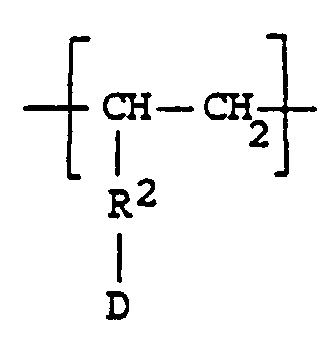 C ausgewählt ist aus der Gruppe bestehend aus(I)
 (II)
(II) (III) Kombinationen derselben, wobeiD OH, Halogenid, OR4, NH2, NHR3, OM' oder OM" ist;E der restliche Bestandteil der Umsetzung von mindestens einer Lewissäure mit dem D-Substituenten der Monomereinheit B ist,R1 ein Proton, eine C1- bis C24-Alkylgruppe oder C3- bis C24-Cycloalkyl wiedergibt,R2 eine C1- bis C24-Alkylengruppe, C3- bis C24-Cycloalkylen, C6- bis C18-Arylen oder C7- bis C30-Alkylarylen wiedergibt,R3 ein C1- bis C24-Alkyl, C3- bis C24-Cycloalkyl, C1- bis C24-Aryl oder C7- bis C30-Alkylaryl wiedergibt,R4 ein C1- bis C24-Alkyl, C3- bis C24-Cycloalkyl, C1- bis C24-Aryl oder C7- bis C30-Alkylaryl wiedergibt undM' Alkalimetall wiedergibt undM" Erdalkalimetall wiedergibt.
 - Immobilisierter Katalysator nach Anspruch 1, bei dem die Monomereinheit A von Propylen, 1-Buten, Ethylen und Mischungen derselben abgeleitet ist.
- Immobilisierter Katalysator nach einem der vorhergehenden Ansprüche, bei dem E von einer Lewissäure ausgewählt aus der Gruppe bestehend aus Borhalogeniden, Aluminiumhalogeniden, Alkylaluminiumhalogeniden, Titanhalogeniden und Kombinationen davon abgeleitet ist.
- Immobilisierter Katalysator nach einem der vorhergehenden Ansprüche, bei dem der Katalysator in Form von Teilchen mit einer Teilchengrößenverteilung von 0,001 bis 1,0 mm vorliegt.
- Immobilisierter Katalysator nach einem der vorhergehenden Ansprüche, der auf ein festes Substrat aufgebracht ist.
- Immobilisierter Katalysator nach einem der vorhergehenden Ansprüche, bei dem der immobilisierte Katalysator von einem funktionalisierten Copolymer mit einem durchschnittlichen Molekulargewicht (Zahlenmittel) von 3 000 bis 10 000 000 und der Strukturformel

- Immobilisierter Katalysator nach einem der vorhergehenden Ansprüche, der von einer Lewissäure ausgewählt aus der Gruppe bestehend aus Ethylaluminiumdihalogenid, Diethylaluminiumhalogenid und BF3 abgeleitet ist.
- Verfahren zur Herstellung eines geformten immobilisierten Katalysators, bei dem ein thermoplastischer immobilisierter Lewissäurekatalysator gemäß einem der Ansprüche 1 bis 7 auf eine ausreichende Temperatur erwärmt wird, um einen fließfähigen Zustand zu ergeben, der erwärmte, immobilisierte Katalysator unter ausreichendem Druck in eine Form, die mindestens einen Hohlraum enthält, transportiert wird, der Hohlraum mit dem immobilisierten Katalysator gefüllt wird, der geformte immobilisierte Katalysator eine ausreichende Zeitdauer abgekühlt wird, um einen nicht fließfähigen Zustand zu erreichen, und der geformte Katalysator aus der Form entfernt wird.
- Verfahren zum Polymerisieren von kationisch polymerisierbarem Monomer, indem das Monomer mit einer katalytisch wirksamen Menge an immobilisiertem Lewissäurekatalysator gemäß einem der Ansprüche 1 bis 7 in einer Weise und unter Bedingungen kontaktiert wird, die zum Polymerisieren des Monomers ausreichend sind.
- Verfahren nach Anspruch 8 oder Anspruch 9, bei dem das kationisch polymerisierbare Monomer mindestens ein Mitglied ausgewählt aus der Gruppe bestehend aus Isobuten, 1-Buten und 2-Buten, Styrolen, Propylen, Ethylen, Dienen und Kombinationen daraus umfaßt.
- Verfahren nach einem der Ansprüche 8 oder 10, bei dem die Polymerisation in Gegenwart von mindestens einem Lewissäure-Cokatalysator durchgeführt wird.
- Verfahren nach einem der Ansprüche 8 bis 11, bei dem die Polymerisation in einem Lösungsmittel durchgeführt wird.
- Verfahren nach einem der Ansprüche 8 bis 12, bei dem die Polymerisation bei einer Temperatur von -30°C bis 50°C durchgeführt wird.
- Verfahren zur Herstellung eines immobilisierten LewissäureKatalysators gemäß einem der Ansprüche 1 bis 7, bei dem in Stufen ein funktionalisiertes Copolymer mit sich wiederholenden Monomereinheiten mit der Formel

- Verfahren nach Anspruch 14, bei dem in dem funktionalisierten Copolymer [D] OM' oder OM" ist, wobei M' = Alkalimetall und M" = Erdalkalimetall ist und die Lewissäure BF3 ist.
- Verfahren zum Alkylieren eines Substrats ausgewählt aus der Gruppe bestehend aus Olefin, Alkan, Alkylhalogenid, aromatischer Verbindung und hydroxyaromatischer Verbindung mit einem Alkylierungsmittel ausgewählt aus mindestens einem Mitglied der Gruppe bestehend aus Olefin, Alkan und Alkylhalogenid, bei dem eine Mischung aus Substrat und Alkylierungsmittel in Gegenwart eines immobilisierten Lewissäurekatalysators gemäß einem der Ansprüche 1 bis 7 in einer Weise und unter Bedingungen kontaktiert wird, die ausreichen, um das Substrat mit dem Alkylierungsmittel zu alkylieren, mit der Maßgabe, daß das Alkylierungsmittel so gewählt ist, daß es sich von dem verwendeten Substrat unterscheidet.
- Immobilisierter Lewissäurekatalysator, der ein festes Polymer mit innerhalb von dessen Struktur immobilisiertem Borfluorid umfaßt, wobei das Polymer Monomereinheiten mit der Strukturformel
-[A]a-[B]b-[C]c-
aufweist, wobei a 1 bis 99 Mol.% ausmacht, b 0 bis 50 Mol.% ausmacht, c 1 bis 99 Mol.% ausmacht und a + b + c = 100 %.A B
B C ausgewählt ist aus der Gruppe bestehend aus(I)
 (II)
(II) (III) Kombinationen derselben, wobeiD OH, Halogenid, OR4, N2, NHR3, OM' oder OM" ist;R1 ein Proton, eine C1- bis C24-Alkylgruppe oder C3- bis C24-Cycloalkyl wiedergibt,R2 eine C1- bis C24-Alkylengruppe, C3- bis C24-Cycloalkylen, C6- bis C18-Arylen oder C7- bis C30-Alkylarylen wiedergibt,R3 ein C1- bis C24-Alkyl, C3- bis C24-Cycloalkyl, C1- bis C24-Aryl oder C7- bis C30-Alkylaryl wiedergibt,R4 ein C1- bis C24-Alkyl, C3- bis C24-Cycloalkyl, C1- bis C24-Aryl oder C7- bis C30-Alkylaryl wiedergibt undM' Alkalimetall wiedergibt undM" Erdalkalimetall wiedergibt.
 - Kationisch polymerisiertes Polymer mit einem durchschnittlichen Molekulargewicht (Zahlenmittel) von 300 bis 1 000 000 und einer Molekulargewichtsverteilung von 1,1 bis 8,0 und mindestens 60 % endständigen Doppelbindungen, wobei das Polymer nach einem Verfahren zum Polymerisieren von kationisch polymerisierbarem Monomer hergestellt ist, bei dem das Monomer mit einer katalytisch wirksamen Menge eines immobilisierten Lewissäurekatalysators gemäß einem der Ansprüche 1 bis 7 und 17 in einer Weise und unter Bedingungen kontaktiert wird, die zum Polymerisieren des Monomers ausreichend sind.
Applications Claiming Priority (3)
| Application Number | Priority Date | Filing Date | Title |
|---|---|---|---|
| US723130 | 1991-06-28 | ||
| US07/723,130 US5288677A (en) | 1991-06-28 | 1991-06-28 | Immobilized Lewis acid catalysts |
| PCT/US1992/005454 WO1993000373A1 (en) | 1991-06-28 | 1992-06-26 | Immobilized lewis acid catalysts |
Publications (2)
| Publication Number | Publication Date |
|---|---|
| EP0591380A1 EP0591380A1 (de) | 1994-04-13 |
| EP0591380B1 true EP0591380B1 (de) | 1997-05-28 |
Family
ID=24904986
Family Applications (1)
| Application Number | Title | Priority Date | Filing Date |
|---|---|---|---|
| EP92914043A Expired - Lifetime EP0591380B1 (de) | 1991-06-28 | 1992-06-26 | Immobilisierte lewis-säure-katalisatoren |
Country Status (16)
| Country | Link |
|---|---|
| US (7) | US5288677A (de) |
| EP (1) | EP0591380B1 (de) |
| JP (1) | JPH06508869A (de) |
| KR (1) | KR100232330B1 (de) |
| CN (3) | CN1032429C (de) |
| AR (1) | AR247574A1 (de) |
| AT (1) | ATE153677T1 (de) |
| AU (1) | AU673331B2 (de) |
| BR (1) | BR9206222A (de) |
| CA (1) | CA2109845A1 (de) |
| DE (1) | DE69220060T2 (de) |
| ES (1) | ES2103033T3 (de) |
| FI (1) | FI935880A0 (de) |
| MX (1) | MX9203432A (de) |
| NO (1) | NO303019B1 (de) |
| WO (1) | WO1993000373A1 (de) |
Families Citing this family (86)
| Publication number | Priority date | Publication date | Assignee | Title |
|---|---|---|---|---|
| US5288677A (en) * | 1991-06-28 | 1994-02-22 | Exxon Chemical Patents Inc. | Immobilized Lewis acid catalysts |
| WO1994028037A1 (en) * | 1993-05-20 | 1994-12-08 | Exxon Chemical Patents Inc. | Lewis acid catalysts supported on porous polymer substrate |
| US5643847A (en) * | 1994-08-03 | 1997-07-01 | Exxon Chemical Patents Inc. | Supported ionic catalyst composition |
| US6143686A (en) * | 1994-08-03 | 2000-11-07 | Exxon Chemical Patents, Inc. | Supported ionic catalyst compositions |
| AU687231B2 (en) * | 1994-08-03 | 1998-02-19 | Exxon Chemical Patents Inc. | Supported ionic catalyst composition |
| US6218331B1 (en) | 1995-03-29 | 2001-04-17 | Equistar Chemicals, L.P. | Polymer-supported catalyst for olefin polymerization |
| US5811617A (en) * | 1995-12-13 | 1998-09-22 | Amoco Corporation | Olefin oligomerization process |
| US5945574A (en) * | 1995-12-13 | 1999-08-31 | Bp Amoco Corporation | Olefin oligomerization process and catalysts therefor |
| WO1997021651A1 (en) * | 1995-12-13 | 1997-06-19 | Amoco Corporation | Olefin oligomerization process and catalyst |
| US5691431A (en) * | 1996-01-18 | 1997-11-25 | Exxon Chemical Patents Inc. | Cationic polymerization catalyzed by lewis acid catalysts supported on porous polymer substrate |
| DE19619267A1 (de) * | 1996-05-13 | 1997-11-20 | Basf Ag | Verfahren zur Herstellung von mittelmolekularem, hochreaktivem Polyisobuten |
| CN1249734A (zh) | 1997-01-08 | 2000-04-05 | 赫尔克里士公司 | 用于制备烃树脂的氟化固体酸催化剂 |
| US6228795B1 (en) | 1997-06-05 | 2001-05-08 | Exxon Chemical Patents, Inc. | Polymeric supported catalysts |
| US6030918A (en) * | 1997-06-25 | 2000-02-29 | The Regents Of The University Of California | Gallium based low-interaction anions |
| US6211312B1 (en) | 1998-06-12 | 2001-04-03 | Univation Technologies | Olefin polymerization process using activated lewis acid-base complexes |
| AU743367B2 (en) | 1998-07-16 | 2002-01-24 | Univation Technologies Llc | Aluminum-based lewis acid cocatalysts for olefin polymerization |
| US6486088B1 (en) | 1998-10-23 | 2002-11-26 | Exxonmobil Chemical Patents Inc. | High activity carbenium-activated polymerization catalysts |
| US6147173A (en) | 1998-11-13 | 2000-11-14 | Univation Technologies, Llc | Nitrogen-containing group 13 anionic complexes for olefin polymerization |
| KR20010070002A (ko) * | 1999-07-29 | 2001-07-25 | 고오사이 아끼오 | 내산성 촉매 시트 및 이의 제조방법 |
| US6562913B1 (en) | 1999-09-16 | 2003-05-13 | Texas Petrochemicals Lp | Process for producing high vinylidene polyisobutylene |
| WO2001019873A1 (en) | 1999-09-16 | 2001-03-22 | Texas Petrochemicals Lp | Process for preparing polyolefin products |
| US6884858B2 (en) * | 1999-10-19 | 2005-04-26 | Texas Petrochemicals Lp | Process for preparing polyolefin products |
| US6992152B2 (en) * | 1999-10-19 | 2006-01-31 | Texas Petrochemicals Lp | Apparatus and method for controlling olefin polymerization process |
| US7037999B2 (en) | 2001-03-28 | 2006-05-02 | Texas Petrochemicals Lp | Mid-range vinylidene content polyisobutylene polymer product and process for producing the same |
| US6858188B2 (en) * | 2003-05-09 | 2005-02-22 | Texas Petrochemicals, Lp | Apparatus for preparing polyolefin products and methodology for using the same |
| US6475946B1 (en) * | 1999-10-22 | 2002-11-05 | Exxonmobil Chemical Patents Inc. | Olefin polymerization catalysis with aryl substituted carbenium cationic complexes |
| US6476164B1 (en) | 1999-10-22 | 2002-11-05 | Exxonmobil Chemical Patents Inc. | Carbenium cationic complexes suitable for polymerization catalysts |
| RU2264860C2 (ru) * | 1999-11-05 | 2005-11-27 | Джонсон Мэтью Плс | Иммобилизованные ионные жидкости |
| JP3389176B2 (ja) * | 1999-11-17 | 2003-03-24 | 科学技術振興事業団 | 高分子担持ルイス酸触媒 |
| US6395847B2 (en) | 1999-11-19 | 2002-05-28 | Exxonmobil Chemical Patents Inc. | Supported organometallic catalysts and their use in olefin polymerization |
| US6822057B2 (en) * | 1999-12-09 | 2004-11-23 | Exxon Mobil Chemical Patents Inc. | Olefin polymerization catalysts derived from Group-15 cationic compounds and processes using them |
| US6489480B2 (en) | 1999-12-09 | 2002-12-03 | Exxonmobil Chemical Patents Inc. | Group-15 cationic compounds for olefin polymerization catalysts |
| JP4107817B2 (ja) | 2000-09-29 | 2008-06-25 | 株式会社リコー | 画像形成用トナー、画像形成方法及び画像形成装置 |
| US7838708B2 (en) | 2001-06-20 | 2010-11-23 | Grt, Inc. | Hydrocarbon conversion process improvements |
| SG130016A1 (en) * | 2002-09-24 | 2007-03-20 | Sumitomo Chemical Co | Modified particle, catalyst component for addition polymerization, catalyst for addition polymerization and process for producing addition polymer |
| WO2004102162A2 (en) * | 2003-03-21 | 2004-11-25 | The Regents Of The University Of California | Inorganic oxides comprising multiple surface-bound functional groups |
| US20050171393A1 (en) | 2003-07-15 | 2005-08-04 | Lorkovic Ivan M. | Hydrocarbon synthesis |
| MXPA06000470A (es) | 2003-07-15 | 2006-08-23 | Grt Inc | Sintesis de hidrocarburos. |
| US6894201B1 (en) * | 2003-12-19 | 2005-05-17 | Uop Llc | Process and apparatus for the removal of nitrogen compounds from a fluid stream |
| US20080275284A1 (en) | 2004-04-16 | 2008-11-06 | Marathon Oil Company | Process for converting gaseous alkanes to liquid hydrocarbons |
| US20060100469A1 (en) | 2004-04-16 | 2006-05-11 | Waycuilis John J | Process for converting gaseous alkanes to olefins and liquid hydrocarbons |
| US8642822B2 (en) | 2004-04-16 | 2014-02-04 | Marathon Gtf Technology, Ltd. | Processes for converting gaseous alkanes to liquid hydrocarbons using microchannel reactor |
| US7244867B2 (en) | 2004-04-16 | 2007-07-17 | Marathon Oil Company | Process for converting gaseous alkanes to liquid hydrocarbons |
| US7674941B2 (en) | 2004-04-16 | 2010-03-09 | Marathon Gtf Technology, Ltd. | Processes for converting gaseous alkanes to liquid hydrocarbons |
| US8173851B2 (en) | 2004-04-16 | 2012-05-08 | Marathon Gtf Technology, Ltd. | Processes for converting gaseous alkanes to liquid hydrocarbons |
| JP4714424B2 (ja) * | 2004-04-20 | 2011-06-29 | Jx日鉱日石エネルギー株式会社 | α−オレフィン重合体の製造方法 |
| US7125939B2 (en) * | 2004-08-30 | 2006-10-24 | Equistar Chemicals, Lp | Olefin polymerization with polymer bound single-site catalysts |
| JP4732087B2 (ja) * | 2005-09-13 | 2011-07-27 | 三井化学株式会社 | オレフィン重合触媒用担体、オレフィン重合触媒およびオレフィン系重合体粒子 |
| DE102006004429A1 (de) * | 2006-01-31 | 2007-08-02 | Advanced Micro Devices, Inc., Sunnyvale | Halbleiterbauelement mit einem Metallisierungsschichtstapel mit einem porösen Material mit kleinem ε mit einer erhöhten Integrität |
| CN101817720A (zh) | 2006-02-03 | 2010-09-01 | Grt公司 | 天然气转化为液体烃的连续方法 |
| EP1993951B1 (de) | 2006-02-03 | 2014-07-30 | GRT, Inc. | Trennung von lichtgasen von brom |
| US7732651B2 (en) * | 2006-06-01 | 2010-06-08 | Chevron Oronite Company, Llc | Method of making an alkylated aromoatic using acidic ionic liquid catalyst |
| US7989116B2 (en) * | 2007-05-08 | 2011-08-02 | Toyota Motor Engineering & Manufacturing North America, Inc. | Electrolyte utilizing a lewis acid/bronstead acid complex |
| AU2008256606A1 (en) | 2007-05-24 | 2008-12-04 | Grt, Inc. | Zone reactor incorporating reversible hydrogen halide capture and release |
| EP2112175A1 (de) | 2008-04-16 | 2009-10-28 | ExxonMobil Chemical Patents Inc. | Aktivator für Metallocene, der einen oder mehrere halogensubstituierte heterocyklische Liganden enthält, die an ein Alumoxan koordiniert sind |
| US8282810B2 (en) | 2008-06-13 | 2012-10-09 | Marathon Gtf Technology, Ltd. | Bromine-based method and system for converting gaseous alkanes to liquid hydrocarbons using electrolysis for bromine recovery |
| NZ591207A (en) | 2008-07-18 | 2013-03-28 | Grt Inc | Continuous process for converting natural gas to liquid hydrocarbons |
| US20100122937A1 (en) * | 2008-11-20 | 2010-05-20 | John Aibangbee Osaheni | Method and system for removing impurities from hydrocarbon oils via lewis acid complexation |
| JP5167110B2 (ja) * | 2008-12-26 | 2013-03-21 | 独立行政法人日本原子力研究開発機構 | バイオディーゼル製造用触媒とその製造方法並びにバイオディーゼルの製造方法 |
| WO2010080871A1 (en) | 2009-01-08 | 2010-07-15 | Univation Technologies, Llc | Additive for gas phase polymerization processes |
| CN102272165B (zh) | 2009-01-08 | 2013-08-28 | 尤尼威蒂恩技术有限责任公司 | 用于聚烯烃聚合方法的添加剂 |
| US20100264067A1 (en) * | 2009-04-16 | 2010-10-21 | General Electric Company | Method for removing impurities from hydrocarbon oils |
| US20100273964A1 (en) * | 2009-04-22 | 2010-10-28 | Stewart Lewis | Heterogeneous lewis acid catalysts for cationic polymerizations |
| US20100298507A1 (en) * | 2009-05-19 | 2010-11-25 | Menschig Klaus R | Polyisobutylene Production Process With Improved Efficiencies And/Or For Forming Products Having Improved Characteristics And Polyisobutylene Products Produced Thereby |
| EP2456796B1 (de) | 2009-07-23 | 2013-07-17 | Univation Technologies, LLC | Polymerisationsreaktionssystem |
| WO2011078923A1 (en) | 2009-12-23 | 2011-06-30 | Univation Technologies, Llc | Methods for producing catalyst systems |
| US8198495B2 (en) | 2010-03-02 | 2012-06-12 | Marathon Gtf Technology, Ltd. | Processes and systems for the staged synthesis of alkyl bromides |
| US8367884B2 (en) | 2010-03-02 | 2013-02-05 | Marathon Gtf Technology, Ltd. | Processes and systems for the staged synthesis of alkyl bromides |
| US20120136189A1 (en) * | 2010-03-09 | 2012-05-31 | Conocophillips Company - Ip Services Group | Buffered ionic liquids for olefin dimerization |
| EP2621938A1 (de) * | 2010-09-29 | 2013-08-07 | Solvay Specialty Polymers Italy S.p.A. | Verbundstoffpolymerisierungsinitiator und daraus hergestellter polymerbürstenverbundstoff |
| US8815050B2 (en) | 2011-03-22 | 2014-08-26 | Marathon Gtf Technology, Ltd. | Processes and systems for drying liquid bromine |
| US8436220B2 (en) | 2011-06-10 | 2013-05-07 | Marathon Gtf Technology, Ltd. | Processes and systems for demethanization of brominated hydrocarbons |
| US8829256B2 (en) | 2011-06-30 | 2014-09-09 | Gtc Technology Us, Llc | Processes and systems for fractionation of brominated hydrocarbons in the conversion of natural gas to liquid hydrocarbons |
| US8802908B2 (en) | 2011-10-21 | 2014-08-12 | Marathon Gtf Technology, Ltd. | Processes and systems for separate, parallel methane and higher alkanes' bromination |
| US9193641B2 (en) | 2011-12-16 | 2015-11-24 | Gtc Technology Us, Llc | Processes and systems for conversion of alkyl bromides to higher molecular weight hydrocarbons in circulating catalyst reactor-regenerator systems |
| MX2014015459A (es) * | 2012-06-18 | 2015-07-14 | Petrochemical Supply Inc | Composicion de poliisobutileno que tiene vinilideno interno y proceso para preparar la composicion polimerica de poliisobutileno. |
| WO2015095879A1 (en) | 2013-12-18 | 2015-06-25 | Invista Technologies S.A.R.L. | Method of manufacturing 2-methyl-1, 3-dioxolane in a solid state polycondensation process |
| JP6005091B2 (ja) * | 2014-03-19 | 2016-10-12 | Jxエネルギー株式会社 | オレフィン重合体の製造方法。 |
| WO2015164510A1 (en) * | 2014-04-25 | 2015-10-29 | Petrochemical Supply, Inc. | Catalyst system for heterogenous catalysis of an isobutylene polymerization reaction |
| US11229095B2 (en) | 2014-12-17 | 2022-01-18 | Campbell Soup Company | Electromagnetic wave food processing system and methods |
| BR112020004716B1 (pt) * | 2017-09-14 | 2023-10-17 | Dow Global Technologies Llc | Catalisador de polimerização de ácido de lewis, poliéter poliol, polímero de poliuretano e método para produzir um poliéter poliol |
| CN110950988A (zh) * | 2019-11-15 | 2020-04-03 | 山东迈特新材料科技有限公司 | 一种低分子量聚苯乙烯的制备方法 |
| CN111100234B (zh) * | 2019-12-30 | 2022-08-12 | 南京大学盐城环保技术与工程研究院 | 一种高比表面积树脂的合成方法 |
| CN111239323A (zh) * | 2020-02-13 | 2020-06-05 | 湖南瀚洋环保科技有限公司 | 一种危险废物危害特性快速检测方法 |
| CN113651678A (zh) * | 2020-05-12 | 2021-11-16 | 中国石油化工股份有限公司 | 合成烷基酚的方法及其应用 |
| CN119661591A (zh) * | 2024-12-06 | 2025-03-21 | 中国石油大学(华东) | 一种co2反应增黏型聚表剂用路易斯碱单体及其制备方法 |
Family Cites Families (40)
| Publication number | Priority date | Publication date | Assignee | Title |
|---|---|---|---|---|
| US3262887A (en) * | 1960-08-31 | 1966-07-26 | Monsanto Co | Polymerization catalysts and processes |
| US3721632A (en) * | 1970-12-30 | 1973-03-20 | Cities Service Co | Method of catalyst preparation |
| US3925495A (en) * | 1974-05-06 | 1975-12-09 | Mobil Oil Corp | Hydrocarbon conversion in the presence of a catalyst of a lewis acid intercalated in graphite |
| US3984352A (en) * | 1974-05-06 | 1976-10-05 | Mobil Oil Corporation | Catalyst containing a Lewis acid intercalated in graphite |
| US4139417A (en) * | 1974-12-12 | 1979-02-13 | Societe Nationale Elf Aquitaine | Lubricating oil compositions containing copolymers of olefins or of olefins and non-conjugated dienes with unsaturated derivatives of cyclic imides |
| GB1533169A (en) * | 1976-06-22 | 1978-11-22 | British Petroleum Co | Oligomerising c3-c8 olefins |
| US4112209A (en) * | 1976-08-18 | 1978-09-05 | The Dow Chemical Company | Process for making polystyrene |
| US4116880A (en) * | 1977-06-16 | 1978-09-26 | Produits Chimiques Ugine Kuhlmann | Solid catalysts based on fluorinated graphite |
| US4167616A (en) * | 1977-08-22 | 1979-09-11 | Rohm And Haas Company | Polymerization with diborane adducts or oligomers of boron-containing monomers |
| US4171414A (en) * | 1977-08-25 | 1979-10-16 | Exxon Research & Engineering Co. | Catalyst composition for an improved polymerization process of isoolefins and multiolefins |
| CA1135705A (en) * | 1978-07-20 | 1982-11-16 | Jens-Uwe Bliesener | N-arylsulfonylpyrroles, their preparation, and therapeutic agents containing these compounds |
| US4235756A (en) * | 1979-07-27 | 1980-11-25 | Shell Oil Company | Modified gamma alumina composition |
| US4342849A (en) * | 1979-09-10 | 1982-08-03 | The University Of Akron | Novel telechelic polymers and processes for the preparation thereof |
| JPS57188996A (en) * | 1981-05-18 | 1982-11-20 | Matsushita Electric Ind Co Ltd | Device for heat emission |
| DE3201780A1 (de) * | 1982-01-21 | 1983-08-25 | Henkel KGaA, 4000 Düsseldorf | Neue polymere organo-borverbindungen und ihre verwendung |
| JPS5980413A (ja) * | 1982-10-29 | 1984-05-09 | Toa Nenryo Kogyo Kk | 共重合体の製造法 |
| JPS59188996A (ja) * | 1983-04-12 | 1984-10-26 | 松下電子工業株式会社 | 電子部品の実装方法 |
| JPS59212438A (ja) * | 1983-05-17 | 1984-12-01 | Nippon Oil Co Ltd | 高純度ブテン−1の分離回収方法 |
| US4558170A (en) * | 1983-06-29 | 1985-12-10 | Exxon Research & Engineering Co. | Polyisobutylene process |
| US4490571A (en) * | 1983-10-05 | 1984-12-25 | Uop Inc. | Oligomerization of olefins |
| GB8329082D0 (en) * | 1983-11-01 | 1983-12-07 | Bp Chem Int Ltd | Low molecular weight polymers of 1-olefins |
| US4698403A (en) * | 1985-10-15 | 1987-10-06 | E. I. Du Pont De Nemours And Company | Nickel-catalyzed copolymerization of ethylene |
| US4719190A (en) * | 1986-10-22 | 1988-01-12 | University Of Florida | Hydrocarbon conversion and polymerization catalyst and method of making and using same |
| US4929800A (en) * | 1986-10-22 | 1990-05-29 | University Of Florida | Hydrocarbon conversion and polymerization catalyst and method of making and using same |
| US4798667A (en) * | 1986-10-22 | 1989-01-17 | University Of Florida | Hydrocarbon conversion polymerization catalyst and method of making and using same |
| CA1283997C (en) * | 1986-12-12 | 1991-05-07 | Frank Joung-Yei Chen | Fixed bed process for polymerizing liquid butenes |
| US4734472A (en) * | 1986-12-24 | 1988-03-29 | Exxon Research And Engineering Company | Method for preparing functional alpha-olefin polymers and copolymers |
| US4751276A (en) * | 1986-12-24 | 1988-06-14 | Exxon Research And Engineering Company | Method for preparing functional alpha-olefin polymers and copolymers |
| EP0274912B1 (de) * | 1987-01-02 | 1993-02-24 | Exxon Research And Engineering Company | Herstellungsverfahren von Polyalkoholcopolymeren |
| US4812529A (en) * | 1987-01-05 | 1989-03-14 | Exxon Research & Engineering Co. | Polyalcohol homopolymers |
| US4987200A (en) * | 1987-06-08 | 1991-01-22 | Exxon Chemical Patents Inc. | Preparation of polymer incorporating masked functional group-containing monomers |
| US5162445A (en) * | 1988-05-27 | 1992-11-10 | Exxon Chemical Patents Inc. | Para-alkylstyrene/isoolefin copolymers and functionalized copolymers thereof |
| US4940760A (en) * | 1988-02-16 | 1990-07-10 | E. I. Du Pont De Nemours And Company | Group Transfer Polymerization process employing supported initiators |
| BE1001858A3 (nl) * | 1988-06-29 | 1990-03-20 | Schelde Delta Bv Ba | Werkwijze voor het raffineren van olien. |
| US4943616A (en) * | 1988-07-26 | 1990-07-24 | Polysar Limited | Living cationic polymerization process |
| DK169166B1 (da) * | 1990-05-14 | 1994-09-05 | Roulunds Fabriker As | Måtte af et væsketæt, fleksibelt materiale |
| US5026799A (en) * | 1990-05-30 | 1991-06-25 | E. I. Du Pont De Nemours And Company | Living cationic polymerization of vinylic unsaturated compounds |
| BE1006694A5 (fr) * | 1991-06-22 | 1994-11-22 | Basf Ag | Procede de preparation de polyisobutenes extremement reactifs. |
| US5288677A (en) * | 1991-06-28 | 1994-02-22 | Exxon Chemical Patents Inc. | Immobilized Lewis acid catalysts |
| US5376744A (en) * | 1993-11-10 | 1994-12-27 | The University Of Akron | Carbocationic polymerizations in supercritical CO2 |
-
1991
- 1991-06-28 US US07/723,130 patent/US5288677A/en not_active Expired - Fee Related
-
1992
- 1992-06-25 AR AR92322623A patent/AR247574A1/es active
- 1992-06-26 EP EP92914043A patent/EP0591380B1/de not_active Expired - Lifetime
- 1992-06-26 JP JP5501698A patent/JPH06508869A/ja active Pending
- 1992-06-26 MX MX9203432A patent/MX9203432A/es not_active Application Discontinuation
- 1992-06-26 ES ES92914043T patent/ES2103033T3/es not_active Expired - Lifetime
- 1992-06-26 AU AU22549/92A patent/AU673331B2/en not_active Ceased
- 1992-06-26 BR BR9206222A patent/BR9206222A/pt not_active Application Discontinuation
- 1992-06-26 AT AT92914043T patent/ATE153677T1/de active
- 1992-06-26 WO PCT/US1992/005454 patent/WO1993000373A1/en not_active Ceased
- 1992-06-26 US US07/905,582 patent/US5409873A/en not_active Expired - Fee Related
- 1992-06-26 KR KR1019930704069A patent/KR100232330B1/ko not_active Expired - Fee Related
- 1992-06-26 CA CA002109845A patent/CA2109845A1/en not_active Abandoned
- 1992-06-26 DE DE69220060T patent/DE69220060T2/de not_active Expired - Fee Related
- 1992-06-27 CN CN92105127A patent/CN1032429C/zh not_active Expired - Fee Related
-
1993
- 1993-11-18 US US08/154,228 patent/US5414177A/en not_active Expired - Fee Related
- 1993-12-13 NO NO934575A patent/NO303019B1/no not_active IP Right Cessation
- 1993-12-27 FI FI935880A patent/FI935880A0/fi unknown
-
1995
- 1995-03-03 US US08/398,637 patent/US5481054A/en not_active Expired - Fee Related
- 1995-03-03 US US08/398,463 patent/US5563313A/en not_active Expired - Fee Related
- 1995-03-03 US US08/398,635 patent/US5571885A/en not_active Expired - Fee Related
- 1995-05-08 US US08/436,508 patent/US5600055A/en not_active Expired - Fee Related
- 1995-05-26 CN CN95105502A patent/CN1048975C/zh not_active Expired - Fee Related
- 1995-05-26 CN CN95105501A patent/CN1049900C/zh not_active Expired - Fee Related
Also Published As
| Publication number | Publication date |
|---|---|
| EP0591380A1 (de) | 1994-04-13 |
| DE69220060T2 (de) | 1997-09-18 |
| AR247574A1 (es) | 1995-01-31 |
| FI935880A7 (fi) | 1993-12-27 |
| NO303019B1 (no) | 1998-05-18 |
| DE69220060D1 (de) | 1997-07-03 |
| CN1121080A (zh) | 1996-04-24 |
| CN1117955A (zh) | 1996-03-06 |
| CN1032429C (zh) | 1996-07-31 |
| US5409873A (en) | 1995-04-25 |
| US5481054A (en) | 1996-01-02 |
| AU2254992A (en) | 1993-01-25 |
| BR9206222A (pt) | 1995-04-25 |
| CN1049900C (zh) | 2000-03-01 |
| WO1993000373A1 (en) | 1993-01-07 |
| ATE153677T1 (de) | 1997-06-15 |
| CA2109845A1 (en) | 1993-01-07 |
| NO934575L (no) | 1993-12-13 |
| US5571885A (en) | 1996-11-05 |
| MX9203432A (es) | 1992-12-01 |
| FI935880A0 (fi) | 1993-12-27 |
| US5414177A (en) | 1995-05-09 |
| CN1048975C (zh) | 2000-02-02 |
| ES2103033T3 (es) | 1997-08-16 |
| AU673331B2 (en) | 1996-11-07 |
| NO934575D0 (no) | 1993-12-13 |
| US5288677A (en) | 1994-02-22 |
| US5600055A (en) | 1997-02-04 |
| KR100232330B1 (ko) | 1999-12-01 |
| CN1069496A (zh) | 1993-03-03 |
| KR940701412A (ko) | 1994-05-28 |
| US5563313A (en) | 1996-10-08 |
| JPH06508869A (ja) | 1994-10-06 |
Similar Documents
| Publication | Publication Date | Title |
|---|---|---|
| US5409873A (en) | Immobilized Lewis acid catalysts | |
| US5877371A (en) | Heterogeneous Lewis acid-type catalysts | |
| EP0752912B1 (de) | Aus supersäuren hergestellte lewissäure enthaltende trägerkatalysatoren, die für umwandlungsreaktionen von kohlenwasserstoffen verwendbar sind. | |
| EP0752914B1 (de) | Lewissäure enthaltende trägerkatalysatoren für anwändlungsreaktionen von kohlenwasserstoffen | |
| JP3950921B2 (ja) | 触媒前駆体組成物、及びその製造方法 | |
| EP0703253A1 (de) | Olefinisch Blockcopolymer und Verfahren zu seiner Herstellung | |
| EP0700405B1 (de) | Lewis-säure-katalysatoren auf einem porösen polymersubstrat | |
| EP0262987B1 (de) | Katalysatoren für die Herstellung elastomerer Olefincopolymere und damit hergestellte Copolymere | |
| US5691431A (en) | Cationic polymerization catalyzed by lewis acid catalysts supported on porous polymer substrate | |
| US3326870A (en) | Copolymers of olefins and acrylonitrile and a process for producing the same | |
| KR100216665B1 (ko) | 알파-올레핀의 입체 특이적 중합에 유용한 촉매고체, 이의 제조방법과 이의 존재하에서의 알파-올레핀의 중합법 | |
| AU702456B2 (en) | Immobilized Lewis acid catalysts | |
| EP0752913B1 (de) | Lewissäure enthaltende trägerkatalysatoren für umwandlungsreaktionen von kohlenwasserstoffen | |
| US20240228677A9 (en) | Method of making an ethylene-propylene copolymer | |
| US3284427A (en) | Monosubstituted aluminum dihalide catalysts for olefin polymerization | |
| KR840001168B1 (ko) | 3염화티타니움 촉매성분 | |
| US3398130A (en) | Catalyst and process for polymerization | |
| Kaminsky | Polymerisation Catalysis | |
| JPS584928B2 (ja) | α−オレフインの重合方法 | |
| JPH0441682B2 (de) | ||
| JP2001310907A (ja) | プロピレン(共)重合体の製造方法 |
Legal Events
| Date | Code | Title | Description |
|---|---|---|---|
| PUAI | Public reference made under article 153(3) epc to a published international application that has entered the european phase |
Free format text: ORIGINAL CODE: 0009012 |
|
| AK | Designated contracting states |
Kind code of ref document: A1 Designated state(s): AT BE CH DE DK ES FR GB GR IT LI NL SE |
|
| 17P | Request for examination filed |
Effective date: 19940201 |
|
| D17P | Request for examination filed (deleted) | ||
| R17P | Request for examination filed (corrected) |
Effective date: 19940128 |
|
| 17Q | First examination report despatched |
Effective date: 19950324 |
|
| GRAG | Despatch of communication of intention to grant |
Free format text: ORIGINAL CODE: EPIDOS AGRA |
|
| GRAH | Despatch of communication of intention to grant a patent |
Free format text: ORIGINAL CODE: EPIDOS IGRA |
|
| GRAH | Despatch of communication of intention to grant a patent |
Free format text: ORIGINAL CODE: EPIDOS IGRA |
|
| GRAA | (expected) grant |
Free format text: ORIGINAL CODE: 0009210 |
|
| AK | Designated contracting states |
Kind code of ref document: B1 Designated state(s): AT BE CH DE DK ES FR GB GR IT LI NL SE |
|
| PG25 | Lapsed in a contracting state [announced via postgrant information from national office to epo] |
Ref country code: LI Free format text: LAPSE BECAUSE OF FAILURE TO SUBMIT A TRANSLATION OF THE DESCRIPTION OR TO PAY THE FEE WITHIN THE PRESCRIBED TIME-LIMIT Effective date: 19970528 Ref country code: GR Free format text: LAPSE BECAUSE OF FAILURE TO SUBMIT A TRANSLATION OF THE DESCRIPTION OR TO PAY THE FEE WITHIN THE PRESCRIBED TIME-LIMIT Effective date: 19970528 Ref country code: DK Effective date: 19970528 Ref country code: CH Free format text: LAPSE BECAUSE OF FAILURE TO SUBMIT A TRANSLATION OF THE DESCRIPTION OR TO PAY THE FEE WITHIN THE PRESCRIBED TIME-LIMIT Effective date: 19970528 Ref country code: AT Effective date: 19970528 |
|
| REF | Corresponds to: |
Ref document number: 153677 Country of ref document: AT Date of ref document: 19970615 Kind code of ref document: T |
|
| REG | Reference to a national code |
Ref country code: CH Ref legal event code: EP |
|
| REF | Corresponds to: |
Ref document number: 69220060 Country of ref document: DE Date of ref document: 19970703 |
|
| ET | Fr: translation filed | ||
| REG | Reference to a national code |
Ref country code: ES Ref legal event code: FG2A Ref document number: 2103033 Country of ref document: ES Kind code of ref document: T3 |
|
| PG25 | Lapsed in a contracting state [announced via postgrant information from national office to epo] |
Ref country code: SE Effective date: 19970828 |
|
| REG | Reference to a national code |
Ref country code: CH Ref legal event code: PL |
|
| PLBE | No opposition filed within time limit |
Free format text: ORIGINAL CODE: 0009261 |
|
| STAA | Information on the status of an ep patent application or granted ep patent |
Free format text: STATUS: NO OPPOSITION FILED WITHIN TIME LIMIT |
|
| 26N | No opposition filed | ||
| PGFP | Annual fee paid to national office [announced via postgrant information from national office to epo] |
Ref country code: FR Payment date: 19990506 Year of fee payment: 8 |
|
| PGFP | Annual fee paid to national office [announced via postgrant information from national office to epo] |
Ref country code: GB Payment date: 19990517 Year of fee payment: 8 |
|
| PGFP | Annual fee paid to national office [announced via postgrant information from national office to epo] |
Ref country code: DE Payment date: 19990526 Year of fee payment: 8 |
|
| PGFP | Annual fee paid to national office [announced via postgrant information from national office to epo] |
Ref country code: NL Payment date: 19990531 Year of fee payment: 8 |
|
| PGFP | Annual fee paid to national office [announced via postgrant information from national office to epo] |
Ref country code: ES Payment date: 19990604 Year of fee payment: 8 |
|
| PGFP | Annual fee paid to national office [announced via postgrant information from national office to epo] |
Ref country code: BE Payment date: 19990607 Year of fee payment: 8 |
|
| PG25 | Lapsed in a contracting state [announced via postgrant information from national office to epo] |
Ref country code: GB Free format text: LAPSE BECAUSE OF NON-PAYMENT OF DUE FEES Effective date: 20000626 |
|
| PG25 | Lapsed in a contracting state [announced via postgrant information from national office to epo] |
Ref country code: ES Free format text: THE PATENT HAS BEEN ANNULLED BY A DECISION OF A NATIONAL AUTHORITY Effective date: 20000627 |
|
| PG25 | Lapsed in a contracting state [announced via postgrant information from national office to epo] |
Ref country code: BE Free format text: LAPSE BECAUSE OF NON-PAYMENT OF DUE FEES Effective date: 20000630 |
|
| BERE | Be: lapsed |
Owner name: EXXON CHEMICAL PATENTS INC. Effective date: 20000630 |
|
| PG25 | Lapsed in a contracting state [announced via postgrant information from national office to epo] |
Ref country code: NL Free format text: LAPSE BECAUSE OF NON-PAYMENT OF DUE FEES Effective date: 20010101 |
|
| GBPC | Gb: european patent ceased through non-payment of renewal fee |
Effective date: 20000626 |
|
| PG25 | Lapsed in a contracting state [announced via postgrant information from national office to epo] |
Ref country code: FR Free format text: LAPSE BECAUSE OF NON-PAYMENT OF DUE FEES Effective date: 20010228 |
|
| NLV4 | Nl: lapsed or anulled due to non-payment of the annual fee |
Effective date: 20010101 |
|
| REG | Reference to a national code |
Ref country code: FR Ref legal event code: ST |
|
| PG25 | Lapsed in a contracting state [announced via postgrant information from national office to epo] |
Ref country code: DE Free format text: LAPSE BECAUSE OF NON-PAYMENT OF DUE FEES Effective date: 20010403 |
|
| REG | Reference to a national code |
Ref country code: ES Ref legal event code: FD2A Effective date: 20020204 |
|
| PG25 | Lapsed in a contracting state [announced via postgrant information from national office to epo] |
Ref country code: IT Free format text: LAPSE BECAUSE OF NON-PAYMENT OF DUE FEES;WARNING: LAPSES OF ITALIAN PATENTS WITH EFFECTIVE DATE BEFORE 2007 MAY HAVE OCCURRED AT ANY TIME BEFORE 2007. THE CORRECT EFFECTIVE DATE MAY BE DIFFERENT FROM THE ONE RECORDED. Effective date: 20050626 |