EP0591463B1 - Verfahren zum auftragen von molekularsiebekristallen auf einen träger und der damit erhaltene beschichtete träger - Google Patents
Verfahren zum auftragen von molekularsiebekristallen auf einen träger und der damit erhaltene beschichtete träger Download PDFInfo
- Publication number
- EP0591463B1 EP0591463B1 EP92915963A EP92915963A EP0591463B1 EP 0591463 B1 EP0591463 B1 EP 0591463B1 EP 92915963 A EP92915963 A EP 92915963A EP 92915963 A EP92915963 A EP 92915963A EP 0591463 B1 EP0591463 B1 EP 0591463B1
- Authority
- EP
- European Patent Office
- Prior art keywords
- support
- molecular sieve
- crystals
- solution
- temperature
- Prior art date
- Legal status (The legal status is an assumption and is not a legal conclusion. Google has not performed a legal analysis and makes no representation as to the accuracy of the status listed.)
- Expired - Lifetime
Links
- 239000013078 crystal Substances 0.000 title claims abstract description 52
- 239000002808 molecular sieve Substances 0.000 title claims abstract description 32
- URGAHOPLAPQHLN-UHFFFAOYSA-N sodium aluminosilicate Chemical compound [Na+].[Al+3].[O-][Si]([O-])=O.[O-][Si]([O-])=O URGAHOPLAPQHLN-UHFFFAOYSA-N 0.000 title claims abstract description 27
- 238000000034 method Methods 0.000 title claims abstract description 26
- 150000001875 compounds Chemical class 0.000 claims abstract description 8
- 238000002425 crystallisation Methods 0.000 claims abstract description 7
- 239000002243 precursor Substances 0.000 claims abstract description 7
- 230000008025 crystallization Effects 0.000 claims abstract description 5
- 238000001354 calcination Methods 0.000 claims description 7
- 239000012528 membrane Substances 0.000 claims description 6
- -1 molecular sieve compound Chemical class 0.000 claims description 6
- 239000003054 catalyst Substances 0.000 claims description 4
- 229910021645 metal ion Inorganic materials 0.000 claims description 3
- 238000001027 hydrothermal synthesis Methods 0.000 claims description 2
- 229910052751 metal Inorganic materials 0.000 description 11
- 239000002184 metal Substances 0.000 description 11
- HNPSIPDUKPIQMN-UHFFFAOYSA-N dioxosilane;oxo(oxoalumanyloxy)alumane Chemical compound O=[Si]=O.O=[Al]O[Al]=O HNPSIPDUKPIQMN-UHFFFAOYSA-N 0.000 description 10
- 230000006911 nucleation Effects 0.000 description 9
- 238000010899 nucleation Methods 0.000 description 9
- 239000010457 zeolite Substances 0.000 description 9
- 229910021536 Zeolite Inorganic materials 0.000 description 8
- 229910052782 aluminium Inorganic materials 0.000 description 8
- XAGFODPZIPBFFR-UHFFFAOYSA-N aluminium Chemical compound [Al] XAGFODPZIPBFFR-UHFFFAOYSA-N 0.000 description 8
- 125000002887 hydroxy group Chemical group [H]O* 0.000 description 8
- XEEYBQQBJWHFJM-UHFFFAOYSA-N Iron Chemical compound [Fe] XEEYBQQBJWHFJM-UHFFFAOYSA-N 0.000 description 6
- VYPSYNLAJGMNEJ-UHFFFAOYSA-N Silicium dioxide Chemical compound O=[Si]=O VYPSYNLAJGMNEJ-UHFFFAOYSA-N 0.000 description 6
- 238000001035 drying Methods 0.000 description 5
- 238000005406 washing Methods 0.000 description 5
- PXHVJJICTQNCMI-UHFFFAOYSA-N Nickel Chemical compound [Ni] PXHVJJICTQNCMI-UHFFFAOYSA-N 0.000 description 4
- 230000015572 biosynthetic process Effects 0.000 description 4
- 230000003197 catalytic effect Effects 0.000 description 4
- 239000010410 layer Substances 0.000 description 4
- 239000000463 material Substances 0.000 description 4
- 239000011148 porous material Substances 0.000 description 4
- 229910001220 stainless steel Inorganic materials 0.000 description 4
- 239000010935 stainless steel Substances 0.000 description 4
- RYGMFSIKBFXOCR-UHFFFAOYSA-N Copper Chemical compound [Cu] RYGMFSIKBFXOCR-UHFFFAOYSA-N 0.000 description 3
- 239000004809 Teflon Substances 0.000 description 3
- 229920006362 Teflon® Polymers 0.000 description 3
- RTAQQCXQSZGOHL-UHFFFAOYSA-N Titanium Chemical compound [Ti] RTAQQCXQSZGOHL-UHFFFAOYSA-N 0.000 description 3
- 229910017052 cobalt Inorganic materials 0.000 description 3
- 239000010941 cobalt Substances 0.000 description 3
- GUTLYIVDDKVIGB-UHFFFAOYSA-N cobalt atom Chemical compound [Co] GUTLYIVDDKVIGB-UHFFFAOYSA-N 0.000 description 3
- 229910052681 coesite Inorganic materials 0.000 description 3
- 229910052802 copper Inorganic materials 0.000 description 3
- 239000010949 copper Substances 0.000 description 3
- 229910052906 cristobalite Inorganic materials 0.000 description 3
- 229910052742 iron Inorganic materials 0.000 description 3
- 230000003647 oxidation Effects 0.000 description 3
- 238000007254 oxidation reaction Methods 0.000 description 3
- 239000000377 silicon dioxide Substances 0.000 description 3
- 229910052682 stishovite Inorganic materials 0.000 description 3
- 239000000126 substance Substances 0.000 description 3
- LPSKDVINWQNWFE-UHFFFAOYSA-M tetrapropylazanium;hydroxide Chemical compound [OH-].CCC[N+](CCC)(CCC)CCC LPSKDVINWQNWFE-UHFFFAOYSA-M 0.000 description 3
- 239000010936 titanium Substances 0.000 description 3
- 229910052719 titanium Inorganic materials 0.000 description 3
- 229910052905 tridymite Inorganic materials 0.000 description 3
- GWEVSGVZZGPLCZ-UHFFFAOYSA-N Titan oxide Chemical compound O=[Ti]=O GWEVSGVZZGPLCZ-UHFFFAOYSA-N 0.000 description 2
- 239000002253 acid Substances 0.000 description 2
- 229910000323 aluminium silicate Inorganic materials 0.000 description 2
- 239000011230 binding agent Substances 0.000 description 2
- 239000000919 ceramic Substances 0.000 description 2
- 238000006482 condensation reaction Methods 0.000 description 2
- 230000000694 effects Effects 0.000 description 2
- 238000005530 etching Methods 0.000 description 2
- 239000011888 foil Substances 0.000 description 2
- 229910052759 nickel Inorganic materials 0.000 description 2
- 229910052710 silicon Inorganic materials 0.000 description 2
- 239000010703 silicon Substances 0.000 description 2
- 239000002356 single layer Substances 0.000 description 2
- 239000007858 starting material Substances 0.000 description 2
- 239000000758 substrate Substances 0.000 description 2
- 238000003786 synthesis reaction Methods 0.000 description 2
- 229910052720 vanadium Inorganic materials 0.000 description 2
- GPPXJZIENCGNKB-UHFFFAOYSA-N vanadium Chemical compound [V]#[V] GPPXJZIENCGNKB-UHFFFAOYSA-N 0.000 description 2
- GYHNNYVSQQEPJS-UHFFFAOYSA-N Gallium Chemical compound [Ga] GYHNNYVSQQEPJS-UHFFFAOYSA-N 0.000 description 1
- ZOKXTWBITQBERF-UHFFFAOYSA-N Molybdenum Chemical compound [Mo] ZOKXTWBITQBERF-UHFFFAOYSA-N 0.000 description 1
- NBIIXXVUZAFLBC-UHFFFAOYSA-N Phosphoric acid Chemical compound OP(O)(O)=O NBIIXXVUZAFLBC-UHFFFAOYSA-N 0.000 description 1
- 229910000831 Steel Inorganic materials 0.000 description 1
- GSEJCLTVZPLZKY-UHFFFAOYSA-N Triethanolamine Chemical compound OCCN(CCO)CCO GSEJCLTVZPLZKY-UHFFFAOYSA-N 0.000 description 1
- PNEYBMLMFCGWSK-UHFFFAOYSA-N aluminium oxide Inorganic materials [O-2].[O-2].[O-2].[Al+3].[Al+3] PNEYBMLMFCGWSK-UHFFFAOYSA-N 0.000 description 1
- 238000001311 chemical methods and process Methods 0.000 description 1
- 239000011248 coating agent Substances 0.000 description 1
- 238000000576 coating method Methods 0.000 description 1
- 239000002131 composite material Substances 0.000 description 1
- 229910052593 corundum Inorganic materials 0.000 description 1
- 230000007423 decrease Effects 0.000 description 1
- 230000008021 deposition Effects 0.000 description 1
- 238000009792 diffusion process Methods 0.000 description 1
- 239000010408 film Substances 0.000 description 1
- 239000012530 fluid Substances 0.000 description 1
- 229910052733 gallium Inorganic materials 0.000 description 1
- 238000000227 grinding Methods 0.000 description 1
- 238000010438 heat treatment Methods 0.000 description 1
- 230000005764 inhibitory process Effects 0.000 description 1
- 150000002500 ions Chemical class 0.000 description 1
- 239000007791 liquid phase Substances 0.000 description 1
- 238000001459 lithography Methods 0.000 description 1
- 238000004519 manufacturing process Methods 0.000 description 1
- 239000010445 mica Substances 0.000 description 1
- 229910052618 mica group Inorganic materials 0.000 description 1
- 229910052750 molybdenum Inorganic materials 0.000 description 1
- 239000011733 molybdenum Substances 0.000 description 1
- 229910052680 mordenite Inorganic materials 0.000 description 1
- 239000002245 particle Substances 0.000 description 1
- 239000003566 sealing material Substances 0.000 description 1
- 238000000926 separation method Methods 0.000 description 1
- 229910001388 sodium aluminate Inorganic materials 0.000 description 1
- 229910052911 sodium silicate Inorganic materials 0.000 description 1
- 239000010959 steel Substances 0.000 description 1
- 239000002344 surface layer Substances 0.000 description 1
- 239000010409 thin film Substances 0.000 description 1
- XLYOFNOQVPJJNP-UHFFFAOYSA-N water Substances O XLYOFNOQVPJJNP-UHFFFAOYSA-N 0.000 description 1
- 229910001845 yogo sapphire Inorganic materials 0.000 description 1
Images




Classifications
-
- B—PERFORMING OPERATIONS; TRANSPORTING
- B01—PHYSICAL OR CHEMICAL PROCESSES OR APPARATUS IN GENERAL
- B01D—SEPARATION
- B01D69/00—Semi-permeable membranes for separation processes or apparatus characterised by their form, structure or properties; Manufacturing processes specially adapted therefor
- B01D69/10—Supported membranes; Membrane supports
- B01D69/105—Support pretreatment
-
- B—PERFORMING OPERATIONS; TRANSPORTING
- B01—PHYSICAL OR CHEMICAL PROCESSES OR APPARATUS IN GENERAL
- B01D—SEPARATION
- B01D67/00—Processes specially adapted for manufacturing semi-permeable membranes for separation processes or apparatus
- B01D67/0039—Inorganic membrane manufacture
- B01D67/0051—Inorganic membrane manufacture by controlled crystallisation, e,.g. hydrothermal growth
-
- B—PERFORMING OPERATIONS; TRANSPORTING
- B01—PHYSICAL OR CHEMICAL PROCESSES OR APPARATUS IN GENERAL
- B01D—SEPARATION
- B01D71/00—Semi-permeable membranes for separation processes or apparatus characterised by the material; Manufacturing processes specially adapted therefor
- B01D71/02—Inorganic material
- B01D71/028—Molecular sieves
-
- B—PERFORMING OPERATIONS; TRANSPORTING
- B01—PHYSICAL OR CHEMICAL PROCESSES OR APPARATUS IN GENERAL
- B01J—CHEMICAL OR PHYSICAL PROCESSES, e.g. CATALYSIS OR COLLOID CHEMISTRY; THEIR RELEVANT APPARATUS
- B01J29/00—Catalysts comprising molecular sieves
- B01J29/04—Catalysts comprising molecular sieves having base-exchange properties, e.g. crystalline zeolites
- B01J29/06—Crystalline aluminosilicate zeolites; Isomorphous compounds thereof
- B01J29/40—Crystalline aluminosilicate zeolites; Isomorphous compounds thereof of the pentasil type, e.g. types ZSM-5, ZSM-8 or ZSM-11, as exemplified by patent documents US3702886, GB1334243 and US3709979, respectively
-
- B—PERFORMING OPERATIONS; TRANSPORTING
- B01—PHYSICAL OR CHEMICAL PROCESSES OR APPARATUS IN GENERAL
- B01J—CHEMICAL OR PHYSICAL PROCESSES, e.g. CATALYSIS OR COLLOID CHEMISTRY; THEIR RELEVANT APPARATUS
- B01J29/00—Catalysts comprising molecular sieves
- B01J29/04—Catalysts comprising molecular sieves having base-exchange properties, e.g. crystalline zeolites
- B01J29/06—Crystalline aluminosilicate zeolites; Isomorphous compounds thereof
- B01J29/70—Crystalline aluminosilicate zeolites; Isomorphous compounds thereof of types characterised by their specific structure not provided for in groups B01J29/08 - B01J29/65
- B01J29/72—Crystalline aluminosilicate zeolites; Isomorphous compounds thereof of types characterised by their specific structure not provided for in groups B01J29/08 - B01J29/65 containing iron group metals, noble metals or copper
- B01J29/76—Iron group metals or copper
- B01J29/7607—A-type
-
- B—PERFORMING OPERATIONS; TRANSPORTING
- B01—PHYSICAL OR CHEMICAL PROCESSES OR APPARATUS IN GENERAL
- B01J—CHEMICAL OR PHYSICAL PROCESSES, e.g. CATALYSIS OR COLLOID CHEMISTRY; THEIR RELEVANT APPARATUS
- B01J29/00—Catalysts comprising molecular sieves
- B01J29/82—Phosphates
- B01J29/84—Aluminophosphates containing other elements, e.g. metals, boron
-
- B—PERFORMING OPERATIONS; TRANSPORTING
- B01—PHYSICAL OR CHEMICAL PROCESSES OR APPARATUS IN GENERAL
- B01J—CHEMICAL OR PHYSICAL PROCESSES, e.g. CATALYSIS OR COLLOID CHEMISTRY; THEIR RELEVANT APPARATUS
- B01J37/00—Processes, in general, for preparing catalysts; Processes, in general, for activation of catalysts
- B01J37/02—Impregnation, coating or precipitation
- B01J37/024—Multiple impregnation or coating
- B01J37/0246—Coatings comprising a zeolite
-
- B—PERFORMING OPERATIONS; TRANSPORTING
- B01—PHYSICAL OR CHEMICAL PROCESSES OR APPARATUS IN GENERAL
- B01D—SEPARATION
- B01D2323/00—Details relating to membrane preparation
- B01D2323/08—Specific temperatures applied
- B01D2323/081—Heating
-
- B—PERFORMING OPERATIONS; TRANSPORTING
- B01—PHYSICAL OR CHEMICAL PROCESSES OR APPARATUS IN GENERAL
- B01J—CHEMICAL OR PHYSICAL PROCESSES, e.g. CATALYSIS OR COLLOID CHEMISTRY; THEIR RELEVANT APPARATUS
- B01J2229/00—Aspects of molecular sieve catalysts not covered by B01J29/00
- B01J2229/60—Synthesis on support
- B01J2229/64—Synthesis on support in or on refractory materials
-
- B—PERFORMING OPERATIONS; TRANSPORTING
- B01—PHYSICAL OR CHEMICAL PROCESSES OR APPARATUS IN GENERAL
- B01J—CHEMICAL OR PHYSICAL PROCESSES, e.g. CATALYSIS OR COLLOID CHEMISTRY; THEIR RELEVANT APPARATUS
- B01J2229/00—Aspects of molecular sieve catalysts not covered by B01J29/00
- B01J2229/60—Synthesis on support
- B01J2229/66—Synthesis on support on metal supports
-
- B—PERFORMING OPERATIONS; TRANSPORTING
- B01—PHYSICAL OR CHEMICAL PROCESSES OR APPARATUS IN GENERAL
- B01J—CHEMICAL OR PHYSICAL PROCESSES, e.g. CATALYSIS OR COLLOID CHEMISTRY; THEIR RELEVANT APPARATUS
- B01J29/00—Catalysts comprising molecular sieves
- B01J29/03—Catalysts comprising molecular sieves not having base-exchange properties
- B01J29/035—Microporous crystalline materials not having base exchange properties, such as silica polymorphs, e.g. silicalites
-
- B—PERFORMING OPERATIONS; TRANSPORTING
- B01—PHYSICAL OR CHEMICAL PROCESSES OR APPARATUS IN GENERAL
- B01J—CHEMICAL OR PHYSICAL PROCESSES, e.g. CATALYSIS OR COLLOID CHEMISTRY; THEIR RELEVANT APPARATUS
- B01J29/00—Catalysts comprising molecular sieves
- B01J29/82—Phosphates
- B01J29/83—Aluminophosphates [APO compounds]
Definitions
- the invention relates to a method of applying molecular sieve crystals to a support.
- molecular sieve crystals find important application in various chemical processes, in particular in catalytic processes and separation processes. In general, they are in that case palletised or extruded, optionally with the aid of binder material and used in a reactor. In general, the crystals in systems thus used are not uniform in size and also pressure losses are hard to avoid.
- the starting material is a support on which separately prepared crystals are spread and, for instance by using a binding agent, are attached.
- US 3 730 910 is concerned with aluminosilicate and zeolitic materials which comprise aluminosilicate or zeolite surfaces on substrates where the surfaces essentially have the same shape and form as the substrate.
- EP 0 135 069 A2 describes a composite membrane having a molecular sieve activity and/or catalytic activity and which is composed of a porous support and an ultrathin film of a cage-shaped zeolite.
- DE 3827 049 A1 describes a zeolitic molecular sieve membrane for separating fluids which comprises a microporous carrier having pore diameters smaller than the mean particle size of zeolitic crystals of the membrane.
- EP 0 481 658 A1 describes a process for the deposition of a zeo-type material on a porous support which incorporates a surface coating of nickel, cobalt, or molybdenum in the form of the metal and/or the oxide.
- the present invention provides a method of applying molecular sieve crystals to a support, comprising contacting said support with a solution of a molecular sieve-forming compound, compounds or precursors thereof, effecting crystallisation on the surface and subsequently calcining the loaded support characterised in that the surface of the support is brought to an oxidic condition by exposing it to the air for a number of hours at a temperature of 400°C or greater.
- the invention is based on the insight that in the oxidic layer of a support surface, free hydroxyl groups are present which can form the nucleation points for the crystal growth of the molecular sieve compound on the surface. These nucleation points are formed in that a hydroxyl group present on the surface enters into a condensation reaction with a hydroxyl group in the molecular sieve compound or precursor thereof, thereby forming a crystallisation nucleus.
- This condensation reaction can be effected using a method which is known per se, for instance under hydrothermal conditions.
- the loaded support is calcined, in particular for 24 h at a temperature of 450°C, so as to render the crystals accessible to host molecules.
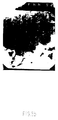
- Fig. 3 shows a photograph of silicalite crystals thus calcined, applied to TiO 2 . This figure was made after the loaded support had been subjected in a liquid phase to the grinding forces caused by a magnet agitator for 12 h. In spite of this rough treatment, the specific distribution of the crystals proved to be hardly affected, if at all.
- the number of free hydroxyl groups on the surface depends on a number of factors. In the first place, this number is determined by the oxidation condition of the surface. Further, the number of hydroxyl groups per unit area is relatively large in metallic supports and relatively small in ceramic (i.e. formed substantially of silicon and aluminum) supports. If the support surface is not or insufficiently in oxidic condition, it can be oxidized using a method which is known per se, for instance by exposure to the air for a number of hours at elevated temperature. When in the method according to the invention a metal support is used, in general the surface thereof is sufficiently oxidized by heating in the air, for instance for four hours at a temperature of 450°C.
- the present invention is partly based on the insight that the extent of oxidation of the support surface can be utilized for the manufacture of different types of molecular sieve crystal layers on the support surfaces.
- the support is oxidized to such an extent that a large number of nucleation points-forming hydroxyl groups are present on the surface. It can be derived that when the concentration of the molecular sieve solution which the crystals are to develop from is chosen so low that it does not determine the size of the crystals formed, the crystals formed are smaller according as the number of nucleation points is larger, while their number increases as well. When such a solution is caused to crystallize on the support surface, highly uniform and small crystals are obtained, having sizes of 20-250 nanometer and possessing micropores which form a selective entrances for substances to be reacted and a selective exit for product molecules to be formed.
- the starting material is a support having a relatively "rough" surface, i.e., a surface that has not been given a micro-fine flatness, then the hydoxyl groups present thereon will not all be oriented in the same direction. This has as a consequence that the crystals of the molecular sieve compound, formed on the support surface, do not grow onto the surface laterally but grow on axially in particular. Such a growth is shown in Figs 1a and 1b.
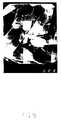
- Fig. 1a shows, at 2,000 magnifications, silicalite crystals grown onto an aluminum plate, axially in particular.
- Fig. 1b shows the grown-on crystals at 6,000 magnifications.
- any support is suitable.
- the only retirement to be met by the support surface is that it can be brought in oxidic condition.
- suitable supports are metal supports, for instance made of aluminum, nickel, copper, steel, iron, titanium, etc.
- suitable supports are for instance made of silicon, mica or Al 2 O 3 .
- the form of the support will be determined in particular by the purpose for which it is used. Suitable forms are plates, tubes, monolith structures, etc.
- metal supports for instance supports made of iron, aluminum and titanium, offers the advantage that during crystal growth and in particular in a basic environment they release metal ions, which are incorporated into the molecular sieve lattice or become associated with the lattice.
- metal ions which are incorporated into the molecular sieve lattice or become associated with the lattice.
- catalytically active sites can be formed in the molecular sieve material.
- any molecular sieve compound or precursor thereof can be caused to crystallize on the support surface.
- Good results are for instance obtained with zeolites such as silicalite-1, ZSM-5, and mordenite and with the molecular sieve AlPO-5.
- These molecular sieves lead to very small crystals, which are highly uniform in size, and, in the case of silicalite and ZSM-5, have a short pore length as well as a very large number of pore entrances.
- a very smooth, i.e., an essentially flat support is used.
- Essentially flat refers to a support having its atoms arranged substantially in one plane. Use of such a support has the important advantage that the hydroxyl groups on the surface are all substantially oriented in the same direction. When it is provided, through sufficient oxidation, that a large number of hydroxyl groups, i.e., a large number of nucleation points, are present on the surface, the formation of crystals on that surface appears to take place in such a manner that the cyrstals are applied in close continuous relationship in the form of a monolayer. Fig.
- a very suitable method for applying molecular sieve crystals to the support surface is the so-called hydrothermal synthesis.
- the oxidized support is submerged in a solution of the molecular sieve compound or the precursor thereof, and heated, for instance in an autoclave, for a number of hours at a temperature of 120-180°C.
- catalytically active ions for instance metal ions, such as gallium, iron, titanium, vanadium, aluminum, cobalt or borium are added to the molecular sieve solution, they deposit in the zeolite lattice, the pores and/or on the surface of the crystals formed, so that the catalyst function of the assembly so obtained can be influenced.
- An aluminum foil of an area of 1 cm 2 was maintained at a temperature of 400°C in a hot-blast furnace for one hour, so as to obtain an oxidic surface layer.
- the foil so treated was introduced into a stainless steel, teflon-coated autoclave of a volume of 3 ml, with 2 ml of a solution containing 1 g of a 40% solution of TPAOH (tetrapropylammoniumhydroxide) and 0.12 g SiO 2 per 100 g H 2 O.
- the pH of this solution was 12.5.
- the solution containing the support was heated for 6-8 h at a temperature of 180°C. After washing and drying, a thin layer of highly uniform prismatic crystals of the MFI type of a size of 1 x 0.5 x 0.1 ⁇ m was obtained, which were randomly oriented on the support surface and covered it entirely.
- a stainless steel grid of a size of 5 x 5 cm and having holes of 0.5 mm was heated in a hot-blast furnace for one hour at 400°C.
- a teflon-coated stainless steel autoclave of a volume of 35 ml 25 ml of a solution containing 1 g of a 40% TPAH solution and 0.12 g SiO 2 per 100 g water was added to the grid.
- the pH of this solution was 12.5.
- Figs 4a, 4b and 4c each show the same part of the grid obtained, covered with crystals, at 150, 860 and 3,000 magnifications, respectively.
- An aluminum platelet having an area of 1 cm 2 and a thickness of 0.5 mm was placed in a hot-blast furnace and maintained at a temperature of 450°C for 1 hour. Then the platelet was introduced into a teflon-coated stainless steel autoclave of a volume of 3 ml and added thereto were 2 ml of a solution containing 1 g of 40% TPAOH and 0.12 g SiO 2 per 250 ml. The pH of this solution was 12.3.
- the solution with the platelet disposed therein was heated at a temperature of 145°C for 10 h.
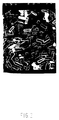
- Fig. 2 shows the support-crystal combination so obtained.
- Figs 5a, 5b, and 5c show the crystal-covered monolith thus obtained at 54, 440 and 12,000 magnifications, respectively, of the same view. It is clearly observable that complete covering with crystals of the internal surface was obtained.
- a copper platelet of 1 cm 2 was submerged in 2 ml of a solution containing 100 g Na 2 SiO 3 9H 2 O and 80 g NaAlO 2 per 100 ml triethanolamine and 700 ml H 2 O.
- the solution with the copper platelet was placed in an autoclave for 10 h at 90°C. After washing and drying, cubic crystals of the zeolite type A were found in a dense layer on the metal surface.
Landscapes
- Chemical & Material Sciences (AREA)
- Chemical Kinetics & Catalysis (AREA)
- Engineering & Computer Science (AREA)
- Materials Engineering (AREA)
- Organic Chemistry (AREA)
- Inorganic Chemistry (AREA)
- Crystallography & Structural Chemistry (AREA)
- Manufacturing & Machinery (AREA)
- Catalysts (AREA)
- Silicates, Zeolites, And Molecular Sieves (AREA)
- Separation Using Semi-Permeable Membranes (AREA)
- Crystals, And After-Treatments Of Crystals (AREA)
- Macromolecular Compounds Obtained By Forming Nitrogen-Containing Linkages In General (AREA)
- Solid-Sorbent Or Filter-Aiding Compositions (AREA)
- Organic Low-Molecular-Weight Compounds And Preparation Thereof (AREA)
- Polymers With Sulfur, Phosphorus Or Metals In The Main Chain (AREA)
Claims (9)
- Verfahren zum Aufbringen von Molekularsiebkristallen auf einen Träger, bei dem eine Oberfläche des Trägers in einen oxidischen Zustand gebracht wird, indem sie eine Anzahl von Stunden bei einer Temperatur von 400°C oder höher Luft ausgesetzt wird, der Träger mit einem oxidischen Zustand mit einer Lösung der Molekularsieb bildenden Verbindung, der Molekularsieb bildenden Verbindungen oder Vorläufern derselben kontaktiert wird, Kristallisation auf der Oberfläche bewirkt wird und nachfolgend der beladene Träger calciniert wird.
- Verfahren nach Anspruch 1, dadurch gekennzeichnet, daß die Trägeroberfläche 4 h bei einer Temperatur über 450°C Luft ausgesetzt wird.
- Verfahren nach Anspruch 1 oder 2, dadurch gekennzeichnet, daß die Kristallisation auf der Oberfläche durch hydrothermale Synthese bewirkt wird.
- Verfahren nach Anspruch 3, dadurch gekennzeichnet, daß die Trägeroberfläche in einer Lösung der Molekularsiebverbindung oder -verbindungen oder Vorläufern derselben untergetaucht wird, wobei die Temperatur der Lösung 120 bis 180°C beträgt.
- Verfahren nach einem der Ansprüche 1 bis 4, dadurch gekennzeichnet, daß die Calcinierung 24 h bei einer Temperatur von 450°C durchgeführt wird.
- Verfahren nach einem der Ansprüche 1 bis 5, dadurch gekennzeichnet, daß der Molekularsieblösung katalytisch aktive Metallionen zugesetzt werden.
- Verfahren nach einem oder mehreren der Ansprüche 1 bis 6, dadurch gekennzeichnet, daß ein vollständig ebener Träger mit einer im wesentlichen kontinuierlichen Schicht aus Molekularsiebkristallen bereitgestellt wird, wonach der Träger teilweise entfernt und eine Membran gebildet wird.
- Katalysator, der einen Träger umfaßt, auf dem nach dem Verfahren gemäß Ansprüchen 1 bis 6 erhaltene kristallisierte Molekularsiebverbindungen bereitgestellt sind.
- Membran, die unter Verwendung des Verfahrens gemäß einem der Ansprüche 1 bis 7 erhalten worden ist.
Applications Claiming Priority (3)
| Application Number | Priority Date | Filing Date | Title |
|---|---|---|---|
| NL9101126A NL9101126A (nl) | 1991-06-28 | 1991-06-28 | Werkwijze voor het aanbrengen van moleculaire-zeefkristallen op een drager, alsmede aldus verkregen beladen drager. |
| NL9101126 | 1991-06-28 | ||
| PCT/NL1992/000110 WO1993000155A1 (en) | 1991-06-28 | 1992-06-26 | A method of applying molecular sieve crystals to a support, and a loaded support thus obtained |
Publications (2)
| Publication Number | Publication Date |
|---|---|
| EP0591463A1 EP0591463A1 (de) | 1994-04-13 |
| EP0591463B1 true EP0591463B1 (de) | 1998-04-29 |
Family
ID=19859436
Family Applications (1)
| Application Number | Title | Priority Date | Filing Date |
|---|---|---|---|
| EP92915963A Expired - Lifetime EP0591463B1 (de) | 1991-06-28 | 1992-06-26 | Verfahren zum auftragen von molekularsiebekristallen auf einen träger und der damit erhaltene beschichtete träger |
Country Status (10)
| Country | Link |
|---|---|
| EP (1) | EP0591463B1 (de) |
| JP (1) | JP3367667B2 (de) |
| AT (1) | ATE165529T1 (de) |
| AU (1) | AU2363892A (de) |
| BR (1) | BR9206218A (de) |
| CA (1) | CA2113256A1 (de) |
| DE (1) | DE69225323T2 (de) |
| ES (1) | ES2118137T3 (de) |
| NL (1) | NL9101126A (de) |
| WO (1) | WO1993000155A1 (de) |
Families Citing this family (9)
| Publication number | Priority date | Publication date | Assignee | Title |
|---|---|---|---|---|
| ATE339249T1 (de) * | 1993-04-23 | 2006-10-15 | Exxonmobil Res & Eng Co | Molekularsiebschichten und verfahren zu ihrer herstellung |
| JP3371533B2 (ja) * | 1994-03-31 | 2003-01-27 | エヌオーケー株式会社 | ガス分離膜の製造法 |
| US5672388A (en) * | 1994-07-08 | 1997-09-30 | Exxon Research & Engineering Company | Membrane reparation and poer size reduction using interfacial ozone assisted chemical vapor deposition |
| US5824617A (en) * | 1994-07-08 | 1998-10-20 | Exxon Research & Engineering Company | Low alkaline inverted in-situ crystallized zeolite membrane |
| GB9413863D0 (en) * | 1994-07-08 | 1994-08-24 | Exxon Chemical Patents Inc | Molecular sieves and processes for their manufacture |
| US5871650A (en) * | 1994-07-08 | 1999-02-16 | Exxon Research And Engineering Company | Supported zeolite membranes with controlled crystal width and preferred orientation grown on a growth enhancing layer |
| DE10136621C2 (de) * | 2001-07-19 | 2003-12-11 | Inst Angewandte Chemie Berlin | Molekularsiebmembran auf Basis poröser Träger und Kristallisationsverfahren |
| JP2007203209A (ja) * | 2006-02-02 | 2007-08-16 | Denso Corp | 触媒体および無機担体および無機担体の製造方法 |
| ITCS20100003A1 (it) | 2010-02-09 | 2011-08-10 | Univ Calabria | Membrana zeolitica per adesioni e colture di cellule, procedimento per la preparazione ed applicazione. |
Family Cites Families (6)
| Publication number | Priority date | Publication date | Assignee | Title |
|---|---|---|---|---|
| US3368981A (en) * | 1965-07-02 | 1968-02-13 | Mobil Oil Corp | Utilization of superactive catalytic materials |
| US3730910A (en) * | 1971-02-02 | 1973-05-01 | Grace W R & Co | Novel zeolite surfaces |
| JPS6028826A (ja) * | 1983-07-26 | 1985-02-14 | Hiroshi Suzuki | かご型ゼオライト薄膜表層を有する複合膜及びその製造法 |
| CA1235684A (en) * | 1984-10-10 | 1988-04-26 | Toa Nenryo Kogyo K.K. | Membraneous synthetic zeolite and process for producing the same |
| DE3827049A1 (de) * | 1988-08-10 | 1990-02-15 | Schulten Rudolf Prof Dr | Zeolithisches molekularsieb zur trennung von fluiden |
| AU8473591A (en) * | 1990-10-19 | 1992-04-30 | British Petroleum Company Plc, The | Deposition process |
-
1991
- 1991-06-28 NL NL9101126A patent/NL9101126A/nl not_active Application Discontinuation
-
1992
- 1992-06-26 CA CA002113256A patent/CA2113256A1/en not_active Abandoned
- 1992-06-26 WO PCT/NL1992/000110 patent/WO1993000155A1/en not_active Ceased
- 1992-06-26 AT AT92915963T patent/ATE165529T1/de not_active IP Right Cessation
- 1992-06-26 EP EP92915963A patent/EP0591463B1/de not_active Expired - Lifetime
- 1992-06-26 AU AU23638/92A patent/AU2363892A/en not_active Abandoned
- 1992-06-26 JP JP50117593A patent/JP3367667B2/ja not_active Expired - Fee Related
- 1992-06-26 DE DE69225323T patent/DE69225323T2/de not_active Expired - Fee Related
- 1992-06-26 BR BR9206218A patent/BR9206218A/pt not_active Application Discontinuation
- 1992-06-26 ES ES92915963T patent/ES2118137T3/es not_active Expired - Lifetime
Also Published As
| Publication number | Publication date |
|---|---|
| CA2113256A1 (en) | 1993-01-07 |
| NL9101126A (nl) | 1993-01-18 |
| EP0591463A1 (de) | 1994-04-13 |
| AU2363892A (en) | 1993-01-25 |
| JP3367667B2 (ja) | 2003-01-14 |
| BR9206218A (pt) | 1994-12-13 |
| ATE165529T1 (de) | 1998-05-15 |
| DE69225323D1 (de) | 1998-06-04 |
| WO1993000155A1 (en) | 1993-01-07 |
| DE69225323T2 (de) | 1998-10-29 |
| ES2118137T3 (es) | 1998-09-16 |
| JPH06508598A (ja) | 1994-09-29 |
Similar Documents
| Publication | Publication Date | Title |
|---|---|---|
| US6037292A (en) | Compositions having two or more zeolite layers | |
| EP0695215B2 (de) | Verfahren zur herstellung von molekularsiebschichten | |
| EP0599117B1 (de) | Verfahren zum Züchten von gemischten Zeolithen auf einem Substrat | |
| KR100189210B1 (ko) | 막 | |
| US7973090B2 (en) | Process for production of zeolite film | |
| RU2169039C2 (ru) | Молекулярные сита, способ их получения, способ разделения текучей смеси, способ катализа химической реакции (варианты) с их использованием | |
| JP4511637B2 (ja) | モレキュラーシーブフィルムの調製方法 | |
| EP0591463B1 (de) | Verfahren zum auftragen von molekularsiebekristallen auf einen träger und der damit erhaltene beschichtete träger | |
| US20010012505A1 (en) | Mordenite zeolite membrane and method for producing the same | |
| EP1157735A2 (de) | Verfahren zur Herstellung von Molekularsieb-Membranen auf porösen Trägern | |
| JP5481075B2 (ja) | ゼオライト膜の製造方法 | |
| JPH1057784A (ja) | ゼオライト分離膜及びその製造方法 | |
| US6734129B2 (en) | Zeolite membrane composites (LAW730) | |
| JP6040273B2 (ja) | リン酸アルミニウムゼオライトの微孔性被膜層を有するアルミニウム含有支持体、該支持体の製造方法および該支持体の使用 | |
| CN114560474A (zh) | 一种金属改性m-mfi分子筛膜的合成方法 | |
| US5843392A (en) | Catalyst system of the structured type | |
| KR101693599B1 (ko) | 제올라이트 분리막 제조 방법 | |
| GB2340112A (en) | Molecular sieve compositions | |
| Zhang et al. | Modification of carbon membranes and preparation of carbon–zeolite composite membranes with zeolite growth | |
| JPH10244161A (ja) | ゼオライト膜、その製造方法およびゼオライト膜を利用したオレフィンの製造方法 | |
| Boudreau | Preparation and characterization of highly oriented films and membranes of zeolite A | |
| KR20140126275A (ko) | 초음파를 이용한 무기 입자의 선택적인 물리적 증착 방법 및 이로부터 제조된 기질 상의 씨드 균일층으로부터 성장된 카바자이트 제올라이트 분리막 및 이에 사용되는 판상의 실리카 카바자이트 제올라이트 입자 및 이를 제조하는 방법 |
Legal Events
| Date | Code | Title | Description |
|---|---|---|---|
| PUAI | Public reference made under article 153(3) epc to a published international application that has entered the european phase |
Free format text: ORIGINAL CODE: 0009012 |
|
| AK | Designated contracting states |
Kind code of ref document: A1 Designated state(s): AT BE CH DE DK ES FR GB GR IT LI LU NL SE |
|
| 17P | Request for examination filed |
Effective date: 19931227 |
|
| 17Q | First examination report despatched |
Effective date: 19940728 |
|
| RAP1 | Party data changed (applicant data changed or rights of an application transferred) |
Owner name: EXXON CHEMICAL PATENTS INC. |
|
| GRAG | Despatch of communication of intention to grant |
Free format text: ORIGINAL CODE: EPIDOS AGRA |
|
| GRAG | Despatch of communication of intention to grant |
Free format text: ORIGINAL CODE: EPIDOS AGRA |
|
| GRAH | Despatch of communication of intention to grant a patent |
Free format text: ORIGINAL CODE: EPIDOS IGRA |
|
| GRAH | Despatch of communication of intention to grant a patent |
Free format text: ORIGINAL CODE: EPIDOS IGRA |
|
| GRAA | (expected) grant |
Free format text: ORIGINAL CODE: 0009210 |
|
| AK | Designated contracting states |
Kind code of ref document: B1 Designated state(s): AT BE CH DE DK ES FR GB GR IT LI LU NL SE |
|
| PG25 | Lapsed in a contracting state [announced via postgrant information from national office to epo] |
Ref country code: GR Free format text: LAPSE BECAUSE OF FAILURE TO SUBMIT A TRANSLATION OF THE DESCRIPTION OR TO PAY THE FEE WITHIN THE PRESCRIBED TIME-LIMIT Effective date: 19980429 |
|
| REF | Corresponds to: |
Ref document number: 165529 Country of ref document: AT Date of ref document: 19980515 Kind code of ref document: T |
|
| REG | Reference to a national code |
Ref country code: CH Ref legal event code: EP |
|
| REF | Corresponds to: |
Ref document number: 69225323 Country of ref document: DE Date of ref document: 19980604 |
|
| PG25 | Lapsed in a contracting state [announced via postgrant information from national office to epo] |
Ref country code: LU Free format text: LAPSE BECAUSE OF NON-PAYMENT OF DUE FEES Effective date: 19980626 |
|
| ITF | It: translation for a ep patent filed | ||
| ET | Fr: translation filed | ||
| PG25 | Lapsed in a contracting state [announced via postgrant information from national office to epo] |
Ref country code: DK Free format text: LAPSE BECAUSE OF FAILURE TO SUBMIT A TRANSLATION OF THE DESCRIPTION OR TO PAY THE FEE WITHIN THE PRESCRIBED TIME-LIMIT Effective date: 19980729 |
|
| REG | Reference to a national code |
Ref country code: CH Ref legal event code: NV Representative=s name: NOVAPAT INTERNATIONAL S.A. |
|
| REG | Reference to a national code |
Ref country code: ES Ref legal event code: FG2A Ref document number: 2118137 Country of ref document: ES Kind code of ref document: T3 |
|
| PLBE | No opposition filed within time limit |
Free format text: ORIGINAL CODE: 0009261 |
|
| STAA | Information on the status of an ep patent application or granted ep patent |
Free format text: STATUS: NO OPPOSITION FILED WITHIN TIME LIMIT |
|
| 26N | No opposition filed | ||
| REG | Reference to a national code |
Ref country code: GB Ref legal event code: IF02 |
|
| PGFP | Annual fee paid to national office [announced via postgrant information from national office to epo] |
Ref country code: GB Payment date: 20030501 Year of fee payment: 12 |
|
| PGFP | Annual fee paid to national office [announced via postgrant information from national office to epo] |
Ref country code: AT Payment date: 20030502 Year of fee payment: 12 |
|
| PGFP | Annual fee paid to national office [announced via postgrant information from national office to epo] |
Ref country code: NL Payment date: 20030513 Year of fee payment: 12 |
|
| PGFP | Annual fee paid to national office [announced via postgrant information from national office to epo] |
Ref country code: FR Payment date: 20030602 Year of fee payment: 12 |
|
| PGFP | Annual fee paid to national office [announced via postgrant information from national office to epo] |
Ref country code: SE Payment date: 20030603 Year of fee payment: 12 |
|
| PGFP | Annual fee paid to national office [announced via postgrant information from national office to epo] |
Ref country code: CH Payment date: 20030605 Year of fee payment: 12 |
|
| PGFP | Annual fee paid to national office [announced via postgrant information from national office to epo] |
Ref country code: ES Payment date: 20030619 Year of fee payment: 12 |
|
| PGFP | Annual fee paid to national office [announced via postgrant information from national office to epo] |
Ref country code: DE Payment date: 20030630 Year of fee payment: 12 |
|
| PGFP | Annual fee paid to national office [announced via postgrant information from national office to epo] |
Ref country code: BE Payment date: 20030715 Year of fee payment: 12 |
|
| PG25 | Lapsed in a contracting state [announced via postgrant information from national office to epo] |
Ref country code: GB Free format text: LAPSE BECAUSE OF NON-PAYMENT OF DUE FEES Effective date: 20040626 Ref country code: AT Free format text: LAPSE BECAUSE OF NON-PAYMENT OF DUE FEES Effective date: 20040626 |
|
| PG25 | Lapsed in a contracting state [announced via postgrant information from national office to epo] |
Ref country code: SE Free format text: LAPSE BECAUSE OF NON-PAYMENT OF DUE FEES Effective date: 20040627 |
|
| PG25 | Lapsed in a contracting state [announced via postgrant information from national office to epo] |
Ref country code: ES Free format text: LAPSE BECAUSE OF NON-PAYMENT OF DUE FEES Effective date: 20040628 |
|
| PG25 | Lapsed in a contracting state [announced via postgrant information from national office to epo] |
Ref country code: LI Free format text: LAPSE BECAUSE OF NON-PAYMENT OF DUE FEES Effective date: 20040630 Ref country code: CH Free format text: LAPSE BECAUSE OF NON-PAYMENT OF DUE FEES Effective date: 20040630 Ref country code: BE Free format text: LAPSE BECAUSE OF NON-PAYMENT OF DUE FEES Effective date: 20040630 |
|
| BERE | Be: lapsed |
Owner name: *EXXON CHEMICAL PATENTS INC. Effective date: 20040630 |
|
| PG25 | Lapsed in a contracting state [announced via postgrant information from national office to epo] |
Ref country code: NL Free format text: LAPSE BECAUSE OF NON-PAYMENT OF DUE FEES Effective date: 20050101 Ref country code: DE Free format text: LAPSE BECAUSE OF NON-PAYMENT OF DUE FEES Effective date: 20050101 |
|
| EUG | Se: european patent has lapsed | ||
| EUG | Se: european patent has lapsed | ||
| REG | Reference to a national code |
Ref country code: CH Ref legal event code: PL |
|
| GBPC | Gb: european patent ceased through non-payment of renewal fee |
Effective date: 20040626 |
|
| PG25 | Lapsed in a contracting state [announced via postgrant information from national office to epo] |
Ref country code: FR Free format text: LAPSE BECAUSE OF NON-PAYMENT OF DUE FEES Effective date: 20050228 |
|
| NLV4 | Nl: lapsed or anulled due to non-payment of the annual fee |
Effective date: 20050101 |
|
| REG | Reference to a national code |
Ref country code: FR Ref legal event code: ST |
|
| PG25 | Lapsed in a contracting state [announced via postgrant information from national office to epo] |
Ref country code: IT Free format text: LAPSE BECAUSE OF NON-PAYMENT OF DUE FEES;WARNING: LAPSES OF ITALIAN PATENTS WITH EFFECTIVE DATE BEFORE 2007 MAY HAVE OCCURRED AT ANY TIME BEFORE 2007. THE CORRECT EFFECTIVE DATE MAY BE DIFFERENT FROM THE ONE RECORDED. Effective date: 20050626 |
|
| REG | Reference to a national code |
Ref country code: ES Ref legal event code: FD2A Effective date: 20040628 |