EP0591607A2 - Dispositif semi-conducteur isolé et méthode de fabrication - Google Patents
Dispositif semi-conducteur isolé et méthode de fabrication Download PDFInfo
- Publication number
- EP0591607A2 EP0591607A2 EP93104466A EP93104466A EP0591607A2 EP 0591607 A2 EP0591607 A2 EP 0591607A2 EP 93104466 A EP93104466 A EP 93104466A EP 93104466 A EP93104466 A EP 93104466A EP 0591607 A2 EP0591607 A2 EP 0591607A2
- Authority
- EP
- European Patent Office
- Prior art keywords
- compound semiconductor
- semiconductor layers
- ion implantation
- layers
- layer
- Prior art date
- Legal status (The legal status is an assumption and is not a legal conclusion. Google has not performed a legal analysis and makes no representation as to the accuracy of the status listed.)
- Withdrawn
Links
Images

Classifications
-
- H—ELECTRICITY
- H10—SEMICONDUCTOR DEVICES; ELECTRIC SOLID-STATE DEVICES NOT OTHERWISE PROVIDED FOR
- H10D—INORGANIC ELECTRIC SEMICONDUCTOR DEVICES
- H10D30/00—Field-effect transistors [FET]
- H10D30/01—Manufacture or treatment
- H10D30/015—Manufacture or treatment of FETs having heterojunction interface channels or heterojunction gate electrodes, e.g. HEMT
-
- H—ELECTRICITY
- H10—SEMICONDUCTOR DEVICES; ELECTRIC SOLID-STATE DEVICES NOT OTHERWISE PROVIDED FOR
- H10D—INORGANIC ELECTRIC SEMICONDUCTOR DEVICES
- H10D30/00—Field-effect transistors [FET]
- H10D30/40—FETs having zero-dimensional [0D], one-dimensional [1D] or two-dimensional [2D] charge carrier gas channels
- H10D30/47—FETs having zero-dimensional [0D], one-dimensional [1D] or two-dimensional [2D] charge carrier gas channels having two-dimensional [2D] charge carrier gas channels, e.g. nanoribbon FETs or high electron mobility transistors [HEMT]
- H10D30/471—High electron mobility transistors [HEMT] or high hole mobility transistors [HHMT]
- H10D30/473—High electron mobility transistors [HEMT] or high hole mobility transistors [HHMT] having confinement of carriers by multiple heterojunctions, e.g. quantum well HEMT
- H10D30/4732—High electron mobility transistors [HEMT] or high hole mobility transistors [HHMT] having confinement of carriers by multiple heterojunctions, e.g. quantum well HEMT using Group III-V semiconductor material
-
- H—ELECTRICITY
- H10—SEMICONDUCTOR DEVICES; ELECTRIC SOLID-STATE DEVICES NOT OTHERWISE PROVIDED FOR
- H10W—GENERIC PACKAGES, INTERCONNECTIONS, CONNECTORS OR OTHER CONSTRUCTIONAL DETAILS OF DEVICES COVERED BY CLASS H10
- H10W10/00—Isolation regions in semiconductor bodies between components of integrated devices
-
- H—ELECTRICITY
- H10—SEMICONDUCTOR DEVICES; ELECTRIC SOLID-STATE DEVICES NOT OTHERWISE PROVIDED FOR
- H10W—GENERIC PACKAGES, INTERCONNECTIONS, CONNECTORS OR OTHER CONSTRUCTIONAL DETAILS OF DEVICES COVERED BY CLASS H10
- H10W10/00—Isolation regions in semiconductor bodies between components of integrated devices
- H10W10/01—Manufacture or treatment
Definitions
- the present invention relates to a semiconductor device and a production method thereof in which a device is formed in a prescribed region of compound semiconductor layers grown on a semiconductor substrate and, more particularly to a method of isolating the device from other regions on the semiconductor substrate.
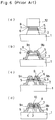
- FIGS 5(a) to 5(c) are diagrams illustrating a high electron mobility transistor (hereinafter referred to as HEMT) formed on an InP substrate included in a prior art semiconductor device, in which figure 5(a) is a top plan view and figures 5(b) and 5(c) are sectional views taken along lines Vb-Vb and Vc-Vc of figure 5(a), respectively.
- HEMT high electron mobility transistor
- a mesa structure comprising compound semiconductor layers, i.e., an intrinsic (hereinafter referred to as i type) InAlAs buffer layer 2, an i type InGaAs channel layer 3, an i type InAlAs spacer layer 4, an n type InAlAs electron supply layer 5, an i type InAlAs Schottky formation layer 6, an n type InAlAs layer 7, and a low-resistance n type InGaAs contact layer 8 with carrier concentration of 2 x 1019 cm3, is disposed on a portion of the InP substrate 1.
- a recess 11 penetrates through the InGaAs contact layer 8 and the InAlAs layer 7 to reach into the Schottky formation layer 6.
- a gate electrode 10 is disposed on the Schottky formation layer 6 exposed on the bottom of the recess 11 and extended onto a portion of the substrate 1.
- Source and drain electrodes 9a and 9b are disposed on the mesa structure where the recess 11 is absent and extended onto portions of the substrate 1.
- the i type InAlAs buffer layer 2 is 1000 ⁇ 1500 angstroms thick and each of the layers disposed on the buffer layer 2 is 100 ⁇ 400 angstroms thick.
- Source and drain regions are formed in the n type InAlAs layer 7.
- Reference numeral 10a designates a bonding pad at an end of the gate electrode 10, to which wires from external devices or devices disposed on other regions of the InP substrate 1 are bonded.
- Figures 6(a) to 6(d) illustrate process steps in a method of producing the HEMT.
- the same reference numerals as in figures 5(a) to 5(c) designate the same or corresponding parts
- reference numeral 12 designates a photoresist pattern.
- the InP substrate 1 the i type InAlAs buffer layer 2, the i type InGaAs channel layer 3, the i type InAlAs spacer layer 4, the n type InAlAs electron supply layer 5, the i type InAlAs Schottky formation layer 6, the n type InAlAs layer 7, and the n type InGaAs contact layer 8, preferably by metal organic chemical vapor deposition (MOCVD).
- MOCVD metal organic chemical vapor deposition
- the semiconductor layers 2 to 8 are etched by wet etching using tartaric acid or the like as an etchant to form the semiconductor layers 2 to 8 in a mesa shape as shown in figure 6(a).
- the mesa-shaped semiconductor layers are isolated from other regions on the InP substrate 1.
- the source and drain electrodes 9a and 9b are formed on prescribed regions on the n type InGaAs contact layer 8, extending onto the surface of the InP substrate 1.
- a bias voltage is applied between the source and drain electrodes 9a and 9b, a two-dimensional gas serving as a channel is formed in the i type InGaAs channel layer 3 in the vicinity of its boundary with the i type InAlAs spacer layer 4, and a current flows through the channel.
- This current is controlled by a voltage applied to the gate electrode 10 to operate the transistor.
- the thickness of the whole compound semiconductor layers must be larger than 0.2 micron.
- the thickness of semiconductor layers between the bottom of the recess, on which the gate electrode is formed, and the surface of the semiconductor substrate must be larger than 0.2 micron.
- a difference in levels between the surface of the semiconductor substrate and the top of the mesa is more than 0.2 micron.
- the HEMT since the HEMT includes the recessed gate, a difference in levels between the surface of the semiconductor substrate and the bottom of the recess is more than 0.2 micron.
- lift-off is usually employed as described above.
- a photoresist film is formed on the mesa and its periphery, and a prescribed portion of the photoresist film is opened by photolithographic technique to form a mask pattern. Then, a metal for the electrode is deposited via the mask pattern, followed by removal of the mask pattern, resulting in an electrode.
- NA a numerical aperture of a projection lens
- ⁇ a wavelength of exposure light
- k1 a constant indicating a lens performance, which is 0.612 in a case of a spherical projection lens according to a theory by Rayleigh. It is known that it is possible to form a fine exposure pattern by increasing the numerical aperture (NA), according to the equation (1).
- a depth of focus is reduced with an increase in the numerical aperture (NA), resulting in an insufficient exposure strength.
- NA numerical aperture
- the gate electrode 10 in forming the gate electrode 10 on the bottom surface of the recess 11 extending onto the surface of the InP substrate 1 by lift-off in the formation of the HEMT, if the opening of the photoresist pattern is fine-patterned in accordance with a desired width of the gate electrode of 0.25 micron or below, the resulting gate electrode is not uniform in its thickness and width and, in some cases, the gate electrode is discontinuous at the edge of the mesa structure, resulting in a HEMT with poor reliability.
- An object of the present invention is to provide a semiconductor device in which a level difference due to a device formed on a substrate is reduced and the device is completely isolated from other regions on the substrate.
- Another object of the present invention is to provide a method for producing the semiconductor device.
- a device in a method of producing a semiconductor device, when a device is formed in a prescribed region of compound semiconductor layers including a low resistance layer which cannot be insulated by ion implantation, upper layers of the compound semiconductor layers including at least the low resistance layer are formed into a mesa shape by etching, and then ion implantation is performed to the compound semiconductor layers other than those beneath the mesa structure, whereby the device is completely isolated from other regions on the semiconductor substrate.
- the device formed on the substrate is isolated from other regions on the substrate using the mesa-etching and the ion implantation, so that a level difference on the substrate due to the device is within a range that does not adversely affect the subsequent process steps, for example, a step of producing electrodes.
- materials and compositions of the compound semiconductor layers isolated by the mesa-etching are selected according to desired device characteristics, without paying consideration on the insulation by ion implantation.
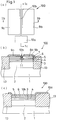
- Figures 1(a) to 1(c) illustrate a HEMT formed on an InP substrate included in a semiconductor device in accordance with a first embodiment of the present invention, in which figure 1(a) is a top plan view and figures 1(b) and 1(c) are sectional views taken along lines Ib-Ib and Ic-Ic of figure 1(a), respectively.
- successively disposed on an InP substrate 1 are an i type InAlAs buffer layer 2, an i type InGaAs channel layer 3, an i type InAlAs spacer layer 4, an n type InAlAs electron supply layer 5, an i type InAlAs Schottky formation layer 6, an n type InAlAs layer 7, and an n type InGaAs contact layer 8a.
- Source and drain electrodes 9a and 9b are disposed on the n type InGaAs contact layer 8a and make an ohmic contact with the contact layer 8a.
- a recess 11 penetrates through the n type InGaAs contact layer 8a and the n type InAlAs layer 7 to reach into the i type InAlAs Schottky formation layer 6.
- a gate electrode 10b having a width of 0.25 micron or below is disposed on the i type InAlAs Schottky formation layer 6 exposed on the bottom surface of the recess 11.
- Reference numeral 13 designates an insulating region for isolating the HEMT 100, which is formed by ion implantation. Source and drain regions are formed in the n type InAlAs layer 7.
- the i type InAsAs buffer layer 2 is 1000 ⁇ 1500 angstroms thick, and each of the layers disposed on the buffer layer 2 is 100 ⁇ 400 angstroms thick.
- the resistance of the n type InGaAs contact layer 8a is reduced by increasing carrier concentration thereof to 1 X 10²⁰/cm3 order, whereby the source and drain electrodes 9a and 9b can favorably make an ohmic contact with the contact layer 8a.
- the contact layer 8a is patterned so that edges of the contact layer are aligned with edges of the insulating region 13.
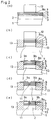
- FIG. 1 A method of manufacturing the HEMT of figures 1(a) to 1(c) is illustrated in figures 2(a) to 2(d).
- the i type InAlAs buffer layer 2 there are successively grown on on the InP substrate 1, the i type InAlAs buffer layer 2, the i type InGaAs channel layer 3, the i type InAlAs spacer layer 4, the n type InAlAs electron supply layer 5, the i type InAlAs Schottky formation layer 6, the n type InAlAs layer 7, and the n type InGaAs contact layer 8a.
- these layers are grown by MOCVD.
- a photoresist pattern 12 is formed on the n type InGaAs contact layer 8a by a conventional photolithographic technique.
- the n type InGaAs contact layer 8a is selectively etched by wet etching using citric acid as an etchant.
- the n type InGaAs layer 8a which is etched by the wet etching is a layer which cannot be insulated by ion implantation because of its high carrier concentration that provides the low resistance of the layer.
- one of hydrogen (H) ion, boron (B) ion, and iron (Fe) ion, or a combination thereof is used as the ion implanted.
- the source and drain electrodes 9a and 9b comprising Au alloy or Ag alloy that make an ohmic contact with the n type InGaAs contact layer 8a are formed on the contact layer 8a and portions of the insulating region 13 by lift-off, as illustrated in figure 2(c).
- a recess etching is carried out from the surface of the contact layer 8a while measuring a current flowing between the source and drain electrodes 9a and 9b, whereby the thickness of the i type InAlAs Schottky formation layer 6 in a gate region is adjusted to a desired thickness, resulting in the recess 11 shown in figure 2(d).
- the gate electrode 10b having a width of 0.25 micron or below is formed on the Schottky formation layer 6 exposed on the bottom of the recess 11 by lift-off.
- an aperture width of a photoresist pattern used for selectively depositing an electrode metal on the bottom of the recess is 0.25 micron or below.
- a difference in levels between the surface of the insulating region 13 and the surface of the Schottky formation layer 6 exposed on the bottom of the recess 11 is in a range of 200 ⁇ 800 angstroms.
- the pattern exposure is carried out without reducing the resolution and the exposure intensity, whereby a photoresist pattern with a uniform aperture width is obtained.
- the gate electrode 10b having uniform width and thickness is formed with no discontinuity at the edge of the insulating region 13.
- an electrode leading part 10a serving as a bonding pad is formed at an end of the gate electrode 10b. Then, wires from a device formed on the other region on the InP substrate 1 or from an external device are bonded onto the bonding pad 10a.
- the uppermost layer of the HEMT 100 i.e., the low resistance n type InGaAs contact layer 8a is isolated from other regions of the compound semiconductor layers by etching, and then the respective layers beneath the contact layer 8a are isolated by ion implantation, whereby the HEMT 100 is completely isolated on the InP substrate 1.
- the gate electrode 10 having a width of 0.25 micron or below is formed on the i type InAlAs Schottky formation layer 6 exposed on the bottom surface of the recess 11, extending onto the surface of the insulating region 13 by lift-off, the difference in levels between the bottom of the recess and the surface of the insulating region 13 is within a range of 200 to 800 angstroms, resulting in a high dimensional precision of the aperture of the photoresist pattern for forming the electrode, and an electrode with uniform width and thickness is attained, with the result that characteristics of the HEMT are improved.
- the buffer layer 2 may be thicker than 1500 angstroms because the increase in the thickness of the buffer layer 2 does not affect the difference in levels between the bottom surface of the recess 11 and the surface of the insulating region 13. In this case, crystallinities of the semiconductor crystal layers 3 to 8a grown on the buffer layer 2 are improved, with a result that characteristics of the HEMT are further improved.
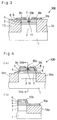
- Figure 3 is a sectional view illustrating a HEMT formed on an InP substrate included in a semiconductor device in accordance with a second embodiment of the present invention.
- the same reference numerals as in figures 1(a) to 1(c) designate the same or corresponding parts.
- width of the n type InGaAs contact layer 8b of the HEMT 300 is narrower than the width of the n type InGaAs contact layer 8a of the HEMT 100 of the first embodiment
- the source and drain electrodes 9a and 9b are disposed over the n type InGaAs contact layer 8a, and intervals between the gate electrode 10b and the source and drain electrodes 9a and 9b are wider than those of the HEMT 100 of the first embodiment.
- a method of manufacturing the HEMT 300 is identical to that of the previously described first embodiment except that photolithography and etching for reducing the width of the n type InGaAs contact layer 8b are carried out before the formation of the source and drain electrodes 9a and 9b.
- the same effects as described in the first embodiment are obtained.
- the width of the n type InGaAs contact layer 8b is narrower and the intervals between the gate electrode 10b and the source and drain electrodes 9a and 9b are wider than those of the HEMT 100 of the first embodiment, a gate junction breakdown voltage is increased, with the result that the characteristics of the HEMT are further improved.
- Figure 4(a) is a sectional view illustrating a HEMT formed on an InP substrate included in a semiconductor device in accordance with a third embodiment of the present invention
- figure 4(b) is a sectional view taken along line IVb-IVb of figure 4(a).
- the same reference numerals as in figures 1(a) to 1(c) designate the same or corresponding parts.
- Reference numeral 13a designates an insulating region formed by ion implantation.
- the semiconductor layers on the i type InAlAs buffer layer 2 are formed in a mesa shape by etching, and a prescribed region 13a of the buffer layer 2 and the InP substrate 1 is insulated by ion implantation, whereby the HEMT 400 is isolated from other regions on the InP substrate 1.
- the gate electrode 10b having a width of 0.25 micron or below is disposed on the bottom surface of the recess 11 and extended onto the surface of the insulating region 13a.
- time for the mesa-etching of the compound semiconductor crystal layers is controlled in the step of figure 6(a) so as to stop the etching on the surface of the i type InAsAs buffer layer 2, and the insulating region 13a is formed by ion implantation. Thereafter, the source and drain electrodes 9a and 9b and the gate electrode 10b are formed to complete the HEMT 400.
- the etching time is controlled so that a level difference on the substrate may not exceed 0.2 micron, differently from the selective etching in the first and second embodiments of the present invention. Therefore, the HEMT 400 which is completely isolated from other regions on the substrate is achieved in a simple process.
- the fine gate electrode 10b achieved in this embodiment has uniform width and continuity at the edge of the mesa structure because the difference in levels between the surface of the insulating region 13a and the bottom surface of the recess 11 is in a range of 400 to 1600 angstroms.
- the HEMT is formed on the InP substrate
- the present invention may be applied to other field effect transistors or other devices formed on semiconductor substrates comprising other materials.
- a device when a device is formed in a prescribed region of compound semiconductor layers including a low resistance layer which cannot be insulated by ion implantation, upper layers of the compound semiconductor layers including at least the low resistance layer are formed into a mesa shape by etching, and ion implantation is carried out into the compound semiconductor layers other than those beneath the mesa structure, whereby the device is completely isolated from other regions on the semiconductor substrate. Therefore, a device structure with a small level difference is attained, resulting in a high-performance device.
- materials and compositions of the compound semiconductor layers isolated by the mesa-etching are selected according to desired device characteristics without paying considerations on the insulation by ion implantation. Therefore, the degree of freedom in selecting materials and compositions of the compound semiconductor layers formed on the semiconductor substrate increases, resulting in a high-performance device.
Landscapes
- Junction Field-Effect Transistors (AREA)
- Element Separation (AREA)
Applications Claiming Priority (2)
| Application Number | Priority Date | Filing Date | Title |
|---|---|---|---|
| JP236556/92 | 1992-08-11 | ||
| JP4236556A JPH0661269A (ja) | 1992-08-11 | 1992-08-11 | 半導体装置及びその製造方法 |
Publications (2)
| Publication Number | Publication Date |
|---|---|
| EP0591607A2 true EP0591607A2 (fr) | 1994-04-13 |
| EP0591607A3 EP0591607A3 (en) | 1997-01-08 |
Family
ID=17002400
Family Applications (1)
| Application Number | Title | Priority Date | Filing Date |
|---|---|---|---|
| EP93104466A Withdrawn EP0591607A3 (en) | 1992-08-11 | 1993-03-18 | Isolated semiconductor device and production method thereof |
Country Status (3)
| Country | Link |
|---|---|
| US (1) | US5483089A (fr) |
| EP (1) | EP0591607A3 (fr) |
| JP (1) | JPH0661269A (fr) |
Cited By (2)
| Publication number | Priority date | Publication date | Assignee | Title |
|---|---|---|---|---|
| FR2783634A1 (fr) * | 1998-09-22 | 2000-03-24 | Koninkl Philips Electronics Nv | Procede de realisation d'un dispositif semiconducteur incluant des etapes de gravure d'un empilement de couches par photolithographie |
| WO2004020686A3 (fr) * | 2002-08-28 | 2004-10-14 | Moxtronics Inc | Systeme et procedes de depot par faisceau hybride pour fabrication de couches minces de zno et d'oxyde de metal, de couches minces de zno de type p, et de dispositifs semi-conducteurs de composes ii-vi a base de zno |
Families Citing this family (4)
| Publication number | Priority date | Publication date | Assignee | Title |
|---|---|---|---|---|
| JP2891244B2 (ja) * | 1997-06-16 | 1999-05-17 | 日本電気株式会社 | 電界効果トランジスタ |
| JP4822667B2 (ja) * | 2004-01-23 | 2011-11-24 | Okiセミコンダクタ株式会社 | 半導体素子及びその製造方法 |
| JP2014007296A (ja) * | 2012-06-25 | 2014-01-16 | Advanced Power Device Research Association | 半導体装置及び半導体装置の製造方法 |
| US10134839B2 (en) * | 2015-05-08 | 2018-11-20 | Raytheon Company | Field effect transistor structure having notched mesa |
Family Cites Families (17)
| Publication number | Priority date | Publication date | Assignee | Title |
|---|---|---|---|---|
| JPS61131526A (ja) * | 1984-11-30 | 1986-06-19 | Fujitsu Ltd | 半導体装置の製造方法 |
| US4843033A (en) * | 1985-09-27 | 1989-06-27 | Texas Instruments Incorporated | Method for outdiffusion of zinc into III-V substrates using zinc tungsten silicide as dopant source |
| JPS63104485A (ja) * | 1986-10-22 | 1988-05-09 | Hitachi Ltd | 半導体装置の製造方法 |
| US5162877A (en) * | 1987-01-27 | 1992-11-10 | Fujitsu Limited | Semiconductor integrated circuit device and method of producing same |
| EP0283278B1 (fr) * | 1987-03-18 | 1993-06-23 | Fujitsu Limited | Composé semi-conducteur à contacts ohmiques sans alliage |
| JPH01283943A (ja) * | 1988-05-11 | 1989-11-15 | Hitachi Ltd | 化合物半導体集積回路およびその製造方法 |
| JPH01302742A (ja) * | 1988-05-30 | 1989-12-06 | Fujitsu Ltd | 化合物半導体装置およびその製造方法 |
| US5012318A (en) * | 1988-09-05 | 1991-04-30 | Nec Corporation | Hybrid semiconductor device implemented by combination of heterojunction bipolar transistor and field effect transistor |
| US4935797A (en) * | 1988-10-31 | 1990-06-19 | International Business Machines Corporation | Heterojunction bipolar transistors |
| JPH0366135A (ja) * | 1989-08-04 | 1991-03-20 | Fujitsu Ltd | 化合物半導体装置 |
| EP0437702B1 (fr) * | 1989-11-21 | 1998-08-12 | Fujitsu Limited | Circuit integré à semi-conducteurs comportant des régions d'isolation entre les composants formés de semi-conducteurs composés et méthode pour sa fabrication |
| JPH03270155A (ja) * | 1990-03-20 | 1991-12-02 | Fujitsu Ltd | 半導体装置及びその製造方法 |
| US5014108A (en) * | 1990-05-15 | 1991-05-07 | Harris Corporation | MESFET for dielectrically isolated integrated circuits |
| JP2626220B2 (ja) * | 1990-09-17 | 1997-07-02 | 日本電気株式会社 | 電界効果トランジスタ及びその製造方法 |
| DE69117866T2 (de) * | 1990-10-26 | 1996-10-10 | Nippon Telegraph & Telephone | Heteroübergangsfeldeffekttransistor |
| US5243207A (en) * | 1991-03-15 | 1993-09-07 | Texas Instruments Incorporated | Method to integrate HBTs and FETs |
| US5166083A (en) * | 1991-03-28 | 1992-11-24 | Texas Instruments Incorporated | Method of integrating heterojunction bipolar transistors with heterojunction FETs and PIN diodes |
-
1992
- 1992-08-11 JP JP4236556A patent/JPH0661269A/ja active Pending
-
1993
- 1993-02-25 US US08/022,309 patent/US5483089A/en not_active Expired - Fee Related
- 1993-03-18 EP EP93104466A patent/EP0591607A3/en not_active Withdrawn
Cited By (4)
| Publication number | Priority date | Publication date | Assignee | Title |
|---|---|---|---|---|
| FR2783634A1 (fr) * | 1998-09-22 | 2000-03-24 | Koninkl Philips Electronics Nv | Procede de realisation d'un dispositif semiconducteur incluant des etapes de gravure d'un empilement de couches par photolithographie |
| EP0989602A1 (fr) * | 1998-09-22 | 2000-03-29 | Koninklijke Philips Electronics N.V. | Procédé de réalisation d'un dispositif semiconducteur à l'aide de gravure d'un empilement de couches et de photolithographie |
| WO2004020686A3 (fr) * | 2002-08-28 | 2004-10-14 | Moxtronics Inc | Systeme et procedes de depot par faisceau hybride pour fabrication de couches minces de zno et d'oxyde de metal, de couches minces de zno de type p, et de dispositifs semi-conducteurs de composes ii-vi a base de zno |
| US7824955B2 (en) | 2002-08-28 | 2010-11-02 | Moxtronics, Inc. | Hybrid beam deposition system and methods for fabricating metal oxide-ZnO films, p-type ZnO films, and ZnO-based II-VI compound semiconductor devices |
Also Published As
| Publication number | Publication date |
|---|---|
| JPH0661269A (ja) | 1994-03-04 |
| US5483089A (en) | 1996-01-09 |
| EP0591607A3 (en) | 1997-01-08 |
Similar Documents
| Publication | Publication Date | Title |
|---|---|---|
| US5510280A (en) | Method of making an asymmetrical MESFET having a single sidewall spacer | |
| US4213840A (en) | Low-resistance, fine-line semiconductor device and the method for its manufacture | |
| US5362677A (en) | Method for producing a field effect transistor with a gate recess structure | |
| KR20050051650A (ko) | 자기 정렬되어 선택적으로 식각된 이중 리세스형 고 전자이동도 트랜지스터 형성 방법 | |
| EP0810645B1 (fr) | Méthode de fabrication d'un transistor bipolaire à hétérojonction auto-aligné à l'aide d'une couche photorésistance double | |
| US6656802B2 (en) | Process of manufacturing a semiconductor device including a buried channel field effect transistor | |
| EP0436192B1 (fr) | Méthode pour la fabrication d'un dispositif semiconducteur ayant des ouvertures à flancs inclinés | |
| US20030173584A1 (en) | Semiconductor integrated circuit device and method of fabricating the same | |
| US5483089A (en) | Electrically isolated MESFET | |
| JPH1140578A (ja) | 半導体装置及びその製造方法 | |
| US4587540A (en) | Vertical MESFET with mesa step defining gate length | |
| CA1271850A (fr) | Methode de fabrication de transistors a effet de champ a grille a auto-alignement | |
| EP0293979A2 (fr) | Structure d'oxyde isolant sans bird-beak pour circuits intégrés | |
| US4935377A (en) | Method of fabricating microwave FET having gate with submicron length | |
| US20030113985A1 (en) | Field effect transistor semiconductor and method for manufacturing the same | |
| EP0091548B1 (fr) | Dispositif semi-conducteur comportant une région mésa, procédé pour la formation d'un semi-conducteur mésa, transistor à effet de champ mésa vertical et procédé pour la formation d'un dispositif semi-conducteur vertical | |
| US5652451A (en) | Recessed gate field effect transistor | |
| US6291277B1 (en) | Method of manufacturing a semiconductor device including etching of a stack of layers by means of photolithography | |
| KR100232152B1 (ko) | 메스펫트의 제조방법 | |
| EP0146212A1 (fr) | Diode à barrière de Schottky et son procédé de fabrication | |
| JPH0797634B2 (ja) | 電界効果トランジスタとその製造方法 | |
| JP2002009275A (ja) | 電界効果型化合物半導体装置 | |
| JPS61137371A (ja) | 半導体装置の製造方法 | |
| JPS59130481A (ja) | シヨツトキゲ−ト電界効果トランジスタ | |
| JPH0247869A (ja) | 半導体装置の電極形成方法 |
Legal Events
| Date | Code | Title | Description |
|---|---|---|---|
| PUAI | Public reference made under article 153(3) epc to a published international application that has entered the european phase |
Free format text: ORIGINAL CODE: 0009012 |
|
| AK | Designated contracting states |
Kind code of ref document: A2 Designated state(s): DE FR GB |
|
| PUAL | Search report despatched |
Free format text: ORIGINAL CODE: 0009013 |
|
| AK | Designated contracting states |
Kind code of ref document: A3 Designated state(s): DE FR GB |
|
| 17P | Request for examination filed |
Effective date: 19970324 |
|
| 18D | Application deemed to be withdrawn |
Effective date: 19981001 |