EP0591609B1 - Technique pour la thermofusion de non-tissés - Google Patents
Technique pour la thermofusion de non-tissés Download PDFInfo
- Publication number
- EP0591609B1 EP0591609B1 EP93105649A EP93105649A EP0591609B1 EP 0591609 B1 EP0591609 B1 EP 0591609B1 EP 93105649 A EP93105649 A EP 93105649A EP 93105649 A EP93105649 A EP 93105649A EP 0591609 B1 EP0591609 B1 EP 0591609B1
- Authority
- EP
- European Patent Office
- Prior art keywords
- web
- hot
- bonding
- binder
- air
- Prior art date
- Legal status (The legal status is an assumption and is not a legal conclusion. Google has not performed a legal analysis and makes no representation as to the accuracy of the status listed.)
- Expired - Lifetime
Links
Images

Classifications
-
- B—PERFORMING OPERATIONS; TRANSPORTING
- B32—LAYERED PRODUCTS
- B32B—LAYERED PRODUCTS, i.e. PRODUCTS BUILT-UP OF STRATA OF FLAT OR NON-FLAT, e.g. CELLULAR OR HONEYCOMB, FORM
- B32B37/00—Methods or apparatus for laminating, e.g. by curing or by ultrasonic bonding
- B32B37/02—Methods or apparatus for laminating, e.g. by curing or by ultrasonic bonding characterised by a sequence of laminating steps, e.g. by adding new layers at consecutive laminating stations
-
- B—PERFORMING OPERATIONS; TRANSPORTING
- B29—WORKING OF PLASTICS; WORKING OF SUBSTANCES IN A PLASTIC STATE IN GENERAL
- B29C—SHAPING OR JOINING OF PLASTICS; SHAPING OF MATERIAL IN A PLASTIC STATE, NOT OTHERWISE PROVIDED FOR; AFTER-TREATMENT OF THE SHAPED PRODUCTS, e.g. REPAIRING
- B29C43/00—Compression moulding, i.e. applying external pressure to flow the moulding material; Apparatus therefor
- B29C43/22—Compression moulding, i.e. applying external pressure to flow the moulding material; Apparatus therefor of articles of indefinite length
-
- D—TEXTILES; PAPER
- D04—BRAIDING; LACE-MAKING; KNITTING; TRIMMINGS; NON-WOVEN FABRICS
- D04H—MAKING TEXTILE FABRICS, e.g. FROM FIBRES OR FILAMENTARY MATERIAL; FABRICS MADE BY SUCH PROCESSES OR APPARATUS, e.g. FELTS, NON-WOVEN FABRICS; COTTON-WOOL; WADDING ; NON-WOVEN FABRICS FROM STAPLE FIBRES, FILAMENTS OR YARNS, BONDED WITH AT LEAST ONE WEB-LIKE MATERIAL DURING THEIR CONSOLIDATION
- D04H1/00—Non-woven fabrics formed wholly or mainly of staple fibres or like relatively short fibres
- D04H1/40—Non-woven fabrics formed wholly or mainly of staple fibres or like relatively short fibres from fleeces or layers composed of fibres without existing or potential cohesive properties
- D04H1/54—Non-woven fabrics formed wholly or mainly of staple fibres or like relatively short fibres from fleeces or layers composed of fibres without existing or potential cohesive properties by welding together the fibres, e.g. by partially melting or dissolving
-
- Y—GENERAL TAGGING OF NEW TECHNOLOGICAL DEVELOPMENTS; GENERAL TAGGING OF CROSS-SECTIONAL TECHNOLOGIES SPANNING OVER SEVERAL SECTIONS OF THE IPC; TECHNICAL SUBJECTS COVERED BY FORMER USPC CROSS-REFERENCE ART COLLECTIONS [XRACs] AND DIGESTS
- Y10—TECHNICAL SUBJECTS COVERED BY FORMER USPC
- Y10T—TECHNICAL SUBJECTS COVERED BY FORMER US CLASSIFICATION
- Y10T156/00—Adhesive bonding and miscellaneous chemical manufacture
- Y10T156/10—Methods of surface bonding and/or assembly therefor
- Y10T156/1052—Methods of surface bonding and/or assembly therefor with cutting, punching, tearing or severing
- Y10T156/1084—Methods of surface bonding and/or assembly therefor with cutting, punching, tearing or severing of continuous or running length bonded web
Definitions
- the present invention relates generally to nonwoven fabrics and more particularly to a method for thermally bonding nonwoven fabrics.
- Thermal bonding processes involve the incorporation of a heat sensitive material into a web using traditional web forming techniques. Heated rolls in calender bonding or hot air in hot air bonding bring the web to a temperature at or near the melting point of this material. The molten mass flows and a glue-like bond forms to provide strength to the nonwoven.
- the bonding agent in many cases is a fusible fiber blended with a matrix fiber or used alone in the base web.
- U.S. Patent No. 2,277,049 to Reed introduced the idea of using fusible fibers to make nonwoven fabrics. He proposed blending fusible and nonfusible fibers of similar denier and cut length and treating the web with either solvent or heat. The fusible fibers become tacky and act as a binder. A nonwoven fabric results after pressing and cooling the tacky web.
- US 3,898,311 describes a process for the formation of nonwoven fabrics in a two-step heating process.
- the recited purpose of US 3,898,311 is to make a lofty, low density nonwoven fabric.
- the melting of the "thermally sensitive" fibers is expressly prohibited, instead the fibers are heated so that they are retracted.
- a goal in manufacturing nonwoven fabrics is to make them both absorbent and strong.
- blends of materials are used.
- rayon or other cellulosics are used for absorbency and polypropylene or other polyolefins are used for strength.
- polypropylene or other polyolefins are used for strength.
- the absorbency decreases.
- the fabric strength decreases.
- Spun-laced fabrics are made by mechanical entanglement of filaments with water jets.
- the resulting fabric is strong and absorbent, but very expensive.
- Strong and absorbent nonwovens may be prepared using latex resin as a bonding agent.
- the use of latex raises the specter of environmental problems. Also, the latex must be dried at additional expense and complication to the process.
- the present invention addresses the shortcomings in the art with a process for thermally bonding nonwoven fabrics comprising supplying a carded web to a hot calender bonding system followed by passing the resulting calendered web to a hot-air bonding system.
- the present invention concerns a process for thermally bonding nonwoven fabrics.
- a two-stage process is used. In the first stage, a nonwoven web is supplied to a calender bonding system. In the second stage, the calender bonded web is provided to a hot-air bonding system. Surprisingly, this process produces a nonwoven fabric having superior strength characteristics without adversely affecting absorbency.
- One component is preferably a cellulosic, most preferably rayon.
- the other component is a binder fiber such as a polyolefin or a bicomponent fiber having a relatively low melting component, most preferably polypropylene, polyethylene, polypropylene/polyester, or polyethylene/polyester sheath/core bicomponent fiber.
- the binding component such as polypropylene
- the binding component forms a molten flow which, after congealing, integrates the cellulosic material.
- the webs subjected to the process of the present invention may be formed from staple or continuous filament according to known or developed methods.
- the web may be formed by carding or air laying methods.
- the cellulosic preferably makes up from 10 to 90% by weight of the web. More preferably, the cellulosic makes up from 25 to 75% by weight to achieve optimum absorbency. The balance is primarily the binder fiber.
- Fig. 1 shows web 11 entering the nip region 12 between two rolls of a calender bonder 13. Circulating oil, steam, gas, or electricity heat the rolls through wide bores machined in their interior (not shown). Thermal energy is supplied to the heating medium via roll heat unit 14. Two roll systems or several stacked rolls for bonding may be used. Rolls may be smooth or embossed, or a combination of the two, as in moire' calendering. Smooth rolls allow bonding of the entire fabric surface, producing a light weight, stiff fabric. In general, fabric stiffness and flexural strength increase with bonding temperature, pressure and content of binder fiber.
- the surface geometry of the embossed roll influences the degree of bonding and in turn the fabric properties. Only the area under the roll pattern bonds from the heat and pressure of the rolls. Small points, such as the tips of pyramids can produce soft, moderately strong fabrics. Grids, on the other hand, give much stronger fabrics but a paper-like fabric hand.
- Rolls for calender bonders range in size from about 150 mm to about 500 mm in diameter, with speeds from about 5 to about 150 m/min. Temperatures up to about 250°C with deviations of 2°C are obtainable. Nip pressures in the gap can exceed 893 kg/cm (5000 pounds/linear inch (pli)) through the use of hydraulic systems.
- the temperature of the roll should be sufficient to melt the binder component at the point of contact, thereby forming a spot weld of the fabric. This temperature is at least 140°C in the case of polypropylene and at least 110°C in the case of polyethylene.
- the tension, speed, web thickness, fiber denier, etc. will affect the performance of the fabric and these variables may be adjusted to achieve optimum results.
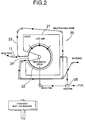
- Fig. 2 is a schematic of a hot air bonder useful in the present invention.
- equipment for hot-air bonding can be divided into two types: conveyor systems, where hot air is forced upon the surface of a web traveling down a conveyor system; and through hot-air ovens, such as suction drum ovens, where hot air is actually sucked through the web for bonding.
- hot-air ovens such as suction drum ovens
- any known or developed hot-air process may be used.
- a suction drum oven is shown in Fig. 2. Bonding occurs as oven 20 vacuums hot air through nonwoven web 11 from hood 21 positioned over perforated drum 22. A carded web enters the oven supported on a wire or a conveyor or a wire covering surface of drum 24. The drum surface is of perforated plate, screen, or honeycomb geometry. A second restraining wire 23 sandwiches the web to the drum and provides consolidation, patterning, and controls shrinkage.
- process air is supplied by heater 25. Increases in air velocity generally increase fabric strength. Temperature variations as little as 1°C across the web are achievable. Once again, the air temperature should be sufficient to melt the binder component causing it to flow. This temperature is about 140°C in the case of polypropylene and at least 110°C in the case of polyethylene.
- Through-hot-air bonders are capable of processing webs from 15 to 600 grams/square meter at speeds up to 183 m/min (600 feet/min). Air velocities of 91.4 m/min (300 feet/min) are obtainable. Manufacturers include Fleissner, Honeycomb, Azetec, Procter, and National.
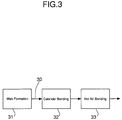
- Fig. 3 is a schematic of the process of the present invention showing integration of the process steps.
- web 30 is formed in web formation step 31, the web 30 is calender bonded 32 followed by hot-air bonding 33.
- the web may be wound up and after treated according to any known or developed method relevant to the desired end use of the web.
Landscapes
- Engineering & Computer Science (AREA)
- Mechanical Engineering (AREA)
- Textile Engineering (AREA)
- Nonwoven Fabrics (AREA)
- Manufacturing Of Multi-Layer Textile Fabrics (AREA)
Claims (9)
- Procédé pour lier thermiquement des non-tissés constitués de deux composants, par un procédé de chauffage à deux étapes, comprenant :(a) l'introduction d'une toile constituée d'un premier composant et d'un composant de liaison dans un système de liaison par calandre chaude;(b) le calandrage de la toile introduite, dans un système de liaison par calandre chaude, de telle manière qu'une fraction du composant de liaison fond et adhère à une fraction du premier composant;(c) le transfert de la toile calandrée résultante vers un système de liaison à air chaud; caractérisé par(d) le chauffage de la toile calandrée transférée, par de l'air chaud introduit dans le système à air chaud, à une température suffisante pour fondre le composant de liaison, provoquant son coulage.
- Procédé selon la revendication 1, dans lequel ladite introduction est celle d'une toile à deux composants, contenant une fibre cellulosique et une fibre de liaison.
- Procédé selon la revendication 1 ou 2, où la fibre cellulosique est la rayonne.
- Procédé selon les revendications 1, 2 ou 3, dans lequel la fibre de liaison est choisie parmi le groupe constitué de polyoléfines et de polyoléfines contenant des bicomposants.
- Procédé selon la revendication 4, dans lequel la polyoléfine est choisie parmi le groupe constitué du polypropylène et du polyéthylène.
- Procédé selon la revendication 4, dans lequel ledit calandrage est effectué avec des rouleaux chauffés à au moins 110 °C dans le cas du polyéthylène et à au moins 140 °C dans le cas du polypropylène.
- Procédé pour lier thermiquement des non-tissés constitués de deux composants, par un procédé de chauffage à deux étapes, comprenant :(a) l'introduction d'une toile composée de fibres de rayonne et de fibres de liaison dans un système de liaison par calandre chaude, présentant au moins deux rouleaux de liaison par calandre, chauffés à une température suffisante pour fondre au moins une fraction des fibres de liaison provoquant le coulage de la fraction et l'incorporation des fibres de rayonne;(b) le calandrage de la toile introduite, dans un système de liaison par calandre chaude, caractérisé par(c) le transfert de la toile calandrée résultante vers un système de liaison à air chaud et la liaison de la toile avec de l'air chauffé à une température suffisante pour fondre au moins une fraction des fibres de liaison, provoquant un coulage supplémentaire de la fraction et l'incorporation supplémentaire des fibres de rayonne.
- Procédé selon la revendication 7, dans lequel la fibre de liaison est choisie parmi le groupe constitué de polyoléfines et de polyoléfines contenant des bicomposants.
- Procédé selon la revendication 7, dans lequel la polyoléfine est le polypropylène.
Applications Claiming Priority (2)
| Application Number | Priority Date | Filing Date | Title |
|---|---|---|---|
| US07/866,700 US5269994A (en) | 1992-04-10 | 1992-04-10 | Nonwoven bonding technique |
| US866700 | 2001-05-30 |
Publications (2)
| Publication Number | Publication Date |
|---|---|
| EP0591609A1 EP0591609A1 (fr) | 1994-04-13 |
| EP0591609B1 true EP0591609B1 (fr) | 1997-08-27 |
Family
ID=25348211
Family Applications (1)
| Application Number | Title | Priority Date | Filing Date |
|---|---|---|---|
| EP93105649A Expired - Lifetime EP0591609B1 (fr) | 1992-04-10 | 1993-04-06 | Technique pour la thermofusion de non-tissés |
Country Status (6)
| Country | Link |
|---|---|
| US (1) | US5269994A (fr) |
| EP (1) | EP0591609B1 (fr) |
| JP (1) | JP3119283B2 (fr) |
| CA (1) | CA2082116A1 (fr) |
| DE (1) | DE69313395T2 (fr) |
| MX (1) | MX9207602A (fr) |
Families Citing this family (22)
| Publication number | Priority date | Publication date | Assignee | Title |
|---|---|---|---|---|
| US7102054B1 (en) | 1991-12-17 | 2006-09-05 | The Procter & Gamble Company | Absorbent article having fused layers |
| US6103953A (en) * | 1991-12-17 | 2000-08-15 | The Procter & Gamble Company | Absorbent article having fused layers |
| JPH1077566A (ja) * | 1996-07-11 | 1998-03-24 | Uni Charm Corp | 不織布およびその製造方法 |
| WO2000044969A1 (fr) * | 1999-01-15 | 2000-08-03 | Valtion Teknillinen Tutkimuskeskus | Fourrure artificielle et procede de fabrication |
| US6454978B1 (en) * | 2000-06-16 | 2002-09-24 | Avery Dennison Corporation | Process for making fuel cell plates |
| EP1320458B2 (fr) | 2000-09-15 | 2016-03-02 | Suominen Corporation | Torchon d'entretien non tisse jetable, et procede de production |
| CN1267780C (zh) | 2002-11-11 | 2006-08-02 | Lg.飞利浦Lcd有限公司 | 用于液晶显示器的阵列基板及其制造方法 |
| DE10319862A1 (de) * | 2003-05-03 | 2004-12-09 | Bundesrepublik Deutschland, vertreten durch das Bundesministerium der Verteidigung, dieses vertreten durch den Präsidenten des Bundesamtes für Wehrtechnik und Beschaffung | Tarnoverall |
| US7452832B2 (en) * | 2003-12-15 | 2008-11-18 | E.I. Du Pont De Nemors And Company | Full-surface bonded multiple component melt-spun nonwoven web |
| US20060027944A1 (en) * | 2004-08-09 | 2006-02-09 | Rachelle Bentley | Apparatus and method for in-line manufacturing of disposable hygienic absorbent products and product produced by the apparatus and methods |
| US20060128247A1 (en) * | 2004-12-14 | 2006-06-15 | Kimberly-Clark Worldwide, Inc. | Embossed nonwoven fabric |
| JP5140330B2 (ja) * | 2007-05-16 | 2013-02-06 | ユニ・チャーム株式会社 | 吸液性シートおよびその製造方法 |
| US10589134B2 (en) | 2008-01-30 | 2020-03-17 | Kimberly-Clark Worldwide, Inc. | Hand health and hygiene system for hand health and infection control |
| US11234905B2 (en) | 2008-07-11 | 2022-02-01 | Kimberly-Clark Worldwide, Inc. | Formulations having improved compatibility with nonwoven substrates |
| US9949906B2 (en) | 2008-07-11 | 2018-04-24 | Kimberly-Clark Worldwide, Inc. | Substrates having formulations with improved transferability |
| DE102009006099A1 (de) | 2009-01-26 | 2010-09-30 | Fiberweb Corovin Gmbh | Polyethylenvlies |
| CN101864641B (zh) * | 2010-06-28 | 2011-06-08 | 北京大源非织造有限公司 | 一种非织造布生产设备 |
| US8398915B2 (en) * | 2010-08-12 | 2013-03-19 | Johnson & Johnson do Brasil Industria e Comercio Produtos Paral Saude Ltda. Rodovia | Method for making a fibrous article |
| US8394316B2 (en) * | 2010-08-12 | 2013-03-12 | Johnson & Johnson Do Brasil Industria E Comercio Produtos Para Saude Ltda. Rodovia | Method for making a fibrous article |
| US20130189506A1 (en) * | 2012-01-25 | 2013-07-25 | James R. Keene | Masonry wall vent |
| JP6026783B2 (ja) * | 2012-06-05 | 2016-11-16 | Oci株式会社 | 食肉包装用シート及び食肉包装用ケーシング |
| CN111663245B (zh) * | 2020-06-21 | 2020-12-11 | 常熟市中意无纺制造有限公司 | 一种带有热量均布机构的无纺布热轧辊 |
Family Cites Families (17)
| Publication number | Priority date | Publication date | Assignee | Title |
|---|---|---|---|---|
| US2277049A (en) * | 1939-11-06 | 1942-03-24 | Kendall & Co | Textile fabric and method of making same |
| US2464301A (en) * | 1943-12-18 | 1949-03-15 | American Viscose Corp | Textile fibrous product |
| US2712171A (en) * | 1952-05-26 | 1955-07-05 | Hoffman Manfred Turner | Method of manufacturing wool felt |
| US3364543A (en) * | 1965-12-15 | 1968-01-23 | West Point Pepperell Inc | Method of making fibrous sheet material |
| US3898311A (en) * | 1969-07-24 | 1975-08-05 | Kendall & Co | Method of making low-density nonwoven fabrics |
| US4476078A (en) * | 1982-05-04 | 1984-10-09 | James River-Dixie/Northern, Inc. | Process for manufacturing embossed nonwoven fibrous products |
| JPS59168160A (ja) * | 1983-03-15 | 1984-09-21 | 日本バイリーン株式会社 | 不織布の製造法 |
| JPS6269822A (ja) * | 1985-09-19 | 1987-03-31 | Chisso Corp | 熱接着性複合繊維 |
| US4753693A (en) * | 1986-04-16 | 1988-06-28 | Cumulus Fibres, Inc. | Method for forming a vacuum bonded non-woven batt |
| GB8618729D0 (en) * | 1986-07-31 | 1986-09-10 | Wiggins Teape Group Ltd | Fibrous structure |
| FI81842C (fi) * | 1986-12-31 | 1990-12-10 | Neste Oy | Icke-vaevd fiberprodukt. |
| DD267278A1 (de) * | 1987-12-24 | 1989-04-26 | Technotex Karl Marx Stadt Veb | Verfahren zur herstellung von vliesstoffen, die einen anteil thermoplastischer fasern aufweisen |
| US5093051A (en) * | 1988-01-21 | 1992-03-03 | Altomar-Ii Trust By Kenneth Safe, Jr. Trustee | Process for making cellulose-containing products |
| DK245488D0 (da) * | 1988-05-05 | 1988-05-05 | Danaklon As | Syntetisk fiber samt fremgangsmaade til fremstilling deraf |
| DE3831496C2 (de) * | 1988-09-16 | 2001-03-22 | Fleissner Maschf Gmbh Co | Verfahren zum thermischen Verfestigen von Vliesen mit Bindepulver |
| US5077874A (en) * | 1990-01-10 | 1992-01-07 | Gates Formed-Fibre Products, Inc. | Method of producing a nonwoven dibrous textured panel and panel produced thereby |
| US5194106A (en) * | 1990-10-31 | 1993-03-16 | E. I. Du Pont De Nemours And Company | Method of making fiber reinforced porous sheets |
-
1992
- 1992-04-10 US US07/866,700 patent/US5269994A/en not_active Expired - Fee Related
- 1992-11-04 CA CA002082116A patent/CA2082116A1/fr not_active Abandoned
- 1992-12-29 MX MX9207602A patent/MX9207602A/es unknown
-
1993
- 1993-04-06 EP EP93105649A patent/EP0591609B1/fr not_active Expired - Lifetime
- 1993-04-06 DE DE69313395T patent/DE69313395T2/de not_active Expired - Fee Related
- 1993-04-09 JP JP05083630A patent/JP3119283B2/ja not_active Expired - Fee Related
Also Published As
| Publication number | Publication date |
|---|---|
| DE69313395D1 (de) | 1997-10-02 |
| JPH0610258A (ja) | 1994-01-18 |
| DE69313395T2 (de) | 1998-01-02 |
| US5269994A (en) | 1993-12-14 |
| CA2082116A1 (fr) | 1993-10-11 |
| EP0591609A1 (fr) | 1994-04-13 |
| MX9207602A (es) | 1993-10-01 |
| JP3119283B2 (ja) | 2000-12-18 |
Similar Documents
| Publication | Publication Date | Title |
|---|---|---|
| US5269994A (en) | Nonwoven bonding technique | |
| US4514455A (en) | Nonwoven fabric for apparel insulating interliner | |
| US4548856A (en) | Method for forming soft, bulky absorbent webs and resulting product | |
| EP0721520B1 (fr) | Etoffes non tissees liees par des motifs | |
| EP0127851B1 (fr) | Etoffe non-tissée et procédé pour sa fabrication | |
| EP0447090B1 (fr) | Etoffe non-tissée à trois dimensions | |
| US3704198A (en) | Nonwoven polypropylene mats of increased strip tensile strength | |
| US4129132A (en) | Fibrous material and method of making the same | |
| US5393599A (en) | Composite nonwoven fabrics | |
| CA1290517C (fr) | Non-tisse a resistance accrue a l'abrasion | |
| CA1248438A (fr) | Feuilles et rubans de tissu decoratif | |
| EP0534863A1 (fr) | Nappe non-tissée laminée et procédé pour sa production | |
| US4774125A (en) | Nonwoven fabric with improved abrasion resistance | |
| EP0171807B1 (fr) | Etoffe non-tissée entremêlée contenant des fibres thermoplastiques en surface et son procédé de fabrication | |
| JPWO1988009838A1 (ja) | 経緯伸縮性布帛及びその製造方法 | |
| Pourmohammadi | Thermal bonding | |
| KR930010809B1 (ko) | 부직포 및 이의 제조방법 | |
| US5336556A (en) | Heat resistant nonwoven fabric and process for producing same | |
| US3510389A (en) | Spot-bonded nonwoven fabric | |
| US3660555A (en) | Method of bonding nonwoven textile fabrics | |
| KR20220095129A (ko) | 심초형 스펀본드 부직포 및 그 제조 방법 | |
| KR100398507B1 (ko) | 섬유 판재 및 그 제조방법 | |
| JPH03249250A (ja) | 耐熱性不織布 | |
| JPS6328962A (ja) | 耐熱性不織布 | |
| CA2221358A1 (fr) | Non-tisse compactable mecaniquement s'utilisant pour produire des pieces moulees indeformables |
Legal Events
| Date | Code | Title | Description |
|---|---|---|---|
| PUAI | Public reference made under article 153(3) epc to a published international application that has entered the european phase |
Free format text: ORIGINAL CODE: 0009012 |
|
| 17P | Request for examination filed |
Effective date: 19940128 |
|
| AK | Designated contracting states |
Kind code of ref document: A1 Designated state(s): BE CH DE FR GB IT LI NL |
|
| 17Q | First examination report despatched |
Effective date: 19950207 |
|
| GRAG | Despatch of communication of intention to grant |
Free format text: ORIGINAL CODE: EPIDOS AGRA |
|
| GRAH | Despatch of communication of intention to grant a patent |
Free format text: ORIGINAL CODE: EPIDOS IGRA |
|
| GRAH | Despatch of communication of intention to grant a patent |
Free format text: ORIGINAL CODE: EPIDOS IGRA |
|
| GRAA | (expected) grant |
Free format text: ORIGINAL CODE: 0009210 |
|
| AK | Designated contracting states |
Kind code of ref document: B1 Designated state(s): BE CH DE FR GB IT LI NL |
|
| REG | Reference to a national code |
Ref country code: CH Ref legal event code: NV Representative=s name: SCHMAUDER & WANN PATENTANWALTSBUERO, INHABER KLAUS Ref country code: CH Ref legal event code: EP |
|
| REF | Corresponds to: |
Ref document number: 69313395 Country of ref document: DE Date of ref document: 19971002 |
|
| ITF | It: translation for a ep patent filed | ||
| ET | Fr: translation filed | ||
| PLBE | No opposition filed within time limit |
Free format text: ORIGINAL CODE: 0009261 |
|
| 26N | No opposition filed | ||
| REG | Reference to a national code |
Ref country code: GB Ref legal event code: IF02 |
|
| PGFP | Annual fee paid to national office [announced via postgrant information from national office to epo] |
Ref country code: DE Payment date: 20050331 Year of fee payment: 13 |
|
| PGFP | Annual fee paid to national office [announced via postgrant information from national office to epo] |
Ref country code: NL Payment date: 20050403 Year of fee payment: 13 |
|
| PGFP | Annual fee paid to national office [announced via postgrant information from national office to epo] |
Ref country code: GB Payment date: 20050406 Year of fee payment: 13 |
|
| PGFP | Annual fee paid to national office [announced via postgrant information from national office to epo] |
Ref country code: FR Payment date: 20050408 Year of fee payment: 13 |
|
| PGFP | Annual fee paid to national office [announced via postgrant information from national office to epo] |
Ref country code: CH Payment date: 20050415 Year of fee payment: 13 |
|
| PG25 | Lapsed in a contracting state [announced via postgrant information from national office to epo] |
Ref country code: GB Free format text: LAPSE BECAUSE OF NON-PAYMENT OF DUE FEES Effective date: 20060406 |
|
| PG25 | Lapsed in a contracting state [announced via postgrant information from national office to epo] |
Ref country code: LI Free format text: LAPSE BECAUSE OF NON-PAYMENT OF DUE FEES Effective date: 20060430 Ref country code: CH Free format text: LAPSE BECAUSE OF NON-PAYMENT OF DUE FEES Effective date: 20060430 |
|
| PGFP | Annual fee paid to national office [announced via postgrant information from national office to epo] |
Ref country code: IT Payment date: 20060430 Year of fee payment: 14 |
|
| PGFP | Annual fee paid to national office [announced via postgrant information from national office to epo] |
Ref country code: BE Payment date: 20060616 Year of fee payment: 14 |
|
| PG25 | Lapsed in a contracting state [announced via postgrant information from national office to epo] |
Ref country code: NL Free format text: LAPSE BECAUSE OF NON-PAYMENT OF DUE FEES Effective date: 20061101 Ref country code: DE Free format text: LAPSE BECAUSE OF NON-PAYMENT OF DUE FEES Effective date: 20061101 |
|
| REG | Reference to a national code |
Ref country code: CH Ref legal event code: PL |
|
| GBPC | Gb: european patent ceased through non-payment of renewal fee |
Effective date: 20060406 |
|
| NLV4 | Nl: lapsed or anulled due to non-payment of the annual fee |
Effective date: 20061101 |
|
| REG | Reference to a national code |
Ref country code: FR Ref legal event code: ST Effective date: 20061230 |
|
| BERE | Be: lapsed |
Owner name: *BASF CORP. Effective date: 20070430 |
|
| PG25 | Lapsed in a contracting state [announced via postgrant information from national office to epo] |
Ref country code: BE Free format text: LAPSE BECAUSE OF NON-PAYMENT OF DUE FEES Effective date: 20070430 |
|
| PG25 | Lapsed in a contracting state [announced via postgrant information from national office to epo] |
Ref country code: FR Free format text: LAPSE BECAUSE OF NON-PAYMENT OF DUE FEES Effective date: 20060502 |
|
| PG25 | Lapsed in a contracting state [announced via postgrant information from national office to epo] |
Ref country code: IT Free format text: LAPSE BECAUSE OF NON-PAYMENT OF DUE FEES Effective date: 20070406 |