EP0591652A1 - Radar à ouverture synthétique à base d'antennes tournantes - Google Patents
Radar à ouverture synthétique à base d'antennes tournantes Download PDFInfo
- Publication number
- EP0591652A1 EP0591652A1 EP93112941A EP93112941A EP0591652A1 EP 0591652 A1 EP0591652 A1 EP 0591652A1 EP 93112941 A EP93112941 A EP 93112941A EP 93112941 A EP93112941 A EP 93112941A EP 0591652 A1 EP0591652 A1 EP 0591652A1
- Authority
- EP
- European Patent Office
- Prior art keywords
- distance
- depth
- antenna
- intervals
- field
- Prior art date
- Legal status (The legal status is an assumption and is not a legal conclusion. Google has not performed a legal analysis and makes no representation as to the accuracy of the status listed.)
- Granted
Links
Images


Classifications
-
- G—PHYSICS
- G01—MEASURING; TESTING
- G01S—RADIO DIRECTION-FINDING; RADIO NAVIGATION; DETERMINING DISTANCE OR VELOCITY BY USE OF RADIO WAVES; LOCATING OR PRESENCE-DETECTING BY USE OF THE REFLECTION OR RERADIATION OF RADIO WAVES; ANALOGOUS ARRANGEMENTS USING OTHER WAVES
- G01S13/00—Systems using the reflection or reradiation of radio waves, e.g. radar systems; Analogous systems using reflection or reradiation of waves whose nature or wavelength is irrelevant or unspecified
- G01S13/88—Radar or analogous systems specially adapted for specific applications
- G01S13/89—Radar or analogous systems specially adapted for specific applications for mapping or imaging
- G01S13/90—Radar or analogous systems specially adapted for specific applications for mapping or imaging using synthetic aperture techniques, e.g. synthetic aperture radar [SAR] techniques
- G01S13/904—SAR modes
- G01S13/9082—Rotating SAR [ROSAR]
Definitions
- a radar device with a synthetic aperture based on rotating antennas which has a transmitter and a receiver, the at least one antenna for transmitting and receiving radar pulses at the end of a rotating arm, For example, a helicopter rotor or a turnstile is arranged above the rotor axis.
- the received signals are demodulated and buffered and then correlated with reference functions. These reference functions are calculated or specified depending on the lighting geometry of the radar device. Parameters for this calculation or specification are the distance intervals to be measured, the transmission frequency, the length of the rotating arm, the angle of rotation range of the antenna from which signals are received, the number of transmission pulses and the height of the rotating antenna above ground.
- the correlation result is displayed in a suitable manner, for example on a monitor.
- a radar device can be used in real-time proximity in on-line operation and thus, in addition to cartography and obstacle warning, can also be used for target clarification and target tracking.
- the processor of this well-known ROSAR device has several components in order to subdivide the diverse and complex computing tasks and thereby enable real-time proximity or online operation.
- the result for each distance interval is always obtained by correlating the received signal with a reference function valid for this distance interval.
- the resolution of a ROSAR device in the lateral and radial direction is determined by parameters that are partially coupled to one another, such as the wavelength ⁇ and the length L of the rotating antenna arm, the opening angle of the antenna ⁇ , the distance R G0 between the antenna and the center line of the illuminated strip , the height H 0 of the antenna above the ground, pulse repetition frequency f P and duration ⁇ of the transmission pulses and thus the number Z S of pulses per aperture length S , the duration t e of the received echo signal, the sampling rate for the distance intervals etc.
- the invention has for its object to develop a ROSAR device of the type in question so that the aberrations are kept small with simple means.
- This object is achieved according to the invention by the features specified in the characterizing part of patent claim 1.
- the processor circuit is expanded by an additional module in which the valid depth of field is calculated. The calculation of the depth of field can then be used to simplify the calculation process.
- the depth of field indicates the frequency of a recalculation of the reference functions over the strip width to be imaged of the individual distance intervals.
- the depth of field determines the area on the edges of which two objects are still sufficiently sharp.
- This relationship can be calculated as a function of the opening angle of the antenna ⁇ and its height H0 above the ground. Since the corresponding distance cells are not used here, the running index n does not apply; R G01 and R G02 are used instead .
- the invention now proposes to provide an additional memory module in which the depth of field for different values of the parameters ⁇ and H0 is stored as a function of the respective distance R G01 .
- the stored values can then be used to call up the associated depth of field on the basis of the actual circumstances, in particular the height of the antenna above ground and the depression angle, i.e. the viewing angle of the antenna towards the ground, and the processor circuit for dividing the illuminated area into individual distance intervals and thus to subdivide the reference functions.
- the storage of predetermined depth of field has the advantage that it is not necessary to calculate these depth of field in real time, since this calculation is also quite complex.
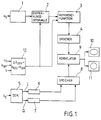
- a circuit diagram of a processor for a ROSAR device is shown, wherein in the upper half of the block diagram corresponding to a first channel those modules are shown which are necessary for generating the reference functions, and those in the lower half corresponding to a second channel Blocks that receive the signals reflected on the ground.
- a geometry module 1 is provided which, based on the height H Titanium of the antenna above ground and other parameters, in particular the angle of depression, the angle of inclination and the length of the rotor arm, calculates various sizes and functions that a processor circuit 2 divides the illuminated area into individual distance intervals can be supplied.
- This processor circuit 2 is connected to a processor module 3, in which the reference functions for the individual distance intervals are calculated on the basis of the output signals of the processor circuit 2.
- the reference functions necessary for the correlation are transferred to a memory 4.
- the received signal S E is fed to a quadrature demodulator 5 and broken down into the in-phase and quadrature components I E and Q E , respectively.
- the two components are transferred to buffer stores 6 and 7 and transferred to a memory 8 for correlation.
- the signals stored in the memories 4 and 8 are fed synchronously to a correlator 9 and correlated.
- the correlation result is shown on a display, for example a monitor 10, and / or is further fed to an evaluation device 11.
- DE-PS 39 22 086 With regard to the more detailed function, in particular with regard to the distribution of the reference functions over individual distance intervals and their calculation, reference is made to the above-mentioned DE-PS 39 22 086.
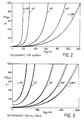
- a minimum distance from the object as a function of the angle of depression is required to maintain a given radial resolution on the ground ⁇ R B min for a given height of use for target reconnaissance on the ground and mapping the terrain from a helicopter.
- This area of the depth of field curve practically does not occur in practice. It is different with obstacle warning radar with radial radiation, whereby the flight altitude is often low; short ranges of up to a few 100 m are also required here. Especially in the distance range up to 50 m or 100 m, it is absolutely necessary to recognize wires and tensioned ropes, which are also difficult to detect, as an obstacle.
- the depth of field is less than the depth of the distance interval and there is therefore a need to generate the reference function several times as a function of depth of field within a single distance interval. Accordingly, under such conditions, the module 12 will intervene in the corresponding circuit elements 2 and 3 of the processor circuit.
- the recalculation of the reference functions within a distance interval as a function of the depth of field can also be used to optimally detect small objects, such as wires or tensioned ropes. For this purpose, several correlations between the associated received signal and various reference functions valid over the distance interval are carried out for a distance interval. The number of reference functions is determined on the basis of the memory module 12.
- the result is several correlation figures of different resolutions, depending on whether an object lies at the beginning or at the end of a distance interval and is also detected and imaged there.
- the correlation results are then averaged within a distance interval, as a result of which small obstacles such as the addressed wires, ropes, etc. are optimally detected. Without averaging, by dividing a distance interval into several areas, all objects are recorded with the required resolution in accordance with the specifications of the memory module 12.
- a maximum permissible angle difference ⁇ Diff angle error between the maximum possible angle of rotation and the actual maximum angle of rotation are calculated as a function of the opening angle of the antenna ⁇ , the rotor blade length L and the distance to the object R G01 , from which the predetermined ⁇ diff is maintained.
- the minimum distance R G0min can be determined from this inequality: From this distance, the closed solution can be used to calculate the depth of field. For a given distance on the floor R G01 and the height of use H0, that distance R G02 is searched which represents the limit of the storage area.
- the individual computation modules are given for the above expressions. These are: a distance block 41 for specifying the distance R G01 , a calculation block 42 for calculating the above expressions A 1 and B 1 , a further calculation block 43 for calculating the size C 1 from the sizes A 1 and B 1 .
- the sizes D and E are calculated from the size C 1 , the height H 0 of the antenna above the ground, the length of the rotor blade L and the opening angle of the antenna ⁇ , from which the boundary condition for the depth of field is then in a further block 45 is determined from the calculation of R G02 .
- the permissible depth of field ⁇ R G 0 V is determined from this size and the size R G01 in a comparator 46, after which the number n * of the range cells or range intervals is determined in a dividing module 47 from this permissible depth of field and the radial resolution ⁇ R B min for which the same reference function is used.
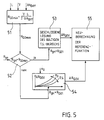
- FIG. 5 shows a schematic diagram for processing the signals with the correct depth of field range or the corresponding reference function.
- the minimum distance R G0 min is calculated from the values ⁇ , L and ⁇ Diff .
- a comparison in a comparator with the value for R gn determines whether this value is larger or smaller.
Landscapes
- Engineering & Computer Science (AREA)
- Remote Sensing (AREA)
- Radar, Positioning & Navigation (AREA)
- Physics & Mathematics (AREA)
- Electromagnetism (AREA)
- Computer Networks & Wireless Communication (AREA)
- General Physics & Mathematics (AREA)
- Radar Systems Or Details Thereof (AREA)
Applications Claiming Priority (2)
| Application Number | Priority Date | Filing Date | Title |
|---|---|---|---|
| DE4233416 | 1992-10-05 | ||
| DE4233416A DE4233416C2 (de) | 1992-10-05 | 1992-10-05 | Radargerät mit synthetischer Apertur auf der Basis rotierender Antennen |
Publications (2)
| Publication Number | Publication Date |
|---|---|
| EP0591652A1 true EP0591652A1 (fr) | 1994-04-13 |
| EP0591652B1 EP0591652B1 (fr) | 1996-11-06 |
Family
ID=6469654
Family Applications (1)
| Application Number | Title | Priority Date | Filing Date |
|---|---|---|---|
| EP93112941A Expired - Lifetime EP0591652B1 (fr) | 1992-10-05 | 1993-08-12 | Radar à ouverture synthétique à base d'antennes tournantes |
Country Status (4)
| Country | Link |
|---|---|
| US (1) | US5379041A (fr) |
| EP (1) | EP0591652B1 (fr) |
| JP (1) | JP2643078B2 (fr) |
| DE (2) | DE4233416C2 (fr) |
Cited By (1)
| Publication number | Priority date | Publication date | Assignee | Title |
|---|---|---|---|---|
| EP1562052A1 (fr) * | 2004-02-03 | 2005-08-10 | EADS Deutschland GmbH | Procédé pour l'amélioration de la définition latérale d'un système ROSAR |
Families Citing this family (9)
| Publication number | Priority date | Publication date | Assignee | Title |
|---|---|---|---|---|
| DE4323511C1 (de) * | 1993-07-14 | 1995-01-26 | Deutsche Aerospace | Radargerät zur Hinderniswarnung |
| DE19528613C2 (de) | 1995-08-04 | 1998-07-02 | Daimler Benz Aerospace Ag | Einrichtung zur Bewegungsfehler-Kompensation für ein Radar mit synthetischer Apertur auf der Basis rotierender Antennen (ROSA) für Hubschrauber |
| US5614907A (en) * | 1996-03-14 | 1997-03-25 | Daimler-Benz Aerospace Ag | All weather visual system for helicopters |
| DE10101990C2 (de) * | 2001-01-18 | 2003-01-09 | Eads Deutschland Gmbh | Verfahren zur Drahterkennung auf der Basis des ROSAR-Systems |
| CN101344594B (zh) * | 2008-05-14 | 2010-10-20 | 中国科学院上海光学精密机械研究所 | 扫描合成孔径激光成像雷达 |
| CN101344593B (zh) * | 2008-05-14 | 2010-10-20 | 中国科学院上海光学精密机械研究所 | 滑动聚束合成孔径激光成像雷达 |
| EP2741106A1 (fr) * | 2012-12-10 | 2014-06-11 | AIRBUS HELICOPTERS DEUTSCHLAND GmbH | Système de radar centrifuge de détection d'obstacle et d'alerte de terrain |
| ITUB20152527A1 (it) | 2015-07-27 | 2017-01-27 | Univ Degli Studi Di Firenze | Radar interferometrico ad apertura sintetica con antenna scorrevole su un braccio rotante. |
| ITUB20152526A1 (it) | 2015-07-27 | 2017-01-27 | Univ Degli Studi Di Firenze | Radar interferometrico ad antenna rotante a polarizzazione lineare |
Family Cites Families (4)
| Publication number | Priority date | Publication date | Assignee | Title |
|---|---|---|---|---|
| US4638315A (en) * | 1984-06-20 | 1987-01-20 | Westinghouse Electric Corp. | Rotor tip synthetic aperture radar |
| US4737788A (en) * | 1985-04-04 | 1988-04-12 | Motorola, Inc. | Helicopter obstacle detector |
| DE3922086C1 (fr) * | 1989-07-05 | 1990-10-18 | Messerschmitt-Boelkow-Blohm Gmbh, 8012 Ottobrunn, De | |
| US5093649A (en) * | 1990-08-28 | 1992-03-03 | The Boeing Company | Bessel beam radar system using sequential spatial modulation |
-
1992
- 1992-10-05 DE DE4233416A patent/DE4233416C2/de not_active Expired - Fee Related
-
1993
- 1993-08-12 DE DE59304404T patent/DE59304404D1/de not_active Expired - Fee Related
- 1993-08-12 EP EP93112941A patent/EP0591652B1/fr not_active Expired - Lifetime
- 1993-09-30 JP JP5245314A patent/JP2643078B2/ja not_active Expired - Fee Related
- 1993-10-05 US US08/131,634 patent/US5379041A/en not_active Expired - Lifetime
Non-Patent Citations (3)
| Title |
|---|
| FREQUENZ, Band 45, Nrn. 1/2, Januar/Februar 1991, BERLIN, DE; H. KLAUSING: "Realisierbarkeit eines Radars mit synthetischer Apertur durch rotierende Antennen (Teil I)", Seiten 51-58 * |
| FREQUENZ, Band 45, Nrn. 3/4, März/April 1991, BERLIN, DE; H. KLAUSING: "Realisierbarkeit eines Radars mit synthetischer Apertur durch rotierende Antennen (Teil II)", Seiten 73-80 * |
| FREQUENZ, Band 45, Nrn. 5/6, Mai/Juni 1991, BERLIN, DE; H. KLAUSING: "Realisierbarkeit eines Radars mit synthetischer Apertur durch rotierende Antennen (Teil III)", Seiten 147-154 * |
Cited By (1)
| Publication number | Priority date | Publication date | Assignee | Title |
|---|---|---|---|---|
| EP1562052A1 (fr) * | 2004-02-03 | 2005-08-10 | EADS Deutschland GmbH | Procédé pour l'amélioration de la définition latérale d'un système ROSAR |
Also Published As
| Publication number | Publication date |
|---|---|
| JPH06214023A (ja) | 1994-08-05 |
| EP0591652B1 (fr) | 1996-11-06 |
| DE59304404D1 (de) | 1996-12-12 |
| JP2643078B2 (ja) | 1997-08-20 |
| DE4233416C2 (de) | 1994-09-08 |
| US5379041A (en) | 1995-01-03 |
| DE4233416A1 (de) | 1994-04-07 |
Similar Documents
| Publication | Publication Date | Title |
|---|---|---|
| DE3882707T2 (de) | Radar mit synthetischer apertur. | |
| EP0757259B1 (fr) | Dispositif de compensation d'erreur de mouvement pour radar à ouverture synthétique à base d'antennes tournantes dans un hélicoptère | |
| EP0634668B1 (fr) | Dispositif radar pour l'avertissement d'obstacle | |
| DE3887667T2 (de) | Radioelektrischer Sensor zur Erstellung einer radioelektrischen Karte einer Landschaft. | |
| EP0406879B1 (fr) | Méthode d'extraction d'erreurs de mouvement d'un porteur transportant un système radar d'imagerie cohérent à partir de données radar brutes et dispositif pour la mise en oeuvre de ce procédé | |
| EP1380854A2 (fr) | Procédé et système radar de détermination d'angles de direction d'objets radar | |
| EP0406877A2 (fr) | Méthode d'extraction d'erreurs de mouvement d'un porteur transportant un système radar d'imagerie cohérent à partir de données brutes et dispositif pour la mise en oeuvre de ce procédé | |
| DE69924473T2 (de) | Verbesserungen an oder bezüglich radarsystemen | |
| DE2409064C1 (fr) | ||
| DE1187140B (de) | Einrichtung zur Verhuetung der Kollisionsgefahr von Luftfahrzeugen | |
| EP0602473B1 (fr) | Radar à ouverture synthétique à base d'antennes tournantes | |
| EP0591652B1 (fr) | Radar à ouverture synthétique à base d'antennes tournantes | |
| EP1515159B1 (fr) | Méthode pour réduire le centroide doppler pour des systèmes radar coherent à impulsion | |
| DE2514751C2 (de) | Tacan-System | |
| DE2429072C3 (de) | Impuls-Doppler-Radargerät | |
| DE4311754C1 (de) | Verfahren zur Extraktion von Bewegungsfehlern eines ein kohärentes Abbildungsradarsystem mitführenden Trägers aus Radar-Rohdaten und Einrichtung zur Durchführung des Verfahrens | |
| EP0591651B1 (fr) | Radar à ouverture synthétique à base d'antennes tourmantes | |
| DE2133395B2 (de) | Einrichtung zur Kompensation deer Eigenbewegung einer kohärenten Impuls-Doppler-Radaranlage | |
| WO2022268600A1 (fr) | Procédé de radar à ouverture synthétique | |
| DE4304027C2 (de) | Radargerät mit synthetischer Apertur auf der Basis rotierender Antennen | |
| EP1004895B1 (fr) | Procédé et dispositif d'amélioration de l'efficacité computationnelle dans un système de rosar | |
| DE10303587A1 (de) | Winkelauflösendes Ortungsgerät für Kraftfahrzeuge | |
| DE2438837A1 (de) | Verfahren und einrichtung zum beseitigen von echosignalen | |
| DE3016554C2 (de) | Orientierungseinrichtung, die nach dem Puls-Doppler-Radar arbeitet und an Bord von Fahrzeugen, insbesondere Luftfahrzeugen, angebracht ist | |
| DE2305941A1 (de) | Fahrzeughindernisradar |
Legal Events
| Date | Code | Title | Description |
|---|---|---|---|
| PUAI | Public reference made under article 153(3) epc to a published international application that has entered the european phase |
Free format text: ORIGINAL CODE: 0009012 |
|
| AK | Designated contracting states |
Kind code of ref document: A1 Designated state(s): DE FR GB IT NL SE |
|
| 17P | Request for examination filed |
Effective date: 19940513 |
|
| RAP1 | Party data changed (applicant data changed or rights of an application transferred) |
Owner name: DAIMLER-BENZ AEROSPACE AKTIENGESELLSCHAFT |
|
| GRAG | Despatch of communication of intention to grant |
Free format text: ORIGINAL CODE: EPIDOS AGRA |
|
| 17Q | First examination report despatched |
Effective date: 19960216 |
|
| GRAH | Despatch of communication of intention to grant a patent |
Free format text: ORIGINAL CODE: EPIDOS IGRA |
|
| GRAH | Despatch of communication of intention to grant a patent |
Free format text: ORIGINAL CODE: EPIDOS IGRA |
|
| GRAA | (expected) grant |
Free format text: ORIGINAL CODE: 0009210 |
|
| AK | Designated contracting states |
Kind code of ref document: B1 Designated state(s): DE FR GB IT NL SE |
|
| ET | Fr: translation filed | ||
| REF | Corresponds to: |
Ref document number: 59304404 Country of ref document: DE Date of ref document: 19961212 |
|
| GBT | Gb: translation of ep patent filed (gb section 77(6)(a)/1977) |
Effective date: 19961217 |
|
| ITF | It: translation for a ep patent filed | ||
| PLBE | No opposition filed within time limit |
Free format text: ORIGINAL CODE: 0009261 |
|
| 26N | No opposition filed | ||
| REG | Reference to a national code |
Ref country code: GB Ref legal event code: IF02 |
|
| PGFP | Annual fee paid to national office [announced via postgrant information from national office to epo] |
Ref country code: NL Payment date: 20060814 Year of fee payment: 14 |
|
| PGFP | Annual fee paid to national office [announced via postgrant information from national office to epo] |
Ref country code: IT Payment date: 20060831 Year of fee payment: 14 |
|
| PGFP | Annual fee paid to national office [announced via postgrant information from national office to epo] |
Ref country code: DE Payment date: 20070822 Year of fee payment: 15 |
|
| PGFP | Annual fee paid to national office [announced via postgrant information from national office to epo] |
Ref country code: GB Payment date: 20070823 Year of fee payment: 15 |
|
| PGFP | Annual fee paid to national office [announced via postgrant information from national office to epo] |
Ref country code: SE Payment date: 20060814 Year of fee payment: 14 |
|
| EUG | Se: european patent has lapsed | ||
| PG25 | Lapsed in a contracting state [announced via postgrant information from national office to epo] |
Ref country code: SE Free format text: LAPSE BECAUSE OF NON-PAYMENT OF DUE FEES Effective date: 20070813 Ref country code: NL Free format text: LAPSE BECAUSE OF NON-PAYMENT OF DUE FEES Effective date: 20080301 |
|
| PGFP | Annual fee paid to national office [announced via postgrant information from national office to epo] |
Ref country code: FR Payment date: 20070812 Year of fee payment: 15 |
|
| NLV4 | Nl: lapsed or anulled due to non-payment of the annual fee |
Effective date: 20080301 |
|
| GBPC | Gb: european patent ceased through non-payment of renewal fee |
Effective date: 20080812 |
|
| REG | Reference to a national code |
Ref country code: FR Ref legal event code: ST Effective date: 20090430 |
|
| PG25 | Lapsed in a contracting state [announced via postgrant information from national office to epo] |
Ref country code: FR Free format text: LAPSE BECAUSE OF NON-PAYMENT OF DUE FEES Effective date: 20080901 Ref country code: DE Free format text: LAPSE BECAUSE OF NON-PAYMENT OF DUE FEES Effective date: 20090303 |
|
| PG25 | Lapsed in a contracting state [announced via postgrant information from national office to epo] |
Ref country code: IT Free format text: LAPSE BECAUSE OF NON-PAYMENT OF DUE FEES Effective date: 20070812 |
|
| PG25 | Lapsed in a contracting state [announced via postgrant information from national office to epo] |
Ref country code: GB Free format text: LAPSE BECAUSE OF NON-PAYMENT OF DUE FEES Effective date: 20080812 |