EP0591907A2 - Procédé de fabrication de tôles ou de plaques céramiques - Google Patents
Procédé de fabrication de tôles ou de plaques céramiques Download PDFInfo
- Publication number
- EP0591907A2 EP0591907A2 EP93116044A EP93116044A EP0591907A2 EP 0591907 A2 EP0591907 A2 EP 0591907A2 EP 93116044 A EP93116044 A EP 93116044A EP 93116044 A EP93116044 A EP 93116044A EP 0591907 A2 EP0591907 A2 EP 0591907A2
- Authority
- EP
- European Patent Office
- Prior art keywords
- layer sequence
- powder
- product
- medium
- sheets
- Prior art date
- Legal status (The legal status is an assumption and is not a legal conclusion. Google has not performed a legal analysis and makes no representation as to the accuracy of the status listed.)
- Withdrawn
Links
- 239000000919 ceramic Substances 0.000 title claims abstract description 43
- 229910052751 metal Inorganic materials 0.000 title claims abstract description 31
- 239000002184 metal Substances 0.000 title claims abstract description 31
- 238000004519 manufacturing process Methods 0.000 title claims abstract description 12
- 239000000843 powder Substances 0.000 claims abstract description 67
- 238000000034 method Methods 0.000 claims abstract description 42
- 239000002775 capsule Substances 0.000 claims abstract description 38
- 238000001513 hot isostatic pressing Methods 0.000 claims abstract description 17
- 238000000926 separation method Methods 0.000 claims description 28
- 239000011888 foil Substances 0.000 claims description 20
- 229910045601 alloy Inorganic materials 0.000 claims description 18
- 239000000956 alloy Substances 0.000 claims description 18
- PXHVJJICTQNCMI-UHFFFAOYSA-N Nickel Chemical compound [Ni] PXHVJJICTQNCMI-UHFFFAOYSA-N 0.000 claims description 15
- 238000007493 shaping process Methods 0.000 claims description 12
- RTAQQCXQSZGOHL-UHFFFAOYSA-N Titanium Chemical compound [Ti] RTAQQCXQSZGOHL-UHFFFAOYSA-N 0.000 claims description 10
- 239000010936 titanium Substances 0.000 claims description 10
- 229910000831 Steel Inorganic materials 0.000 claims description 8
- 238000006243 chemical reaction Methods 0.000 claims description 8
- 238000000576 coating method Methods 0.000 claims description 8
- 239000010959 steel Substances 0.000 claims description 8
- 229910052719 titanium Inorganic materials 0.000 claims description 6
- 229910052759 nickel Inorganic materials 0.000 claims description 5
- 150000004767 nitrides Chemical class 0.000 claims description 5
- 230000001143 conditioned effect Effects 0.000 claims description 4
- 150000001247 metal acetylides Chemical class 0.000 claims description 3
- 229910000531 Co alloy Inorganic materials 0.000 claims description 2
- 229910000990 Ni alloy Inorganic materials 0.000 claims description 2
- 229910001069 Ti alloy Inorganic materials 0.000 claims description 2
- 239000011248 coating agent Substances 0.000 claims description 2
- 238000010285 flame spraying Methods 0.000 claims description 2
- 238000007750 plasma spraying Methods 0.000 claims description 2
- XEEYBQQBJWHFJM-UHFFFAOYSA-N Iron Chemical compound [Fe] XEEYBQQBJWHFJM-UHFFFAOYSA-N 0.000 claims 2
- 239000010941 cobalt Substances 0.000 claims 1
- 229910017052 cobalt Inorganic materials 0.000 claims 1
- GUTLYIVDDKVIGB-UHFFFAOYSA-N cobalt atom Chemical compound [Co] GUTLYIVDDKVIGB-UHFFFAOYSA-N 0.000 claims 1
- 229910052742 iron Inorganic materials 0.000 claims 1
- 239000000047 product Substances 0.000 description 46
- 239000000463 material Substances 0.000 description 20
- 238000007872 degassing Methods 0.000 description 8
- 239000002245 particle Substances 0.000 description 8
- 230000015572 biosynthetic process Effects 0.000 description 4
- 150000002739 metals Chemical class 0.000 description 4
- 230000007704 transition Effects 0.000 description 4
- 239000002131 composite material Substances 0.000 description 3
- 238000005086 pumping Methods 0.000 description 3
- 238000005096 rolling process Methods 0.000 description 3
- 238000007789 sealing Methods 0.000 description 3
- 238000005245 sintering Methods 0.000 description 3
- 229910000851 Alloy steel Inorganic materials 0.000 description 2
- 238000000137 annealing Methods 0.000 description 2
- 239000003795 chemical substances by application Substances 0.000 description 2
- 239000000470 constituent Substances 0.000 description 2
- 239000000835 fiber Substances 0.000 description 2
- 239000000203 mixture Substances 0.000 description 2
- RVTZCBVAJQQJTK-UHFFFAOYSA-N oxygen(2-);zirconium(4+) Chemical compound [O-2].[O-2].[Zr+4] RVTZCBVAJQQJTK-UHFFFAOYSA-N 0.000 description 2
- 125000006850 spacer group Chemical group 0.000 description 2
- 238000003466 welding Methods 0.000 description 2
- 229910001928 zirconium oxide Inorganic materials 0.000 description 2
- 229910052580 B4C Inorganic materials 0.000 description 1
- 229910052582 BN Inorganic materials 0.000 description 1
- PZNSFCLAULLKQX-UHFFFAOYSA-N Boron nitride Chemical compound N#B PZNSFCLAULLKQX-UHFFFAOYSA-N 0.000 description 1
- 229910052581 Si3N4 Inorganic materials 0.000 description 1
- 239000000654 additive Substances 0.000 description 1
- 239000011324 bead Substances 0.000 description 1
- INAHAJYZKVIDIZ-UHFFFAOYSA-N boron carbide Chemical compound B12B3B4C32B41 INAHAJYZKVIDIZ-UHFFFAOYSA-N 0.000 description 1
- 238000005266 casting Methods 0.000 description 1
- 238000002485 combustion reaction Methods 0.000 description 1
- 238000010276 construction Methods 0.000 description 1
- 238000011109 contamination Methods 0.000 description 1
- 238000001816 cooling Methods 0.000 description 1
- 230000007547 defect Effects 0.000 description 1
- 238000003795 desorption Methods 0.000 description 1
- 230000029087 digestion Effects 0.000 description 1
- 239000006185 dispersion Substances 0.000 description 1
- 238000005530 etching Methods 0.000 description 1
- 238000001704 evaporation Methods 0.000 description 1
- 230000008020 evaporation Effects 0.000 description 1
- 239000004744 fabric Substances 0.000 description 1
- 239000003733 fiber-reinforced composite Substances 0.000 description 1
- 238000005242 forging Methods 0.000 description 1
- 238000000227 grinding Methods 0.000 description 1
- 238000009499 grossing Methods 0.000 description 1
- 239000011261 inert gas Substances 0.000 description 1
- 238000004898 kneading Methods 0.000 description 1
- TWNQGVIAIRXVLR-UHFFFAOYSA-N oxo(oxoalumanyloxy)alumane Chemical compound O=[Al]O[Al]=O TWNQGVIAIRXVLR-UHFFFAOYSA-N 0.000 description 1
- -1 plates Substances 0.000 description 1
- 238000004663 powder metallurgy Methods 0.000 description 1
- 239000011265 semifinished product Substances 0.000 description 1
- 229910010271 silicon carbide Inorganic materials 0.000 description 1
- HBMJWWWQQXIZIP-UHFFFAOYSA-N silicon carbide Chemical compound [Si+]#[C-] HBMJWWWQQXIZIP-UHFFFAOYSA-N 0.000 description 1
- HQVNEWCFYHHQES-UHFFFAOYSA-N silicon nitride Chemical compound N12[Si]34N5[Si]62N3[Si]51N64 HQVNEWCFYHHQES-UHFFFAOYSA-N 0.000 description 1
- 238000007569 slipcasting Methods 0.000 description 1
- 239000007858 starting material Substances 0.000 description 1
- 238000005482 strain hardening Methods 0.000 description 1
Images

Classifications
-
- B—PERFORMING OPERATIONS; TRANSPORTING
- B22—CASTING; POWDER METALLURGY
- B22F—WORKING METALLIC POWDER; MANUFACTURE OF ARTICLES FROM METALLIC POWDER; MAKING METALLIC POWDER; APPARATUS OR DEVICES SPECIALLY ADAPTED FOR METALLIC POWDER
- B22F3/00—Manufacture of workpieces or articles from metallic powder characterised by the manner of compacting or sintering; Apparatus specially adapted therefor ; Presses and furnaces
- B22F3/12—Both compacting and sintering
- B22F3/14—Both compacting and sintering simultaneously
- B22F3/15—Hot isostatic pressing
-
- B—PERFORMING OPERATIONS; TRANSPORTING
- B22—CASTING; POWDER METALLURGY
- B22F—WORKING METALLIC POWDER; MANUFACTURE OF ARTICLES FROM METALLIC POWDER; MAKING METALLIC POWDER; APPARATUS OR DEVICES SPECIALLY ADAPTED FOR METALLIC POWDER
- B22F5/00—Manufacture of workpieces or articles from metallic powder characterised by the special shape of the product
-
- C—CHEMISTRY; METALLURGY
- C04—CEMENTS; CONCRETE; ARTIFICIAL STONE; CERAMICS; REFRACTORIES
- C04B—LIME, MAGNESIA; SLAG; CEMENTS; COMPOSITIONS THEREOF, e.g. MORTARS, CONCRETE OR LIKE BUILDING MATERIALS; ARTIFICIAL STONE; CERAMICS; REFRACTORIES; TREATMENT OF NATURAL STONE
- C04B35/00—Shaped ceramic products characterised by their composition; Ceramics compositions; Processing powders of inorganic compounds preparatory to the manufacturing of ceramic products
- C04B35/622—Forming processes; Processing powders of inorganic compounds preparatory to the manufacturing of ceramic products
- C04B35/64—Burning or sintering processes
- C04B35/645—Pressure sintering
- C04B35/6455—Hot isostatic pressing
Definitions
- the invention relates to a method for producing metal sheets or thin ceramic plates.
- the starting point is metal blocks, which are cast and first forged, or continuous cast flat material is used as the starting material for rolling sheet metal.
- Ceramic plates are produced using a sintering process, a disadvantage of which is a high proportion of sintering additives Ceramic powder is added, which only partially evaporates during sintering and is partially built into the ceramic plates. Up to now, it has not been possible to produce thin ceramic plates over a large area.
- the object of the invention is to provide a generic method with which sheets can be produced without deformation steps and intermediate glow phases and special alloys of low ductility can be produced as sheet metal or thin ceramic plates from high-purity material.
- This method has the advantage that sheets can also be produced from brittle materials and the required fine grain size of sheets can be set directly via the particle size of the product powder and the crystalline fine grain size of the particles without forming and annealing steps.
- Another advantage of the method lies in the production of a stacking sequence of sheets or ceramic plates with a surface area adapted to the dimensions of a hot isostatic press.
- the layer sequence can already be generated in an evacuated container, so that degassing and the setting of a reaction atmosphere take place synchronously with the generation of the layer sequence.
- This has the additional advantage that the powder particles can be degassed over a large area before they are enclosed between the separating films. Degassing after finishing the layer sequence can only take place over the relatively small marginal areas of the layer sequence.
- conditioned product powder Another possibility for rationalizing the process is preferably the use of conditioned product powder.
- the surfaces of the particles of conditioned product powder are free of contamination and already degassed.
- This product powder is stored in an inert gas atmosphere or in an evacuated container until it is processed. Its use has the advantage that degassing of the layer sequence is not necessary.
- Ceramic or metallic powders are preferably used as the separation medium. This has the advantage of a simplified production of the layer sequence, since only separating medium powder and product powder have to be poured alternately onto a shaping base.
- Oxides, carbides, nitrides or titanium, nickel or cobalt-based alloys are preferably used as separation media.
- Oxides such as zirconium oxide or aluminum oxide have the advantage that they do not react with metal powder as product powder in hot isostatic pressing.
- boron nitride, boron carbide, silicon nitride or silicon carbide if the product powder is a metal powder.
- preference has been given to those metals which do not form a connection with the product powder during hot isostatic pressing and which are therefore easy to lift off from the resulting sheets or ceramic plates after hot isostatic pressing.
- metals are preferably used as release agents, which form brittle transitions of intermetallic phases with the metallic product powders, so that the metal sheets formed are easily blasted off in the region of the brittle transitions can or jump apart due to different thermal expansion when cooling.
- foils or plates can preferably also be introduced between each layer of metal powder.
- the foil material corresponds to the metallic separating powder material and ceramic plates of the same material are used instead of ceramic separating powder.
- a steel foil which has a thickness of between 50 and 500 ⁇ m has preferably proven itself as the separating foil.
- Coatings on foils are used as a further preferred separation medium. This has the advantage that inexpensive metallic foil material can be covered with non-reactive coatings that serve as a separation medium. Oxide, carbide or nitride coatings are preferably used as such coatings.
- the separation medium depends on the product material that is to be produced with this process. Titanium is preferably used as the separation medium in the production of sheets from Co or Ni-based alloys, since titanium forms brittle, intermetallic phases with these base alloys, which facilitate separation. Separation media made of Co or Ni-based alloys, which are preferably used for the production of titanium sheets from titanium powder, have the same advantages.
- a separating medium is first applied to a shaping base in order to generate the layer sequence. Then a product powder layer applied to the separation medium and this layer combination multiplied until, for example, a cylindrical capsule is filled in layers. After the layer sequence has been sealed in this capsule, hot isostatic pressing follows. The capsule shrinks and densifies the layer sequence, so that either sheets or thin ceramic plates are formed from the product powder between the separation medium, which are then removed from the capsule.
- product powder is poured between shaping parting surfaces which are used as parting medium to produce the layer sequence.
- This pouring can also be done by slip casting or shaking.
- An advantage of this process variant is that thick sheets or ceramic plates and complicated preformed sheets or ceramic plates such as domes can be produced, since the formation of the product shape follows the shaping separating surfaces and a stacking sequence of products with identical shapes is created.
- a particularly economical variant of the method consists in that a flat pre-pressed or pre-sintered product powder is used to generate the layer sequence. This reduces the subsequent effort involved in hot isostatic pressing and an increased number of sheets or ceramic plates can be produced with one hot isostatic pressing process.
- a metal powder is preferably enclosed as a product powder between two metal foils which are to be bonded to the metal powder.
- this advantageously results in a composite sheet with different grain sizes on the inside and on the surfaces.
- the most varied sheet metal or ceramic plate qualities can advantageously be produced with the method according to the invention.
- chemically and crystallographically extremely homogeneous sheets or ceramic plates can be produced from the product powder layer.
- a flat separation medium is preferably coated with product powder by flame or plasma spraying and then stacked to form a layer sequence. This has the advantage of precompaction of the product powder and simplified production of the layer sequence.
- the generation of the layer sequence is preferably carried out under a reaction atmosphere or under reduced pressure, so that it is possible to enclose the layer sequence in a capsule in a highly pure manner.
- the reaction atmosphere is preferably maintained even in the case of gas-tight confinement. If a high vacuum is required as the reaction atmosphere, the layer sequence is preferably enclosed in an evacuated capsule.
- the layer sequence is preferably degassed in a vacuum chamber and in enclosed a gas-tight capsule after a reaction atmosphere was created.
- the layer sequence it can be placed in an evacuable, shrinkable capsule.
- the capsule is then evacuated at the degassing temperature.
- the layer sequence is then enclosed in the capsule in a gastight manner.
- the degassing temperature depends on the evaporation and desorption temperature of volatile constituents of the metal powder. It is preferably between 90 and 500 ° C.
- the layer sequence is degassed in a vacuum chamber and the edges of the separating foils are connected gas-tight. With this degassing, the layer sequence is also heated in order to be able to pump out volatile constituents or air humidity.
- the advantage is that no additional capsule is required and a gas-tight sealing of the layer sequence takes place by the gas-tight connection of the edges of the separating film after degassing, so that the layer sequence can be removed from the vacuum chamber as a closed unit and exposed to a hot isostatic pressing.
- the gas-tight connection of the edges of the separating film is preferably carried out by vacuum welding.
- Spacers made of separating film material are inserted at the edges of the separating film to keep the separating films at a distance or to prepare a gas-tight connection of the separating film edges.
- Pipes, U-profiles, V-profiles are preferred as spacers or L-profiles used. These must be dimensioned such that they can be pressed together during hot isostatic pressing to the thickness of the sheets or ceramic plates and have appropriate material properties for gas-tight sealing.
- a preferred inclusion consists in welding distance profiles to the edges of the separating film after the layer sequence has been degassed.
- the edges of the separating film are preferably flanged before a layer sequence is generated.
- the material of the release film should be dimensionally stable, at least as a release film covered with product powder, on the other hand, it should be shrinkable in hot isostatic pressing. Finally, in a preferred embodiment of the method, it should not combine with the product powder in the layer sequence, so that it can be easily removed from the sheet metal or ceramic plates produced.
- a steel foil coated on both sides is used as the preferred material.
- a preferably non-metallic coating a few micrometers thick ensures that the steel foil can be separated from the metal sheet.
- Steel foils coated on one side can also be used. If they remain connected on one side to the sheets or ceramic plates after the hot isostatic process, they can advantageously be quickly and extensively removed after the capsule has been removed be etched selectively from the individual sheets or ceramic plates if they are not intended to protect the sheets on the surface. When the product and the release film are connected on both sides, mechanical disassembly of the stack is not possible, so that a selective etching out of the release film from the layer sequence is necessary in order to remove the release medium.
- the sheets or ceramic plates can be further processed into components after the capsule and separation medium have been removed, or they can first be subjected to surface finishing. If a strain hardening in the sheets is desired or a calibration of the sheet thickness or a surface smoothing, this can be achieved with a few rolling passes and without intermediate annealing.
- the sheet or ceramic plate thickness after hot isostatic pressing and the thickness of the product powder bed depend on the density of the sheet or ceramic plate after hot isostatic pressing and the bulk density or vibrating density of the metal powder, so that not only the grain size due to the product powder, but also the sheet - or ceramic plate thickness can be specified. It is preferable to use a particle size of the product powder which is smaller than the sheet or ceramic plate thickness. A range between 1 ⁇ m and 500 ⁇ m for the average particle diameter has proven itself.
- sheet metal or ceramic plates produced by powder metallurgy are preferably used in aircraft and engine construction as semi-finished products for turbine housings or annular combustion chamber walls or other thermally highly stressed nozzle walls and flaps.
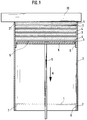
- the flanged edge 6 of the cylindrical bottom 1 is connected in a gas-tight manner to the lower cylinder end 7 and a cover (not shown) with pumping nozzle is placed on the layer sequence and the upper end of the The cylinder is sealed gas-tight with the cover.
- the capsule and the layer sequence are evacuated via the pump connector and the pump connector is closed gas-tight.
- the gas-tight capsule from the capsule bottom 1 cylinder 2 and the lid is enclosed Layer sequence placed in a hot isostatic press. There heated to the reaction temperature and pressed hot isostastically.
- the capsule shrinks during hot isostatic pressing.
- the product medium 4 is compacted into a metal sheet if metal powder is used or a ceramic plate if ceramic powder is used.
- the separating powder which is made of zirconium oxide powder in the production of a Ni-base alloy sheet, ensures that the sheets do not weld to one another.
- the capsule is removed and circular sheets made of a Ni-based alloy are present as a sheet stack after the capsule has been removed.
- More complex product layers such as are required for composite sheets or composite ceramics, can be produced with this method by introducing different layer sequences within the product layer or by alternating powder spills with foil layers, felt layers, fiber layers or fabrics within the product layer.
- shaping parting surfaces 10 allows curvatures and thickness variations, such as for example in the case of corrugated sheet shapes, beads or knob-shaped bulges, to be implemented within wide limits.
- shaping semicircular separating surfaces 10 made of 0.5 mm thick steel sheet are placed in a half cylinder 11 made of capsule material.
- the separating surfaces 10 have shaping bulges 15.
- the half cylinder 11 is closed gas-tight on its end faces.
- a cover 13 with pumping nozzle 14 is placed in the direction of arrow B on the half cylinder 11 and connected to it in a gastight manner, so that a semi-cylindrical capsule is formed.
- the capsule is evacuated via the pump nozzle 14 and charged with product powder 12.
- the spaces between the separating surfaces 10 are filled with product powder 12 in such a way that a layer sequence (10/12) of separating surfaces 10 and product powder 12 is generated.
- the pumping nozzle 14 is removed after the opening 16 in the cover 13 has been closed in a gas-tight manner.
- the capsules can be hot isostatically compressed simultaneously in a hot isostatic press. Finally, the capsules are removed, for example by grinding.
- the separating surfaces 11, which consist for example of 0.5 mm steel sheet, are etched out and, for example, 2 mm thick semicircular identical sheets provided with a bulge 15 are taken from a Ni-based alloy.
Landscapes
- Engineering & Computer Science (AREA)
- Manufacturing & Machinery (AREA)
- Chemical & Material Sciences (AREA)
- Mechanical Engineering (AREA)
- Ceramic Engineering (AREA)
- Inorganic Chemistry (AREA)
- Materials Engineering (AREA)
- Structural Engineering (AREA)
- Organic Chemistry (AREA)
- Powder Metallurgy (AREA)
Applications Claiming Priority (2)
| Application Number | Priority Date | Filing Date | Title |
|---|---|---|---|
| DE4234004 | 1992-10-09 | ||
| DE19924234004 DE4234004C1 (de) | 1992-10-09 | 1992-10-09 | Verfahren zur Herstellung von Blechen oder Keramikplatten |
Publications (2)
| Publication Number | Publication Date |
|---|---|
| EP0591907A2 true EP0591907A2 (fr) | 1994-04-13 |
| EP0591907A3 EP0591907A3 (en) | 1995-12-13 |
Family
ID=6470027
Family Applications (1)
| Application Number | Title | Priority Date | Filing Date |
|---|---|---|---|
| EP93116044A Withdrawn EP0591907A3 (en) | 1992-10-09 | 1993-10-05 | Process for preparing metal sheets or ceramic plates |
Country Status (2)
| Country | Link |
|---|---|
| EP (1) | EP0591907A3 (fr) |
| DE (1) | DE4234004C1 (fr) |
Cited By (2)
| Publication number | Priority date | Publication date | Assignee | Title |
|---|---|---|---|---|
| CN119609136A (zh) * | 2024-12-12 | 2025-03-14 | 无锡市东杨新材料股份有限公司 | 一种强界面异质金属复合箔材的制备方法 |
| CN119928040A (zh) * | 2025-03-10 | 2025-05-06 | 东莞市思纳克材料科技有限公司 | 一种陶瓷薄板的成型方法 |
Families Citing this family (1)
| Publication number | Priority date | Publication date | Assignee | Title |
|---|---|---|---|---|
| GB0912259D0 (en) | 2009-07-15 | 2009-08-26 | Rolls Royce Plc | A method and assembly for forming a component by isostatic pressing |
Family Cites Families (5)
| Publication number | Priority date | Publication date | Assignee | Title |
|---|---|---|---|---|
| DE870185C (de) * | 1944-02-22 | 1953-03-12 | Eisen & Stahlind Ag | Verfahren zur Herstellung von gesinterten Hartmetallformkoerpern |
| DE2203137A1 (de) * | 1971-02-01 | 1972-08-17 | Allmaenna Svenska Elek Ska Ab | Verfahren zum Herstellen von Scheiben aus pulverfoermigem Metall |
| AU563498B2 (en) * | 1983-07-19 | 1987-07-09 | Ford Motor Co. | Making hot pressed silicon nitride by use of low density reaction bonded body |
| JPS6362122A (ja) * | 1986-09-03 | 1988-03-18 | 株式会社日立製作所 | 真空遮断器用電極の製造法 |
| US4909841A (en) * | 1989-06-30 | 1990-03-20 | Westinghouse Electric Corp. | Method of making dimensionally reproducible compacts |
-
1992
- 1992-10-09 DE DE19924234004 patent/DE4234004C1/de not_active Expired - Fee Related
-
1993
- 1993-10-05 EP EP93116044A patent/EP0591907A3/de not_active Withdrawn
Cited By (3)
| Publication number | Priority date | Publication date | Assignee | Title |
|---|---|---|---|---|
| CN119609136A (zh) * | 2024-12-12 | 2025-03-14 | 无锡市东杨新材料股份有限公司 | 一种强界面异质金属复合箔材的制备方法 |
| CN119928040A (zh) * | 2025-03-10 | 2025-05-06 | 东莞市思纳克材料科技有限公司 | 一种陶瓷薄板的成型方法 |
| CN119928040B (zh) * | 2025-03-10 | 2026-01-06 | 东莞市思纳克材料科技有限公司 | 一种陶瓷薄板的成型方法 |
Also Published As
| Publication number | Publication date |
|---|---|
| EP0591907A3 (en) | 1995-12-13 |
| DE4234004C1 (de) | 1994-02-10 |
Similar Documents
| Publication | Publication Date | Title |
|---|---|---|
| JP4110533B2 (ja) | Mo系ターゲット材の製造方法 | |
| DE60021579T2 (de) | Verfahren zur herstellung von feuerfestpulver mit niedrigen sauerstoffgehalt zur verwendung in der pulvermetallurgie | |
| US5119729A (en) | Process for producing a hollow charge with a metallic lining | |
| EP0118702B1 (fr) | Procédé pour la fabrictaion d'une ébauche à partir d'un matériau pulvérulent par pressage isostatique | |
| US4126451A (en) | Manufacture of plates by powder-metallurgy | |
| EP2990141B1 (fr) | Procédé de fabrication de composants en Titanaluminide (TiAI) | |
| CN114058901B (zh) | 亚微米氧化钇颗粒增韧的高性能近α粉末冶金钛合金及其制法 | |
| US12043892B2 (en) | Method for producing molybdenum alloy targets | |
| DE4019439A1 (de) | Verfahren zum herstellen von presskoerpern | |
| JPH08120445A (ja) | Ti−Al合金ターゲット材の製造方法 | |
| GB2092619A (en) | Porous sintered body and procedure for producing porous sintered bodies | |
| EP0959055B1 (fr) | Procédé de fabrication de pièces en oxyde d'indium étain | |
| US7625520B2 (en) | Manufacturing method for high yield rate of metal matrix composite sheet production | |
| DE2258485A1 (de) | Verfahren und vorrichtung zur herstellung von guss- und pressformen | |
| CN115026301A (zh) | 一种粘结剂喷射3D打印制备WC-Co硬质合金的方法 | |
| US3809553A (en) | Metal foil-making process | |
| DE4234004C1 (de) | Verfahren zur Herstellung von Blechen oder Keramikplatten | |
| JP2003226964A (ja) | スパッタリング用タングステンターゲットの製造方法 | |
| US5427736A (en) | Method of making metal alloy foils | |
| EP3661678A1 (fr) | Procédé de fabrication d'un produit semi-fini destiné à un matériau composite | |
| US20050019199A1 (en) | Double-layer metal sheet and method of fabricating the same | |
| DE2824257C2 (de) | Verfahren zum Herstellen eines hohlkörperartigen Bauteiles mit verbesserter thermischer Belastbarkeit in elektromagnetischen Maschinen | |
| DE69013885T2 (de) | Verfahren zur Herstellung von Materialscheiben. | |
| EP0248783A1 (fr) | Appareil de forgeage pour la préparation d'ébauches à densité élevée par la métallurgie des poudres | |
| JP7822314B2 (ja) | チタン合金積層成形体並びにその製造方法及び原料 |
Legal Events
| Date | Code | Title | Description |
|---|---|---|---|
| PUAI | Public reference made under article 153(3) epc to a published international application that has entered the european phase |
Free format text: ORIGINAL CODE: 0009012 |
|
| AK | Designated contracting states |
Kind code of ref document: A2 Designated state(s): AT DE FR GB IT SE |
|
| PUAL | Search report despatched |
Free format text: ORIGINAL CODE: 0009013 |
|
| AK | Designated contracting states |
Kind code of ref document: A3 Designated state(s): AT DE FR GB IT SE |
|
| STAA | Information on the status of an ep patent application or granted ep patent |
Free format text: STATUS: THE APPLICATION IS DEEMED TO BE WITHDRAWN |
|
| 18D | Application deemed to be withdrawn |
Effective date: 19960501 |