EP0591977A1 - Bildprozessor und Druckgerät - Google Patents
Bildprozessor und Druckgerät Download PDFInfo
- Publication number
- EP0591977A1 EP0591977A1 EP93116262A EP93116262A EP0591977A1 EP 0591977 A1 EP0591977 A1 EP 0591977A1 EP 93116262 A EP93116262 A EP 93116262A EP 93116262 A EP93116262 A EP 93116262A EP 0591977 A1 EP0591977 A1 EP 0591977A1
- Authority
- EP
- European Patent Office
- Prior art keywords
- binary
- color component
- coding
- coded
- threshold
- Prior art date
- Legal status (The legal status is an assumption and is not a legal conclusion. Google has not performed a legal analysis and makes no representation as to the accuracy of the status listed.)
- Granted
Links
- 230000003247 decreasing effect Effects 0.000 claims abstract description 21
- 238000000034 method Methods 0.000 claims description 123
- 239000003086 colorant Substances 0.000 claims description 23
- 239000000976 ink Substances 0.000 claims description 17
- 230000007423 decrease Effects 0.000 claims description 16
- 238000009792 diffusion process Methods 0.000 claims description 12
- FFBHFFJDDLITSX-UHFFFAOYSA-N benzyl N-[2-hydroxy-4-(3-oxomorpholin-4-yl)phenyl]carbamate Chemical compound OC1=C(NC(=O)OCC2=CC=CC=C2)C=CC(=C1)N1CCOCC1=O FFBHFFJDDLITSX-UHFFFAOYSA-N 0.000 description 13
- 230000006870 function Effects 0.000 description 12
- 230000003044 adaptive effect Effects 0.000 description 8
- 238000010586 diagram Methods 0.000 description 6
- 238000012545 processing Methods 0.000 description 6
- 238000012937 correction Methods 0.000 description 4
- 239000011159 matrix material Substances 0.000 description 4
- 238000013461 design Methods 0.000 description 3
- 239000000203 mixture Substances 0.000 description 3
- 238000013139 quantization Methods 0.000 description 3
- 239000000654 additive Substances 0.000 description 1
- 230000000996 additive effect Effects 0.000 description 1
- 238000013459 approach Methods 0.000 description 1
- 238000004364 calculation method Methods 0.000 description 1
- 238000006243 chemical reaction Methods 0.000 description 1
- 238000007906 compression Methods 0.000 description 1
- 230000006835 compression Effects 0.000 description 1
- 238000010276 construction Methods 0.000 description 1
- 230000006378 damage Effects 0.000 description 1
- 238000013144 data compression Methods 0.000 description 1
- 238000004042 decolorization Methods 0.000 description 1
- 230000002950 deficient Effects 0.000 description 1
- 230000001419 dependent effect Effects 0.000 description 1
- 230000006866 deterioration Effects 0.000 description 1
- 238000011156 evaluation Methods 0.000 description 1
- 239000000463 material Substances 0.000 description 1
- 238000012546 transfer Methods 0.000 description 1
Images

Classifications
-
- H—ELECTRICITY
- H04—ELECTRIC COMMUNICATION TECHNIQUE
- H04N—PICTORIAL COMMUNICATION, e.g. TELEVISION
- H04N1/00—Scanning, transmission or reproduction of documents or the like, e.g. facsimile transmission; Details thereof
- H04N1/46—Colour picture communication systems
- H04N1/52—Circuits or arrangements for halftone screening
Definitions
- the invention relates to an image processor and a color printing apparatus to which the image processor is applied.
- the original image data consists of three color components, cyan (C), magenta (M), yellow (Y), which are the primary colors of inks.
- C cyan
- M magenta
- Y yellow
- Each of the color components belonging to a pixel can take a total of 256 tone levels from 0 to 255.
- the C, M, Y dots must be binary-coded for each pixel of the image data to determine that such dots are to be printed (ON) or not (OFF).
- a minimum average error method and an error diffusion method are in wide use and are excellent techniques in terms of resolution and tone reproducibility.
- the minimum average error method corrects the data value of a pixel to be binary-coded based on a weighted mean value of a quantization error caused in already binary-coded pixels adjacent the pixel to be binary-coded.
- the error diffusion method adds a quantization error caused at the time of binary-coding a pixel to neighboring pixels that have not yet been binary-coded by diffusion. What makes the former different from the latter is the timing at which the error diffusion process is executed; the two techniques are completely equivalent logically.
- the error diffusion method is disclosed in "R.
- the error diffusion is performed on a color component basis independently.
- the process of binary-coding the color component C is performed independently of the color components M and Y. Therefore, whether the C dot is superposed on the M dot or the Y dot on a single pixel is random, which means that no control is provided to make the dot easy or difficult to be superposed, or the like.
- gray data that is achromatic is binary-coded.
- a black dot is usually produced by superposing the three color dots one upon another on a single pixel.
- the ordinary adaptive algorithm for spatial grayscale for color images performs the error diffusing process on each color component independently.
- how dots are superposed cannot be completely controlled.
- binary-coding achromatic gray data of an intermediate density the three color dots are superposed at random.
- an output including a dot produced by superposing two colors out of the three, a single color dot, and a pixel without color ink also may be present.
- gray data in which the tone level of an original image is 128/255 for each of the three color components C, M, Y is binary-coded the probability that each color component dot will be binary-coded to ON is almost 1/2.
- total of eight combinations of colors are produced after the pixel-based binary coding process at an almost equal probability of 1/8.
- a black pixel of case (1) in which all the three color dots C, M, Y are binary-coded to ON can be replaced by a pixel consisting only of K ink (C, M, Y are OFF and only K is ON).
- K black ink
- UCR under color removal
- the UCR technique is designed to remove the black component K from the C, M, Y components before binary-coding.
- tone level data of the four color components C', M', Y', and K are generated by the UCR process based on the original image tone data of C, M, Y components, and the color components C', M', Y', K are binary-coded thereafter.
- the simplest example of the UCR process is as follows.
- the C', M', Y', K values obtained by the UCR process are binary-coded by error diffusion method or the like to generate binary-coded dots of the respective color components C, M, Y, K.
- the binary-coded results of C', M', Y', K may be printed as they are, whereas in the case of using only the three color inks C, M, Y, then the K dot is replaced by the superposition of the three colors C, M, Y.
- the values of C, M, Y are equal to one another.
- all of the C', M', Y' components become zero, leaving only the K component. Therefore, the binary-coded results indicate that only the K dot exists.
- the achromatic area consists only of black dots, thereby avoiding generation of gray balance unmatching and inconsistency in the produced color due to the gray area being made up of pixels of various colors.
- Binary-coded color component signals of a target pixel are sorted in descending order and binary-coded as sorted. If the binary-coded results of the already binary-coded color components are OFF, then the color components thereafter in descending order are forced to be OFF, making sure that they cannot be ON. According to such technique, small color signal components cannot be ON unless larger color signal components are ON, making the ON dots easy to be superposed.
- this technique involves the operation of sorting the respective color data of a target pixel in descending order. That is, the binary-coding process cannot started unless all the color data of the target ready, which is a problem. Thus, even if th color is to be received on a line basis or on the binary-coding process cannot be started from color component, making it necessary for the components to be stored until all the color da From this arises the problem of reduced processing and a requirement for larger storage.
- the object of the above-mentioned publication No. 6948/1992 is only to improve the data compression ratio, and the specification provides no method for controlling gray balance.
- an object of the invention is to provide an image processor and a color printing apparatus capable of producing an output that maintains excellent gray balance while satisfying the conditions that:
- the invention provides an image processor according to independent claim 1 and a printing apparatus according to independent claims 4 or 5. Further advantageous features, aspects and details of the invention are evident from the dependent claims, the description and the drawings.
- the claims are intended to be understood as a first non-limiting approach of defining the invention in general terms.
- the invention refers to an image processor having the function of binary-coding color half-tone image data so that the image data can be outputted to apparatuses not having a pixel-based tone control system.
- the invention is applied to an image processor for binary-coding respective color components of tone color image data consisting of three color components.
- the image processor includes: a first color component binary-coding means for binary-coding a first color component, a second color component binary-coding means for binary-coding a second color component, a second color component threshold controlling means for the second color component binary-coding means, the second color component threshold controlling means increasing or decreasing a second color component binary-coding threshold in accordance with a binary-coded result OFF or ON of the first color component, a third color component binary-coding means for binary-coding a third color component, and a third color component threshold controlling means for the third color component binary-coding means, the third color component threshold controlling means increasing or decreasing a third color component binary-coding threshold by referring to at least one of the binary-coded results OFF or ON of the first color component and the binary-coded results for the second color component.
- the color printing apparatus of the invention preferably includes a black dot generating means for replacing a target pixel with a single black ink dot if the respective color components of the target pixel have been binary-coded to ON (a dot is present).
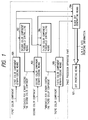
- Figure 1 shows an image processor and a printing apparatus of a first embodiment of the invention.
- a color component 1 is cyan (C)
- a color component 2 is magenta (M)
- a color component 3 is yellow (Y) and the respective color components of a target pixel is binary-coded to ON (a dot is present) and OFF (a dot is absent).
- the entire portion of Figure 1 refers to an example of a printing apparatus of the invention, whereas the portion surrounded by a broken line refers only to an image processor of the invention.
- a binary-coding algorithm used in this embodiment will be described.
- the following description refers to an example in which a minimum average error method is employed as a basic binary-coding method.
- a dot is present (ON) when a color component is binary-coded to a larger value, and a dot is absent (OFF) when a color component is binary-coded to a smaller value.
- a first color component binary-coding means 101 binary-codes the color component C of a target pixel. The following steps are taken when the mean error minimizing method is used as a binary-coding technique:
- a second color component threshold controlling means 102 increases or decreases the threshold for binary-coding the second color component M in accordance with the binary-coded result of the first color component C. Specifically, when the color component C is binary-coded to ON (a dot is present), the threshold is decreased, whereas when the color component C is binary-coded to OFF (a dot is absent), the threshold is increased.
- a second color component binary-coding means 103 binary-codes the color component M using the threshold for binary-coding the second color component M determined by the second color component threshold controlling means 102. The following steps are taken based on the mean error minimizing method:
- a third color component threshold controlling means 104 increases or decreases a threshold for binary-coding the third color component Y in accordance with the binary-coded results of the first color component C and the second color component M. Specifically, if both C and M are binary-coded to ON, the threshold is decreased, whereas if C or M is binary-coded to OFF, the threshold is increased.
- a third color component binary-coding means 105 binary-codes the color component Y using the threshold for binary-coding the third color component Y determined by the third color component threshold controlling means 104 in a manner similar to that for the M component in Process 3.
- the mean error minimizing method is used, the following steps are taken:
- a black dot generating means 106 simply sets a K dot to OFF when any one of C, M, Y components of the target pixel is OFF.
- the black dot generating means 106 replaces them with a K dot; i.e. , the K dot is set to ON and the C, M, Y dots, to OFF.
- a dot printing means 107 prints with inks in accordance with the binary-coded results of the C, M, Y, and K dots obtained in Process 6.
- Printing methods include a wire dot method, an ink jet method, a thermal transfer method, an electrophotographic method, or the like.
- Process 4A to Process 4D may be applied.
- the third color component threshold controlling means 104 decreases the threshold when the first color component C is binary-coded to ON, or increases the threshold when C is binary-coded to OFF in accordance with the binary-coded result of C.
- the third color component threshold controlling means 104 decreases the threshold when the second color component M is binary-coded to ON, or increases the threshold when M is binary-coded to OFF in accordance with the binary-coded result of M.
- the third color component threshold controlling means 104 decreases the threshold when C or M is binary-coded to ON, or increases the threshold when both C and M are binary-coded to OFF in accordance with the binary-coded results of C and M.
- the third color component threshold controlling means 104 first decreases the threshold when C is binary-coded to ON, or increases the threshold when C is binary-coded to OFF in accordance with the binary-coded result of C. The third color component threshold controlling means 104 then decreases the threshold when M is binary-coded to ON, or increases the threshold when M is binary-coded to OFF in accordance with the binary-coded result of M.
- Process 4A and Process 4B only refer to the binary-coded result of either the first color component C or the second color component M at the time of binary-coding the third color component Y.
- the M dot is most likely to be binary-coded to ON for a pixel whose C dot has been binary-coded to ON up to Process 3, so that an advantage close to that obtained by referring to both C and M can be obtained by referring only to either one of them.
- the threshold for binary-coding the third color component becomes: a minimum value if both C and M are binary-coded to ON; a maximum value if both C and M are binary-coded to OFF; and a mean value if either C or M is binary-coded to ON.
- the threshold varies in three to four levels.
- both the second color component threshold controlling means and the third color component threshold controlling means refer only to the binary-coded result of the first color component C. Therefore, it can be said that the image processor of the invention can be implemented with a simple design for the reasons that it is not necessary to store the binary-coded result of the second color component M and that second color component threshold controlling means and the third color component threshold controlling means are of the same construction, etc.
- Process 1 to Process 5 are portions shared in common with the existing mean error minimizing method, whereas the second color component threshold controlling means 102, portions of Process 2 and Process 4 involving the third color component threshold controlling means 104 are material to the invention. These threshold controlling means contribute to increasing the probability of dots being superposed. The principle of such process will be described below.
- the probability of a binary-coded result being ON increases if the binary-coding threshold is decreased, whereas the probability of a binary-coded result being OFF decreases if the binary-coding threshold is increased. Therefore, when the threshold for binary-coding M is increased or decreased in accordance with the binary-coded result of C as in this embodiment, the probability of M being binary-coded to ON is increased if the binary-coded result of C is ON, whereas the probability of M being binary-coded to OFF is increased if the binary-coded result of C is OFF. As a result, the C dot and the M dot are easy to superpose. In addition, at the time of binary-coding Y, the Y dot can be made easy to be superposed on the C and M dots by decreasing the threshold for binary-coding Y only when the binary-coded results of M and C are ON.
- the probability of the first color being superposed upon the second color can be increased or decreased. Furthermore, by changing the threshold for binary-coding the third color in accordance with the binary-coded result of the first color or the binary-coded result of the second color, the probability of the first color being superposed upon the second color can also be increased. Since the invention is designed to artificially make the dots formed of the three colors C, M, and Y easy to be superposed one upon another on the basis of this principle, the probability of the three color dots being binary-coded to ON so that they can be superposed on a single pixel is increased.
- the mean error minimizing method is used as the binary-coding technique
- other binary-coding techniques such as an ordered dither method, a multi-level division quantization method, or the like may be employed to binary-code the first color component 1 in Process 1.
- the advantage of the superposition probability control mechanism of the invention can be obtained by any binary-coding techniques as long as the such techniques include the binary-coding process based on the comparison with thresholds.
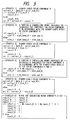
- Figure 2 is a diagram illustrative of a second embodiment of the invention, in which the first embodiment is further specified by using a pseud-programming language.
- the second embodiment is designed to binary-code the respective color components of image data either 0 or 255, the image data consisting of three colors, C, M, and Y and having a total of 256 tone levels (from 0 to 255).
- slsh_C, slsh_base_M, slsh_base_Y, slsh_add_M, slsh_add_Y, slsh_sub_M, slsh_sub_Y are constants.
- the function error_sum_C() in Process 1 of Figure 2 calculates a correction of the color component C data. This data correcting process is usually performed by the mean error minimizing method. A weighted mean of the binary-coding errors of the color components C caused at already binary-coded neighboring pixels is calculated.
- the function error_sum_A() calculates (2 ⁇ E(-1,0)+2 ⁇ E(0,1)+E(-2,0)+E(-1,1)+E(1,1)+E(0,2))/(2+2+1+1+1) for the color component C, and the calculated value is added to renew the calculation.
- the function error_sum_M() in Process 3 calculates the same thing for the color component M.
- the first color component binary-coding threshold slsh_C in Process 1 usually uses a value between two values that could be the binary-coded results. A value 127 is used in this embodiment.
- the corrected C color component data correct_C is binary-coded to either 0 or 255 by comparison with the threshold slsh_C to obtain the binary-coded result data result_C.
- An error err_C is a binary-coding error of the color component C caused by binary-coding the target pixel. This binary-coding error is referred to by the function error_sum_C() of Process 1 when a next pixel is binary-coded, and is therefore stored for such next binary-coding operation.
- Process 2 is the operation of increasing or decreasing the threshold for the second color component M performed by the second color component threshold controlling means.
- slsh_base_M which is the basic threshold value for the color component M
- slsh_add_M is added
- slsh_sub_M is subtracted.
- Process 4 is an operation of increasing or decreasing the threshold for the third color component Y performed by the third color component threshold controlling means.
- slsh_base_Y which is the basic threshold value for the color component Y
- slsh_add_Y is added
- slsh_sub_Y is subtracted.
- Process 6 is a portion related to the printing apparatus of the invention and generates result_K for an output to a printer having a black ink and new result_C, result_M, result_Y based on the result_C, result_M, result_Y already obtained by the image processor section of the invention up to Process 5. A detailed description of the final step of actually printing dots will be omitted.
- the threshold increases or decreases slsh_add_M, slsh_sub_M and slsh_add_Y, slsh_sub_Y are all set to 25.
- a gray tone image i.e. , an image in which the values of the three primary color components C, M, Y are equal to one another has been binary-coded, dots in which all the three colors C, M, Y have been superposed stand for 99% or more with a scanty 10% threshold increase or decrease.
- slsh_base_M and slsh_base_Y are constants in the above description, they may be variables that vary systematically or at random in accordance with the position of a pixel.
- the adaptive algorithm for spatial grayscale may be a substitute since the adaptive algorithm for spatial grayscale is principally equivalent to the mean error minimizing method.
- a correction of data to be calculated by the function error_sum_M() in Process 3 is expressed as being a sum of errors diffused from neighboring pixels in terms of the adaptive algorithm for spatial grayscale, both are substantially the same.
- the operations 1-1 to 1-3 in Process 1 of the first embodiment can be described in terms of the adaptive algorithm for spatial grayscale as follows:
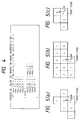
- Figure 3 shows a third embodiment of the invention. Similar to the embodiment of Figure 2, the third embodiment is also described in a pseudo-programming language similar to the C language. While C, M, Y components, which are the primary colors of subtractive color mixture, are used in the embodiments of Figures 1 and 2, red (R), green (G), and blue (B), which are the primary colors of additive color mixture, are assigned as the first color component, the second color component, and the third color component in this embodiment.
- C, M, Y components which are the primary colors of subtractive color mixture
- R red
- G green
- B blue
- the color components are binary-coded to either 0 or 255 by dividing the original image data into 256 tone levels from 0 to 255 in the second embodiment
- the number of tone levels is not limited to a particular value in this embodiment. That is, the original image data takes a real value from 0 to 1, and such real value is binary-coded to 0 (a dot is OFF) or to 1 (a dot is ON).
- a negative pixel in this embodiment is a positive pixel in the second embodiment; i.e. , when all the dots R, G, B are binary-coded to ON, the pixel becomes white (highlighted), whereas when all the dots are binary-coded to OFF, the pixel becomes black.
- Figure 4 is a rewritten version of Process 6 of Figure 3. The results obtained by this version is the same.
- the image processor of the invention is characterized as allowing all the dots of three color components to be made easy to be superposed only by performing a simple operation such as a threshold increasing or decreasing operation by the second color component threshold controlling means and the third color component threshold controlling means.
- a simple operation such as a threshold increasing or decreasing operation by the second color component threshold controlling means and the third color component threshold controlling means.
- the threshold controlling means of the image processor of the invention is characterized as referring to the binary-coded results of the already binary-coded color components only. Therefore, it is not necessary to wait for all the color data of a target pixel to be ready.
- This feature contributes to receiving the respective color component data in any sequence, e.g. , pixel sequential, line sequential, or screen sequential, etc. , flexibly. Since the capacity of the binary-coded data is largely reduced compared with that of the original image data, this is advantageous in saving storage capacity.
- the design such that the third color component threshold controlling means refers only to the binary-coded data of the first color component can dispense with referring to the binary-coded result of the second color component, such design is advantageous in a screen sequential system or the like.
- the printing apparatus of the invention is characterized as including, in addition to the image processor of the invention, the black dot generating means that replaces a dot whose color components C, M, Y have been binary-coded to ON with a black-ink dot. Therefore, the gray data is outputted in the black ink, thereby allowing further improved gray balance to be maintained. What is more advantageous is that no further complicated binary-coding process is required to be added therefor.
Landscapes
- Engineering & Computer Science (AREA)
- Multimedia (AREA)
- Signal Processing (AREA)
- Facsimile Image Signal Circuits (AREA)
- Color Image Communication Systems (AREA)
- Image Processing (AREA)
Applications Claiming Priority (4)
| Application Number | Priority Date | Filing Date | Title |
|---|---|---|---|
| JP4268839A JPH06121156A (ja) | 1992-10-07 | 1992-10-07 | 画像処理装置 |
| JP268839/92 | 1992-10-07 | ||
| JP348849/92 | 1992-12-28 | ||
| JP4348849A JPH06205220A (ja) | 1992-12-28 | 1992-12-28 | 画像処理装置および印刷装置 |
Publications (2)
| Publication Number | Publication Date |
|---|---|
| EP0591977A1 true EP0591977A1 (de) | 1994-04-13 |
| EP0591977B1 EP0591977B1 (de) | 1998-01-21 |
Family
ID=26548501
Family Applications (1)
| Application Number | Title | Priority Date | Filing Date |
|---|---|---|---|
| EP93116262A Expired - Lifetime EP0591977B1 (de) | 1992-10-07 | 1993-10-07 | Bildprozessor und Druckgerät |
Country Status (4)
| Country | Link |
|---|---|
| US (1) | US5509085A (de) |
| EP (1) | EP0591977B1 (de) |
| DE (1) | DE69316504T2 (de) |
| SG (1) | SG66255A1 (de) |
Cited By (3)
| Publication number | Priority date | Publication date | Assignee | Title |
|---|---|---|---|---|
| EP0732843A3 (de) * | 1995-03-16 | 1997-03-19 | Lexmark Int Inc | Kombinierte Farbhalbtonrasterung |
| EP0774860A3 (de) * | 1995-11-16 | 1998-07-22 | Xerox Corporation | Bildverarbeitungsverfahren und -system für einen mehrfarbigen Drucker |
| WO2000030342A1 (en) * | 1998-11-16 | 2000-05-25 | Conexant Systems, Inc. | Black replacement for color digital image printing |
Families Citing this family (16)
| Publication number | Priority date | Publication date | Assignee | Title |
|---|---|---|---|---|
| US6445725B1 (en) * | 1993-09-03 | 2002-09-03 | Canon Kabushiki Kaisha | Spread spectrum communication apparatus |
| JP3110924B2 (ja) * | 1993-09-30 | 2000-11-20 | キヤノン株式会社 | 画像形成装置 |
| US5748798A (en) * | 1993-12-28 | 1998-05-05 | Matsushita Wlectric Ind. | Method and system for adding effects to gray scale images |
| US5696611A (en) * | 1994-11-08 | 1997-12-09 | Matsushita Graphic Communication Systems, Inc. | Color picture processing apparatus for reproducing a color picture having a smoothly changed gradation |
| US6213586B1 (en) * | 1998-04-20 | 2001-04-10 | Hewlett-Packard Company | Method and apparatus for controlling a multicolor inkjet printhead to produce temporally or spatially shingled images |
| US6360006B1 (en) * | 1998-09-29 | 2002-03-19 | Canon Kabushiki Kaisha | Color block selection |
| US6471332B1 (en) | 2001-01-31 | 2002-10-29 | Hewlett-Packard Company | Multiple marker inkjet printing for increased print speed |
| US20050219623A1 (en) * | 2003-07-23 | 2005-10-06 | Konica Minolta Holdings, Inc. | Image processing apparatus and image processing method |
| US8279232B2 (en) * | 2007-06-15 | 2012-10-02 | Ricoh Co., Ltd. | Full framebuffer for electronic paper displays |
| US8203547B2 (en) * | 2007-06-15 | 2012-06-19 | Ricoh Co. Ltd | Video playback on electronic paper displays |
| US8319766B2 (en) * | 2007-06-15 | 2012-11-27 | Ricoh Co., Ltd. | Spatially masked update for electronic paper displays |
| US8416197B2 (en) * | 2007-06-15 | 2013-04-09 | Ricoh Co., Ltd | Pen tracking and low latency display updates on electronic paper displays |
| US8913000B2 (en) | 2007-06-15 | 2014-12-16 | Ricoh Co., Ltd. | Video playback on electronic paper displays |
| US8355018B2 (en) * | 2007-06-15 | 2013-01-15 | Ricoh Co., Ltd. | Independent pixel waveforms for updating electronic paper displays |
| CN105900412B (zh) * | 2013-10-15 | 2018-11-06 | 惠普发展公司,有限责任合伙企业 | 使用基于内容的加权抖动进行图像处理的方法、图像处理器和打印机 |
| US10922801B2 (en) * | 2017-07-19 | 2021-02-16 | Lockheed Martin Corporation | Channel-based binarization of color |
Citations (2)
| Publication number | Priority date | Publication date | Assignee | Title |
|---|---|---|---|---|
| EP0444290A2 (de) * | 1990-02-26 | 1991-09-04 | Hewlett-Packard Company | Verfahren und Vorrichtung zur Wiedergabe von Monochrom- und Farbbildern unter Verwendung einer geordneten Zitter und Fehlerdiffusion |
| EP0501023A2 (de) * | 1991-02-25 | 1992-09-02 | International Business Machines Corporation | Farbgekoppelte Fehlerdiffusion |
Family Cites Families (3)
| Publication number | Priority date | Publication date | Assignee | Title |
|---|---|---|---|---|
| GB2120896B (en) * | 1982-04-06 | 1987-01-28 | Canon Kk | Half-tone facsimile system |
| US5128748A (en) * | 1989-02-15 | 1992-07-07 | Hitachi, Ltd. | Image processing system and apparatus for processing color documents |
| US5243443A (en) * | 1991-12-06 | 1993-09-07 | Xerox Corporation | Halftoning with error feedback and image dependent enhancement |
-
1993
- 1993-10-05 US US08/131,377 patent/US5509085A/en not_active Expired - Fee Related
- 1993-10-07 SG SG1996005184A patent/SG66255A1/en unknown
- 1993-10-07 EP EP93116262A patent/EP0591977B1/de not_active Expired - Lifetime
- 1993-10-07 DE DE69316504T patent/DE69316504T2/de not_active Expired - Lifetime
Patent Citations (2)
| Publication number | Priority date | Publication date | Assignee | Title |
|---|---|---|---|---|
| EP0444290A2 (de) * | 1990-02-26 | 1991-09-04 | Hewlett-Packard Company | Verfahren und Vorrichtung zur Wiedergabe von Monochrom- und Farbbildern unter Verwendung einer geordneten Zitter und Fehlerdiffusion |
| EP0501023A2 (de) * | 1991-02-25 | 1992-09-02 | International Business Machines Corporation | Farbgekoppelte Fehlerdiffusion |
Non-Patent Citations (1)
| Title |
|---|
| T.M. HOLLADAY: "Digital techniques for producing under-colored halftone images", XEROX DISCLOSURE JOURNAL, vol. 8, no. 6, STAMFORD, CONN. (US), pages 531, XP002132137 * |
Cited By (5)
| Publication number | Priority date | Publication date | Assignee | Title |
|---|---|---|---|---|
| EP0732843A3 (de) * | 1995-03-16 | 1997-03-19 | Lexmark Int Inc | Kombinierte Farbhalbtonrasterung |
| US6363172B1 (en) | 1995-03-16 | 2002-03-26 | Lexmark International, Inc. | Combined color halftoning |
| EP0774860A3 (de) * | 1995-11-16 | 1998-07-22 | Xerox Corporation | Bildverarbeitungsverfahren und -system für einen mehrfarbigen Drucker |
| WO2000030342A1 (en) * | 1998-11-16 | 2000-05-25 | Conexant Systems, Inc. | Black replacement for color digital image printing |
| US6343851B2 (en) | 1998-11-16 | 2002-02-05 | Conexant Systems, Inc. | K replacement for color digital image printing |
Also Published As
| Publication number | Publication date |
|---|---|
| DE69316504T2 (de) | 1998-05-28 |
| EP0591977B1 (de) | 1998-01-21 |
| DE69316504D1 (de) | 1998-02-26 |
| SG66255A1 (en) | 1999-07-20 |
| US5509085A (en) | 1996-04-16 |
Similar Documents
| Publication | Publication Date | Title |
|---|---|---|
| EP0591977B1 (de) | Bildprozessor und Druckgerät | |
| US6363172B1 (en) | Combined color halftoning | |
| US5243443A (en) | Halftoning with error feedback and image dependent enhancement | |
| US5353127A (en) | Method for quantization gray level pixel data with extended distribution set | |
| US5050000A (en) | Error diffusion of subcells in digital halftoning | |
| US6813043B1 (en) | Image processing device, image forming device incorporating the same, and storage medium for storing program used thereby | |
| US5226096A (en) | Digital halftoning with selectively applied dot-to-dot error diffusion | |
| US6552822B1 (en) | Image processing method and apparatus | |
| US5289294A (en) | Image processing apparatus | |
| US7417771B2 (en) | Error diffusion halftoning system | |
| JPH10112801A (ja) | 入力イメージ処理方法 | |
| US6307647B1 (en) | Digital halftoning with error diffusion | |
| US20040085553A1 (en) | Multitoning a digital image having at least one group of similar colors channels | |
| JPH06205220A (ja) | 画像処理装置および印刷装置 | |
| US7593135B2 (en) | Digital image multitoning method | |
| US6707576B1 (en) | Noise modulation error diffusion of digital halftoning | |
| JPH08307720A (ja) | カラー画像の階調数変換方式及び方法 | |
| US6847732B1 (en) | Image error diffusion device with noise superposition | |
| US6101001A (en) | Target patterns controlled error management | |
| JPH0738767A (ja) | 画像2値化処理装置 | |
| US6714318B1 (en) | Dithering method and apparatus for multitone printers | |
| US6614943B1 (en) | Method of image binary coding and image binary coding apparatus | |
| US7149351B2 (en) | Image processing apparatus and method, computer program and computer-readable storage medium | |
| JP2800071B2 (ja) | カラー画像形成装置 | |
| US6442300B1 (en) | Three-pixel line screen with high addressability and error diffusion |
Legal Events
| Date | Code | Title | Description |
|---|---|---|---|
| PUAI | Public reference made under article 153(3) epc to a published international application that has entered the european phase |
Free format text: ORIGINAL CODE: 0009012 |
|
| AK | Designated contracting states |
Kind code of ref document: A1 Designated state(s): DE FR GB |
|
| 17P | Request for examination filed |
Effective date: 19940916 |
|
| GRAG | Despatch of communication of intention to grant |
Free format text: ORIGINAL CODE: EPIDOS AGRA |
|
| 17Q | First examination report despatched |
Effective date: 19970127 |
|
| GRAH | Despatch of communication of intention to grant a patent |
Free format text: ORIGINAL CODE: EPIDOS IGRA |
|
| GRAH | Despatch of communication of intention to grant a patent |
Free format text: ORIGINAL CODE: EPIDOS IGRA |
|
| GRAA | (expected) grant |
Free format text: ORIGINAL CODE: 0009210 |
|
| AK | Designated contracting states |
Kind code of ref document: B1 Designated state(s): DE FR GB |
|
| REF | Corresponds to: |
Ref document number: 69316504 Country of ref document: DE Date of ref document: 19980226 |
|
| ET | Fr: translation filed | ||
| PLBE | No opposition filed within time limit |
Free format text: ORIGINAL CODE: 0009261 |
|
| STAA | Information on the status of an ep patent application or granted ep patent |
Free format text: STATUS: NO OPPOSITION FILED WITHIN TIME LIMIT |
|
| 26N | No opposition filed | ||
| REG | Reference to a national code |
Ref country code: GB Ref legal event code: IF02 |
|
| PGFP | Annual fee paid to national office [announced via postgrant information from national office to epo] |
Ref country code: DE Payment date: 20091001 Year of fee payment: 17 |
|
| PGFP | Annual fee paid to national office [announced via postgrant information from national office to epo] |
Ref country code: GB Payment date: 20091007 Year of fee payment: 17 Ref country code: FR Payment date: 20091029 Year of fee payment: 17 |
|
| GBPC | Gb: european patent ceased through non-payment of renewal fee |
Effective date: 20101007 |
|
| PG25 | Lapsed in a contracting state [announced via postgrant information from national office to epo] |
Ref country code: FR Free format text: LAPSE BECAUSE OF NON-PAYMENT OF DUE FEES Effective date: 20101102 |
|
| REG | Reference to a national code |
Ref country code: FR Ref legal event code: ST Effective date: 20110630 |
|
| PG25 | Lapsed in a contracting state [announced via postgrant information from national office to epo] |
Ref country code: GB Free format text: LAPSE BECAUSE OF NON-PAYMENT OF DUE FEES Effective date: 20101007 |
|
| REG | Reference to a national code |
Ref country code: DE Ref legal event code: R119 Ref document number: 69316504 Country of ref document: DE Effective date: 20110502 |
|
| PG25 | Lapsed in a contracting state [announced via postgrant information from national office to epo] |
Ref country code: DE Free format text: LAPSE BECAUSE OF NON-PAYMENT OF DUE FEES Effective date: 20110502 |