EP0592034A2 - Méthode de conception statistique étendue - Google Patents
Méthode de conception statistique étendue Download PDFInfo
- Publication number
- EP0592034A2 EP0592034A2 EP93202800A EP93202800A EP0592034A2 EP 0592034 A2 EP0592034 A2 EP 0592034A2 EP 93202800 A EP93202800 A EP 93202800A EP 93202800 A EP93202800 A EP 93202800A EP 0592034 A2 EP0592034 A2 EP 0592034A2
- Authority
- EP
- European Patent Office
- Prior art keywords
- design
- tail
- determining
- circuit
- parameters
- Prior art date
- Legal status (The legal status is an assumption and is not a legal conclusion. Google has not performed a legal analysis and makes no representation as to the accuracy of the status listed.)
- Withdrawn
Links
Images





Classifications
-
- G—PHYSICS
- G06—COMPUTING OR CALCULATING; COUNTING
- G06F—ELECTRIC DIGITAL DATA PROCESSING
- G06F30/00—Computer-aided design [CAD]
- G06F30/30—Circuit design
- G06F30/36—Circuit design at the analogue level
Definitions
- the present invention relates to electrical circuit design and in particular to computer aided electrical circuit design.
- a hypothetical distribution of a variable which in the present case can be a parameter or a circuit performance function, has been shown with a single peak or maximum.
- the extreme value region of the distribution is called the tail.
- Fig. 1B shows a magnification of the tail region of Fig 1A.
- the subscript E denotes an estimated value
- T denotes a true value (may be obtained by simulation).
- the variable is distributed in a bell-shaped curve around its mean value.
- a specification of mean +/- 3 sigma means that 99.87 percent of all the circuits (designs) built will have the PF within the specified range.
- the circuit is usually defined by the values of its constituent devices, such as resistances, capacitances, inductances, power supply currents, voltages, transistor gains etc. which determine PFs. It is these elements that results from the manufacturing parameters.
- the value of a silicon resistor is determined by its physical dimensions and the electrical sheet resistivity of the silicon. The sheet resistivity in turn is affected by the concentration and distribution of dopants (impurities) added to the silicon. Variations in the physical dimensions or the dopant concentration lead to a variation of the resistor value.
- a Field Effect Transistor has parameters such as channel length, channel width, gate oxide thickness, mobility, and effective charge, etc. These parameters determine the FETs functional characteristics.
- FET Field Effect Transistor
- circuit simulation programs are Advanced Statistical and Transient Analysis Program (ASTAP), Circuit Simulator for IC Circuits (SPICE), and Statistical Simulator for IC Fabrication (FABRICS II). These are used to simulate the circuits, devices and processes. Depending on the complexity of the device or circuit, these simulations require large computers and use significant CPU times.
- It is yet another object of the present invention is to improve circuit design at reduced cost and time.
- the present invention is a method of circuit design. First, the sensitivity of a circuit performance function (Sensitivity Data Set - SDS) to at least one physical parameter is determined. Then, an estimated distribution of the design function is calculated by using the SDS and random parameter values. Subsequently, the parameters corresponding to the estimated distribution is used to calculate the tail. The calculated tail is compared to a predetermined design objective. If the objective is not met, the design is modified and the calculation steps repeated until the design objective is met.
- a circuit performance function Signal Set - SDS
- Fig. 2 is a flow diagram of a preferred embodiment of the present invention.
- the INPUT 10 step involves entering design data, design parameters, extreme values of the design parameters and information on performance function, design specification and specification of the tail area of interest.
- the CIRCUIT 20 step is the description of the circuit.
- GENERATE SDS 30 step the circuit sensitivity for each of the performance function to the parameter of interest is determined.
- the PF values are determined by circuit simulation at the following parameter values: all parameters at their average value and each parameter varied to its extreme high and low value individually, while keeping the rest of the parameters at their average value. If there are n variables, then the circuit simulation is used 2n+1 times for each design performance function to determine the SDS values.
- circuit performance sensitivity to a parameter between its average and extreme value is approximated by the slope of the line connecting the calculated PF value at the extreme and average parameter values. Accordingly, there will be 2n SDS values for each performance function.
- Any of the available circuit simulation programs such as ASTAP, SPICE, etc., can be used for simulation.
- CALC EST. DIST 40 step determines the estimated distribution of the design PFs by evaluating them at the specified total number of cases required by the tail specification.
- the number of cases for analysis is specified at the INPUT 10 step.
- the default for the number of cases analyzed is set at 2000, however, it can be set to any desired value.
- the tail can be specified by the fractional area, such as 0.5% of the total area or by the number of tail cases desired.
- the tail specification must correspond to the design specification. For example, if the design range is specified to be a 3 sigma design, then the tail is a 3 sigma tail.
- a random generator is used to determine a random parameter value for each case at the step EST.DIST 40, at which the PF is calculated to establish the estimated distribution curve.
- the random parameter values corresponding to the PF value from the estimated distribution tail is retrieved. These retrieved parameter values are used to accurately construct a new tail for the PF, referred to as true tail.
- the true tail boundary value for the PF is compared to the design specification (also referred to as design objective) for the same PF in the DESIGN MEET SPEC 60 step. If the comparison is unfavorable, then the circuit is modified in CIRCUIT 20 and steps 30 to 60 are repeated. If, however, the comparison is favorable, then the actual values of the true tail are reported. The design is complete.
- a circuit has 100 variables and there are 10 points in the tail region of interest, according to the present invention the circuit must be simulated 211 times (201 times for the SDS values and 10 times for the tail) instead of 1000 times by the prior art methods. Since the design will have several performance functions and may require several passes, the present invention provides a significant time and cost savings. Further savings can be achieved by selectively limiting parameters varied. Fig. 4 shows a comparison for the example case where only 23 out of 99 parameters were selected.
- Fig. 5 a graphical construction of an estimated distribution using three statistical variables p1, p2 and p3. These variables have their own unique distribution, and the performance function sensitivity of each variable f(p1), f(p2) and f(p3) is approximated by a linear curve.
- the estimated distribution is obtained by the method of summing the product of mi and the parameter value difference from their nominal value.
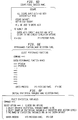
- Fig. 6A-F is an example of a menu driven, interactive system according to the preferred embodiments of the present invention.
- This system includes a variety of display panels which prompt the designer to select the required analysis and allows the designer to describe the structure of the circuit and for inputting and selecting other parameters.
- Fig. 6A is the ESCAPE initial selection panel.
- the user selects options from among possible operations and inputs the name of the circuit data set. If option one is selected, then the system provides the panel shown in Fig. 6B (the ESCAPE main options panel) to the designer for selecting the type of circuit analysis and thus the type of output. Further, the designer can select other inputs such as the tail or the number of cases for the histogram.
- the designer selects the tail failure criteria, which may be an "n" sigma design (where n ranges from 3 to 6).
- the success panel in Fig. 6D is displayed. If options one, two or five in Fig. 6B had been selected, after selecting the tail fail criteria (Fig. 6C), the designer selects the PF names in Fig. 6E. Then the designer uses one of three different techniques to select statistical parameters as in Fig. 6F.
- the second example is the design of the chain of 4 AND INVERT (AI) logic circuit shown in Fig. 7 for the delay (the rise and fall) performance function. A total of 99 parameters were identified. The tail area was specified to be 0.5%.
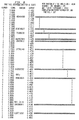
- Fig. 8 shows the final result of the estimated distribution (histogram and cumulative distribution).
- the calculated specified tail region has been highlighted by a box in the figure.
- the number of cases calculated were 2000 and, therefore, the number of cases in the tail area specified is ten, which has been marked.
- Also shown in Fig. 8 is the random seed numbers corresponding to the tail area. It should be understood that had the calculated true tail not been within a predetermined range, the AI's would be modified until that objective (predetermined range) was met.
- the tail region has the true PF values obtained by circuit simulation using the random number seeds obtained from the tail of the estimated distribution.
- the table provides some comparisons between the true PF and estimated PF values of the tail region.
- the true and estimated tails correlate well with a correlation coefficient of 0.927, where 1 means equivalence.
- Fig. 10 is a plot of calculated values by the present invention compared to Monte Carlo method (scattergram) for the performance function of Fig. 9. In this case, the correlation coefficient between the estimated and true values is 0.993.
- the present invention has been described in terms of circuit design. However, the concept of the present invention is equally applicable to other designs such as for mechanical systems, thermal systems and structures. Every design has certain operational characteristics or performance functions and design objectives or specification. To illustrate this generality, consider a mechanical design of an engine wherein the power output is a PF. The parameters that affect this PF are compression ratios, bore diameters, etc., which vary in a manufacturing process. The method of calculating the variability of engine power and modifying design if needed is identical to that used for circuit design.
Landscapes
- Engineering & Computer Science (AREA)
- Computer Hardware Design (AREA)
- Physics & Mathematics (AREA)
- Theoretical Computer Science (AREA)
- Evolutionary Computation (AREA)
- Geometry (AREA)
- General Engineering & Computer Science (AREA)
- General Physics & Mathematics (AREA)
- Design And Manufacture Of Integrated Circuits (AREA)
Applications Claiming Priority (2)
| Application Number | Priority Date | Filing Date | Title |
|---|---|---|---|
| US958389 | 1992-10-08 | ||
| US07/958,389 US5418974A (en) | 1992-10-08 | 1992-10-08 | Circuit design method and system therefor |
Publications (2)
| Publication Number | Publication Date |
|---|---|
| EP0592034A2 true EP0592034A2 (fr) | 1994-04-13 |
| EP0592034A3 EP0592034A3 (fr) | 1994-11-02 |
Family
ID=25500910
Family Applications (1)
| Application Number | Title | Priority Date | Filing Date |
|---|---|---|---|
| EP9393202800A Withdrawn EP0592034A3 (fr) | 1992-10-08 | 1993-10-01 | Méthode de conception statistique étendue. |
Country Status (3)
| Country | Link |
|---|---|
| US (1) | US5418974A (fr) |
| EP (1) | EP0592034A3 (fr) |
| JP (1) | JPH087763B2 (fr) |
Cited By (4)
| Publication number | Priority date | Publication date | Assignee | Title |
|---|---|---|---|---|
| WO1999060710A3 (fr) * | 1998-05-20 | 2000-03-16 | Conexant Systems Inc | Coupleurs et detecteurs a large plage de frequence destines a une detection de puissance dans des systemes a bandes de frequences multiples |
| WO2003021488A3 (fr) * | 2001-09-06 | 2003-10-02 | Analog Design Automation Inc | Procede d'optimisation de conception de produits de circuits a semi-conducteurs robustes au moyen de l'optimisation robuste rationnelle |
| WO2003021489A3 (fr) * | 2001-09-06 | 2003-10-02 | Topological Programming Inc | Procede de conception de technologie robuste dans lequel il est fait appel a une optimisation robuste rationnelle |
| CN103136396A (zh) * | 2011-11-30 | 2013-06-05 | 深圳光启高等理工研究院 | 一种超材料结构单元参数仿真选取方法及装置 |
Families Citing this family (17)
| Publication number | Priority date | Publication date | Assignee | Title |
|---|---|---|---|---|
| US5719796A (en) * | 1995-12-04 | 1998-02-17 | Advanced Micro Devices, Inc. | System for monitoring and analyzing manufacturing processes using statistical simulation with single step feedback |
| US6028994A (en) * | 1998-05-06 | 2000-02-22 | Advanced Micro Devices | Method for predicting performance of microelectronic device based on electrical parameter test data using computer model |
| US6366822B1 (en) * | 1998-08-04 | 2002-04-02 | Advanced Micro Devices, Inc. | Statistical process window design methodology |
| GB2354096B (en) * | 1999-07-30 | 2003-11-12 | Parametric Tech Corp | Method and system for obtaining design parameters for satisfying multiple constraints and/or optimizing multiple objective functions |
| DE19941784A1 (de) * | 1999-09-02 | 2001-03-08 | Picanol Nv | Webmaschine mit einer Vorrichtung zum Abtrennen eines Schussfadens |
| US6711723B2 (en) * | 2000-04-28 | 2004-03-23 | Northrop Grumman Corporation | Hybrid semi-physical and data fitting HEMT modeling approach for large signal and non-linear microwave/millimeter wave circuit CAD |
| US6708073B1 (en) * | 2000-08-10 | 2004-03-16 | Advanced Micro Devices, Inc. | Lot specific process design methodology |
| JP2002110489A (ja) * | 2000-09-26 | 2002-04-12 | Toshiba Corp | 半導体装置の回路特性のシミュレータ、及び、シミュレート方法 |
| US6859914B2 (en) * | 2002-08-27 | 2005-02-22 | Synopsys, Inc. | Smooth operators in optimization of circuit structures |
| JP2006524402A (ja) * | 2003-04-21 | 2006-10-26 | シンボル テクノロジーズ インコーポレイテッド | Rfidタグの設計および実装を最適化するための方法 |
| US7178118B2 (en) * | 2003-05-30 | 2007-02-13 | Synplicity, Inc. | Method and apparatus for automated circuit design |
| US20050288918A1 (en) * | 2004-06-24 | 2005-12-29 | Chen Thomas W | System and method to facilitate simulation |
| US20060190888A1 (en) * | 2005-01-31 | 2006-08-24 | Texas Instruments Incorporated | Apparatus and method for electronic device design |
| US20070180411A1 (en) * | 2006-01-27 | 2007-08-02 | Wolfgang Swegat | Method and apparatus for comparing semiconductor-related technical systems characterized by statistical data |
| CA2633162A1 (fr) * | 2007-06-01 | 2008-12-01 | Solido Design Automation Inc. | Amelioration a la volee de la certitude des estimations en modele statistique, avec retroaction visuelle correspondante |
| US8601416B2 (en) * | 2012-03-15 | 2013-12-03 | Taiwan Semiconductor Manufacturing Co., Ltd. | Method of circuit design yield analysis |
| US9256704B2 (en) | 2014-01-31 | 2016-02-09 | International Business Machines Corporation | Efficient deployment of table lookup (TLU) in an enterprise-level scalable circuit simulation architecture |
Family Cites Families (14)
| Publication number | Priority date | Publication date | Assignee | Title |
|---|---|---|---|---|
| US3702011A (en) * | 1970-05-12 | 1972-10-31 | Bell Telephone Labor Inc | Apparatus and method for simulating logic faults |
| US4386403A (en) * | 1979-12-31 | 1983-05-31 | International Business Machines Corp. | System and method for LSI circuit analysis |
| US4527249A (en) * | 1982-10-22 | 1985-07-02 | Control Data Corporation | Simulator system for logic design validation |
| GB8327753D0 (en) * | 1983-10-17 | 1983-11-16 | Robinson G D | Test generation system |
| FR2567273B1 (fr) * | 1984-07-03 | 1986-11-14 | Commissariat Energie Atomique | Dispositif de simulation de la defaillance ou du bon fonctionnement d'un systeme logique |
| US5157778A (en) * | 1986-08-20 | 1992-10-20 | Digital Equipment Corporation | Method and apparatus for circuit simulation using parallel processors including memory arrangements and matrix decomposition synchronization |
| US4727545A (en) * | 1986-09-02 | 1988-02-23 | Digital Equipment Corporation | Method and apparatus for isolating faults in a digital logic circuit |
| US4791578A (en) * | 1986-12-30 | 1988-12-13 | Eta Systems, Inc. | Logic gate system design |
| US4797838A (en) * | 1987-11-16 | 1989-01-10 | Ncr Corporation | Procedure for evaluating the metastability characteristics of a synchronizing device |
| US4937765A (en) * | 1988-07-29 | 1990-06-26 | Mentor Graphics Corporation | Method and apparatus for estimating fault coverage |
| US5047969A (en) * | 1988-12-15 | 1991-09-10 | Schlumberger Technologies, Limited | General network modeling and synthesis |
| US5245543A (en) * | 1990-12-21 | 1993-09-14 | Texas Instruments Incorporated | Method and apparatus for integrated circuit design |
| US5301118A (en) * | 1991-11-18 | 1994-04-05 | International Business Machines Corporation | Monte carlo simulation design methodology |
| JP2763985B2 (ja) * | 1992-04-27 | 1998-06-11 | 三菱電機株式会社 | 論理シミュレーション装置 |
-
1992
- 1992-10-08 US US07/958,389 patent/US5418974A/en not_active Expired - Fee Related
-
1993
- 1993-09-29 JP JP5242361A patent/JPH087763B2/ja not_active Expired - Lifetime
- 1993-10-01 EP EP9393202800A patent/EP0592034A3/fr not_active Withdrawn
Non-Patent Citations (2)
| Title |
|---|
| AT & T TECHNICAL JOURNAL, vol.69, no.3, May 1990, NEW YORK US pages 46 - 60 LIU ET AL 'computer-aided design for quality (cadq)' * |
| IEEE INTERNATIONAL CONFERENCE ON COMPUTER - AIDED DESIGN, 11 November 1986, US pages 228 - 231 VISVANATHAN 'variational analysis of integrated circuits' * |
Cited By (8)
| Publication number | Priority date | Publication date | Assignee | Title |
|---|---|---|---|---|
| WO1999060710A3 (fr) * | 1998-05-20 | 2000-03-16 | Conexant Systems Inc | Coupleurs et detecteurs a large plage de frequence destines a une detection de puissance dans des systemes a bandes de frequences multiples |
| US6397077B1 (en) | 1998-05-20 | 2002-05-28 | Conexant Systems, Inc. | Wide frequency range couplers and detectors for power detection in multiple frequency band systems |
| WO2003021488A3 (fr) * | 2001-09-06 | 2003-10-02 | Analog Design Automation Inc | Procede d'optimisation de conception de produits de circuits a semi-conducteurs robustes au moyen de l'optimisation robuste rationnelle |
| WO2003021489A3 (fr) * | 2001-09-06 | 2003-10-02 | Topological Programming Inc | Procede de conception de technologie robuste dans lequel il est fait appel a une optimisation robuste rationnelle |
| US6807652B2 (en) | 2001-09-06 | 2004-10-19 | Synopsys, Inc. | Method of robust semiconductor circuit products design using rational robust optimization |
| US6910192B2 (en) | 2001-09-06 | 2005-06-21 | Synopsys, Inc. | Method of robust technology design using rational robust optimization |
| CN103136396A (zh) * | 2011-11-30 | 2013-06-05 | 深圳光启高等理工研究院 | 一种超材料结构单元参数仿真选取方法及装置 |
| CN103136396B (zh) * | 2011-11-30 | 2016-08-03 | 深圳光启高等理工研究院 | 一种超材料结构单元参数仿真选取方法及装置 |
Also Published As
| Publication number | Publication date |
|---|---|
| JPH06195401A (ja) | 1994-07-15 |
| EP0592034A3 (fr) | 1994-11-02 |
| US5418974A (en) | 1995-05-23 |
| JPH087763B2 (ja) | 1996-01-29 |
Similar Documents
| Publication | Publication Date | Title |
|---|---|---|
| US5418974A (en) | Circuit design method and system therefor | |
| US8036870B2 (en) | Simulation method for efficient characterization of electronic systems under variability effects | |
| US6182269B1 (en) | Method and device for fast and accurate parasitic extraction | |
| US8245165B1 (en) | Methods and apparatus for waveform based variational static timing analysis | |
| US6314546B1 (en) | Interconnect capacitive effects estimation | |
| US5535133A (en) | Method of fabricating IC chips with table look-up estimated crosstalk voltages being less than noise margin | |
| US6253359B1 (en) | Method for analyzing circuit delays caused by capacitive coupling in digital circuits | |
| US5617325A (en) | Method for estimating interconnect delays in integrated circuits | |
| US6219822B1 (en) | Method and system for tuning of components for integrated circuits | |
| US8966421B1 (en) | Static timing analysis methods for integrated circuit designs using a multi-CCC current source model | |
| US20040139405A1 (en) | Optimizing designing apparatus of integrated circuit, optimizing designing method of integrated circuit, and storing medium in which program for carrying out optimizing designing method of integrated circuit is stored | |
| US20030066034A1 (en) | Corner simulation methodology | |
| US9898566B2 (en) | Method for automated assistance to design nonlinear analog circuit with transient solver | |
| US20050257077A1 (en) | Method for voltage drop analysis in integreted circuits | |
| US7987439B2 (en) | Method and apparatus for analyzing circuit model by reduction and computer program product for analyzing the circuit model | |
| US6587999B1 (en) | Modeling delays for small nets in an integrated circuit design | |
| CN114925636A (zh) | 组合逻辑单元的时序特征的表征方法、存储介质 | |
| US6405349B1 (en) | Electronic device parameter estimator and method therefor | |
| US7117455B2 (en) | System and method for derivative-free optimization of electrical circuits | |
| US7181713B2 (en) | Static timing and risk analysis tool | |
| US5883818A (en) | Method for generating an improved model for evaluating the operation of an integrated circuit design | |
| US20050278671A1 (en) | Method and system for modeling variation of circuit parameters in delay calculation for timing analysis | |
| JP2007172258A (ja) | タイミング検証方法及びレイアウト最適化方法 | |
| US7480605B2 (en) | Techniques for determining parameter variability for interconnects in the presence of manufacturing uncertainty | |
| US20040143800A1 (en) | Method and apparatus for modeling dynamic systems |
Legal Events
| Date | Code | Title | Description |
|---|---|---|---|
| PUAI | Public reference made under article 153(3) epc to a published international application that has entered the european phase |
Free format text: ORIGINAL CODE: 0009012 |
|
| AK | Designated contracting states |
Kind code of ref document: A2 Designated state(s): DE FR GB |
|
| PUAL | Search report despatched |
Free format text: ORIGINAL CODE: 0009013 |
|
| 17P | Request for examination filed |
Effective date: 19940819 |
|
| AK | Designated contracting states |
Kind code of ref document: A3 Designated state(s): DE FR GB |
|
| 18W | Application withdrawn |
Withdrawal date: 19960923 |