EP0592390B1 - Schliessstück - Google Patents
Schliessstück Download PDFInfo
- Publication number
- EP0592390B1 EP0592390B1 EP19930890197 EP93890197A EP0592390B1 EP 0592390 B1 EP0592390 B1 EP 0592390B1 EP 19930890197 EP19930890197 EP 19930890197 EP 93890197 A EP93890197 A EP 93890197A EP 0592390 B1 EP0592390 B1 EP 0592390B1
- Authority
- EP
- European Patent Office
- Prior art keywords
- threaded spindles
- closure piece
- threaded
- latch
- connection pieces
- Prior art date
- Legal status (The legal status is an assumption and is not a legal conclusion. Google has not performed a legal analysis and makes no representation as to the accuracy of the status listed.)
- Expired - Lifetime
Links
- 238000010304 firing Methods 0.000 claims 1
- 238000010276 construction Methods 0.000 description 2
- 238000007654 immersion Methods 0.000 description 1
Images
Classifications
-
- E—FIXED CONSTRUCTIONS
- E05—LOCKS; KEYS; WINDOW OR DOOR FITTINGS; SAFES
- E05B—LOCKS; ACCESSORIES THEREFOR; HANDCUFFS
- E05B15/00—Other details of locks; Parts for engagement by bolts of fastening devices
- E05B15/02—Striking-plates; Keepers; Bolt staples; Escutcheons
- E05B15/0205—Striking-plates, keepers, staples
- E05B15/024—Striking-plates, keepers, staples adjustable
- E05B15/025—Striking-plates, keepers, staples adjustable the striker being movable by a screw/nut
-
- E—FIXED CONSTRUCTIONS
- E05—LOCKS; KEYS; WINDOW OR DOOR FITTINGS; SAFES
- E05B—LOCKS; ACCESSORIES THEREFOR; HANDCUFFS
- E05B15/00—Other details of locks; Parts for engagement by bolts of fastening devices
- E05B15/02—Striking-plates; Keepers; Bolt staples; Escutcheons
- E05B15/0205—Striking-plates, keepers, staples
- E05B15/024—Striking-plates, keepers, staples adjustable
- E05B15/0245—Movable elements held by friction, cooperating teeth, or the like
Definitions
- the invention relates to a striker with an adjustable stop bar for adjusting the engagement position of a latch in the closed position of a wing, at least two threaded spindles are arranged with their axis of rotation in the closing direction in the striker, these threaded spindles in the striker or in the stop bar are axially immovable and the each other part has at least two threaded sections which engage the threaded spindles in a form-fitting manner, furthermore the threaded spindles can be rotated through an opening, in particular a bore opening on the wing side, for example by means of a screwdriver or a hexagon key, and preferably locking screws are provided on the striker, which Fix the position of the stop bar in the striker after adjustment using the threaded spindles.
- Such a striker is known from DE-A-35 02 989. It describes how an already installed door frame can be converted: The recess provided for the latch is first enlarged; Due to the enlarged recess, molded parts are then attached behind the frame. One molded part is screwed to the frame, the other is adjustable using adjusting screws. The adjusting screws are screwed into the molded part screwed to the frame and axially immovable in the adjustable molded part. The ends of the adjustable molded part are slotted in the axial direction of the adjusting screws; this means that the adjusting screws can be clamped securely by means of locking screws.
- the adjustable molded part must be made relatively thick so that it can withstand the forces that are transmitted to it from the trap.
- the door on the door frame rests over a fold on the outside; this means that the cutout in the striker for the latch is very close to the wing-side edge of the door frame, so that there is no more space for thick molded parts.
- the stop bar is part of a trap pocket with an approximately trough-shaped recess, which has a particularly inclined stop surface on the inside for engaging the trap side surface and at the longitudinal ends of the connectors for the threaded spindles are provided, the trap pocket with a the adjustment path through the threaded spindles corresponding play is slidably mounted in the striker.
- the threaded spindles cooperate with connectors which are provided at the two ends of the latch pocket - that is, above and below the recess for the latch. In this way, enough space for the threaded spindles and a sufficiently large adjustment path is possible.
- a special embodiment is characterized in that the connecting pieces on the wing side are engaged by the striker, that the connecting pieces have threaded bores into which the threaded spindles engage, and that the threaded spindles are axially immovably mounted in the rear engages for the connecting pieces.
- the connectors are so slightly offset from the door panel relative to the stop bar; the space gained in this way is filled with undercuts in which the threaded spindles are axially immovable.
- the threaded spindles engage in threaded bores provided in the connecting pieces. In each case, only approximately half-shell-shaped threaded parts can be provided as threaded bores, which form-fit only on one half of the threaded spindles concern without embracing them.
- elongated holes for locking screws are provided in parallel to the threaded holes for the threaded spindles in the stop bar, in particular in the connecting pieces on both sides, and the locking screws can be screwed into holes in the striker.
- the stop bar has the elongated holes here; the fixing screws are screwed into the striker behind the stop bar.
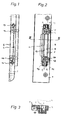
- Fig. 1 shows a striker in side view
- Fig. 2 in front view
- Fig. 3 shows a section along the line III-III in Fig. 2nd
- a striker 1 such as is milled into a door frame, comprises a stop bar 2, on the stop surface 3 of which a latch 4 abuts when the door leaf is closed.
- the stop bar 2 is part of a latch pocket 5 which is slidably mounted in a recess 6 of the striker 1. According to FIG. 2, the latch pocket 5 can be shifted to the left and right, whereby the stop bar 2 with its stop surface 3 creates a different suit or play for the latch 4.
- the threaded bores for threaded spindles 9, 10 are stationary, but rotatable, in recesses in the closing piece 1. They each have a hexagon socket 11, 12 on the end face. which can be reached through holes 13, 14 through a hex key.
- the latch pocket 5 and thus the stop bar 2 can thus be adjusted relative to the striker 1 via the threaded spindles 9, 10.
- the bores 13, 14 are covered when the door is closed or locked; this is an unauthorized adjustment prevented.
- locking screws 15, 16 are also provided, which extend through the elongated holes 17, 18 in the connecting pieces 7, 8 adjoining the latch pocket 5 and are screwed into the base body of the closing piece 1. Before an adjustment, these locking screws 15, 16 are loosened, then the adjustment is carried out by means of the threaded spindles 9, 10 and finally the locking screws 15, 16 can be tightened again.
- the bar 19 shown in FIG. 3 should also be mentioned, which limits the latch pocket 5 on the side opposite the stop bar 2. It serves to reinforce the entire displaceable component and has a lower height than the terminal strip 2, so that the inlet slope of the trap 4 does not hinder immersion in the trap pocket.
Landscapes
- Lock And Its Accessories (AREA)
- Closing And Opening Devices For Wings, And Checks For Wings (AREA)
Description
- Die Erfindung betrifft ein Schließstück mit einer einstellbaren Anschlagleiste zur Justierung der Eingriffsposition einer Falle in der Geschlossenstellung eines Flügels, wobei mindestens zwei Gewindespindeln mit ihrer Drehachse in Schließrichtung im Schließstück angeordnet sind, wobei diese Gewindespindeln im Schließstück oder in der Anschlagleiste axial unverschiebbar gelagert sind und der jeweils andere Teil mindestens zwei Gewindeabschnitte aufweist, die an den Gewindespindeln formschlüssig angreifen, wobei weiters die Gewindespindeln durch eine Öffnung, insbesondere eine flügelseitig ausmündende Bohrung, beispielsweise durch einen Schraubendreher oder einen Sechskantschlüssel drehbar sind, und wobei vorzugsweise Feststellschrauben am Schließstück vorgesehen sind, die die Position der Anschlagleiste im Schließstück nach Justierung durch die Gewindespindeln fixieren.
- Ein derartiges Schließstück ist aus der DE-A-35 02 989 bekannt. Es ist dort beschrieben, wie eine bereits eingebaute Türzarge umgebaut werden kann: Die für die Falle vorgesehene Aussparung wird zunächst vergrößert; durch die vergrößerte Aussparung werden dann Formteile hinter der Zarge angebracht. Ein Formteil wird an der Zarge fest verschraubt, der andere ist durch Justierschrauben verstellbar. Die Justierschrauben sind in den mit der Zarge verschraubten Formteil eingeschraubt und in dem verstellbaren Formteil axial unbeweglich gelagert. Die Enden des verstellbaren Formteiles sind in axialer Richtung der Justierschrauben geschlitzt; dadurch lassen sich die Justierschrauben mittels Feststellschrauben verdrehungssicher festklemmen.
- Nachteilig ist dabei, daß der verstellbare Formteil relativ dick ausgebildet sein muß, damit er den Kräften, die von der Falle auf ihn übertragen werden, standhält. Bei den in Österreich und in Deutschland meist verwendeten Türen liegt aber die Tür am Türstock außen über einen Falz auf; dadurch kommt aber die Aussparung im Schließstück für die Falle sehr knapp am flügelseitigen Rand des Türstockes zu liegen, sodaß für dicke Formteile kein Platz mehr ist.
- Es ist Aufgabe der vorliegenden Erfindung, ein Schließstück der eingangs genannten Art so abzuändern, daß die Anschlagleiste dünn ausgebildet werden kann, ohne die Stabilität zu gefährden.
- Diese Aufgabe wird erfindungsgemäß dadurch gelöst, daß die Anschlagleiste Teil einer Fallentasche mit etwa wannenförmiger Ausnehmung ist, die an der Innenseite über eine insbesondere schrägstehende Anschlagfläche zur Anlage der Fallenseitenfläche verfügt und an deren längsseitigen Enden Anschlußstücke für die Gewindespindeln vorgesehen sind, wobei die Fallentasche mit einem dem Verstellweg durch die Gewindespindeln entsprechenden Spiel im Schließstück verschiebbar gelagert ist.
- Dadurch, daß die Anschlagleiste Teil einer Fallentasche ist, wird die Stabilität im Vergleich zu einer isolierten Anschlagleiste wesentlich erhöht. Die Gewindespindeln wirken mit Anschlußstücken zusammen, die an den beiden Enden der Fallentasche - also oberhalb und unterhalb der Ausnehmung für die Falle - vorgesehen sind. Auf diese Weise ist genug Platz für die Gewindespindeln und ein ausreichend großer Verstellweg möglich.
- Eine besondere Ausführungsform ist dadurch gekennzeichnet, daß die Anschlußstücke flügelseitig vom Schließstück hintergriffen werden, daß die Anschlußstücke Gewindebohrungen aufweisen, in welche jeweils die Gewindespindeln eingreifen, und daß die Gewindespindeln in den Hintergreifungen für die Anschlußstücke axial unverschiebbar gelagert sind. Auf diese Weise ergibt sich eine besonders platzsparende Konstruktion. Die Anschlußstücke sind also gegenüber der Anschlagleiste etwas in Richtung vom Türflügel weg versetzt; der dadurch gewonnene Platz wird von Hintergreifungen ausgefüllt, in denen die Gewindespindeln axial unverschiebbar gelagert sind. Die Gewindespindeln greifen in Gewindebohrungen ein, die in den Anschlußstücken vorgesehen sind. Als Gewindebohrungen können jeweils auch nur etwa halbschalenförmige Gewindeteile vorgesehen sein, die formschlüssig nur an einer Hälfte der Gewindespindeln anliegen, ohne diese zu umgreifen.
- Um eine zusätzliche Sicherung der eingestellten Position zu gewährleisten, sind parallel zu den Gewindebohrungen für die Gewindespindeln in der Anschlagleiste, insbesondere in den beidseitigen Anschlußstücken, Langlöcher für Feststellschrauben vorgesehen, und die Feststellschrauben sind in Bohrungen des Schließstückes einschraubbar. Im Gegensatz zur erwähnten DE-A-35 02 989 hat also hier die Anschlagleiste die Langlöcher; die Fixierschrauben sind hinter der Anschlagleiste in das Schließstück eingeschraubt. Dadurch muß die Anschlagleiste auf der Türstück-Innenseite nicht hintergriffen sein, sodaß die Konstruktion vereinfacht und Platz gewonnen wird.
- Ein Ausführungsbeispiel des Erfindungsgegenstandes ist in den Zeichnungen dargestellt. Fig. 1 zeigt ein Schließstück in Seitenansicht, Fig. 2 in Frontansicht und Fig. 3 einen Schnitt nach der Linie III-III in Fig. 2.
- Ein Schließstück 1, wie es etwa in einem Türstock eingefräst wird, umfaßt eine Anschlagleiste 2, an deren Anschlagfläche 3 eine Falle 4 bei geschlossenem Türflügel anliegt. Die Anschlagleiste 2 ist Teil einer Fallentasche 5, die in einer Ausnehmung 6 des Schließstückes 1 verschiebbar gelagert ist. Gemäß Fig. 2 kann die Fallentasche 5 nach links und rechts verschoben werden, wodurch die Anschlagleiste 2 mit ihrer Anschlagfläche 3 unterschiedlichen Anzug oder Spiel für die Falle 4 schafft.
- An der Fallentasche 5, die etwa wannenförmig ausgebildet ist, schließen schmalseitig jeweils beiderseits Anschlußstücke 7, 8 an, die Gewindebohrungen für Gewindespindeln 9, 10 liegen ortsfest, jedoch drehbar, in Ausnehmungen des Schließstückes 1. Sie tragen stirnseitig jeweils einen Inensechskant 11, 12, der durch Bohrungen 13, 14 hindurch von einem Sechskantschlüssel erreichbar ist. Über die Gewindespindeln 9,10 kann somit die Fallentasche 5 und damit die Anschlagleiste 2 relativ zum Schließstück 1 justiert werden. Die Bohrungen 13, 14 sind bei geschlossener bzw. versperrter Tür abgedeckt; dadurch ist ein unbefugtes Verstellen verhindert.
- Ergänzend sind noch Feststellschrauben 15, 16 vorgesehen, die Langlöcher 17, 18 in den an die Fallentasche 5 anschließenden Anschlußstücken 7, 8 durchgreifen und in den Grundkörper des Schließstückes 1 eingeschraubt sind. Vor einer Justierung werden diese Feststellschrauben 15, 16 gelockert, dann erfolgt die Justierung mittels der Gewindespindeln 9, 10 und schließlich könnnen die Feststellschrauben 15, 16 wieder festgezogen werden.
- Erwähnt sei noch die in Fig. 3 ersichtliche Leiste 19, welche die Fallentasche 5 an der der Anschlagleiste 2 gegenüberliegenden Seite begrenzt. Sie dient der Verstärkung des gesamten verschiebbaren Bauteiles und weist eine geringere Höhe auf als die Anschlußleiste 2, damit die Einlaufschräge der Falle 4 ein Eintauchen in die Fallentasche nicht behindert.
Claims (3)
- Schließstück (1) mit einer einstellbaren Anschlagleiste (2) zur Justierung der Eingriffsposition einer Falle (4) in der Geschlossenstellung eines Flügels, wobei mindestens zwei Gewindespindeln (9, 10) mit ihrer Drehachse in Schließrichtung im Schließstück (1) angeordnet sind, wobei diese Gewindespindeln (9, 10) im Schließstück (1) oder in der Anschlagleiste (2) axial unverschiebbar gelagertsind und der jeweils andere Teil (2 bzw. 1) mindestens zwei Gewindeabschnitte aufweist, die an den Gewindespindeln (9, 10) formschlüssig angreifen, wobei weiters die Gewindespindeln (9, 10) durch eine Öffnung, insbesondere eine flügelseitig ausmündende Bohrung (13, 14), beispielsweise durch einen Schraubendreher oder einen Sechskantschlüssel drehbar sind, und wobei vorzugsweise Feststellschrauben (15, 16) am Schließstück (1) vorgesehen sind, die die Position der Anschlagleiste (2) im Schließstück (1) nach Justierung durch die Gewindespindeln (9, 10) fixieren, dadurch gekennzeichnet, daß die Anschlagleiste (2) Teil einer Fallentasche (5) mit etwa wannenförmiger Ausnehmung ist, die an der Innenseite über eine insbesondere schrägstehende Anschlagfläche (3) zur Anlage der Fallenseitenfläche verfügt und an deren längsseitigen Enden Anschlußstücke (7, 8) für die Gewindespindeln (9, 10) vorgesehen sind, wobei die Fallentasche (5) mit einem dem Verstellweg durch die Gewindespindeln (9, 10) entsprechenden Spiel im Schließstück (1) verschiebbar gelagert ist.
- Schließstück nach Anspruch 1, dadurch gekennzeichnet, daß die Anschlußstücke (7, 8) flügelseitig vom Schließstück (1) hintergriffen werden, daß die Anschlußstücke (7, 8) Gewindebohrungen aufweisen, in welche jeweils die Gewindespindeln (9, 10) eingreifen, und daß die Gewindespindeln (9, 10) in den Hintergreifungen für die Anschlußstücke (7, 8) axial unverschiebbar gelagert sind.
- Schließstück nach Anspruch 1 oder 2, dadurch gekennzeichnet, daß parallel zu den Gewindebohrungen für die Gewindespindeln (9, 10) in der Anschlagleiste (2), insbesondere in den beidseitigen Anschlußstücken (7, 8), Langlöcher (17, 18) für Feststellschrauben (15, 16) vorgesehen und die Feststellschrauben (15, 16) in Bohrungen des Schließstückes (1) einschraubbar sind.
Applications Claiming Priority (2)
| Application Number | Priority Date | Filing Date | Title |
|---|---|---|---|
| AT1996/92 | 1992-10-09 | ||
| AT199692A AT401403B (de) | 1992-10-09 | 1992-10-09 | Schliessstück |
Publications (2)
| Publication Number | Publication Date |
|---|---|
| EP0592390A1 EP0592390A1 (de) | 1994-04-13 |
| EP0592390B1 true EP0592390B1 (de) | 1996-04-24 |
Family
ID=3525587
Family Applications (1)
| Application Number | Title | Priority Date | Filing Date |
|---|---|---|---|
| EP19930890197 Expired - Lifetime EP0592390B1 (de) | 1992-10-09 | 1993-10-08 | Schliessstück |
Country Status (3)
| Country | Link |
|---|---|
| EP (1) | EP0592390B1 (de) |
| AT (1) | AT401403B (de) |
| DE (1) | DE59302345D1 (de) |
Families Citing this family (2)
| Publication number | Priority date | Publication date | Assignee | Title |
|---|---|---|---|---|
| DE29601885U1 (de) * | 1996-02-05 | 1997-06-05 | Niemann, Hans Dieter, 50169 Kerpen | Schließleiste |
| GB2425567B (en) * | 2005-04-29 | 2009-10-07 | Laird Security Hardware Ltd | Keeps for locking systems |
Family Cites Families (8)
| Publication number | Priority date | Publication date | Assignee | Title |
|---|---|---|---|---|
| DE7402626U (de) * | 1974-04-25 | Siegenia Frank Kg | Schließplatte für Treibstangenverschlüsse von Fenstern, Türen od. dgl | |
| GB543168A (en) * | 1940-12-23 | 1942-02-12 | Henry Hope & Sons Ltd | Improvements relating to door-fastening fittings for use on metal door frames |
| GB677953A (en) * | 1950-10-05 | 1952-08-27 | Stanmore Springs Ltd | Improvements in locks, latches and the like |
| US2884277A (en) * | 1956-04-20 | 1959-04-28 | Eileen N Hale | Latch plate mounting |
| CH599437A5 (en) * | 1975-10-06 | 1978-05-31 | Schliesstech Anst | Misalignment correcting lock bolt abutment |
| US4288120A (en) * | 1979-05-14 | 1981-09-08 | Moore Donald H | Door latch assembly |
| DE3502989A1 (de) * | 1984-11-13 | 1986-05-22 | Westdeutscher Rundfunk, Anstalt des öffentlichen Rechts, 5000 Köln | Justiervorrichtung fuer schallhemmende tueren |
| GB8907514D0 (en) * | 1989-04-04 | 1989-05-17 | Tonkin Roger G | An adjustable striking plate |
-
1992
- 1992-10-09 AT AT199692A patent/AT401403B/de not_active IP Right Cessation
-
1993
- 1993-10-08 DE DE59302345T patent/DE59302345D1/de not_active Expired - Fee Related
- 1993-10-08 EP EP19930890197 patent/EP0592390B1/de not_active Expired - Lifetime
Also Published As
| Publication number | Publication date |
|---|---|
| EP0592390A1 (de) | 1994-04-13 |
| AT401403B (de) | 1996-09-25 |
| DE59302345D1 (de) | 1996-05-30 |
| ATA199692A (de) | 1996-01-15 |
Similar Documents
| Publication | Publication Date | Title |
|---|---|---|
| DE2639065B2 (de) | Verriegelungsvorrichtung | |
| DE9317370U1 (de) | Schloß für eine schlüsselbetätigte Festsetzung der Treibstange des Beschlages eines Schiebe-Kipp-Fensters | |
| EP2752539B2 (de) | Treibriegelschloss | |
| EP0856626B1 (de) | Klemmbefestigungsvorrichtung für Beschlagteile | |
| EP0592390B1 (de) | Schliessstück | |
| EP2113624A2 (de) | Tür- oder Fenstersicherungsvorrichtung | |
| CH599437A5 (en) | Misalignment correcting lock bolt abutment | |
| DE102020206316B4 (de) | Antrieb | |
| DE19745553A1 (de) | Schließvorrichtung | |
| DE102007035123B4 (de) | Kippsicherung | |
| DE3543027A1 (de) | Doppelfluegelige brandschutztuer | |
| DE19603415C1 (de) | Vorrichtung zur Verriegelung eines zwischen zwei Endstellungen um eine Achse schwenkbaren, in Verschlußstellung befindlichen Bauteils zum Verschließen einer Zugangsöffnung zu einem von Wänden umschlossenen Raum | |
| EP0298292A2 (de) | Türschloss mit verschiebbarem Riegel und Falle | |
| DE29815095U1 (de) | Niveauschaltsperre | |
| DE19937889C1 (de) | Schaltschrank mit einem Schwenkrahmen | |
| DE19937891C1 (de) | Schaltschrank | |
| EP0143237B2 (de) | Griffbeschlag für Treibstangenbeschläge von Fenstern, Türen oder dergleichen | |
| DE8335786U1 (de) | Vorrichtung zum verriegeln von tueren oder fenstern | |
| EP0154124A2 (de) | Riegelschloss | |
| DE102019103075B3 (de) | Schaltschrank mit einem Rahmengestell und einem daran festgelegten Seitenwandelement | |
| DE29512995U1 (de) | Anschlagvorrichtung für Türen oder Tore | |
| DE2833652C2 (de) | ||
| DE1653951A1 (de) | Mechanischer Verschluss an Glastueren | |
| DE2703967C2 (de) | An einem Pfosten aus einem Hohlprofil befestigbares Schließblech für Türen oder Tore | |
| EP0087542A1 (de) | Verschlussbeschlag für Fenster oder Türen |
Legal Events
| Date | Code | Title | Description |
|---|---|---|---|
| PUAI | Public reference made under article 153(3) epc to a published international application that has entered the european phase |
Free format text: ORIGINAL CODE: 0009012 |
|
| AK | Designated contracting states |
Kind code of ref document: A1 Designated state(s): DE FR IT SE |
|
| 17P | Request for examination filed |
Effective date: 19940824 |
|
| 17Q | First examination report despatched |
Effective date: 19950804 |
|
| GRAH | Despatch of communication of intention to grant a patent |
Free format text: ORIGINAL CODE: EPIDOS IGRA |
|
| GRAA | (expected) grant |
Free format text: ORIGINAL CODE: 0009210 |
|
| AK | Designated contracting states |
Kind code of ref document: B1 Designated state(s): DE FR IT SE |
|
| REF | Corresponds to: |
Ref document number: 59302345 Country of ref document: DE Date of ref document: 19960530 |
|
| ET | Fr: translation filed | ||
| ITF | It: translation for a ep patent filed | ||
| PLBE | No opposition filed within time limit |
Free format text: ORIGINAL CODE: 0009261 |
|
| STAA | Information on the status of an ep patent application or granted ep patent |
Free format text: STATUS: NO OPPOSITION FILED WITHIN TIME LIMIT |
|
| 26N | No opposition filed | ||
| PGFP | Annual fee paid to national office [announced via postgrant information from national office to epo] |
Ref country code: SE Payment date: 20011008 Year of fee payment: 9 |
|
| PGFP | Annual fee paid to national office [announced via postgrant information from national office to epo] |
Ref country code: FR Payment date: 20011026 Year of fee payment: 9 |
|
| PGFP | Annual fee paid to national office [announced via postgrant information from national office to epo] |
Ref country code: DE Payment date: 20011121 Year of fee payment: 9 |
|
| PG25 | Lapsed in a contracting state [announced via postgrant information from national office to epo] |
Ref country code: SE Free format text: LAPSE BECAUSE OF NON-PAYMENT OF DUE FEES Effective date: 20021009 |
|
| PG25 | Lapsed in a contracting state [announced via postgrant information from national office to epo] |
Ref country code: DE Free format text: LAPSE BECAUSE OF NON-PAYMENT OF DUE FEES Effective date: 20030501 |
|
| EUG | Se: european patent has lapsed | ||
| PG25 | Lapsed in a contracting state [announced via postgrant information from national office to epo] |
Ref country code: FR Free format text: LAPSE BECAUSE OF NON-PAYMENT OF DUE FEES Effective date: 20030630 |
|
| REG | Reference to a national code |
Ref country code: FR Ref legal event code: ST |
|
| PG25 | Lapsed in a contracting state [announced via postgrant information from national office to epo] |
Ref country code: IT Free format text: LAPSE BECAUSE OF NON-PAYMENT OF DUE FEES Effective date: 20051008 |