EP0592838A1 - Wasserlösliche Schwefelfarbstoffe, ihre Herstellung und Verwendung - Google Patents
Wasserlösliche Schwefelfarbstoffe, ihre Herstellung und Verwendung Download PDFInfo
- Publication number
- EP0592838A1 EP0592838A1 EP93114982A EP93114982A EP0592838A1 EP 0592838 A1 EP0592838 A1 EP 0592838A1 EP 93114982 A EP93114982 A EP 93114982A EP 93114982 A EP93114982 A EP 93114982A EP 0592838 A1 EP0592838 A1 EP 0592838A1
- Authority
- EP
- European Patent Office
- Prior art keywords
- dye
- sulfur
- formula
- black
- leuco
- Prior art date
- Legal status (The legal status is an assumption and is not a legal conclusion. Google has not performed a legal analysis and makes no representation as to the accuracy of the status listed.)
- Granted
Links
Classifications
-
- C—CHEMISTRY; METALLURGY
- C09—DYES; PAINTS; POLISHES; NATURAL RESINS; ADHESIVES; COMPOSITIONS NOT OTHERWISE PROVIDED FOR; APPLICATIONS OF MATERIALS NOT OTHERWISE PROVIDED FOR
- C09D—COATING COMPOSITIONS, e.g. PAINTS, VARNISHES OR LACQUERS; FILLING PASTES; CHEMICAL PAINT OR INK REMOVERS; INKS; CORRECTING FLUIDS; WOODSTAINS; PASTES OR SOLIDS FOR COLOURING OR PRINTING; USE OF MATERIALS THEREFOR
- C09D11/00—Inks
- C09D11/16—Writing inks
- C09D11/17—Writing inks characterised by colouring agents
-
- C—CHEMISTRY; METALLURGY
- C09—DYES; PAINTS; POLISHES; NATURAL RESINS; ADHESIVES; COMPOSITIONS NOT OTHERWISE PROVIDED FOR; APPLICATIONS OF MATERIALS NOT OTHERWISE PROVIDED FOR
- C09B—ORGANIC DYES OR CLOSELY-RELATED COMPOUNDS FOR PRODUCING DYES, e.g. PIGMENTS; MORDANTS; LAKES
- C09B49/00—Sulfur dyes
-
- C—CHEMISTRY; METALLURGY
- C09—DYES; PAINTS; POLISHES; NATURAL RESINS; ADHESIVES; COMPOSITIONS NOT OTHERWISE PROVIDED FOR; APPLICATIONS OF MATERIALS NOT OTHERWISE PROVIDED FOR
- C09B—ORGANIC DYES OR CLOSELY-RELATED COMPOUNDS FOR PRODUCING DYES, e.g. PIGMENTS; MORDANTS; LAKES
- C09B69/00—Dyes not provided for by a single group of this subclass
- C09B69/02—Dyestuff salts, e.g. salts of acid dyes with basic dyes
- C09B69/04—Dyestuff salts, e.g. salts of acid dyes with basic dyes of anionic dyes with nitrogen containing compounds
-
- C—CHEMISTRY; METALLURGY
- C09—DYES; PAINTS; POLISHES; NATURAL RESINS; ADHESIVES; COMPOSITIONS NOT OTHERWISE PROVIDED FOR; APPLICATIONS OF MATERIALS NOT OTHERWISE PROVIDED FOR
- C09D—COATING COMPOSITIONS, e.g. PAINTS, VARNISHES OR LACQUERS; FILLING PASTES; CHEMICAL PAINT OR INK REMOVERS; INKS; CORRECTING FLUIDS; WOODSTAINS; PASTES OR SOLIDS FOR COLOURING OR PRINTING; USE OF MATERIALS THEREFOR
- C09D11/00—Inks
- C09D11/30—Inkjet printing inks
- C09D11/32—Inkjet printing inks characterised by colouring agents
- C09D11/328—Inkjet printing inks characterised by colouring agents characterised by dyes
Definitions
- the present invention relates to black water-soluble sulfur dyes of the formula I. wherein F the dye chromophore from CI Sulfur or Leuco Sulfur Black 1, CI No.53185; CI Sulfur or Leuco Sulfur Black 2, CI No.53195; CI Sulfur or Leuco Sulfur Black 5, CI No. 53205; CI Sulfur Black 6, CI No. 53295; CI Sulfur Black 7, CI No. 53300; CI Sulfur or Leuco Sulfur Black 10, CI No. 53190; CI Sulfur Black 11, CI No.
- R1 is hydrogen or (C1-C4) alkyl, M ⁇ an alkali metal cation and / or an ammonium cation of the formula II R2, R3, R4 hydrogen, (C1-C4) alkyl, (C2-C4) alkenyl, 2-hydroxypropyl, 3-hydroxypropyl, 2,3-dihydroxypropyl, - (CH2CH2NH) p -CH2CH2NH2, - (CH2CH2O) m -R5 , 2-aminoethyl, 2-aminopropyl, 3-aminopropyl, or 2 or 3 of the radicals R2, R3, R4 together with the nitrogen atom, to which they are attached form a heterocyclic ring which can also contain further heteroatoms or heteroatom groups, R5 is hydrogen or (C1-C4) alkyl, p is a number from 1 to 10, m is a number
- the invention also relates to a process for the preparation of the sulfur dyes of the formula I according to the invention and their use, and to a recording liquid.
- the radicals R1 to R5 can be the same or different.
- the alkyl radicals which represent R1 to R5 and the alkenyl radicals which represent R2 to R4 can be straight-chain or branched.
- alkyl radicals for R1 methyl and ethyl are preferred.
- M ⁇ is Li ⁇ , Na ⁇ and K ⁇ , particularly preferably Na ⁇ .
- M ⁇ can represent a single cation from the series of the alkali metal cations or the ammonium cation of the formula II or a mixture of these cations.
- Various ammonium cations of the formula II and / or different radicals R 1 can also be present in a dye of the formula I according to the invention.
- one of the radicals R2, R3 or R4 is hydrogen and the other two radicals are alkyl, then methyl and ethyl are preferred for the two alkyl radicals.
- the heterocyclic ring is in particular a 5- or 6- membered ring, optionally with a fused aromatic 6-ring.
- Preferred dyes of the formula I according to the invention have a content of 7 to 15% by weight of -COO ⁇ groups.
- Particularly preferred dyes of the formula I according to the invention have, as F, the dye chromophore of C.I. Leuco Sulfur Black 1.
- the dyes of the general formula I according to the invention which may have uniform or mixed cations of the type mentioned, can be prepared by adding a sulfur dye of the formula III, in which F ⁇ is the dye chromophore of CI Sulfur Black 1, 2, 5, 6, 7, 10, 11 or 12 in leuco form means reacting in an alkaline medium with an ⁇ -halocarboxylic acid of the formula IV or its alkali salt, the following reaction taking place: Mean Y ⁇ an alkali metal cation, preferably Na ⁇ , X chlorine or bromine and R1 and n have the meanings already mentioned.
- the reaction is normally carried out in an aqueous medium at pH values from 7 to 14, preferably 9 to 11, and temperatures from 30 to 120 ° C., preferably 40 to 100 ° C.
- a mixture of different dyes of the formula III and / or a mixture of different ⁇ -halocarboxylic acids of the formula IV and / or their alkali metal salts can also be used in the reaction.
- the leuco dyes of the formula III are known.
- CI No. 53185 is 2,4-dinitrophenol or its sodium salt (which can be prepared in situ by alkaline hydrolysis of 1-chloro-2,4-dinitrobenzene), for example with sodium polysulfide in aqueous solution at 110 to 120 ° C. for 48 to 72 hours under reflux heated (see e.g. Color Index, Third Edition, Volume 4 (1971), p.4485, and the literature cited there).
- the leucosulfur dyes CI Leuco Sulfur Black 2, CI No. 53195, CI Leuco Sulfur Black 5, CI No.
- CI Leuco Sulfur Black 10 CI No. 53190 and CI Leuco Sulfur Black 12, CI No. 53200 are manufactured similarly to CI Leuco Sulfur Black 1.
- the following are used instead of 2,4-dinitrophenol: CI Leuco Sulfur Black 2: a mixture of 2,4-dinitrophenol with picric acid or picramic acid; CI Leuco Sulfur Black 5: picric acid or picramic acid; CI Leuco Sulfur Black 10: a mixture of 2,4-dinitrophenol and p-aminophenol; CI Leuco Sulfur Black 12: a mixture of 2,4-dinitrophenol and p- (2,4-dinitro-anilino) phenol, (see e.g. Color Index, loc.cit. Pages 4485 and 4486 and the literature cited there).
- CILeuco Sulfur Black 1 can also be made from CI Solubilized Sulfur Black 1, CI No. 53186, can be obtained with reducing agents (see, for example, Rev. Pure Appl. Chem. 12 , 72 (1962).
- the reaction (1) can also be carried out simultaneously with the reduction.
- the structure of the leucosulfur dyes of the formula III is not yet known in detail. Presumably it is a mixture of different dyes.
- For the CI Leuco Sulfur Black 1, structures VI and VII (K.Venkataraman “The Chemistry of Synthetic Dyes", Vol.II, p.1090, (1952)) and VIII (F.Gordon and P.Gregory “Organic Chemistry in Color ", p.16, Springer Verlag (1983)): (R ', R'' OH, NH2)
- the reaction mixture obtained in the synthesis of the leucosulfur dyes can, if appropriate after dilution with water, be used directly in the synthesis of the dyes according to the invention according to (1).
- ⁇ -halocarboxylic acids of the formula IV ⁇ -chloro or ⁇ -bromo-acetic acid, ⁇ -chloro or ⁇ -bromo-propionic acid and ⁇ -chloro or ⁇ -bromo-butyric acid.
- the ⁇ -halocarboxylic acids can also be used in the form of their alkali metal salts, in particular their sodium salts.
- the leucosulfur dyes of the formula III to be used are frequently prepared directly from the organic starting products, such as 2,4-dinitrophenol, it is convenient to add the amount of ⁇ -halocarboxylic acid of the formula IV or its alkali metal salt to the starting product in the reaction (1) the leucosulfur dye, such as 2,4-dinitrochlorobenzene.
- the amount of ⁇ -halocarboxylic acid used or its Alkali salt within wide limits of e.g. 0.4 to 2 mol of ⁇ -halocarboxylic acid or its alkali salt, preferably 0.5 to 1.5 mol, and very particularly preferably 0.6 to 1.3 mol, can be varied.
- the dyes according to the invention are normally obtained in the synthesis as alkali metal salts, preferably as sodium salts of the formula Ia in aqueous solution, the salts which are still production-related, such as chlorides, sulfates, sulfites or thiosulfates, in particular sodium chloride, sodium sulfate, Contains sodium sulfite or sodium thiosulfate.
- these salts can be removed by dialysis or membrane filtration and the salt-free dyes can be isolated from the desalted aqueous solutions in a customary manner.
- the dyes according to the invention from the aqueous solutions of the alkali salts of the formula Ia initially obtained by adjusting pH values from 0 to 5, preferably 2 to 4, as poorly soluble dye acids of the formula Ib to be separated and separated and isolated in a manner known per se, for example by filtration.
- the pH can be adjusted with a suitable acid, for example with a mineral acid such as hydrochloric acid, sulfuric acid or phosphoric acid.
- the above-mentioned inorganic salts can be easily removed and the products Ib can be obtained in a salt-free form.
- an alkali metal hydroxide and / or carbonate and / or bicarbonate and / or an amine of the formula VIII the dyes of the formula I according to the invention can be obtained. This reaction is neutralization and is normally carried out in water.
- the hydroxides, carbonates or bicarbonates of lithium, sodium or potassium are used as alkali metal hydroxides, carbonates or bicarbonates.
- Mixtures of various hydroxides, carbonates, bicarbonates and / or amines of the formula VIII can also be used for the neutralization.
- the cations M ⁇ contained in the dyes of the formula I according to the invention can be varied widely.
- Suitable amines of the formula VIII are: Ammonia, methylamine, ethylamine, propylamine, isopropylamine, n-butylamine; Isobutylamine, sec-butylamine, tert.-butylamine, dimethylamine, diethylamine, dipropylamine, diisopropylamine, trimethylamine, triethylamine, ethanolamine, diethanolamine, triethanolamine, allylamine, dimethylaminoethylamine, diethylaminopropylamine, (dibutyl) (2-hydroxyethyl) amine, ethy 2-diaminopropane, 1,3-diaminopropane, 1-amino-2-hydroxypropane, 1-amino-2,3-dihydroxypropane, 1-dimethylamino-2,3-dihydroxypropane, diethylenetriamine, triethylenetetramine, pyridine, pyrrolidine,
- F in formula Ia is the dye chromophore of C.I. Leuco Sulfur Black 6, 7 or 11 means that reaction (1) gives greenish or dark green solutions of the compounds Ia in which the dye chromophore F present in the leuco form is oxidized to the black dye chromophore in a manner known per se of the CI Sulfur Blacks 6, 7 or 11 must be transferred.
- suitable all oxidizing agents that are known from the production of sulfur dyes or dyeing for the transfer of a sulfur dye from the leuco form into the actual dye form, e.g.
- a conversion of the chromophore of the leuco form into the actual dye form is in the case where the dye chromophore of C.I. Leuco Sulfur Black 1, 2, 5, 10 or 12 is not required but can be used if desired.
- the preferred oxidation with hydrogen peroxide in the aqueous phase is advantageously carried out at normal temperature or only slightly elevated temperature.
- Oxidation to be carried out in Leuco Sulfur Black 6, 7 and 11 and, if desired, in the case of the other dye chromophores can also be carried out only after desalination by dialysis or membrane filtration or after the precipitation of the dye acid Ib and its subsequent neutralization to give the dye I.
- the black dyes of the formula I according to the invention have very good solubility in water and have excellent lightfastness and waterfastness.
- the dyes of the formula I according to the invention are particularly suitable for the production of writing inks and recording liquids, in particular for the inkjet or inkjet printing process.
- the inks and recording liquids which can be prepared with the dyes of the formula I according to the invention have excellent storage stability even in concentrated form and excellent printing properties, in particular good response and ejection behavior, good droplet formation and excellent image properties, in particular with regard to density, color tone, contrast, water and light - and weather fastness.
- An ink for the ink jet printing process or for the ink jet printing process consists of an aqueous solution of one or more dyes of the general formula I.
- the ink can also contain one or more water-miscible solvents.
- water-miscible solvents come in particular (C1-C4) alkanols, such as methanol, ethanol, propanol, isopropanol, butanol, sec-butanol; Amides such as dimethylformamide and dimethylacetamide; Ketones or ketone alcohols, such as acetone or diacetone alcohol; also glycols and glycol ethers, such as ethylene glycol, diethylene glycol, triethylene glycol, polyethylene glycol, into consideration.
- the ink can also contain one or more other dyes.
- the ink can also contain one or more auxiliaries, such as, for example, biocides, conductive salts or agents for adjusting the electrical resistance, such as, for example, lithium chloride, sodium chloride, sodium sulfate, ammonium chloride, corrosion inhibitors, thickeners or agents for influencing the viscosity, such as, for example, cellulose derivatives, polyvinyl alcohol or water-soluble Resins, surface-active agents, such as, for example, cationic, anionic or nonionic surfactants, such as, for example, diethanolamine or triethanolamine, agents for adjusting the pH, in particular buffers, humectants, etc. contain.
- auxiliaries such as, for example, biocides, conductive salts or agents for adjusting the electrical resistance, such as, for example, lithium chloride, sodium chloride, sodium sulfate, ammonium chloride, corrosion inhibitors, thickeners or agents for influencing the viscosity
- the amount of the dyes of the formula I according to the invention in the ink depends on the desired optical density of the image.
- the ink generally contains 0.5 to 20% by weight, preferably 0.5 to 15% by weight, of one or more water-soluble sulfur dyes of the formula I.
- the ink contains 10 to 95% by weight % Water and 0 to 70% by weight, preferably 0.5 to 70% by weight, of one or more water-miscible solvents.
- a dye of the formula I according to the invention in particular a dye according to the invention prepared from CI Leuco Sulfur Black 1, which preferably has a content of 7 to 15% by weight -COO ⁇ groups, can be dissolved in water and possibly then mixed with the other components, solvents, auxiliaries, etc. and then filtered.
- the aqueous solutions of the dyes I according to the invention which are obtained in the neutralization of the dyes Ib can, if appropriate after addition of further solvents and / or auxiliaries and / or dyes and filtration, be used directly as inks or recording liquids.
- the precipitated color acid is isolated by filtration and washed salt-free with 3 l of water.
- the product is stirred in 1750 ml of deionized water and adjusted to pH 8 with 68 ml of 10 N sodium hydroxide solution.
- the salt-free dye solution obtained is dried at 100 ° C. to constant weight. Yield: 242.6 g black powder, easily soluble in water. Absorption spectrum in water: ⁇ max : 610 nm. COO ⁇ content: 10.5% by weight
- Example 1 If the procedure of Example 1 is followed, but instead of a solution of 145.6 g of sodium monochloroacetate in 700 ml of water, a solution of 87.4 g of sodium monochloroacetate in 400 ml of water is used, 227.3 g of one are obtained black powder, which is also easily soluble in water. Absorption spectrum in water: ⁇ max : 615 nm. COO ⁇ content: 8.3% by weight
- Example 1 The process described in Example 1 is carried out with a solution of 174.8 g of sodium monochloroacetate in 800 ml of water (instead of 145.6 g of sodium monochloroacetate in 700 ml of water). Yield: 252.6 g black powder, easily soluble in water. Absorption spectrum in water: ⁇ max : 615 nm. COO ⁇ content: 13.7% by weight
- Example 1 The procedure shown in Example 1 is repeated, using a solution of 163.1 g of sodium ⁇ -chloropropionate in 800 ml of water instead of a solution of 145.6 g of sodium monochloroacetate in 700 ml of water.
- Recording fluids for the ink jet process can be produced according to the following recipe: Formula I dye: 5 - 15% by weight n-propanol: 5 - 10% by weight Diethylene glycol: 10 - 10% by weight Water: ad 100% by weight
- the dye is dissolved in water, the n-propanol and diethylene glycol are added to the solution, made up to 100% by weight with water and filtered.
- Example 2 The procedure of Example 1 is followed, and the dye solution obtained by neutralizing the resulting color acid with 68 ml of 10 N sodium hydroxide solution in 1750 ml of deionized water is mixed with 43.0 g of 35% hydrogen peroxide. The mixture is stirred for a further 6 hours at 25 to 30 ° C., an increase in viscosity and a decrease in the pH value from 8 to 6.4 being observed.
- the dye solution is then dried at 80 ° C in vacuo to constant weight. Yield: 225.1 g black powder Absorption spectrum in water: ⁇ max : 590 nm. COO ⁇ content: 10.6% by weight.
- the press cake obtained is introduced into 800 ml of water and adjusted to pH 7.5 with 16 ml of 10 N sodium hydroxide solution. Then 20 g of 35% strength hydrogen peroxide are added to the dark green solution, the mixture is stirred for 2 hours and the resulting black dye solution is dried at 80 ° C. in vacuo. Yield: 96.8 g black powder Absorption spectrum in water: ⁇ max : 570 nm. COO ⁇ content: 7.4% by weight.
Landscapes
- Chemical & Material Sciences (AREA)
- Organic Chemistry (AREA)
- Life Sciences & Earth Sciences (AREA)
- Engineering & Computer Science (AREA)
- Materials Engineering (AREA)
- Wood Science & Technology (AREA)
- Inks, Pencil-Leads, Or Crayons (AREA)
- Coloring (AREA)
- Ink Jet Recording Methods And Recording Media Thereof (AREA)
Abstract
Description
- Die vorliegende Erfindung betrifft schwarze wasserlösliche Schwefelfarbstoffe der Formel I

worin
F den Farbstoffchromophor von C.I. Sulphur oder Leuco Sulphur Black 1, C.I. No.53185; C.I. Sulphur oder Leuco Sulphur Black 2, C.I. No.53195; C.I. Sulphur oder Leuco Sulphur Black 5, C.I. No. 53205; C.I. Sulphur Black 6, C.I. No. 53295; C.I. Sulphur Black 7, C.I. No. 53300; C.I. Sulphur oder Leuco Sulphur Black 10, C.I. No. 53190; C.I. Sulphur Black 11, C.I. No. 53290, oder C.I. Sulphur oder Leuco Sulphur Black 12, C.I. No.53200,
R¹ Wasserstoff oder (C₁-C₄)Alkyl,
M⊕ ein Alkalimetallkation und/oder ein Ammoniumkation der Formel II
R², R³, R⁴ Wasserstoff, (C₁-C₄)Alkyl, (C₂-C₄)Alkenyl, 2-Hydroxypropyl, 3-Hydroxypropyl, 2,3-Dihydroxypropyl, -(CH₂CH₂NH)p-CH₂CH₂NH₂, -(CH₂CH₂O)m-R⁵, 2-Aminoethyl, 2-Aminopropyl, 3-Aminopropyl, oder
2 oder 3 der Reste R², R³, R⁴ zusammen mit dem Stickstoffatom, an das sie gebunden sind, einen heterocyclischen Ring bilden, der auch noch weitere Heteroatome oder Heteroatomgruppierungen enthalten kann,
R⁵ Wasserstoff oder (C₁-C₄)Alkyl,
p eine Zahl von 1 bis 10,
m eine Zahl von 1 bis 10 und
n eine so große Zahl bedeuten, daß der Farbstoff I 5 bis 20 Gew.% COO⊖-Gruppen enthält. - Die Erfindung betrifft auch ein Verfahren zur Herstellung der erfindungsgemäßen Schwefelfarbstoffe der Formel I und ihre Verwendung sowie eine Aufzeichnungsflüssigkeit.
- Die Reste R¹ bis R⁵ können gleich oder verschieden sein. Die für R¹ bis R⁵ stehenden Alkylreste und die für R² bis R⁴ stehenden Alkenylreste können geradkettig oder verzweigt sein.
- Als Alkylreste für R¹ sind Methyl und Ethyl bevorzugt.
- Als Alkalimetallkationen für M⊕ kommen insbesondere Li⊕, Na⊕ und K⊕, besonders bevorzugt Na⊕, in Betracht. In einem erfindungsgemäßen Farbstoff I kann M⊕ ein einziges Kation aus der Reihe der Alkalimetallkationen oder dem Ammoniumkation der Formel II oder aber ein Gemisch dieser Kationen darstellen. In einem erfindungsgemäßen Farbstoff der Formel I können auch verschiedene Ammoniumkationen der Formel II und/oder verschiedene Reste R¹ vorhanden sein.
- Falls in dem Kation der Formel II einer der Reste R², R³ oder R⁴ Wasserstoff und die beiden anderen Reste Alkyl bedeuten, dann sind für die beiden Alkylreste Methyl und Ethyl bevorzugt.
- Wenn 2 oder 3 der Reste R² bis R⁴ zusammen mit dem Stickstoff, an den sie gebunden sind, einen heterocyclischen Ring bilden, dann kann der heterocyclische Ring gesättigt, ungesättigt oder aromatisch sein und kann neben dem Atom X auch noch andere Heteroatome, wie z.B. -O-, -N= oder Heteroatomgruppierungen, wie -NH-, -N(Alkyl), insbesondere -N((C₁-C₄Alkyl)- enthalten, sowie einen ankondensierten Ring besitzen. Der heterocyclische Ring ist insbesondere ein 5- oder 6-gliedriger Ring, gegebenenfalls mit einem ankondensierten aromatischen 6-Ring.
- Bevorzugte erfindungsgemäße Farbstoffe der Formel I weisen einen Gehalt von 7 bis 15 Gew.% -COO⊖-Gruppen auf.
- Besonders bevorzugte erfindungsgemäße Farbstoffe der Formel I besitzen als F den Farbstoffchromophor von C.I. Leuco Sulphur Black 1.
- Die erfindungsgemäßen Farbstoffe der allgemeinen Formel I, die einheitliche oder gemischte Kationen der genannten Art aufweisen können, lassen sich dadurch herstellen, daß ein Schwefelfarbstoff der Formel III, worin F⊖ den Farbstoffchromophor von CI Sulphur Black 1, 2, 5, 6, 7, 10, 11 oder 12 in der Leukoform bedeutet, im alkalischen Medium mit einer α-Halogencarbonsäure der Formel IV oder ihrem Alkalisalz umgesetzt wird, wobei folgende Reaktion abläuft:
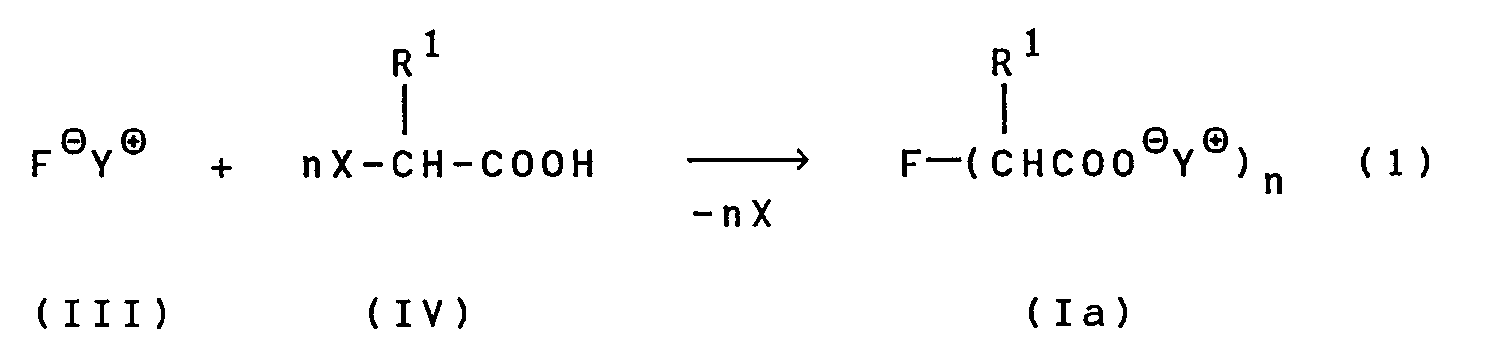
Dabei bedeuten
Y⊕ ein Alkalimetallkation, vorzugsweise Na⊕,
X Chlor oder Brom und
R¹ und n haben die bereits genannten Bedeutungen. - Die Reaktion wird normalerweise im wäßrigen Medium bei pH-Werten von 7 bis 14, vorzugsweise 9 bis 11, und Temperaturen von 30 bis 120°C, vorzugsweise 40 bis 100°C durchgeführt.
- Bei der Reaktion kann auch ein Gemisch verschiedener Farbstoffe der Formel III und/oder ein Gemisch verschiedener α-Halogencarbonsäuren der Formel IV und/oder ihrer Alkalisalze eingesetzt werden.
- Die Leucofarbstoffe der Formel III sind bekannt. Bei der Synthese des Leuco-Schwefelfarbstoffs C.I. Leuco Sulphur Black 1, C.I. No. 53185 wird 2,4-Dinitrophenol oder dessen Natriumsalz (das in situ durch alkalische Hydrolyse von 1-Chlor-2,4-dinitrobenzol hergestellt werden kann) z.B. mit Natriumpolysulfid in wäßriger Lösung bei 110 bis 120°C für 48 bis 72 Stunden unter Rückfluß erhitzt (vgl. z.B. Colour Index, Third Edition, Volume 4 (1971), S.4485, und die dort zitierte Literatur). Die Leucoschwefelfarbstoffe
C.I. Leuco Sulphur Black 2, C.I. No. 53195,
C.I. Leuco Sulphur Black 5, C.I. No. 53205,
C.I. Leuco Sulphur Black 10, C.I. No. 53190 und
C.I. Leuco Sulphur Black 12, C.I. No. 53200
werden ähnlich wie C.I. Leuco Sulphur Black 1 hergestellt. Dabei werden anstelle von 2,4-Dinitrophenol eingesetzt:
bei C.I. Leuco Sulphur Black 2: ein Gemisch von 2,4-Dinitrophenol mit Pikrinsäure oder Pikraminsäure;
bei C.I. Leuco Sulphur Black 5: Pikrinsäure oder Pikraminsäure;
bei C.I. Leuco Sulphur Black 10: ein Gemisch aus 2,4-Dinitrophenol und p-Aminophenol;
bei C.I. Leuco Sulphur Black 12: ein Gemisch aus 2,4-Dinitrophenol und p-(2,4-Dinitro-anilino)-phenol,
(vgl. z.B. Colour Index, loc.cit. Seiten 4485 und 4486 und die dort zitierte Literatur). - Bei der Herstellung von C.I. Leuco Sulphur Black 11, C.I. No. 53290, wird p-2-Naphthylaminophenol, neben geringen Mengen Phenol und 4,4'-Iminodiphenol, in einer Lösung von Natriumpolysulfid in Butanol 30 Stunden am Rückfluß bei 108°C erhitzt (vgl. z.B. Colour Index loc.cit., S.4490, und die dort zitierte Literatur, insbesondere Bios Final Report No. 983, S.59, 117-129). C.I. Leuco Sulphur Black 6, C.I. No. 53295, C.I. Leuco Sulphur Black 7, C.I. No. 53300, werden ähnlich hergestellt, wobei zusätzlich zu p-2-Napthylaminophenol bei C.I. Leuco Sulphur Black 6 noch kleine Mengen von p-Nitrophenol und 2,4-Diaminotoluol und bei C.I. Leuco Sulphur Black 7 noch kleine Mengen von p-(3-Carbazolylamino)-phenol und p-Nitrophenol eingesetzt werden (vgl. Colour Index loc.cit., S.4491 und 4490, und die dort zitierte Literatur.)
Die für die Herstellung der erfindungsgemäßen Schwefelfarbstoffe I als Ausgangsprodukte benötigten Leucoschwefelfarbstoffe der Formel III können aber auch aus den Schwefelfarbstoffen C.I. Sulphur Black 1, C.I. No. 53185, C.I. Sulphur Black 2, C.I. No. 53195, C.I. Sulphur Black 5, C.I. No. 53205, C.I. Sulphur Black 6, C.I. No. 53295, C.I. Sulphur Black 7, C.I. No. 53300, C.I. Sulphur Black 10, C.I. No. 53190, C.I. Sulphur Black 11, C.I. No. 52290, C.I. Sulphur Black 12, C.I. No. 53200, durch an sich bekannte Umsetzung mit Reduktionsmitteln, wie z.B. Na₂S und/oder NaHS, und/oder Natriumformaldehydsulfoxylat und/oder Natriumdithionit und/oder Glucose hergestellt werden. - C.I.Leuco Sulphur Black 1 kann auch aus C.I. Solubilized Sulphur Black 1, C.I. No. 53186, mit Reduktionsmitteln erhalten werden (vgl. beispielsweise Rev. Pure Appl. Chem. 12, 72 (1962).
- Wenn die als Ausgangsprodukt benötigten Leucoschwefelfarbstoffe der Formel III durch Reduktion der entsprechenden Schwefelfarbstoffe hergestellt werden, dann kann die Reaktion (1) auch gleichzeitig mit der Reduktion durchgeführt werden.
- Die Struktur der Leucoschwefelfarbstoffe der Formel III ist noch nicht im einzelnen bekannt. Vermutlich handelt es sich um ein Gemisch von verschiedenen Farbtoffen. Für das C.I. Leuco Sulphur Black 1 sind die Strukturen VI und VII (K.Venkataraman "The Chemistry of Synthetic Dyes", Vol.II, S.1090, (1952)) bzw. VIII (F.Gordon und P.Gregory "Organic Chemistry in Color", S.16, Springer Verlag (1983)) vorgeschlagen worden:

(R', R'' = OH, NH₂)
Das bei der Synthese der Leucoschwefelfarbstoffe anfallende Reaktionsgemisch kann, gegebenenfalls nach Verdünnung mit Wasser, direkt bei der Synthese der erfindungsgemäßen Farbstoffe nach (1) eingesetzt werden. - Als α-Halogencarbonsäuren der Formel IV werden bevorzugt verwendet: α-Chlor- oder α-Brom-essigsäure, α-Chlor- oder α-Brom-propionsäure und α-Chlor- oder α-Brom-buttersäure. Die α-Halogencarbonsäuren können auch in Form ihrer Alkalisalze, insbesondere ihrer Natriumsalze, eingesetzt werden.
- Da die einzusetzenden Leucoschwefelfarbstoffe der Formel III häufig direkt aus den organischen Ausgangsprodukten, wie 2,4-Dinitrophenol, hergestellt werden, ist es bequem, die bei der Reaktion (1) einzusetzende Menge an α-Halogencarbonsäure der Formel IV oder ihres Alkalisalzes auf das Ausgangsprodukt des Leucoschwefelfarbstoffs, wie z.B. 2,4-Dinitrochlorbenzol, zu beziehen. Bezogen auf 1 Mol dieses bei der Synthese des Leucoschwefelfarbstoffs der Formel III eingesetzten organischen Ausgangsprodukts (das auch ein Gemisch verschiedener organischer Verbindungen darstellen kann), bzw. bezogen auf 1 Gewichtsteil des Leucoschwefelfarbstoffs der Formel III, kann die eingesetzte Menge an α-Halogencarbonsäure oder ihres Alkalisalzes in weiten Grenzen von z.B. 0,4 bis 2 Mol α-Halogencarbonsäure oder ihres Alkalisalzes, vorzugsweise 0,5 bis 1,5 Mol, und ganz besonders bevorzugt 0,6 bis 1,3 Mol, variiert werden.
- Die erfindungsgemäßen Farbstoffe fallen bei der Synthese normalerweise als Alkalisalze, vorzugsweise als Natriumsalze der Formel Ia in wäßriger Lösung an, die noch herstellungsbedingte Salze, wie Chloride, Sulfate, Sulfite oder Thiosulfate, insbesondere Natriumchlorid, Natriumsulfat, Natriumsulfit oder Natriumthiosulfat, enthält.
- Zur Herstellung von Farbstoffen der Formel Ia in salzfreier Form können diese Salze durch Dialyse oder Membranfiltration entfernt und die salzfreien Farbstoffe aus den entsalzten wäßrigen Lösungen in üblicher Weise isoliert werden.
- Alternativ ist es auch möglich, die erfindungsgemäßen Farbstoffe aus den zunächst erhaltenen wäßrigen Lösungen der Alkalisalze der Formel Ia durch Einstellen von pH-Werten von 0 bis 5, vorzugsweise 2 bis 4, als schwerlösliche Farbstoffsäuren der Formel Ib

abzuscheiden und in an sich bekannter Weise, z.B. durch Filtration abzutrennen und zu isolieren. Die pH-Einstellung kann hierbei mit einer geeigneten Säure, z.B. mit einer Mineralsäure, wie Salzsäure, Schwefelsäure oder Phosphorsäure, vorgenommen werden. - Aufgrund der Schwerlöslichkeit der Farbstoffsäuren der Formel Ib können die oben genannten anorganischen Salze leicht entfernt und die Produkte Ib in salzfreier Form erhalten werden. Durch anschließende Umsetzung der Farbstoffsäuren der Formel Ib mit einem Alkalimetall-hydroxid und/oder -carbonat und/oder -bicarbonat und/oder einem Amin der Formel VIII

können die erfindungsgemäßen Farbstoffe der Formel I erhalten werden. Diese Umsetzung stellt eine Neutralisation dar und wird normalerweise in Wasser durchgeführt. - Als Alkalimetall-hydroxide, -carbonate oder -bicarbonate werden insbesondere die Hydroxide, Carbonate oder Bicarbonate des Lithiums, Natriums oder Kaliums verwendet. Zur Neutralisation können auch Gemische verschiedener Hydroxide, Carbonate, Bicarbonate und/oder Amine der Formel VIII verwendet werden. Dadurch können die in den erfindungsgemäßen Farbstoffen der Formel I enthaltenen Kationen M⊕ breit variiert werden.
- Als Amine der Formel VIII eignen sich beispielsweise:
Ammoniak, Methylamin, Ethylamin, Propylamin, Isopropylamin, n-Butylamin; Isobutylamin, sek.-Butylamin, tert.-Butylamin, Dimethylamin, Diethylamin, Dipropylamin, Diisopropylamin, Trimethylamin, Triethylamin, Ethanolamin, Diethanolamin, Triethanolamin, Allylamin, Dimethylaminoethylamin, Diethylaminopropylamin, (Dibutyl)(2-hydroxyethyl)amin, Ethylendiamin, 1,2-Diaminopropan, 1,3-Diaminopropan, 1-Amino-2-hydroxypropan, 1-Amino-2,3-dihydroxypropan, 1-Dimethylamino-2,3-dihydroxypropan, Diethylentriamin, Triethylentetramin, Pyridin, Pyrrolidin, N-Methylpyrrolidin, N-Hydroxyethylpyrrolidin, Piperidin, N-Hydroxyethylpiperidin, Morpholin, N-Hydroxyethylmorpholin. - Für den Fall, daß F in der Formel Ia den Farbstoffchromophor von C.I. Leuco Sulphur Black 6, 7 oder 11 bedeutet, werden bei der Reaktion (1) grünliche bzw. dunkelgrüne Lösungen der Verbindungen Ia erhalten, in denen der in der Leuco-Form vorliegende Farbstoffchromophor F durch Oxidation nach in an sich bekannter Weise in den schwarzen Farbstoffchromophor des C.I. Sulphur Blacks 6, 7 oder 11 überführt werden muß. Für diese Oxidation sind z.B. alle Oxidationsmittel geeignet, die aus der Schwefelfarbstoffherstellung oder der Schwefelfarbstoffärberei für die Überführung eines Schwefelfarbstoffs aus der Leucoform in die eigentliche Farbstofform bekannt sind, so z.B. Brom, Iod, Natriumchlorit, Natriumbromat in schwach saurer Lösung katalysiert durch Vanadat, vorzugsweise aber Wasserstoffperoxid in saurer oder vorzugsweise alkalisch wäßriger Phase. Eine derartige Überführung des Chromophors der Leucoform in die eigentliche Farbstofform ist für den Fall, daß in den Verbindungen Ia F der Farbstoffchromophor von C.I. Leuco Sulphur Black 1, 2, 5, 10 oder 12 darstellt, nicht erforderlich, kann aber gewünschtenfalls durchgeführt werden. Die bevorzugte Oxidation mit Wasserstoffperoxid in wäßriger Phase erfolgt zweckmäßigerweise bei Normaltemperatur oder nur leicht erhöhter Temperatur. Die im Falle der Farbstoffchromophore C.I. Leuco Sulphur Black 6, 7 und 11 durchzuführende und im Falle der anderen Farbstoffchromophore gewünschtenfalls durchzuführende Oxidation kann auch erst nach der Entsalzung durch Dialyse oder Membranfiltration oder nach der Fällung der Farbsäure Ib und deren anschließende Neutralisation zu dem Farbstoff I durchgeführt werden.
- Die erfindungsgemäßen schwarzen Farbstoffe der Formel I besitzen eine sehr gute Löslichkeit in Wasser und weisen eine hervorragende Lichtechtheit und Wasserechtheit auf.
- Sie sind daher insbesondere zum Färben und Bedrucken von Baumwolle, Polyamid, Papier, Leder und Holz nach den üblichen Verfahren gut geeignet und liefern schwarze Färbungen und Drucke.
- Die erfindungsgemäßen Farbstoffe der Formel I sind besonders für die Herstellung von Schreibtinten und Aufzeichnungsflüssigkeiten, insbesondere für das Tintenstrahl- oder Ink-Jet-Druckverfahren geeignet.
- Das Tintenstrahl- oder Ink-Jet-Druckverfahrens und die Anforderungen an die hierbei verwendeten Tinten und Aufzeichnungsflüssigkeiten sind z.B. beschrieben in:
Kirk-Othmer, Encyclopedia of Chemical Technology, 3rd Edt., Vol.20 (1982), 153-156, und in Ullmann's Encyclopedia of Industrial Chemistry, 5th Edt., Vol. A 13 (1989), 588-594. - Die mit den erfindungsgemäßen Farbstoffen der Formel I herstellbaren Tinten und Aufzeichnungsflüssigkeiten besitzen eine hervorragende Lagerstabilität auch in konzentrierter Form und ausgezeichnete Druckeigenschaften, insbesondere ein gutes Ansprech- und Ausstoßverhalten, gute Tröpfchenbildung und hervorragende Bildeigenschaften, insbesondere hinsichtlich Dichte, Farbton, Kontrast, Wasser-, Licht- und Wetterechtheit.
- Eine Tinte für das Tintenstrahldruckverfahren bzw. für das Ink-Jet-Druckverfahren besteht aus einer wäßrigen Lösung eines oder mehrerer Farbstoffe der allgemeinen Formel I. Die Tinte kann auch ein oder mehrere mit Wasser mischbare Lösungsmittel enthalten. Als derartige, mit Wasser mischbare Lösungsmittel kommen insbesondere (C₁-C₄)Alkanole, wie z.B. Methanol, Ethanol, Propanol, Isopropanol, Butanol, sec.Butanol; Amide, wie z.B. Dimethylformamid und Dimethylacetamid; Ketone oder Ketonalkohole, wie z.B. Aceton oder Diacetonalkohol; ferner Glykole und Glykolether, wie z.B. Ethylenglykol, Diethylenglykol, Triethylenglykol, Polyethylenglykol, in Betracht. Die Tinte kann auch noch einen oder mehrere andere Farbstoffe enthalten. Die Tinte kann auch noch einen oder mehrere Hilfsmittel, wie z.B. Biozide, Leitsalze oder Mittel zur Einstellung des elektrischen Widerstands, wie z.B. Lithiumchlorid, Natriumchlorid, Natriumsulfat, Ammoniumchlorid, Korrosionsinhibitoren, Verdicker oder Mittel zur Beeinflussung der Viskosität, wie z.B. Cellulosederivate, Polyvinylalkohol oder wasserlösliche Harze, oberflächenaktive Mittel, wie z.B. kationische, anionische oder nichtionische Tenside, so z.B. Diethanolamin oder Triethanolamin, Mittel zur Einstellung des pH-Werts, insbesondere Puffer, Feuchthaltemittel etc. enthalten.
- Die Menge der erfindungsgemäßen Farbstoffe der Formel I in der Tinte richtet sich nach der gewünschten optischen Dichte des Bildes. In der Regel enthält die Tinte 0,5 bis 20 Gew.%, vorzugsweise 0,5 bis 15 Gew.%, eines oder mehrerer wasserlöslicher Schwefelfarbstoffe der Formel I. Normalerweise enthält neben dem Farbstoff und den eventuell vorhandenen Hilfsmitteln die Tinte 10 bis 95 Gew.% Wasser und 0 bis 70 Gew.%, vorzugsweise 0,5 bis 70 Gew.% eines oder mehrerer mit Wasser mischbarer Lösungsmittel.
- Zur Herstellung der Tinten oder Aufzeichnungsflüssigkeiten kann ein erfindungsgemäßer Farbstoff der Formel I, insbesondere ein aus C.I. Leuco Sulphur Black 1 hergestellter erfindungsgemäßen Farbstoff, der vorzugsweise einen Gehalt von 7 bis 15 Gew.% -COO⊖-Gruppen aufweist, in Wasser gelöst und evtl. anschließend mit den anderen Komponenten, Lösungsmitteln, Hilfsmitteln etc. versetzt und dann filtriert werden. Auch die bei der Neutralisation der Farbsäuren Ib anfallenden wäßrigen Lösungen der erfindungsgemäßen Farbstoffe I können gegebenenfalls nach Zusatz weiterer Lösungs- und/oder Hilfsmittel und/oder Farbstoffe und Filtration direkt als Tinten oder Aufzeichnungsflüssigkeiten verwendet werden.
- 769,4 g einer 25%igen, aus 202,6 g 2,4-Dinitrochlorbenzol in bekannter Weise hergestellten Lösung von C.I. Leuco Sulphur Black 1 (vergl. z.B. Fierz-David, Blangey: Grundlegende Operationen der Farbenchemie, 8. Auflage (1952), 329-330) werden mit 500 ml Wasser und bei 60°C mit einer Lösung von 145,6 g Natrium-Monochloracetat in 700 ml Wasser versetzt. Man rührt 2 Stunden bei 60°C nach und gibt zur Fällung der Farbsäure 159,0 g 32%ige wäßrige Salzsäure bis zu einem pH-Wert von 2 zu. Die ausgefallene Farbsäure wird durch Filtration isoliert und mit 3 l Wasser salzfrei gewaschen. Das Produkt wird in 1750 ml entsalztem Wasser angerührt und mit 68 ml 10 N Natronlauge auf pH 8 gestellt. Die erhaltene salzfreie Farbstofflösung wird bei 100°C bis zur Gewichtskonstanz getrocknet.
Ausbeute: 242,6 g schwarzes Pulver, leicht löslich in Wasser.
Absorptionspektrum in Wasser: λmax: 610 nm.
COO⊖-Gehalt: 10,5 Gew.% - Verfährt man nach den Angaben des Beispiels 1, setzt jedoch statt einer Lösung von 145,6 g Natrium-Monochloracetat in 700 ml Wasser eine Lösung von 87,4 g Natrium-Monochloracetat in 400 ml Wasser ein, so erhält man 227,3 g eines schwarzen Pulvers, das ebenfalls in Wasser leicht löslich ist.
Absorptionspektrum in Wasser: λmax: 615 nm.
COO⊖-Gehalt: 8,3 Gew.% - Das in Beispiel 1 beschriebene Verfahren wird mit einer Lösung von 174,8 g Natrium-Monochloracetat in 800 ml Wasser (statt 145,6 g Natrium-Monochloracetat in 700 ml Wasser) durchgeführt.
Ausbeute: 252,6 g schwarzes Pulver, leicht löslich in Wasser.
Absorptionspektrum in Wasser: λmax: 615 nm.
COO⊖-Gehalt: 13,7 Gew.% - Das in Beispiel 1 wiedergegebene Verfahren wird wiederholt, wobei anstelle einer Lösung von 145,6 g Natrium-Monochloracetat in 700 ml Wasser eine Lösung von 163,1 g Natrium-α-chlorpropionat in 800 ml Wasser eingesetzt wird.
- Man erhält 263,1 g eines schwarzen Pulvers, leicht lösdich in Wasser.
Absorptionspektrum in Wasser: λmax: 605 nm.
COO⊖-Gehalt: 9,9 Gew.%
In der folgenden Tabelle sind weitere erfindungsgemäße Farbstoffe der allgemeinen Formel I wiedergegeben, die nach den Angaben des Beispiels 1 hergestellt werden können, wobei in Spalte 2 das zur Neutralisation der Farbsäure verwendete Alkalihydroxid oder Amin der Formel VIII aufgeführt ist.Beispiel Alkalihydroxid oder Amin der Formel VIII 5 Lithiumhydroxid 6 Kaliumhydroxid 7 Ammoniak 8 Ammoniak/Natriumhydroxid (1:1) 9 Ethanolamin 10 Diethanolamin 11 Triethanolamin 12 Methylamin 13 Dimethylethanolamin 14 Dimethylaminethoxyethanol [(CH₃)₂NCH₂CH₂OCH₂CH₂OH] 15 Isopropylamin 16 Butylamin 17 Dibutylethanolamin 18 1-Dimethylamino-2,3-dihydroxypropan [(CH₃)₂NCH₂CHOHCH₂OH] 19 Pyridin 20 Pyrrolidin 21 N-Hydroxyethylpyrrolidin 22 Piperidin 23 N-Hydroxyethylpiperidin 24 Morpholin 25 N-Hydroxyethylmorpholin 26 Triethylentetramin - Aufzeichnungsflüssigkeiten für das Ink-Jet-Verfahren lassen sich nach dem folgenden Rezept herstellen:
Farbstoff der Formel I: 5 - 15 Gew.% n-Propanol: 5 - 10 Gew.% Diethylenglykol: 10 - 10 Gew.% Wasser: ad 100 Gew.% - Der Farbstoff wird in Wasser gelöst, zu der Lösung das n-Propanol und Diethylengkyol zugemischt, mit Wasser auf 100 Gew.% aufgefüllt und filtriert.
- Man verfährt nach den Angaben des Beispiels 1 und versetzt die durch Neutralisation der anfallenden Farbsäure mit 68 ml 10 N Natronlauge in 1750 ml entsalztem Wasser erhaltene Farbstofflösung mit 43,0 g Wasserstoffperoxid 35%ig. Man rührt noch 6 Stunden bei 25 bis 30°C nach, wobei eine Viskositätszunahme und ein Absinken des pH-Wrts von 8 auf 6,4 festzustellen ist.
- Die Farbstofflösung wird anschließend bei 80°C im Vakuum bis zur Gewichtskonstanz getrocknet.
Ausbeute: 225,1 g schwarzes Pulver
Absorptionspektrum in Wasser: λmax: 590 nm.
COO⊖-Gehalt: 10,6 Gew.%. - 104 g C.I. Sulphur Black 11 (Herstellung s. Colour Index, Vol.4, 3. Edition (1971); Bios Final Report No. 983, S. 59, 117-129) werden in 1 l Wasser suspendiert und mit 144 ml 10 N Natronlauge und 62,4 g Schwefelnatrium 60%ig versetzt. Das Reaktionsgemisch wird dann 2 Stunden bei 95 bis 100°C gerührt. Anschließend setzt man eine Lösung von 120,8 g Natrium-monochloracetat in 250 ml Wasser zu und rührt 2 Stunden bei 60°C nach. Die Fällung der Farbsäure erfolgt durch Zugabe von 212 g einer 30%igen Salzsäure bis pH 3. Die ausgefallene Farbsäure wird abfiltriert und mit 2 l Wasser salzfrei gewaschen. Der erhaltene Preßkuchen wird in 800 ml Wasser eingetragen und mit 16 ml 10 N Natronlauge auf pH 7,5 gestellt. Darauf wird die dunkelgrüne Lösung mit 20 g Wasserstoffperoxid 35%ig versetzt, 2 Stunden nachgerührt und die resultierende schwarze Farbstofflösung bei 80°C im Vakuum getrocknet.
Ausbeute: 96,8 g schwarzes Pulver
Absorptionspektrum in Wasser: λmax: 570 nm.
COO⊖-Gehalt: 7,4 Gew.%.
Claims (8)
- Wasserlösliche schwarze Schwefelfarbstoffe der Formel I

F den Farbstoffchromophor von C.I. Sulphur oder Leuco Sulphur Black 1, C.I. No.53185; C.I. Sulphur oder Leuco Sulphur Black 2, C.I. No.53195; C.I. Sulphur oder Leuco Sulphur Black 5, C.I. No. 53205; C.I. Sulphur Black 6, C.I. No. 53295; C.I. Sulphur Black 7, C.I. No. 53300; C.I. Sulphur oder Leuco Sulphur Black 10, C.I. No. 53190; C.I. Sulphur Black 11, C.I. No. 53290, oder C.I. Sulphur oder Leuco Sulphur Black 12, C.I. No.53200,
R¹ Wasserstoff oder (C₁-C₄)Alkyl,
M⊕ ein Alkalimetallkation und/oder ein Ammoniumkation der Formel II
2 oder 3 der Reste R², R³, R⁴ zusammen mit dem Stickstoffatom, an das sie gebunden sind, einen heterocyclischen Ring bilden, der auch noch weitere Heteroatome oder Heteroatomgruppierungen enthalten kann,
R⁵ Wasserstoff oder (C₁-C₄)Alkyl,
p eine Zahl von 1 bis 10,
m eine Zahl von 1 bis 10 und
n eine so große Zahl bedeutet, daß der Farbstoff I 5 bis 20 Gew.% COO⊖-Gruppen enthält. - Wasserlösliche Schwefelfarbstoffe nach Anspruch 1, dadurch gekennzeichnet, daß sie sich von dem Farbstoffchromophor von C.I. Leuco Sulphur Black 1 ableiten.
- Wasserlösliche Schwefelfarbstoffe nach den Ansprüchen 1 und 2, dadurch gekennzeichnet, daß im Farbstoffmolekül 7 bis 15 Gew.% Carboxylgruppen vorliegen.
- Verfahren zur Herstellung der Schwefelfarbstoffe eines oder mehrerer der Ansprüche 1 bis 3, dadurch gekennzeichnet, daß ein Schwefelfarbstoff der Formel III
F⊖Y⊕ (III)
worin
F⊖ den Farbstoffchromophor von C.I. Leuco Sulphur Black 1, 2, 5, 6, 7, 10, 11 oder 12 und
Y⊕ ein Alkalikation
bedeuten, mit einer α-Halogencarbonsäure der Formel IV
X Chlor oder Brom und
R¹ Wasserstoff oder (C₁-C₄)Alkyl,
bedeuten oder einem ihrer Alkalisalze umgesetzt wird und daß gewünschtenfalls der dabei entstandene Farbstoff der Formel Ia


R², R³ und R⁴ die in Anspruch 1 angegebenen Bedeutungen besitzen, zu einem Farbstoff der Formel I umgesetzt wird, wobei für den Fall, daß F in der Formel Ia den Farbstoffchromophor von C.I. Leuco Sulphur Black 6, 7 oder 11 bedeutet, der Farbstoff Ia oder der nach der Fällung der Farbsäure Ib und anschließende Umsetzung mit einem Alkalimetallhydroxid, Alkalimetallcarbonat, Alkalimetallbicarbonat und/oder einem Amin der Formel VIII anfallende Farbstoff I oxidiert wird oder daß für den Fall, daß F in der Formel Ia den Farbstoffchromophor von C.I. Leuco Sulphur Black 1, 2, 5, 10 oder 12 bedeutet, der Farbstoff Ia oder der Farbstoff I gewünschenfalls oxidiert wird. - Verfahren nach Anspruch 4, dadurch gekennzeichnet, daß der Farbstoff C.I. Leuco Sulphur Black 1, C.I. No. 53185, eingesetzt wird.
- Verwendung der wasserlöslichen Schwefelfarbstoffe der Formel I eines oder mehrerer der Ansprüche 1 bis 3 zum Färben und Bedrucken von Baumwolle, Polyamid, Papier, Holz oder Leder sowie zur Herstellung von Schreibtinten und Aufzeichnungsflüssigkeiten, insbesondere für das Ink-Jet-Verfahren.
- Aufzeichnungsflüssigkeit, insbesondere für das Tintenstrahl oder Ink-Jet-Druckverfahren, enthaltend in einer wäßrigen Lösung einen Farbstoff I eines oder mehrerer Ansprüche 1 bis 3.
- Aufzeichnungsflüssigkeit nach Anspruch 7, dadurch gekennzeichnet, daß sie 0,5 bis 20 Gew.%, vorzugsweise 0,5 bis 15 Gew.%, eines Farbstoffs der Formel I enthält.
Applications Claiming Priority (2)
| Application Number | Priority Date | Filing Date | Title |
|---|---|---|---|
| DE4234222A DE4234222A1 (de) | 1992-10-10 | 1992-10-10 | Wasserlösliche Schwefelfarbstoffe, ihre Herstellung und Verwendung |
| DE4234222 | 1992-10-10 |
Publications (2)
| Publication Number | Publication Date |
|---|---|
| EP0592838A1 true EP0592838A1 (de) | 1994-04-20 |
| EP0592838B1 EP0592838B1 (de) | 1997-09-17 |
Family
ID=6470172
Family Applications (1)
| Application Number | Title | Priority Date | Filing Date |
|---|---|---|---|
| EP93114982A Expired - Lifetime EP0592838B1 (de) | 1992-10-10 | 1993-09-17 | Wasserlösliche Schwefelfarbstoffe, ihre Herstellung und Verwendung |
Country Status (6)
| Country | Link |
|---|---|
| US (1) | US5383961A (de) |
| EP (1) | EP0592838B1 (de) |
| JP (1) | JPH06220344A (de) |
| AT (1) | ATE158332T1 (de) |
| DE (2) | DE4234222A1 (de) |
| ES (1) | ES2110553T3 (de) |
Families Citing this family (36)
| Publication number | Priority date | Publication date | Assignee | Title |
|---|---|---|---|---|
| US5700850A (en) | 1993-08-05 | 1997-12-23 | Kimberly-Clark Worldwide | Colorant compositions and colorant stabilizers |
| US5733693A (en) | 1993-08-05 | 1998-03-31 | Kimberly-Clark Worldwide, Inc. | Method for improving the readability of data processing forms |
| US6017471A (en) | 1993-08-05 | 2000-01-25 | Kimberly-Clark Worldwide, Inc. | Colorants and colorant modifiers |
| US6017661A (en) | 1994-11-09 | 2000-01-25 | Kimberly-Clark Corporation | Temporary marking using photoerasable colorants |
| US5645964A (en) | 1993-08-05 | 1997-07-08 | Kimberly-Clark Corporation | Digital information recording media and method of using same |
| US5721287A (en) | 1993-08-05 | 1998-02-24 | Kimberly-Clark Worldwide, Inc. | Method of mutating a colorant by irradiation |
| US5681380A (en) | 1995-06-05 | 1997-10-28 | Kimberly-Clark Worldwide, Inc. | Ink for ink jet printers |
| US5865471A (en) | 1993-08-05 | 1999-02-02 | Kimberly-Clark Worldwide, Inc. | Photo-erasable data processing forms |
| US5773182A (en) | 1993-08-05 | 1998-06-30 | Kimberly-Clark Worldwide, Inc. | Method of light stabilizing a colorant |
| US6211383B1 (en) | 1993-08-05 | 2001-04-03 | Kimberly-Clark Worldwide, Inc. | Nohr-McDonald elimination reaction |
| US6071979A (en) | 1994-06-30 | 2000-06-06 | Kimberly-Clark Worldwide, Inc. | Photoreactor composition method of generating a reactive species and applications therefor |
| US5685754A (en) | 1994-06-30 | 1997-11-11 | Kimberly-Clark Corporation | Method of generating a reactive species and polymer coating applications therefor |
| US6242057B1 (en) | 1994-06-30 | 2001-06-05 | Kimberly-Clark Worldwide, Inc. | Photoreactor composition and applications therefor |
| US6008268A (en) | 1994-10-21 | 1999-12-28 | Kimberly-Clark Worldwide, Inc. | Photoreactor composition, method of generating a reactive species, and applications therefor |
| BR9608367A (pt) | 1995-06-05 | 1998-08-18 | Kimberly Clark Co | Pré-corantes novos |
| US5786132A (en) | 1995-06-05 | 1998-07-28 | Kimberly-Clark Corporation | Pre-dyes, mutable dye compositions, and methods of developing a color |
| JP2000506550A (ja) | 1995-06-28 | 2000-05-30 | キンバリー クラーク ワールドワイド インコーポレイテッド | 新規な着色剤および着色剤用改質剤 |
| US6099628A (en) | 1996-03-29 | 2000-08-08 | Kimberly-Clark Worldwide, Inc. | Colorant stabilizers |
| ES2175168T3 (es) | 1995-11-28 | 2002-11-16 | Kimberly Clark Co | Compuestos de colorantes estabilizados por la luz. |
| US5855655A (en) | 1996-03-29 | 1999-01-05 | Kimberly-Clark Worldwide, Inc. | Colorant stabilizers |
| US5782963A (en) | 1996-03-29 | 1998-07-21 | Kimberly-Clark Worldwide, Inc. | Colorant stabilizers |
| US5891229A (en) | 1996-03-29 | 1999-04-06 | Kimberly-Clark Worldwide, Inc. | Colorant stabilizers |
| US6524379B2 (en) | 1997-08-15 | 2003-02-25 | Kimberly-Clark Worldwide, Inc. | Colorants, colorant stabilizers, ink compositions, and improved methods of making the same |
| SK1542000A3 (en) | 1998-06-03 | 2001-11-06 | Kimberly Clark Co | Neonanoplasts produced by microemulsion technology and inks for ink jet printing |
| SK1552000A3 (en) | 1998-06-03 | 2000-08-14 | Kimberly Clark Co | Novel photoinitiators and applications therefor |
| JP2002520470A (ja) | 1998-07-20 | 2002-07-09 | キンバリー クラーク ワールドワイド インコーポレイテッド | 改良されたインクジェットインク組成物 |
| BR9914123B1 (pt) | 1998-09-28 | 2010-11-30 | fotoiniciadores e aplicações para os mesmos. | |
| EP1144512B1 (de) | 1999-01-19 | 2003-04-23 | Kimberly-Clark Worldwide, Inc. | Farbstoffe, farbstoffstabilisatoren, tintenzusammensetzungen und verfahren zu deren herstellung |
| US6331056B1 (en) | 1999-02-25 | 2001-12-18 | Kimberly-Clark Worldwide, Inc. | Printing apparatus and applications therefor |
| US6294698B1 (en) | 1999-04-16 | 2001-09-25 | Kimberly-Clark Worldwide, Inc. | Photoinitiators and applications therefor |
| US6368395B1 (en) | 1999-05-24 | 2002-04-09 | Kimberly-Clark Worldwide, Inc. | Subphthalocyanine colorants, ink compositions, and method of making the same |
| AU2001269905A1 (en) | 2000-06-19 | 2002-01-08 | Kimberly-Clark Worldwide, Inc. | Novel photoinitiators and applications therefor |
| US6538056B1 (en) | 2000-10-10 | 2003-03-25 | Clariant International Ltd. | Polyolefin articles with long-term elevated temperature stability |
| CN103013177B (zh) * | 2012-12-26 | 2014-06-25 | 山东新家园精细化学品有限公司 | 活性硫化黑染料及其制备方法 |
| CN103627209A (zh) * | 2013-10-22 | 2014-03-12 | 大连市旅顺口区江西化工工业总公司 | 一种多羧基水溶性硫化黑的制备方法 |
| CN116622252B (zh) * | 2023-05-25 | 2024-10-15 | 大连理工大学 | 一种含有两种不同反应基团的水溶性硫化染料及其制备方法 |
Citations (2)
| Publication number | Priority date | Publication date | Assignee | Title |
|---|---|---|---|---|
| EP0063208A1 (de) * | 1981-04-17 | 1982-10-27 | International Business Machines Corporation | Vollständig oxidiertes Schwefelschwarz 1 für wässerige Drucktinte |
| EP0274216A1 (de) * | 1986-12-02 | 1988-07-13 | Canon Kabushiki Kaisha | Tinte und Tintenstrahldruckverfahren unter Verwendung derselben |
-
1992
- 1992-10-10 DE DE4234222A patent/DE4234222A1/de not_active Withdrawn
-
1993
- 1993-09-17 ES ES93114982T patent/ES2110553T3/es not_active Expired - Lifetime
- 1993-09-17 EP EP93114982A patent/EP0592838B1/de not_active Expired - Lifetime
- 1993-09-17 AT AT93114982T patent/ATE158332T1/de not_active IP Right Cessation
- 1993-09-17 DE DE59307385T patent/DE59307385D1/de not_active Expired - Fee Related
- 1993-09-30 US US08/128,641 patent/US5383961A/en not_active Expired - Lifetime
- 1993-10-06 JP JP5250727A patent/JPH06220344A/ja not_active Ceased
Patent Citations (2)
| Publication number | Priority date | Publication date | Assignee | Title |
|---|---|---|---|---|
| EP0063208A1 (de) * | 1981-04-17 | 1982-10-27 | International Business Machines Corporation | Vollständig oxidiertes Schwefelschwarz 1 für wässerige Drucktinte |
| EP0274216A1 (de) * | 1986-12-02 | 1988-07-13 | Canon Kabushiki Kaisha | Tinte und Tintenstrahldruckverfahren unter Verwendung derselben |
Also Published As
| Publication number | Publication date |
|---|---|
| EP0592838B1 (de) | 1997-09-17 |
| DE4234222A1 (de) | 1994-04-14 |
| ES2110553T3 (es) | 1998-02-16 |
| ATE158332T1 (de) | 1997-10-15 |
| JPH06220344A (ja) | 1994-08-09 |
| DE59307385D1 (de) | 1997-10-23 |
| US5383961A (en) | 1995-01-24 |
Similar Documents
| Publication | Publication Date | Title |
|---|---|---|
| EP0592838B1 (de) | Wasserlösliche Schwefelfarbstoffe, ihre Herstellung und Verwendung | |
| DE3512836C2 (de) | ||
| DE3606219C2 (de) | ||
| DE2616856C2 (de) | Organische Verbindungen, deren Herstellung und Verwendung | |
| DE69520387T2 (de) | Verwendung eines Monoazofarbstoffs mit einer Kupplungskomponente aus der Aminonaphtholsulfonsäure-Reihe als Farbstoff in einer Aufzeichnungsflüssigkeit sowie diesen enthaltende Aufzeichnungsflüssigkeit | |
| DE69801818T2 (de) | Metallkomplex-Disazofarbstoffe, ihre Herstellung und Verwendung | |
| DE69229917T2 (de) | Aufzeichnungsfluid | |
| EP0585659A1 (de) | Verwendung von flüssigen Farbstoffpräparationen, enthaltend einen Disazofarbstoff, im Ink-Jet-Verfahren sowie dieser Disazofarbstoff | |
| EP0827985B1 (de) | Wasserlösliche Kupferphthalocyanin-Farbstoffe, ihre Herstellung und Verwendung | |
| EP0158888B1 (de) | Disazoverbindungen, Verfahren zu ihrer Herstellung und ihre Verwendung | |
| DE69215214T2 (de) | Anionische disazofarbstoffe | |
| EP0014407B1 (de) | Farbstofflösungen sowie deren Herstellung und Verwendung zum Färben von Papier | |
| DE3017070A1 (de) | Verfahren zur herstellung salzarmer wasserloeslicher farbstoffe | |
| DE913174C (de) | Verfahren zur Herstellung von neuen, zwei 1,2,3,-Triazolringe enthaltenden aromatischen Verbindungen | |
| DE60308404T2 (de) | Farben für tintenstrahldrucker auf basis eines tris-azo farbstoffes | |
| DE19831095A1 (de) | Wasserlösliche schwarze Stilbenfarbstoffe, ihre Herstellung und Verwendung | |
| EP0174586A2 (de) | Kupferphthalocyaninfarbstoffe, ihre Herstellung, ihre wässrigen Lösungen und ihre Verwendung zum Färben von Papier | |
| EP0692523B1 (de) | Azofarbstoffe, deren Herstellung und Verwendung | |
| EP0712903B1 (de) | Wasserlösliche Polyazofarbstoffe | |
| EP0593923B1 (de) | Wasserunlösliche Schwefelfarbstoffe, ihre Herstellung und Verwendung | |
| EP0311949B1 (de) | Wasserlösliche gelbe Monoazofarbstoffe | |
| DE2403736A1 (de) | Sulfonsaeuregruppenfreie basische azoverbindungen, ihre herstellung und verwendung | |
| DE69410606T2 (de) | Monoazo reaktivfarbstoffe | |
| EP0262095B1 (de) | Anionische Disazoverbindungen | |
| EP0597292B1 (de) | Wasserunlösliche Schwefelfarbstoffe, ihre Herstellung und Verwendung |
Legal Events
| Date | Code | Title | Description |
|---|---|---|---|
| PUAI | Public reference made under article 153(3) epc to a published international application that has entered the european phase |
Free format text: ORIGINAL CODE: 0009012 |
|
| AK | Designated contracting states |
Kind code of ref document: A1 Designated state(s): AT CH DE ES FR GB IT LI |
|
| 17P | Request for examination filed |
Effective date: 19940319 |
|
| RAP1 | Party data changed (applicant data changed or rights of an application transferred) |
Owner name: HOECHST AKTIENGESELLSCHAFT |
|
| 17Q | First examination report despatched |
Effective date: 19960215 |
|
| GRAG | Despatch of communication of intention to grant |
Free format text: ORIGINAL CODE: EPIDOS AGRA |
|
| GRAH | Despatch of communication of intention to grant a patent |
Free format text: ORIGINAL CODE: EPIDOS IGRA |
|
| GRAH | Despatch of communication of intention to grant a patent |
Free format text: ORIGINAL CODE: EPIDOS IGRA |
|
| GRAA | (expected) grant |
Free format text: ORIGINAL CODE: 0009210 |
|
| AK | Designated contracting states |
Kind code of ref document: B1 Designated state(s): AT CH DE ES FR GB IT LI |
|
| REF | Corresponds to: |
Ref document number: 158332 Country of ref document: AT Date of ref document: 19971015 Kind code of ref document: T |
|
| REG | Reference to a national code |
Ref country code: CH Ref legal event code: EP |
|
| REF | Corresponds to: |
Ref document number: 59307385 Country of ref document: DE Date of ref document: 19971023 |
|
| RAP2 | Party data changed (patent owner data changed or rights of a patent transferred) |
Owner name: CLARIANT GMBH |
|
| ITF | It: translation for a ep patent filed | ||
| GBT | Gb: translation of ep patent filed (gb section 77(6)(a)/1977) |
Effective date: 19971119 |
|
| ET | Fr: translation filed | ||
| REG | Reference to a national code |
Ref country code: ES Ref legal event code: FG2A Ref document number: 2110553 Country of ref document: ES Kind code of ref document: T3 |
|
| PLBE | No opposition filed within time limit |
Free format text: ORIGINAL CODE: 0009261 |
|
| 26N | No opposition filed | ||
| PGFP | Annual fee paid to national office [announced via postgrant information from national office to epo] |
Ref country code: AT Payment date: 19990723 Year of fee payment: 7 |
|
| PGFP | Annual fee paid to national office [announced via postgrant information from national office to epo] |
Ref country code: CH Payment date: 19990728 Year of fee payment: 7 |
|
| PGFP | Annual fee paid to national office [announced via postgrant information from national office to epo] |
Ref country code: ES Payment date: 19990923 Year of fee payment: 7 |
|
| PGFP | Annual fee paid to national office [announced via postgrant information from national office to epo] |
Ref country code: FR Payment date: 20000720 Year of fee payment: 8 |
|
| PGFP | Annual fee paid to national office [announced via postgrant information from national office to epo] |
Ref country code: GB Payment date: 20000721 Year of fee payment: 8 |
|
| PG25 | Lapsed in a contracting state [announced via postgrant information from national office to epo] |
Ref country code: AT Free format text: LAPSE BECAUSE OF NON-PAYMENT OF DUE FEES Effective date: 20000917 |
|
| PG25 | Lapsed in a contracting state [announced via postgrant information from national office to epo] |
Ref country code: ES Free format text: LAPSE BECAUSE OF NON-PAYMENT OF DUE FEES Effective date: 20000918 |
|
| PG25 | Lapsed in a contracting state [announced via postgrant information from national office to epo] |
Ref country code: LI Free format text: LAPSE BECAUSE OF NON-PAYMENT OF DUE FEES Effective date: 20000930 Ref country code: CH Free format text: LAPSE BECAUSE OF NON-PAYMENT OF DUE FEES Effective date: 20000930 |
|
| REG | Reference to a national code |
Ref country code: CH Ref legal event code: PL |
|
| PG25 | Lapsed in a contracting state [announced via postgrant information from national office to epo] |
Ref country code: GB Free format text: LAPSE BECAUSE OF NON-PAYMENT OF DUE FEES Effective date: 20010917 |
|
| REG | Reference to a national code |
Ref country code: GB Ref legal event code: IF02 |
|
| GBPC | Gb: european patent ceased through non-payment of renewal fee |
Effective date: 20010917 |
|
| PG25 | Lapsed in a contracting state [announced via postgrant information from national office to epo] |
Ref country code: FR Free format text: LAPSE BECAUSE OF NON-PAYMENT OF DUE FEES Effective date: 20020531 |
|
| REG | Reference to a national code |
Ref country code: FR Ref legal event code: ST |
|
| REG | Reference to a national code |
Ref country code: ES Ref legal event code: FD2A Effective date: 20011011 |
|
| PG25 | Lapsed in a contracting state [announced via postgrant information from national office to epo] |
Ref country code: IT Free format text: LAPSE BECAUSE OF NON-PAYMENT OF DUE FEES;WARNING: LAPSES OF ITALIAN PATENTS WITH EFFECTIVE DATE BEFORE 2007 MAY HAVE OCCURRED AT ANY TIME BEFORE 2007. THE CORRECT EFFECTIVE DATE MAY BE DIFFERENT FROM THE ONE RECORDED. Effective date: 20050917 |
|
| PGFP | Annual fee paid to national office [announced via postgrant information from national office to epo] |
Ref country code: DE Payment date: 20060816 Year of fee payment: 14 |
|
| PG25 | Lapsed in a contracting state [announced via postgrant information from national office to epo] |
Ref country code: DE Free format text: LAPSE BECAUSE OF NON-PAYMENT OF DUE FEES Effective date: 20080401 |