EP0593080A1 - Bedrückte und laminierte Verbindung - Google Patents
Bedrückte und laminierte Verbindung Download PDFInfo
- Publication number
- EP0593080A1 EP0593080A1 EP93116724A EP93116724A EP0593080A1 EP 0593080 A1 EP0593080 A1 EP 0593080A1 EP 93116724 A EP93116724 A EP 93116724A EP 93116724 A EP93116724 A EP 93116724A EP 0593080 A1 EP0593080 A1 EP 0593080A1
- Authority
- EP
- European Patent Office
- Prior art keywords
- film
- lamination
- adhesive layer
- product according
- Prior art date
- Legal status (The legal status is an assumption and is not a legal conclusion. Google has not performed a legal analysis and makes no representation as to the accuracy of the status listed.)
- Granted
Links
Images




Classifications
-
- B—PERFORMING OPERATIONS; TRANSPORTING
- B29—WORKING OF PLASTICS; WORKING OF SUBSTANCES IN A PLASTIC STATE IN GENERAL
- B29C—SHAPING OR JOINING OF PLASTICS; SHAPING OF MATERIAL IN A PLASTIC STATE, NOT OTHERWISE PROVIDED FOR; AFTER-TREATMENT OF THE SHAPED PRODUCTS, e.g. REPAIRING
- B29C59/00—Surface shaping of articles, e.g. embossing; Apparatus therefor
- B29C59/02—Surface shaping of articles, e.g. embossing; Apparatus therefor by mechanical means, e.g. pressing
- B29C59/022—Surface shaping of articles, e.g. embossing; Apparatus therefor by mechanical means, e.g. pressing characterised by the disposition or the configuration, e.g. dimensions, of the embossments or the shaping tools therefor
-
- B—PERFORMING OPERATIONS; TRANSPORTING
- B41—PRINTING; LINING MACHINES; TYPEWRITERS; STAMPS
- B41M—PRINTING, DUPLICATING, MARKING, OR COPYING PROCESSES; COLOUR PRINTING
- B41M7/00—After-treatment of prints, e.g. heating, irradiating, setting of the ink, protection of the printed stock
- B41M7/0027—After-treatment of prints, e.g. heating, irradiating, setting of the ink, protection of the printed stock using protective coatings or layers by lamination or by fusion of the coatings or layers
Definitions
- the present invention relates to a print-laminated product in which a laminate film for the protection of print is laminated to a bonding surface such as printed paper. More particularly, the present invention relates to a print-laminated product which can be obtained using a laminate film for print lamination that can be laminated simply by the application of heat and pressure and without the aid of any adhesive or organic solvent.
- the laminate film for print lamination according to the present invention provides a print-laminated product with excellent transparency, antiblocking characteristics, processability, collapse, gloss, adhesiveness to bonding surfaces such as printed matter and appearance.
- This print-laminated product of the invention is useful for, e.g., book covers, catalogue covers, and packaging materials for forming boxes for toys, cameras, etc. having a cavity with window frame.
- a film has conventionally been laminated on the printed paper. This technique is generally referred to as "a print lamination method" in the technical art concerned.
- the film for the heat-pressure bond type of lamination of method (2) there are also some disadvantages to the requirement of easy-adhesiveness to the printed side of the printed paper, that the film is inferior in its slipperiness and antiblocking characteristics since an ethylene-based copolymer resin such as ethylene-vinylacetate copolymer, ethylene-ethylacrylate copolymer having an extremely high functional monomer (vinylacetate, ethylacrylate) content is used as the heat-adhesive layer in the laminate film. Consequently, the film with bad roll-releasability is destined to have a wrinkle during production of the film.
- an ethylene-based copolymer resin such as ethylene-vinylacetate copolymer, ethylene-ethylacrylate copolymer having an extremely high functional monomer (vinylacetate, ethylacrylate) content
- the present invention has been accomplished for the purpose of improving the above problems. That is, one object of the present invention is to provide:
- a film for print lamination comprising a sheet substrate (a) and an adhesive layer (b) laminated on said substrate (a), wherein said substrate (a) comprises a transparent thermoplastic resin 6 ⁇ m or more thick and the adhesive layer (b) comprises an 8 ⁇ m or more thick ethylene-based copolymer resin film containing 70 % by weight or more of ethylene and has a lower melt temperature than said substrate (a), and wherein the surface of the adhesive layer (b) is embossed with jag patterns in which a 10 points-mean roughness (Rz) of the embossing is from 4.0 to 8.5 ⁇ m, a surface ratio of a convex section at a neutral line surface roughness (Sr) lower than 55 % and a surface smoothness of 500 sec. or lower.
- Rz points-mean roughness
- the present invention also provide a print-laminated product which is produced by bonding by heat-pressing an adhesive layer (b) of said film for print lamination described above onto a bonding surface.
- Fig. 1 is a schematic illustration in cross section of a laminate film for print lamination of the present invention.
- Fig. 1 is a laminate film for print lamination
- 2 is a substrate (a) comprising a thermoplastic resin
- 3 is an adhesive layer (b) for heat-pressure bonding comprising an ethylene-based copolymer resin film
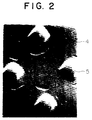
- 4 is a concave face (a valley) of the heliocrasho type of embossed pattern applied to the heat-adhesive layer
- 5 is a convex (a crest) of the embossed pattern.
- Fig. 2 is an electron microscope photograph ( ⁇ 500) of the surface of an adhesive layer of a laminate film for print lamination prepared in Example 1.
- Fig. 3 is an electron microscope photograph ( ⁇ 500) of the surface of an adhesive layer of a laminate film prepared in Example 6.
- 6 is a fine embossed pattern formed on the concave face 5 of the embossed pattern.
- Fig. 4 is a trace given by a roughness meter, which shows the surface roughness of the surface of the laminate film prepared in Example 1.
- Fig. 5 is a trace given by a roughness meter, which shows the surface roughness of the surface of the laminate film prepared in Example 2.
- Fig. 6 is a trace given by a roughness meter, which shows the surface roughness of the surface of the laminate film prepared in Example 6.
- Fig. 7 is an electron microscope photograph ( ⁇ 500) of the surface of the laminate film prepared in Comparative Example 2.
- Fig. 8 is an electron microscope photograph ( ⁇ 500) of the surface of the laminate film prepared in Comparative Example 3.
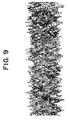
- Fig. 9 is a trace given by a roughness meter, which shows the surface roughness of the surface of the laminate film prepared in Comparative Example 3.
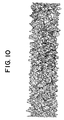
- Fig. 10 is a trace given by a roughness meter, which shows the surface roughness of the surface of the laminate film prepared in Comparative Example 2.
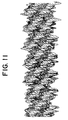
- Fig. 11 is a trace given by a roughness meter, which shows the surface roughness of the surface of the laminate film prepared in Comparative Example 1.
- Fig. 12 is a schematic illustration in cross section of a print-laminated printed paper prepared by bonding a film for print lamination of the present invention to a printed paper using a heat-pressure bonding roll.
- 2 is a substrate sheet (a)
- 3 is an adhesive layer (b)
- 7 is a printed portion
- 8 is a paper, etc. to be printed on.
- stretched or non-streched films of thermoplastic resins such as polypropylene, polyethylene, polyethylene telephthalate, polyvinyl chloride, polystyrene, and the like may be used.
- thermoplastic resins such as polypropylene, polyethylene, polyethylene telephthalate, polyvinyl chloride, polystyrene, and the like
- biaxially stretched polypropylene films and polyethylene telephthalate films are especially preferred.
- Mixture of resins may be used.
- the thickness of the substrate is from 6 to 100 ⁇ m, and preferably from 6 to 40 ⁇ m.
- the haze value (according to ASTM D1003) of the substrate is preferably 5 % or lower.
- the ethylene-based copolymer resins to be laminated on said substrates are not particularly limited.
- Examples of such ethylene-based copolymer resins include copolymers of ethylene and a monomer able to copolymerize therewith, such as vinyl acetate, methyl acrylate, ethyl acrylate, methyl methacrylate, acrylic acid, propylene, 1-butene, 1-hexene, etc.
- Copolymers modified by hydrolysis or bridge formation by metal ions after copolymerization, or copolymers obtained by graft polymerization of polyethylene with maleic anhydride, etc. can also be employed. These copolymers can be used in combination of two or more.
- the ethylene-based copolymer resins are required to have 70 % by weight or more of ethylene monomer unit content.
- An ethylene content of less than 70 % by weight causes poor slipperiness and antiblocking characteristics of the resulting lamination film, as well as bad roll-releasability during production of the film, resulting in significant wrinkling. Furthermore, when such film is laminated on the substrate, the neck-in becomes large, and heat-deterioration is liable to occur.
- the total ethylene content in the copolymer should be at least 70 % by weight, and is preferably 70 to 90 % by weight.
- the ethylene-based copolymer resin layer may contain, as required, lubricants, antiblocking agents, stabilizers, ultraviolet absorbents, antistatic agents, anticlouding agents, coloring agents, and other various additives in amounts within ranges known to those of skill in the art so that the adhesive strength to printed papers and the like is not negatively changed. Generally, these agents are used within the range of 0.01 to 3 % by weight based on the total weight of ethylene-based copolymer resin.
- the thickness of the ethylene-based copolymer resin film to be laminated on the substrate is 8 ⁇ m or more, and preferably 8 to 40 ⁇ m.
- the thickness is less than 8 ⁇ m, the collapse and gloss of the resulting print-laminated product is not good, and furthermore, the transfer of the embossing deteriorates and blocking resistance becomes inferior.
- thicknesses of over 40 ⁇ m causes not only lowering of the print lamination speed and poor productivity, but also high cost.
- the method of laminating the ethylene-based copolymer resin on the substrate layer is not particularly limited so long as an embossed pattern is transferred to the ethylene-based copolymer resin. This can be done before or after lamination. Examples of methods include extrusion lamination methods, co-extrusion methods, a method in which the ethylene-based copolymer resin is laminated on the substrate layer after longitudinal or lateral stretching of the substrate layer, followed by further longitudinal or lateral stretching of the resulting laminate, coating methods, and so on.
- an anchor coating agent should be coated on the surface of the biaxially stretched film in an amount of 1 to 10 g/m2, and then the ethylene-based copolymer is laminated thereon.
- Suitable anchor coating agents are polyethyleneimine, polyetherpolyol-polyisocyanate, polyesterpolyol-polyisocyanate, epichlorhydrine adduct of polyamine-polyamide and so on.
- the surface is preferably subjected to oxidation treatment, such as corona discharge treatment, ozone treatment, flame treatment, etc, and is preferably treated so that the wetting tensile strength of the surface is within the range of 36 to 55 dyne/cm, preferably 40 to 55 dyne/cm.
- oxidation treatment such as corona discharge treatment, ozone treatment, flame treatment, etc.
- the embossed pattern formed on the surface of the ethylene-based copolymer resin film laminated on a substrate is one which is not limited, and is preferably formed according to a method in which a softened or melt ethylene-based copolymer resin is pressed to a metal roll having a heliocrasho type or embossing type of regular reverse embossed pattern with crests and valleys by using a rubber roll and so on, and then transferring the reverse-pyramidal shapes to the surface of the ethylene-based copolymer resin film.
- the embossing should have a construction in which the 10 points-mean roughness (Rz) of the embossing is 4.0 to 8.5 ⁇ m, the surface ratio (Sr) of the convex cross section at a neutral line of the surface roughness (that is, the horizontal face through the 1/2 point of the distance between the crest and valley of the embossing) is smaller than 55 %, and the Beck smoothness (according to JIS-P8119) of the surface is smaller than 500 sec., preferably 80 to 400 sec.
- the Rz value of the embossing in the ethylene-based copolymer resin is smaller than 4.0 ⁇ m, especially in cases where there is high functional monomer (such as vinylacetate, methylacrylate, ethylacrylate, methyl methacrylate, etc.) content in the ethylene-based copolymer resin (14 to 30 % by weight), the roll-releasability of the laminate in extrusion and lamination of the ethylene-based copolymer film on the substrate is worsened.
- the laminate when the laminate is wound into a roll shape around a paper tube, wrinkling or blocking is caused. Consequently, the resulting print-laminated products may contain inferior ones, due to residual wrinkling and breaking of the laminate film during print lamination to a printed paper.
- the unevenness and surface area of the embossing of the ethylene-based copolymer film of the heat-sensitive adhesive layer is increased.
- the embossing shape provided at the cooling roll section may be transferred to the melting resin in an imperfect condition or uneven cooling may occur during production of the lamination film, or unnecessary patterns or a biased thickness may occur in the laminate film, resulting in bad transparency or differences in thickness of the rolled product (referred to as "bone” or "vein").
- the resulting laminate film enfolds air in the uneven parts of the surface during the print lamination process, and is laminated on a printed paper. Consequently, the residual air between the laminate film and the color-printed paper of the resulting print-laminated product causes print color lacking beauty, low gloss and inferior adhesiveness to the printed parts.
- the number of points or lines of the embossing is not particularly limited, so far as it can satisfy the ranges of the Rz and Sr values and smoothness. But an embossed pattern having 120 to 300 per inch (2.54 cm) is preferable.
- a fine embossing 6 can be further applied to the above embossed face (see Fig. 3).
- the depth of the fine embossing is from 0.01 ⁇ m to 0.7 ⁇ m, and its wide is from 0.2 to 4 ⁇ m.
- Such fine embossing can be formed using a roll which is obtained by giving a fine embossing pattern to a cooling roll of, for example, a heliocrasho type by a corrosion resistant treatment of micro-mat plating, in a manner that the surface of the heat-adhesive layer of the ethylene-based copolymer film applied with the first embossing is contacted with the roll under pressure.
- the fine embossing pattern is transferred to the surface of the ethylene-based copolymer of the laminate film as 0.7 ⁇ m maximum of ten-point mean roughness, and 0.05 to 0.3 ⁇ m of average ten-point mean roughness.
- the heat-pressure bonding of a film for print lamination to a bonding surface of printed matter (paper) can be carried out so that the adhesive layer (b) side of the the film for print lamination is adhered to the print of the printed matter at 5 to 100 kg of roll line pressure, using a heating roll heated to 70 to 120°C.
- Suitable bonding surfaces include all types of paper, carrying printed material or illustrations, cardboard, pulp paper, synthetic paper, biaxially stretched polypropylene film, laminate of polypropylene and aluminium foil, etc.
- the printed matter may have a window to see through a article in a box.
- the window is obtained by the printed matter.
- An ethylene-vinyl acetate copolymer resin having a 15 g/10 min. of MFR (melt flow rate measured according to JIS K-7210; 190°C, 2.16 kg load) and containing 19 % by weight of vinyl acetate (VA) ("Mitsubishi EVA V401S" produced by Mitsubishi Petrochemical Co., Ltd.; melting point 99°C ) was melt-extruded from a T-die equipped on an extruder having an opening diameter of 90 mm ⁇ in a film of 1300 mm in width and 15 ⁇ m in thickness at a resin temperature of 240°C.
- a biaxially stretched polypropylene film (“FOR” produced by Futamura Kagaku Kogyo K.K.; haze value of 1.2 %) having a thickness of 15 ⁇ m was fed from the substrate feeding section of the laminator.
- an isocyanate-based anchor coating agent (“Titabond T-120" produced by Nisso) was coated in an amount of 5 g/m2. After drying, the coated polypropylene film and said melting copolymer resin film were led to the pressure-bonding roll so that one side of the melt copolymer film was an adhesive side to be bonded to the anchor coated side of the coated polypropylene film.
- the two films were laminated to one another under pressure using a compressing rubber roll and a heliocrasho type cooling roll having 250 lines per 1 inch (2.54 cm) (there were three kinds of cooling rolls used each having different embossed patterns ⁇ engraved by 18 cm wide ⁇ , in which the depths of the area ratio of concave parts were 10 ⁇ m, 21 ⁇ m and 26 ⁇ m and the surface ratios of the concave parts were 34 %, 55 % and 59 %, respectively, as the cooling rolls for Example 1, Example 2 and Comparative Example 1, respectively), to give three kinds of laminates of an ethylene-vinyl acetate copolymer resin having different embossed patterns and a biaxially stretched polypropylene film.
- the embossed surface of the ethylene-vinyl acetate copolymer resin laminates thus obtained were treated by a corona discharge treatment of 40 w min./m2. Then, the treated laminate films were slit into the widths of each embossed pattern size to give films for heat-pressure bonding type print lamination.
- print-laminated products were prepared in a manner where the above films for print lamination were bonded with offset-printed art paper using a pressure-bonding machine at 80°C roll temperature, 55.6 kg line pressure and 30 m/min. of speed.
- the resulting products were evaluated for their collapse characteristic, gloss, adhesiveness, appearance, etc. The results are also shown in Table 1.
- PET a biaxially stretched polyethylene terephthalate film, 12 ⁇ m (produced by Diafoil; haze value of 1.8 %)
- Example 2 Other laminate and print-laminated products were prepared in the same manner as Example 1, except that a cooling roll in which fine embossing by micro-plating applied to a heliocrasho type cooling roll was used.
- the fine embossing is about 0.1 ⁇ m of depth and about 1 ⁇ m of width. The results are shown in Table 1.
- the 10 points-mean roughness (Rz) and the surface ratio of the convex cross section (Sr) were measured using a surface roughness meter ["Surfcorder ET-30HK” produced by Kosaka Kenkyu-sho K.K.].
- the 10 points-mean roughness is a value given by dividing the sum of heights of 5 crests which are the highest crest to the fifth highest crest existing in a 1 mm embossing length measured portion with the sum of depths of 5 valleys which are the deepest valley to the fifth deepest valley existing in said measured portion (according to JIS B-0601).
- the surface ratio of the convex cross section at a neutral line is a value occupied by the sum of each crest cross section area in a 0.1 mm2 of emboss-processing area, the crest cross section area being given by cutting the convex at a neutral line at which two areas of crest and valley become equal.
- the Beck smoothness is a value measured according to JIS-P8119.
- the haze value of laminate film was measured according to ASTM D1003 using a "Direct Reading Haze Meter” (trade name produced by Toyo Seiki Seisaku-sho, Ltd.). The transparency was evaluated in the range of O to X according to the following judgements: Haze value Judgement 0 to lower than 25 % O 25 to lower than 50 % ⁇ 50 to lower than 75 % ⁇ higher than 75 % X
- the biaxially stretched polypropylene film side (2) of a laminate film 21 cm wide ⁇ 29 cm long was superposed on the ethylene-vinyl acetate copolymer resin side (3) applied with embossing form, and loaded at 0.05 kg/cm2 in an oven of 60°C over an area 15 cm wide ⁇ 20 cm long. After standing for 24 hours, the superposed laminate film was cut off so that the shearing peel area of the film became 10 cm2 (2 cm wide ⁇ 5 cm long) and the force required for peeling was measured using a tensile tester. In this test, the smaller value shows superior antiblocking characteristic.
- a laminate film was evaluated according to the following judgements: one having a peeling force of 2.0 kg or higher and being broken by film peeling as X ; one having a peeling force of 1.5 kg to less than 2.0 kg and being extended to its full length at peeling as ⁇ ; one having a peeling force of 1.0 kg to less than 1.5 kg and being slightly extended at peeling but restored as ⁇ ; and one having a peeling force of less than 1 kg and exhibiting little resistance at peeling as O .
- the processability was evaluated on the basis of the rolling appearance of the laminate film when a 2000 m of film was taken up in a roll and the measured value of the biased thickness of the laminate film, according to the following: O : good rolling appearance and biased thickness of ⁇ 0.5 ⁇ m ⁇ : good rolling appearance and biased thickness of ⁇ 1.0 ⁇ m ⁇ : wrinkling in the rolling appearance and biased thickness of ⁇ 1.5 ⁇ m X : occurrence of thickness difference in the roll (bone) and biased thickness of ⁇ 2.0 ⁇ m
- a print-laminated product having a 590 mm of width which was prepared by bonding a printed art paper to a laminate film given in the above examples using a print laminator having a roll temperature of 90°C , a line pressure of 55.6 kg and a speed of 35 m/min.
- a cellophane adhesive tape (15 mm wide ⁇ 100 mm long) was pasted. After scrubbing the cellophane adhesive tape side with fingers several times, the tape was peeled.
- the laminate film After peeling the laminate film partially from the printed art paper in a test piece of said print-laminated product (25 mm wide ⁇ 100 mm long) 50 mm to the length direction by hand, the laminate film was further peeled in the 180° direction entirely from the printed art paper using a tensile test machine produced by Shimadzu Corporation at a tensile speed of 300 mm/min.
- the adhesive strength was evaluated according to the value given by the above measurement as follows:
Landscapes
- Engineering & Computer Science (AREA)
- Mechanical Engineering (AREA)
- Laminated Bodies (AREA)
Applications Claiming Priority (2)
| Application Number | Priority Date | Filing Date | Title |
|---|---|---|---|
| JP30154892A JPH06126915A (ja) | 1992-10-15 | 1992-10-15 | 熱圧着プリントラミネート用フィルム |
| JP301548/92 | 1992-10-15 |
Publications (2)
| Publication Number | Publication Date |
|---|---|
| EP0593080A1 true EP0593080A1 (de) | 1994-04-20 |
| EP0593080B1 EP0593080B1 (de) | 1998-04-08 |
Family
ID=17898266
Family Applications (1)
| Application Number | Title | Priority Date | Filing Date |
|---|---|---|---|
| EP19930116724 Expired - Lifetime EP0593080B1 (de) | 1992-10-15 | 1993-10-15 | Laminiertes bedrucktes Erzeugnis |
Country Status (3)
| Country | Link |
|---|---|
| EP (1) | EP0593080B1 (de) |
| JP (1) | JPH06126915A (de) |
| DE (1) | DE69317848T2 (de) |
Cited By (4)
| Publication number | Priority date | Publication date | Assignee | Title |
|---|---|---|---|---|
| EP0802854A4 (de) * | 1995-11-09 | 1998-01-21 | Flex Products Inc | Gelrägtes substrat und photoreceptor, vorrichtung und vefahren die diese beinhalten |
| WO2001028755A1 (de) * | 1999-10-15 | 2001-04-26 | Trespaphan Gmbh | Etikett aus polyolefinfolie |
| EP1475217A1 (de) * | 2003-05-08 | 2004-11-10 | Fuji Photo Film Co., Ltd. | Glanzvermindernde Beschichtung, Verfahren zur Herstellung derselben, Entspiegelungsschicht, Polarisierendes Plättchen und Bildanzeigevorrichtung |
| CH695675A5 (de) * | 2002-02-18 | 2006-07-31 | Ampack Ag Bautechnik | Geprägte Klebefolien. |
Families Citing this family (3)
| Publication number | Priority date | Publication date | Assignee | Title |
|---|---|---|---|---|
| JP2001341243A (ja) * | 2000-06-06 | 2001-12-11 | Gunze Ltd | プリントラミネート用フィルム及びプリントラミネート製品 |
| JP5581769B2 (ja) * | 2010-03-25 | 2014-09-03 | 大日本印刷株式会社 | 加飾シートの製造方法及び加飾シート |
| TWI887731B (zh) * | 2023-08-10 | 2025-06-21 | 南亞塑膠工業股份有限公司 | 壓印pvc膠布 |
Citations (1)
| Publication number | Priority date | Publication date | Assignee | Title |
|---|---|---|---|---|
| EP0397425A2 (de) * | 1989-05-09 | 1990-11-14 | Toray Industries, Inc. | Film zum Laminieren von Klichees |
-
1992
- 1992-10-15 JP JP30154892A patent/JPH06126915A/ja active Pending
-
1993
- 1993-10-15 EP EP19930116724 patent/EP0593080B1/de not_active Expired - Lifetime
- 1993-10-15 DE DE1993617848 patent/DE69317848T2/de not_active Expired - Fee Related
Patent Citations (1)
| Publication number | Priority date | Publication date | Assignee | Title |
|---|---|---|---|---|
| EP0397425A2 (de) * | 1989-05-09 | 1990-11-14 | Toray Industries, Inc. | Film zum Laminieren von Klichees |
Non-Patent Citations (5)
| Title |
|---|
| DATABASE WPI, n 90-129015,Derwent Publications Ltd,London,GB; JP-A-2078544(TORAY)19-03-1990 *The entire abstract* * |
| DATABASE WPI, n 92-059288 Derwent Publications Ltd,London,GB; JP-A-3297644(TORAY)27-12-1991 *The entire abstract* * |
| DATABASE WPI, n89-373388,Derwent Publications Ltd,London,GB; JP-A-1278345(TORAY)08-11-1989 *The entire abstract* * |
| DATABASE WPI,n 87-224452 Derwent Publications Ltd,London,GB; JP-A-62148752(DAINIPPON PRINTING) 02-07-1987*The entire abstract* * |
| DATABASE WPI,n81-41260D,Derwent Publications Ltd,London,GB; JP-A-56042652(TORAY)20-04-1981 *The entire abstract* * |
Cited By (7)
| Publication number | Priority date | Publication date | Assignee | Title |
|---|---|---|---|---|
| EP0802854A4 (de) * | 1995-11-09 | 1998-01-21 | Flex Products Inc | Gelrägtes substrat und photoreceptor, vorrichtung und vefahren die diese beinhalten |
| US5789125A (en) * | 1995-11-09 | 1998-08-04 | Flex Products, Inc. | Embossed substrate and photoreceptor device incorporating the same and method |
| US5993702A (en) * | 1995-11-09 | 1999-11-30 | Flex Products, Inc. | Embossed substrate and photoreceptor device incorporating the same and method |
| WO2001028755A1 (de) * | 1999-10-15 | 2001-04-26 | Trespaphan Gmbh | Etikett aus polyolefinfolie |
| US6838042B1 (en) | 1999-10-15 | 2005-01-04 | Trespaphan Gmbh | Label made of polyolefin film |
| CH695675A5 (de) * | 2002-02-18 | 2006-07-31 | Ampack Ag Bautechnik | Geprägte Klebefolien. |
| EP1475217A1 (de) * | 2003-05-08 | 2004-11-10 | Fuji Photo Film Co., Ltd. | Glanzvermindernde Beschichtung, Verfahren zur Herstellung derselben, Entspiegelungsschicht, Polarisierendes Plättchen und Bildanzeigevorrichtung |
Also Published As
| Publication number | Publication date |
|---|---|
| DE69317848D1 (de) | 1998-05-14 |
| DE69317848T2 (de) | 1998-09-17 |
| EP0593080B1 (de) | 1998-04-08 |
| JPH06126915A (ja) | 1994-05-10 |
Similar Documents
| Publication | Publication Date | Title |
|---|---|---|
| KR100304330B1 (ko) | 다층구조를갖는인쇄특성이우수한합성지 | |
| US6521312B1 (en) | Multilayered film structures and methods of making and using the same | |
| EP1739147B1 (de) | Klebfolie und trennelement | |
| US6579601B2 (en) | Conformable multilayer films | |
| EP0358445A2 (de) | Mehrschichtfolie aus Polyäthylen und Etikett | |
| JP2001505145A (ja) | 高い二軸延伸の高密度ポリエチレンフィルム | |
| US3963851A (en) | Paper for adhesive stickers and the like | |
| JP2005145068A (ja) | 共押出二軸延伸ポリエステルフィルム及びその製造方法ならびにそれから成る包装材およびトレー用蓋材 | |
| CA2844368A1 (en) | Graphic article | |
| CA2226770C (en) | Polymeric films | |
| AU2003253107B2 (en) | Synthetic paper label | |
| US4876139A (en) | Film for print laminates and thermocompression bonding process therefor | |
| EP0593080B1 (de) | Laminiertes bedrucktes Erzeugnis | |
| EP1652875B1 (de) | Thermoplastharzfolie | |
| JP3718958B2 (ja) | 剥離シート | |
| JPS5851823B2 (ja) | カチヤクセイヒヨウメンホゴシ−トノ セイゾウホウホウ | |
| JPH06143518A (ja) | 積層体フィルムおよびそれを用いた箱形成用包装材 | |
| JP2627605B2 (ja) | 工程紙付きフッ化ビニリデン系樹脂積層フィルム状物およびその製法 | |
| AU748319B2 (en) | Polymeric films | |
| JP4923818B2 (ja) | 剥離防止部を備える易剥離積層体 | |
| GB1601498A (en) | Adhesive skin film | |
| JPH10278163A (ja) | プリントラミ用フィルム及びそのラミネート体 | |
| JPH0677986B2 (ja) | 複合2軸延伸ポリプロピレンフイルム,その製造方法,及び該フイルムの使用方法 |
Legal Events
| Date | Code | Title | Description |
|---|---|---|---|
| PUAI | Public reference made under article 153(3) epc to a published international application that has entered the european phase |
Free format text: ORIGINAL CODE: 0009012 |
|
| AK | Designated contracting states |
Kind code of ref document: A1 Designated state(s): DE FR GB IT |
|
| 17P | Request for examination filed |
Effective date: 19940920 |
|
| RAP1 | Party data changed (applicant data changed or rights of an application transferred) |
Owner name: WADA CHEMICAL INDUSTRY CO., LTD. Owner name: MITSUBISHI CHEMICAL CORPORATION |
|
| 17Q | First examination report despatched |
Effective date: 19960909 |
|
| GRAG | Despatch of communication of intention to grant |
Free format text: ORIGINAL CODE: EPIDOS AGRA |
|
| GRAG | Despatch of communication of intention to grant |
Free format text: ORIGINAL CODE: EPIDOS AGRA |
|
| GRAH | Despatch of communication of intention to grant a patent |
Free format text: ORIGINAL CODE: EPIDOS IGRA |
|
| GRAH | Despatch of communication of intention to grant a patent |
Free format text: ORIGINAL CODE: EPIDOS IGRA |
|
| GRAA | (expected) grant |
Free format text: ORIGINAL CODE: 0009210 |
|
| AK | Designated contracting states |
Kind code of ref document: B1 Designated state(s): DE FR GB IT |
|
| REF | Corresponds to: |
Ref document number: 69317848 Country of ref document: DE Date of ref document: 19980514 |
|
| ITF | It: translation for a ep patent filed | ||
| ET | Fr: translation filed | ||
| PLBE | No opposition filed within time limit |
Free format text: ORIGINAL CODE: 0009261 |
|
| STAA | Information on the status of an ep patent application or granted ep patent |
Free format text: STATUS: NO OPPOSITION FILED WITHIN TIME LIMIT |
|
| 26N | No opposition filed | ||
| PGFP | Annual fee paid to national office [announced via postgrant information from national office to epo] |
Ref country code: GB Payment date: 19991019 Year of fee payment: 7 |
|
| PGFP | Annual fee paid to national office [announced via postgrant information from national office to epo] |
Ref country code: FR Payment date: 19991027 Year of fee payment: 7 |
|
| PGFP | Annual fee paid to national office [announced via postgrant information from national office to epo] |
Ref country code: DE Payment date: 19991124 Year of fee payment: 7 |
|
| PG25 | Lapsed in a contracting state [announced via postgrant information from national office to epo] |
Ref country code: GB Free format text: LAPSE BECAUSE OF NON-PAYMENT OF DUE FEES Effective date: 20001015 |
|
| GBPC | Gb: european patent ceased through non-payment of renewal fee |
Effective date: 20001015 |
|
| PG25 | Lapsed in a contracting state [announced via postgrant information from national office to epo] |
Ref country code: FR Free format text: LAPSE BECAUSE OF NON-PAYMENT OF DUE FEES Effective date: 20010629 |
|
| PG25 | Lapsed in a contracting state [announced via postgrant information from national office to epo] |
Ref country code: DE Free format text: LAPSE BECAUSE OF NON-PAYMENT OF DUE FEES Effective date: 20010703 |
|
| REG | Reference to a national code |
Ref country code: FR Ref legal event code: ST |
|
| PG25 | Lapsed in a contracting state [announced via postgrant information from national office to epo] |
Ref country code: IT Free format text: LAPSE BECAUSE OF NON-PAYMENT OF DUE FEES Effective date: 20051015 |