EP0593348A1 - Nouveaux composés de thiazolidine dione, leur procédé de préparation et les compositions pharmaceutiques les contenant - Google Patents
Nouveaux composés de thiazolidine dione, leur procédé de préparation et les compositions pharmaceutiques les contenant Download PDFInfo
- Publication number
- EP0593348A1 EP0593348A1 EP93402497A EP93402497A EP0593348A1 EP 0593348 A1 EP0593348 A1 EP 0593348A1 EP 93402497 A EP93402497 A EP 93402497A EP 93402497 A EP93402497 A EP 93402497A EP 0593348 A1 EP0593348 A1 EP 0593348A1
- Authority
- EP
- European Patent Office
- Prior art keywords
- radical
- thiazolidine
- dione
- benzyl
- carbon atoms
- Prior art date
- Legal status (The legal status is an assumption and is not a legal conclusion. Google has not performed a legal analysis and makes no representation as to the accuracy of the status listed.)
- Granted
Links
Classifications
-
- C—CHEMISTRY; METALLURGY
- C07—ORGANIC CHEMISTRY
- C07D—HETEROCYCLIC COMPOUNDS
- C07D417/00—Heterocyclic compounds containing two or more hetero rings, at least one ring having nitrogen and sulfur atoms as the only ring hetero atoms, not provided for by group C07D415/00
- C07D417/02—Heterocyclic compounds containing two or more hetero rings, at least one ring having nitrogen and sulfur atoms as the only ring hetero atoms, not provided for by group C07D415/00 containing two hetero rings
- C07D417/10—Heterocyclic compounds containing two or more hetero rings, at least one ring having nitrogen and sulfur atoms as the only ring hetero atoms, not provided for by group C07D415/00 containing two hetero rings linked by a carbon chain containing aromatic rings
-
- A—HUMAN NECESSITIES
- A61—MEDICAL OR VETERINARY SCIENCE; HYGIENE
- A61P—SPECIFIC THERAPEUTIC ACTIVITY OF CHEMICAL COMPOUNDS OR MEDICINAL PREPARATIONS
- A61P3/00—Drugs for disorders of the metabolism
-
- A—HUMAN NECESSITIES
- A61—MEDICAL OR VETERINARY SCIENCE; HYGIENE
- A61P—SPECIFIC THERAPEUTIC ACTIVITY OF CHEMICAL COMPOUNDS OR MEDICINAL PREPARATIONS
- A61P3/00—Drugs for disorders of the metabolism
- A61P3/08—Drugs for disorders of the metabolism for glucose homeostasis
-
- A—HUMAN NECESSITIES
- A61—MEDICAL OR VETERINARY SCIENCE; HYGIENE
- A61P—SPECIFIC THERAPEUTIC ACTIVITY OF CHEMICAL COMPOUNDS OR MEDICINAL PREPARATIONS
- A61P3/00—Drugs for disorders of the metabolism
- A61P3/08—Drugs for disorders of the metabolism for glucose homeostasis
- A61P3/10—Drugs for disorders of the metabolism for glucose homeostasis for hyperglycaemia, e.g. antidiabetics
-
- C—CHEMISTRY; METALLURGY
- C07—ORGANIC CHEMISTRY
- C07D—HETEROCYCLIC COMPOUNDS
- C07D277/00—Heterocyclic compounds containing 1,3-thiazole or hydrogenated 1,3-thiazole rings
- C07D277/02—Heterocyclic compounds containing 1,3-thiazole or hydrogenated 1,3-thiazole rings not condensed with other rings
- C07D277/20—Heterocyclic compounds containing 1,3-thiazole or hydrogenated 1,3-thiazole rings not condensed with other rings having two or three double bonds between ring members or between ring members and non-ring members
- C07D277/32—Heterocyclic compounds containing 1,3-thiazole or hydrogenated 1,3-thiazole rings not condensed with other rings having two or three double bonds between ring members or between ring members and non-ring members with hetero atoms or with carbon atoms having three bonds to hetero atoms with at the most one bond to halogen, e.g. ester or nitrile radicals, directly attached to ring carbon atoms
- C07D277/34—Oxygen atoms
-
- C—CHEMISTRY; METALLURGY
- C07—ORGANIC CHEMISTRY
- C07D—HETEROCYCLIC COMPOUNDS
- C07D417/00—Heterocyclic compounds containing two or more hetero rings, at least one ring having nitrogen and sulfur atoms as the only ring hetero atoms, not provided for by group C07D415/00
- C07D417/02—Heterocyclic compounds containing two or more hetero rings, at least one ring having nitrogen and sulfur atoms as the only ring hetero atoms, not provided for by group C07D415/00 containing two hetero rings
- C07D417/12—Heterocyclic compounds containing two or more hetero rings, at least one ring having nitrogen and sulfur atoms as the only ring hetero atoms, not provided for by group C07D415/00 containing two hetero rings linked by a chain containing hetero atoms as chain links
Definitions
- the subject of the present invention is new thiazolidine dione compounds, their preparation process and the pharmaceutical compositions containing them.
- the compounds of the present invention apart from the fact that they are new, differ from the previously known thiazolidine-2,4-dione compounds by the intensity of their pharmacological properties.
- insulin resistance and the lack of insulin secretion are responsible for the glucose intolerance observed in patients with non-insulin dependent diabetes.
- the currently available therapies essentially correct the defect in insulin secretion without necessarily improving the insulin sensitivity of peripheral tissues (muscles, adipose tissue).
- the thiazolidine-2,4-dione compounds are capable of causing a drop in blood sugar and improving glucose tolerance in non-insulin dependent diabetes models without causing an increase in insulin secretion.
- the compounds of the present invention have the advantage of being particularly powerful (more especially compared to ciglitazone, reference compound belonging to this chemical class) while being devoid of harmful haematological effects, as the pharmacological study proves it. hereinafter described.
- the compounds of the present invention can be used in the treatment of insulin resistance states and / or non-isulinopenic diabetic states, making it possible to obtain better control of the glycemia while the circulating insulin level decreases.
- Prevention of this relative hyperinsulinemia, associated with a decrease in triglycerides circulating under the effect of these products, can contribute to a reduction in the risks of macroangiopathy.
- the present invention also relates to pharmaceutical compositions containing as active ingredient a compound of formula I or one of its physiologically tolerable salts, mixed or associated with one or more suitable pharmaceutical excipients.
- compositions thus obtained are generally in dosage form containing from 100 to 200 mg of active principle. They can, for example, take the form of tablets, dragees, capsules, suppositories, injectable or oral solutions and be administered by the oral, rectal or parenteral route.
- the dosage can vary significantly depending on the age and weight of the patient, the route of administration, the nature of the disease and the associated treatments and ranges from 100 to 200 mg of active principle, 2 to 3 times a day.
- the raw materials of formula II were prepared from the amines of formula: themselves obtained by hydrogenation under a pressure of 3.105 Pa in the presence of Raney Nickel of the corresponding nitro compounds.
- Method B is advantageously carried out by carrying out the reaction of compounds IV and V at a temperature of 20-25 ° C for 8 to 15 hours in an adequate solvent such as, for example, tetrahydrofuran, dimethylformamide or acetonitrile, alone or in combination mixture, in the presence of an acceptor of the acid formed during the reaction.
- an adequate solvent such as, for example, tetrahydrofuran, dimethylformamide or acetonitrile, alone or in combination mixture, in the presence of an acceptor of the acid formed during the reaction.
- This acceptor may for example be triethylamine or an excess of compound V used for the synthesis.
- the compounds of formula I in which the group Ar is substituted, inter alia, by a hydroxy radical can also be prepared by saponification, in the presence of sodium hydroxide, of the corresponding acyloxy compounds.
- the products I thus prepared according to methods A or B, can be purified by crystallization from the usual customary organic solvents or by chromatoflash on an Amicon silica support (35-70 ⁇ ), eluting with suitable solvents such as: CH2Cl2, CH2Cl2- acetone (95-5), toluene-ethanol (95-5), under a pressure of 0.5 to 1 atmosphere of nitrogen.
- the compounds of formula I can be transformed into addition salts with acids, salts which are, as such, part of the invention.
- acids which can be used for the formation of these salts there may be mentioned, for example, in the mineral series, hydrochloric, hydrobromic, nitric, sulfuric, phosphoric acids and, in the organic series, acetic, propionic, maleic, fumaric, tartaric acids , oxalic, benzoic, methanesulfonic and isethionic.
- a mixture of 4.1 g of 3- ⁇ 4- [2- (2-methoxy-5-chloro benzamido) ethyl] phenyl ⁇ -2-methyl chloro propionate (oil) is heated for 10 hours at 120 ° C. and 1.52 g of thiourea in 40 ml of sulfolane®.
- the imine formed is hydrolyzed by adding 14 ml of 2N HCl to the mixture and heating the whole to 100 ° C. for 8 hours.
- the gummy product is extracted with CH2Cl2 and the organic solution is washed with water.
- anhydrous dimethylformamide 2.3 g of anhydrous dimethylformamide are added to a solution of 3 g of 5- [4- (2-aminoethyl) benzyl] thiazolidine-2,4-dione and 1.16 g of triethylamine in 50 ml of anhydrous dimethylformamide. acetyl salicyloyl and allow the mixture to stir at room temperature for 15 hours. The dimethylformamide is then evaporated and the residue taken up with CH2Cl2 and water. The organic phase is decanted and then evaporated under reduced pressure. 5.3 g of an oily residue are obtained which is chromatographed on 170 g of silica eluting with the CH2Cl2-acetone mixture (90-10).
- NIDDM non-insulin-dependent diabetes
- mice The animals (ob / ob mice) are treated daily, for 4 days, by administering orally, the compounds of the invention suspended in a 20% solution of Senegal gum. Before and after treatment, ie on D0 and D5, the blood is taken by puncture of the orbital sinus and the blood sugar is determined. Table 1 shows the doses of the different products to be administered to obtain the same hypoglycemic effect (base 100).
- Table 1 doses causing the same hypoglycemic effect in ob / ob mice Products Dose mg / kg / day for 4 days Hypoglycemic power Ciglitazone 50-100 100
- Example 1 ⁇ 10 100
- Example 3 25 100
- Example 4 10
- Example 6 10
- Example 7 25
- Example 14 10
- Example 15 25
- Example 25 10
- Example 28 10
- Example 33 25
- Example 35 20
- Example 36 20
- Example 40 50 100
- Example 46 40 100 doses causing the same hypoglycemic effect in ob / ob mice Products Dose mg / kg / day for 4 days Hypoglycemic power Ciglitazone 50-100 100
- Example 1 10
- Example 3 25
- Example 4 10
- Example 6 10
- Example 7 25
- Example 14 10
- Example 15 25
- Example 25 10
- Example 28 10
- Example 33 25
- Example 35 20
- the animals male Zucker Fa / Fa rats
- the animals are treated, each day, for 10 days, by administering, orally, the compounds of the invention at a dose of 5 mg / kg / day suspended in a 20% solution. % gum from Senegal.
- the animals are sacrificed and the blood collected in order to determine the glycemia, the plasma triglycerides and the immunoreactive insulin.
- the animals are weighed before and after treatment.
- the compounds of the invention have no influence on the level of circulating glucose but reduce the level of triglycerides (TG) and of free fatty acids in plasma (AGL) as well as that of insulin immuno -reactive. This activity is equal to or greater than that of other reference thiazolidinedione derivatives.
Landscapes
- Chemical & Material Sciences (AREA)
- Organic Chemistry (AREA)
- Health & Medical Sciences (AREA)
- Diabetes (AREA)
- General Chemical & Material Sciences (AREA)
- General Health & Medical Sciences (AREA)
- Hematology (AREA)
- Obesity (AREA)
- Engineering & Computer Science (AREA)
- Chemical Kinetics & Catalysis (AREA)
- Veterinary Medicine (AREA)
- Medicinal Chemistry (AREA)
- Nuclear Medicine, Radiotherapy & Molecular Imaging (AREA)
- Public Health (AREA)
- Pharmacology & Pharmacy (AREA)
- Life Sciences & Earth Sciences (AREA)
- Animal Behavior & Ethology (AREA)
- Bioinformatics & Cheminformatics (AREA)
- Emergency Medicine (AREA)
- Endocrinology (AREA)
- Pharmaceuticals Containing Other Organic And Inorganic Compounds (AREA)
- Plural Heterocyclic Compounds (AREA)
- Thiazole And Isothizaole Compounds (AREA)
Abstract
Description
- La présente invention a pour objet de nouveaux composés de thiazolidine dione, leur procédé de préparation et les compositions pharmaceutiques les renfermant.
- Elle concerne plus particulièrement :
- les composés de thiazolidine dione de formule I :
dans laquelle :
Ar représente : - a) un cycle polyméthylénique contenant de 5 à 7 atomes de carbone éventuellement substitué par un ou plusieurs radicaux alkyle ayant de 1 à 5 atomes de carbone,
- b) un radical hydrocarboné mono-, bi- ou tricyclique tel que par exemple un radical phényle, naphtyle, fluorényle, dibenzocycloheptényle, biphénylyle chacun éventuellement mono- ou poly- substitué par un atome d'halogène tel que par exemple un atome de fluor, chlore ou brome, un radical trifluorométhyle, un radical alkyle, alkoxy ou alkylthio ayant chacun de 1 à 5 atomes de carbone en chaine droite ou ramifiée, un radical acyloxy, un radical hydroxy ou un radical de formule

- c) un radical hétérocyclique mono-, bi- ou tricyclique renfermant 1 ou 2 hétéroatomes choisis parmi les atomes d'azote, d'oxygène ou de soufre, tel que par exemple les radicaux furyle, thiényle, pyrrolinyle, pyridyle, pyrazinyle, oxazolyle, thiazolyle, indolyle, imidazolyle, chromanyle ou xanthényle, chacun éventuellement substitué par un radical oxo- et/ou par un ou plusieurs atomes d'halogène ou radicaux alkyle (ayant de 1 à 5 atomes de carbone) ou phényle lui-même éventuellement substitué par un ou plusieurs atomes d'halogène ou radicaux trifluorométhyle ou alkyle ou alkoxy ayant chacun de 1 à 5 atomes de carbone ;
- L'état antérieur de la technique est illustré notamment par les demandes de brevet EP 008203, WO 8607056, EP 207581, WO 8504171 et WO 9207850 lesquelles concernent des composés de thiazolidine-2,4-dione utilisables comme agents antidiabétiques.
- Or les composés de la présente invention, outre le fait qu'ils soient nouveaux, se différencient des composés de thiazolidine-2,4-dione antérieurement connus par l'intensité de leurs propriétés pharmacologiques.
- En effet, l'insulino-résistance et le défaut de sécrétion de l'insuline sont les responsables de l'intolérance au glucose observée chez les patients ayant un diabète non insulino-dépendant.
- Les thérapeutiques actuellement disponibles permettent de corriger essentiellement le défaut de sécrétion d'insuline sans nécessairement améliorer la sensibilité à l'insuline des tissus périphériques (muscles, tissu adipeux).
- Les composés de thiazolidine-2,4-dione sont capables de provoquer une baisse de la glycémie et d'améliorer la torérance au glucose dans les modèles de diabète non insulino-dépendant sans provoquer une augmentation de la sécrétion d'insuline.
- Les composés de la présente invention ont l'avantage d'être particulièrement puissants (plus spécialement par rapport à la ciglitazone, composé de référence appartenant à cette classe chimique) tout en étant dépourvus d'effets hématologiques nocifs, comme le prouve l'étude pharmacologique ci-après décrite.
- Ainsi les composés de la présente invention sont utilisables dans le traitement des états d'insulino-résistance et/ou des états diabétiques non isulinopéniques, permettant d'obtenir un meilleur contrôle de la glycémie alors que le taux d'insuline circulante diminue. La prévention de cette hyperinsulinémie relative, associée à une diminution des triglycérides circulant sous l'effet de ces produits, peut concourir à une réduction des risques de macroangiopathie.
- Ces mêmes composés trouvent de plus une utilisation dans le traitement de l'hypertension chez les sujets âgés présentant une insulino-résistance associée ou non à d'autres anomalies métaboliques.
- La présente invention a également pour objet les compositions pharmaceutiques contenant comme principe actif un composé de formule I ou un de ses sels physiologiquement tolérable, mélangé ou associé à un ou plusieurs excipients pharmaceutiques appropriés.
- Les compositions pharmaceutiques ainsi obtenues se présentent généralement sous forme dosée renfermant de 100 à 200 mg de principe actif. Elles peuvent, par exemple, revêtir la forme de comprimés, dragées, gélules, suppositoires, solutions injectables ou buvables et être administrées par la voie orale, rectale ou parentérale.
- La posologie peut varier notablement selon l'âge et le poids du patient, la voie d'administration, la nature de la maladie et les traitements associés et s'échelonne de 100 à 200 mg de principe actif, 2 à 3 fois par jour.
- La présente invention a aussi pour objet le procédé de préparation des composés de formule I
caractérisé en ce que : - soit,
A) l'on fait réagir un composé de formule II :
- Ar, A, X et B ont les significations précédemment définies et
- Hal représente un atome de chlore ou de brome,


- soit,
B) l'on fait réagir un composé de formule IV :
Ar-A-X' (IV)
dans laquelle :- Ar et A ont les significations précédemment définies, et
- X' représente COCl, SO₂Cl, un ester activé ou -(CO)₂O,

- B a la signification précédemment définie et
- R' représente un atome d'hydrogène ou un radical alkyle de 1 à 5 atomes de carbone en chaine droite ou ramifiée.
- La méthode A, décrite par T. Sohda et coll, Chem. Pharm. Bull., 30 (10) 3580-3600 (1982), a été mise en oeuvre de façon particulièrement adéquate pour préparer les composés I en opérant dans un solvant approprié tel que, par exemple, le méthanol, l'éthanol, le sulfolane®, le diméthylformamide et en chauffant à 100-120 °C pendant 6 à 10 heures le mélange de composé II et de thiourée, puis en hydrolysant le composé III au moyen d'un acide fort, HCl ou H₂SO₄ par exemple.
- Les matières premières de formule II ont été préparées à partir des amines de formule :

elles-mêmes obtenues par hydrogénation sous une pression de 3.10⁵ Pa en présence de Nickel de Raney des composés nitrés correspondants. - La méthode B est avantageusement réalisée en effectuant la réaction des composés IV et V à une température de 20-25 °C pendant 8 à 15 heures dans un solvant adéquat tel que par exemple le tétrahydrofurane, le diméthylformamide ou l'acétonitrile, seuls ou en mélange, en présence d'un accepteur de l'acide formé au cours de la réaction.
- Cet accepteur peut-être par exemple la triéthylamine ou un excès du composé V utilisé pour la synthèse. De plus, les composés de formule I dans laquelle le groupe Ar est substitué, entre autres, par un radical hydroxy, peuvent également être préparés par saponification, en présence de soude, des composés acyloxy correspondants.
- Les produits I, ainsi préparés selon les méthodes A ou B, peuvent être purifiés par cristallisation au sein des solvants organiques usuels appropriés ou par chromatoflash sur support de silice Amicon (35-70 µ) en éluant avec des solvants appropriés tels que : CH₂Cl₂, CH₂Cl₂- acétone (95-5), toluène-éthanol (95-5), sous une pression de 0,5 à 1 atmosphère d'azote.
- Les composés de formule I peuvent être transformés en sels d'addition avec les acides, sels qui font, à ce titre, partie de l'invention. Comme acides utilisables pour la formation de ces sels, on peut citer par exemple, dans la série minérale, les acides chlorhydrique, bromhydrique, nitrique, sulfurique, phosphorique et, dans la série organique, les acides acétique, propionique, maléique, fumarique, tartrique, oxalique, benzoîque, méthanesulfonique et iséthionique.
- Les exemples suivants illustrent la présente invention. Les points de fusion sont déterminés à la platine chauffante de Kofler, sauf mention contraire.
- 5-{4-[2-(2-méthoxy 5-chloro benzamido) éthyl] benzyl} thiazolidine 2,4-dione.

- On chauffe pendant 10 heures à 120 °C un mélange de 4,1 g de 3-{4-[2-(2-méthoxy-5-chloro benzamido) éthyl] phényl}-2-chloro propionate de méthyle (huile) et 1,52 g de thiourée dans 40 ml de sulfolane®. L'imine formée est hydrolysée en ajoutant au mélange 14 ml d'HCl, 2N et en chauffant l'ensemble à 100 °C pendant 8 heures. Lorsque la réaction est terminée, on dilue avec 600 ml d'eau et décante la partie aqueuse. On extrait le produit gommeux avec CH₂Cl₂ et lave à l'eau la solution organique. Après évaporation du solvant, le résidu est purifié sur 90 g de silice par chromatoflash en éluant avec le mélange CH₂Cl₂-méthanol (95-5). Les éluats évaporés donnent 2,6 g du produit attendu, sous forme cristallisée, PF : 182 °C.
- (R,S) 5-{4-[2-(4-hydroxy-3,5-ditert-butyl benzamido) éthyl] benzyl) thiazolidine-2,4-dione.

- A une solution de 3 g d'acide 4-hydroxy-3,5-ditert-butyl benzoïque dans 150 ml de tétrahydrofurane anhydre, on ajoute 1,9 g de 1,1-carbonyl diimidazole et on agite la solution pendant 8 heures à température ambiante. Ensuite, on ajoute 3 g de 5-[4-(2-amino éthyl) benzyl] thiazolidine-2,4-dione (fondant à 200 °C) et laisse le mélange sous agitation à température ambiante pendant 15 heures. Le solvant est ensuite évaporé et le résidu est repris avec un mélange à 10 % de Na₂CO₃ dans CH₂Cl₂. Le précipité est filtré puis purifié par chromatoflash sur 180 g de silice, en éluant avec le mélange CH₂Cl₂-méthanol (97-3).
- Après évaporation des éluats, on recueille 3 g de produit attendu sous forme amorphe. La 5-[4-(2-aminoéthyl) benzyl] thiazolidine-2,4-dione de départ a été préparée selon la méthode de SOHDA et Coll. à partir du 3-[4-(2-acétamido éthyl) phényl]-2-chloro propionate de méthyle (huile).
- (R,S) 5-{4-[2-(salicyloyamino) éthyl] benzyl} thiazolidine-2,4-dione.

- A une solution de 3 g de 5-[4-(2-aminoéthyl) benzyl] thiazolidine-2,4-dione et 1,16 g de triéthylamine dans 50 ml de diméthylformamide anhydre, on ajoute 2,3 g de chlorure d'acétyl salicyloyle et laisse agiter le mélange à température ordinaire pendant 15 heures.
Le diméthylformamide est ensuite évaporé et le résidu repris avec CH₂Cl₂ et eau.
La phase organique est décantée puis évaporée sous pression réduite. On obtient 5,3 g d'un résidu huileux que l'on chromatographie sur 170 g de silice en éluant avec le mélange CH₂Cl₂-acétone (90-10). L'évaporation des éluats laisse 3 g de produit amorphe que l'on dissout dans 50 ml d'éthanol puis saponifie en présence de 8,5 ml de NaOH, N, à température ordinaire pendant 5 heures. On évapore ensuite le solvant, reprend le produit avec HCl, N et essore les cristaux blancs formés.
On obtient 1,9 g du produit attendu. PF : 184 °C. - En opérant par analogie avec les méthodes ci-dessus axemplifiées, ont été préparés les composés suivants :
- 4) 5-{4-[2-(phtalimido)éthyl]benzyl}thiazolidine-2,4-dione, PF : 180 °C.
- 5) 5-{4-[2-(diphénylacétylamino)éthyl]benzyl}thiazolidine-2,4-dione, produit amorphe.
- 6) (R,S) 5-{4-[2-(3,3-diphénylpropionamido)éthyl]benzyl}thiazolidine-2,4-dione, PF : 148 °C.
- 7) (R,S) 5-{4-[2-(2,5-diméthoxybenzamido)éthyl]benzyl}thiazolidine-2,4-dione, PF : 182 °C.
- 8) (R,S) 5-{4-[2-(4-méthoxyphényl sulfamoyl)éthyl]benzyl}thiazolidine-2,4-dione, PF : 143 °C.
- 9) (R,S) 5-{4-[2-(3-trifluorométhyl benzamido)éthyl]benzyl}thiazolidine-2,4-dione, PF : 130 °C.
- 10) (R,S) 5-{4-[2-(3,4-dichlorobenzamido)éthyl]benzyl}thiazolidine-2,4-dione, PF : 170 °C.
- 11) (R,S) 5-{4-[2-(phénylacétylamino)éthyl]benzyl}thiazolidine-2,4-dione, PF : 128 °C.
- 12) (R,S) 5-{4-[2-(phényloxyacétylamino)éthyl]benzyl}thiazolidine-2,4-dione, PF : 138 °C.
- 13) (R,S) 5-{4-[2-(cyclopentyl carbonylamino éthyl]benzyl}thiazolidine-2,4-dione, PF : 154 °C.
- 14) (R,S) 5-{4-[2-(fur-2-ylcarbonylamino)éthyl]benzyl}thiazolidine-2,4-dione, PF : 150 °C.
- 15) (R,S) 5-{4-[2-(5-méthyl 1,2-oxazol-3-yl carbonylamino)éthyl]benzyl} thiazolidine-2,4-dione, PF : 148 °C.
- 16) (R,S) 5-{4-[2-(2-hydroxy-5-chlorobenzamido)éthyl]benzyl}thiazolidine-2,4-dione, PF (cap) : 242-244 °C.
- 17) (R,S) 5-{4-[2-(2-amino-5-chlorobenzamido)éthyl]benzyl}thiazolidine-2,4-dione, PF (cap) : 196-200 °c.
- 18) (R,S) 5-{4-[2-(2-diméthylamino-5-chlorobenzamido)éthyl]benzyl} thiazolidine-2,4-dione, PF (cap) : 162-164 °C.
- 19) (R,S) 5-{4-[2-(5-méthoxy indol-2-yl carbonylamino)éthyl]benzyl} thiazolidine-2,4-dione, PF : 232-236 °C,
- 20) (R,S) 5-{4-[2-(pyrid-3-yl carbonylamino)éthyl]benzyl}thiazolidine-2,4-dione, PF (cap) : 238-240 °C.
- 21) (R,S) 5-{4-[2-(pyrid-4-yl carbonylamino)éthyl]benzyl}thiazolidine-2,4-dione, PF (cap) : 278-280 °C.
- 22) (R,S) 5-{4-[2-(cinnamylcarbonylamino)éthyl]benzyl}thiazolidine-2,4-dione, PF (cap) : 76-78 °C.
- 23) (R,S) 5-{4-[2-(3-phénylthio propionamido)éthyl]benzyl}thiazolidine 2,4-dione, PF(cap) : 76-78 °C.
- 24) (R,S) 5-{4-[(R,S) 2-(2,5,7,8-tétraméthyl-6-hydroxy chroman-2-yl carbonylamino)éthyl]benzyl}thiazolidine-2,4-dione, produit amorphe.
- 25) (R,S) 5-{4-[2-(pyrazin-2-yl carbonylamino)éthyl]benzyl}thiazolidine-2,4-dione, PF : 198-200 °C.
- 26) (R,S) 5-{4-[2-(pyrid-2-ylcarbonylamino)éthyl]benzyl}thiazolidine-2,4-dione, PF : 160 °C.
- 27) (R,S) 5-{4-[2-(indol-2-yl carbonylamino)éthyl]benzyl}thiazolidine-2,4-dione, PF : 256 °C.
- 28) (R,S) 5-{4-[2-(2-diméthylaminobenzamido)éthyl]benzyl}thiazolidine-2,4-dione, PF : 180 °C.
- 29) (R,S) 5-{4-[2-(2-pipéridino-5-chlorobenzamido)éthyl]benzyl} thiazolidine-2,4-dione, PF (cap) : 164-166 °C.
- 30) (R,S) 5-{4-[2-(fur-3-yl carbonylamino)éthyl]benzyl}thiazolidine-2,4-dione, PF (cap) : 176-178 °C.
- 31) (R,S) 5-{4-[2-(5-méthyl-2-phényloxazol-4-yl-carbonylamino)éthyl] benzyl}thiazolidine-2,4-dione, PF (cap) : 178-180 °C.
- 32) (R,S) 5-{4-[2-(5-méthyl-2-phényloxazol-4-yl acétylamino)éthyl] benzyl}thiazolidine-2,4-dione, PF (cap) : 146-150 °C.
- 33) (R,S) 5-{4-[3-(2-méthoxy-5-chlorobenzamido)propyl]benzyl}thiazolidine-2,4-dione, PF (cap) : 142 °C.
- 34) (R,S) 5-{4-[2-(2-méthoxy-5-trifluorométhylbenzamido)éthyl]benzyl} thiazolidine-2,4-dione, PF (cap) avec décomposition > 160 °C.
- 35) (R,S) 5-{4-[2-(thién-2-yl carbonylamino)éthyl]benzyl}thiazolidine-2,4-dione, PF (cap) : 150-152 °C.
- 36) (R,S) 5-{4-[(5-chloro-2-méthoxybenzamido)méthyl]benzyl}thiazolidine-2,4-dione, PF (cap) :150-152 °C.
- 37) (R,S) 5-{4-[2-(5-chloro-2-méthoxyphénylacétamido)éthyl]benzyl} thiazolidine-2,4-dione, PF (cap) : 116-118 °C.
- 38) (R,S) 5-{4-[2-(4-amino 5-chloro 2-méthoxybenzamido)éthyl]benzyl} thiazolidine-2,4-dione, PF (cap) du chlorhydrate correspondant : 125-130 °C.
- 39) (R,S) 5-{4-[1-oxo-2-(5-chloro-2-méthoxybenzamido)éthyl]benzyl} thiazolidine-2,4-dione, PF (cap) : 190-192 °C.
- 40) (R,S) 5-{4-[1-hydroxy-2-(5-chloro-2-méthoxybenzamido)éthyl]benzyl} thiazolidine-2,4-dione, PF (cap) : 175-178 °C.
- 41) (R,S) 5-{4-[2-(3,5-di-tert-butyl-4-hydroxyphénoxy)éthyl]benzyl} thiazolidine-2,4-dione, PF (cap) : 118-120 °C.
- 42) (R,S) 5-{4-[2-(3-éthyl-4-méthyl-2-oxo-3-pyrrolin-1-yl carbonylamino) éthyl]benzyl} thiazolidine-2,4-dione, PF (cap) : 178-180 °C.
- 43) (R,S) 5-{4-[2-(3-(3,4-diméthoxyphényl)prop-2-énoylamino)éthyl]benzyl} thiazolidine-2,4-dione, PF (cap) : 178-180 °C.
- 44) (R,S) 5-{4-[2-(3-(3,4-méthylènedioxyphényl)prop-2-énoylamino)éthyl] benzyl} thiazolidine-2,4-dione, PF (cap) : 155-157 °C.
- 45) (R,S) 5-{4-[2-(xanthén-9-yl carbonylamino)éthyl] benzyl}thiazolidine-2,4-dione, PF (cap) : 138-140 °C.
- 46) (R,S) 5-{4-[2-(2,2-bis(2,6-diméthylphényl)acétylamino)éthyl]benzyl} thiazolidine-2,4-dione, PF : 182 °C.
- 47) (R,S) 5-{4-[2-(10,11-dihydro-5H-dibenzo[a,d]cycloheptén-5-yl carbonylamino)éthyl]benzyl}thiazolidine-2,4-dione, PF (cap) : 180-182 °C.
- 48) (R,S) 5-{4-[2-(3-(4-hydroxy-3-méthoxyphényl)prop-2-énoylamino)éthyl] benzyl} thiazolidine-2,4-dione, PF (cap) : 172-176 °C.
- 49) (R,S) 5-{4-[2-(fluorén-9-yl carbonylamino)éthyl] benzyl} thiazolidine-2,4-dione, PF (cap) : 180-184 °C.
- 50) (R,S) 5-{4-[2-(3-(4-acétoxy-3-méthoxyphényl)propén-2-oyl amino)éthyl] benzyl} thiazolidine-2,4-dione, PF (cap) : 135-140 °C.
- Les animaux (souris ob/ob) sont traités chaque jour, pendant 4 jours, en administrant par voie orale, les composés de l'invention en suspension dans une solution à 20 % de gomme du Sénégal.
Avant et après traitement, soit à J0 et à J5, le sang est prélevé par ponction du sinus orbital et la glycémie est déterminée.
Le tableau 1 présente les doses des différents produits à administrer pour obtenir le même effet hypoglycémiant (base 100).Tableau 1 : doses provoquant le même effet hypoglycémiant chez la souris ob/ob Produits Dose mg/kg/jour pendant 4 jours Pouvoir hypoglycémiant Ciglitazone 50-100 100 Exemple 1 ≦ 10 100 Exemple 3 25 100 Exemple 4 10 100 Exemple 6 10 100 Exemple 7 25 100 Exemple 14 10 100 Exemple 15 25 100 Exemple 25 10 100 Exemple 28 10 100 Exemple 33 25 100 Exemple 35 20 100 Exemple 36 20 100 Exemple 40 50 100 Exemple 41 50 100 Exemple 43 25 100 Exemple 44 10 100 Exemple 45 15 100 Exemple 46 40 100 - Les animaux (rats Zucker Fa/Fa mâles) sont traités, chaque jour, pendant 10 jours, en administrant, par voie orale, les composés de l'invention à la dose de 5 mg/kg/jour en suspension dans une solution à 20 % de gomme du Sénégal. Le 11ème jour, les animaux sont sacrifiés et le sang recueilli afin de déterminer la glycémie, les triglycérides plasmatiques et l'insuline immuno-réactive. D'autre part, les animaux sont pesés avant et après traitement.
- Dans ces conditions, les composés de l'invention n'ont pas d'influence sur le taux de glucose circulant mais diminuent le taux de triglycérides (TG) et d'acides gras libres plasmatiques (AGL) ainsi que celui de l'insuline immuno-réactive. Cette activité est égale ou supérieure à celle d'autres dérivés de thiazolidinedione de référence.
Tableau 2 : Etude pharmacologique sur rats mâles Zucker Fa/Fa Dose (mg/kg/jour) pendant 10 jours Poids ΔP% J₁₁-J₁ Glycémie (%) Plasma insuline (%) TG (%) AGL (%) Contrôle 0 +100 100 100 100 100 Pioglitazone 5 +320 115 49 35 57 Exemple 1 5 +112 113 71 94 83 Exemple 4 5 +132 108 72 78 108 Exemple 28 5 +103 99 75 89 110 - Administrés per os à des rats SDCD mâles pesant 175 g les produits sont sans effet sur les éléments figurés du sang et le volume plasmatique, à la différence de la pioglitazone :
Tableau 3 (valeurs contrôle = 100) Durée de traitement : 8 jours Globules blancs Globules rouges Hématocrite Hémoglobine Pioglitazone : 100 mg/kg/j - 46 % - 37 % - 26 % - 29 % Exemple 1 : 100mg/kg/j - 6 % - 2 % + 11 % + 11 % 250 mg/kg/j - 4 % - 11 % + 4 % + 4 %
A représente : une liaison simple, une chaîne hydrocarbonée de 2 à 3 atomes de carbone renfermant une double liaison, ou une chaîne de formule

-O-(CH₂)m-, ou -S-(CH₂)m-, dans lesquelles :
- m est un nombre entier de 1 à 3 et R' et R'', identiques ou différents, représentent chacun un atome d'hydrogène ou un radical alkyle ayant de 1 à 5 atomes de carbone en chaîne droite ou ramifiée ;
X représente un atome d'oxygène, -CONR- ou -SO₂NR- dans lesquelles R représente un atome d'hydrogène ou un radical alkyle de 1 à 5 atomes de carbone en chaine droite ou ramifiée renfermant éventuellement une double liaison,
ou, lorsque A représente une liaison simple et Ar un radical phényle, R représente aussi un radical carbonyl relié à Ar par sa liaison libre de façon à ce que l'ensemble Ar-A-X forme un radical phtalimido;
B représente une chaine hydrocarbonée saturée de 1 à 6 atomes de carbone éventuellement ramifiée et/ou substituée par un radical hydroxy ou un radical oxo ;
ainsi que les énantiomères et dans le cas où B est ramifié, les diastéréoisomères correspondants.
Claims (7)

Ar représente :
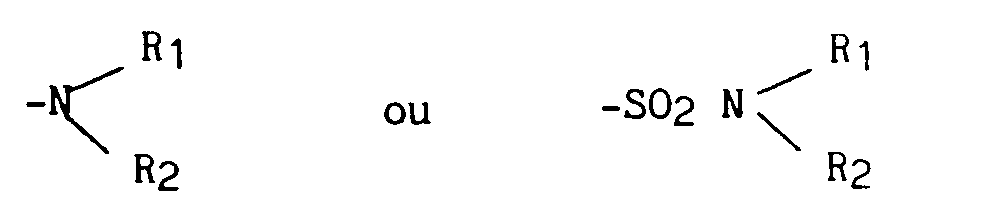

- m est un nombre de 1 à 3 et R' et R'', identiques ou différents, représentent chacun un atome d'hydrogène ou un radical alkyle ayant de 1 à 5 atomes de carbone en chaîne droite ou ramifiée ;
X représente un atome d'oxygène, -CONR- ou -SO₂NR- dans lesquelles R représente un atome d'hydrogène ou un radical alkyle de 1 à 5 atomes de carbone en chaine droite ou ramifiée renfermant éventuellement une double liaison,
ou, lorsque A représente une liaison simple et Ar un radical phényle, R représente aussi un radical carbonyl relié à Ar par sa liaison libre de façon à ce que l'ensemble Ar-A-X forme un radical phtalimido ;
B représente une chaine hydrocarbonée saturée de 1 à 6 atomes de carbone éventuellement ramifiée et/ou substituée par un radical hydroxy ou un radical oxo ;
et,
leurs énantiomères et diastéréoisomères, ainsi que leurs sels d'addition à un acide pharmaceutiquement acceptable.
A) l'on fait réagir un composé de formule II :


B) l'on fait réagir un composé de formule IV :
Ar-A-X' (IV)
dans laquelle :

Applications Claiming Priority (2)
| Application Number | Priority Date | Filing Date | Title |
|---|---|---|---|
| FR9212123A FR2696743B1 (fr) | 1992-10-12 | 1992-10-12 | Nouveaux composés de thiazolidine dione, leur procédé de préparation et les compositions pharmaceutiques les contenant. |
| FR9212123 | 1992-10-12 |
Publications (2)
| Publication Number | Publication Date |
|---|---|
| EP0593348A1 true EP0593348A1 (fr) | 1994-04-20 |
| EP0593348B1 EP0593348B1 (fr) | 1998-03-25 |
Family
ID=9434401
Family Applications (1)
| Application Number | Title | Priority Date | Filing Date |
|---|---|---|---|
| EP93402497A Expired - Lifetime EP0593348B1 (fr) | 1992-10-12 | 1993-10-11 | Dérivés de thiazolidin-2,4-dione, leur procédé de préparation et les compositions pharmaceutiques les contenant |
Country Status (12)
| Country | Link |
|---|---|
| EP (1) | EP0593348B1 (fr) |
| JP (1) | JP2948076B2 (fr) |
| AT (1) | ATE164374T1 (fr) |
| AU (1) | AU662658B2 (fr) |
| CA (1) | CA2108064C (fr) |
| DE (1) | DE69317621T2 (fr) |
| DK (1) | DK0593348T3 (fr) |
| ES (1) | ES2117114T3 (fr) |
| FR (1) | FR2696743B1 (fr) |
| GR (1) | GR3026633T3 (fr) |
| NZ (1) | NZ248905A (fr) |
| ZA (1) | ZA937552B (fr) |
Cited By (3)
| Publication number | Priority date | Publication date | Assignee | Title |
|---|---|---|---|---|
| WO1998052946A1 (fr) * | 1997-12-02 | 1998-11-26 | Dr. Reddy's Research Foundation | Azolidinediones utilises dans le traitement du diabetes, de la dyslipidemie et de l'hypertension |
| EP0787725B1 (fr) * | 1994-10-20 | 2003-04-23 | Nippon Chemiphar Co., Ltd. | Derive de quinoline |
| CZ300933B6 (cs) * | 1998-09-14 | 2009-09-16 | Dr. Reddy's Laboratories Limited | Zpusob prípravy 5-[4-[[3-methyl-4-oxo-3,4-dihydrochinazolin-2-yl]methoxy]benzyl]thiazolidin-2,4-dionu |
Families Citing this family (3)
| Publication number | Priority date | Publication date | Assignee | Title |
|---|---|---|---|---|
| JP3906935B2 (ja) * | 1995-12-18 | 2007-04-18 | 杏林製薬株式会社 | N−置換ジオキソチアゾリジルベンズアミド誘導体及びその製造法 |
| US6121288A (en) * | 1996-11-08 | 2000-09-19 | Nippon Chemiphar Co., Ltd. | Visceral fat lowering agent |
| PL2220030T3 (pl) * | 2007-11-06 | 2016-07-29 | Bioelectron Tech Corp | Pochodne 4-(p-chinonylo)-2-hydroksybutanamidu do leczenia chorób mitochondrialnych |
Citations (2)
| Publication number | Priority date | Publication date | Assignee | Title |
|---|---|---|---|---|
| EP0332332A1 (fr) * | 1988-03-08 | 1989-09-13 | Pfizer Inc. | Thiazolidinediones à activité hypoglycémique |
| EP0332331A2 (fr) * | 1988-03-08 | 1989-09-13 | Pfizer Inc. | Thiazolidine diones comme agents hypoglycémiques |
Family Cites Families (6)
| Publication number | Priority date | Publication date | Assignee | Title |
|---|---|---|---|---|
| JPS5522636A (en) * | 1978-08-04 | 1980-02-18 | Takeda Chem Ind Ltd | Thiazoliding derivative |
| DK173350B1 (da) * | 1985-02-26 | 2000-08-07 | Sankyo Co | Thiazolidinderivater, deres fremstilling og farmaceutisk paæparat indeholdende dem |
| WO1989008652A1 (fr) * | 1988-03-08 | 1989-09-21 | Pfizer Inc. | Derives de thiazolidinedione comme agents hypoglycemiques |
| GB8919434D0 (en) * | 1989-08-25 | 1989-10-11 | Beecham Group Plc | Novel compounds |
| US5143930A (en) * | 1990-02-07 | 1992-09-01 | Sankyo Company, Limited | Thiazolidine derivatives with anti-diabetic activity, their preparation and their use |
| GB9023584D0 (en) * | 1990-10-30 | 1990-12-12 | Beecham Group Plc | Novel compounds |
-
1992
- 1992-10-12 FR FR9212123A patent/FR2696743B1/fr not_active Expired - Fee Related
-
1993
- 1993-10-08 CA CA002108064A patent/CA2108064C/fr not_active Expired - Fee Related
- 1993-10-11 DK DK93402497T patent/DK0593348T3/da active
- 1993-10-11 ES ES93402497T patent/ES2117114T3/es not_active Expired - Lifetime
- 1993-10-11 EP EP93402497A patent/EP0593348B1/fr not_active Expired - Lifetime
- 1993-10-11 AT AT93402497T patent/ATE164374T1/de not_active IP Right Cessation
- 1993-10-11 NZ NZ248905A patent/NZ248905A/en unknown
- 1993-10-11 DE DE69317621T patent/DE69317621T2/de not_active Expired - Fee Related
- 1993-10-11 AU AU48905/93A patent/AU662658B2/en not_active Ceased
- 1993-10-12 ZA ZA937552A patent/ZA937552B/xx unknown
- 1993-10-12 JP JP5287220A patent/JP2948076B2/ja not_active Expired - Lifetime
-
1998
- 1998-04-14 GR GR980400832T patent/GR3026633T3/el unknown
Patent Citations (2)
| Publication number | Priority date | Publication date | Assignee | Title |
|---|---|---|---|---|
| EP0332332A1 (fr) * | 1988-03-08 | 1989-09-13 | Pfizer Inc. | Thiazolidinediones à activité hypoglycémique |
| EP0332331A2 (fr) * | 1988-03-08 | 1989-09-13 | Pfizer Inc. | Thiazolidine diones comme agents hypoglycémiques |
Non-Patent Citations (2)
| Title |
|---|
| BERNARD HULIN ET AL: "Novel thiazolidine-2,4-diones as potent euglycemic agents", JOURNAL OF MEDICINAL CHEMISTRY, vol. 35, no. 10, 15 May 1992 (1992-05-15), WASHINGTON US, pages 1853 - 1864 * |
| TAKASHI SOHDA ET AL: "Studies on antidiabetic agents.II.Synthesis of 5-[4-(1-methylcyclohexylmethoxy)-benzyl]thiazolidine-2,4-dione(ADD-3878) and its derivatives", CHEMICAL AND PHARMACEUTICAL BULLETIN., vol. 30, no. 10, October 1982 (1982-10-01), TOKYO JP, pages 3580 - 3600 * |
Cited By (3)
| Publication number | Priority date | Publication date | Assignee | Title |
|---|---|---|---|---|
| EP0787725B1 (fr) * | 1994-10-20 | 2003-04-23 | Nippon Chemiphar Co., Ltd. | Derive de quinoline |
| WO1998052946A1 (fr) * | 1997-12-02 | 1998-11-26 | Dr. Reddy's Research Foundation | Azolidinediones utilises dans le traitement du diabetes, de la dyslipidemie et de l'hypertension |
| CZ300933B6 (cs) * | 1998-09-14 | 2009-09-16 | Dr. Reddy's Laboratories Limited | Zpusob prípravy 5-[4-[[3-methyl-4-oxo-3,4-dihydrochinazolin-2-yl]methoxy]benzyl]thiazolidin-2,4-dionu |
Also Published As
| Publication number | Publication date |
|---|---|
| NZ248905A (en) | 1994-12-22 |
| EP0593348B1 (fr) | 1998-03-25 |
| DE69317621D1 (de) | 1998-04-30 |
| ES2117114T3 (es) | 1998-08-01 |
| CA2108064A1 (fr) | 1994-04-13 |
| ATE164374T1 (de) | 1998-04-15 |
| FR2696743B1 (fr) | 1994-12-23 |
| DE69317621T2 (de) | 1998-10-15 |
| CA2108064C (fr) | 2001-10-23 |
| AU4890593A (en) | 1994-04-28 |
| GR3026633T3 (en) | 1998-07-31 |
| JP2948076B2 (ja) | 1999-09-13 |
| ZA937552B (en) | 1994-05-02 |
| FR2696743A1 (fr) | 1994-04-15 |
| DK0593348T3 (da) | 1999-01-11 |
| JPH07309852A (ja) | 1995-11-28 |
| AU662658B2 (en) | 1995-09-07 |
Similar Documents
| Publication | Publication Date | Title |
|---|---|---|
| EP0528734B1 (fr) | Dérivés de 2,4-thiazolidinedione, leur procédé de préparation et les compositions pharmaceutiques qui les contiennent | |
| CA2029703C (fr) | Agents hypoglycemiques de type oxazolidinedione | |
| CN1040324C (zh) | 新的噻唑烷二酮及含有这些化合物的药剂 | |
| US5478853A (en) | Thazolidinedione compounds | |
| EP0659747B1 (fr) | Dérivés amino ramifiés du thiazole, leurs procédés de préparation et les compositions pharmaceutiques qui les contiennent | |
| JPH05508654A (ja) | 血糖低下性ヒドロキシ尿素誘導体 | |
| EP0833822A1 (fr) | Derives de 4-phenylaminothiazole, leur procede de preparation et les compositions pharmaceutiques les contenant | |
| EP0389699B1 (fr) | Thiazolidinediones comme agents hypoglycémiques | |
| FR2967674A1 (fr) | Derives d'heteroarylsulfonamides, leur preparation et leur application en therapeutique humaine | |
| EP0109866B1 (fr) | Nouveaux dérivés de la sulfonylurée, leurs procédés de préparation et les compositions pharmaceutiques les renfermant | |
| EP1502590B1 (fr) | Dérivés d'oximes hétérocycliques, leur procédé de préparation et leur utilisation dans le traitement du diabète de type II | |
| EP0543713B1 (fr) | Nouveaux dérivés de benzoate d'éthanolamine, leur procédé de préparation et les compositions pharmaceutiques les renfermant | |
| EP0593348B1 (fr) | Dérivés de thiazolidin-2,4-dione, leur procédé de préparation et les compositions pharmaceutiques les contenant | |
| JP4728484B2 (ja) | 多環2−アミノチアゾール系、その製造方法およびそれを含む医薬 | |
| EP0463944B1 (fr) | Acyl benzoxazolinones, leur procédé de préparation et les compositions pharmaceutiques qui les contiennent | |
| US5506245A (en) | Thiazolidinedione compounds | |
| EP0559571A1 (fr) | Nouveaux dérivés de thiazolidine-2,4-dione, leur procédé de préparation et les compositions pharmaceutiques qui les contiennent | |
| EP0669322A1 (fr) | Nouvelles sulfonamides substituées, leur procédé de préparation et les compositions pharmaceutiques les renfermant | |
| WO2007003767A2 (fr) | Nouveaux composes chimiques et leurs utilisations comme medicament pour des maladies neurodegeneratives | |
| EP0430800B1 (fr) | Nouvelles benzothiazolinones substituées, leur procédé de préparation et les compositions pharmaceutiques qui les contiennent | |
| EP1413579B1 (fr) | Dérivés de l'imidazoline, leur procédé de préparation et les compositions pharmaceutiques qui les contiennent | |
| CA2596156A1 (fr) | Nouveaux derives d'oximes heterocycliques, leur procede de preparation et les compositions pharmaceutiques qui les contiennent | |
| FR2898125A1 (fr) | Nouveaux derives heterocycliques cycloalkyles, leur procede de preparation et les compositions pharmaceutiques qui les contiennent | |
| WO2004043947A1 (fr) | Nouveau derives de la pyridine, leur procede de preparation et l es compositions pharmaceutiques quiles contiennent |
Legal Events
| Date | Code | Title | Description |
|---|---|---|---|
| PUAI | Public reference made under article 153(3) epc to a published international application that has entered the european phase |
Free format text: ORIGINAL CODE: 0009012 |
|
| 17P | Request for examination filed |
Effective date: 19931015 |
|
| AK | Designated contracting states |
Kind code of ref document: A1 Designated state(s): AT BE CH DE DK ES FR GB GR IE IT LI LU NL PT SE |
|
| 17Q | First examination report despatched |
Effective date: 19950921 |
|
| GRAG | Despatch of communication of intention to grant |
Free format text: ORIGINAL CODE: EPIDOS AGRA |
|
| GRAG | Despatch of communication of intention to grant |
Free format text: ORIGINAL CODE: EPIDOS AGRA |
|
| GRAH | Despatch of communication of intention to grant a patent |
Free format text: ORIGINAL CODE: EPIDOS IGRA |
|
| GRAH | Despatch of communication of intention to grant a patent |
Free format text: ORIGINAL CODE: EPIDOS IGRA |
|
| GRAA | (expected) grant |
Free format text: ORIGINAL CODE: 0009210 |
|
| ITF | It: translation for a ep patent filed | ||
| AK | Designated contracting states |
Kind code of ref document: B1 Designated state(s): AT BE CH DE DK ES FR GB GR IE IT LI LU NL PT SE |
|
| REF | Corresponds to: |
Ref document number: 164374 Country of ref document: AT Date of ref document: 19980415 Kind code of ref document: T |
|
| REG | Reference to a national code |
Ref country code: CH Ref legal event code: NV Representative=s name: A. BRAUN, BRAUN, HERITIER, ESCHMANN AG PATENTANWAE Ref country code: CH Ref legal event code: EP |
|
| REF | Corresponds to: |
Ref document number: 69317621 Country of ref document: DE Date of ref document: 19980430 |
|
| GBT | Gb: translation of ep patent filed (gb section 77(6)(a)/1977) |
Effective date: 19980624 |
|
| REG | Reference to a national code |
Ref country code: IE Ref legal event code: FG4D Free format text: 79467 |
|
| REG | Reference to a national code |
Ref country code: PT Ref legal event code: SC4A Free format text: AVAILABILITY OF NATIONAL TRANSLATION Effective date: 19980326 |
|
| REG | Reference to a national code |
Ref country code: ES Ref legal event code: FG2A Ref document number: 2117114 Country of ref document: ES Kind code of ref document: T3 |
|
| REG | Reference to a national code |
Ref country code: DK Ref legal event code: T3 |
|
| PLBE | No opposition filed within time limit |
Free format text: ORIGINAL CODE: 0009261 |
|
| STAA | Information on the status of an ep patent application or granted ep patent |
Free format text: STATUS: NO OPPOSITION FILED WITHIN TIME LIMIT |
|
| 26N | No opposition filed | ||
| PGFP | Annual fee paid to national office [announced via postgrant information from national office to epo] |
Ref country code: SE Payment date: 20010620 Year of fee payment: 9 |
|
| PGFP | Annual fee paid to national office [announced via postgrant information from national office to epo] |
Ref country code: GR Payment date: 20010622 Year of fee payment: 9 |
|
| PGFP | Annual fee paid to national office [announced via postgrant information from national office to epo] |
Ref country code: LU Payment date: 20010629 Year of fee payment: 9 |
|
| PGFP | Annual fee paid to national office [announced via postgrant information from national office to epo] |
Ref country code: IE Payment date: 20010704 Year of fee payment: 9 |
|
| PGFP | Annual fee paid to national office [announced via postgrant information from national office to epo] |
Ref country code: FR Payment date: 20010712 Year of fee payment: 9 Ref country code: BE Payment date: 20010712 Year of fee payment: 9 |
|
| PGFP | Annual fee paid to national office [announced via postgrant information from national office to epo] |
Ref country code: NL Payment date: 20010717 Year of fee payment: 9 |
|
| PGFP | Annual fee paid to national office [announced via postgrant information from national office to epo] |
Ref country code: AT Payment date: 20010806 Year of fee payment: 9 |
|
| PGFP | Annual fee paid to national office [announced via postgrant information from national office to epo] |
Ref country code: PT Payment date: 20010808 Year of fee payment: 9 |
|
| PGFP | Annual fee paid to national office [announced via postgrant information from national office to epo] |
Ref country code: DE Payment date: 20010821 Year of fee payment: 9 |
|
| PGFP | Annual fee paid to national office [announced via postgrant information from national office to epo] |
Ref country code: CH Payment date: 20010928 Year of fee payment: 9 |
|
| PGFP | Annual fee paid to national office [announced via postgrant information from national office to epo] |
Ref country code: DK Payment date: 20011010 Year of fee payment: 9 Ref country code: GB Payment date: 20011010 Year of fee payment: 9 |
|
| PGFP | Annual fee paid to national office [announced via postgrant information from national office to epo] |
Ref country code: ES Payment date: 20011016 Year of fee payment: 9 |
|
| REG | Reference to a national code |
Ref country code: CH Ref legal event code: PFA Free format text: ADIR ET COMPAGNIE TRANSFER- LES LABORATOIRES SERVIER |
|
| REG | Reference to a national code |
Ref country code: FR Ref legal event code: TP |
|
| REG | Reference to a national code |
Ref country code: GB Ref legal event code: 732E |
|
| REG | Reference to a national code |
Ref country code: GB Ref legal event code: IF02 |
|
| NLS | Nl: assignments of ep-patents |
Owner name: LES LABORATOIRES SERVIER |
|
| REG | Reference to a national code |
Ref country code: PT Ref legal event code: PC4A Free format text: LES LABORATOIRES SERVIER FR Effective date: 20011105 |
|
| PG25 | Lapsed in a contracting state [announced via postgrant information from national office to epo] |
Ref country code: LU Free format text: LAPSE BECAUSE OF NON-PAYMENT OF DUE FEES Effective date: 20021011 Ref country code: IE Free format text: LAPSE BECAUSE OF NON-PAYMENT OF DUE FEES Effective date: 20021011 Ref country code: GB Free format text: LAPSE BECAUSE OF NON-PAYMENT OF DUE FEES Effective date: 20021011 Ref country code: AT Free format text: LAPSE BECAUSE OF NON-PAYMENT OF DUE FEES Effective date: 20021011 |
|
| PG25 | Lapsed in a contracting state [announced via postgrant information from national office to epo] |
Ref country code: SE Free format text: LAPSE BECAUSE OF NON-PAYMENT OF DUE FEES Effective date: 20021012 Ref country code: ES Free format text: LAPSE BECAUSE OF NON-PAYMENT OF DUE FEES Effective date: 20021012 |
|
| PG25 | Lapsed in a contracting state [announced via postgrant information from national office to epo] |
Ref country code: LI Free format text: LAPSE BECAUSE OF NON-PAYMENT OF DUE FEES Effective date: 20021031 Ref country code: DK Free format text: LAPSE BECAUSE OF NON-PAYMENT OF DUE FEES Effective date: 20021031 Ref country code: CH Free format text: LAPSE BECAUSE OF NON-PAYMENT OF DUE FEES Effective date: 20021031 Ref country code: BE Free format text: LAPSE BECAUSE OF NON-PAYMENT OF DUE FEES Effective date: 20021031 |
|
| BERE | Be: lapsed |
Owner name: LES LABORATOIRES *SERVIER Effective date: 20021031 |
|
| PG25 | Lapsed in a contracting state [announced via postgrant information from national office to epo] |
Ref country code: PT Free format text: LAPSE BECAUSE OF NON-PAYMENT OF DUE FEES Effective date: 20030430 |
|
| PG25 | Lapsed in a contracting state [announced via postgrant information from national office to epo] |
Ref country code: NL Free format text: LAPSE BECAUSE OF NON-PAYMENT OF DUE FEES Effective date: 20030501 Ref country code: DE Free format text: LAPSE BECAUSE OF NON-PAYMENT OF DUE FEES Effective date: 20030501 |
|
| PG25 | Lapsed in a contracting state [announced via postgrant information from national office to epo] |
Ref country code: GR Free format text: LAPSE BECAUSE OF NON-PAYMENT OF DUE FEES Effective date: 20030506 |
|
| EUG | Se: european patent has lapsed | ||
| GBPC | Gb: european patent ceased through non-payment of renewal fee |
Effective date: 20021011 |
|
| REG | Reference to a national code |
Ref country code: DK Ref legal event code: EBP |
|
| REG | Reference to a national code |
Ref country code: CH Ref legal event code: PL |
|
| PG25 | Lapsed in a contracting state [announced via postgrant information from national office to epo] |
Ref country code: FR Free format text: LAPSE BECAUSE OF NON-PAYMENT OF DUE FEES Effective date: 20030630 |
|
| NLV4 | Nl: lapsed or anulled due to non-payment of the annual fee |
Effective date: 20030501 |
|
| REG | Reference to a national code |
Ref country code: IE Ref legal event code: MM4A |
|
| REG | Reference to a national code |
Ref country code: FR Ref legal event code: ST |
|
| REG | Reference to a national code |
Ref country code: ES Ref legal event code: FD2A Effective date: 20031112 |
|
| PG25 | Lapsed in a contracting state [announced via postgrant information from national office to epo] |
Ref country code: IT Free format text: LAPSE BECAUSE OF NON-PAYMENT OF DUE FEES;WARNING: LAPSES OF ITALIAN PATENTS WITH EFFECTIVE DATE BEFORE 2007 MAY HAVE OCCURRED AT ANY TIME BEFORE 2007. THE CORRECT EFFECTIVE DATE MAY BE DIFFERENT FROM THE ONE RECORDED. Effective date: 20051011 |