EP0593843A2 - Améliorations dans les systèmes de transmission de relais de trame - Google Patents
Améliorations dans les systèmes de transmission de relais de trame Download PDFInfo
- Publication number
- EP0593843A2 EP0593843A2 EP19930104002 EP93104002A EP0593843A2 EP 0593843 A2 EP0593843 A2 EP 0593843A2 EP 19930104002 EP19930104002 EP 19930104002 EP 93104002 A EP93104002 A EP 93104002A EP 0593843 A2 EP0593843 A2 EP 0593843A2
- Authority
- EP
- European Patent Office
- Prior art keywords
- atm
- bandwidth
- frame relay
- unit
- frame
- Prior art date
- Legal status (The legal status is an assumption and is not a legal conclusion. Google has not performed a legal analysis and makes no representation as to the accuracy of the status listed.)
- Withdrawn
Links
Images

Classifications
-
- H—ELECTRICITY
- H04—ELECTRIC COMMUNICATION TECHNIQUE
- H04Q—SELECTING
- H04Q11/00—Selecting arrangements for multiplex systems
- H04Q11/04—Selecting arrangements for multiplex systems for time-division multiplexing
- H04Q11/0428—Integrated services digital network, i.e. systems for transmission of different types of digitised signals, e.g. speech, data, telecentral, television signals
- H04Q11/0478—Provisions for broadband connections
-
- H—ELECTRICITY
- H04—ELECTRIC COMMUNICATION TECHNIQUE
- H04L—TRANSMISSION OF DIGITAL INFORMATION, e.g. TELEGRAPHIC COMMUNICATION
- H04L12/00—Data switching networks
- H04L12/66—Arrangements for connecting between networks having differing types of switching systems, e.g. gateways
-
- H—ELECTRICITY
- H04—ELECTRIC COMMUNICATION TECHNIQUE
- H04L—TRANSMISSION OF DIGITAL INFORMATION, e.g. TELEGRAPHIC COMMUNICATION
- H04L12/00—Data switching networks
- H04L12/54—Store-and-forward switching systems
- H04L12/56—Packet switching systems
- H04L12/5601—Transfer mode dependent, e.g. ATM
- H04L2012/5619—Network Node Interface, e.g. tandem connections, transit switching
-
- H—ELECTRICITY
- H04—ELECTRIC COMMUNICATION TECHNIQUE
- H04L—TRANSMISSION OF DIGITAL INFORMATION, e.g. TELEGRAPHIC COMMUNICATION
- H04L12/00—Data switching networks
- H04L12/54—Store-and-forward switching systems
- H04L12/56—Packet switching systems
- H04L12/5601—Transfer mode dependent, e.g. ATM
- H04L2012/5629—Admission control
- H04L2012/5631—Resource management and allocation
- H04L2012/5632—Bandwidth allocation
-
- H—ELECTRICITY
- H04—ELECTRIC COMMUNICATION TECHNIQUE
- H04L—TRANSMISSION OF DIGITAL INFORMATION, e.g. TELEGRAPHIC COMMUNICATION
- H04L12/00—Data switching networks
- H04L12/54—Store-and-forward switching systems
- H04L12/56—Packet switching systems
- H04L12/5601—Transfer mode dependent, e.g. ATM
- H04L2012/5638—Services, e.g. multimedia, GOS, QOS
- H04L2012/5645—Connectionless
Definitions
- This invention relates to frame relay systems for data transmission.
- Frame relay transmission systems using existing protocols are perfectly satisfactory when used in systems dedicated exclusively to such protocols. With future transmission requirements, however, it is envisaged that a plurality of frame relay systems may need to be placed in mutual communication via a broadband network such as an asynchronous transfer mode (ATM) system.
- ATM asynchronous transfer mode
- Frame relay traffic is predominantly bursty data traffic although speech traffic may be included.
- bursty traffic requires high bandwidths for part of the time, and little or no bandwidth at other times.
- mean bandwidth allocation is used however, total peak bandwidth may at times be greater than the available bandwidth which is a serious problem. The problem is particularly apparent when a number of data transmission sources share the same path. Under these circumstances, if two or more of the transmission sources burst at the same time, they may require greater bandwidth than is instantaneously available in independent disparately distributed sources.
- a frame relay system includes an ATM inter-working unit via which signals for transmission to, or reception from, a remote frame relay system via an ATM network are routed, the unit comprising means for sending to the remote frame relay system a bandwidth request frame, means for assessing such a request frame in relation to available bandwidth and means for providing an appropriate response.
- the bandwidth request frame may comprise data appertaining to at least four parameters, such parameters being specified as; committed information rate (CIR); committed burst size (Bc), excess burst size (Be) and a time interval over which Bc and Be are measured (dt).
- CIR committed information rate
- Bc committed burst size
- Be excess burst size
- dt time interval over which Bc and Be are measured
- the interworking unit may comprise a management unit including a store for the parameters CIR, Bc and Be, a bandwidth comparator responsive to the store which indicates available bandwidth and responsive also to bandwidth requests for making the appropriate response.
- the appropriate response will be determined in dependence upon the said request and the available bandwidth, these being provided for allocating bandwidth and sending an appropriate acknowledgement, or rejecting a request, or changing a request in accordance with the bandwidth available when a request is received.
- Frame relay systems operate in accordance with a protocol which specifies an address header of pre-determined size, associated with a data packet of generally indeterminate size
- ATM systems operate in accordance with a protocol which specifies a fixed header size associated with a data packet of pre-determined size.
- the ATM inter-working unit thus comprises an ATM segmentation unit used to convert frame relay packets to corresponding ATM packets for the transmission of data from frame relay to ATM and an ATM re-assembly unit for performing a reverse function to facilitate the transmission of data from ATM to frame relay.
- the ATM segmentation unit may be fed from a frame buffer store, the management unit being responsive to the frame buffer store and to the ATM re-assembly unit for, on the one hand received bandwidth request allocation, and on the other hand, bandwidth requests/rejections and acknowledgements.
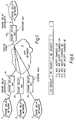
- each frame relay network is provided with a frame relay inter-working unit (IWU) whereby, as shown in Figure 1, the frame relay networks 1, 2, 3 and 4 have operatively associated with them, frame relay interworking units 1a, 2a, 3a and 4a respectively.
- IWU frame relay inter-working unit
- Frame relay connections across a broadband ATM network form permanent virtual circuits (PVCs) which are bi-directional and can only be set up by off-line contact with a system controller.
- the frames are encapsulated within a broadband datagram packet and then segmented. The segments are transmitted across the network. Because it has been encapsulated, the frame relay protocol takes no part in transmission across the broadband network.
- Each frame relay interface both sending and receiving, has a maximum bandwidth of 2 Mbps.
- the connection across the broadband network must also have a maximum bandwidth of 2 Mbps each in order to allow the frame relay connections to work to their full efficiency.
- FRACA Frame Relay Access for Congestion Avoidance
- the IWUs may limit the bandwidth they can use between each other to less than 2 Mbps for a single connection.
- the receiving IWU will want to limit the bandwidth that may be received at the fan-in point to 2 Mbps. Therefore initially at PVC establishment the broadband network will allocate 2 Mbps each to the PVCs. The frame relay network will allocate zero or very little bandwidth to each PVC.
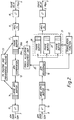
- each of the frame relay inter-working units comprises a path between an input line 6, and an output line 7, for the transmission of data from a frame relay network, to the ATM network and a path from input line 8 to output line 9 for the transmission of data in the opposite direction from the ATM network to a frame relay network.
- the path between the lines 6 and 7 comprises a line termination unit 10, and a high-level data-line controller 11, which feed a frame buffer store 12, and perform a line termination and frame-forming function.
- the frame buffer 12 is arranged to feed an ATM segmentation unit 13, which segments the frame relay data so as to convert it to an ATM form. Data in the ATM form is then stored in a large ATM buffer 14, and transmitted to the output line 7 via a line termination unit 15.
- a frame relay policing and preventative policing unit 23 which checks the frames in the large ATM buffer 14, and in the frame buffer 12 and if necessary deletes frames if a pre-determined number is exceeded.
- data on the input line 8 from the ATM network is fed via a line termination unit 16, and a large ATM buffer 17, to an ATM re-assembly unit 18.
- the ATM re-assembly unit serves to convert data in an ATM format to corresponding frame relay format which data is then transmitted to frame buffers 19, 20 and 21, the frame buffers being fed with appropriate address information from a translation function unit 22, which is responsive to the ATM address data and provides a translation facility, for example from a look-up table.
- each frame relay inter-working unit such as the frame relay inter-working unit 4a, as shown in Figure 2 is provided with a frame relay access for congestion avoidance (FRACA) allocation management unit 24, as shown in Figure 2.
- FRACA frame relay access for congestion avoidance
- the management unit 24, is responsive to the frame buffer 12 and to the ATM re-assembly unit 18 as will hereinafter be explained with reference to Figure 3, for the allocation of bandwidth to facilitate reception and for the generation of bandwidth requests to facilitate transmission.
- lines 25 and 26a and 26b are shown which couple the FRACA allocation unit 24 to the ATM re-assembly unit 18 and the frame buffer 12 respectively. These lines 25, 26a and 26b are shown also in Figure 3.
- receive bandwidth allocation request frames are fed via the line 25 to a bandwidth comparator 27, which compares the available bandwidth as indicated by data stored in a bandwidth allocation table 28, which includes data appertaining to the parameters CIR, Bc and Be, with the bandwidth required. If there is sufficient available bandwidth an appropriate signal is sent via line 29 to a bandwidth allocator 30, which sends an acknowledgement on the line 26b to confirm that the bandwidth is available and also sends a signal via a line 31 to the bandwidth allocation table 28 to update the data therein so that it correctly reflects the new available bandwidth.
- a signal is sent via line 32 to a change request or reject request unit 33, which either requests a change of requirement via a line 34 or rejects the bandwidth request by sending an appropriate signal via the line 35.
- bandwidth is required to facilitate transmission then a request bandwidth signal is sent via a line 36 to a request frame compilation unit 37, which generates a request frame which is transmitted via a line 38.
- send acknowledgement signals, bandwidth request signals and bandwidth request rejection signals are all fed via the line 26b to the frame buffer 12, while bandwidth requests are sent from the frame buffer 12 to the FRACA allocation management unit 12 via the line 26a.
- the line 25 serves only for receive bandwidth allocation requests.
- CIR Committed Information Rate
- Bc Committed Burst size
- Time dt is the time interval over which Bc and Be are measured.
- an IWU When an IWU has a data burst it wants to send, it first sends a bandwidth request frame to the receiving IWU which contains the four parameters CIR, Bc, Be, dt. These standard parameters are defined in ANSI T1.607.
- the receiving IWU checks the amount of CIR bandwidth it has already allocated and if the amount requested does not exceed 2 Mbps, it allocates the CIR. If Be is also requested the IWU may accept the request although the total bandwidth requested between CIR and Be is over 2 Mbps. This is because data sent under the Be parameter is not guaranteed to be passed across the network. It may be deleted if the network is congested.
- the parameters are usually only changed for a specific PVC at call establishment, however the bandwidth request may now use different values of the parameters for each request.
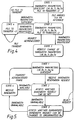
- the protocol may offer unguaranteed bandwidth in place of some or all of the guaranteed bandwidth requested, as shown in State 3 of figure 5. This provides a best effort service which may be sufficient for some applications. Alternatively, a user may accept the best offer and attempt by repeated requests to increase the guaranteed component of the allocated bandwidth and reduce the unguaranteed component of the bandwidth.
- the time taken to send a bandwidth request and receive a reply is called the round trip delay.
- a data burst which may take 10 ms to send across the broadband network may take 50 ms in round trip delay to set up. Therefore bandwidth may be reserved but unused. The unused bandwidth may be used by the Be parameter so improving the utilisation of bandwidth and hence the allocation method.
- the bandwidth may be set up across the broadband network by using a broadband packet to transmit the information, however as the bandwidth reservation is taking place for the benefit of the frame relay network efficiency, a frame relay network message format should be used as the requesting mechanism.
- a method of network signalling for frame relay across broadband networks has not yet been proposed to the standards bodies and so a definitive requesting mechanism is not yet available..
- the Local Management Interface LMI
- a new report type will be required and the information required is as shown in Figure 6.
- a zero in either the C or E positions indicates that the requesting user will not accept changes to the request and therefore the request is either accepted or rejected.
- a frame relay system having a dynamic bandwidth allocation scheme has the following advantages; It removes the possibility of being unable to guarantee bandwidth to a number of connections; It avoids congestion caused by the fan-in of a number of connections; It allows unused but reserved bandwidth to be used by unguaranteed data transfer, and It increases the utilisation of each inter-frame relay broadband connection.
Landscapes
- Engineering & Computer Science (AREA)
- Computer Networks & Wireless Communication (AREA)
- Signal Processing (AREA)
- Data Exchanges In Wide-Area Networks (AREA)
Applications Claiming Priority (2)
| Application Number | Priority Date | Filing Date | Title |
|---|---|---|---|
| GB9222204A GB2271911A (en) | 1992-10-22 | 1992-10-22 | Improvements in or relating to frame relay data transmission systems |
| GB9222204 | 1992-10-22 |
Publications (1)
| Publication Number | Publication Date |
|---|---|
| EP0593843A2 true EP0593843A2 (fr) | 1994-04-27 |
Family
ID=10723876
Family Applications (1)
| Application Number | Title | Priority Date | Filing Date |
|---|---|---|---|
| EP19930104002 Withdrawn EP0593843A2 (fr) | 1992-10-22 | 1993-03-12 | Améliorations dans les systèmes de transmission de relais de trame |
Country Status (3)
| Country | Link |
|---|---|
| EP (1) | EP0593843A2 (fr) |
| JP (1) | JPH06152635A (fr) |
| GB (1) | GB2271911A (fr) |
Cited By (4)
| Publication number | Priority date | Publication date | Assignee | Title |
|---|---|---|---|---|
| WO1996010876A1 (fr) * | 1994-10-04 | 1996-04-11 | Telia Ab | Dispositif permettant de regler la capacite d'un reseau de telecommunications |
| WO1996019886A3 (fr) * | 1994-12-21 | 1996-09-06 | Nokia Telecommunications Oy | Procede pour signaler la congestion du trafic dans un reseau mta a un reseau a repetition de trame |
| WO1997025831A1 (fr) * | 1996-01-11 | 1997-07-17 | Cisco Systems, Inc. | Mise en file d'attente et prise en charge de trames par voie dans le sens de sortie d'un reseau de telecommunications |
| GB2339118A (en) * | 1998-01-28 | 2000-01-12 | Northern Telecom Ltd | Cell to frame conversion management |
Families Citing this family (3)
| Publication number | Priority date | Publication date | Assignee | Title |
|---|---|---|---|---|
| US4860108A (en) * | 1986-12-29 | 1989-08-22 | Minolta Camera Kabushiki Kaisha | Image sensing device for an electronic still camera |
| GB2310972B (en) * | 1996-03-07 | 2000-06-14 | Motorola Ltd | Communication system and operating method thereof |
| JPH10135964A (ja) * | 1996-10-28 | 1998-05-22 | Fujitsu Ltd | ネットワークシステム及びフレームリレー交換機 |
Family Cites Families (2)
| Publication number | Priority date | Publication date | Assignee | Title |
|---|---|---|---|---|
| CA2038646C (fr) * | 1990-03-20 | 1995-02-07 | Katsumi Oomuro | Systeme de communication mta avec controle optimal du traffic en effectuant le changement de la bande allouee |
| DE69130853T2 (de) * | 1990-11-21 | 1999-07-22 | At & T Corp., New York, N.Y. | Bandbreitenverwaltung und Überlastabwehr für den Zugang zu Breitband-ISDN-Netzen |
-
1992
- 1992-10-22 GB GB9222204A patent/GB2271911A/en not_active Withdrawn
-
1993
- 1993-03-12 EP EP19930104002 patent/EP0593843A2/fr not_active Withdrawn
- 1993-04-22 JP JP9618893A patent/JPH06152635A/ja active Pending
Cited By (7)
| Publication number | Priority date | Publication date | Assignee | Title |
|---|---|---|---|---|
| WO1996010876A1 (fr) * | 1994-10-04 | 1996-04-11 | Telia Ab | Dispositif permettant de regler la capacite d'un reseau de telecommunications |
| WO1996019886A3 (fr) * | 1994-12-21 | 1996-09-06 | Nokia Telecommunications Oy | Procede pour signaler la congestion du trafic dans un reseau mta a un reseau a repetition de trame |
| US6064648A (en) * | 1994-12-21 | 2000-05-16 | Nokia Telecommunications Oy | Method for notifying a frame relay network of traffic congestion in an ATM network |
| WO1997025831A1 (fr) * | 1996-01-11 | 1997-07-17 | Cisco Systems, Inc. | Mise en file d'attente et prise en charge de trames par voie dans le sens de sortie d'un reseau de telecommunications |
| US5765032A (en) * | 1996-01-11 | 1998-06-09 | Cisco Technology, Inc. | Per channel frame queuing and servicing in the egress direction of a communications network |
| GB2339118A (en) * | 1998-01-28 | 2000-01-12 | Northern Telecom Ltd | Cell to frame conversion management |
| US6252887B1 (en) | 1998-01-28 | 2001-06-26 | Northern Telecom Limited | Cell to frame conversion management |
Also Published As
| Publication number | Publication date |
|---|---|
| GB9222204D0 (en) | 1992-12-02 |
| JPH06152635A (ja) | 1994-05-31 |
| GB2271911A (en) | 1994-04-27 |
Similar Documents
| Publication | Publication Date | Title |
|---|---|---|
| US5448559A (en) | ATM communication system with interrogation of output port servers for available handing capacity | |
| EP0535860B1 (fr) | Contrôle de congestion dans des réseaux de paquets à haute vitesse | |
| DE69636786T2 (de) | Mehrdienste-MAC-Protokoll für drahtloses ATM-System | |
| EP0961522B1 (fr) | Nouveau procédé et dispositif de mise en forme du trafic dans un système d'access à large bande, basée sûr fibre optique | |
| CA2145821C (fr) | Ameliorations a ou en relation aux systemes de communications atm | |
| CA2184830C (fr) | Systeme de commutation a large bande | |
| US5784358A (en) | Broadband switching network with automatic bandwidth allocation in response to data cell detection | |
| US5448564A (en) | Modular architecture for fast-packet network | |
| EP0398037A2 (fr) | Réseau de paquet à affectation de ressources de communication et contrôle d'établissement des appels à une qualité de service plus élevée | |
| EP0596624A2 (fr) | Allocation de bande passante, ordonnancement de transmission et empêchement de congestion dans des réseaux à mode de transfert asynchrone et large bande | |
| KR100452952B1 (ko) | 비동기 전송방식 네트워크에서 데이터 셀 전송 스케줄링 방법 | |
| EP0904648B1 (fr) | Negociation flexible de largeur de bande pour transfert de donnees par bloc | |
| US6298049B1 (en) | Method and arrangement for upstream timeslot assignment, and communication system wherein the method is used | |
| JP2648443B2 (ja) | 非同期転送モードで動作する通信システムにおける交換技術上の資源を割当てる方法 | |
| CN1233121A (zh) | 控制访问通信网资源的方法 | |
| GB2271911A (en) | Improvements in or relating to frame relay data transmission systems | |
| US6512771B1 (en) | Transmission bandwidth sharing system | |
| GB2272820A (en) | Improvements in or relating to asynchronous transfer mode communication systems | |
| JP2814672B2 (ja) | 通信システムにおける帯域割り当て方法及び通信システム | |
| KR960004709B1 (ko) | 비동기 전송모드(atm)망에서 공용 대역을 이용한 전송 대역 할당 및 관리 방법 | |
| AU657176B2 (en) | Method and circuit for controlling access to an asynchronously oeprated network | |
| JPH06334680A (ja) | 通信方法 | |
| JP2626585B2 (ja) | 通信資源管理型パケット交換装置 | |
| US6853649B1 (en) | Method for controlling packet-oriented data forwarding via a coupling field | |
| KR970002719B1 (ko) | 랜(lan)간 접속을 위한 타임슬롯 방식의 가변대역 할당장치 및 그에 따른 가변대역 할당방법 |
Legal Events
| Date | Code | Title | Description |
|---|---|---|---|
| PUAI | Public reference made under article 153(3) epc to a published international application that has entered the european phase |
Free format text: ORIGINAL CODE: 0009012 |
|
| AK | Designated contracting states |
Kind code of ref document: A2 Designated state(s): AT BE CH DE DK ES FR GB GR IE IT LI LU MC NL PT SE |
|
| 18W | Application withdrawn |
Withdrawal date: 19940803 |