EP0594191A1 - Procédé pour enlever les fractions à bas poids moléculaire de polymères de polyarylène sulphide - Google Patents
Procédé pour enlever les fractions à bas poids moléculaire de polymères de polyarylène sulphide Download PDFInfo
- Publication number
- EP0594191A1 EP0594191A1 EP93117150A EP93117150A EP0594191A1 EP 0594191 A1 EP0594191 A1 EP 0594191A1 EP 93117150 A EP93117150 A EP 93117150A EP 93117150 A EP93117150 A EP 93117150A EP 0594191 A1 EP0594191 A1 EP 0594191A1
- Authority
- EP
- European Patent Office
- Prior art keywords
- polymer
- phase
- arylene sulfide
- molecular weight
- lean
- Prior art date
- Legal status (The legal status is an assumption and is not a legal conclusion. Google has not performed a legal analysis and makes no representation as to the accuracy of the status listed.)
- Granted
Links
- 229920000642 polymer Polymers 0.000 title claims abstract description 127
- -1 poly(arylene sulfide Chemical compound 0.000 title claims abstract description 103
- 238000000034 method Methods 0.000 title claims abstract description 48
- 230000008569 process Effects 0.000 title abstract description 22
- 239000012071 phase Substances 0.000 claims abstract description 89
- 150000002894 organic compounds Chemical class 0.000 claims abstract description 43
- 239000007791 liquid phase Substances 0.000 claims abstract description 36
- 238000009826 distribution Methods 0.000 claims abstract description 6
- 229920000069 polyphenylene sulfide Polymers 0.000 claims description 89
- XLYOFNOQVPJJNP-UHFFFAOYSA-N water Substances O XLYOFNOQVPJJNP-UHFFFAOYSA-N 0.000 claims description 78
- 229910001868 water Inorganic materials 0.000 claims description 69
- 239000000203 mixture Substances 0.000 claims description 37
- 229910052783 alkali metal Inorganic materials 0.000 claims description 18
- 239000000155 melt Substances 0.000 claims description 13
- NINIDFKCEFEMDL-UHFFFAOYSA-N Sulfur Chemical compound [S] NINIDFKCEFEMDL-UHFFFAOYSA-N 0.000 claims description 8
- 229910052717 sulfur Inorganic materials 0.000 claims description 8
- 239000011593 sulfur Substances 0.000 claims description 8
- 238000000926 separation method Methods 0.000 claims description 5
- 239000003733 fiber-reinforced composite Substances 0.000 claims description 4
- 239000000463 material Substances 0.000 claims description 3
- 229920000049 Carbon (fiber) Polymers 0.000 claims description 2
- 239000004917 carbon fiber Substances 0.000 claims description 2
- VNWKTOKETHGBQD-UHFFFAOYSA-N methane Chemical compound C VNWKTOKETHGBQD-UHFFFAOYSA-N 0.000 claims description 2
- OKTJSMMVPCPJKN-UHFFFAOYSA-N Carbon Chemical compound [C] OKTJSMMVPCPJKN-UHFFFAOYSA-N 0.000 claims 1
- 229910052799 carbon Inorganic materials 0.000 claims 1
- 150000001875 compounds Chemical class 0.000 abstract description 7
- 238000002955 isolation Methods 0.000 abstract 1
- SECXISVLQFMRJM-UHFFFAOYSA-N N-Methylpyrrolidone Chemical compound CN1CCCC1=O SECXISVLQFMRJM-UHFFFAOYSA-N 0.000 description 104
- 238000005191 phase separation Methods 0.000 description 32
- FAPWRFPIFSIZLT-UHFFFAOYSA-M Sodium chloride Chemical compound [Na+].[Cl-] FAPWRFPIFSIZLT-UHFFFAOYSA-M 0.000 description 22
- VMHLLURERBWHNL-UHFFFAOYSA-M Sodium acetate Chemical compound [Na+].CC([O-])=O VMHLLURERBWHNL-UHFFFAOYSA-M 0.000 description 19
- 239000000243 solution Substances 0.000 description 17
- 230000015572 biosynthetic process Effects 0.000 description 16
- 238000005194 fractionation Methods 0.000 description 15
- 239000001632 sodium acetate Substances 0.000 description 14
- 235000017281 sodium acetate Nutrition 0.000 description 14
- 238000006116 polymerization reaction Methods 0.000 description 13
- 239000011541 reaction mixture Substances 0.000 description 13
- 230000000694 effects Effects 0.000 description 12
- 239000012535 impurity Substances 0.000 description 12
- 239000011521 glass Substances 0.000 description 11
- 239000011780 sodium chloride Substances 0.000 description 11
- 238000002425 crystallisation Methods 0.000 description 10
- 230000008025 crystallization Effects 0.000 description 10
- 239000002253 acid Substances 0.000 description 9
- 230000002378 acidificating effect Effects 0.000 description 9
- 238000013019 agitation Methods 0.000 description 9
- 229910001508 alkali metal halide Inorganic materials 0.000 description 9
- 150000008045 alkali metal halides Chemical class 0.000 description 9
- 239000006227 byproduct Substances 0.000 description 9
- 229940031993 lithium benzoate Drugs 0.000 description 9
- LDJNSLOKTFFLSL-UHFFFAOYSA-M lithium;benzoate Chemical compound [Li+].[O-]C(=O)C1=CC=CC=C1 LDJNSLOKTFFLSL-UHFFFAOYSA-M 0.000 description 9
- 239000012153 distilled water Substances 0.000 description 8
- 150000003839 salts Chemical class 0.000 description 8
- 230000010512 thermal transition Effects 0.000 description 8
- QTBSBXVTEAMEQO-UHFFFAOYSA-N Acetic acid Chemical compound CC(O)=O QTBSBXVTEAMEQO-UHFFFAOYSA-N 0.000 description 7
- IJGRMHOSHXDMSA-UHFFFAOYSA-N Atomic nitrogen Chemical compound N#N IJGRMHOSHXDMSA-UHFFFAOYSA-N 0.000 description 7
- 238000002844 melting Methods 0.000 description 7
- 230000008018 melting Effects 0.000 description 7
- 239000002131 composite material Substances 0.000 description 6
- 238000005227 gel permeation chromatography Methods 0.000 description 6
- 238000010438 heat treatment Methods 0.000 description 6
- XIXADJRWDQXREU-UHFFFAOYSA-M lithium acetate Chemical compound [Li+].CC([O-])=O XIXADJRWDQXREU-UHFFFAOYSA-M 0.000 description 6
- 238000004458 analytical method Methods 0.000 description 5
- 238000002474 experimental method Methods 0.000 description 5
- 239000000047 product Substances 0.000 description 5
- OCJBOOLMMGQPQU-UHFFFAOYSA-N 1,4-dichlorobenzene Chemical compound ClC1=CC=C(Cl)C=C1 OCJBOOLMMGQPQU-UHFFFAOYSA-N 0.000 description 4
- 238000010306 acid treatment Methods 0.000 description 4
- 230000018044 dehydration Effects 0.000 description 4
- 238000006297 dehydration reaction Methods 0.000 description 4
- 229910052757 nitrogen Inorganic materials 0.000 description 4
- WXMKPNITSTVMEF-UHFFFAOYSA-M sodium benzoate Chemical compound [Na+].[O-]C(=O)C1=CC=CC=C1 WXMKPNITSTVMEF-UHFFFAOYSA-M 0.000 description 4
- 239000004299 sodium benzoate Substances 0.000 description 4
- 235000010234 sodium benzoate Nutrition 0.000 description 4
- 229960003885 sodium benzoate Drugs 0.000 description 4
- 239000002904 solvent Substances 0.000 description 4
- 238000005406 washing Methods 0.000 description 4
- DGAQECJNVWCQMB-PUAWFVPOSA-M Ilexoside XXIX Chemical compound C[C@@H]1CC[C@@]2(CC[C@@]3(C(=CC[C@H]4[C@]3(CC[C@@H]5[C@@]4(CC[C@@H](C5(C)C)OS(=O)(=O)[O-])C)C)[C@@H]2[C@]1(C)O)C)C(=O)O[C@H]6[C@@H]([C@H]([C@@H]([C@H](O6)CO)O)O)O.[Na+] DGAQECJNVWCQMB-PUAWFVPOSA-M 0.000 description 3
- 229910013594 LiOAc Inorganic materials 0.000 description 3
- HEMHJVSKTPXQMS-UHFFFAOYSA-M Sodium hydroxide Chemical compound [OH-].[Na+] HEMHJVSKTPXQMS-UHFFFAOYSA-M 0.000 description 3
- 229960000583 acetic acid Drugs 0.000 description 3
- 150000003857 carboxamides Chemical class 0.000 description 3
- 230000007423 decrease Effects 0.000 description 3
- 238000000113 differential scanning calorimetry Methods 0.000 description 3
- 238000004090 dissolution Methods 0.000 description 3
- 238000001914 filtration Methods 0.000 description 3
- 230000009477 glass transition Effects 0.000 description 3
- 229920006158 high molecular weight polymer Polymers 0.000 description 3
- 229910052744 lithium Inorganic materials 0.000 description 3
- 239000003607 modifier Substances 0.000 description 3
- 238000002360 preparation method Methods 0.000 description 3
- 229910052708 sodium Inorganic materials 0.000 description 3
- 239000011734 sodium Substances 0.000 description 3
- 239000007787 solid Substances 0.000 description 3
- 238000003756 stirring Methods 0.000 description 3
- RZVAJINKPMORJF-UHFFFAOYSA-N Acetaminophen Chemical compound CC(=O)NC1=CC=C(O)C=C1 RZVAJINKPMORJF-UHFFFAOYSA-N 0.000 description 2
- RTZKZFJDLAIYFH-UHFFFAOYSA-N Diethyl ether Chemical group CCOCC RTZKZFJDLAIYFH-UHFFFAOYSA-N 0.000 description 2
- WHXSMMKQMYFTQS-UHFFFAOYSA-N Lithium Chemical compound [Li] WHXSMMKQMYFTQS-UHFFFAOYSA-N 0.000 description 2
- ZLMJMSJWJFRBEC-UHFFFAOYSA-N Potassium Chemical compound [K] ZLMJMSJWJFRBEC-UHFFFAOYSA-N 0.000 description 2
- 230000003247 decreasing effect Effects 0.000 description 2
- ZUOUZKKEUPVFJK-UHFFFAOYSA-N diphenyl Chemical group C1=CC=CC=C1C1=CC=CC=C1 ZUOUZKKEUPVFJK-UHFFFAOYSA-N 0.000 description 2
- JBKVHLHDHHXQEQ-UHFFFAOYSA-N epsilon-caprolactam Chemical compound O=C1CCCCCN1 JBKVHLHDHHXQEQ-UHFFFAOYSA-N 0.000 description 2
- 238000000605 extraction Methods 0.000 description 2
- 239000000835 fiber Substances 0.000 description 2
- 239000012362 glacial acetic acid Substances 0.000 description 2
- 238000001746 injection moulding Methods 0.000 description 2
- 150000002576 ketones Chemical group 0.000 description 2
- 239000007788 liquid Substances 0.000 description 2
- KWGKDLIKAYFUFQ-UHFFFAOYSA-M lithium chloride Chemical compound [Li+].[Cl-] KWGKDLIKAYFUFQ-UHFFFAOYSA-M 0.000 description 2
- 239000002245 particle Substances 0.000 description 2
- 229910052700 potassium Inorganic materials 0.000 description 2
- 239000011591 potassium Substances 0.000 description 2
- SCVFZCLFOSHCOH-UHFFFAOYSA-M potassium acetate Chemical compound [K+].CC([O-])=O SCVFZCLFOSHCOH-UHFFFAOYSA-M 0.000 description 2
- 229910052701 rubidium Inorganic materials 0.000 description 2
- IGLNJRXAVVLDKE-UHFFFAOYSA-N rubidium atom Chemical compound [Rb] IGLNJRXAVVLDKE-UHFFFAOYSA-N 0.000 description 2
- 239000000126 substance Substances 0.000 description 2
- 150000003457 sulfones Chemical group 0.000 description 2
- MBFGXWLPCQHIHT-UHFFFAOYSA-N (4-methylphenyl) acetate;potassium Chemical compound [K].CC(=O)OC1=CC=C(C)C=C1 MBFGXWLPCQHIHT-UHFFFAOYSA-N 0.000 description 1
- AVQQQNCBBIEMEU-UHFFFAOYSA-N 1,1,3,3-tetramethylurea Chemical compound CN(C)C(=O)N(C)C AVQQQNCBBIEMEU-UHFFFAOYSA-N 0.000 description 1
- CYSGHNMQYZDMIA-UHFFFAOYSA-N 1,3-Dimethyl-2-imidazolidinon Chemical compound CN1CCN(C)C1=O CYSGHNMQYZDMIA-UHFFFAOYSA-N 0.000 description 1
- AZAMPMUEKXNYFW-UHFFFAOYSA-N 1-[2-(2-oxopyrrolidin-1-yl)ethyl]pyrrolidin-2-one Chemical compound O=C1CCCN1CCN1C(=O)CCC1 AZAMPMUEKXNYFW-UHFFFAOYSA-N 0.000 description 1
- JTPNRXUCIXHOKM-UHFFFAOYSA-N 1-chloronaphthalene Chemical compound C1=CC=C2C(Cl)=CC=CC2=C1 JTPNRXUCIXHOKM-UHFFFAOYSA-N 0.000 description 1
- GWCFTYITFDWLAY-UHFFFAOYSA-N 1-ethylazepan-2-one Chemical compound CCN1CCCCCC1=O GWCFTYITFDWLAY-UHFFFAOYSA-N 0.000 description 1
- HCSCWJCZRCSQFA-UHFFFAOYSA-N 1-methylpyrrolidin-2-one;hydrate Chemical compound O.CN1CCCC1=O HCSCWJCZRCSQFA-UHFFFAOYSA-N 0.000 description 1
- 229910000619 316 stainless steel Inorganic materials 0.000 description 1
- UHVALGUQIYIIQY-UHFFFAOYSA-N C1(CCCCC1)C1=CC=CC=C1.[Na] Chemical compound C1(CCCCC1)C1=CC=CC=C1.[Na] UHVALGUQIYIIQY-UHFFFAOYSA-N 0.000 description 1
- IFXDHSAHRVLQBZ-UHFFFAOYSA-N CC1CCCC1.[Na] Chemical compound CC1CCCC1.[Na] IFXDHSAHRVLQBZ-UHFFFAOYSA-N 0.000 description 1
- 239000005641 Methyl octanoate Substances 0.000 description 1
- ZWXPDGCFMMFNRW-UHFFFAOYSA-N N-methylcaprolactam Chemical compound CN1CCCCCC1=O ZWXPDGCFMMFNRW-UHFFFAOYSA-N 0.000 description 1
- 239000004793 Polystyrene Substances 0.000 description 1
- UCKMPCXJQFINFW-UHFFFAOYSA-N Sulphide Chemical compound [S-2] UCKMPCXJQFINFW-UHFFFAOYSA-N 0.000 description 1
- 239000000654 additive Substances 0.000 description 1
- 150000001298 alcohols Chemical class 0.000 description 1
- 150000001340 alkali metals Chemical class 0.000 description 1
- 125000002877 alkyl aryl group Chemical group 0.000 description 1
- 125000000217 alkyl group Chemical group 0.000 description 1
- 150000001491 aromatic compounds Chemical class 0.000 description 1
- 125000003710 aryl alkyl group Chemical group 0.000 description 1
- 125000003118 aryl group Chemical group 0.000 description 1
- 239000004305 biphenyl Chemical group 0.000 description 1
- 235000010290 biphenyl Nutrition 0.000 description 1
- 238000009835 boiling Methods 0.000 description 1
- HYWCISCKYCCFMI-UHFFFAOYSA-M butanoate;rubidium(1+) Chemical compound [Rb+].CCCC([O-])=O HYWCISCKYCCFMI-UHFFFAOYSA-M 0.000 description 1
- 229910052792 caesium Inorganic materials 0.000 description 1
- TVFDJXOCXUVLDH-UHFFFAOYSA-N caesium atom Chemical compound [Cs] TVFDJXOCXUVLDH-UHFFFAOYSA-N 0.000 description 1
- 125000004432 carbon atom Chemical group C* 0.000 description 1
- 238000005119 centrifugation Methods 0.000 description 1
- WDPREJLILODKKB-UHFFFAOYSA-M cesium;cyclododecanecarboxylate Chemical compound [Cs+].[O-]C(=O)C1CCCCCCCCCCC1 WDPREJLILODKKB-UHFFFAOYSA-M 0.000 description 1
- NMKVMUXQLXZRNQ-UHFFFAOYSA-M cesium;hexanoate Chemical compound [Cs+].CCCCCC([O-])=O NMKVMUXQLXZRNQ-UHFFFAOYSA-M 0.000 description 1
- 230000008859 change Effects 0.000 description 1
- 239000003795 chemical substances by application Substances 0.000 description 1
- 238000007796 conventional method Methods 0.000 description 1
- 238000001816 cooling Methods 0.000 description 1
- 238000005260 corrosion Methods 0.000 description 1
- 230000007797 corrosion Effects 0.000 description 1
- 125000000753 cycloalkyl group Chemical group 0.000 description 1
- 230000000593 degrading effect Effects 0.000 description 1
- 239000008367 deionised water Substances 0.000 description 1
- 229910021641 deionized water Inorganic materials 0.000 description 1
- 230000001627 detrimental effect Effects 0.000 description 1
- 229940117389 dichlorobenzene Drugs 0.000 description 1
- 229910001873 dinitrogen Inorganic materials 0.000 description 1
- 150000002170 ethers Chemical class 0.000 description 1
- 239000000945 filler Substances 0.000 description 1
- 239000010408 film Substances 0.000 description 1
- 239000012467 final product Substances 0.000 description 1
- CKDDRHZIAZRDBW-UHFFFAOYSA-M henicosanoate Chemical compound CCCCCCCCCCCCCCCCCCCCC([O-])=O CKDDRHZIAZRDBW-UHFFFAOYSA-M 0.000 description 1
- GNOIPBMMFNIUFM-UHFFFAOYSA-N hexamethylphosphoric triamide Chemical compound CN(C)P(=O)(N(C)C)N(C)C GNOIPBMMFNIUFM-UHFFFAOYSA-N 0.000 description 1
- 230000006872 improvement Effects 0.000 description 1
- 239000004413 injection moulding compound Substances 0.000 description 1
- 150000003951 lactams Chemical class 0.000 description 1
- IIDVGIFOWJJSIJ-UHFFFAOYSA-M lithium;2-methylpropanoate Chemical compound [Li+].CC(C)C([O-])=O IIDVGIFOWJJSIJ-UHFFFAOYSA-M 0.000 description 1
- ZSICDRPAYOOLQB-UHFFFAOYSA-M lithium;2-phenylacetate Chemical compound [Li+].[O-]C(=O)CC1=CC=CC=C1 ZSICDRPAYOOLQB-UHFFFAOYSA-M 0.000 description 1
- OYTJIZNGQNUSAK-UHFFFAOYSA-M lithium;cyclohexanecarboxylate Chemical compound [Li+].[O-]C(=O)C1CCCCC1 OYTJIZNGQNUSAK-UHFFFAOYSA-M 0.000 description 1
- RQZHWDLISAJCLK-UHFFFAOYSA-M lithium;heptanoate Chemical compound [Li+].CCCCCCC([O-])=O RQZHWDLISAJCLK-UHFFFAOYSA-M 0.000 description 1
- KDDRURKXNGXKGE-UHFFFAOYSA-M lithium;pentanoate Chemical compound [Li+].CCCCC([O-])=O KDDRURKXNGXKGE-UHFFFAOYSA-M 0.000 description 1
- AXMOZGKEVIBBCF-UHFFFAOYSA-M lithium;propanoate Chemical compound [Li+].CCC([O-])=O AXMOZGKEVIBBCF-UHFFFAOYSA-M 0.000 description 1
- GPSDUZXPYCFOSQ-UHFFFAOYSA-M m-toluate Chemical compound CC1=CC=CC(C([O-])=O)=C1 GPSDUZXPYCFOSQ-UHFFFAOYSA-M 0.000 description 1
- 239000011159 matrix material Substances 0.000 description 1
- 238000005259 measurement Methods 0.000 description 1
- 230000004048 modification Effects 0.000 description 1
- 238000012986 modification Methods 0.000 description 1
- 238000000465 moulding Methods 0.000 description 1
- 239000012299 nitrogen atmosphere Substances 0.000 description 1
- 238000010943 off-gassing Methods 0.000 description 1
- 238000010587 phase diagram Methods 0.000 description 1
- 229920002223 polystyrene Polymers 0.000 description 1
- 229960003975 potassium Drugs 0.000 description 1
- 235000011056 potassium acetate Nutrition 0.000 description 1
- XAEFZNCEHLXOMS-UHFFFAOYSA-M potassium benzoate Chemical compound [K+].[O-]C(=O)C1=CC=CC=C1 XAEFZNCEHLXOMS-UHFFFAOYSA-M 0.000 description 1
- 239000004300 potassium benzoate Substances 0.000 description 1
- 235000010235 potassium benzoate Nutrition 0.000 description 1
- 229940103091 potassium benzoate Drugs 0.000 description 1
- HLCXPTFJMZUPPP-UHFFFAOYSA-M potassium;2-cyclohexylacetate Chemical compound [K+].[O-]C(=O)CC1CCCCC1 HLCXPTFJMZUPPP-UHFFFAOYSA-M 0.000 description 1
- HIDKSOTTZRMUML-UHFFFAOYSA-M potassium;dodecanoate Chemical compound [K+].CCCCCCCCCCCC([O-])=O HIDKSOTTZRMUML-UHFFFAOYSA-M 0.000 description 1
- 239000002244 precipitate Substances 0.000 description 1
- 238000012545 processing Methods 0.000 description 1
- HNJBEVLQSNELDL-UHFFFAOYSA-N pyrrolidin-2-one Chemical compound O=C1CCCN1 HNJBEVLQSNELDL-UHFFFAOYSA-N 0.000 description 1
- 238000010791 quenching Methods 0.000 description 1
- 239000000376 reactant Substances 0.000 description 1
- 238000011084 recovery Methods 0.000 description 1
- 230000002787 reinforcement Effects 0.000 description 1
- 239000011347 resin Substances 0.000 description 1
- 229920005989 resin Polymers 0.000 description 1
- 239000002002 slurry Substances 0.000 description 1
- HYHCSLBZRBJJCH-UHFFFAOYSA-M sodium hydrosulfide Chemical compound [Na+].[SH-] HYHCSLBZRBJJCH-UHFFFAOYSA-M 0.000 description 1
- RYYKJJJTJZKILX-UHFFFAOYSA-M sodium octadecanoate Chemical compound [Na+].CCCCCCCCCCCCCCCCCC([O-])=O RYYKJJJTJZKILX-UHFFFAOYSA-M 0.000 description 1
- JXKPEJDQGNYQSM-UHFFFAOYSA-M sodium propionate Chemical compound [Na+].CCC([O-])=O JXKPEJDQGNYQSM-UHFFFAOYSA-M 0.000 description 1
- 239000004324 sodium propionate Substances 0.000 description 1
- 235000010334 sodium propionate Nutrition 0.000 description 1
- 229960003212 sodium propionate Drugs 0.000 description 1
- LHYPLJGBYPAQAK-UHFFFAOYSA-M sodium;pentanoate Chemical compound [Na+].CCCCC([O-])=O LHYPLJGBYPAQAK-UHFFFAOYSA-M 0.000 description 1
- 238000000638 solvent extraction Methods 0.000 description 1
- 150000003462 sulfoxides Chemical group 0.000 description 1
- 239000004094 surface-active agent Substances 0.000 description 1
- 238000012360 testing method Methods 0.000 description 1
- YXFVVABEGXRONW-UHFFFAOYSA-N toluene Substances CC1=CC=CC=C1 YXFVVABEGXRONW-UHFFFAOYSA-N 0.000 description 1
- 230000007704 transition Effects 0.000 description 1
- 230000008016 vaporization Effects 0.000 description 1
Images




Classifications
-
- C—CHEMISTRY; METALLURGY
- C08—ORGANIC MACROMOLECULAR COMPOUNDS; THEIR PREPARATION OR CHEMICAL WORKING-UP; COMPOSITIONS BASED THEREON
- C08G—MACROMOLECULAR COMPOUNDS OBTAINED OTHERWISE THAN BY REACTIONS ONLY INVOLVING UNSATURATED CARBON-TO-CARBON BONDS
- C08G75/00—Macromolecular compounds obtained by reactions forming a linkage containing sulfur with or without nitrogen, oxygen, or carbon in the main chain of the macromolecule
- C08G75/02—Polythioethers
- C08G75/0204—Polyarylenethioethers
- C08G75/0277—Post-polymerisation treatment
- C08G75/0281—Recovery or purification
Definitions
- This invention relates to a method for removing lower molecular weight fractions of a poly(arylene sulfide) polymer and the composition produced thereby. More particularly, in a more preferred aspect, this invention pertains to removal of essentially all oligomers and non-polymeric impurities from a poly(phenylene sulfide) polymer and the composition produced thereby.
- Poly(arylene sulfide) polymers are known in the art and have found wide use due to their desirable thermal and chemical resistance. Poly(arylene sulfide) polymers Are useful in the formation of films, fibers, composites and molded parts by a variety of methods known to those of skill in the art.
- Lower molecular weight fractions of poly(arylene sulfide) polymers may contribute to certain processing and final product problems. Problems attributed to high oligomer concentrations in the polymer include mold plate out, die face build up, exhaust duct fouling, bubble formation in molded parts, corrosion, injection molding drool and off-gassing during injection molding, reduced mechanical properties and decreased weld line strength in parts having a weld line. Solvent extraction methods have been used to remove some of the oligomers from poly(phenylene sulfide) products, but a detrimental oligomer concentration usually remains after extraction. Thus, there still exists a need for an improved oligomer and non-polymeric impurity removal technique.
- An object of this invention is to minimize the oligomers and non-polymeric impurities in a poly(arylene sulfide) polymer.
- Another object of this invention is to provide a method of selectively removing lower molecular weight fractions from a poly(arylene sulfide) polymer.
- a poly(arylene sulfide) polymer is contacted with a polar organic compound and at least one promoter compound selected from the group consisting of an alkali metal halide which is soluble in said polar organic compound, an alkali metal carboxylate, water, and mixtures thereof, at a temperature sufficient to form a less dense liquid phase containing a portion of the lower molecular weight fraction of the poly(arylene sulfide) polymer, oligomers and impurities (polymer-lean phase), and a more dense liquid phase containing essentially all of the higher molecular weight fraction of the poly(arylene sulfide) polymer, and the remaining portion of the lower molecular weight fraction of the poly(arylene sulfide) polymer, oligomers and impurities (polymer-rich phase).
- a promoter compound selected from the group consisting of an alkali metal halide which is soluble in said polar organic compound, an alkali metal carboxylate, water, and
- the less dense and more dense phases can be separated and the higher molecular weight poly(arylene sulfide) polymer recovered from the more dense phase directly, or the more dense phase can be contacted with additional polar organic compound, and optionally additional promoter in order to form two new phases.
- the less dense and more dense phases can again be separated, thus removing another portion of the lower molecular weight fraction of the poly(arylene sulfide) polymer, oligomers and impurities.
- the process can be repeated as desired until the desired amount of lower molecular weight poly(arylene sulfide) polymer, oligomers and impurities has been removed.
- Figure 1 graphically depicts the effect of varying the amount of the polar organic compound N-methyl-2-pyrrolidone used in the invention process on the melting temperature (Tm) and melt crystallization temperature (Tmc) of the resulting poly(phenylene sulfide) polymer.
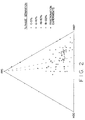
- Figure 2 graphically depicts the observed phase separation for a poly(phenylene sulfide) polymer dissolved in N-methyl-2-pyrrolidone using water as the sole promoter in the invention process.
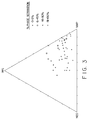
- Figure 3 graphically depicts the observed phase separation when a combination of water and sodium acetate is used as the promoter in the invention process.
- Figure 4 graphically depicts the observed phase separation when a combination of water and sodium benzoate is used as the promoter in the invention process.
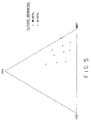
- Figure 5 graphically depicts the observed phase separation when a combination of water and lithium benzoate is used as the promoter in the invention process.
- Figure 6 graphically depicts the observed phase separation when a combination of water and lithium benzoate is used as the promoter in the invention process.
- Figures 7 and 8 graphically depict the observed phase separation when the amount of water used as a promoter in the invention process varies for poly(phenylene sulfide) polymers having varied molecular weights.
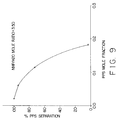
- Figure 9 graphically depicts the observed phase separation when the amount of poly(arylene sulfide) polymer varies with relation to the polar organic compound in the invention process.
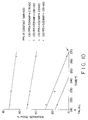
- Figure 10 graphically depicts the observed phase separation when the temperature is varied in the invention process.
- a poly(arylene sulfide) polymer is contacted with a polar organic compound and a promoter which is at least one of an alkali metal halide which is soluble in the polar organic compound, an alkali metal carboxylate, and water, at a temperature sufficient to form a less dense polymer-lean liquid phase and a more dense polymer-rich liquid phase, then the phases are separated from each other and the polymer is recovered from the more dense polymer-rich phase.
- the less dense phase will hereinafter be referred to as the "upper” phase and the more dense phase will be referred to as the “lower” phase.
- the lower phase contains essentially all of the high molecular weight polymer and a portion of the lower molecular weight polymer, oligomers and other impurities.
- the upper phase contains the remainder of the lower molecular weight polymer, oligomers and impurities.
- the molar ratio of the polar organic compound to water, if employed, is similar in the upper and lower phases.
- the formation of, and relative volume of the two phases depends on several factors.
- the molecular weight of the starting poly(arylene sulfide) polymer is one factor. Higher molecular weight poly(arylene sulfide) polymers more easily form two phases when placed in the polar organic compound/promoter mixture. Higher molecular weight poly(arylene sulfide) polymers cause the formation of more concentrated lower liquid phases; that is, high molecular weight polymer exists in a smaller volume of polar organic compound/promoter mixture, relative to the volume of the polar organic compound/promoter mixture in the upper phase.
- the type and amount of promoter used affects the formation of the two phases. If water is employed as the promoter, generally the addition of a greater amount of water aids in the formation of the two phases. If water and another promoter such as an alkali metal carboxylate are both present, less water is necessary to cause the formation of the two phases than when the second promoter is not present. Certain alkali metal carboxylates, notably lithium benzoate, aid in the formation of two phases without any water being present.
- the formation of the two phases is also affected by temperature. While higher temperatures aid in the dissolution of solid polymer in the polar organic compound, lower temperatures appear to aid two phase formation.
- the temperature should remain below that at which the polar organic compound and/or promoters, polymers, oligomers and impurities decompose or vaporize, at the pressure employed. Generally, temperatures in the range of about 200-300°C, preferably 220-280°C, most preferably 230-270°C, are employed.
- poly(arylene sulfide) polymers useful in this invention can be made by any method known to those of ordinary skill in the art.
- poly(arylene sulfide) polymers useful in this invention are those prepared according to U.S. 3,919,177, U.S. 3,354,129, U.S. 4,038,261, U.S. 4,038,262, U.S. 4,116,947, U.S. 4,282,347 and U.S. 4,350,810, which patents are hereby incorporated by reference.
- the poly(arylene sulfide) polymers generally are prepared by contacting reactants comprising a dihalosubstituted aromatic compound, a sulfur source and a polar organic compound under polymerization conditions. Those polymers which were initially polymerized to relatively high molecular weight may also be prepared using alkali metal carboxylates or other molecular weight modifying agents and/or polyhaloaromatic compounds during polymerization.
- poly(arylene sulfide) polymers suitable for purposes of this invention include poly(2,4-toluene sulfide), poly(4,4'-biphenylene sulfide) and poly(phenylene sulfide). Because of its availability and desirable properties (such as high chemical resistance, non-flammability, and high strength and hardness) poly(phenylene sulfide) is the presently preferred poly(arylene sulfide).
- poly(arylene sulfide) polymers containing other groups such as sulfone, sulfoxide, ketone, ether and biphenyl in the polymer backbone.
- the poly(arylene sulfide) polymer can be of either relatively high or relatively low molecular weight.
- the poly(arylene sulfide) initially can be polymerized to relatively high molecular weight by the process described in U.S. Patent No. 3,919,177, or by any other process known to those of ordinary skill in the art which produces a high molecular weight poly(arylene sulfide) polymer.
- the preferred high molecular weight poly(arylene sulfide) for use in this invention is poly(phenylene sulfide).
- the melt flow of the high molecular weight poly(phenylene sulfide) is generally less than about 3,000 g/10 min.
- the relatively low molecular weight poly(arylene sulfide) can be prepared by the process of U.S. Patent No. 3,354,129, but any process which produces a relatively low molecular weight poly(arylene sulfide) is acceptable.
- the preferred relatively low molecular weight poly(arylene sulfide) is poly(phenylene sulfide).
- the melt flow of the relatively low molecular weight poly(phenylene sulfide) is generally about 3,000 to about 30,000 g/10 min.
- the polar organic compounds useful in this invention are those in which the poly(arylene sulfide) polymer, oligomers and impurities are soluble.
- the polar organic compound should be miscible with water and/or be a solvent by itself or when mixed with water for the alkali metal carboxylate or alkali metal halide used to promote phase separation.
- the polar organic compound need not be a solvent for the alkali metal halide produced as a by-product during the polymerization.
- the polar organic compound should be chosen to be liquid at the pressures and temperatures employed in this invention.
- Suitable polar organic compounds include organic amides, such as, for example lactams; high boiling alcohols; ethers; ketones; and sulfones. It is presently preferred to employ an organic amide as the polar organic compound.
- Suitable organic amides include, but are not limited to, N,N'-ethylene dipyrrolidone, N-methyl-2-pyrrolidone (NMP), N-methyl-caprolactam, N-ethyl-caprolactam, caprolactam, pyrrolidone, 1,3-dimethyl-2-imidazolidinone, tetramethyl urea, hexamethylphosphoramide, and N,N'-dimethylacetamide. It is presently most preferred to use NMP as the polar organic compound.
- any amount of polar organic compound can be employed which is sufficient to result in the formation of a solution.
- enough polar organic compound must be present to allow the poly(arylene sulfide) polymer, oligomers and impurities to dissolve.
- this amount will be in the range of 2:1 to 25:1 moles of polar organic compound per mole of sulfur in the polymer.
- polymer concentrations above about 0.5 moles of sulfur in the polymer per mole of polar organic compound it is generally more difficult to form two easily separable phases.
- the amount of water used if water is employed as a promoter, will generally be that amount necessary to aid in the formation of the two phases. As previously discussed, the amount of water used will vary according to other factors such as the molecular weight of the poly(arylene sulfide) to be treated according to this invention, the temperature of the poly(arylene sulfide) solution in the polar organic compound, the concentration of the polymer in the polar organic compound and the presence or absence of other promoter compounds. Broadly speaking, the amount will be about 0.2 to about 10 moles of water per mole of sulfur in the polymer.
- Alkali metal carboxylates that can be employed in the process of the invention can be represented by the formula R'CO2M where R' is a hydrocarbyl radical selected from alkyl, cycloalkyl, aryl and combinations thereof such as alkaryl, aralkyl, and the like.
- R' is a hydrocarbyl radical selected from alkyl, cycloalkyl, aryl and combinations thereof such as alkaryl, aralkyl, and the like.
- the number of carbon atoms in said R' is within the range of about 1 to about 20 and M is an alkali metal selected from lithium, sodium, potassium, rubidium, and cesium.
- alkali metal carboxylates examples include lithium acetate, sodium acetate, potassium acetate, lithium propionate, sodium propionate, lithium 2-methylpropionate, rubidium butyrate, lithium valerate, sodium valerate, cesium hexanoate, lithium heptanoate, lithium 2-methyl octanoate, potassium dodecanoate, rubidium 4-ethyl tetradecanoate, sodium octadecanoate, sodium heneicosanoate, lithium cyclohexane carboxylate, cesium cyclododecane carboxylate, sodium 3-methyl cyclopentane carboxylate, potassium cyclohexylacetate, potassium benzoate, lithium benzoate, sodium benzoate, potassium m-toluate, lithium phenyl acetate, sodium 4-phenyl cyclohexane carboxylate, potassium p-tolyl acetate, lithium 4-ethy
- alkali metal carboxylate While any amount of alkali metal carboxylate can be used that is sufficient to promote the formation of two phases, an amount within the range of about 0.01 to about 2 moles of alkali metal carboxylate per mole of sulfur in the polymer will generally be used when the alkali metal carboxylate is employed with water. When certain alkali metal carboxylates are employed as promoters without water, the amount employed will also generally be in the range of about 0.01 to about 2 moles of alkali metal carboxylate per mole of sulfur in the polymer.
- the alkali metal halides useful in this invention are those which are soluble in the polar organic compound or can be made soluble in a mixture of the polar organic compound and another promoter compound.
- lithium chloride is useful as a promoter compound since it is soluble in certain polar organic compounds, such as, for example, NMP.
- sodium chloride when placed in NMP, is insoluble and thus not useful by itself as a promoter.
- the polymerization reaction mixture is subjected to a process to remove the by-product alkali metal halide, such as for example, washing the polymer particles with a compound in which the alkali metal halide is soluble but in which the polymer is not soluble.
- a process to remove the by-product alkali metal halide such as for example, washing the polymer particles with a compound in which the alkali metal halide is soluble but in which the polymer is not soluble.
- sodium chloride by-product can be removed from a poly(phenylene sulfide) polymer produced as described in U.S. 3,919,177 by washing the polymer with water.
- the system be quiescent. While some agitation appears to aid in the initial dissolution of the polymer into the liquid phase, agitation renders the separation of the two phases difficult. Thus, if agitation is employed, it is preferred to remove such agitation prior to attempting to separate the liquid phases.
- the two liquid phases an be separated by any method known to those of ordinary skill in the art.
- the lower phase can be separated from the upper in a mixer-settler apparatus including a means for detecting the boundary between the two phases based on viscosity, density or the like, with a port for removing the desired portion, whether upper or lower phase.
- the higher molecular weight polymer-containing lower phase can be subjected to a process to recover the polymer; or additional polar organic compound and optionally additional promoter can be added to the lower phase to cause the formation of two new phases.
- the high molecular weight polymer can be subjected to repeated extractions to remove as much of the lower molecular weight fraction as is desired or practicable.
- the upper-phase can be subjected to a process to recover the lower molecular weight polymer, or additional polar organic compound and optionally promoter can be added to from two new phases.
- additional polar organic compound and optionally promoter can be added to from two new phases.
- the poly(arylene sulfide) polymer can be recovered from the lower liquid phase by any suitable method, for example, by vaporizing the polar organic compound/promoter mixture, or by lowering the temperature of the liquid phase to a point at which the polymer solidifies in the polar organic compound/promoter mixture, recovering the solid polymer by filtration or centrifugation.
- the polymer produced by the invention method can be used neat or be mixed with various additives, fillers and reinforcement for use in varied applications, such as for the formation of fibers, injection molding compounds, or fiber-reinforced composites.
- the invention polymer has been found to be particularly useful as the polymer matrix in the preparation of continuous long fiber reinforced composites.
- poly(phenylene sulfide) (PPS) flow rates were determined by the method of ASTM D 1238-86, Procedure B-Automatically Timed Flow Rate Procedure, Condition 316/5.0 modified to use a 5 minute preheat time, with the values of flow rate expressed in units of grams per ten minutes (g/10 min).
- the polymer thermal transitions were determined by differential scanning calorimetry (DSC) on a Perkin-Elmer DSC-7 Equipped with a data station.
- Polymer glass transition (Tg), crystallization from the glass (Tcc), and melting point (Tm) temperatures were determined in a nitrogen atmosphere at a heating rate of 20°C/min.
- Crystallization temperatures from the melt (Tmc) were determined by heating the sample to 320°C, holding for five minutes, and cooling the sample at 20°C/min.
- the PPS fractionations were done by heating the autoclave contents to the desired temperature with stirring, stopping the stirring, waiting ten minutes, and collecting samples (about 75 mL) from the top and bottom portions of the autoclave.
- Lithium acetate (LiOAc) and lithium benzoate (LiOBz) were readily soluble in pure NMP and did not require any water to dissolve them.
- Sodium acetate (NaOAc) did not appear to dissolve appreciably at temperatures up to 265°C in pure NMP. When water was also present, the NaOAc did show increased solubility in NMP at temperatures between 215°C and 265°C, although not all the NaOAc went into solution.
- phase separation data were determined in the small glass reactor using PPS-A and the results are displayed as ternary phase diagrams.
- FIG. 3 through 6 show the effect of added sodium acetate, sodium benzoate, lithium benzoate, and lithium acetate (all at the 0.3 mole per mole of PPS repeat unit level) on the phase separation.
- PPS-B was a lower molecular weight, linear, commercial sample (Mw about 20,000 g/mol) available from Phillips 66 Company as V-1 and was made without a polymerization modifier.
- PPS-C had a degree of polymerization of about 13 and a molecular weight of about 1400 g/mol.
- This example demonstrates the effect of solution temperature on the PPS phase separation.
- the amount of observed phase separation of several mixtures of PPS-A, NMP, and water at several different temperatures was determined. As shown in Figure 10, the degree of phase separation increases for a given PPS/NMP/water composition as the temperature decreases.
- Solution fractionations were carried out in a 1-L autoclave to show the effect on a PPS-NMP-water phase composition of changes in the water content in the absence of an added salt.
- Sample mixtures 23 and 24 were prepared using (quantities expressed as a mole ratio relative to the moles of PPS repeat units) 1.0 PPS-D, 3.50 NMP, and 2.00 water in mixture 23 or 3.00 water in mixture 24.
- PPS-D was produced with a sodium acetate modifier and a water quench recovery and had a flow rate of 248 g/10 min.
- the PPS, NMP, water composition was deoxygenated by pressurizing the reaction mixture with 200 psi nitrogen and then releasing the pressure.
- the reaction mixture was subjected at room temperature to a total of 3 pressurize/release cycles.
- the reaction mixture was heated to 265°C with slow agitation. After 30 minutes at 265°C, the agitation was halted and the dispersed liquid layers were allowed to coalesce into two discreet liquid phases in a quiescent state.
- the headspace of the autoclave was then pressurized with an additional 50 psig nitrogen gas.
- the autoclave was equipped with a dip tube which was long enough to extend only into the upper liquid phase. This dip tube was connected to a small heated sample collection vessel. A high temperature valve was used to control the acquisition of the sample from the quiescent reaction mixture into the upper phase sample vessel. Analogously, the lower phase was sampled by opening a high temperature valve which was attached to a port in the bottom of the autoclave. The lower phase sample valve was connected to a small heated collection vessel.
- a GPC analysis of the PPS from the upper layer of sample 23 showed that the PPS was low molecular weight material.
- the solvent fractionation separates the PPS into a higher molecular weight PPS in the lower phase and a lower molecular weight PPS in the upper phase.
- Mixture 25 was prepared from 1.0 PPS-D, 3.5 NMP, 1.33 water, and 0.30 sodium acetate with the units being in terms of a mole ratio relative to the moles PPS repeat units in the polymer.
- Example VIII The PPS, NMP, water, sodium acetate mixture was charged to a 1-L autoclave. Dissolution of the PPS and sodium acetate in the NMP/water solvent system was accomplished according to the procedure described in Example VIII. Samples of the two liquid phases were obtained as described in Example VIII.
- Table IV shows the results of the analyses of samples taken at 265°C from both liquid phases from mixture 25.
- the presence of the sodium acetate resulted in the formation of two liquid phases with a large amount of the PPS in the lower phase with a relatively low level of water.
- About two-thirds of the sodium acetate was present in the upper layer.
- This example demonstrates the difference in phase separation between a recovered PPS sample which is subjected to two-phase solution conditions using NMP, water and sodium acetate, and a finished polymerization mixture comprising PPS, NMP, water, sodium acetate and by-product sodium chloride.
- Sample 26 was a finished PPS polymerization mixture which was prepared in a 1-liter autoclave. The autoclave was charged with 1.0 sodium hydrosulfide, 1.01 sodium hydroxide, 2.5 NMP and 0.30 sodium acetate. The autoclave was flushed with nitrogen and all valves closed. Heating was accomplished with an electric furnace. When the temperature reached 151°C, the valve to the dehydration condenser was opened.
- a slow flow of nitrogen was purged through the headspace of the autoclave to assist dehydration.
- the first drop of condensate was received when the contents of the autoclave reached 158°C. 35.41 grams of condensate were collected.
- Dehydration was terminated when the contents of the autoclave reached 204°C.
- 1.01 ⁇ -dichlorobenzene and 1.0 NMP were charged to the autoclave.
- the polymerization mixture was then heated to 235°C for 1 hour and then to 265°C for 3 hours. At the end of the 3 hour hold period at 265°C, the agitator was turned off and the reaction mixture allowed to sit in a quiescent state for 10 minutes.
- Sample 27 was prepared in the 1-L autoclave from 1.0 PPS-D, 3.50 NMP, and 0.75 lithium benzoate with the quantities expressed as a mole ratio to relative to moles of PPS repeat units in the polymer. This mixture was heated to 265°C and observed to separate into two liquid phases. Both liquid phases were sampled as in Example VIII and analyzed.
- This example demonstrates the effect of acidic treatment on the thermal transitions of a solution fractionated PPS.
- a high molecular weight linear PPS resin designated sample 28
- Polymer sample 28 was solution fractionated by dissolving the polymer in an NMP/water mixture having the following mole ratios: 7.55 moles of NMP and 3.13 moles of water per 1.0 mole of PPS repeat units in the polymer.
- the PPS/NMP/water reaction mixture was charged to the autoclave, deoxygenated and heated to 265°C. Upon reaching 265°C, the agitation was stopped and the 2 liquid phases were allowed to coalesce.
- sample 29 The polymer from the polymer-rich lower phase was collected and washed with distilled water to remove residual NMP.
- the product obtained from this solution fractionation (designated sample 29) had a melt flow of 69 g/10 min.
- a portion of sample 29 was subjected to an acidic treatment by dispersing 500 grams of sample 29 in 3500 grams of distilled water which contained 10 grams of glacial acetic acid. This reaction mixture was charged to an autoclave, deoxygenated and heated to 225°C. The mixture was held at 225°C for 45 minutes and then cooled. The polymer was recovered by filtration and rinsed in hot distilled water three times. The product of this acidic treatment was designated sample 30.
- This example demonstrates that a high molecular weight PPS polymer can be fractionated to produce a material that is essentially inert to an acid treatment.
- a starting high molecular weight PPS polymer, sample 31, was acid treated to show that the acid treatment results in changes in the thermal transition of PPS.
- sample 31, having a melt flow before acid treatment of 35 g/10 min was acid treated with 0.3 weight percent acetic acid at 225°C for 45 minutes in a manner analogous to that described for sample 30 in Example XII
- the product, sample 32 had a melt flow of 46 g/10 min.
- the Tcc decreased and the Tmc increased for sample 32 relative to the corresponding thermal transitions of sample 31, indicating an increase in the crystallization rate of the polymer.
- sample 33 Another high molecular weight PPS polymer, sample 33, having a melt flow of 38 g/10 min, was solution fractionated in a manner analogous to that described for the preparation of sample 29 in Example XII.
- Sample 33 was solution fractionated by dissolving the 27.0 grams of sample 33 in 687 grams of NMP and 32.3 grams of distilled water. This reaction mixture was charged to an autoclave, deoxygenated and heated to 260°C. Upon reaching 260°C, the agitation was stopped and the two liquid phases allowed to settle. After approximately 7 minutes in the quiescent state, the reaction mixture was allowed to cool. When the temperature on the reaction mixture reached approximately 90°C, the autoclave was opened and the lower polymer-rich liquid phase was collected.
- sample 34 The polymer-rich phase was washed with hot distilled water to remove residual NMP.
- the polymer obtained from this solution fractionation (designated sample 34) had a melt flow of 7.7 g/10 min.
- a portion of sample 34 was subjected to an acidic treatment by dispersing 7.94 grams of sample 34 in 400.0 grams of distilled water which contained 2.00 grams of glacial acetic acid. This reaction mixture was charged to an autoclave, deoxygenated and heated to 235°C for 25 minutes and then cooled. The polymer was recovered by filtration and rinsed in hot deionized water three times. The product of this acidic treatment was designated sample 35.
- the melt flow of sample 35 was 7.8 g/10 min.
- This example describes the preparation of fiber-reinforced composites from two PPS samples prepared according to the invention method.
- Sample 29 and Sample 30 were ground in an air-mill in order to reduce the particle size of the polymers.
- a 475 g portion of each of Sample 29 polymer and Sample 30 polymer were suspended in 2500 g of distilled water and 3.0 g Neodol 91-6, a surfactant, to form an addition bath.
- a 175 g portion of each of the polymers was suspended in 2650 g distilled water and 2.5 g Neodol 91-6 to form the main bath.
- Tows of Hercules AS-4 carbon fiber, lot 748-4K were pulled through the bath at a tension of approximately 200 g/tow.
- Make up slurry from the addition bath was added at a rate of 15.3 mL/min.
- the resulting 1 inch tapes were spliced and consolidated to form 10" tapes.
- the 10" tapes were laid-up to form 10" by 10", 14 ply unidirectional laminates using a PDP press mold with a FK-800 release having a single sleeve.
- the molding was performed at 329°C (625°F) at a pressure of 200 psi for 20 minutes then the laminates were cold pressed at 10°C (50°F) and 250 psi and held until cool.
- the composites prepared from the invention polymers were compared to a composite designated AC-40-60, which was prepared in a similar manner from a branched poly(phenylene sulfide) polymer having an ash content of approximately 0.6 and a nominal melt flow of 30-50 g/10 minutes.
- the results are shown in Table IX below.
Landscapes
- Chemical & Material Sciences (AREA)
- General Chemical & Material Sciences (AREA)
- Health & Medical Sciences (AREA)
- Chemical Kinetics & Catalysis (AREA)
- Medicinal Chemistry (AREA)
- Polymers & Plastics (AREA)
- Organic Chemistry (AREA)
- Polymers With Sulfur, Phosphorus Or Metals In The Main Chain (AREA)
- Extraction Or Liquid Replacement (AREA)
Applications Claiming Priority (2)
| Application Number | Priority Date | Filing Date | Title |
|---|---|---|---|
| US965489 | 1992-10-23 | ||
| US07/965,489 US5334701A (en) | 1992-10-23 | 1992-10-23 | Process for the removal of lower molecular weight fractions of poly(arylene sulfide) polymers |
Publications (2)
| Publication Number | Publication Date |
|---|---|
| EP0594191A1 true EP0594191A1 (fr) | 1994-04-27 |
| EP0594191B1 EP0594191B1 (fr) | 2001-12-12 |
Family
ID=25510040
Family Applications (1)
| Application Number | Title | Priority Date | Filing Date |
|---|---|---|---|
| EP93117150A Expired - Lifetime EP0594191B1 (fr) | 1992-10-23 | 1993-10-22 | Procédé pour enlever les fractions à bas poids moléculaire de polymères de polyarylène sulphide |
Country Status (7)
| Country | Link |
|---|---|
| US (1) | US5334701A (fr) |
| EP (1) | EP0594191B1 (fr) |
| JP (1) | JPH06192422A (fr) |
| AT (1) | ATE210694T1 (fr) |
| CA (1) | CA2104539C (fr) |
| DE (1) | DE69331306T2 (fr) |
| ES (1) | ES2168266T3 (fr) |
Cited By (1)
| Publication number | Priority date | Publication date | Assignee | Title |
|---|---|---|---|---|
| EP1171511A4 (fr) * | 1998-12-31 | 2002-01-16 | Phillips Petroleum Co | Procede de production de poly(arylene sulfures) |
Families Citing this family (13)
| Publication number | Priority date | Publication date | Assignee | Title |
|---|---|---|---|---|
| US6082380A (en) * | 1999-05-06 | 2000-07-04 | Phillips Petroleum Company | Process to remove poly(arylene sulfide) based deposits from an article |
| US6331608B1 (en) * | 1999-09-13 | 2001-12-18 | Phillips Petroleum Company | Process for producing poly(arylene sulfide) |
| US6437024B1 (en) * | 1999-09-13 | 2002-08-20 | Phillips Petroleum Company | Menthanol extraction of polar organic compounds and modifier compounds from poly(arylene sulfide) polymer and oligomer streams |
| JP2003292622A (ja) * | 2002-04-05 | 2003-10-15 | Idemitsu Petrochem Co Ltd | ポリアリーレンスルフィドの精製方法及びその精製装置 |
| KR101750014B1 (ko) * | 2010-05-12 | 2017-06-23 | 에스케이케미칼 주식회사 | 가공성이 우수한 폴리아릴렌 설파이드 및 이의 제조 방법 |
| WO2016133739A1 (fr) | 2015-02-19 | 2016-08-25 | Ticona Llc | Procédé de formation d'un poly(sulfure d'arylène) de poids moléculaire élevé |
| WO2016133740A1 (fr) | 2015-02-19 | 2016-08-25 | Ticona Llc | Procédé de précipitation de poly(sulfure d'arylène) |
| JP6803844B2 (ja) | 2015-02-19 | 2020-12-23 | ティコナ・エルエルシー | 低粘度のポリアリーレンスルフィドを形成する方法 |
| WO2016153610A1 (fr) | 2015-03-25 | 2016-09-29 | Ticona Llc | Technique pour former un poly(sulfure d'arylène) à haute viscosité à l'état fondu |
| US11407861B2 (en) | 2019-06-28 | 2022-08-09 | Ticona Llc | Method for forming a polyarylene sulfide |
| WO2021126543A1 (fr) | 2019-12-20 | 2021-06-24 | Ticona Llc | Procédé de formation d'un sulfure de polyarylène |
| JP2024535216A (ja) | 2021-09-08 | 2024-09-30 | ティコナ・エルエルシー | ポリアリーレンスルフィド廃棄汚泥から有機溶媒を回収するための逆溶媒技術 |
| KR20240060812A (ko) | 2021-09-08 | 2024-05-08 | 티코나 엘엘씨 | 폴리아릴렌 설파이드 폐슬러지로부터 유기 용매를 회수하기 위한 추출 기술 |
Citations (6)
| Publication number | Priority date | Publication date | Assignee | Title |
|---|---|---|---|---|
| JPS57205425A (en) * | 1981-06-12 | 1982-12-16 | Toray Ind Inc | Stabilized polyphenylene sulfide |
| DE3527492A1 (de) * | 1984-07-31 | 1986-02-27 | Dainippon Ink And Chemicals, Inc., Tokio/Tokyo | Verfahren zur herstellung eines polyarylensulfidpolymeren |
| DE3921260A1 (de) * | 1989-06-29 | 1991-01-03 | Bayer Ag | Verfahren zur molgewichtsfraktionierung von polyarylensulfiden |
| JPH0324159A (ja) * | 1989-06-21 | 1991-02-01 | Toray Ind Inc | 高強度耐熱耐薬品性ポリアリ―レンスルフィド複合体の製法 |
| EP0417448A1 (fr) * | 1989-07-31 | 1991-03-20 | Phillips Petroleum Company | Procédé pour la préparation de poly(sulfures d'arylène) |
| EP0418455A2 (fr) * | 1989-09-20 | 1991-03-27 | Phillips Petroleum Company | Sulfure de polyarylène amélioré, procédé de préparation et articles réalisés en ce matériau |
Family Cites Families (9)
| Publication number | Priority date | Publication date | Assignee | Title |
|---|---|---|---|---|
| US4415729A (en) * | 1982-06-04 | 1983-11-15 | Phillips Petroleum Company | Recovering granular poly(arylene sulfide) particles from a poly(arylene sulfide) reaction mixture |
| JPS6140323A (ja) * | 1984-07-31 | 1986-02-26 | Dainippon Ink & Chem Inc | アリ−レンスルフイドポリマ−の製造方法 |
| JPS6176528A (ja) * | 1984-09-25 | 1986-04-19 | Dainippon Ink & Chem Inc | 高分子量アリ−レンスルフイドポリマ−の製造方法 |
| JPS61111329A (ja) * | 1984-11-05 | 1986-05-29 | Dainippon Ink & Chem Inc | アリ−レンスルフイドポリマ−の製造方法 |
| JPS62195022A (ja) * | 1986-02-21 | 1987-08-27 | Dainippon Ink & Chem Inc | 高分子量アリ−レンスルフイドポリマ−の製造法 |
| US4748231A (en) * | 1986-11-21 | 1988-05-31 | Phillips Petroleum Company | Reprecipitation of poly(arylene sulfide) to increase molecular weight thereof |
| US4801664A (en) * | 1988-01-29 | 1989-01-31 | Phillips Petroleum Company | Acid wash of polyarylene sulfides |
| US5098992A (en) * | 1989-10-04 | 1992-03-24 | Phillips Petroleum Company | Method to recover high molecular weight poly(arylene sulfide) by reprecipitation |
| US5128445A (en) * | 1990-06-14 | 1992-07-07 | Phillips Petroleum Company | Method to recover poly(arylene sulfide) polymers with water-polar organic compound |
-
1992
- 1992-10-23 US US07/965,489 patent/US5334701A/en not_active Expired - Lifetime
-
1993
- 1993-08-20 CA CA002104539A patent/CA2104539C/fr not_active Expired - Fee Related
- 1993-10-18 JP JP5259783A patent/JPH06192422A/ja active Pending
- 1993-10-22 EP EP93117150A patent/EP0594191B1/fr not_active Expired - Lifetime
- 1993-10-22 AT AT93117150T patent/ATE210694T1/de not_active IP Right Cessation
- 1993-10-22 DE DE69331306T patent/DE69331306T2/de not_active Expired - Fee Related
- 1993-10-22 ES ES93117150T patent/ES2168266T3/es not_active Expired - Lifetime
Patent Citations (6)
| Publication number | Priority date | Publication date | Assignee | Title |
|---|---|---|---|---|
| JPS57205425A (en) * | 1981-06-12 | 1982-12-16 | Toray Ind Inc | Stabilized polyphenylene sulfide |
| DE3527492A1 (de) * | 1984-07-31 | 1986-02-27 | Dainippon Ink And Chemicals, Inc., Tokio/Tokyo | Verfahren zur herstellung eines polyarylensulfidpolymeren |
| JPH0324159A (ja) * | 1989-06-21 | 1991-02-01 | Toray Ind Inc | 高強度耐熱耐薬品性ポリアリ―レンスルフィド複合体の製法 |
| DE3921260A1 (de) * | 1989-06-29 | 1991-01-03 | Bayer Ag | Verfahren zur molgewichtsfraktionierung von polyarylensulfiden |
| EP0417448A1 (fr) * | 1989-07-31 | 1991-03-20 | Phillips Petroleum Company | Procédé pour la préparation de poly(sulfures d'arylène) |
| EP0418455A2 (fr) * | 1989-09-20 | 1991-03-27 | Phillips Petroleum Company | Sulfure de polyarylène amélioré, procédé de préparation et articles réalisés en ce matériau |
Non-Patent Citations (2)
| Title |
|---|
| DATABASE WPI Week 8305, Derwent World Patents Index; AN 83-10568K * |
| PATENT ABSTRACTS OF JAPAN vol. 15, no. 145 (C - 0823) 12 April 1991 (1991-04-12) * |
Cited By (1)
| Publication number | Priority date | Publication date | Assignee | Title |
|---|---|---|---|---|
| EP1171511A4 (fr) * | 1998-12-31 | 2002-01-16 | Phillips Petroleum Co | Procede de production de poly(arylene sulfures) |
Also Published As
| Publication number | Publication date |
|---|---|
| JPH06192422A (ja) | 1994-07-12 |
| DE69331306D1 (de) | 2002-01-24 |
| CA2104539A1 (fr) | 1994-04-24 |
| CA2104539C (fr) | 1997-12-30 |
| US5334701A (en) | 1994-08-02 |
| ES2168266T3 (es) | 2002-06-16 |
| DE69331306T2 (de) | 2003-03-27 |
| ATE210694T1 (de) | 2001-12-15 |
| EP0594191B1 (fr) | 2001-12-12 |
Similar Documents
| Publication | Publication Date | Title |
|---|---|---|
| EP0594191B1 (fr) | Procédé pour enlever les fractions à bas poids moléculaire de polymères de polyarylène sulphide | |
| EP0096384B2 (fr) | Récupération de particules granulées de poly(sulfide d'arylène) à partir d'un mélange de réaction de poly(sulfide d'arylène) | |
| US5023315A (en) | Process for preparing arylene sulfide polymers | |
| EP0258866B1 (fr) | Préparation de poly(arylène thioéther cétones) ayant un poids moléculaire élevé | |
| JP4256506B2 (ja) | ポリアリーレンスルフィドの製造方法 | |
| US4730034A (en) | Recovering poly(arylene sulfide) oligomers from a poly(arylene sulfide) reaction mixture | |
| US6982312B2 (en) | Process for producing polyarylene sulfide | |
| EP0525638A2 (fr) | Compositions de polyarylène-thioéther, produits composites et méthodes de fabrication | |
| JP2018024851A (ja) | ポリアリーレンスルフィドおよびその製造方法 | |
| JP3143977B2 (ja) | ポリアリーレンスルフィドの精製方法 | |
| EP0594189A1 (fr) | Production de polymères de poly(arylène sulphide) ayant une teneur d'oligomères réduite | |
| EP0385299A1 (fr) | Préparation de polymères aromatiques sulfide/cétone | |
| CN119931051A (zh) | 一种低氯聚苯硫醚腈的合成方法 | |
| KR100250871B1 (ko) | 폴리(아릴렌설파이드)중합체 정제방법 | |
| EP0427134A1 (fr) | Traitement de polymères de sulfures/sulfones de polyarylène | |
| EP0446057B1 (fr) | Procédé pour préparer des poly(sulfures d'arylène) à poids moléculaire augmenté | |
| US5374709A (en) | Production of granular poly(arylene sulfide) polymers containing reduced amounts of oligomers | |
| US5393865A (en) | Poly(arylene sulfide) fibrid particles and process for their preparation | |
| EP4375319A1 (fr) | Procédé de séparation de sulfure de polyarylène ainsi que procédé de production de composition de résine de sulfure de polyarylène | |
| EP0418455A2 (fr) | Sulfure de polyarylène amélioré, procédé de préparation et articles réalisés en ce matériau | |
| US5013822A (en) | Process for preparing poly(arylene sulfide sulfone) with in-situ preparation of alkali metal carboxylate | |
| JP3490137B2 (ja) | ポリアリーレンスルフィドの製造方法 | |
| EP0479069A2 (fr) | Matériau plastique comprenant une matrice de copolymère de sulfides d'arylène sulfoné et renforcé par des fibres continues | |
| JPH0641516B2 (ja) | ポリアリ−レンスルフイドの製造方法 | |
| EP0594192A1 (fr) | Production de polymères de poly(arylène sulphide) ayant une teneur d'oligomères réduite |
Legal Events
| Date | Code | Title | Description |
|---|---|---|---|
| PUAI | Public reference made under article 153(3) epc to a published international application that has entered the european phase |
Free format text: ORIGINAL CODE: 0009012 |
|
| AK | Designated contracting states |
Kind code of ref document: A1 Designated state(s): AT BE DE ES FR GB IT NL |
|
| 17P | Request for examination filed |
Effective date: 19940829 |
|
| 17Q | First examination report despatched |
Effective date: 19960102 |
|
| APAB | Appeal dossier modified |
Free format text: ORIGINAL CODE: EPIDOS NOAPE |
|
| APAB | Appeal dossier modified |
Free format text: ORIGINAL CODE: EPIDOS NOAPE |
|
| APAD | Appeal reference recorded |
Free format text: ORIGINAL CODE: EPIDOS REFNE |
|
| APAB | Appeal dossier modified |
Free format text: ORIGINAL CODE: EPIDOS NOAPE |
|
| GRAG | Despatch of communication of intention to grant |
Free format text: ORIGINAL CODE: EPIDOS AGRA |
|
| GRAH | Despatch of communication of intention to grant a patent |
Free format text: ORIGINAL CODE: EPIDOS IGRA |
|
| GRAH | Despatch of communication of intention to grant a patent |
Free format text: ORIGINAL CODE: EPIDOS IGRA |
|
| GRAH | Despatch of communication of intention to grant a patent |
Free format text: ORIGINAL CODE: EPIDOS IGRA |
|
| GRAA | (expected) grant |
Free format text: ORIGINAL CODE: 0009210 |
|
| AK | Designated contracting states |
Kind code of ref document: B1 Designated state(s): AT BE DE ES FR GB IT NL |
|
| REF | Corresponds to: |
Ref document number: 210694 Country of ref document: AT Date of ref document: 20011215 Kind code of ref document: T |
|
| REG | Reference to a national code |
Ref country code: GB Ref legal event code: IF02 |
|
| REF | Corresponds to: |
Ref document number: 69331306 Country of ref document: DE Date of ref document: 20020124 |
|
| ET | Fr: translation filed | ||
| REG | Reference to a national code |
Ref country code: ES Ref legal event code: FG2A Ref document number: 2168266 Country of ref document: ES Kind code of ref document: T3 |
|
| PLBE | No opposition filed within time limit |
Free format text: ORIGINAL CODE: 0009261 |
|
| STAA | Information on the status of an ep patent application or granted ep patent |
Free format text: STATUS: NO OPPOSITION FILED WITHIN TIME LIMIT |
|
| PG25 | Lapsed in a contracting state [announced via postgrant information from national office to epo] |
Ref country code: AT Free format text: LAPSE BECAUSE OF NON-PAYMENT OF DUE FEES Effective date: 20021022 |
|
| 26N | No opposition filed | ||
| PGFP | Annual fee paid to national office [announced via postgrant information from national office to epo] |
Ref country code: GB Payment date: 20040915 Year of fee payment: 12 |
|
| APAH | Appeal reference modified |
Free format text: ORIGINAL CODE: EPIDOSCREFNO |
|
| PG25 | Lapsed in a contracting state [announced via postgrant information from national office to epo] |
Ref country code: GB Free format text: LAPSE BECAUSE OF NON-PAYMENT OF DUE FEES Effective date: 20051022 |
|
| GBPC | Gb: european patent ceased through non-payment of renewal fee |
Effective date: 20051022 |
|
| PGFP | Annual fee paid to national office [announced via postgrant information from national office to epo] |
Ref country code: NL Payment date: 20081024 Year of fee payment: 16 |
|
| PGFP | Annual fee paid to national office [announced via postgrant information from national office to epo] |
Ref country code: DE Payment date: 20081201 Year of fee payment: 16 |
|
| PGFP | Annual fee paid to national office [announced via postgrant information from national office to epo] |
Ref country code: ES Payment date: 20081027 Year of fee payment: 16 |
|
| PGFP | Annual fee paid to national office [announced via postgrant information from national office to epo] |
Ref country code: BE Payment date: 20081112 Year of fee payment: 16 Ref country code: IT Payment date: 20081030 Year of fee payment: 16 |
|
| PGFP | Annual fee paid to national office [announced via postgrant information from national office to epo] |
Ref country code: FR Payment date: 20081018 Year of fee payment: 16 |
|
| BERE | Be: lapsed |
Owner name: *PHILLIPS PETROLEUM CY Effective date: 20091031 |
|
| REG | Reference to a national code |
Ref country code: NL Ref legal event code: V1 Effective date: 20100501 |
|
| REG | Reference to a national code |
Ref country code: FR Ref legal event code: ST Effective date: 20100630 |
|
| PG25 | Lapsed in a contracting state [announced via postgrant information from national office to epo] |
Ref country code: NL Free format text: LAPSE BECAUSE OF NON-PAYMENT OF DUE FEES Effective date: 20100501 Ref country code: FR Free format text: LAPSE BECAUSE OF NON-PAYMENT OF DUE FEES Effective date: 20091102 Ref country code: DE Free format text: LAPSE BECAUSE OF NON-PAYMENT OF DUE FEES Effective date: 20100501 |
|
| PG25 | Lapsed in a contracting state [announced via postgrant information from national office to epo] |
Ref country code: BE Free format text: LAPSE BECAUSE OF NON-PAYMENT OF DUE FEES Effective date: 20091031 |
|
| REG | Reference to a national code |
Ref country code: ES Ref legal event code: FD2A Effective date: 20110324 |
|
| PG25 | Lapsed in a contracting state [announced via postgrant information from national office to epo] |
Ref country code: IT Free format text: LAPSE BECAUSE OF NON-PAYMENT OF DUE FEES Effective date: 20091022 |
|
| PG25 | Lapsed in a contracting state [announced via postgrant information from national office to epo] |
Ref country code: ES Free format text: LAPSE BECAUSE OF NON-PAYMENT OF DUE FEES Effective date: 20110310 |
|
| PG25 | Lapsed in a contracting state [announced via postgrant information from national office to epo] |
Ref country code: ES Free format text: LAPSE BECAUSE OF NON-PAYMENT OF DUE FEES Effective date: 20091023 |