EP0594827B1 - Zusammensetzung fuer einen dickschichtwiderstand - Google Patents
Zusammensetzung fuer einen dickschichtwiderstand Download PDFInfo
- Publication number
- EP0594827B1 EP0594827B1 EP93911027A EP93911027A EP0594827B1 EP 0594827 B1 EP0594827 B1 EP 0594827B1 EP 93911027 A EP93911027 A EP 93911027A EP 93911027 A EP93911027 A EP 93911027A EP 0594827 B1 EP0594827 B1 EP 0594827B1
- Authority
- EP
- European Patent Office
- Prior art keywords
- glass
- pbo
- composition
- lead
- content
- Prior art date
- Legal status (The legal status is an assumption and is not a legal conclusion. Google has not performed a legal analysis and makes no representation as to the accuracy of the status listed.)
- Expired - Lifetime
Links
Images


Classifications
-
- C—CHEMISTRY; METALLURGY
- C03—GLASS; MINERAL OR SLAG WOOL
- C03C—CHEMICAL COMPOSITION OF GLASSES, GLAZES OR VITREOUS ENAMELS; SURFACE TREATMENT OF GLASS; SURFACE TREATMENT OF FIBRES OR FILAMENTS MADE FROM GLASS, MINERALS OR SLAGS; JOINING GLASS TO GLASS OR OTHER MATERIALS
- C03C8/00—Enamels; Glazes; Fusion seal compositions being frit compositions having non-frit additions
- C03C8/14—Glass frit mixtures having non-frit additions, e.g. opacifiers, colorants, mill-additions
-
- C—CHEMISTRY; METALLURGY
- C03—GLASS; MINERAL OR SLAG WOOL
- C03C—CHEMICAL COMPOSITION OF GLASSES, GLAZES OR VITREOUS ENAMELS; SURFACE TREATMENT OF GLASS; SURFACE TREATMENT OF FIBRES OR FILAMENTS MADE FROM GLASS, MINERALS OR SLAGS; JOINING GLASS TO GLASS OR OTHER MATERIALS
- C03C3/00—Glass compositions
- C03C3/04—Glass compositions containing silica
- C03C3/062—Glass compositions containing silica with less than 40% silica by weight
- C03C3/07—Glass compositions containing silica with less than 40% silica by weight containing lead
-
- C—CHEMISTRY; METALLURGY
- C03—GLASS; MINERAL OR SLAG WOOL
- C03C—CHEMICAL COMPOSITION OF GLASSES, GLAZES OR VITREOUS ENAMELS; SURFACE TREATMENT OF GLASS; SURFACE TREATMENT OF FIBRES OR FILAMENTS MADE FROM GLASS, MINERALS OR SLAGS; JOINING GLASS TO GLASS OR OTHER MATERIALS
- C03C3/00—Glass compositions
- C03C3/04—Glass compositions containing silica
- C03C3/062—Glass compositions containing silica with less than 40% silica by weight
- C03C3/07—Glass compositions containing silica with less than 40% silica by weight containing lead
- C03C3/072—Glass compositions containing silica with less than 40% silica by weight containing lead containing boron
-
- C—CHEMISTRY; METALLURGY
- C03—GLASS; MINERAL OR SLAG WOOL
- C03C—CHEMICAL COMPOSITION OF GLASSES, GLAZES OR VITREOUS ENAMELS; SURFACE TREATMENT OF GLASS; SURFACE TREATMENT OF FIBRES OR FILAMENTS MADE FROM GLASS, MINERALS OR SLAGS; JOINING GLASS TO GLASS OR OTHER MATERIALS
- C03C3/00—Glass compositions
- C03C3/04—Glass compositions containing silica
- C03C3/062—Glass compositions containing silica with less than 40% silica by weight
- C03C3/07—Glass compositions containing silica with less than 40% silica by weight containing lead
- C03C3/072—Glass compositions containing silica with less than 40% silica by weight containing lead containing boron
- C03C3/074—Glass compositions containing silica with less than 40% silica by weight containing lead containing boron containing zinc
-
- C—CHEMISTRY; METALLURGY
- C03—GLASS; MINERAL OR SLAG WOOL
- C03C—CHEMICAL COMPOSITION OF GLASSES, GLAZES OR VITREOUS ENAMELS; SURFACE TREATMENT OF GLASS; SURFACE TREATMENT OF FIBRES OR FILAMENTS MADE FROM GLASS, MINERALS OR SLAGS; JOINING GLASS TO GLASS OR OTHER MATERIALS
- C03C3/00—Glass compositions
- C03C3/04—Glass compositions containing silica
- C03C3/076—Glass compositions containing silica with 40% to 90% silica, by weight
- C03C3/102—Glass compositions containing silica with 40% to 90% silica, by weight containing lead
- C03C3/105—Glass compositions containing silica with 40% to 90% silica, by weight containing lead containing aluminium
-
- C—CHEMISTRY; METALLURGY
- C03—GLASS; MINERAL OR SLAG WOOL
- C03C—CHEMICAL COMPOSITION OF GLASSES, GLAZES OR VITREOUS ENAMELS; SURFACE TREATMENT OF GLASS; SURFACE TREATMENT OF FIBRES OR FILAMENTS MADE FROM GLASS, MINERALS OR SLAGS; JOINING GLASS TO GLASS OR OTHER MATERIALS
- C03C3/00—Glass compositions
- C03C3/04—Glass compositions containing silica
- C03C3/076—Glass compositions containing silica with 40% to 90% silica, by weight
- C03C3/102—Glass compositions containing silica with 40% to 90% silica, by weight containing lead
- C03C3/108—Glass compositions containing silica with 40% to 90% silica, by weight containing lead containing boron
-
- C—CHEMISTRY; METALLURGY
- C03—GLASS; MINERAL OR SLAG WOOL
- C03C—CHEMICAL COMPOSITION OF GLASSES, GLAZES OR VITREOUS ENAMELS; SURFACE TREATMENT OF GLASS; SURFACE TREATMENT OF FIBRES OR FILAMENTS MADE FROM GLASS, MINERALS OR SLAGS; JOINING GLASS TO GLASS OR OTHER MATERIALS
- C03C8/00—Enamels; Glazes; Fusion seal compositions being frit compositions having non-frit additions
- C03C8/02—Frit compositions, i.e. in a powdered or comminuted form
- C03C8/10—Frit compositions, i.e. in a powdered or comminuted form containing lead
-
- C—CHEMISTRY; METALLURGY
- C03—GLASS; MINERAL OR SLAG WOOL
- C03C—CHEMICAL COMPOSITION OF GLASSES, GLAZES OR VITREOUS ENAMELS; SURFACE TREATMENT OF GLASS; SURFACE TREATMENT OF FIBRES OR FILAMENTS MADE FROM GLASS, MINERALS OR SLAGS; JOINING GLASS TO GLASS OR OTHER MATERIALS
- C03C8/00—Enamels; Glazes; Fusion seal compositions being frit compositions having non-frit additions
- C03C8/22—Enamels; Glazes; Fusion seal compositions being frit compositions having non-frit additions containing two or more distinct frits having different compositions
-
- H—ELECTRICITY
- H01—ELECTRIC ELEMENTS
- H01C—RESISTORS
- H01C17/00—Apparatus or processes specially adapted for manufacturing resistors
- H01C17/06—Apparatus or processes specially adapted for manufacturing resistors adapted for coating resistive material on a base
- H01C17/065—Apparatus or processes specially adapted for manufacturing resistors adapted for coating resistive material on a base by thick film techniques, e.g. serigraphy
- H01C17/06506—Precursor compositions therefor, e.g. pastes, inks, glass frits or green body
- H01C17/06513—Precursor compositions therefor, e.g. pastes, inks, glass frits or green body characterised by the resistive component
- H01C17/06533—Precursor compositions therefor, e.g. pastes, inks, glass frits or green body characterised by the resistive component composed of oxides
- H01C17/0654—Oxides of the platinum group
-
- H—ELECTRICITY
- H01—ELECTRIC ELEMENTS
- H01C—RESISTORS
- H01C17/00—Apparatus or processes specially adapted for manufacturing resistors
- H01C17/06—Apparatus or processes specially adapted for manufacturing resistors adapted for coating resistive material on a base
- H01C17/065—Apparatus or processes specially adapted for manufacturing resistors adapted for coating resistive material on a base by thick film techniques, e.g. serigraphy
- H01C17/06506—Precursor compositions therefor, e.g. pastes, inks, glass frits or green body
- H01C17/06573—Precursor compositions therefor, e.g. pastes, inks, glass frits or green body characterised by the permanent binder
- H01C17/0658—Precursor compositions therefor, e.g. pastes, inks, glass frits or green body characterised by the permanent binder composed of inorganic material
Definitions
- the present invention relates to a composition useful for producing a thick film resistor, more specifically, relates to a composition which uses a ruthenium pyrochlore oxide as a conducting component.
- a thick film resistor composition widely used in thick film resistor electrical parts and thick film hybrid circuits is a composition for forming a resistor thick film by printing the composition on a conductor pattern or an electrode formed on the surface of an insulating substrate, and then firing the print.
- the thick film resistor composition is prepared by dispersing a conducting component and a glass binder in an organic medium (vehicle).
- the conducting component plays a principal role of determining the electrical properties of the thick film resistor, and a ruthenium pyrochlore oxide is used as the conducting component.
- the glass binder consists of glass, and has a major role of retaining the thick film integrally and binding it to the substrate.
- the organic medium is a dispersing medium that affects the application properties, particularly rheology, of the composition. Such compositions are e.g.
- EP-A-0 416 522 disclosing a composition consisting of finely divided particles of (a) a ruthenium-based pyrochlore, and (b) a short borosilicate glass mixture, both dispersed in (c) an organic medium).
- Ruthenium pyrochlore oxide series thick film resistors containing ruthenium pyrochlore oxides such as lead ruthenate (PbRuO 3 ) are usually fired by means of a belt furnace.
- the substrates with prints of the resistor compositions to be fired are arranged on the belt of the belt furnace, and heated for firing.
- the firing is performed at a peak temperature of 850 °C for a peak time of 5-10 minutes.
- the travel from the inlet to the outlet of the belt furnace takes about 25-110 minutes, but the firing time becomes shorter year by year.
- the resistance and the temperature coefficient of resistance (TCR) of the fired resistor fluctuate, and their variations increase. Some variation in the resistance can be corrected by a subsequent laser trimming step, while TCR cannot be adjusted. Thus, it is desired to minimize its fluctuations and variations due to the firing.
- the ruthenium pyrochlore oxide series resistor It is also important for the ruthenium pyrochlore oxide series resistor to have a small thermal coefficient of expansion (TCE). Since 96% alumina ceramic, an ordinary substrate, has a TCE of 75 x 10 -7 /°C, the TCE of the thick film resistor should preferably be smaller than that.
- a thick film resistor composition comprising:
- the inventors of the present invention found that variations in the resistance and TCR of a ruthenium pyrochlore oxide-derived resistor composition during the firing step were ascribed to variations in the firing temperature, especially in the range of from 800 to 900 °C, and that these variations in the resistance and TCR were closely related to the decomposition of the ruthenium pyrochlore oxide. Based on these findings, we attempted to obtain a resistor composition insensitive to the firing temperature by diminishing the temperature dependence of decomposition of PbRuO 3 in the temperature range of from 800 to 900 °C, and further by minimizing, preferably preventing, the decomposition of PbRuO 3 in this temperature range.
- the furnace for firing of the resistor composition involves short-time firing.
- the temperature distribution widens in the width direction of the belt.
- PbRuO 3 decomposes into ruthenium oxide and lead oxide, as in the formula PbRuO 3 ⁇ 4 RuO 2 + PbO, in the glass as an inorganic binder.
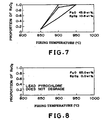
- this decomposition of PbRuO 3 was temperature-dependent, particularly, in the temperature range of from 800 to 900 °C, and that as the decomposition proceeded, the resistance of the resistor lowered down to 1/100, while its TCR rose to up to 2000 ppm/°C. Then, the inventors noticed the relationship between the formulation of the glass binder of the resistor composition and the decomposition of PbRuO 3 , and sought such a formulation of the glass binder that PbRuO 3 will minimally degrade.
- each of various glasses and a powder of lead pyrochlore (PbRuO 3 ) with specific surface areas of 7-10/m 2 /g and an average particle size of 5.0-10.0 nm (50-100 ⁇ ) were mixed with an organic solvent, terpineol.
- the mixture was coated onto the entire surface of an alumina substrate by means of a doctor blade, and dried at 150 °C. After the organic component was burned out, the coating was fired at 850, 900 and 950 °C, and analyzed by X-ray diffraction.
- the peak intensities of the lead pyrochlore and RuO 2 of the X-ray diffraction pattern were determined, and the peak ratio expressed as (RuO 2 )/(RuO 2 + lead pyrochlore) was calculated. Based on the results, the degree of decomposition of the lead pyrochlore was evaluated.
- a low thermal coefficient of expansion (e.g., 5.8 ppm/°C) can be achieved by using a glass with a high B 2 O 3 content, i.e., a glass containing 2-20 wt. % of B 2 O 3 , preferably a glass with a high B 2 O 3 content and free from PbO.
- a glass with a high B 2 O 3 content involves the decomposition of the lead pyrochlore.
- the inventors studied how to suppress the decomposition of the lead pyrochlore while maintaining a low thermal coefficient of expansion.
- a glass with a specific PbO content and a specific B 2 O 3 content (first glass) was combined with PbRuO 3 in specific proportions.
- the combined components were dispersed in a glass matrix with a specific B 2 O 3 content (a glass binder containing the first glass as one component).
- the resulting composition was found to give a thick film resistor with a low thermal coefficient of expansion, with the decomposition of the lead pyrochlore suppressed, and with small fluctuations and small variations in the TCR during the firing step.
- the present invention is based on this finding.
- the resistor in which the lead pyrochlore decomposed was also shown to be poor in noise and electrostatic discharge (ESD).
- ESD electrostatic discharge
- the resistor in accordance with the present invention is excellent in terms of noise and ESD because of the suppression of lead pyrochlore decomposition.
- the thick film resistor composition of the present invention contains a lead pyrochlore oxide as the conducting component.
- the lead pyrochlore oxide is lead ruthenate (PbRuO 3 or Pb 2 Ru 2 O 6 ), which is described in detail in the specification of U.S. Patent 3,583,931.
- PbRuO 3 is obtained easily in pure from, is not adversely affected by the glass binder, has a relatively small TCR, is stable even when heated to 1000 °C in air, and is relatively stable even in a reducing atmosphere.
- PbRuO 3 is used in a proportion of 5-30 wt. %, preferably 10-25 wt. %, based on the total weight of the composition containing the organic medium. If based on the total content of the inorganic solids, its proportion is 7.1-42.9 wt. %, preferably 14.2-35.8 wt. %.
- the total content of the inorganic solids refers to the total amount of the conducting component and the glass binder. In case the composition of the present invention contains an inorganic additive in addition to the conducting component and the inorganic binder, the total content of the inorganic solids is taken to contain the inorganic additive.
- compositions of the present invention may contain ruthenium oxide (RuO 2 ) as the conducting component.
- RuO 2 ruthenium oxide
- the conducting component is used in a proportion of 0-20 wt. %, based on the total weight of the composition containing the organic medium. If based on the total content of the inorganic solids, its proportion is 0-71.5 wt. %, preferably 0-28.6 wt.%.
- the glass binder used in the thick film resistor composition of the present invention is a glass which contains a first glass containing 61-85 wt. % of PbO, 10-36% of SiO 2 and 0-2 wt. % of B 2 O 3 , the total content of the PbO, SiO 2 and B 2 O 3 accounting for 95 wt. % or more, and in which 2-20 wt. % of B 2 O 3 is contained in the entire glass binder.
- the B 2 O 3 content of the glass binder has to be 2-20 wt. %.
- the B 2 O 3 content is determined in accordance with the kind and amount of the conducting component used, as well as the desired resistance of the thick film resistor.
- the formulations and proportions used of the first glass and the second glass to be described are selected so as to afford the desired B 2 O 3 content.
- the PbO content of the first glass is 61-85 wt. %, preferably 63-78 wt. %, more preferably 63-70 wt. %.
- Its SiO 2 content is 10-36 wt. %, preferably 15-36 wt. %, more preferably 25-36 wt. %.
- Its B 2 O 3 content is 0-2 wt. %, preferably 0 wt. %.
- the total content of PbO, SiO 2 and B 2 O 3 in the first glass is 95 wt. % or more.
- the first glass is used in a proportion of 10-25 wt. %, based on the total weight of the composition containing the organic medium. If based on the total content of the inorganic solids, its proportion is 7.1-42.9 wt. %, preferably 14.2-35.8 wt. %.
- the first glass must be used in such a range that the ratio of PbRuO 3 to the first glass will be 5:30-60:40, preferably 5:30-1:1.
- the glass binder contains one or more glasses in addition to the first glass.
- This glass component other than the first glass is designated as the second glass.
- the second glass is used in a proportion of 10-40 wt. %, based on the total weight of the composition containing the organic medium. If based on the total content of the inorganic solids, its proportion is 7.1-85.7 wt. %, preferably 14.2-57.2 wt. %.
- the second glass is a glass containing 30-60 wt. % of SiO 2 , 5-30 wt. % of CaO, 1-40 wt. % of B 2 O 3 , 0-50 wt. % of PbO, and 0-20 wt. % of Al 2 O 3 , the total content of the SiO 2 CaO, B 2 O 3 , PbO and Al 2 O 3 accounting for 35 wt. % or more of the glass (hereinafter referred to as "the second glass (A)").
- the use of the second glass (A) enables the thermal coefficient of expansion (TCE) to be controlled to some extent and sintering to be controlled.
- the second glass used in the present invention is a mixture of the second glass (A) and a glass comprising PbO-SiO 2 glass with a PbO content of at least 50 wt, % (hereinafter referred to as "the second glass (B)").
- the second glass (B) a glass comprising PbO-SiO 2 glass with a PbO content of at least 50 wt, %.
- the use of such two glasses with different lead oxide contents or softening points in the glass binder gives a thick film resistor with the low shape effect of resistance and TCR as well as small fluctuations in resistance and TCR due to the firsing of the overcoat glass.
- the low shape effect of resistance and TCR refers to small changes in resistance and TCR according to the change of the pad length (width) of the resistor, say, the change from 0.8 mm x 0.8 mm to 0.5 mm x 0.5 mm.
- the second glass (A) contains only up to 50 wt. % of lead oxide, and so it is generally a high softening point glass.
- the second glass (B) contains at least 50 wt. % of lead oxide, and so it is generally a low softening point glass.
- the second glasses (A) and (B) each cannot be used alone as a glass binder for the thick film resistor composition, because the former glass cannot be sintered, while the latter is too soft as glass, making the resistor ill-shaped.
- the present invention achieved a thick film resistor with a low shape effect of resistance and TCR, as well as small changes in resistance and TCR due to calcination of the overcoat glass. This was quite unpredictable.
- the second glass (A) is glass in which the total content of SiO 2 , CaO, B 2 O 3 , PbO and Al 2 O 3 accounts for 35 wt. % or more of the glass.
- the SiO 2 content needs to be at least 30 wt. %. A lower content will result in an insufficiently high softening point. However, the content must be 60 wt. % or less. A higher content than this may result in crystallized Si.
- the CaO content needs to be at least 5 wt. %, but has to be 30 wt. % or less. A content in excess of 30 wt. % may cause Ca to be crystallized with other elements.
- the B 2 O 3 content needs to be at least 1 wt.
- the content of PbO must be 50 wt. % or less. A content exceeding 50 wt. % will result in an insufficiently high softening point. Preferably, it is 0-30 wt. %, more preferably 0-20 wt. %.
- the content of Al 2 O 3 must be 20 wt. % or less. A content exceeding 20 wt. % will result in no glass formation. The preferred content is 0-5 wt. %.
- the second glass (A) is used in a proportion of 5-35 wt. %, preferably 10-25 wt. %, based on the total weight of the composition containing the organic medium. If based on the total content of the inorganic solids, its proportion is 7-50 wt. %, preferably 14-36 wt. %.
- the second glass (B) is PbO-SiO 2 glass with a PbO content of at least 50 wt. %. Only when the second glass (A) is used in combination with the second glass (B), can the reduction of the shape effect of the resistor TCR, as well as the reduction of changes in resistance and TCR due to firing of the overcoat glass, be achieved.
- the second glass (B) is preferably a glass containing 50-80 wt. % of PbO, 10-35 wt. % of SiO 2 , 0-10 wt. % of Al 2 O 3 , 1-10 wt. % of B 2 O 3 , 1-10 wt. % of CuO, and 1-10 wt. % of ZnO, the total content of the PbO, SiO 2 , Al 2 O 3 , B 2 O 3 , CuO and ZnO being 95 wt. % or more of the glass.
- the second glass (B) is used in a proportion of 5-40 wt. %, preferably 10-35 wt. %, based on the total weight of the composition containing the organic medium. If based on the total content of the inorganic solids, its proportion is 7-57 wt. %, preferably 14-50 wt. %.
- the glass formulation of the glass binder is preferably selected such that the softening point of the aforementioned first glass will be lower than that of the second glass (A), but higher than that of the second glass (B).
- the first and second glasses that are used as the glass binder in the present invention may each contain, in addition to the aforementioned components, less than 15 wt. % of components for regulating the thermal expansion coefficient of the thick film resistor and the maturing temperature of the glass binder.
- 96% alumina ceramic, an ordinary substrate has a thermal expansion coefficient of 75 x 10 -7 /°C, and so the thermal expansion coefficient of the thick film resistor should preferably be lower than that.
- the thermal coefficient of expansion can be regulated by adjusting the contents of silica, lead oxide and boron oxide. The incorporation of a small amount of an oxide of lithium, potassium or sodium may result in a regulated thermal expansion coefficient.
- Lithium oxide is advantageously incorporated in the glass binder component to a content of up to 3 wt. %.
- ZrO 2 in an amount of up to 4% enhances the resistance of the glass to dissolution in an alkali solution, while TiO 2 enhances the resistance of the glass to attack by an acid.
- the incorporation of Na 2 O can provide a favorable thermal expansion coefficient range.
- the above-described glasses as the glass binders can each be produced by an ordinary glass manufacturing technique. Namely, they can be produced by mixing the desired components or their precursors, e.g., H 3 BO 3 for B 2 O 3 , in the desired proportions, and heating the mixture to form a melt. As is well known in the art, the heating is performed to a peak temperature until the melt will become completely liquid and no gases will be generated. In the present invention, the peak temperature is in the range of from 1100 to 1500 °C, usually from 1200 to 1400 °C. Then, the melt is typically poured onto a cold belt or in cold running water for quenching. Then, the product is milled, if desired, to reduce its particle sizes.
- these glasses can be produced by melting for 20 minutes to 1 hour at 1200-1400°C in a platinum crucible in a silicon carbide furnace electrically heated.
- a rotary or oscillating mill By treatment with a rotary or oscillating mill, the final particle size can be adjusted to 1-10 m 2 /g.
- the oscillating mill treatment is carried out by placing inorganic powder and cylinders of alumina, etc. together with an aqueous medium in the container, and then oscillating the container for a specified period of time.
- the thick film resistor composition of the present invention may contain an inorganic additive.
- an inorganic additive such as Nb 2 O 5 , MnO and Cu 2 O, as TCR regulators, and oxides with low TCEs, such as ZrSiO 4 , as TCE fillers.
- ZrSiO 4 contributes to improved laser trimming properties of the thick film resistor.
- the inorganic additive is used in a proportion of 0.05-15 wt. % based on the total weight of the composition containing the organic medium, or 7.1-21.4 wt. % based on the total content of the inorganic solids.
- PbO can be used as a coat on the surfaces of PbRuO 3 particles.
- Coating with PbO can be performed by heating PbRuO 3 powder at a low temperature (e.g., 400-600°C) in a Pb-rich atmosphere. This can be done by superimposing a large crucible and a small crucible on each other, placing PbO powder in the large crucible, placing PbRuO 3 powder in the small crucible, and heating the crucible with a cover applied to the whole of them.
- the coating with PbO can also be carried out by coating the surfaces of PbRuO 3 powder with PbO at the molecular level.
- the above inorganic solids of the present invention are dispersed in the organic medium or vehicle to make a printable composition paste.
- the organic medium is used in a proportion of 20-40 wt. %, preferably 25-35 wt. %, based on the total weight of the composition.
- any inert liquids can be used as the vehicle.
- water or one of various organic liquids the water or each liquid containing or not containing thickening agents and/or stabilizers and/or other ordinary additives.
- the organic liquid usable are aliphatic alcohols, esters (e.g., acetates and propionates) of such alcohols, terpenes such as pine root oil or terpineol, and solutions of resins (e.g., polymethacrylates of lower alcohols or ethyl cellulose) in solvents (e.g., pine root oil and monobutyl ether of ethylene glycol monoacetate).
- the vehicle may be incorporated volatile liquids for promoting rapid solidification after application to the substrate.
- the vehicle may be composed of such volatile liquids.
- the preferred vehicle is based on ethyl cellulose and ⁇ -terpineol.
- the thick film resistor composition of the present invention can be produced by means of, say, a triple roll mill.
- the first glass and PbRuO 3 preliminarily, and add the fired product to the vehicle.
- This preliminary firing involves, for example, heating at 600-1000°C for
- the resistor composition of the present invention can be printed as a film on a ceramic, alumina or other dielectric substrate by an ordinary method.
- an alumina substrate is used, and the resistor composition is printed on a fired palladium-silver terminal.
- a screen stencil technique can be used preferably.
- the substrate with printed pattern is generally allowed to stand for leveling the printed pattern, and dried for 10 minutes at an elevated temperature of, say, 150°C. Then, is is fired at a peak temperature of 850°C in a belt furnace in air.
- the predetermined inorganic solid and vehicle are mixed, and the mixture is kneaded with a roll mill to make a paste.
- a Pd/Ag thick film conductor is printed on a 25 mm x 25 mm (1 inch x 1 inch) 96% alumina substrate to a dry film thickness of 18 ⁇ 2 ⁇ m, and is then dried for 10 minutes at 150°C.
- This Pd/Ag thick film conductor contains 0.5 wt. % of Pd in the paste.
- the thick film resistor composition paste is printed to a size of 0.8 mm x 0.8 mm and a dry film thickness of 18 ⁇ 2 ⁇ m.
- the print is dried at 150°C for 10 minutes, and then heated in a box furnace for calcination.
- the temperature profile of the box furnace is such that the dried film is heated for 10 minutes at 350°C to burn out the organic medium, whereafter the heated film is fired separately at a peak temperature of 800°C for 10 minutes, or at a peak temperature of 850°C for 10 minutes, or at a peak temperature of 900°C for 10 minutes, followed by cooling.
- the firing time is such that the period from the time when the temperature during firing has exceeded 100°C until the time when the temperature during cooling has becomes lower than 100°C is 30 minutes.
- the resistance (R) is measured with a terminal-patterned probe using an autorange autobalance digital ohmmeter with a precision of 0.01%. Specifically, samples are laid on the terminal post in the chamber, and electrically connected with the digital ohmmeter. The temperature in the chamber is adjusted to 25°C and equilibrated. Then, each sample is measured for resistance, and the readings are recorded.
- the temperature in the chamber is raised to 125°C and equilibrated. Then, each sample is measured again for resistance, and the readings are recorded.
- TCR hot temperature coefficient of resistance
- the firing temperature dependences of the resistance and TCR are evaluated by the difference in resistance ( ⁇ R(a-b)) and the difference in TCR ( ⁇ HTCR(a-b)) between the resistors calcined at different peak temperatures (a°C and b°C).
- ⁇ R(a-b) ((R(a°C) - (b°C)/R(b°C))) x 100 (%)
- ⁇ HTCR(a-b) HTCR(a°C) - HTCR(b°C) (ppm/°C)
- PbRuO 3 for use as the conducting component in the Examples and Comparitive Example was prepared by firing PbO and RuO 2 in air at 800-1000°C, and then finely pulverizing the fired product to particles with surface areas of 3-60 m 2 /g.
- the RuO 2 was one with a surface area of 25 m 2 /g.
- Glasses a, b, c and d for use as glass binders were produced by heat-melting the predetermined materials at 1000-1700°C for 30 minutes to 5 hours depending on the formulation of the glass until the generation of gases would completely stop; then quenching the melt in water; and milling the quenched product to specific surface areas of 2-5 m 2 /g.
- the formulations of these glasses are shown in Table 2.
- Glass a corresponds to the glass of the Comparative Example
- glass b to the first glass of the invention
- glass c to the second glass (A)
- glass d to the second glass (B).
- the organic media used in the Examples and Comparative Example were mixtures of 10-30 parts of ethyl cellulose and 90-70 parts of ⁇ -terpineol.
- compositions (Comparative Example 1, Example 1 and Example 2) were prepared using the starting materials shown in Table 3.
- the respective solid components were separately mixed with the organic medium.
- PbRuO 3 and glass b were precalcined for 1 hour at 850°C, and then pulverized to make powders, which were used as the starting materials.
- the resulting three compositions were subjected to the aforementioned testing methods so that these samples were measured for resistance and HTCR. The results shown in Table 3 were obtained.
- Example 2 representing the composition of the present invention were smaller than Comparative Example 1 in the temperature range of from 800 to 900°C.
- Example 1 is not an embodiment of the invention, but is useful for its understanding.
- Example 2 Example 3 PbRuO 3 11.5 wt. % 16.8 wt. % 16.8 wt. % RuO 2 11.5 wt. % 3.0 wt. % 3.0 wt. % Glass a 47.0 wt. % - - Glass b - 28.9 wt. % 16.8 wt. % Glass c - 20.1 wt. % 12.0 wt. % Glass d - - 20.0 wt. % Nb 2 O 5 - 1.2 wt. % 1.2wt. % Organic Medium 30.0 wt.
- the thick film resistor composition of the present invention provides a thick film resistor having small variations in TCR during the firing step and a low thermal coefficient of expansion, because the decomposition of lead pyrochlore (PbRuO 3 ) is suppressed and the firing temperature dependence of resistance and TCR is minimal.
Landscapes
- Chemical & Material Sciences (AREA)
- Engineering & Computer Science (AREA)
- Materials Engineering (AREA)
- Chemical Kinetics & Catalysis (AREA)
- General Chemical & Material Sciences (AREA)
- Geochemistry & Mineralogy (AREA)
- Life Sciences & Earth Sciences (AREA)
- Organic Chemistry (AREA)
- Manufacturing & Machinery (AREA)
- Microelectronics & Electronic Packaging (AREA)
- Inorganic Chemistry (AREA)
- Non-Adjustable Resistors (AREA)
- Glass Compositions (AREA)
- Inorganic Compounds Of Heavy Metals (AREA)
Claims (3)
- Dickschichtwiderstands-Zusammensetzung, umfassend:(a) 5 bis 30 Gew.-%, bezogen auf das Gesamtgewicht der Zusammensetzung, eines Bleioxids vom Pyrochlor-Typ, bei dem es sich um Bleiruthenat handelt;(b) 0 bis 20 Gew.-%, bezogen auf das Gesamtgewicht der Zusammensetzung, RuO2;(c) 10 bis 25 Gew.-%, bezogen auf das Gesamtgewicht der Zusammensetzung, eines ersten Glases, das 61 bis 85 Gew.-% PbO, 10 bis 36 Gew.-% SiO2 und 0 bis 2 Gew.-% B2O3 umfaßt;(d) 10 bis 40 Gew.-%, bezogen auf das Gesamtgewicht der Zusammensetzung, eines zweiten Glases (A), das 30 bis 60 Gew.-% SiO2, 5 bis 30 Gew.-% CaO, 1 bis 40 Gew.-% B2O3, 0 bis 50 Gew.-% PbO und 0 bis 20 Gew.-% Al2O3 umfaßt;(e) ein organisches Medium;
mit der Maßgabe, daß(i) der Gesamtgehalt von PbO, SiO2 und B2O3 in dem ersten Glas wenigstens 95 Gew.-% des ersten Glases umfaßt;(ii) der Gesamtgehalt von PbO, SiO2, CaO, Al2O3 und B2O3 wenigstens 35 Gew.-% des zweiten Glases umfaßt;(iii) der B2O3-Gehalt des ersten und zweiten Glases 2 bis 20 Gew.-% ausmacht; und(iv) das Gewichtsverhältnis des Bleioxids vom Pyrochlor-Typ zum ersten Glas im Bereich von 5:30 bis 60:40 liegt. - Zusammensetzung gemäß Anspruch 1, worin das zweite Glas weiterhin ein Glas (B) enthält, umfassend 50 bis 80 Gew.-% PbO, 10 bis 35 Gew.-% SiO2, 0 bis 10 Gew.-% Al2O3, 1 bis 10 Gew.-% B2O3, 1 bis 10 Gew.-% CuO und 1 bis 10 Gew.-% ZnO; mit der Maßgabe, daß der Gesamtgehalt an PbO, SiO2, Al2O3, B2O3, CuO und ZnO wenigstens 95 Gew.-% der Glaskomponente (B) umfaßt.
- Zusammensetzung gemäß den Ansprüchen 1 und 2, die weiterhin ein anorganisches Additiv umfaßt, das aus Nb2O5, MnO, Cu2O, ZrSiO4 oder Mischungen derselben ausgewählt ist.
Applications Claiming Priority (4)
| Application Number | Priority Date | Filing Date | Title |
|---|---|---|---|
| JP11770192 | 1992-05-11 | ||
| JP4117701A JPH05335110A (ja) | 1992-05-11 | 1992-05-11 | 厚膜抵抗体組成物 |
| JP117701/92 | 1992-05-11 | ||
| PCT/US1993/004187 WO1993023855A1 (en) | 1992-05-11 | 1993-05-10 | Thick film resistor composition |
Publications (2)
| Publication Number | Publication Date |
|---|---|
| EP0594827A1 EP0594827A1 (de) | 1994-05-04 |
| EP0594827B1 true EP0594827B1 (de) | 1999-08-04 |
Family
ID=14718171
Family Applications (1)
| Application Number | Title | Priority Date | Filing Date |
|---|---|---|---|
| EP93911027A Expired - Lifetime EP0594827B1 (de) | 1992-05-11 | 1993-05-10 | Zusammensetzung fuer einen dickschichtwiderstand |
Country Status (7)
| Country | Link |
|---|---|
| EP (1) | EP0594827B1 (de) |
| JP (1) | JPH05335110A (de) |
| KR (1) | KR0130831B1 (de) |
| CN (1) | CN1033410C (de) |
| DE (1) | DE69325871T2 (de) |
| TW (1) | TW215965B (de) |
| WO (1) | WO1993023855A1 (de) |
Families Citing this family (12)
| Publication number | Priority date | Publication date | Assignee | Title |
|---|---|---|---|---|
| KR100365692B1 (ko) | 2000-02-24 | 2002-12-26 | 삼성전자 주식회사 | 토너 화상 정착을 위한 직접 가열 롤러 및 그 제조 방법 |
| JP5406277B2 (ja) | 2008-04-18 | 2014-02-05 | イー・アイ・デュポン・ドウ・ヌムール・アンド・カンパニー | Cu含有ガラスフリットを使用する抵抗体組成物 |
| US8257619B2 (en) * | 2008-04-18 | 2012-09-04 | E I Du Pont De Nemours And Company | Lead-free resistive composition |
| TW201227761A (en) | 2010-12-28 | 2012-07-01 | Du Pont | Improved thick film resistive heater compositions comprising ag & ruo2, and methods of making same |
| CN103021601A (zh) * | 2012-12-27 | 2013-04-03 | 青岛艾德森能源科技有限公司 | 一种电阻浆料 |
| CN104464991B (zh) * | 2013-09-12 | 2017-06-06 | 中国振华集团云科电子有限公司 | 一种线性正温度系数热敏电阻浆料的制备方法 |
| CN104409133A (zh) * | 2014-12-26 | 2015-03-11 | 常熟联茂电子科技有限公司 | 一种无机电阻浆料 |
| CN104464878A (zh) * | 2014-12-26 | 2015-03-25 | 常熟联茂电子科技有限公司 | 一种电阻浆料 |
| CN106571170A (zh) * | 2016-10-25 | 2017-04-19 | 东莞珂洛赫慕电子材料科技有限公司 | 一种具有低电阻重烧变化率的高温无铅钌浆及其制备方法 |
| CN109637695A (zh) * | 2018-12-12 | 2019-04-16 | 西安宏星电子浆料科技有限责任公司 | 一种高性能厚膜电阻浆料组合物 |
| CN112992401B (zh) * | 2021-04-25 | 2021-09-03 | 西安宏星电子浆料科技股份有限公司 | 一种可无损调阻的电阻浆料 |
| CN114853448B (zh) * | 2022-06-08 | 2023-05-16 | 中国振华集团云科电子有限公司 | 一种低温共烧用负温度系数热敏陶瓷材料制备方法 |
Family Cites Families (3)
| Publication number | Priority date | Publication date | Assignee | Title |
|---|---|---|---|---|
| US4362656A (en) * | 1981-07-24 | 1982-12-07 | E. I. Du Pont De Nemours And Company | Thick film resistor compositions |
| US4961999A (en) * | 1988-07-21 | 1990-10-09 | E. I. Du Pont De Nemours And Company | Thermistor composition |
| US5096619A (en) * | 1989-03-23 | 1992-03-17 | E. I. Du Pont De Nemours And Company | Thick film low-end resistor composition |
-
1992
- 1992-05-11 JP JP4117701A patent/JPH05335110A/ja active Pending
-
1993
- 1993-05-10 KR KR1019940700060A patent/KR0130831B1/ko not_active Expired - Fee Related
- 1993-05-10 EP EP93911027A patent/EP0594827B1/de not_active Expired - Lifetime
- 1993-05-10 WO PCT/US1993/004187 patent/WO1993023855A1/en not_active Ceased
- 1993-05-10 DE DE69325871T patent/DE69325871T2/de not_active Expired - Fee Related
- 1993-05-11 CN CN93106557A patent/CN1033410C/zh not_active Expired - Fee Related
- 1993-05-11 TW TW082103746A patent/TW215965B/zh not_active IP Right Cessation
Non-Patent Citations (1)
| Title |
|---|
| PATENT ABSTRACTS OF JAPAN vol. 15, no. 121 (E-1049)25 March 1991;& JP-A-03 009 501 * |
Also Published As
| Publication number | Publication date |
|---|---|
| DE69325871D1 (de) | 1999-09-09 |
| WO1993023855A1 (en) | 1993-11-25 |
| JPH05335110A (ja) | 1993-12-17 |
| TW215965B (en) | 1993-11-11 |
| CN1033410C (zh) | 1996-11-27 |
| DE69325871T2 (de) | 2000-01-13 |
| CN1086042A (zh) | 1994-04-27 |
| KR0130831B1 (ko) | 1998-05-15 |
| EP0594827A1 (de) | 1994-05-04 |
Similar Documents
| Publication | Publication Date | Title |
|---|---|---|
| US4548741A (en) | Method for doping tin oxide | |
| CA1211625A (en) | Stain-resistant ruthenium oxide-based resistors | |
| JP5406277B2 (ja) | Cu含有ガラスフリットを使用する抵抗体組成物 | |
| EP2274249A1 (de) | Bleifreie widerstandszusammensetzungen mit rutheniumoxid | |
| US5534194A (en) | Thick film resistor composition containing pyrochlore and silver-containing binder | |
| JPS6339082B2 (de) | ||
| US4707346A (en) | Method for doping tin oxide | |
| EP0548865B1 (de) | Zusammensetzung für Dickschicht-Widerstand | |
| WO1993023855A1 (en) | Thick film resistor composition | |
| EP0185321A1 (de) | Zusammensetzungen für Widerstände | |
| US5474711A (en) | Thick film resistor compositions | |
| JP3619262B2 (ja) | 厚膜抵抗体組成物 | |
| EP0551100B1 (de) | Teilweise kristallisierbare niedrigschmelzende Glaszusammensetzung | |
| US4597897A (en) | Hexaboride resistor composition | |
| KR900004078B1 (ko) | 저항기 조성물 | |
| EP0563838B1 (de) | Zusammensetzung für einen Dickschichtwiderstand | |
| KR100284785B1 (ko) | 메모리 데이터 처리 시스템 및 방법과 이건 시스템을 구비하는 통신 시스템 | |
| US4613539A (en) | Method for doping tin oxide | |
| JPH08186006A (ja) | 厚膜抵抗体組成物 | |
| US4652397A (en) | Resistor compositions | |
| JP7794036B2 (ja) | 厚膜抵抗ペースト、厚膜抵抗体、及び電子部品 | |
| JP3042180B2 (ja) | 厚膜抵抗体及びその製造方法 | |
| JPH04177702A (ja) | 厚膜抵抗体用組成物 |
Legal Events
| Date | Code | Title | Description |
|---|---|---|---|
| PUAI | Public reference made under article 153(3) epc to a published international application that has entered the european phase |
Free format text: ORIGINAL CODE: 0009012 |
|
| 17P | Request for examination filed |
Effective date: 19940103 |
|
| AK | Designated contracting states |
Kind code of ref document: A1 Designated state(s): DE FR GB |
|
| 17Q | First examination report despatched |
Effective date: 19960410 |
|
| GRAG | Despatch of communication of intention to grant |
Free format text: ORIGINAL CODE: EPIDOS AGRA |
|
| GRAG | Despatch of communication of intention to grant |
Free format text: ORIGINAL CODE: EPIDOS AGRA |
|
| GRAH | Despatch of communication of intention to grant a patent |
Free format text: ORIGINAL CODE: EPIDOS IGRA |
|
| GRAH | Despatch of communication of intention to grant a patent |
Free format text: ORIGINAL CODE: EPIDOS IGRA |
|
| GRAA | (expected) grant |
Free format text: ORIGINAL CODE: 0009210 |
|
| AK | Designated contracting states |
Kind code of ref document: B1 Designated state(s): DE FR GB |
|
| REF | Corresponds to: |
Ref document number: 69325871 Country of ref document: DE Date of ref document: 19990909 |
|
| ET | Fr: translation filed | ||
| PLBE | No opposition filed within time limit |
Free format text: ORIGINAL CODE: 0009261 |
|
| STAA | Information on the status of an ep patent application or granted ep patent |
Free format text: STATUS: NO OPPOSITION FILED WITHIN TIME LIMIT |
|
| 26N | No opposition filed | ||
| REG | Reference to a national code |
Ref country code: GB Ref legal event code: IF02 |
|
| PGFP | Annual fee paid to national office [announced via postgrant information from national office to epo] |
Ref country code: DE Payment date: 20070503 Year of fee payment: 15 |
|
| PGFP | Annual fee paid to national office [announced via postgrant information from national office to epo] |
Ref country code: GB Payment date: 20070509 Year of fee payment: 15 |
|
| PGFP | Annual fee paid to national office [announced via postgrant information from national office to epo] |
Ref country code: FR Payment date: 20070510 Year of fee payment: 15 |
|
| GBPC | Gb: european patent ceased through non-payment of renewal fee |
Effective date: 20080510 |
|
| REG | Reference to a national code |
Ref country code: FR Ref legal event code: ST Effective date: 20090119 |
|
| PG25 | Lapsed in a contracting state [announced via postgrant information from national office to epo] |
Ref country code: FR Free format text: LAPSE BECAUSE OF NON-PAYMENT OF DUE FEES Effective date: 20080602 Ref country code: DE Free format text: LAPSE BECAUSE OF NON-PAYMENT OF DUE FEES Effective date: 20081202 |
|
| PG25 | Lapsed in a contracting state [announced via postgrant information from national office to epo] |
Ref country code: GB Free format text: LAPSE BECAUSE OF NON-PAYMENT OF DUE FEES Effective date: 20080510 |