EP0594898B1 - Méthode pour sortir des caractères multitypes sur un appareil à haute résolution - Google Patents
Méthode pour sortir des caractères multitypes sur un appareil à haute résolution Download PDFInfo
- Publication number
- EP0594898B1 EP0594898B1 EP19920250314 EP92250314A EP0594898B1 EP 0594898 B1 EP0594898 B1 EP 0594898B1 EP 19920250314 EP19920250314 EP 19920250314 EP 92250314 A EP92250314 A EP 92250314A EP 0594898 B1 EP0594898 B1 EP 0594898B1
- Authority
- EP
- European Patent Office
- Prior art keywords
- font
- scaling
- size
- letters
- master
- Prior art date
- Legal status (The legal status is an assumption and is not a legal conclusion. Google has not performed a legal analysis and makes no representation as to the accuracy of the status listed.)
- Expired - Lifetime
Links
Images

Classifications
-
- B—PERFORMING OPERATIONS; TRANSPORTING
- B41—PRINTING; LINING MACHINES; TYPEWRITERS; STAMPS
- B41B—MACHINES OR ACCESSORIES FOR MAKING, SETTING, OR DISTRIBUTING TYPE; TYPE; PHOTOGRAPHIC OR PHOTOELECTRIC COMPOSING DEVICES
- B41B19/00—Photoelectronic composing machines
-
- G—PHYSICS
- G06—COMPUTING OR CALCULATING; COUNTING
- G06K—GRAPHICAL DATA READING; PRESENTATION OF DATA; RECORD CARRIERS; HANDLING RECORD CARRIERS
- G06K15/00—Arrangements for producing a permanent visual presentation of the output data, e.g. computer output printers
- G06K15/02—Arrangements for producing a permanent visual presentation of the output data, e.g. computer output printers using printers
Definitions
- the invention relates to a method for outputting writing on high-resolution output devices according to the preamble of patent claim 1.
- Such high-resolution output devices are, for example, electronic light typesetting machines or high-resolution laser printers. These devices contain their own computer unit, which receives the text to be output as such, for example from an external computer, and uses digitally stored fonts to convert it into a given font of a certain font and size. A margin adjustment can also be taken into account.
- the data output by the computer unit contain the complete information about the typeface and are fed to a buffer which serves to control an output unit which transfers the data to a reproduction medium such as film or paper, for example with the aid of a laser beam.
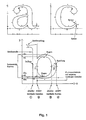
- the fonts are stored in digital form, whereby today the outline coding has largely become established, in which the contours or edges of a letter are described by discrete control points and connecting curve elements, as shown in FIG. 1.
- the X, Y coordinates of start, corner, curve and tangent points are digitized as points and the curve elements are described by the various manufacturers as straight lines and circles, Bezier functions, as spirals or as spline functions.
- An overview of the digital font formats can be found in the book "Digital Fonts", Peter Karow, Springer-Verlag, Berlin Heidelberg, 1992.
- the letters contain so-called instructions that are used in the screening for the output of the letter, for example on a laser printer or a screen, and today are used by all manufacturers of digital fonts for "intelligent screening” (intelligent font scaling) (cf. book “Font Technology”, Peter Karow, Springer-Verlag, Berlin Heidelberg, 1992; Chapter 7).
- point (pt) a typographic unit
- 1 pt 0.375 mm.
- hair lines must be reinforced with small font sizes so that they remain recognizable at all and do not "break through” through the printing process, i.e. partially disappear.
- the letters can be put together relatively closely, white or interior spaces remain small and hair lines are thin. This can be summarized as follows if you start from a master in the design size of the font:
- the master font stored in an average point size is first rescaled linearly by a factor to the desired point size and then the instructions are used to continuously increase the line width of the letters rescaled by the factor in a first predetermined dependence on the factor to vary, the line width for factors less than one increased by a percentage predetermined by the predetermined dependency and decreased for factors greater than one by a percentage predetermined by the predetermined dependency.
- the white spaces may be changed, but not the line widths.
- EP-A-0 580 900 a method for outputting writing is proposed, in which, starting from a single master font, the font to be output is brought to the desired width by linear expansion or condensation, and then the Instructions are used to change the stroke width when linearly expanding or condensing to keep the letters constant and in this way only widen or narrow the interiors.
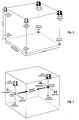
- FIG. 2 The interaction of the three font-varying operations (optical scaling, expanding / condensing, generation of a degree of fat) is shown schematically in FIG. 2.
- Font interpolation is shown using a cube, with the point size (optical scaling) along one axis, the alphabet length (expanding / condensing) along the second axis and the degree of fat along the third axis.
- the display of a desired font is based on linear interpolation between stored master fonts with different point sizes, alphabet lengths and degrees of fat.
- eight master fonts are required to be able to generate a font with the desired point size, alphabet length and fat level. These eight master fonts correspond to the eight corner points of the cube shown in FIG. 2.
- a serious disadvantage of this method is that eight master fonts are required, which on the one hand results in a high storage space requirement (approx. 50 Kbytes per master font) and on the other hand means that it takes a lot of time to produce the master fonts.
- the following difficulty arises: When producing eight master fonts, it is necessary to keep the eight variants of a letter under control at the same time, ie all eight variants must be digitized with such data be provided that they remain linear interpolatable. In particular, care must be taken to ensure that the number, type and location of the digitization points are the same in all cases and that the instructions for "Intelligent Font Scaling" are the same in number, type and parameterization. If, for example, an appearance error (digitization points) or processing (instructions) occurs afterwards with just one letter, the associated seven other letter variants must also be corrected, which overall takes a considerable amount of time in the production of the master fonts leads.
- FIG. 1 shows examples for the definition of the outer lines of letters by discrete points
- two master fonts of medium dot size and medium alphabet length are used, the first having a low degree of fat and the second having a high degree of fat. Between them, the font with the desired fat level is generated by linear interpolation. In the schematic illustration of the font generation in FIG. 3, the two master fonts lie in the middle of the end face and in the middle of the opposite side of the cube, which represents the different font representations.
- the instructions are automatically scaled to the point size and expanded / condensed to the desired alphabet length using the instructions. The method for optical scaling using the instructions and the expanding / condensing are described in the mentioned EP-A-0 580 900.
- the letters contain so-called instructions which allow the screening to be carried out intelligently for the output of the letter, for example on a laser printer. Instructions are also referred to as "hints" or “switches”. They initially contain an identifier for the type of instruction, for example bars; Figures 4 and 5 provide an overview of the common types of instructions. In addition, the instruction contains information about where the element, for example the bar, is and how wide it is. Different instructions may contain different information for controlling the screening. An instruction causes the important descriptive elements of a font to be screened in a homogeneous manner, as shown in FIG.
- a bar a straight vertical smear (as for example with the I) can be considered.
- the parts of the outline that form the left and right boundaries are automatically available.
- the left edge of the I-beam is now moved to the nearest grid line of the raster. This is caused by an X shift that is applied to all coordinates of the outline. So there is no change in the shape of the letter.
- the right edge is then moved to the grid line that is a certain number of grid points to the right of the left edge. This fixed number is determined beforehand from the type of instruction generally for the whole script.
- the average thickness of the descriptive element in the present case the average bar thickness, and the rounding up determines the best possible number of grid points for the representation of the bar thickness.
- the shape of the I can change such that the I has a slightly thinner or thicker bar thickness after the shift of the right edge. It will be one Bar thickness achieved, which automatically avoids random effects during subsequent rasterization and which is in line with the other bar thicknesses of the font.
- the provision of the instructions and this procedure therefore mean that bars or other letter elements can either be thickened or thinned, or these elements (such as the bars) can be controlled, for example moved to the left or right overall.
- This procedure which enables a uniform rasterization of the elements in the output devices, is also referred to as "intelligent font scaling". So it was originally invented to avoid random screenings for the low resolutions of screens and laser printers.
- the instructions are initially used to arbitrarily fine-scale thickening / thinning of the line widths of the letters in high-resolution devices such as light setting machines, in order to achieve a typographically correct optical scaling as a function of the dot size generated, the line width for factors less than one increased by a percentage predetermined by the predetermined dependency and reduced for factors greater than one by a percentage predetermined by the predetermined dependency.
- This causes smaller dot sizes to have a relatively larger line width and larger dot sizes to have a relatively smaller line width. This ensures that even small point sizes remain pleasant and legible, which can be particularly important if texts are copied several times or transmitted by fax. In these cases, the optically scaled texts are much easier to read and clearly superior to the traditional linear rescaling.
- the lowercase letter b is thickened (see FIG. 1) in such a way that the two vertical bars (left bar, right curve) and then the two horizontal elements (upper sheet and lower sheet) are processed in two steps. Both steps run independently of each other.
- the first step consists of the following procedure: With the help of the four bar instructions (two absolute limits - (1) and (3) - and two relative limits (2) and (4)), all control points are located to the left of limit (1) , held.
- the thickening dimension is added in the x direction to the control points to the right of the limit (2).
- the thickening dimension is linearly interpolated, with (1) with zero, then linearly increasing, until (2) is fully added.
- the left bar is thickened.
- the right rounding is also processed.
- the x coordinates are recorded, between (3) and (4) the thickening dimension is added in a linear interpolating manner, to the right of (4) is added in full.
- the two arches are processed analogously in the y direction.
- a dilution can be achieved in the same way with a degree of dilution by subtraction.
- the letter b is first expanded by simply applying an x factor to all x coordinates, i.e. the x-axis (width) of the letter is stretched.
- the b and the rounding of the b also become wider (thicker) by this factor.
- the original line width and thus a dilution measure can be determined automatically.
- the limit (2) is shifted to the left by the amount of dilution, between (1) and (2) is shifted linearly interpolating, and to the right of (2) is also shifted linearly interpolating to the left so that near (2) the Dilution is fully added and falls to zero in the middle between (2) and (3).
- a dilution measure is determined for the rounding on the basis of the old limits (3) and (4) and applied as above.
- Condensation is similarly compensated for by determining and processing a thickening dimension in the x direction.
- the step of optical scaling is carried out by linearly rescaling each letter to the desired point size by a factor starting from a font which is available in an average dot size of 12 pt, for example, and then using the instructions to the stroke width of the letter continuously, with a first predetermined dependency on the factor.
- the first predefined dependency is shown in FIG. 6, which shows the percentage change in the line thickness as a function of the point size to which the rescaling is carried out.
- the stroke width is increased when changing to small point sizes, in this embodiment the stroke width is increased by 5% when changing to the point size 6 pt, while it is decreased by 2% when changing to very large letters of size 24 pt.
- the width of the rescaled letters is further varied in a second predetermined dependence on the rescaling factor during optical scaling, the width being increased when changing to smaller point sizes and decreasing when changing to larger point sizes.
- the height of the lower case letters is varied in a third predetermined dependency on the factor, the height being increased when changing to small point sizes and decreasing when changing to large point sizes.
- the spaces between the letters can be changed as a percentage of the capital letter height as a function of the point size. Examples of the specified dependencies on optical scaling are listed in the applicant's mentioned EP-A-0 580 900.
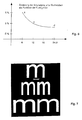
- the mode of action of the typographically correct condensing / expanding compared to the linear one is shown in FIG.
- the letter m is traditionally simply linearly narrowed or widened on the left-hand side compared to a typographically correct expansion on the right-hand side, where the line width is kept constant with the help of the instructions and thus only the interiors of the letters when widening / narrowing be widened or narrowed.
Landscapes
- Engineering & Computer Science (AREA)
- General Engineering & Computer Science (AREA)
- Physics & Mathematics (AREA)
- General Physics & Mathematics (AREA)
- Theoretical Computer Science (AREA)
- Controls And Circuits For Display Device (AREA)
Claims (8)
- Procédé permettant la production de polices de caractères sur des organes de sortie à haute résolution, notamment des photocomposeuses, pourvus d'un processeur, d'une mémoire tampon pour stocker les données des polices de caractères ainsi que d'une unité de sortie, qui transfère les données issues de la mémoire tampon directement sur un support de reproduction, le processeur utilisant plusieurs matrices de polices de caractères, représentées par un codage numérique des contours, chaque caractère comportant plusieurs points discrets de contrôle définissant les contours du caractère ainsi que des instructions supplémentaires, telles qu'elles sont prescrites pour la "mise à l'échelle intelligente", une police sélectionnée pour la sortie selon sa graisse, son corps et sa longueur d'alphabet étant générée avant son transfert vers la mémoire tampon à partir de plusieurs matrices de polices de caractères stockées, en la mettant optiquement à l'échelle du corps souhaité, en la élargissant ou condensant selon la longueur d'alphabet souhaitée et en générant la graisse souhaitée,
caractérisé par- la génération d'une police de caractères de sortie par interpolation mathématique linéaire entre deux matrices de polices de caractères de graisse différente,- la mise à l'échelle optique par la mise à l'échelle de la police de caractères de sortie au corps souhaité utilisant les instructions pour générer une variation continue de l'épaisseur de trait des caractères obtenue par la mise à l'échelle avec le facteur linéaire, variation qui dépend du facteur selon une première relation pré-définie, l'épaisseur de trait étant augmentée selon le pourcentage résultant de la relation pré-définie pour des facteur inférieurs à un et étant réduite selon le pourcentage résultant de la relation pré-définie pour des facteur supérieurs à un,- la génération de la longueur de l'alphabet souhaitée en élargissant ou condensant la police de sortie mise à l'échelle optiquement par un deuxième facteur linéaire atteignant ainsi la largeur souhaitée, en utilisant les instructions pour garder constante l'épaisseur de trait des caractères lorsqu'ils sont élargis ou condensés, élargissant ou condensant ainsi uniquement les espaces blancs. - Procédé selon revendication 1, caractérisé en ce que lors de la mise à l'échelle optique au corps souhaité en partant d'une police de caractères de corps 12 pt, l'épaisseur de trait des caractères est augmentée d'environ 5% pour une mise à l'échelle optique à 6 pt, et réduite d'environ 2% lors d'une mise à l'échelle à 24 pt.
- Procédé selon une des revendications précédentes, caractérisé en ce que lors de la mise à l'échelle optique au corps souhaité, la largeur des caractères obtenue par une mis à l'échelle linéaire subit une variation qui dépend du facteur de mise à l'échelle selon une deuxième relation pré-définie, la largeur étant réduite pour des facteurs inférieurs à un et augmentée pour des facteurs supérieurs à un, et caractérisé par une variation de la hauteur des caractères minuscules qui dépend du facteur de mise à l'échelle selon une troisième relation pré-définie, la hauteur étant augmentée pour des facteurs inférieurs à un et la hauteur étant réduite pour des facteurs supérieurs à un.
- Procédé selon revendication 3, caractérisé en ce que lors de la mise à l'échelle optique au corps souhaité, la largeur des caractères est augmenté d'environ 15% par rapport à une mise à l'échelle linéaire à 6 pt d'une matrice de police de caractères de 12 pt, et que la largeur des caractères est réduite d'environ 1% par rapport à une mise à l'échelle à 24 pt d'une matrice de police de caractères de 12 pt, et que la hauteur des caractères minuscules est augmentée d'environ 15% par rapport à une mise à l'échelle à un corps de 6 pt et que la hauteur des caractères minuscules est réduite d'environ 1% lors d'une mise à l'échelle à un corps de 24 pt.
- Procédé selon une des revendications précédentes, caractérisé en ce que lors de la mise à l'échelle optique au corps souhaité, les espaces entre les lettres d'une police de caractères mise à l'échelle de façon linéaire sont élargis d'un pourcentage relatif à la hauteur des caractères majuscules pour des facteurs inférieur à un, et que les espaces entre les lettres sont réduits par un pourcentage relatif à la hauteur des caractères majuscules pour des facteurs inférieurs à un.
- Procédé selon revendication 5, caractérisé en ce que lors de la mise à l'échelle optique au corps souhaité, les espaces entre les lettres sont élargis d'environ 6% de la hauteur des caractères majuscules lors d'une mise à l'échelle à un corps de 6 pt d'une matrice de police de caractères de 12 pt, et que les espaces entre les lettres sont réduits d'environ 4% de la hauteur des caractères majuscules lors d'une mise à l'échelle à un corps de 24 pt.
- Procédé selon une des revendications précédentes, caractérisé en ce que lors de la mise à l'échelle optique au corps souhaité, un contour extérieur et uniforme est généré autour des caractères de la police mise à l'échelle de façon linéaire avec des facteurs inférieurs à un, contour dont l'épaisseur dépend de la hauteur des caractères majuscules selon une quatrième relation pré-définie, et un contour intérieur et uniforme est généré à l'intérieur des caractères de la police de caractères mise à l'échelle de façon linéaire avec des facteurs supérieurs à un, contour dont l'épaisseur dépend de la hauteur des caractères majuscules selon une cinquième relation pré-définie.
- Procédé selon revendication 7, caractérisé en ce que lors de la mise à l'échelle optique au corps souhaité à partir d'une matrice de police de caractères de 12 pt, un contour extérieur d'une épaisseur uniforme d'environ 0,5% de la hauteur des caractères majuscules est généré autour des caractères de la police pour une mise à l'échelle à 6 pt, et un contour intérieur d'une épaisseur uniforme d'environ 0,2% de la hauteur des caractères majuscules est généré à l'intérieur des caractères de la police de caractères pour une mise à l'échelle à 24 pt.
Priority Applications (3)
| Application Number | Priority Date | Filing Date | Title |
|---|---|---|---|
| EP19920250314 EP0594898B1 (fr) | 1992-10-29 | 1992-10-29 | Méthode pour sortir des caractères multitypes sur un appareil à haute résolution |
| DE59209091T DE59209091D1 (de) | 1992-10-29 | 1992-10-29 | Verfahren zum Ausgeben von Multitype-Schrift auf hochauflösenden Ausgabegeräten |
| US08/141,962 US5398306A (en) | 1992-07-31 | 1993-10-28 | Generation of multitype fonts on high resolution output devices |
Applications Claiming Priority (1)
| Application Number | Priority Date | Filing Date | Title |
|---|---|---|---|
| EP19920250314 EP0594898B1 (fr) | 1992-10-29 | 1992-10-29 | Méthode pour sortir des caractères multitypes sur un appareil à haute résolution |
Publications (2)
| Publication Number | Publication Date |
|---|---|
| EP0594898A1 EP0594898A1 (fr) | 1994-05-04 |
| EP0594898B1 true EP0594898B1 (fr) | 1997-12-29 |
Family
ID=8211209
Family Applications (1)
| Application Number | Title | Priority Date | Filing Date |
|---|---|---|---|
| EP19920250314 Expired - Lifetime EP0594898B1 (fr) | 1992-07-31 | 1992-10-29 | Méthode pour sortir des caractères multitypes sur un appareil à haute résolution |
Country Status (2)
| Country | Link |
|---|---|
| EP (1) | EP0594898B1 (fr) |
| DE (1) | DE59209091D1 (fr) |
Families Citing this family (2)
| Publication number | Priority date | Publication date | Assignee | Title |
|---|---|---|---|---|
| US5959634A (en) * | 1993-12-09 | 1999-09-28 | Canon Kabushiki Kaisha | Character generating system employing thickening or narrowing of characters |
| DE19716445A1 (de) * | 1997-04-21 | 1998-10-22 | Heidelberger Druckmasch Ag | Verfahren zur Verbreiterung von Zeichen |
Family Cites Families (1)
| Publication number | Priority date | Publication date | Assignee | Title |
|---|---|---|---|---|
| JPH03288196A (ja) * | 1990-04-04 | 1991-12-18 | Canon Inc | 文字処理装置 |
-
1992
- 1992-10-29 EP EP19920250314 patent/EP0594898B1/fr not_active Expired - Lifetime
- 1992-10-29 DE DE59209091T patent/DE59209091D1/de not_active Expired - Lifetime
Also Published As
| Publication number | Publication date |
|---|---|
| EP0594898A1 (fr) | 1994-05-04 |
| DE59209091D1 (de) | 1998-02-05 |
Similar Documents
| Publication | Publication Date | Title |
|---|---|---|
| DE69222689T2 (de) | Verfahren und Vorrichtung zur Substituierung von Schriftarten und zur Anzeige von Zeichen | |
| DE69434405T2 (de) | Verfahren zur Erzeugung eines visuellen Entwurfs | |
| DE69331716T2 (de) | Etikettendruckgerät | |
| DE69736649T2 (de) | Schriftteilung für verschiedene Zeichengrössen | |
| DE69622961T2 (de) | Verfahren und Vorrichtung zur Darstellung von Zeichen | |
| DE69221414T2 (de) | Intelligenter Schriftartdarstellungskoprozessor | |
| DE69130382T2 (de) | Zeichenverarbeitungsverfahren | |
| DE69323983T2 (de) | Methode zur Modifizierung des Fettdruckes von Buchstaben | |
| DE69422879T2 (de) | Layout-Anzeigegerät für Streifendrucker zur Anzeige von Mehrzeilenzeichen mit hoher Geschwindigkeit | |
| EP0654778B1 (fr) | Méthode d'affichage de texte sur un écran | |
| DE2928865A1 (de) | Verfahren und anordnung zur vergroesserung von zeichensignalen | |
| DE3688154T2 (de) | Gerät und Verfahren zur Aufzeichnung vergrösserter Punktmatrix-Zeichen. | |
| DE69229112T2 (de) | Verfahren zur Wiedergabe von Text auf einem Rasterausgangsgerät | |
| EP0132456B1 (fr) | Méthode et dispositif pour contrôler la qualité des phrases de matière imprimée particulièrement pour journaux | |
| DE69020930T2 (de) | Gerät und Verfahren zum Generieren von Musterdaten für ein Anzeige und/oder einen Drucker. | |
| DE3632603C2 (fr) | ||
| DE19610759C2 (de) | Verfahren zum Codieren eines Dokumentes und Verfahren zum Senden eines Dokumentes von einem Sendecomputersystem zu einem Empfangscomputersystem | |
| DE3932024C2 (de) | Datenverarbeitungsanlage zur Umwandlung einer Gruppe von Umrißdaten | |
| DE68903837T2 (de) | Verfahren zum vergroessern der daten eines bitrasters in einer horizontalen richtung. | |
| DE69419198T2 (de) | Verfahren und Vorrichtung zum Drucken eines verbesserten Bildes | |
| EP1536377B1 (fr) | Procédé pour modifier les dimensions d'une image mémorisée électroniquement | |
| DE4124554C2 (de) | Datenumwandlungseinrichtung und Zeichenausgabeeinrichtung | |
| DE60024392T2 (de) | Verringerung des Erscheinungsunterschieds zwischen kodierten und nichkodierten Texteinheiten | |
| DE69521178T2 (de) | Drucker für schmale Bahnen | |
| DE69124185T2 (de) | Ausgabeverfahren und Gerät |
Legal Events
| Date | Code | Title | Description |
|---|---|---|---|
| PUAI | Public reference made under article 153(3) epc to a published international application that has entered the european phase |
Free format text: ORIGINAL CODE: 0009012 |
|
| AK | Designated contracting states |
Kind code of ref document: A1 Designated state(s): DE FR GB |
|
| 17P | Request for examination filed |
Effective date: 19940607 |
|
| 17Q | First examination report despatched |
Effective date: 19950619 |
|
| RAP1 | Party data changed (applicant data changed or rights of an application transferred) |
Owner name: ADOBE SYSTEMS INCORPORATED |
|
| GRAG | Despatch of communication of intention to grant |
Free format text: ORIGINAL CODE: EPIDOS AGRA |
|
| GRAH | Despatch of communication of intention to grant a patent |
Free format text: ORIGINAL CODE: EPIDOS IGRA |
|
| GRAH | Despatch of communication of intention to grant a patent |
Free format text: ORIGINAL CODE: EPIDOS IGRA |
|
| GRAA | (expected) grant |
Free format text: ORIGINAL CODE: 0009210 |
|
| AK | Designated contracting states |
Kind code of ref document: B1 Designated state(s): DE FR GB |
|
| REF | Corresponds to: |
Ref document number: 59209091 Country of ref document: DE Date of ref document: 19980205 |
|
| GBT | Gb: translation of ep patent filed (gb section 77(6)(a)/1977) |
Effective date: 19980203 |
|
| ET | Fr: translation filed | ||
| PGFP | Annual fee paid to national office [announced via postgrant information from national office to epo] |
Ref country code: FR Payment date: 19980930 Year of fee payment: 7 |
|
| PLBE | No opposition filed within time limit |
Free format text: ORIGINAL CODE: 0009261 |
|
| 26N | No opposition filed | ||
| PG25 | Lapsed in a contracting state [announced via postgrant information from national office to epo] |
Ref country code: FR Free format text: LAPSE BECAUSE OF NON-PAYMENT OF DUE FEES Effective date: 20000630 |
|
| REG | Reference to a national code |
Ref country code: FR Ref legal event code: ST |
|
| PGFP | Annual fee paid to national office [announced via postgrant information from national office to epo] |
Ref country code: GB Payment date: 20001004 Year of fee payment: 9 |
|
| PG25 | Lapsed in a contracting state [announced via postgrant information from national office to epo] |
Ref country code: GB Free format text: LAPSE BECAUSE OF NON-PAYMENT OF DUE FEES Effective date: 20011029 |
|
| REG | Reference to a national code |
Ref country code: GB Ref legal event code: IF02 |
|
| GBPC | Gb: european patent ceased through non-payment of renewal fee |
Effective date: 20011029 |
|
| PGFP | Annual fee paid to national office [announced via postgrant information from national office to epo] |
Ref country code: DE Payment date: 20101027 Year of fee payment: 19 |
|
| REG | Reference to a national code |
Ref country code: DE Ref legal event code: R071 Ref document number: 59209091 Country of ref document: DE |
|
| REG | Reference to a national code |
Ref country code: DE Ref legal event code: R071 Ref document number: 59209091 Country of ref document: DE |