EP0595663A2 - Rauschverminderung für Videosignale - Google Patents
Rauschverminderung für Videosignale Download PDFInfo
- Publication number
- EP0595663A2 EP0595663A2 EP93308724A EP93308724A EP0595663A2 EP 0595663 A2 EP0595663 A2 EP 0595663A2 EP 93308724 A EP93308724 A EP 93308724A EP 93308724 A EP93308724 A EP 93308724A EP 0595663 A2 EP0595663 A2 EP 0595663A2
- Authority
- EP
- European Patent Office
- Prior art keywords
- video signal
- output
- line
- signal
- line video
- Prior art date
- Legal status (The legal status is an assumption and is not a legal conclusion. Google has not performed a legal analysis and makes no representation as to the accuracy of the status listed.)
- Granted
Links
Images




Classifications
-
- H—ELECTRICITY
- H04—ELECTRIC COMMUNICATION TECHNIQUE
- H04N—PICTORIAL COMMUNICATION, e.g. TELEVISION
- H04N5/00—Details of television systems
- H04N5/14—Picture signal circuitry for video frequency region
- H04N5/21—Circuitry for suppressing or minimising disturbance, e.g. moiré or halo
Definitions
- the present invention relates to noise reduction for video signals.
- video signal processing systems e.g. televisions, Video Tape Recorders (VTR's), etc. include circuits for cancelling the noise contained in a video signal, as means for acquiring good picture quality.
- VTR's Video Tape Recorders
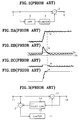
- FIG. 1 of the accompanying diagrammatic drawings is a block diagram of a conventional noise canceller for a video signal.
- the conventional noise canceller comprises a high-pass filter (HPF) 3 for high-pass-filtering a video signal input via an input port 1, a limiter 4 for extracting and outputting the noise components below a threshold from the output of HPF 3, and a subtracter 2, for subtracting the output of limiter 4 from the video signal and outputting the result via an output port 5.
- HPF high-pass filter
- Figures 2A-2D of the accompanying diagrammatic drawings are operation waveforms of the conventional noise canceller shown in Figure 1, with N indicating noise and TH representing the threshold of the limiter.
- Figure 2A shows a video signal input via input port 1 and containing noise.
- Figure 2B shows the video signal having passed through HPF 3, whereby a pulse is formed in correspondence with the sharply rising leading edge thereof.
- Figure 2C shows noise components in which the signal of Figure 2B is limited to a predetermined threshold level.
- Figure 2D shows the output in which the noise components of Figure 2C are subtracted from the video signal of Figure 2A. In Figure 2D, however, it is noted that the noise components are not cancelled in the portions in which the signal changes sharply.
- the video signal of Figure 2A is input to subtracter 2 and HPF 3 via input port 1.
- Limiter 4 connected in series to HPF 3 extracts and outputs to subtracter 2 the noise components contained in the video signal.
- Subtracter 2 cancels the output of limiter 4, that is, the noise components of Figure 2C, from the input video signal, and then outputs the video signal without noise to the output port 5.
- the noise canceller of Figure 1 can cancel most of the noise components, i.e. low-level components. but is unable to cancel those above the threshold level. As shown in Figure 2C, since, at the transitional edges of a signal, the noise occurs at a level higher than the threshold. the noise is blocked by limiter 4 and thus cannot be cancelled.
- Figure 3 of the accompanying diagrammatic drawings shows another conventional noise canceller for a video signal which cancels noise using a correlation of the horizontal lines of a video signal.
- a video signal is input to first and second subtracters 12 and 13 via input port 11.
- the output signal of first subtracter 12 is delayed by delay line 14 by 1H and is input to second subtracter 13.
- H denotes a horizontal scan period.
- Second subtracter 13 subtracts the delayed signal input from delay line 14 from the video signal input from input port 11 so as to extract and output the noise components and a correlation component to limiter 15.
- Limiter 15 extracts the noise components and sends them to first subtracter 12.
- First subtracter 12 subtracts the noise components from the video signal. and feeds back the subtracted video signal to delay line 14 so that the video signal is averaged to cancel the noise and is output to output port 16.
- Preferred embodiments of the present invention aim to provide a noise canceller for a video signal which is simplified to cancel efficiently noise contained in the video signal, using the correlation between horizontal lines.
- a noise reduction circuit for a video signal comprising: a video signal delay circuit for outputting, from consecutively input video signals, a succeeding line video signal, a present line video signal which is delayed by one horizontal line, and a preceding line video signal which is delayed by two horizontal lines; a minimum value detector for a horizontal line which compares the succeeding line video signal with the present line video signal, and the present line video signal with the preceding line video signal, so as to output first and second minimum values, respectively; a maximum value selector for comparing said first and second minimum values so as to select and output the higher of the two; a maximum value detector for a horizontal line which compares the succeeding line video signal with the present line video signal, and the present line video signal with the preceding line video signal, so as to output first and second maximum values, respectively; a minimum value selector for comparing said first and second maximum values so as to select and output the lower of the two; an adder for summing the maximum value output from the maximum value selector
- the minimum value detector for a horizontal line comprises: a first minimum value detector which receives the succeeding line video signal and present line video signal and compares the two video signals so as to detect and output the lower-level signal thereof; and a second minimum value detector which receives the present line video signal and preceding line video signal and compares the two video signals so as to detect and output the lower-level signal thereof.
- the first minimum value detector comprises: a comparator for receiving the succeeding line video signal and present line video signal to compare the levels thereof; and a multiplexer for outputting one of the succeeding line video signal and present line video signal according to the output of the comparator.
- the second minimum value detector comprises: a comparator for receiving the present line video signal and preceding line video signal to compare the levels thereof; and a multiplexer for outputting one of the present line video signal and preceding line video signal according to the output of the comparator.
- the maximum value detector for a horizontal line comprises: a first maximum value detector which receives the succeeding line video signal and present line video signal and compares the two video signals so as to detect and output the higher-level signal thereof; and a second maximum value detector which receives the present line video signal and preceding line video signal and compares the two video signals so as to detect and output the higher-level signal thereof.
- the first maximum value detector comprises: a comparator for receiving the succeeding line video signal and present line video signal to compare the levels thereof; and a multiplexer for outputting the higher-level signal between the succeeding line video signal and present line video signal, according to the output of the comparator.
- the second maximum value detector comprises: a comparator for receiving the present line video signal and preceding line video signal to compare the levels thereof; and a multiplexer for outputting the higher-level signal between the present line video signal and preceding line video signal, according to the output of the comparator.
- the video signal delay circuit comprises: a first delay line for supplying the present line video signal generated by delaying the consecutively input video signals by one horizontal line to the first and second minimum value detectors and first and second maximum value detectors; and a second delay line serially connected to the output of the first delay line for supplying the preceding line video signal generated by delaying the output signal of the first delay line by one horizontal line to the second minimum value detector and second maximum value detector.
- the maximum value selector comprises: a comparator for receiving the first and second minimum values to compare the levels thereof; and a multiplexer for outputting the higher-level signal between the first and second minimum values. according to the output of the comparator.
- the minimum value selector comprises: a comparator for receiving the first and second maximum values to compare the levels thereof; and a multiplexer for outputting the lower-level signal between the first and second maximum values, according to the output of the comparator.
- a noise reduction circuit for a video signal as above may further comprise: a correlation detector for comparing the succeeding line video signal, present line video signal and preceding line video signal so as to detect the correlation between horizontal lines and output a selection signal; and an output selector for receiving the output signal of the subtracter and the present line video signal so that, according to the selection signal of the correlation detector, if correlation does exist, the output of the subtracter is selected, and if no correlation exists, the present line video signal is selected.
- the correlation detector comprises: an adder for summing the succeeding line video signal and preceding line video signal; an attenuator for receiving the output of the adder so as to reduce the level by half; a signal subtracter for subtracting the output of the attenuator from the present line video signal; and a comparator for comparing the output of the signal subtracter with a reference level to output a selection signal.
- the output selector comprises a multiplexer.
- a noise reduction circuit for a video signal comprising means for providing three successive line signals of a video frame simultaneously to a combining circuit, the combining circuit being operative to compare said line signals and to derive therefrom maximum and minimum value signals which are combined algebraically to cancel out noise components in one of the line signals.
- a noise reduction circuit as above may further comprise any one or more of the features disclosed in the accompanying specification, claims, abstract and/or drawings, in any combination.
- the invention extends to a video signal processing apparatus provided with a noise reduction apparatus according to any of the preceding aspects of the invention.
- Such an apparatus may comprise a television and/or video recorder and/or reproducer.
- noise cancellers are conveniently referred to as "noise cancellers", although it will be appreciated that noise may not always be cancelled absolutely, but rather reduced to a significant degree.
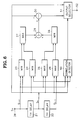
- input video signals are delayed by one horizontal (H) period so that the output signal of a first delay line 21 at a reference time point t0 is taken as a present line video signal S n .
- a signal input to an input port 20 at the reference time point to is taken as a succeeding line video signal S n+1 .
- the output of a second delay line 22 at the reference time point to is taken as a preceding line video signal S n-1 .
- video signal S v is input to first delay line 21, first minimum value detector (MIN) 23 and first maximum value detector (MAX) 25, via input port 20.
- the input video signal S v is delayed by first delay line 21 by one H period and then output simultaneously to second delay line 22, first minimum value detector 23, second minimum value detector 24, first maximum detector 25 and a second maximum detector 26.
- Second delay line 22 is serially connected to first delay line 21, to delay again the delayed signal by one H period, to then be output to second minimum value detector 24 and second maximum value detector 26. Therefore, the continuously input video signals S v are one-H-delayed by first delay line 21 to become the present line video signal S n .
- minimum value detector 32 is composed of first minimum value detector 23 and second minimum value detector 24.
- Maximum value detector 33 consists of first maximum value detector 25 and second maximum detector 26.
- First minimum value detector 23 compares the succeeding line video signal S n+1 with the present line video signal S n so as to output a first minimum value MIN1.
- Second minimum value detector 24 compares the present line video signal S n with the preceding line video signal S n-1 so as to output a second minimum value MIN2.
- First maximum value detector 25 compares the succeeding line video signal S n+1 with the present line video signal S n so as to output a first maximum value MAX1.
- Second maximum value detector 26 compares the present line video signal S n with the preceding line video signal S n-1 so as to output a second maximum value MAX2.
- Maximum value selector 27 compares the output of first minimum value detector 23 and the output of second minimum detector 24 so as to output a maximum value MAX.
- Minimum value selector 28 compares the output of first maximum value detector 25 and the output of second maximum detector 26 so as to output a minimum value MIN.
- Adder 29 sums the output of maximum value selector 27 and the output of minimum value selector 28 so as to output a signal representing the resulting total MAX + MIN.
- Subtracter 30 subtracts present line video signal S n from the summed signal (i.e. the output of adder 29) so as to output the video signal without noise to output port 31.
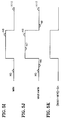
- Figure 5A shows the waveform of the succeeding line video signal S n+1 which contains noise components represented as N1, N2 and N3.
- Figure 5B shows the waveform of the present line video signal S n which contains noise components N5, N6, N7, N8, N9 and N10.
- Figure 5C shows the waveform of the preceding line video signal S n-1 containing noise components N11, N12, N13, N14 and N15.
- Figure 5D is a waveform diagram in which the succeeding line video signal S n+1 ( Figure 5A) and the present line video signal S n ( Figure 5B) are compared so as to obtain first minimum value MIN1.
- Figure 5E is a waveform diagram in which the present line video signal S n of Figure 5B and the preceding line video signal S n-1 of Figure 5C are compared so as to obtain second minimum value MIN2.
- Figure 5F is a waveform diagram in which the succeeding line video signal S n+1 of Figure 5A and the present line video signa S n of Figure 5B are compared so as to obtain first maximum value MAX1.
- Figure 5G is a waveform diagram in which the present line video signal S n of Figure 5B and the preceding line video signal S n-1 of Figure 5C are compared so as to obtain second maximum value MAX2.
- Figure 5H is a waveform diagram in which the first minimum value MIN1 of Figure 5D and the second minimum value MIN2 of Figure 5E are compared so as to obtain maximum value MAX.
- Figure 51 is a waveform diagram in which the first maximum value MAX1 of Figure 5F and the second maximum value MAX2 of Figure 5G are compared so as to obtain minimum value MIN.
- Figure 5J is a waveform diagram of a summed signal MAX+MIN in which the maximum value of the minimum values of Figure 5H and the minimum value of the maximum values of Figure 5I are summed.
- Figure 5K shows a difference signal (MAX+MIN)-S n in which the present line video signal S n of Figure 5B is subtracted from the summed signal of Figure 5J.
- the difference signal is the video signal output without noise.
- First minimum value detector 23 compares the succeeding line video signal S n+1 of Figure 5A and the present line video signal S n of Figure 5B and thus detects first minimum value MIN1 containing the N6, N7, N9 and N3 noise components which are minimum levels of the two line signals shown in Figure 5D. so as to output the first minimum value to maximum value selector 27.
- Second minimum value detector 24 compares the present line video signal S n of Figure 5B and the preceding line video signal S n-1 of Figure 5C and thus detects second minimum value MIN2 containing the N11, N6, N7, N9 and N14 noise components which are minimum levels of the two line signals shown in Figure 5E, so as to output the second minimum value to maximum value selector 27.
- Maximum value selector 27 receives and compares minimum values from first and second minimum value detectors 23 and 24, selecting only the higher-level maximum value, as shown in Figure 5H, to output the selected value to adder 29. For instance, when the waveform of Figure 5D (the output of first minimum value detector 23) and the waveform of Figure 5E (the output of second minimum value detector 24) are compared, since the video signal level as shown in Figure 5D is higher than the level of noise component N11 as shown in Figure 5E, the output of first minimum value detector 23 is selected to be output. Also. noise component N6 being the same level in both Figures 5D and 5E means that this noise component is output without change.
- maximum value selector 27 compares first minimum value MIN1 and second minimum value MIN2, and if they differ, selects the greater, so that the N11. N3 and N14 noise components which are present in only one side of inputs are cancelled and the N6, N7 and N9 noise components (called “correlation" noise) which are present in both sides of inputs as shown in Figure 5G are output to adder 29 along with the signal component.
- first maximum value detector 25 compares the succeeding line video signal S n+1 of Figure 5A and the present line video signal S n of Figure 5B and thus detects first maximum value MAX2 containing the N1, N5, N2, N8 and N10 noise components which are maximum levels of the two line signals as shown in Figure 5F, so as to output the first maximum value to minimum value selector 28.
- Second maximum value detector 26 compares the present line video signal S n of Figure 5B and the preceding line video signal S n-1 of Figure 5C and thus detects second maximum value MAX2 containing the N5, N12, N13, N8, N15 and N10 noise components which are maximum levels of the two line signals as shown in Figure 5G, so as to output the second maximum value to minimum value selector 28.
- Minimum value selector 28 receives first and second maximum values MAX1 and MAX2 to compare the received minimum values, and selects only the lower-level minimum value, as shown in Figure 5I, to output the selected value to adder 29. For instance, when the level of Figure 5F (the output of first maximum value detector 25) and the level of Figure 5G (the output of second maximum value detector 26) are compared, since the video signal level of Figure 5G is lower than the level of noise component N1 of Figure 5F, the output of second maximum value detector 26 is selected to be output, and since the level of noise component N5 contained in the waveform of Figure 5F is the same as the level of noise component N5 contained in the waveform of Figure 5G, noise component N5 is output without change.
- minimum value selector 28 compares first maximum value MAX1 and second maximum value MAX2, and if they differ, selects the smaller one, so that the N1, N12, N2, N13 and N15 noise components which are present in only one side of inputs are cancelled and the N5, N8 and N10 noise components (correlation noise) which are present in both sides of inputs as shown in Figure 5I are output to adder 29 along with the signal component.
- Adder 29 sums the output of maximum value selector 27 and the output of minimum value selector 28, and applies the summed signal as shown in Figure 5J to subtracter 30.
- the level of the summed signal from adder 29 is doubled, the levels of the noise components do not increase because the noise occurs randomly.
- Subtracter 30 subtracts the present line video signal S n ( Figure 5B) from the summed signal ( Figure 5J), and outputs a difference signal without noise components as shown in Figure 5K, as the video signal.
- Figure 6 is another embodiment of the present invention, which employs a correlation detector and output selector in addition the circuit of Figure 4, so as to prevent the distortion of signal components which may be created due to a lack of correlation.
- second delay line 22 first minimum value detector 23, second minimum value detector 24, first maximum value detector 25, second maximum value detector 26, maximum value selector 27, minimum value selector 28.
- adder 29 and subtracter 30 are the same as in Figures 4 and 5.
- the correlation detector 50 which is newly included in Figure 6, compares the succeeding line video signal S n+1 , present line video signal S n and preceding line video signal S n-1 , so as to determine the correlation between them. If the present line video signal S n has correlation with the other two line video signals, correlation detector 50 controls output selector 51 to select the output signal of subtracter 30 (processed as described above). If the present line video signal has no correlation with the other two video signals, correlation detector 50 controls output selector 51 to select the present line video signal S n directly.
- Output selector 51 selects one of the output of subtracter 30 and the present line video signal S n according to the selected signal of correlation detector 50, and outputs the selected one to output port 52.
- Figure 7 shows one embodiment of first and second minimum value detector 23 and 24, first and second maximum value detector 25 and 26, maximum value selector 27 and minimum value selector 28 which are shown in Figures 4 and 6. They can be implemented with a multiplexer and comparator.
- the signals to be compared are input to input ports A and B of multiplexer 73 and comparator 74 via input ports 71 and 72, respectively.
- Comparator 74 compares the inputs of input ports A and B and outputs the result to the selection port of multiplexer 73 so as to select one of these inputs to be output to output port 75.
- Table 1 illustrates the output of comparator 74 and multiplexer 73 according to the signals to be compared.
- Table 1 state comparator output MUX output MAX MIN A ⁇ B H A B A ⁇ B L B A
- comparator 74 outputs a "high" signal to the selection port of multiplexer 73 so that multiplexer 73 selects and outputs the input signal of input port A. If the circuit is used as the first minimum value detector 23, multiplexer 73 outputs the input signal of input port B. If the signal of input port A is smaller than the signal of input port B, the comparator and multiplexer function in an opposite manner.
- the succeeding line video signal S n+1 and preceding line video signal S n-1 are summed in adder 79, thus doubling the level and supplying the summed signal to an attenuator 80.
- Attenuator 80 reduces the input level by half and outputs the attenuated signal to subtracter 81.
- Subtracter 81 subtracts the output of attenuator 80 from the present line video signal S n , and outputs the difference signal to input port A of comparator 82.
- Comparator 82 compares the reference signal input to input port B and the output of subtracter 81 so as to detect the correlation of the three line signals.
- the output signal of subtracter 81 is smaller than the reference value, so that comparator 82 outputs a "low” signal. If they have no correlation, the output of subtracter 81 is greater than the reference value so that comparator 82 outputs a "high” signal.
- the present line video signal S n is input to input port A of multiplexer 87 via input port 84 and the output of subtracter 30 is input to input port B of multiplexer 87 via input port 85, so that one of these inputs is selected and output via port 88, according to the output signal of comparator 82 of Figure 8 received via port 86.
- the output signal of subtracter 30 at input port B is selected to be output. If there is no correlation and the output of comparator 82 of Figure 8 is high, the present line video signal S n at input port A is selected to be output.
- Figures 10A, 10B and 10C illustrate waveforms of video signals S n+1 , S n and S n-1 which contain noise.
- Figure 10B is the waveform of the present line video signal S n which is delayed by ⁇ t to create portions r1 and r2 which have no correlation.
- Figure 10D shows a waveform in which noise is cancelled from the waveforms of Figures 10A, 10B and 10C, using a conventional noise canceller. It can be seen from the waveform of Figure 10D that the distortion of the present line output signal is created in the leading edge r1 and falling edge r2 which are portions without correlation.
- Figure 10E shows a waveform in which noise is cancelled from the waveforms of Figure 10A, 10B and 10C, using the circuit of Figure 6.
- the correlation detector 50 of Figure 6 selects the present line video signal S n of Figure 10B in the non-correlating portions r1 and r2 so as to cancel noise, without any distortion of the present line output signal.
- the above-described embodiments of the present invention can efficiently extract and cancel only the noise contained in a video signal, using the correlation of video signals, so as to prevent the deterioration of resolution during reproduction. Further, the illustrated embodiments of the present invention may be easy to implement, because of the simplified circuitry.
Landscapes
- Engineering & Computer Science (AREA)
- Multimedia (AREA)
- Signal Processing (AREA)
- Picture Signal Circuits (AREA)
Applications Claiming Priority (4)
| Application Number | Priority Date | Filing Date | Title |
|---|---|---|---|
| KR1019920020206A KR0139782B1 (ko) | 1992-10-30 | 1992-10-30 | 노이즈 제거회로 |
| KR9220206 | 1992-10-30 | ||
| KR9225635 | 1992-12-26 | ||
| KR1019920025635A KR0135863B1 (ko) | 1992-12-26 | 1992-12-26 | 디지탈 영상신호의 잡음 제거기 |
Publications (3)
| Publication Number | Publication Date |
|---|---|
| EP0595663A2 true EP0595663A2 (de) | 1994-05-04 |
| EP0595663A3 EP0595663A3 (de) | 1994-10-19 |
| EP0595663B1 EP0595663B1 (de) | 1998-07-22 |
Family
ID=26629330
Family Applications (1)
| Application Number | Title | Priority Date | Filing Date |
|---|---|---|---|
| EP93308724A Expired - Lifetime EP0595663B1 (de) | 1992-10-30 | 1993-11-01 | Rauschverminderung für Videosignale |
Country Status (5)
| Country | Link |
|---|---|
| US (1) | US5448309A (de) |
| EP (1) | EP0595663B1 (de) |
| JP (1) | JP2859526B2 (de) |
| CN (1) | CN1041265C (de) |
| DE (1) | DE69319840T2 (de) |
Cited By (1)
| Publication number | Priority date | Publication date | Assignee | Title |
|---|---|---|---|---|
| WO2002080618A1 (en) * | 2001-03-30 | 2002-10-10 | Leonhard Research A/S | Noise suppression in measurement of a repetitive signal |
Families Citing this family (27)
| Publication number | Priority date | Publication date | Assignee | Title |
|---|---|---|---|---|
| JP2705569B2 (ja) * | 1994-04-27 | 1998-01-28 | 日本電気株式会社 | ノイズ除去回路 |
| JP3356201B2 (ja) * | 1996-04-12 | 2002-12-16 | ソニー株式会社 | ビデオカメラおよび輪郭強調装置 |
| US6201582B1 (en) * | 1997-09-19 | 2001-03-13 | Philips Electronics North America Corporation | Circuit for moiré suppression |
| JP2001510618A (ja) * | 1997-11-29 | 2001-07-31 | コーニンクレッカ フィリップス エレクトロニクス エヌ ヴィ | 記録媒体上に記録された周期的特性を有する信号のための振幅検出器及びかかる振幅検出器を含む光学テープレコーダ |
| GB9807201D0 (en) * | 1998-04-03 | 1998-06-03 | Nds Ltd | Filtering video signals containing chrominance information |
| TWI387335B (zh) * | 2008-05-26 | 2013-02-21 | Novatek Microelectronics Corp | 信號調節電路及其視訊裝置 |
| US10299149B2 (en) | 2013-03-15 | 2019-05-21 | DGS Global Systems, Inc. | Systems, methods, and devices for electronic spectrum management |
| US10257729B2 (en) | 2013-03-15 | 2019-04-09 | DGS Global Systems, Inc. | Systems, methods, and devices having databases for electronic spectrum management |
| US12356206B2 (en) | 2013-03-15 | 2025-07-08 | Digital Global Systems, Inc. | Systems and methods for automated financial settlements for dynamic spectrum sharing |
| US10231206B2 (en) | 2013-03-15 | 2019-03-12 | DGS Global Systems, Inc. | Systems, methods, and devices for electronic spectrum management for identifying signal-emitting devices |
| US12256233B2 (en) | 2013-03-15 | 2025-03-18 | Digital Global Systems, Inc. | Systems and methods for automated financial settlements for dynamic spectrum sharing |
| US10257727B2 (en) | 2013-03-15 | 2019-04-09 | DGS Global Systems, Inc. | Systems methods, and devices having databases and automated reports for electronic spectrum management |
| US10219163B2 (en) | 2013-03-15 | 2019-02-26 | DGS Global Systems, Inc. | Systems, methods, and devices for electronic spectrum management |
| US11646918B2 (en) | 2013-03-15 | 2023-05-09 | Digital Global Systems, Inc. | Systems, methods, and devices for electronic spectrum management for identifying open space |
| US9078162B2 (en) | 2013-03-15 | 2015-07-07 | DGS Global Systems, Inc. | Systems, methods, and devices for electronic spectrum management |
| US10244504B2 (en) | 2013-03-15 | 2019-03-26 | DGS Global Systems, Inc. | Systems, methods, and devices for geolocation with deployable large scale arrays |
| US10271233B2 (en) | 2013-03-15 | 2019-04-23 | DGS Global Systems, Inc. | Systems, methods, and devices for automatic signal detection with temporal feature extraction within a spectrum |
| US10257728B2 (en) | 2013-03-15 | 2019-04-09 | DGS Global Systems, Inc. | Systems, methods, and devices for electronic spectrum management |
| US10237770B2 (en) | 2013-03-15 | 2019-03-19 | DGS Global Systems, Inc. | Systems, methods, and devices having databases and automated reports for electronic spectrum management |
| US9637393B2 (en) | 2014-05-19 | 2017-05-02 | Carbon Engineering Limited Partnership | Recovering a caustic solution via calcium carbonate crystal aggregates |
| US10498951B2 (en) | 2017-01-23 | 2019-12-03 | Digital Global Systems, Inc. | Systems, methods, and devices for unmanned vehicle detection |
| US10529241B2 (en) | 2017-01-23 | 2020-01-07 | Digital Global Systems, Inc. | Unmanned vehicle recognition and threat management |
| US10459020B2 (en) | 2017-01-23 | 2019-10-29 | DGS Global Systems, Inc. | Systems, methods, and devices for automatic signal detection based on power distribution by frequency over time within a spectrum |
| US12183213B1 (en) | 2017-01-23 | 2024-12-31 | Digital Global Systems, Inc. | Unmanned vehicle recognition and threat management |
| US12205477B2 (en) | 2017-01-23 | 2025-01-21 | Digital Global Systems, Inc. | Unmanned vehicle recognition and threat management |
| US10700794B2 (en) | 2017-01-23 | 2020-06-30 | Digital Global Systems, Inc. | Systems, methods, and devices for automatic signal detection based on power distribution by frequency over time within an electromagnetic spectrum |
| US10943461B2 (en) | 2018-08-24 | 2021-03-09 | Digital Global Systems, Inc. | Systems, methods, and devices for automatic signal detection based on power distribution by frequency over time |
Family Cites Families (18)
| Publication number | Priority date | Publication date | Assignee | Title |
|---|---|---|---|---|
| FR2359559A1 (fr) * | 1976-07-23 | 1978-02-17 | Thomson Csf | Dispositif de traitement d'image de television |
| JPH0799804B2 (ja) * | 1981-07-13 | 1995-10-25 | ソニー株式会社 | フィルタ装置 |
| JPS58215175A (ja) * | 1982-06-08 | 1983-12-14 | Sony Corp | フイルタ装置 |
| JPS60117909A (ja) * | 1983-11-30 | 1985-06-25 | Sony Corp | 論理フイルタ−装置 |
| JPS60149264A (ja) * | 1984-01-13 | 1985-08-06 | Sony Corp | 論理フイルタ−装置 |
| JPH0622313B2 (ja) * | 1984-07-27 | 1994-03-23 | ソニー株式会社 | ロジカルフイルタ回路 |
| JPH07123307B2 (ja) * | 1986-05-20 | 1995-12-25 | ソニー株式会社 | Y/c分離回路 |
| JP2508442B2 (ja) * | 1987-06-09 | 1996-06-19 | ソニー株式会社 | ノイズ除去回路 |
| US4930005A (en) * | 1987-12-18 | 1990-05-29 | Victor Company Of Japan, Ltd. | Circuit for removing crosstalk components in a carrier chrominance signal |
| JPH0215784A (ja) * | 1988-07-01 | 1990-01-19 | Mitsubishi Electric Corp | ノイズ低減回路 |
| JP2551113B2 (ja) * | 1988-08-05 | 1996-11-06 | 三菱電機株式会社 | ノイズ低減装置 |
| JPH0720207B2 (ja) * | 1989-02-10 | 1995-03-06 | 三菱電機株式会社 | 適応型雑音抑圧装置 |
| US5166794A (en) * | 1989-03-10 | 1992-11-24 | Sony Corporation | Drop out compensating circuit with interpolation of proximate pixel signals |
| JPH021604A (ja) * | 1989-04-14 | 1990-01-05 | Sony Corp | フィルタ装置 |
| JPH0720256B2 (ja) * | 1989-06-26 | 1995-03-06 | 三洋電機株式会社 | 輝度信号分離回路 |
| JPH03243069A (ja) * | 1990-02-21 | 1991-10-30 | Toshiba Corp | ドット除去回路 |
| JPH03268684A (ja) * | 1990-03-19 | 1991-11-29 | Hitachi Ltd | 輪郭補正回路 |
| JPH04154377A (ja) * | 1990-10-18 | 1992-05-27 | Mitsubishi Electric Corp | 固体撮像装置 |
-
1993
- 1993-10-27 JP JP5268890A patent/JP2859526B2/ja not_active Expired - Fee Related
- 1993-10-30 CN CN93119833A patent/CN1041265C/zh not_active Expired - Fee Related
- 1993-11-01 DE DE69319840T patent/DE69319840T2/de not_active Expired - Lifetime
- 1993-11-01 EP EP93308724A patent/EP0595663B1/de not_active Expired - Lifetime
- 1993-11-01 US US08/143,618 patent/US5448309A/en not_active Expired - Lifetime
Cited By (1)
| Publication number | Priority date | Publication date | Assignee | Title |
|---|---|---|---|---|
| WO2002080618A1 (en) * | 2001-03-30 | 2002-10-10 | Leonhard Research A/S | Noise suppression in measurement of a repetitive signal |
Also Published As
| Publication number | Publication date |
|---|---|
| DE69319840D1 (de) | 1998-08-27 |
| EP0595663A3 (de) | 1994-10-19 |
| JPH06217171A (ja) | 1994-08-05 |
| DE69319840T2 (de) | 1998-12-24 |
| US5448309A (en) | 1995-09-05 |
| EP0595663B1 (de) | 1998-07-22 |
| CN1041265C (zh) | 1998-12-16 |
| CN1088040A (zh) | 1994-06-15 |
| JP2859526B2 (ja) | 1999-02-17 |
Similar Documents
| Publication | Publication Date | Title |
|---|---|---|
| EP0595663B1 (de) | Rauschverminderung für Videosignale | |
| EP0731601B2 (de) | Vorrichtung zur Videorauschreduktion | |
| GB2173066A (en) | Adaptive control of a recursive filter | |
| EP0267786A2 (de) | Rauschverminderungsvorrichtung für Videosignal | |
| US5155582A (en) | Dot crawling interference elimination device and color subcarrier vertical correlation detection device | |
| US7133080B2 (en) | Video signal processor and TV receiver using the same | |
| EP0556501B1 (de) | Videobewegungsdetektoren | |
| EP0173439B1 (de) | Luminanz-Chrominanzsignal-Trennstufe | |
| US5047866A (en) | Comb filter type luminance/chrominance signal separation circuit | |
| EP0217565A2 (de) | Schaltung zum Verarbeiten eines Farbträgersignals | |
| KR930003178B1 (ko) | 상관적응형 휘도신호와 색신호 분리회로 | |
| US4695877A (en) | Video signal processing apparatus for compensating for time differences between luminance and chrominance signals of a PAL system | |
| US5414473A (en) | Apparatus and method for enhancing transient edge of video signal | |
| US5144414A (en) | Ghost cancelling device with waveform checking circuit | |
| US5185679A (en) | Inversion phenomenon preventing circuit | |
| US5426470A (en) | Luminance and chrominance signal separation circuit employing comparison of level detected signal with a reference level | |
| JPH0358233B2 (de) | ||
| EP0412790A2 (de) | Adaptive Kammfilter und Verfahren zum Trennen von Videosignal-Komponenten | |
| EP0540347A2 (de) | Schaltung zur Bewegungsdetektion für ein Signal eines Fernsehbildes mit hoher Auflösung nach dem Musesystem | |
| US5400082A (en) | Device for reducing noise in a composite video signal | |
| KR960004134B1 (ko) | 임펄스 노이즈 제거방법 및 회로 | |
| US5373329A (en) | Method of picture movement signal detection and associated circuit | |
| US4750033A (en) | Comb filter, chrominance and luminance signal separating circuit for modifying the level-frequency characteristic of the luminance signal | |
| GB2283147A (en) | Adaptive luminance and chrominance separator controlled by luminance and chrominance correlators | |
| JP3439306B2 (ja) | ノイズ低減回路及び画像信号処理装置 |
Legal Events
| Date | Code | Title | Description |
|---|---|---|---|
| PUAI | Public reference made under article 153(3) epc to a published international application that has entered the european phase |
Free format text: ORIGINAL CODE: 0009012 |
|
| AK | Designated contracting states |
Kind code of ref document: A2 Designated state(s): DE FR GB |
|
| PUAL | Search report despatched |
Free format text: ORIGINAL CODE: 0009013 |
|
| AK | Designated contracting states |
Kind code of ref document: A3 Designated state(s): DE FR GB |
|
| 17P | Request for examination filed |
Effective date: 19950322 |
|
| 17Q | First examination report despatched |
Effective date: 19970506 |
|
| GRAG | Despatch of communication of intention to grant |
Free format text: ORIGINAL CODE: EPIDOS AGRA |
|
| GRAG | Despatch of communication of intention to grant |
Free format text: ORIGINAL CODE: EPIDOS AGRA |
|
| GRAH | Despatch of communication of intention to grant a patent |
Free format text: ORIGINAL CODE: EPIDOS IGRA |
|
| GRAH | Despatch of communication of intention to grant a patent |
Free format text: ORIGINAL CODE: EPIDOS IGRA |
|
| GRAA | (expected) grant |
Free format text: ORIGINAL CODE: 0009210 |
|
| AK | Designated contracting states |
Kind code of ref document: B1 Designated state(s): DE FR GB |
|
| REF | Corresponds to: |
Ref document number: 69319840 Country of ref document: DE Date of ref document: 19980827 |
|
| ET | Fr: translation filed | ||
| PLBE | No opposition filed within time limit |
Free format text: ORIGINAL CODE: 0009261 |
|
| 26N | No opposition filed | ||
| REG | Reference to a national code |
Ref country code: GB Ref legal event code: IF02 |
|
| PGFP | Annual fee paid to national office [announced via postgrant information from national office to epo] |
Ref country code: DE Payment date: 20091105 Year of fee payment: 17 |
|
| PGFP | Annual fee paid to national office [announced via postgrant information from national office to epo] |
Ref country code: GB Payment date: 20091104 Year of fee payment: 17 Ref country code: FR Payment date: 20091123 Year of fee payment: 17 |
|
| GBPC | Gb: european patent ceased through non-payment of renewal fee |
Effective date: 20101101 |
|
| REG | Reference to a national code |
Ref country code: DE Ref legal event code: R119 Ref document number: 69319840 Country of ref document: DE Effective date: 20110601 Ref country code: DE Ref legal event code: R119 Ref document number: 69319840 Country of ref document: DE Effective date: 20110531 |
|
| REG | Reference to a national code |
Ref country code: FR Ref legal event code: ST Effective date: 20110801 |
|
| PG25 | Lapsed in a contracting state [announced via postgrant information from national office to epo] |
Ref country code: DE Free format text: LAPSE BECAUSE OF NON-PAYMENT OF DUE FEES Effective date: 20110531 |
|
| PG25 | Lapsed in a contracting state [announced via postgrant information from national office to epo] |
Ref country code: FR Free format text: LAPSE BECAUSE OF NON-PAYMENT OF DUE FEES Effective date: 20101130 |
|
| PG25 | Lapsed in a contracting state [announced via postgrant information from national office to epo] |
Ref country code: GB Free format text: LAPSE BECAUSE OF NON-PAYMENT OF DUE FEES Effective date: 20101101 |