EP0596476A1 - Herstellverfahren für Polstermaterial - Google Patents
Herstellverfahren für Polstermaterial Download PDFInfo
- Publication number
- EP0596476A1 EP0596476A1 EP93117826A EP93117826A EP0596476A1 EP 0596476 A1 EP0596476 A1 EP 0596476A1 EP 93117826 A EP93117826 A EP 93117826A EP 93117826 A EP93117826 A EP 93117826A EP 0596476 A1 EP0596476 A1 EP 0596476A1
- Authority
- EP
- European Patent Office
- Prior art keywords
- mixed cotton
- cushion material
- manufacturing
- portions
- heat
- Prior art date
- Legal status (The legal status is an assumption and is not a legal conclusion. Google has not performed a legal analysis and makes no representation as to the accuracy of the status listed.)
- Granted
Links
Images




Classifications
-
- D—TEXTILES; PAPER
- D04—BRAIDING; LACE-MAKING; KNITTING; TRIMMINGS; NON-WOVEN FABRICS
- D04H—MAKING TEXTILE FABRICS, e.g. FROM FIBRES OR FILAMENTARY MATERIAL; FABRICS MADE BY SUCH PROCESSES OR APPARATUS, e.g. FELTS, NON-WOVEN FABRICS; COTTON-WOOL; WADDING ; NON-WOVEN FABRICS FROM STAPLE FIBRES, FILAMENTS OR YARNS, BONDED WITH AT LEAST ONE WEB-LIKE MATERIAL DURING THEIR CONSOLIDATION
- D04H1/00—Non-woven fabrics formed wholly or mainly of staple fibres or like relatively short fibres
- D04H1/40—Non-woven fabrics formed wholly or mainly of staple fibres or like relatively short fibres from fleeces or layers composed of fibres without existing or potential cohesive properties
- D04H1/54—Non-woven fabrics formed wholly or mainly of staple fibres or like relatively short fibres from fleeces or layers composed of fibres without existing or potential cohesive properties by welding together the fibres, e.g. by partially melting or dissolving
- D04H1/558—Non-woven fabrics formed wholly or mainly of staple fibres or like relatively short fibres from fleeces or layers composed of fibres without existing or potential cohesive properties by welding together the fibres, e.g. by partially melting or dissolving in combination with mechanical or physical treatments other than embossing
-
- D—TEXTILES; PAPER
- D04—BRAIDING; LACE-MAKING; KNITTING; TRIMMINGS; NON-WOVEN FABRICS
- D04H—MAKING TEXTILE FABRICS, e.g. FROM FIBRES OR FILAMENTARY MATERIAL; FABRICS MADE BY SUCH PROCESSES OR APPARATUS, e.g. FELTS, NON-WOVEN FABRICS; COTTON-WOOL; WADDING ; NON-WOVEN FABRICS FROM STAPLE FIBRES, FILAMENTS OR YARNS, BONDED WITH AT LEAST ONE WEB-LIKE MATERIAL DURING THEIR CONSOLIDATION
- D04H1/00—Non-woven fabrics formed wholly or mainly of staple fibres or like relatively short fibres
- D04H1/40—Non-woven fabrics formed wholly or mainly of staple fibres or like relatively short fibres from fleeces or layers composed of fibres without existing or potential cohesive properties
- D04H1/54—Non-woven fabrics formed wholly or mainly of staple fibres or like relatively short fibres from fleeces or layers composed of fibres without existing or potential cohesive properties by welding together the fibres, e.g. by partially melting or dissolving
- D04H1/541—Composite fibres, e.g. sheath-core, sea-island or side-by-side; Mixed fibres
- D04H1/5412—Composite fibres, e.g. sheath-core, sea-island or side-by-side; Mixed fibres sheath-core
-
- D—TEXTILES; PAPER
- D04—BRAIDING; LACE-MAKING; KNITTING; TRIMMINGS; NON-WOVEN FABRICS
- D04H—MAKING TEXTILE FABRICS, e.g. FROM FIBRES OR FILAMENTARY MATERIAL; FABRICS MADE BY SUCH PROCESSES OR APPARATUS, e.g. FELTS, NON-WOVEN FABRICS; COTTON-WOOL; WADDING ; NON-WOVEN FABRICS FROM STAPLE FIBRES, FILAMENTS OR YARNS, BONDED WITH AT LEAST ONE WEB-LIKE MATERIAL DURING THEIR CONSOLIDATION
- D04H1/00—Non-woven fabrics formed wholly or mainly of staple fibres or like relatively short fibres
- D04H1/40—Non-woven fabrics formed wholly or mainly of staple fibres or like relatively short fibres from fleeces or layers composed of fibres without existing or potential cohesive properties
- D04H1/54—Non-woven fabrics formed wholly or mainly of staple fibres or like relatively short fibres from fleeces or layers composed of fibres without existing or potential cohesive properties by welding together the fibres, e.g. by partially melting or dissolving
- D04H1/541—Composite fibres, e.g. sheath-core, sea-island or side-by-side; Mixed fibres
- D04H1/5418—Mixed fibres, e.g. at least two chemically different fibres or fibre blends
Definitions
- the present invention relates to a method of manufacturing a cushion material having different hardnesses which is used for a vehicle seat, a bed, or the like.
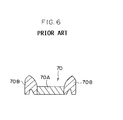
- a cushion material when a cushion material is used for a seat pad 70 of a seat cushion for a vehicle, the hardness of a central portion 70A of the seat pad 70 is low, and the hardness of both side portions 70B is high so as to improve the seating comfort for the vehicle occupant and to improve the ability of the seat pad 70 to hold the vehicle occupant.
- the heat-fusible fibers 74A and 74B are mixed such that the density of the heat-fusible fibers 74A is higher at portions 72B corresponding to both side portions of the seat pad, i.e., at portions which are to be formed hard. Thereafter, pressure is applied as illustrated in Fig. 8.
- the mold 72 which is filled with the heat-fusible fibers is placed within a heating portion 86 of a penetration-type heating apparatus 84 which is equipped with a hot air generating device 80 and a fan 82.
- the entire mold is heated at the same temperature.
- an object of the present invention is to provide a method of manufacturing a cushion material which is simple and in which it is difficult for irregularities in hardness to be generated in respective portions which are to be formed hard and portions which are to be formed soft.
- the method of manufacturing a cushion material of the present invention includes the steps of: a mixed cotton manufacturing process in which main fibers and a plurality of types of heat-fusible fibers, which are formed of main fibers and sheath portions and whose sheath portions have different melting points, are mixed so as to make a mixed cotton; a laminating process in which the mixed cotton is spread at a substantially uniform density at an entire one forming mold of a plurality of forming molds; and a heating process in which the mixed cotton spread at the entire one forming mold is heated such that a heating temperature of portions of a cushion material which are to be formed hard differs from a heating temperature of portions of the cushion material which are to be formed soft so that a number of types of the heat-fusible fibers which melt at the portions of the cushion material which are to be formed hard is greater than a number of types of the heat-fusible fibers which melt at the portions of the cushion material which are to be formed soft.
- main fibers and a plurality of types of heat-fusible fibers which are formed of main fibers and sheath portions and whose sheath portions have different melting points, are mixed so as to make a mixed cotton.
- the mixed cotton is spread at a substantially uniform density at an entire forming mold of a plurality of forming molds.
- a heating temperature of portions of a cushion material which are to be formed hard differs from a heating temperature of portions of the cushion material which are to be formed soft so that a number of types of the heat-fusible fibers which melt at the portions of the cushion material which are to be formed hard is greater than a number of types of the heat-fusible fibers which melt at the portions of the cushion material which are to be formed soft.
- the mixed cotton in which the main fibers are mixed with the plurality of types of heat-fusible fibers formed of main fibers and sheath portions and whose sheath portions have different melting points, is spread uniformly at the entire mold.
- the portions of the cushion material which are to be formed hard are heated at a high temperature as compared with the portions which are to be formed soft.
- the number of fusion points of the heat-fusible fibers of the hard portions of the cushion material is greater than the number of fusion points of the heat-fusible fibers of the soft portions so that a cushion material having hard portions and soft portions is manufactured.
- the manufacturing process of the present invention is simple, and there is no need to vary the densities of the heat-fusible fibers. Therefore, it is difficult for irregularities in hardness to be generated in the portions which are to be formed soft and in the portions which are to be formed hard.
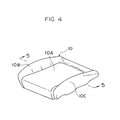
- a seat pad 10 of a seat cushion for a vehicle manufactured by the method of manufacturing a cushion material of the present embodiment is formed such that side portions 10B, 10C protrude upwardly with respect to a seat surface central portion 10A.
- the hardness of the seat surface central portion 10A of the seat pad 10 is low, and the hardness of the side portions 10B, 10C is high so that the seat is comfortable for a vehicle occupant. Further, because the side portions 10B, 10C reliably restrain the hips of the vehicle occupant, it is difficult for the occupant to slide towards the sides of the seat.
- main fibers melting point: 250 ° C
- two types of heat-fusible fibers A, B which respectively have the same core portion as the main fiber, but have a sheath portion of a different melting point at the outer periphery of the core portion.
- the melting point of the sheath portion of the heat-fusible fibers A is 150° C and that of the heat-fusible fibers B is 180 ° C.
- the fibers are mixed uniformly so that the mixing ratio of the main fibers, the heat-fusible fibers A and the heat-fusible fibers B is 65%, 20%, 15%.
- a mixed cotton 18 formed of main fibers 12, heat-fusible fibers A 14, and heat-fusible fibers B 16 is thereby manufactured. (Hereinafter, this process will be referred to as the "mixed cotton manufacturing process").
- the mixed cotton 18 manufactured in the mixed cotton manufacturing process is spread evenly on a lower mold 20 which forms the upper surface of the seat pad 10.
- the lower mold 20 is formed of punching metal having a predetermined rate of hole area (i.e., the area of the holes per unit area).
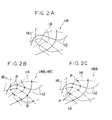
- the mixed cotton 18 is to be measured and spread by taking the volume of the interior of the molds into consideration so that the overall density of the entire seat pad 10 is a predetermined value when the molds are clamped. Therefore, as can be seen in Figs. 1 through 3, the mixed cotton 18 is compressed by the clamping of the molds such that a predetermined internal compressive force is generated.
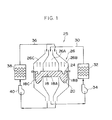
- the clamped mixed cotton 18 is set within a heating portion 26 of a penetration-type heating apparatus 25.
- the interior of the heating portion 26 of the penetration-type heating apparatus 25 is divided into a low temperature heating portion 26A and high temperature heating portions 26B, 26C.
- the low temperature heating portion 26A heats a seat surface central portion corresponding portion 18A of the clamped mixed cotton 18 which corresponds to the seat surface central portion 10A of the seat pad 10.
- the high temperature heating portions 26B, 26C heat side portion corresponding portions 18B, 18C of the clamped mixed cotton 18 which correspond to the side portions 10B, 10C of the seat pad 10.
- the low temperature heating portion 26A is connected, via a duct 30, to a hot air generating device 32 and to a fan 34 which blows heat generated by the hot air generating device 32.
- the seat surface central portion corresponding portion 18A of the clamped mixed cotton 18 is thereby heated to, for example, 170 ° C.
- the high temperature heating portions 26B, 26C of the penetration-type heating apparatus 25 are connected, via respective ducts 36, to a hot air generating device 38 and to a fan 40 which blows heat generated by the hot air generating device 38.
- the side portion corresponding portions 18B, 18C of the clamped mixed cotton 18 are thereby heated to, for example, 200 ° C
- both the sheath portions of the heat-fusible fibers A 14 and the sheath portions of the heat-fusible fibers B 16 are melted by heat as illustrated in Fig. 2B at the side portion corresponding portions 18B, 18C of the clamped mixed cotton 18. Therefore, the main fibers 12, the heat-fusible fibers A 14 and the heat-fusible fibers B 16 are fused together at fusion points P.
- the heat-fusible fibers A 14 fuse with the main fibers 12 and the heat-fusible fibers B 16 at the fusion points P.
- heating i.e., heating processing
- the side portion corresponding portions 18B, 18C of the clamped mixed cotton 18 which are to be formed hard
- the seat surface central portion corresponding portion 18A which is to be formed soft.
- the number of types of heat-fusible fibers whose sheath portions melt i.e., two types: the heat-fusible fibers A 14 and the heat-fusible fibers B 16
- the number of types of heat-fusible fibers i.e., one type: the heat-fusible fibers A 14
- the manufacturing process of the present invention for manufacturing the mixed cotton is simple, and there is no need to vary the densities of the heat-fusible fibers. Therefore, it is difficult for irregularities in hardness to be generated in the portions which are to be formed soft and in the portions which are to be formed hard.
- the seat surface central portion corresponding portion 18A of the clamped mixed cotton 18 which is to be formed soft is heated to 170 ° C, and simultaneously, the side portion corresponding portions 18B, 18C which are to be formed hard are heated to 200 ° C.
- an alternative method may be used in which the entire mixed cotton 18 clamped in the molds is heated to 170°C, and thereafter, only the side portion corresponding portions 18B, 18C of the clamped mixed cotton 18 which are to be formed hard are heated to 200 ° C.
- the mixing ratio of the heat-fusible fibers A 14 and the heat-fusible fibers B 16 may be varied. For example, if the main fibers 12 are decreased and the heat-fusible fibers A 14 are increased, the entire seat pad 10 becomes more hard. On the other hand, if the main fibers 12 are decreased and the heat-fusible fibers B 16 are increased, only the side portions 10B, 10C of the seat pad 10 become harder. Further, if the heat-fusible fibers A 14 are decreased and the heat-fusible fibers B 16 are increased, the seat surface central portion 10A of the seat pad becomes more soft and the side portions 10B, 10C of the seat pad 10 become more hard.
- the mixed cotton 18 is formed of the main fibers 12 and two types of heat fusible fibers having different sheath portion melting points.
- the mixed cotton 18 may be formed of a main fiber and three or more types of heat-fusible fibers having different melting points of the sheath portions.
- a method of manufacturing a seat pad of a seat cushion for a vehicle is described.
- the method of manufacturing a cushion material of the present invention is not limited to the manufacturing of seat pads of seat cushions for vehicles.
- the method of the present invention is directed toward the manufacturing of cushion materials in general, and may also be applied to chairs, beds and the like.
- a method of manufacturing a cushion material including steps of: a mixed cotton manufacturing process in which main fibers and a plurality of types of heat-fusible fibers, which are formed of main fibers and sheath portions and whose sheath portions have different melting points, are mixed so as to make a mixed cotton; a laminating process in which the mixed cotton is spread at a substantially uniform density at an entire one forming mold of a plurality of forming molds; and a heating process in which the mixed cotton spread at the entire one forming mold is heated such that a heating temperature of portions of a cushion material which are to be formed hard differs from a heating temperature of portions of the cushion material which are to be formed soft so that a number of types of the heat-fusible fibers which melt at the portions of the cushion material which are to be formed hard is greater than a number of types of the heat-fusible fibers which melt at the portions of the cushion material which are to be formed soft.
Landscapes
- Engineering & Computer Science (AREA)
- Textile Engineering (AREA)
- Mechanical Engineering (AREA)
- Nonwoven Fabrics (AREA)
- Mattresses And Other Support Structures For Chairs And Beds (AREA)
Applications Claiming Priority (2)
| Application Number | Priority Date | Filing Date | Title |
|---|---|---|---|
| JP4294860A JP2842100B2 (ja) | 1992-11-04 | 1992-11-04 | クッション材の製造方法 |
| JP294860/92 | 1992-11-04 |
Publications (2)
| Publication Number | Publication Date |
|---|---|
| EP0596476A1 true EP0596476A1 (de) | 1994-05-11 |
| EP0596476B1 EP0596476B1 (de) | 1998-02-04 |
Family
ID=17813192
Family Applications (1)
| Application Number | Title | Priority Date | Filing Date |
|---|---|---|---|
| EP93117826A Expired - Lifetime EP0596476B1 (de) | 1992-11-04 | 1993-11-03 | Herstellverfahren für Polstermaterial |
Country Status (4)
| Country | Link |
|---|---|
| US (1) | US5456873A (de) |
| EP (1) | EP0596476B1 (de) |
| JP (1) | JP2842100B2 (de) |
| DE (1) | DE69316827T2 (de) |
Cited By (5)
| Publication number | Priority date | Publication date | Assignee | Title |
|---|---|---|---|---|
| EP0707820A1 (de) * | 1994-10-17 | 1996-04-24 | Hoover Universal,Inc. | Verfahren zum Herstellen eines Körpers mit variabler Dichte aus polymerem Fasermaterial |
| EP0708191A3 (de) * | 1994-10-17 | 1996-11-06 | Hoover Universal | Verfahren zum Herstellen eines Fahrzeugsitzelemnts mit erhöhter Widerstandsfähigkeit gegen dauerhafte Verformung |
| EP0894885A3 (de) * | 1997-07-30 | 1999-03-03 | Teijin Limited | Verfahren und Vorrichtung zum Formen einer Fasermischung |
| EP0837168A4 (de) * | 1995-07-04 | 2001-01-03 | Teijin Ltd | Verfahren zur herstellung einer polsterstruktur von einer faseranordnung und vorrichtung dafür |
| CN110337509A (zh) * | 2017-03-03 | 2019-10-15 | 帝人富瑞特株式会社 | 纤维结构体及其制备方法 |
Families Citing this family (7)
| Publication number | Priority date | Publication date | Assignee | Title |
|---|---|---|---|---|
| US5788332A (en) * | 1996-04-29 | 1998-08-04 | Hettinga; Siebolt | Seat unit and cushion |
| US6063317A (en) * | 1998-04-01 | 2000-05-16 | Oakwood Padded Products, Inc. | Method for molding polymeric fibers into products |
| US6027674A (en) * | 1998-06-03 | 2000-02-22 | Yates; Paul M. | Resilient cushion method of manufacture |
| JP4505109B2 (ja) * | 2000-06-02 | 2010-07-21 | 株式会社フジ医療器 | マッサージ器 |
| DE202006007567U1 (de) * | 2006-05-10 | 2006-07-27 | Colbond B.V. | Vliesstoff, getufteter Vliesstoff und die Stoffe enthaltende Erzeugnisse |
| DE102008035622B4 (de) * | 2008-04-22 | 2010-11-25 | Johnson Controls Gmbh | Verfahren zur Herstellung eines Polsterelements, insbesondere ein Sitzpolsterelement zur Verwendung in einem Kraftfahrzeug, und Polsterelement |
| JP6222843B2 (ja) * | 2014-03-31 | 2017-11-01 | 株式会社タチエス | シートクッションの成形方法およびシートクッション |
Citations (7)
| Publication number | Priority date | Publication date | Assignee | Title |
|---|---|---|---|---|
| JPS55148150A (en) * | 1979-05-08 | 1980-11-18 | Mitsui Petrochemical Ind | Backing material for cushion floor |
| EP0212082A1 (de) * | 1985-08-15 | 1987-03-04 | Allied Corporation | Thermisch geformter Gradientdichtheitsfilter |
| EP0214374A1 (de) * | 1985-09-06 | 1987-03-18 | Allied Corporation | Thermisch geformter Filter |
| WO1988009406A1 (en) * | 1987-05-21 | 1988-12-01 | Automotive Investment Co. | Molding process using polypropylene strands and fabric fibers to produce article |
| EP0401738A2 (de) * | 1989-06-05 | 1990-12-12 | E.I. Du Pont De Nemours And Company | Baumwolle/Polyester-Fasermischungen und Schichten |
| JPH03170112A (ja) * | 1989-11-30 | 1991-07-23 | Nhk Spring Co Ltd | クッション材の製造方法 |
| JPH03292991A (ja) * | 1990-04-10 | 1991-12-24 | Toyo Kutsushiyon Kk | ポリエステル繊維製クッション材及びその製造方法 |
Family Cites Families (10)
| Publication number | Priority date | Publication date | Assignee | Title |
|---|---|---|---|---|
| US4186165A (en) * | 1976-06-14 | 1980-01-29 | Johnson & Johnson | Method of producing an absorbent panel having densified portion with hydrocolloid material fixed therein |
| US4608213A (en) * | 1983-11-04 | 1986-08-26 | Ikeda Bussan Co., Ltd. | Method and mold apparatus for molding a padding member |
| SE458418B (sv) * | 1984-07-16 | 1989-04-03 | Moelnlycke Ab | Absorptionskropp med kontinuerlig densitetsgradient samt saett foer dess framstaellning |
| US4737404A (en) * | 1984-08-16 | 1988-04-12 | Chicopee | Fused laminated fabric |
| US4568581A (en) * | 1984-09-12 | 1986-02-04 | Collins & Aikman Corporation | Molded three dimensional fibrous surfaced article and method of producing same |
| JPS61167071A (ja) * | 1985-01-18 | 1986-07-28 | ミドリシー・エム・ビー株式会社 | 合成繊維含有不織布成形品の製造方法 |
| US5169580A (en) * | 1985-05-15 | 1992-12-08 | E. I. Du Pont De Nemours And Company | Bonded non-woven polyester fiber structures |
| US4663225A (en) * | 1986-05-02 | 1987-05-05 | Allied Corporation | Fiber reinforced composites and method for their manufacture |
| JPH03170111A (ja) * | 1989-11-30 | 1991-07-23 | Nhk Spring Co Ltd | クッション材及びその製造方法 |
| JP2907916B2 (ja) * | 1990-01-29 | 1999-06-21 | ユニ・チャーム株式会社 | 着用体液吸収物品の吸収パネル |
-
1992
- 1992-11-04 JP JP4294860A patent/JP2842100B2/ja not_active Expired - Fee Related
-
1993
- 1993-11-01 US US08/143,645 patent/US5456873A/en not_active Expired - Fee Related
- 1993-11-03 DE DE69316827T patent/DE69316827T2/de not_active Expired - Fee Related
- 1993-11-03 EP EP93117826A patent/EP0596476B1/de not_active Expired - Lifetime
Patent Citations (7)
| Publication number | Priority date | Publication date | Assignee | Title |
|---|---|---|---|---|
| JPS55148150A (en) * | 1979-05-08 | 1980-11-18 | Mitsui Petrochemical Ind | Backing material for cushion floor |
| EP0212082A1 (de) * | 1985-08-15 | 1987-03-04 | Allied Corporation | Thermisch geformter Gradientdichtheitsfilter |
| EP0214374A1 (de) * | 1985-09-06 | 1987-03-18 | Allied Corporation | Thermisch geformter Filter |
| WO1988009406A1 (en) * | 1987-05-21 | 1988-12-01 | Automotive Investment Co. | Molding process using polypropylene strands and fabric fibers to produce article |
| EP0401738A2 (de) * | 1989-06-05 | 1990-12-12 | E.I. Du Pont De Nemours And Company | Baumwolle/Polyester-Fasermischungen und Schichten |
| JPH03170112A (ja) * | 1989-11-30 | 1991-07-23 | Nhk Spring Co Ltd | クッション材の製造方法 |
| JPH03292991A (ja) * | 1990-04-10 | 1991-12-24 | Toyo Kutsushiyon Kk | ポリエステル繊維製クッション材及びその製造方法 |
Non-Patent Citations (3)
| Title |
|---|
| DATABASE WPI Section Ch Week 8104, Derwent World Patents Index; Class A94, AN 81-04693 * |
| DATABASE WPI Section Ch Week 9206, Derwent World Patents Index; Class A23, AN 92-046365 * |
| PATENT ABSTRACTS OF JAPAN vol. 015, no. 413 (C - 0877) 22 October 1991 (1991-10-22) * |
Cited By (8)
| Publication number | Priority date | Publication date | Assignee | Title |
|---|---|---|---|---|
| EP0707820A1 (de) * | 1994-10-17 | 1996-04-24 | Hoover Universal,Inc. | Verfahren zum Herstellen eines Körpers mit variabler Dichte aus polymerem Fasermaterial |
| EP0708191A3 (de) * | 1994-10-17 | 1996-11-06 | Hoover Universal | Verfahren zum Herstellen eines Fahrzeugsitzelemnts mit erhöhter Widerstandsfähigkeit gegen dauerhafte Verformung |
| EP0837168A4 (de) * | 1995-07-04 | 2001-01-03 | Teijin Ltd | Verfahren zur herstellung einer polsterstruktur von einer faseranordnung und vorrichtung dafür |
| EP0894885A3 (de) * | 1997-07-30 | 1999-03-03 | Teijin Limited | Verfahren und Vorrichtung zum Formen einer Fasermischung |
| US6033607A (en) * | 1997-07-30 | 2000-03-07 | Teijin Limited | Method and apparatus for molding fiber mixture |
| CN110337509A (zh) * | 2017-03-03 | 2019-10-15 | 帝人富瑞特株式会社 | 纤维结构体及其制备方法 |
| EP3591108A4 (de) * | 2017-03-03 | 2020-03-25 | Teijin Frontier Co., Ltd. | Faserstruktur und verfahren zur herstellung davon |
| CN110337509B (zh) * | 2017-03-03 | 2022-05-10 | 帝人富瑞特株式会社 | 纤维结构体及其制备方法 |
Also Published As
| Publication number | Publication date |
|---|---|
| JPH06141957A (ja) | 1994-05-24 |
| DE69316827T2 (de) | 1998-06-25 |
| US5456873A (en) | 1995-10-10 |
| DE69316827D1 (de) | 1998-03-12 |
| EP0596476B1 (de) | 1998-02-04 |
| JP2842100B2 (ja) | 1998-12-24 |
Similar Documents
| Publication | Publication Date | Title |
|---|---|---|
| US5456873A (en) | Method of manufacturing cushion material | |
| EP0567921B1 (de) | Verfahren zur Herstellung von Material für Kissen | |
| EP0672771A3 (de) | Verfahren und Vorrichtung zur Herstellung von Kissen aus Fasern | |
| TW486528B (en) | Method and apparatus for molding fiber mixture | |
| US5492662A (en) | Process for forming multiple density body from fibrous polymeric material and vehicle seat component formed thereby | |
| US6378150B1 (en) | Cushion member, method and apparatus for manufacturing the same | |
| KR100300469B1 (ko) | 섬유집합체의성형방법 | |
| US4883632A (en) | Method for shaping thermoplastic fabrics | |
| JP3686692B2 (ja) | クッション体の製造方法 | |
| CN118748961A (zh) | 用于制造交通工具内饰部件的方法 | |
| JP5762418B2 (ja) | クッションの成形方法 | |
| JPH08118520A (ja) | 永久変形に対する抵抗を改良した車両シート部品の製造方法 | |
| EP0780503A3 (de) | Verfahren und Vorrichtung zur Herstellung eines fasergefüllten, gepolsterten Kissens | |
| JPH0861413A (ja) | リサイクル可能なクッション体 | |
| CN115590333B (zh) | 晶格结构弹性体及基于晶格结构弹性体制成的弹性垫 | |
| JP2001049560A (ja) | 繊維クッション体の成形方法、並びに繊維クッション体および繊維クッション体を用いた車両用シート | |
| JPH09252919A (ja) | フロアーマットの製造方法 | |
| JP3671249B2 (ja) | 繊維クッション体の成形方法及びそれに用いられる熱風成形型 | |
| JP2000004975A (ja) | ヘッドレストの製造方法 | |
| JP2555744B2 (ja) | 繊維充填クッション体の製造方法 | |
| JPH0938358A (ja) | クッション体の成形方法 | |
| FI97342B (fi) | Menetelmä ja laite epähomogeenisen kappaleen valmistamiseksi kaasua läpäisevässä muotissa, sekä tällä menetelmällä valmistettu tuote | |
| KR20240019959A (ko) | 차량용 시트 커버 제조 방법 및 이를 이용하여 제조된 차량용 시트 커버 | |
| JP3677523B2 (ja) | 繊維集合体の成形方法 | |
| JPH1143853A (ja) | 繊維性弾性部材の成形方法及び装置 |
Legal Events
| Date | Code | Title | Description |
|---|---|---|---|
| PUAI | Public reference made under article 153(3) epc to a published international application that has entered the european phase |
Free format text: ORIGINAL CODE: 0009012 |
|
| 17P | Request for examination filed |
Effective date: 19931116 |
|
| AK | Designated contracting states |
Kind code of ref document: A1 Designated state(s): DE FR GB |
|
| 17Q | First examination report despatched |
Effective date: 19950302 |
|
| GRAG | Despatch of communication of intention to grant |
Free format text: ORIGINAL CODE: EPIDOS AGRA |
|
| GRAG | Despatch of communication of intention to grant |
Free format text: ORIGINAL CODE: EPIDOS AGRA |
|
| GRAH | Despatch of communication of intention to grant a patent |
Free format text: ORIGINAL CODE: EPIDOS IGRA |
|
| GRAH | Despatch of communication of intention to grant a patent |
Free format text: ORIGINAL CODE: EPIDOS IGRA |
|
| GRAA | (expected) grant |
Free format text: ORIGINAL CODE: 0009210 |
|
| AK | Designated contracting states |
Kind code of ref document: B1 Designated state(s): DE FR GB |
|
| REF | Corresponds to: |
Ref document number: 69316827 Country of ref document: DE Date of ref document: 19980312 |
|
| ET | Fr: translation filed | ||
| PLBE | No opposition filed within time limit |
Free format text: ORIGINAL CODE: 0009261 |
|
| STAA | Information on the status of an ep patent application or granted ep patent |
Free format text: STATUS: NO OPPOSITION FILED WITHIN TIME LIMIT |
|
| 26N | No opposition filed | ||
| REG | Reference to a national code |
Ref country code: GB Ref legal event code: IF02 |
|
| REG | Reference to a national code |
Ref country code: GB Ref legal event code: 746 Effective date: 20020620 |
|
| REG | Reference to a national code |
Ref country code: FR Ref legal event code: D6 |
|
| PGFP | Annual fee paid to national office [announced via postgrant information from national office to epo] |
Ref country code: GB Payment date: 20021030 Year of fee payment: 10 |
|
| PGFP | Annual fee paid to national office [announced via postgrant information from national office to epo] |
Ref country code: DE Payment date: 20021107 Year of fee payment: 10 |
|
| PGFP | Annual fee paid to national office [announced via postgrant information from national office to epo] |
Ref country code: FR Payment date: 20021108 Year of fee payment: 10 |
|
| PG25 | Lapsed in a contracting state [announced via postgrant information from national office to epo] |
Ref country code: GB Free format text: LAPSE BECAUSE OF NON-PAYMENT OF DUE FEES Effective date: 20031103 |
|
| PG25 | Lapsed in a contracting state [announced via postgrant information from national office to epo] |
Ref country code: DE Free format text: LAPSE BECAUSE OF NON-PAYMENT OF DUE FEES Effective date: 20040602 |
|
| GBPC | Gb: european patent ceased through non-payment of renewal fee |
Effective date: 20031103 |
|
| PG25 | Lapsed in a contracting state [announced via postgrant information from national office to epo] |
Ref country code: FR Free format text: LAPSE BECAUSE OF NON-PAYMENT OF DUE FEES Effective date: 20040730 |
|
| REG | Reference to a national code |
Ref country code: FR Ref legal event code: ST |