EP0596496B1 - Méthode et appareil d'implantation ionique par un plasma de haute impédance - Google Patents
Méthode et appareil d'implantation ionique par un plasma de haute impédance Download PDFInfo
- Publication number
- EP0596496B1 EP0596496B1 EP93117908A EP93117908A EP0596496B1 EP 0596496 B1 EP0596496 B1 EP 0596496B1 EP 93117908 A EP93117908 A EP 93117908A EP 93117908 A EP93117908 A EP 93117908A EP 0596496 B1 EP0596496 B1 EP 0596496B1
- Authority
- EP
- European Patent Office
- Prior art keywords
- plasma
- target
- negative voltage
- chamber
- target object
- Prior art date
- Legal status (The legal status is an assumption and is not a legal conclusion. Google has not performed a legal analysis and makes no representation as to the accuracy of the status listed.)
- Expired - Lifetime
Links
- 238000000034 method Methods 0.000 title claims description 52
- 238000005468 ion implantation Methods 0.000 title claims description 30
- 150000002500 ions Chemical class 0.000 claims description 58
- 230000003993 interaction Effects 0.000 claims description 15
- 239000007943 implant Substances 0.000 claims description 9
- 230000000977 initiatory effect Effects 0.000 claims description 8
- 238000009826 distribution Methods 0.000 claims description 6
- 230000015556 catabolic process Effects 0.000 claims 2
- 210000002381 plasma Anatomy 0.000 description 148
- 239000007789 gas Substances 0.000 description 33
- 238000002513 implantation Methods 0.000 description 31
- 238000004519 manufacturing process Methods 0.000 description 12
- IJGRMHOSHXDMSA-UHFFFAOYSA-N Atomic nitrogen Chemical compound N#N IJGRMHOSHXDMSA-UHFFFAOYSA-N 0.000 description 11
- 230000007246 mechanism Effects 0.000 description 10
- 230000008569 process Effects 0.000 description 10
- 230000002459 sustained effect Effects 0.000 description 8
- 238000010894 electron beam technology Methods 0.000 description 7
- 238000013461 design Methods 0.000 description 6
- 229910052757 nitrogen Inorganic materials 0.000 description 6
- 230000015572 biosynthetic process Effects 0.000 description 5
- 230000005684 electric field Effects 0.000 description 5
- 230000008901 benefit Effects 0.000 description 4
- 239000000463 material Substances 0.000 description 4
- 229910052751 metal Inorganic materials 0.000 description 3
- 239000002184 metal Substances 0.000 description 3
- 238000005121 nitriding Methods 0.000 description 3
- -1 nitrogen ions Chemical class 0.000 description 3
- 238000004544 sputter deposition Methods 0.000 description 3
- 238000013459 approach Methods 0.000 description 2
- 238000010420 art technique Methods 0.000 description 2
- 239000010406 cathode material Substances 0.000 description 2
- 239000011248 coating agent Substances 0.000 description 2
- 238000000576 coating method Methods 0.000 description 2
- 238000011109 contamination Methods 0.000 description 2
- 229910001873 dinitrogen Inorganic materials 0.000 description 2
- 238000000605 extraction Methods 0.000 description 2
- 239000000203 mixture Substances 0.000 description 2
- 230000010355 oscillation Effects 0.000 description 2
- 239000010963 304 stainless steel Substances 0.000 description 1
- CWYNVVGOOAEACU-UHFFFAOYSA-N Fe2+ Chemical compound [Fe+2] CWYNVVGOOAEACU-UHFFFAOYSA-N 0.000 description 1
- ZOKXTWBITQBERF-UHFFFAOYSA-N Molybdenum Chemical compound [Mo] ZOKXTWBITQBERF-UHFFFAOYSA-N 0.000 description 1
- 229910000589 SAE 304 stainless steel Inorganic materials 0.000 description 1
- ATJFFYVFTNAWJD-UHFFFAOYSA-N Tin Chemical compound [Sn] ATJFFYVFTNAWJD-UHFFFAOYSA-N 0.000 description 1
- 230000001133 acceleration Effects 0.000 description 1
- 230000003190 augmentative effect Effects 0.000 description 1
- 230000000052 comparative effect Effects 0.000 description 1
- 238000007796 conventional method Methods 0.000 description 1
- 230000008878 coupling Effects 0.000 description 1
- 238000010168 coupling process Methods 0.000 description 1
- 238000005859 coupling reaction Methods 0.000 description 1
- 238000000151 deposition Methods 0.000 description 1
- 230000008021 deposition Effects 0.000 description 1
- 238000010586 diagram Methods 0.000 description 1
- 230000000694 effects Effects 0.000 description 1
- 230000008030 elimination Effects 0.000 description 1
- 238000003379 elimination reaction Methods 0.000 description 1
- 230000008020 evaporation Effects 0.000 description 1
- 238000001704 evaporation Methods 0.000 description 1
- 239000010408 film Substances 0.000 description 1
- 230000004907 flux Effects 0.000 description 1
- 230000006872 improvement Effects 0.000 description 1
- 238000010884 ion-beam technique Methods 0.000 description 1
- 238000000752 ionisation method Methods 0.000 description 1
- 229910052750 molybdenum Inorganic materials 0.000 description 1
- 239000011733 molybdenum Substances 0.000 description 1
- 150000004767 nitrides Chemical class 0.000 description 1
- 229910052756 noble gas Inorganic materials 0.000 description 1
- 150000002835 noble gases Chemical class 0.000 description 1
- 238000013021 overheating Methods 0.000 description 1
- 239000002245 particle Substances 0.000 description 1
- 230000035515 penetration Effects 0.000 description 1
- 238000012545 processing Methods 0.000 description 1
- 230000000630 rising effect Effects 0.000 description 1
- 238000000992 sputter etching Methods 0.000 description 1
- 239000000758 substrate Substances 0.000 description 1
- 238000010408 sweeping Methods 0.000 description 1
- 239000010409 thin film Substances 0.000 description 1
- WFKWXMTUELFFGS-UHFFFAOYSA-N tungsten Chemical compound [W] WFKWXMTUELFFGS-UHFFFAOYSA-N 0.000 description 1
- 229910052721 tungsten Inorganic materials 0.000 description 1
- 239000010937 tungsten Substances 0.000 description 1
Images

Classifications
-
- H—ELECTRICITY
- H01—ELECTRIC ELEMENTS
- H01J—ELECTRIC DISCHARGE TUBES OR DISCHARGE LAMPS
- H01J37/00—Discharge tubes with provision for introducing objects or material to be exposed to the discharge, e.g. for the purpose of examination or processing thereof
- H01J37/32—Gas-filled discharge tubes
- H01J37/32009—Arrangements for generation of plasma specially adapted for examination or treatment of objects, e.g. plasma sources
- H01J37/32412—Plasma immersion ion implantation
Definitions
- the invention relates to a high impedance plasma ion implantation method, comprising the steps of:
- the invention further, relates to a plasma ion implantation system implementing the above method, comprising:
- Plasma ion implantation is a process in which regularly shaped target objects are immersed in a plasma and biased negatively to attract positive ions from the plasma, which impact the targets with sufficient energy to be implanted into them.
- the intent is to improve the surface properties of the object in areas such as better wear characteristics and increased hardness.
- Numerous different applications for ion implantation are known; its advantageous uses include the rapid processing of ferrous materials, for the production of industrial tool dies with good wear qualities but at relatively low cost and mass per die.
- a high voltage typically greater than 50 kV, must be applied to the target to provide sufficient acceleration to the plasma ions to achieve a significant implantation depth of 0.1 microns (0.1 ⁇ m) or greater.
- Previous implantation systems have used independent mechanisms to produce a continuous plasma, and to bias the target.
- US-A-4 764 394 uses a discharge between a cathode inserted into a plasma chamber and a chamber wall (which functions as an anode) to produce a continuous plasma through volume ionization of the background gas.
- a separately biased target is inserted into the plasma for ion implantation.
- the background gas pressure is typically 1.33 mPa-13.3 mPa [10 -5 - 10 -4 Torr].
- the plasma envelopes all of the surface irregularities of the target object, which is pulse-biased to a high negative potential (on the order of 20 - 100 kV) with respect to the plasma by a high voltage modulator system that is independent of the plasma production system.
- the pulse-biasing of the immersed target reduces arcing, limits expansion of the plasma sheath, and achieves an omnidirectional and uniform implantation of plasma ions over the entire target surface.
- Major disadvantages are that a separate plasma production system is required, and that sustaining the plasma on a continuous basis during the target pulsing results in a high ion surge current during the rise times of the voltage pulses.
- a very high frequency operation of the target pulse modulator (on the order of 1 kHz) is required, which can lead to arcing.
- the ion implantation rate could also be increased by increasing the gas pressure above 13.3 mPa [10 -4 Torr] to raise the plasma density, but this can also result in arc formation.
- the plasma sheath is initially close (a few Debye lengths) to the target surface.
- the plasma ions are removed from the plasma and the sheath expands.
- the plasma sheath moves back toward the surface of the part.
- a very high electric field develops (> 50 - 100 kV/cm) across the plasma sheath once the implantation voltage is applied.
- a high ion current spike occurs which, together with the high electric field stress, leads to arcing at high repetition rate (>1kHz) and high gas pressure (> 13.3 mPa [10 -4 Torr]).
- ion systems that operate at a much lower voltage regime than that discussed so far, generally at less than 1 kV, for coating a target rather than implanting ions into it.
- a glow discharge is used to produce ions in the gas.
- the ions are then attracted to the target surface with the same voltage signal that was used to create the glow discharge.
- Negative voltage pulses of between 0,1 and 1 kV are applied to the target, with pulse durations of about 10 - 100 microseconds at a repetition frequency of about 1 - 10 kHz. Pulses are used rather than a continuous signal to avoid depletion of plasma near the target surface, arcing and overheating of the target surface during deposition.
- a specific gas pressure is not given, although the document states that it may be less than 100 Pa (0,73 Torr).
- a pulsed glow discharge has also been used for ion nitriding, in which nitrides are formed at the target surface from an ionized nitrogen gas.
- This technique is described, for example, in a document of Kwon et al. , "A Comparative Study Between Pulsed and D.C. Ion Nitriding Behavior in Specimens with Blind Holes", Proceedings of the International Conference on Ion Nitriding, 1987, pages 77 - 81.
- the gas pressure is even higher, on the order of 1 - 10 Torr, and again the voltage levels employed to establish a glow discharge (typically less than 1 kV) are much lower than those used for ion implantation.
- the present invention seeks to provide an improved plasma ion implantation technique and apparatus particularly a high dose rate, high impedance plasma ion implantation technique and apparatus that eliminates the need for a separate plasma formation system, is capable of a higher implanted-ion dose rate and avoids the ion surge current of the technique disclosed in document US-A-4 764 394, and is capable of sustaining a plasma at high ion implantation voltages in excess of 50 kV.
- this object is achieved by the steps of setting the voltage of said negative voltage pulses at a sufficiently high voltage level, setting the duration and frequency of the pulses and setting the pressure within the plasma chamber so as to induce a three-dimensional distribution of secondary electrons from the target object that initiates and sustains said plasma in the surrounding gas through a beam-plasma instability interaction for at least a portion of each negative voltage pulse.
- the object is achieved by said applying means being adapted to apply said negative voltage pulses at a sufficiently high voltage level, to set the duration and frequency of the pulses and to set the pressure within the chamber so as to induce a three-dimensional distribution of secondary electrons from said target object that sustains a plasma in the surrounding gas through a beam-plasma instability interaction for at least a portion of each negative voltage pulse.
- the invention discloses a high dose rate, high impedance plasma ion implantation method and apparatus to apply high voltage pulses to a target cathode within an ionization chamber to both sustain a plasma in the gas surrounding the target, and to implant ions from the plasma into the target during at least a portion of each pulse.
- the plasma is instead sustained through a beam-plasma instability interaction between secondary electrons emitted from the target and a background pulsed plasma.
- the voltage pulses are at least about 50 kV and preferably 100 kV or more. Pulse durations are preferably less than 8 mirco-seconds, with a frequency in the 50 - 1000 Hz range.
- the preferred gas pressure range is 13.3 - 133 mPa [1x10 -4 - 1x10 -3 Torr].
- Auxiliary electrodes can be used at the lower pressures to provide sufficient seed electrons for initiating a plasma, which is sustained by the beam-plasma instability interaction.
- a negative voltage pulse train is applied to an ion implantation target at a voltage level that is too high for the reliable establishment of a conventional glow discharge plasma. Rather, a pulsed plasma is established around the target by means of a beam-plasma instability interaction for at least a portion of each pulse.
- This is the same plasma generation mechanism that is used to fill the slow wave structure in a microwave source described in document US-A-4 912 397 and marketed by the applicant under the PASOTRON trademark.
- the secondary electrons emitted from the target are generally insufficient to establish a direct glow discharge, they do establish a background pulsed plasma that is used to build up a primary pulsed plasma through the beam-plasma instability interaction between the secondary electrons and the background plasma.
- the plasma is produced as a result of the application of the voltage pulses to the target, such that an ion current surge at the beginning of each voltage pulse in inhibited.
- the new implantation method enables targets to be implanted at significantly higher doses in shorter time periods.
- the preferred operating parameters are a voltage level in excess of 50 kV and preferably in excess of 100 kV, pulse durations of less than about 10 microseconds with a frequency in the 50 - 1000 pulses per second range, and a gas pressure of about 13.3-133 mPa [1x10 -4 - 1x10 -3 ] Torr.
- one or more auxiliary electrodes can be placed within the ion chamber.
- seed electrons which initiate the beam plasma discharge are produced by the auxiliary electrode.
- the target pulses also sustain the plasma through the beam-plasma instability interaction.
- no auxiliary electrodes are required but they may still be used to help control and adjust plasma conditions.
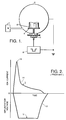
- FIG. 1 A simplified view of a plasma ion implantation system that can be used to practice the method of the present invention is given in Fig. 1. It consists of a sealed plasma chamber 2 with a platform 4 supported inside the chamber 2 to support a target object 6 into which ions are to be implanted. A gas such as nitrogen is introduced into the chamber 2 from a gas source 7.
- the chamber 2 and target support structures 4 are not of conventional design and will be described in detail later.
- a high voltage pulse generator 8 is connected through an insulated vacuum feedthrough 10 to the target 6, which is elevated to the same voltage potential as the output of source 8.
- a ground reference is provided for both the voltage source 8 and walls of chamber 2.
- a fast high voltage switch is necessary to form the pulses.
- a switch as disclosed in documents US-A-4 247 804, 4 596 945 and 5 019 752, and as marketed by the applicant under the trademark CROSSATRON is suitable for this purpose.
- the voltage pulses supplied from source 8 to the target 6 are high enough for ion implantation, generally in excess of 50 kV and preferably at least 100 kV.
- a conventional glow discharge could be established around the target, and a plasma formation system that is separate from the target voltage source would normally be used.
- a plasma can be sustained at these high voltage levels through a mechanism that is quite different from the normal glow discharge. This plasma generating mechanism is referred to as a beam-plasma instability interaction, and has heretofore been observed only in connection with electron beams.
- the electrons that leave a cathode are accelerated by an applied voltage and make ionizing collisions with surrounding gas atoms.
- the background plasma produced by these primary electrons is very tenuous, since they are relatively few in number and their mean free paths are much longer than the length of the discharge chamber.
- the resulting mixture of primary electrons (the electron beam) and background plasma is unstable with respect to density fluctuations. Due to this beam-plasma interaction, strong high frequency plasma waves are excited in the plasma. These waves heat the background plasma electrons, and the tail of the resulting electron velocity distribution, ionizes the fill gas to increase the plasma density to levels much higher than one would calculate based upon the ionization rate of the original high energy electron beam.
- the plasma density radially increases and the primary plasma density reaches a steady state value at which the beam-plasma, plasma production is balanced by particle losses to the chamber walls.
- Various types of electron beam guns have been employed to provide the beam which initiates the plasma production, including the hollow cathode plasma E-gun described in document US-A-4 912 367.
- the entire exposed surface of the implantation target in effect serves as the electron source, and the electron beam becomes a 3-dimensional distribution of secondary electrons flowing into the background gas.
- This distinct plasma generation mechanism is used instead of a conventional glow discharge to establish a pulsed plasma around the implantation target 6 at the high voltage levels (50 - 100 kV) required for ion implantation.
- a high impedance on the order of 2 Kohm - 0.2 Kohm can be sustained across the plasma sheath that surrounds the target surface during each pulse.
- the pulse duration must be long enough to allow sufficient time to establish plasma in the working chamber via the beam-plasma instability mechanism.
- the pulse duration must also be short enough to prevent excessive movement of the plasma sheath away from the target surface during implantation, which could otherwise result in the plasma sheath being unable to conform to small features of the target surface. This requirement is distinct from the technique disclosed in document US-A-4 764 394 mentioned at the outset, in which the plasma sheath is established around the target surface prior to the application of the implantation voltage pulse.
- the pulse duration determines the amount of sheath expansion that will occur. During the pulse-OFF time, the plasma sheath moves back in toward the target surface and establishes its previous position before the next voltage pulse is applied.
- the pulse duration must be long enough to allow sufficient time to establish plasma in the working chamber via the beam-plasma instability mechanism, but short enough to prevent excessive movement of the plasma sheath away from the target surface during implantation. To satisfy these simultaneous requirements, the pulse duration should be longer than 1 microsecond.
- a pulse duration of 7 - 8 microseconds is used; longer pulse durations result in arcing across the plasma sheath between the target surface and the plasma.
- the pulse repetition frequency should generally be kept between 50 - 1000 Hz.
- Successful operation has been sustained with pulse durations of about 5 microseconds, and a pulse frequency in the range 80 - 200 Hz.
- the gas pressure within the chamber is another important parameter for the implantation process. Increasing the pressure causes the plasma density to rise, and this yields a more rapid implantation of ions. However, arcing can occur if the pressure is too high. It has been found that, with 100 kV pulses, arcing can occur at pressures above about 0,67 Pa [5x10 -3 Torr]. A lower limit to the permissible pressure range is established by the minimum pressure at which a pulsed high impedance discharge plasma can be sustained. Suitable plasmas are achievable at gas pressures down to about 13.3 mPa [1x10 -4 Torr], although at such pressures an auxiliary electrode (described below) is generally required to initiate each plasma pulse.
- An important advantage of the present invention is that it is capable of achieving much higher plasma densities, and thus faster implantation rates, than according to the techniques disclosed in document US-A-4 764 394.
- the ion dose rate per pulse, achievable with the afore-mentioned prior art technique is generally on the order of 1 mA/cm 2 , as opposed to dose rates greater than 10 mA/cm 2 with this invention.
- This high current density allows the sheath thickness to be small, on the order of 3 - 6 cm even at 50 - 100 kV.
- the presence of a plasma is needed before the application of the high voltage pulse so that a small sheath is established to enable the implantation of fine features on the target.
- the ion current density is so high that adequately small sheaths are obtained even at 100 kV.
- the second contribution is from the large flux of ions flowing onto the target when the applied high voltage establishes the Child-Langmuir sheath between the target and the plasma by sweeping out the charge (ions) as the sheath expands.
- the current rises to 2 - 10 times its equilibrium value while the voltage is rising.
- the large current spike requires a significant surge current capability by the high voltage modulator, and places undue stress on the modulator circuit.
- the plasma and high voltage pulses are created simultaneously from a single modulator.
- the voltage pulse rises faster than the plasma density due to the finite time required to generate the plasma, fill the working volume with plasma, and transport the ions to the target.
- the ion current to the target rises slower than the voltage pulse, resulting in ion implantation at full voltage during the current rise time.
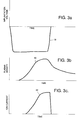
- Figs. 3a, 3b and 3c in which curves 18, 20 and 22, respectively, indicate the implantation voltage, plasma density and ion current waveforms plotted against a common time scale. It can be seen that the rise in both the plasma density and in the ion current lag behind the voltage rise, and do not reach peak values until the peak voltage has already been established.
- the slower ion current rise time provided by the invention gives a "soft start" to the current pulse that reduces the target's arcing rate.
- this pulse shape can be more easily coupled to step-up transformers to increase the implantation voltage without exciting high frequency oscillations in the voltage pulse applied to the target. This is in contrast to the high current turn-on spike characteristic of the continuous plasma approach according to document US-A-4 764 394, which tends to ring pulse transformers and to produce significant oscillations in the implantation voltage output during the pulse.
- the result with the continuous plasma technique is an implantation voltage that is typically lower than the modulator's peak voltage during some large portion of the pulse, accompanied by shallow ion implantation.
- the improved current pulse 22 illustrated in Fig. 3c provides both good coupling to a pulse transformer and stable output voltages over the entire pulse length.
- the pulsed plasma system shown in Fig. 1 may not be capable of initiating a plasma at the lower end of the 13.3-133 mPa [1x10 -4 - 1x10 -3 Torr] pressure range.
- a modified system that allows for this is shown in Fig. 4.
- Fig. 1 As the gas pressure is reduced to the range of 13.3 mPa [1x10 -4 Torr] it becomes increasingly difficult to initiate the beam-plasma discharge. This is because the density of background gas atoms is low, and there are few seed electrons present that are required to produce a tenuous plasma that then leads to dense plasma production via the beam plasma instability. There are two techniques that can be used to alleviate this problem and provide sufficient seed electrons.
- Both techniques involve the use of auxiliary electrodes placed in the ion implantation chamber to provide the required seed electrons.
- thermionic filaments are used as continuously operating auxiliary electrodes as a source of seed electrons.
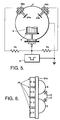
- Fig. 4 is a diagram of the first embodiment to aid in operation at low background pressures. It consists of placing one or more electron-emitting filaments inside the ionization chamber 2.
- the filaments 36 are referenced at one end to the vacuum chamber wall, either by using resistors Rc as shown, or by connecting them directly to the wall.
- the filaments 36 are heated to thermionic temperatures using the power supplies 38, to cause electron emission. No separate plasma is created using these filaments. They merely serve to continuously supply seed electrons to the ion implantation volume.
- the seed electrons from the filaments cause sufficient low-level ionization of the background gas so that the beam-plasma discharge process can be initiated at pressures in the lower range of 13.3 mPa [1x10 -4 Torr].
- the temperature of the filaments By varying the temperature of the filaments, the plasma density and therefore the ion current density implanted into the target, can be varied and controlled, independent of the gas pressure and the applied voltage. Although it is primarily intended for allowing operation at low pressure ranges, this embodiment can also be used at the high pressure range described previously.
- Fig. 5 shows the second embodiment that can be used to aid in beam-plasma discharge operation at low background pressures.
- This embodiment replaces the hot filament cathode 36 (and their associated filament heater power supplies 38) with a simple cold cathode system. It consists of one or more metal electrode structures referred as auxiliary cathodes 24a and 24b that are suspended in the vacuum chamber 2 through feedthroughs 26a and 26b, respectively.
- the cathodes 24a and 24b receive signals from the high voltage pulse generator 8 and are referenced to the target through ballast resistors Ra and Rb.
- a localized magnetic field is introduced to the auxiliary cathode structure by means of permanent magnets 28 (as shown in Fig.
- This localized magnetic field increases the path length of any electrons emitted from the cold cathode surface; such a discharge can be initiated on the auxiliary cathode at a reduced pressure ( ⁇ 10 -3 microns).
- the geometry of the magnetic field at the auxiliary cathode is such that an ExB discharge runs on the cathode.
- the crossed-field plasma production discharge looks similar to that found in a planar magnetron. The plasma discharge is produced locally at the auxiliary cathodes when the high-voltage pulse is initiated, and ion and electrons diffuse to the target region to aid the plasma build up.
- a cold cathode technique (as opposed to a hot filament technique) for the auxiliary cathode configuration shown in Fig. 5.
- filament heater power supply which would have to float at the high voltage at the start of the pulse, can be eliminated.
- the ExB discharge initiates before the high-impedance discharge in the main chamber because of the longer path length of the electrons. This provides control over the introduction of the seed electrons to prevent arcing of the target by improper plasma location and generation.
- the ExB auxiliary cathode can be used to produce a significant amount of plasma, depending upon the value of the ballast resistor, which can be utilized to control the plasma uniformity on the target.
- the material of the auxiliary cathode can be selected to minimize contamination of the substrate by picking a low sputtering yield material (such as molybdenum or tungsten) or, alternatively, a cathode material can be picked that aids in the formation of thin films on the target object by providing simultaneous sputter deposition and ion implantation.
- a low sputtering yield material such as molybdenum or tungsten
- a cathode material can be picked that aids in the formation of thin films on the target object by providing simultaneous sputter deposition and ion implantation.
- An example might be a Ti cathode material to produce TiN on the surface of the target object due to ion implantation of the deposited Ti with nitrogen ions.
- the pulsed plasma created with the invention is characterized by a high impedance of between 2 kohms and 0.2 kohms between the target cathode and chamber wall anode, in the sense at a high voltage drop is sustained at the target relative to the plasma. Nearly all of the applied voltage appears across the discharge in the cathode sheath, rather than across a current limiting resistor in the external circuit.
- the apparatus shown schematically in Fig. 1 should preferably adhere to optimum design requirements.
- the first design requirement concerns the distance between the target support structure 4 and the vacuum chamber walls, both in the upper and lower hemnispheres of the vacuum chamber 2 shown in Fig. 1.
- the beam-plasma discharge process is initiated and sustained between the target surface and the vacuum chamber walls 2, rather than between the bottom of the target support structure 4 and the vacuum chamber walls 2.
- the distance between the surface of the target 6 and the upper hemnisphere of the vacuum chamber 2 should be sufficiently greater (at least a factor of two times greater) than the corresponding distance below the target support structure 4.
- This design requirement is distinct and different from the prior art according to document US-A-4 764 394, which poses no such requirement on the location of the target support structure with respect to the vacuum chamber walls.
- the target support structure 4 should be dimensioned to leave a gap of about 3 to 4 inches (76,2 - 101,6 mm) between the edges of the support structure 4 and the adjacent vacuum chamber walls 2, as suggested in Fig. 1.
- This gap is small enough to prevent a glow discharge from being created in the gap, while at the same time is large enough to prevent unwanted arcing between the support structure 4 and the chamber walls 2.
- the gap size should be small enough to inhibit plasma, created by the glow discharge above the support structure 4 or table, from leaking around the table and flowing under the support structure 4 to cause initiation of a glow discharge in that region.
- the target support structure 4 simultaneously performs multiple tasks not previously taught by the prior art according to document US-A-4 764 394. It (a) supports the target 6 to be implanted, and (b) also shields the plasma from flowing beneath it. This is in contrast to conventional target support structures, which consist of a single metal electrode to support the target and which allow plasma to flow around it.
- the target support structure 4 has not previously been used as a device to limit the flow of plasma to various locations in the ion implantation chamber 2.
- Magnetic fields are typically required in conventional techniques such as those taught in document US-A-4 764 394, to improve the efficiency of the ionization process for operation at low pressures 1.33-13.3 mPa [10 -5 - 10 -4 Torr]. Since the present invention intentionally deals with a higher pressure plasma process, there is no requirement for the use of magnets at the parameter of the vacuum chamber.
- a 50 - 60 kV implantation voltage and a pressure of 133 mPa [1x10 -3 Torr] of nitrogen were used.
- the pulse repetition rate was 80 Hz, with a pulse length of 5 microseconds.
- an implanted dose of 1x10 16 /cm 2 was achieved with a pulsed current density of 10 mA/cm 2 .
- This is constrasted with an implant voltage of 50 kV at the same repetition rate and pulse length in the continuous plasma system according to document US-A-4 764 394 in which the pulsed current density is much lower (on the order of 1 mA/cm 2 ).
- the implant dose was less than 10 15 /cm 2 .
Landscapes
- Physics & Mathematics (AREA)
- Engineering & Computer Science (AREA)
- Plasma & Fusion (AREA)
- Chemical & Material Sciences (AREA)
- Analytical Chemistry (AREA)
- Electron Sources, Ion Sources (AREA)
- Physical Vapour Deposition (AREA)
Claims (21)
- Procédé d'implantation ionique par plasma à haute impédance, comprenant les étapes suivantes :caractérisé par les étapes de réglage de la tension desdites impulsions de tension négative (18) à un niveau de tension suffisamment élevé, de réglage de la durée et de la fréquence des impulsions (18) et de réglage de la pression dans la chambre à plasma (2) de façon à induire une répartition en trois dimensions des électrons secondaires à partir de l'objet cible (6) amorçant et entretenant ledit plasma dans le gaz environnant par l'intermédiaire d'une interaction d'instabilité de faisceau/plasma pour au moins une partie de chaque impulsion de tension négative (18).disposer un objet cible (6) dans une chambre à plasma (2);introduire un gaz ionisable dans ladite chambre à plasma (2);amorcer et entretenir un plasma dans ladite chambre à plasma (2) ; etappliquer une série d'impulsions de tension négative espacées dans le temps (18) audit objet cible (6) de façon à implanter des ions à partir dudit plasma dans ledit objet cible (6) pendant au moins une partie de chaque impulsion de tension négative (18),
- Procédé selon la revendication 1, caractérisé en ce que lesdits électrons secondaires établissent un plasma pulsé d'arrière-plan au voisinage dudit objet cible (6) par l'intermédiaire de collisions d'électrons/gaz et ainsi, un plasma pulsé primaire au voisinage dudit objet cible (6) par l'intermédiaire de l'interaction d'instabilité de faisceau/plasma entre lesdits électrons secondaires et ledit plasma d'arrière-plan.
- Procédé selon la revendication 1 ou 2, caractérisé par l'étape d'excitation d'une électrode auxiliaire (24a, 24b; 36) dans ladite chambre à plasma (2) pour aider l'amorçage dudit plasma à une faible pression d'arrière-plan à l'aide d'électrons d'ensemencement émis par ladite électrode auxiliaire (24a, 24b; 36) avec lesdites impulsions de tension négative (18) entretenant ledit plasma par l'intermédiaire de ladite interaction d'instabilité de faisceau/plasma.
- Procédé selon la revendication 3, caractérisé en ce que ladite électrode auxiliaire (24a, 24b) est prévue sous la forme d'une cathode froide suspendue dans ladite chambre à plasma (2) et référencée audit objet cible (6).
- Procédé selon la revendication 4, caractérisé par l'étape d'établissement d'un champ magnétique localisé (B) au voisinage de ladite électrode auxiliaire (24a, 24b) afin de restreindre une panne d'amorçage de plasma de Paschen à ladite cathode auxiliaire (24a, 24b).
- Procédé selon la revendication 3, caractérisé en ce que ladite électrode auxiliaire (36) est prévue sous la forme d'un filament d'émission d'électrons, et une tension est appliquée audit filament pour l'exciter à des températures thermoioniques pour produire des électrons d'ensemencement.
- Procédé selon la revendication 6, caractérisé en ce que la température dudit filament commande la densité de courant ionique indépendamment de la pression du gaz et de la tension appliquée.
- Procédé selon l'une quelconque des revendications 1 à 7, caractérisé en ce que ledit objet cible (6) est excité par des impulsions de tension négative (18) d'au moins environ 50 kV, de préférence de 100 kV ou plus.
- Procédé selon l'une quelconque des revendications 1 à 8, caractérisé en ce que la durée d'impulsion desdites impulsions de tension négative (18) est inférieure à environ 8 µs.
- Procédé selon l'une quelconque des revendications 1 à 9, caractérisé en ce que lesdites impulsions de tension négative (18) sont appliquées à une fréquence appartenant à l'intervalle approximatif de 50 à 1000 impulsions par seconde.
- Procédé selon l'une quelconque des revendications 1 à 10, caractérisé en ce que la pression du gaz dans ladite chambre à plasma (2) est sensiblement inférieure à 133 mPa (1 x 10⁻³ Torr).
- Procédé selon la revendication 11, caractérisé en ce que ladite pression de gaz appartient à l'intervalle approximatif de 13,3 à 133 mPa (1 x 10⁻⁴ à 1 x 10⁻³ Torr).
- Procédé selon l'une quelconque des revendications 1 à 12, caractérisé en ce que lesdites impulsions de tension négative (18) sont appliquées audit objet cible (6) avec un temps de montée assez rapide pour que la montée en densité de plasma (20) et en courant d'implantation (22) lors de chaque impulsion de tension négative (18) soit en retard sur la montée de l'impulsion de tension.
- Système d'implantation ionique par plasma mettant en oeuvre le procédé selon l'une quelconque des revendications 1 à 13, comprenant :caractérisé en ce que lesdits moyens d'application (8) sont prévus pour appliquer lesdites impulsions de tension négative (18) à un niveau de tension suffisamment haut afin de régler la durée et la fréquence des impulsions (18) et la pression dans la chambre à plasma (2) de façon à induire une répartition en trois dimensions des électrons secondaires à partir dudit objet cible (6) entretenant un plasma dans le gaz environnant par l'intermédiaire d'une interaction d'instabilité de faisceau/plasma pendant au moins une partie de chaque impulsion de tension négative (18).une chambre à plasma (2) possédant des parois de chambre formant des parties supérieure et inférieure de chambre;un moyen (7) pour introduire un gaz ionisable dans ladite chambre à plasma (2);une structure de support de cible (4) dans ladite chambre à plasma (2) qui est positionnée dans ladite chambre à plasma (2) pour supporter ledit objet cible (6) avec la surface de la cible espacée de ladite partie supérieure de chambre d'au moins deux fois la distance séparant ladite structure de support de cible (4) de ladite partie inférieure de chambre; etdes moyens (8) pour appliquer des impulsions de tension négative (18) à ladite structure de support de cible (4) et ainsi, à un objet cible (6) supporté par ladite structure de support de cible (4) afin d'établir une décharge d'incandescence ionisante entre ledit objet cible (6) et lesdites parois de chambre;
- Système selon la revendication 14, caractérisé en ce que ladite structure de support de cible (4) s'étend de façon assez rapprochée desdites parois de chambre pour empêcher sensiblement le plasma au-dessus de ladite structure de support de cible (4) de s'écouler en dessous de ladite structure de support de cible (4).
- Système selon la revendication 14 ou 15, caractérisé par une électrode auxiliaire (24a, 24b; 36) positionnée, de façon globale, au-dessus de ladite structure de support de cible (4) dans ladite chambre à plasma (2), et des moyens (8; 38) pour exciter ladite électrode auxiliaire (24a, 24b; 36) afin d'émettre des électrons d'ensemencement pour amorçage d'un plasma dans ladite chambre à plasma (2) à une faible pression de gaz d'arrière-plan.
- Système selon la revendication 16, caractérisé en ce que ladite électrode auxiliaire (24a, 24b) comprend une cathode froide suspendue dans ladite chambre à plasma (2) et référencée audit objet cible (6).
- Système selon la revendication 17, caractérisé en ce que ladite électrode auxiliaire (24a, 24b) comprend, de plus, un moyen magnétique (28) établissant un champ magnétique localisé (B) au voisinage de ladite électrode auxiliaire (24a, 24b) afin de restreindre une panne d'amorçage de plasma de Paschen à ladite électrode auxiliaire (24a, 24b).
- Système selon la revendication 16, caractérisé en ce que ladite électrode auxiliaire (36) comprend un filament d'émission d'électrons, et ledit moyen d'excitation d'électrode (38) est connecté pour appliquer une tension audit filament afin de l'exciter à une température thermoionique pour fournir des électrons d'ensemencement.
- Système selon la revendication 19, caractérisé en ce que ladite température de filament commande la densité de courant d'ions indépendamment de la pression du gaz et de la tension appliquée.
- Système selon l'une quelconque des revendications 14 à 20, caractérisé en ce que ledit système est prévu pour présenter des paramètres de fonctionnement établis comme suit :lesdites impulsions de tension négative (18) sont établies à une tension d'au moins environ 50 kV, de préférence à 100 kV ou plus; et/oula durée d'impulsion desdites impulsions de tension négative (18) est réglée à moins d'environ 8 µs; et/oulesdites impulsions de tension négative (18) sont appliquées à une fréquence comprise dans l'intervalle approximatif de 50 à 1000 impulsions par seconde; et/ouladite pression de gaz est choisie sensiblement inférieure à 133 mPa (1 x 10⁻³ Torr), de façon plus spécifique entre 13,3 et 133 mPa (1 x 10⁻⁴ à 1 x 10⁻³ Torr) ; et/oulesdites impulsions de tension négative (18) sont appliquées audit objet cible (6) avec un temps de montée assez rapide pour que la montée en densité de plasma (20) et en courant d'implantation (22) lors de chaque impulsion de tension négative (18) soit en retard sur la montée d'impulsion de tension.
Applications Claiming Priority (2)
| Application Number | Priority Date | Filing Date | Title |
|---|---|---|---|
| US07/971,433 US5330800A (en) | 1992-11-04 | 1992-11-04 | High impedance plasma ion implantation method and apparatus |
| US971433 | 1992-11-04 |
Publications (2)
| Publication Number | Publication Date |
|---|---|
| EP0596496A1 EP0596496A1 (fr) | 1994-05-11 |
| EP0596496B1 true EP0596496B1 (fr) | 1999-04-07 |
Family
ID=25518384
Family Applications (1)
| Application Number | Title | Priority Date | Filing Date |
|---|---|---|---|
| EP93117908A Expired - Lifetime EP0596496B1 (fr) | 1992-11-04 | 1993-11-04 | Méthode et appareil d'implantation ionique par un plasma de haute impédance |
Country Status (7)
| Country | Link |
|---|---|
| US (2) | US5330800A (fr) |
| EP (1) | EP0596496B1 (fr) |
| JP (1) | JPH06256943A (fr) |
| KR (1) | KR960014437B1 (fr) |
| CA (1) | CA2102384C (fr) |
| DE (1) | DE69324326T2 (fr) |
| IL (1) | IL107475A (fr) |
Families Citing this family (79)
| Publication number | Priority date | Publication date | Assignee | Title |
|---|---|---|---|---|
| KR930011413B1 (ko) * | 1990-09-25 | 1993-12-06 | 가부시키가이샤 한도오따이 에네루기 겐큐쇼 | 펄스형 전자파를 사용한 플라즈마 cvd 법 |
| US5330800A (en) * | 1992-11-04 | 1994-07-19 | Hughes Aircraft Company | High impedance plasma ion implantation method and apparatus |
| US5354381A (en) * | 1993-05-07 | 1994-10-11 | Varian Associates, Inc. | Plasma immersion ion implantation (PI3) apparatus |
| US5498290A (en) * | 1993-08-27 | 1996-03-12 | Hughes Aircraft Company | Confinement of secondary electrons in plasma ion processing |
| US5558718A (en) * | 1994-04-08 | 1996-09-24 | The Regents, University Of California | Pulsed source ion implantation apparatus and method |
| JP3060876B2 (ja) * | 1995-02-15 | 2000-07-10 | 日新電機株式会社 | 金属イオン注入装置 |
| US5711812A (en) * | 1995-06-06 | 1998-01-27 | Varian Associates, Inc. | Apparatus for obtaining dose uniformity in plasma doping (PLAD) ion implantation processes |
| US5672541A (en) * | 1995-06-14 | 1997-09-30 | Wisconsin Alumni Research Foundation | Ultra-shallow junction semiconductor device fabrication |
| US5693376A (en) * | 1995-06-23 | 1997-12-02 | Wisconsin Alumni Research Foundation | Method for plasma source ion implantation and deposition for cylindrical surfaces |
| DE19538903A1 (de) * | 1995-10-19 | 1997-04-24 | Rossendorf Forschzent | Verfahren zur Implantation von Ionen in leitende bzw. halbleitende Werkstücke mittels Plasmaimmersionsionenimplantation (P III) und Implantationskammer zur Durchführung des Verfahrens |
| US6784080B2 (en) | 1995-10-23 | 2004-08-31 | Matsushita Electric Industrial Co., Ltd. | Method of manufacturing semiconductor device by sputter doping |
| JP3862305B2 (ja) * | 1995-10-23 | 2006-12-27 | 松下電器産業株式会社 | 不純物の導入方法及びその装置、並びに半導体装置の製造方法 |
| CA2205817C (fr) * | 1996-05-24 | 2004-04-06 | Sekisui Chemical Co., Ltd. | Traitement a decharge luminescente du plasma et appareil utilise a cette fin |
| US6137231A (en) * | 1996-09-10 | 2000-10-24 | The Regents Of The University Of California | Constricted glow discharge plasma source |
| US5654043A (en) * | 1996-10-10 | 1997-08-05 | Eaton Corporation | Pulsed plate plasma implantation system and method |
| DE19702294A1 (de) * | 1997-01-23 | 1998-07-30 | Rossendorf Forschzent | Modulator für die Plasmaimmersions-Ionenimplantation |
| WO1999020086A2 (fr) * | 1997-09-24 | 1999-04-22 | The Regents Of The University Of California | Procede de production de revetements adherents par traitement plasmatique |
| KR100521120B1 (ko) * | 1998-02-13 | 2005-10-12 | 가부시끼가이샤 히다치 세이사꾸쇼 | 반도체소자의 표면처리방법 및 장치 |
| US6143631A (en) | 1998-05-04 | 2000-11-07 | Micron Technology, Inc. | Method for controlling the morphology of deposited silicon on a silicon dioxide substrate and semiconductor devices incorporating such deposited silicon |
| US6368676B1 (en) * | 1999-07-20 | 2002-04-09 | Diversified Technologies, Inc. | Method of coating an article |
| US7838842B2 (en) * | 1999-12-13 | 2010-11-23 | Semequip, Inc. | Dual mode ion source for ion implantation |
| US6458430B1 (en) | 1999-12-22 | 2002-10-01 | Axcelis Technologies, Inc. | Pretreatment process for plasma immersion ion implantation |
| CN1158403C (zh) * | 1999-12-23 | 2004-07-21 | 西南交通大学 | 一种人工器官表面改性方法 |
| US6403029B1 (en) * | 2000-01-12 | 2002-06-11 | The Trustees Of Princeton University | System and method of applying energetic ions for sterilization |
| US7747002B1 (en) * | 2000-03-15 | 2010-06-29 | Broadcom Corporation | Method and system for stereo echo cancellation for VoIP communication systems |
| US6459066B1 (en) | 2000-08-25 | 2002-10-01 | Board Of Regents, The University Of Texas System | Transmission line based inductively coupled plasma source with stable impedance |
| US6875700B2 (en) * | 2000-08-29 | 2005-04-05 | Board Of Regents, The University Of Texas System | Ion-Ion plasma processing with bias modulation synchronized to time-modulated discharges |
| US6531367B2 (en) * | 2001-03-20 | 2003-03-11 | Macronix International Co., Ltd. | Method for forming ultra-shallow junction by boron plasma doping |
| KR100425453B1 (ko) * | 2001-07-06 | 2004-03-30 | 삼성전자주식회사 | 고밀도 플라즈마용 자석과 그 제조방법 및 이를 이용한고밀도 플라즈마용 반도체 제조장치 |
| US7163901B2 (en) | 2002-03-13 | 2007-01-16 | Varian Semiconductor Equipment Associates, Inc. | Methods for forming thin film layers by simultaneous doping and sintering |
| US6878415B2 (en) * | 2002-04-15 | 2005-04-12 | Varian Semiconductor Equipment Associates, Inc. | Methods for chemical formation of thin film layers using short-time thermal processes |
| EP1361437A1 (fr) * | 2002-05-07 | 2003-11-12 | Centre National De La Recherche Scientifique (Cnrs) | Un nouveau marqueur biologique pour des tumeurs et des méthodes pour la détection de phénotype cancéreux ou non-cancéreux de cellules |
| US20060233682A1 (en) * | 2002-05-08 | 2006-10-19 | Cherian Kuruvilla A | Plasma-assisted engine exhaust treatment |
| US20060062930A1 (en) * | 2002-05-08 | 2006-03-23 | Devendra Kumar | Plasma-assisted carburizing |
| US7638727B2 (en) * | 2002-05-08 | 2009-12-29 | Btu International Inc. | Plasma-assisted heat treatment |
| US7504061B2 (en) * | 2002-05-08 | 2009-03-17 | Leonhard Kurz Gmbh & Co., Kg | Method of decorating large plastic 3D objects |
| JP2005524963A (ja) * | 2002-05-08 | 2005-08-18 | ダナ・コーポレーション | プラズマ触媒 |
| US7560657B2 (en) * | 2002-05-08 | 2009-07-14 | Btu International Inc. | Plasma-assisted processing in a manufacturing line |
| US7465362B2 (en) * | 2002-05-08 | 2008-12-16 | Btu International, Inc. | Plasma-assisted nitrogen surface-treatment |
| US7497922B2 (en) * | 2002-05-08 | 2009-03-03 | Btu International, Inc. | Plasma-assisted gas production |
| US20050233091A1 (en) * | 2002-05-08 | 2005-10-20 | Devendra Kumar | Plasma-assisted coating |
| US7432470B2 (en) | 2002-05-08 | 2008-10-07 | Btu International, Inc. | Surface cleaning and sterilization |
| US20060228497A1 (en) * | 2002-05-08 | 2006-10-12 | Satyendra Kumar | Plasma-assisted coating |
| US7445817B2 (en) * | 2002-05-08 | 2008-11-04 | Btu International Inc. | Plasma-assisted formation of carbon structures |
| US7494904B2 (en) * | 2002-05-08 | 2009-02-24 | Btu International, Inc. | Plasma-assisted doping |
| US7498066B2 (en) * | 2002-05-08 | 2009-03-03 | Btu International Inc. | Plasma-assisted enhanced coating |
| US20060237398A1 (en) * | 2002-05-08 | 2006-10-26 | Dougherty Mike L Sr | Plasma-assisted processing in a manufacturing line |
| US20060057016A1 (en) * | 2002-05-08 | 2006-03-16 | Devendra Kumar | Plasma-assisted sintering |
| US7147759B2 (en) * | 2002-09-30 | 2006-12-12 | Zond, Inc. | High-power pulsed magnetron sputtering |
| US6896773B2 (en) * | 2002-11-14 | 2005-05-24 | Zond, Inc. | High deposition rate sputtering |
| US7189940B2 (en) | 2002-12-04 | 2007-03-13 | Btu International Inc. | Plasma-assisted melting |
| BR0205419B1 (pt) * | 2002-12-20 | 2017-10-24 | Coppe/Ufrj Coordenacao Dos Programas De Pos Graduacao De Engenharia Da Univ Federal Do Rio De Janeir | Process of ionic nitretation by pulsed plasma for obtaining diffusion barrier for hydrogen for steel api 5l x-65 |
| USH2212H1 (en) * | 2003-09-26 | 2008-04-01 | The United States Of America As Represented By The Secretary Of The Navy | Method and apparatus for producing an ion-ion plasma continuous in time |
| US20050103620A1 (en) * | 2003-11-19 | 2005-05-19 | Zond, Inc. | Plasma source with segmented magnetron cathode |
| US9771648B2 (en) * | 2004-08-13 | 2017-09-26 | Zond, Inc. | Method of ionized physical vapor deposition sputter coating high aspect-ratio structures |
| US7663319B2 (en) * | 2004-02-22 | 2010-02-16 | Zond, Inc. | Methods and apparatus for generating strongly-ionized plasmas with ionizational instabilities |
| US9123508B2 (en) | 2004-02-22 | 2015-09-01 | Zond, Llc | Apparatus and method for sputtering hard coatings |
| US7095179B2 (en) * | 2004-02-22 | 2006-08-22 | Zond, Inc. | Methods and apparatus for generating strongly-ionized plasmas with ionizational instabilities |
| FR2871934B1 (fr) * | 2004-06-16 | 2006-09-22 | Ion Beam Services Sa | Alimentation d'implanteur ionique prevue pour une limitation de l'effet de charge |
| US7741621B2 (en) * | 2004-07-14 | 2010-06-22 | City University Of Hong Kong | Apparatus and method for focused electric field enhanced plasma-based ion implantation |
| EP2477207A3 (fr) * | 2004-09-24 | 2014-09-03 | Zond, Inc. | Appareil pour générer des décharges électriques de courant élevé |
| WO2006127037A2 (fr) * | 2004-11-05 | 2006-11-30 | Dana Corporation | Traitement atmospherique effectue au moyen de plasmas generes par des micro-ondes |
| US20060236931A1 (en) * | 2005-04-25 | 2006-10-26 | Varian Semiconductor Equipment Associates, Inc. | Tilted Plasma Doping |
| CN101160643B (zh) * | 2005-05-12 | 2012-04-18 | 松下电器产业株式会社 | 等离子体掺入方法和等离子体掺入设备 |
| US20070170867A1 (en) * | 2006-01-24 | 2007-07-26 | Varian Semiconductor Equipment Associates, Inc. | Plasma Immersion Ion Source With Low Effective Antenna Voltage |
| US20080132046A1 (en) * | 2006-12-04 | 2008-06-05 | Varian Semiconductor Equipment Associates, Inc. | Plasma Doping With Electronically Controllable Implant Angle |
| US20080169183A1 (en) * | 2007-01-16 | 2008-07-17 | Varian Semiconductor Equipment Associates, Inc. | Plasma Source with Liner for Reducing Metal Contamination |
| US7820533B2 (en) * | 2007-02-16 | 2010-10-26 | Varian Semiconductor Equipment Associates, Inc. | Multi-step plasma doping with improved dose control |
| US20090071371A1 (en) * | 2007-09-18 | 2009-03-19 | College Of William And Mary | Silicon Oxynitride Coating Compositions |
| US8994270B2 (en) | 2008-05-30 | 2015-03-31 | Colorado State University Research Foundation | System and methods for plasma application |
| WO2009146432A1 (fr) * | 2008-05-30 | 2009-12-03 | Colorado State University Research Foundation | Dispositif de source chimique à base de plasma et procédé d'utilisation de celle-ci |
| JP2013529352A (ja) | 2010-03-31 | 2013-07-18 | コロラド ステート ユニバーシティー リサーチ ファウンデーション | 液体−気体界面プラズマデバイス |
| EP2552340A4 (fr) | 2010-03-31 | 2015-10-14 | Univ Colorado State Res Found | Dispositif à plasma à interface liquide-gaz |
| KR101147349B1 (ko) * | 2010-09-17 | 2012-05-23 | 인제대학교 산학협력단 | 누설 전류형 변압기를 이용한 플라즈마 처리장치 |
| CN104094377B (zh) * | 2011-12-19 | 2016-05-11 | 弗劳恩霍弗实用研究促进协会 | 用于产生空心阴极电弧放电等离子体的装置 |
| US9532826B2 (en) | 2013-03-06 | 2017-01-03 | Covidien Lp | System and method for sinus surgery |
| US9555145B2 (en) | 2013-03-13 | 2017-01-31 | Covidien Lp | System and method for biofilm remediation |
| US10784079B2 (en) | 2018-09-26 | 2020-09-22 | Taiwan Semiconductor Manufacturing Co., Ltd. | Ion implantation system and source bushing thereof |
| US20210391161A1 (en) * | 2019-01-15 | 2021-12-16 | Fluidigm Canada Inc. | Direct ionization in imaging mass spectrometry operation |
Family Cites Families (22)
| Publication number | Priority date | Publication date | Assignee | Title |
|---|---|---|---|---|
| US3479269A (en) * | 1967-01-04 | 1969-11-18 | Bell Telephone Labor Inc | Method for sputter etching using a high frequency negative pulse train |
| US3732158A (en) * | 1971-01-14 | 1973-05-08 | Nasa | Method and apparatus for sputtering utilizing an apertured electrode and a pulsed substrate bias |
| JPS5360560A (en) * | 1976-11-12 | 1978-05-31 | Hitachi Ltd | Injection method of ion to treated substance surface |
| US4247804A (en) * | 1979-06-04 | 1981-01-27 | Hughes Aircraft Company | Cold cathode discharge device with grid control |
| JPS58157081A (ja) * | 1982-03-12 | 1983-09-19 | 松下電器産業株式会社 | 高周波加熱装置 |
| US4596945A (en) * | 1984-05-14 | 1986-06-24 | Hughes Aircraft Company | Modulator switch with low voltage control |
| US4810322A (en) * | 1986-11-03 | 1989-03-07 | International Business Machines Corporation | Anode plate for a parallel-plate reactive ion etching reactor |
| DE3700633C2 (de) * | 1987-01-12 | 1997-02-20 | Reinar Dr Gruen | Verfahren und Vorrichtung zum schonenden Beschichten elektrisch leitender Gegenstände mittels Plasma |
| US4764394A (en) * | 1987-01-20 | 1988-08-16 | Wisconsin Alumni Research Foundation | Method and apparatus for plasma source ion implantation |
| KR930003857B1 (ko) * | 1987-08-05 | 1993-05-14 | 마쯔시다덴기산교 가부시기가이샤 | 플라즈마 도우핑방법 |
| US4912367A (en) * | 1988-04-14 | 1990-03-27 | Hughes Aircraft Company | Plasma-assisted high-power microwave generator |
| US5019752A (en) * | 1988-06-16 | 1991-05-28 | Hughes Aircraft Company | Plasma switch with chrome, perturbated cold cathode |
| JPH0211762A (ja) * | 1988-06-28 | 1990-01-16 | Masanobu Nunogaki | 表面加工容器中高エネルギーイオン注入法 |
| JP2775274B2 (ja) * | 1989-01-23 | 1998-07-16 | 實 菅原 | プラズマ発生装置 |
| JPH02230734A (ja) * | 1989-03-03 | 1990-09-13 | Nec Corp | 薄膜形成装置 |
| US5198072A (en) * | 1990-07-06 | 1993-03-30 | Vlsi Technology, Inc. | Method and apparatus for detecting imminent end-point when etching dielectric layers in a plasma etch system |
| US5126163A (en) * | 1990-09-05 | 1992-06-30 | Northeastern University | Method for metal ion implantation using multiple pulsed arcs |
| US5218179A (en) * | 1990-10-10 | 1993-06-08 | Hughes Aircraft Company | Plasma source arrangement for ion implantation |
| CA2052080C (fr) * | 1990-10-10 | 1997-01-14 | Jesse N. Matossian | Disposition de la source de plasma pour l'implantation ionique |
| US5212425A (en) * | 1990-10-10 | 1993-05-18 | Hughes Aircraft Company | Ion implantation and surface processing method and apparatus |
| US5330800A (en) * | 1992-11-04 | 1994-07-19 | Hughes Aircraft Company | High impedance plasma ion implantation method and apparatus |
| US5354381A (en) * | 1993-05-07 | 1994-10-11 | Varian Associates, Inc. | Plasma immersion ion implantation (PI3) apparatus |
-
1992
- 1992-11-04 US US07/971,433 patent/US5330800A/en not_active Expired - Lifetime
-
1993
- 1993-11-02 IL IL107475A patent/IL107475A/en not_active IP Right Cessation
- 1993-11-03 CA CA002102384A patent/CA2102384C/fr not_active Expired - Lifetime
- 1993-11-04 KR KR1019930023273A patent/KR960014437B1/ko not_active Expired - Fee Related
- 1993-11-04 DE DE69324326T patent/DE69324326T2/de not_active Expired - Lifetime
- 1993-11-04 EP EP93117908A patent/EP0596496B1/fr not_active Expired - Lifetime
- 1993-11-04 JP JP5275832A patent/JPH06256943A/ja active Pending
-
1996
- 1996-04-22 US US08/635,527 patent/US5607509A/en not_active Expired - Lifetime
Also Published As
| Publication number | Publication date |
|---|---|
| JPH06256943A (ja) | 1994-09-13 |
| KR940013298A (ko) | 1994-06-25 |
| US5330800A (en) | 1994-07-19 |
| DE69324326T2 (de) | 1999-12-16 |
| KR960014437B1 (ko) | 1996-10-15 |
| EP0596496A1 (fr) | 1994-05-11 |
| CA2102384C (fr) | 2000-01-11 |
| IL107475A0 (en) | 1994-02-27 |
| DE69324326D1 (de) | 1999-05-12 |
| CA2102384A1 (fr) | 1994-05-05 |
| US5607509A (en) | 1997-03-04 |
| IL107475A (en) | 1998-03-10 |
Similar Documents
| Publication | Publication Date | Title |
|---|---|---|
| EP0596496B1 (fr) | Méthode et appareil d'implantation ionique par un plasma de haute impédance | |
| US5558718A (en) | Pulsed source ion implantation apparatus and method | |
| US7147759B2 (en) | High-power pulsed magnetron sputtering | |
| US7663319B2 (en) | Methods and apparatus for generating strongly-ionized plasmas with ionizational instabilities | |
| EP1556882B1 (fr) | Traitement par plasma pulsé de forte puissance assisté par champ magnétique | |
| EP1726190B1 (fr) | Procedes et appareil pour la generation de plasmas a haute densite avec des instabilites d'ionisation | |
| JP4722486B2 (ja) | 高蒸着速度スパッタリング | |
| US9123508B2 (en) | Apparatus and method for sputtering hard coatings | |
| US5537005A (en) | High-current, low-pressure plasma-cathode electron gun | |
| JP2008523625A (ja) | 軸方向静電気的閉じ込めによるプラズマイオン注入装置 | |
| JP2512649B2 (ja) | イオン注入用のプラズマソ―ス装置 | |
| Bugaev et al. | “Titan,” a source of gas and metal ions based on a contracted discharge and vacuum arc | |
| Burdovitsin et al. | Plasma Electron Sources | |
| Ryabchikov | 634050, ΡΟ Box 25, Tomsk, USSR | |
| JPH05258697A (ja) | 電子銃 | |
| JPH05290775A (ja) | 電子銃 |
Legal Events
| Date | Code | Title | Description |
|---|---|---|---|
| PUAI | Public reference made under article 153(3) epc to a published international application that has entered the european phase |
Free format text: ORIGINAL CODE: 0009012 |
|
| AK | Designated contracting states |
Kind code of ref document: A1 Designated state(s): DE FR GB IT SE |
|
| 17P | Request for examination filed |
Effective date: 19941013 |
|
| 17Q | First examination report despatched |
Effective date: 19951221 |
|
| GRAG | Despatch of communication of intention to grant |
Free format text: ORIGINAL CODE: EPIDOS AGRA |
|
| GRAG | Despatch of communication of intention to grant |
Free format text: ORIGINAL CODE: EPIDOS AGRA |
|
| GRAH | Despatch of communication of intention to grant a patent |
Free format text: ORIGINAL CODE: EPIDOS IGRA |
|
| RAP1 | Party data changed (applicant data changed or rights of an application transferred) |
Owner name: HE HOLDINGS, INC. |
|
| RAP1 | Party data changed (applicant data changed or rights of an application transferred) |
Owner name: HUGHES ELECTRONICS CORPORATION |
|
| GRAH | Despatch of communication of intention to grant a patent |
Free format text: ORIGINAL CODE: EPIDOS IGRA |
|
| GRAA | (expected) grant |
Free format text: ORIGINAL CODE: 0009210 |
|
| AK | Designated contracting states |
Kind code of ref document: B1 Designated state(s): DE FR GB IT SE |
|
| PG25 | Lapsed in a contracting state [announced via postgrant information from national office to epo] |
Ref country code: SE Free format text: THE PATENT HAS BEEN ANNULLED BY A DECISION OF A NATIONAL AUTHORITY Effective date: 19990407 Ref country code: IT Free format text: LAPSE BECAUSE OF FAILURE TO SUBMIT A TRANSLATION OF THE DESCRIPTION OR TO PAY THE FEE WITHIN THE PRE;WARNING: LAPSES OF ITALIAN PATENTS WITH EFFECTIVE DATE BEFORE 2007 MAY HAVE OCCURRED AT ANY TIME BEFORE 2007. THE CORRECT EFFECTIVE DATE MAY BE DIFFERENT FROM THE ONE RECORDED.SCRIBED TIME-LIMIT Effective date: 19990407 |
|
| REF | Corresponds to: |
Ref document number: 69324326 Country of ref document: DE Date of ref document: 19990512 |
|
| ET | Fr: translation filed | ||
| PG25 | Lapsed in a contracting state [announced via postgrant information from national office to epo] |
Ref country code: GB Free format text: LAPSE BECAUSE OF NON-PAYMENT OF DUE FEES Effective date: 19991104 |
|
| PLBE | No opposition filed within time limit |
Free format text: ORIGINAL CODE: 0009261 |
|
| STAA | Information on the status of an ep patent application or granted ep patent |
Free format text: STATUS: NO OPPOSITION FILED WITHIN TIME LIMIT |
|
| 26N | No opposition filed | ||
| GBPC | Gb: european patent ceased through non-payment of renewal fee |
Effective date: 19991104 |
|
| GBPC | Gb: european patent ceased through non-payment of renewal fee |
Free format text: THE NOTICE IN THE PDJ OF 21 JUNE 2000 (NO. 5797) ANNOUNCING THAT EUROPEAN PATENT (UK) 0596496 HAD CEASED WAS AN ERROR AND IS CANCELLED. |
|
| REG | Reference to a national code |
Ref country code: GB Ref legal event code: IF02 |
|
| PGFP | Annual fee paid to national office [announced via postgrant information from national office to epo] |
Ref country code: DE Payment date: 20121121 Year of fee payment: 20 Ref country code: FR Payment date: 20121130 Year of fee payment: 20 |
|
| PGFP | Annual fee paid to national office [announced via postgrant information from national office to epo] |
Ref country code: GB Payment date: 20121120 Year of fee payment: 20 |
|
| REG | Reference to a national code |
Ref country code: DE Ref legal event code: R071 Ref document number: 69324326 Country of ref document: DE |
|
| REG | Reference to a national code |
Ref country code: GB Ref legal event code: PE20 Expiry date: 20131103 |
|
| PG25 | Lapsed in a contracting state [announced via postgrant information from national office to epo] |
Ref country code: GB Free format text: LAPSE BECAUSE OF EXPIRATION OF PROTECTION Effective date: 20131103 Ref country code: DE Free format text: LAPSE BECAUSE OF EXPIRATION OF PROTECTION Effective date: 20131105 |