EP0597411A1 - Verfahren zur Herstellung von Phthalocyaninreaktivfarbstoffen - Google Patents
Verfahren zur Herstellung von Phthalocyaninreaktivfarbstoffen Download PDFInfo
- Publication number
- EP0597411A1 EP0597411A1 EP93118037A EP93118037A EP0597411A1 EP 0597411 A1 EP0597411 A1 EP 0597411A1 EP 93118037 A EP93118037 A EP 93118037A EP 93118037 A EP93118037 A EP 93118037A EP 0597411 A1 EP0597411 A1 EP 0597411A1
- Authority
- EP
- European Patent Office
- Prior art keywords
- formula
- groups
- alkyl
- pyridine
- metal
- Prior art date
- Legal status (The legal status is an assumption and is not a legal conclusion. Google has not performed a legal analysis and makes no representation as to the accuracy of the status listed.)
- Granted
Links
- IEQIEDJGQAUEQZ-UHFFFAOYSA-N phthalocyanine Chemical compound N1C(N=C2C3=CC=CC=C3C(N=C3C4=CC=CC=C4C(=N4)N3)=N2)=C(C=CC=C2)C2=C1N=C1C2=CC=CC=C2C4=N1 IEQIEDJGQAUEQZ-UHFFFAOYSA-N 0.000 title claims abstract description 25
- 238000000034 method Methods 0.000 title claims abstract description 21
- 239000000985 reactive dye Substances 0.000 title claims abstract description 19
- 238000002360 preparation method Methods 0.000 title claims abstract description 9
- -1 beta -substituted ethylsulphonyl groups Chemical group 0.000 claims abstract description 41
- 150000001412 amines Chemical class 0.000 claims abstract description 20
- 239000003054 catalyst Substances 0.000 claims abstract description 13
- 125000000623 heterocyclic group Chemical group 0.000 claims abstract description 11
- 238000006243 chemical reaction Methods 0.000 claims description 28
- LSNNMFCWUKXFEE-UHFFFAOYSA-M Bisulfite Chemical compound OS([O-])=O LSNNMFCWUKXFEE-UHFFFAOYSA-M 0.000 claims description 18
- 125000004178 (C1-C4) alkyl group Chemical group 0.000 claims description 12
- 229910052751 metal Inorganic materials 0.000 claims description 10
- 239000002184 metal Substances 0.000 claims description 10
- JUJWROOIHBZHMG-UHFFFAOYSA-N Pyridine Chemical compound C1=CC=NC=C1 JUJWROOIHBZHMG-UHFFFAOYSA-N 0.000 claims description 9
- 239000001257 hydrogen Substances 0.000 claims description 9
- 229910052739 hydrogen Inorganic materials 0.000 claims description 9
- RAXXELZNTBOGNW-UHFFFAOYSA-N imidazole Natural products C1=CNC=N1 RAXXELZNTBOGNW-UHFFFAOYSA-N 0.000 claims description 9
- 125000004169 (C1-C6) alkyl group Chemical group 0.000 claims description 6
- 150000001768 cations Chemical class 0.000 claims description 6
- 125000001997 phenyl group Chemical group [H]C1=C([H])C([H])=C(*)C([H])=C1[H] 0.000 claims description 6
- 125000001033 ether group Chemical group 0.000 claims description 5
- 125000004430 oxygen atom Chemical group O* 0.000 claims description 5
- UMJSCPRVCHMLSP-UHFFFAOYSA-N pyridine Natural products COC1=CC=CN=C1 UMJSCPRVCHMLSP-UHFFFAOYSA-N 0.000 claims description 5
- 125000000020 sulfo group Chemical group O=S(=O)([*])O[H] 0.000 claims description 5
- 125000006125 ethylsulfonyl group Chemical group 0.000 claims description 4
- 125000004435 hydrogen atom Chemical group [H]* 0.000 claims description 4
- 229910052757 nitrogen Inorganic materials 0.000 claims description 4
- 125000004433 nitrogen atom Chemical group N* 0.000 claims description 4
- 150000003141 primary amines Chemical class 0.000 claims description 4
- 150000003335 secondary amines Chemical class 0.000 claims description 4
- 125000001424 substituent group Chemical group 0.000 claims description 4
- 125000000391 vinyl group Chemical group [H]C([*])=C([H])[H] 0.000 claims description 4
- 229920002554 vinyl polymer Polymers 0.000 claims description 4
- KPBDDCHVARVOII-UHFFFAOYSA-N 5,5-dimethyltetrazole Chemical compound CC1(C)N=NN=N1 KPBDDCHVARVOII-UHFFFAOYSA-N 0.000 claims description 3
- 125000000217 alkyl group Chemical group 0.000 claims description 3
- 125000002947 alkylene group Chemical group 0.000 claims description 3
- 239000012736 aqueous medium Substances 0.000 claims description 3
- 239000000460 chlorine Substances 0.000 claims description 3
- 229910052801 chlorine Inorganic materials 0.000 claims description 3
- 125000005842 heteroatom Chemical group 0.000 claims description 3
- 239000000203 mixture Substances 0.000 claims description 3
- 125000004957 naphthylene group Chemical group 0.000 claims description 3
- 125000000229 (C1-C4)alkoxy group Chemical group 0.000 claims description 2
- GIWQSPITLQVMSG-UHFFFAOYSA-N 1,2-dimethylimidazole Chemical group CC1=NC=CN1C GIWQSPITLQVMSG-UHFFFAOYSA-N 0.000 claims description 2
- OQZBAQXTXNIPRA-UHFFFAOYSA-N 1-pyridin-4-ylpiperazine Chemical compound C1CNCCN1C1=CC=NC=C1 OQZBAQXTXNIPRA-UHFFFAOYSA-N 0.000 claims description 2
- NPLHXOPRCBNQFM-UHFFFAOYSA-N 2-(1,2,4-triazol-4-yl)acetic acid Chemical group OC(=O)CN1C=NN=C1 NPLHXOPRCBNQFM-UHFFFAOYSA-N 0.000 claims description 2
- PBEDVTDUVXFSMW-UHFFFAOYSA-N 3-methylimidazole-4-carboxylic acid Chemical group CN1C=NC=C1C(O)=O PBEDVTDUVXFSMW-UHFFFAOYSA-N 0.000 claims description 2
- MTPBUCCXRGSDCR-UHFFFAOYSA-N 4-piperidin-1-ylpyridine Chemical compound C1CCCCN1C1=CC=NC=C1 MTPBUCCXRGSDCR-UHFFFAOYSA-N 0.000 claims description 2
- QJWQYVJVCXMTJP-UHFFFAOYSA-N 4-pyridin-4-ylmorpholine Chemical compound C1COCCN1C1=CC=NC=C1 QJWQYVJVCXMTJP-UHFFFAOYSA-N 0.000 claims description 2
- RGUKYNXWOWSRET-UHFFFAOYSA-N 4-pyrrolidin-1-ylpyridine Chemical compound C1CCCN1C1=CC=NC=C1 RGUKYNXWOWSRET-UHFFFAOYSA-N 0.000 claims description 2
- 125000001931 aliphatic group Chemical group 0.000 claims description 2
- 125000003118 aryl group Chemical group 0.000 claims description 2
- 125000001309 chloro group Chemical group Cl* 0.000 claims description 2
- QAFBDRSXXHEXGB-UHFFFAOYSA-N imidazol-1-ylacetic acid Chemical group OC(=O)CN1C=CN=C1 QAFBDRSXXHEXGB-UHFFFAOYSA-N 0.000 claims description 2
- 150000002460 imidazoles Chemical class 0.000 claims description 2
- 125000004194 piperazin-1-yl group Chemical group [H]N1C([H])([H])C([H])([H])N(*)C([H])([H])C1([H])[H] 0.000 claims description 2
- UIIMBOGNXHQVGW-UHFFFAOYSA-M Sodium bicarbonate Chemical compound [Na+].OC([O-])=O UIIMBOGNXHQVGW-UHFFFAOYSA-M 0.000 description 24
- PAYRUJLWNCNPSJ-UHFFFAOYSA-N Aniline Chemical compound NC1=CC=CC=C1 PAYRUJLWNCNPSJ-UHFFFAOYSA-N 0.000 description 12
- 235000017557 sodium bicarbonate Nutrition 0.000 description 12
- 229910000030 sodium bicarbonate Inorganic materials 0.000 description 12
- 239000007787 solid Substances 0.000 description 12
- RBTKNAXYKSUFRK-UHFFFAOYSA-N heliogen blue Chemical compound [Cu].[N-]1C2=C(C=CC=C3)C3=C1N=C([N-]1)C3=CC=CC=C3C1=NC([N-]1)=C(C=CC=C3)C3=C1N=C([N-]1)C3=CC=CC=C3C1=N2 RBTKNAXYKSUFRK-UHFFFAOYSA-N 0.000 description 11
- MCTWTZJPVLRJOU-UHFFFAOYSA-N 1-methyl-1H-imidazole Chemical compound CN1C=CN=C1 MCTWTZJPVLRJOU-UHFFFAOYSA-N 0.000 description 10
- 239000002270 dispersing agent Substances 0.000 description 10
- YBBRCQOCSYXUOC-UHFFFAOYSA-N sulfuryl dichloride Chemical compound ClS(Cl)(=O)=O YBBRCQOCSYXUOC-UHFFFAOYSA-N 0.000 description 10
- XLYOFNOQVPJJNP-UHFFFAOYSA-N water Substances O XLYOFNOQVPJJNP-UHFFFAOYSA-N 0.000 description 10
- 239000002253 acid Substances 0.000 description 9
- 239000000975 dye Substances 0.000 description 9
- UFHFLCQGNIYNRP-UHFFFAOYSA-N Hydrogen Chemical compound [H][H] UFHFLCQGNIYNRP-UHFFFAOYSA-N 0.000 description 8
- WCUXLLCKKVVCTQ-UHFFFAOYSA-M Potassium chloride Chemical compound [Cl-].[K+] WCUXLLCKKVVCTQ-UHFFFAOYSA-M 0.000 description 6
- 150000003254 radicals Chemical class 0.000 description 6
- 238000004519 manufacturing process Methods 0.000 description 5
- 238000001694 spray drying Methods 0.000 description 5
- IALORYHODRVWKZ-UHFFFAOYSA-N 2-(4-aminophenyl)sulfonylethyl sulfate;hydron Chemical compound NC1=CC=C(S(=O)(=O)CCOS(O)(=O)=O)C=C1 IALORYHODRVWKZ-UHFFFAOYSA-N 0.000 description 4
- VHYFNPMBLIVWCW-UHFFFAOYSA-N 4-Dimethylaminopyridine Chemical compound CN(C)C1=CC=NC=C1 VHYFNPMBLIVWCW-UHFFFAOYSA-N 0.000 description 4
- DGAQECJNVWCQMB-PUAWFVPOSA-M Ilexoside XXIX Chemical compound C[C@@H]1CC[C@@]2(CC[C@@]3(C(=CC[C@H]4[C@]3(CC[C@@H]5[C@@]4(CC[C@@H](C5(C)C)OS(=O)(=O)[O-])C)C)[C@@H]2[C@]1(C)O)C)C(=O)O[C@H]6[C@@H]([C@H]([C@@H]([C@H](O6)CO)O)O)O.[Na+] DGAQECJNVWCQMB-PUAWFVPOSA-M 0.000 description 4
- ZMXDDKWLCZADIW-UHFFFAOYSA-N N,N-Dimethylformamide Chemical compound CN(C)C=O ZMXDDKWLCZADIW-UHFFFAOYSA-N 0.000 description 3
- 150000001875 compounds Chemical class 0.000 description 3
- 239000013530 defoamer Substances 0.000 description 3
- 238000004043 dyeing Methods 0.000 description 3
- 239000001103 potassium chloride Substances 0.000 description 3
- 235000011164 potassium chloride Nutrition 0.000 description 3
- 239000000047 product Substances 0.000 description 3
- 230000035484 reaction time Effects 0.000 description 3
- 238000005185 salting out Methods 0.000 description 3
- 239000011734 sodium Substances 0.000 description 3
- VEXZGXHMUGYJMC-UHFFFAOYSA-M Chloride anion Chemical compound [Cl-] VEXZGXHMUGYJMC-UHFFFAOYSA-M 0.000 description 2
- ZAMOUSCENKQFHK-UHFFFAOYSA-N Chlorine atom Chemical compound [Cl] ZAMOUSCENKQFHK-UHFFFAOYSA-N 0.000 description 2
- WHXSMMKQMYFTQS-UHFFFAOYSA-N Lithium Chemical compound [Li] WHXSMMKQMYFTQS-UHFFFAOYSA-N 0.000 description 2
- SECXISVLQFMRJM-UHFFFAOYSA-N N-Methylpyrrolidone Chemical compound CN1CCCC1=O SECXISVLQFMRJM-UHFFFAOYSA-N 0.000 description 2
- PXHVJJICTQNCMI-UHFFFAOYSA-N Nickel Chemical compound [Ni] PXHVJJICTQNCMI-UHFFFAOYSA-N 0.000 description 2
- 150000001450 anions Chemical class 0.000 description 2
- 239000011230 binding agent Substances 0.000 description 2
- 239000002657 fibrous material Substances 0.000 description 2
- 150000002431 hydrogen Chemical class 0.000 description 2
- 125000002887 hydroxy group Chemical group [H]O* 0.000 description 2
- 229910001416 lithium ion Inorganic materials 0.000 description 2
- 239000002609 medium Substances 0.000 description 2
- 125000000843 phenylene group Chemical group C1(=C(C=CC=C1)*)* 0.000 description 2
- 125000004193 piperazinyl group Chemical group 0.000 description 2
- 229910001414 potassium ion Inorganic materials 0.000 description 2
- 229910001415 sodium ion Inorganic materials 0.000 description 2
- 238000006467 substitution reaction Methods 0.000 description 2
- 239000000758 substrate Substances 0.000 description 2
- 125000003837 (C1-C20) alkyl group Chemical group 0.000 description 1
- 125000004769 (C1-C4) alkylsulfonyl group Chemical group 0.000 description 1
- OBLKZZPCLPRRQC-UHFFFAOYSA-N 1-(2-butoxyethyl)imidazole Chemical compound CCCCOCCN1C=CN=C1 OBLKZZPCLPRRQC-UHFFFAOYSA-N 0.000 description 1
- KCUJESPQBWOLQF-UHFFFAOYSA-N 1-(2-ethoxybutyl)imidazole Chemical compound CCOC(CC)CN1C=CN=C1 KCUJESPQBWOLQF-UHFFFAOYSA-N 0.000 description 1
- NUXHRJHNSNRMMO-UHFFFAOYSA-N 1-(2-ethoxyethyl)imidazole Chemical compound CCOCCN1C=CN=C1 NUXHRJHNSNRMMO-UHFFFAOYSA-N 0.000 description 1
- RAOBMQKBUQUGQW-UHFFFAOYSA-N 1-(2-ethoxypropyl)imidazole Chemical compound CCOC(C)CN1C=CN=C1 RAOBMQKBUQUGQW-UHFFFAOYSA-N 0.000 description 1
- VWDQCFCVMDBIRX-UHFFFAOYSA-N 1-(2-methoxybutyl)imidazole Chemical compound CCC(OC)CN1C=CN=C1 VWDQCFCVMDBIRX-UHFFFAOYSA-N 0.000 description 1
- FPIOHADYDKAXRD-UHFFFAOYSA-N 1-(2-methoxyethyl)imidazole Chemical compound COCCN1C=CN=C1 FPIOHADYDKAXRD-UHFFFAOYSA-N 0.000 description 1
- OZVKDEKNDIJFDS-UHFFFAOYSA-N 1-(2-methoxypropyl)imidazole Chemical compound COC(C)CN1C=CN=C1 OZVKDEKNDIJFDS-UHFFFAOYSA-N 0.000 description 1
- NPOZBHCPELPGKW-UHFFFAOYSA-N 1-(2-methylpropyl)imidazole Chemical compound CC(C)CN1C=CN=C1 NPOZBHCPELPGKW-UHFFFAOYSA-N 0.000 description 1
- AYOQRHYWWXYNHS-UHFFFAOYSA-N 1-(2-propan-2-yloxyethyl)imidazole Chemical compound CC(C)OCCN1C=CN=C1 AYOQRHYWWXYNHS-UHFFFAOYSA-N 0.000 description 1
- AVYOPGFYXSEYQB-UHFFFAOYSA-N 1-(2-propoxyethyl)imidazole Chemical compound CCCOCCN1C=CN=C1 AVYOPGFYXSEYQB-UHFFFAOYSA-N 0.000 description 1
- RBVSNZGUVIHVBP-UHFFFAOYSA-N 1-(3-ethoxypropyl)imidazole Chemical compound CCOCCCN1C=CN=C1 RBVSNZGUVIHVBP-UHFFFAOYSA-N 0.000 description 1
- SXDHKXUBLJRYCJ-UHFFFAOYSA-N 1-(4-ethoxybutyl)imidazole Chemical compound CCOCCCCN1C=CN=C1 SXDHKXUBLJRYCJ-UHFFFAOYSA-N 0.000 description 1
- RYVHFLUDHXLODT-UHFFFAOYSA-N 1-(4-methoxybutyl)imidazole Chemical compound COCCCCN1C=CN=C1 RYVHFLUDHXLODT-UHFFFAOYSA-N 0.000 description 1
- GYKNBGLKLKMMJO-UHFFFAOYSA-N 1-butan-2-ylimidazole Chemical compound CCC(C)N1C=CN=C1 GYKNBGLKLKMMJO-UHFFFAOYSA-N 0.000 description 1
- MCMFEZDRQOJKMN-UHFFFAOYSA-N 1-butylimidazole Chemical compound CCCCN1C=CN=C1 MCMFEZDRQOJKMN-UHFFFAOYSA-N 0.000 description 1
- WMIVAQQWPXUGEV-UHFFFAOYSA-N 1-ethyl-4-pyridin-4-ylpiperazine Chemical compound C1CN(CC)CCN1C1=CC=NC=C1 WMIVAQQWPXUGEV-UHFFFAOYSA-N 0.000 description 1
- IWDFHWZHHOSSGR-UHFFFAOYSA-N 1-ethylimidazole Chemical compound CCN1C=CN=C1 IWDFHWZHHOSSGR-UHFFFAOYSA-N 0.000 description 1
- NGHHVCGBOOCIBY-UHFFFAOYSA-N 1-methyl-4-pyridin-4-ylpiperazine Chemical compound C1CN(C)CCN1C1=CC=NC=C1 NGHHVCGBOOCIBY-UHFFFAOYSA-N 0.000 description 1
- IPIORGCOGQZEHO-UHFFFAOYSA-N 1-propan-2-ylimidazole Chemical compound CC(C)N1C=CN=C1 IPIORGCOGQZEHO-UHFFFAOYSA-N 0.000 description 1
- IYVYLVCVXXCYRI-UHFFFAOYSA-N 1-propylimidazole Chemical compound CCCN1C=CN=C1 IYVYLVCVXXCYRI-UHFFFAOYSA-N 0.000 description 1
- NGNBDVOYPDDBFK-UHFFFAOYSA-N 2-[2,4-di(pentan-2-yl)phenoxy]acetyl chloride Chemical compound CCCC(C)C1=CC=C(OCC(Cl)=O)C(C(C)CCC)=C1 NGNBDVOYPDDBFK-UHFFFAOYSA-N 0.000 description 1
- 125000004200 2-methoxyethyl group Chemical group [H]C([H])([H])OC([H])([H])C([H])([H])* 0.000 description 1
- LBLYYCQCTBFVLH-UHFFFAOYSA-M 2-methylbenzenesulfonate Chemical compound CC1=CC=CC=C1S([O-])(=O)=O LBLYYCQCTBFVLH-UHFFFAOYSA-M 0.000 description 1
- 125000005916 2-methylpentyl group Chemical group 0.000 description 1
- LVQFHDAKZHGEAJ-UHFFFAOYSA-M 4-methylbenzenesulfonate Chemical compound [CH2]C1=CC=C(S([O-])(=O)=O)C=C1 LVQFHDAKZHGEAJ-UHFFFAOYSA-M 0.000 description 1
- QGZKDVFQNNGYKY-UHFFFAOYSA-O Ammonium Chemical compound [NH4+] QGZKDVFQNNGYKY-UHFFFAOYSA-O 0.000 description 1
- CPELXLSAUQHCOX-UHFFFAOYSA-M Bromide Chemical compound [Br-] CPELXLSAUQHCOX-UHFFFAOYSA-M 0.000 description 1
- WKBOTKDWSSQWDR-UHFFFAOYSA-N Bromine atom Chemical compound [Br] WKBOTKDWSSQWDR-UHFFFAOYSA-N 0.000 description 1
- RYGMFSIKBFXOCR-UHFFFAOYSA-N Copper Chemical compound [Cu] RYGMFSIKBFXOCR-UHFFFAOYSA-N 0.000 description 1
- 229920000742 Cotton Polymers 0.000 description 1
- KRHYYFGTRYWZRS-UHFFFAOYSA-M Fluoride anion Chemical compound [F-] KRHYYFGTRYWZRS-UHFFFAOYSA-M 0.000 description 1
- AFVFQIVMOAPDHO-UHFFFAOYSA-N Methanesulfonic acid Chemical compound CS(O)(=O)=O AFVFQIVMOAPDHO-UHFFFAOYSA-N 0.000 description 1
- FXHOOIRPVKKKFG-UHFFFAOYSA-N N,N-Dimethylacetamide Chemical compound CN(C)C(C)=O FXHOOIRPVKKKFG-UHFFFAOYSA-N 0.000 description 1
- 229910004727 OSO3H Inorganic materials 0.000 description 1
- 229910019142 PO4 Inorganic materials 0.000 description 1
- NQRYJNQNLNOLGT-UHFFFAOYSA-O Piperidinium(1+) Chemical compound C1CC[NH2+]CC1 NQRYJNQNLNOLGT-UHFFFAOYSA-O 0.000 description 1
- 239000004952 Polyamide Substances 0.000 description 1
- 241000083869 Polyommatus dorylas Species 0.000 description 1
- RWRDLPDLKQPQOW-UHFFFAOYSA-O Pyrrolidinium ion Chemical compound C1CC[NH2+]C1 RWRDLPDLKQPQOW-UHFFFAOYSA-O 0.000 description 1
- 150000001242 acetic acid derivatives Chemical group 0.000 description 1
- 230000002378 acidificating effect Effects 0.000 description 1
- 150000007933 aliphatic carboxylic acids Chemical class 0.000 description 1
- 150000001408 amides Chemical class 0.000 description 1
- 239000012431 aqueous reaction media Substances 0.000 description 1
- SRSXLGNVWSONIS-UHFFFAOYSA-M benzenesulfonate Chemical compound [O-]S(=O)(=O)C1=CC=CC=C1 SRSXLGNVWSONIS-UHFFFAOYSA-M 0.000 description 1
- 229940077388 benzenesulfonate Drugs 0.000 description 1
- 125000001797 benzyl group Chemical group [H]C1=C([H])C([H])=C(C([H])=C1[H])C([H])([H])* 0.000 description 1
- 150000001642 boronic acid derivatives Chemical group 0.000 description 1
- GDTBXPJZTBHREO-UHFFFAOYSA-N bromine Substances BrBr GDTBXPJZTBHREO-UHFFFAOYSA-N 0.000 description 1
- 229910052794 bromium Inorganic materials 0.000 description 1
- 239000000872 buffer Substances 0.000 description 1
- 125000000484 butyl group Chemical group [H]C([*])([H])C([H])([H])C([H])([H])C([H])([H])[H] 0.000 description 1
- 229940043430 calcium compound Drugs 0.000 description 1
- 150000001674 calcium compounds Chemical class 0.000 description 1
- BVKZGUZCCUSVTD-UHFFFAOYSA-N carbonic acid Chemical class OC(O)=O BVKZGUZCCUSVTD-UHFFFAOYSA-N 0.000 description 1
- 150000004649 carbonic acid derivatives Chemical class 0.000 description 1
- 239000007795 chemical reaction product Substances 0.000 description 1
- 229910017052 cobalt Inorganic materials 0.000 description 1
- 239000010941 cobalt Substances 0.000 description 1
- GUTLYIVDDKVIGB-UHFFFAOYSA-N cobalt atom Chemical compound [Co] GUTLYIVDDKVIGB-UHFFFAOYSA-N 0.000 description 1
- 238000004040 coloring Methods 0.000 description 1
- 238000009833 condensation Methods 0.000 description 1
- 230000005494 condensation Effects 0.000 description 1
- 238000006482 condensation reaction Methods 0.000 description 1
- 229910052802 copper Inorganic materials 0.000 description 1
- 239000010949 copper Substances 0.000 description 1
- GUVUOGQBMYCBQP-UHFFFAOYSA-N dmpu Chemical compound CN1CCCN(C)C1=O GUVUOGQBMYCBQP-UHFFFAOYSA-N 0.000 description 1
- RTZKZFJDLAIYFH-UHFFFAOYSA-N ether Substances CCOCC RTZKZFJDLAIYFH-UHFFFAOYSA-N 0.000 description 1
- 125000001495 ethyl group Chemical group [H]C([H])([H])C([H])([H])* 0.000 description 1
- 125000004051 hexyl group Chemical group [H]C([H])([H])C([H])([H])C([H])([H])C([H])([H])C([H])([H])C([H])([H])* 0.000 description 1
- XMBWDFGMSWQBCA-UHFFFAOYSA-N hydrogen iodide Chemical compound I XMBWDFGMSWQBCA-UHFFFAOYSA-N 0.000 description 1
- 230000007062 hydrolysis Effects 0.000 description 1
- 238000006460 hydrolysis reaction Methods 0.000 description 1
- GLUUGHFHXGJENI-UHFFFAOYSA-O hydron piperazine Chemical compound [H+].C1CNCCN1 GLUUGHFHXGJENI-UHFFFAOYSA-O 0.000 description 1
- 150000004679 hydroxides Chemical class 0.000 description 1
- 125000000959 isobutyl group Chemical group [H]C([H])([H])C([H])(C([H])([H])[H])C([H])([H])* 0.000 description 1
- 238000002955 isolation Methods 0.000 description 1
- 125000001972 isopentyl group Chemical group [H]C([H])([H])C([H])(C([H])([H])[H])C([H])([H])C([H])([H])* 0.000 description 1
- 125000001449 isopropyl group Chemical group [H]C([H])([H])C([H])(*)C([H])([H])[H] 0.000 description 1
- 239000010985 leather Substances 0.000 description 1
- 239000007788 liquid Substances 0.000 description 1
- 239000000463 material Substances 0.000 description 1
- 229910021645 metal ion Inorganic materials 0.000 description 1
- 150000002739 metals Chemical class 0.000 description 1
- 125000002496 methyl group Chemical group [H]C([H])([H])* 0.000 description 1
- YNAVUWVOSKDBBP-UHFFFAOYSA-O morpholinium Chemical compound [H+].C1COCCN1 YNAVUWVOSKDBBP-UHFFFAOYSA-O 0.000 description 1
- 125000002757 morpholinyl group Chemical group 0.000 description 1
- ODKLEQPZOCJQMT-UHFFFAOYSA-N n,n-diethylpyridin-4-amine Chemical compound CCN(CC)C1=CC=NC=C1 ODKLEQPZOCJQMT-UHFFFAOYSA-N 0.000 description 1
- 125000001971 neopentyl group Chemical group [H]C([*])([H])C(C([H])([H])[H])(C([H])([H])[H])C([H])([H])[H] 0.000 description 1
- 229910052759 nickel Inorganic materials 0.000 description 1
- QJGQUHMNIGDVPM-UHFFFAOYSA-N nitrogen group Chemical group [N] QJGQUHMNIGDVPM-UHFFFAOYSA-N 0.000 description 1
- 239000003960 organic solvent Substances 0.000 description 1
- 125000001147 pentyl group Chemical group C(CCCC)* 0.000 description 1
- 230000000737 periodic effect Effects 0.000 description 1
- NFBAXHOPROOJAW-UHFFFAOYSA-N phenindione Chemical class O=C1C2=CC=CC=C2C(=O)C1C1=CC=CC=C1 NFBAXHOPROOJAW-UHFFFAOYSA-N 0.000 description 1
- 125000003170 phenylsulfonyl group Chemical group C1(=CC=CC=C1)S(=O)(=O)* 0.000 description 1
- 235000021317 phosphate Nutrition 0.000 description 1
- 150000003013 phosphoric acid derivatives Chemical group 0.000 description 1
- SIOXPEMLGUPBBT-UHFFFAOYSA-N picolinic acid Chemical compound OC(=O)C1=CC=CC=N1 SIOXPEMLGUPBBT-UHFFFAOYSA-N 0.000 description 1
- 125000003386 piperidinyl group Chemical group 0.000 description 1
- 229920002647 polyamide Polymers 0.000 description 1
- 150000003112 potassium compounds Chemical class 0.000 description 1
- 125000001436 propyl group Chemical group [H]C([*])([H])C([H])([H])C([H])([H])[H] 0.000 description 1
- DWJMBQYORXLGAE-UHFFFAOYSA-N pyridine-2-sulfonamide Chemical class NS(=O)(=O)C1=CC=CC=N1 DWJMBQYORXLGAE-UHFFFAOYSA-N 0.000 description 1
- KZVLNAGYSAKYMG-UHFFFAOYSA-N pyridine-2-sulfonic acid Chemical class OS(=O)(=O)C1=CC=CC=N1 KZVLNAGYSAKYMG-UHFFFAOYSA-N 0.000 description 1
- 125000000719 pyrrolidinyl group Chemical group 0.000 description 1
- 239000004627 regenerated cellulose Substances 0.000 description 1
- 125000002914 sec-butyl group Chemical group [H]C([H])([H])C([H])([H])C([H])(*)C([H])([H])[H] 0.000 description 1
- 229910052708 sodium Inorganic materials 0.000 description 1
- FAPWRFPIFSIZLT-UHFFFAOYSA-M sodium chloride Inorganic materials [Na+].[Cl-] FAPWRFPIFSIZLT-UHFFFAOYSA-M 0.000 description 1
- 239000011780 sodium chloride Substances 0.000 description 1
- 239000000126 substance Substances 0.000 description 1
- 125000000565 sulfonamide group Chemical group 0.000 description 1
- 125000001973 tert-pentyl group Chemical group [H]C([H])([H])C([H])([H])C(*)(C([H])([H])[H])C([H])([H])[H] 0.000 description 1
- 239000004753 textile Substances 0.000 description 1
- 229940066528 trichloroacetate Drugs 0.000 description 1
- YNJBWRMUSHSURL-UHFFFAOYSA-N trichloroacetic acid Chemical compound OC(=O)C(Cl)(Cl)Cl YNJBWRMUSHSURL-UHFFFAOYSA-N 0.000 description 1
- YXZRCLVVNRLPTP-UHFFFAOYSA-J turquoise blue Chemical compound [Na+].[Na+].[Na+].[Na+].[Cu+2].NC1=NC(Cl)=NC(NC=2C=C(NS(=O)(=O)C3=CC=4C(=C5NC=4NC=4[N-]C(=C6C=CC(=CC6=4)S([O-])(=O)=O)NC=4NC(=C6C=C(C=CC6=4)S([O-])(=O)=O)NC=4[N-]C(=C6C=CC(=CC6=4)S([O-])(=O)=O)N5)C=C3)C(=CC=2)S([O-])(=O)=O)=N1 YXZRCLVVNRLPTP-UHFFFAOYSA-J 0.000 description 1
- 210000002268 wool Anatomy 0.000 description 1
Classifications
-
- C—CHEMISTRY; METALLURGY
- C09—DYES; PAINTS; POLISHES; NATURAL RESINS; ADHESIVES; COMPOSITIONS NOT OTHERWISE PROVIDED FOR; APPLICATIONS OF MATERIALS NOT OTHERWISE PROVIDED FOR
- C09B—ORGANIC DYES OR CLOSELY-RELATED COMPOUNDS FOR PRODUCING DYES, e.g. PIGMENTS; MORDANTS; LAKES
- C09B62/00—Reactive dyes, i.e. dyes which form covalent bonds with the substrates or which polymerise with themselves
- C09B62/44—Reactive dyes, i.e. dyes which form covalent bonds with the substrates or which polymerise with themselves with the reactive group not directly attached to a heterocyclic ring
- C09B62/503—Reactive dyes, i.e. dyes which form covalent bonds with the substrates or which polymerise with themselves with the reactive group not directly attached to a heterocyclic ring the reactive group being an esterified or non-esterified hydroxyalkyl sulfonyl or mercaptoalkyl sulfonyl group, a quaternised or non-quaternised aminoalkyl sulfonyl group, a heterylmercapto alkyl sulfonyl group, a vinyl sulfonyl or a substituted vinyl sulfonyl group, or a thiophene-dioxide group
- C09B62/517—Porphines; Azaporphines
-
- C—CHEMISTRY; METALLURGY
- C09—DYES; PAINTS; POLISHES; NATURAL RESINS; ADHESIVES; COMPOSITIONS NOT OTHERWISE PROVIDED FOR; APPLICATIONS OF MATERIALS NOT OTHERWISE PROVIDED FOR
- C09B—ORGANIC DYES OR CLOSELY-RELATED COMPOUNDS FOR PRODUCING DYES, e.g. PIGMENTS; MORDANTS; LAKES
- C09B67/00—Influencing the physical, e.g. the dyeing or printing properties of dyestuffs without chemical reactions, e.g. by treating with solvents grinding or grinding assistants, coating of pigments or dyes; Process features in the making of dyestuff preparations; Dyestuff preparations of a special physical nature, e.g. tablets, films
- C09B67/0001—Post-treatment of organic pigments or dyes
- C09B67/0014—Influencing the physical properties by treatment with a liquid, e.g. solvents
- C09B67/0016—Influencing the physical properties by treatment with a liquid, e.g. solvents of phthalocyanines
Definitions
- the present invention relates to a new process for the preparation of phthalocyanine reactive dyes which have ⁇ -substituted ethylsulfonyl groups or vinylsulfonyl groups by reacting a phthalocyaninesulfonic acid chloride with amines which have ⁇ -substituted ethylsulfonyl groups or vinylsulfonyl groups, and optionally with further amines in the presence of a catalyst.
- EP-A-231 837 describes the use of pyridine carbonamides or pyridine sulfonamides as catalysts for this purpose.
- the object of the present invention was to provide a new process for the preparation of phthalocyanine reactive dyes, in which phthalocyanine sulfonyl chlorides are reacted with amines which carry reactive groups in an advantageous manner.
- the target products should be obtained in high yield and purity.
- metal-free or metal-containing phthalocyanine reactive dyes which, as reactive groups, has one or more ethylsulfonyl groups which, in the ⁇ -position, carry a radical which can be split off under alkaline reaction conditions as substituents, or has vinylsulfonyl groups
- the process according to the invention is preferably carried out in the presence of a 1- (C1-C4-alkyl) imidazole.
- the phthalocyanine reactive dyes in the process according to the invention are metal-free or metal-containing phthalocyanines.
- Metal-containing phthalocyanines are in particular copper, cobalt or nickel phthalocyanines. The production of copper phthalocyanine reactive dyes is preferred.
- R1, R2 and R3 are z.
- B methyl, ethyl, propyl, isopropyl, butyl, isobutyl, sec-butyl, pentyl, isopentyl, neopentyl, tert-pentyl, hexyl or 2-methylpentyl.
- Residues R2 and R3 are further e.g. 2-methoxyethyl, 2-ethoxyethyl, 2-propoxyethyl, 2-isopropoxyethyl, 2-butoxyethyl, 2- or 3-methoxypropyl, 2- or 3-ethoxypropyl, 2- or 4-methoxybutyl, 2- or 4-ethoxybutyl, 3, 6-dioxaheptyl or 3,6-dioxaoctyl.
- radicals R2 and R3 together with the nitrogen atom connecting them represent a five- or six-membered saturated heterocyclic radical which may have further heteroatoms, z.
- L are z. B. (CH2) 2, (CH2) 3, (CH2) 4, CH (CH3) CH2, CH (CH3) CH (CH3) (CH2) 2O (CH2) 2, phenylene, hydroxysulfonylmethylphenylene, hydroxysulfonylphenylene, naphthylene or phenylene methylene.
- M ⁇ represents the equivalent of a cation. It either represents a proton or is derived from metal or ammonium ions. Metal ions are in particular the lithium, sodium or potassium ions. Ammonium ions in the sense of the invention are understood to mean unsubstituted or substituted ammonium cations.
- Substituted ammonium cations are, for example, monoalkyl, dialkyl, trialkyl, tetraalkyl or benzyltrialkylammonium cations or those cations which are derived from nitrogen-containing five- or six-membered saturated heterocycles, such as pyrrolidinium, piperidinium, morpholinium, piperazinium or N-alkylpiperium or N- N-monoalkyl or N, N-dialkyl substituted products.
- Alkyl is generally understood to mean straight-chain or branched C1-C20-alkyl which can be substituted by hydroxyl groups and / or interrupted by ether oxygen atoms.
- the ammonium ion can also be derived from the heterocycles mentioned at the beginning.
- cations are protons or lithium, sodium or potassium ions.
- the rest Q stands for a group which can be split off under alkaline reaction conditions.
- groups are, for example, chlorine, bromine, C1-C4-alkylsulfonyl, phenylsulfonyl, OSO3H, SSO3H, OP (O) (OH) 2, C1-C4-alkylsulfonyloxy, phenylsulfonyloxy, C1-C4-alkanoyloxy, C1-C4-dialkylamino or a Rest of the formula where Z1, Z2 and Z3 are the same or different and each independently of the other means C1-C4-alkyl or benzyl and An ⁇ each means one equivalent of an anion.
- Anions which may be used here are, for example, fluoride, chloride, bromide, iodide, mono-, di- or trichloroacetate, methanesulfonate, benzenesulfonate or 2- or 4-methylbenzenesulfonate.
- phthalocyanine reactive dyes of the formula I in which m is 0, p is 1.3 to 2.5 and q is 0.
- phthalocyanine reactive dyes of the formula I in which m is O, R1 is hydrogen and L is phenylene.
- phthalocyanine reactive dyes of the formula I in which Y is vinyl, 2-sulfatoethyl or 2-thiosulfatoethyl.
- the phthalocyanine reactive dyes which can be prepared according to the invention are generally obtained in the form of mixtures of the individual compounds, for example the individual compounds of the formula I, these individual compounds differing from one another by the degree of substitution of the hydroxysulfonyl groups and sulfonamide groups on the phthalocyanine radical - using the example of the formula I by the degree of substitution of the radicals designated by the indices p, q and r.
- the indices p, q and r in the designation of the formula of the phthalocyanine reactive dye obtained are generally fractional numbers.
- the process according to the invention is expediently carried out in an aqueous medium at a pH of 3.5 to 8.5, preferably 4 to 8, in particular 5 to 7, with the addition of an acid-binding agent.
- the inventive method can be carried out at a temperature of 0 to 60 ° C.
- the reaction is preferably carried out at a temperature of 10 to 35 ° C.
- Acid-binding agents used in the process according to the invention are, for example, hydroxides, carbonates or hydrogen carbonates, secondary or tertiary phosphates, borates or acetates of the metals of the first to third groups of the periodic table, preferably the sodium or potassium compounds or also calcium compounds.
- organic solvents preferably amides of aliphatic carboxylic acids, such as N, N-dimethylformamide, N, N-dimethylacetamide, N-methylpyrrolidinone or 1,3-dimethyltetrahydropyrimid-2-one, can optionally be used, clog.
- phthalocyanine sulfonic acid chloride Based on 1 mol of phthalocyanine sulfonic acid chloride, 1 to 8 mol, preferably 1.5 to 4 mol, of an amine which carries the reactive anchor, and 0 to 4 mol, preferably 0 to 2 mol, of the "non-reactive amine" are generally used.
- heterocycles which act as catalysts are used in an amount of 0.1 to 1 mol%, preferably 0.1 to 0.5 mol%, in each case based on the weight of phthalocyanine sulfonic acid chloride.
- the process according to the invention is advantageously carried out in such a way that phthalocyanine sulfonyl chloride, optionally in the presence of auxiliaries, such as dispersing agents or defoamers, is suspended in water and under the above-mentioned reaction conditions with the entry of the catalyst, the amine which carries the reactive anchor and optionally the " non-reactive "amine begins.
- the reactive dye from the resulting reaction solution z. B. by spray drying or salting out, for example with sodium or potassium chloride.
- the inventive method can be modified in such a way that before, during or after the actual condensation reaction, part of the sulfonyl chloride groups of the phthalocyaninesulfonyl chloride, for. B. of formula II, is converted by hydrolysis into hydroxysulfonyl groups.
- the condensation can be carried out, for example, in such a way that the Implementation of the amines, e.g. B. the amine III and / or IV, part of the sulfonyl chloride groups is hydrolyzed. It can also be done in such a way that initially with an insufficient amount of amine, e.g. B.
- the new process delivers the target products in high yield and purity.
- the phthalocyanine reactive dyes which can be prepared by means of the process according to the invention are suitable for dyeing or printing organic substrates having hydroxyl groups or nitrogen atoms.
- Such substrates are, for example, leather or fiber material which predominantly contains natural or synthetic polyamides or natural or regenerated cellulose. They are preferably suitable for dyeing and printing textile material based on wool or in particular cotton. Colorings are obtained in turquoise-blue shades.
Landscapes
- Chemical & Material Sciences (AREA)
- Organic Chemistry (AREA)
- Chemical Kinetics & Catalysis (AREA)
- Coloring (AREA)
- Nitrogen Condensed Heterocyclic Rings (AREA)
Abstract
Description
- Die vorliegende Erfindung betrifft ein neues Verfahren zur Herstellung von Phthalocyaninreaktivfarbstoffen, die β-substituierte Ethylsulfonylgruppen oder Vinylsulfonylgruppen aufweisen, durch Umsetzung eines Phthalocyaninsulfonsäurechlorids mit Aminen, die β-substituierte Ethylsulfonylgruppen oder Vinylsulfonylgruppen aufweisen, und gegebenenfalls mit weiteren Aminen in Gegenwart eines Katalysators.
- Die Umsetzung von Phthalocyaninsulfonsäurechloriden mit reaktive Gruppen tragenden Aminen in Gegenwart von speziellen Pyridincarbon- oder Pyridinsulfonsäuren als Katalysatoren ist aus der DE-A-2 824 211 oder DE-A-2 906 442 bekannt. Weiterhin beschreibt die EP-A-231 837 die Anwendung von Pyridincarbonamiden oder Pyridinsulfonamiden als Katalysatoren für diesen Zweck.
- Aufgabe der vorliegenden Erfindung war es, ein neues Verfahren zur Herstellung von Phthalocyaninreaktivfarbstoffen bereitzustellen, bei dem man Phthalocyaninsulfonsäurechloride mit Aminen, die reaktive Gruppen tragen, in vorteilhafter Weise zur Reaktion bringt. Die Zielprodukte sollten dabei in hoher Ausbeute und Reinheit anfallen.
- Es wurde nun gefunden, daß die Herstellung von metallfreien oder metallhaltigen Phthalocyaninreaktivfarbstoffen, die als reaktive Gruppen eine oder mehrere Ethylsulfonylgruppen, welche in β-Position einen unter alkalischen Reaktionsbedingungen abspaltbaren Rest als Substituenten tragen, oder Vinylsulfonylgruppen aufweisen, durch Umsetzung eines metallfreien oder metallhaltigen Phthalocyaninsulfonsäurechlorids mit primären oder sekundären Aminen, die eine oder mehrere Ethylsulfonylgruppen, welche in β-Position einen unter alkalischen Reaktionsbedingungen abspaltbaren Rest als Substituenten tragen, oder Vinylsulfonylgruppen aufweisen, und gegebenenfalls mit weiteren primären oder sekundären Aminen aus der aliphatischen, aromatischen oder heterocyclischen Reihe in Gegenwart eines Katalysators vorteilhaft gelingt, wenn man die Umsetzung in Gegenwart eines Heterocyclus als Katalysator durchführt, der ausgewählt ist aus der Klasse, bestehend aus 1-(C₁-C₄-Alkyl)imidazolen, in denen die Alkylgruppe gegebenenfalls durch C₁-C₄-Alkoxy substituiert ist, 1-Carboxymethylimidazol, 1,2-Dimethylimidazol, 1-Methylimidazol-5-carbonsäure, 1-Carboxymethyl-1,3,4-triazol, 4-(C₁-C₄-Dialkylamino)pyridin, 4-(Pyrrolidin-1-yl)pyridin, 4-(Piperidin-1-yl)pyridin, 4-(Morpholin-4-yl)pyridin, 4-(Piperazin-1-yl)pyridin, 4-[4-(C₁-C₄-Alkyl)piperazin-1-yl]pyridin und Dimethyltetrazol.
- Neben den bereits einzeln aufgeführten Heterocyclen sind weitere geeignete Heterocyclen z. B. 1-Methylimidazol, 1-Ethylimidazol, 1-Propylimidazol, 1-Isopropylimidazol, 1-Butylimidazol, 1-Isobutylimidazol, 1-sec-Butylimidazol, 1-(2-Methoxyethyl)imidazol, 1-(2-Ethoxyethyl)imidazol, 1-(2-Propoxyethyl)imidazol, 1-(2-Isopropoxyethyl)imidazol, 1-(2-Butoxyethyl)imidazol, 1-(2-Methoxypropyl)imidazol, 1-(3-Methoxyoropyl)imidazol, 1-(2-Ethoxypropyl)imidazol, 1-(3-Ethoxypropyl)imidazol, 1-(2-Methoxybutyl)imidazol, 1-(4-Methoxybutyl)imidazol, 1-(2-Ethoxybutyl)imidazol, 1-(4-Ethoxybutyl)imidazol, 4-Dimethylaminopyridin, 4-Diethylaminopyridin, 4-(4-Methylpiperazin-1-yl)pyridin oder 4-(4-Ethylpiperazin-1-yl)pyridin.
- Bevorzugt wird das erfindungsgemäße Verfahren in Gegenwart eines 1-(C₁-C₄-Alkyl)imidazols durchgeführt.
- Bei den Phthalocyaninreaktivfarbstoffen im erfindungsgemäßen Verfahren handelt es sich um metallfreie oder metallhaltige Phthalocyanine. Metallhaltige Phthalocyanin sind insbesondere Kupfer-, Kobalt- oder Nickelphthalocyanine. Die Herstellung von Kupferphthalocyaninreaktivfarbstoffen ist bevorzugt.
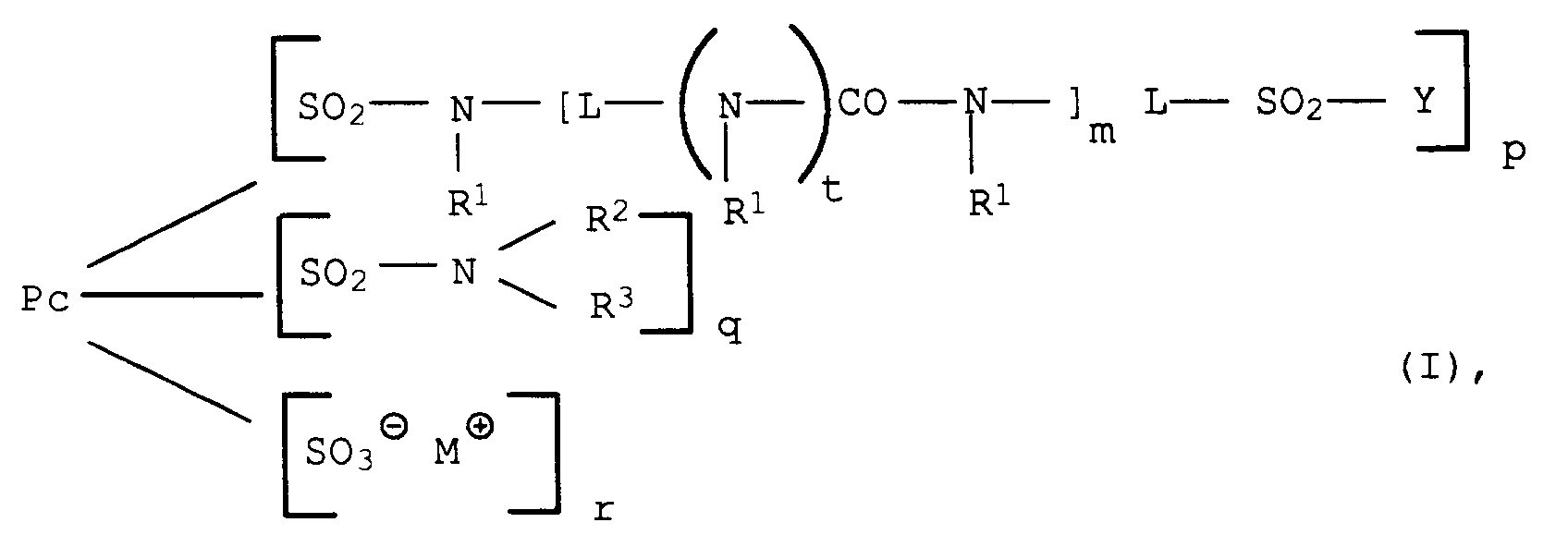
- Bevorzugt ist weiterhin ein Verfahren zur Herstellung von Phthalocyaninreaktivfarbstoffen der Formel I

in der - Pc
- den Rest eines metallfreien oder metallhaltigen Phthalocyaninsystems, das gegebenenfalls durch Chlor oder Phenyl substituiert ist,
- R¹
- Wasserstoff oder C₁-C₆-Alkyl,
- R² und R³
- unabhängig voneinander jeweils Wasserstoff, C₁-C₆-Alkyl, das gegebenenfalls durch 1 oder 2 Sauerstoffatome in Etherfunktion unterbrochen ist, Phenyl oder zusammen mit dem sie verbindenden Stickstoffatom einen fünf- oder sechsgliedrigen gesättigten heterocyclischen Rest, der weitere Heteroatome aufweisen kann,
- L
- C₂-C₄-Alkylen, das gegebenenfalls durch ein Sauerstoffatom in Etherfunktion unterbrochen ist, Naphthylen oder einen Rest der Formel

- Y
- Vinyl oder einen Rest der Formel C₂H₄-Q, worin Q für eine unter alkalischen Reaktionsbedingungen abspaltbare Gruppe steht,
- M⊕
- das Äquivalent eines Kations,
- m
- 0 oder 1,
- p
- 1 bis 3,
- q
- 0 bis 3,
- r
- 1 bis 3 und
- t
- 0 oder 1 bedeuten,
- Reste R¹, R² und R³ sind z. B. Methyl, Ethyl, Propyl, Isopropyl, Butyl, Isobutyl, sec-Butyl, Pentyl, Isopentyl, Neopentyl, tert-Pentyl, Hexyl oder 2-Methylpentyl.
- Reste R² und R³ sind weiterhin z.B. 2-Methoxyethyl, 2-Ethoxyethyl, 2-Propoxyethyl, 2-Isopropoxyethyl, 2-Butoxyethyl, 2- oder 3-Methoxypropyl, 2- oder 3-Ethoxypropyl, 2- oder 4-Methoxybutyl, 2- oder 4-Ethoxybutyl, 3,6-Dioxaheptyl oder 3,6-Dioxaoctyl.
- Wenn die Reste R² und R³ zusammen mit dem sie verbindenden Stickstoffatom einen fünf- oder sechsgliedrigen gesättigten heterocyclischen Rest, der weitere Heteroatome aufweisen kann, bedeuten, so können dafür z. B. Pyrrolidinyl, Piperidinyl, Morpholinyl, Piperazinyl oder N-(C₁-C₄-Alkyl)piperazinyl in Betracht kommen.
- Reste L sind z. B. (CH₂)₂, (CH₂)₃, (CH₂)₄, CH(CH₃)CH₂, CH(CH₃)CH(CH₃) (CH₂)₂O(CH₂)₂, Phenylen, Hydroxysulfonylmethylphenylen, Hydroxysulfonylphenylen, Naphthylen oder Phenylenmethylen.
- M⊕ stellt des Äquivalent eines Kations dar. Es stellt entweder ein Proton dar oder leitet sich von Metall- oder Ammoniumionen ab. Metallionen sind insbesondere die Lithium-, Natrium- oder Kaliumionen. Unter Ammoniumionen im erfindungsgemäßen Sinne sind unsubstituierte oder substituierte Ammoniumkationen zu verstehen. Substituierte Ammoniumkationen sind z.B. Monoalkyl-, Dialkyl-, Trialkyl- Tetraalkyl- oder Benzyltrialkylammoniumkationen oder solche Kationen, die sich von stickstoffhaltigen fünf- oder sechsgliedrigen gesättigten Heterocyclen ableiten, wie Pyrrolidinium-, Piperidinium-, Morpholinium-, Piperazinium- oder N-Alkylpiperaziniumkationen oder deren N-monoalkyl- oder N,N-dialkylsubstituierte Produkte. Unter Alkyl ist dabei im allgemeinen geradkettiges oder verzweigtes C₁-C₂₀-Alkyl zu verstehen, das durch Hydroxylgruppen substituiert und/oder durch Sauerstoffatome in Etherfunktion unterbrochen sein kann. Das Ammoniumion kann sich auch von den eingangs aufgeführten Heterocyclen ableiten.
- Besonders als Kationen hervorzuheben sind Protonen oder Lithium-, Natrium- oder Kaliumionen.
- Der Rest Q steht für eine unter alkalischen Reaktionsbedingungen abspaltbare Gruppe. Solche Gruppen sind z.B. Chlor, Brom, C₁-C₄-Alkylsulfonyl, Phenylsulfonyl, OSO₃H, SSO₃H, OP(O)(OH)₂, C₁-C₄-Alkylsulfonyloxy, Phenylsulfonyloxy, C₁-C₄-Alkanoyloxy, C₁-C₄-Dialkylamino oder ein Rest der Formel

wobei Z¹, Z² und Z³ gleich oder verschieden sind und unabhängig voneinander jeweils die Bedeutung von C₁-C₄-Alkyl oder Benzyl und An⊖ jeweils die Bedeutung eines Äquivalents eines Anions besitzen. Als Anionen können dabei z.B. Fluorid, Chlorid, Bromid, Iodid, Mono-, Di- oder Trichloracetat, Methansulfonat, Benzolsulfonat oder 2- oder 4-Methylbenzolsulfonat in Betracht kommmen. - Hervorzuheben ist die Herstellung von Phthalocyaninreaktivfarbstoffen der Formel I, in der
- Pc
- den Rest eines Kupferphthalocyaninsystems, das nicht weiter substituiert ist,
- R¹
- Wasserstoff oder C₁-C₄-Alkyl,
- R² und R³
- unabhängig voneinander jeweils Wasserstoff oder C₁-C₄-Alkyl, das gegebenenfalls durch ein Sauerstoffatom in Etherfunktion unterbrochen ist,
- L
- C₂-C₃-Alkylen, Phenylen oder Phenylenmethylen und
- m und t
- jeweils 0 bedeuten und Y, M⊕ ,p,q und r jeweils die obengenannte Bedeutung besitzen.
- Besonders zu nennen ist die Herstellung von Phthalocyaninreaktivfarbstoffen der Formel I, in der m 0, p 1,3 bis 2,5 und q 0 bedeuten.
- Besonders zu nennen ist weiterhin die Herstellung von Phthalocyaninreaktivfarbstoffen der Formel I, in der m O, R¹ Wasserstoff und L Phenylen bedeuten.
- Besonders zu nennen ist weiterhin die Herstellung von Phthalocyaninreaktivfarbstoffen der Formel I, in der q O bedeutet.
- Besonders zu nennen ist weiterhin die Herstellung von Phthalocyaninreaktivfarbstoffen der Formel I, in der Y Vinyl, 2-Sulfatoethyl oder 2-Thiosulfatoethyl bedeutet.
- Die erfindungsgemäß herstellbaren Phthalocyaninreaktivfarbstoffe, beispielsweise die Farbstoffe der Formel I, werden in der Regel in Form von Gemischen der Einzelverbindungen, beispielsweise der Einzelverbindungen der Formel I, erhalten, wobei sich diese Einzelverbindungen voneinander durch den Substitutionsgrad der Hydroxysulfonylgruppen und Sulfonamidgruppen am Phthalocyaninrest unterscheiden - am Beispiel der Formel I durch den Substitutionsgrad der mit den Indizes p,q und r bezeichneten Reste. Am Beispiel der Formel I sind deshalb bei der Bezeichnung der Formel des erhaltenen Phthalocyaninreaktivfarbstoffs die Indices p, q und r in der Regel gebrochenene Zahlen.
- Das erfindungsgemäße Verfahren wird zweckmäßig in wäßrigem Medium bei einem pH-Wert von 3,5 bis 8,5, vorzugsweise 4 bis 8, insbesondere 5 bis 7, unter Zusatz eines säurebindenden Mittels durchgeführt.
- Das erfindungsgemäße Verfahren kann bei einer Temperatur von 0 bis 60°C durchgeführt werden. Bevorzugt erfolgt die Umsetzung bei einer Temperatur von 10 bis 35°C.
- Säurebindende Mittel, die im erfindungsgemäßen Verfahren verwendet werden, sind beispielsweise Hydroxide, Carbonate oder Hydrogencarbonate, sekundäre oder tertiäre Phosphate, Borate oder Acetate der Metalle der ersten bis dritten Gruppe des Periodensystems, vorzugsweise die Natrium- oder Kaliumverbindungen oder auch Calciumverbindungen.
- Zur Verbesserung der Löslichkeit der Ausgangs- oder Endprodukte im wäßrigen Reaktionsmedium kann man gegebenenfalls organische Lösungsmittel, vorzugsweise Amide aliphatischer Carbonsäuren, wie N,N-Dimethylformamid, N,N-Dimethylacetamid, N-Methylpyrrolidinon oder 1,3-Dimethyltetrahydropyrimid-2-on, zusetzen.
- Bezogen auf 1 mol Phthalocyaninsulfonsäurechlorid kommen in der Regel 1 bis 8 mol, vorzugsweise 1,5 bis 4 mol, eines Amins, das den reaktiven Anker trägt, sowie 0 bis 4 mol, vorzugsweise 0 bis 2 mol des "nichtreaktiven Amins" zur Anwendung.
- Die als Katalysator wirkenden Heterocyclen werden in einer Menge von 0,1 bis 1 mol-%, vorzugsweise 0,1 bis 0,5 mol-%, jeweils bezogen auf das Gewicht an Phthalocyaninsulfonsäurechlorid, angewandt.
- Das erfindungsgemäße Verfahren wird zweckmäßig so durchgeführt, daß man Phthalocyaninsulfonsäurechlorid, gegebenenfalls in Anwesenheit von Hilfsmitteln, wie Dispergiermittel oder Entschäumer, in Wasser suspendiert und unter den obengenannten Reaktionsbedingungen mit dem Eintrag des Katalysators, des Amins, welches den reaktiven Anker trägt, und gegebenenfalls des "nichtreaktiven" Amins beginnt. Nach beendeter Umsetzung, die in der Regel 6 bis 8 Stunden in Anspruch nimmt, kann der Reaktivfarbstoff aus der entstandenen Reaktionslösung z. B. durch Sprühtrocknen oder Aussalzen, beispielsweise mit Natrium- oder Kaliumchlorid, isoliert werden.
- Es ist aber auch möglich, die resultierende Farbstofflösung, nach entsprechender Standardisierung und gegebenenfalls weiterer Zugabe von Puffersubstanzen, ohne weitere Isolierung des entstandenen Farbstoffs direkt als Flüssigeinstellung zum Färben oder Bedrucken von Fasermaterialien zu verwenden.
- Das erfindungsgemäße Verfahren kann in der Weise modifiziert werden, daß vor, während oder nach der eigentlichen Kondensationsreaktion ein Teil der Sulfonsäurechloridgruppen des Phthalocyaninsulfonsäurechlorids, z. B. der Formel II, durch Hydrolyse in Hydroxysulfonylgruppen übergeführt wird. Es kann die Kondensation beispielsweise so durchgeführt werden, daß gleichzeitig mit der Umsetzung der Amine, z. B. des Amins III und/oder IV, ein Teil der Sulfonsäurechloridgruppen hydrolysiert wird. Es kann auch so verfahren werden, daß zunächst mit einer zur vollständigen Umsetzung aller Sulfonsäurechloridgruppen nicht ausreichenden Menge an Amin, z. B. dem Amin der Formel III und/oder IV, umgesetzt wird und daß anschließend die restlichen Sulfonsäurechloridgruppen durch einen besonderen Reaktionsschritt in saurem bis schwach alkalischem Milieu, z. B. bei einem pH-Wert von 1 bis 8, gegebenenfalls in der Wärme, z. B. bei einer Temperatur von 20 bis 60°C, hydrolysiert werden.
- Das neue Verfahren liefert die Zielprodukte in hoher Ausbeute und Reinheit.
- Die mittels des erfindungsgemäßen Verfahrens herstellbaren Phthalocyaninreaktivfarbstoffe eignen sich zum Färben oder Bedrucken von Hydroxygruppen oder Stickstoffatome aufweisenden organischen Substraten. Solche Substrate sind beispielsweise Leder oder Fasermaterial, das überwiegend natürliche oder synthetische Polyamide oder natürliche oder regnerierte Cellulose enthält. Vorzugsweise eignen sie sich zum Färben und Bedrucken von Textilmaterial auf der Basis von Wolle oder insbesondere von Baumwolle. Man erhält Ausfärbungen in türkisblauen Farbtönen.
- Die folgenden Beispiele sollen die Erfindung näher erläutern.
- In 1000 ml Wasser wurden 0,4 mol Kupferphthalocyaninsulfonsäurechlorid (mit etwa 3,8 Sulfonsäurechloridgruppen) als feuchter Preßkuchen in Gegenwart eines Dispergiermittels suspendiert. Es wurden 450 g (1,6 mol)4-(2-Sulfatoethylsulfonyl)anilin und 3,3 g (0,04 mol) 1-Methylimidazol eingetragen. Durch Zugabe von festem Natriumhydrogencarbonat wurde der pH-Wert bei 6,2 bis 6,5 gehalten (Temperatur ca. 25°C). Nach 7 h war die Reaktion beendet. Aus der klaren blauen Lösung wurde der Farbstoff durch Aussalzen mit Kaliumchlorid isoliert. Die Konstitution (in Form der freien Säure) wurde, wie auch in den folgenden Beispielen, nach der in Beispiel 1 der US-A-4 576 755 beschriebenen Methode bestimmt und ergibt sich zu etwa:

- In 100 ml Wasser wurden 0,1 mol Kupferphthalocyaninsulfonsäurechlorid (mit etwa 3,8 Sulfonsäurechloridgruppen) als feuchter Preßkuchen in Gegenwart eines Dispergiermittels suspendiert. Es wurden 112 g (0,4 mol) 4-(2-Sulfatoethylsulfonyl)anilin und 4,1 g (0,05 mol) 1-Methylimidazol eingetragen. Durch Zugabe von festem Natriumhydrogencarbonat wurde der pH-Wert bei 6,2 bis 6,5 gehaltenen (Temperatur ca. 25°C). Nach 7 h war die Reaktion beendet. Aus der klaren blauen Lösung wurde der Farbstoff durch Sprühtrocknen isoliert. Die Konstitution (in Form der freien Säure) ergibt sich zu etwa:

- In 500 ml Wasser wurden 0,2 mol Kupferphthalocyaninsulfonsäurechlorid (mit etwa 3,8 Sulfonsäurechloridgruppen) als feuchter Preßkuchen in Gegenwart eines Dispergiermittels suspendiert. Es wurden 169 g (0,6 mol) 4-(2-Sulfatoethylsulfonyl)anilin und 1,6 g (0,02 mol) 1-Methylimidazol eingetragen. Durch Zugabe von festem Natriumhydrogencarbonat wurde der pH-Wert bei 6,2 bis 6,5 gehalten (Temperatur ca. 25°C). Nach ca. 7 h war die Reaktion beendet. Aus der klaren blauen Lösung wurde der Farbstoff durch Aussalzen mit Kaliumchlorid isoliert. Die Konstitution (in Form der freien Säure) ergibt sich zu etwa:

- Man verfuhr analog Beispiel 2, verwendete jedoch 1,2 g (0,01 mol) 4-Dimethylaminopyridin als Katalysator. Es ergibt sich die Konstitution (in Form der freien Säure) zu etwa:

-
- a) Man verfuhr analog Beispiel 2, verwendete jedoch 1 g (0,01 mol) Dimethyltetrazol als Katalysator. Es ergibt sich die Konstitution (in Form der freien Säure) nach 8 h Reaktionszeit zu etwa:

- b) Nach insgesamt 22 h Reaktionszeit ergibt sich die Konstitution zu etwa

- In 220 ml Wasser wurden in Gegenwart eines Dispergiermittels 0,1 mol Kupferphthalocyaninsulfonsäurechlorid (mit etwa 3,8 Sulfonsäurechloridgruppen) als feuchter Preßkuchen suspendiert, 87,3 g (0,3 mol) 3-(2-Sulfatoethyl)anilin und 0,8 g (0,01 mol) 1-Methylimidazol zugegeben und durch Zugabe von festem Natriumhydrogencarbonat ein pH-Wert von 6,2 bis 6,5 eingehalten. Nach etwa 8 h war die Reaktion beendet. Die Konstitution (in Form der freien Säure) ergibt sich zu etwa:

- In 220 ml Wasser wurden in Gegenwart eines Dispergiermittels 0,1 mol Kupferphthalocyaninsulfonsäurechlorid (mit etwa 3,8 Sulfonsäurechloridgruppen) als feuchter Preßkuchen suspendiert, 56,5 g (0,2 mol) 3-(2-Sulfatoethyl)anilin, 56,5 g (0,2 mol) 4-(2-Sulfatoethyl)anilin und 0,8 g (0,01 mol) 1-Methylimidazol zugegeben und durch Zugabe von festem Natriumhydrogencarbonat ein pH-Wert von 6,2 bis 6,5 eingehalten. Nach etwa 8 h war die Reaktion beendet. Die Konstitution (in Form der freien Säure) ergibt sich zu etwa:

- In 500 ml Wasser wurden in Gegenwart eines Dispergiermittels und eines Entschäumers 450 g (1,6 mol) 4-(2-Sulfatoethyl)anilin eingetragen und durch Zugabe von festem Natriumhydrogencarbonat ein pH-Wert von 6,0 bis 6,5 eingestellt. Dazu wurden 0,4 mol Kupferphthalocyaninsulfonsäurechlorid (mit etwa 3,8 Sulfonsäurechloridgruppen) als feuchter Preßkuchen eingetragen, gefolgt von 0,1 mol 1-Methylimidazol. Dann wurde festes Natriumhydrogencarbonat zugegeben, um den pH-Wert bei 6,2 bis 6,5 zu halten. Die Reaktion war nach 8 h beendet. Der Farbstoff wurde aus der Lösung durch Sprühtrocknen isoliert. Seine Konstitution ergibt sich zu etwa:

-
- a) In 200 ml Wasser wurden in Gegenwart eines Dispergiermittels 0,1 mol Kupferphthalocyaninsulfonsäurechlorid (mit etwa 3,8 Sulfonsäurechloridgruppen) als feuchter Preßkuchen suspendiert, 42,1 g (0,15 mol) 3-(2-Sulfatoethyl)anilin und 0,8 g (0,01 mol) 1-Methylimidazol zugegeben und durch Zugabe von festem Natriumhydrogencarbonat ein pH-Wert von 6,2 bis 6,5 eingehalten. Nach 8 h Reaktionszeit ergibt sich die Konstitution zu etwa:

- b) Nach 22 h Reaktionszeit ergibt sich die Konstitution zu etwa:

- In 500 ml Wasser wurden in Gegenwart eines Dispergiermittels und eines Entschäumers 340 g (1,2 mol) 4-(2-Sulfatoethyl)anilin eingetragen und durch Zugabe von festem Natriumhydrogencarbonat ein pH-Wert von 6,0 bis 6,5 eingestellt. Dazu wurden 0,4 mol Kupferphthalocyaninsulfonsäurechlorid (mit etwa 3,5 Sulfonsäurechloridgruppen) als feuchter Preßkuchen eingetragen, gefolgt von 0,1 mol 1-Methylimidazol. Dann wurde festes Natriumhydrogencarbonat zugegeben, um den pH-Wert bei 6,2 bis 6,5 zu halten. Die Reaktion war nach 8 h beendet. Der Farbstoff wurde aus der Lösung durch Sprühtrocknen isoliert. Seine Konstitution ergibt sich zu etwa:

- In 230 ml Wasser wurden 87,3 g (0,3 mol) 4-(2-Sulfatoethylsulfonyl)anilin in Gegenwart eines Dispergiermittels und Entschäumers durch Zugabe von festem Natriumhydrogencarbonat bei einem pH-Wert von 6,0 bis 6,5 gelöst. Dazu wurden 0,1 mol Kupferphthalocyaninsulfonsäurechlorid (mit etwa 3,8 Sulfonsäurechloridgruppen) als feuchter Preßkuchen eingetragen, gefolgt von 4 g (0,05 mol) 1-Methylimidazol. Durch Zugabe von festem Natriumhydrogencarbonat wurde ein pH-Wert von 6,2 bis 6,6 eingehalten. Die Reaktion war nach 7 h beendet. Der Farbstoff wurde aus der Lösung durch Sprühtrocknen isoliert. Die Konstitution ergibt sich zu etwa:


in der Pc und M⊕ jeweils die obengenannte Bedeutung besitzen und a 1 bis 4 und b 0 bis 3 bedeuten, mit der Maßgabe, daß die Summe von a und b höchstens 4 ist, oder eine Mischung von Phthalocyaninsulfonsäurechloriden der Formel II in wäßrigem Medium mit einem Amin der Formel III

in der R¹, L, Y, m und t jeweils die obengenannte Bedeutung besitzen, und gegebenenfalls mit einem Amin der Formel IV

in der R² und R³ jeweils die obengenannte Bedeutung besitzen, wobei die Reihenfolge der Umsetzung mit den Aminen III und IV beliebig sein kann, in Gegenwart eines der obengenannten Heterocyclen als Katalysator umsetzt.
Claims (4)
- Verfahren zur Herstellung von metallfreien oder metallhaltigen Phthalocyaninreaktivfarbstoffen, die als reaktive Gruppen eine oder mehrere Ethylsulfonylgruppen, welche β-Position einen unter alkalischen Reaktionsbedingungen abspaltbaren Rest als Substituenten tragen, oder Vinylsulfonylgruppen aufweisen, durch Umsetzung eines metallfreien oder metallhaltigen Phthalocyaninsulfonsäurechlorids, mit primären oder sekundären Aminen, die eine oder mehrere Ethylsulfonylgruppen, welche in β-Position einen unter alkalischen Reaktionsbedingungen abspaltbaren Rest als Substituenten tragen, oder Vinylsulfonylgruppen aufweisen, und gegebenenfalls mit weiteren primären oder sekundären Aminen aus der aliphatischen, aromatischen oder heterocyclischen Reihe in Gegenwart eines Katalysators, dadurch gekennzeichnet, daß man die Umsetzung in Gegenwart eines Heterocyclus als Katalysator durchführt, der ausgewählt ist aus der Klasse, bestehend aus 1-(C₁-C₄-Alkyl)imidazolen, in denen die Alkylgruppe gegebenenfalls durch C₁-C₄-Alkoxy substituiert ist, 1-Carboxymethylimidazol, 1,2-Dimethylimidazol, 1-Methylimidazol-5-carbonsäure, 1-Carboxymethyl-1,3,4-triazol, 4-(C₁-C₄-Dialkylamino)pyridin, 4-(Pyrrolidin-1-yl)pyridin, 4-(Piperidin-1-yl)pyridin, 4-(Morpholin-4-yl)pyridin, 4-(Piperazin-1-yl)pyridin, 4-[4-(C₁-C₄-Alkyl)piperazin-1-yl]pyridin und Dimethyltetrazol.
- Verfahren nach Anspruch 1, dadurch gekennzeichnet, daß man die Umsetzung in Gegenwart eines 1-(C₁-C₄-Alkyl)imidazols durchführt.
- Verfahren nach Anspruch 1, dadurch gekennzeichnet, daß man die Umsetzung bei einer Temperatur von 0 bis 60°C vornimmt.
- Verfahren nach Anspruch 1 zur Herstellung von Pthalocyaninreaktivfarbstoffen der Formel I
 Pc den Rest eines metallfreien oder metallhaltigen Phthalocyaninsystems, das gegebenenfalls durch Chlor oder Phenyl substituiert ist,R¹ Wasserstoff oder C₁-C₆-Alkyl,R² und R³ unabhängig voneinander jeweils Wasserstoff, C₁-C₆-Alkyl, das gegebenenfalls durch 1 oder 2 Sauerstoffatome in Etherfunktion unterbrochen ist, Phenyl oder zusammen mit dem sie verbindenden Stickstoffatom einen fünf- oder sechsgliedrigen gesättigten heterocyclischen Rest, der weitere Heteroatome aufweisen kann,L C₂-C₄-Alkylen, das gegebenenfalls durch ein Sauerstoffatom in Etherfunktion unterbrochen ist, Naphthylen oder einen Rest der Formel
 Y Vinyl oder einen Rest der Formel C₂H₄-Q, worin Q für eine unter alkalischen Reaktionsbedingungen abspaltbare Gruppe steht,M⊕ das Äquivalent eines Kations,m 0 oder 1,p 1 bis 3,q 0 bis 3,r 1 bis 3 undt 0 oder 1 bedeuten,mit der Maßgabe, daß die Summe von p, q und r höchstens 4 ist, dadurch gekennzeichnet, daß man ein Phthalocyaninsulfonsäurechlorid der Formel II


Applications Claiming Priority (2)
| Application Number | Priority Date | Filing Date | Title |
|---|---|---|---|
| DE4238047 | 1992-11-11 | ||
| DE4238047A DE4238047A1 (de) | 1992-11-11 | 1992-11-11 | Verfahren zur Herstellung von Phthalocyaninreaktivfarbstoffen |
Publications (2)
| Publication Number | Publication Date |
|---|---|
| EP0597411A1 true EP0597411A1 (de) | 1994-05-18 |
| EP0597411B1 EP0597411B1 (de) | 1999-04-28 |
Family
ID=6472617
Family Applications (1)
| Application Number | Title | Priority Date | Filing Date |
|---|---|---|---|
| EP93118037A Expired - Lifetime EP0597411B1 (de) | 1992-11-11 | 1993-11-08 | Verfahren zur Herstellung von Phthalocyaninreaktivfarbstoffen |
Country Status (5)
| Country | Link |
|---|---|
| US (1) | US5444163A (de) |
| EP (1) | EP0597411B1 (de) |
| JP (1) | JPH06200180A (de) |
| KR (1) | KR100270287B1 (de) |
| DE (2) | DE4238047A1 (de) |
Cited By (1)
| Publication number | Priority date | Publication date | Assignee | Title |
|---|---|---|---|---|
| DE102009047183A1 (de) | 2008-12-19 | 2010-07-15 | Basf Se | Farbstoffmischung zum Färben von Leder |
Families Citing this family (6)
| Publication number | Priority date | Publication date | Assignee | Title |
|---|---|---|---|---|
| DE4242975A1 (de) * | 1992-12-18 | 1994-06-23 | Basf Ag | Verfahren zur Herstellung von Phthalocyaninreaktivfarbstoffen |
| FR2716204B1 (fr) * | 1994-02-12 | 1997-12-19 | Sandoz Sa | Phtalocyanines d'aluminium, leur préparation et leur utilisation comme colorants. |
| DE19624469A1 (de) * | 1996-06-19 | 1998-01-02 | Dystar Textilfarben Gmbh & Co | Reaktive Aluminiumphthalocyaninfarbstoffe, Verfahren zu ihrer Herstellung und Verwendung |
| GB9808169D0 (en) * | 1998-04-20 | 1998-06-17 | Ciba Sc Holding Ag | Production process |
| MX2008006914A (es) * | 2005-12-01 | 2008-11-28 | Basf Se | Moleculas efectoras que se unen a la queratina, que contienen tintes reactivos. |
| KR102241627B1 (ko) | 2019-11-13 | 2021-04-19 | 한국생산기술연구원 | 방사형 부직포 제조용 파이버 블로잉 장치 |
Citations (6)
| Publication number | Priority date | Publication date | Assignee | Title |
|---|---|---|---|---|
| DE2824211A1 (de) * | 1978-06-02 | 1979-12-06 | Hoechst Ag | Verfahren zur herstellung wasserloeslicher phthalocyaninfarbstoffe |
| FR2427365A1 (fr) * | 1978-06-02 | 1979-12-28 | Hoechst Ag | Procede de preparation de colorants phtalocyaniques solubles dans l'eau |
| DE2906442A1 (de) * | 1979-02-20 | 1980-08-28 | Hoechst Ag | Verfahren zur herstellung wasserloeslicher phthalocyaninfarbstoffe |
| EP0074837A1 (de) * | 1981-09-11 | 1983-03-23 | REILLY TAR & CHEMICAL CORPORATION | 4-Substituierte Pyridin-Katalysatoren |
| EP0231837A2 (de) * | 1986-02-01 | 1987-08-12 | Hoechst Aktiengesellschaft | Verfahren zur Herstellung von wasserlöslichen Phthalocyaninfarbstoffen |
| EP0304751A1 (de) * | 1987-08-21 | 1989-03-01 | Hoechst Aktiengesellschaft | Wasserlösliche Phthalocyanin-Verbindungen, Verfahren zu ihrer Herstellung und ihre Verwendung als Farbstoffe |
Family Cites Families (2)
| Publication number | Priority date | Publication date | Assignee | Title |
|---|---|---|---|---|
| DE3138864A1 (de) * | 1981-09-30 | 1983-04-14 | Hoechst Ag, 6230 Frankfurt | Wasserloesliche faserreaktive phthalocyaninverbindungen, verfahren zu ihrer herstellung und ihre verwendung als farbstoffe |
| DE4114587A1 (de) * | 1991-05-04 | 1992-11-05 | Bayer Ag | Feste farbstoffpraeparationen mit verbesserter wasserloeslichkeit |
-
1992
- 1992-11-11 DE DE4238047A patent/DE4238047A1/de not_active Withdrawn
-
1993
- 1993-11-08 DE DE59309540T patent/DE59309540D1/de not_active Expired - Fee Related
- 1993-11-08 EP EP93118037A patent/EP0597411B1/de not_active Expired - Lifetime
- 1993-11-11 JP JP5282362A patent/JPH06200180A/ja not_active Withdrawn
- 1993-11-11 KR KR1019930023843A patent/KR100270287B1/ko not_active Expired - Fee Related
- 1993-11-12 US US08/151,174 patent/US5444163A/en not_active Expired - Fee Related
Patent Citations (6)
| Publication number | Priority date | Publication date | Assignee | Title |
|---|---|---|---|---|
| DE2824211A1 (de) * | 1978-06-02 | 1979-12-06 | Hoechst Ag | Verfahren zur herstellung wasserloeslicher phthalocyaninfarbstoffe |
| FR2427365A1 (fr) * | 1978-06-02 | 1979-12-28 | Hoechst Ag | Procede de preparation de colorants phtalocyaniques solubles dans l'eau |
| DE2906442A1 (de) * | 1979-02-20 | 1980-08-28 | Hoechst Ag | Verfahren zur herstellung wasserloeslicher phthalocyaninfarbstoffe |
| EP0074837A1 (de) * | 1981-09-11 | 1983-03-23 | REILLY TAR & CHEMICAL CORPORATION | 4-Substituierte Pyridin-Katalysatoren |
| EP0231837A2 (de) * | 1986-02-01 | 1987-08-12 | Hoechst Aktiengesellschaft | Verfahren zur Herstellung von wasserlöslichen Phthalocyaninfarbstoffen |
| EP0304751A1 (de) * | 1987-08-21 | 1989-03-01 | Hoechst Aktiengesellschaft | Wasserlösliche Phthalocyanin-Verbindungen, Verfahren zu ihrer Herstellung und ihre Verwendung als Farbstoffe |
Cited By (1)
| Publication number | Priority date | Publication date | Assignee | Title |
|---|---|---|---|---|
| DE102009047183A1 (de) | 2008-12-19 | 2010-07-15 | Basf Se | Farbstoffmischung zum Färben von Leder |
Also Published As
| Publication number | Publication date |
|---|---|
| US5444163A (en) | 1995-08-22 |
| DE59309540D1 (de) | 1999-06-02 |
| EP0597411B1 (de) | 1999-04-28 |
| KR100270287B1 (ko) | 2000-11-01 |
| JPH06200180A (ja) | 1994-07-19 |
| KR940011591A (ko) | 1994-06-21 |
| DE4238047A1 (de) | 1994-05-19 |
Similar Documents
| Publication | Publication Date | Title |
|---|---|---|
| CH352655A (de) | Verfahren zur Erhöhung der Beständigkeit von dihalogentriazingruppenhaltigen Verbindungen | |
| DE19600765A1 (de) | Reaktive Azofarbstoffe mit einer Kupplungskomponente aus der Reihe der Aminonaphthalinsulfonsäuren sowie deren Zwischenprodukte | |
| EP0772653B1 (de) | Reaktive azofarbstoffe mit einer kupplungskomponente aus der aminonaphthalinreihe | |
| EP0056975B1 (de) | Wasserlösliche Monoazoverbindungen, Verfahren zu ihrer Herstellung und ihre Verwendung als Farbstoffe | |
| DE3025572A1 (de) | Wasserloesliche azoverbindungen, verfahren zu ihrer herstellung und ihre verwendung als farbstoffe | |
| EP0075905A2 (de) | Wasserlösliche faserreaktive Phthalocyaninverbindungen, Verfahren zu ihrer Herstellung und ihre Verwendung als Farbstoffe | |
| EP0597411B1 (de) | Verfahren zur Herstellung von Phthalocyaninreaktivfarbstoffen | |
| EP0028788A1 (de) | Kupferkomplex-Formazanverbindungen, Verfahren zu ihrer Herstellung und ihre Verwendung als Farbstoffe | |
| DE4413265A1 (de) | Hydroxyphenylharnstoffe | |
| EP0231837B1 (de) | Verfahren zur Herstellung von wasserlöslichen Phthalocyaninfarbstoffen | |
| EP0051807A2 (de) | Wasserlösliche Disazoverbindungen, Verfahren zu ihrer Herstellung und ihre Verwendung als Farbstoffe | |
| EP0602562A1 (de) | Verfahren zur Herstellung von Phthalocyaninreaktivfarbstoffe | |
| EP0503385B1 (de) | Verdoppelte Phenylazo- oder Naphthylazobenzole mit mehreren reaktiven Gruppen sowie deren Zwischenprodukte | |
| DE4226045A1 (de) | Phthalocyaninreaktivfarbstoffe | |
| EP0587030B1 (de) | Reaktivfarbstoffe auf Formazanbasis sowie Hydrazone | |
| DE19521056A1 (de) | Aluminium Phthalocyanin Reaktivfarbstoffe | |
| EP0735108B1 (de) | Reaktive Azofarbstoffe mit einer Kupplungskomponente aus der Reihe der Aminonaphtalinsulfonsäuren | |
| EP0592980A2 (de) | Reaktivfarbstoffe auf Formazanbasis, die mindestens zwei reaktive Gruppen aufweisen, sowie Aminophenole | |
| EP0382111A1 (de) | Kupferkomplex-Formazanverbindungen, Verfahren zu ihrer Herstellung und ihre Verwendung als Farbstoffe | |
| EP0648815A1 (de) | Wasserlösliche, metallfreie Phthalocyaninfarbstoffe, Verfahren zu ihrer Herstellung und ihre Verwendung | |
| EP0437699A1 (de) | Phenylazo- oder Naphthylazobenzole mit mehreren reaktiven Gruppen sowie deren Zwischenprodukte | |
| DE4419659A1 (de) | Phthalocyaninreaktivfarbstoffe und Verfahren zu ihrer Herstellung | |
| EP0731089B1 (de) | Anilinderivate | |
| DE4319674A1 (de) | Vinylsulfonylreaktivfarbstoffe, die als Chromophor ein Phthalocyanin und/oder ein Triphendioxazin aufweisen | |
| DE3906353A1 (de) | Wasserloesliche faserreaktive farbstoffe, verfahren zu ihrer herstellung und ihre verwendung |
Legal Events
| Date | Code | Title | Description |
|---|---|---|---|
| PUAI | Public reference made under article 153(3) epc to a published international application that has entered the european phase |
Free format text: ORIGINAL CODE: 0009012 |
|
| AK | Designated contracting states |
Kind code of ref document: A1 Designated state(s): CH DE FR GB IT LI |
|
| 17P | Request for examination filed |
Effective date: 19940329 |
|
| GRAG | Despatch of communication of intention to grant |
Free format text: ORIGINAL CODE: EPIDOS AGRA |
|
| 17Q | First examination report despatched |
Effective date: 19980806 |
|
| GRAG | Despatch of communication of intention to grant |
Free format text: ORIGINAL CODE: EPIDOS AGRA |
|
| GRAH | Despatch of communication of intention to grant a patent |
Free format text: ORIGINAL CODE: EPIDOS IGRA |
|
| GRAH | Despatch of communication of intention to grant a patent |
Free format text: ORIGINAL CODE: EPIDOS IGRA |
|
| GRAA | (expected) grant |
Free format text: ORIGINAL CODE: 0009210 |
|
| AK | Designated contracting states |
Kind code of ref document: B1 Designated state(s): CH DE FR GB IT LI |
|
| PG25 | Lapsed in a contracting state [announced via postgrant information from national office to epo] |
Ref country code: IT Free format text: LAPSE BECAUSE OF FAILURE TO SUBMIT A TRANSLATION OF THE DESCRIPTION OR TO PAY THE FEE WITHIN THE PRE;WARNING: LAPSES OF ITALIAN PATENTS WITH EFFECTIVE DATE BEFORE 2007 MAY HAVE OCCURRED AT ANY TIME BEFORE 2007. THE CORRECT EFFECTIVE DATE MAY BE DIFFERENT FROM THE ONE RECORDED.SCRIBED TIME-LIMIT Effective date: 19990428 Ref country code: GB Free format text: LAPSE BECAUSE OF FAILURE TO SUBMIT A TRANSLATION OF THE DESCRIPTION OR TO PAY THE FEE WITHIN THE PRESCRIBED TIME-LIMIT Effective date: 19990428 Ref country code: FR Free format text: LAPSE BECAUSE OF FAILURE TO SUBMIT A TRANSLATION OF THE DESCRIPTION OR TO PAY THE FEE WITHIN THE PRESCRIBED TIME-LIMIT Effective date: 19990428 |
|
| REG | Reference to a national code |
Ref country code: CH Ref legal event code: EP |
|
| REF | Corresponds to: |
Ref document number: 59309540 Country of ref document: DE Date of ref document: 19990602 |
|
| EN | Fr: translation not filed | ||
| GBV | Gb: ep patent (uk) treated as always having been void in accordance with gb section 77(7)/1977 [no translation filed] |
Effective date: 19990428 |
|
| PLBE | No opposition filed within time limit |
Free format text: ORIGINAL CODE: 0009261 |
|
| STAA | Information on the status of an ep patent application or granted ep patent |
Free format text: STATUS: NO OPPOSITION FILED WITHIN TIME LIMIT |
|
| 26N | No opposition filed | ||
| PGFP | Annual fee paid to national office [announced via postgrant information from national office to epo] |
Ref country code: DE Payment date: 20011010 Year of fee payment: 9 |
|
| PGFP | Annual fee paid to national office [announced via postgrant information from national office to epo] |
Ref country code: CH Payment date: 20011022 Year of fee payment: 9 |
|
| PG25 | Lapsed in a contracting state [announced via postgrant information from national office to epo] |
Ref country code: LI Free format text: LAPSE BECAUSE OF NON-PAYMENT OF DUE FEES Effective date: 20021130 Ref country code: CH Free format text: LAPSE BECAUSE OF NON-PAYMENT OF DUE FEES Effective date: 20021130 |
|
| PG25 | Lapsed in a contracting state [announced via postgrant information from national office to epo] |
Ref country code: DE Free format text: LAPSE BECAUSE OF NON-PAYMENT OF DUE FEES Effective date: 20030603 |
|
| REG | Reference to a national code |
Ref country code: CH Ref legal event code: PL |