EP0597600B1 - Anordnung zur Anzeige des Zustands eines Druckers - Google Patents
Anordnung zur Anzeige des Zustands eines Druckers Download PDFInfo
- Publication number
- EP0597600B1 EP0597600B1 EP93308387A EP93308387A EP0597600B1 EP 0597600 B1 EP0597600 B1 EP 0597600B1 EP 93308387 A EP93308387 A EP 93308387A EP 93308387 A EP93308387 A EP 93308387A EP 0597600 B1 EP0597600 B1 EP 0597600B1
- Authority
- EP
- European Patent Office
- Prior art keywords
- mode
- printer
- indicating
- printing
- data
- Prior art date
- Legal status (The legal status is an assumption and is not a legal conclusion. Google has not performed a legal analysis and makes no representation as to the accuracy of the status listed.)
- Expired - Lifetime
Links
Images




Classifications
-
- B—PERFORMING OPERATIONS; TRANSPORTING
- B41—PRINTING; LINING MACHINES; TYPEWRITERS; STAMPS
- B41J—TYPEWRITERS; SELECTIVE PRINTING MECHANISMS, i.e. MECHANISMS PRINTING OTHERWISE THAN FROM A FORME; CORRECTION OF TYPOGRAPHICAL ERRORS
- B41J29/00—Details of, or accessories for, typewriters or selective printing mechanisms not otherwise provided for
- B41J29/38—Drives, motors, controls or automatic cut-off devices for the entire printing mechanism
- B41J29/393—Devices for controlling or analysing the entire machine ; Controlling or analysing mechanical parameters involving printing of test patterns
Definitions
- the present invention relates to a printer, and, more particularly, to the contents of indication on a display portion, comprising light-emitting diodes (LED's) or the like, which is located on an operating panel.
- LED's light-emitting diodes
- This conventional structure has the following shortcoming.
- a user cannot check whether or not those special modes are set from the indication on the operating panel.
- printing data such as a document prepared on a high rank apparatus like a host computer is sent to the printer to provide a desired printout, if the printout is done in an unexpected print status (line feed pitch, character font, character pitch, etc.), the user cannot see whether the different print status has occurred from an error in the printing data or from the set contents of the printer.
- a printer connectable to a high rank apparatus, for making a printout in accordance with printing data containing a control command sent from the high rank apparatus, which printer comprises control means for changing and controlling a printing mode according to a specific control command sent from the high rank apparatus; memory means for storing predetermined set data; inhibiting means for inhibiting a control operation of the control means associated with said specific control command sent from the high rank apparatus and indicating means for indicating said predetermined set data characterised in that said indicating means indicate said predetermined set data in a mode in which the printer is ready to receive a control command from the high rank apparatus and wherein said inhibiting means inhibits said control means by disregarding said specific control command and allows the printing mode to be controlled in accordance with the predetermined set data.
- the present invention provides a printer which will indicate whether or not a special mode associated with a specific control command is set, when the printer is ready to receive printing data from a high rank apparatus or source of print data.
- the printer may have switching means for switching the indication contents of the indicating means whereby indication of the indicating means is switched between indication of the set contents of the set data and indication of a selected status of a printing mode for printing printing data on a printing medium in accordance with a switching operation of the switching means.
- the indicating mode for indicating the set contents of the set data may differ from the indicating mode of indicating the selected status of the printing mode.
- the indicating means may comprise a plurality of light emitting portions.
- a switch which serves as a FONT switch in off-line mode may be used directly as a changeover switch serving as the switching means in on-line mode.
- the set contents of the set data may be indicated by switching on and off the light emitting portions and the selected status of the printing mode may be indicated by keeping the light emitting portions on.
- the set status of a special mode for inhibiting the operation in response to a specific control command is indicated in a state where the printer is ready to receive printing data containing a control command from a high rank apparatus. Even when the printing data sent to the printer differs from the printing result, therefore, the user can easily understand the cause for the difference, thus significantly improving the operability of the printer.
- a microprocessor unit (hereinafter called “MPU") 1 performs the general control of the printer according to a program previously stored in a ROM (Read Only Memory) 3.
- a RAM (Random Access Memory) 5 is provided to store various pieces of internal data or temporarily store printing data which is input via an interface (hereinafter called "IF") 7 from a host computer 8.
- An EEPROM (Electrically Erasable and Programmable Read Only Memory) 9 is provided to store variable data which should be saved even when electric power is gone. When power is given, a series of data stored in the EEPROM 9 is collectively transferred to a work area in the RAM 5 and is initialized under designated conditions.
- I/O (input/output) port 11 through which signals from various panel switches 15, provided on the operating panel of the printer, or signals from various sensors 17, provided at individual portions of the printing mechanism, are input to the MPU 1.
- a driving circuit 19 Connected to the I/O port 11 via a driving circuit 19 are a carriage motor 21, a line feed (LF) motor 23 for feeding paper, a printing head 25, and various kinds of panel LED's 27 provided on the operating panel.
- Drive signals are output to the carriage motor 17, LF motor 23, printing head 25 and panel LED's 27 via the I/O port 11 and the driving circuit 19.
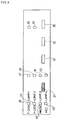
- Fig. 2 shows the panel structure in off-line mode while Fig. 3 shows the panel structure in on-line mode.
- the reason why the panel structure in off-line mode differs from that in on-line mode even on the same panel is because certain switches serve different functions between the off-line mode and the on-line mode.
- the panel structure in off-line mode will be described as the basic structure.
- the switches (the panel switches 15 shown in Fig. 1) include a FONT switch 29, a PITCH switch 31, a PAPER FEED switch 33, and an ON-LINE switch 35. Of those switches, the FONT switch 29 is one of the aforementioned certain switches, and becomes a STATUS switch 37 as a changeover switch in on-line mode as shown in Fig. 3.
- the light indicating portions include LED lamps 39 to 57.
- the LED lamps 39 to 45 are used to indicate the types of fonts in off-line mode and indicate different contents in on-line mode. More specifically, the LED lamp 39 serves to indicate “DRAFT” in off-line mode and “F-LOCK” in on-line mode.
- the LED lamp 41 is used to indicate “COURIER” in off-line mode and “P-LOCK” in on-line mode.
- the LED lamp 43 is used to indicate “SANSERIF” in off-line mode and "MACRO” in on-line mode. Further, the LED lamp 45 is used to indicate “ORATOR” in off-line mode and "AEC” in on-line mode.
- the LED lamps 47 to 53 are used to indicate character pitches: the LED lamp 47 indicates “10 CPI,” the LED lamp 49 “12 CPI,” the LED lamp 51 "PROP,” and the LED lamp 53 “COND.”
- the LED lamp 55 indicates whether or not power is given, and the LED lamp 57 indicates whether or not the printer is in the on-line mode.
- Fig. 6 illustrates how individual bits (eight in total) of an I/O address "0001H" of the I/O port 11, which is assigned to a latch circuit (not shown) for driving the LED lamps, are associated with the individual LED lamps 39 to 53 on the operating panel. In this diagram, those associated with one another are connected by lines.
- the printer according to this embodiment will indicate some special modes which are associated with the validity/invalidity of several receivea commands, without complicating the structure of the display portion. Such modes are not indicated on the panel in the prior art. A description will now be given of those special modes which include lock modes, a macro command mode, and auto-emulation change mode (hereinafter referred to as "AEC mode"), for example.
- the lock modes, the macro command mode and the AEC mode will be described in details below.
- the lock modes are a font-lock (F-LOCK) mode and a pitch-lock (P-LOCK) mode.
- the font-lock mode gives the font designation by the panel operation a priority over the font designation, if given, from the host computer 8 and disregards the latter font designation when the printer is in use or printing.
- the "font designation” means the designation of an arbitrary one of a plurality of resident fonts or optional fonts. This font-lock mode is selected by, for example, throwing in the power switch while depressing the FONT switch 29.
- the pitch-lock mode gives the designation of a character pitch (e.g., 10 CPI, 12 CPI, proportional, or condense) set by the panel operation a priority over the pitch designation given from the host computer 8 and disregards the latter pitch designation.
- This pitch-lock mode is set by, for example, throwing in the power switch while depressing the PITCH switch 31.
- a pitch-lock (P-LOCK) flag is set on in the RAM 5 as in the case of the font-lock mode.
- the P-LOCK flag is referred to and this pitch command will be neglected.
- the font-lock mode and pitch-lock mode are independent modes, only one of the modes may be set or both modes may be set by operating both switches 29 and 31 at the power ON time.
- This macro command mode allows the printer to be activated with the previously designated and registered conditions effective, if any, when the power is given.
- This macro command mode eliminates the troublesome work of designating the font, character pitch, etc. every time the power is given.
- This macro command mode is set by, for example, depressing both the FONT switch 29 and the PITCH switch 31 for two seconds in off-line mode. When such a switch operation is performed, a short buzzer sound is generated and the contents of the current panel setting are internally registered.
- control command data sent to each printer should conform to the control command code specifications of that printer.
- Printers available on the market are, however, classified into several groups depending on the manufacturers and the types or groups of standard host computers 8 to which the printers are to be connected, and there is no compatibility between those groups.
- application programs which run on the host computer 8 are designed to allow a user to designate a printer in use and convert control commands and printing data, which are to be sent to that printer, into proper codes for the printer.
- AEC mode As there are many groups of control commands, the user should know the category (or type) of the printer designated and registered in an application software. If a wrong printer type is specified, the printer in use would receive a wrong group of control commands and might not provide a desired printing result.
- This shortcoming is overcome by the so-called AEC mode.
- control commands sent from the host computer 8 are temporarily stored without being processed, and it is determined to which group those control commands belong from the types of the control commands or a combination pattern thereof. Based on the discrimination result, the proper emulation is selected and executed from a plurality of previously prepared emulations corresponding to individual control command groups. With the AEC mode disabled, only the commands of a specific control command group become valid based on the information designated by DIP switches (not shown) or emulation designation data stored in the EEPROM 9, and the other groups of commands will be ignored.
- the AEC mode is set, for example, by operating the DIP switches or based on AEC flag data stored in the EEPROM 9.
- the data writing in the EEPROM 9 can be enabled or disabled, as desired, by the user performing a specific operation of the panel switches 15.
- the set status of the DIP switches or the set status of the EEPROM 9 is read in the starting program routine.
- the AEC flag set on the AEC mode is executed and all the groups of commands become valid or enabled. If the AEC flag is set off, available control commands are limited to those of a specific control command group designated by the DIP switches or the emulation designation data stored in another area in the EEPROM 9.
- the AEC mode may be temporarily selected by a specific operation on the operating panel, in which case the contents of the EEPROM 9 are not altered and only the AEC flag data sent to the work area of the RAM 5 is rewritten to enable the AEC mode.
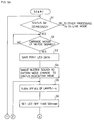
- step S1 the printer is set in on-line mode. It is then discriminated whether or not the STATUS switch is depressed (step S1).
- the STATUS switch 37 is the switch the user should depress to see what special mode is currently set. If the STATUS switch 37 is not depressed, other on-line processing will be executed. With the STATUS switch 37 depressed, however, it is checked whether or not the printer is printing (step S2). If the printer is printing, the discrimination in step S2 is repeated.
- step S3 If the printer is not printing, on the other hand, lighting data of the LED lamps 39 to 45, which indicates the selected font type is stored in off-line mode (step S3).
- the arrow a in Fig. 7 represents the flow of data at that time, in which data at the I/O address "0001H" is read out and is stored at an LED data saving address in the work area of the RAM 5. Then, a buzzer sound is generated once to indicate that the mode has been changed to the status indicating mode as a special indicating mode from the normal indicating mode (step S4).
- the mode is changed to the status indicating mode from the normal indicating mode.
- "00H” is written at the I/O address "0001H” to turn off all of the LED lamps 39 to 45 as mentioned earlier (step S5) and the time in which the LED lamps 39 to 45 are turned off is set to 100 msec (step S6).
- the sequence enters the stage at which the set status of various special modes is checked and indicated, if any.
- the status of the F-LOCK flag in the RAM 5 is tested to discriminate if the font-lock mode has been set (step S7). If the font-lock mode is currently set, the LED lamp 39 flickers (step S8).
- step S9 the status of the P-LOCK flag in the RAM 5 is tested to discriminate if the pitch-lock mode has been set (step S9). If the pitch-lock mode is currently set, the LED lamp 41 flickers (step S10). Then, the macro flag in the RAM 5 is tested to discriminate if the macro mode has been set (step S11). If the macro mode is currently set, the LED lamp 43 flickers (step S12). Further, the AEC flag in the RAM 5 is tested to discriminate if the AEC mode has been set (step S13). If the AEC mode is currently set, the LED lamp 45 flickers (step S14). The time in which the LED lamps 39 to 45 are turned on is set to 100 msec (step S15).
- the user can confirm whether or not the font-lock mode, pitch-lock mode, macro mode and AEC mode are set, by checking the presence or absence of flickering conditions of the associated LED lamps 39-45.
- the arrow b in Fig. 7 represents the flow of data that is written at the I/O address "0001H" during the sequence of steps S7 to S14; the upper four bits of the data are altered.
- step S16 it is discriminated whether or not the STATUS switch 37 is depressed. If the STATUS switch 37 is depressed, the flow returns to step S5 and the above-described sequence of processes will be repeated. In other words, the above-described indication is maintained while the STATUS switch 37 is depressed. If the STATUS switch 37 is not depressed, on the other hand, the previous stored lighting data of the LED lamps 39-45 is restored on the LED's (step S17) and a buzzer sound is generated once to indicate the end of the status indicating mode (step S18). This completes the status indicating mode and restores the normal indicating mode.
- the arrow c in Fig. 7 represents the flow of data in step S17, in which the data stored in the RAM 5 is returned to the latch circuit at the I/O address "0001H" and the LED lamps return to the original lighting conditions.
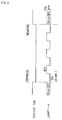
- the timing of the depression of the STATUS switch 37 and the timing of the lighting of the LED lamps 39-45 have the relationship as shown in Fig. 4.
- the STATUS switch 37 When the STATUS switch 37 is depressed, all the LED lamps 39-45 are temporarily turned off, and then the standby time is set to 100 msec (step S6). After the standby time has elapsed, the flickering of the LED lamps 39-45 starts. The lamps are turned on or off every 100 msec (step S15).
- the depression of the STATUS switch 37 is released, the flickering of the LED lamps 39-45 stops.
- This embodiment has the following advantages.
- the user can check the setting of several special modes on the panel, which was not conventionally possible, without increasing the number of the LED lamps as the light indicating portions. More specifically, the depression of the STATUS switch 37 by the user changes the mode to the status indicating mode from the normal indicating mode, so that the user can determine if some special modes are currently set by checking the flickering of the LED lamps 39-45.
- the mode will not be changed to the status indicating mode unless the user depresses the STATUS switch 37. That is, the mode is changed to the status indicating mode only when the user desires the mode change. This design reduces the possibility of erroneous mode confirmation.
- the LED lamps 39-45 are made to flicker in the status indicating mode, the user can easily confirm that the mode is currently set to the status indicating mode, not the normal indicating mode, and can also surely confirm if the individual special modes are currently set.
- the present invention is not limited to the above-described embodiment.
- the type of the printer is not restricted to a specific type, and this invention can be applied to various types of printers.
- the light indicating portions are not limited to those using LED's, but may use other means.
- the special modes are not limited to the various lock modes, the macro mode and the AEC mode, but this invention can be applied to other modes as well.
Landscapes
- Accessory Devices And Overall Control Thereof (AREA)
Claims (6)
- Ein mit einer übergeordneten Vorrichtung (8) verbindbarer Drucker zur Anfertigung einer Ausdrucks in Übereinstimmung mit Druckdaten, die einen Steuerbefehl enthalten, der von der übergeordneten Vorrichtung (8) gesendet wird, wobei der Drucker umfaßt:Steuermittel (1) zum Verändern und Steuern eines Druckmodus' entsprechend einem spezifischen, von der übergeordneten Vorrichtung (8) gesandten Steuerbefehl;Speichermittel (5) zum Speichern vorbestimmter eingestellter Daten/Werte;Hemm- oder Sperrmittel (1, 3) zum Hemmen/Sperren eines Steuervorgangs der Steuermittel (1), verbunden mit dem spezifischen, von der übergeordneten Vorrichtung (8) gesandten Steuerbefehl und Anzeigemitteln (39, 41, 43, 54) zum Anzeigen der vorbestimmten eingestellten Daten, dadurch gekennzeichnet, daß die Anzeigemittel (39, 41, 43, 54) die vorbestimmten eingestellten Werte in einem Modus anzeigen, in dem der Drucker bereit ist, von der übergeordneten Vorrichtung (8) einen Steuerbefehl zu empfangen, und wobei das Hemm- oder Sperrmittel die Steuermittel (1) durch Nichtbeachten des spezifischen Steuerbefehls hemmt bzw. sperrt und es dem Druckmodus ermöglicht, in Übereinstimmung mit dem vorbestimmten eingestellten Wert gesteuert zu werden.
- Der Drucker nach Anspruch 1, weiterhin umfassend Schaltmittel (29) zum Schalten von Anzeigeinhalten der Anzeigemittel (39, 41, 43, 45), wodurch die Anzeige der Anzeigemittel (39, 41, 43, 45) zwischen einer Anzeige des eingestellten Inhalts der eingestellten Werte und einer Anzeige eines ausgewählten Zustands des Druckmodus' zum Druck von Druckdaten auf einem Druckmedium in Übereinstimmung mit einem Schaltvorgang der Schaltmittel (29) geschaltet wird.
- Der Drucker nach Anspruch 2, bei dem sich ein Anzeigemodus zum Anzeigen des eingestellten Inhalts der eingestellten Werte von einem Anzeigemodus zum Anzeigen des ausgewählten Zustands des Druckmodus' unterscheidet.
- Der Drucker nach Anspruch 2 oder 3, bei dem ein Schalter als ein FONT-Schalter (Zeichensatz-Schalter) (29) in ausgeschaltetem Zustand direkt als ein Umschalter (29) verwendet wird, der als das Schaltmittel im angeschalteten Zustand dient.
- Der Drucker nach einem der Ansprüche 1 bis 4, bei dem das Anzeigemittel eine Mehrzahl Licht emittierender Abschnitte (39, 41, 43, 45) umfaßt.
- Der Printer nach Anspruch 5, bei dem der eingestellte Inhalt der eingestellten Werte durch An- und Ausschalten der Licht emittierenden Abschnitte (39, 41, 43, 45) angezeigt wird und der ausgewählte Zustand des Druckmodus dadurch angezeigt wird, daß man die Licht emittierenden Abschnitte (39, 41, 43, 45) angeschaltet läßt.
Applications Claiming Priority (2)
| Application Number | Priority Date | Filing Date | Title |
|---|---|---|---|
| JP4316100A JP3004489B2 (ja) | 1992-10-30 | 1992-10-30 | 印字装置 |
| JP316100/92 | 1992-10-30 |
Publications (3)
| Publication Number | Publication Date |
|---|---|
| EP0597600A2 EP0597600A2 (de) | 1994-05-18 |
| EP0597600A3 EP0597600A3 (en) | 1994-08-24 |
| EP0597600B1 true EP0597600B1 (de) | 1997-06-18 |
Family
ID=18073244
Family Applications (1)
| Application Number | Title | Priority Date | Filing Date |
|---|---|---|---|
| EP93308387A Expired - Lifetime EP0597600B1 (de) | 1992-10-30 | 1993-10-21 | Anordnung zur Anzeige des Zustands eines Druckers |
Country Status (4)
| Country | Link |
|---|---|
| US (1) | US5427459A (de) |
| EP (1) | EP0597600B1 (de) |
| JP (1) | JP3004489B2 (de) |
| DE (1) | DE69311677T2 (de) |
Families Citing this family (4)
| Publication number | Priority date | Publication date | Assignee | Title |
|---|---|---|---|---|
| US6597465B1 (en) | 1994-08-09 | 2003-07-22 | Intermec Ip Corp. | Automatic mode detection and conversion system for printers and tag interrogators |
| JP3983312B2 (ja) * | 1995-01-12 | 2007-09-26 | ゼロックス コーポレイション | プリンタのセキュリティモジュール |
| JPH09220844A (ja) * | 1996-02-19 | 1997-08-26 | Nec Corp | プリンタ装置 |
| JP5489770B2 (ja) | 2010-02-17 | 2014-05-14 | キヤノン株式会社 | 印刷装置、制御方法及びプログラム |
Family Cites Families (10)
| Publication number | Priority date | Publication date | Assignee | Title |
|---|---|---|---|---|
| JPS59156784A (ja) * | 1983-02-25 | 1984-09-06 | Canon Inc | 診断表示装置 |
| DE3607945A1 (de) * | 1986-03-11 | 1987-09-17 | Mannesmann Ag | Bedienungspult fuer drucker, insbesondere fuer matrixdrucker |
| JPS62219023A (ja) * | 1986-03-19 | 1987-09-26 | Canon Inc | コマンド変換装置 |
| JPH0714651B2 (ja) * | 1986-06-23 | 1995-02-22 | 株式会社精工舎 | プリンタの設定方法 |
| JPS63231973A (ja) * | 1987-03-20 | 1988-09-28 | Fujitsu Ltd | プリンタの印字品質制御装置 |
| JPH089254B2 (ja) * | 1987-04-08 | 1996-01-31 | ブラザー工業株式会社 | プリンタ |
| US4990005A (en) * | 1987-10-30 | 1991-02-05 | Brother Kogyo Kabushiki Kaisha | Printer that prints a table of information about printing effects using the selected printing effects |
| JPH01214464A (ja) * | 1988-02-23 | 1989-08-28 | Tokyo Electric Co Ltd | 電子タイプライタ |
| JPH0476461A (ja) * | 1990-07-18 | 1992-03-11 | Mazda Motor Corp | ヨーレートセンサ |
| US5089690A (en) * | 1990-12-14 | 1992-02-18 | Hewlett-Packard Company | Keyboard overlay |
-
1992
- 1992-10-30 JP JP4316100A patent/JP3004489B2/ja not_active Expired - Fee Related
-
1993
- 1993-10-21 EP EP93308387A patent/EP0597600B1/de not_active Expired - Lifetime
- 1993-10-21 DE DE69311677T patent/DE69311677T2/de not_active Expired - Fee Related
- 1993-10-21 US US08/140,787 patent/US5427459A/en not_active Expired - Fee Related
Also Published As
| Publication number | Publication date |
|---|---|
| JPH06143757A (ja) | 1994-05-24 |
| EP0597600A2 (de) | 1994-05-18 |
| JP3004489B2 (ja) | 2000-01-31 |
| US5427459A (en) | 1995-06-27 |
| DE69311677D1 (de) | 1997-07-24 |
| DE69311677T2 (de) | 1998-01-15 |
| EP0597600A3 (en) | 1994-08-24 |
Similar Documents
| Publication | Publication Date | Title |
|---|---|---|
| EP0685818B1 (de) | Vorrichtung und Verfahren zur Fehlerkontrolle für einen Drucker | |
| US5218353A (en) | Display device for a recording device capable of displaying a plurality of operating states or conditions in effect | |
| EP1106368B1 (de) | Drucker, Steuerungsverfahren dafür und Datenspeichermedium | |
| KR930000488B1 (ko) | 실제적인 장착위치와는 무관하게 폰트 메모리를 지정할 수 있는 인자장치와 그 지정방법 | |
| EP0452115B1 (de) | Informationsausgabegerät mit umschaltbarem Programm | |
| US5328278A (en) | Printing apparatus for printing data based on input program | |
| US6752548B2 (en) | Printer and print system | |
| US6035149A (en) | Output apparatus and method in which a suitable analyzer is selected for input information, and the input information is skipped if no analyzer is selected | |
| EP0597600B1 (de) | Anordnung zur Anzeige des Zustands eines Druckers | |
| US6587971B1 (en) | Print control method and print control apparatus | |
| EP0568765A1 (de) | Steuerpanel für Periferiegerät mit intelligenter Taste | |
| US7255501B2 (en) | Printing device | |
| US6927867B2 (en) | Output control method and apparatus therefor | |
| JPH0224183A (ja) | プリンタ | |
| KR100334102B1 (ko) | 프린터의 이력 관리방법 | |
| US5577257A (en) | Information processing apparatus | |
| EP0686937B1 (de) | Drucksteuervorrichtung und Verfahren zur Auswahl des Steuerprogramms | |
| KR940003635B1 (ko) | 프린터 제어방법 | |
| JP3049685B2 (ja) | 情報出力装置及び情報出力方法 | |
| KR100243125B1 (ko) | 컴퓨터의 이미지정보 인쇄지시 처리방법 | |
| JP2861859B2 (ja) | 出力制御装置 | |
| JPH02283466A (ja) | プリンタ | |
| JP4047361B2 (ja) | 情報処理装置及びその制御方法及び記録媒体 | |
| JPH01281522A (ja) | 印字装置 | |
| JPH05221097A (ja) | プリンタ |
Legal Events
| Date | Code | Title | Description |
|---|---|---|---|
| PUAI | Public reference made under article 153(3) epc to a published international application that has entered the european phase |
Free format text: ORIGINAL CODE: 0009012 |
|
| AK | Designated contracting states |
Kind code of ref document: A2 Designated state(s): DE FR GB NL |
|
| PUAL | Search report despatched |
Free format text: ORIGINAL CODE: 0009013 |
|
| AK | Designated contracting states |
Kind code of ref document: A3 Designated state(s): DE FR GB NL |
|
| 17P | Request for examination filed |
Effective date: 19950216 |
|
| 17Q | First examination report despatched |
Effective date: 19960118 |
|
| GRAG | Despatch of communication of intention to grant |
Free format text: ORIGINAL CODE: EPIDOS AGRA |
|
| GRAH | Despatch of communication of intention to grant a patent |
Free format text: ORIGINAL CODE: EPIDOS IGRA |
|
| GRAH | Despatch of communication of intention to grant a patent |
Free format text: ORIGINAL CODE: EPIDOS IGRA |
|
| GRAA | (expected) grant |
Free format text: ORIGINAL CODE: 0009210 |
|
| AK | Designated contracting states |
Kind code of ref document: B1 Designated state(s): DE FR GB NL |
|
| PG25 | Lapsed in a contracting state [announced via postgrant information from national office to epo] |
Ref country code: NL Free format text: LAPSE BECAUSE OF FAILURE TO SUBMIT A TRANSLATION OF THE DESCRIPTION OR TO PAY THE FEE WITHIN THE PRESCRIBED TIME-LIMIT Effective date: 19970618 Ref country code: FR Effective date: 19970618 |
|
| REF | Corresponds to: |
Ref document number: 69311677 Country of ref document: DE Date of ref document: 19970724 |
|
| EN | Fr: translation not filed | ||
| NLV1 | Nl: lapsed or annulled due to failure to fulfill the requirements of art. 29p and 29m of the patents act | ||
| PLBE | No opposition filed within time limit |
Free format text: ORIGINAL CODE: 0009261 |
|
| 26N | No opposition filed | ||
| PGFP | Annual fee paid to national office [announced via postgrant information from national office to epo] |
Ref country code: GB Payment date: 20011024 Year of fee payment: 9 |
|
| PGFP | Annual fee paid to national office [announced via postgrant information from national office to epo] |
Ref country code: DE Payment date: 20011105 Year of fee payment: 9 |
|
| REG | Reference to a national code |
Ref country code: GB Ref legal event code: IF02 |
|
| PG25 | Lapsed in a contracting state [announced via postgrant information from national office to epo] |
Ref country code: GB Free format text: LAPSE BECAUSE OF NON-PAYMENT OF DUE FEES Effective date: 20021021 |
|
| PG25 | Lapsed in a contracting state [announced via postgrant information from national office to epo] |
Ref country code: DE Free format text: LAPSE BECAUSE OF NON-PAYMENT OF DUE FEES Effective date: 20030501 |
|
| GBPC | Gb: european patent ceased through non-payment of renewal fee |
Effective date: 20021021 |