EP0597960B1 - Traitement de populations de cellules - Google Patents
Traitement de populations de cellules Download PDFInfo
- Publication number
- EP0597960B1 EP0597960B1 EP92916742A EP92916742A EP0597960B1 EP 0597960 B1 EP0597960 B1 EP 0597960B1 EP 92916742 A EP92916742 A EP 92916742A EP 92916742 A EP92916742 A EP 92916742A EP 0597960 B1 EP0597960 B1 EP 0597960B1
- Authority
- EP
- European Patent Office
- Prior art keywords
- cells
- pcr
- cell
- primers
- copies
- Prior art date
- Legal status (The legal status is an assumption and is not a legal conclusion. Google has not performed a legal analysis and makes no representation as to the accuracy of the status listed.)
- Expired - Lifetime
Links
Images




Classifications
-
- C—CHEMISTRY; METALLURGY
- C12—BIOCHEMISTRY; BEER; SPIRITS; WINE; VINEGAR; MICROBIOLOGY; ENZYMOLOGY; MUTATION OR GENETIC ENGINEERING
- C12N—MICROORGANISMS OR ENZYMES; COMPOSITIONS THEREOF; PROPAGATING, PRESERVING, OR MAINTAINING MICROORGANISMS; MUTATION OR GENETIC ENGINEERING; CULTURE MEDIA
- C12N15/00—Mutation or genetic engineering; DNA or RNA concerning genetic engineering, vectors, e.g. plasmids, or their isolation, preparation or purification; Use of hosts therefor
- C12N15/09—Recombinant DNA-technology
- C12N15/10—Processes for the isolation, preparation or purification of DNA or RNA
- C12N15/1034—Isolating an individual clone by screening libraries
- C12N15/1075—Isolating an individual clone by screening libraries by coupling phenotype to genotype, not provided for in other groups of this subclass
-
- C—CHEMISTRY; METALLURGY
- C07—ORGANIC CHEMISTRY
- C07K—PEPTIDES
- C07K16/00—Immunoglobulins [IG], e.g. monoclonal or polyclonal antibodies
-
- C—CHEMISTRY; METALLURGY
- C12—BIOCHEMISTRY; BEER; SPIRITS; WINE; VINEGAR; MICROBIOLOGY; ENZYMOLOGY; MUTATION OR GENETIC ENGINEERING
- C12N—MICROORGANISMS OR ENZYMES; COMPOSITIONS THEREOF; PROPAGATING, PRESERVING, OR MAINTAINING MICROORGANISMS; MUTATION OR GENETIC ENGINEERING; CULTURE MEDIA
- C12N15/00—Mutation or genetic engineering; DNA or RNA concerning genetic engineering, vectors, e.g. plasmids, or their isolation, preparation or purification; Use of hosts therefor
- C12N15/09—Recombinant DNA-technology
- C12N15/10—Processes for the isolation, preparation or purification of DNA or RNA
Definitions
- This invention concerns the treatment of cell populations and relates to methods of treating cell populations, e.g. for analysing the linkage of genes within individual cells of a heterogeneous population, novel protein and nucleic acid compositions, and kits for performing said methods.
- This invention concerns techniques for the treatment of populations of cells, typically heterogeneous populations of cells, and has particular, but not exclusive, application to the treatment of lymphocytes such as those producing antibodies.
- Antibodies are present in serum and bind to and help eliminate diverse pathogens such as toxins, bacteria and viruses. They consist of a Y-shaped protein built from two heavy chains and two light chains. Each chain has a modular construction: each light chain consists of two domains, and each heavy chain has at least four domains. The antigen binding site is fashioned by one domain from the heavy chain (VH domain) and one domain from the light chain (VL domain). Indeed small antigen binding fragments can be prepared which consist only of these two domains, either associated non-covalently, or via disulphide bonds or via a peptide linker.
- the antigen binding domains are more variable in amino acid sequence than the other domains of the antibody, and are therefore termed variable (V) domains in contrast to the constant (C) domains.
- V variable domains in contrast to the constant (C) domains.
- C constant domains.
- the constant domains of the antibody are responsible for triggering antibody effector mechanisms such as complement lysis and cell mediated killing.
- Antibodies are made by B-lymphocytes in a process of gene rearrangement.
- the genes encoding the variable domains are assembled from genetic elements.
- the VH domains there are three elements, the unrearranged VH gene, the D segment and the JH-segment.
- the VL domains there are two elements, the unrearranged VL (V lambda or V Kappa) gene and the JL (J lambda or J Kappa) segment. Random combination of these gene segments and random combination of the rearranged VH and VL domains generates a large repertoire of diverse antibodies, capable of binding to diverse antigens.
- the potential diversity is large (primary repertoire in mouse is greater than 10 10 ), although the repertoire expressed at any time must be less than the total number of lymphocytes (in mouse less than 10 8 ).
- antigen is recognised by lymphocytes and they proliferate and secrete antibody which is usually of low affinity (less than 10 6 M - 1 ).
- V-genes of these cells are subjected to mutation and lymphocytes displaying antibody with enhanced affinity are selected.
- This process in which high affinity antibodies are made in two stages from a primary repertoire and subsequently from a hyperimmune repertoire is highly efficient. It has advantages over selecting antibodies in a single step, as this would require a much larger primary repertoire (the potential hyperimmune repertoire is perhaps greater than 10 30 ).
- the key step is the cloning of the genes encoding the VH and VL genes directly from B-lymphocytes (or hybridomas) into expression vectors.
- the genes can be expressed as single variable domains, or Fv or Fab fragments or antibodies in either bacteria or mammalian cells.
- the key to these recombinant DNA based methods are the rapid cloning of the V-genes directly into expression vectors.
- V-genes by the polymerase chain reaction (PCR) using "universal" primers which hybridise to the 5' and 3' ends of V-genes.
- the primers include restriction sites to permit the cloning of the genes directly into expression vectors.
- VH and VL genes from only one thousand different lymphocytes were reshuffled. It would probably require the screening of over a million VH and VL gene combinations to have a reasonable chance of finding the original VH and VL gene combination from any one cell.
- This calculation assumes that the VH and VL genes of the chosen cell are unique: this will be particularly true for a hyperimmune response.
- VH and VL gene combinations selected from a large repertoire of V genes are likely to be artificial combinations. However it is possible that some artificial combinations with binding activities may be similar to the original combination, perhaps with a few amino acid substitutions. Nevertheless it is expected that the majority of such artificial antibodies will have lower affinities than the original combination (although a few may even have improved affinities).
- the present invention is based in part on the proposal that the combination of VH and VL genes present in each cell can be retained if they are copied and the copies of each are linked together preferentially. The linked copies could then be cloned directly into expression vectors. However depending on the efficiency of the linking and copying processes, it might be necessary to first make further copies of the linked genes before cloning.
- VH and VL genes are linked by in situ PCR, either of the genes themselves or of cDNA copies of their mRNA transcripts.
- the invention provides a method of treating a heterogeneous population of cells to link together two or more copies of non-contiguous DNA sequences from at least some of the cells comprising the steps of:
- nucleic acid copies derived from a nucleic acid sequence within the same cell are more likely to become associated with each other than with a copy derived from a nucleic acid sequence from a different cell. Thus the original combination of genetic elements present in any one particular cell will tend to be conserved.
- This preferential linkage occurs in the "vicinity" of the nucleic acid sequence from which the copies are derived. Use of this term is intended to indicate that the preferential linkage defined above occurs relatively locally, near the site of synthesis of the copied nucleic acids.
- the diameter of a mammalian cell is typically in the range 5-15um. Since the key factor is preferential linkage between nucleic acids copied from templates within the same cell, the volume or 'vicinity' within which linkage can occur preferentially varies according to the density of sites of nucleic acid synthesis. For reasons described below, such foci or sites need not always be intact cells.
- the sites of synthesis should however generally be separated by at least one typical cell diameter (5-30um) because there may be some diffusion of the synthesised nucleic acid copies before linkage occurs. Thus separation or "compartmentalisation" of the sites of synthesis will aid in maintaining the preferential nature of the linkage. These practical constraints require that linkage generally occurs within 30-60um of the site of synthesis, although as explained above, if the separation of the compartments within which synthesis takes place is increased, the effective volume available for preferential linkage is also increased.
- the gene elements of cells could be encapsulated together and then the individual genes copied and the copies linked together within the capsule.
- the capsule must be robust enough to survive the copying process and retain the individual gene copies sufficiently to allow linking of the gene copies from the same cell.
- the capsule can be permeable to reagents, such as oligonucleotide primers and polymerase, or impermeable in which case the reagents must be introduced into the capsule.
- the capsule could be the nuclear membrane, the plasma membrane or an artificial capsule constructed around the cell.
- the artificial capsule could be a separate artificial membrane or a different liquid phase, for example an organic solvent.
- the cell membrane might form the capsule if fixed with formaldehyde and made permeable to reagents.
- in situ "in-cell” PCR An example of this is provided by in situ "in-cell" PCR.
- the general technique of in-cell PCR is known and typically involves fixing (i.e. stabilising with respect to temperature) and permeabilising the cells (so as to allow PCR reagents to enter the cell) and performing PCR in the conventional manner. There may be some diffusion of the PCR products into the external medium. However, in the method of the present invention, these products and excess PCR reagents may be removed by washing.
- the cells and reagents could be introduced together into droplets and dispersed in an organic phase as an emulsion, in which case it is necessary to ensure that the majority of droplets are occupied on average by a single cell.
- a method of treating a population of cells to link together copies of two or more non-contiguous DNA sequences from at least some of the cells comprising steps of:
- the preferential linkage can be brought about by suitable techniques, e.g. by ligation using DNA ligase (with or without prior digestion with restriction enzymes). However, most conveniently, the preferential linkage is brought about by PCR. This may be done by the use of sets of primers where an end of a primer which primes the synthesis of one nucleic acid sequence is complementary to and end of a primer which primes the synthesis of a second nucleic acid sequence.
- the DNA sequence subjected to PCR is derived from cellular mRNA. This is conveniently achieved by reverse transcription of the mRNA.
- fluorescently labelled PCR primers allows for the analysis of a population of cells for example by counting cells which express a particular gene or combination of genes.
- certain embodiments of the present invention comprise an additional step of monitoring the fluorescent label
- a cell population subjected to this method of treatment is suitable for analysis by fluorescence activated cell sorting (FACS).
- FACS fluorescence activated cell sorting
- Fluorescence labelling of amplified DNA is particularly advantageous, as it can allow for the sorting of labelled cells (e.g. by FACS) and the direct cloning of the amplkified DNA from sorted cells.
- two different primers labelled with different fluorescent labels ar employed. This can allow for the analysis of two different sub-populations within a heterogeneous population in one experiment.
- fluorescent labelling allows for counting of labelled cells, which is a preferred feature of this aspect of the invention.
- cells may be stabilised with respect to heat by 'fixing' with formaldehyde.
- a convenient method of permeabilising cells is to treat them with a detergent, typically the non-ionic detergent Nonidet P40 (NP40).
- the methods defined above further comprise one or more rounds or further rounds of PCR.
- any further rounds of PCR are performed using "nested" primers, which are complementary to sequences copied in the preliminary amplification.
- a washing step may be usefully incorporated after the linkage step into any of the methods defined above, particularly those using in-cell PCR, to remove from the external surface or outer layers of cells unwanted material, e.g. linked copies from other cells, in order to reduce the background "noise". This is particularly useful if one or more further rounds of PCR are to be performed.
- the nucleic acid sequences copied may be genomic DNA sequences (such as those encoding immunoglobulin VH and VL domains).
- genomic DNA sequences such as those encoding immunoglobulin VH and VL domains.
- mRNA may be reverse transcribed in situ into cDNA and the resulting cDNA amplified by in cell PCR. Further, analysis of mRNA rather than genomic DNA more accurately reflects the activity of the cell.
- TCR T cell receptor
- nucleic acid produced by the method aspects of the invention may be beneficial to isolate the nucleic acid produced by the method aspects of the invention.
- the products are typically inserted into suitable vectors.
- the inserted nucleic acid product is then generally sequenced or annealed to nucleic acid probes to confirm its identity.
- vectors which may express the nucleic acid sequence as a polypeptide. This is of special interest when isolating sequences encoding VH and/or VL domains, as it represents a method of producing mono-specific antibody binding fragments.
- Such cloning and expression vectors are well known to those skilled in the art.
- Particularly preferred is the technique whereby VH/VL combinations are expressed on the surface of a phage (McCafferty et al. (9)), such a technique representing a powerful selection method.
- Expression on the surface of a phage is a particular embodiment of a generally preferred feature: expression of the cloned nucleic acid product as a fusion protein.
- the cloned nucleic acid product could be expressed as a fusion protein with a peptide tag for detection purposes.
- the invention provides a composition comprising copies of two or more nucleic acid sequences preferentially linked in the vicinity of the nucleic acid sequences from which the copies were derived.
- the invention provides a kit for performing any of the method aspects of the invention, comprising at least a PCR primer for copying a DNA sequence of interest and intructions for use.
- kits include further overlapping and/or nested PCR primers, labelled oligonucleotides which may be used as PCR primers or as probes, other PCR reagents (such as Taq polymerase, buffers) or reagents for fixing and permeabilising cells.
- VH and VL genes of a hybridoma cell line can be copied using the polymerase chain reaction and primers located at the 5' and 3' end of the VH and also of the Vk gene ( Figure 1).
- the amplified VH and Vk DNA are also linked during the PCR reaction, in the order 5' VH-Vk 3' by virtue of a match between the primers at the 3' end of the VH gene, and the 5' end of the Vk gene (Stage 1).
- a second set of 'nested' PCR primers is used (Stage 2).
- VH and Vk genes are linked preferentially within the same cell as follows.
- the cell is first fixed with formaldehyde to stabilise it to the temperature cycling, and treated with Nonidet P40 to permeabilise the cell clones analysed by probing and sequencing.
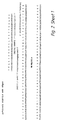
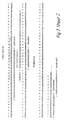
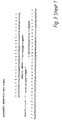
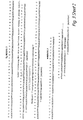
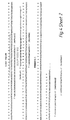
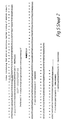
- nucleotide sequences of the mature heavy chain VH domains and the Vk light chain genes of the anti-phenyloxazolone hybridomas NQ2/12.4 and NQ10/12.5, and the encoded protein sequences, are given in Figures 2-5.
- the VH and Vk genes are linked by a nucleotide sequence encoding a polypeptide spacer providing a flexible polypeptide chain to link the two domains.
- the complete nucleotide sequence in Figures 2 and 4 encodes a single chain Fv fragment.
- the spacer is incorporated within the PCR primers MoVhlnk3 and MoVklnk3, which are used with a VH back (NQ10/12.5 or NQ2/12.4) primer and a Vk forward primer (MoJkFOR2) to amplify and link the VH and Vk genes in a form suitable for expression.
- Figures 3 and 5 are similar, and show a shorter linker that contains a unique restriction site to allow the cloning of a longer polypeptide linker by introducing a synthetic oligonucleotide.
- further cycles of PCR are used with a nested VH back (NQ10/12.5BKNES or NQ2/12.4BKNES) primer and a nested Vk forward (MokFORNES) primer.
- the sequence of the hybridoma genes was already known and primers specific to the hybridomas were designed. However in principle more general primers could be used, for example, to clone variable domains in general by PCR (reference 5). Also the second round of PCR amplification in the example gives rise to a single chain Fv truncated at both N- and C-terminus. However, a different set of primers should overcome these problems.
- Vk forward primers might be designed directly to the 3' side of the J-regions, either in the C kappa or C lambda constant domain for RNA templates, or in the region of DNA next to the splice junction for genomic DNA templates.
- Linking primers would be used that encoded a polypeptide sequence (as above), for example to join the VH and Vk as a single chain Fv fragment.
- the Vh back primer would incorporate a restriction site for cloning into expression vectors.
- Vk forward primer(s) based within the Jk region itself (and incorporating restriction site for cloning into expression vectors) might be used in conjunction with the VH back primer.
- NQ2/12.4 or NQ10/12.5 hybridoma cells were grown in tissue culture flasks in Dulbecco's modified Eagle's medium containing 5% foetal bovine serum. Cultures in late logarithmic growth phase were harvested by rinsing adherent cells into the supernatant medium, and centrifuging the medium at 800 rpm for 5 minutes at room temperature. The supernatant was removed and the cells were resuspended in 5ml phosphate buffered saline (PBS, pH 7.2) at room temperature and again centrifuged at 800 rpm for 5 mins (1st wash). Two further washes in 5ml PBS were given under the same conditions.
- PBS phosphate buffered saline
- the cell pellets were then suspended in 10% formal saline (10% formalin [i.e. 4% formaldehyde] and 0.15M NaCl in distilled water), using 1ml per 10-50ml of original culture, and transferred to 2ml Eppendorf Safe-Lock tubes. They were incubated on ice for 1 hour, with frequent agitation on a vortex mixer. The cells were then spun down at 13,000 rpm in a microfuge, and washed 3 times with lml ice-cold PBS, dispersing them by pipetting up and down several times at each wash.
- 10% formal saline % formalin [i.e. 4% formaldehyde] and 0.15M NaCl in distilled water
- the pellets were resuspended in 1ml ice-cold Nonidet P40 in water, and incubated on ice for a further 1 hour with frequent agitation.
- the cells were washed 4 more times in 1ml ice-cold PBS, with vigorous pipetting, and suspended in 0.2-0.5ml cold PBS containing 0.1M glycine.
- a sample was examined microscopically in a haemocytometer, and if clumps were present they were dispersed into single cells by vigorous pipetting or repeated passage through a 26 gauge hypodermic needle.
- the cells were then counted and adjusted to 10 7 per ml in PBS + 0.1M glycine, and aliquoted into 0.5 ml tubes (usually 0.05-0.1 ml per tube) and frozen in dry ice. The frozen aliquots were stored at -70 degrees C.
- Heavy and light chain variable regions were assembled and amplified by a 2-stage Polymerase Chain Reaction.
- VH and Vk genes were linked together, and in the second stage the assembled product was amplified from the cell template.
- Reactions were carried out in Techne HI-TEMP 96 polycarbonate microplates using a Techne PHC-3 programmable heating block, or in 0.5ml Sarstedt tubes using a BioTherm Inc. BioOven.
- Reaction conditions were as follows:- 1ST STAGE: Water 26.5 ul Forward Vk primer 2.5 ul Back Vh primer 2.5 ul Forward Link primer 0.5 ul Back Link primer 0.5 ul dNTPs (5mM) 2.0 ul 10 x PCR buffer 5.0 ul Cell template (in PBS/glycine) 10.0 ul Taq polymerase (5 units/ul) 0.5 ul
- the cell templates were separated from the rest of the reagents and washed. In Techne plates, the supernatant PCR mix and overlying oil were carefully pipetted away, leaving the cells at the bottom of the well. The cells were then suspended in 0.2ml of PBS/0.1M glycine and spun down in a microfuge at 13,000 rpm. After resuspension in the same buffer they were again spun down for a 2nd wash, then resuspended in 10ul PBS/glycine for use as the 2nd stage template.
- Example 2 Use of an emulsion for PCR amplification
- the mixture was incubated for 5 minutes at 64°C.
- the tubes were incubated at 64°C to evaporate the excess ether and 1 ul of the DNA was then removed for a second round of PCR with the nested primers as in Example 1. Analysis of the DNA on a 2% high-gelling temperature agarose gel demonstrated that assembly had occurred.
- Monoclonal antibodies have provided reagents for the identification of marker proteins (and lipids and carbohydrates) expressed within cells (1), on the surface of cells (2) or secreted from cells (3). These reagents have had diverse uses, ranging from the localisation of cells in histological sections (1) to the use of fluorescence activated cell sorting (FACS) of populations of cells (4).
- FACS fluorescence activated cell sorting
- the nucleotide sequence encoding a desired marker we could in principle use the mRNA species as a marker for a cell.
- Such a process could also be used to detect and to clone combinations of mRNAs by linking the PCR amplified cDNAs within the same cell.
- it could help in the cloning of Ig V-gene combinations from immunised or auto-immune sources using recombinant DNA techniques.
- repertoires of antibody heavy and light chains are prepared from lymphocyte populations by PCR (5,6,7), combined at random (8) and expressed as soluble fragments in bacteria for screening with antigen (8), or displayed on the surface of filamentous phage and selected by panning (9,10).
- lentivirus DNA can be amplified in situ using PCR, and the infected cells detected by autoradiography (15).
- the cells were fixed with formalin and permeabilised with the detergent NP40 to allow the access of nucleotides, primers and enzymes.
- one primer was designed to prime at the 3' end of the VH gene, and another at the 5' end of the VL gene, but with complementary tails to allow the self-assembly of the VH and VL genes.
- NQ10/12.5 murine hybridoma cells were grown in Dulbecco's modified Eagle's medium supplemented with 5% fetal bovine serum (FBS), and B1-8 hybridoma cells in RPMI 1640 medium supplemented with 5% FBS. Cells were used or passaged at late log phase, when almost all were viable. NQ10/12.5 secretes a kappa light chain and B1-8 a lambda light chain (16,17). The sequences of the VH and VL genes for both these hybridomas are known (16,17). The human myeloid leukemia cell line K562 was grown in RPMI with 5% FBS.
- FBS fetal bovine serum
- This line carries the Philadelphia chromosome, which is characterised by a bcr-abl fusion gene as a result of a translocation between the abl proto-oncogene on chromosome 9 and the bcr gene on chromosome 22 (19).
- Cells (10 7 to 10 8 ) were sedimented at 50 x g for 5 mins, washed 3 times in 5 ml PBS pH 7.2 at room temperature then suspended in 1 ml ice-cold 10% formaldehyde solution in 0.15M NaCl (formal saline). They were kept on ice for 1 hour, with occasional agitation on a vortex mixer. They were then spun at 13,000 rpm in a microcentrifuge for 2.5 mins and washed 3 times in ice-cold PBS, with vigorous pipetting with a Pasteur pipette to resuspend and disperse any clumps visible by eye.
- the cells were next suspended in 0.5% Nonidet P40 (NP40, B.D.H.) in water. After a further 1 hour incubation on ice with frequent agitation, they were again washed 3 times in ice-cold PBS with vigorous pipetting. A final wash was given in PBS containing 0.1 M glycine, and the cells were resuspended in 0.2 to 0.5 ml of the same buffer, using a 1 ml syringe and 26 gauge needle to disperse the clumps visible using a light microscope. The cells were counted, and for most experiments adjusted to a final concentration of 10 7 per ml. They were frozen in small aliquots in dry ice and stored at -7°C for up to a month.
- NP40 Nonidet P40
- oligonucleotides are listed according to their use as primers or probes. The sequences were based on the sequence of the hybridoma V genes (16,17), and the bcr-abl gene (20), and were synthesised using an Applied Biosystems 394 DNA synthesiser and used without purification.
- a 'first strand mix' was freshly prepared, comprising 5 ul 10 x 1st strand buffer (1.4M KCl, 0.5M Tris-HCl pH8.1 at 42°C, 80mM MgCl 2 ), 5 ul 0.1M dithiothreitol (DTT), 5 ul 5 mM dNTPs, 25 pmol each forward primer, 80 units RNase inhibitor (RNasin, Promega) and water to a total volume of 28 ul.
- the cells were heated to 65°C for 3 mins then cooled on ice.
- the 'first strand mix' was added, followed by 40 units Super RT AMV reverse transcriptase (HT Biotechnology Ltd., Cambridge).
- the cells and reagents were mixed and incubated at 42°C for 1 hour, then the cells were spun down, washed in 200 ul PBS (pH 7.2) containing 0.1 M glycine (PBS/0.1 M glycine) and resuspended in 20 ul of the same buffer for use immediately in PCR.
- PBS pH 7.2
- PBS/0.1 M glycine 0.1 M glycine
- cDNA synthesis was as above except using random primers and oligo (dT) (21).
- viable cells (5 x 10 6 ) were boiled for 5 mins in 100 ul water containing 0.1% diethyl pyrocarbonate and spun for 2 mins at 13,000 rpm in a microcentrifuge.
- a 'first strand mix' was prepared, comprising 10 ul 10 x 1st strand buffer, 5 ul 5 mM dNTPs, 5 ul 100 mM DTT, and 25 pmol each forward primer. It was added to a volume of 62-67 ul supernatant from the boiled cells, and the mixture heated at 65°C for 3 mins and left to cool at room temperature for 15 mins.
- RNasin 160 units
- reverse transcriptase 100 units
- Reactions were set up in 50 ul volumes in 0.5 ml Sarstedt tubes with 10 ul fixed template cells in PBS/0.1 M glycine buffer, 25 pmol back primer, 25 pmol forward primer, 200 uM dNTPs, 5 ul 10x Taq polymerase buffer (Promega) and 2.5 units of Taq polymerase.
- the tubes were subjected to up to 40 cycles of PCR with denaturation at 95°C and extension at 72°C for 1 min each. Annealing was for 1 min at temperatures ranging from 60°C to 72°C.
- a thermal cycling oven ("BioOven", BioTherm Corp.) was used, which did not require the use of a mineral oil overlay. Where cell recovery was not required, cycling was performed on a cycling heat block (Techne PHC-3) with an overlay of 50 ul mineral oil.
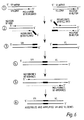
- the cDNAs were amplified by PCR and linked in the same reaction by using primers with complementary tails (22) (Fig. 6).
- Figure 6 illustrates assembly and nested amplification of Ig V-genes from hybridomas for cloning, cDNA synthesis and assembly of VH and VL gene from hybridomas NQ10/12.5 and B1.8. Sequences of primers (small arrows) indicated are as described previously. In each step the template strand is marked with a thick line, and the newly synthesised (first) strand with a thin line; in some cases, two steps are combined in the figure, and the second synthesised strand (using the first as template) is then marked with a dashed line. Sequence tags for assembly are marked as blocks.
- Reactions were set up in 50 ul volumes in tubes as follows: 25 pmol VH back primer, 25 pmol VL forward primer, 10 pmol VH forward primer with linker sequence, 10 pmol VL back primer with linker sequence, 200 uM dNTPs, 5 ul 10 x Taq polymerase buffer, 2.5 units Taq polymerase, and 10 ul fixed cells in PBS/0.1 M glycine buffer. Generally 10 5 (but sometimes up to 5 x 10 5 ) cells per tube were used, and the tubes were given 30 cycles of 95°C for 30 secs, 65°C for 30 secs and 72°C for 30 secs.
- the cells were spun down at 13,000 rpm, washed twice in 200 ul PBS/0.1 M glycine, and resuspended in 10 ul PBS/glycine.
- a second PCR was set up with the washed cells, nested primers (23) using 25 pmol nested VH back primer and 25 pmol nested VL forward primer, 200 uM dNTPs, 5 ul 10 x PCR buffer and 2.5 units Taq polymerase.
- the cells were subjected to 30 more cycles of PCR, and DNA for cloning was isolated from the supernatant.
- PCR primers for each cell line were included in both first and second "nested" PCRs using a 100 ul reaction volume.
- cDNA was synthesised from a 1:1 mix of B1-8 and NQ10/12.5 (NQ10) fixed cells using the primers MOLFOR, MOJH3FOR, B1-8LFOR and B1-8VHLINK3, and the cells washed and resuspended in PBS/0.1 M glycine for PCR assembly.
- the first PCR was carried out using the VL forward primers MOLFOR and B1-8LFOR and the VH back primers NQ10BK and B1-8BK.
- the PCR linker primers MOVHLINK3, MOVKLINK3, B1-8VLLINK3 and B1-8VHLINK3 were also included.
- the 3' ends of the PCR linker primers are complementary to the ends of the DNA template, but incorporate a 5' "tag" to allow assembly of the VH and VL genes (Fig. 6).
- the tags were identical for both NQ10 and B1-8 linker primers, so that all possible combinations of VH and VL could be formed.
- the second PCR used the nested primers NQ10BKNES, MOLFORNES, B1-8BKNES and B1-8FORNES.
- cDNA in the B1-8 and NQ10 cells was subjected to PCR to amplify VH genes, using the primers indicated in Table 1. They were then washed twice and the genes further amplified with nested PCR primers tagged with sequences complementary to those fluorescence tagged primers (-21ROX, -21FAM, M13ROX used for DNA sequencing) (Table 1). After washing, a third PCR was used with 3pmol of M13 or-21 primers labelled with 6 carboxy-X-rhodamine (ROX) (Applied Biosystems). Conditions for each PCR were 94° C for 40 secs, 58°C for 40 secs, and 72°C for 40 secs.
- ROX carboxy-X-rhodamine
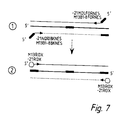
- Figure 7 illustrates nested amplification of assembled Ig V-genes for fluorescent labelling.
- (I) shows second "nested” PCR with tagged primers to introduce primer sites for "universal” fluorescent primers and (2) shows third PCR with fluorescent primers.
- the same fluorescent primer can prime at both the 5' and 3' ends of the tagged sequences.
- the cells were examined and photographed on a MRC 500 scanning laser confocal microscope (BioRad). Between 10 3 and 10 4 cells in 10 ul TE were spread on a glass slide and covered with a coverslip, sealed at the edges with nail varnish. In addition, cytofluorographic analysis was performed on a FACScan flow cytometer (Becton Dickinson). Fluorescence data were displayed as logarithmic overlay histograms using Consort 30 software (Becton Dickinson). Cell debris was gated out and 10 5 cells were analysed per sample.
- DNA from the supernatants of cells after assembly and amplification was purified from 1.5% agarose gels in 0.5 x Tris-borate EDTA (TBE) buffer (pH 8.0) with ethidium bromide (0.5 ug/ml) incorporated into the gels.
- TBE Tris-borate EDTA
- the assembled DNA bands of around 600 bp were eluted with Geneclean II (BIO 101 Inc.), with the addition of Geneclean 'TBE modifier'.
- the purified DNA was ligated into a 'T vector' derived from Bluescript KS+ (Stratagene) (24), and the vector transfected into E. coli CMK603 by electroporation.
- the cells were grown overnight on TYE plates (25) with 100 ug/ml ampicillin, 5-bromo-4-chloroindolyl-B-D-galactoside (26) and isopropyl-B-D-l-thiogalacto-pyranoside (27). White colonies were replica plated in order to prepare colony lifts for hybridisation, or for use as templates for PCR screening.
- the reactions were set up in 20 ul volumes in individual wells of Hi-temp plates (Techne), containing 8 pmol of forward and back primers, 200 uM dNTPs, 2 ul 10 x Taq buffer and 0.4 units Taq polymerase per well.
- each clone was screened with the primers NQ10BKNES and MOLFORNES, B1-8BKNES and B1-8FORNES, NQ10BKNES and B1-8FORNES, and B1-8BKNES and MOLFORNES.
- Each well was inoculated with bacteria from a single replica plated colony by means of a toothpick, and overlaid with 50 ul of mineral oil.
- the plates were subjected to 30 cycles of 95°C for 30 secs, 65°C for 1 min and 72°C for 1 min on a Techne PHC-3 heat block designed for multi-well plates.
- the PCR products were run on 1.5% agarose gels (10 ul per lane).
- bacterial colony lifts were made using Hybond-N nylon membranes (Millipore). The bacteria were lysed with sodium dodecyl sulphate and the DNA denatured and fixed to the membrane by microwaving (29), followed by UV cross-linking. Oligonucleotide probes for heavy (V186.2) and light (B1-8LPRB) chains of the B1-8 hybridoma, and heavy (NQ10PRB) and light (NQ10KPRB) chains of the NQ10/12.5 hybridoma, were labelled with gamma 32 p-ATP using polynucleotide kinase (New England BioLabs) and hybridised to the nylon filters for 16 to 60 hours. The filters were washed with solutions containing tetramethylammonium chloride (21) and exposed on Kodak XAR 5 film.
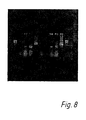
- Permeabilisation was a necessary step (Fig. 8), but formaldehyde concentrations ranging from 4% to 10% were equally effective for fixation. However, fixed and permeabilised cells which had undergone cDNA synthesis provided a much better template for PCR amplification (as shown by the examples in Fig. 8), which shows the gel electrophoresis of PCR products. In this Figure, supernatants from cDNA amplifications were run on a 1.5% agarose gel in TBE buffer.
- lanes 1 and 11 phi X174 HaeIII marker
- lane 2 PCR of B1-8 VH from fixed cells (formalin only);
- lane 3 PCR of B1-8 VH from fixed and permeabilised cells (formalin and NP40);
- lane 4 PCR assembly of B1-8 VH and V lambda from fixed and permeabilised cells;
- lane 5 as lane 4 except using nested primers in second PCR;
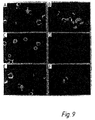
- the amplified DNA within the cells could be visualised directly by confocal microscopy (or conventional fluorescence microscopy) by incorporation of a fluorescent PCR primer in a third PCR step (30).
- B1-8 and NQ10 cells were fixed, permeabilised and mixed in equal ratios. The mixtures were then treated to cDNA synthesis and PCR amplification and assembly (Fig. 6), and the linked product isolated from the supernatant and cloned. The clones were then screened for the four different combinations of heavy and light chains (as described elsewhere). The results of three independent experiments are shown in Table 2 for 1:1 mixtures. In all cases the in-cell PCRs resulted in linkage of NQ10 VH with V Kappa, or B1-8 VH with V lambda, corresponding to the combinations of the hybridomas; no "crossovers" were seen in the 104 clones evaluated. By contrast, PCRs performed with soluble cDNA led in addition to cross-over combinations of NQ10 VH with V lambda and B1-8 VH with V Kappa.
- VH and VL linkage were performed by PCR of cell and soluble cDNA templates from a mix containing 10% B1-8 cells and 90% NQ10/12.5 cells (Table 3).
- 450 clones of each PCR assembly were initially probed with 32 P kinase labelled V186.2 oligonucleotide probe to identify those clones expressing the B1-8 VH chain.
- the positive clones were then screened on agarose gels to detect either V Kappa and V lambda genes using PCR with the primers MOVKLINK3 and MOLFORNES, and B1-8VLLINK3 and B1-8FORNES respectively.
- VH and VL human immunoglobulin variable region genes
- Lymphoprep lynphocyte separation medium Nacomed
- Tubes were centrifuged at 4,000 x g for 20 minutes, after which mononuclear cells (which include lymphocytes) were visible as a band separating the blood plasma (upper layer) and the Lymphoprep (lower layer).
- the cells were removed and washed 3 times in phosphate buffered saline (PBS, pH 7.2), and incubated in 10% formaldehyde in 0.15M NaCl solution on ice for 1 hour. They were again washed in PBS 3 times, followed by incubation on ice in 0.5% Nonidet P40 (BDH) in water. After a further 3 washes in PBS the cells were suspended in PBS containing 0.1M glycine and counted. They were stored frozen at -70°C.
- PBS phosphate buffered saline
- Reactions were set up in 50ul volumes in 0.5 ml Sarstedt tubes, using 10 5 cDNA template cells in 10ul together with a mix containing 25 pmol VH back primer mix (VH3LDR1 + VH3LDR2 + VH3LDR3), 25pmol Ck5'FOR, 10 pmol linker primer mix (JHLINK 1,2 + JH3LINK + JH6LINK + VkLINK + VkLINK1), 200 uM dNTPs, 5ul 10x Taq polymerase buffer (Promega) and 2.5 unit Taq polymerase.
- the tubes were subjected to 30 cycles of PCR with denaturation at 95°C for 30 seconds, annealing for 58 or 65°C for 30 seconds, and extension at 72°C for 30 seconds, in a thermal cycling oven (BioTherm Corp. "BioOven") without an oil overlay. This was referred to as the "1st PCR”.
- the cells were spun down and washed twice in PBS/O.1M glycine, and suspended in 10ul of this buffer for a 2nd PCR together with the following mix:- 200 uM dNTPs, 5ul 10x Taq buffer, 2.5 units Taq polymerase, and either of primer combinations (a) 25 pmol VH3A and 25 pmol of a mix of Jk1FOR + Jk2FOR + Jk3FOR + Jk4FOR + Jk5FOR, or (b) 25 pmol VH3ASfi and 25 pmol of a mix of Jk1FORNot + Jk2FORNot + Jk3FORNot + Jk4FORNot + Jk5FORNot.
- PCR products were analysed by running on 1.5% agarose gels in 0.5 x Tris-borate-EDTA buffer containing 0.5ug/ml ethidium bromide and viewing under ultra-violet light.
- the amplified DNA could be fluorescence labelled within the cell using fluorescent PCR primers, and should allow the analysis of large and diverse populations of cells by fluorescence.
- fluorescent PCR primers we used three PCR amplifications in order to tag the amplified DNA, and then fluorescence lable and tagged DNA with "universal" fluorescent PCR primers.
- fluorescence lable the cDNAs within the cell with a single PCR amplification using a set of fluorescent PCR primers specifically made for the gene of interest.
- PCR templates were derived from a 1:1 mix of NQ10/12.5 and B1-8 cells which were divided into two portions. One portion of the cells were fixed before cDNA synthesis and PCR assembly and nested amplification (Fixed cells), and the other was boiled in water for cDNA synthesis and PCR assembly and nested amplification from soluble mRNA (Random combinatorial). Colonies were screened by PCR for Expts 1, 2 and 3, but extra Expt. 1 colonies were also probed. Screening of linked VH and VL gene combinations from 1:9 mixtures of B1-8: NQ10/12.5 hybridoma cells.
- PCR assembly templates For preparation of PCR assembly templates a 1: 9 mix of B1-8 : NQ10/12.5 cells was divided into two portions. One portion was fixed for cDNA synthesis and PCR (Fixed cells), and the other was boiled in water for cDNA synthesis and PCR from soluble mRNA (Random combinatorial). Clones were probed with 32 P labelled V186.2 probe, and those clones identified with B1.8 VH genes were PCR screened for either V ⁇ or V ⁇ genes.
Landscapes
- Chemical & Material Sciences (AREA)
- Health & Medical Sciences (AREA)
- Genetics & Genomics (AREA)
- Life Sciences & Earth Sciences (AREA)
- Organic Chemistry (AREA)
- Engineering & Computer Science (AREA)
- Biotechnology (AREA)
- Zoology (AREA)
- General Engineering & Computer Science (AREA)
- Biomedical Technology (AREA)
- Bioinformatics & Cheminformatics (AREA)
- Wood Science & Technology (AREA)
- Biophysics (AREA)
- Molecular Biology (AREA)
- Biochemistry (AREA)
- General Health & Medical Sciences (AREA)
- Microbiology (AREA)
- Plant Pathology (AREA)
- Physics & Mathematics (AREA)
- Crystallography & Structural Chemistry (AREA)
- Bioinformatics & Computational Biology (AREA)
- Medicinal Chemistry (AREA)
- Proteomics, Peptides & Aminoacids (AREA)
- Immunology (AREA)
- Measuring Or Testing Involving Enzymes Or Micro-Organisms (AREA)
- Medicines Containing Material From Animals Or Micro-Organisms (AREA)
- Preparation Of Compounds By Using Micro-Organisms (AREA)
- Immobilizing And Processing Of Enzymes And Microorganisms (AREA)
- Micro-Organisms Or Cultivation Processes Thereof (AREA)
- Peptides Or Proteins (AREA)
Claims (18)
- Méthode de traitement d'une population hétérogène de cellules pour enchaíner ensemble deux copies ou plus de séquences non contiguës d'ADN d'au moins certaines des cellules comprenant les étapes de :où ledit enchaínement a lieu préférentiellement à proximité des séquences non contiguës d'ADN, de manière que deux copies ou plus des séquences non contiguës d'ADN de la même cellule soient plus probablement enchaínées les unes avec les autres qu'avec des copies dérivées d'une séquence d'acides nucléiques d'une cellule différente.(i) amplifier les séquences non contiguës d'ADN; et(ii) enchaíner les copies des séquences non contiguës d'ADN,
- Méthode de traitement d'une population de cellules pour enchaíner ensemble des copies de deux séquences non contiguës ou plus d'ADN d'au moins certaines des cellules comprenant les étapes de :(i) traiter les cellules pour les stabiliser par rapport a la température et les perméabiliser par rapport aux réactifs;(ii) ajouter des amorces pour accomplir une réaction en chaíne de polymérase (PCR) d'une manière telle que les amorces se diffusent à l'intérieur des cellules;(iii)soumettre les cellules à un traitement approprié de manière que des séquences non contiguës d'ADN d'une cellule particulière soient copiées dans cette cellule par PCR; et(iv) enchaíner ensemble les copies des séquences non contiguës d'ADN, ledit enchaínement ayant lieu préférentiellement à proximité des séquences non contiguës d'ADN d'où les copies sont dérivées de manière que deux copies ou plus des séquences non contiguës d'ADN de la même cellule soient plus probablement enchaínées les unes aux autres qu'avec des copies dérivées d'une séquence d'acide nucléique d'une cellule différente.
- Méthode selon la revendication 1 ou 2, où les copies des séquences d'ADN sont enchaínées par PCR.
- Méthode selon la revendication 2 où les amorces sont marquées par fluorescence, et ladite méthode comprend l'étape additionnelle de surveiller les marqueurs fluorescents.
- Méthode selon la revendication 4, où les cellules sont triées par triage de cellules activées à la fluorescence (FACS).
- Méthode selon les revendications 4 ou 5, comprenant de plus l'utilisation de deux amorces ou sondes différentes marquées avec des marqueurs fluorescents différents.
- Méthode selon l'une quelconque des revendications 4, 5 ou 6, où ladite surveillance des marqueurs fluorescents consiste à compter les cellules marquées.
- Méthode selon l'une quelconque des revendications 2 à 7, où la séquence d'ADN soumise à PCR est dérivée de l'ARNm cellulaire.
- Méthode selon la revendication 8, où la séquence d'ADN est l'ADNc dérivé par transcription réverse de l'ARNm.
- Méthode selon l'une quelconque des revendications précédentes, comprenant de plus une étape de lavage suivant l'enchaínement de l'ADN.
- Méthode selon l'une quelconque des revendications précédentes, comprenant de plus un ou plusieurs tours ou d'autres tours de PCR.
- Méthode selon la revendication 11, où d'autres tours de PCR sont accomplis en utilisant des amorces qui sont complémentaires des séquences copiées dans un tour précédent de PCR.
- Méthode selon l'une quelconque des revendications précédentes, où les séquences d'ADN comprennent des séquences codant pour les domaines VH et VL de l'immunoglobuline.
- Méthode selon l'une quelconque des revendications précédentes, où l'ADN résultant est cloné par insertion dans un vecteur approprié.
- Méthode selon la revendication 14, où les clones sont mis en séquence ou recuits aux sondes d'acide nucléïque.
- Méthode selon la revendication 14 ou 15, comprenant de plus l'expression d'une protéine codée par l'ADN d'un clone.
- Méthode selon la revendication 16, où la protéine est exprimée en tant que partie d'une protéine de fusion.
- Méthode selon la revendication 17, où la protéine de fusion comprend la protéine de couche d'un phage filamentaire ou un marqueur peptidique.
Applications Claiming Priority (5)
| Application Number | Priority Date | Filing Date | Title |
|---|---|---|---|
| GB91173526 | 1991-08-10 | ||
| GB919117352A GB9117352D0 (en) | 1991-08-10 | 1991-08-10 | Recombinant dna method |
| GB929212419A GB9212419D0 (en) | 1992-06-11 | 1992-06-11 | Recombinant dna method |
| GB92124197 | 1992-06-11 | ||
| PCT/GB1992/001483 WO1993003151A1 (fr) | 1991-08-10 | 1992-08-10 | Traitement de populations de cellules |
Publications (2)
| Publication Number | Publication Date |
|---|---|
| EP0597960A1 EP0597960A1 (fr) | 1994-05-25 |
| EP0597960B1 true EP0597960B1 (fr) | 1999-01-20 |
Family
ID=26299394
Family Applications (1)
| Application Number | Title | Priority Date | Filing Date |
|---|---|---|---|
| EP92916742A Expired - Lifetime EP0597960B1 (fr) | 1991-08-10 | 1992-08-10 | Traitement de populations de cellules |
Country Status (11)
| Country | Link |
|---|---|
| US (1) | US5830663A (fr) |
| EP (1) | EP0597960B1 (fr) |
| JP (1) | JPH06509473A (fr) |
| AT (1) | ATE175997T1 (fr) |
| AU (1) | AU665365B2 (fr) |
| CA (1) | CA2114950A1 (fr) |
| DE (1) | DE69228247T2 (fr) |
| DK (1) | DK0597960T3 (fr) |
| ES (1) | ES2130177T3 (fr) |
| GR (1) | GR3029913T3 (fr) |
| WO (1) | WO1993003151A1 (fr) |
Cited By (2)
| Publication number | Priority date | Publication date | Assignee | Title |
|---|---|---|---|---|
| EP2626433A1 (fr) | 2012-02-09 | 2013-08-14 | Max-Planck-Gesellschaft zur Förderung der Wissenschaften e.V. | Procédé pour lier et pour caractériser les acides nucléiques liés dans une composition |
| US8921281B2 (en) | 2009-05-20 | 2014-12-30 | Novimmune S.A. | Synthetic polypeptide libraries and methods for generating naturally diversified polypeptide variants |
Families Citing this family (157)
| Publication number | Priority date | Publication date | Assignee | Title |
|---|---|---|---|---|
| US5830713A (en) * | 1986-11-04 | 1998-11-03 | Protein Polymer Technologies, Inc. | Methods for preparing synthetic repetitive DNA |
| PT1024191E (pt) | 1991-12-02 | 2008-12-22 | Medical Res Council | Produção de auto-anticorpos a partir de reportórios de segmentos de anticorpo e exibidos em fagos |
| GB9216983D0 (en) * | 1992-08-11 | 1992-09-23 | Unilever Plc | Polypeptide production |
| GB9324807D0 (en) * | 1993-12-03 | 1994-01-19 | Cancer Res Campaign Tech | Tumour antibody |
| GB9401815D0 (en) * | 1994-01-31 | 1994-03-23 | Ray Ronnie A | A new method for combined intracellular reverse transciption and amplification |
| ES2201097T3 (es) * | 1994-01-31 | 2004-03-16 | Trustees Of Boston University | Bibliotecas de anticuerpos policlonales. |
| US20030027126A1 (en) | 1997-03-14 | 2003-02-06 | Walt David R. | Methods for detecting target analytes and enzymatic reactions |
| US7622294B2 (en) | 1997-03-14 | 2009-11-24 | Trustees Of Tufts College | Methods for detecting target analytes and enzymatic reactions |
| EP2327797B1 (fr) | 1997-04-01 | 2015-11-25 | Illumina Cambridge Limited | Methode de séquençage d'acide nucléique |
| US6143496A (en) * | 1997-04-17 | 2000-11-07 | Cytonix Corporation | Method of sampling, amplifying and quantifying segment of nucleic acid, polymerase chain reaction assembly having nanoliter-sized sample chambers, and method of filling assembly |
| ATE358177T1 (de) | 1997-07-07 | 2007-04-15 | Medical Res Council | Ein in vitro sortierverfahren |
| AU760678B2 (en) * | 1998-05-08 | 2003-05-22 | Stichting Sanquin Bloedvoorziening | Method for diagnosis and treatment of haemophilia a patients with an inhibitor |
| AR021833A1 (es) | 1998-09-30 | 2002-08-07 | Applied Research Systems | Metodos de amplificacion y secuenciacion de acido nucleico |
| DK1141331T3 (da) | 1998-12-16 | 2009-01-05 | Novartis Vaccines & Diagnostic | Human cyclinafhængig kinase (hPNQALRE) |
| GB9900298D0 (en) * | 1999-01-07 | 1999-02-24 | Medical Res Council | Optical sorting method |
| WO2000056914A1 (fr) * | 1999-03-24 | 2000-09-28 | Gene Therapy Systems, Inc. | Procede de production de fragments d'adn transcriptionnellement actifs |
| US6770441B2 (en) | 2000-02-10 | 2004-08-03 | Illumina, Inc. | Array compositions and methods of making same |
| WO2001062908A2 (fr) * | 2000-02-22 | 2001-08-30 | Ahuva Nissim | Banques d'affichage de phages chimeriques et tcr, reactifs chimeriques et tcr et methodes d'utilisation correspondantes |
| US6211164B1 (en) * | 2000-03-10 | 2001-04-03 | Abbott Laboratories | Antisense oligonucleotides of the human chk1 gene and uses thereof |
| US8288322B2 (en) | 2000-04-17 | 2012-10-16 | Dyax Corp. | Methods of constructing libraries comprising displayed and/or expressed members of a diverse family of peptides, polypeptides or proteins and the novel libraries |
| ES2531551T3 (es) * | 2000-04-17 | 2015-03-17 | Dyax Corp. | Métodos para construir bibliotecas de presentación de paquetes genéticos para miembros de una familia diversa de péptido |
| GB0022458D0 (en) * | 2000-09-13 | 2000-11-01 | Medical Res Council | Directed evolution method |
| US7294503B2 (en) * | 2000-09-15 | 2007-11-13 | California Institute Of Technology | Microfabricated crossflow devices and methods |
| CN1306272C (zh) * | 2000-11-17 | 2007-03-21 | 罗切斯特大学 | 筛选编码抗原特异性免疫球蛋白分子或其抗原特异性片段的方法 |
| US20050196755A1 (en) * | 2000-11-17 | 2005-09-08 | Maurice Zauderer | In vitro methods of producing and identifying immunoglobulin molecules in eukaryotic cells |
| AR031640A1 (es) | 2000-12-08 | 2003-09-24 | Applied Research Systems | Amplificacion isotermica de acidos nucleicos en un soporte solido |
| JP4860098B2 (ja) | 2000-12-18 | 2012-01-25 | ダイアックス、コープ | 遺伝的パッケージの焦点を合わせたライブラリー |
| US20030104402A1 (en) * | 2001-01-23 | 2003-06-05 | University Of Rochester | Methods of producing or identifying intrabodies in eukaryotic cells |
| WO2002070678A2 (fr) | 2001-02-05 | 2002-09-12 | Bayer Aktiengesellschaft | Regulation de la serine/threonine proteine kinase humaine |
| GB0127564D0 (en) | 2001-11-16 | 2002-01-09 | Medical Res Council | Emulsion compositions |
| EP1900827A3 (fr) | 2002-05-21 | 2008-04-16 | Bayer HealthCare AG | Procédés et compositions pour la prédiction, le diagnostic, le pronostic et la prévention et le traitement de néoplasies malignes |
| US20040067532A1 (en) | 2002-08-12 | 2004-04-08 | Genetastix Corporation | High throughput generation and affinity maturation of humanized antibody |
| JP4395133B2 (ja) * | 2002-12-20 | 2010-01-06 | カリパー・ライフ・サイエンシズ・インク. | Dnaの単一分子増幅および検出 |
| DE602004026033D1 (de) | 2003-01-29 | 2010-04-29 | 454 Corp | Zweiendige sequenzierung |
| US20060078893A1 (en) | 2004-10-12 | 2006-04-13 | Medical Research Council | Compartmentalised combinatorial chemistry by microfluidic control |
| GB0307428D0 (en) | 2003-03-31 | 2003-05-07 | Medical Res Council | Compartmentalised combinatorial chemistry |
| GB0307403D0 (en) | 2003-03-31 | 2003-05-07 | Medical Res Council | Selection by compartmentalised screening |
| WO2005001083A1 (fr) | 2003-06-27 | 2005-01-06 | Actimis Pharmaceuticals, Inc. | Regulation de kinase, « regule en kinase bpco » (kinase rc) |
| US8048627B2 (en) | 2003-07-05 | 2011-11-01 | The Johns Hopkins University | Method and compositions for detection and enumeration of genetic variations |
| US7824856B2 (en) * | 2003-09-10 | 2010-11-02 | Althea Technologies, Inc. | Expression profiling using microarrays |
| HRP20080197T8 (hr) * | 2003-09-18 | 2008-07-31 | Symphogen A/S | Postupak za povezivanje sekvenci od interesa |
| TWI333977B (en) * | 2003-09-18 | 2010-12-01 | Symphogen As | Method for linking sequences of interest |
| EP1892306A3 (fr) | 2003-10-06 | 2008-06-11 | Bayer HealthCare AG | Méthode et trousses pour évaluer un cancer |
| EP1691792A4 (fr) * | 2003-11-24 | 2008-05-28 | Yeda Res & Dev | Compositions et procedes de tri i in vitro /i de banques moleculaires et cellulaires |
| US20050221339A1 (en) | 2004-03-31 | 2005-10-06 | Medical Research Council Harvard University | Compartmentalised screening by microfluidic control |
| EP1745292A2 (fr) | 2004-04-28 | 2007-01-24 | Bayer HealthCare AG | Diagnostics et therapeutiques de maladies associees a la dipeptidyl-peptidase 1 (dpp1) |
| GB0418651D0 (en) * | 2004-08-20 | 2004-09-22 | Medical Res Council | Method |
| US7968287B2 (en) | 2004-10-08 | 2011-06-28 | Medical Research Council Harvard University | In vitro evolution in microfluidic systems |
| EP2236628A3 (fr) | 2005-02-01 | 2010-10-13 | AB Advanced Genetic Analysis Corporation | Reactifs, méthodes et bibliothèques pour séquencage fondé sur des billes |
| EP2857523A1 (fr) | 2005-02-01 | 2015-04-08 | Applied Biosystems, LLC | Procédé pour détermine un séquence dans un polynucleotide |
| WO2006119439A2 (fr) * | 2005-05-03 | 2006-11-09 | Althea Technologies, Inc. | Compositions et procedes d'analyse d'acides nucleiques degrades |
| WO2007081385A2 (fr) | 2006-01-11 | 2007-07-19 | Raindance Technologies, Inc. | Dispositifs microfluidiques et leurs procédés d'utilisation dans la formation et le contrôle de nanoréacteurs |
| US20080045880A1 (en) * | 2006-02-11 | 2008-02-21 | Rune Kjeken | Device and method for single-needle in vivo electroporation |
| US20080287857A1 (en) * | 2006-02-11 | 2008-11-20 | Rune Kjeken | Device and method for single-needle in vivo electroporation |
| CA3063263C (fr) * | 2006-02-11 | 2024-01-16 | Genetronics, Inc. | Dispositif et procede pour une electroporation in vivo a aiguille unique |
| WO2007111937A1 (fr) | 2006-03-23 | 2007-10-04 | Applera Corporation | enrichissement dirige d'adn genomique pour un sequencage a haut rendement |
| US7455844B2 (en) | 2006-03-29 | 2008-11-25 | Merial Limited | Vaccine against streptococci |
| AU2007237909A1 (en) * | 2006-04-19 | 2007-10-25 | Applied Biosystems, Llc. | Reagents, methods, and libraries for gel-free bead-based sequencing |
| WO2007133710A2 (fr) | 2006-05-11 | 2007-11-22 | Raindance Technologies, Inc. | Dispositifs microfluidiques et leurs procédés d'utilisation |
| US9562837B2 (en) | 2006-05-11 | 2017-02-07 | Raindance Technologies, Inc. | Systems for handling microfludic droplets |
| WO2007140015A2 (fr) * | 2006-05-26 | 2007-12-06 | Althea Technologies, Inc | Analyse biochimique de cellules partagées |
| US9012390B2 (en) | 2006-08-07 | 2015-04-21 | Raindance Technologies, Inc. | Fluorocarbon emulsion stabilizing surfactants |
| EP2121983A2 (fr) | 2007-02-02 | 2009-11-25 | Illumina Cambridge Limited | Procedes pour indexer des echantillons et sequencer de multiples matrices nucleotidiques |
| WO2008097559A2 (fr) | 2007-02-06 | 2008-08-14 | Brandeis University | Manipulation de fluides et de réactions dans des systèmes microfluidiques |
| NZ578851A (en) | 2007-03-01 | 2011-09-30 | Symphogen As | Method for cloning cognate antibodies |
| WO2008130623A1 (fr) | 2007-04-19 | 2008-10-30 | Brandeis University | Manipulation de fluides, composants fluidiques et réactions dans des systèmes microfluidiques |
| US7883265B2 (en) * | 2007-06-01 | 2011-02-08 | Applied Biosystems, Llc | Devices, systems, and methods for preparing emulsions |
| AU2008282863A1 (en) * | 2007-07-31 | 2009-02-05 | Merck Sharp & Dohme Corp. | IGF-1R specific antibodies useful in the detection and diagnosis of cellular proliferative disorders |
| US8287885B2 (en) | 2007-09-12 | 2012-10-16 | Novartis Ag | GAS57 mutant antigens and GAS57 antibodies |
| US8877688B2 (en) | 2007-09-14 | 2014-11-04 | Adimab, Llc | Rationally designed, synthetic antibody libraries and uses therefor |
| US12529164B2 (en) | 2007-09-14 | 2026-01-20 | Adimab, Llc | Rationally designed, synthetic antibody libraries and uses therefor |
| WO2009036379A2 (fr) * | 2007-09-14 | 2009-03-19 | Adimab, Inc. | Bibliothèques d'anticorps synthétiques rationnelles et leurs utilisations |
| US20090191553A1 (en) * | 2007-10-01 | 2009-07-30 | Applied Biosystems Inc. | Chase Ligation Sequencing |
| NZ586430A (en) | 2007-12-21 | 2012-09-28 | Novartis Ag | Mutant forms of streptolysin o (slo) |
| EP2489744B1 (fr) | 2008-02-04 | 2014-09-03 | Life Technologies Corporation | Composition et procédé permettant le séquencage d'acide nucléique |
| EP2100970B1 (fr) * | 2008-03-13 | 2017-05-10 | National Institute of Immunology | Oligonucléotides spécifiques aux gènes Ig et leurs utilisations |
| WO2009114815A1 (fr) | 2008-03-13 | 2009-09-17 | Dyax Corp | Bibliothèques de boîtiers génétiques comprenant de nouvelles conceptions de hc cdr3 |
| PT2281078E (pt) * | 2008-04-24 | 2015-02-05 | Dyax Corp | Bibliotecas de pacotes genéticos compreendendo desenhos de novas cdr1, cdr2, e cdr3 de hc e novas cdr1, cr2, e cdr3 de lc |
| EP4047367A1 (fr) | 2008-07-18 | 2022-08-24 | Bio-Rad Laboratories, Inc. | Procedé de détection d'analytes cibles au moyens des bibliothèques de gouttelettes |
| US12038438B2 (en) | 2008-07-18 | 2024-07-16 | Bio-Rad Laboratories, Inc. | Enzyme quantification |
| US8728764B2 (en) | 2008-10-02 | 2014-05-20 | Illumina Cambridge Limited | Nucleic acid sample enrichment for sequencing applications |
| CA2743904A1 (fr) | 2008-11-17 | 2010-05-20 | The Regents Of The University Of Michigan | Compositions de vaccins contre le cancer et leurs methodes d'utilisation |
| WO2010111231A1 (fr) | 2009-03-23 | 2010-09-30 | Raindance Technologies, Inc. | Manipulation de gouttelettes microfluidiques |
| NZ596603A (en) | 2009-05-29 | 2013-07-26 | Morphosys Ag | A collection of antibodies or fragments having properties relevant to developability |
| EP3020412B1 (fr) | 2009-06-16 | 2017-10-11 | The Regents of the University of Michigan | Vaccins en nanoémulsion |
| AU2010291902A1 (en) * | 2009-09-14 | 2012-04-05 | Dyax Corp. | Libraries of genetic packages comprising novel HC CDR3 designs |
| US8182994B2 (en) | 2009-09-15 | 2012-05-22 | Illumina Cambridge Limited | Centroid markers for image analysis of high denisty clusters in complex polynucleotide sequencing |
| US10520500B2 (en) | 2009-10-09 | 2019-12-31 | Abdeslam El Harrak | Labelled silica-based nanomaterial with enhanced properties and uses thereof |
| EP2517025B1 (fr) | 2009-12-23 | 2019-11-27 | Bio-Rad Laboratories, Inc. | Procédés pour réduire l'échange de molécules entre des gouttelettes |
| US9399797B2 (en) | 2010-02-12 | 2016-07-26 | Raindance Technologies, Inc. | Digital analyte analysis |
| US9366632B2 (en) | 2010-02-12 | 2016-06-14 | Raindance Technologies, Inc. | Digital analyte analysis |
| EP4435111A1 (fr) | 2010-02-12 | 2024-09-25 | Bio-Rad Laboratories, Inc. | Analyse numérique d'analyte |
| US10351905B2 (en) | 2010-02-12 | 2019-07-16 | Bio-Rad Laboratories, Inc. | Digital analyte analysis |
| CN102939537B (zh) | 2010-05-14 | 2016-09-14 | 全技术公司 | 酵母细胞壁组分及其检测 |
| MX381912B (es) | 2010-07-16 | 2025-03-13 | Adimab Llc | Colecciones de anticuerpos. |
| CA2808118C (fr) | 2010-07-22 | 2016-04-19 | Kieran Curran | Cellules de liquide composite |
| WO2012045012A2 (fr) | 2010-09-30 | 2012-04-05 | Raindance Technologies, Inc. | Dosages sandwich dans des gouttelettes |
| WO2012058647A1 (fr) | 2010-10-28 | 2012-05-03 | Life Technologies Corporation | Compositions d'amorce chimiquement améliorées, procédés et trousses |
| EP2640742B1 (fr) | 2010-11-19 | 2018-08-15 | MorphoSys AG | Collection de sequences d'anticorps et leur utilisations |
| WO2012083225A2 (fr) | 2010-12-16 | 2012-06-21 | Gigagen, Inc. | Système et procédés pour l'analyse parallèle massive des acides nucléiques contenus dans des cellules individuelles |
| EP3252076B1 (fr) | 2011-01-14 | 2019-09-04 | The Regents Of The University Of California | Utilisation diagnostique d' anticorps thérapeutiques contre la protéine ror-1 |
| EP3859011A1 (fr) | 2011-02-11 | 2021-08-04 | Bio-Rad Laboratories, Inc. | Procédés permettant de former des gouttelettes mélangées |
| WO2012112804A1 (fr) | 2011-02-18 | 2012-08-23 | Raindance Technoligies, Inc. | Compositions et méthodes de marquage moléculaire |
| CA2829835A1 (fr) | 2011-03-09 | 2012-09-13 | Bayer Intellectual Property Gmbh | Modulateurs de slc22a7 |
| SG10201900183VA (en) | 2011-04-28 | 2019-05-30 | Univ Leland Stanford Junior | Identification of polynucleotides associated with a sample |
| CN112225798B (zh) | 2011-05-17 | 2023-07-18 | 洛克菲勒大学 | 人类免疫缺陷病毒中和抗体及其使用方法 |
| EP2714970B1 (fr) | 2011-06-02 | 2017-04-19 | Raindance Technologies, Inc. | Quantification d'enzyme |
| US8841071B2 (en) | 2011-06-02 | 2014-09-23 | Raindance Technologies, Inc. | Sample multiplexing |
| US8658430B2 (en) | 2011-07-20 | 2014-02-25 | Raindance Technologies, Inc. | Manipulating droplet size |
| CN107287660A (zh) | 2011-09-30 | 2017-10-24 | 中外制药株式会社 | 离子浓度依赖性结合分子文库 |
| EP2612916A1 (fr) | 2012-01-09 | 2013-07-10 | Universität Zürich | Encapsulation à rendement cellulaire élevé pour le criblage ou la sélection |
| KR102028225B1 (ko) | 2012-01-25 | 2019-10-02 | 젠셀 바이오시스템즈 리미티드 | 생체분자 분리 |
| US11591637B2 (en) | 2012-08-14 | 2023-02-28 | 10X Genomics, Inc. | Compositions and methods for sample processing |
| US9701998B2 (en) | 2012-12-14 | 2017-07-11 | 10X Genomics, Inc. | Methods and systems for processing polynucleotides |
| CN114891871A (zh) | 2012-08-14 | 2022-08-12 | 10X基因组学有限公司 | 微胶囊组合物及方法 |
| US10752949B2 (en) | 2012-08-14 | 2020-08-25 | 10X Genomics, Inc. | Methods and systems for processing polynucleotides |
| US10323279B2 (en) | 2012-08-14 | 2019-06-18 | 10X Genomics, Inc. | Methods and systems for processing polynucleotides |
| US10584381B2 (en) | 2012-08-14 | 2020-03-10 | 10X Genomics, Inc. | Methods and systems for processing polynucleotides |
| US9951386B2 (en) | 2014-06-26 | 2018-04-24 | 10X Genomics, Inc. | Methods and systems for processing polynucleotides |
| US10273541B2 (en) | 2012-08-14 | 2019-04-30 | 10X Genomics, Inc. | Methods and systems for processing polynucleotides |
| CN104812492A (zh) | 2012-11-27 | 2015-07-29 | 基因细胞生物系统有限公司 | 处理液体样品 |
| EP3567116A1 (fr) | 2012-12-14 | 2019-11-13 | 10X Genomics, Inc. | Procédés et systèmes de traitement de polynucléotides |
| US10533221B2 (en) | 2012-12-14 | 2020-01-14 | 10X Genomics, Inc. | Methods and systems for processing polynucleotides |
| KR20230003659A (ko) | 2013-02-08 | 2023-01-06 | 10엑스 제노믹스, 인크. | 폴리뉴클레오티드 바코드 생성 |
| US11901041B2 (en) | 2013-10-04 | 2024-02-13 | Bio-Rad Laboratories, Inc. | Digital analysis of nucleic acid modification |
| US9944977B2 (en) | 2013-12-12 | 2018-04-17 | Raindance Technologies, Inc. | Distinguishing rare variations in a nucleic acid sequence from a sample |
| WO2015103367A1 (fr) | 2013-12-31 | 2015-07-09 | Raindance Technologies, Inc. | Système et procédé de détection d'une espèce d'arn |
| EP3105326A4 (fr) | 2014-02-10 | 2018-01-10 | Gencell Biosystems Limited | Dispositif de préparation de banque d'acides nucléiques médiée par des cellules à liquides composites (clc), et ses procédés d'utilisation |
| US9694361B2 (en) | 2014-04-10 | 2017-07-04 | 10X Genomics, Inc. | Fluidic devices, systems, and methods for encapsulating and partitioning reagents, and applications of same |
| CN105085673B (zh) * | 2014-05-19 | 2018-09-11 | 厦门大学 | 用于检测柯萨奇病毒a16型病毒实心颗粒的单克隆抗体及其用途 |
| US12312640B2 (en) | 2014-06-26 | 2025-05-27 | 10X Genomics, Inc. | Analysis of nucleic acid sequences |
| EP4574974A3 (fr) | 2014-06-26 | 2025-10-08 | 10x Genomics, Inc. | Procédés d'analyse d'acides nucléiques à partir de cellules individuelles ou de populations cellulaires |
| KR20170026383A (ko) | 2014-06-26 | 2017-03-08 | 10엑스 제노믹스, 인크. | 핵산 서열의 분석 |
| WO2016053881A1 (fr) | 2014-10-03 | 2016-04-07 | Life Technologies Corporation | Compositions, méthodes et kits de vérification de séquence génétique |
| EP3204414B1 (fr) | 2014-10-07 | 2024-12-04 | Ann and Robert H. Lurie Children's Hospital of Chicago | Nouveaux anticorps anti-nodal et méthodes d'utilisation de ceux-ci |
| AU2016207023B2 (en) | 2015-01-12 | 2019-12-05 | 10X Genomics, Inc. | Processes and systems for preparing nucleic acid sequencing libraries and libraries prepared using same |
| EP4286516A3 (fr) | 2015-02-24 | 2024-03-06 | 10X Genomics, Inc. | Procédés et systèmes de traitement de cloisonnement |
| US9422547B1 (en) | 2015-06-09 | 2016-08-23 | Gigagen, Inc. | Recombinant fusion proteins and libraries from immune cell repertoires |
| US10647981B1 (en) | 2015-09-08 | 2020-05-12 | Bio-Rad Laboratories, Inc. | Nucleic acid library generation methods and compositions |
| WO2017201390A1 (fr) | 2016-05-19 | 2017-11-23 | The Regents Of The University Of Michigan | Nouvelles compositions adjuvantes |
| US11448648B2 (en) | 2016-11-11 | 2022-09-20 | Ascendant Diagnostics, LLC | Compositions and methods for diagnosing and differentiating systemic juvenile idiopathic arthritis and Kawasaki disease |
| US10815525B2 (en) | 2016-12-22 | 2020-10-27 | 10X Genomics, Inc. | Methods and systems for processing polynucleotides |
| US10550429B2 (en) | 2016-12-22 | 2020-02-04 | 10X Genomics, Inc. | Methods and systems for processing polynucleotides |
| EP4310183B1 (fr) | 2017-01-30 | 2025-07-09 | 10X Genomics, Inc. | Procédés et systèmes de codage à barres de cellules uniques à base de gouttelettes |
| US10844372B2 (en) | 2017-05-26 | 2020-11-24 | 10X Genomics, Inc. | Single cell analysis of transposase accessible chromatin |
| CN116064732A (zh) | 2017-05-26 | 2023-05-05 | 10X基因组学有限公司 | 转座酶可接近性染色质的单细胞分析 |
| EP3625361A1 (fr) | 2017-11-15 | 2020-03-25 | 10X Genomics, Inc. | Perles de gel fonctionnalisées |
| WO2019099908A1 (fr) | 2017-11-17 | 2019-05-23 | 10X Genomics, Inc. | Procédés et systèmes pour associer des propriétés physiques et génétiques de particules biologiques |
| US12215154B2 (en) | 2018-01-19 | 2025-02-04 | The Trustees Of The University Of Pennsylvania | Compositions and methods for targeting γδ T cells with chimeric antigen receptors |
| EP3775271B1 (fr) | 2018-04-06 | 2025-03-12 | 10X Genomics, Inc. | Systèmes et procédés de contrôle de qualité dans un traitement de cellules uniques |
| US11541105B2 (en) | 2018-06-01 | 2023-01-03 | The Research Foundation For The State University Of New York | Compositions and methods for disrupting biofilm formation and maintenance |
| US11929171B2 (en) | 2018-10-18 | 2024-03-12 | The Board Of Trustees Of The Leland Stanford Junior University | Methods for evaluation and treatment of glycemic dysregulation and atherosclerotic cardiovascular disease and applications thereof |
| WO2020191365A1 (fr) | 2019-03-21 | 2020-09-24 | Gigamune, Inc. | Cellules modifiées exprimant des récepteurs de lymphocytes t anti-viraux et leurs méthodes d'utilisation |
| CN114107449B (zh) * | 2020-08-31 | 2024-04-09 | 中山大学孙逸仙纪念医院 | 一种单细胞内原位qPCR方法 |
| US12426782B2 (en) | 2020-11-06 | 2025-09-30 | The Board Of Trustees Of The Leland Stanford Junior University | Systems and temporal alignment methods for evaluation of gestational age and time to delivery |
| WO2024050450A1 (fr) | 2022-08-31 | 2024-03-07 | Gigamune, Inc. | Vecteurs enveloppés modifiés et leurs procédés d'utilisation |
| CN116590283B (zh) * | 2023-07-17 | 2023-11-07 | 北京微岩医疗器械有限公司 | 一种细胞结合增强剂和去除人源游离核酸的方法 |
-
1992
- 1992-08-10 AT AT92916742T patent/ATE175997T1/de not_active IP Right Cessation
- 1992-08-10 ES ES92916742T patent/ES2130177T3/es not_active Expired - Lifetime
- 1992-08-10 US US08/190,199 patent/US5830663A/en not_active Expired - Lifetime
- 1992-08-10 WO PCT/GB1992/001483 patent/WO1993003151A1/fr not_active Ceased
- 1992-08-10 JP JP5503446A patent/JPH06509473A/ja active Pending
- 1992-08-10 DK DK92916742T patent/DK0597960T3/da active
- 1992-08-10 AU AU24001/92A patent/AU665365B2/en not_active Expired
- 1992-08-10 DE DE69228247T patent/DE69228247T2/de not_active Expired - Lifetime
- 1992-08-10 EP EP92916742A patent/EP0597960B1/fr not_active Expired - Lifetime
- 1992-08-10 CA CA002114950A patent/CA2114950A1/fr not_active Abandoned
-
1999
- 1999-04-07 GR GR990401004T patent/GR3029913T3/el unknown
Cited By (3)
| Publication number | Priority date | Publication date | Assignee | Title |
|---|---|---|---|---|
| US8921281B2 (en) | 2009-05-20 | 2014-12-30 | Novimmune S.A. | Synthetic polypeptide libraries and methods for generating naturally diversified polypeptide variants |
| EP2626433A1 (fr) | 2012-02-09 | 2013-08-14 | Max-Planck-Gesellschaft zur Förderung der Wissenschaften e.V. | Procédé pour lier et pour caractériser les acides nucléiques liés dans une composition |
| WO2013117591A1 (fr) | 2012-02-09 | 2013-08-15 | Max-Planck Gesellschaft zur Förderung der Wissenschaften e.V. | Procédé de liaison et de caractérisation d'acides nucléiques liés, par exemple des acides nucléiques codant pour un anticorps, dans une composition |
Also Published As
| Publication number | Publication date |
|---|---|
| DK0597960T3 (da) | 1999-09-13 |
| ES2130177T3 (es) | 1999-07-01 |
| ATE175997T1 (de) | 1999-02-15 |
| AU2400192A (en) | 1993-03-02 |
| DE69228247D1 (de) | 1999-03-04 |
| AU665365B2 (en) | 1996-01-04 |
| US5830663A (en) | 1998-11-03 |
| WO1993003151A1 (fr) | 1993-02-18 |
| EP0597960A1 (fr) | 1994-05-25 |
| GR3029913T3 (en) | 1999-07-30 |
| DE69228247T2 (de) | 1999-07-08 |
| CA2114950A1 (fr) | 1993-02-11 |
| JPH06509473A (ja) | 1994-10-27 |
Similar Documents
| Publication | Publication Date | Title |
|---|---|---|
| US5830663A (en) | In situ recombinant PCR within single cells | |
| Embleton et al. | In-cell PCR from mRNA: amplifying and linking the rearranged immunoglobulin heavy and light chain V-genes within single cells | |
| US12129462B2 (en) | Single cell bar-coding for antibody discovery | |
| KR102550778B1 (ko) | 고-처리량 폴리뉴클레오타이드 라이브러리 시퀀싱 및 전사체 분석 | |
| CN107002076B (zh) | 高通量核苷酸文库测序 | |
| CA2002868C (fr) | Ligands a domaine unique, recepteurs comprenant de tels ligands, methode de production, utilisation desdits ligands et recepteurs | |
| DE602004012299T2 (de) | Verfahren zur verknüpfung interessierender sequenzen | |
| JP5669397B2 (ja) | 同族抗体をクローニングするための方法 | |
| US6255455B1 (en) | Rh(D)-binding proteins and magnetically activated cell sorting method for production thereof | |
| US9926555B2 (en) | Recombinant fusion proteins and libraries from immune cell repertoires | |
| RU2204602C2 (ru) | Полипептид, способный к образованию антигенсвязывающих структур со специфичностью к резус-d-антигенам, днк-последовательность, способ получения полипептида, способ селекции полипептида, полное антирезус-d-антитело (варианты), фармкомпозиция, диагностическое средство для резус-d-типирования | |
| JP2012500634A (ja) | 鳥類から得られた抗体のクローニング方法 | |
| Duan et al. | Elimination of endogenous aberrant kappa chain transcripts from sp2/0-derived hybridoma cells by specific ribozyme cleavage: utility in genetic therapy of HIV-1 infections | |
| Pope et al. | Construction and use of antibody gene repertoires | |
| Amersdorfer et al. | Phage libraries for generation of anti-botulinum scFv antibodies | |
| WO1992015678A1 (fr) | Molecules d'adn dicistroniques produites par reaction en chaine de polymerase et servant a produire des anticorps | |
| JPH08116978A (ja) | 抗体Fabライブラリーの作製法 | |
| WO1994011507A2 (fr) | Production d'anticorps monoclonaux recombines sans utilisation d'hybridomes et par culture in vitro de fragment de rate combinee avec la replication autonome isothermique de sequences d'arn | |
| RU2790291C2 (ru) | Секвенирование полинуклеотидных библиотек с высокой пропускной способностью и анализ транскриптомов | |
| US9938522B2 (en) | High throughput sequencing of end regions of long linear DNAs | |
| Kato et al. | Enzymatic assembly for scFv library construction | |
| HK1078607A (en) | Method for linking sequences of interest | |
| MXPA06002894A (en) | Method for linking sequences of interest |
Legal Events
| Date | Code | Title | Description |
|---|---|---|---|
| PUAI | Public reference made under article 153(3) epc to a published international application that has entered the european phase |
Free format text: ORIGINAL CODE: 0009012 |
|
| 17P | Request for examination filed |
Effective date: 19940309 |
|
| AK | Designated contracting states |
Kind code of ref document: A1 Designated state(s): AT BE CH DE DK ES FR GB GR IE IT LI LU MC NL SE |
|
| 17Q | First examination report despatched |
Effective date: 19970505 |
|
| GRAG | Despatch of communication of intention to grant |
Free format text: ORIGINAL CODE: EPIDOS AGRA |
|
| GRAG | Despatch of communication of intention to grant |
Free format text: ORIGINAL CODE: EPIDOS AGRA |
|
| GRAG | Despatch of communication of intention to grant |
Free format text: ORIGINAL CODE: EPIDOS AGRA |
|
| GRAH | Despatch of communication of intention to grant a patent |
Free format text: ORIGINAL CODE: EPIDOS IGRA |
|
| GRAH | Despatch of communication of intention to grant a patent |
Free format text: ORIGINAL CODE: EPIDOS IGRA |
|
| GRAH | Despatch of communication of intention to grant a patent |
Free format text: ORIGINAL CODE: EPIDOS IGRA |
|
| GRAA | (expected) grant |
Free format text: ORIGINAL CODE: 0009210 |
|
| AK | Designated contracting states |
Kind code of ref document: B1 Designated state(s): AT BE CH DE DK ES FR GB GR IE IT LI LU MC NL SE |
|
| REF | Corresponds to: |
Ref document number: 175997 Country of ref document: AT Date of ref document: 19990215 Kind code of ref document: T |
|
| REG | Reference to a national code |
Ref country code: CH Ref legal event code: EP |
|
| REG | Reference to a national code |
Ref country code: IE Ref legal event code: FG4D |
|
| REF | Corresponds to: |
Ref document number: 69228247 Country of ref document: DE Date of ref document: 19990304 |
|
| ITF | It: translation for a ep patent filed | ||
| ET | Fr: translation filed | ||
| REG | Reference to a national code |
Ref country code: ES Ref legal event code: FG2A Ref document number: 2130177 Country of ref document: ES Kind code of ref document: T3 |
|
| REG | Reference to a national code |
Ref country code: DK Ref legal event code: T3 |
|
| PLBE | No opposition filed within time limit |
Free format text: ORIGINAL CODE: 0009261 |
|
| 26N | No opposition filed | ||
| PGFP | Annual fee paid to national office [announced via postgrant information from national office to epo] |
Ref country code: MC Payment date: 20010426 Year of fee payment: 10 |
|
| PGFP | Annual fee paid to national office [announced via postgrant information from national office to epo] |
Ref country code: GR Payment date: 20010504 Year of fee payment: 10 |
|
| PGFP | Annual fee paid to national office [announced via postgrant information from national office to epo] |
Ref country code: LU Payment date: 20010827 Year of fee payment: 10 |
|
| REG | Reference to a national code |
Ref country code: GB Ref legal event code: IF02 |
|
| PGFP | Annual fee paid to national office [announced via postgrant information from national office to epo] |
Ref country code: ES Payment date: 20020605 Year of fee payment: 11 |
|
| PG25 | Lapsed in a contracting state [announced via postgrant information from national office to epo] |
Ref country code: LU Free format text: LAPSE BECAUSE OF NON-PAYMENT OF DUE FEES Effective date: 20020810 |
|
| PGFP | Annual fee paid to national office [announced via postgrant information from national office to epo] |
Ref country code: FR Payment date: 20020821 Year of fee payment: 11 |
|
| PGFP | Annual fee paid to national office [announced via postgrant information from national office to epo] |
Ref country code: AT Payment date: 20020822 Year of fee payment: 11 Ref country code: IE Payment date: 20020822 Year of fee payment: 11 |
|
| PGFP | Annual fee paid to national office [announced via postgrant information from national office to epo] |
Ref country code: BE Payment date: 20020829 Year of fee payment: 11 |
|
| PG25 | Lapsed in a contracting state [announced via postgrant information from national office to epo] |
Ref country code: MC Free format text: LAPSE BECAUSE OF NON-PAYMENT OF DUE FEES Effective date: 20030301 |
|
| PG25 | Lapsed in a contracting state [announced via postgrant information from national office to epo] |
Ref country code: GR Free format text: LAPSE BECAUSE OF NON-PAYMENT OF DUE FEES Effective date: 20030305 |
|
| PG25 | Lapsed in a contracting state [announced via postgrant information from national office to epo] |
Ref country code: AT Free format text: LAPSE BECAUSE OF NON-PAYMENT OF DUE FEES Effective date: 20030810 |
|
| PG25 | Lapsed in a contracting state [announced via postgrant information from national office to epo] |
Ref country code: IE Free format text: LAPSE BECAUSE OF NON-PAYMENT OF DUE FEES Effective date: 20030811 Ref country code: ES Free format text: LAPSE BECAUSE OF NON-PAYMENT OF DUE FEES Effective date: 20030811 |
|
| PG25 | Lapsed in a contracting state [announced via postgrant information from national office to epo] |
Ref country code: BE Free format text: LAPSE BECAUSE OF NON-PAYMENT OF DUE FEES Effective date: 20030831 |
|
| BERE | Be: lapsed |
Owner name: *MEDICAL RESEARCH COUNCIL Effective date: 20030831 |
|
| PG25 | Lapsed in a contracting state [announced via postgrant information from national office to epo] |
Ref country code: FR Free format text: LAPSE BECAUSE OF NON-PAYMENT OF DUE FEES Effective date: 20040430 |
|
| REG | Reference to a national code |
Ref country code: IE Ref legal event code: MM4A |
|
| REG | Reference to a national code |
Ref country code: FR Ref legal event code: ST |
|
| REG | Reference to a national code |
Ref country code: ES Ref legal event code: FD2A Effective date: 20030811 |
|
| PG25 | Lapsed in a contracting state [announced via postgrant information from national office to epo] |
Ref country code: IT Free format text: LAPSE BECAUSE OF NON-PAYMENT OF DUE FEES Effective date: 20050810 |
|
| REG | Reference to a national code |
Ref country code: GB Ref legal event code: 732E |
|
| REG | Reference to a national code |
Ref country code: CH Ref legal event code: PLI Owner name: CAMBRIDGE ANTIBODY TECHNOLOGY LIMITED Free format text: MEDICAL RESEARCH COUNCIL#20 PARK CRESCENT#LONDON W1N 4AL (GB) -TRANSFER TO- CAMBRIDGE ANTIBODY TECHNOLOGY LIMITED#MILSTEIN BUILDING GRANTA PARK#CAMBRIDGE CB1 6GH (GB) |
|
| NLUE | Nl: licence registered with regard to european patents |
Effective date: 20060420 |
|
| PGFP | Annual fee paid to national office [announced via postgrant information from national office to epo] |
Ref country code: CH Payment date: 20110725 Year of fee payment: 20 Ref country code: DK Payment date: 20110725 Year of fee payment: 20 |
|
| PGFP | Annual fee paid to national office [announced via postgrant information from national office to epo] |
Ref country code: GB Payment date: 20110720 Year of fee payment: 20 Ref country code: SE Payment date: 20110725 Year of fee payment: 20 Ref country code: DE Payment date: 20110725 Year of fee payment: 20 |
|
| PGFP | Annual fee paid to national office [announced via postgrant information from national office to epo] |
Ref country code: NL Payment date: 20110728 Year of fee payment: 20 |
|
| REG | Reference to a national code |
Ref country code: DE Ref legal event code: R071 Ref document number: 69228247 Country of ref document: DE |
|
| REG | Reference to a national code |
Ref country code: DE Ref legal event code: R071 Ref document number: 69228247 Country of ref document: DE |
|
| REG | Reference to a national code |
Ref country code: DK Ref legal event code: EUP |
|
| REG | Reference to a national code |
Ref country code: CH Ref legal event code: PL |
|
| REG | Reference to a national code |
Ref country code: NL Ref legal event code: V4 Effective date: 20120810 |
|
| REG | Reference to a national code |
Ref country code: GB Ref legal event code: PE20 Expiry date: 20120809 |
|
| PG25 | Lapsed in a contracting state [announced via postgrant information from national office to epo] |
Ref country code: GB Free format text: LAPSE BECAUSE OF EXPIRATION OF PROTECTION Effective date: 20120809 Ref country code: DE Free format text: LAPSE BECAUSE OF EXPIRATION OF PROTECTION Effective date: 20120811 |