EP0598535A1 - Circuit de commande à postmémorisation pour unité de commande d'antémémoire couplé à un bus à commutation de paquets - Google Patents
Circuit de commande à postmémorisation pour unité de commande d'antémémoire couplé à un bus à commutation de paquets Download PDFInfo
- Publication number
- EP0598535A1 EP0598535A1 EP93308913A EP93308913A EP0598535A1 EP 0598535 A1 EP0598535 A1 EP 0598535A1 EP 93308913 A EP93308913 A EP 93308913A EP 93308913 A EP93308913 A EP 93308913A EP 0598535 A1 EP0598535 A1 EP 0598535A1
- Authority
- EP
- European Patent Office
- Prior art keywords
- cache
- memory
- write
- line
- owned
- Prior art date
- Legal status (The legal status is an assumption and is not a legal conclusion. Google has not performed a legal analysis and makes no representation as to the accuracy of the status listed.)
- Granted
Links
Images





Classifications
-
- G—PHYSICS
- G06—COMPUTING OR CALCULATING; COUNTING
- G06F—ELECTRIC DIGITAL DATA PROCESSING
- G06F12/00—Accessing, addressing or allocating within memory systems or architectures
- G06F12/02—Addressing or allocation; Relocation
- G06F12/08—Addressing or allocation; Relocation in hierarchically structured memory systems, e.g. virtual memory systems
- G06F12/0802—Addressing of a memory level in which the access to the desired data or data block requires associative addressing means, e.g. caches
- G06F12/0804—Addressing of a memory level in which the access to the desired data or data block requires associative addressing means, e.g. caches with main memory updating
-
- G—PHYSICS
- G06—COMPUTING OR CALCULATING; COUNTING
- G06F—ELECTRIC DIGITAL DATA PROCESSING
- G06F12/00—Accessing, addressing or allocating within memory systems or architectures
- G06F12/02—Addressing or allocation; Relocation
- G06F12/08—Addressing or allocation; Relocation in hierarchically structured memory systems, e.g. virtual memory systems
- G06F12/0802—Addressing of a memory level in which the access to the desired data or data block requires associative addressing means, e.g. caches
- G06F12/0806—Multiuser, multiprocessor or multiprocessing cache systems
- G06F12/0815—Cache consistency protocols
- G06F12/0831—Cache consistency protocols using a bus scheme, e.g. with bus monitoring or watching means
Definitions
- the present invention relates to the field of cache memory structures for multiprocessor computer systems. More particularly, the present invention relates to a pending write-back cache controller in a cache control system for a multiprocessor computer system using a packet switched bus.
- Each cache line represents an aligned continuous segment of main memory. Since the cache memory is usually much smaller than the main memory, it can store only a limited subset of the main memory. Therefore the cache memory needs to store a portion of the data's main memory address. This portion of the address is called the address tag, and there is one address tag per cache line. Each cache line may be further subdivided into smaller uniform increments referred to as subblocks. Access to a cache line in the cache memory is typically made using a cache directory which stores the address tags and a set of status bits associated with the cache line.
- each of the processor subsystems may have its own individual cache memory.
- the system In order for a multiprocessor system with individual cache memories to operate properly, the system must maintain proper correspondence of the data stored in the cache memories since each processor may alter the data stored in its local cache memory. Correspondence of the data in the various caches is termed "cache consistency". A cache system is deemed “consistent” when the value returned from a "load from memory” operation is always the same value of the latest "store to memory” operation to the same memory address.
- a "valid” bit reflects whether the information stored in the cache line is currently valid.
- a "shared” status bit indicates whether the information in the cache line is shared by other cache memories. If a cache line is “shared” it cannot be modified without first invalidating the cache line in the other cache memories or updating the cache line in the other cache memories.
- An “owned” status bit indicates that the information in the cache line has been modified without being written back to the main memory.
- a line of memory can be “owned” by only one processor subsystem at a time. If a processor needs to modify the contents of one of its cache lines, the processor must first change the status of cache line to make it "owned”. Owned cache lines must be written back to main memory before they are replaced with new information.
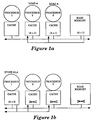
- FIG. 1a An example of a multiprocessor system maintaining cache consistency is illustrated in Figures 1a through 1d .
- the main memory unit has an address A that contains a value of 1.
- Processors 2 and 3 perform load A operations to obtain the value of A. During each processors load operation, the value of A is stored in the processor's local cache memory. Processors 2 and 3 now "share" memory location A and both caches have "valid" data.
- Figure 1b Processor 1 has written a value of 2 to location A. This is permitted since neither processor 2 or processor 3 "owned” memory location A.
- Processor 1 broadcasts a message across the memory bus informing other memory devices that the contents of memory location A has changed.
- This message causes the cache memories of processor 2 and 3 to change the status of memory location A to "invalid".
- the main memory unit does not maintain a set of status bits for each memory line. Instead, the main memory monitors a control line on the memory bus that is asserted whenever a request is made for a memory line that is "owned” by a processor subsystem. When the "owned" control line is asserted, the main memory learns that the line is owned by some processor subsystem and therefore does not respond to the request.
- Cache memory 1 now "owns” location A since it modified the contents of memory location A without updating the main memory. In Figure 1c , processor 1 has changed the contents of memory location A to the value of 3.
- processor 1 Since processor 1 does not share memory location A with any other processor, Processor 1 does not need to send a message across the memory bus. However, in Figure 1d , processor 3 requires the value of memory location A for a load operation. Processor 3 must therefore send a request across the bus requesting the value of memory location A. Since processor 1 "owns" memory location A, it must respond to the request with a reply containing contents of memory location A. Memory location A is now represented in the cache memories of processors 1 and 3. Although memory location A is still “owned” by processor 1, it must now "share” memory location A with processor 3. Therefore, any further changes to memory location A by processor 1 must be forwarded to processor 3. Processor 1 must eventually write-back the changed contents of memory location A to main memory.
- the cache memory is first searched when a processor requests data from a memory address.
- a cache controller examines the address tags in the cache directory for the requested memory address. If an address tag in the cache directory matches the memory address needed and the cache line is valid, there is a cache "hit” and the data is transferred from the cache memory to the processor. If the processor subsequently modifies the data stored in a cache line, the cache line becomes a "owned” cache line. As illustrated above, the modified or "owned” cache line must eventually be written back to the main memory. If the cache controller always updates the main memory immediately after a cache line is modified, the system is referred to as a "write-through" cache. It is called a "write-through" cache since the cache system always writes through the cache memory and into the main memory.
- a cache controller When a cache controller retrieves a line of data from the main memory or from another processor's cache memory for the local processor, the line is placed into the local cache memory. If no empty cache line is available, the cache must replace one of the currently used cache lines. The cache line chosen to be replaced is typically referred to as the displaced or victim line. If the cache system is a "write-through" cache system replaces the victim line immediately. The victim line in a "write-through" cache system can be immediately replaced since the main memory already has the contents as the victim line. However, if the processor modified the contents of the cache line (an "owned” cache line), the cache controller must first write-back the contents of the cache line to main memory before the cache line can be replaced.
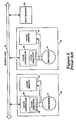
- FIG. 2 illustrates a prior art multiprocessor system with individual write-back cache memories for each processor subsystem.
- the multiprocessor system of Figure 2 maintains cache consistency by using a set of cache directories 28 located in each cache controller 29 .
- the cache directories 28 contains the tag addresses for each cache line and the status bits which specify if a cache line is valid (contains valid data), owned (modified and not written back to main memory yet), and/or shared (represented in another processor's cache memory).
- a processor in the multiprocessor system of Figure 2 When a processor in the multiprocessor system of Figure 2 needs to read information not currently stored in the local cache memory, it must often replace a currently used cache line. If the cache line to be replaced is "owned", the contents of the cache line must be written back to main memory 23 . In a typical write-back cache memory system, the cache controller 29 first writes-back the "owned" cache line to main memory 23 and after the write-back is completed, it requests the new line of data from main memory 23 . Although requesting the new cache line only after writing back the owned cache line results in a simple design, this method creates a long latency period while the owned cache line is written back and the new cache line is obtained. During this latency period, the processor 21 usually remains idle while it waits for the needed data.
- Apparatus and methods for implementing a dual directory cache control system having a pending write-back cache controller in a cache memory strudure supporting multiple processing units are disdosed.
- the processing units in the multiprocessor system are coupled together using a high-speed synchronous packet switching bus called a memory bus.
- Each processing unit has an associated write-back cache control system.
- Each write-back cache control system is divided into two separate cache controllers: the bus cache controller and the processor cache controller.
- the bus cache controller and the processor cache controller are coupled to one another over a second high-speed synchronous packet switching bus called a cache bus.
- the bus cache controller and the processor cache controller each maintain a separate directory containing tag addresses and status bits.
- the processor cache controller is closely coupled to the actual processing unit.
- the processor cache controller services memory requests made by the processing unit.
- the processor cache controller does not have a required memory location in the cache memory, it sends a request across the cache bus to the bus cache controller. If a cache line must be replaced, the processor cache controller then immediately proceeds to send the owned subblocks from the cache line that will be replaced to the bus cache controller.
- the bus cache controller is connected directly to the memory bus and handles all the memory bus transactions for the processing unit.
- the bus cache controller contains a pending write-back controller which is responsible for handling the write-backs of owned cache lines to main memory.
- the bus cache controller receives a memory request from the processor cache controller caused by a cache miss, it quickly broadcasts a corresponding memory request packet on the memory bus. If an owned cache line is to be replaced, the processor cache controller sends the subblocks from the owned cache line to the bus cache controller which buffers the owned subblocks in the pending write-back controller.
- the bus cache controller receives the new cache line information from the memory bus, it immediately sends the new cache line information to the processor cache controller which replaces the cache line and allows the processing to continue.
- the pending write-back controller allows the new cache line to be requested and replaced before the owned cache line is written back to main memory. This allows the cache miss latency period to be reduced substantially on the average.
- the pending write-back controller in the bus cache controller acts as an intelligent write-back buffer for the bus cache controller. Once the bus cache controller has sent out a read request for new cache line data, the old cache line data from the owned cache line is given to the pending write-back controller to be written back to main memory. While the pending write-back controller is in control of an owned cache line which has not been written back yet, it must respond to read requests directed to that cache line. If another device on the memory bus performs a write to a cache line owned by the pending write-back controller, the pending write-back controller must not perform the write-back since it contains stale data.
- Figures 1a - 1d provide an illustration of maintaining cache consistency in a multiprocessor system where each processor subsystem has its own cache memory.
- Figure 2 is a block diagram of a multiprocessor system with prior art write-back cache memory systems for each processor subsystem.
- Figure 3a is a block diagram of a multiprocessor system with the cache control system of the present invention where the cache controller is divided into a processor cache controller and a bus cache controller.
- Figure 3b is a block diagram of an alternate embodiment of the cache memory system of the present invention where the multiprocessor system has multiple memory buses.
- Figure 4 is a block diagram depicting the internals of the bus cache controller which are related to the pending write-back controller of the present invention.
- FIG. 5 is a block diagram of the cache memory structure used in the present invention.
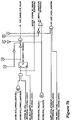
- Figure 6 is an electrical diagram depicting the subblock logic in the pending write-back controller of the present invention.
- Figure 7a is a first electrical diagram depicting the cache line logic in the pending write-back controller of the present invention.
- Figure 7b is a second electrical diagram depicting the cache line logic in the pending write-back controller of the present invention.
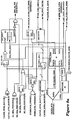
- Figure 8a is a first electrical diagram depicting the global pending write-back controller logic in the present invention.
- Figure 8a is a second electrical diagram depicting the global pending write-back controller logic in the present invention.
- Figure 9 is a block diagram illustrating the interconnections between the various hierarchical logic levels of the pending write-back controller of the present invention.
- FIG. 3a depicts a block diagram overview of a multiple processor high performance computer system incorporating the teachings of the present invention.
- a main memory unit 23 is shown coupled to a memory bus 25 .
- the main memory address space may broken into several distinct memory units. Therefore it is possible to have more than one memory unit connected to memory bus 25 .
- Also shown coupled to the memory bus 25 are a pair of processor subsystems 20 .
- the processor subsystems 20 read data from and write data to the main memory 23 over the memory bus 25 . More than two processor subsystems 20 can be coupled to the memory bus 25 to provide additional processing power.
- the memory bus 25 of Figure 3a is a high speed synchronous packet switching bus used to transfer data between a plurality of devices on the memory bus 25 . Details for implementing a packet-switched memory bus are given in the U.S. patent application Serial No. 07/620,508, filed November 30, 1990, entitled "Consistent Packet Switched Memory Bus For Shared Memory Multiprocessors" which is hereby incorporated by reference. Most transactions on the memory bus 25 consists of a request packet sent by a first device followed an arbitrary time period later by a reply packet sent by a second device. For example, a processor subsystem 20 on the memory bus 25 may send a read request packet requesting a subblock of memory.
- the main memory 23 (or another processor subsystem 20 that "owns" the subblock) would then reply back to the requesting processor subsystem with a read reply packet containing the requested memory subblock.
- a few memory bus 25 transactions consist only of a request packet, such as a write request, with no corresponding reply packet.
- the processor subsystems 20 of Figure 3a are comprised of a bus cache controller 31 , a cache bus 33 , and a processor module 32 .
- the processor module 32 performs the actual processing.
- the bus cache controller 31 performs all the required memory bus 25 transactions for the associated processor module 32 .
- the bus cache controller 31 and the processor module 32 communicate with one another over a high speed synchronous packet switching bus referred to as the cache bus 33 .
- the cache bus 33 is similar to the memory bus 25 in that each transaction consists of a request packet followed an arbitrary time period later by a reply packet.
- the cache bus 33 can be used by the processor module 32 to support multiple bus cache controllers coupled to separate memory buses. Referring to Figure 3b , an alternate embodiment of the present invention with two memory buses is illustrated. In the embodiment of Figure 3b , a processor module 32 is coupled to a cache bus 33 which has two separate bus cache controllers 30 and 31 . Each bus cache controller 30 and 31 controls bus transactions on a separate memory bus. The separate memory buses each have their own associated main memory units 22 and 24 .
- the processor module 32 contains a processor 21 , a processor cache controller 35 , and a cache memory 37 .
- the processor cache controller 35 maintains a processor cache directory 34 containing address tags and status bits for the cache lines stored in the processor cache memory 37 .
- the processor cache controller 35 is responsible for acting as an interface between the processor cache memory 37 and the processor 21 .
- the bus cache controller 31 performs a number of cache control operations for the processor subsystem 20 .
- the main purpose of the bus cache controller 31 is to perform all the required memory bus 25 transactions for the processor subsystem 20 .
- the bus cache controller 31 maintains a cache directory 46 containing the address tags and status bits for the data in the cache memory 37 .
- the bus cache controller 31 includes a pending write-back controller 40 which is responsible for writing back owned cache lines which have been replaced with new information as will be explained later.
- the functionality of the bus cache controller 31 is best explained with reference to the transactions it manages on the memory bus 25 .
- the bus cache controller 31 performs three types of bus transactions on the memory bus 25 : reads, writes, and write-backs. Each transaction type will be addressed separately.
- the processor cache controller 35 sends a read request packet across the cache bus 33 to the bus cache controller 31 .
- the bus cache controller 31 proceeds to broadcast a corresponding read request packet across the memory bus 25 .
- the read transaction initiated by the bus cache controller 31 consists of two packets: a read request packet sent by the bus cache controller 31 on the memory bus 25 and a read reply packet sent by another device on the memory bus.
- the read request packet contains the address of the memory requested by the processor cache controller 35 and is broadcast to all entities on the memory bus 25 .
- a device on the memory bus 25 that contains the requested memory address responds to the read request packet with a read reply packet containing the subblock which includes the requested memory address.
- the read reply packet is generally issued by the main memory 23 except when the desired memory address is "owned" by another processor subsystem 20 . In that case, the processor subsystem that owns the subblock must generate a read reply packet with the requested data.
- Write-back transactions are issued by the bus cache controller 31 when updating main memory 23 with owned subblocks from cache lines that are no longer needed by the processor 21 .
- Write-back transactions on the memory bus 25 are directed to the main memory 23 and are ignored by the other processor subsystems on the memory bus.
- step-by-step the events that take place when there is a cache miss and no empty cache lines are available.
- a write-back transaction which gets rid of the old information in the cache line
- a read transaction which obtains the new information for the new cache line.
- the processor cache controller 35 issues a read request packet containing the required memory address to the bus cache controller 31 through the cache bus 33 .
- the bus cache controller 31 responds to the read request packet by broadcasting a corresponding read request packet across the memory bus 25 .
- the appropriate memory unit or processor subsystem on the memory bus 25 should eventually respond to the read request packet with a read reply packet containing the requested data.
- the bus cache controller 31 gives the pending write-back controller 40 the responsibility of writing back the old owned subblocks from the cache line being replaced.
- the pending write-back controller 40 acts as an intelligent buffer which handles all read requests for the old cache line data until it is written back to main memory 23 .
- the processor cache controller 35 After the processor cache controller 35 has sent the read request packet to the bus cache controller 31 , and independently of whether or not the bus cache controller 31 issued the read request packet, the processor cache controller 35 begins to send the bus cache controller 31 any owned subblocks in the cache line which will be replaced by the new information.
- the bus cache controller 31 directs these owned subblocks to the pending write-back controller 40 which stores them into a data RAM.
- the processor cache controller 35 marks the cache line as invalid and is ready to accept the new cache line data.
- the pending write-back controller 40 After the pending write-back controller 40 has received all the owned subblocks from the processor cache controller 35 and the bus cache controller 31 has issued a read request for the desired data, the pending write-back controller 40 begins sending write-back packets containing owned subblocks to main memory 23 . The write-backs to main memory 23 occur and independently of whether the bus cache controller has received a read reply packet.
- the write-back cache system of the present invention maintains three separate cache directories: the processor cache directory 34 , the bus cache controller directory 46 , and a small directory in the pending write-back controller.
- the processor cache directory 34 and the bus cache controller directory 46 store the address tags and status bits for the information in the cache memory 37 .
- the address tags and status bits in the processor cache directory 34 and the bus cache controller directory 46 usually match. However, the address tag and status bits for a given cache line in the processor cache directory 34 and the bus cache controller directory 46 may not correlate at all times. For example the processor cache controller 35 may have written back a subblock from a cache line to the bus cache controller 31 so the processor cache controller 35 no longer "owns" the subblock, but the bus cache controller 31 does still own the subblock.
- the bus cache controller 31 issues a request for the new information and transfers control of the old subblocks to the pending write-back controller 40 , the bus cache controller directory 46 again matches the processor cache directory 34 .
- the pending write-back controller 40 maintains a small directory of the owned subblocks it is buffering until they are written back to main memory 23 .
- Each of the subblocks stored in the pending write-back controller 40 can be in one of 3 states: valid, owned, and invalid.
- the pending write-back controller 40 uses its directory to implement the two rules given above. If another processor subsystem executes a write to one of the owned subblocks in the pending write-back controller, it changes the status of that subblock to not owned since the data in the pending write-back controller is now stale.
- the pending write-back controller 40 receives a read request packet from another processor subsystem for an owned subblock, the pending write-back controller 40 responds with a read reply packet containing the requested information.
- Figure 4 illustrates in block diagram form, the internals of the bus cache controller 31 which are used to perform cache line write-backs. Other parts of the bus cache controller 31 have been omitted to avoid confusion.
- the parts of the bus cache controller 31 used to perform write-backs include an arbiter controller 41 , a bus data controller 43 , a pending write-back controller 40 , and a tag controller 45 with an associated cache directory 46 containing address tags and status bits.
- the arbiter controller 41 performs the required memory bus arbitration steps for the pending write-back controller 40 .
- the arbiter controller 41 is used by the pending write-back controller 40 when it needs the memory bus 25 in order to perform a write-back of an owned cache line or to send a read reply packet in response to a read request packet received from another processor subsystem.
- Methods for performing bus arbitration on a packet-switched bus are provided in the U.S. patent application, Serial No. 07/621,123, filed November 30, 1990, entitled "Arbitration Of Packet Switched Busses, Including Busses For Shared Memory Multiprocessors" which is hereby incorporated by reference.
- the bus data controller 43 performs the "packaging" operations required to send "request” and "reply” packets on the memory bus once the arbiter controller 41 has obtained ownership of the memory bus 25 .
- the pending write-back controller 40 uses the bus data controller 43 to send write-back and read reply packets. Methods and apparatus for sending packets on a packet switched bus are well known in the art and therefore the bus data controller 43 will not be discussed further.
- the tag controller 45 controls the bus cache controller directory 46 of address tags and status bits which reflect the state of the cache memory 37 .
- the tag controller 45 provides an owned_flag [L] signal to the pending write-back controller 40 .
- the "[L]” designates a subblock index as will be explained later.
- the owned_flag [L] is used to transfer ownership of subblocks from the bus cache controller to the pending write-back controller 40 .
- the pending write-back controller 40 stores the owned cache lines which need to be written back to main memory and controls the write-back operation.
- the internals of the pending write-back controller 40 will now be explained in detail.
- the control logic in the pending write-back controller is best explained by splitting it into three hierarchical levels.
- the lowest level is the subblock logic.
- the subblock logic is the logic that required to control each subblock stored in the pending write-back controller.
- the next level is the cache line logic.
- the cache line logic is the logic required to control each cache line in the pending write-back controller .
- the highest level is the global logic.
- the global logic uses the information from the two lower levels of logic in its operation.
- Figures 6 , 7a , 7b , 8a , 8b and 9 will be used to explain the pending write-back controller logic in detail.
- All the signals on the left side of the page are input signals and all the signals on the right side of the page are output signals.
- Signals names with an accompanying "(EXTERNAL)" label represent signals that are connected to a higher hierarchical level.
- Signal names without the "(EXTERNAL)" label represent signals that are connected to a lower higher hierarchical level.
- Figures 6 , 7a , 7b , 8a , and 8b explain a pending write-back controller logic in a system with the cache memory depicted in Figure 5 .
- the cache memory of Figure 5 contains M cache lines which are indexed from 1 to M using an index K.
- the cache lines are each split into N subblocks which are indexed from 1 to N using an index L.
- M and N are generally chosen to be a power of two.
- Figures 6, 7a , 7b , 8a , and 8b all the signals pertaining to a specific cache line will be given an appended index value [K] and the signals pertaining to a specific subblock will be given an appended index value [L].
- I is defined to be log2 M or the number of bits needed to represent any number between 1 and M.
- Each subblock within the pending write-back controller has two flip-flops 61 and 63 which produce the two signal bits subblock_valid [L] and subblock_owned [L] respectively. These bits reflect the status of the subblocks in the pending write-back controller. Additional logic produces the subblock_owned_match [L] signal.
- subblock_valid [L] signal bit 61 When the subblock_valid [L] signal bit 61 is asserted, it indicates that the corresponding subblock in the pending write-back controller data RAM either contains the valid data for the subblock, which has been received from the processor cache controller through the cache bus, or that this data is not expected to be sent by the processor cache controller. Therefore, it is set when last_data_arrived is asserted signaling that the processor cache controller has sent the pending write-back controller all the owned subblocks, or when the bus cache controller issues the read request packet (See Figure 7b ) and the corresponding owned bit in the tag directory is not set.
- the subblock_valid [L] signal bit 61 is reset when there are no read replies pending to other processors, all the required subblocks have been received by the pending write-back controller from the processor cache controller and written back if they are still owned. The resetting of the subblock_valid [L] signal will be explained in more detail in the description of the cache line logic.
- the subblock_owned [L] flip-flop 63 indicates that the corresponding subblock is owned by the pending write-back controller.
- read replies must be sent to other processor subsystems requesting this subblock and the subblock must be written back to main memory before the subblock_owned [L] flip-flop can be cleared.
- the subblock_owned [L] bit 63 is set when the bus cache controller issues a read request packet on the memory bus and the corresponding "owned" status bit in the bus cache control directory 46 (See Figure 3a ) is set as indicated by the owned_flag [L] . This in effect transfers "ownership" of the subblock from the bus cache controller directory 46 to the pending write-back controller.
- the subblock_owned [L] bit 63 is reset when the write-back to main memory is performed by the pending write-back controller or another processor writes to the subblock before the write-back takes place, thereby signaling that the data for this subblock in the pending write-back controller is stale.
- the signal resetting the subblock_owned [L] bit 63 is formed by the logical AND of a signal that detects a write on the memory bus ( wb_or_write ), a signal that detects a cache line match ( cache_line_match ), and a signal that detects a subblock match ( mem_bus_addr_dec [L]).
- the subblock_owned_match [L] signal indicates that the current subblock on the memory bus matches this particular subblock and that the subblock is owned by the pending write-back controller. This signal is used by the next two higher levels of pending write-back controller logic.
- the subblock_owned_match [L] signal is produced by the logical AND of the cache_line_match signal (which signals that the address on the memory bus matches the address of this cache line), the mem_bus_addr_dec [L] signal (which signals that the subblock on the memory bus matches this subblock), and the subblock_owned signal[L].
- subblock_valid [1 - N], subblock_owned [1 - N], and subblock_owned_match [1 - N] signals described in the previous section are input signals from the subblock logic units associated with this particular cache line.
- the cache_line_valid signal is asserted from the time that the processor cache controller issues a read request until the time that all the necessary subblocks have been written back to main memory and no more read replies need to be issued to other requesting processors. This signal is produced by a logical OR of the cache line's associated subblock_valid [1 - N], subblock_owned [1 -N], rd_req_pending, and rd_reply_pending bits.
- the rd_reply_pending signal bit 75 is set whenever another processor in the system issues a read request for a subblock owned by the pending write-back controller.
- the rd_reply_pending signal bit 75 indicates that the pending write-back controller needs to send one or more read reply packets containing the owned subblocks back to the appropriate requesting processor subsystems before the cache line can be purged.
- the rd_reply_pending signal bit 75 is set by a logical AND of the other_rd_req signal and a signal indicating an address match between the memory bus and a subblock in this cache line.
- the signal used to set the rd_reply_pending signal bit 75 is also used to inform the pending write-back global logic by generating a queue_other_rd_req [K] signal to queue the read request onto a FIFO queue storing a list of read replies that must be sent out.
- the cache_line_addr flip-flops 71 store the current address of the associated cache line.
- the mem_bus_addr_match signal is asserted if the address for the command on the memory bus matches the address stored in the cache_line_addr flip-flops 71 .
- the cache_line_busy [K] signal is similar to the cache_line_valid signal, except that it will only be asserted if the processor cache controller sends a packet across the cache bus with the same address as that stored in the cache_line_addr flip-flops 71 . This allows the processor cache controller to send multiple outstanding read requests to the same cache line, as could be implemented for pre-fetching additional data within the cache line.
- the rst_subblock_valid signal is asserted when all of the subblock_valid [L] bits for the cache line are set, there is no rd_req_pending, for the cache line, there is no rd_reply_pending, for the cache line, and none of the subblocks are owned (as indicated by a logical NOR of all the subblock_owned [L] bits). This indicates that all the required subblocks have been received by the pending write-back controller, written back to main memory if needed, and no more read replies need be issued to other requesting processor subsystems.
- the queue_other_rd_req [K] line indicates when another processor has requested an owned subblock from this cache line in the pending write-back controller.
- the queue_other_rd_req [K] line is asserted if any one of the subblock_owned_match [L] bits indicates an address match with the packet on the memory bus and the other_rd_req signal indicates the packet on the memory bus is a read request from another processor subsystem.
- the queue_other_rd_req signal will cause a read request to be queued onto a FIFO queue in the global logic storing a list of read replies that must be sent out.
- the rd_rply_enable [K] signal for the cache line is asserted if either all the required owned subblocks have been issued by the processor cache, or this cache line controller is not being used. This signal is used by the global logic to determine if the arbiter controller should attempt to get access to the memory bus.
- the last_data_arrived signal indicates when the last cycle transferring an owned subblock from the processor cache controller to the pending write-back controller has occurred. This signal is the logical AND of cache_line_valid, last_data_xferred, and wb_fifo_dec [K].
- Figures 8a and 8b illustrate the global pending write-back controller logic.
- the decoder 82 will decode the read request control information and allocate a cache line by examining the cache lines that are not busy using a priority encoder 89 . This will cause one of the cache_line_allocated [K] signals to be asserted which loads the address into the cache_line_addr flip-flips 71 of the chosen cache line controller.
- the wb_fifo 83 contains an encoded list of the subblocks in the data_ram 81 that need to be written back to main memory. These subblocks cannot be sent to main memory until all the rd_req_pending [1 - M] signals are de-asserted, indicating that the read request has been issued by the bus cache controller and ownership of the subblocks is transferred to the pending write-back controller. Once the subblocks are ready to be transferred to the memory bus, the appropriate subblock_owned [L] bit must be checked again to ensure that it is still set. If a write request by another processor to a particular subblock has occurred, its subblock_owned [L] bit will not be set.
- subblock_owned [L] bit If subblock_owned [L] bit is not set then the subblock must not be written to main memory since the subblock is stale. A similar check may be performed before requesting access to the memory bus, however the details of the memory bus arbitration logic are beyond the scope of this patent.
- the rd_fifo 85 contains an encoded list of the read requests issued by other processor subsystems to the subblocks owned by the pending write-back controller.
- the pending write-back controller does not reply to the pending read requests in the rd_fifo 85 until all the owned subblocks which will be replaced have been sent from the processor cache controller.
- the pending write-back controller must respond to all the read requests in the rd_fifo 85 before the subblocks in the pending write-back controller can be invalidated.
- the data_ram 81 , wb_fifo 83 , and rd_fifo 85 need not be implemented as single RAMs or FIFOs. Each may be implemented with as many RAMs and FIFOs as there are cache lines. This approach removes the dependency on all the cache lines for emptying the wb_fifo 83 and the rd_fifo. 85 For example, if a single RAM is used to implement the rd_fifo 85 , the cache line corresponding to the read request at the top of the queue may not have received the data from the processor cache controller yet. This would prevent other read requests in the rd_fifo 85 requesting information from other cache lines from proceeding, even if the data is available in the data_ram 81 .
- Each cache line logic unit is given a label Cx where x is a value from 1 to M corresponding to the cache line.
- Each subblock logic unit is given a label Cx.SBy where x is a value from 1 to M corresponding to the cache line and y is a value from 1 to N corresponding to the subblock.
- Cx.SBy where x is a value from 1 to M corresponding to the cache line and y is a value from 1 to N corresponding to the subblock.
- three cache line logic units are depicted with two subblock logic units for each cache line logic unit.
- the global logic also has several internal inputs and outputs which connect to the cache line logic units and the subblock logic units.
- Global logic output lines 91 carry the signals issued_rd_req , mem_bus_addr , cache_bus_addr , cache_subbloc_xfer , other_rd_rq , and rd_fifo_empty to every cache line logic unit C1 - CM.
- Global logic output lines 91 also carry the appropriate cache_line_allocated [K] and wb_fifo_dec [K] signals to each cache logic unit CK where K is from 1 to M.
- Global logic output lines 93 carry signals to all the subblock logic units.
- the cache line logic units to the right of the global logic receive input from the global logic and the associated subblocks.
- Each cache line logic CK receives the global logic output lines 91 described above as input.
- Each cache line logic CK also receives the signals subblock_valid [1 - N], subblock_owned [1 - N], and subblock_owned matchl [1 - N] from the associated subblocks L over the subblock output lines 99 .
- the cache line logic units output the global logic input lines 95 described above.
- Each cache line logic unit also outputs the signals set_subblock_valid, rst_subblock_valid, last_dafa_arrived, and cache_line_match on cache line output lines 92 to each associated subblock logic unit.
- the subblock logic units receive input from the associated cache line logic unit, the global logic, and the tag controller.
- the subblock logic units each receive the global logic output lines 93 from global logic and the cache line output lines 92 from the associated cache line logic.
- Each subblock logic unit also receives the input owned_flag [L] from the tag controller in the bus cache controller. This signal is used to transfer ownership from the bus cache controller to the pending write-back controller.
- Each subblock logic unit outputs the global logic input lines 97 and the subblock to cache line signals described above.
Landscapes
- Engineering & Computer Science (AREA)
- Theoretical Computer Science (AREA)
- Physics & Mathematics (AREA)
- General Engineering & Computer Science (AREA)
- General Physics & Mathematics (AREA)
- Memory System Of A Hierarchy Structure (AREA)
Applications Claiming Priority (2)
| Application Number | Priority Date | Filing Date | Title |
|---|---|---|---|
| US973309 | 1992-11-09 | ||
| US07/973,309 US5434993A (en) | 1992-11-09 | 1992-11-09 | Methods and apparatus for creating a pending write-back controller for a cache controller on a packet switched memory bus employing dual directories |
Publications (2)
| Publication Number | Publication Date |
|---|---|
| EP0598535A1 true EP0598535A1 (fr) | 1994-05-25 |
| EP0598535B1 EP0598535B1 (fr) | 1999-12-22 |
Family
ID=25520741
Family Applications (1)
| Application Number | Title | Priority Date | Filing Date |
|---|---|---|---|
| EP93308913A Expired - Lifetime EP0598535B1 (fr) | 1992-11-09 | 1993-11-08 | Circuit de commande à postmémorisation pour unité de commande d'antémémoire couplé à un bus à commutation de paquets |
Country Status (4)
| Country | Link |
|---|---|
| US (1) | US5434993A (fr) |
| EP (1) | EP0598535B1 (fr) |
| JP (1) | JPH076092A (fr) |
| DE (1) | DE69327387T2 (fr) |
Cited By (14)
| Publication number | Priority date | Publication date | Assignee | Title |
|---|---|---|---|---|
| EP0735486A1 (fr) * | 1995-03-31 | 1996-10-02 | Sun Microsystems, Inc. | Système multiprocesseur à commutation par paquets et à cohérence d'antémémoire |
| EP0735485A1 (fr) * | 1995-03-31 | 1996-10-02 | Sun Microsystems, Inc. | Système de traitement parallèlisé et cohérent de transactions de lecture et de postmémorisation pour un système multiprocesseur à commutation par paquets et à cohérence d'antémémoire |
| EP0735484A1 (fr) * | 1995-03-31 | 1996-10-02 | Sun Microsystems, Inc. | Système de traitement pour suppression de postmémorisation pour un système multiprocesseur à commutation par paquets et à cohérence d'antémémoire |
| WO1997027543A1 (fr) * | 1996-01-25 | 1997-07-31 | Unisys Corporation | Procede et circuits d'execution de commandes de lecture et de modification de mots de donnees dans un systeme informatique distribue multi-niveaux |
| US5655100A (en) * | 1995-03-31 | 1997-08-05 | Sun Microsystems, Inc. | Transaction activation processor for controlling memory transaction execution in a packet switched cache coherent multiprocessor system |
| US5657472A (en) * | 1995-03-31 | 1997-08-12 | Sun Microsystems, Inc. | Memory transaction execution system and method for multiprocessor system having independent parallel transaction queues associated with each processor |
| US5689713A (en) * | 1995-03-31 | 1997-11-18 | Sun Microsystems, Inc. | Method and apparatus for interrupt communication in a packet-switched computer system |
| US5706463A (en) * | 1995-03-31 | 1998-01-06 | Sun Microsystems, Inc. | Cache coherent computer system that minimizes invalidation and copyback operations |
| US5710891A (en) * | 1995-03-31 | 1998-01-20 | Sun Microsystems, Inc. | Pipelined distributed bus arbitration system |
| US5737755A (en) * | 1995-03-31 | 1998-04-07 | Sun Microsystems, Inc. | System level mechanism for invalidating data stored in the external cache of a processor in a computer system |
| EP0793178A3 (fr) * | 1996-02-27 | 1998-04-15 | Sun Microsystems, Inc. | Mémoire tampon et procédé de post-mémorisation pour système multiprocesseur |
| US5893165A (en) * | 1996-07-01 | 1999-04-06 | Sun Microsystems, Inc. | System and method for parallel execution of memory transactions using multiple memory models, including SSO, TSO, PSO and RMO |
| US5907485A (en) * | 1995-03-31 | 1999-05-25 | Sun Microsystems, Inc. | Method and apparatus for flow control in packet-switched computer system |
| US6101565A (en) * | 1996-07-01 | 2000-08-08 | Sun Microsystems, Inc. | System for multisized bus coupling in a packet-switched computer system |
Families Citing this family (44)
| Publication number | Priority date | Publication date | Assignee | Title |
|---|---|---|---|---|
| ES2139583T3 (es) * | 1992-08-19 | 2000-02-16 | Siemens Nixdorf Inf Syst | Sistema multiprocesador con memorias cache. |
| US6088768A (en) * | 1993-12-28 | 2000-07-11 | International Business Machines Corporation | Method and system for maintaining cache coherence in a multiprocessor-multicache environment having unordered communication |
| US5832534A (en) * | 1994-01-04 | 1998-11-03 | Intel Corporation | Method and apparatus for maintaining cache coherency using a single controller for multiple cache memories |
| TW243509B (en) * | 1994-01-31 | 1995-03-21 | Ibm | Data processor with memory cache and method of operation |
| JP2778913B2 (ja) * | 1994-04-26 | 1998-07-23 | 株式会社東芝 | マルチプロセッサシステム及びメモリアロケーション方法 |
| JP3360933B2 (ja) * | 1994-06-01 | 2003-01-07 | 富士通株式会社 | 情報処理システムにおける記憶制御方法および記憶制御装置 |
| US5566317A (en) * | 1994-06-14 | 1996-10-15 | International Business Machines Corporation | Method and apparatus for computer disk drive management |
| US5642494A (en) * | 1994-12-21 | 1997-06-24 | Intel Corporation | Cache memory with reduced request-blocking |
| US6000017A (en) * | 1995-01-20 | 1999-12-07 | Intel Corporation | Hybrid tag architecture for a cache memory |
| JP3872118B2 (ja) * | 1995-03-20 | 2007-01-24 | 富士通株式会社 | キャッシュコヒーレンス装置 |
| US5649157A (en) * | 1995-03-30 | 1997-07-15 | Hewlett-Packard Co. | Memory controller with priority queues |
| US5737756A (en) * | 1995-04-28 | 1998-04-07 | Unisys Corporation | Dual bus computer network using dual busses with dual spy modules enabling clearing of invalidation queue for processor with store through cache while providing retry cycles for incomplete accesses to invalidation queue |
| US6076150A (en) * | 1995-08-10 | 2000-06-13 | Lsi Logic Corporation | Cache controller with improved instruction and data forwarding during refill operation |
| US5887146A (en) * | 1995-08-14 | 1999-03-23 | Data General Corporation | Symmetric multiprocessing computer with non-uniform memory access architecture |
| US6021472A (en) * | 1995-08-21 | 2000-02-01 | Canon Kabushiki Kaisha | Information processing device and control method thereof |
| US5778208A (en) * | 1995-12-18 | 1998-07-07 | International Business Machines Corporation | Flexible pipeline for interlock removal |
| US5829035A (en) * | 1995-12-22 | 1998-10-27 | Apple Computer, Inc. | System and method for preventing stale data in multiple processor computer systems |
| JPH09223118A (ja) * | 1996-02-14 | 1997-08-26 | Oki Electric Ind Co Ltd | スヌープキャッシュメモリ制御システム |
| US6385710B1 (en) | 1996-02-23 | 2002-05-07 | Sun Microsystems, Inc. | Multiple-mode external cache subsystem |
| US5911052A (en) * | 1996-07-01 | 1999-06-08 | Sun Microsystems, Inc. | Split transaction snooping bus protocol |
| US5829033A (en) * | 1996-07-01 | 1998-10-27 | Sun Microsystems, Inc. | Optimizing responses in a coherent distributed electronic system including a computer system |
| US5860117A (en) * | 1996-05-31 | 1999-01-12 | Sun Microsystems, Inc. | Apparatus and method to improve primary memory latencies using an eviction buffer to store write requests |
| US5809548A (en) * | 1996-08-30 | 1998-09-15 | International Business Machines Corporation | System and method for zeroing pages with cache line invalidate instructions in an LRU system having data cache with time tags |
| US6202125B1 (en) | 1996-11-25 | 2001-03-13 | Intel Corporation | Processor-cache protocol using simple commands to implement a range of cache configurations |
| US5829029A (en) * | 1996-12-18 | 1998-10-27 | Bull Hn Information Systems Inc. | Private cache miss and access management in a multiprocessor system with shared memory |
| US6122711A (en) | 1997-01-07 | 2000-09-19 | Unisys Corporation | Method of and apparatus for store-in second level cache flush |
| US6032226A (en) * | 1997-04-14 | 2000-02-29 | International Business Machines Corporation | Method and apparatus for layering cache and architectural specific functions to expedite multiple design |
| US6061755A (en) * | 1997-04-14 | 2000-05-09 | International Business Machines Corporation | Method of layering cache and architectural specific functions to promote operation symmetry |
| US6209072B1 (en) | 1997-05-06 | 2001-03-27 | Intel Corporation | Source synchronous interface between master and slave using a deskew latch |
| US6434639B1 (en) * | 1998-11-13 | 2002-08-13 | Intel Corporation | System for combining requests associated with one or more memory locations that are collectively associated with a single cache line to furnish a single memory operation |
| US6859399B1 (en) | 2000-05-17 | 2005-02-22 | Marvell International, Ltd. | Memory architecture and system and multiport interface protocol |
| US7472230B2 (en) * | 2001-09-14 | 2008-12-30 | Hewlett-Packard Development Company, L.P. | Preemptive write back controller |
| US6785779B2 (en) * | 2002-01-09 | 2004-08-31 | International Business Machines Company | Multi-level classification method for transaction address conflicts for ensuring efficient ordering in a two-level snoopy cache architecture |
| WO2004092958A2 (fr) * | 2003-04-11 | 2004-10-28 | Sun Microsystems, Inc. | Systeme informatique multinoeud a transactions de substitution permettant de lire des donnees dans un dispositif de memoire non exclusif |
| US7945738B2 (en) * | 2003-04-11 | 2011-05-17 | Oracle America, Inc. | Multi-node computer system employing a reporting mechanism for multi-node transactions |
| US7606978B2 (en) * | 2003-04-11 | 2009-10-20 | Sun Microsystems, Inc. | Multi-node computer system implementing global access state dependent transactions |
| US7360029B2 (en) * | 2003-04-11 | 2008-04-15 | Sun Microsystems, Inc. | Multi-node computer system in which interfaces provide data to satisfy coherency transactions when no owning device present in modified global access state node |
| US20050005075A1 (en) * | 2003-04-11 | 2005-01-06 | Sun Microsystems, Inc. | Multi-node computer system employing multiple memory response states |
| US7814278B2 (en) * | 2003-04-11 | 2010-10-12 | Oracle America, Inc. | Multi-node system with response information in memory |
| US20050010615A1 (en) * | 2003-04-11 | 2005-01-13 | Sun Microsystems, Inc. | Multi-node computer system implementing memory-correctable speculative proxy transactions |
| US20050013294A1 (en) * | 2003-04-11 | 2005-01-20 | Sun Microsystems, Inc. | Multi-node computer system with active devices employing promise arrays for outstanding transactions |
| US8559443B2 (en) | 2005-07-22 | 2013-10-15 | Marvell International Ltd. | Efficient message switching in a switching apparatus |
| JP6139689B2 (ja) * | 2012-10-22 | 2017-05-31 | インテル・コーポレーション | 装置 |
| CN112416615B (zh) * | 2020-11-05 | 2024-08-16 | 珠海格力电器股份有限公司 | 多核处理器及其缓存一致性的实现方法、装置和存储介质 |
Citations (2)
| Publication number | Priority date | Publication date | Assignee | Title |
|---|---|---|---|---|
| WO1990005953A1 (fr) * | 1988-11-14 | 1990-05-31 | Unisys Corporation | Protocole de coherence d'antememoire mis en ×uvre au niveau des equipements avec repertoire distribue et duplique pour multiprocesseurs a hautes performances |
| EP0468831A2 (fr) * | 1990-06-29 | 1992-01-29 | Digital Equipment Corporation | Protocole de bus pour processeur avec antémémoire à postmémorisation |
Family Cites Families (10)
| Publication number | Priority date | Publication date | Assignee | Title |
|---|---|---|---|---|
| US5247648A (en) * | 1990-04-12 | 1993-09-21 | Sun Microsystems, Inc. | Maintaining data coherency between a central cache, an I/O cache and a memory |
| US5263144A (en) * | 1990-06-29 | 1993-11-16 | Digital Equipment Corporation | Method and apparatus for sharing data between processors in a computer system |
| US5347648A (en) * | 1990-06-29 | 1994-09-13 | Digital Equipment Corporation | Ensuring write ordering under writeback cache error conditions |
| US5265235A (en) * | 1990-11-30 | 1993-11-23 | Xerox Corporation | Consistency protocols for shared memory multiprocessors |
| US5303362A (en) * | 1991-03-20 | 1994-04-12 | Digital Equipment Corporation | Coupled memory multiprocessor computer system including cache coherency management protocols |
| US5265233A (en) * | 1991-05-17 | 1993-11-23 | Sun Microsystems, Inc. | Method and apparatus for providing total and partial store ordering for a memory in multi-processor system |
| US5313609A (en) * | 1991-05-23 | 1994-05-17 | International Business Machines Corporation | Optimum write-back strategy for directory-based cache coherence protocols |
| US5325504A (en) * | 1991-08-30 | 1994-06-28 | Compaq Computer Corporation | Method and apparatus for incorporating cache line replacement and cache write policy information into tag directories in a cache system |
| US5353424A (en) * | 1991-11-19 | 1994-10-04 | Digital Equipment Corporation | Fast tag compare and bank select in set associative cache |
| US5355471A (en) * | 1992-08-14 | 1994-10-11 | Pyramid Technology Corporation | Multiprocessor cache coherency tester that exercises the coherency logic exhaustively and also detects errors in a processor using an automatic CPU sort |
-
1992
- 1992-11-09 US US07/973,309 patent/US5434993A/en not_active Expired - Lifetime
-
1993
- 1993-11-08 DE DE69327387T patent/DE69327387T2/de not_active Expired - Fee Related
- 1993-11-08 EP EP93308913A patent/EP0598535B1/fr not_active Expired - Lifetime
- 1993-11-09 JP JP5302259A patent/JPH076092A/ja active Pending
Patent Citations (2)
| Publication number | Priority date | Publication date | Assignee | Title |
|---|---|---|---|---|
| WO1990005953A1 (fr) * | 1988-11-14 | 1990-05-31 | Unisys Corporation | Protocole de coherence d'antememoire mis en ×uvre au niveau des equipements avec repertoire distribue et duplique pour multiprocesseurs a hautes performances |
| EP0468831A2 (fr) * | 1990-06-29 | 1992-01-29 | Digital Equipment Corporation | Protocole de bus pour processeur avec antémémoire à postmémorisation |
Non-Patent Citations (2)
| Title |
|---|
| "Improved data cache reload performance", IBM TECHNICAL DISCLOSURE BULLETIN, vol. 32, no. 4B, September 1989 (1989-09-01), NEW YORK US, pages 244 - 245 * |
| QUINONES: "The NS32605 cache controller", COMPCON 88, THIRTY-THIRD IEEE COMPUTER SOCIETY INTERNATIONAL CONFERENCE, DIGEST OF PAPERS, 29 February 1988 (1988-02-29), SAN FRANCISCO; US, pages 218 - 222, XP010011506, DOI: doi:10.1109/CMPCON.1988.4862 * |
Cited By (17)
| Publication number | Priority date | Publication date | Assignee | Title |
|---|---|---|---|---|
| US5657472A (en) * | 1995-03-31 | 1997-08-12 | Sun Microsystems, Inc. | Memory transaction execution system and method for multiprocessor system having independent parallel transaction queues associated with each processor |
| EP0735485A1 (fr) * | 1995-03-31 | 1996-10-02 | Sun Microsystems, Inc. | Système de traitement parallèlisé et cohérent de transactions de lecture et de postmémorisation pour un système multiprocesseur à commutation par paquets et à cohérence d'antémémoire |
| EP0735484A1 (fr) * | 1995-03-31 | 1996-10-02 | Sun Microsystems, Inc. | Système de traitement pour suppression de postmémorisation pour un système multiprocesseur à commutation par paquets et à cohérence d'antémémoire |
| US5634068A (en) * | 1995-03-31 | 1997-05-27 | Sun Microsystems, Inc. | Packet switched cache coherent multiprocessor system |
| EP0735486A1 (fr) * | 1995-03-31 | 1996-10-02 | Sun Microsystems, Inc. | Système multiprocesseur à commutation par paquets et à cohérence d'antémémoire |
| US5655100A (en) * | 1995-03-31 | 1997-08-05 | Sun Microsystems, Inc. | Transaction activation processor for controlling memory transaction execution in a packet switched cache coherent multiprocessor system |
| US5892957A (en) * | 1995-03-31 | 1999-04-06 | Sun Microsystems, Inc. | Method and apparatus for interrupt communication in packet-switched microprocessor-based computer system |
| US5684977A (en) * | 1995-03-31 | 1997-11-04 | Sun Microsystems, Inc. | Writeback cancellation processing system for use in a packet switched cache coherent multiprocessor system |
| US5689713A (en) * | 1995-03-31 | 1997-11-18 | Sun Microsystems, Inc. | Method and apparatus for interrupt communication in a packet-switched computer system |
| US5706463A (en) * | 1995-03-31 | 1998-01-06 | Sun Microsystems, Inc. | Cache coherent computer system that minimizes invalidation and copyback operations |
| US5710891A (en) * | 1995-03-31 | 1998-01-20 | Sun Microsystems, Inc. | Pipelined distributed bus arbitration system |
| US5737755A (en) * | 1995-03-31 | 1998-04-07 | Sun Microsystems, Inc. | System level mechanism for invalidating data stored in the external cache of a processor in a computer system |
| US5907485A (en) * | 1995-03-31 | 1999-05-25 | Sun Microsystems, Inc. | Method and apparatus for flow control in packet-switched computer system |
| WO1997027543A1 (fr) * | 1996-01-25 | 1997-07-31 | Unisys Corporation | Procede et circuits d'execution de commandes de lecture et de modification de mots de donnees dans un systeme informatique distribue multi-niveaux |
| EP0793178A3 (fr) * | 1996-02-27 | 1998-04-15 | Sun Microsystems, Inc. | Mémoire tampon et procédé de post-mémorisation pour système multiprocesseur |
| US5893165A (en) * | 1996-07-01 | 1999-04-06 | Sun Microsystems, Inc. | System and method for parallel execution of memory transactions using multiple memory models, including SSO, TSO, PSO and RMO |
| US6101565A (en) * | 1996-07-01 | 2000-08-08 | Sun Microsystems, Inc. | System for multisized bus coupling in a packet-switched computer system |
Also Published As
| Publication number | Publication date |
|---|---|
| US5434993A (en) | 1995-07-18 |
| DE69327387D1 (de) | 2000-01-27 |
| JPH076092A (ja) | 1995-01-10 |
| DE69327387T2 (de) | 2000-08-31 |
| EP0598535B1 (fr) | 1999-12-22 |
Similar Documents
| Publication | Publication Date | Title |
|---|---|---|
| US5434993A (en) | Methods and apparatus for creating a pending write-back controller for a cache controller on a packet switched memory bus employing dual directories | |
| KR100491435B1 (ko) | 다수의 시스템 버스를 가지는 컴퓨터 시스템 내의 메모리 일관성을 유지하기 위한 시스템 및 방법 | |
| EP0817073B1 (fr) | Système multiprocesseur capable d'exécuter efficacement des opérations d'écriture | |
| US6629205B2 (en) | System and method for increasing the snoop bandwidth to cache tags in a cache memory subsystem | |
| EP0936555B1 (fr) | Protocole de cohérence d'antémémoire avec réalisation indépendante d'operations d'antémémoire optimisées | |
| KR100318789B1 (ko) | 멀티프로세서 데이타 처리 시스템에서의 캐쉬를 관리하는시스템과 방법 | |
| US7827354B2 (en) | Victim cache using direct intervention | |
| US20070239938A1 (en) | Area effective cache with pseudo associative memory | |
| US20060155934A1 (en) | System and method for reducing unnecessary cache operations | |
| KR19980079433A (ko) | 비포함 캐쉬 메모리 계층 구조에서 사용하기 위한 캐쉬 일관성 메카니즘 구현 방법 및 시스템 | |
| KR20050070013A (ko) | 원격 캐쉬 존재 정보를 저장하는 프로세서 캐쉬를 구비한컴퓨터 시스템 | |
| US20020169935A1 (en) | System of and method for memory arbitration using multiple queues | |
| GB2460337A (en) | Reducing back invalidation transactions from a snoop filter | |
| JPH11506852A (ja) | 多数のバスマスタと共用レベル2キャッシュとを備える多レベルキャッシュシステムでのキャッシュスヌーピングオーバーヘッドの低減 | |
| US20060184743A1 (en) | Cache memory direct intervention | |
| US5909697A (en) | Reducing cache misses by snarfing writebacks in non-inclusive memory systems | |
| US5551000A (en) | I/O cache with dual tag arrays | |
| US6029224A (en) | Self-contained memory apparatus having diverse types of memory and distributed control | |
| EP1224553B1 (fr) | Procede et systeme multiprocesseur d'acces a des donnees | |
| US6247098B1 (en) | Cache coherency protocol with selectively implemented tagged state | |
| US6341336B1 (en) | Cache coherency protocol having tagged state used with cross-bars | |
| US6701416B1 (en) | Cache coherency protocol with tagged intervention of modified values | |
| JP2001109662A (ja) | キャッシュ装置及び制御方法 | |
| EP0533373A2 (fr) | Système d'ordinateur avec antémémoire | |
| US6785775B1 (en) | Use of a cache coherency mechanism as a doorbell indicator for input/output hardware queues |
Legal Events
| Date | Code | Title | Description |
|---|---|---|---|
| PUAI | Public reference made under article 153(3) epc to a published international application that has entered the european phase |
Free format text: ORIGINAL CODE: 0009012 |
|
| AK | Designated contracting states |
Kind code of ref document: A1 Designated state(s): DE FR GB NL |
|
| 17P | Request for examination filed |
Effective date: 19940929 |
|
| 17Q | First examination report despatched |
Effective date: 19980602 |
|
| GRAG | Despatch of communication of intention to grant |
Free format text: ORIGINAL CODE: EPIDOS AGRA |
|
| GRAG | Despatch of communication of intention to grant |
Free format text: ORIGINAL CODE: EPIDOS AGRA |
|
| GRAH | Despatch of communication of intention to grant a patent |
Free format text: ORIGINAL CODE: EPIDOS IGRA |
|
| GRAH | Despatch of communication of intention to grant a patent |
Free format text: ORIGINAL CODE: EPIDOS IGRA |
|
| GRAA | (expected) grant |
Free format text: ORIGINAL CODE: 0009210 |
|
| AK | Designated contracting states |
Kind code of ref document: B1 Designated state(s): DE FR GB NL |
|
| REF | Corresponds to: |
Ref document number: 69327387 Country of ref document: DE Date of ref document: 20000127 |
|
| ET | Fr: translation filed | ||
| PLBE | No opposition filed within time limit |
Free format text: ORIGINAL CODE: 0009261 |
|
| 26N | No opposition filed | ||
| REG | Reference to a national code |
Ref country code: GB Ref legal event code: IF02 |
|
| PGFP | Annual fee paid to national office [announced via postgrant information from national office to epo] |
Ref country code: NL Payment date: 20021129 Year of fee payment: 10 |
|
| PGFP | Annual fee paid to national office [announced via postgrant information from national office to epo] |
Ref country code: GB Payment date: 20031105 Year of fee payment: 11 |
|
| PGFP | Annual fee paid to national office [announced via postgrant information from national office to epo] |
Ref country code: FR Payment date: 20031110 Year of fee payment: 11 |
|
| PGFP | Annual fee paid to national office [announced via postgrant information from national office to epo] |
Ref country code: DE Payment date: 20031120 Year of fee payment: 11 |
|
| PG25 | Lapsed in a contracting state [announced via postgrant information from national office to epo] |
Ref country code: NL Free format text: LAPSE BECAUSE OF NON-PAYMENT OF DUE FEES Effective date: 20040601 |
|
| NLV4 | Nl: lapsed or anulled due to non-payment of the annual fee |
Effective date: 20040601 |
|
| PG25 | Lapsed in a contracting state [announced via postgrant information from national office to epo] |
Ref country code: GB Free format text: LAPSE BECAUSE OF NON-PAYMENT OF DUE FEES Effective date: 20041108 |
|
| PG25 | Lapsed in a contracting state [announced via postgrant information from national office to epo] |
Ref country code: DE Free format text: LAPSE BECAUSE OF NON-PAYMENT OF DUE FEES Effective date: 20050601 |
|
| GBPC | Gb: european patent ceased through non-payment of renewal fee |
Effective date: 20041108 |
|
| PG25 | Lapsed in a contracting state [announced via postgrant information from national office to epo] |
Ref country code: FR Free format text: LAPSE BECAUSE OF NON-PAYMENT OF DUE FEES Effective date: 20050729 |
|
| REG | Reference to a national code |
Ref country code: FR Ref legal event code: ST |