EP0599541A2 - Analyseur de gaz par infrarouge - Google Patents
Analyseur de gaz par infrarouge Download PDFInfo
- Publication number
- EP0599541A2 EP0599541A2 EP93309170A EP93309170A EP0599541A2 EP 0599541 A2 EP0599541 A2 EP 0599541A2 EP 93309170 A EP93309170 A EP 93309170A EP 93309170 A EP93309170 A EP 93309170A EP 0599541 A2 EP0599541 A2 EP 0599541A2
- Authority
- EP
- European Patent Office
- Prior art keywords
- source
- gas
- detector
- radiation
- sample
- Prior art date
- Legal status (The legal status is an assumption and is not a legal conclusion. Google has not performed a legal analysis and makes no representation as to the accuracy of the status listed.)
- Withdrawn
Links
Images



Classifications
-
- G—PHYSICS
- G01—MEASURING; TESTING
- G01N—INVESTIGATING OR ANALYSING MATERIALS BY DETERMINING THEIR CHEMICAL OR PHYSICAL PROPERTIES
- G01N21/00—Investigating or analysing materials by the use of optical means, i.e. using sub-millimetre waves, infrared, visible or ultraviolet light
- G01N21/17—Systems in which incident light is modified in accordance with the properties of the material investigated
- G01N21/25—Colour; Spectral properties, i.e. comparison of effect of material on the light at two or more different wavelengths or wavelength bands
- G01N21/31—Investigating relative effect of material at wavelengths characteristic of specific elements or molecules, e.g. atomic absorption spectrometry
- G01N21/35—Investigating relative effect of material at wavelengths characteristic of specific elements or molecules, e.g. atomic absorption spectrometry using infrared light
- G01N21/3504—Investigating relative effect of material at wavelengths characteristic of specific elements or molecules, e.g. atomic absorption spectrometry using infrared light for analysing gases, e.g. multi-gas analysis
-
- G—PHYSICS
- G01—MEASURING; TESTING
- G01N—INVESTIGATING OR ANALYSING MATERIALS BY DETERMINING THEIR CHEMICAL OR PHYSICAL PROPERTIES
- G01N21/00—Investigating or analysing materials by the use of optical means, i.e. using sub-millimetre waves, infrared, visible or ultraviolet light
- G01N21/17—Systems in which incident light is modified in accordance with the properties of the material investigated
- G01N21/25—Colour; Spectral properties, i.e. comparison of effect of material on the light at two or more different wavelengths or wavelength bands
- G01N21/27—Colour; Spectral properties, i.e. comparison of effect of material on the light at two or more different wavelengths or wavelength bands using photo-electric detection ; circuits for computing concentration
- G01N21/274—Calibration, base line adjustment, drift correction
Definitions
- This invention relates generally to gas analyzers for detecting one or more component gas concentrations in a sample and, more particularly, to non-dispersive infrared gas analyzers.
- Non-dispersive infrared gas analyzers have long been known. Such analyzers direct a source of infrared radiation along an optical path in a preselected spectral band having at least one absorption line of the component gas to be detected. A detector, positioned in the optical path, detects radiation in the preselected spectral band and produces a detector output. A sample chamber is positioned in the optical path between the source and the detector in order to contain a quantity of the sample gas, which includes the component gas to be detected.
- Such infrared gas analyzers have suffered from numerous problems. Their response time, being on the order of one to three seconds, is much too slow for many applications.
- Sources for infrared gas analyzers radiate electromagnetic energy in the infrared band by applying a current to a resistance element, such as a tungsten alloy filament.
- a resistance element such as a tungsten alloy filament.
- a resistance element such as a tungsten alloy filament.
- One difficulty with such an approach is that it increases the oxidation of the source element. Such oxidation not only reduces the efficiency of the source, but results in a significant amount of drift in the source emissivity over time. This instability must be compensated for in order to avoid a resulting inaccuracy in analyzer readings.
- One approach at solving this problem has been to coat the element with a ceramic jacket in order to avoid oxidation of the elements. Although this approach may reduce oxidation of the element per se, various oxides are still formed and deposited on the ceramic layer resulting in undesirable variation in the source emissivity.
- the prior art has attempted to sense the level of source emissivity by placing, for example, temperature sensors in a position to monitor the temperature of the source. Because source emissivity is proportional to temperature, the output of the temperature sensor may be used in a feedback loop to regulate the current applied to the source and, in theory, maintain a constant level of emissivity of the source.
- the principle behind this approach is that, if source emissivity is regulated to a constant level, system drift will then be kept to a minimum. In practice, this has not worked satisfactorily. The extensive amount of heat generated by the source introduces second and third order errors in the detector circuitry, as well as in the system's optics.
- Another approach at applying compensation to a gas analyzer system has been to divide the radiation path either spatially into two beams, a reference beam and a sensing beam, or, temporally, into a sequence of intermittent transmissions between the source and detector separated by blank periods when no beam is being transmitted.
- the principle behind this approach is that the detection circuitry may provide an accurate reading by comparing the reference beam, or period, with the sensed beam, or period, in order to subtract the effect of source strength from the detected signals.
- One approach at temporally dividing the detected signal into intermittent pulses is by chopping the light source utilizing a mechanical vibrating device or rotating device. This approach has several difficulties. The requirement for a mechanical device not only adds to the bulk and complexity of the system, but also adds to the system's low reliability. Furthermore, the thermopile detectors that are commonly used in infrared gas analyzers respond very slowly to the large swing in the detected beam between the blank periods and the sensing periods. This contributes to a system response time on the order of one to three seconds for
- Another approach to temporally dividing the beam into intermittent segments is by switching the source periodically between off and on conditions. Because source emissivity is a function of heat output, they are not readily switched between off and on conditions because the heat must dissipate between each interval. As a result, switched source gas analyzers have the same difficulty of slow system response time as do the mechanically chopped beam systems. Furthermore, the periodic switching of the source introduces temperature variations to the system components, which not only degrades the system's longevity but also make appropriate compensation impractical.
- an apparatus for detecting at least one component gas in a sample comprises: a source adapted to radiating and directing the radiation along an optical path, the radiation having at least one absorption line of the component gas to be detected; a detector positioned in said optical path and adapted to detecting radiation at said at least one absorption line and producing thereby a detector output; and a sample chamber positioned in said optical path between said source and said detector and adapted to contain a quantity of sample gas including the component gas to be detected.
- the present invention makes it possible to construct a gas analyzer having a response time never before achieved in the art. This is accomplished in a manner that reduces power requirements to a level which allows operation of the gas analyzer from portable power sources, such as miniature batteries. This combination of features allows applications never before achieved with conventional gas analyzer technology. For example, response times sufficiently fast to allow real time monitoring of the carbon dioxide level of a patient's respiration are now possible. With increased reliability and superior drift performance characteristics, gas analyzer technology may be incorporated into portable diagnostic instruments as an ancillary feature to standard diagnostic tools.
- control means are provided for controlling the source and for processing the detector output to a component gas indication.
- the control means is independent of the emissivity of the source.
- a source which includes an infrared emitter enclosed in a space defined within a gas-impervious envelope with the space being void of reactive gases.
- the envelope is made of a material that transmits infrared radiation.
- the space is evacuated.
- the material making up the envelope may be quartz or a heat-resistant glass such as that sold under the name Pyrex.
- the source is a visible light source that is operated at approximately 50% of rated voltage.
- the invention provides an exceptionally compact, low power, gas analyzer which has no moving parts.
- the illustrated embodiment is of a gas analyzer which is capable of operation with less than one watt of power.
- the internal volume of the sample chamber is approximately 0.5 millilitres in order to detect carbon dioxide at 0-20% concentrations.
- the entire gas analyzer occupies a volume of less than 32.8 cu cms (two cubic inches).
- the invention may be adapted to detecting multiple component gases in a sample in a manner which is set forth in detail in the following specification.
- an infrared gas analyzer 15 includes a sensor assembly 16 mounted to an electronic assembly 18 and encapsulated within encapsulation material 20 (Fig. 1).
- a metallic jacket (not shown) encloses encapsulation material 20.
- encapsulation material 20 is silicone rubber and is surrounded by a sheet-aluminium jacket.
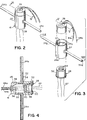
- Sensor assembly 16 includes a tubular sample chamber assembly 22 having open ends 24a and 24b thereof, a source assembly 26 fitted within one open end 24a and a detector assembly 28 fitted within the other open end 24b (Figs. 2-4).
- Sample chamber assembly 22 includes a cylindrical wall 30 which, along with source assembly 26 and detector assembly 28, encloses a sample chamber 32.
- a pair of tubes 34a, 34b penetrate wall 30 in order to provide ingress and egress of a sample gas into sample chamber 32.
- the sample gas may be supplied to sample chamber 32 under positive pressure by a sample pump (not shown) or by diffusion.
- a carbon dioxide (CO2) gas analyzer for sensing between zero and 20% carbon dioxide levels, sample chamber 32 has a volume of 0.5 millilitres. For detecting component gases at lower concentrations, it may be necessary to increase the volume of sample chamber 32 correspondingly.
- CO2 carbon dioxide
- Source assembly 26 includes a source 36 and a reflector 38.
- Reflector 38 is made from aluminium and has a polished reflecting surface 40 that is either elliptical or parabolic in shape.
- Source 36 includes an infrared emitting element 42, which is supplied with an electrical current from electronic assembly 18 through electrical leads 44a and 44b.
- Emitting element 42 is positioned within a chamber 46 (Fig. 7). Chamber 46 is surrounded by an envelope 48 made of a material that is a good transmitter of electromagnetic radiation in the infrared band of between 0.5 micrometres and 5.0 micrometres. Chamber 46 is void of any active gases which may react with the material of emitting element 42. In a preferred embodiment, chamber 46 is evacuated to form a vacuum.
- Envelope 48 must also be made from a material which is capable of being moulded and which is gas impervious in order to avoid any exchange of atmospheric gas with chamber 46.
- envelope 48 is made from quartz, although a heat resistant glass sold under the trade mark Pyrex is a suitable alternative.
- Emitting element 42 is a filament of tungsten alloy.
- source 36 is commercially available and is marketed by Chicago Miniature under Model No. 7219. Chicago Miniature for Model No. 7219 is marketed as a miniature panel light and is, therefore, commercially provided for the purposes of generating visible light.
- source 36 is energized from a power source at a voltage level that is 50% of the rated voltage advised by Chicago Miniature Model No. 7219.
- emitting element 42 gives off very little visible light. It emits primarily in the infrared region. Although, in the preferred embodiment, a commercially available miniature lamp is used, not all incandescent lamps are suitable. Incandescent lamps are typically enclosed with glass envelopes. Glass is a poor conductor of infrared radiation and, typically, cuts off transmission at wavelengths well below the infrared band.
- Detector assembly 28 includes a 48-junction thermopile sensor 50 enclosed within an argon-filled container 52.
- Container 52 is closed by a sapphire window 54, which allows infrared radiation to penetrate the container.
- An optical filter 56 is positioned within container 52 in the radiation pathway between source 36 and sensor 50. Optical filter 56 passes energy at the wavelength of the absorption line of the component gas to be detected.
- detector assembly 28 is commercially available and is marketed by Dexter Research under Model No. 2M.
- a plurality of leads 57 supply the output from sensor 50 to electronic assembly 18.
- Detector assembly 28 is for the purpose of detecting a single component gas in a sample.
- Gas analyzer 15 may be adapted to detecting a plurality of component gases in a sample by utilizing a detector assembly 28' (Fig. 10) in which a plurality of sensors 50a, 50b and 50c are positioned within the radiation pathway.
- Each sensor 50a-50c is positioned behind an optical filter (not shown) having a transmission band at the absorption line of the component gas to be detected by the associated sensor 50a-50c.
- a fourth sensor 50d is not exposed to the radiation from source 36 but is provided for the purpose of monitoring the temperature of the detector assembly for first-order temperature compensation of sensor outputs.
- a single detector assembly 28 is provided wherein optical filter 56 transmits radiation at 4.25 micrometres. As previously set forth, concentration of carbon dioxide from between zero and 20% may be measured by a sample chamber volume of 0.5 millilitres.
- a multiple sensor detector assembly 28' is utilized wherein the sensors 50a-50c are positioned behind optical filters which transmit at 3.5 micrometres for detecting hydrocarbons (hexane), 4.65 micrometres for detecting carbon monoxide and 4.25 micrometres for detecting carbon dioxide.
- Such a multiple sensor detector assembly 28' is commercially available and is marketed by Dexter Research under Model No. DR26 for dual sensor.
- a quad sensor such as that illustrated in Fig. 10, is presently under development by Dexter Research and by Armtec.
- Electronic assembly 18 In order to provide an accurate determination of the concentration of the component gas of interest in the sample, electronic assembly 18 amplifies the signal produced by sensor 50 by a factor of approximately 50,000 and provides first-order temperature compensation for ambient temperature. This latter function is necessary because a thermopile sensor drifts at a rate of 0.4% per degree centigrade.
- Electronic assembly 18 includes an amplifier 58 (Fig. 11A) whose gain is established by a feedback resistor 60, connected between an output 62 and an inverting input 64, and by a resistor 62a connected between inverting input 64 and signal ground.
- Sensor 50 is connected between a non-inverting input 66 of amplifier 58 and signal ground.
- the case 52 of detector assembly 28 is also grounded.
- Output 62 of amplifier 58 is supplied to the non-inverting input 68 of an amplifier 70.
- the gain of amplifier 70 is established by feedback resistors 72, 74 and Rg and a resistor R1 connected in series with an inverting input 76. Resistor R1 is, in turn, connected with an output 78 of an amplifier 80.
- Amplifier 80 has a non-inverting input 82 connected to signal ground with a bias resistor 84.
- Amplifier 80 additionally includes an inverting input 86 connected to an output 91 of a temperature sensor 88 through a bias resistor 90.
- Temperature sensor 88 has an input that is connected with a source of voltage at 89.
- Inverting input 86 is additionally connected, through a bias resistor 96, with the wiper 95 of a potentiometer Rz connected between a positive voltage source 92 and a negative voltage source 94.
- Amplifier 80 additionally includes a feedback resistor 98 connected between output 78 and inverting input 86.
- Output 100 of amplifier 70 is supplied to an inverting input 102 of an amplifier 104.
- a non-inverting input 106 of amplifier 104 is supplied with a reference voltage produced by a unity gain amplifier 108 that is supplied with a stable voltage from a zener diode 110 connected in series with a bias resistor 112 to a voltage source 114;
- the reference voltage level on input 106 is adjustable by an adjustable resistor 116.
- the output of amplifier 104 provides a voltage V out , which is proportional to the concentration of the detected component gas, at 120.
- V out (V ref - V det ) [1 + 2R1/R g ] + V offset + V tempcomp
- V ref is the voltage at input 106
- V det is the voltage at output 62
- R1 is the resistance of resistor R1
- R g is the combined series resistance of resistors 72 and R g
- V offset is the voltage at wiper 95
- V tempcomp is the voltage at output 91.
- the span of amplifier chain in electronic assembly 18 is established by the R1/R g term and is adjustable by adjusting the value of variable resistor R g .
- the value of V offset which establishes the offset of the amplifier chain, is established by adjusting the position of wiper 95 of variable resistor R z .
- Temperature sensor 88 detects ambient temperature. Because all components of gas analyzer 15 are encapsulated by encapsulation material 20, the temperature of sensor 50 is very stable and not susceptible to abrupt changes in ambient temperature. Furthermore, any changes in the temperature of sensor 50 are accurately detected by temperature sensor 88. As set forth above, temperature sensor 88 may be sensor 50d incorporated within detector assembly 28' behind a dark panel.
- amplifier 58 is a chopper-stabilized amplifier, which is exceptionally stable. Such amplifier is commercially available from a variety of suppliers under industry Model No. LT1050CS6. Amplifiers 70, 80, 104 and 108 are provided in a single package under Model No. LT1014DS.
- the positive and negative voltage sources may be supplied from a unipolar battery by the provision of a commercially available voltage converter (not shown).
- Emitting element 42 of source 36 is supplied continuously with a regulated DC voltage through lead 44a from a regulated DC voltage source 125 (Fig. 11B). The opposite lead 44b is connected with signal ground.
- the voltage at voltage source 125 is six volts DC in the illustrated embodiment.
- Chicago Miniature panel light Model No. 7219 has a rated voltage of 12 volts DC.
- emitting element 42 is positioned within a chamber that is void of reacting gases, there is no potential for the formation of oxides of the material composing the emitting element or of any surrounding material. Furthermore, because the emitting element is surrounded by a vacuum, in the preferred embodiment, its colour temperature is maintained at a much lower wattage input because the emitting element is not being cooled by surrounding atmosphere. Additionally, because the emitting element is not heating the surrounding atmosphere, the detrimental effects of heating of surrounding components, resulting in second and third order errors, is virtually eliminated. Because oxidation of the emitting element does not occur, the radiation output of the element is exceptionally stable over very long periods of time.
- the source is inherently stable, there is no need for monitoring the temperature, or emissivity, of the source as an input to a stabilizing feedback control circuit, or as a compensation input to the detector amplifier circuitry, as required in prior infrared gas analyzers.
- the invention is capable of implementation in a system having exceptionally low noise levels and very stable, low drift, output.
- the response time of the system as defined as the time it takes to obtain a reading that swings from 10% to 90% of the span of the system, from a change of from zero gas to full scale gas at a flow rate of 250 millilitres per minute, may be reduced to below 200 milliseconds using the apparatus described.
- This superior response time opens the possibility for real time monitoring of patient's respiration and the like.
- the compact package within which the present invention may be embodied, opens up applications never before possible for infrared gas analysis technology.
- Portable hand-held engine analyzers may now be embellished with exhaust gas analysis capabilities. Such possibilities are, indeed, revolutionary.
Landscapes
- Physics & Mathematics (AREA)
- Spectroscopy & Molecular Physics (AREA)
- Biochemistry (AREA)
- Health & Medical Sciences (AREA)
- Life Sciences & Earth Sciences (AREA)
- Chemical & Material Sciences (AREA)
- Analytical Chemistry (AREA)
- General Health & Medical Sciences (AREA)
- General Physics & Mathematics (AREA)
- Immunology (AREA)
- Pathology (AREA)
- Theoretical Computer Science (AREA)
- Mathematical Physics (AREA)
- Engineering & Computer Science (AREA)
- Investigating Or Analysing Materials By Optical Means (AREA)
Applications Claiming Priority (2)
| Application Number | Priority Date | Filing Date | Title |
|---|---|---|---|
| US97981892A | 1992-11-20 | 1992-11-20 | |
| US979818 | 1992-11-20 |
Publications (2)
| Publication Number | Publication Date |
|---|---|
| EP0599541A2 true EP0599541A2 (fr) | 1994-06-01 |
| EP0599541A3 EP0599541A3 (en) | 1994-06-15 |
Family
ID=25527173
Family Applications (1)
| Application Number | Title | Priority Date | Filing Date |
|---|---|---|---|
| EP19930309170 Withdrawn EP0599541A3 (en) | 1992-11-20 | 1993-11-17 | Infrared gas analyzer. |
Country Status (2)
| Country | Link |
|---|---|
| EP (1) | EP0599541A3 (fr) |
| CA (1) | CA2109544A1 (fr) |
Cited By (3)
| Publication number | Priority date | Publication date | Assignee | Title |
|---|---|---|---|---|
| FR2768816A1 (fr) * | 1997-09-24 | 1999-03-26 | Draeger Sicherheitstech Gmbh | Dispositif de mesure d'infrarouge a plage de mesure elargie |
| WO2004013600A3 (fr) * | 2002-08-01 | 2004-04-08 | R L Agebos Sa | Detecteur a capteur de rayonnement infrarouge pour la mesure directe d'une production d'un gaz dans l'environnement d'un appareil |
| CN106124710A (zh) * | 2016-08-12 | 2016-11-16 | 安徽中杰信息科技有限公司 | 挥发性气体浓度检查方法 |
Family Cites Families (2)
| Publication number | Priority date | Publication date | Assignee | Title |
|---|---|---|---|---|
| US4649027A (en) * | 1985-01-29 | 1987-03-10 | Cmi, Inc. | Breath tester |
| US4648396A (en) * | 1985-05-03 | 1987-03-10 | Brigham And Women's Hospital | Respiration detector |
-
1993
- 1993-11-17 EP EP19930309170 patent/EP0599541A3/en not_active Withdrawn
- 1993-11-18 CA CA 2109544 patent/CA2109544A1/fr not_active Abandoned
Cited By (3)
| Publication number | Priority date | Publication date | Assignee | Title |
|---|---|---|---|---|
| FR2768816A1 (fr) * | 1997-09-24 | 1999-03-26 | Draeger Sicherheitstech Gmbh | Dispositif de mesure d'infrarouge a plage de mesure elargie |
| WO2004013600A3 (fr) * | 2002-08-01 | 2004-04-08 | R L Agebos Sa | Detecteur a capteur de rayonnement infrarouge pour la mesure directe d'une production d'un gaz dans l'environnement d'un appareil |
| CN106124710A (zh) * | 2016-08-12 | 2016-11-16 | 安徽中杰信息科技有限公司 | 挥发性气体浓度检查方法 |
Also Published As
| Publication number | Publication date |
|---|---|
| EP0599541A3 (en) | 1994-06-15 |
| CA2109544A1 (fr) | 1994-05-21 |
Similar Documents
| Publication | Publication Date | Title |
|---|---|---|
| US5583339A (en) | Infrared method and apparatus for measuring gas concentration of a plurality of component gases in a sample | |
| US5261415A (en) | CO2 mainstream capnography sensor | |
| US5184017A (en) | Method and apparatus for detecting a component gas in a sample | |
| KR100395460B1 (ko) | Ndir 계기 | |
| US6843102B1 (en) | Gas sensor arrangement | |
| US7796265B2 (en) | Optical absorption gas analyser | |
| US4730112A (en) | Oxygen measurement using visible radiation | |
| US5886348A (en) | Non-dispersive infrared gas analyzer with interfering gas correction | |
| US5146092A (en) | Gas analysis transducers with electromagnetic energy detector units | |
| US4859859A (en) | Gas analyzers | |
| US4859858A (en) | Gas analyzers | |
| US5401966A (en) | Spectrophotometric sensor assembly including a microlamp | |
| US4500207A (en) | Non-dispersive optical determination of gas concentration | |
| JP2001507798A (ja) | 光音響装置及び複数ガス感知方法 | |
| CA2312706C (fr) | Appareil de detection de gaz mettant en application une combinaison de source d'infrarouges et de bolometre a temperature elevee | |
| CA2338875A1 (fr) | Sources de rayonnement infrarouge, combinaisons de detecteurs et de source, procedes de production associe | |
| US6642522B2 (en) | Optical gas sensor | |
| JP2604754B2 (ja) | 分光光度計 | |
| Johnston | Gas monitors employing infrared LEDs | |
| EP0599541A2 (fr) | Analyseur de gaz par infrarouge | |
| JPH05142146A (ja) | ガス測定装置 | |
| US6218665B1 (en) | Infrared detector and gas analyzer | |
| JP2002539426A (ja) | ガスセンサーおよびガスセンサーの動作方法 | |
| US4624572A (en) | Non-invasive reflectance spectrophotometric apparatus | |
| US4501968A (en) | Infrared radiation gas analyzer |
Legal Events
| Date | Code | Title | Description |
|---|---|---|---|
| PUAI | Public reference made under article 153(3) epc to a published international application that has entered the european phase |
Free format text: ORIGINAL CODE: 0009012 |
|
| PUAL | Search report despatched |
Free format text: ORIGINAL CODE: 0009013 |
|
| AK | Designated contracting states |
Kind code of ref document: A2 Designated state(s): CH DE ES FR GB IE IT LI NL SE |
|
| AK | Designated contracting states |
Kind code of ref document: A3 Designated state(s): CH DE ES FR GB IE IT LI NL SE |
|
| 18D | Application deemed to be withdrawn |
Effective date: 19941216 |