EP0599886B1 - Macromonomere mit reaktiven endgruppen - Google Patents
Macromonomere mit reaktiven endgruppen Download PDFInfo
- Publication number
- EP0599886B1 EP0599886B1 EP92916566A EP92916566A EP0599886B1 EP 0599886 B1 EP0599886 B1 EP 0599886B1 EP 92916566 A EP92916566 A EP 92916566A EP 92916566 A EP92916566 A EP 92916566A EP 0599886 B1 EP0599886 B1 EP 0599886B1
- Authority
- EP
- European Patent Office
- Prior art keywords
- macromonomer
- group
- macromonomers
- rigid
- groups
- Prior art date
- Legal status (The legal status is an assumption and is not a legal conclusion. Google has not performed a legal analysis and makes no representation as to the accuracy of the status listed.)
- Expired - Lifetime
Links
- 0 CC(NC(C(C)C1=C)=Cc2c1[s]c(C(C)(*)*)n2)S Chemical compound CC(NC(C(C)C1=C)=Cc2c1[s]c(C(C)(*)*)n2)S 0.000 description 1
Classifications
-
- C—CHEMISTRY; METALLURGY
- C07—ORGANIC CHEMISTRY
- C07D—HETEROCYCLIC COMPOUNDS
- C07D207/00—Heterocyclic compounds containing five-membered rings not condensed with other rings, with one nitrogen atom as the only ring hetero atom
- C07D207/02—Heterocyclic compounds containing five-membered rings not condensed with other rings, with one nitrogen atom as the only ring hetero atom with only hydrogen or carbon atoms directly attached to the ring nitrogen atom
- C07D207/30—Heterocyclic compounds containing five-membered rings not condensed with other rings, with one nitrogen atom as the only ring hetero atom with only hydrogen or carbon atoms directly attached to the ring nitrogen atom having two double bonds between ring members or between ring members and non-ring members
- C07D207/34—Heterocyclic compounds containing five-membered rings not condensed with other rings, with one nitrogen atom as the only ring hetero atom with only hydrogen or carbon atoms directly attached to the ring nitrogen atom having two double bonds between ring members or between ring members and non-ring members with hetero atoms or with carbon atoms having three bonds to hetero atoms with at the most one bond to halogen, e.g. ester or nitrile radicals, directly attached to ring carbon atoms
- C07D207/36—Oxygen or sulfur atoms
- C07D207/40—2,5-Pyrrolidine-diones
- C07D207/404—2,5-Pyrrolidine-diones with only hydrogen atoms or radicals containing only hydrogen and carbon atoms directly attached to other ring carbon atoms, e.g. succinimide
-
- C—CHEMISTRY; METALLURGY
- C07—ORGANIC CHEMISTRY
- C07C—ACYCLIC OR CARBOCYCLIC COMPOUNDS
- C07C225/00—Compounds containing amino groups and doubly—bound oxygen atoms bound to the same carbon skeleton, at least one of the doubly—bound oxygen atoms not being part of a —CHO group, e.g. amino ketones
- C07C225/02—Compounds containing amino groups and doubly—bound oxygen atoms bound to the same carbon skeleton, at least one of the doubly—bound oxygen atoms not being part of a —CHO group, e.g. amino ketones having amino groups bound to acyclic carbon atoms of the carbon skeleton
- C07C225/14—Compounds containing amino groups and doubly—bound oxygen atoms bound to the same carbon skeleton, at least one of the doubly—bound oxygen atoms not being part of a —CHO group, e.g. amino ketones having amino groups bound to acyclic carbon atoms of the carbon skeleton the carbon skeleton being unsaturated
- C07C225/16—Compounds containing amino groups and doubly—bound oxygen atoms bound to the same carbon skeleton, at least one of the doubly—bound oxygen atoms not being part of a —CHO group, e.g. amino ketones having amino groups bound to acyclic carbon atoms of the carbon skeleton the carbon skeleton being unsaturated and containing six-membered aromatic rings
-
- C—CHEMISTRY; METALLURGY
- C07—ORGANIC CHEMISTRY
- C07C—ACYCLIC OR CARBOCYCLIC COMPOUNDS
- C07C225/00—Compounds containing amino groups and doubly—bound oxygen atoms bound to the same carbon skeleton, at least one of the doubly—bound oxygen atoms not being part of a —CHO group, e.g. amino ketones
- C07C225/22—Compounds containing amino groups and doubly—bound oxygen atoms bound to the same carbon skeleton, at least one of the doubly—bound oxygen atoms not being part of a —CHO group, e.g. amino ketones having amino groups bound to carbon atoms of six-membered aromatic rings of the carbon skeleton
-
- C—CHEMISTRY; METALLURGY
- C07—ORGANIC CHEMISTRY
- C07C—ACYCLIC OR CARBOCYCLIC COMPOUNDS
- C07C235/00—Carboxylic acid amides, the carbon skeleton of the acid part being further substituted by oxygen atoms
- C07C235/70—Carboxylic acid amides, the carbon skeleton of the acid part being further substituted by oxygen atoms having carbon atoms of carboxamide groups and doubly-bound oxygen atoms bound to the same carbon skeleton
- C07C235/84—Carboxylic acid amides, the carbon skeleton of the acid part being further substituted by oxygen atoms having carbon atoms of carboxamide groups and doubly-bound oxygen atoms bound to the same carbon skeleton with the carbon atom of at least one of the carboxamide groups bound to a carbon atom of a six-membered aromatic ring
-
- C—CHEMISTRY; METALLURGY
- C07—ORGANIC CHEMISTRY
- C07C—ACYCLIC OR CARBOCYCLIC COMPOUNDS
- C07C255/00—Carboxylic acid nitriles
- C07C255/49—Carboxylic acid nitriles having cyano groups bound to carbon atoms of six-membered aromatic rings of a carbon skeleton
- C07C255/56—Carboxylic acid nitriles having cyano groups bound to carbon atoms of six-membered aromatic rings of a carbon skeleton containing cyano groups and doubly-bound oxygen atoms bound to the carbon skeleton
-
- C—CHEMISTRY; METALLURGY
- C07—ORGANIC CHEMISTRY
- C07D—HETEROCYCLIC COMPOUNDS
- C07D207/00—Heterocyclic compounds containing five-membered rings not condensed with other rings, with one nitrogen atom as the only ring hetero atom
- C07D207/02—Heterocyclic compounds containing five-membered rings not condensed with other rings, with one nitrogen atom as the only ring hetero atom with only hydrogen or carbon atoms directly attached to the ring nitrogen atom
- C07D207/44—Heterocyclic compounds containing five-membered rings not condensed with other rings, with one nitrogen atom as the only ring hetero atom with only hydrogen or carbon atoms directly attached to the ring nitrogen atom having three double bonds between ring members or between ring members and non-ring members
- C07D207/444—Heterocyclic compounds containing five-membered rings not condensed with other rings, with one nitrogen atom as the only ring hetero atom with only hydrogen or carbon atoms directly attached to the ring nitrogen atom having three double bonds between ring members or between ring members and non-ring members having two doubly-bound oxygen atoms directly attached in positions 2 and 5
- C07D207/448—Heterocyclic compounds containing five-membered rings not condensed with other rings, with one nitrogen atom as the only ring hetero atom with only hydrogen or carbon atoms directly attached to the ring nitrogen atom having three double bonds between ring members or between ring members and non-ring members having two doubly-bound oxygen atoms directly attached in positions 2 and 5 with only hydrogen atoms or radicals containing only hydrogen and carbon atoms directly attached to other ring carbon atoms, e.g. maleimide
- C07D207/452—Heterocyclic compounds containing five-membered rings not condensed with other rings, with one nitrogen atom as the only ring hetero atom with only hydrogen or carbon atoms directly attached to the ring nitrogen atom having three double bonds between ring members or between ring members and non-ring members having two doubly-bound oxygen atoms directly attached in positions 2 and 5 with only hydrogen atoms or radicals containing only hydrogen and carbon atoms directly attached to other ring carbon atoms, e.g. maleimide with hydrocarbon radicals, substituted by hetero atoms, directly attached to the ring nitrogen atom
-
- C—CHEMISTRY; METALLURGY
- C07—ORGANIC CHEMISTRY
- C07D—HETEROCYCLIC COMPOUNDS
- C07D209/00—Heterocyclic compounds containing five-membered rings, condensed with other rings, with one nitrogen atom as the only ring hetero atom
- C07D209/56—Ring systems containing three or more rings
- C07D209/58—[b]- or [c]-condensed
- C07D209/72—4,7-Endo-alkylene-iso-indoles
- C07D209/76—4,7-Endo-alkylene-iso-indoles with oxygen atoms in positions 1 and 3
-
- C—CHEMISTRY; METALLURGY
- C07—ORGANIC CHEMISTRY
- C07D—HETEROCYCLIC COMPOUNDS
- C07D295/00—Heterocyclic compounds containing polymethylene-imine rings with at least five ring members, 3-azabicyclo [3.2.2] nonane, piperazine, morpholine or thiomorpholine rings, having only hydrogen atoms directly attached to the ring carbon atoms
- C07D295/16—Heterocyclic compounds containing polymethylene-imine rings with at least five ring members, 3-azabicyclo [3.2.2] nonane, piperazine, morpholine or thiomorpholine rings, having only hydrogen atoms directly attached to the ring carbon atoms acylated on ring nitrogen atoms
- C07D295/18—Heterocyclic compounds containing polymethylene-imine rings with at least five ring members, 3-azabicyclo [3.2.2] nonane, piperazine, morpholine or thiomorpholine rings, having only hydrogen atoms directly attached to the ring carbon atoms acylated on ring nitrogen atoms by radicals derived from carboxylic acids, or sulfur or nitrogen analogues thereof
- C07D295/182—Radicals derived from carboxylic acids
- C07D295/192—Radicals derived from carboxylic acids from aromatic carboxylic acids
-
- C—CHEMISTRY; METALLURGY
- C07—ORGANIC CHEMISTRY
- C07D—HETEROCYCLIC COMPOUNDS
- C07D303/00—Compounds containing three-membered rings having one oxygen atom as the only ring hetero atom
- C07D303/02—Compounds containing oxirane rings
- C07D303/12—Compounds containing oxirane rings with hydrocarbon radicals, substituted by singly or doubly bound oxygen atoms
- C07D303/18—Compounds containing oxirane rings with hydrocarbon radicals, substituted by singly or doubly bound oxygen atoms by etherified hydroxyl radicals
- C07D303/20—Ethers with hydroxy compounds containing no oxirane rings
- C07D303/22—Ethers with hydroxy compounds containing no oxirane rings with monohydroxy compounds
-
- C—CHEMISTRY; METALLURGY
- C07—ORGANIC CHEMISTRY
- C07D—HETEROCYCLIC COMPOUNDS
- C07D303/00—Compounds containing three-membered rings having one oxygen atom as the only ring hetero atom
- C07D303/02—Compounds containing oxirane rings
- C07D303/36—Compounds containing oxirane rings with hydrocarbon radicals, substituted by nitrogen atoms
-
- C—CHEMISTRY; METALLURGY
- C07—ORGANIC CHEMISTRY
- C07D—HETEROCYCLIC COMPOUNDS
- C07D303/00—Compounds containing three-membered rings having one oxygen atom as the only ring hetero atom
- C07D303/02—Compounds containing oxirane rings
- C07D303/38—Compounds containing oxirane rings with hydrocarbon radicals, substituted by carbon atoms having three bonds to hetero atoms with at the most one bond to halogen, e.g. ester or nitrile radicals
- C07D303/46—Compounds containing oxirane rings with hydrocarbon radicals, substituted by carbon atoms having three bonds to hetero atoms with at the most one bond to halogen, e.g. ester or nitrile radicals by amide or nitrile radicals
-
- C—CHEMISTRY; METALLURGY
- C08—ORGANIC MACROMOLECULAR COMPOUNDS; THEIR PREPARATION OR CHEMICAL WORKING-UP; COMPOSITIONS BASED THEREON
- C08F—MACROMOLECULAR COMPOUNDS OBTAINED BY REACTIONS ONLY INVOLVING CARBON-TO-CARBON UNSATURATED BONDS
- C08F290/00—Macromolecular compounds obtained by polymerising monomers on to polymers modified by introduction of aliphatic unsaturated end or side groups
- C08F290/02—Macromolecular compounds obtained by polymerising monomers on to polymers modified by introduction of aliphatic unsaturated end or side groups on to polymers modified by introduction of unsaturated end groups
- C08F290/06—Polymers provided for in subclass C08G
-
- C—CHEMISTRY; METALLURGY
- C08—ORGANIC MACROMOLECULAR COMPOUNDS; THEIR PREPARATION OR CHEMICAL WORKING-UP; COMPOSITIONS BASED THEREON
- C08F—MACROMOLECULAR COMPOUNDS OBTAINED BY REACTIONS ONLY INVOLVING CARBON-TO-CARBON UNSATURATED BONDS
- C08F290/00—Macromolecular compounds obtained by polymerising monomers on to polymers modified by introduction of aliphatic unsaturated end or side groups
- C08F290/08—Macromolecular compounds obtained by polymerising monomers on to polymers modified by introduction of aliphatic unsaturated end or side groups on to polymers modified by introduction of unsaturated side groups
- C08F290/14—Polymers provided for in subclass C08G
-
- C—CHEMISTRY; METALLURGY
- C08—ORGANIC MACROMOLECULAR COMPOUNDS; THEIR PREPARATION OR CHEMICAL WORKING-UP; COMPOSITIONS BASED THEREON
- C08F—MACROMOLECULAR COMPOUNDS OBTAINED BY REACTIONS ONLY INVOLVING CARBON-TO-CARBON UNSATURATED BONDS
- C08F290/00—Macromolecular compounds obtained by polymerising monomers on to polymers modified by introduction of aliphatic unsaturated end or side groups
- C08F290/08—Macromolecular compounds obtained by polymerising monomers on to polymers modified by introduction of aliphatic unsaturated end or side groups on to polymers modified by introduction of unsaturated side groups
- C08F290/14—Polymers provided for in subclass C08G
- C08F290/141—Polyesters; Polycarbonates
-
- C—CHEMISTRY; METALLURGY
- C08—ORGANIC MACROMOLECULAR COMPOUNDS; THEIR PREPARATION OR CHEMICAL WORKING-UP; COMPOSITIONS BASED THEREON
- C08G—MACROMOLECULAR COMPOUNDS OBTAINED OTHERWISE THAN BY REACTIONS ONLY INVOLVING UNSATURATED CARBON-TO-CARBON BONDS
- C08G61/00—Macromolecular compounds obtained by reactions forming a carbon-to-carbon link in the main chain of the macromolecule
-
- C—CHEMISTRY; METALLURGY
- C08—ORGANIC MACROMOLECULAR COMPOUNDS; THEIR PREPARATION OR CHEMICAL WORKING-UP; COMPOSITIONS BASED THEREON
- C08G—MACROMOLECULAR COMPOUNDS OBTAINED OTHERWISE THAN BY REACTIONS ONLY INVOLVING UNSATURATED CARBON-TO-CARBON BONDS
- C08G61/00—Macromolecular compounds obtained by reactions forming a carbon-to-carbon link in the main chain of the macromolecule
- C08G61/02—Macromolecular compounds containing only carbon atoms in the main chain of the macromolecule, e.g. polyxylylenes
-
- C—CHEMISTRY; METALLURGY
- C08—ORGANIC MACROMOLECULAR COMPOUNDS; THEIR PREPARATION OR CHEMICAL WORKING-UP; COMPOSITIONS BASED THEREON
- C08G—MACROMOLECULAR COMPOUNDS OBTAINED OTHERWISE THAN BY REACTIONS ONLY INVOLVING UNSATURATED CARBON-TO-CARBON BONDS
- C08G63/00—Macromolecular compounds obtained by reactions forming a carboxylic ester link in the main chain of the macromolecule
- C08G63/02—Polyesters derived from hydroxycarboxylic acids or from polycarboxylic acids and polyhydroxy compounds
- C08G63/12—Polyesters derived from hydroxycarboxylic acids or from polycarboxylic acids and polyhydroxy compounds derived from polycarboxylic acids and polyhydroxy compounds
- C08G63/16—Dicarboxylic acids and dihydroxy compounds
- C08G63/18—Dicarboxylic acids and dihydroxy compounds the acids or hydroxy compounds containing carbocyclic rings
- C08G63/181—Acids containing aromatic rings
-
- C—CHEMISTRY; METALLURGY
- C08—ORGANIC MACROMOLECULAR COMPOUNDS; THEIR PREPARATION OR CHEMICAL WORKING-UP; COMPOSITIONS BASED THEREON
- C08G—MACROMOLECULAR COMPOUNDS OBTAINED OTHERWISE THAN BY REACTIONS ONLY INVOLVING UNSATURATED CARBON-TO-CARBON BONDS
- C08G63/00—Macromolecular compounds obtained by reactions forming a carboxylic ester link in the main chain of the macromolecule
- C08G63/68—Polyesters containing atoms other than carbon, hydrogen and oxygen
- C08G63/685—Polyesters containing atoms other than carbon, hydrogen and oxygen containing nitrogen
- C08G63/6854—Polyesters containing atoms other than carbon, hydrogen and oxygen containing nitrogen derived from polycarboxylic acids and polyhydroxy compounds
- C08G63/6856—Dicarboxylic acids and dihydroxy compounds
-
- C—CHEMISTRY; METALLURGY
- C08—ORGANIC MACROMOLECULAR COMPOUNDS; THEIR PREPARATION OR CHEMICAL WORKING-UP; COMPOSITIONS BASED THEREON
- C08G—MACROMOLECULAR COMPOUNDS OBTAINED OTHERWISE THAN BY REACTIONS ONLY INVOLVING UNSATURATED CARBON-TO-CARBON BONDS
- C08G64/00—Macromolecular compounds obtained by reactions forming a carbonic ester link in the main chain of the macromolecule
- C08G64/04—Aromatic polycarbonates
- C08G64/06—Aromatic polycarbonates not containing aliphatic unsaturation
-
- C—CHEMISTRY; METALLURGY
- C08—ORGANIC MACROMOLECULAR COMPOUNDS; THEIR PREPARATION OR CHEMICAL WORKING-UP; COMPOSITIONS BASED THEREON
- C08G—MACROMOLECULAR COMPOUNDS OBTAINED OTHERWISE THAN BY REACTIONS ONLY INVOLVING UNSATURATED CARBON-TO-CARBON BONDS
- C08G64/00—Macromolecular compounds obtained by reactions forming a carbonic ester link in the main chain of the macromolecule
- C08G64/04—Aromatic polycarbonates
- C08G64/06—Aromatic polycarbonates not containing aliphatic unsaturation
- C08G64/08—Aromatic polycarbonates not containing aliphatic unsaturation containing atoms other than carbon, hydrogen or oxygen
- C08G64/12—Aromatic polycarbonates not containing aliphatic unsaturation containing atoms other than carbon, hydrogen or oxygen containing nitrogen
-
- C—CHEMISTRY; METALLURGY
- C08—ORGANIC MACROMOLECULAR COMPOUNDS; THEIR PREPARATION OR CHEMICAL WORKING-UP; COMPOSITIONS BASED THEREON
- C08G—MACROMOLECULAR COMPOUNDS OBTAINED OTHERWISE THAN BY REACTIONS ONLY INVOLVING UNSATURATED CARBON-TO-CARBON BONDS
- C08G69/00—Macromolecular compounds obtained by reactions forming a carboxylic amide link in the main chain of the macromolecule
- C08G69/02—Polyamides derived from amino-carboxylic acids or from polyamines and polycarboxylic acids
-
- C—CHEMISTRY; METALLURGY
- C08—ORGANIC MACROMOLECULAR COMPOUNDS; THEIR PREPARATION OR CHEMICAL WORKING-UP; COMPOSITIONS BASED THEREON
- C08G—MACROMOLECULAR COMPOUNDS OBTAINED OTHERWISE THAN BY REACTIONS ONLY INVOLVING UNSATURATED CARBON-TO-CARBON BONDS
- C08G69/00—Macromolecular compounds obtained by reactions forming a carboxylic amide link in the main chain of the macromolecule
- C08G69/02—Polyamides derived from amino-carboxylic acids or from polyamines and polycarboxylic acids
- C08G69/08—Polyamides derived from amino-carboxylic acids or from polyamines and polycarboxylic acids derived from amino-carboxylic acids
- C08G69/14—Lactams
- C08G69/16—Preparatory processes
- C08G69/18—Anionic polymerisation
- C08G69/20—Anionic polymerisation characterised by the catalysts used
-
- C—CHEMISTRY; METALLURGY
- C08—ORGANIC MACROMOLECULAR COMPOUNDS; THEIR PREPARATION OR CHEMICAL WORKING-UP; COMPOSITIONS BASED THEREON
- C08G—MACROMOLECULAR COMPOUNDS OBTAINED OTHERWISE THAN BY REACTIONS ONLY INVOLVING UNSATURATED CARBON-TO-CARBON BONDS
- C08G69/00—Macromolecular compounds obtained by reactions forming a carboxylic amide link in the main chain of the macromolecule
- C08G69/02—Polyamides derived from amino-carboxylic acids or from polyamines and polycarboxylic acids
- C08G69/26—Polyamides derived from amino-carboxylic acids or from polyamines and polycarboxylic acids derived from polyamines and polycarboxylic acids
-
- C—CHEMISTRY; METALLURGY
- C08—ORGANIC MACROMOLECULAR COMPOUNDS; THEIR PREPARATION OR CHEMICAL WORKING-UP; COMPOSITIONS BASED THEREON
- C08G—MACROMOLECULAR COMPOUNDS OBTAINED OTHERWISE THAN BY REACTIONS ONLY INVOLVING UNSATURATED CARBON-TO-CARBON BONDS
- C08G69/00—Macromolecular compounds obtained by reactions forming a carboxylic amide link in the main chain of the macromolecule
- C08G69/02—Polyamides derived from amino-carboxylic acids or from polyamines and polycarboxylic acids
- C08G69/26—Polyamides derived from amino-carboxylic acids or from polyamines and polycarboxylic acids derived from polyamines and polycarboxylic acids
- C08G69/32—Polyamides derived from amino-carboxylic acids or from polyamines and polycarboxylic acids derived from polyamines and polycarboxylic acids from aromatic diamines and aromatic dicarboxylic acids with both amino and carboxylic groups aromatically bound
-
- C—CHEMISTRY; METALLURGY
- C08—ORGANIC MACROMOLECULAR COMPOUNDS; THEIR PREPARATION OR CHEMICAL WORKING-UP; COMPOSITIONS BASED THEREON
- C08G—MACROMOLECULAR COMPOUNDS OBTAINED OTHERWISE THAN BY REACTIONS ONLY INVOLVING UNSATURATED CARBON-TO-CARBON BONDS
- C08G69/00—Macromolecular compounds obtained by reactions forming a carboxylic amide link in the main chain of the macromolecule
- C08G69/02—Polyamides derived from amino-carboxylic acids or from polyamines and polycarboxylic acids
- C08G69/36—Polyamides derived from amino-carboxylic acids or from polyamines and polycarboxylic acids derived from amino acids, polyamines and polycarboxylic acids
-
- C—CHEMISTRY; METALLURGY
- C08—ORGANIC MACROMOLECULAR COMPOUNDS; THEIR PREPARATION OR CHEMICAL WORKING-UP; COMPOSITIONS BASED THEREON
- C08G—MACROMOLECULAR COMPOUNDS OBTAINED OTHERWISE THAN BY REACTIONS ONLY INVOLVING UNSATURATED CARBON-TO-CARBON BONDS
- C08G73/00—Macromolecular compounds obtained by reactions forming a linkage containing nitrogen with or without oxygen or carbon in the main chain of the macromolecule, not provided for in groups C08G12/00 - C08G71/00
- C08G73/06—Polycondensates having nitrogen-containing heterocyclic rings in the main chain of the macromolecule
- C08G73/0622—Polycondensates containing six-membered rings, not condensed with other rings, with nitrogen atoms as the only ring hetero atoms
-
- C—CHEMISTRY; METALLURGY
- C08—ORGANIC MACROMOLECULAR COMPOUNDS; THEIR PREPARATION OR CHEMICAL WORKING-UP; COMPOSITIONS BASED THEREON
- C08G—MACROMOLECULAR COMPOUNDS OBTAINED OTHERWISE THAN BY REACTIONS ONLY INVOLVING UNSATURATED CARBON-TO-CARBON BONDS
- C08G73/00—Macromolecular compounds obtained by reactions forming a linkage containing nitrogen with or without oxygen or carbon in the main chain of the macromolecule, not provided for in groups C08G12/00 - C08G71/00
- C08G73/06—Polycondensates having nitrogen-containing heterocyclic rings in the main chain of the macromolecule
- C08G73/0622—Polycondensates containing six-membered rings, not condensed with other rings, with nitrogen atoms as the only ring hetero atoms
- C08G73/0627—Polycondensates containing six-membered rings, not condensed with other rings, with nitrogen atoms as the only ring hetero atoms with only one nitrogen atom in the ring
-
- C—CHEMISTRY; METALLURGY
- C08—ORGANIC MACROMOLECULAR COMPOUNDS; THEIR PREPARATION OR CHEMICAL WORKING-UP; COMPOSITIONS BASED THEREON
- C08G—MACROMOLECULAR COMPOUNDS OBTAINED OTHERWISE THAN BY REACTIONS ONLY INVOLVING UNSATURATED CARBON-TO-CARBON BONDS
- C08G73/00—Macromolecular compounds obtained by reactions forming a linkage containing nitrogen with or without oxygen or carbon in the main chain of the macromolecule, not provided for in groups C08G12/00 - C08G71/00
- C08G73/06—Polycondensates having nitrogen-containing heterocyclic rings in the main chain of the macromolecule
- C08G73/0622—Polycondensates containing six-membered rings, not condensed with other rings, with nitrogen atoms as the only ring hetero atoms
- C08G73/0633—Polycondensates containing six-membered rings, not condensed with other rings, with nitrogen atoms as the only ring hetero atoms with only two nitrogen atoms in the ring
-
- C—CHEMISTRY; METALLURGY
- C08—ORGANIC MACROMOLECULAR COMPOUNDS; THEIR PREPARATION OR CHEMICAL WORKING-UP; COMPOSITIONS BASED THEREON
- C08G—MACROMOLECULAR COMPOUNDS OBTAINED OTHERWISE THAN BY REACTIONS ONLY INVOLVING UNSATURATED CARBON-TO-CARBON BONDS
- C08G73/00—Macromolecular compounds obtained by reactions forming a linkage containing nitrogen with or without oxygen or carbon in the main chain of the macromolecule, not provided for in groups C08G12/00 - C08G71/00
- C08G73/06—Polycondensates having nitrogen-containing heterocyclic rings in the main chain of the macromolecule
- C08G73/0622—Polycondensates containing six-membered rings, not condensed with other rings, with nitrogen atoms as the only ring hetero atoms
- C08G73/0638—Polycondensates containing six-membered rings, not condensed with other rings, with nitrogen atoms as the only ring hetero atoms with at least three nitrogen atoms in the ring
-
- C—CHEMISTRY; METALLURGY
- C08—ORGANIC MACROMOLECULAR COMPOUNDS; THEIR PREPARATION OR CHEMICAL WORKING-UP; COMPOSITIONS BASED THEREON
- C08G—MACROMOLECULAR COMPOUNDS OBTAINED OTHERWISE THAN BY REACTIONS ONLY INVOLVING UNSATURATED CARBON-TO-CARBON BONDS
- C08G73/00—Macromolecular compounds obtained by reactions forming a linkage containing nitrogen with or without oxygen or carbon in the main chain of the macromolecule, not provided for in groups C08G12/00 - C08G71/00
- C08G73/06—Polycondensates having nitrogen-containing heterocyclic rings in the main chain of the macromolecule
- C08G73/18—Polybenzimidazoles
-
- C—CHEMISTRY; METALLURGY
- C08—ORGANIC MACROMOLECULAR COMPOUNDS; THEIR PREPARATION OR CHEMICAL WORKING-UP; COMPOSITIONS BASED THEREON
- C08G—MACROMOLECULAR COMPOUNDS OBTAINED OTHERWISE THAN BY REACTIONS ONLY INVOLVING UNSATURATED CARBON-TO-CARBON BONDS
- C08G8/00—Condensation polymers of aldehydes or ketones with phenols only
- C08G8/28—Chemically modified polycondensates
-
- C—CHEMISTRY; METALLURGY
- C08—ORGANIC MACROMOLECULAR COMPOUNDS; THEIR PREPARATION OR CHEMICAL WORKING-UP; COMPOSITIONS BASED THEREON
- C08G—MACROMOLECULAR COMPOUNDS OBTAINED OTHERWISE THAN BY REACTIONS ONLY INVOLVING UNSATURATED CARBON-TO-CARBON BONDS
- C08G85/00—General processes for preparing compounds provided for in this subclass
-
- C—CHEMISTRY; METALLURGY
- C08—ORGANIC MACROMOLECULAR COMPOUNDS; THEIR PREPARATION OR CHEMICAL WORKING-UP; COMPOSITIONS BASED THEREON
- C08L—COMPOSITIONS OF MACROMOLECULAR COMPOUNDS
- C08L67/00—Compositions of polyesters obtained by reactions forming a carboxylic ester link in the main chain; Compositions of derivatives of such polymers
-
- C—CHEMISTRY; METALLURGY
- C08—ORGANIC MACROMOLECULAR COMPOUNDS; THEIR PREPARATION OR CHEMICAL WORKING-UP; COMPOSITIONS BASED THEREON
- C08L—COMPOSITIONS OF MACROMOLECULAR COMPOUNDS
- C08L67/00—Compositions of polyesters obtained by reactions forming a carboxylic ester link in the main chain; Compositions of derivatives of such polymers
- C08L67/02—Polyesters derived from dicarboxylic acids and dihydroxy compounds
-
- C—CHEMISTRY; METALLURGY
- C08—ORGANIC MACROMOLECULAR COMPOUNDS; THEIR PREPARATION OR CHEMICAL WORKING-UP; COMPOSITIONS BASED THEREON
- C08L—COMPOSITIONS OF MACROMOLECULAR COMPOUNDS
- C08L69/00—Compositions of polycarbonates; Compositions of derivatives of polycarbonates
-
- C—CHEMISTRY; METALLURGY
- C08—ORGANIC MACROMOLECULAR COMPOUNDS; THEIR PREPARATION OR CHEMICAL WORKING-UP; COMPOSITIONS BASED THEREON
- C08L—COMPOSITIONS OF MACROMOLECULAR COMPOUNDS
- C08L71/00—Compositions of polyethers obtained by reactions forming an ether link in the main chain; Compositions of derivatives of such polymers
- C08L71/08—Polyethers derived from hydroxy compounds or from their metallic derivatives
- C08L71/10—Polyethers derived from hydroxy compounds or from their metallic derivatives from phenols
- C08L71/12—Polyphenylene oxides
- C08L71/126—Polyphenylene oxides modified by chemical after-treatment
-
- C—CHEMISTRY; METALLURGY
- C08—ORGANIC MACROMOLECULAR COMPOUNDS; THEIR PREPARATION OR CHEMICAL WORKING-UP; COMPOSITIONS BASED THEREON
- C08L—COMPOSITIONS OF MACROMOLECULAR COMPOUNDS
- C08L85/00—Compositions of macromolecular compounds obtained by reactions forming a linkage in the main chain of the macromolecule containing atoms other than silicon, sulfur, nitrogen, oxygen and carbon; Compositions of derivatives of such polymers
-
- C—CHEMISTRY; METALLURGY
- C07—ORGANIC CHEMISTRY
- C07C—ACYCLIC OR CARBOCYCLIC COMPOUNDS
- C07C2602/00—Systems containing two condensed rings
- C07C2602/02—Systems containing two condensed rings the rings having only two atoms in common
- C07C2602/04—One of the condensed rings being a six-membered aromatic ring
- C07C2602/06—One of the condensed rings being a six-membered aromatic ring the other ring being four-membered
-
- C—CHEMISTRY; METALLURGY
- C07—ORGANIC CHEMISTRY
- C07C—ACYCLIC OR CARBOCYCLIC COMPOUNDS
- C07C2603/00—Systems containing at least three condensed rings
- C07C2603/02—Ortho- or ortho- and peri-condensed systems
- C07C2603/04—Ortho- or ortho- and peri-condensed systems containing three rings
- C07C2603/06—Ortho- or ortho- and peri-condensed systems containing three rings containing at least one ring with less than six ring members
- C07C2603/10—Ortho- or ortho- and peri-condensed systems containing three rings containing at least one ring with less than six ring members containing five-membered rings
- C07C2603/12—Ortho- or ortho- and peri-condensed systems containing three rings containing at least one ring with less than six ring members containing five-membered rings only one five-membered ring
- C07C2603/18—Fluorenes; Hydrogenated fluorenes
-
- C—CHEMISTRY; METALLURGY
- C08—ORGANIC MACROMOLECULAR COMPOUNDS; THEIR PREPARATION OR CHEMICAL WORKING-UP; COMPOSITIONS BASED THEREON
- C08G—MACROMOLECULAR COMPOUNDS OBTAINED OTHERWISE THAN BY REACTIONS ONLY INVOLVING UNSATURATED CARBON-TO-CARBON BONDS
- C08G2261/00—Macromolecular compounds obtained by reactions forming a carbon-to-carbon link in the main chain of the macromolecule
- C08G2261/30—Monomer units or repeat units incorporating structural elements in the main chain
- C08G2261/31—Monomer units or repeat units incorporating structural elements in the main chain incorporating aromatic structural elements in the main chain
- C08G2261/312—Non-condensed aromatic systems, e.g. benzene
Definitions
- This invention relates to soluble macromonomers having rigid-rod backbones, pendant, flexible, solubilizing organic groups attached to the backbone, and reactive end groups at the ends of the macromonomer chains. They can be chemically incorporated into other polymer and monomer systems to yield strengthened, stiffened polymer compositions.
- PPTA poly-1,4-phenylene-l,4-terephthalamide
- Fibers can be prepared in which the chains are essentially all extended into rod-like conformations, and these fibers are extraordinarily strong and stiff.
- PPTA is difficult to process (except for fiber spinning) and cannot be molded or extruded. In general, the more rigid the polymer main chain the more difficult it is to prepare and process.
- Some applications require strong, stiff materials that can be easily processed by molding or extrusion.
- a widely used approach to obtain such stiff materials is to add fillers such as carbon or silica, or to incorporate fibers, such as glass and carbon fibers, into a relatively flexible polymer, thereby forming a stiff, strong composite material.
- the most widely utilized, high-performance fiber-polymer composites are composed of oriented carbon (graphite) fibers embedded in a suitable polymer matrix.
- the improvements in strength and stiffness of composites are related to the aspect ratio of the filler or fiber, i.e., the length to diameter ratio of the smallest diameter cylinder that will enclose the filler or fiber.
- the fibers must have an aspect ratio of at least about 25, and preferably at least 100.
- Continuous fibers have the highest aspect ratio and yield the best mechanical properties but are costly to process.
- Low aspect ratio materials, such as chopped fibers and fillers, give limited improvement in mechanical properties but are easy and inexpensive to process.
- the success of composites is demonstrated by their wide use as structural materials.
- molecular composites (composed of polymeric materials only) offer the prospect of high performance, lower cost and easier processability than conventional fiber-polymer composites.
- molecular composites generally can be recycled and repaired. Because molecular composites contain no fibers, they can be fabricated much more easily than fiber-polymer compositions, which contain macroscopic fibers.
- Molecular composites are materials composed of a rigid-rod polymer embedded in a flexible polymer matrix.
- the rigid-rod polymer in a molecular composite can be thought of as the microscopic equivalent of the fiber in a fiber-polymer composite.
- the flexible polymer component of a molecular composite serves to disperse the rigid-rod polymer, preventing bundling of the rigid-rod molecules.
- the flexible polymer in a molecular composite helps to distribute stress along the rigid-rod molecules via elastic deformation of the flexible polymer.
- the second, or matrix-resin, polymer must be sufficiently flexible to effectively surround the rigid-rod molecules while still being able to stretch upon stress.
- the flexible and rigid-rod polymers can also interact strongly via Van der Waals, hydrogen bonding, or ionic interactions.
- the advantages of molecular composites have been demonstrated by W.F. Hwang, D.R. Wiff, C.L. Brenner and T.E. Helminiaak, Journal of Macromolecular Science Phys , B22, 231-257 (1983).
- Molecular composites are simple mixtures or blends of a rigid-rod polymer with a flexible polymer. As is known in the art, most polymers do not mix with other polymers, and attempts at blends lead to macroscopic phase separation. This is also true of rigid-rod polymer/flexible polymer blends. Metastable blends may be prepared by rapid coagulation from solution. However, metastable blends will phase separate on heating, ruling out further thermal processing, such as molding or melt spinning. The problem of macroscopic phase separation is reported by H.H. Chuah, T. Kyu and T.E. Helminiak, Polymer , 28 , 2130-2133 (1987). Macroscopic phase separation is a major limitation of molecular composites.
- Rigid-rod polymers produced in the past are, in general, highly insoluble (except in the special case of polymers with basic groups, which may be dissolved in strong acids or in organic solvents with the aid of Lewis acids) and infusible. Preparation and processing of such polymers is, accordingly, difficult.
- Rigid-rod polymers have been described which have a rigid-rod backbone comprising a chain length of at least 25 organic monomer units joined together by covalent bonds wherein at least about 95% of the bonds are substantially parallel; and solubilizing organic groups attached to at least 1% of the monomer units.
- the polymers are prepared in a solvent system that is a solvent for both the monomer starting materials and the rigid-rod polymer product.
- the preferred monomer units includes: paraphenyl, parabiphenyl, paraterphenyl, 2,6-quinoline, 2,6-quinazoline, paraphenylene-2-benzobisthiazole, paraphenylene-2-benzobisoxazole, paraphenylene-2-benzobisimidazole, 1,4-naphthylene, 1,5-naphthylene, 1,4-anthracenyl, 1,10-anthracenyl, 1,5-anthracenyl, 2,6-anthracenyl, 9,10-anthracenyl, and 2,5-pyridinyl.
- EP 348717 discloses a broad range of polyphenylene structures, however the methods described in this document all involve an aqueous or acid work-up and thus would not lead to halogen-terminated polyphenylenes.
- WO-A-91/02764 discloses a broad range of polyphenylene structures. The particular methods described all involve a work-up with protic solvents, including acid, water and ethanol and are essentially guaranteed to result in the replacement of halide end groups with hydrogen and not produce halogen-terminated polyphenylenes. Similarly, the work-up in WO 89/07617 is also with protic solvents so that halogen-terminated polyphenylene would not be produced.
- the rigid-rod polymers described above can be used as self-reinforced engineering plastics and exhibit physical properties and cost-effectiveness superior to that exhibited by many conventional fiber-containing composites.
- rigid-rod polymers could be incorporated into conventional flexible polymers, especially large volume commodity polymers.
- the value of a flexible polymer would be increased significantly if its mechanical properties could be enhanced by addition of rigid-rod polymers.
- Such molecular composites could displace more expensive engineering resins and specialty polymers and conventional composites as well.
- practical molecular composites have not been demonstrated. This is chiefly due to deficiencies in currently available rigid-rod polymers, namely limited solubility and fusibility, and unfavorable chemical and physical interactions between the rigid-rod and flexible polymer component.
- thermoset resin which incorporates rigid segments and the more flexible segments of the original polymer. These rigid segments act in a manner conceptually similar to the way stiff fibers act to reinforce composites; however, in the present invention no macroscopic fibers are present.
- the problem of macroscopic phase separation, found in molecular composites, is avoided by the use of rigid-rod macromonomers having reactive end groups.
- the rigid-rod macromonomers are made to react with flexible polymers, via reactive end groups, to form covalent bonds between the rigid-rod macromonomer and the flexible polymer, thereby preventing macroscopic phase separation.
- macroscopic phase separation is prevented by forming the flexible polymer in the presence of the macromonomer.
- the reactive end groups of the macromonomer react with monomers during polymerization of the flexible polymer, forming covalent bonds between the macromonomer and flexible polymer.
- the rigid-rod macromonomer is modified, by way of chemical transformation of its reactive end groups, such that the end groups are made compatible with the flexible polymers.
- Compatibilizers include groups which will interact with the flexible polymer ionically, by hydrogen bonding, or by van der Waals interactions.
- Compatibilizers may be polymeric, or oligomeric.
- a rigid-rod macromonomer may be made to react, via its reactive end groups, with caprolactam to form short polycaprolactam chains at either end, the resulting polycaprolactam-modified macromonomer being compatible with polycaprolactam.
- the rigid-rod monomers are used alone to form thermosetting resins.
- the reactive end groups provide some degree of processability and will react under the appropriate conditions, e.g., heat, irradiation, exposure to air, etc., to form crosslinks and effect curing.
- the macromonomers of the present invention have the structure (1): where each G 1 , G 2 , G 3 , and G 4 , on each monomer unit, independently, is a solubilizing side group or hydrogen, E is a functional ("reactive") end group, and the number average degree of polymerization, DP n , is greater than 6. If DP n is less than 7 or 8, the rigidity and stiffness of the resulting macromonomer-reinforced polymer is only slightly increased. Preferably, DP n is between 10 and 500. G will be used to mean a general solubilizing group and G 1 , G 2 , G 3 , and G 4 specific solubilizing groups.
- Monomer units may have random orientation, or may be alternating head-to-head, tail-to-tail, or regular head-to-tail, or have other arrangements, depending on the conditions of the polymerization and reactivity of monomers.
- the macromonomers of the present invention may also contain heteroatoms in the main chain.
- Heteroaromatic rigid-rod macromonomers have structure (2), where A 1 , A 2 , A 3 , and A 4 on each monomer unit, independently, may be carbon or nitrogen and G and E are as defined above, except that where an A is nitrogen, the corresponding G is nil.
- rigid-rod monomer units can be incorporated into the macromonomers prepared in accordance with the present invention.
- a rigid-rod macromonomer having monomer units of the type shown in structures (1) and/or (2) and benzobisthiazole monomer units can be used in the same way as (1) and (2).
- rigid-rod pyromellitimide, benzobisoxazole, benzobisimidazole and other rigid-rod monomer units may be substituted for some of the phenylene units without loss of function.
- the benzobisimidazole, thiazole and oxazole units can have either cis or trans configuration.
- the rigid-rod macromonomers of the present invention may be further polymerized or cured by virtue of their reactive end groups. Depending on the nature of the end groups and cure conditions, either linear, branched or network structures result.
- the macromonomers of the present invention may be used to form thermosets, either alone or in combination with other thermosetting polymers.
- the macromonomers may also be used with thermoplastics, e.g., by forming a copolymer.
- the strength and stiffness of a polymer are related to the flexibility of the polymer chain on a molecular level. It has now been found that for any given polymer, improvements in stiffness and strength can be obtained by preparing a copolymer having rigid segments as well as the more flexible segments of the original polymer. These rigid segments act in a manner conceptually similar to the way stiff fibers act to reinforce composites, however, in the present invention no macroscopic fibers are present.
- the rigid segments are provided by incorporating rigid-rod macromonomers having structures (1) and/or (2) during or subsequent to polymerization of the flexible polymer.
- Macromonomers having structure (1) are solubilized polyparaphenylenes having reactive functional end groups.
- Macromonomers having structure (2) are aza derivatives of polyparaphenylenes having reactive end groups.
- G 1 through G 4 are solubilizing side groups or hydrogen
- E is a functional end group
- the number average degree of polymerization, DP n is greater than about 6, preferably between 10 and 500.
- endcapper shall mean any reagent which serves to terminate growth of one or both ends of the macromonomer being formed, thus preventing further extension of the rigid-rod macromonomer backbone via the ongoing macromonomer-forming reaction, and which results in a "reactive end group", E, being chemically incorporated into that end of the rigid-rod macromonomer molecule.
- reactive end group “reactive end group,” “functional end group,” are defined to mean any chemical moiety incorporated into an end of a rigid-rod macromonomer molecule, which chemical moiety can be used in a subsequent reaction to effect one or more of the following reactions:
- Reactive groups may be transformed by further chemical reaction including, without limitation, oxidation, reduction, deprotonation, halogenation, Schiff base formation, hydrolysis, electrophilic or nucleophilic substitution, and the like, to yield new reactive groups.
- endcapper reactive groups in a protected form in order to ensure that the reactive group does not poison or otherwise participate in or interfere with the macromonomer-forming reaction, e.g., an amine can be incorporated as an amide, a carboxylic acid can be incorporated as an ester, and an alcohol can be incorporated is an ester or as an ether.
- the protected reactive end group can then be deprotected, e.g., an amide or an ester can be hydrolyzed to produce an amine and an alcohol, respectively.
- Nonlimiting examples of reactive end groups, E include acetals, acetals from ethylvinylether, acetylenes, acetyls, acid anhydrides, acids, acrylamides, acrylates, alcohols, aldehydes, alkanols, alkyl aldehydes, alkyl halides, amides, amines, anilines, aryl aldehydes, azides, benzocyclobutenes, biphenylenes, carboxylates, carboxylic acids and their salts, carboxylic acid halides, carboxylic anhydrides, cyanates, cyanides, epoxides, esters, ethers, formyls, fulvenes, halides, heteroaryls, hydrazines, hydroxylamines, imides, imines, isocyanates, ketals, ketoalkyls, ketoaryls, ketones, maleimides, nitriles olefin
- reactive groups can be prepared from “non-reactive” groups and “less reactive” groups.
- some applications make it desirable to incorporate a rigid rod polymer having tolyl end groups into a flexible polyester.
- the tolyl group is unreactive toward polyesters or polyester monomers, however, the tolyl group can be oxidized to a reactive carboxyphenyl group which then can react with polyesters by trans-esterification, or with polyester monomers to form polyesters containing the rigid rod macromonomer.
- acetyl group can be modified by formation of a Schiff's base with 4-aminophenol, to give a macromonomer having phenolic end groups, useful for reinforcing thermoset resins such as epoxies and phenolics.
- a relatively non-reactive acetyl group can be modified by formation of a Schiff's base with 4-aminophenol, to give a macromonomer having phenolic end groups, useful for reinforcing thermoset resins such as epoxies and phenolics.
- soluble side group means a chemical moiety which, when attached to the backbone of the macromonomer, improves the solubility of the macromonomer in an appropriate solvent system.
- soluble will mean that a solution can be prepared containing greater than 0.5% by weight of the macromonomer or greater than about 0.5% of the monomer(s) being used to form the macromonomer.
- solubilizing group for a particular polymer and solvent, and that, all else being the same, a larger or higher molecular weight solubilizing group will induce a higher degree of solubility.
- solubilizing groups matching the properties of the solvent and solubilizing groups is more critical, and it may be necessary to have, in addition, other favorable interactions inherent in the structure of the polymer to aid in solubilization.
- some of the side groups G will also be “reactive" functional groups, in the same sense that the end groups E are reactive.
- M n M o ⁇ DP n
- M o the weight of one monomer unit in the chain.
- the rigid-rod macromonomers of the present invention are formed by reacting a macromonomer with an "endcapper" or endcapping moiety.
- the endcapper provides the functional end group E, directly or by chemical transformation (including, e.g., deprotection) into E.
- the number average degree of polymerization DP n is indicated in structural formulae, as in structure (1), by "n".
- Compounds having structure (1) or (2) are rigid-rod macromonomers having reactive end groups. Such macromonomers are rigid or stiff on both the microscopic and macroscopic level. These macromonomers can be incorporated into other polymers via the two reactive end groups, E, and will impart stiffness and strength to the resultant polymers. Compounds of this type are sometimes called telechelic polymers or telechelic oligomers. The distinction between oligomers and polymers is that the properties of an oligomer change measurably on changing the degree of polymerization by one, while for a polymer adding an additional monomer unit has little effect on properties.
- the monomer unit is a pyridazine; if only A 1 and A 3 are N, the monomer unit is a pyrazine, if only A 1 and A 4 are N, the monomer unit is a pyrimidine. If three A's are N, the monomer unit is a triazine.
- Other heterocyclic monomer units are included if some of the G's are bridging, for example, if G 1 and G 2 are -CHCHCHCH-, and A 3 is N, the monomer unit is an isoquinoline.
- Macromonomers having the structure (2) include compounds of the structure (1) as a subset.
- rigid-rod macromonomers in accordance with the present invention comprising several types of monomer units, each with a different set of A's and G's, i.e., each A 1 , A 2 , A 3 and A 4 on each monomer unit, independently is C or N, and each G 1 , G 2 , G 3 , and G 4 on each monomer unit, independently is H or a solubilizing side group.
- adjacent monomer units need not be identical.
- Macromoncmers comprised of different monomers are copolymer-type macromonomers and are usually prepared using more than one monomer.
- the macromonomers of the present invention may interact differently with different classes of flexible polymers, for example, addition polymers and condensation polymers.
- a nonlimiting list of flexible polymers that can incorporate the macromonomers of the present invention includes polyacetals, polyamides, polyimides, polyesters, polycarbonates, polyamide-imides, polyamide-esters, polyamide ethers, polycarbonate-esters, polyamide-ethers, polyacrylates; elastomers such as polybutadiene, copolymers of butadiene with one or more other monomers, butadiene-acrylonitrile rubber, styrene-butadiene rubber, polyisoprene, copolymers of isoprene with one or more other monomers, polyphosphazenes, natural rubber, blends of natural and synthetic rubber, polydimethylsiloxane, copolymers containing the diphenylsiloxane unit; polyalkylmethacrylates, polyethylene, polypropylene, polys
- Rigid segments may be introduced into a wide variety of condensation polymers through the use of the rigid-rod macromonomers of the present invention.
- the macromonomer is added during the polymer forming reacting (polymerization) of the polymer to be stiffened.
- the polymer to be stiffened and/or strengthened will be referred to as the flexible polymer, regardless of its absolute stiffness.
- the macromonomer in addition to being rigid, will dissolve in the flexible polymer polymerization dope and have functionality enabling it to take part in the polymerization reaction.
- the initially formed flexible condensation polymer is isolated, and a solvent is selected for both the macromonomer and the flexible polymer. The flexible polymer and macromonomer are redissolved, and the macromonomer reacts with the originally formed flexible polymer. Macromonomers may also be dissolved in the melt of the flexible polymer, where reaction of the end groups may then occur.
- Condensation polymers may include a single monomer, usually referred to as an A-B monomer: x A-B ⁇ [A-B] n .
- A-A and B-B may be condensed: x A-A + x B-B ⁇ [AA-BB] n .
- the rigid-rod macromonomers are used in a condensation polymerization, they may be considered A-A (or B-B) type monomers. That is, the two reactive end groups E can be considered to be the A-A (or B-B) type end groups typically described in condensation polymerization systems.
- A-A, B-B, and A-B type monomers are described in U.S. Patent No. 4,000,187 to Stille.
- A-A can represent a diamine, e.g., and B-B a diacid, and vice versa.
- B-B a diacid
- Nonlimiting examples of A-A and B-B type monomers include diamine-type monomers such as p-phenylenediamine, m-phenylenediamine, oxydianiline, methylenedianiline, tetramethylenediamine, hexamethylenediamine; diol-type monomers such as resorcinol and hexanediol; bisaminoketones, bisthiols; diacid-type monomers such as adipic acid, adipoyl chloride, esters of adipic acid, terephthalic acid, terephthaloyl chloride, esters of terephthalic acid; bisketomethylenes, bis(activated halides) such as chlorophenyl sulfone.
- diamine-type monomers such as p-phenylenediamine, m-phenylenediamine, oxydianiline, methylenedianiline, tetramethylenediamine,
- Nonlimiting examples of A-B type monomers include amino acids, amino acid esters, activated halides such as 4-fluoro-4'-hydroxybenzophenone, lactams (e.g., caprolactam), lactones.
- AMA or BMB
- AMA + B-B ⁇ [AMA-BB] n B-B monomer
- the resulting copolymer will incorporate rigid AMA macromonomer blocks separated by single B-B type monomer units.
- a copolymer also can be formed using AMA macromonomers in conjunction with a second A-A monomer having similar end functionality, and a B-B monomer: where the symbol "/" indicates a random copolymer.
- the relative amount of rigid segments is determined by the ratio of x to y, that is by the ratio of A-A monomer to AMA macromonomer used.
- Rigid macromonomers AMA when used with A-B monomers result in tri-block copolymers when the molar amount of A-B monomer is large relative to AMA: In general the macromonomer will form the center block with AB blocks at the ends. If A-B is not in molar excess, mixtures of di and tri blocks, e.g., may result.
- A-A, B-B and A-B monomers More complex mixtures of rigid macromonomers with A-A, B-B and A-B monomers are also possible. Order of addition and control of monomer imbalance can be used to create complex block copolymers. Any set of A-A, B-B and A-B monomers which will co-condense with an AMA (or BMB) type macromonomer will be called complementary monomers. For example, terephthalic acid and ethylene glycol are complementary monomers that will condense with the AMA-type macromonomers of the present invention.
- a co-polyester can be formed by condensing AMA-type macromonomers having structure (1) or (2) with one or more complementary monomers such as biscarboxylic acids, biscarboxylic acid halides, biscarboxylic acid esters, bisdiols, hydroxycarboxylic acids and lactones.
- complementary monomers such as biscarboxylic acids, biscarboxylic acid halides, biscarboxylic acid esters, bisdiols, hydroxycarboxylic acids and lactones.
- A-B and/or A-A type monomers are present along with AMA and B-B type monomers, W r is lowered.
- the molecular weight ratio can also be changed by changing the macromonomer M.
- the rigid-rod macromonomers of the present invention may also be used to form thermoset resins, either alone or in conjunction with existing thermoset formulas to impart strength, stiffness, and/or a lower coefficient of thermal expansion.
- Thermosets are often formed in stages, where monomers are allowed to react to a limited extent to give a processable resin, which is cured in a second stage, often by heat treatment.
- Thermosets are typically crosslinked, and the stages are defined by the degree of crosslinking. Aside from the insoluble, infusible nature of the resulting cured thermoset, the chemistry is similar to condensation polymers. Diols, polyols, diamines and polyamines are commonly used thermoset precursors that will react with the macromonomers of the present invention.
- Rigid-rod polymers heretofore have not been used in thermosets, primarily because it is commonly thought that rigid-rod polymers are not soluble in resin systems, including solutions of resins or pre-polymers used to prepare thermoset resins.
- the rigid-rod macromonomers of this invention are soluble in common solvents, and can be made compatible with various resin systems by proper choice of side groups, G.
- the end groups E also should be compatible with the cure chemistry of the thermoset.
- E will be chosen to match the reactive groups in the thermoset.
- E should be an epoxy group or an amino group for use with an epoxy resin, or a phenol group for use with phenolic resins. It is also usually desirable for the cure temperatures of the end groups E and the thermoset to be similar.
- thermoset systems which can incorporate the rigid-rod macromonomers of the present invention are: allyl resins, benzophenonetetracarboxylic acid or its anhydride, bisacetylene resins, bisbenzocyclobutene resins, bisbiphenylene resins, bisphenoltetracarboxylic acid or its anhydride, diepoxides, epoxy resins, formaldehyde and paraformaldehyde-based resins, furan resins, phenolic resins, polyepoxides, pyromellitic acid or its anhydride, trioxanes, phenol-formaldehyde resins, novolac resins, resole resins, resorcinol-formaldehyde resins, silicone resins, urethanes, melamine resins, isocyanate resins, resins based on cyanuric acid and cyanuric chloride, polyamic acids, polyamide resins, crosslinked polyamides and polyesters
- the rigid-rod macromonomers of the present invention may also be used alone to form thermosetting resins.
- the side groups G are not needed for solubility in, or compatibility with, other resins, polymers or monomers, but impart some degree of thermoformability.
- rigid-rod macromonomers with smaller n will have lower glass transition temperatures and melting temperatures, and will be more readily heat processed. As is known in the art it is necessary to adjust the melting temperature and cure temperature so that the polymer system does not cure before it is thermoformed, and so that unreasonably high temperatures are not needed for curing.
- the rigid-rod macromonomer When used as a thermoset, the rigid-rod macromonomer must have sufficient flow properties to be shaped or processed, typically at elevated temperatures.
- the side groups G and the DP n are chosen to allow some degree of thermoformability. In general, larger and more flexible G's increase processability, as does lower DP n . On the other hand, smaller G's and larger DP n 's enhance stiffness and strength, so that optimum sizes for DP n and G can be found.
- Different processing methods will have different requirements; for example, sintering does not require complete melting, whereas injection molding requires low viscosity melts.
- the reactive end groups E of a rigid-rod macromonomer for use as a thermoset should have a cure temperature consistent with the required processing temperature.
- cure is effected by using a curing agent such as a catalyst or low molecular weight crosslinking agent.
- Non-limiting examples of reactive end groups with good cure temperatures are maleimides, nadimides, and acetylenes.
- the rigid-rod macromonomers of the present invention also find use as pre- and post-polymerization additives.
- post-polymerization additives rigid-rod macromonomers may be used in compounding, blending, alloying, or otherwise mixing with preformed polymers, preformed blends, alloys, or mixtures of polymers.
- the side groups and end groups help make the macromonomer compatible with the polymer to be reinforced.
- Such compounding, blending, alloying etc. may be done by solution methods, melt processing, milling, calendaring, grinding or other physical or mechanical methods, or by a combination of such methods.
- the rigid-rod macromonomer may be introduced by the above methods in post-polymerization processes.
- Non-limiting examples of such polymers include, polyethylene, polypropylene, polyvinylchloride, polystyrene, polyacrylonitrile, polyacrylates, ABS, SBR, and other homopolymers, copolymers, blends, alloys etc. The above methods may also be used with condensation polymers.
- the macromonomers of the present invention are added along with other monomers to be polymerized to yield the final polymer.
- Reinforced polymers may be produced, for example, by copolymerization of macromonomers having structures 1 and 2 with one or more addition monomers.
- additional monomers are alkylmethacrylates, butadiene, styrene, tetrafluoroethylene, vinyl acetate, and vinyl chloride.
- conventional fillers such as carbon black, silica, talc, powders, chopped or continuous fibers, or other macroscopic reinforcing agents as are known in the art can be added to the polymer systems which incorporate the rigid-rod macromonomers of the present invention.
- the macromonomers of the present invention add additional strength, stiffness, creep resistance, fire resistance, toughness and/or other properties to what would otherwise be conventional composites and resins and also serve to decrease the amount of filler used in a conventional composite or resin.
- the rigid-rod macromonomers of the present invention may be used to enhance the properties of all types of natural and synthetic polymers, including but not limited to, addition polymers, condensation polymers, ring opening polymers, thermosets, thermoplastics, elastomers, rubbers, silicones, silicone rubbers, latexes, gums, varnishes, and cellulose derived polymers.
- the rigid rod macromonomers When used with rubbers and elastomers having a polymer network the rigid rod macromonomers act to modify such properties as strength, abrasion resistance, resilience, wear resistance, creep, and may be used to replace or eliminate the use of fillers.
- the reinforced polymers of the present invention may be used to fabricate films, fibers, and molded parts having improved properties, especially improved mechanical properties, relative to the same material without reinforcement by rigid-rod macromonomers.
- Other non-limiting examples of applications of the reinforced polymers of the present invention include adhesives, elastomers, coatings, membranes, plastic sheet, and sheet molding compounds.
- the poly-1,4-phenylene structure (1) and aza derivatives (structure (2) ) offer a stiff, strong, thermally stable, and chemically inert backbone, of potentially low cost.
- Polyphenylenes have also been prepared by methods which do not give exclusive para linkage, such as Diels-Alder condensation of bis-acetylenes and bis-pyrones, polymerization of 1,3-cyclohexadiene followed by aromatization and oxidative polymerization of benzene.
- the rigid-rod macromonomers of the present invention may be made by these and other methods, keeping in mind the special requirements of side groups and end groups.
- the catalytic reductive coupling of 1,4-dihaloaryls is preferred, (and more preferably, reductive coupling of 1,4-dichloroaryls) because of its simplicity and wider tolerance of functional groups.
- the special nature of the rigid-rod macromonomers of the present invention must be taken into account in order to successfully prepare these macromonomers.
- poly-1,4-phenylene (structure (1) , where G 1 through G 4 and E are each hydrogen) compounds with n greater than about 8 are essentially insoluble in all solvents, and are infusible.
- Solubility is achieved in the present invention by appropriate choice of solubilizing groups G, bearing in mind the solvent systems to be employed.
- solubilizing groups G bearing in mind the solvent systems to be employed.
- polar aprotic solvents such as dimethylformamide or N-methylpyrrolidone
- polar aprotic side groups such as amides and ketones are appropriate.
- protic solvents e.g. water, acids or alcohols, ionizable side groups, e.g. pyridyl or sulfonate, might be considered.
- the solubilizing substituent may also act to twist the main chain phenylene units out of planarity (although the main chain remains straight and not coiled). Phenylene pairs with substituents at the 2,2' positions will be twisted out of planarity by steric repulsion. Since planar phenylene chains pack more efficiently, a twisted chain will be more soluble.
- One means of solubilizing rigid-rod molecules is to provide adjacent phenylene pairs with substituents ortho with respect to the other phenylene of the pair. Even occasional 2,2' side groups will disrupt packing and enhance solubility.
- Another means of improving solubility is to decrease the order (increase the entropy) of the side groups, for example by a random copolymer with two or more different types of substituents. Other mechanisms of increasing solubility may also be possible.
- G are: phenyl, biphenyl, naphthyl, phenanthryl, anthracenyl, benzyl, benzoyl, naphthoyl, phenoxy, phenoxyphenyl, phenoxybenzoyl, alkyl, alkyl ketone, aryl, aryl ketone, aralkyl, alkaryl, alkoxy, aryloxy, alkyl ester, aryl ester (esters may be C-bound or O-bound), amide, alkyl amide, dialkyl amide, aryl amide, diaryl amide, alkyl aryl amide, amides of cyclic amines such as piperidine, piperazine and morpholine (amides may be CO-bound or N-bound), alkyl ether, aryl ether, alkyl sulfides, aryl sulfides, alkyl sulfones, aryl sul
- G 1 and G 2 , and/or G 3 and G 4 may be interconnected to form bridging groups.
- Nonlimiting examples of such groups and the monomer units that result are shown below:
- Solubilizing side groups G may also be oligomeric or polymeric groups. Using side groups which are functionally equivalent to the flexible polymer to be strengthened increases the compatibility of the rigid segments with the flexible segments.
- a nonlimiting example is the use of a macromonomer, denoted "M oligo ,” bearing oligocaprolactam side groups G, as a comonomer with a caprolactam in the preparation of poly(hexamethyleneadipamide-co-M oligo ).
- the monomer unit of the macromonomer is unsymmetrical about the plane perpendicular to the polymer axis and centered on the monomer unit, for example if G 1 is benzoyl and G 2 , G 3 , and G 4 , are hydrogen, isomeric forms of the macromonomer exist.
- the monomers can link exclusively head-to-tail to form a regular structure.
- the monomers can also form a regular structure by linking exclusively head-to-head and tail-to-tail. Other more complicated structures and a random structure are also possible.
- the particular monomers and conditions used to form the macromonomer will determine the detailed structure.
- structures (1) , (2) and (3) represent all isomeric cases, either regular or random.
- More than one type of monomer may be used to prepare the macromonomers of the present invention.
- the resulting macromonomer may be a random copolymer or it may have additional order, as in a block, diblock, multiblock, or alternating copolymer. Copolymerization is a convenient way to adjust the number and type of side groups G.
- the reactive end groups, E are chosen to allow copolymerization with the flexible polymer to be stiffened or strengthened.
- an end group is interconnected with the main chain of the rigid-rod macromonomer by reacting a chemical moiety referred to herein as an "endcap” or “endcapper” during or after polymerization of the monomer units that form the main chain of the macromonomer.
- Reactive end groups can be further derivatized to provide additional examples of end functionality E, as for example during deprotection, or transformation of one reactive group into another, for example reduction of a nitrile into an amine, or an aldehyde into an alcohol, or an amine into an imine. More than one type of end group may be present. For example, if three different endcappers are used during preparation of the macromonomer, a distribution of end groups will result.
- endcapper and monomer must also be taken into account during macromonomer preparation. If the endcapper is significantly more reactive than the monomer it will be depleted before the monomer, resulting in some chains without end groups and an irregular molecular weight distribution.
- the endcapper may be added after the reaction has proceeded to a desired molecular weight, as determined for example by viscosity; however, in this case excess endcapper may be used, and there may be formation of some "endcapper dimer.” If the endcapper is inexpensive, the dimer may be tolerated and, if necessary, removed in a later purification step.
- macromonomers having several types of reactive end groups may be prepared by adding several different endcappers during synthesis of the macromonomer. It may be desired that the different end groups have varying degrees of reactivity. It may also be desired that each macromonomer have only one reactive end group, the other being relatively inert. If two endcappers are used during macromonomer synthesis, typically a statistical distribution of end groups will result, consistent with the relative reactivities of the endcappers and the growing macromonomer chain. Such a statistical distribution may be separated by methods known in the art, for example chromatography, to yield substantially pure samples of macromonomers having two end groups, E and E'. Macromonomers with a single reactive end group and a single inert end group may be useful in addition polymerizations where crosslinking must be avoided.
- the molecular weight of the resulting macromonomer may be controlled by the catalyst-to-monomer ratio. In this case the polymerization will cease when the number of chain ends (capped with catalyst) equals the number of catalyst molecules initially present.
- the DP n will equal twice the monomer to catalyst ratio.
- End groups E then may be introduced by adding reagents which displace the metallo end groups. The metallo-terminated macromonomer is thereby quenched. Introducing end groups by quenching avoids any problems of relative rates of endcapper and monomer.
- a macromonomer bearing a particular end group for example, an amine or alcohol
- the precursor group need not be an amine or alcohol, e.g., and may be unrelated to the final end group except that an appropriate chemical transformation exists to convert the precursor to, e.g., an amine or alcohol.
- a fluorobenzophenone precursor group can be converted into a variety of amines or alcohols by nucleophilic displacement of fluoride.
- Amines form an important class of end groups.
- Amine-terminated macromonomers can be used with polyamides, polyimides, polyimidamides, polyureas, polyimines, and other polymers derived from bisamine monomers.
- Amine-terminated macromonomers can also be used with polymers not derived from bisamine monomers, such as epoxides and polyesters; in the latter case the macromonomer would be incorporated into the polyester chain via amide links.
- Preparation of the amine terminated macromonomers can involve protection/deprotection of the amine groups, for example as a succinimide, or an amide.
- amine derived end groups amino, aminoalkyl, aminoaryl, aminoalkaryl, aminoaralkyl, aniline, C-alkylaniline, N-alkylaniline, aminophenoxy, and aminobenzoyl.
- Other substituted and/or chemically protected aniline side groups may also be used.
- the following structures illustrate non-limiting examples of amine-derived end groups.
- Typical amines, amino alkyls, and amino aralkyls are given by the following structures (4a-4d): where R and R' may be independently chosen from: hydrogen, alkyl, aryl, alkaryl, aralkyl, alkylketone, arylketone, alkylether or arylether, where alkyl and aryl are as defined above, x ranges from one to about twenty, and X is a difunctional group chosen from: nil, phenyleneoxy, ketophenylene, phenylenesulfone, -O-, -NH-, keto, -SO 2 -, aryl, alkyl, alkaryl, or aralkyl.
- R and R' include bridging groups, such as -CH 2 CH 2 CH 2 CH 2 CH 2 -, -CH 2 CH 2 OCH 2 CH 2 -, and -CH 2 CH 2 CH 2 CO-.
- R and R' will often be used as protecting groups, to be removed at a later stage of processing, and as such include common amine and alcohol protecting groups, nonlimiting examples of which are: trimethylsilyl, trityl, tetrahydropyranyl, tosyl, methoxyisopropylidene, imide, imine, amide, and ester.
- Typical amino aryl end groups, E have the structures (5a-5c): where X, R, R' and the groups G 1 through G 4 are as defined above.
- Aniline end groups have the above structure where X is nil and the G's are all hydrogen.
- Aminophenoxyphenyl and aminobenzophenone end groups have the general structures (6a and 6b): where R and R' are as defined above.
- endcappers can react to form dimers.
- the extent of such reactions is determined by the ratio of endcapper to monomer, and is usually very small. This is usually not of significance, however, certain endcappers, for example N-(4-chlorophenyl)-succinimide, will, when dimerized, form benzidine or benzidine derivatives, which are highly toxic. If such materials are used proper precautions should be taken. Where possible such materials should be avoided.
- the imides comprise a second class of end groups.
- Bismaleimides are commercially valuable in thermoset resins. Rigid-rod macromonomers with maleimide end groups are useful for strengthening conventional bismaleimide resins. They may also be used alone as novel bismaleimide resins containing rigid-rod elements.
- Other reactive imide end groups are contemplated by the present invention, including the nadimide end groups. Unreactive imides may also be used; succinimide may be used as a protected form of amine.
- amides Closely related to the amines are the amides.
- R or R' -COalkyl or -COaryl
- the end groups are amides.
- the end groups are acrylamides.
- Amide functionalized macromonomers are also useful in reinforcing polyamides, such as nylon. Amide groups may react by transamination with the flexible polymer during polymerization or compounding.
- Diol-capped macromonomers may be used as comonomers with other diol monomers. Polyesters, polycarbonates, urethanes, and polyethers are nonlimiting examples of polymers prepared from diols.
- Alcohol macromonomers may also be used in non-diol derived polymers, for example, polyamides, where linkage to the macromonomer is through ester links. Both the amine macromonomers and the alcohol macromonomers may be used to replace dibasic monomers, in general, in condensation polymerizations.
- Nonlimiting examples of alcohol-terminated macromonomers are: hydroxy, hydroxyalkyl, hydroxyaryl, hydroxyalkaryl, hydroxyaralkyl, phenol, C-alkylphenol, O-alkylphenol, hydroxyphenoxy, and hydroxybenzoyl.
- the following nonlimiting structures (7a-7d) illustrate exemplary alcohol end groups: where R, x and X are as defined in the discussion following structures (4a-4d) .
- the structures (9a-9c) represent phenol, hydroxyphenoxyphenyl, and hydroxybenzophenone end groups, respectively.
- the structures (9a-9c) are phenylesters.
- R may contain additional reactive groups, such as acrylate or vinyl.
- Carbonyl-containing reactive end groups including acetyl, formyl, carboxy, ester, amide, acrylate, ketoalkyl and ketoaryl are represented by the structures (10a-10d) where Y is CH 3 , H, OH, OR, NRR', vinyl, alkyl and aryl respectively, and G 1 - G 4 and X are as defined above.
- Amides may be C- or N-bound; see structures 4a-6b above Macromonomers of the present invention having carboxy end groups may be used to reinforce polyesters, polycarbonates, and polyamides.
- Acetylene end groups have the structures (11a-11d) where Y is -CCH.
- Halide, cyano, cyanate, and isocyanate end groups have the structures (11a-11d) where Y is -halogen, -CN, -OCN and -NCO respectively.
- Reactive end groups may also be strained ring compounds including epoxides, biphenylenes and benzocyclobutenes.
- both the end groups E and the groups on the flexible polymer or monomer with which they are ultimately to react should be selected so that the relative rates of reaction are approximately equal. This will enhance the randomness of the distribution of the macromonomer within the final polymer.
- the rigid-rod macromonomers of the present invention are used as pre-polymerization additives, they are preferably added in an amount such that W r ranges from 1 percent to 60 percent, i.e., the rigid-rod macromonomers make up from 1 percent to 60 percent of the weight of the resulting polymeric material.
- W r ranges from 1 percent to 60 percent, i.e., the rigid-rod macromonomers make up from 1 percent to 60 percent of the weight of the resulting polymeric material.
- W r it may be desirable for W r to exceed 60 percent of the total weight of the copolymeric material.
- W r can approach the limiting value of 100 percent, depending on the size, frequency, and orientation of the crosslinking groups formed during curing.
- suitable endcapped macromonomers could be utilized to prepare new rigid-rod copolymers wherein all of the segments are rigid. For instance, if a macromonomer with amino endgroups were reacted with pyromellitic dianhydride (PMDA), the resulting copolymer would be a rigid-rod after complete imidization.
- the polyamic acid prepolymer should retain reasonable processability and could be fabricated into desirable shapes before effecting imidization to the final rigid-rod polymer.
- L r typically between 8 and 500 repeat units, beyond which additional increases in length will have little further effect on strength or stiffness but will reduce processability.
- Optimal ranges for both W r and L r can be readily determined by one skilled in the art.
- the aspect ratio of the macromonomers incorporated into copolymers also affects the physical properties of the copolymers, particularly the processability thereof.
- the aspect ratio of a macromonomer is defined to be the length to diameter ratio of the smallest diameter cylinder which will enclose the macromonomer segment, including half the length of the terminal connecting bonds, including hydrogen but not any attached side groups, such that the axis of the cylinder is parallel to the connecting bonds in the straight segment.
- the aspect ratio is approximately equal to the DP n , because the phenylene monomer unit has an aspect ratio of about one.
- the macromonomers When the average aspect ratio of the macromonomers is less than about 7 or 8, the macromonomers typically do not impart the desired strength and stiffness into the final polymer. As the aspect ratio is increased, the mechanical properties of the reinforced polymer improve. All other factors being equal, a longer rigid-rod segment will provide a greater increase in stiffness than a shorter rigid-rod segment. This is true for reinforcement of any geometrical type of polymer, e.g., linear, branched and crosslinked. It is known in the art that for conventional fiber-containing composites mechanical properties improve rapidly up to aspect ratios of about 100, after which there are lesser improvements. A similar situation has been found to exist for rigid-rod macromonomers.
- Viscosities of polymer solutions are dependent on the DP n of the polymer. Viscosities of rigid-rod polymers increase much more rapidly with DP n than viscosities of flexible polymers. Similarly, melt viscosities of flexible polymers reinforced with rigid-rod polymers increase with the DP n of the rigid segments, making thermal processing more difficult as DP n increases.
- nickel catalyzed coupling reactions many variations on catalyst composition, accelerators, solvent, reducing agent, order of addition, and the like are possible.
- phosphines other than triphenylphosphine have been used with nickel coupling catalysts, including triethylphosphine and bis(diphenylphosphino)ethane; electrochemical reduction has been used as an alternative to zinc; accelerators have included chloride, bromide, iodide, and aromatic nitrogen heterocycles such as 2,2'-bipyridine; and solvents have included ethers, acetone, dimethylformamide, and acetonitrile.
- Anhydrous bis(triphenylphosphine) nickel(II) chloride (0.25 g; 0.39 mmol), triphenylphosphine (0.60 g; 2.29 mmol), sodium iodide (0.175 g, 1.17 mmol), and 325 mesh activated zinc powder (approximately 1.5 mmol / mmol monomer) are placed into a 25 ml flask under an inert atmosphere along with 7 ml of anhydrous N-methylpyrrolidinone (NMP). This mixture is stirred for about 10-20 minutes, leading to a deep-red coloration.
- NMP N-methylpyrrolidinone
- a solution of between 3-20 mmol of monomer and between about 0.3 to 2.5 mmol endcapper in 8 ml of anhydrous NMP is then added by syringe. After stirring for about 12-60 hours at 50-60°C, the resulting viscous solution is poured into 100 ml of 1 molar hydrochloric acid in ethanol to dissolve the excess zinc metal and to precipitate the macromonomer. This suspension is filtered and the precipitate triturated with acetone and dried to afford a light yellow to white powder in 40-99% yield.
- Anhydrous bis(triphenylphosphine) nickel(II) chloride (0.25 g, 0.39 mmol), triphenylphosphine (0.60 g; 2.29 mmol), sodium iodide (0.175 g, 1.17 mmol), and 325 mesh activated zinc powder (approximately 1.5 mmol / mmol monomer) are placed into a 25 ml flask under an inert atmosphere along with 7 ml of anhydrous N-methylpyrrolidinone (NMP). This mixture is stirred for about 10-20 minutes, leading to a deep-red coloration.
- NMP N-methylpyrrolidinone
- a solution of between 3-20 mmol of monomer in 8 ml of anhydrous NMP is then added all at once by syringe, and between 0.3 to 2.5 mmol endcapper in 5 ml of anhydrous NMP is then added dropwise by syringe over a period ranging from about 15 to about 60 minutes with the reaction mixture held at 50-60°C.
- the resulting viscous solution is poured into 100 ml of 1 molar hydrochloric acid in ethanol to dissolve the excess zinc metal and to precipitate the macromonomer. This suspension is filtered and the precipitate triturated with acetone and dried to afford a light yellow to white powder in 40-99% yield.
- Anhydrous bis(triphenylphosphine) nickel(II) chloride (0.25 g, 0.39 mmol), triphenylphosphine (0.60 g; 2.29 mmol), sodium iodide (0.175 g, 1.17 mmol), and 325 mesh activated zinc powder (approximately 1.5 mmol / mmol monomer) are placed into a 25 ml flask under an inert atmosphere along with 7 ml of anhydrous N-methylpyrrolidinone (NMP). This mixture is stirred for about 10-20 minutes, leading to a deep-red coloration.
- NMP N-methylpyrrolidinone
- a solution of between 3-20 mmol of monomer in 8 ml of anhydrous NMP is then added all at once by syringe and the reaction mixture brought to 50-60°C.
- a large excess (at least about 5-10 mmol) of endcapper is then added by syringe.
- the color of the reaction mixture will become green upon addition of the monomer and then evolve through orange and then back to red as the monomer is consumed.
- the endcap is optimally added just as the reaction begins to develop the orange coloration.
- the resulting viscous solution is poured into 100 ml of 1 molar hydrochloric acid in ethanol to dissolve the excess zinc metal and to precipitate the macromonomer. This suspension is filtered and the precipitate triturated with acetone and dried to afford a light yellow to white powder in 40-99% yield.
- the nickel catalyst resides at the end of the chain, and on completion of reaction functions as a chain terminator. Therefore, the length of the macromonomer chain will be largely determined by the molar ratios of monomer (U), endcapper (E) and catalyst (C): where m, e and c are the number of moles of monomer, endcapper and catalyst, respectively.
- DP n 2m/(e+c)
- DP n or any other property, such as viscosity may be adjusted by trial and error, varying ratios of monomer, endcapper and catalyst experimentally to identify the desired range.
- the protecting groups are removed as follows: The protected macromonomer is suspended in 25 ml of 10% HCl in ethanol and heated to reflux for six to twelve hours. This mixture is neutralized with sodium hydroxide, filtered, washed and dried. Further purification by dissolution and precipitation by adding a non-solvent may be effected.
- 2,5-dichlorobenzoyl-containing compounds e.g. 2,5-dichlorobenzophenones and 2,5-dichlorobenzamides
- 2,5-dichlorobenzoylchloride Pure 2,5-dichlorobenzoylchloride is obtained by vacuum distillation of the mixture obtained from the reaction of commercially available 2,5-dichlorobenzoic acid with a slight excess of thionyl chloride in refluxing toluene.
- 2,5-dichlorobenzophenones (2,5-dichlorobenzophenone, 2,5-dichloro-4'-methylbenzophenone,2,5-dichloro-4'-methoxybenzophenone, and 2,5-dichloro-4'-phenoxy-benzophenone) are prepared by the Friedel-Crafts benzoylations of benzene and substituted benzenes (e.g. toluene, anisole, diphenyl ether), respectively, with 2,5-dichlorobenzoylchloride at 0-5°C using 2-3 mol equivalents of aluminum chloride as a catalyst.
- substituted benzenes e.g. toluene, anisole, diphenyl ether
- 2,5-dichlorobenzoylmorpholine and 2,5-dichlorobenzoylpiperidine are prepared from the reaction of 2,5-dichlorobenzoylchloride and either morpholine or piperidine, respectively, in toluene with pyridine added to trap the HCl that is evolved. After washing away the pyridinium salt and any excess amine, the product is crystallized from the toluene solution.
- Activated zinc powder is obtained after 2-3 washings of commercially available 325 mesh zinc dust with 1 molar hydrogen chloride in diethyl ether (anhydrous) and drying in vacuo or under inert atmosphere for several hours at abut 100-120°C. This material should be used immediately or stored under an inert atmosphere away from oxygen and moisture.
- Anhydrous bis(triphenylphosphine)nickel(II) chloride (5.04 g; 7.7 mmol), triphenylphosphine (12 g; 45.75 mmol), sodium iodide (3.5 g, 23.35 mmol), and 325 mesh activated zinc powder (20 g, 306 mmol) were placed into a 500 ml round-bottom flask under an inert atmosphere along with 140 ml of anhydrous N-methylpyrrolidinone (NMP). This mixture was stirred for about 10-20 minutes, leading to a deep-red coloration.
- NMP N-methylpyrrolidinone
- Phenyl-3-chlorobenzoate is prepared by reacting 3-chlorobenzoyl chloride with phenol in toluene with some pyridine (1 mol equivalent per acid chloride) to trap the HCl that evolves. After aqueous extraction of the pyridinium salt and any excess starting materials, the product is crystallized from the toluene solution.
- Example 13 The procedure of Example 13 is followed, but the endcapper is 4-chloro-N,N-dimethylbenzamide (0.20 g, 1.09 mmol) to yield the amido-functionalized macromonomer.
- 4-Chloro-N,N-dimethylbenzamide is prepared by reacting 4-chlorobenzoyl chloride with dimethylamine in toluene with some pyridine (1 mol equivalent per acid chloride) to trap the HCl that is evolved. After aqueous extraction of the pyridinium salt and any excess starting materials, the product is crystallized from the toluene solution.
- Example 13 The procedure of Example 13 is followed, but the endcapper is 4'-chloro-3-dimethylaminopropiophenone (0.10 g, 0.47 mmol) to yield the ketone-functionalized macromonomer.
- the product has structure 1 , where G 1 is benzoyl, G 2 through G 4 are hydrogen, E is 4'-(3-dimethyl-aminopropionyl)phenyl, and DP n ⁇ 28.
- This oligomer can be converted to the more useful acrylyl-terminated form by thermally induced loss of dimethylamine.
- 4'-Chloro-3-dimethylaminopropiophenone is prepared by treating 4'-chloro-3-dimethylaminopropiophenone hydrochloride with aqueous base to remove the HCl. The free amine is extracted into diethyl ether and recovered by evaporation of the solvent.
- the hydrochloride salt is prepared by the method of Maxwell in Org. Synth. Coll. Vol. III, 305-306.
- a mixture of 4-chloroacetophenone, dimethylamine hydrochloride, and paraformaldehyde is refluxed for 2-4 hours in 95% ethanol with a small amount of added hydrochloric acid. The solid product is obtained after adding acetone and cooling overnight.
- 3-Chlorophenyl vinyl ketone is prepared by thermolysis of 4'-chloro-3-dimethylaminopropiophenone hydrochloride (see Example 15).
- Example 11 The procedure of Example 11 is followed, where the endcapper is 4-bromo-1,8-naphthalic anhydride (1.5 g, 5.41 mmol) in 10 ml of anhydrous NMP, which is added all at once after a period of 20 minutes, to yield the anhydride-functionalized macromonomer.
- the endcapper is 4-bromo-1,8-naphthalic anhydride (1.5 g, 5.41 mmol) in 10 ml of anhydrous NMP, which is added all at once after a period of 20 minutes, to yield the anhydride-functionalized macromonomer.
- Example 11 The procedure of Example 11 is followed, where the endcapper is 3-iodotoluene (1 ml, 7.79 mmol), which is added all at once after a period of 30 minutes, to yield the methyl-functionalized macromonomer.
- the product has structure 1 , where G 1 is benzoyl, G 2 through G 4 are hydrogen, E is 3-tolyl, and n ⁇ 20-25. This oligomer can be converted to the more useful carboxy-terminated form by oxidation.
- Example 11 The procedure of Example 11 is followed, where the endcapper is 4-chlorophenyl vinyl ketone (1 ml, 7.79 mmol), which is added all at once after a period of 15 minutes, to yield the acrylyl-functionalized macromonomer.
- Example 11 The procedure of Example 11 is followed, where the endcapper is methyl iodide (0.5 ml, 8.0 mmol), which is added all at once after a period of 90 minutes, to yield the methyl-functionalized macromonomer.
- This oligomer can be converted to the more useful carboxy-terminated form by oxidation.
- the resulting product has structure 1 , where G 1 is benzoyl, the remaining G's are hydrogen, E is carboxy, and n ⁇ 20-25.
- Example 11 The procedure of Example 11 is followed, where the endcapper is sodium cyanide (0.5 g; 10.2 mmol) in 1 ml of anhydrous NMP, which is added all at once after a period of 30 minutes, to yield the cyano-functionalized macromonomer.
- the endcapper is sodium cyanide (0.5 g; 10.2 mmol) in 1 ml of anhydrous NMP, which is added all at once after a period of 30 minutes, to yield the cyano-functionalized macromonomer.
- Example 11 The procedure of Example 11 is followed, where the endcapper is N-bromosuccinimide (NBS) (1 g, 5.6 mmol), which is added all at once after a period of 30 minutes, to yield the succinimido-functionalized macromonomer.
- NBS N-bromosuccinimide
- This oligomer can be converted to the more useful amino-terminated form by acidic hydrolysis.
- the resulting product has structure 1 , where G 1 is benzoyl, the remaining G's are hydrogen, E is amino, and n ⁇ 20-25.
- Example 11 The procedure of Example 11 is followed, where the endcapper is acetyl chloride (0.5 ml, 7.0 mmol), which is added all at once after a period of 90 minutes, to yield the acetyl-functionalized macromonomer.
- the endcapper is acetyl chloride (0.5 ml, 7.0 mmol), which is added all at once after a period of 90 minutes, to yield the acetyl-functionalized macromonomer.
- Example 11 Procedure of Example 11 is followed, where the endcapper is acryloyl chloride (0.5 ml, 6.2 mmol), which is added all at once after a period of 90 minutes, to yield the acrylyl-functionalized macromonomer.
- the endcapper is acryloyl chloride (0.5 ml, 6.2 mmol), which is added all at once after a period of 90 minutes, to yield the acrylyl-functionalized macromonomer.
- Example 11 The procedure of Example 11 is followed, where the endcapper is adipoyl chloride (1 ml, 6.9 mmol), which is added all at once after a period of 90 minutes, to yield the adipyl-functionalized macromonomer.
- G 2 through G 4 are hydrogen, E is 4-acetylphenyl, and DP n ⁇ 20-25.
- Example 26 The procedure of Example 26 is followed, where the endcapper is phenyl-3-chlorobenzoate (1.5 g, 6.4 mmol), which is added all at once after a period of 8 hours, to yield the ester-functionalized macromonomer.
- the endcapper is phenyl-3-chlorobenzoate (1.5 g, 6.4 mmol), which is added all at once after a period of 8 hours, to yield the ester-functionalized macromonomer.
- Example 30 The procedure of Example 30 is followed, where the endcapper is phenyl-3-chlorobenzoate (0.30 g, 1.3 mmol) to yield the ester-functionalized macromonomer.
- 2-Chloro-4'-(N-succinimido)benzophenone is prepared as follows: To a solution of 2-chloro-4'-fluorobenzophenone (100mmol) in NMP (100 ml) is added succinimide (110 mmol) and potassium carbonate (200 mmol). After heating at 80°C for 8 hours, 100 ml of water is added and the mixture extracted with methylene chloride. The product is recrystallized from methylene chloride - ethanol.
- Example 32 The procedure of Example 32 is followed, where the endcapper is 2-bromo-7-N-succinimidofluorene (1.533 mmol) (prepared from 2-amino-7-bromofluorene using General Procedure IV). Deprotection yields the amino-functionalized macromonomer.
- Example 32 The procedure of Example 32 is followed, where the endcapper is 4-chlorophenylacetate (1.533 mmol). Deprotection yields the hydroxy-functionalized macromonomer.
- 4-Chlorophenyl acetate is prepared by acylation of 4-chlorophenol with acetic anhydride using Schotten Baumann conditions.
- Example 32 The procedure of Example 32 is followed, where the endcapper is 4-acetoxy-4'- chlorobenzophenone (2.3 mmol), prepared by acylation of 4-chloro-4'-hydroxybenzophenone with acetic anhydride using Schotten Baumann conditions.
- Example 32 The procedure of Example 32 is followed, where the endcapper is the tetrahydropyranyl ether of 4-chlorophenethyl alcohol (1.15 mmol). Deprotection yields the hydroxy-functionalized macromonomer.
- 1,4-Diiodo-2,5-diphenylbenzene is prepared as described in M. Hart and K. Harada, Tetrahedron Letters , Vol. 26, No. 1, pages 29-32 (1985).
- the amine-terminated rigid-rod macromonomer is dissolved in 25 ml of N,N-dimethylacetamide. To this solution, 2.5 mmol of maleic anhydride and 0.25 mols of p-toluenesulfonic acid are added. The solution is refluxed for 12 hours and then cooled to room temperature. The solution is poured into toluene, whereupon the product precipitates. The product is filtered, washed with toluene, and dried to constant weight.
- the amine-terminated rigid-rod macromonomer is dissolved in 25 ml of toluene. To this solution, 2.5 mmol of maleic anhydride and 0.25 mmol p-toluenesulfonic acid are added. The solution is refluxed for 12 hours and then cooled to room temperature. The solvent is evaporated, and the product is washed repeatedly with 1M potassium carbonate, followed by washing with water. The bismaleimide macromonomer is then dried to constant weight.
- the endcapper 4-chloro-4'-(N-succinimido) diphenylether is prepared by an Ullmann ether synthesis.
- the reaction of 4-chlorophenol with 4-bromonitrobenzene yields 4-chloro-4'-(nitro)diphenylether. Reduction of the nitro group under standard conditions yields the corresponding aminochloro derivative.
- the succinimide is prepared by allowing succinic anhydride to react with the aminochloro compound in toluene, using p-toluenesulfonic acid as catalyst.
- the monomer 1,4-dichloro-2,5-dibutoxybenzene can be obtained by treatment of 2,5-dichlorohydroquinone (R. L. Beddoes, J. M. Bruce, H. Finch, L. M. J. Heelam, I. D. Hunt, and O. S. Mills, J. C. S. Perkin I, 2670, (1981).) with sodium carbonate in N,N'-dimethylacetamide, followed by addition of approximately 2.2 equivalents of n-butanol.
- 2,5-dichlorohydroquinone R. L. Beddoes, J. M. Bruce, H. Finch, L. M. J. Heelam, I. D. Hunt, and O. S. Mills, J. C. S. Perkin I, 2670, (1981).
- the amine-terminated rigid-rod macromonomer is dissolved in 25 ml of toluene. To this solution 1.25 mmol of maleic anhydride and 0.13 mmol p-toluenesulfonic acid are added. The solution is refluxed for 12 hours and then cooled to room temperature. The solvent is evaporated, and the product is washed repeatedly with 1M potassium carbonate, followed by washing with water. The product is then dried to constant weight.
- the amine-terminated rigid-rod macromonomer of Example 33 is dissolved in 25 milliliters of N,N-dimethyl-acetamide. To this solution, 2.5 mmol of cis-5-norbornene-endo-2,3-dicarboxylic anhydride and 0.25 mmol p-toluenesulfonic acid are added. The solution is refluxed for 12 hours and then cooled to room temperature. The solution is poured into toluene, whereupon the product precipitates. The product is filtered, washed with toluene, and dried to constant weight to give the nadimide terminated macromonomer.
- the amine-terminated rigid-rod macromonomer is dissolved in 25 ml of N,N-dimethylacetamide. To this solution, 2.5 mmol of cis-5-norbornene-endo-2,3-dicarboxylic and 0.25 mols of p-toluenesulfonic acid are added. The solution is refluxed for 12 hours and then cooled to room temperature. The solution is poured into toluene, whereupon the product precipitates. The product is filtered, washed with toluene, and dried to constant weight.
- the amine-terminated rigid-rod macromonomer of Example 47 is dissolved in 25 ml of N,N-dimethylacetamide. To this solution, 1.13 mmol cis-5-norbornene-endo-2,3-dicarboxylic anhydride and 0.13 mmol p-toluenesulfonic acid are added. The solution is refluxed for 12 hours and then cooled to room temperature. The solution is poured into toluene, whereupon the product precipitates. The product is filtered, washed with toluene, and dried to constant weight.
- the amine-terminated rigid-rod macromonomer is dissolved in 25 ml of N,N-dimethylacetamide. To this solution, 1.13 mmol cis-5-norbornene-endo-2,3-dicarboxylic anhydride and 0.13 mmol p-toluenesulfonic acid are added. The solution is refluxed for 12 hours and then cooled to room temperature. The solution is poured into toluene, whereupon the product precipitates. The product is filtered, washed with toluene, and dried to constant weight.
- the endcapper 4-iodomethylbenzocyclobutene can be obtained by first esterifying commercially available 3,3-dimethylbenzoic acid with ethanol, using HCl as a catalyst. The corresponding ethyl ester derivative is treated with N-bromosuccinimide to yield the dibenzyl bromide. Treatment of this compound with disodium sulfide in refluxing 95% ethanol yields ethylbenzotetrahydro-thiophene-4-carboxylate. This compound is treated with peracetic acid to yield the corresponding sulfone. Pyrolysis of this sulfone in vacuo leads to ethylbenzocyclobutene-4-carboxylate [ref. M.
- the endcapper 2-chlorobiphenylene is prepared from the corresponding 2-aminobiphenylene [Reference to synthesis: W. Vancraeynest and J.K. Stille, Macromolecules , 13 , 1361 (1980)].
- the amine is first converted to 2-diazobiphenylene by treatment with nitrous acid, followed by addition of cuprous chloride, which results in formation of 2-chlorobiphenylene (Sandmeyer reaction).
- the monomer 2,5-dichlorobiphenyl is prepared by treating dichlorobenzene with 75% dibenzoyl peroxide (25% water) for 2.5 hours from 100°C to 140°C.
- the product is isolated by distillation under reduced pressure [H. T. Land, W. Hatke, A. Greiner, H. W. Schmidt, W. Heitz, Makromol. Chem., 191, 2005 (1990)].
- EXAMPLE 59 ACETYLENE TERMINATED MACROMONOMERS
- Example 11 To the monomer of Example 11 (4.2 g, 1 mmol) in 25 ml of anisole (cooled to 0°C) is added lithium diisopropylamine (LDA) (2 mmol) and diethyl chlorophosphate (2 mmol). The reaction mixture is warmed to room temperature and additional LDA (2.2 mmol) is added. After 4 hours, the mixture is poured into 100 ml of ethanol and the precipitate is filtered, washed with 25 ml of ethanol, and dried.
- LDA lithium diisopropylamine
- this solution is diluted with tetrahydrofuran, cooled to 5°C, and 1.68 mmols of trimethylsulfonium iodide added to form dimethylsulfonium methylide.
- This solution is then added by syringe to a solution of the bis(aldehyde) macromonomer dissolved in methylene chloride [E.J. Corey and M. Chaykovsky, Journal of the American Chemical Society , 87 , 1345 (1965); also Ibid, page 1353.]
- the product bis(epoxide) rigid-rod macromonomer is isolated by precipitation into water. Soxhlet extraction of the product with a 90:10 mixture of water/triethylamine for 24 hours yields the purified bis(epoxide).
- Anhydrous nickel(II) chloride 50 mg, 0.39 mmol
- triphenylphosphine 750 mg, 2.86 mmol
- sodium iodide 150 mg, 1.0 mmol
- 325 mesh activated zinc powder 1.2g, 18 mmol
- NMP N-methylpyrrolidinone
- Anhydrous nickel(II) chloride (0.4 mmol), triphenylphosphine (750 mg, 2.86 mmol), sodium iodide (150 mg, 1.0 mmol), and 325 mesh activated zinc powder (1.2g, 18 mmol) are placed into a 25 ml flask under an inert atmosphere along with 5 ml of anhydrous N-methylpyrrolidinone (NMP). This mixture is stirred at 50°C for about 10 minutes, leading to a deep-red coloration. A solution of 10 mmol of monomer in 10 ml of anhydrous NMP is then added by syringe.
- Anhydrous nickel(II) chloride 50 mg, 0.39 mmol
- triphenylphosphine 750 mg, 2.86 mmol
- sodium iodide 175 mg, 1.17 mmol
- 325 mesh activated zinc powder 0.5-1.0 g, 7.5-15 mmol
- NMP N-methylpyrrolidinone
- the reaction is pressurized with carbon dioxide. After stirring for about 24 hours, the resulting viscous solution is poured into 100 ml of 1 molar hydrochloric acid in ethanol to hydrolyze the metal carboxylate derivative, dissolve the excess zinc metal and precipitate the macromonomer. This suspension is filtered and the precipitate triturated with acetone and dried to afford the carboxy-terminated macromonomer.
- the Grignard reagent of 2,5-dibromophenol-tetrahydropyranylether was prepared by addition of 2,5-dibromophenol-tetrahydropyranylether (50 mmol) to magnesium turnings, 50 mmol, in dry tetrahydrofuran (THF). Upon completion of the reaction, 2.5 mmol 2-(3-bromophenyl)-1,3-dioxolane is added, followed by 0.1 mmol of bis(triphenylphosphine)nickel (II) chloride. The solution is heated to reflux for 6 hr. The polymer is precipitated by addition of the cooled solution to dilute acid.
- Phosgene at a rate of 0.25 g/min. is passed into the rapidly stirred reaction mixture, which is maintained at 25-30° with a water bath. Pyridine hydrochloride will begin to separate from the reaction mixture after about 25 minutes. This is an indication that the reaction is about 60 percent completed. Approximately 15 minutes later, a marked increase in viscosity will be noted over a period of 2-3 minutes; the polymerization is then essentially completed.
- the copolymer may be precipitated directly in the reaction flask and is approximately 9 percent by weight ricid-rod.
- a 3 L three-necked round bottom flask (or resin pot) equipped with a Teflon or stainless steel paddle-type stirrer, thermometer, efficient bulb-type reflux condenser, and heating mantle is charged with 893 g (9.5 mol) of phenol (99 percent purity), 70 g (0.75 mol) of aniline, 30 g (0.0163 mol) of the macromonomer of Example 38, 1,130 g of 37.2 percent formaldehyde solution (14 mols) and 110 g of a 28.5 percent hot water solution of barium hydroxide octahydrate.
- the pressure is reduced to 300-350 torr and the reactants are heated slowly to a reflux temperature of 80° and maintained there for 15 min.
- the reflux condenser is then replaced with a condenser set for distillation, and the resin is dehydrated at 10-20 torr to a final temperature of 80-90°.
- the molecular weight and viscosity of the condensate increase progressively, and the resin becomes increasingly sensitive to further heating.
- the "gel time,” as determined by the so-called stroke cure test falls to 65-85 sec., the apparatus is quickly disassembled and the resin is poured in a thin layer into a large shallow vessel covered with heavy aluminum foil to provide rapid cooling. The resulting resin is approximately 5% by weight rigid-rod.
- a glass polymer tube about 25 mm by 250 mm, sealed to a 10 mm by 70 mm neck carrying a side arm for distillation is charged with 13.6 g (0.07 mol) of dimethyl terephthalate (DMT), 3 g of the macromonomer of Examiner 5, 10 g (8.8 ml, 0.15 mol) of ethylene glycol, 0.022 g (0.15% based on DMT) of calcium acetate dihydrate, and 0.005 g (0.035% based on DMT) of antimony trioxide.
- DMT dimethyl terephthalate
- Examiner 5 10 g (8.8 ml, 0.15 mol) of ethylene glycol
- 0.022 g 0.15% based on DMT
- calcium acetate dihydrate 0.005 g (0.035% based on DMT
- the charge is melted by submerging the tube about half way in the vapors of boiling ethylene glycol (197°), and a fine capillary connected to nitrogen under pressure, is introduced through the neck of the tube.
- a vacuum tight seal is made with a piece of heavy walled rubber tubing, well lubricated with silicone grease.
- the capillary must be adjusted to reach the very bottom of the polymer tube. Methyl alcohol distills rapidly for a few minutes. After one hour, the tube is adjusted to be heated as completely as possible by the glycol vapors, and heating at 197° is continued for two hours more.
- the polymer tube is then transferred to a 222° (methyl salicylate) vapor bath for 15 minutes, during which time excess glycol distills and polymerization begins.
- the side arm of the polymer tube is then connected by means of a short piece of heavy walled tubing to a receiver having a side arm for collection under vacuum.
- the tube is heated at 283° (dimethyl phthalate). Polymerization proceeds and glycol distills slowly. After 5 to 10 minutes vacuum is applied very cautiously and the pressure is brought to 0.2 torr or less in about 15 minutes. Polymerization should be complete within 3 hours.
- the tube is then filled with nitrogen, removed from the vapor bath and allowed to cool. The glass is cracked away from the mass of polymer by wrapping it in a towel and tapping with hammer. The last of the glass, which adheres very tenaciously, must be removed with a course file.
- the resulting copolymer is approximately 15% by weight rigid-rod.
- the reaction mixture is flushed with nitrogen for about 5 minutes and then heated in an oil bath from room temperature to 135° to 140° in about 30 minutes. It is maintained at this temperature for 48 hours under a static nitrogen atmosphere.
- the resulting clear, highly viscous solution is poured slowly into a stirred solution of 500 ml of ethanol containing 50 ml of triethylamine to yield an off-white fibrous material.
- This fibrous polymer is suspended in a small amount (about 50 ml) of ethanol containing 10% v/v of triethylamine, chopped in a blender and collected by filtration.
- the polymer is continuously extracted for 24 hours in a Soxhlet apparatus with ethanol containing 10% v/v triethylamine.
- the polymer is then air dried and then further dried at 110° and 0.1 torr for 4 hours.
- the polymer is redissolved in 30 ml of chloroform and reprecipitated by slow addition to a stirred solution of 300 ml of ethanol containing 30 ml of triethylamine.
- the precipitated fibrous polymer is suspended in about 50 ml of ethanol containing 5 ml of triethylamine, chopped in a blender, collected by filtration, air dried, and then dried further at 110° and 0.1 torr for 24 hours to yield the copolymer, which is approximately 50% by weight rigid rod.
- Flake potassium hydroxide (97%) (3.4 g) is added.
- the water formed, together with about 20 ml of monomer, is rapidly distilled from the flask at 1 torr.
- the hot solution is rapidly transferred to an 8 oz. polyethylene bottle previously purged with nitrogen.
- Ten g of the ester-substituted macromonomer of Example 4 is then added followed by 0.5 g of silicon tetrachloride.
- the bottle is capped, agitated by hand, and allowed to cool to room temperature. After 10 minutes and at a temperature of about 50°, polymerization is indicated by precipitation of solid polymer. After 24 hours at room temperature, the mixture is very hard. It is broken with a hammer and the bottle is cut open for its removal.
- the lumps are then blended with a 150 ml of water containing 0.1% formic acid in a blender.
- the powdered product is filtered and washed in the filter with 150 ml of 0.1% formic acid followed by three 100 ml washings with distilled water. It is finally washed with alcohol and dried at 3 torr at 70°.
- the resulting resin is approximately 10-15% by weight rigid-rod.
- a 1 liter, 3 necked flask is charged with 26.784 g (0.125 mol) of purified 3,3'-diaminobenzidine (DAB), 38.836 g (122 mmol) of diphenyl isophthalate (DPIP), and 15.06 g (3 mmol) of the ester-substituted macromonomer of Example 31 (with molecular weight of about 5,020).
- DAB 3,3'-diaminobenzidine
- DPIP diphenyl isophthalate
- the flask is immersed in an oil bath and is equipped with a stirrer, Dean-Stark trap with condenser, and a nitrogen purge throughout the whole system. Degassing of the reactants and system is done by alternately evacuating with a vacuum pump and filling with nitrogen. A flow of nitrogen of about 100 ml per minute is begun and maintained throughout the reaction.
- reaction is stirred and heating is begun at a rate of about 2° per minute. Reaction commences at about 215° to 225°. Phenol and water collect in the Dean-Stark trap. As the temperature increases and reaction proceeds, the mass becomes so stiff that stirring is impossible. The stirring should be stopped when the temperature reaches 250° to 255° and about 15 ml of condensate has been collected. After the stirrer is stopped, the mass foams and fills the flask about three quarters full. The polymer is heated to 290° and is held there for 1.5 hours. About 22 ml of condensate is recovered.
- the friable prepolymer is removed from the flask and is crushed.
- the prepolymer is charged into a flask and degassed in the same manner as in the first stage.
- a nitrogen sweep of 60 to 120 ml per minute is used throughout the second stage.
- the temperature is raised at a rate of about 1.5° per minute from 220° to 385°. Polymerization is continued at 385° for three hours.
- a granulated copolymer that is about 28% by weight rigid-rod is recovered.
- a three-liter three-necked flask is charged with 1.5 liters of distilled water, 15 grams of Cyanamer A-379 (a water soluble modified polyacrylamide resin available from American Cyanamid Company as a free-flowing powder), 8.5 grams of disodium phosphate (Na 2 HPO 4 ), and 0.5 gram of monosodium phosphate (NaH 2 PO 4 ).
- the flask is fitted with a thermometer, a condenser, and a glass stirrer of the half-moon type; the mixture is warmed to 30-35° and stirred until a clear solution is obtained.
- the copolymer is precipitated in methanol, filtered, redissolved in chloroform, reprecipitated in methanol, filtered, and dried at 80-100°C i.vac.
- the resulting copolymer is approximately 25% by weight rigid-rod.
- the epoxy-terminated macromonomer of Example 62 (45 g) is mixed with the diglycidyl ether of bisphenol-A (EPON 825, commercially available from Shell Chemical Co.) to form Part I of a two-part epoxy.
- Part II is formed using triethylene tetramine (TETA) as a curing agent.
- TETA triethylene tetramine
- the cured epoxy resin is formed by mixing TETA (12.3 g) with Part I (100 g).
- a mixture of the ester functionalized macromonomer of Example 4 (0.65 g), caprolactam (13 g) and 0.5 g of 50% aqueous aminocaproic acid as the catalyst was heated in a nitrogen purged tube for about 4-6 hours at approximately 280° C in a sand bath and then allowed to cool.
- the copolymer which is approximately 5-10% by weight rigid-rod, was obtained as a light yellow powder after crushing, extracting with boiling water for about 8 hours, and vacuum drying at 50° C.
Landscapes
- Chemical & Material Sciences (AREA)
- Organic Chemistry (AREA)
- Health & Medical Sciences (AREA)
- Chemical Kinetics & Catalysis (AREA)
- Medicinal Chemistry (AREA)
- Polymers & Plastics (AREA)
- General Chemical & Material Sciences (AREA)
- Proteomics, Peptides & Aminoacids (AREA)
- Life Sciences & Earth Sciences (AREA)
- Polyamides (AREA)
- Other Resins Obtained By Reactions Not Involving Carbon-To-Carbon Unsaturated Bonds (AREA)
- Compositions Of Macromolecular Compounds (AREA)
- Macromonomer-Based Addition Polymer (AREA)
- Addition Polymer Or Copolymer, Post-Treatments, Or Chemical Modifications (AREA)
- Polyoxymethylene Polymers And Polymers With Carbon-To-Carbon Bonds (AREA)
- Polyesters Or Polycarbonates (AREA)
- Polyethers (AREA)
Claims (43)
- Starres, stabförmiges Makromonomer der Formel:worin A1, A2, A3 und A4 in jeder Monomereinheit unabhängig voneinander C oder N sind, G1, G2, G3 und G4 in jeder Monomereinheit unabhängig voneinander H oder eine löslichkeitsvermittelnde Seitengruppe sind, vorausgesetzt, daß mindestens eine Monomereinheit mindestens eine löslichkeitsvermittelnde Seitengruppe hat und vorausgesetzt, daß wenn irgendeine der Gruppen A1, A2, A3 und A4 N ist, das entsprechende G1, G2, G3 oder G4 fehlt, E eine reaktive Endgruppe is , das Makromonomer einen Polymerisationsgrad, DPn, von 16 oder höher hat, wobei die löslichkeitsvermittelnden Seitengruppen dem Makromonomer eine Löslichkeit von mehr als 0,5 Gew.-% in dem Lösungsmittelsystem verleihen, aus dem sie gebildet werden, und wobei benachbarte Monomereinheiten in Kopf-Kopf-Orientierung, Kopf-Schwanz-Orientierung oder in statistischer Orientierung vorliegen.
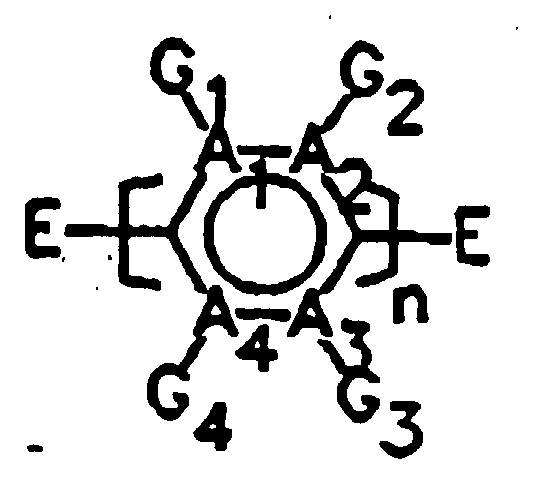
- Makromonomer nach Anspruch 1, worin E aus der Gruppe ausgewählt ist, die aus Acetalen, Acetalen von Ethylvinylether, Acetylenen, Acetylen, Säureanhydriden, Säuren, Acrylamiden, Acrylaten, Alkoholen, Aldehyden, Alkanolen, Alkylaldehyden, Alkylhalogeniden, Amiden, Aminen, Anilinen, Arylaldehyden, Aziden, Benzocyclobutenen, Biphenylen, Carboxylaten, Carbonsäuren und deren Salzen, Carbonsäurehalogeniden, Carbonsäureanhydriden, Cyanaten, Cyaniden, Epoxiden, Estern, Ethern, Formylen, Fulvenen, Halogeniden, Heteroarylen, Hydrazinen, Hydroxylaminen, Imiden, Iminen, Isocyanaten, Ketalen, Ketoalkylen, Ketoarylen, Ketonen, Maleimiden, Nadimiden, Nitrilen, Olefinen, Phenolen, Phosphaten, Phosphonaten, quartären Aminen, Silanen, Silicaten, Siliconen, Silylethern, Styrolen, Sulfonamiden,: Sulfonen, Sulfonsäuren und deren Salzen, Sulfonylhalogeniden, Sulfoxiden, Tetrahydropyranylethern, Thioethern, Urethanen, Vinylethern und Vinylen besteht.
- Makromonomer nach Anspruch 1, worin die löslichkeitsvermittelnde Seitengruppe aus der Gruppe ausgewählt ist, die aus Alkylen, Amiden, Arylen, Arylsulfiden, Arylsulfonen, Estern, Ethern, Thioethern, Fluoralkylen und Ketonen besteht.
- Makromonomer nach Anspruch 1, worin G1 ein Arylketon und E eine von einem Amin abgeleitete Endgruppe ist.
- Makromonomer nach Anspruch 1, worin G1 aus der Gruppe ausgewählt ist, die aus Arylketon, Aryl, Arylether und Amid besteht, und E aus der Gruppe ausgewählt ist, die aus Amiden, Carbonsäuren, Carbonsäurehalogeniden, Carbonsäureanhydriden, Estern, Alkoholen, Epoxiden, Vinylen, Imiden und von Amin abgeleiteten Gruppen besteht.
- Verfahren zur Herstellung von verstärkten Polymeren, welches die Copolymerisation von Makromonomeren nach Anspruch 1 mit einem oder mehreren komplementären Additions- oder Kondensationsmonomeren umfaßt.
- Verfahren zur Herstellung von verstärkten Polymeren, welches umfaßt:das Mischen von Makromonomeren nach Anspruch 1 mit einem oder mehreren vorgeformten Polymeren unddas Ausbilden von chemischen Bindungen zwischen den Monomeren und dem/den einen oder mehreren vorgeformten Polymeren, wobei die Bindungsbildung in einer Reihenfolge fortschreitet, die aus der Gruppe ausgewählt ist, die aus der Bindungsbildung gleichzeitig mit dem Mischen, der Bindungsbildung nach dem Mischen und der Bindungsbildung sowohl gleichzeitig mit als auch nach dem Mischen der Makromonomere und des/der einen oder mehreren vorgeformten Polymere besteht.
- Verfahren nach Anspruch 7, wobei das Mischverfahren aus der Gruppe ausgewählt ist, die aus Schmelzmischen, Lösungsmischen und Reaktionsspritzgießen besteht.
- Verfahren zur Herstellung von verstärkten wärmegehärteten Harzen, welches umfaßt: das Umsetzen eines Makromonomers nach Anspruch 1 mit ungehärteten Harzen, die aus der Gruppe ausgewählt sind, die aus Allylharzen, Bisacetylenharzen, Bisbenzocyclobutenharzen, Melaminharzen, Nadimidharzen, Phenolharzen, Siliconharzen, ungesättigen Polyesterharzen, Harnstoffharzen, Urethanen und Vinylesterharzen besteht, und Härtungsmitteln, die reaktive Gruppen enthalten, die mit den reaktiven Endgruppen E in dem Makromonomer komplementär sind und die kovalente Venetzungen mit den Endgruppen E ausbilden können.
- Polymer, das ein Copolyamid mit kovalent gebundenen starren, stabförmigen Segmenten enthält, die von den Makromonomeren nach Anspruch 1 abgeleitet sind.
- Verfahren zur Herstellung von verstärkten Polyamiden, das die Copolymerisation eines Makromonomers nach Anspruch 1 mit einem oder mehreren Monomeren, die Polyamide bilden können, umfaßt.
- Polymer mit einem starren Segment, das von den Makromonomeren nach Anspruch 1 abgeleitet ist und kovalent an flexible Segmente gebunden ist, die von flexiblen Polymeren abgeleitet sind, die aus der aus Polyacetalen, Polyamiden, Polyimiden, Polyestern, Polycarbonaten, Polyamidimiden, Polyamidestern, Polyimidethern, Polycarbonatestern und Polyamidethern bestehenden Gruppe ausgewählt sind.
- Polymer, das einen Copolyester umfaßt, der aus Makromonomeren vom AMA-Typ nach Anspruch 1 gebildet ist, die mit einem oder mehreren komplementären Monomeren kondensiert sind, die aus der aus Biscarbonsäuren, Biscarbonsäurechloriden, Biscarbonsäureestern, Bisdiolen, Hydroxycarbonsäuren und Lactonen bestehenden Gruppe ausgewählt sind.
- Wärmegehärtetes Harz, das durch Härten von Makromonomeren nach Anspruch 1, die Endgruppen haben, die aus der aus Epoxiden, Acetylenen, Maleimiden, Nadimiden, Benzocyclobutenen, Biphenylen, Acrylaten, Isocyanaten und Vinylen bestehenden Gruppe ausgewählt sind, in Anwesenheit von Härtungsmitteln oder Startern gebildet wurde.
- Polymermaterial, das durch Umsetzen eines Makromonomers nach Anspruch 1, das ausgewählte reaktive Endgruppen E hat, mit einem oder mehreren Polymeren oder Monomeren mit funktionellen Gruppen, die mit den ausgewählten reaktiven Endgruppen E chemisch umgesetzt werden können, hergestellt wurde.
- Wärmegehärtete Zusammensetzung, die durch thermisches Härten von Makromonomeren nach Anspruch 1 gebildet wurde.
- Wärmegehärtete Zusammensetzung nach Anspruch 16, worin die reaktiven Endgruppen aus der Gruppe ausgewählt sind, die aus Acetylen, Benzocyclobuten, Biphenylen, Maleimid und Nadimid besteht.
- Verstärktes Polymerelastomer, das ein Elastomer mit einem Polymernetzwerk und starre Segmente umfaßt, die von Makromonomeren nach Anspruch 1 abgeleitet sind, die kovalent an das Polymernetzwerk gebunden sind.
- Verfahren zur Herstellung von verstärkten Polymeren, welches die Copolymerisation eines Makromonomers nach Anspruch 1 mit Monomeren umfaßt, die ein flexibles Polymer bilden können, das aus der Gruppe ausgewählt ist, die aus Polycarbonaten, Polyethern, Polyetherketonen, Polyestern, Polyimiden, Polyphenylenoxiden und Polysulfonen besteht.
- Verfahren zur Herstellung von verstärkten Polymeren, welches das physikalische Mischen von Makromonomeren nach Anspruch 1 mit einem oder mehreren vorgeformten Polymeren umfaßt.
- Makromonomer nach Anspruch 1, worin A1, A2, A3 und A4 jeweils C sind und G1, G2, G3 und G4 in jeder Monomereinheit unabhängig voneinander H oder eine löslichkeitsvermittelnde Seitengruppe sind, vorausgesetzt, daß mindestens eine Monomereinheit mindestens eine löslichkeitsvermittelnde Seitengruppe hat, E eine reaktive Endgruppe ist, das Makromonomer einen Polymerisationsgrad, DPn von 16 oder höher hat, wobei die löslichkeitsvermittelnden Seitengruppen dem Makromonomer eine Löslichkeit von mehr als 0,5 Gew.-% in dem Lösungsmittelsystem verleihen, aus dem sie gebildet werden, und wobei benachbarte Monomereinheiten Kopf-Kopf-Orientierung, Kopf-Schwanz-Orientierung aufweisen oder statistisch orientiert sind.
- Makromonomer nach Anspruch 21, worin G1 Benzoyl ist und G2, G3 und G4 jeweils Wasserstoff sind.
- Makromonomer nach Anspruch 21, worin G1 eine aromatische oder substituierte aromatische Gruppe ist und G2, G3 und G4 jeweils Wasserstoff sind.
- Makromonomer nach Anspruch 21, worin G1 Benzoyl ist, G2, G3 und G4 jeweils Wasserstoff sind und E aus der Gruppe ausgewählt ist, die aus Acetoxy, 5-(2-Aminobenzophenon), 3-Aminophenyl, Carboxy, Carboxyphenyl, 3-Carbomethoxyphenyl, Cyanphenyl, 4-(4'-Hydroxybenzophenon) und Hydroxyphenyl besteht.
- Verfahren zur Herstellung eines Makromonomers nach Anspruch 21, welches das reduktive Verknüpfen von substituierten 1,4-Dihalogenbenzolen unter Einsatz eines Nickel- oder Palladiumkatalysators, wobei ein metallterminiertes Polyphenylen gebildet wird, und die nachfolgende Zugabe einer Endgruppe umfaßt.
- Verfahren zur Herstellung eines Makromonomers der Formelworin A1, A2, A3 und A4 in jeder Monomereinheit unabhängig voneinander C oder N sind, G1, G2, G3 und G4 in jeder Monomereinheit unabhängig voneinander H oder eine löslichkeitsvermittelnde Seitengruppe sind, vorausgesetzt, daß mindestens eine Monomereinheit mindestens eine löslichkeitsvermittelnde Seitengruppe hat und vorausgesetzt, daß wenn irgendeine der Gruppen A1, A2, A3 und A4 N ist, das entsprechende G1, G2, G3 oder G4 fehlt, E eine reaktive Endgruppe ist, das Makromonomer einen Polymerisationsgrad, DPn, von 16 oder höher hat, wobei die löslichkeitsvermittelnden Seitengruppen dem Makromonomer eine Löslichkeit von mehr als 0,5 Gew.-% in dem Lösungsmittelsystem verleihen, aus dem sie gebildet werden, und wobei benachbarte Monomereinheiten in Kopf-Kopf-Orientierung, Kopf-Schwanz-Orientierung oder statistisch orientiert vorliegen, welches das reduktive Verknüpfen von 1,4-dihalogenaromatischen Verbindungen in Anwesenheit einer substituierten Monohalogenaryl-Endgruppe umfaßt.
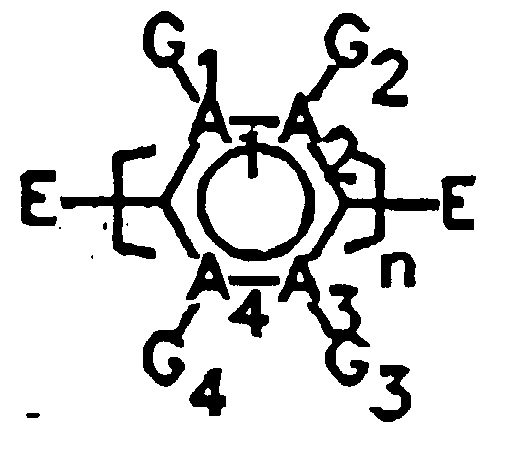
- Starres, stabförmiges Makromonomer der Formel:worin A1, A2, A3 und A4 in jeder Monomereinheit unabhängig voneinander C oder N sind, G1, G2, G3 und G4 in jeder Monomereinheit unabhängig voneinander aus der aus H, löslichkeitsvermittelnden Seitengruppen und reaktiven Seitengruppen bestehenden Gruppe ausgewählt ist, vorausgesetzt, daß mindestens eine Monomereinheit mindestens eine reaktive Seitengruppe hat und vorausgesetzt, daß mindestens eine Monomereinheit eine löslichkeitsvermittelnde Seitengruppe hat, und vorausgesetzt, daß wenn irgendeine der Gruppen A1, A2, A3 und A4 N ist, das entsprechende G1, G2, G3 oder G4 fehlt, E eine reaktive Endgruppe ist, das Makromonomer einen Polymerisationsgrad, DPn, von 16 oder höher hat, wobei die löslichkeitsvermittelnden Seitengruppen dem Makromonomer eine Löslichkeit von mehr als 0,5 Gew.-% in dem Lösungsmittelsystem verleihen, aus dem sie gebildet werden, und wobei benachbarte Monomereinheicen in Kopf-Kopf-Orientierung, Kopf-Schwanz-Orientierung oder statistisch orientiert vorliegen.

- Starres, stabförmiges Makromonomer nach Anspruch 27, worin das Makromonomer einen Polymerisationsgrad, DPn, von 16 oder höher hat.
- Starres, stabförmiges Makromonomer nach Anspruch 27, worin die reaktive Endgruppe E aus der Gruppe ausgewählt ist, die aus Acetalen, Acetylenen, Acetylen, Säureanhydriden, Alkylamiden, Acrylaten, Aldehyden, Alkylaldehyden, Alkylhalogeniden, Amiden, Aminen, Anilinen, Arylaldehyden, Aziden, Benzocyclobutenen, Biphenylenen, Carboxylaten, Carbonsäuren und deren Salzen, Carbonsäurehalogeniden, Carbonsäureanhydriden, Cyanaten, Cyaniden, Epoxiden, Estern, Ethern, Formylen, Fulvenen, Heteroarylen, Hydrazinen, Hydroxylaminen, Imiden, Iminen, Isocyanaten, Ketalen, Ketoalkylen, Ketoarylen, Ketonen, Maleimiden, Nadimiden, Nitrilen, Olefinen, Phenolen, Phosphaten, Phosphonaten, quartären Aminen, Silanen, Silicaten, Siliconen, Silylethern, Styrolen, Sulfonamiden, Sulfonen, Sulfonsäuren und deren Salzen, Sulfonylhalogeniden, Sulfoxiden, Tetrahydropyranylethern, Thioethern, Urethanen, Vinylethern und Vinylen besteht.
- Makromonomer nach Anspruch 29, worin die löslichkeitsvermittelnde Endgruppe aus der Gruppe ausgewählt ist, die aus Alkylen, Amiden, Arylen, Arylsulfiden, Arylsulfonen, Estern, Ethern, Thioethern, Fluoralkylen und Ketonen besteht.
- Makromonomer nach Anspruch 29, worin G1 und E aus den folgenden Kombinationen ausgewählt sind: G1 ist ein Arylketon und E ist aus der aus Amiden, Carbonsäuren, Carbonsäurehalogeniden, Carbonsäureanhydriden und Estern bestehenden Gruppe ausgewählt, G1 ist ein Arylketon und E umfaßt einen Alkohol, und G1 ist ein Arylketon und E ist aus der aus Epoxid-, Vinyl- und Imidgruppen bestehenden Gruppe ausgewählt.
- Makromonomer nach Anspruch 29, worin G1 Benzoyl ist und G2, G3 und G4 H sind.
- Makromonomer nach Anspruch 29, worin G1 und E aus den folgenden Kombinationen ausgewählt sind: G1 ist eine Arylgruppe und E ist eine von Amin abgeleitete Endgruppe, G1 ist eine Arylgruppe und E ist aus der aus Amiden, Carbonsäuren, Carbonsäurehalogeniden, Carbonsäureanhydriden und Estern bestehenden Gruppe ausgewählt, G1 ist eine Arylgruppe und E umfaßt einen Alkohol, und G1 ist eine Arylgruppe und E ist aus der aus Epoxid-, Vinyl- und Imidgruppen bestehenden Gruppe ausgewählt.
- Makromonomer nach Anspruch 29, worin G1 ein Arylether ist und E aus der Gruppe ausgewählt ist, die aus von Amin abgeleiteten Gruppen, Amiden, Carbonsäuren, Carbonsäurehalogeniden, Carbonsäureanhydriden, Estern, Alkoholen, Epoxiden, Vinyl- und Imidgruppen besteht.
- Makromonomer nach Anspruch 29, worin G1 ein Amid ist und E aus der Gruppe ausgewählt ist, die aus von Amin abgeleiteten Gruppen, Amiden, Carbonsäuren, Carbonsäurehalogeniden, Carbonsäureanhydriden, Estern, Alkoholen, Epoxiden, Vinyl- und Imidgruppen besteht.
- Verfahren nach Anspruch 26, wobei die Verknüpfung durch Nickelsalze in Anwesenheit eines Phosphinliganden unter Einsatz von Zink als Reduktionsmittel katalysiert wird.
- Verfahren zur Herstellung von wärmegehärteten Epoxidpolymeren, welches das Umsetzen eines Makromonomers nach Anspruch 1 mit einem Diepoxid oder Polyepoxid umfaßt, wobei ein vernetztes Harz gebildet wird, das starre Segmente enthält, die von dem Makromonomer abgeleitet sind.
- verfahren zur Herstellung von wärmegehärteten Phenolpolymeren, welches das Umsetzen eines Makromonomers nach Anspruch 1, das Endgruppen E vom Phenoltyp hat, mit einer oder mehreren Substanzen umfaßt, die aus der Gruppe ausgewählt sind, die aus Formaldehyd, para-Formaldehyd, Trioxan, Phenol-Formaldehyd-Harzen, Novolakharzen, Resolharzen und Resorcin-Formaldehyd-Harzen besteht.
- Verstärktes Polymer mit starren Segmenten, die aus den Makromonomeren nach Anspruch 1 abgeleitet sind, die kovalent an flexible Segmente gebunden sind, die aus einem oder mehreren vorgeformten flexiblen Polymeren abgeleitet sind.
- Wärmegehärtete Zusammensetzung, die ein Produkt enthält, das durch Härten eines Makromonomers nach Anspruch 1 mit einem Härter erhalten wird, der reaktive Gruppen hat, die zu den reaktiven Endgruppen E in dem Makromonomer komplementär sind und kovalente Vernetzungen mit den Endgruppen E ausbilden können.
- Starres, stabförmiges Makromonomer nach Anspruch 27, worin mindestens eine Monomereinheit mindestens eine reaktive Seitengruppe hat.
- Verfahren zur Herstellung eines Makromonomers der Formel:worin A1, A2, A3 und A4 in jeder Monomereinheit unabhängig voneinander C oder N sind, G1, G2, G3 und G4 in jeder Monomereinheit unabhängig voneinander H oder eine löslichkeitsvermittelnde Seitengruppe sind, vorausgesetzt, daß mindestens eine Monomereinheit mindestens eine löslichkeitsvermittelnde Seitengruppe hat und vorausgesetzt, daß wenn irgendeine der Gruppen A1, A2, A3 und A4 N ist, das entsprechende G1, G2, G3 oder G4 0 ist, E eine reaktive Endgruppe ist, das Makromonomer einen Polymerisationsgrad, DPn, von 16 oder höher hat, wobei die löslichkeitsvermittelnden Seitengruppen dem Makromonomer eine Löslichkeit von mehr als 0,5 Gew.-% in dem Lösungsmittelsystem verleihen, aus dem sie gebildet werden, und wobei benachbarte Monomereinheiten in Kopf-Kopf-Orientierung, Kopf-Schwanz-Orientierung oder in statistischer Orientierung vorliegen, vorliegen, welches die reduktive Kopplung von 1,4-Dihalogen-aromatischen Verbindungen in Gegenwart eines substituierten Monohalogenaryl-Endverkappungsmittels umfaßt.
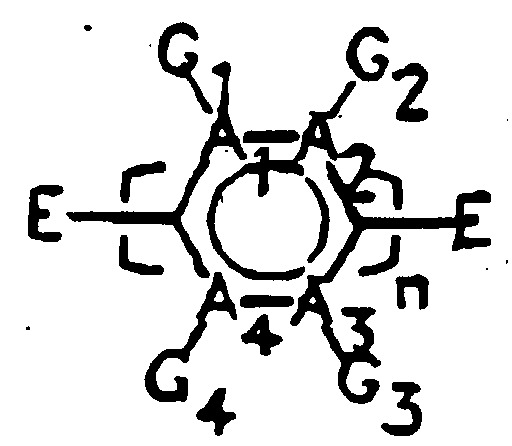
- Starres stabförmiges Makromonomer der Formelworin jedes A1, A2, A3 und A4 in jeder Monomereinheit unabhängig C oder N ist, jedes G1, G2, G3 oder G4 in jeder Monomereinheit unabhängig voneinander aus der aus H, löslichkeitsvermittelnden Seitengruppen und reaktiven Seitengruppen bestehenden Gruppe ausgewählt ist, vorausgesetzt, daß mindestens eine Monomereinheit mindestens eine reaktive Seitengruppe enthält und vorausgesetzt, daß mindestens eine Monomereinheit mindestens eine löslichkeitsvermittelnde Seitengruppe aufweist, und weiterhin vorausgesetzt, daß dann, wenn irgendeines von A1, A2, A3 und A4 für steht, das entsprechende G1, G2, G3 und G4 fehlt, E eine reaktive Endgruppe bedeutet, das Makromonomer einen Polymerisätionsgrad DPn von mehr als 6 hat, wobei die löslichkeitsvermittelnden Seitengruppen dem Makromonomer eine Löslichkeit von mehr als 0,5 Gew.-% in dem Lösungsmittelsystem, in dem es gebildet wird, verleiht und wobei benachbarte Monomereinheiten in Kopf-Kopf-, Kopf-Schwanz-Anordnung oder regellos orientiert sind.
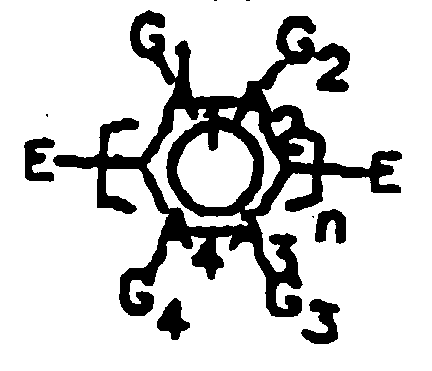
Applications Claiming Priority (3)
| Application Number | Priority Date | Filing Date | Title |
|---|---|---|---|
| US74691791A | 1991-08-19 | 1991-08-19 | |
| PCT/US1992/005889 WO1993004099A1 (en) | 1991-08-19 | 1992-07-14 | Macromonomers having reactive end groups |
| US746917 | 2000-12-22 |
Publications (3)
| Publication Number | Publication Date |
|---|---|
| EP0599886A1 EP0599886A1 (de) | 1994-06-08 |
| EP0599886A4 EP0599886A4 (en) | 1996-07-24 |
| EP0599886B1 true EP0599886B1 (de) | 2001-03-21 |
Family
ID=25002904
Family Applications (1)
| Application Number | Title | Priority Date | Filing Date |
|---|---|---|---|
| EP92916566A Expired - Lifetime EP0599886B1 (de) | 1991-08-19 | 1992-07-14 | Macromonomere mit reaktiven endgruppen |
Country Status (6)
| Country | Link |
|---|---|
| US (4) | US5824744A (de) |
| EP (1) | EP0599886B1 (de) |
| JP (1) | JP3245163B2 (de) |
| CA (1) | CA2115143C (de) |
| DE (1) | DE69231754T2 (de) |
| WO (1) | WO1993004099A1 (de) |
Families Citing this family (61)
| Publication number | Priority date | Publication date | Assignee | Title |
|---|---|---|---|---|
| US5383499A (en) * | 1992-05-04 | 1995-01-24 | Earth Resources Corporation | System for removal of unknown, corrossive, or potentially hazardous gases from a gas container |
| DE4401217A1 (de) * | 1994-01-18 | 1995-07-20 | Bayer Ag | Polymerblends |
| JP4104680B2 (ja) * | 1995-11-09 | 2008-06-18 | ミシシッピ ポリマー テクノロジーズ | 複素環式側基を有するポリマー |
| US5868174A (en) * | 1997-07-28 | 1999-02-09 | Earth Resources Corporation | System for accessing and extracting contents from a container within a sealable recovery vessel |
| US5777070A (en) * | 1997-10-23 | 1998-07-07 | The Dow Chemical Company | Process for preparing conjugated polymers |
| JP2002520432A (ja) * | 1998-07-10 | 2002-07-09 | イー・アイ・デュポン・ドウ・ヌムール・アンド・カンパニー | ミクロゲルおよびその調製方法 |
| DE60116678T2 (de) | 2000-03-29 | 2006-08-24 | Jsr Corp. | Polyarylen Kopolymer und Protonen leitende Membran |
| US6881795B2 (en) * | 2001-03-28 | 2005-04-19 | Firestone Polymers, Llc | CO2 terminated rubber for plastics |
| DE10164309A1 (de) * | 2001-12-28 | 2003-07-10 | Fraunhofer Ges Forschung | Verbesserte strukturiert-funktionale Bindematrices für Biomoleküle |
| KR20050121232A (ko) * | 2003-03-31 | 2005-12-26 | 스미또모 가가꾸 가부시키가이샤 | 중합체 및 그것을 사용한 고분자 발광 소자 |
| EP1720941A4 (de) * | 2004-01-28 | 2009-07-29 | Solvay Advanced Polymers Llc | Substituierte polyphenylene durch katalyse mit geträgertem übergangsmetall |
| US7268193B2 (en) * | 2004-03-04 | 2007-09-11 | Mississippi Polymer Technologies, Inc. | Branched polyphenylene polymers |
| US20060094859A1 (en) * | 2004-11-03 | 2006-05-04 | Marrocco Matthew L Iii | Class of bridged biphenylene polymers |
| DE112006000379T5 (de) | 2005-02-22 | 2008-02-07 | Sumation Co. Ltd. | Arylenpolymere mit grosser Bandlücke |
| US8240252B2 (en) * | 2005-03-07 | 2012-08-14 | Nikica Maljkovic | Ammunition casing |
| EP1913036B1 (de) * | 2005-07-20 | 2013-03-06 | Bridgestone Corporation | Aminfunktionalisierte polymere |
| ATE517946T1 (de) * | 2006-03-07 | 2011-08-15 | Solvay Advanced Polymers Llc | Neue polyarylenzusammensetzung |
| US7820767B2 (en) * | 2006-03-07 | 2010-10-26 | Solvay Advanced Polymers, L.L.C. | Aromatic polyimide composition |
| US20080312387A1 (en) * | 2006-08-11 | 2008-12-18 | Solvay Advanced Polymers, L.L.C. | New Polyarylene Composition |
| US20070270970A1 (en) * | 2006-03-14 | 2007-11-22 | Sdgi Holdings, Inc. | Spinal implants with improved wear resistance |
| US20070270971A1 (en) * | 2006-03-14 | 2007-11-22 | Sdgi Holdings, Inc. | Intervertebral prosthetic disc with improved wear resistance |
| US20070233246A1 (en) * | 2006-03-31 | 2007-10-04 | Sdgi Holdings, Inc. | Spinal implants with improved mechanical response |
| EP2033324B1 (de) | 2006-05-24 | 2016-04-13 | Ben Gurion University of the Negev Research and Development Authority | Membranen und herstellungsverfahren dafür |
| US20080021462A1 (en) * | 2006-07-24 | 2008-01-24 | Warsaw Orthopedic Inc. | Spinal stabilization implants |
| US20080021557A1 (en) * | 2006-07-24 | 2008-01-24 | Warsaw Orthopedic, Inc. | Spinal motion-preserving implants |
| DE602007011298D1 (de) * | 2006-09-06 | 2011-01-27 | Solvay Advanced Polymers Llc | Neue aromatisches polycarbonat enthaltende zusammensetzung |
| US8716409B2 (en) * | 2006-12-29 | 2014-05-06 | Firestone Polymers, Llc | Carboxylate terminated polymers and their use in impact-modified plastics |
| US8153728B2 (en) | 2007-03-15 | 2012-04-10 | Dsm Ip Assets B.V. | PDMS-PVP block copolymers |
| US8053031B2 (en) * | 2007-07-26 | 2011-11-08 | Raven Lining Systems Inc. | Two-part epoxy composition |
| EP2200672B1 (de) | 2007-09-11 | 2012-06-27 | Solvay Specialty Polymers USA, LLC. | Verbesserte prothesenvorrichtungen |
| EP2357014A1 (de) | 2010-03-17 | 2011-08-17 | Solvay Advanced Polymers, L.L.C. | Verbesserte, aus einem bestimmten Kunststoffmaterial hergestellte Nadeln |
| US8742064B2 (en) * | 2007-10-23 | 2014-06-03 | Solvay Advanced Polymers, L.L.C. | Medical tubings made of a polymer material |
| US7772355B2 (en) * | 2008-01-28 | 2010-08-10 | The United States Of America As Represented By The Secretary Of The Navy | Divinylsilane-terminated aromatic ether-aromatic ketone-containing compounds |
| WO2010023281A1 (en) * | 2008-08-29 | 2010-03-04 | Solvay Advanced Polymers, L.L.C. | Thermally stabilized polyarylene compositions |
| WO2010036170A1 (en) * | 2008-09-23 | 2010-04-01 | Nexam Chemical Ab | Acetylenic polyamide |
| WO2010071532A1 (en) * | 2008-12-16 | 2010-06-24 | Nexam Chemical Ab | Acetylenic phenol-aldehyde resin |
| AU2010215116A1 (en) | 2009-02-19 | 2011-10-13 | Ben-Gurion University Of The Negev Research And Development Authority | Chemically resistant membranes, coatings and films and methods for their preparation |
| JP5805065B2 (ja) | 2009-03-30 | 2015-11-04 | ソルベイ・アドバンスト・ポリマーズ・エルエルシー | ポリマー材料製の締結具 |
| DE102009027983A1 (de) | 2009-07-24 | 2011-01-27 | Robert Bosch Gmbh | Copolymer aus einem Polyphenylen und einer flexiblen Kettenkomponente |
| WO2011078387A1 (ja) * | 2009-12-25 | 2011-06-30 | 住友化学株式会社 | 組成物及び該組成物を用いてなる発光素子 |
| US8623253B2 (en) | 2010-02-26 | 2014-01-07 | The United States Of America As Represented By The Administrator Of The National Aeronautics And Space Administration | Low-melt poly(amic acids) and polyimides and their uses |
| US9365756B1 (en) | 2010-02-26 | 2016-06-14 | The United States Of America As Represented By The Administrator Of The National Aeronautics And Space Administration | Low-melt poly(amic acids) and polyimides and their uses |
| US10532152B2 (en) | 2010-03-17 | 2020-01-14 | Solvay Specialty Polymers Usa, L.L.C. | Needles made of a particular plastic material |
| KR101708934B1 (ko) * | 2010-07-05 | 2017-03-08 | 심천 워트 어드밴스드 머티리얼즈 주식회사 | 열경화성 수지 제조용 조성물 및 그의 경화물, 상기 경화물을 포함하는 프리프레그와 프리프레그 적층체, 및 상기 프리프레그 또는 프리프레그 적층체를 채용한 금속박 적층판과 프린트 배선판 |
| WO2012081026A2 (en) | 2010-12-12 | 2012-06-21 | Ben-Gurion University Of The Negev Research And Development Authority | Anion exchange membranes, methods of preparation and uses |
| EP2737275A4 (de) | 2011-07-28 | 2014-09-17 | Mac Llc | Polymere munitionshülsengeometrie |
| US9182204B2 (en) | 2011-07-28 | 2015-11-10 | Mac, Llc | Subsonic ammunition casing |
| US8669314B2 (en) | 2012-02-03 | 2014-03-11 | Sabic Innovative Plastics Ip B.V. | Hydrolytic stability in polycarbonate compositions |
| US9127127B2 (en) | 2012-10-03 | 2015-09-08 | Sabic Global Technologies B.V. | Polyetherimide compositions, methods of manufacture, and articles formed therefrom |
| US9023954B1 (en) | 2012-12-26 | 2015-05-05 | The United States Of America As Represented By The Secretary Of The Navy | Side-chain and end-group modified poly-p-phenylene oligomers |
| US9355787B2 (en) * | 2013-01-30 | 2016-05-31 | Colorado School Of Mines | Method of forming rigid imide material from soluble amide ester functionalized precursors |
| US10676571B2 (en) | 2013-12-02 | 2020-06-09 | Sabic Global Technologies B.V. | Polyetherimides with improved melt stability |
| WO2015130409A2 (en) | 2014-01-13 | 2015-09-03 | Mac Llc | Neck polymeric ammuniti0n casing geometry |
| US9085692B1 (en) | 2014-02-25 | 2015-07-21 | The Government Of The United States Of America, As Represented By The Secretary Of The Navy | Synthesis of oligomeric divinyldialkylsilane containing compositions |
| WO2015154079A1 (en) | 2014-04-04 | 2015-10-08 | Mac, Llc | Method for producing subsonic ammunition casing |
| CN106824099B (zh) * | 2017-03-10 | 2019-07-12 | 郑州大学 | 一种磁性CCPs固相萃取剂及其制备方法和应用 |
| JP7582967B2 (ja) | 2019-04-23 | 2024-11-13 | デュポン エレクトロニクス インコーポレイテッド | 電子デバイスで使用するためのポリマー |
| DE102023102255A1 (de) | 2023-01-31 | 2024-08-01 | Forschungszentrum Jülich GmbH | Verfahren zur Herstellung eines Polymers, insbesondere für eine Membran, Polymer, Membran und Verwendung einer Membran |
| CN116285557B (zh) * | 2023-03-01 | 2023-09-05 | 格林斯达(北京)环保科技股份有限公司 | 一种高耐热性etfe涂料及其制备工艺 |
| KR20260005917A (ko) | 2023-04-19 | 2026-01-12 | 사이언스코 스페셜티 폴리머즈 유에스에이, 엘엘씨 | 연료 전지 또는 전해 전지 응용을 위한 폴리페닐렌 이오노머 |
| CN120865668B (zh) * | 2025-09-29 | 2025-12-09 | 陕西聚能塑胶有限公司 | 一种可降解pa6复合改性塑料 |
Family Cites Families (16)
| Publication number | Priority date | Publication date | Assignee | Title |
|---|---|---|---|---|
| GB928576A (en) * | 1959-10-21 | 1963-06-12 | Artrite Resins Ltd | Method for the preparation of resins containing linked aromatic nuclei |
| US3536636A (en) * | 1968-05-08 | 1970-10-27 | Us Air Force | Polyfluorophenylene polymers |
| US4000187A (en) * | 1972-04-11 | 1976-12-28 | University Of Iowa Research Foundation | Quinoline and anthrazoline polymers |
| US3998864A (en) * | 1975-02-03 | 1976-12-21 | Standard Oil Company (Indiana) | Heterogeneous catalyst for the hydroformylation of olegins |
| US4486576A (en) * | 1982-04-22 | 1984-12-04 | Union Carbide Corporation | High-temperature, aromatic coating materials from aryl polyhalides |
| GB8317169D0 (en) * | 1983-06-24 | 1983-07-27 | British Petroleum Co | Fluorinated polyphenylenes |
| US4911801A (en) * | 1985-10-01 | 1990-03-27 | University Of Utah | Electrically conductive polyparaphenylene polymers, and methods for their preparation and use |
| JP3009691B2 (ja) * | 1988-02-17 | 2000-02-14 | マックスデム インコーポレイテッド | 剛直性ポリマー |
| US5227457A (en) * | 1988-02-17 | 1993-07-13 | Maxdem Incorporated | Rigid-rod polymers |
| JPH01259030A (ja) * | 1988-04-11 | 1989-10-16 | Asahi Chem Ind Co Ltd | 芳香族ポリエーテルケトン共重合体 |
| DE3821567A1 (de) * | 1988-06-25 | 1989-12-28 | Bayer Ag | Loesliche polyaromaten |
| JPH02113023A (ja) * | 1988-10-20 | 1990-04-25 | Mitsui Petrochem Ind Ltd | 芳香族コポリエステル |
| US5017677A (en) * | 1988-11-18 | 1991-05-21 | Colorado State University Research Foundation | Polyquinoline copolymers |
| DE4001915A1 (de) * | 1989-12-06 | 1991-06-13 | Bayer Ag | Mischungen aus substituierten homo-poly-p-phenylenen und thermoplasten |
| US5169929A (en) * | 1990-06-25 | 1992-12-08 | University Of South Carolina | Lithium/hmpa-promoted synthesis of poly(phenylenes) |
| US5241044A (en) * | 1992-03-20 | 1993-08-31 | Edison Polymer Innovation Corporation | Soluble poly(p-phenylene)s |
-
1992
- 1992-07-14 EP EP92916566A patent/EP0599886B1/de not_active Expired - Lifetime
- 1992-07-14 DE DE69231754T patent/DE69231754T2/de not_active Expired - Lifetime
- 1992-07-14 CA CA002115143A patent/CA2115143C/en not_active Expired - Lifetime
- 1992-07-14 WO PCT/US1992/005889 patent/WO1993004099A1/en not_active Ceased
- 1992-07-14 JP JP50429393A patent/JP3245163B2/ja not_active Expired - Lifetime
-
1995
- 1995-06-01 US US08/457,268 patent/US5824744A/en not_active Expired - Lifetime
- 1995-06-01 US US08/457,092 patent/US5670564A/en not_active Expired - Lifetime
-
1996
- 1996-05-14 US US08/645,914 patent/US5827927A/en not_active Expired - Lifetime
-
1998
- 1998-06-08 US US09/093,746 patent/US5973075A/en not_active Expired - Lifetime
Also Published As
| Publication number | Publication date |
|---|---|
| US5973075A (en) | 1999-10-26 |
| JP3245163B2 (ja) | 2002-01-07 |
| JPH06510315A (ja) | 1994-11-17 |
| EP0599886A4 (en) | 1996-07-24 |
| DE69231754D1 (de) | 2001-04-26 |
| US5670564A (en) | 1997-09-23 |
| WO1993004099A1 (en) | 1993-03-04 |
| US5824744A (en) | 1998-10-20 |
| CA2115143C (en) | 2002-11-19 |
| EP0599886A1 (de) | 1994-06-08 |
| DE69231754T2 (de) | 2001-11-15 |
| US5827927A (en) | 1998-10-27 |
| CA2115143A1 (en) | 1993-03-04 |
Similar Documents
| Publication | Publication Date | Title |
|---|---|---|
| US5973075A (en) | Methods for preparing rigid-rod macromonomers with reactive end groups | |
| EP0646143B1 (de) | Makromonomere mit reaktiven nebengruppen | |
| US5886130A (en) | Polyphenylene co-polymers | |
| Crivello et al. | Aromatic bisvinyl ethers: A new class of highly reactive thermosetting monomers | |
| Pak et al. | Synthesis and characterization of novel toughened thermosets derived from pendent amines on the backbone of poly (arylene ether sulphone) s | |
| CA1253646A (en) | Process for catalytic preparation of poly(ether- amide) polymeric composition from oxazoline and polyphenol | |
| Hsiao et al. | Synthesis and characterization of new diphenylfluorene‐based aromatic polyamides derived from 9, 9‐bis [4‐(4‐carboxy‐phenoxy) phenyl] fluorene | |
| JPH09309945A (ja) | ポリフェニレンコポリマー | |
| Liaw et al. | Synthesis and characterization of new adamantane‐type cardo polyamides | |
| US5155203A (en) | Poly (ether-ketone) | |
| EP3494157B1 (de) | Stabilisatoren für bromierte polymere flammschutzmittel | |
| EP4028450B1 (de) | Polyamidimid polymer und verfahren zu seiner herstellung | |
| EP0773249B1 (de) | Polyphenylencopolymere | |
| US3657190A (en) | Method for forming pyrrone molding powders and products of said method | |
| JPH0224305A (ja) | 熱硬化性樹脂組成物 | |
| CN118684895A (zh) | 聚酰胺弹性体及其制备方法和应用 | |
| CN120484245A (zh) | 高强度聚芳醚腈的制备方法及其应用 | |
| Gao | New methods for cross-linking of high performance polymers | |
| Gao et al. | Thermally crosslinkable poly (aryl ether) s containing a chalcone moiety | |
| JPH04233968A (ja) | 変性ポリフェニレンエーテルを基礎とする熱可塑性成形材料 | |
| Lee et al. | Processable rigid polymers containing spiroacetal units | |
| Zhang | Synthesis and characterization of nylon 6-b-aramid-b-nylon 6 copolymers | |
| JPH02258835A (ja) | 熱硬化性芳香族ポリアミド用組成物 |
Legal Events
| Date | Code | Title | Description |
|---|---|---|---|
| PUAI | Public reference made under article 153(3) epc to a published international application that has entered the european phase |
Free format text: ORIGINAL CODE: 0009012 |
|
| 17P | Request for examination filed |
Effective date: 19940318 |
|
| AK | Designated contracting states |
Kind code of ref document: A1 Designated state(s): DE FR GB IT NL |
|
| RIN1 | Information on inventor provided before grant (corrected) |
Inventor name: HENDRICKS, NEIL H. Inventor name: TRIMMER, MARK STEVEN Inventor name: MARROCCO, MATTHEW, LOUIS, III Inventor name: GAGNE, ROBERT, R. |
|
| A4 | Supplementary search report drawn up and despatched |
Effective date: 19960606 |
|
| AK | Designated contracting states |
Kind code of ref document: A4 Designated state(s): DE FR GB IT NL |
|
| 17Q | First examination report despatched |
Effective date: 19961024 |
|
| GRAG | Despatch of communication of intention to grant |
Free format text: ORIGINAL CODE: EPIDOS AGRA |
|
| GRAG | Despatch of communication of intention to grant |
Free format text: ORIGINAL CODE: EPIDOS AGRA |
|
| GRAG | Despatch of communication of intention to grant |
Free format text: ORIGINAL CODE: EPIDOS AGRA |
|
| GRAH | Despatch of communication of intention to grant a patent |
Free format text: ORIGINAL CODE: EPIDOS IGRA |
|
| GRAH | Despatch of communication of intention to grant a patent |
Free format text: ORIGINAL CODE: EPIDOS IGRA |
|
| RAP1 | Party data changed (applicant data changed or rights of an application transferred) |
Owner name: MISSISSIPPI POLYMER TECHNOLOGIES, INC. |
|
| GRAA | (expected) grant |
Free format text: ORIGINAL CODE: 0009210 |
|
| AK | Designated contracting states |
Kind code of ref document: B1 Designated state(s): DE FR GB IT NL |
|
| PG25 | Lapsed in a contracting state [announced via postgrant information from national office to epo] |
Ref country code: NL Free format text: LAPSE BECAUSE OF FAILURE TO SUBMIT A TRANSLATION OF THE DESCRIPTION OR TO PAY THE FEE WITHIN THE PRESCRIBED TIME-LIMIT Effective date: 20010321 Ref country code: IT Free format text: LAPSE BECAUSE OF FAILURE TO SUBMIT A TRANSLATION OF THE DESCRIPTION OR TO PAY THE FEE WITHIN THE PRE;WARNING: LAPSES OF ITALIAN PATENTS WITH EFFECTIVE DATE BEFORE 2007 MAY HAVE OCCURRED AT ANY TIME BEFORE 2007. THE CORRECT EFFECTIVE DATE MAY BE DIFFERENT FROM THE ONE RECORDED.SCRIBED TIME-LIMIT Effective date: 20010321 |
|
| REF | Corresponds to: |
Ref document number: 69231754 Country of ref document: DE Date of ref document: 20010426 |
|
| ET | Fr: translation filed | ||
| NLV1 | Nl: lapsed or annulled due to failure to fulfill the requirements of art. 29p and 29m of the patents act | ||
| REG | Reference to a national code |
Ref country code: GB Ref legal event code: IF02 |
|
| PLBE | No opposition filed within time limit |
Free format text: ORIGINAL CODE: 0009261 |
|
| 26N | No opposition filed | ||
| PGFP | Annual fee paid to national office [announced via postgrant information from national office to epo] |
Ref country code: FR Payment date: 20100805 Year of fee payment: 19 Ref country code: DE Payment date: 20100707 Year of fee payment: 19 |
|
| PGFP | Annual fee paid to national office [announced via postgrant information from national office to epo] |
Ref country code: GB Payment date: 20100714 Year of fee payment: 19 |
|
| GBPC | Gb: european patent ceased through non-payment of renewal fee |
Effective date: 20110714 |
|
| REG | Reference to a national code |
Ref country code: FR Ref legal event code: ST Effective date: 20120330 |
|
| PG25 | Lapsed in a contracting state [announced via postgrant information from national office to epo] |
Ref country code: DE Free format text: LAPSE BECAUSE OF NON-PAYMENT OF DUE FEES Effective date: 20120201 Ref country code: FR Free format text: LAPSE BECAUSE OF NON-PAYMENT OF DUE FEES Effective date: 20110801 |
|
| REG | Reference to a national code |
Ref country code: DE Ref legal event code: R119 Ref document number: 69231754 Country of ref document: DE Effective date: 20120201 |
|
| PG25 | Lapsed in a contracting state [announced via postgrant information from national office to epo] |
Ref country code: GB Free format text: LAPSE BECAUSE OF NON-PAYMENT OF DUE FEES Effective date: 20110714 |