EP0600841A1 - Appareil de contrôle pour la prévention d'accident sur presses hydrauliques et similaires, en particulier pour travaux de broyage de pierres - Google Patents
Appareil de contrôle pour la prévention d'accident sur presses hydrauliques et similaires, en particulier pour travaux de broyage de pierres Download PDFInfo
- Publication number
- EP0600841A1 EP0600841A1 EP93830325A EP93830325A EP0600841A1 EP 0600841 A1 EP0600841 A1 EP 0600841A1 EP 93830325 A EP93830325 A EP 93830325A EP 93830325 A EP93830325 A EP 93830325A EP 0600841 A1 EP0600841 A1 EP 0600841A1
- Authority
- EP
- European Patent Office
- Prior art keywords
- operating head
- active portion
- sensing unit
- case
- oil
- Prior art date
- Legal status (The legal status is an assumption and is not a legal conclusion. Google has not performed a legal analysis and makes no representation as to the accuracy of the status listed.)
- Withdrawn
Links
- 230000003245 working effect Effects 0.000 title claims abstract description 10
- 230000001747 exhibiting effect Effects 0.000 claims abstract 2
- 230000003213 activating effect Effects 0.000 claims description 3
- 239000012780 transparent material Substances 0.000 claims description 2
- 239000004575 stone Substances 0.000 description 14
- 210000004247 hand Anatomy 0.000 description 12
- 238000005520 cutting process Methods 0.000 description 4
- 238000010008 shearing Methods 0.000 description 4
- 238000006073 displacement reaction Methods 0.000 description 2
- 238000004519 manufacturing process Methods 0.000 description 2
- 230000000284 resting effect Effects 0.000 description 2
- 230000004913 activation Effects 0.000 description 1
- 239000002969 artificial stone Substances 0.000 description 1
- 230000000994 depressogenic effect Effects 0.000 description 1
- 239000000428 dust Substances 0.000 description 1
- 239000000463 material Substances 0.000 description 1
- 239000002184 metal Substances 0.000 description 1
- 238000001228 spectrum Methods 0.000 description 1
- 210000000707 wrist Anatomy 0.000 description 1
Images




Classifications
-
- F—MECHANICAL ENGINEERING; LIGHTING; HEATING; WEAPONS; BLASTING
- F16—ENGINEERING ELEMENTS AND UNITS; GENERAL MEASURES FOR PRODUCING AND MAINTAINING EFFECTIVE FUNCTIONING OF MACHINES OR INSTALLATIONS; THERMAL INSULATION IN GENERAL
- F16P—SAFETY DEVICES IN GENERAL; SAFETY DEVICES FOR PRESSES
- F16P3/00—Safety devices acting in conjunction with the control or operation of a machine; Control arrangements requiring the simultaneous use of two or more parts of the body
- F16P3/12—Safety devices acting in conjunction with the control or operation of a machine; Control arrangements requiring the simultaneous use of two or more parts of the body with means, e.g. feelers, which in case of the presence of a body part of a person in or near the danger zone influence the control or operation of the machine
- F16P3/14—Safety devices acting in conjunction with the control or operation of a machine; Control arrangements requiring the simultaneous use of two or more parts of the body with means, e.g. feelers, which in case of the presence of a body part of a person in or near the danger zone influence the control or operation of the machine the means being photocells or other devices sensitive without mechanical contact
- F16P3/145—Safety devices acting in conjunction with the control or operation of a machine; Control arrangements requiring the simultaneous use of two or more parts of the body with means, e.g. feelers, which in case of the presence of a body part of a person in or near the danger zone influence the control or operation of the machine the means being photocells or other devices sensitive without mechanical contact using magnetic technology
-
- B—PERFORMING OPERATIONS; TRANSPORTING
- B28—WORKING CEMENT, CLAY, OR STONE
- B28D—WORKING STONE OR STONE-LIKE MATERIALS
- B28D1/00—Working stone or stone-like materials, e.g. brick, concrete or glass, not provided for elsewhere; Machines, devices, tools therefor
- B28D1/22—Working stone or stone-like materials, e.g. brick, concrete or glass, not provided for elsewhere; Machines, devices, tools therefor by cutting, e.g. incising
- B28D1/222—Working stone or stone-like materials, e.g. brick, concrete or glass, not provided for elsewhere; Machines, devices, tools therefor by cutting, e.g. incising by pressing, e.g. presses
-
- F—MECHANICAL ENGINEERING; LIGHTING; HEATING; WEAPONS; BLASTING
- F16—ENGINEERING ELEMENTS AND UNITS; GENERAL MEASURES FOR PRODUCING AND MAINTAINING EFFECTIVE FUNCTIONING OF MACHINES OR INSTALLATIONS; THERMAL INSULATION IN GENERAL
- F16P—SAFETY DEVICES IN GENERAL; SAFETY DEVICES FOR PRESSES
- F16P3/00—Safety devices acting in conjunction with the control or operation of a machine; Control arrangements requiring the simultaneous use of two or more parts of the body
- F16P3/12—Safety devices acting in conjunction with the control or operation of a machine; Control arrangements requiring the simultaneous use of two or more parts of the body with means, e.g. feelers, which in case of the presence of a body part of a person in or near the danger zone influence the control or operation of the machine
-
- F—MECHANICAL ENGINEERING; LIGHTING; HEATING; WEAPONS; BLASTING
- F16—ENGINEERING ELEMENTS AND UNITS; GENERAL MEASURES FOR PRODUCING AND MAINTAINING EFFECTIVE FUNCTIONING OF MACHINES OR INSTALLATIONS; THERMAL INSULATION IN GENERAL
- F16P—SAFETY DEVICES IN GENERAL; SAFETY DEVICES FOR PRESSES
- F16P3/00—Safety devices acting in conjunction with the control or operation of a machine; Control arrangements requiring the simultaneous use of two or more parts of the body
- F16P3/12—Safety devices acting in conjunction with the control or operation of a machine; Control arrangements requiring the simultaneous use of two or more parts of the body with means, e.g. feelers, which in case of the presence of a body part of a person in or near the danger zone influence the control or operation of the machine
- F16P3/14—Safety devices acting in conjunction with the control or operation of a machine; Control arrangements requiring the simultaneous use of two or more parts of the body with means, e.g. feelers, which in case of the presence of a body part of a person in or near the danger zone influence the control or operation of the machine the means being photocells or other devices sensitive without mechanical contact
- F16P3/144—Safety devices acting in conjunction with the control or operation of a machine; Control arrangements requiring the simultaneous use of two or more parts of the body with means, e.g. feelers, which in case of the presence of a body part of a person in or near the danger zone influence the control or operation of the machine the means being photocells or other devices sensitive without mechanical contact using light grids
-
- F—MECHANICAL ENGINEERING; LIGHTING; HEATING; WEAPONS; BLASTING
- F16—ENGINEERING ELEMENTS AND UNITS; GENERAL MEASURES FOR PRODUCING AND MAINTAINING EFFECTIVE FUNCTIONING OF MACHINES OR INSTALLATIONS; THERMAL INSULATION IN GENERAL
- F16P—SAFETY DEVICES IN GENERAL; SAFETY DEVICES FOR PRESSES
- F16P3/00—Safety devices acting in conjunction with the control or operation of a machine; Control arrangements requiring the simultaneous use of two or more parts of the body
- F16P3/18—Control arrangements requiring the use of both hands
- F16P3/20—Control arrangements requiring the use of both hands for electric control systems
Definitions
- the present invention relates to an accident-preventing control device for oil-operated presses and the like, in particular for stone-breaking workings, said presses being of the type comprising a fixed base provided with a workbench on which a workpiece is disposed, an operating head engaged to said fixed base and vertically movable with a reciprocating motion consisting of a downward work stroke against the workpiece and an upward return stroke; actuating means for the operating head; and a control pedal for said actuating means.
- the operating head is reciprocated by actuating means comprising for example at least one oil-operated cylinder.
- an upper blade or cutting tool is engaged to the operating head, which blade in cooperation with a lower blade emerging from the workbench and possibly driven by a second oil-operated cylinder, penetrates into the blocks and slits them according to substantially vertical surfaces.
- said shearing machines for stone-breaking workings are provided with a pedal for controlling the actuating means of the operating head.
- This control pedal enables the operator to have both hands free, for positioning the small stone blocks for example, so that the machine output may be increased. Due to the fact that this working is very dangerous and since increasingly more restrictive safety regulations are imposed, in machines of the known type the control pedal has been often replaced by a pair of pushbuttons, disposed on the operating head for example, and adapted to oblige an operator to engage both hands in contact therewith while the operating head is carrying out its work stroke.
- this known accident-preventing control device has the important drawback of greatly reducing the output of the oil-operated presses to which it is applied.
- the operator's hands are engaged on the control pushbuttons over the whole work stroke of the operating head and therefore over an important period of time, which will prevent the operator from accomplishing other operating steps. It may sometimes happen that when the control pedal is still present, an operator, driven by a need to increase his work rates, will restore operation of same, thereby making the newly introduced accident-preventing measures fruitless.
- the technical task underlying the present invention is to provide an accident-preventing control device for oil-operated presses and the like, in particular for stone-breaking workings, capable of substantially obviating the above drawbacks.
- an accident-preventing control device for oil-operated presses and the like, in particular for stone-breaking workings characterized in that it comprises:
- the accident-preventing control device has been generally identified by reference numeral 1.
- an oil-operated press 2 adapted to break workpieces 3 such as stones, for producing stone cubes.
- the oil-operated press 2 is conventionally provided with a base 30 on which a workbench 31 is defined which is designed to receive said workpieces 3 resting thereon. Integrally engaged with the base 30 is a vertical pillar 32 from which a horizontal support arm 33 extends in cantilevered fashion and an operating head 4 is mounted to an end 33a of said arm.
- the operating head 4, to which an upper blade 5 is applied, is made vertically movable by actuating means defined by an oil-operated cylinder 6 operatively interposed between said head and the horizontal supporting arm 33.
- the operating head 4 carries out a reciprocating motion formed of a downward work stroke against the workpiece 3 and an upward return stroke.
- a control pedal 7, if depressed, enables an oil-operated cylinder 6 to be actuated, thereby imposing the downward displacement of the operating head 4.
- a lower blade 10 emerges from the workbench 31, which blade is adapted to cooperate with the upper blade 5 when a stone-breaking operation is being carried out.
- the lower blade 10 cooperates with the upper blade 5 following lowering of the workbench itself, against the action of a supporting hydraulic cylinder 9 or as a result of lifting of the blade 10.
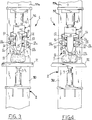
- the accident-preventing control device shown in one embodiment in Figs. 1, 2, 3 and 4, comprises one sensing unit 11, in turn comprising a protection case 12 for the operating head 4 extending at the lowermost area of said head.
- the case 12 exhibits at the lower part thereof, an edge band 13 disposed close to a lower end of the operating head 4 and sideways enclosing the upper blade 5.
- the edge band 13 defines one active portion of the first sensing unit 11. Said first sensing unit, in the presence of any obstacle interferring with the edge band 13 during the work stroke of the operating head 4, is adapted to send a stop signal to the oil-operated cylinder 6 that immediately stops lowering of the operating head 4.
- edge band 13 of the protection case 12 projects downwardly, for example some centimetres, from the lower end of the operating head 4, being therefore located at an advanced position with respect to the upper blade 5 during the downward work stroke of the latter.
- the protection case 12 is engaged to the operating head 4 by connecting means 14 comprising connecting rods 15 and rotating engagement members 16 provided with elastically yielding elements acting in a torsional direction.
- the rotating engagement members 16 are located between the case 12 and first end portions of the connecting rods 15 and between the operating head 4 and second end portions of said connecting rods.
- the connecting means 14 enables the edge band 13, and therefore the whole case, to be retracted with respect to the operating head 4 upon contact of the edge band itself 13 with any hindrance, a hand or the workpiece, for example. Since the rotating engagement members 16 are provided with elastically yielding elements acting in a torsional direction, retraction of the edge band 13 takes place against the action of the elastic resistance offered by the engagement members 16 themselves.
- the first sensing unit 11 further comprises at least one proximity switch 17 engaged to the operating head 4 and activated by the retraction of the edge band 13, and consequently the whole case 12.
- the proximity switch 17 is adapted to send a stop signal to the oil-operated cylinder 6 and thereby stop lowering of the operating head 4.
- the relative position of the switch 17 to the case 12 is such that the stop signal is emitted even when the retraction of the edge band 13 is very reduced, always corresponding, at all events, to a position of the upper blade 5 within the case 12 itself.
- the accident-preventing device 1 further comprises a pair of enabling members 18 adapted to activate the oil-operated cylinder 6 again, for completing the work stroke of the operating head 6 after it has been stopped.
- the enabling members 18 are disposed spaced apart from the lower end of the operating head 4 and for their activation the intervention of the operator's two hands is required over the whole time needed for completing the work stroke.
- the enabling members 18 are disposed spaced apart a safety distance from the upper blade 5, so that all risks of interference between the blade and any part of the operator's hands are eliminated.
- the enabling members 18 are embodied by two pushbuttons 18a engaged to the case 12 on opposite sides thereof.
- the connecting means 14, in addition to enabling the first partial retraction of the case 12 relative to the operating head 4 are also capable of enabling a further retraction of the case 12 itself so that the upper blade 5 may emerge therefrom after intervention of the enabling members 18.
- the case 12 is divided into two halves 12a and 12b linked independently of each other to the operating head 4 by the connecting means 14.
- each half 12a and 12b is engaged to the operating head 4 by means of a pair of connecting rods 15 and is provided at the lower part thereof with its own edge band 13.
- the first sensing unit 11 comprises two proximity switches 17, one for each half.
- the case 12 is formed with a single half portion positioned before the cutting blade 5.
- the case 12 may be advantageously made of transparent material, so that the operator can visually follow the whole cutting operation.
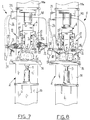
- the device of the invention has a second sensing unit 19 comprising at least one second active portion 20 defined by a first magnetic sensor for example, and disposed at a lower edge of the first active portion, that is the edge band 13 of the case 12.
- the second sensing unit 19 further comprises a pair of control and protection gloves 21 provided with metal plates 22 electrically connected with each other.
- the interference of one glove 21 with the second active portion 20 causes the emission of a stop signal by the glove itself for stopping the oil-operated cylinder 6.
- the enabling members 18 in the second embodiment of the device 1 may consist of second magnetic sensors 18b engaged to the case 12 through supports 23, upon interposition of insulating elements 24.
- Sending of signals from the control gloves 21 to the electric panel 25 can take place following different modalities.
- a direct connection through an insulated electric cable 26 may be provided, or a wrist transmitter 27 of electromagnetic signals may be applied to the gloves 21, or yet an electric connection to a radiotransmitter 28 provided with an antenna may be envisaged.
- the first sensing unit 11 comprises at least one support arm 34 having one end 34a fastened to said operating head 4 and a second end 34b projecting downwardly beyond the operating head.
- An optoelectric detector 35 is mounted to the second end 34b of the support arm 34, said detector defining said first active portion of the first sensing unit 11.
- the optoelectric detector 35 is disposed in coplanar relation with the upper cutting blade 5, at a lower position relative to the same blade and offset with respect to the work area.
- Said optoelectric detector 35 comprises a light emitter preferentially acting in the spectrum field of infrared waves, arranged to generate a light beam 36 substantially extending flush with a free edge 5a of said upper blade 5.
- the light beam 36 generated by the emitter impinges on such an obstacle and is consequently reflected therefrom.
- the reflected beam impinges on a photoelectric cell associated with the optoelectric detector 35 too, and responsive to the light generated by said emitter.
- Said photoelectric cell as soon as it is lit by the light beam reflected from the obstacle, causes said stop signal to be sent for stopping the oil-operated cylinder 6.
- the corresponding half portion bears against said stone and stops.
- the operating head 4 goes on its stroke over a short length until the relative retraction of the half portion actuates the respective proximity switch 17 that immediately stops further lowering of the operating head 4 (see Fig. 3). If the stone 3 has an uneven upper surface, that is higher and lower regions for example, the half portion put at the lower region may not undergo any relative retraction with respect to the upper blade 5. At all events this blade is always inside the protection case 12.
- Completion of the work stroke, that is further lowering of the upper blade 5 for carrying out the splitting step can only take place if the operator engages both his hands for operation of the two pushbuttons 18a (see Fig. 4).
- the operator wears the control gloves 21 and the initial lowering of the operating head 4 is carried out in the same manner as in the first embodiment, operation of which has been described above.
- a first magnetic sensor 20 the immediate stopping of the operating head work stroke takes place, without the occurrence of the partial retraction of the case 12 and consequently the intervention of the proximity switch 17 being required.
- the first magnetic sensors 20 offer a further accident-preventing safety measure, in addition to the one provided in the first embodiment.
- Prosecution of the work stroke can take place only if both gloves 21 are brought to slightly touch the second magnetic sensors 18b, that is if both hands are moved away from the intervening area of the upper blade 5.
- the case 12 also performs the function of a hood for conveying and sucking dust developed during the working and is also a protection against splinters.
- the case 12 may help in reducing the noise produced during the breaking step.
- the first sensing unit has an optoelectric detector 35 acting under the operating head 6, in place of the case 12.
- the optoelectric detector 35 that sends a stop signal to the oil-operated cylinder 6 when it detects the presence of one of the operator's hands or the workpiece.
- the invention achieves important advantages.
- the accident-preventing device of the invention greatly increases the production rate of hydraulic presses and in particular of shearing machines for stone-breaking workings, because it restricts the time of non-use of the operator's hands to that part of the work stroke which is really dangerous, that is the splitting step.
- this splitting step is strictly defined by the device starting from the instant that the case or optoelectric detector interferes with the workpiece. Consequently, this splitting step is automatically made proportionate to the thickness in height of the workpiece. Therefore the operator is constantly guided in a safe manner when performing his task. As a result he undergoes reduced fatigue and stress.
- control device 1 is directly in contact with the workpiece 3 and therefore the mechanical wear of the device is substantially zero.
Landscapes
- Engineering & Computer Science (AREA)
- General Engineering & Computer Science (AREA)
- Mechanical Engineering (AREA)
- Mining & Mineral Resources (AREA)
- Auxiliary Devices For Machine Tools (AREA)
Applications Claiming Priority (4)
| Application Number | Priority Date | Filing Date | Title |
|---|---|---|---|
| IT002784 IT1256465B (it) | 1992-12-04 | 1992-12-04 | Dispositivo di comando antinfortunistico per presse oleodinamiche e simili, particolarmente per lavorazioni a spacco di pietre |
| ITMI922784 | 1992-12-04 | ||
| IT93MI000557 IT230342Y1 (it) | 1993-07-08 | 1993-07-08 | Dispositivo di sicurezza per presse oleodinamiche e simili, particolarmente per la lavorazione a spacco di pietre |
| ITMI930557U | 1993-07-08 |
Publications (1)
| Publication Number | Publication Date |
|---|---|
| EP0600841A1 true EP0600841A1 (fr) | 1994-06-08 |
Family
ID=26330936
Family Applications (1)
| Application Number | Title | Priority Date | Filing Date |
|---|---|---|---|
| EP93830325A Withdrawn EP0600841A1 (fr) | 1992-12-04 | 1993-07-23 | Appareil de contrôle pour la prévention d'accident sur presses hydrauliques et similaires, en particulier pour travaux de broyage de pierres |
Country Status (1)
| Country | Link |
|---|---|
| EP (1) | EP0600841A1 (fr) |
Cited By (4)
| Publication number | Priority date | Publication date | Assignee | Title |
|---|---|---|---|---|
| EP0716907A1 (fr) * | 1994-12-16 | 1996-06-19 | Posch Gesellschaft m.b.H. | Dispositif de protection pour machines à outil mobile pour fendre le bois |
| ITMO20100153A1 (it) * | 2010-05-21 | 2011-11-22 | Steinex Srl | Impianto per la lavorazione di manufatti |
| CN101670622B (zh) * | 2009-09-11 | 2011-12-21 | 陈思扬 | 任意角度的石材自动切割机 |
| CN115648468A (zh) * | 2022-11-16 | 2023-01-31 | 天津市环欧新能源技术有限公司 | 一种线切机安全视觉系统 |
Citations (8)
| Publication number | Priority date | Publication date | Assignee | Title |
|---|---|---|---|---|
| US1503940A (en) * | 1922-04-08 | 1924-08-05 | Dennis Earl | Electric control mechanism |
| US4358651A (en) * | 1981-02-12 | 1982-11-09 | Bristol Corporation | Machine safety guard |
| WO1986006816A1 (fr) * | 1985-05-15 | 1986-11-20 | Northern Food-Line Machines K/S | Systeme de securite associe a des machines de travail |
| DE3641219A1 (de) * | 1985-12-03 | 1987-06-04 | Mitsubishi Electric Corp | Naehmaschineneinrichtung zur verhinderung des naehens bei unzulaessigen bedingungen |
| WO1987004259A1 (fr) * | 1986-01-13 | 1987-07-16 | Data Instruments Inc. | Systeme de detection d'intrusions dans des machines industrielles en fonctionnement |
| EP0445860A2 (fr) * | 1990-03-07 | 1991-09-11 | Giorgio Grasselli | Système de contrôle et de sécurité pour dispositifs actionnés électriquement |
| WO1991016569A1 (fr) * | 1990-04-18 | 1991-10-31 | Korea Industrial Safety Corporation (Kisco) | Dispositif de securite utilisant le rayonnement dans l'infrarouge lointain et adapte a une presse |
| GB2256612A (en) * | 1991-06-11 | 1992-12-16 | Burlington Slate Limited | Splitting of slabs or blocks |
-
1993
- 1993-07-23 EP EP93830325A patent/EP0600841A1/fr not_active Withdrawn
Patent Citations (8)
| Publication number | Priority date | Publication date | Assignee | Title |
|---|---|---|---|---|
| US1503940A (en) * | 1922-04-08 | 1924-08-05 | Dennis Earl | Electric control mechanism |
| US4358651A (en) * | 1981-02-12 | 1982-11-09 | Bristol Corporation | Machine safety guard |
| WO1986006816A1 (fr) * | 1985-05-15 | 1986-11-20 | Northern Food-Line Machines K/S | Systeme de securite associe a des machines de travail |
| DE3641219A1 (de) * | 1985-12-03 | 1987-06-04 | Mitsubishi Electric Corp | Naehmaschineneinrichtung zur verhinderung des naehens bei unzulaessigen bedingungen |
| WO1987004259A1 (fr) * | 1986-01-13 | 1987-07-16 | Data Instruments Inc. | Systeme de detection d'intrusions dans des machines industrielles en fonctionnement |
| EP0445860A2 (fr) * | 1990-03-07 | 1991-09-11 | Giorgio Grasselli | Système de contrôle et de sécurité pour dispositifs actionnés électriquement |
| WO1991016569A1 (fr) * | 1990-04-18 | 1991-10-31 | Korea Industrial Safety Corporation (Kisco) | Dispositif de securite utilisant le rayonnement dans l'infrarouge lointain et adapte a une presse |
| GB2256612A (en) * | 1991-06-11 | 1992-12-16 | Burlington Slate Limited | Splitting of slabs or blocks |
Cited By (6)
| Publication number | Priority date | Publication date | Assignee | Title |
|---|---|---|---|---|
| EP0716907A1 (fr) * | 1994-12-16 | 1996-06-19 | Posch Gesellschaft m.b.H. | Dispositif de protection pour machines à outil mobile pour fendre le bois |
| CN101670622B (zh) * | 2009-09-11 | 2011-12-21 | 陈思扬 | 任意角度的石材自动切割机 |
| ITMO20100153A1 (it) * | 2010-05-21 | 2011-11-22 | Steinex Srl | Impianto per la lavorazione di manufatti |
| WO2011144997A2 (fr) | 2010-05-21 | 2011-11-24 | Steinex S.R.L. | Installation destinée à travailler des produits |
| WO2011144997A3 (fr) * | 2010-05-21 | 2012-08-02 | Steinex S.R.L. | Installation destinée à travailler des produits |
| CN115648468A (zh) * | 2022-11-16 | 2023-01-31 | 天津市环欧新能源技术有限公司 | 一种线切机安全视觉系统 |
Similar Documents
| Publication | Publication Date | Title |
|---|---|---|
| US3861016A (en) | Electric safety control mechanism | |
| US7281403B2 (en) | Production device, in particular a folding press and a method for operating a production device | |
| US4166369A (en) | Safety device for press brake | |
| JP4132959B2 (ja) | 保護装置 | |
| JPH06210594A (ja) | 切断機における切断過程の最適化方法及び装置 | |
| EP0346308B1 (fr) | Dispositif d'ébranchage d'un arbre | |
| EP0560054B1 (fr) | Système automatique d'une presse pour éviter les collisions du porte-pièce | |
| CN216859959U (zh) | 一种模切机用机械防护机构 | |
| EP2572137B1 (fr) | Installation destinée à travailler des produits | |
| US4220032A (en) | Power press break guard | |
| US7578156B2 (en) | Safety method and safety device for a machine, especially a bending press | |
| US5894997A (en) | Machine for shredding a discarded tire | |
| CN1883845A (zh) | 冲床的护手装置 | |
| CN200984615Y (zh) | 冲床的护手装置 | |
| JP3319725B2 (ja) | プレス機械のガード式安全装置 | |
| CN210139098U (zh) | 一种冲压板料的剪切机 | |
| CN215880132U (zh) | 一种用于铜材生产的锯床 | |
| CN210477926U (zh) | 一种带有安全装置的手动扪切机 | |
| FR2268609A1 (en) | Safety device for woodworking machine - has plate over cutter raised and lowered by sensors actuated by workpiece | |
| US3819022A (en) | Safety guard device for power presses and the like | |
| CN218080108U (zh) | 一种具有断电保护的冲剪机 | |
| SE8205179D0 (sv) | Method and apparatus for controlling the upper limit of a cutting blade in cutting machines | |
| CN215969513U (zh) | 一种截断机切割机构 | |
| CN218461011U (zh) | 一种分块剪切机的剪切刀片安装结构 | |
| CN220805265U (zh) | 一种具有双重安全防护的冲床 |
Legal Events
| Date | Code | Title | Description |
|---|---|---|---|
| PUAI | Public reference made under article 153(3) epc to a published international application that has entered the european phase |
Free format text: ORIGINAL CODE: 0009012 |
|
| AK | Designated contracting states |
Kind code of ref document: A1 Designated state(s): AT BE CH DE ES FR GB IT LI LU NL PT |
|
| STAA | Information on the status of an ep patent application or granted ep patent |
Free format text: STATUS: THE APPLICATION IS DEEMED TO BE WITHDRAWN |
|
| 18D | Application deemed to be withdrawn |
Effective date: 19941209 |