EP0601201B1 - Wellenform-a/d-wandler und d/a-wandler - Google Patents
Wellenform-a/d-wandler und d/a-wandler Download PDFInfo
- Publication number
- EP0601201B1 EP0601201B1 EP93913522A EP93913522A EP0601201B1 EP 0601201 B1 EP0601201 B1 EP 0601201B1 EP 93913522 A EP93913522 A EP 93913522A EP 93913522 A EP93913522 A EP 93913522A EP 0601201 B1 EP0601201 B1 EP 0601201B1
- Authority
- EP
- European Patent Office
- Prior art keywords
- waveform
- converter
- differential
- converting
- digital
- Prior art date
- Legal status (The legal status is an assumption and is not a legal conclusion. Google has not performed a legal analysis and makes no representation as to the accuracy of the status listed.)
- Expired - Lifetime
Links
Images






Classifications
-
- H—ELECTRICITY
- H03—ELECTRONIC CIRCUITRY
- H03M—CODING; DECODING; CODE CONVERSION IN GENERAL
- H03M3/00—Conversion of analogue values to or from differential modulation
-
- G—PHYSICS
- G06—COMPUTING OR CALCULATING; COUNTING
- G06J—HYBRID COMPUTING ARRANGEMENTS
- G06J1/00—Hybrid computing arrangements
Definitions
- the present invention relates to an A/D converter and a D/A converter for converting an analog or digital waveform signal to digital or analog waveform signal and, more particularly, to an A/D converter and a D/A converter which implement high-speed, high-resolution waveform conversion through use of a plurality of A/D or D/A conversion parts.
- JP-A-57-140026 discloses a D/A converter wherein an input digital signal is input to a digital adder, the output of which is supplied to an inverter.
- a cascade connection consisting of several delay elements is connected to the output of the inverter, with each output of each delay element being supplied to the digital adder.
- the output of the digital adder thus forms a sum of three differential waveforms (after an initial transient phase of ca 10 sample periods) which is fed, via a distribution switch, to registers sequentially and circulatingly.
- the output of each register is connected to a D/A converter generating analog values which are added by means of a further adder generating the final analog output signal corresponding to the input digital signal.
- Fig. 1A is a block diagram of the A/D converter of the above-mentioned prior art example, in which plural (for example, two) A/D converting parts AD 1 and AD 2 are connected in parallel to and are driven alternately with each other to thereby implement an A/D converter of an operating speed twice higher than that of a single A/D converting part.
- the A/D converting parts AD 1 and AD 2 have their inputs connected in parallel to each other and alternately convert the amplitude of the input analog waveforms S A to digital values D 1 and D 2 at the timing of their clocks CK 1 and CK 2 as shown in Fig. 1B and hold the converted value until the occurrence of the next clock.
- a multiplexer 2 responds to the clocks CK 1 and CK 2 to output the digital values D 1 and D 2 alternately with each other, providing a digital waveform S D .
- the digital waveform S D is composed of outputs a n and b n that are provided alternately from the A/D converting parts AD 1 and AD 2 ; thus, the A/D converter outputs data at an operating speed twice higher than that of the individual A/D converting parts AD 1 and AD 2 .
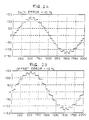
- Fig. 2A is a diagram showing a digital data waveform distorted by the gain error; the gain error between the two A/D converting parts is 10% in this example.
- Fig. 2B is a diagram showing a digital data waveform distorted by the offset error; the offset error between the two converting parts is 10% in this example. In either of Figs.
- a D/A converter for waveform conversion also encounters similar problems. That is, by distributing an input digital waveform signal to a plurality of D/A converting parts one after another through a multiplexer for conversion into analog signals and then switching the converted outputs one after another through a switch to output an analog waveform signal, the operating speed for the D/A conversion can be increased, but the output waveform is distorted by a gain error and an offset error between the plurality of D/A converting parts and the resolution of the output anaiog waveform is not improved. Also in this instance, if the output changeover switch is replaced with an analog adder, the gain and offset errors between the respective D/A converting parts are averaged, and consequently, the distortion by these errors is reduced but the resolution still remains unimproved.
- to add the outputs from a plurality of converting parts in the A/D or D/A converting device is to average the amplitude of a waveform at a plurality of successive sample points -- this only makes the waveform gentle by applying the waveform signal to a low-pass filter and does not improve resolution.
- An object of the present invention is to provide an A/D converter (or D/A converter) for waveform conversion which permits high-speed, high-resolution waveform conversion through use of a plurality of A/D (or D/A) converting parts and reduces the distortion of the converted output waveform that is attributable to the gain and offset errors between the converting parts.
- the present invention provides an A/D converter and D/A converter in accordance with claim 1 and 2, respectively.
- each converting means needs only to convert every N-th one of differential waveforms that are distributed from the distributing means -- this permits high-speed conversion throughout the N converting means.
- the output from the adding means represents the amplitude itself at each sample point of the input waveform, i.e. the waveform before conversion, not the average value of the waveform.
- resolution at the output of the adding means is increased N times higher than the resolution of the individual converting means.
- the gain and offset errors between the converting means are averaged down to 1/N.
- Fig. 1A is a block diagram showing an example of a conventional A/D converter adapted for high-speed operation through use of a plurality of A/D converting parts.
- Fig. 1B is a timing chart for explaining the operation of the A/D converter shown in Fig. 1A.
- Fig. 2A is a diagram showing an output digital waveform from the A/D converter of Fig. 1A which contains distortion attributable to a 10% gain error.
- Fig. 2B is a diagram showing an output digital waveform from the A/D converter of Fig. 1A which contains distortion attributable to a 10% offset error.
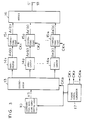
- Fig. 3 is a block diagram illustrating the basic construction of the A/D converter and the D/A converter for waveform conversion according to the present invention.
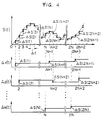
- Fig. 4 is a waveform diagram for explaining the operation of the converters depicted in Fig. 3.
- Fig. 5A is a block diagram illustrating an embodiment of the A/D converter according to the present invention.
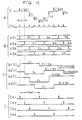
- Fig. 5B is a timing chart showing the operation of the A/D converter depicted in Fig. 5A.
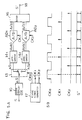
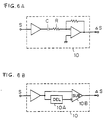
- Fig. 6A is a diagram illustrating an embodiment of an analog differentiation circuit 10.
- Fig. 6B is a diagram illustrating another embodiment of the analog differentiation circuit 10.
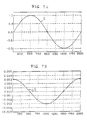
- Fig. 7A is a diagram showing an analog input waveform to the differentiation circuit 10.
- Fig. 7B is a diagram showing the output waveform from the differentiation circuit 10 which has differentiated the analog input waveform.
- Fig. 8A is a diagram showing one of two output waveforms distributed by a distributor 13.
- Fig. 8B is a diagram showing the other output waveform distributed by the distributor 13.
- Fig. 9A is a diagram showing the output waveform from the one integrator 14 1 .
- Fig. 9B is a diagram showing the output waveform from the other integrator 14 2 .
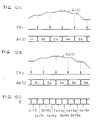
- Fig. 10A is a diagram for explaining how to control the timing for A/D conversion in the one A/D converting part AD 1 .
- Fig. 10B is a diagram for explaining how to control the timing for A/D conversion in the other A/D converting part AD 2 .
- Fig. 10C is a diagram showing the output digital waveform data from an adder 16.
- Fig. 11 is a diagram showing the output digital waveform from the adder in the case where no error is present between the A/D converting parts AD 1 and AD 2 .
- Fig. 12 is a diagram showing the output digital waveform from the adder in the case where a 10% gain error is present between the converting parts AD 1 and AD 2 .
- Fig. 13 is a diagram showing the output digital waveform from the adder in the case where a 10% offset error is present between the converting parts AD 1 and AD 2 .
- Fig. 14 is a block diagram illustrating an embodiment of the present invention of Fig. 3 applied to a D/A converter.
- Fig. 15 is a diagram for explaining the D/A converting operation of the Fig. 14 embodiment.
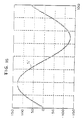
- Fig. 16 is a diagram showing an example of the D/A converted output waveform of the Fig. 14 embodiment.
- Fig. 17 is a block diagram illustrating a modified form of the Fig. 14 embodiment in which a differential waveform generating part 10 is formed by a waveform memory having stored therein differential waveforms.
- Fig. 18 is a block diagram illustrating an embodiment in which outputs from integrators 14 1 through 14 4 in Fig. 14 are prestored in separate waveform memories.
- Fig. 3 is a theoretical block diagram showing either of the A/D converter and the D/A converter according to the present invention. That is, in the case where a differential waveform ⁇ S that is output from a differential waveform generating part 10 is an analog signal, converting parts 15 1 through 15 N are all A/D converting parts, and when the differential waveform ⁇ S is a digital signal, the converting parts 15 1 through 15 N are D/A converting parts.
- the differential value ⁇ S of the waveform is fed from the differential waveform generating part 10 to a distributor 13.
- the distributor 13 repeats distributing the differential value ⁇ S to the N (where N is an integer equal to or greater than 2) integrators 14 1 through 14 N one after another in synchronization with a clock signal CK 0 from a timing signal generator 17.
- the integrators 14 1 through 14 N integrate the differential values distributed thereto and the integrated outputs are A/D or D/A converted by the converting parts 15 1 through 15 N at the timing of clock signals CK 1 through CK N .
- Converted outputs A 1 '(t) through A N '(t) from the converting parts 15 1 through 15 N are provided to and added together by an adder 16, and a converted output waveform S' is obtained at a terminal 18.
- Fig. 4 shows waveforms that occur at respective parts of the A/D or D/A converter, for explaining the principle of operation thereof.
- An analog waveform signal S is applied to the differential waveform generating part 10, from which variations ⁇ S(1), ⁇ S(2), ⁇ S(3), ... of the input waveform signal every clock CK 0 are sequentially output as the differential waveform ⁇ S.
- the distributor 13 distributes these variations to the integrators 14 1 through 14 N in a sequential order.
- the integrator 14 1 is supplied with the variations ⁇ S(1), ⁇ S(N+1), ⁇ S(2N+1), ... at time intervals ⁇ tN and integrates them.
- the resulting integrated output A 1 (t) varies stepwise as shown.
- the integrated output A 1 (t) is A/D converted by the A/D converting part 15 1 and the converted output A 1 '(t) is fed to the adder 16.
- Similar processing is also carried out by corresponding combinations of the integrators 14 2 through 14 N and converting parts 15 2 through 15 N , and the adder 16 adds together the converted signals A 1 '(t) through A N '(t) and provides the added output as the converted digital signal S'.
- Fig. 5A is a block diagram of the converter of the present invention applied to an A/D converter, which employs two A/D converting parts AD 1 and AD 2 .
- Fig. 5B is a timing chart for explaining the operation of the A/D converter shown in Fig. 5A.
- the differential waveform generating part 10 is formed by a differentiator which differentiates the analog input waveform S to obtain its variations.
- the distributor 13 is a high-speed electronic switch, which responds to the clock CK 0 to output the differential output waveform ⁇ S to the integrators 14 1 and 14 2 alternately with each other.
- the integrators 14 1 and 14 2 integrate the differential output waveforms ⁇ S 1 and ⁇ S 2 that are distributed from the distributor 13.
- the A/D converting parts AD 1 and AD 2 convert the integrated outputs from the integrators 14 1 and 14 2 to digital values, respectively.
- the adder 16 adds together the output digital values from the A/D converting parts AD 1 and AD 2 and outputs the digital waveform S'.
- the differentiation circuit 10 may be formed by a known primary high-pass filter using a capacitor C and a resistor R, for example, as shown in Fig. 6A. It is also possible to employ such a circuit construction as shown in Fig. 6B, in which the input analog waveform signal S is applied to the one input of a subtractor 10B and a waveform signal S delayed by a delay element 10A for a predetermined period of time is applied to the other input of the subtractor and the difference between these two signals is obtained as the differential output ⁇ S. It will easily be understood by those skilled in the art that various other differentiation circuits can be used.
- the output ⁇ S from the differentiation circuit 10 becomes such a cosine-wave signal as shown in Fig. 7B.
- Distributing the cosine-wave signal ⁇ S by the distributor 13 into two series, signals ⁇ S 1 and ⁇ S 2 depicted in Figs. 8A and 8B are obtained.
- the distributor 13 is formed by a high-speed electronic switch, whose connection is changed over in accordance with the control clock CK 0 from the timing signal generating part 17, such as shown in Fig. 5B.
- the distributed output waveform ⁇ S 1 shown in Fig. 8A, is fed to and integrated by the integrator 14 1 .
- Fig. 9A shows the output waveform A 1 (t) from the integrator 14 1 . That is, upon each occurrence of a substantially strip-like input, it is integrated by the integrator 14 1 and its output waveform A 1 (t) increases or decreases. In respective sections where no such strip-shaped input is present, the output waveform A 1 (t) from the integrator 14 1 maintains the level immediately preceding the section.
- the distributed output waveform ⁇ S 2 shown in Fig. 8B is provided to and integrated by the integrator 142, from which is obtained the integrated output waveform A 2 (t) depicted in Fig. 9B.
- the output waveforms A 1 (t) and A 2 (t) shown in Figs. 9A and 9B are fed to the A/D converting parts AD 1 and AD 2 , respectively.
- the A/D converting parts AD 1 and AD 2 convert the integrated outputs A 1 (t) and A 2 (t) into a sequence A 1 '(t) of digital values a 1 , a 2 , a 3 , ... and a sequence A 2 '(t) of digital values b 1 , b 2 , b 3 , ... at the timing of the clock signals CK 1 and CK 2 from the timing signal generating part 17, respectively.
- Fig. 10C shows a data sequence of the digital waveform S' obtained by adding together the digital outputs A 1 '(t) and A 2 '(t) from the A/D converting parts AD 1 and AD 2 in the adder 16, and the added digital waveform is such as shown in Fig. 11, for instance. Incidentally, this is the case where no gain and offset errors exist between the A/D converting parts AD 1 and AD 2 .
- Fig. 12 shows an example of the output digital waveform S' provided from the adder 16 when a 10% gain error exists between the two A/D converting parts AD 1 and AD 2 ; in this case, the waveform contains a total of about 5% gain error but its distortion is small.
- Fig. 13 shows an example of the output digital waveform from the adder in the case where a 10% offset error exists between the two A/D converting parts AD 1 and AD 2 ; in this instance, the waveform contains a total of about 5% offset error but its distortion is small.
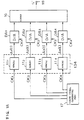
- Fig. 14 illustrates an embodiment of the Fig. 3 construction of the invention applied to a D/A converter for waveform conversion, in which the number of distributed outputs, N, by the distributor 13 is 4.
- the input digital waveform signal S may be provided from the outside, but in this embodiment, the differential waveform generating part 10 is formed by a waveform memory 11 and a differentiation circuit 12 and the digital waveform S prestored in the waveform memory 11 is read out therefrom in synchronization with the clock CK 0 and fed to the differentiation circuit 12.
- the differentiation circuit 12 outputs, as the digital differential waveform value ⁇ S, a difference (i.e. a variation) of the input digital waveform data S upon each occurrence of the clock CK 0 , for instance.
- the digital differential waveform ⁇ S thus generated by the differentiation circuit 12 is fed to the distributor 13, from which it is distributed to the digital integrators 14 1 through 14 4 one after another in synchronization with the clock CK 0 .
- the digital integrated outputs A 1 (t) through A 4 (t) from the integrators 14 1 through 14 4 are applied to D/A converting parts DA 1 through DA 4 , whereby they are converted to analog signals A 1 '(t) through A 4 '(t) upon occurrence of clock signals CK 1 through CK 4 , respectively.
- the outputs A 1 '(t) through A 4 '(t) from the D/A converting parts DA 1 through DA 4 are applied to and added together by an analog adder 16 and output therefrom as an analog waveform signal S'.
- Fig. 15A shows the digital waveform S read out from the waveform memory 11 and the arrows a 1 , b 1 , c 1 , d 1 , a 2 , b 2 , c 2 , d 2 , a 3 , b 3 , ... on the waveform represent the outputs ⁇ S from the differentiation circuit 12 that has differentiated the waveform S at the timing of the clock CK 0 , the arrows also representing the signs of the differentiated outputs. As shown in Fig.
- Fig. 15C shows the outputs A 1 '(t) through A 4 '(t) in the case where the pieces of differentiated data ⁇ S 1 through ⁇ S 4 input into the integrators 14 1 through 14 4 were accumulated at the timing of clock signals CK 1 through CK 4 shown in Fig. 15D and the integrator outputs were converted by the D/A converting parts DA 1 through DA 4 into digital form.
- the D/A converting parts DA 1 through DA 4 perform conversion at time intervals 4 ⁇ t four times longer than the cycle of the clock signal CK 0 and in phases displaced apart in steps of the clock cycle ⁇ t, as shown in Fig. 15D.
- the analog signals A 1 '(t) through A 4 '(t) sequentially converted by the four D/A converting parts DA 1 through DA 4 are added together by the analog adder 16, from which is obtained the analog waveform S' shown in Fig. 15A.
- Fig. 16 shows an example of the analog waveform that is provided from the analog adder 16 when digital sinusoidal waveform data is read out from the waveform data memory 11.
- the maximum amplitude of the analog waveform signal S' obtained by adding the four analog signals A 1 '(t) through A 4 '(t) by the adder 16, becomes the sum of maximum amplitudes of the outputs from the respective D/A converting parts; hence, resolution is improved four times higher than the resolution obtainable with a single D/A converting part, while at the same time the gain error and the offset error between the D/A converting parts DA 1 through DA 4 are respectively reduced down to 1/4.
- the converting operation speed of the D/A converter in its entirety becomes four times higher than the operating speed of each D/A converting part.
- the positions of the integrators 14 1 through 14 4 and the D/A converting parts DA 1 through DA 4 may be reversed in the Fig. 14 embodiment. That is, the pieces of data sequentially distributed by the distributor 13 are first converted by the D/A converting parts DA 1 through DA 4 to analog form, the analog differentiated waveforms thus obtained are integrated by the integrators 14 1 through 14 4 and then added by the analog adder 16.
- the differential waveform generating part 10 needs only to output the differential waveform data ⁇ S
- the differentiation circuit 12 is unnecessary and the output of the memory 11 is connected to the distributor 13.
- the output data A 1 (t) through A 4 (t) from the integrators 14 1 through 14 4 with respect to a desired waveform in the embodiment of Fig. 14 are precalculated and prestored in four waveform data memories 11 1 through 11 4 , respectively, as shown in Fig. 18, the distributor 13 and the integrators 14 1 through 144 as well as the differentiation circuit 12 will become unnecessary.
- the pieces of data individually stored in the waveform data memories 11 1 through 11 4 are read out therefrom in a sequential order at the timing of the clock signals CK 1 through CK 4 and are D/A converted by the corresponding D/A converting parts DA 1 through DA 4 , and then the converted outputs are added together in the analog adder 16.
Landscapes
- Engineering & Computer Science (AREA)
- Theoretical Computer Science (AREA)
- Physics & Mathematics (AREA)
- Computer Hardware Design (AREA)
- Mathematical Physics (AREA)
- Automation & Control Theory (AREA)
- Evolutionary Computation (AREA)
- Fuzzy Systems (AREA)
- General Physics & Mathematics (AREA)
- Software Systems (AREA)
- Analogue/Digital Conversion (AREA)
Claims (8)
- A/D-Umsetzer zur Wellenformumsetzung, umfassend:eine Differentialwellenform-Erzeugungsanordnung (10) zum Erzeugen einer Differentialwellenform (ΔS) einer Analogwellenform;eine Verteilanordnung (13) zur einzeln aufeinanderfolgenden Aufteilung der Differentialwellenform auf N Signalfolgen, wobei N eine ganze Zahl größer oder gleich 2 ist;N Umsetzteil-Anordnungen (141 - 14N, 151 - 15N), von denen jede aus einer Reihenschaltung aus einer Integrieranordnung (141 - 14N) und einer A/D-Umsetzanordnung (151 - 15N) aufgebaut ist, die mit einer jeweiligen der N Signalfolgen beliefert werden und Integrationswellenformen der Signale in digitaler Form zu Zeitpunkten ausgeben, die in Schritten einer 1/N-Periode des Aufteilzyklus versetzt sind; undeine Addieranordnung (16), die die Ausgangssignale aus den N Umsetzteil-Anordnungen aufaddiert und das Additionsausgangssignal als Digitalwellenform ausgibt.
- D/A-Umsetzer zur Wellenformumsetzung, umfassend:eine Differentialwellenform-Erzeugungsanordnung (10) zum Erzeugen einer Differentialwellenform (ΔS) einer Digitalwellenform;eine Verteilanordnung (13) zur einzeln aufeinanderfolgenden Aufteilung der Differentialwellenform auf N Signalfolgen, wobei N eine ganze Zahl größer oder gleich 2 ist;N Umsetzteil-Anordnungen (141 - 14N, 151 - 15N), von denen jede aus einer Reihenschaltung aus einer Integrieranordnung (141 - 14N) und einer A/D-Umsetzanordnung (151 - 15N) aufgebaut ist, die mit einer jeweiligen der N Signalfolgen beliefert werden und Integrationswellenformen der Signale in analoger Form zu Zeitpunkten ausgeben, die in Schritten einer 1/N-Periode des Aufteilzyklus versetzt sind; undeine Addieranordnung (16), die die Ausgangssignale aus den N Umsetzteil-Anordnungen aufaddiert und das Additionsausgangssignal als Analogwellenform ausgibt.
- Umsetzer zur Wellenformumsetzung nach Anspruch 1 oder 2, bei dem eine Taktsignalerzeugungsanordnung (17) zum Erzeugen von N Taktsignalen vorgesehen ist, die in Schritten einer 1/N-Periode des Aufteilzyklus der Verteilanordnung (13) versetzt sind.
- A/D-Umsetzer zur Wellenformumsetzung nach Anspruch 1, bei dem die Differentialwellenform-Erzeugungsanordnung (10) eine Hochpaßfilteranordnung (R, C) erster Ordnung umfaßt, die mit der Analogwellenform (S) beliefert wird und ihr Ausgangssignal als die Differentialwellenform (ΔS) liefert.
- A/D-Umsetzer zur Wellenformumsetzung nach Anspruch 1, bei dem die Differentialwellenform-Erzeugungsanordnung aufweist: eine Verzögerungsanordnung (10A), die die Analogwellenform um eine feste Zeitspanne verzögert; und eine Subtrahieranordnung (10B), die an einem Eingang mit der Analogwellenform (S) und am anderen Eingang mit dem Ausgangssignal aus der Verzögerungsanordnung (10A) beliefert wird und deren Differenz als die Differentialwellenform (ΔS) ausgibt.
- D/A-Umsetzer zur Wellenformumsetzung nach Anspruch 2, bei dem die Differentialwellenform-Erzeugungsanordnung aufweist: eine Wellenformspeicheranordnung (11) zum Speichern der Digitalwellenform; und eine Differenzieranordnung (12), mit der Variationen der Digitalwellenform, die in festen Zeitabständen aus der Wellenformspeicheranordnung (11) ausgelesen werden, differenziert und als die Differentialwellenform (ΔS) ausgegeben werden.
- D/A-Umsetzer zur Wellenformumsetzung nach Anspruch 2, bei dem die Differentialwellenform-Erzeugungsanordnung eine Wellenformspeicheranordnung (11) zum Speichern von Variationen der Digitalwellenform in regelmäßigen Zeitabständen aufweist und die aus der Wellenformspeicheranordnung (11) ausgelesenen Variationen als die Differentialwellenform ausgibt.
- D/A-Umsetzer zur Wellenformumsetzung, bei dem ein digitales Eingangssignal sequentiell und wiederholt auf N D/A-Umsetzanordnungen (DA1 - DA4) aufgeteilt wird, wobei N eine ganze Zahl größer oder gleich 2 ist, und die jeweiligen Umsetzungsausgangssignale aus den N D/A-Umsetzanordnungen in einer Addieranordnung (16) addiert werden, um ein Analogwellenformsignal zu erzeugen, gekennzeichnet durch:N Wellenformdatenspeicheranordnungen (111 - 114), in denen N Wellenformdatenelemente gespeichert sind, die erhalten werden durch Differenzieren einer Eingangsdigitalwellenform, sequentielles Aufteilen der differenzierten Digitalwellenform in N Differentialwellenformdatenelemente und gesondertes Integrieren der N Differentialwellenformdatenelemente;eine Taktsignalerzeugungsanordnung (17), die N Taktsignale zum sequentiellen Auslesen der gespeicherten Wellenformdaten in den N jeweiligen Wellenformdatenspeicheranordnungen (111 - 114) in festen Zeitabständen erzeugt; undwobei die N D/A-Umsetzanordnungen (DA1 - DA4) durch Umsetzung eines jeweiligen der aus den N jeweiligen Wellenformdatenspeicheranordnungen ausgelesenen N Wellenformdatenelemente Analogwerte erzeugen.
Applications Claiming Priority (7)
| Application Number | Priority Date | Filing Date | Title |
|---|---|---|---|
| JP15805192A JP3235676B2 (ja) | 1992-06-17 | 1992-06-17 | 任意波形発生器 |
| JP158052/92 | 1992-06-17 | ||
| JP15805292A JP3209237B2 (ja) | 1992-06-17 | 1992-06-17 | A/d変換器 |
| JP15805292 | 1992-06-17 | ||
| JP15805192 | 1992-06-17 | ||
| JP158051/92 | 1992-06-17 | ||
| PCT/JP1993/000800 WO1993026093A1 (fr) | 1992-06-17 | 1993-06-15 | Convertisseur analogique/numerique et convertisseur numerique/analogique de forme d'onde |
Publications (3)
| Publication Number | Publication Date |
|---|---|
| EP0601201A1 EP0601201A1 (de) | 1994-06-15 |
| EP0601201A4 EP0601201A4 (en) | 1995-09-27 |
| EP0601201B1 true EP0601201B1 (de) | 1999-09-22 |
Family
ID=26485302
Family Applications (1)
| Application Number | Title | Priority Date | Filing Date |
|---|---|---|---|
| EP93913522A Expired - Lifetime EP0601201B1 (de) | 1992-06-17 | 1993-06-15 | Wellenform-a/d-wandler und d/a-wandler |
Country Status (4)
| Country | Link |
|---|---|
| US (1) | US5537113A (de) |
| EP (1) | EP0601201B1 (de) |
| DE (1) | DE69326528T2 (de) |
| WO (1) | WO1993026093A1 (de) |
Families Citing this family (27)
| Publication number | Priority date | Publication date | Assignee | Title |
|---|---|---|---|---|
| KR0138029B1 (ko) * | 1993-06-07 | 1998-05-15 | 가나이 쯔또무 | Ad 컨버터 및 그것을 사용한 자기기록재생장치(ad converter and magnetic recording/regenerating apparatus using thereof |
| JP3457517B2 (ja) | 1997-09-12 | 2003-10-20 | 松下電器産業株式会社 | D/a変換装置 |
| US6028544A (en) * | 1998-01-02 | 2000-02-22 | Motorola, Inc. | Digital-to-analog converter with noiseshaping modulator, commutator and plurality of unit converters, and method |
| DE19809882A1 (de) * | 1998-03-07 | 1999-09-09 | Gte Ges Fuer Tech Entwicklunge | Vorrichtung zur Signalverarbeitung von zeitdiskreten Werten |
| JP4547064B2 (ja) | 1999-03-24 | 2010-09-22 | 株式会社アドバンテスト | A/d変換装置およびキャリブレーション装置 |
| US7102692B1 (en) * | 1999-10-13 | 2006-09-05 | Thomson Licensing | Digital and analog television signal digitization and processing device |
| US6441761B1 (en) * | 1999-12-08 | 2002-08-27 | Texas Instruments Incorporated | High speed, high resolution digital-to-analog converter with off-line sigma delta conversion and storage |
| US7933341B2 (en) * | 2000-02-28 | 2011-04-26 | Broadcom Corporation | System and method for high speed communications using digital signal processing |
| US7433665B1 (en) | 2000-07-31 | 2008-10-07 | Marvell International Ltd. | Apparatus and method for converting single-ended signals to a differential signal, and transceiver employing same |
| US7194037B1 (en) | 2000-05-23 | 2007-03-20 | Marvell International Ltd. | Active replica transformer hybrid |
| US7113121B1 (en) | 2000-05-23 | 2006-09-26 | Marvell International Ltd. | Communication driver |
| US7312739B1 (en) | 2000-05-23 | 2007-12-25 | Marvell International Ltd. | Communication driver |
| US6462688B1 (en) | 2000-12-18 | 2002-10-08 | Marvell International, Ltd. | Direct drive programmable high speed power digital-to-analog converter |
| US6775529B1 (en) | 2000-07-31 | 2004-08-10 | Marvell International Ltd. | Active resistive summer for a transformer hybrid |
| US7095348B1 (en) | 2000-05-23 | 2006-08-22 | Marvell International Ltd. | Communication driver |
| USRE41831E1 (en) | 2000-05-23 | 2010-10-19 | Marvell International Ltd. | Class B driver |
| US7606547B1 (en) | 2000-07-31 | 2009-10-20 | Marvell International Ltd. | Active resistance summer for a transformer hybrid |
| JP3745962B2 (ja) * | 2001-01-24 | 2006-02-15 | 株式会社アドバンテスト | インターリーブad変換方式波形ディジタイザ装置、及び試験装置 |
| US7038610B2 (en) * | 2001-07-19 | 2006-05-02 | Rohm Co., Ltd. | Integration type A/D converter, and battery charger utilizing such converter |
| JP2005530460A (ja) * | 2002-06-20 | 2005-10-06 | ダコタ・テクノロジーズ・インコーポレーテッド | 過渡信号をデジタル化するシステム |
| US6975251B2 (en) * | 2002-06-20 | 2005-12-13 | Dakota Technologies, Inc. | System for digitizing transient signals with waveform accumulator |
| RU2236750C2 (ru) * | 2002-11-22 | 2004-09-20 | Открытое акционерное общество "Корпорация "Фазотрон - научно-исследовательский институт радиостроения" | Способ преобразования сигнала в цифровую форму |
| KR20050056125A (ko) * | 2003-12-09 | 2005-06-14 | 마쯔시다덴기산교 가부시키가이샤 | 인버터 제어 장치 및 인버터 제어 방법 |
| DE102004009613B4 (de) * | 2004-02-27 | 2010-05-12 | Infineon Technologies Ag | Schaltungsanordnung zum Kompensieren von Nichtlinearitäten von zeitversetzt arbeitenden Analog-Digital-Wandlern |
| US8164501B2 (en) * | 2004-10-28 | 2012-04-24 | Broadcom Corporation | Method and system for time interleaved digital to analog conversion for a cable modem |
| US7312662B1 (en) | 2005-08-09 | 2007-12-25 | Marvell International Ltd. | Cascode gain boosting system and method for a transmitter |
| US7577892B1 (en) | 2005-08-25 | 2009-08-18 | Marvell International Ltd | High speed iterative decoder |
Family Cites Families (11)
| Publication number | Priority date | Publication date | Assignee | Title |
|---|---|---|---|---|
| JPS5630737B2 (de) * | 1975-01-20 | 1981-07-16 | ||
| FR2428945A1 (fr) * | 1978-06-13 | 1980-01-11 | Thomson Csf | Dispositif de numerisation de signaux transitoires |
| JPS57140026A (en) * | 1981-02-24 | 1982-08-30 | Nec Corp | Digital-to-analog converting circuit |
| US4591832A (en) * | 1984-07-18 | 1986-05-27 | Rca Corporation | Digital-to-analog conversion system as for use in a digital TV receiver |
| JPS62135243A (ja) * | 1985-12-06 | 1987-06-18 | Mitsubishi Electric Corp | 回転電機巻線の絶縁方法 |
| JPS62135243U (de) * | 1986-02-18 | 1987-08-26 | ||
| JPS62287717A (ja) * | 1986-06-06 | 1987-12-14 | Matsushita Electric Ind Co Ltd | デイジタル・アナログ変換回路 |
| JPH01137831A (ja) * | 1987-11-25 | 1989-05-30 | Mitsubishi Electric Corp | アナログーデジタル変換器 |
| JPH01314417A (ja) * | 1988-06-14 | 1989-12-19 | Matsushita Electric Ind Co Ltd | ディジタルフィルタ |
| JPH04208716A (ja) * | 1990-11-30 | 1992-07-30 | Yokogawa Hewlett Packard Ltd | ディジタル―アナログ変換回路 |
| US5268688A (en) * | 1992-05-13 | 1993-12-07 | Hughes Aircraft Company | Linear signal reconstruction system and method |
-
1993
- 1993-06-15 US US08/196,071 patent/US5537113A/en not_active Expired - Fee Related
- 1993-06-15 EP EP93913522A patent/EP0601201B1/de not_active Expired - Lifetime
- 1993-06-15 DE DE69326528T patent/DE69326528T2/de not_active Expired - Fee Related
- 1993-06-15 WO PCT/JP1993/000800 patent/WO1993026093A1/ja not_active Ceased
Also Published As
| Publication number | Publication date |
|---|---|
| EP0601201A4 (en) | 1995-09-27 |
| US5537113A (en) | 1996-07-16 |
| DE69326528T2 (de) | 2000-03-09 |
| WO1993026093A1 (fr) | 1993-12-23 |
| DE69326528D1 (de) | 1999-10-28 |
| EP0601201A1 (de) | 1994-06-15 |
Similar Documents
| Publication | Publication Date | Title |
|---|---|---|
| EP0601201B1 (de) | Wellenform-a/d-wandler und d/a-wandler | |
| KR930001296B1 (ko) | 보간용 시간이산 필터장치 | |
| USRE31460E (en) | Method and apparatus for standards conversion of television signals | |
| US5512895A (en) | Sample rate converter | |
| EP0917290A3 (de) | Impulsgenerator | |
| JPH04229703A (ja) | 位相相関波形の発生方法 | |
| US4929947A (en) | Constant width pulse distribution in a digital to analog converter for serial digital data | |
| KR100241119B1 (ko) | 디지탈 이상장치 | |
| US4758781A (en) | DA converter testing system | |
| EP1096688B1 (de) | Digital/analog-wandler | |
| EP1263128A2 (de) | Sinuswellensynthese | |
| JP3235676B2 (ja) | 任意波形発生器 | |
| SU1363460A1 (ru) | Устройство дл аналого-цифрового преобразоввани | |
| JPH0710411Y2 (ja) | 信号発生器 | |
| JP2782761B2 (ja) | パルス幅出力装置 | |
| JPS62231508A (ja) | デイジタル遅延回路 | |
| SU1686433A1 (ru) | Многоканальное устройство дл вычислени модульной коррел ционной функции | |
| SU1406794A1 (ru) | Преобразователь частоты следовани импульсов в посто нный ток или напр жение | |
| SU652555A1 (ru) | Устройство дл вывода информации из электронно-вычислительной машины | |
| JP3354739B2 (ja) | Daコンバータ | |
| SU1409953A1 (ru) | Модул ционный радиометр | |
| SU1012302A1 (ru) | Преобразователь угла поворота вала в код | |
| SU1626383A1 (ru) | Дробно-пропорциональный преобразователь частот | |
| SU1751736A1 (ru) | Цифровой функциональный преобразователь | |
| SU1010638A1 (ru) | Устройство дл сжати во времени входного сигнала |
Legal Events
| Date | Code | Title | Description |
|---|---|---|---|
| PUAI | Public reference made under article 153(3) epc to a published international application that has entered the european phase |
Free format text: ORIGINAL CODE: 0009012 |
|
| 17P | Request for examination filed |
Effective date: 19940210 |
|
| AK | Designated contracting states |
Kind code of ref document: A1 Designated state(s): DE FR |
|
| A4 | Supplementary search report drawn up and despatched | ||
| AK | Designated contracting states |
Kind code of ref document: A4 Designated state(s): DE FR |
|
| 17Q | First examination report despatched |
Effective date: 19970425 |
|
| GRAG | Despatch of communication of intention to grant |
Free format text: ORIGINAL CODE: EPIDOS AGRA |
|
| GRAG | Despatch of communication of intention to grant |
Free format text: ORIGINAL CODE: EPIDOS AGRA |
|
| GRAH | Despatch of communication of intention to grant a patent |
Free format text: ORIGINAL CODE: EPIDOS IGRA |
|
| GRAH | Despatch of communication of intention to grant a patent |
Free format text: ORIGINAL CODE: EPIDOS IGRA |
|
| GRAA | (expected) grant |
Free format text: ORIGINAL CODE: 0009210 |
|
| AK | Designated contracting states |
Kind code of ref document: B1 Designated state(s): DE FR |
|
| PG25 | Lapsed in a contracting state [announced via postgrant information from national office to epo] |
Ref country code: FR Free format text: LAPSE BECAUSE OF FAILURE TO SUBMIT A TRANSLATION OF THE DESCRIPTION OR TO PAY THE FEE WITHIN THE PRESCRIBED TIME-LIMIT Effective date: 19990922 |
|
| REF | Corresponds to: |
Ref document number: 69326528 Country of ref document: DE Date of ref document: 19991028 |
|
| EN | Fr: translation not filed | ||
| PLBE | No opposition filed within time limit |
Free format text: ORIGINAL CODE: 0009261 |
|
| STAA | Information on the status of an ep patent application or granted ep patent |
Free format text: STATUS: NO OPPOSITION FILED WITHIN TIME LIMIT |
|
| 26N | No opposition filed | ||
| PGFP | Annual fee paid to national office [announced via postgrant information from national office to epo] |
Ref country code: DE Payment date: 20070607 Year of fee payment: 15 |
|
| PG25 | Lapsed in a contracting state [announced via postgrant information from national office to epo] |
Ref country code: DE Free format text: LAPSE BECAUSE OF NON-PAYMENT OF DUE FEES Effective date: 20090101 |