EP0601312A1 - Objet en matériau plastique moulé par injection - Google Patents
Objet en matériau plastique moulé par injection Download PDFInfo
- Publication number
- EP0601312A1 EP0601312A1 EP93116903A EP93116903A EP0601312A1 EP 0601312 A1 EP0601312 A1 EP 0601312A1 EP 93116903 A EP93116903 A EP 93116903A EP 93116903 A EP93116903 A EP 93116903A EP 0601312 A1 EP0601312 A1 EP 0601312A1
- Authority
- EP
- European Patent Office
- Prior art keywords
- plastic
- polyamide
- plastic component
- carpet
- polypropylene
- Prior art date
- Legal status (The legal status is an assumption and is not a legal conclusion. Google has not performed a legal analysis and makes no representation as to the accuracy of the status listed.)
- Granted
Links
- 238000002347 injection Methods 0.000 title description 2
- 239000007924 injection Substances 0.000 title description 2
- 239000002991 molded plastic Substances 0.000 title 1
- 229920003023 plastic Polymers 0.000 claims abstract description 53
- 239000004033 plastic Substances 0.000 claims abstract description 53
- 239000004952 Polyamide Substances 0.000 claims abstract description 32
- 229920002647 polyamide Polymers 0.000 claims abstract description 32
- 238000001746 injection moulding Methods 0.000 claims abstract description 11
- -1 polypropylene Polymers 0.000 claims description 30
- 239000008187 granular material Substances 0.000 claims description 18
- 239000004743 Polypropylene Substances 0.000 claims description 17
- 229920001155 polypropylene Polymers 0.000 claims description 17
- 239000004698 Polyethylene Substances 0.000 claims description 12
- 229920000573 polyethylene Polymers 0.000 claims description 12
- 229920000098 polyolefin Polymers 0.000 claims description 10
- 239000007858 starting material Substances 0.000 claims description 10
- 239000000463 material Substances 0.000 claims description 7
- 239000012876 carrier material Substances 0.000 claims description 5
- NJVOHKFLBKQLIZ-UHFFFAOYSA-N (2-ethenylphenyl) prop-2-enoate Chemical compound C=CC(=O)OC1=CC=CC=C1C=C NJVOHKFLBKQLIZ-UHFFFAOYSA-N 0.000 claims description 4
- 229920002292 Nylon 6 Polymers 0.000 claims description 4
- 239000002174 Styrene-butadiene Substances 0.000 claims description 4
- MTAZNLWOLGHBHU-UHFFFAOYSA-N butadiene-styrene rubber Chemical compound C=CC=C.C=CC1=CC=CC=C1 MTAZNLWOLGHBHU-UHFFFAOYSA-N 0.000 claims description 4
- 239000011115 styrene butadiene Substances 0.000 claims description 4
- 229920003048 styrene butadiene rubber Polymers 0.000 claims description 4
- 239000004744 fabric Substances 0.000 claims description 3
- 229920001200 poly(ethylene-vinyl acetate) Polymers 0.000 claims description 3
- 238000013467 fragmentation Methods 0.000 claims description 2
- 238000006062 fragmentation reaction Methods 0.000 claims description 2
- 239000012939 laminating adhesive Substances 0.000 claims description 2
- 239000000835 fiber Substances 0.000 description 15
- 238000002844 melting Methods 0.000 description 8
- 230000008018 melting Effects 0.000 description 6
- 229920001169 thermoplastic Polymers 0.000 description 4
- 239000004416 thermosoftening plastic Substances 0.000 description 4
- 229920000049 Carbon (fiber) Polymers 0.000 description 3
- 238000005452 bending Methods 0.000 description 3
- 239000004917 carbon fiber Substances 0.000 description 3
- 238000000034 method Methods 0.000 description 3
- 239000000470 constituent Substances 0.000 description 2
- 238000011161 development Methods 0.000 description 2
- 230000018109 developmental process Effects 0.000 description 2
- 230000000694 effects Effects 0.000 description 2
- 238000001125 extrusion Methods 0.000 description 2
- 238000004519 manufacturing process Methods 0.000 description 2
- 239000002184 metal Substances 0.000 description 2
- 239000000126 substance Substances 0.000 description 2
- 239000012815 thermoplastic material Substances 0.000 description 2
- 229920000426 Microplastic Polymers 0.000 description 1
- 230000035508 accumulation Effects 0.000 description 1
- 238000009825 accumulation Methods 0.000 description 1
- 238000007596 consolidation process Methods 0.000 description 1
- 229920001577 copolymer Polymers 0.000 description 1
- 238000009826 distribution Methods 0.000 description 1
- 239000003292 glue Substances 0.000 description 1
- 230000001788 irregular Effects 0.000 description 1
- 238000003475 lamination Methods 0.000 description 1
- 229920013754 low-melting plastic Polymers 0.000 description 1
- 238000003860 storage Methods 0.000 description 1
- 239000004753 textile Substances 0.000 description 1
Images


Classifications
-
- B—PERFORMING OPERATIONS; TRANSPORTING
- B29—WORKING OF PLASTICS; WORKING OF SUBSTANCES IN A PLASTIC STATE IN GENERAL
- B29B—PREPARATION OR PRETREATMENT OF THE MATERIAL TO BE SHAPED; MAKING GRANULES OR PREFORMS; RECOVERY OF PLASTICS OR OTHER CONSTITUENTS OF WASTE MATERIAL CONTAINING PLASTICS
- B29B17/00—Recovery of plastics or other constituents of waste material containing plastics
-
- B—PERFORMING OPERATIONS; TRANSPORTING
- B29—WORKING OF PLASTICS; WORKING OF SUBSTANCES IN A PLASTIC STATE IN GENERAL
- B29L—INDEXING SCHEME ASSOCIATED WITH SUBCLASS B29C, RELATING TO PARTICULAR ARTICLES
- B29L2031/00—Other particular articles
- B29L2031/732—Floor coverings
- B29L2031/7322—Carpets
-
- Y—GENERAL TAGGING OF NEW TECHNOLOGICAL DEVELOPMENTS; GENERAL TAGGING OF CROSS-SECTIONAL TECHNOLOGIES SPANNING OVER SEVERAL SECTIONS OF THE IPC; TECHNICAL SUBJECTS COVERED BY FORMER USPC CROSS-REFERENCE ART COLLECTIONS [XRACs] AND DIGESTS
- Y02—TECHNOLOGIES OR APPLICATIONS FOR MITIGATION OR ADAPTATION AGAINST CLIMATE CHANGE
- Y02W—CLIMATE CHANGE MITIGATION TECHNOLOGIES RELATED TO WASTEWATER TREATMENT OR WASTE MANAGEMENT
- Y02W30/00—Technologies for solid waste management
- Y02W30/50—Reuse, recycling or recovery technologies
- Y02W30/62—Plastics recycling; Rubber recycling
Definitions
- the invention relates to a plastic component produced by the plastic injection molding process.
- the object of the present invention is to provide a new type of plastic component produced by the plastic injection molding process.
- a new type of plastic component is produced which is produced by the plastic injection molding process and which has increased stability.
- This is achieved by portions of high-temperature-resistant plastic, in particular polyamide, which are distributed in the plastic component and which, as a rule, are not melted (cracked), but are finely distributed due to a softening process.
- the preferably used polyamide components have a melting point of approx. 220 ° C. The latter is significantly higher than that of the starting material for the manufacture of the plastic component.
- Polyolefins such as polypropylene, polyethylene or the like, which have a melting point of approximately 120 ° to 170 ° C., can be used as the starting material.
- thermoplastic components based on polyolefins such as polypropylene and / or polyethylene
- these components are essentially unmelted polyamide components which are very finely distributed in the mass, so that they cannot be identified individually even under microscopic magnification.
- These components in particular polyamide components, which may have undergone a softening process during extrusion in the sense of melting, result in increased stability of the plastic component in the extrudate. An increased tear resistance and bending stiffness of the plastic component is achieved in particular.
- this configuration provides a non-slip and matt surface than in the case of products made from pure polyolefins, in particular polypropylene or polyethylene.
- the material produced in this way shows a remarkable number of air pockets when viewed under a microscope. On the surface, these lead to a corresponding number of microscopic craters, which overall lead to a matt surface effect.
- This provides a microscopically irregular surface of the plastic component, which is particularly advantageous, for example, in the case of pipes produced in this way, on which carpets are wound. This increases the adhesion of the carpet to the pipe, so that slipping of the carpet from the carpet pipe is counteracted.
- the already mentioned increased stability of the plastic component is also of particular importance, since the carpet tubes mentioned must have a high bending stiffness over a free length of, for example, 4 to 5 m.
- the invention also relates to a plastic component produced by the plastic injection molding process, which has a starting material that is at least partially a granulate that was obtained by fragmentation under the action of heat from parts of a carpet with a pole material based on preferably polyamide 6 or polyamide 6.6, preferably a carrier material made of polypropylene fleece or polypropylene tape fabric, further preferably a primer made of ethylene-vinyl acetate copolymers, styrene-butadiene, styrene-acrylate or the like, further preferably a laminating adhesive and further preferably a backing layer based on polyolefins such as polyethylene, polypropylene or similar.
- the fibers based on polyamide or the like for example the pile material of a carpet
- the thermoplastic materials made of, for example, polyolefins, in particular polyethylene, polypropylene, etc.
- the starting material mentioned can preferably be obtained by tearing entire parts of a carpet, which essentially consists of pole material based on polyamide, furthermore from components based on polyolefins, into smaller parts and then agglomerating them in a so-called plastcompactor.
- a Plastcompactor grinds these components, whereby a certain amount of heat occurs which leads to the melting of the low-melting thermoplastic components, but not to the melting of the polyamide components or the like.
- a granulate-like mass is obtained from the plastic compactor, which is used as a starting material for producing a plastic component in the plastic injection molding process.
- 40 to 70%, preferably 70%, pure plastic, in particular polyethylene / polypropylene, is added to the granules thus obtained.
- conductive constituents to the granulate, for example carbon fibers or metal-coated, conductive fibers (the latter in turn preferably based on polyamide).
- the plastic component produced can be made conductive, which is particularly advantageous in the case of carpet pipes.
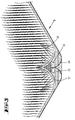
- a plastic component 1 which is shown in this embodiment as a carpet tube 2.
- the carpet tube 2 that is to say in its wall 3, contains portions of high-temperature-resistant plastic which, as a rule, are not melted (cracked), but are finely distributed due to a softening process.
- the latter consist of polyamide 6 or polyamide 6.6.
- the process-melted polyamide components are embedded in the wall 3, which consists largely of low-temperature-resistant plastic.
- FIGS. 1 and 2 schematically shows the craters arranged on the surface 6.
- the surface 6 is also formed comparatively non-slip.
- the wall 3 of the carpet tube 2 can contain conductive components 8 in the form of carbon fibers or metal-vapor-coated fibers (the latter in turn preferably based on polyamide).
- Such a plastic component 1, in particular carpet tube 2 can be produced from a starting material in the form of polyolefins, such as polyethylene, polypropylene or the like, fibers 4, in particular polyamide fibers and optionally conductive components 8, which are resistant to high temperatures being added to this starting material.
- a starting material in the form of polyolefins, such as polyethylene, polypropylene or the like, fibers 4, in particular polyamide fibers and optionally conductive components 8, which are resistant to high temperatures being added to this starting material.
- a carpet 9 to be recycled is shown schematically in FIG. This has pile threads 10, which form a pile layer made of polyamide 6 or polyamide 6.6. These pile threads 10 are needled into a carrier material 11, which can be a fleece or ribbon fabric made of polypropylene.
- a first consolidation of the pile threads 10 with the primary carrier material 11 is achieved by a so-called primer 12, which is shown here as an exaggerated layer.
- the primer consists of copolymers of e.g. Ethylene-vinyl acetate copolymers, styrene-butadiene, styrene-acrylate and others.
- the carrier material 11 with the needled and solidified pile threads 10 is by means of a lamination 13, such as polyethylene or the like, which is also shown here for reasons of demonstration as an exaggeratedly thick layer, with a so-called textile backing 14, which in the exemplary embodiment is based on polypropylene, connected.
- a lamination 13 such as polyethylene or the like, which is also shown here for reasons of demonstration as an exaggeratedly thick layer, with a so-called textile backing 14, which in the exemplary embodiment is based on polypropylene, connected.
- the carpet 1 is first, crushed into carpet parts 15, placed in a so-called plastic compactor 16 (cf. FIG. 4).
- This agglomerates the carpet parts 15, whereby the thermoplastic parts of polyolefins are melted by the optionally controlled heat development, but not the pile threads 10 made of polyamide.
- the result is granules 17.
- the granules macroscopically consist of individual, dry granules 17 that give a free-flowing substance.
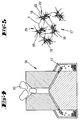
- Such a granule 17 is shown on an enlarged scale, but schematically, in FIG. It can be seen that a large number of polyamide fibers 4 make up the overall "fibrous" appearance of a grain 17.
- the polyamide fibers 4 are connected to one another by low-melting plastic parts which, in part like an envelope, as shown by reference numeral 18, glue the polyamide fibers 4 together. There are also larger accumulations, as explained by reference number 19, of the thermoplastic components. This results in fiber groups 20 which, due to longer polyamide fibers 4, which are connected to other fiber groups 20 ′, combine to form a granule 17 due to their tangled position.
- the desired conductive components 8 within the plastic component 1 can also be obtained from the recycled carpet 9, provided that it contains 10 conductive substances within its pile fibers.
- the granules 17 obtained as described above are preferably mixed with unmixed plastic granules 21, in particular polyethylene granules / polypropylene granules, namely approximately in a proportion of 40 to 70%, preferably 70%.
- the granules 17 and 21 are fed to an extruder 22 which, via a rotating screw 23, feeds the granules 17 and 21 from a storage container 24 into a temperature-controlled cylinder 25.
- the temperature here is below the melting point of approximately 220 ° C. for polyamide, which ensures that the polyamide fibers 4 are not melted (cracked).
- these are unmelted or fused polyamide components.
- the high temperature leads to such a softening that a polyamide fiber is shredded as it passes through the extruder and the polyamide is distributed fairly homogeneously in the extrudate.
- the distribution is so fine that the proportions of polyamide cannot be identified individually even with microscopic magnification.
- the conductive components 8 which can consist of carbon fibers or metal-coated, conductive fibers based on polyamide.
- the other plastic parts made of polypropylene, ethylene-vinyl acetate copolymers, styrene-butadiene, styrene-acrylate or the like and based on polyolefins such as polyethylene, polypropylene or the like are melted, whereby the high-temperature-resistant plastic parts and the conductive components in distribute the melted plastic mass homogeneously. This plastic mass is pressed through a profiling nozzle 26.
- the extrudate here is a carpet tube 2, as shown in FIG. 1, which has polyamide components and conductive components 8 embedded in its wall 3.
Landscapes
- Engineering & Computer Science (AREA)
- Environmental & Geological Engineering (AREA)
- Mechanical Engineering (AREA)
- Carpets (AREA)
- Compositions Of Macromolecular Compounds (AREA)
- Injection Moulding Of Plastics Or The Like (AREA)
- Laminated Bodies (AREA)
- Nonwoven Fabrics (AREA)
Applications Claiming Priority (2)
| Application Number | Priority Date | Filing Date | Title |
|---|---|---|---|
| DE4241172A DE4241172A1 (de) | 1992-12-07 | 1992-12-07 | Im Kunststoffspritzverfahren hergestelltes Kunststoffbauteil |
| DE4241172 | 1992-12-07 |
Publications (2)
| Publication Number | Publication Date |
|---|---|
| EP0601312A1 true EP0601312A1 (fr) | 1994-06-15 |
| EP0601312B1 EP0601312B1 (fr) | 1999-06-30 |
Family
ID=6474604
Family Applications (1)
| Application Number | Title | Priority Date | Filing Date |
|---|---|---|---|
| EP93116903A Expired - Lifetime EP0601312B1 (fr) | 1992-12-07 | 1993-10-20 | Objet en matériau plastique moulé par injection |
Country Status (4)
| Country | Link |
|---|---|
| EP (1) | EP0601312B1 (fr) |
| AT (1) | ATE181694T1 (fr) |
| CA (1) | CA2110743A1 (fr) |
| DE (2) | DE4241172A1 (fr) |
Cited By (1)
| Publication number | Priority date | Publication date | Assignee | Title |
|---|---|---|---|---|
| EP0976522A3 (fr) * | 1997-03-18 | 2000-04-12 | Collins & Aikman Floorcoverings, Inc. | Article fabriqué à partir de déchets en matériau polymère |
Families Citing this family (1)
| Publication number | Priority date | Publication date | Assignee | Title |
|---|---|---|---|---|
| WO2015120830A1 (fr) * | 2014-02-13 | 2015-08-20 | Herbold Meckesheim Gmbh | Procédé de traitement de matières et dispositif correspondant |
Citations (9)
| Publication number | Priority date | Publication date | Assignee | Title |
|---|---|---|---|---|
| SU374340A1 (ru) * | 1971-05-26 | 1973-03-20 | Композиция на основе покистирола | |
| FR2253616A1 (en) * | 1973-12-11 | 1975-07-04 | Gisiger Lusa Armin | Decorative multi-coloured mouldings - contain heat-resistant, differently coloured, randomly distributed filler particles |
| DE2722774A1 (de) * | 1977-05-20 | 1978-11-23 | Franz Dr Matejcek | Verfahren zur verwertung von textilen abfaellen |
| JPS5841910A (ja) * | 1981-08-31 | 1983-03-11 | Kanebo Ltd | 導電性混繊糸 |
| JPS60107309A (ja) * | 1983-11-15 | 1985-06-12 | Ikeda Bussan Co Ltd | カ−ペツト破材の処理方法 |
| JPS60109806A (ja) * | 1983-11-18 | 1985-06-15 | Sekisui Chem Co Ltd | 繊維状シ−ト体を用いた溶融混練成形方法 |
| JPS60219016A (ja) * | 1984-04-13 | 1985-11-01 | Sekisui Chem Co Ltd | 繊維状シ−ト体の再生処理方法 |
| EP0232522A2 (fr) * | 1985-12-19 | 1987-08-19 | Chisso Corporation | Composition de polypropylène |
| JPS63295615A (ja) * | 1987-05-28 | 1988-12-02 | Teijin Ltd | 成形用熱硬化性エポキシ樹脂組成物 |
-
1992
- 1992-12-07 DE DE4241172A patent/DE4241172A1/de not_active Withdrawn
-
1993
- 1993-10-20 DE DE59309673T patent/DE59309673D1/de not_active Expired - Fee Related
- 1993-10-20 AT AT93116903T patent/ATE181694T1/de not_active IP Right Cessation
- 1993-10-20 EP EP93116903A patent/EP0601312B1/fr not_active Expired - Lifetime
- 1993-12-06 CA CA 2110743 patent/CA2110743A1/fr not_active Abandoned
Patent Citations (9)
| Publication number | Priority date | Publication date | Assignee | Title |
|---|---|---|---|---|
| SU374340A1 (ru) * | 1971-05-26 | 1973-03-20 | Композиция на основе покистирола | |
| FR2253616A1 (en) * | 1973-12-11 | 1975-07-04 | Gisiger Lusa Armin | Decorative multi-coloured mouldings - contain heat-resistant, differently coloured, randomly distributed filler particles |
| DE2722774A1 (de) * | 1977-05-20 | 1978-11-23 | Franz Dr Matejcek | Verfahren zur verwertung von textilen abfaellen |
| JPS5841910A (ja) * | 1981-08-31 | 1983-03-11 | Kanebo Ltd | 導電性混繊糸 |
| JPS60107309A (ja) * | 1983-11-15 | 1985-06-12 | Ikeda Bussan Co Ltd | カ−ペツト破材の処理方法 |
| JPS60109806A (ja) * | 1983-11-18 | 1985-06-15 | Sekisui Chem Co Ltd | 繊維状シ−ト体を用いた溶融混練成形方法 |
| JPS60219016A (ja) * | 1984-04-13 | 1985-11-01 | Sekisui Chem Co Ltd | 繊維状シ−ト体の再生処理方法 |
| EP0232522A2 (fr) * | 1985-12-19 | 1987-08-19 | Chisso Corporation | Composition de polypropylène |
| JPS63295615A (ja) * | 1987-05-28 | 1988-12-02 | Teijin Ltd | 成形用熱硬化性エポキシ樹脂組成物 |
Non-Patent Citations (8)
| Title |
|---|
| DATABASE WPI Week 7407, Derwent World Patents Index; AN 74-12825V * |
| DATABASE WPI Week 8316, Derwent World Patents Index; AN 83-37924K * |
| DATABASE WPI Week 8530, Derwent World Patents Index; AN 85-180267 * |
| DATABASE WPI Week 8530, Derwent World Patents Index; AN 85-181298 * |
| DATABASE WPI Week 8550, Derwent World Patents Index; AN 85-314023 * |
| DATABASE WPI Week 8802, Derwent World Patents Index; AN 88-012327, ANONYMOUS * |
| DATABASE WPI Week 8903, Derwent World Patents Index; AN 89-019698 * |
| RESEARCH DISCLOSURE, vol. 284, no. 003, 10 December 1987 (1987-12-10) * |
Cited By (1)
| Publication number | Priority date | Publication date | Assignee | Title |
|---|---|---|---|---|
| EP0976522A3 (fr) * | 1997-03-18 | 2000-04-12 | Collins & Aikman Floorcoverings, Inc. | Article fabriqué à partir de déchets en matériau polymère |
Also Published As
| Publication number | Publication date |
|---|---|
| CA2110743A1 (fr) | 1994-06-08 |
| EP0601312B1 (fr) | 1999-06-30 |
| DE4241172A1 (de) | 1994-06-09 |
| ATE181694T1 (de) | 1999-07-15 |
| DE59309673D1 (de) | 1999-08-05 |
Similar Documents
| Publication | Publication Date | Title |
|---|---|---|
| DE3280480T2 (de) | Granulat aus faserverstärkten Verbundstoffen und deren Herstellungsverfahren | |
| DE2118931C3 (de) | Verbundmaterial, welches ein organisches Polymeres und ein anorganisches Oxydglas enthält, sowie dessen Verwendung | |
| DE69718653T2 (de) | Polymerzusammensetzungen und verfahren zur herstellung von baumaterialien daraus | |
| DE60106798T2 (de) | Faserverstärkte thermoplastische Harzpellets und Verfahren zu dessen Herstellung | |
| DE19512767C2 (de) | Rollbare Wärmedämmung auf Basis vollsynthetischer Fasern | |
| DE3239732T1 (de) | Formbare fasermatte und verfahren zum herstellen der matte und daraus geformte produkte | |
| EP0685520A1 (fr) | Matériau plastique renforcé par des fibres et procédé pour sa préparation | |
| DE60011268T2 (de) | Für schuhe geeigneter verbundwerkstoff, verfahren zur dessen herstellung sowie den verbundwerkstoff beinhaltende schuheinlagen | |
| DE102018132317A1 (de) | Langfaserverstärktes thermoplastisches Filament | |
| DE69009560T2 (de) | Vliesstoff zur Verstärkung von Kunstharz und diesen verwendende formbare Platte. | |
| DE3526102C2 (fr) | ||
| DE102020115509A1 (de) | Schwellenbesohlung für ein Betonbauteil | |
| EP0595063B1 (fr) | Couche adhésive et tapis comprenant, sur son envers, une telle couche adhésive | |
| EP0643093A1 (fr) | Ebauche de forme plane à partir de matières thermoplastiques renforcées de nappes de verre recyclées | |
| DE202019005308U1 (de) | Dilour-Teppich mit erhöhten Gebrauchswert-Eigenschaften | |
| DE1964060A1 (de) | Nichtgewebtes Vlies aus Polypropylenfasern und Verfahren zu dessen Herstellung | |
| EP0570803B1 (fr) | Procédé de fabrication de pièces moulées par compression d'une matière fibreuse avec collage simultané et les objets obtenus selon ce procédé | |
| EP2052827B1 (fr) | Procédé et équipement de fabrication de granulés souples à partir de déchets de feuilles lourdes en matière synthétique, et d'une feuille lourde en matière synthétique de recyclage dotée de caractéristiques améliorées. | |
| DE2536409A1 (de) | Verfahren zur aufbereitung von mit kunststoff beschichteten gewebeabfaellen | |
| EP0601312A1 (fr) | Objet en matériau plastique moulé par injection | |
| DE2632775B2 (de) | Verfahren zur Herstellung von Gegenständen aus unterschiedlichen thermoplastischen Polymeren | |
| DE2340369C3 (de) | Verfahren zur kontinuierlichen Herstellung von Granalien aus faserverstärkten thermoplastischen Kunststoffen | |
| EP2743292B1 (fr) | Procédé de fabrication d'un corps de formage tridimensionnel et semi-produit | |
| DE2816463A1 (de) | Formmasse | |
| DE69512289T2 (de) | Thermoplastisches Verbundmaterial und Verfahren zur Herstellung von Artikeln daraus |
Legal Events
| Date | Code | Title | Description |
|---|---|---|---|
| PUAI | Public reference made under article 153(3) epc to a published international application that has entered the european phase |
Free format text: ORIGINAL CODE: 0009012 |
|
| AK | Designated contracting states |
Kind code of ref document: A1 Designated state(s): AT BE DE FR GB NL |
|
| 17P | Request for examination filed |
Effective date: 19940923 |
|
| 17Q | First examination report despatched |
Effective date: 19961113 |
|
| GRAG | Despatch of communication of intention to grant |
Free format text: ORIGINAL CODE: EPIDOS AGRA |
|
| GRAG | Despatch of communication of intention to grant |
Free format text: ORIGINAL CODE: EPIDOS AGRA |
|
| GRAH | Despatch of communication of intention to grant a patent |
Free format text: ORIGINAL CODE: EPIDOS IGRA |
|
| GRAH | Despatch of communication of intention to grant a patent |
Free format text: ORIGINAL CODE: EPIDOS IGRA |
|
| GRAA | (expected) grant |
Free format text: ORIGINAL CODE: 0009210 |
|
| RIN1 | Information on inventor provided before grant (corrected) |
Inventor name: WERNER, ACHIM Inventor name: HOELZEL, KLAUS Inventor name: BEYER, FRIEDRICH |
|
| AK | Designated contracting states |
Kind code of ref document: B1 Designated state(s): AT BE DE FR GB NL |
|
| REF | Corresponds to: |
Ref document number: 181694 Country of ref document: AT Date of ref document: 19990715 Kind code of ref document: T |
|
| GBT | Gb: translation of ep patent filed (gb section 77(6)(a)/1977) |
Effective date: 19990630 |
|
| ET | Fr: translation filed | ||
| REF | Corresponds to: |
Ref document number: 59309673 Country of ref document: DE Date of ref document: 19990805 |
|
| PLBE | No opposition filed within time limit |
Free format text: ORIGINAL CODE: 0009261 |
|
| STAA | Information on the status of an ep patent application or granted ep patent |
Free format text: STATUS: NO OPPOSITION FILED WITHIN TIME LIMIT |
|
| 26N | No opposition filed | ||
| PGFP | Annual fee paid to national office [announced via postgrant information from national office to epo] |
Ref country code: NL Payment date: 20010912 Year of fee payment: 9 Ref country code: GB Payment date: 20010912 Year of fee payment: 9 Ref country code: BE Payment date: 20010912 Year of fee payment: 9 |
|
| PGFP | Annual fee paid to national office [announced via postgrant information from national office to epo] |
Ref country code: FR Payment date: 20010913 Year of fee payment: 9 |
|
| REG | Reference to a national code |
Ref country code: GB Ref legal event code: IF02 |
|
| PG25 | Lapsed in a contracting state [announced via postgrant information from national office to epo] |
Ref country code: GB Free format text: LAPSE BECAUSE OF NON-PAYMENT OF DUE FEES Effective date: 20021020 |
|
| PG25 | Lapsed in a contracting state [announced via postgrant information from national office to epo] |
Ref country code: BE Free format text: LAPSE BECAUSE OF NON-PAYMENT OF DUE FEES Effective date: 20021031 |
|
| BERE | Be: lapsed |
Owner name: *VORWERK & CO. INTERHOLDING G.M.B.H. Effective date: 20021031 |
|
| PG25 | Lapsed in a contracting state [announced via postgrant information from national office to epo] |
Ref country code: NL Free format text: LAPSE BECAUSE OF NON-PAYMENT OF DUE FEES Effective date: 20030501 |
|
| GBPC | Gb: european patent ceased through non-payment of renewal fee |
Effective date: 20021020 |
|
| PG25 | Lapsed in a contracting state [announced via postgrant information from national office to epo] |
Ref country code: FR Free format text: LAPSE BECAUSE OF NON-PAYMENT OF DUE FEES Effective date: 20030630 |
|
| NLV4 | Nl: lapsed or anulled due to non-payment of the annual fee |
Effective date: 20030501 |
|
| REG | Reference to a national code |
Ref country code: FR Ref legal event code: ST |
|
| PGFP | Annual fee paid to national office [announced via postgrant information from national office to epo] |
Ref country code: DE Payment date: 20081113 Year of fee payment: 16 |
|
| PGFP | Annual fee paid to national office [announced via postgrant information from national office to epo] |
Ref country code: AT Payment date: 20081008 Year of fee payment: 16 |
|
| PG25 | Lapsed in a contracting state [announced via postgrant information from national office to epo] |
Ref country code: DE Free format text: LAPSE BECAUSE OF NON-PAYMENT OF DUE FEES Effective date: 20100501 |
|
| PG25 | Lapsed in a contracting state [announced via postgrant information from national office to epo] |
Ref country code: AT Free format text: LAPSE BECAUSE OF NON-PAYMENT OF DUE FEES Effective date: 20091020 |