EP0601432B1 - Procédé et système d'estimation d'inertie pour un système de deux masses au cours de régulation de vitesse - Google Patents
Procédé et système d'estimation d'inertie pour un système de deux masses au cours de régulation de vitesse Download PDFInfo
- Publication number
- EP0601432B1 EP0601432B1 EP93119206A EP93119206A EP0601432B1 EP 0601432 B1 EP0601432 B1 EP 0601432B1 EP 93119206 A EP93119206 A EP 93119206A EP 93119206 A EP93119206 A EP 93119206A EP 0601432 B1 EP0601432 B1 EP 0601432B1
- Authority
- EP
- European Patent Office
- Prior art keywords
- load torque
- output
- observer
- mass
- estimate
- Prior art date
- Legal status (The legal status is an assumption and is not a legal conclusion. Google has not performed a legal analysis and makes no representation as to the accuracy of the status listed.)
- Expired - Lifetime
Links
- 238000000034 method Methods 0.000 title claims description 19
- 238000004364 calculation method Methods 0.000 claims description 29
- 238000010586 diagram Methods 0.000 description 15
- 230000010354 integration Effects 0.000 description 5
- 230000001133 acceleration Effects 0.000 description 2
- 238000001514 detection method Methods 0.000 description 2
- 238000004088 simulation Methods 0.000 description 2
- 229910000831 Steel Inorganic materials 0.000 description 1
- 238000010276 construction Methods 0.000 description 1
- 238000007796 conventional method Methods 0.000 description 1
- 238000005096 rolling process Methods 0.000 description 1
- 239000010959 steel Substances 0.000 description 1
Images


Classifications
-
- H—ELECTRICITY
- H02—GENERATION; CONVERSION OR DISTRIBUTION OF ELECTRIC POWER
- H02P—CONTROL OR REGULATION OF ELECTRIC MOTORS, ELECTRIC GENERATORS OR DYNAMO-ELECTRIC CONVERTERS; CONTROLLING TRANSFORMERS, REACTORS OR CHOKE COILS
- H02P5/00—Arrangements specially adapted for regulating or controlling the speed or torque of two or more electric motors
-
- H—ELECTRICITY
- H02—GENERATION; CONVERSION OR DISTRIBUTION OF ELECTRIC POWER
- H02P—CONTROL OR REGULATION OF ELECTRIC MOTORS, ELECTRIC GENERATORS OR DYNAMO-ELECTRIC CONVERTERS; CONTROLLING TRANSFORMERS, REACTORS OR CHOKE COILS
- H02P29/00—Arrangements for regulating or controlling electric motors, appropriate for both AC and DC motors
- H02P29/0016—Control of angular speed of one shaft without controlling the prime mover
Definitions
- the present invention relates to a method and system for estimating an inertia of torsionally vibrating 2-mass system in a speed control.
- 2-mass system is constituted by a motor and a load connected through a low rigidity shaft (elastic shaft) in an elevator, rolling mill of steel or arm of robot
- the 2-mass system generates a shaft torsional vibration and cannot be improved in responsibility of a speed control system.
- a shaft torsional vibration is effected by a ratio between inertia of moments of the motor and the load.
- the vibration tends to be generated when the moment of inertia of the load is smaller than that of the motor.
- an inertia of 1-mass system (a motor) is estimated by a speed-accelerating test of a motor. Then, after the connection of a load with the motor, the 2-mass system is gradually accelerated so as not to generate a vibration, and under this condition an inertia of the 2-mass (motor + load) system is estimated.
- Fig. 14 shows an explanatory view which shows a model of 2-mass system.
- the 2-mass system comprises a motor M and a load L which are connected through an elastic shaft S.
- ⁇ M is a motor generating torque
- ⁇ M is a motor angle speed
- ⁇ L is a load torque
- ⁇ L is an angle speed of load L
- ⁇ S is a shaft torque.
- n M ( ⁇ M - ⁇ S ) / T M S
- n L ( ⁇ S - ⁇ L ) / T L S
- ⁇ S (n M - n L ) / T S S
- n M is a motor speed
- n L is a load speed
- Fig. 15 shows a block diagram of the 2-mass system of Fig. 14.
- T M denotes a time constant of a machine of motor
- T L denotes a machine time constant of load
- T S denotes a time constant of a spring.
- ⁇ M ⁇ L + ST M n M + SL L n L
- Fig. 1 shows a first embodiment of the inertia estimating circuit of the torsionally vibrating 2-mass system according to the present invention.
- reference numeral 11 is a subtracting section which calculates the difference between the motor speed command n M * and the motor speed n M .
- the output of the subtracting section 11 is inputted into a speed control amplifier 12.
- the output i A * of the speed control amplifier 12 is inputted into the adding section 13 wherein the output i A * of the speed control amplifier 12 is added with the load torque estimate ⁇ and L .
- the output of the adding section 13 is treated as a motor generating torque ⁇ M and is supplied to a 2-mass system model 14 shown in Fig. 15.
- the motor generating torque ⁇ M is inputted into the load torque estimating observer 15 wherein the load torque estimate ⁇ and L is obtained.
- the load torque estimating observer 15 comprises a subtracting section 15a which detects a difference between the motor generating torque ⁇ M and the load torque estimate ⁇ and L .
- the output of the subtracting section 15a is supplied to an integration section 15b which is constituted by a time constant of the model machine.
- a subtracting section 15c obtains a difference between the output of the integration section 15b and the motor speed n M .
- the output of the subtracting section 15c is supplied to an observer gain section 15d where the load torque estimate ⁇ and L is outputted.
- the load torque estimate ⁇ and L from the load torque estimating observer 15 is supplied to the inertia error estimating section 16.
- the inertia error estimating section 16 comprises a subtracting section 16a to which the load torque estimate ⁇ and L and the load torque equivalent value ⁇ L ' are supplied.
- the output of the subtracting section 16a is supplied to an integration section 16b constituted by a model machine time constant and an inverse-number section 16c for the observer gain. Both outputs of the integral factor 16b and the inverse-number section 16c are inputted into an adding section 16d.
- the output of the adding section 16d is divided by the motor speed n M in a dividing section 16e.
- a switch section 16f for obtaining the load torque equivalent value ⁇ L ' is installed in the inertia error estimating section 16.
- Fig. 2 shows a second embodiment of the inertia torque estimating circuit according to the present invention.
- the observer gain inverse-number section 16c of the inertia error estimating section 16 is omitted as shown in Fig. 2.
- K-1 ⁇ 1 ST ML * ( ⁇ L - ⁇ L' )+ 1 L 1 ( ⁇ L - ⁇ L' ) ⁇ 1 n M
- FIG. 3 there is shown a third embodiment of the inertia estimating circuit according to the present invention.
- the third embodiment is a deformation of the second embodiment. That is, the third embodiment further comprises a second integral calculation section 16g which is constituted by a model machine time constant of the sum of the machine time constants of the motor and the load. An observer-gain inverse-number section 16h and a subtracting section 16i are further added to the inertia error estimating section 16. The second integration section 16g receives the output i A * of the speed control amplifier 12.
- FIG. 4 there is shown a fourth embodiment of the inertia estimating circuit according to the present invention.
- the fourth embodiment comprises a second integration sectionl6g, an observer gain inverse number section 16h and a subtracting section 16i in the inertia error estimating section 16 of the third embodiment.
- Figs. 5 and 6 are characteristic graphs which show examples of simulation of the inertia error estimation of the torsionally vibrating 2-mass system.
- Fig. 7 shows a detector circuit which is used to judge that the system is in the speed-adjusting condition (accelerating or decelerating condition) when the output i A * of the speed control amplifier 12 is greater than a predetermined value.
- the detector circuit comprises an absolute value circuit 71 and a filter 72 for taking an overshoot and an undershoot of the output i A * into consideration.
- F of the filter 71 are transferred through an OR circuit 73 to a comparator 74 wherein the outputs are compared whith a speed-adjusting detection set value.
- a signal indicative that the 2-mass system is now in a speed-adjusting condition is outputted from the comparator 74, and in reply to the signal a switch 16f is opened. Accordingly, the load torque estimate ⁇ and L is held and therefore the lead torque equivalent value ⁇ L ', which keeps stable, is obtained.
- the above-mentioned embodiment is an inertia error (K-1) estimating section.
- n M 1 S ( T M + T L ) ( ⁇ M - ⁇ L ) + T L T M + T L (n M - n L )
- Fig. 8 shows a fifth embodiment of the inertia estimating circuit according to the present invention.
- an inertia ratio estimating section 17 comprises a subtracting section 17a, an integral calculation section 17b, a dividing section 17c and a switch 17d.
- the subtracting section 17a outputs a difference between the motor generating torque ⁇ M and the load torque equivalent value ⁇ L '.
- the integral factor 17b is constituted by a model machine time constant (the sum of the machine time constant of the motor and the machine time constant of the load) and outputs the motor speed estimate n and M according to the output of the subtracting section 17a.
- the dividing section 17c divides the motor speed estimate n and M by the motor speed n M and outputs the inertia ratio K.
- Fig. 9 shows a sixth embodiment of the inertia estimating system according to the present invention.
- the sixth embodiment is different from the fifth embodiment in the inertia ratio estimating section 17.
- the inertia ratio estimating section 17 of the sixth embodiment comprises an adding section 17e.
- the output i A * of the speed control amplifier 12 is applied to an input end of the adding section 17e.
- the load torque estimate ⁇ and L is applied to the other input end of the adding section 17e.
- the adding section 17e outputs the motor generating torque ⁇ M to the subtracting section 17a.
- Fig. 10 shows a seventh embodiment which is arranged such that a second integral calculation section 17f, an observer gain inverse number section 17g and a subtracting section 17h are further added in the inertia ratio estimating section of the sixth embodiment.
- the second integral calculation section 17f receives the output i A * of the speed control amplifier 12, and the observer gain inverse number section 17g receives the load torque estimate ⁇ and L .
- the outputs of the second integral calculation section 17f and the observer gain inverse number section 17g is inputted into the subtracting section 17h which outputs the motor speed n M .
- eighth and ninth embodiments are arranged to have an inertia ratio estimating section where the load torque estimate ⁇ and L is not added to the torque current command i T *.
- Fig. 11 shows the eighth embodiment of the inertia estimating circuit according to the present invention.
- a current control system 21 receives the output i A * of the speed control amplifier 12 and outputs a torque current i T .
- the torque current is inputted to a constant section 22 of a torque coefficient K ⁇
- the torque command ⁇ M is outputted from the constant section 22.
- a subtracting section 23 receives the torque command ⁇ M and the load torque ⁇ L , and outputs the difference to a 2-mass system model 14.
- reference numeral 15e is a constant section of the model value K ⁇ * of the torque coefficient
- 15f is an inverse number section of the model value K ⁇ *.
- Fig. 12 shows the ninth embodiment of the inertia estimating circuit according to the present invention.
- auto-tuning of the motor speed control system is implemented by applying the variation K of the inertia ratio estimating section 17 to the model machine time constant 15b of the load torque estimating observer 15 and the speed control amplifier 12.
- Both of tenth and eleventh embodiments of the inertia estimating circuit comprise an inertia estimating section where the load torque estimate ⁇ and L is not added to the torque current command i T * as is similar to the eighth and ninth embodiments.
- Fig. 16 shows the tenth embodiment wherein it is arranged such that the load torque estimate ⁇ and L is not added to the output of the speed control amplifier 12 of the fifth embodiment of Fig. 8.
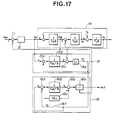
- Fig. 17 shows the eleventh embodiment wherein it is arranged such that the load torque estimate ⁇ and L is not added to the output of the speed control amplifier 12 of the first embodiment of Fig. 1. It will be understood that in the eleventh embodiment the inverse number section 16c of the observer gain in the inertia estimating section may be removed and then the construction of the inertia error estimating section 16 becomes the same as that in Fig. 2. Also, the speed-adjusting period detecting circuit as shown in Fig. 13A is used in the tenth and eleventh embodiments as is similar to that in the eighth and ninth embodiments since the load torque estimate ⁇ and L is not added to the output of the speed control amplifier 12 in the tenth and eleventh embodiments.
Landscapes
- Engineering & Computer Science (AREA)
- Power Engineering (AREA)
- Control Of Electric Motors In General (AREA)
Claims (17)
- Procédé d'estimation d'une inertie dans un système de régulation de vitesse de deux masses comprenant un moteur (M) (première masse) et une charge (L) (seconde masse) accouplés par l'intermédiaire d'un arbre (S) ayant des propriétés élastiques, dans lequel :un amplificateur (12) de régulation de vitesse amplifie la différence entre une vitesse (nM*) de consigne de moteur et une vitesse (nM) réelle de moteur et produit une sortie (iA*) ;un observateur (15) d'estimation de couple de charge obtient et sort une estimation (τ andL) de couple de charge ;dans lequel la sortie (iA*) dudit amplificateur (12) de régulation de vitesse est additionnée à ladite estimation (τ andL) de couple de charge et le signal résultant entre dans un modèle (14) de système à deux masses qui, à son tour, sort une consigne de couple de charge qui est utilisée comme base pour la régulation dudit système à deux masses, ce par quoi :a) la différence entre ladite estimation (τ andL) de couple de charge et une valeur équivalente (τL') de couple de charge entre dans une section (16b, 17b) de calcul intégral qui calcule et sort une estimation de vitesse d'observateur sur la base d'une constante de temps de machine (TML*) obtenue en additionnant les constantes de temps de machine (TM, TL) dudit moteur (M) et de ladite charge (L) ;b) l'inertie dudit système de régulation de vitesse de deux masses est estimée en divisant ladite estimation de vitesse d'observateur par la vitesse de moteur (nM).
- Procédé selon la revendication 1, dans lequel :c) la sortie (iA*) de l'amplificateur (12) de régulation de vitesse entre dans une seconde section (16g, 17f) de calcul intégral qui calcule et sort un signal sur la base d'une constante de temps de machine (TML*) obtenue en additionnant les constantes de temps de machine (TM, TL) dudit moteur (M) et de ladite charge (L) ;d) la vitesse de moteur (nM) se calcule à partir de la différence entre la sortie de la seconde section (16g, 17f) de calcul intégral et la sortie d'une section (16h) d'inversion de gain d'observateur dans laquelle entre la sortie (iA*) de l'amplificateur (12) de régulation de vitesse.
- Procédé selon la revendication 1, dans lequel une section (16c) d'inversion de gain d'observateur est disposée en parallèle avec la section (16b) de calcul intégral, et dans lequel la sortie de la section (16c) d'inversion de gain d'observateur est additionnée à la sortie de la section (16b) de calcul intégral.
- Procédé selon la revendication 2, dans lequel une section (16c) d'inversion de gain d'observateur est disposée en parallèle avec la première section (16b) de calcul intégral, et dans lequel la sortie de la section (16c) d'inversion de gain d'observateur est additionnée à la sortie de la première section (16b) de calcul intégral.
- Procédé selon la revendication 1, dans lequel la différence à entrer dans la section (17b) de calcul intégral se calcule à partir de la différence entre la valeur équivalente (τL') de couple de charge et la somme de la sortie (iA*) de l'amplificateur (12) de régulation de vitesse et de l'estimation (τ andL) de couple de charge.
- Procédé selon la revendication 2, dans lequel la différence à entrer dans la première section (17b) de calcul intégral se calcule à partir de la différence entre la valeur équivalente (τL') de couple de charge et la somme de la sortie (iA*) de l'amplificateur (12) de régulation de vitesse et de l'estimation (τ andL) de couple de charge.
- Procédé d'estimation d'une inertie dans un système de régulation de vitesse de deux masses comprenant un moteur (M) (première masse) et une charge (L) (seconde masse) accouplés par l'intermédiaire d'un arbre (S) ayant des propriétés élastiques, dans lequel :a) un observateur (15) d'estimation de couple de charge obtient et sort une estimation (τ andL) de couple de charge ;b) la différence entre ladite estimation (τ andL) de couple de charge et une valeur équivalente (τL') de couple de charge entre dans une section (16b) de calcul intégral qui calcule et sort une estimation de vitesse d'observateur sur la base d'une constante de temps de machine (TML*) obtenue en additionnant les constantes de temps de machine (TM, TL) dudit moteur (M) et de ladite charge (L) ;c) l'inertie dudit système de régulation de vitesse de deux masses est estimée en divisant ladite estimation de vitesse d'observateur par la vitesse de moteur (nM).
- Procédé selon la revendication 7, dans lequel une section (16c) d'inversion de gain d'observateur est disposée en parallèle avec la section (16b) de calcul intégral, et dans lequel la sortie de la section (16c) d'inversion de gain d'observateur est additionnée à la sortie de la section (16b) de calcul intégral.
- Système destiné à estimer l'inertie dans un système de régulation de vitesse de deux masses comprenant un moteur (M) (première masse) et une charge (L) (seconde masse) accouplés par l'intermédiaire d'un arbre (S) ayant des propriétés élastiques, comprenant :un amplificateur (12) de régulation de vitesse qui amplifie la différence entre une vitesse (nM*) de consigne de moteur et une vitesse (nM) réelle de moteur et produit une sortie (iA*) ;un observateur (15) d'estimation de couple de charge qui obtient et sort une estimation (τ andL) de couple de charge ;un modèle (14) de système à deux masses dans lequel on entre la somme de la sortie (iA*) dudit amplificateur (12) de régulation de vitesse et de ladite estimation (τ andL) de couple et charge et qui, à son tour, sort une consigne de couple de charge qui est utilisée comme base pour réguler le système à deux masses, le système comprenant en outre :une section (16b, 17b) de calcul intégral dans laquelle entre la différence entre ladite estimation (τ andL) de couple de charge et une valeur équivalente (τL') de couple de charge et qui, à son tour, calcule et sort une estimation de vitesse d'observateur sur la base d'une constante de temps de machine (TML*) obtenue en additionnant les constantes de temps de machine (TM, TL) dudit moteur (M) et de ladite charge (L) ;et un moyen destiné à estimer l'inertie dudit système de régulation de vitesse de deux masses en divisant ladite estimation de vitesse d'observateur par la vitesse de moteur (nM).
- Système selon la revendication 9, dans lequel le système comprend en outre une seconde section (16g, 17f) de calcul intégral dans laquelle on entre la sortie de l'amplificateur (12) de régulation de vitesse et qui, à son tour, calcule et sort un signal sur la base d'une constante de temps de machine (TML*) obtenue en additionnant les constantes de temps de machine (TM, TL) dudit moteur (M) et de ladite charge (L) ;
et un moyen destiné à obtenir une vitesse de moteur (nM) à partir d'une différence entre la sortie de la seconde section (16g, 17f) de calcul intégral et la sortie d'une section (16h) d'inversion de gain d'observateur dans laquelle entre la sortie (iA*) de l'amplificateur (12) de régulation de vitesse. - Système selon la revendication 9, comprenant une section (16c) d'inversion de gain d'observateur disposée en parallèle avec la section (16b) de calcul intégral, et un moyen (16d) destiné à additionner la sortie de la section (16c) d'inversion de gain d'observateur à la sortie de la première section (16b) de calcul intégral.
- Système selon la revendication 10, comprenant une section (16c) d'inversion de gain d'observateur en parallèle avec la première section (16b) de calcul intégral, et comprenant un moyen destiné à additionner la sortie de la section (16c) d'inversion de gain d'observateur à la sortie de la première section (16b) de calcul intégral.
- Système selon la revendication 9, comprenant en outre un moyen (17e) destiné à additionner la sortie (iA*) de l'amplificateur (12) de régulation de vitesse et l'estimation (τ andL) de couple de charge et à sortir la somme (τM), et dans lequel on calcule la différence à entrer dans la section (17b) de calcul intégral à partir de la différence entre la valeur équivalente (τL') de couple de charge et la somme (τM).
- Système selon la revendication 10, comprenant en outre un moyen (17e) destiné à additionner la sortie (iA*) de l'amplificateur (12) de régulation de vitesse et l'estimation (τ andL) de couple de charge et à sortir la somme (τM), et dans lequel on calcule la différence à entrer dans la première section (17b) de calcul intégral à partir de la différence entre la valeur équivalente (τL') de couple de charge et la somme (τM).
- Système destiné à estimer l'inertie dans un système de régulation de vitesse de deux masses comprenant un moteur (M) (première masse) et une charge (L) (seconde masse) accouplés par l'intermédiaire d'un arbre (S) ayant des propriétés élastiques, comprenant :un moyen destiné à obtenir et à sortir une estimation (τ andL) de couple de charge en utilisant un observateur (15) d'estimation de couple de charge ;un moyen destiné à obtenir une estimation de vitesse d'observateur incluant une section (16b) de calcul intégral dans laquelle on entre une différence entre l'estimation (τ andL) de couple de charge et la valeur équivalente (τL') de couple de charge et qui calcule et sort l'estimation de vitesse d'observateur sur la base d'une constante de temps de machine (TML*) obtenue en additionnant les constantes de temps de machine (TM, TL) dudit moteur (M) et de ladite charge (L), et un moyen destiné à estimer l'inertie dudit système de régulation de deux masses en divisant ladite estimation de vitesse d'observateur par la vitesse de moteur (nM).
- Système selon la revendication 15, dans lequel une section (16c) d'inversion de gain d'observateur est disposée en parallèle avec la section (16b) de calcul intégral, et qui comprend un moyen (16d) destiné à additionner la sortie de la section (16c) d'inversion de gain d'observateur à la sortie de la section (16b) de calcul intégral.
- Système selon la revendication 1, dans lequel la valeur équivalente (τL') de couple de charge est l'estimation (τ andL) de couple de charge dans un état stationnaire du système à deux masses.
Applications Claiming Priority (4)
| Application Number | Priority Date | Filing Date | Title |
|---|---|---|---|
| JP32000592 | 1992-11-30 | ||
| JP320005/92 | 1992-11-30 | ||
| JP14371/93 | 1993-02-01 | ||
| JP01437193A JP3235242B2 (ja) | 1992-11-30 | 1993-02-01 | 2慣性ねじり振動系の速度制御におけるイナーシャ推定方法 |
Publications (3)
| Publication Number | Publication Date |
|---|---|
| EP0601432A2 EP0601432A2 (fr) | 1994-06-15 |
| EP0601432A3 EP0601432A3 (fr) | 1994-12-28 |
| EP0601432B1 true EP0601432B1 (fr) | 1999-01-27 |
Family
ID=26350299
Family Applications (1)
| Application Number | Title | Priority Date | Filing Date |
|---|---|---|---|
| EP93119206A Expired - Lifetime EP0601432B1 (fr) | 1992-11-30 | 1993-11-29 | Procédé et système d'estimation d'inertie pour un système de deux masses au cours de régulation de vitesse |
Country Status (7)
| Country | Link |
|---|---|
| US (1) | US5477114A (fr) |
| EP (1) | EP0601432B1 (fr) |
| JP (1) | JP3235242B2 (fr) |
| KR (1) | KR970003192B1 (fr) |
| CA (1) | CA2110208C (fr) |
| DE (1) | DE69323284T2 (fr) |
| ES (1) | ES2129061T3 (fr) |
Families Citing this family (12)
| Publication number | Priority date | Publication date | Assignee | Title |
|---|---|---|---|---|
| DE19500738C1 (de) * | 1995-01-12 | 1996-04-11 | Siemens Ag | Regelanordnung und Regelverfahren für einen motorisch betriebenen Gelenkarm |
| JP3611147B2 (ja) * | 1996-02-20 | 2005-01-19 | 株式会社安川電機 | 多軸ロボットの制御装置 |
| JP3185857B2 (ja) * | 1996-12-20 | 2001-07-11 | 株式会社安川電機 | モータ制御装置 |
| KR100237306B1 (ko) * | 1997-03-25 | 2000-01-15 | 윤종용 | 2관성 공진계의 진동 억제방법 및 장치 |
| KR100427477B1 (ko) * | 2001-12-17 | 2004-04-28 | 한국전기연구원 | 컴퓨터 단층촬영 장치용 갠트리의 속도 제어장치 |
| DE10236847A1 (de) * | 2002-08-08 | 2004-02-26 | Dr. Johannes Heidenhain Gmbh | Verfahren zur Bestimmung des Massenträgheitsmomentes eines elektromotorischen Antriebssystems |
| US6831429B2 (en) * | 2003-03-10 | 2004-12-14 | Visteon Global Technologies, Inc. | Prediction of available torque and power from battery-powered traction motor |
| JP4656245B2 (ja) * | 2009-03-30 | 2011-03-23 | シンフォニアテクノロジー株式会社 | 動力伝達系の試験装置とその制御方法 |
| DK201070274A (en) * | 2009-10-08 | 2011-04-09 | Vestas Wind Sys As | Control method for a wind turbine |
| KR101597085B1 (ko) * | 2013-04-10 | 2016-02-23 | 파나소닉 아이피 매니지먼트 가부시키가이샤 | 모터 구동 장치 |
| JP7119759B2 (ja) * | 2018-08-21 | 2022-08-17 | オムロン株式会社 | 設定支援装置 |
| US11316452B2 (en) | 2020-01-15 | 2022-04-26 | Delta Electronics, Inc. | Electronic device and control method thereof |
Family Cites Families (10)
| Publication number | Priority date | Publication date | Assignee | Title |
|---|---|---|---|---|
| US4580084A (en) * | 1981-07-10 | 1986-04-01 | Hitachi, Ltd. | Method and system for controlling speed of electric motor |
| US4680526A (en) * | 1984-08-21 | 1987-07-14 | Hitachi, Ltd. | Method of controlling inverter-driven induction motor |
| US4867287A (en) * | 1986-06-20 | 1989-09-19 | Toyota Jidosha Kabushiki Kaisha | Control method for magnetic powder clutch |
| JPH0199485A (ja) * | 1987-10-09 | 1989-04-18 | Toshiba Corp | サーボ電動機の制御装置 |
| SE8800386L (sv) * | 1988-02-05 | 1989-08-06 | Control Drive Utveckling Komma | Anordning foer oeverfoering av vridmoment |
| US5304906A (en) * | 1989-12-26 | 1994-04-19 | Fanuc Ltd. | Collision detecting method using an observer |
| JP2892802B2 (ja) * | 1990-09-21 | 1999-05-17 | 株式会社日立製作所 | 電動機の速度制御装置 |
| KR940003005B1 (ko) * | 1991-01-26 | 1994-04-09 | 삼성전자 주식회사 | 동기형 교류 서보모터의 속도제어방법 |
| TW221535B (fr) * | 1991-05-20 | 1994-03-01 | Meidensha Electric Mfg Co Ltd | |
| CA2174939C (fr) * | 1993-10-11 | 1999-09-21 | The United States Of America, Represented By The Secretary Of The Department Of Agriculture | Formulation pulverisable a base de gluten pour eliminer les parasites |
-
1993
- 1993-02-01 JP JP01437193A patent/JP3235242B2/ja not_active Expired - Fee Related
- 1993-11-29 DE DE69323284T patent/DE69323284T2/de not_active Expired - Fee Related
- 1993-11-29 ES ES93119206T patent/ES2129061T3/es not_active Expired - Lifetime
- 1993-11-29 CA CA002110208A patent/CA2110208C/fr not_active Expired - Fee Related
- 1993-11-29 EP EP93119206A patent/EP0601432B1/fr not_active Expired - Lifetime
- 1993-11-30 KR KR1019930025756A patent/KR970003192B1/ko not_active Expired - Fee Related
- 1993-11-30 US US08/159,488 patent/US5477114A/en not_active Expired - Fee Related
Also Published As
| Publication number | Publication date |
|---|---|
| JPH06217578A (ja) | 1994-08-05 |
| DE69323284T2 (de) | 1999-06-24 |
| JP3235242B2 (ja) | 2001-12-04 |
| EP0601432A3 (fr) | 1994-12-28 |
| EP0601432A2 (fr) | 1994-06-15 |
| KR970003192B1 (ko) | 1997-03-14 |
| KR940011935A (ko) | 1994-06-22 |
| CA2110208A1 (fr) | 1994-05-31 |
| DE69323284D1 (de) | 1999-03-11 |
| US5477114A (en) | 1995-12-19 |
| CA2110208C (fr) | 1997-10-07 |
| ES2129061T3 (es) | 1999-06-01 |
Similar Documents
| Publication | Publication Date | Title |
|---|---|---|
| EP0601432B1 (fr) | Procédé et système d'estimation d'inertie pour un système de deux masses au cours de régulation de vitesse | |
| JP3796261B1 (ja) | モータの負荷イナーシャ推定方法 | |
| EP0713287B1 (fr) | Stabilisateur de système d'alimentation pour générateur | |
| KR0163638B1 (ko) | 2 질량체 관성 공진계의 가요성 구동축 상에 발생하는 축 방향 비틀림 진동을 억제하는 저 관성화 제어 장치 | |
| US5115418A (en) | Servo control apparatus | |
| US7328123B2 (en) | System for collision avoidance of rotary atomizer | |
| US20090251093A1 (en) | Motor control apparatus | |
| KR20040093160A (ko) | 제어 정수 조정 장치 | |
| CN1199276A (zh) | 用于控制双惯性系统中的伺服电机的方法和装置 | |
| JPH09282008A (ja) | サーボ制御装置 | |
| EP0952372A2 (fr) | Ajustement au décalage de phase dans un système actif d'amortissement de vibration | |
| JP3360935B2 (ja) | 電動機制御系における機械共振検出装置及び制振制御装置 | |
| JP3337826B2 (ja) | オープンループ振動抑制方法 | |
| JPH06225565A (ja) | 電動機駆動系の慣性負荷測定方式 | |
| JP2838578B2 (ja) | モータ制御装置、外乱負荷トルク推定装置 | |
| JP3006223B2 (ja) | 電動機の制御装置 | |
| JPH02109749A (ja) | 車両駆動系制御装置および制御方法 | |
| JPH08278821A (ja) | サーボ制御系の制振方法 | |
| JPH06225564A (ja) | 電動機駆動系の負荷定数測定方法 | |
| JP3247295B2 (ja) | サーボ装置 | |
| JPH02307384A (ja) | 電動機の速度制御装置 | |
| JPH03110605A (ja) | サーボ制御装置 | |
| RU2079961C1 (ru) | Устройство для управления электроприводом с фрикционной нагрузкой | |
| KR100222953B1 (ko) | 서보시스템의 제어방법 및 제어장치 | |
| JP2730668B2 (ja) | 飛しょう体等の制御装置 |
Legal Events
| Date | Code | Title | Description |
|---|---|---|---|
| PUAI | Public reference made under article 153(3) epc to a published international application that has entered the european phase |
Free format text: ORIGINAL CODE: 0009012 |
|
| 17P | Request for examination filed |
Effective date: 19931129 |
|
| AK | Designated contracting states |
Kind code of ref document: A2 Designated state(s): CH DE ES FR GB IT LI |
|
| PUAL | Search report despatched |
Free format text: ORIGINAL CODE: 0009013 |
|
| AK | Designated contracting states |
Kind code of ref document: A3 Designated state(s): CH DE ES FR GB IT LI |
|
| 17Q | First examination report despatched |
Effective date: 19970502 |
|
| GRAG | Despatch of communication of intention to grant |
Free format text: ORIGINAL CODE: EPIDOS AGRA |
|
| GRAG | Despatch of communication of intention to grant |
Free format text: ORIGINAL CODE: EPIDOS AGRA |
|
| GRAH | Despatch of communication of intention to grant a patent |
Free format text: ORIGINAL CODE: EPIDOS IGRA |
|
| GRAH | Despatch of communication of intention to grant a patent |
Free format text: ORIGINAL CODE: EPIDOS IGRA |
|
| GRAA | (expected) grant |
Free format text: ORIGINAL CODE: 0009210 |
|
| AK | Designated contracting states |
Kind code of ref document: B1 Designated state(s): CH DE ES FR GB IT LI |
|
| ITF | It: translation for a ep patent filed | ||
| REG | Reference to a national code |
Ref country code: CH Ref legal event code: EP |
|
| REF | Corresponds to: |
Ref document number: 69323284 Country of ref document: DE Date of ref document: 19990311 |
|
| ET | Fr: translation filed | ||
| REG | Reference to a national code |
Ref country code: ES Ref legal event code: FG2A Ref document number: 2129061 Country of ref document: ES Kind code of ref document: T3 |
|
| PLBE | No opposition filed within time limit |
Free format text: ORIGINAL CODE: 0009261 |
|
| STAA | Information on the status of an ep patent application or granted ep patent |
Free format text: STATUS: NO OPPOSITION FILED WITHIN TIME LIMIT |
|
| 26N | No opposition filed | ||
| PGFP | Annual fee paid to national office [announced via postgrant information from national office to epo] |
Ref country code: GB Payment date: 20001030 Year of fee payment: 8 |
|
| PGFP | Annual fee paid to national office [announced via postgrant information from national office to epo] |
Ref country code: FR Payment date: 20001116 Year of fee payment: 8 |
|
| PGFP | Annual fee paid to national office [announced via postgrant information from national office to epo] |
Ref country code: ES Payment date: 20001121 Year of fee payment: 8 |
|
| PGFP | Annual fee paid to national office [announced via postgrant information from national office to epo] |
Ref country code: CH Payment date: 20001122 Year of fee payment: 8 |
|
| PGFP | Annual fee paid to national office [announced via postgrant information from national office to epo] |
Ref country code: DE Payment date: 20010110 Year of fee payment: 8 |
|
| PG25 | Lapsed in a contracting state [announced via postgrant information from national office to epo] |
Ref country code: GB Free format text: LAPSE BECAUSE OF NON-PAYMENT OF DUE FEES Effective date: 20011129 |
|
| PG25 | Lapsed in a contracting state [announced via postgrant information from national office to epo] |
Ref country code: LI Free format text: LAPSE BECAUSE OF NON-PAYMENT OF DUE FEES Effective date: 20011130 Ref country code: ES Free format text: LAPSE BECAUSE OF NON-PAYMENT OF DUE FEES Effective date: 20011130 Ref country code: CH Free format text: LAPSE BECAUSE OF NON-PAYMENT OF DUE FEES Effective date: 20011130 |
|
| REG | Reference to a national code |
Ref country code: GB Ref legal event code: IF02 |
|
| PG25 | Lapsed in a contracting state [announced via postgrant information from national office to epo] |
Ref country code: DE Free format text: LAPSE BECAUSE OF NON-PAYMENT OF DUE FEES Effective date: 20020702 |
|
| REG | Reference to a national code |
Ref country code: CH Ref legal event code: PL |
|
| GBPC | Gb: european patent ceased through non-payment of renewal fee |
Effective date: 20011129 |
|
| PG25 | Lapsed in a contracting state [announced via postgrant information from national office to epo] |
Ref country code: FR Free format text: LAPSE BECAUSE OF NON-PAYMENT OF DUE FEES Effective date: 20020730 |
|
| REG | Reference to a national code |
Ref country code: FR Ref legal event code: ST |
|
| REG | Reference to a national code |
Ref country code: FR Ref legal event code: ST |
|
| REG | Reference to a national code |
Ref country code: ES Ref legal event code: FD2A Effective date: 20021213 |
|
| PG25 | Lapsed in a contracting state [announced via postgrant information from national office to epo] |
Ref country code: IT Free format text: LAPSE BECAUSE OF NON-PAYMENT OF DUE FEES;WARNING: LAPSES OF ITALIAN PATENTS WITH EFFECTIVE DATE BEFORE 2007 MAY HAVE OCCURRED AT ANY TIME BEFORE 2007. THE CORRECT EFFECTIVE DATE MAY BE DIFFERENT FROM THE ONE RECORDED. Effective date: 20051129 |