EP0601670A1 - Composite graphite-feuille et procédé d'utilisation - Google Patents
Composite graphite-feuille et procédé d'utilisation Download PDFInfo
- Publication number
- EP0601670A1 EP0601670A1 EP93203465A EP93203465A EP0601670A1 EP 0601670 A1 EP0601670 A1 EP 0601670A1 EP 93203465 A EP93203465 A EP 93203465A EP 93203465 A EP93203465 A EP 93203465A EP 0601670 A1 EP0601670 A1 EP 0601670A1
- Authority
- EP
- European Patent Office
- Prior art keywords
- graphite
- ribbon
- vermiculated
- fiber reinforced
- strand
- Prior art date
- Legal status (The legal status is an assumption and is not a legal conclusion. Google has not performed a legal analysis and makes no representation as to the accuracy of the status listed.)
- Granted
Links
Images



Classifications
-
- B—PERFORMING OPERATIONS; TRANSPORTING
- B32—LAYERED PRODUCTS
- B32B—LAYERED PRODUCTS, i.e. PRODUCTS BUILT-UP OF STRATA OF FLAT OR NON-FLAT, e.g. CELLULAR OR HONEYCOMB, FORM
- B32B18/00—Layered products essentially comprising ceramics, e.g. refractory products
-
- B—PERFORMING OPERATIONS; TRANSPORTING
- B29—WORKING OF PLASTICS; WORKING OF SUBSTANCES IN A PLASTIC STATE IN GENERAL
- B29C—SHAPING OR JOINING OF PLASTICS; SHAPING OF MATERIAL IN A PLASTIC STATE, NOT OTHERWISE PROVIDED FOR; AFTER-TREATMENT OF THE SHAPED PRODUCTS, e.g. REPAIRING
- B29C63/00—Lining or sheathing, i.e. applying preformed layers or sheathings of plastics; Apparatus therefor
- B29C63/02—Lining or sheathing, i.e. applying preformed layers or sheathings of plastics; Apparatus therefor using sheet or web-like material
- B29C63/04—Lining or sheathing, i.e. applying preformed layers or sheathings of plastics; Apparatus therefor using sheet or web-like material by folding, winding, bending or the like
- B29C63/06—Lining or sheathing, i.e. applying preformed layers or sheathings of plastics; Apparatus therefor using sheet or web-like material by folding, winding, bending or the like around tubular articles
- B29C63/065—Lining or sheathing, i.e. applying preformed layers or sheathings of plastics; Apparatus therefor using sheet or web-like material by folding, winding, bending or the like around tubular articles continuously
-
- C—CHEMISTRY; METALLURGY
- C04—CEMENTS; CONCRETE; ARTIFICIAL STONE; CERAMICS; REFRACTORIES
- C04B—LIME, MAGNESIA; SLAG; CEMENTS; COMPOSITIONS THEREOF, e.g. MORTARS, CONCRETE OR LIKE BUILDING MATERIALS; ARTIFICIAL STONE; CERAMICS; REFRACTORIES; TREATMENT OF NATURAL STONE
- C04B35/00—Shaped ceramic products characterised by their composition; Ceramics compositions; Processing powders of inorganic compounds preparatory to the manufacturing of ceramic products
- C04B35/515—Shaped ceramic products characterised by their composition; Ceramics compositions; Processing powders of inorganic compounds preparatory to the manufacturing of ceramic products based on non-oxide ceramics
- C04B35/52—Shaped ceramic products characterised by their composition; Ceramics compositions; Processing powders of inorganic compounds preparatory to the manufacturing of ceramic products based on non-oxide ceramics based on carbon, e.g. graphite
- C04B35/536—Shaped ceramic products characterised by their composition; Ceramics compositions; Processing powders of inorganic compounds preparatory to the manufacturing of ceramic products based on non-oxide ceramics based on carbon, e.g. graphite based on expanded graphite or complexed graphite
-
- C—CHEMISTRY; METALLURGY
- C04—CEMENTS; CONCRETE; ARTIFICIAL STONE; CERAMICS; REFRACTORIES
- C04B—LIME, MAGNESIA; SLAG; CEMENTS; COMPOSITIONS THEREOF, e.g. MORTARS, CONCRETE OR LIKE BUILDING MATERIALS; ARTIFICIAL STONE; CERAMICS; REFRACTORIES; TREATMENT OF NATURAL STONE
- C04B35/00—Shaped ceramic products characterised by their composition; Ceramics compositions; Processing powders of inorganic compounds preparatory to the manufacturing of ceramic products
- C04B35/71—Ceramic products containing macroscopic reinforcing agents
- C04B35/78—Ceramic products containing macroscopic reinforcing agents containing non-metallic materials
- C04B35/80—Fibres, filaments, whiskers, platelets, or the like
-
- F—MECHANICAL ENGINEERING; LIGHTING; HEATING; WEAPONS; BLASTING
- F16—ENGINEERING ELEMENTS AND UNITS; GENERAL MEASURES FOR PRODUCING AND MAINTAINING EFFECTIVE FUNCTIONING OF MACHINES OR INSTALLATIONS; THERMAL INSULATION IN GENERAL
- F16J—PISTONS; CYLINDERS; SEALINGS
- F16J15/00—Sealings
- F16J15/16—Sealings between relatively-moving surfaces
- F16J15/18—Sealings between relatively-moving surfaces with stuffing-boxes for elastic or plastic packings
- F16J15/20—Packing materials therefor
-
- F—MECHANICAL ENGINEERING; LIGHTING; HEATING; WEAPONS; BLASTING
- F16—ENGINEERING ELEMENTS AND UNITS; GENERAL MEASURES FOR PRODUCING AND MAINTAINING EFFECTIVE FUNCTIONING OF MACHINES OR INSTALLATIONS; THERMAL INSULATION IN GENERAL
- F16J—PISTONS; CYLINDERS; SEALINGS
- F16J15/00—Sealings
- F16J15/16—Sealings between relatively-moving surfaces
- F16J15/18—Sealings between relatively-moving surfaces with stuffing-boxes for elastic or plastic packings
- F16J15/20—Packing materials therefor
- F16J15/22—Packing materials therefor shaped as strands, ropes, threads, ribbons, or the like
-
- C—CHEMISTRY; METALLURGY
- C04—CEMENTS; CONCRETE; ARTIFICIAL STONE; CERAMICS; REFRACTORIES
- C04B—LIME, MAGNESIA; SLAG; CEMENTS; COMPOSITIONS THEREOF, e.g. MORTARS, CONCRETE OR LIKE BUILDING MATERIALS; ARTIFICIAL STONE; CERAMICS; REFRACTORIES; TREATMENT OF NATURAL STONE
- C04B2237/00—Aspects relating to ceramic laminates or to joining of ceramic articles with other articles by heating
- C04B2237/30—Composition of layers of ceramic laminates or of ceramic or metallic articles to be joined by heating, e.g. Si substrates
- C04B2237/32—Ceramic
- C04B2237/36—Non-oxidic
- C04B2237/363—Carbon
-
- C—CHEMISTRY; METALLURGY
- C04—CEMENTS; CONCRETE; ARTIFICIAL STONE; CERAMICS; REFRACTORIES
- C04B—LIME, MAGNESIA; SLAG; CEMENTS; COMPOSITIONS THEREOF, e.g. MORTARS, CONCRETE OR LIKE BUILDING MATERIALS; ARTIFICIAL STONE; CERAMICS; REFRACTORIES; TREATMENT OF NATURAL STONE
- C04B2237/00—Aspects relating to ceramic laminates or to joining of ceramic articles with other articles by heating
- C04B2237/30—Composition of layers of ceramic laminates or of ceramic or metallic articles to be joined by heating, e.g. Si substrates
- C04B2237/32—Ceramic
- C04B2237/38—Fiber or whisker reinforced
-
- C—CHEMISTRY; METALLURGY
- C04—CEMENTS; CONCRETE; ARTIFICIAL STONE; CERAMICS; REFRACTORIES
- C04B—LIME, MAGNESIA; SLAG; CEMENTS; COMPOSITIONS THEREOF, e.g. MORTARS, CONCRETE OR LIKE BUILDING MATERIALS; ARTIFICIAL STONE; CERAMICS; REFRACTORIES; TREATMENT OF NATURAL STONE
- C04B2237/00—Aspects relating to ceramic laminates or to joining of ceramic articles with other articles by heating
- C04B2237/50—Processing aspects relating to ceramic laminates or to the joining of ceramic articles with other articles by heating
- C04B2237/70—Forming laminates or joined articles comprising layers of a specific, unusual thickness
- C04B2237/704—Forming laminates or joined articles comprising layers of a specific, unusual thickness of one or more of the ceramic layers or articles
Definitions
- the present invention relates to a reinforced vermiculated graphite textile yarn and a method for its production.
- braided graphite-foil yarns would become commercially viable and available.
- a method of manufacturing a low cost fiber reinforced, vermiculated natural flake graphite textile yarn suitable for braiding, weaving, twisting, and other common textile processing has been elusive, until now.
- Cables of braided graphite yarns have shown promise as offering an effective substitute for asbestos. The best of these yarns, however, have not fulfilled their promise. The reason for this is that existing methods of production have compromised the structural integrity of the braided yarn in order to produce a reinforced graphite strand. Reinforced strands of graphite are the key to an effective braided graphite yarn.
- Yarns intended for braiding, weaving and other textile processes which may be formed from the reinforcing fibers are jacketed with vermiculated natural flake graphite (vermiculated graphite was first described in Aylsworth Patent numbers: 1,137,373 of 4/27/1915 and 1,191,383 of 7/18/1916) Braiding of graphite yarns is discussed in Shane et al US Patent Numbers 3,404,382 and 3,494,382. Unfortunately, a practical, low cost method of fabricating these yarns from commercially available graphite sheet material had not become commercially practical. The wrapping method described in the above patents was not commercially implemented because it was destructive to the graphite material and therefore it never could be manufactured in the manner in which it was proposed in the patents.
- US Patent 1,137,373 teaches a novel form of graphite and a process for its production.
- This invention changes the physical orientation of flake graphite so that the flake graphite is greatly expanded in volume after treatment of the myriad of small leaves, which each flake is composed, opened up and separated like leaves of an open or partly open book. These leaves however, are not completely separated from one another. The separation is accomplished by the entrapment of gas or air between the leaves of the expanded flakes, resulting in a graphite of reduced specific gravity and vastly increased bulk or volume.
- US Patent 1,191,383 teaches the use of expanded graphite from US Patent 1,137,373 compounded with a binder and other substances which can then be molded in various forms.
- US Patent 3,404,061 teaches a novel form of graphite and a process of producing the same. This patent further shows that threads or yarns can be woven, braided or otherwise worked into the thin, flat, flexible graphic sheet material.
- US Patent 3,494,382 teaches a tubular article comprising overlying layers of graphite material.
- the graphite is characterized by being composed of graphite particles which have been expanded at least 80 times and then recompressed into an integral mass.
- Shane also discloses that flexible graphite web materials can be produced and that it is desirable to reinforce the graphite sheets with filaments.
- US Patent 4,151,031 teaches an apparatus for continuously forming composite shapes. This apparatus locally heats a fiber-reinforced thermoplastic tape, gradually forms the strip along lines parallel to the length of the strip, then cools the strip while maintaining the desired shape. Further Goad teaches the use of a resin/graphite composite. While the end product of Goad is an I beam, the teaching of joining composites together with adhesives may be important.
- US Patent 4,270,963 teaches a method of wrapping articles of indefinite length.
- a cable or optical fiber is wrapped in material by progressively pressing the wrapping material along a narrow width portion to the cable, then succeeding width portions are also turned around the article and pressed against it. Howat combines a tape, an adhesive and fibers.
- US Patent 4,961,988 teaches a packing of expanded graphite and the process for production thereof.
- the packing mainly includes vermiform laminae of expanded graphite and auxiliary materials, which is characterized by embedment of the auxiliary materials into the vermiform graphite laminae and the bond of the auxiliary materials to the vermiform graphite laminae with organic adhesives.
- auxiliary materials which is characterized by embedment of the auxiliary materials into the vermiform graphite laminae and the bond of the auxiliary materials to the vermiform graphite laminae with organic adhesives.
- In processing the graphite Zhu teaches the creation of a sheet of graphite with a resinous material which is subsequently reinforced with fibers. The problem here is that the resin volatilizes at high temperature and a significant volume of the mass turns to ash causing it to lose volume and cohesion. This means the material cannot be removed with standard extraction tools and must be picked out of the cavity.
- US Patent 5,134,030 teaches packing material made from flexible graphite sheets.
- a cord-like structure is produced from flexible graphite sheets cut to a width of less than 5 mm which is then twisted or braided.
- the flexible graphite is laminated with at least one reinforcing fiber material or foil and the surface is covered with a fiber material to achieve a synergistic action of the fiber material, flexible graphite sheet and the reinforcing fiber or foil material.
- Ueda teaches the equivalent of putting graphite strips into a sock and compressing it. When this material is used as a gasket with volatile hydrocarbons, the hydrocarbon molecules have a porous path to follow, preventing effective sealing.
- column 1 lines 43 - 47 it is tought that flexible graphite cannot be braided or knitted.
- the adhesive material which carbonizes in the absence of oxygen (the core of the jacketed yarns are relatively oxygen free) at elevated temperatures is no longer required as an adhesive once it has been fully encapsulated and has been processed into a textile yarn. This permits the material to be used at extremely high temperatures without significant change in service capability, also the adhesive has no significant weight or volume loss effect because it has become carbon which is very suitable for the services intended.
- This simple, inexpensive yarn is made by slitting a vermiculated graphite roll into ribbons having suitable widths for this purpose.
- the ribbons are mounted into a "protrusion” device, which is a combination extrusion/pultrusion die, wherein the workpiece is fed into the die by rollers and the product is removed by pulling from the exit end of the die.
- the end of the graphite ribbon is fed through a compression roller with a ribbon of two sided adhesive thin plastic film. One side is then bonded to the ribbon of graphite, the other side is intended for the reinforcing fiber.
- the protective paper or plastic is stripped, exposing the adhesive on the outside surface of the laminated ribbon to permit the reinforcing fibers to attach themselves to the adhesive surface of the laminated ribbon.
- Fibrous strands are then threaded into the protrusion device to be laid up on the adhesive matrix and to become attached to the ribbon.
- the fiber reinforced laminated ribbon which still has exposed adhesive on the surface is then fed at a critical angle through a tapered, cone shaped circular die having a specific geometry suitable for curling the fiber and adhesive coated surface inward upon itself, so that the curled ribbon will adhere to itself when compressed into the final protrusion die forming a finished fiber reinforced composite strand of expanded graphite flake having suitable tensile strength, flexibility, and toughness to permit braiding, weaving and other processing making it commercially useful wherever a dry, lubricious, strong, flexible material is desirable.
- the invention provides apparatus and a method for production of braided graphite-foil yarns.
- a ribbon of vermiculated graphite a ribbon of plastic adhesive film and a reinforcing fiber are brought together, and passed through the conical die which founds these elements onto themselves. Pressure is then applied to form a fiber reinforced composite strand of expanded graphite flake having suitable tensile strength, flexibility, and toughness to permit braiding, weaving and other processing.
- the present invention is particularly useful for the production of braided graphite-foil yarns.
- the principal object of the invention is to provide an improved method of producing a strand of reinforced graphite-foil yarn which is the basis of the braided graphite-foil yarns.
- a further object of this invention is to provide a method of curling the fiber and adhesive coated surface inward upon itself, so that the curled ribbon will adhere to itself when compressed into the final protrusion die forming a finished fiber reinforced composite strand of expanded graphite flake.
- a further object of this invention is to provide a method of fully encapsulating the adhesive and reinforcing fibers, preventing these areas from becoming a leak path.
- Another object of the invention is to provide a gasket made of braided graphite which can effectively replace asbestos gaskets and work effectively at temperatures at or above 2200° Fahrenheit, as well as at cryogenic temperatures.
- a further object of this invention is to provide a method of fully encapsulating the adhesive protecting it from chemical exposure.
- a further object of this invention is to provide a method of fully encapsulating the adhesive allowing carbonization of the adhesive when exposed to high temperatures.
- Another object of the invention is to provide apparatus for a tapered, cone shaped circular die having a specific geometry suitable for curling the fiber and adhesive coated surface inward upon itself, so that the curled ribbon will adhere to itself when compressed into the final protrusion die forming a finished fiber reinforced composite strand of expanded graphite flake having suitable tensile strength, flexibility, and toughness to permit braiding, weaving or other textile processing, making it commercially useful wherever a dry lubricious, strong, flexible material is desirable.
- a simple, inexpensive yarn is made by slitting a vermiculated graphite roll 20 into ribbons having suitable widths for this purpose. While a number of widths are possible, a preferred width of the vermiculated graphite ribbon 44 is 0.375 inches wide by 0.015 inches thick, while having a length of many feet.
- the ribbon of vermiculated graphite 44 and a ribbon of plastic adhesive film 46, such as polyester, cellophane, or acrylic, having a protective plastic or paper strip 26 are fed through compression rollers 22.
- the plastic adhesive is conveniently about 0.2 inches in width with a depth of about 0.00025 inches (one-quarter mil).
- the ribbon of vermiculated graphite 44 is laminated in the compressive protrusion rollers 22 with a ribbon of a suitably thin plastic film 46 so the exposed side is covered with protective plastic film 26.
- the protective plastic film 26 is stripped by a peeler 42, exposing the adhesive on the outside surface of the laminated ribbon 48, after which reinforcing fibers 30 are placed on and attach themselves to the adhesive surface of the laminated ribbon.
- the reinforcing fiber may be made up of thousands of monofilaments. Alternatively the reinforcing fiber can be a single fiber or a bundle of fibers.
- Fibrous strands are threaded into the protrusion device at roller 32, at which point the reinforcing fiber 30 is adhesively attached to the laminated ribbon 48.
- the fiber reinforced laminated ribbon 50 (also shown in Figure 8a) which still has exposed adhesive on the surface is then fed at a critical angle 64 of about 10° to 40°, but preferably from 20° to 30°, through a tapered, cone shaped, circular cross-section die 34 having a specific geometry suitable for curling the fiber and adhesive coated surface inward upon itself, as shown by reference numeral 52 in Figure 2, so that the curled fiber reinforced ribbon 54, also shown in Figure 8b, will adhere to itself.
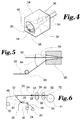
- Interior geometry of the cone shaped circular die 34 is shown in Figure 5 where the angle 62 of the cone is from about 10° to 20°.
- the entrance to the cone shaped circular die 34 has a radius 56.
- the cone 74 extends about three-quarters of the way into the die, then radius surface 58 leads into a straight or tubular portion 76 of the die.
- cone 74 can extend all the way through the die 78, so it terminates at the exit orifice 80 of the die. In this configuration it is preferable that the exit orifice 80 be provided with radius 82 to inhibit scoring or tearing of the ribbon 54 upon exiting the die.
- the curled fiber reinforced ribbon 54 is fed into the final calendar protrusion die 38, 39, where it is compressed, as shown in Figure 9, forming a finished fiber reinforced composite strand 40 of expanded graphite flake having suitable tensile strength, flexibility, and toughness to permit braiding, weaving and other processing, making it commercially useful wherever a dry lubricous, strong, flexible material is desirable.
- the finished fiber reinforced composite strand 40 of expanded graphite flake is then collected on a roller 41.
- Fiber reinforced composite strands 40 of expanded graphite flake can then be braided together to form braided graphite-foil yarn 10 as shown in Figure 1.
- FIG. 6 While a rectangular finished fiber reinforced composite strand 40 of expanded graphite flake can be produced by the apparatus depicted in Figure 3, there are applications where it is preferable to have a round finished fiber reinforced composite strand 72 of expanded graphite flake as shown in Figure 10.
- the apparatus of Figure 3 is modified as shown in Figure 6.
- the apparatus of Figure 6 is identical to that of Figure 3, but with the addition of protrusion die rolls 52, 53.
- the curled fiber reinforced ribbon 54 ( Figure 6), is fed into the first calendar protrusion die 38, 39 where it is compressed as shown in Figure 9, forming a rectangular fiber reinforced composite strand 40 ( Figure 8c) of expanded graphite flake.
- the rectangular fiber reinforced composite strand 40 of Figure 6 is fed through a second calendar protrusion die 52, 53, where it is compressed, forming a round fiber reinforced composite strand 72, as in Figure 10, which can then be collected on the take up roller 41 of Figure 6. It is also possible to pull composite strand 40 through a second die, such as die 34 or 78, to yield a round strand 72.
- the material when braided or woven into suitable cross sections, can be used as an electrically conductive joint sealant for electronic cabinetry for the purpose of providing electrical continuity for static electricity protection and as a jointing for protection for background radio interference in a Faraday Cage device.
- reinforced vermiculated graphite yarn in its braided, twisted or woven forms, reinforced vermiculated graphite yarn can be used as a jointing and sealant which can be placed into sealing cavities and compressed to form into a homogeneous mass conforming to exact geometry of the seal cavity providing a positive sealing medium.
- the braided graphite strand can be used in two ways. First, an endless ring gasket can be formed from the braided graphite material as shown in Figure 12. Second, when not preformed, the braided graphite 10, as shown in Figure 1, can be used on site to form a gasket of the desired size. The braided graphite can be cut to the approximate length, then laid in the connection area with the ends 90, 92 overlapped. When compressed, a gasket is formed as shown in Figure 11. The overlapped area 70 has the same thickness as the non-overlapped areas 68.
- each gasket can be produced as needed so that sized preformed gaskets need not be stocked; 2) the overlapped ends provide tabs which facilitate removal in tight areas; 3) gaskets of unusual size and shape can easily be configured.
- Gaskets formed of the material made by the invented process can be used in pumps where the braided graphite-foil yarn acts as a heat sink in the sealing cavity allowing the pumps to run leak- free without cooling liquid flushes at peripheral shaft speeds up to 4800 ft/minute.
- braided graphite gaskets and other braided graphite items, stand up under extremes of temperature. They operate successfully at temperatures as low as -400°F, and at temperatures as high as 5400°F.
- Graphite sublimes (changes from a solid state to a gaseous state) between 6605°F and 6687°F. (Note that while carbon is amorphous, graphite is crystalline).
- the preferred upper operating limit is about 2300°F.
Landscapes
- Engineering & Computer Science (AREA)
- Chemical & Material Sciences (AREA)
- Ceramic Engineering (AREA)
- General Engineering & Computer Science (AREA)
- Manufacturing & Machinery (AREA)
- Materials Engineering (AREA)
- Structural Engineering (AREA)
- Mechanical Engineering (AREA)
- Organic Chemistry (AREA)
- Chemical Kinetics & Catalysis (AREA)
- Carbon And Carbon Compounds (AREA)
- Yarns And Mechanical Finishing Of Yarns Or Ropes (AREA)
- Gasket Seals (AREA)
- Sealing Material Composition (AREA)
- Sealing Devices (AREA)
- Manufacture Of Alloys Or Alloy Compounds (AREA)
- Ceramic Products (AREA)
- Laminated Bodies (AREA)
- Reinforced Plastic Materials (AREA)
Applications Claiming Priority (2)
| Application Number | Priority Date | Filing Date | Title |
|---|---|---|---|
| US98764092A | 1992-12-09 | 1992-12-09 | |
| US987640 | 1992-12-09 |
Publications (2)
| Publication Number | Publication Date |
|---|---|
| EP0601670A1 true EP0601670A1 (fr) | 1994-06-15 |
| EP0601670B1 EP0601670B1 (fr) | 1996-06-19 |
Family
ID=25533429
Family Applications (1)
| Application Number | Title | Priority Date | Filing Date |
|---|---|---|---|
| EP93203465A Expired - Lifetime EP0601670B1 (fr) | 1992-12-09 | 1993-12-09 | Composite graphite-feuille et procédé d'utilisation |
Country Status (7)
| Country | Link |
|---|---|
| EP (1) | EP0601670B1 (fr) |
| AT (1) | ATE139517T1 (fr) |
| BR (1) | BR9304986A (fr) |
| CA (1) | CA2110754C (fr) |
| DE (1) | DE69303256T2 (fr) |
| ES (1) | ES2088220T3 (fr) |
| MX (1) | MX9307768A (fr) |
Cited By (3)
| Publication number | Priority date | Publication date | Assignee | Title |
|---|---|---|---|---|
| EP0967423A2 (fr) | 1998-06-27 | 1999-12-29 | Sgl Technik Gmbh | Garniture d'étanchéité en graphite et feuille de plastique |
| EP0967422A2 (fr) | 1998-06-27 | 1999-12-29 | Sgl Technik Gmbh | Garniture d'étanchéité en graphite et feuille de plastique |
| US20110162338A1 (en) * | 2008-09-10 | 2011-07-07 | Nippon Pillar Packing Co., Ltd. | Yarn |
Families Citing this family (2)
| Publication number | Priority date | Publication date | Assignee | Title |
|---|---|---|---|---|
| CN112253750A (zh) * | 2020-10-21 | 2021-01-22 | 中国航发沈阳发动机研究所 | 一种柔性石墨编织密封条及其安装方法 |
| CN115418762B (zh) * | 2022-09-13 | 2024-11-15 | 东华大学 | 棘轮式强化展丝辊表面振动而增加展丝功效的装置及用途 |
Citations (3)
| Publication number | Priority date | Publication date | Assignee | Title |
|---|---|---|---|---|
| US3404061A (en) * | 1962-03-21 | 1968-10-01 | Union Carbide Corp | Flexible graphite material of expanded particles compressed together |
| FR2054807A5 (fr) * | 1969-07-28 | 1971-05-07 | Gore & Ass | |
| EP0340303A1 (fr) * | 1986-11-25 | 1989-11-08 | Nippon Pillar Packing Co., Ltd. | Materiau d'etancheification et garniture composee de ce materiau |
-
1993
- 1993-12-06 CA CA002110754A patent/CA2110754C/fr not_active Expired - Fee Related
- 1993-12-08 MX MX9307768A patent/MX9307768A/es not_active IP Right Cessation
- 1993-12-09 BR BR9304986A patent/BR9304986A/pt not_active IP Right Cessation
- 1993-12-09 ES ES93203465T patent/ES2088220T3/es not_active Expired - Lifetime
- 1993-12-09 EP EP93203465A patent/EP0601670B1/fr not_active Expired - Lifetime
- 1993-12-09 AT AT93203465T patent/ATE139517T1/de not_active IP Right Cessation
- 1993-12-09 DE DE69303256T patent/DE69303256T2/de not_active Expired - Fee Related
Patent Citations (3)
| Publication number | Priority date | Publication date | Assignee | Title |
|---|---|---|---|---|
| US3404061A (en) * | 1962-03-21 | 1968-10-01 | Union Carbide Corp | Flexible graphite material of expanded particles compressed together |
| FR2054807A5 (fr) * | 1969-07-28 | 1971-05-07 | Gore & Ass | |
| EP0340303A1 (fr) * | 1986-11-25 | 1989-11-08 | Nippon Pillar Packing Co., Ltd. | Materiau d'etancheification et garniture composee de ce materiau |
Cited By (5)
| Publication number | Priority date | Publication date | Assignee | Title |
|---|---|---|---|---|
| EP0967423A2 (fr) | 1998-06-27 | 1999-12-29 | Sgl Technik Gmbh | Garniture d'étanchéité en graphite et feuille de plastique |
| EP0967422A2 (fr) | 1998-06-27 | 1999-12-29 | Sgl Technik Gmbh | Garniture d'étanchéité en graphite et feuille de plastique |
| US6385956B1 (en) | 1998-06-27 | 2002-05-14 | Sgl Technik Gmbh | Packing yarn made of graphite foil and metal foil and method of manufacturing a packing yarn |
| US20110162338A1 (en) * | 2008-09-10 | 2011-07-07 | Nippon Pillar Packing Co., Ltd. | Yarn |
| US8375693B2 (en) * | 2008-09-10 | 2013-02-19 | Nippon Pillar Packing Co., Ltd. | Yarn |
Also Published As
| Publication number | Publication date |
|---|---|
| CA2110754A1 (fr) | 1994-06-10 |
| MX9307768A (es) | 1994-06-30 |
| CA2110754C (fr) | 2001-03-06 |
| ES2088220T3 (es) | 1996-08-01 |
| EP0601670B1 (fr) | 1996-06-19 |
| DE69303256T2 (de) | 1997-01-16 |
| ATE139517T1 (de) | 1996-07-15 |
| BR9304986A (pt) | 1994-06-21 |
| DE69303256D1 (de) | 1996-07-25 |
Similar Documents
| Publication | Publication Date | Title |
|---|---|---|
| JP4184664B2 (ja) | 複合織物 | |
| US5549306A (en) | Knitting yarn for gland packing and gland packing made of said knitting yarn | |
| CA1299686C (fr) | Manchon recyclable, en tissu | |
| EP0024179B1 (fr) | Elément chauffant électrique et son procédé de fabrication | |
| JPS63135653A (ja) | パツキン材料 | |
| US5141812A (en) | Heat recoverable product | |
| JP4252669B2 (ja) | 膨張黒鉛製グランドパッキンに用いられる材料およびこの材料からなる膨張黒鉛製グランドパッキン並びにその膨張黒鉛製グランドパッキンの製造方法 | |
| EP0391970A1 (fr) | Matiere multidirectionnelle legere hautement resistante entrelacee et son procede de fabrication | |
| EP0601670B1 (fr) | Composite graphite-feuille et procédé d'utilisation | |
| IE903495A1 (en) | Recovery fabric sleeve | |
| EP0466923B1 (fr) | Garniture d'etancheite | |
| JPH0425671A (ja) | グランドパッキン | |
| DE102017108389B4 (de) | Barriereschicht gegen Migration eines Stoffes, elektrischer Leiter, Verfahren zum Fertigen eines beschichteten Kabels und Verwendung von Polyethylenfuranoat als Barriereschicht | |
| JP3537097B2 (ja) | 膨張黒鉛製グランドパッキンの製造方法 | |
| US5266393A (en) | Method of making a fiber reinforced heat recoverable object | |
| US3586557A (en) | Micaceous insulation and electrical apparatus insulated therewith | |
| US5217553A (en) | Method for making heat recoverable product | |
| US5229177A (en) | Multi-directional, light-weight, high-strength interlaced material | |
| JPH02133493A (ja) | ガスケツト材料 | |
| US6110591A (en) | Compressed high temperature non-asbestos sheet and method for making the same | |
| EP1541909B1 (fr) | Materiau pour garniture d'etancheite et ladite garniture d'etancheite | |
| JP2901671B2 (ja) | 膨脹黒鉛製グランドパッキンの製造方法 | |
| CN1030754C (zh) | 一种径向可回复的套筒复合材料、其制法和用途 | |
| JPH046234B2 (fr) | ||
| JP3122967B2 (ja) | パッキン用編み糸 |
Legal Events
| Date | Code | Title | Description |
|---|---|---|---|
| PUAI | Public reference made under article 153(3) epc to a published international application that has entered the european phase |
Free format text: ORIGINAL CODE: 0009012 |
|
| AK | Designated contracting states |
Kind code of ref document: A1 Designated state(s): AT BE CH DE DK ES FR GB GR IE IT LI LU MC NL PT SE |
|
| 17P | Request for examination filed |
Effective date: 19941116 |
|
| 17Q | First examination report despatched |
Effective date: 19950921 |
|
| GRAH | Despatch of communication of intention to grant a patent |
Free format text: ORIGINAL CODE: EPIDOS IGRA |
|
| GRAH | Despatch of communication of intention to grant a patent |
Free format text: ORIGINAL CODE: EPIDOS IGRA |
|
| GRAA | (expected) grant |
Free format text: ORIGINAL CODE: 0009210 |
|
| AK | Designated contracting states |
Kind code of ref document: B1 Designated state(s): AT BE CH DE DK ES FR GB GR IE IT LI LU MC NL PT SE |
|
| PG25 | Lapsed in a contracting state [announced via postgrant information from national office to epo] |
Ref country code: LI Effective date: 19960619 Ref country code: GR Free format text: LAPSE BECAUSE OF FAILURE TO SUBMIT A TRANSLATION OF THE DESCRIPTION OR TO PAY THE FEE WITHIN THE PRESCRIBED TIME-LIMIT Effective date: 19960619 Ref country code: DK Effective date: 19960619 Ref country code: CH Effective date: 19960619 Ref country code: AT Effective date: 19960619 |
|
| REF | Corresponds to: |
Ref document number: 139517 Country of ref document: AT Date of ref document: 19960715 Kind code of ref document: T |
|
| REG | Reference to a national code |
Ref country code: ES Ref legal event code: BA2A Ref document number: 2088220 Country of ref document: ES Kind code of ref document: T3 |
|
| ITF | It: translation for a ep patent filed | ||
| REG | Reference to a national code |
Ref country code: IE Ref legal event code: FG4D Free format text: 68806 |
|
| REF | Corresponds to: |
Ref document number: 69303256 Country of ref document: DE Date of ref document: 19960725 |
|
| ET | Fr: translation filed | ||
| REG | Reference to a national code |
Ref country code: ES Ref legal event code: FG2A Ref document number: 2088220 Country of ref document: ES Kind code of ref document: T3 |
|
| PG25 | Lapsed in a contracting state [announced via postgrant information from national office to epo] |
Ref country code: SE Effective date: 19960919 Ref country code: PT Effective date: 19960919 |
|
| PG25 | Lapsed in a contracting state [announced via postgrant information from national office to epo] |
Ref country code: IE Free format text: LAPSE BECAUSE OF NON-PAYMENT OF DUE FEES Effective date: 19961209 |
|
| PG25 | Lapsed in a contracting state [announced via postgrant information from national office to epo] |
Ref country code: LU Free format text: LAPSE BECAUSE OF NON-PAYMENT OF DUE FEES Effective date: 19961231 |
|
| REG | Reference to a national code |
Ref country code: CH Ref legal event code: PL |
|
| PLBE | No opposition filed within time limit |
Free format text: ORIGINAL CODE: 0009261 |
|
| 26N | No opposition filed | ||
| PG25 | Lapsed in a contracting state [announced via postgrant information from national office to epo] |
Ref country code: MC Effective date: 19970630 |
|
| REG | Reference to a national code |
Ref country code: GB Ref legal event code: IF02 |
|
| PGFP | Annual fee paid to national office [announced via postgrant information from national office to epo] |
Ref country code: IT Payment date: 20061231 Year of fee payment: 14 |
|
| REG | Reference to a national code |
Ref country code: GB Ref legal event code: 732E |
|
| NLS | Nl: assignments of ep-patents |
Owner name: SLADE, INC. Effective date: 20070625 |
|
| REG | Reference to a national code |
Ref country code: FR Ref legal event code: TP |
|
| REG | Reference to a national code |
Ref country code: ES Ref legal event code: PC2A |
|
| PGFP | Annual fee paid to national office [announced via postgrant information from national office to epo] |
Ref country code: NL Payment date: 20071213 Year of fee payment: 15 |
|
| PGFP | Annual fee paid to national office [announced via postgrant information from national office to epo] |
Ref country code: BE Payment date: 20071231 Year of fee payment: 15 |
|
| PGFP | Annual fee paid to national office [announced via postgrant information from national office to epo] |
Ref country code: GB Payment date: 20071218 Year of fee payment: 15 Ref country code: ES Payment date: 20071228 Year of fee payment: 15 |
|
| PGFP | Annual fee paid to national office [announced via postgrant information from national office to epo] |
Ref country code: DE Payment date: 20071221 Year of fee payment: 15 |
|
| PGFP | Annual fee paid to national office [announced via postgrant information from national office to epo] |
Ref country code: FR Payment date: 20071217 Year of fee payment: 15 |
|
| BERE | Be: lapsed |
Owner name: *SLADE INC. Effective date: 20081231 |
|
| GBPC | Gb: european patent ceased through non-payment of renewal fee |
Effective date: 20081209 |
|
| PG25 | Lapsed in a contracting state [announced via postgrant information from national office to epo] |
Ref country code: IT Free format text: LAPSE BECAUSE OF NON-PAYMENT OF DUE FEES Effective date: 20071209 |
|
| NLV4 | Nl: lapsed or anulled due to non-payment of the annual fee |
Effective date: 20090701 |
|
| PG25 | Lapsed in a contracting state [announced via postgrant information from national office to epo] |
Ref country code: BE Free format text: LAPSE BECAUSE OF NON-PAYMENT OF DUE FEES Effective date: 20081231 |
|
| REG | Reference to a national code |
Ref country code: FR Ref legal event code: ST Effective date: 20090831 |
|
| PG25 | Lapsed in a contracting state [announced via postgrant information from national office to epo] |
Ref country code: DE Free format text: LAPSE BECAUSE OF NON-PAYMENT OF DUE FEES Effective date: 20090701 |
|
| PG25 | Lapsed in a contracting state [announced via postgrant information from national office to epo] |
Ref country code: NL Free format text: LAPSE BECAUSE OF NON-PAYMENT OF DUE FEES Effective date: 20090701 Ref country code: GB Free format text: LAPSE BECAUSE OF NON-PAYMENT OF DUE FEES Effective date: 20081209 |
|
| REG | Reference to a national code |
Ref country code: ES Ref legal event code: FD2A Effective date: 20081210 |
|
| PG25 | Lapsed in a contracting state [announced via postgrant information from national office to epo] |
Ref country code: FR Free format text: LAPSE BECAUSE OF NON-PAYMENT OF DUE FEES Effective date: 20081231 Ref country code: ES Free format text: LAPSE BECAUSE OF NON-PAYMENT OF DUE FEES Effective date: 20081210 |