EP0601694A2 - Verfahren zur Herstellung von dispersionsgehärteten Metallmatrixverbundmaterial - Google Patents
Verfahren zur Herstellung von dispersionsgehärteten Metallmatrixverbundmaterial Download PDFInfo
- Publication number
- EP0601694A2 EP0601694A2 EP93307538A EP93307538A EP0601694A2 EP 0601694 A2 EP0601694 A2 EP 0601694A2 EP 93307538 A EP93307538 A EP 93307538A EP 93307538 A EP93307538 A EP 93307538A EP 0601694 A2 EP0601694 A2 EP 0601694A2
- Authority
- EP
- European Patent Office
- Prior art keywords
- dispersing medium
- dispersion strengthening
- strengthening material
- temperature
- stirring
- Prior art date
- Legal status (The legal status is an assumption and is not a legal conclusion. Google has not performed a legal analysis and makes no representation as to the accuracy of the status listed.)
- Withdrawn
Links
Images





Classifications
-
- C—CHEMISTRY; METALLURGY
- C22—METALLURGY; FERROUS OR NON-FERROUS ALLOYS; TREATMENT OF ALLOYS OR NON-FERROUS METALS
- C22C—ALLOYS
- C22C1/00—Making non-ferrous alloys
- C22C1/10—Alloys containing non-metals
- C22C1/1036—Alloys containing non-metals starting from a melt
-
- C—CHEMISTRY; METALLURGY
- C22—METALLURGY; FERROUS OR NON-FERROUS ALLOYS; TREATMENT OF ALLOYS OR NON-FERROUS METALS
- C22C—ALLOYS
- C22C1/00—Making non-ferrous alloys
- C22C1/04—Making non-ferrous alloys by powder metallurgy
- C22C1/05—Mixtures of metal powder with non-metallic powder
- C22C1/059—Making alloys comprising less than 5% by weight of dispersed reinforcing phases
-
- C—CHEMISTRY; METALLURGY
- C22—METALLURGY; FERROUS OR NON-FERROUS ALLOYS; TREATMENT OF ALLOYS OR NON-FERROUS METALS
- C22C—ALLOYS
- C22C32/00—Non-ferrous alloys containing at least 5% by weight but less than 50% by weight of oxides, carbides, borides, nitrides, silicides or other metal compounds, e.g. oxynitrides, sulfides, whether added as such or formed in situ
- C22C32/0047—Non-ferrous alloys containing at least 5% by weight but less than 50% by weight of oxides, carbides, borides, nitrides, silicides or other metal compounds, e.g. oxynitrides, sulfides, whether added as such or formed in situ with carbides, nitrides, borides or silicides as the main non-metallic constituents
- C22C32/0052—Non-ferrous alloys containing at least 5% by weight but less than 50% by weight of oxides, carbides, borides, nitrides, silicides or other metal compounds, e.g. oxynitrides, sulfides, whether added as such or formed in situ with carbides, nitrides, borides or silicides as the main non-metallic constituents only carbides
- C22C32/0063—Non-ferrous alloys containing at least 5% by weight but less than 50% by weight of oxides, carbides, borides, nitrides, silicides or other metal compounds, e.g. oxynitrides, sulfides, whether added as such or formed in situ with carbides, nitrides, borides or silicides as the main non-metallic constituents only carbides based on SiC
-
- Y—GENERAL TAGGING OF NEW TECHNOLOGICAL DEVELOPMENTS; GENERAL TAGGING OF CROSS-SECTIONAL TECHNOLOGIES SPANNING OVER SEVERAL SECTIONS OF THE IPC; TECHNICAL SUBJECTS COVERED BY FORMER USPC CROSS-REFERENCE ART COLLECTIONS [XRACs] AND DIGESTS
- Y10—TECHNICAL SUBJECTS COVERED BY FORMER USPC
- Y10S—TECHNICAL SUBJECTS COVERED BY FORMER USPC CROSS-REFERENCE ART COLLECTIONS [XRACs] AND DIGESTS
- Y10S164/00—Metal founding
- Y10S164/90—Rheo-casting
Definitions
- This invention relates to a method for the production of dispersion strengthened metal matrix composites (hereinafter referred to as a composite material) in which a dispersion strengthening material such as metal. metallic compound, ceramic particle, whisker or the like is uniformly dispersed in a metal dispersing medium (metal matrix).
- a dispersion strengthening material such as metal. metallic compound, ceramic particle, whisker or the like is uniformly dispersed in a metal dispersing medium (metal matrix).
- High pressure casting process A molten alloy as a dispersing medium is impregnated into a preform of a dispersion strengthening material under pressure and then solidified to form a composite material.
- Powder working process An alloy as a dispersing medium is pulverized and mixed with a dispersion strengthening material, which is extruded at a high temperature under pressure to form a composite material.
- An alloy as a dispersing medium is pulverized and mixed with a dispersion strengthening material, which is mechanically kneaded to form a composite material.
- Molten metal process A dispersion strengthening material is added to a molten alloy as a dispersing medium and then mixed with stirring to form a composite material.
- Semi-solidification process ( inclusive of semi-melting process): An alloy as a dispersing medium is rendered into a mixed solid-liquid phase slurry and added with a dispersion strengthening material, which is mixed with stirring to form a composite material.
- the molten metal process and the semi-solidification process have merits that the production step is simple and the large size composite material can easily be produced.
- the molten metal process it is difficult to uniformly disperse the dispersion strengthening material into the dispersing medium and hence the composite material having excellent properties can not be obtained.
- the semi-solidification process can easily attain the uniform dispersion of the dispersion strengthening material or the good formation of the composite material, but have the following problems. That is, when the dispersion strengthening material is added to the mixed solid-liquid phase slurry as a dispersing medium, if the wettability of the dispersion strengthening material to the slurry is insufficient, there is caused a problem that the dispersing medium reacts at its surface with the dispersion strengthening material to produce gas (frequently hydrogen gas), but the resulting reaction gas hardly floats up because the viscosity of the mixed solid-liquid phase slurry is high and hence it remains in the composite material to cause defects due to the entrapment of the gas or the like.
- the surface area increases (which is in inverse proportion to the particle size of the dispersion strengthening material) or the wetting area over the full surface of the dispersion strengthening material to the dispersing medium increases, but this material is apt to be rendered into a lump.
- the insufficient wetting defect is caused in the composite material.
- the surface deposit increases with the increase of the surface area of the dispersion strengthening material and hence the amount of reaction gas produced increases, while atmosphere gas is entrapped into the slurry in the addition of the dispersion strengthening material as a lump.
- a method of producing a dispersion strengthened metal matrix composite which comprises stirring a mixed solid-liquid phase slurry as a dispersing medium under a reduced pressure, adding a dispersion strengthening material to the dispersing medium, and continuing the stirring under the reduced pressure till the dispersion strengthening material is uniformly dispersed in the dispersing medium.
- the resulting composite slurry consisting of the dispersing medium and the dispersion strengthening material is subjected to an overheat melting treatment in which the temperature is raised to a temperature higher than a liquids line of a metal in the dispersing medium to conduct degassing with the stirring under a reduced pressure after the addition of the dispersion strengthening material or the uniform dispersion thereof.
- an atmosphere under a reduced pressure is an inert gas and the reduced pressure is within a range of 100 Torr to 1x10 ⁇ 4 Torr. Particularly, the reduced pressure is within a range of 1 Torr to 1x10 ⁇ 4 Torr when using the ultra-fine dispersion strengthening material.
- the ultra-fine dispersion strengthening material includes SiC particles having a particle size of not more than 1 ⁇ m and the like.
- a method of producing dispersion strengthened metal matrix composites which comprises preparing a mixed solid-liquid phase slurry of semi-solidified or semi-molten dispersing medium having such a composition that a temperature width between solids line and liquids line is wider than that of an alloy composition in a final product and a ratio of eutectic texture is small, incorporating a dispersion strengthening material into the slurry with stirring to form a precomposite material, adding an ingredient separately prepared for the compensation of the final alloy composition to the resulting molten precomposite material or adding the precomposite material to the molten ingredient with stirring.
- the temperature of the dispersing medium at the time of adding the compensational ingredient is within a range of from a liquids line temperature of the final alloy composition to 150°C higher than the liquids line temperature and the addition with stirring is conducted in an inert gas atmosphere under a reduced pressure of 100 Torr to 1x10 ⁇ 4 Torr.
- the dispersing medium is a pure metal or an extreme-low alloy thereof such as pure copper or an extreme-low copper alloy
- the final product is a high-strength and high-conductivity composite material.
- the feature that it is difficult to produce the composite materials having good properties as the dispersion strengthening material becomes finer is due to the following reasons. That is, as the dispersion strengthening material becomes finer, it is apt to form a lump and if such a lump is added to a mixed solid-liquid phase slurry, the amount of reaction gas produced in the slurry increases and also atmosphere gas is entrapped into the slurry.
- the dispersion strengthening material becomes finer, the total surface area increases and also the wetting area and amount of surface deposit increase, so that when such a dispersion strengthening material is added to the mixed solid-liquid phase slurry as a dispersing medium, work done for wetting the full surface of the dispersion strengthening material and the amount of reaction gas between the dispersing medium and the surface deposit in the dispersion strengthening material become larger. Since the viscosities of the mixed solid-liquid phase slurry and the composite slurry after the addition of the dispersion strengthening material are high, the reaction gas produced in the slurry hardly floats up to the surface of the slurry.
- the inventors have made various studies and experiments and established a method of producing composite materials having good properties without defects by uniformly dispersing the dispersion strengthening material through the semi-solidification process even if the dispersion strengthening material is fine or ultra-fine.
- the dispersion strengthening material is first added to the mixed solid-liquid phase slurry as a dispersing medium with stirring under a reduced pressure.
- the dispersing medium is hardly oxidized owing to the holding of the reduced pressure, and even if the dispersion strengthening material is added to the dispersing medium in form of lump, the atmosphere gas is less in the surrounding of the dispersion strengthening material and in the lump thereof, so that the reaction between the dispersing medium and the surface deposit to the dispersion strengthening material is accelerated to promote the wetting of the dispersion strengthening material to the dispersing medium.
- the shearing force between the outer circumference of the lump of the dispersion strengthening material and the slurry under stirring becomes large and also the lump collides with a solid phase of metal in the dispersing medium to promote the wetting of the dispersion strengthening material from its lump surface, so that the circumference of the lump is gradually wetted to progress the separation of the dispersion strengthening material from the lump and hence promote the uniform dispersion of the dispersion strengthening material.
- the dispersion strengthening material becomes finer, it becomes difficult to completely separate the lump of the dispersion strengthening material.
- the stirring of the resulting composite slurry is continued under a reduced pressure till the dispersion strengthening material is uniformly dispersed in the dispersing medium.
- the collision of the lump of the dispersion strengthening material with the solid phase (primary crystal grains) of metal as a dispersing medium is caused to separate the dispersion strengthening material from the lump owing to the high viscosity of the composite slurry, whereby the uniform dispersion of the dispersion strengthening material can be promoted and further the degassing can be accelerated with stirring under a reduced pressure.
- the viscosity of the composite slurry is preferably higher, it is desirable that the fraction solid of the dispersing medium is large.
- the viscosity of the composite slurry after the addition of the dispersion strengthening material is larger, so that it is desirable that the amount of the dispersion strengthening material added is not less than 3% by volume.
- the generation of reaction gas between the surface portion of the slurry and the surface deposit in the dispersion strengthening material is promoted in the slurry to increase the ratio of the reaction gas generated on the surface portion of the slurry, and consequently the amount of reaction gas produced in the composite slurry is decreased to reduce the defect of the composite material due to the entrapment of the gas and also the surface deposit prematurely disappears to make the wetting of the dispersion strengthening material good and obtain a composite material having no defects.
- the amount of atmosphere gas supplied from the dispersion strengthening material to the slurry is decreased under the reduced pressure.
- the gas pressure in the lump is low and the gas pressure of the atmosphere around the dispersion strengthening material (lump) newly exposed after the wetted dispersion of the dispersion strengthening material is low, so that the dispersion strengthening material is easily contacted with the dispersing medium and hence the reaction gas is apt to be easily generated in the slurry to prematurely complete the generation of the reaction gas.
- the rapid completion of the generation of the reaction gas has an effect that when the operation time is constant, the degassing time in the composite slurry after the completion of the reaction gas generation can be ensured longer to conduct much degassing.
- the surface area of the dispersion strengthening material and the amount of surface deposit thereto increase and the lump is apt to be formed and also the amount of the lump added to the mixed solid-liquid phase slurry increases and the reaction between the dispersing medium in the surface portion of the slurry and the surface deposit inversely reduces to increase the generation of reaction gas in the mixed solid-liquid phase slurry and the amount of atmosphere gas entrapped in the slurry.
- the viscosity becomes higher as the dispersion strengthening material becomes finer and hence the floating speed of the gas becomes slower, so that the insufficient degassing is caused.
- the composite slurry is subjected to an overheat melting treatment in which the temperature is raised to a temperature higher than a liquids line temperature of metal as a dispersing medium to conduct the degassing with stirring under a reduced pressure.
- the temperature is raised to 150°C higher than the liquidus line temperature of the metal.
- the composite slurry when the viscosity is high and the gas floating speed is slow, the degassing is insufficient as mentioned above, but according to the overheat melting treatment, the composite slurry is heated to a temperature higher than a liquids line temperature of metal as a dispersing medium, so that the viscosity of the composite slurry is lowered to facilitate the floating of the gas and promote the degassing, and further the solid phase of the metal as a dispersing medium is lost to more uniformly disperse the dispersion strengthening material in the dispersing medium.
- the stirring is continued through the step of adding the dispersion strengthening material to the mixed solid-liquid phase slurry and the step of subjecting the composite slurry to the overheat melting treatment, so that there is caused a tendency that the dispersing medium is apt to be oxidized and the wetting of the dispersion strengthening materials to the oxidized dispersing medium may be deteriorated. Therefore, it is preferable to conduct these steps in an inert gas atmosphere such as Ar gas or the like.
- the above steps are carried out under a reduced pressure in order to promote the wetting of the dispersion strengthening material to the dispersing medium and the generation of reaction gas between the dispersing medium and the surface deposit in the dispersion strengthening material for prematurely completing the generation of the reaction gas and improving the degassing effect.
- the reduced pressure is preferably within a range of 100 Torr to 1x10 ⁇ 4 Torr. When the reduced pressure exceeds 100 Torr, the wetting of the dispersion strengthening material to the dispersing medium, the promotion of the reaction gas generation and the degassing effect are insufficient, while when it is less than 1x10⁴ Torr, the dispersing medium may easily be evaporated, and also the installation cost becomes higher and the operation time becomes longer.
- the reduced pressure is favorably within a range of 1 Torr to 1x10 ⁇ 4 Torr.
- the dispersion strengthened metal matrix composite When the dispersion strengthened metal matrix composite is produced through the semi-solidification process, if the temperature width between solids line and liquids line in the alloy as a dispersing medium of the composite material is narrow and the ratio of eutectic texture is large, it is difficult to hold a good mixed solid-liquid phase state at the production step including the addition of the dispersion strengthening material and hence the production of the metal matrix composite becomes difficult.
- the mixed solid-liquid phase slurry of semi-solidified or semi-molten state having such a composition that a temperature width between solids line and liquids line is wider than that of an alloy composition in a final product and a ratio of eutectic texture is small is first prepared before the incorporation of the dispersion strengthening material, so that the good mixed solid-liquid phase state can more stably be held.
- the dispersion strengthening material is incorporated into the slurry of good mixed solid-liquid phase state with stirring, so that the dispersion state of the dispersion strengthening material in the dispersing medium is uniform and good.
- the resulting precomposite material is synthesized with an ingredient separately prepared for the compensation of the final alloy composition, so that the dispersion strengthening material is uniformly dispersed in the dispersing medium having an objective alloy composition to obtain a final composite material.
- the above method according to the invention facilitates the production of the composite material and has considerable effects thereon.
- this method is easy to hold a better mixed solid-liquid phase state even when the temperature width exceeds 15°C and develops an effect of improving the quality and operability.
- the objective composition A of the alloy as a dispersing medium of the final composite material is divided into a composition B as an alloy composition in which the temperature width between solids line and liquids line is wider than that of the alloy composition A and an ingredient C required for the compensation of the objective alloy composition A.
- the slurry of the composition B is prepared at a semi-solidified or semi-molten state, the better mixed solid-liquid phase state can stably be held, so that the dispersion strengthening material is added to the slurry. Thereafter, the resulting composite slurry is synthesized with an alloy or a metal corresponding to the ingredient C for the compensation of the alloy composition A. Thus, there can be obtained a final composite material uniformly dispersing the dispersion strengthening material therein and having a good quality.
- the temperature of the slurry to be added with the ingredient C is desirable to be not lower than a liquids line temperature of the objective alloy composition A for attaining the rapid and uniform dispersion of the ingredient C.
- the slurry temperature is too high, the interfacial reaction between the dispersion strengthening material and the dispersing medium is promoted and also the viscosity of the dispersing medium lowers to easily separate the dispersion strengthening material from the dispersing medium, and hence the dispersion state of the dispersion strengthening material is deteriorated and the unfavorable precipitates are produced. Therefore, the upper limit of the slurry temperature is preferably 150°C higher than the liquids line temperature of the objective alloy composition.
- the surface of the dispersion strengthening material is wetted with the dispersing medium.
- the dispersing medium is oxidized or the amount of gas is large around the dispersion strengthening material at the addition thereof, the wettability is considerably degraded. Therefore, it is important to conduct the addition of the dispersion strengthening material in an inert gas atmosphere for the prevention of the oxidation.
- the gas pressure is preferably within a range of 100 Torr to 1x10 ⁇ 4 Torr.
- the gas pressure exceeds 100 Torr, the amount of the inert gas at the boundary between the dispersion strengthening material and the dispersing medium in the addition of the dispersion strengthening material becomes large and hence the wettability is degraded, while when it is less than 1x10 ⁇ 4 Torr, the alloying ingredient in the dispersing medium is apt to be evaporated, and also the installation cost becomes high and the operation time becomes unfavorably longer.
- the incorporation of the dispersion strengthening material into the semi-solidified or semi-molten slurry is preferably carried out with stirring.
- the revolution number is favorable to be within a range of 100 rpm to 1000 rpm.
- the stirring is continued till the ingredient C is added while holding the temperature above the liquids line temperature of the objective alloy composition A as the dispersing medium in order to achieve the uniform dispersion of the dispersion strengthening material and the uniform and sure dispersion of the ingredient C.
- the precomposite material of the dispersing medium is preferable to have a temperature width between solids line and liquids line of not lower than 30°C.
- the precomposite material when it is incorporated into the ingredient C for the compensation of the objective alloy composition, it may be added in form of a slurry or a lump. In case of adding the lump, it is preferable to use a cut piece of the lump for easily dissolving into the dispersing medium.
- the composition B is a pure metal or an extreme-low alloy near to the pure metal.
- this is not necessarily applied to high alloys and eutectic alloy composition as a dispersing medium.
- particles and whiskers of ceramics and metals and metal short fibers such as particle or whisker of silicon carbide, particle or whisker of alumina, whisker of potassium titanate, particle of titanium carbide, particle or whisker of silicon oxide, boron short fiber and the like.
- numeral 1 is a crucible, numeral 2 a rotating stirrer, numeral 3 a device for the addition of a dispersion strengthening material, numeral 4 a device for the addition of an ingredient for the compensation of final alloy composition, numeral 5 a mold.
- These members are placed in a closed space of a vacuum tank 6.
- the vacuum tank 6 is provided with a discharge port 7 and an inlet port 8 for atmosphere gas, whereby the inside of the vacuum tank 6 may be adjusted to optional reduced pressure and optional gas atmosphere.
- a composite material is produced by using the apparatus shown in Fig. 1, in which 270 g in total of SiC particles having a particle size of 8 ⁇ m as a dispersion strengthening material is added at a rate of 5 g/min to 2400 g of a mixed solid-liquid phase slurry of 7 wt% Si - 0.3 wt% Mg - Al alloy (solids line temperature: 559°C, liquids line temperature: 615°C) in the crucible 1 from the device 3 at a temperature of 603°C and a fraction solid of 0.20 in an Ar gas atmosphere under a reduced pressure of 1x10 ⁇ 2 Torr with stirring over 54 minutes to form a composite slurry.
- the composite slurry is stirred with the rotating stirrer 2 at a temperature of 603°C (fraction solid of dispersing medium: 0.2) in the same atmosphere under the same reduced pressure for 30 minutes and heated to 700°C, which is poured into the mold 5 to form a composite material (cast ingot).
- 603°C fraction solid of dispersing medium: 0.2
- composition, metallurgical texture, gas content and density are measured with respect to the thus obtained composite material.
- Example 2 The same procedure as in Example 1 is repeated except that the temperature of the composite slurry is raised to 700°C immediately after the completion of the addition of the dispersion strengthening material. The same measurement as in Example 1 is conducted with respect to the resulting composite material.
- the composition of the alloy as a dispersing medium is 7 wt% Si - 0.3 wt% Mg - Al alloy and 10 wt% of SiC particles having a particle size of 8 ⁇ m are dispersed therein.
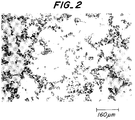
- Fig. 2 the metallurgical texture of the composite material in Example 1 is shown in Fig. 2 as a microphotograph
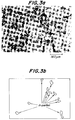
- Fig. 3a the metallurgical texture of the composite material in Comparative Example 1
- Fig. 3b its illustration is shown in Fig. 3b in which an A-portion is a densely aggregated portion of SiC particles.
- the composite material of Example 1 is very good in the uniformly dispersed state of the dispersion strengthening material, while the composite material of Comparative Example 1 has the densely aggregated portions of the dispersion strengthening material as shown in Figs. 3 a and 3b. That is, the formation of the densely aggregated portion can not be avoided in Comparative Example 1.
- the gas content is 0.24 cc/100 g and the density is 2.70 g/cm3, while the composite material of Comparative Example 1 has a gas content of 0.29 cc/100 g and a density of 2.67 g/cm3.
- a composite material is produced by using the apparatus shown in Fig. 1, in which 270 g in total of SiC particles having a particle size of 1 ⁇ m as a dispersion strengthening material is added at a rate of 1.5 g/min to 2400 g of a mixed solid-liquid phase slurry of 7 wt% Si - 0.3 wt% Mg - Al alloy (solids line temperature: 559°C, liquids line temperature: 615°C) in the crucible 1 from the device 3 at a temperature of 589°C and a fraction solid of 0.35 in an Ar gas atmosphere under a reduced pressure of 1x10 ⁇ 2 Torr with stirring over 180 minutes to form a composite slurry.
- the composite slurry is stirred with the rotating stirrer 2 at a temperature of 603°C (fraction solid of dispersing medium: 0.2) in the same atmosphere under the same reduced pressure for 30 minutes and heated to 700°C higher than liquids line temperature of the dispersing medium with the stirring in the same atmosphere under the same reduced pressure and then the stirring is continued for 30 minutes, which is poured into the mold 5 to form a composite material (cast ingot).
- 603°C fraction solid of dispersing medium: 0.2
- composition, metallurgical texture, gas content and density are measured with respect to the thus obtained composite material.
- Example 2 The same procedure as in Example 2 is repeated except that the temperature of the composite slurry is raised to 700°C immediately after the completion of the addition of the dispersion strengthening material and then held at this temperature for 30 minutes. The same measurement as in Example 2 is conducted with respect to the resulting composite material.
- the composition of the alloy as a dispersing medium is 7 wt% Si - 0.3 wt% Mg - Al alloy and 10 wt% of SiC particles having a particle size of 1 ⁇ m are dispersed therein.
- Fig. 4 the metallurgical texture of the composite material in Example 2 is shown in Fig. 4 as a microphotograph
- Fig. 5a the metallurgical texture of the composite material in Comparative Example 2
- Fig. 5b its illustration is shown in Fig. 5b in which an A-portion is a densely aggregated portion of SiC particles.
- the composite material of Example 2 is very good in the uniformly dispersed state of the dispersion strengthening material, while the composite material of Comparative Example 2 has the densely aggregated portions of the dispersion strengthening material as shown in Figs. 5a and 5b. That is, the formation of the densely aggregated portion can not be avoided in Comparative Example 2.
- the gas content is 0.30 cc/100 g and the density is 2.68 g/cm3, while the composite material of Comparative Example 2 has a gas content of 0.40 cc/100 g and a density of 2.65 g/cm3.
- the invention can provide a composite material having a good quality.
- a composite material is produced by using the apparatus shown in Fig. 1, in which SiC particles having a particle size of 5 ⁇ m as a dispersion strengthening material is added at a rate of 1.5 g/min to 2400 g of a mixed solid-liquid phase slurry of 7 wt% Si - 0.3 wt% Mg - Al alloy (solids line temperature: 559°C, liquids line temperature: 615°C) in the crucible 1 from the device 3 at a temperature of 589°C and a fraction solid of 0.35 in an Ar gas atmosphere under a reduced pressure of 100 Torr with stirring over 180 minutes to form a composite slurry.
- the composite slurry is stirred with the rotating stirrer 2 at a temperature of 603°C (fraction solid of dispersing medium: 0.2) in the same atmosphere under the same reduced pressure for 30 minutes and heated to 700°C higher than liquids line temperature of the dispersing medium with the stirring in the same atmosphere under the same reduced pressure and then the stirring is continued for 30 minutes, which is poured into the mold 5 to form a composite material (cast ingot).
- 603°C fraction solid of dispersing medium: 0.2
- composition, metallurgical texture, gas content and density are measured with respect to the thus obtained composite material.
- Example 3 The same procedure as in Example 3 is repeated except that the Ar gas atmosphere is used under a reduced pressure of 1x10 ⁇ 4 Torr. The same measurement as in Example 3 is conducted with respect to the resulting composite material.
- Example 3 The same procedure as in Example 3 is repeated except that the Ar gas atmosphere is used under a reduced pressure of 700 Torr. The same measurement as in Example 3 is conducted with respect to the resulting composite material.
- Example 3 The same procedure as in Example 3 is repeated except that the reduced pressure is 1x10 ⁇ 5 Torr, during which gas is generated by the evaporation of the dispersing medium, so that the reduced pressure can not be maintained at a level of 1x10 ⁇ 5 Torr.
- the composition of the alloy as a dispersing medium is 7 wt% Si - 0.3 wt% Mg - Al alloy and 10 wt% of SiC particles having a particle size of 5 ⁇ m are dispersed therein.
- the gas content is 0.25 cc/100 g and 0.22 cc/100 g, respectively, and the density is 2.70 g/cm3 and 2.71 g/cm3, respectively, while the composite material of Comparative Example 3 has a gas content of 0.48 cc/100 g and a density of 2.54 g/cm3.
- a composite material is produced by using the apparatus shown in Fig. 1, in which 600 g in total of SiC particles having a particle size of 10 ⁇ m as a dispersion strengthening material is added at a rate of 2.5 g/min to 2400 g of a mixed solid-liquid phase slurry of 7 wt% Si - 0.3 wt% Mg - Al alloy (solids line temperature: 559°C, liquids line temperature: 615°C) in the crucible 1 from the device 3 at a temperature of 603°C and a fraction solid of 0.2 in an Ar gas atmosphere under a reduced pressure of 100 Torr with stirring over 240 minutes to form a composite slurry.
- the composite slurry is heated to 700°C with the stirring in the same atmosphere under the same reduced pressure and then the stirring is continued for 30 minutes, which is poured into the mold 5 to form a composite material (cast ingot).
- the composition, metallurgical texture, gas content and density are measured with respect to the thus obtained composite material.
- Example 5 The same procedure as in Example 5 is repeated except that the Ar gas atmosphere is used under a reduced pressure of 1x10 ⁇ 4 Torr and the dispersion strengthening material is added at a rate of 10 g/min over 60 minutes. The same measurement as in Example 5 is conducted with respect to the resulting composite material.
- Example 5 The same procedure as in Example 5 is repeated except that the Ar gas atmosphere is used under a reduced pressure of 700 Torr and 600 g in total of the dispersion strengthening material is added at a rate of 1 g/min, which is slower than a practical addition rate, over 600 minutes. The same measurement as in Example 5 is conducted with respect to the resulting composite material.
- Example 5 The same procedure as in Example 5 is repeated except that the reduced pressure is 1x10 ⁇ 5 Torr, during which gas is generated by the evaporation of the dispersing medium, so that the reduced pressure can not be maintained at a level of 1x10 ⁇ 5 Torr.
- the composition of the alloy as a dispersing medium is 7 wt% Si - 0.3 wt% Mg - Al alloy and 20 wt% of SiC particles having a particle size of 10 ⁇ m are dispersed therein.
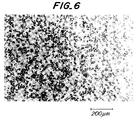
- Example 5 the metallurgical texture of the composite material in Example 5 is shown in Fig. 6 as a microphotograph
- the metallurgical texture of the composite material in Comparative Example 5 is shown in Fig. 7a as a microphotograph and its illustration is shown in Fig. 7b in which an A-portion is a densely aggregated portion of SiC particles and a B-portion is a bubble portion.
- the metallurgical texture of the composite material in Example 6 is the same as in Example 5.
- the composite material of Comparative Example 5 has the densely aggregated portions of SiC particles and the bubble portions as shown in Figs. 7a and 7b. That is, the formation of these defect portions can not be avoided in Comparative Example 5.
- the composite materials of Examples 5 and 6 have no densely aggregated portions of SiC particles and no bubble portions as shown in Fig. 6 and are uniform and very good in the dispersed state of the dispersion strengthening material.
- the composite materials of Examples 5 and 6 are less in the gas content and large in the density as compared with those of Comparative Example 5, which show that the composite material according to the invention has a good quality without defect.
- a composite material consisting of 11.7 wt% Si - 0.3 wt% Mg - Al alloy (liquids line temperature: 575°C, solids line temperature: 573°C) as a dispersing medium and SiC particles as a dispersion strengthening material is produced by using the apparatus shown in Fig. 1.
- 2279 g of 7.0 wt% Si - 0.32 wt% Mg - Al alloy (liquids line temperature: 615°C, solids line temperature: 559°C) having a temperature width between solids line and liquids line wider than that of the dispersing medium is prepared in the crucible 1 and stirred with the rotating stirrer 2 (revolution number: 450 rpm) at a temperature of 603°C as a mixed solid-liquid phase state having a fraction solid of 0.20 and then 600 g in total of SiC particles having a particle size of 10 ⁇ m as a dispersion strengthening material is added thereto at a rate of 10 g/min from the device 3 over 60 minutes to form a precomposite material.
- the precomposite material is heated to 700°C with the stirring and then the stirring is continued for 30 minutes. Thereafter, 121 g of Si lump as an ingredient required for the compensation of dispersing medium composition is added from the device 4 and then stirred for 30 minutes, which is poured into the mold 5 to form a cast ingot.
- the stirring is carried out in an Ar gas atmosphere under a reduced pressure of 10 ⁇ 2 Torr.
- composition and metallurgical texture are measured with respect to the thus obtained cast ingot.
- a composite material is produced by directly incorporating a dispersion strengthening material into a melt of 11.7 wt% Si - 0.3 wt% Mg - Al alloy as a dispersing medium.
- the growth of shell is remarkable near to the liquids line temperature of the Al alloy or at a temperature of lower than 575°C, so that a good mixed solid-liquid phase state can not be obtained.
- the Al alloy melt is stirred at 600°C in the crucible 1 in the same manner as in Example 7, to which is added SiC particles having a particle size of 10 ⁇ m and heated to 700°C with stirring and then the stirring is continued for 60 minutes. Moreover, the stirring is carried out in the same atmosphere as in Example 7.
- composition and metallurgical texture are measured with respect to the cast ingot in the same manner as in Example 7.
- Figs. 8 and 9a The metallurgical textures of the cast ingots in Example 7 and Comparative Example 7 are shown in Figs. 8 and 9a as a microphotograph, respectively.
- Fig. 9b is an illustration of Fig. 9a in which an A-portion is a densely aggregated portion of SiC particles.
- the alloy composition of the dispersing medium is 11.7 wt% Si - 0.3 wt% Mg - Al alloy and 20 wt% of SiC particles having a particle size of 10 ⁇ m are dispersed in the dispersing medium.
- Various composite materials are produced by changing the temperature of the dispersing medium when the ingredient required for the compensation of the objective alloy composition is added after the incorporation of the dispersion strengthening material at a solid-liquid phase coexisting state.
- Example 8 The same procedure as in Example 7 is repeated except that the temperature of the dispersing medium in the addition of the ingredient is set to 725°C (corresponding to liquids line temperature (°C) of objective alloy composition + 150°C: Example 8) or 815°C (corresponding to liquids line temperature (°C) of objective alloy composition + 240°C: Comparative Example 8).
- Example 9 2341 g of 9.5 wt% Si - 0.31 wt% Mg - Al alloy (liquids line temperature: 596°C, solids line temperature: 557°C) having a temperature width between solids line and liquids line wider than that of the same dispersing medium as in Example 7 (11.7 wt% Si - 0.3 wt% Mg - Al alloy) is prepared in the crucible 1 and stirred with the rotating stirrer 2 (revolution number: 500 rpm) at a temperature of 587°C as a mixed solid-liquid phase state having a fraction solid of 0.20 and then 600 g in total of SiC particles having a particle size of 10 ⁇ m as a dispersion strengthening material is added thereto at a rate of 10 g/min from the device 3 over 60 minutes to form a precomposite material.
- the precomposite material is stirred for uniformly dispersing SiC particles even in the solid phase and heated to 650°C with the stirring for removing the solid phase other than SiC particles and then the stirring is continued for 30 minutes.
- 59 g of Si lump as an ingredient required for the compensation of dispersing medium composition is added from the device 4 and then stirred for 60 minutes while maintaining the temperature of the dispersing medium above 575°C and heated to 630°C for improving the fluidization of the dispersing medium melt, which is immediately poured into the mold 5 to form a cast ingot.
- the stirring is carried out in an Ar gas atmosphere under a reduced pressure of 10 ⁇ 2 Torr.
- composition and metallurgical texture are measured with respect to the resulting cast ingots.
- the alloy composition of the dispersing medium is 11.7 wt% Si - 0.3 wt% Mg - Al alloy and 20 wt% of SiC particles having a particle size of 10 ⁇ m are dispersed in the dispersing medium.
- Example 7 The same procedure as in Example 7 is repeated by changing a gas pressure in the vacuum tank 6 under Ar gas atmosphere.
- composition and metallurgical texture are measured with respect to the resulting cast ingots.
- the alloy composition of the dispersing medium is 11.7 wt% Si - 0.3 wt% Mg - Al alloy and 20 wt% of SiC particles having a particle size of 10 ⁇ m are dispersed in the dispersing medium.
- Comparative Example 9 In Comparative Example 9, however, the formation of the densely aggregated portion of SiC particles can not be avoided likewise Comparative Example 7 (Fig. 9). In Examples 10 and 11, the densely aggregated portion of SiC particles is not observed likewise Example 7 (Fig. 8) and the dispersion state of SiC particles is very uniform.
- a composite material consisting of Cu - 0.19 mass% Sn alloy (temperature width between solids line and liquids line: 6°C) as a dispersing medium and 1 wt% of Al2O3 as a dispersion strengthening material is produced by using the apparatus shown in Fig. 1 as follows.
- a mixed solid-liquid phase slurry having a fraction solid of 0.3 is prepared in the crucible 1 by using 2500 g of Cu - 1 mass% Sn alloy (temperature width between solids line and liquids line: 33°C) having a temperature width between solids line and liquids line wider than that of the dispersing medium at a temperature of 1067°C, to which is added 132 g in total of Al2O3 particles having a particle size of 1 ⁇ m from the device 3 at a rate of 1.0 g/min over 132 minutes with stirring and heated to 1125°C with stirring and poured into the mold 5 to form a cast ingot of a precomposite material (Cu - 1 mass% Sn alloy: 95 wt%, Al2O3 particles: 5 wt%). Then, the cast ingot is cut into a size of 20x20x20 mm.
- the dispersion state of the dispersion strengthening material, conductivity and hardness are measured with respect to the resulting composite material.
- HRF hardness
- the dispersion strengthening material is incorporated into the semi-solidified or semi-molten medium having a temperature width between solids line and liquids line wider than that of the objective alloy composition of the dispersing medium in the final product, so that the better mixed solid-liquid phase state can stably be maintained and hence the dispersion state of the dispersion strengthening material becomes good. Furthermore, the ingredient required for the compensation of the objective alloy composition as a dispersing medium is supplied, so that there is obtained composite materials in which the dispersion strengthening material is uniformly dispersed in the dispersing medium of the objective alloy composition.
- the overheat melting treatment for the degassing is carried out by raising the temperature to not lower than liquids line temperature of metal as a dispersing medium with stirring under a reduced pressure, there are obtained composite materials uniformly dispersing the dispersion strengthening material therein and having good quality and less defect due to the gas entrapment.
- This treatment is made possible to easily produce composite materials having good quality even when using fine dispersion strengthening material, so that the kind and size of the dispersion strengthening material to be applied can considerably be widened and the effect of improving product quality and production yield is large.
- the objective alloy composition of the dispersing medium in the composite material to be produced is divided into a composition having a temperature width between solids line and liquids line wider than that of the medium and a small ratio of eutectic texture and a composition required for the compensation of the objective alloy composition.
- the former composition is prepared as a mixed solid-liquid phase slurry and added with the dispersion strengthening material to form a precomposite material, which is mixed with the latter composition to provide the objective alloy composition. Therefore, the kind of the alloy as a dispersing medium to be used can considerably be widened as compared with the conventional semi-solidification process, whereby composite materials having good quality can be produced cheaply.
Landscapes
- Chemical & Material Sciences (AREA)
- Engineering & Computer Science (AREA)
- Materials Engineering (AREA)
- Mechanical Engineering (AREA)
- Metallurgy (AREA)
- Organic Chemistry (AREA)
- Dispersion Chemistry (AREA)
- Manufacture Of Alloys Or Alloy Compounds (AREA)
Applications Claiming Priority (8)
| Application Number | Priority Date | Filing Date | Title |
|---|---|---|---|
| JP351071/92 | 1992-12-07 | ||
| JP35107192A JP3190754B2 (ja) | 1992-12-07 | 1992-12-07 | 複合材の製造方法 |
| JP55844/93 | 1993-03-16 | ||
| JP5584493A JPH06264162A (ja) | 1993-03-16 | 1993-03-16 | 分散強化型金属基複合材の製造方法 |
| JP17358893A JPH079113A (ja) | 1993-06-22 | 1993-06-22 | 複合材の製造方法 |
| JP173588/93 | 1993-06-22 | ||
| JP17358993A JPH079114A (ja) | 1993-06-22 | 1993-06-22 | 複合材の製造方法 |
| JP173589/93 | 1993-06-22 |
Publications (2)
| Publication Number | Publication Date |
|---|---|
| EP0601694A2 true EP0601694A2 (de) | 1994-06-15 |
| EP0601694A3 EP0601694A3 (en) | 1995-09-06 |
Family
ID=27463255
Family Applications (1)
| Application Number | Title | Priority Date | Filing Date |
|---|---|---|---|
| EP93307538A Withdrawn EP0601694A3 (en) | 1992-12-07 | 1993-09-23 | Method for the production of dispersion strengthened metal matrix composites. |
Country Status (3)
| Country | Link |
|---|---|
| US (1) | US5513688A (de) |
| EP (1) | EP0601694A3 (de) |
| CA (1) | CA2106803A1 (de) |
Cited By (2)
| Publication number | Priority date | Publication date | Assignee | Title |
|---|---|---|---|---|
| US6531089B1 (en) | 1997-08-30 | 2003-03-11 | Honsel Gmbh & Co. Kg | Alloy and method for producing objects therefrom |
| US6644202B1 (en) | 1998-08-13 | 2003-11-11 | Expert Explosives (Proprietary) Limited | Blasting arrangement |
Families Citing this family (5)
| Publication number | Priority date | Publication date | Assignee | Title |
|---|---|---|---|---|
| US20030150595A1 (en) * | 2002-02-12 | 2003-08-14 | Yung-Cheng Chen | Structure and manufacture of a heat sink with high heat transmission |
| US20040261970A1 (en) * | 2003-06-27 | 2004-12-30 | Cyco Systems Corporation Pty Ltd. | Method and apparatus for producing components from metal and/or metal matrix composite materials |
| JP2006086384A (ja) * | 2004-09-16 | 2006-03-30 | Ses Co Ltd | 基板処理装置 |
| CN108746565B (zh) * | 2018-06-05 | 2020-06-16 | 宁波海威汽车零件股份有限公司 | 半固态浆料制备方法 |
| WO2026083113A1 (en) * | 2024-10-18 | 2026-04-23 | Gissco Company Limited | Apparatus and method for casting metal parts |
Family Cites Families (17)
| Publication number | Priority date | Publication date | Assignee | Title |
|---|---|---|---|---|
| US3951651A (en) * | 1972-08-07 | 1976-04-20 | Massachusetts Institute Of Technology | Metal composition and methods for preparing liquid-solid alloy metal compositions and for casting the metal compositions |
| CA994573A (en) * | 1972-08-07 | 1976-08-10 | Massachusetts Institute Of Technology | Method for preparing liquid-solid alloy and product |
| US4108643A (en) * | 1976-09-22 | 1978-08-22 | Massachusetts Institute Of Technology | Method for forming high fraction solid metal compositions and composition therefor |
| JPS5782441A (en) * | 1980-11-12 | 1982-05-22 | Manabu Kiuchi | Manufacture of grain reinforced composite material |
| US4432936A (en) * | 1982-08-27 | 1984-02-21 | The Dow Chemical Company | Method for adding insoluble material to a liquid or partially liquid metal |
| US4786467A (en) * | 1983-06-06 | 1988-11-22 | Dural Aluminum Composites Corp. | Process for preparation of composite materials containing nonmetallic particles in a metallic matrix, and composite materials made thereby |
| US4759995A (en) * | 1983-06-06 | 1988-07-26 | Dural Aluminum Composites Corp. | Process for production of metal matrix composites by casting and composite therefrom |
| JPS6077946A (ja) * | 1983-10-04 | 1985-05-02 | Mitsubishi Heavy Ind Ltd | 分散強化型複合材料の製造方法 |
| JPS61104039A (ja) * | 1984-10-25 | 1986-05-22 | Toshiba Corp | ウイスカ強化形金属基複合材料の製造法 |
| US4865806A (en) * | 1986-05-01 | 1989-09-12 | Dural Aluminum Composites Corp. | Process for preparation of composite materials containing nonmetallic particles in a metallic matrix |
| JPH0826419B2 (ja) * | 1987-01-14 | 1996-03-13 | 新日本製鐵株式会社 | 分散強化複合材料の製造方法 |
| US4865808A (en) * | 1987-03-30 | 1989-09-12 | Agency Of Industrial Science And Technology | Method for making hypereutetic Al-Si alloy composite materials |
| JPH0196341A (ja) * | 1987-10-08 | 1989-04-14 | Agency Of Ind Science & Technol | 過共晶Al−Si合金複合材料の製造方法 |
| JPH01247539A (ja) * | 1988-03-30 | 1989-10-03 | Toshiba Corp | 金属基複合材料の製造方法 |
| JPH02166242A (ja) * | 1988-12-20 | 1990-06-26 | Suzuki Motor Co Ltd | 複合材料の製造方法 |
| JPH02166241A (ja) * | 1988-12-20 | 1990-06-26 | Suzuki Motor Co Ltd | 複合材料の製造方法 |
| DE69120415T2 (de) * | 1990-07-26 | 1996-10-31 | Alcan International Ltd., Montreal, Quebec | Gegossenes verbundmaterial |
-
1993
- 1993-09-21 US US08/124,933 patent/US5513688A/en not_active Expired - Fee Related
- 1993-09-23 EP EP93307538A patent/EP0601694A3/en not_active Withdrawn
- 1993-09-23 CA CA002106803A patent/CA2106803A1/en not_active Abandoned
Cited By (2)
| Publication number | Priority date | Publication date | Assignee | Title |
|---|---|---|---|---|
| US6531089B1 (en) | 1997-08-30 | 2003-03-11 | Honsel Gmbh & Co. Kg | Alloy and method for producing objects therefrom |
| US6644202B1 (en) | 1998-08-13 | 2003-11-11 | Expert Explosives (Proprietary) Limited | Blasting arrangement |
Also Published As
| Publication number | Publication date |
|---|---|
| CA2106803A1 (en) | 1994-06-08 |
| US5513688A (en) | 1996-05-07 |
| EP0601694A3 (en) | 1995-09-06 |
Similar Documents
| Publication | Publication Date | Title |
|---|---|---|
| US4759995A (en) | Process for production of metal matrix composites by casting and composite therefrom | |
| US4915908A (en) | Metal-second phase composites by direct addition | |
| CA1329023C (en) | Process for forming metal-second phase composites and product thereof | |
| US6723282B1 (en) | Metal product containing ceramic dispersoids form in-situ | |
| US4865808A (en) | Method for making hypereutetic Al-Si alloy composite materials | |
| CN114427057A (zh) | 一种铝基复合材料及其制备方法 | |
| Gui M.-C. et al. | Microstructure and mechanical properties of cast (Al–Si)/SiCp composites produced by liquid and semisolid double stirring process | |
| US5513688A (en) | Method for the production of dispersion strengthened metal matrix composites | |
| US5402843A (en) | Stepped alloying in the production of cast composite materials | |
| JP2743720B2 (ja) | TiB2 分散TiAl基複合材料の製造方法 | |
| EP0346771B1 (de) | Verfahren zur Herstellung von Verbundwerkstoff, insbesondere eine Metallmatrix mit dispergierten Keramikteilchen | |
| EP0413747A1 (de) | Bogenschmelzverfahren zur herstellung von metall-zweite-phase-verbindungen und daraus hergestelltes produkt | |
| CN113136496A (zh) | 基于金属氧化物MxOy的Al-M-B细化剂制备方法 | |
| EP0627015A1 (de) | Verfahren zur herstellung von werkstoffen aus verbundguss mit einer aluminium-magnesium matrix-legierung. | |
| US3961945A (en) | Aluminum-silicon composite | |
| US4432936A (en) | Method for adding insoluble material to a liquid or partially liquid metal | |
| JP3777878B2 (ja) | 金属基複合材料の製造方法 | |
| GB2171723A (en) | Producing an alloy containing titanium carbide | |
| US3985557A (en) | Method of producing a high strength composite of zircon | |
| JP3190754B2 (ja) | 複合材の製造方法 | |
| EP0608299B1 (de) | Gegossene Verbundmaterial aus Al-Mg-Sr-Matrix mit Aluminiumoxidverstärkung | |
| SU1650746A1 (ru) | Способ получени лигатур дл алюминиевых сплавов | |
| JPH079113A (ja) | 複合材の製造方法 | |
| JPH05302137A (ja) | 粒子分散合金の製造方法 | |
| JPH05214477A (ja) | 複合材料とその製造方法 |
Legal Events
| Date | Code | Title | Description |
|---|---|---|---|
| PUAI | Public reference made under article 153(3) epc to a published international application that has entered the european phase |
Free format text: ORIGINAL CODE: 0009012 |
|
| AK | Designated contracting states |
Kind code of ref document: A2 Designated state(s): DE FR GB IT |
|
| PUAL | Search report despatched |
Free format text: ORIGINAL CODE: 0009013 |
|
| AK | Designated contracting states |
Kind code of ref document: A3 Designated state(s): DE FR GB IT |
|
| 17P | Request for examination filed |
Effective date: 19951026 |
|
| 17Q | First examination report despatched |
Effective date: 19961002 |
|
| STAA | Information on the status of an ep patent application or granted ep patent |
Free format text: STATUS: THE APPLICATION IS DEEMED TO BE WITHDRAWN |
|
| 18D | Application deemed to be withdrawn |
Effective date: 19981205 |