EP0602036B1 - Druckkompensiertes strömungsverstärkendes tellerventil - Google Patents
Druckkompensiertes strömungsverstärkendes tellerventil Download PDFInfo
- Publication number
- EP0602036B1 EP0602036B1 EP92904925A EP92904925A EP0602036B1 EP 0602036 B1 EP0602036 B1 EP 0602036B1 EP 92904925 A EP92904925 A EP 92904925A EP 92904925 A EP92904925 A EP 92904925A EP 0602036 B1 EP0602036 B1 EP 0602036B1
- Authority
- EP
- European Patent Office
- Prior art keywords
- valve
- flow
- compensating
- passage
- regulating
- Prior art date
- Legal status (The legal status is an assumption and is not a legal conclusion. Google has not performed a legal analysis and makes no representation as to the accuracy of the status listed.)
- Expired - Lifetime
Links
Images



Classifications
-
- F—MECHANICAL ENGINEERING; LIGHTING; HEATING; WEAPONS; BLASTING
- F15—FLUID-PRESSURE ACTUATORS; HYDRAULICS OR PNEUMATICS IN GENERAL
- F15B—SYSTEMS ACTING BY MEANS OF FLUIDS IN GENERAL; FLUID-PRESSURE ACTUATORS, e.g. SERVOMOTORS; DETAILS OF FLUID-PRESSURE SYSTEMS, NOT OTHERWISE PROVIDED FOR
- F15B13/00—Details of servomotor systems ; Valves for servomotor systems
- F15B13/02—Fluid distribution or supply devices characterised by their adaptation to the control of servomotors
- F15B13/04—Fluid distribution or supply devices characterised by their adaptation to the control of servomotors for use with a single servomotor
- F15B13/0416—Fluid distribution or supply devices characterised by their adaptation to the control of servomotors for use with a single servomotor with means or adapted for load sensing
- F15B13/0417—Load sensing elements; Internal fluid connections therefor; Anti-saturation or pressure-compensation valves
-
- F—MECHANICAL ENGINEERING; LIGHTING; HEATING; WEAPONS; BLASTING
- F15—FLUID-PRESSURE ACTUATORS; HYDRAULICS OR PNEUMATICS IN GENERAL
- F15B—SYSTEMS ACTING BY MEANS OF FLUIDS IN GENERAL; FLUID-PRESSURE ACTUATORS, e.g. SERVOMOTORS; DETAILS OF FLUID-PRESSURE SYSTEMS, NOT OTHERWISE PROVIDED FOR
- F15B13/00—Details of servomotor systems ; Valves for servomotor systems
- F15B13/02—Fluid distribution or supply devices characterised by their adaptation to the control of servomotors
- F15B13/04—Fluid distribution or supply devices characterised by their adaptation to the control of servomotors for use with a single servomotor
- F15B13/0401—Valve members; Fluid interconnections therefor
- F15B13/0405—Valve members; Fluid interconnections therefor for seat valves, i.e. poppet valves
-
- Y—GENERAL TAGGING OF NEW TECHNOLOGICAL DEVELOPMENTS; GENERAL TAGGING OF CROSS-SECTIONAL TECHNOLOGIES SPANNING OVER SEVERAL SECTIONS OF THE IPC; TECHNICAL SUBJECTS COVERED BY FORMER USPC CROSS-REFERENCE ART COLLECTIONS [XRACs] AND DIGESTS
- Y10—TECHNICAL SUBJECTS COVERED BY FORMER USPC
- Y10T—TECHNICAL SUBJECTS COVERED BY FORMER US CLASSIFICATION
- Y10T137/00—Fluid handling
- Y10T137/8593—Systems
- Y10T137/87169—Supply and exhaust
- Y10T137/87193—Pilot-actuated
Definitions
- This invention relates generally to poppet type hydraulic control valves and more particularly to a pressure compensated flow amplifying poppet valve.
- poppet valves typically include a cylindrical poppet valve element having a reduced diameter end seated against a valve seat in the valve. Fluid flow from an inlet port through the valve to an outlet port is controlled by controllably moving the valve element off the seat.
- a basic type of poppet valve has a throttling slot through the valve element to communicate the inlet port pressure to a control chamber at the back side of the valve element. The fluid pressure in the control chamber exerts a closing force on the valve element holding it against the valve seat.
- a spring is also generally used to hold the valve element against the valve seat when the inlet, control and outlet pressures are all equal.
- One method of controlling the opening position of the poppet valve element is to communicate the control chamber with the outlet port through a variable regulating orifice of a pilot valve.
- the variable regulating orifice is normally closed so that fluid pressure in the control chamber equals the inlet pressure and the poppet valve element is urged against the valve seat by the pressure in the control chamber. Opening of the poppet valve element is achieved by controllably opening the variable regulating orifice to communicate the control chamber with the outlet port. This creates a pressure drop through the throttling slot in the valve element such that the inlet pressure urges the valve element off the valve seat as the control pressure drops below the balance pressure.
- the degree of opening of the valve element is subsequently controlled by controlling the flow through the variable regulating orifice of the pilot valve to regulate the flow through the throttling slot.
- This method of control is described in US-A-4,535,809.
- One of the problems with that design is that the flow through the poppet valve increases and decreases with increasing and decreasing pressure drops respectively between the inlet and outlet ports. The pressure drop between the inlet and outlet port changes with changing loads and/or pump pressure due to other circuits of the hydraulic system.
- Another method of controlling the position of the poppet valve element also described in US-A-4,535,809 includes the addition of a pressure reducing valve in series with the variable regulating orifice described in the preceding paragraph.
- the pressure reducing valve maintains a constant pressure drop across the variable regulating orifice.
- the throttling slot of that design is always open to some degree to allow control fluid flow through the slot to pressurize the control chamber and urge the valve element against the seat.
- the amount of opening through the slot when the valve element is seated against the valve seat depends upon machining tolerances. However, due to this control flow, the outlet flow decreases with increasing pressure drop between the inlet and outlet ports.
- the present invention is directed to overcoming one or more of the problems as set forth above.
- a means is provided for establishing a restricted compensating flow path from the control chamber to the outlet port parallel to the flow regulating passage means.
- the establishing means includes a compensating orifice disposed in the compensating flow path and a compensating valve movable between a variable open position for controlling fluid flow through the compensating flow path and a closed position blocking fluid flow through the compensating flow path.
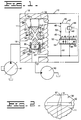
- a pressure compensated flow amplifying poppet valve is generally indicated by the reference numeral 10 and includes a composite valve body 11 and a valve element 12.
- the body includes a pair of concentric cylindrical bores 13,14, a pair of axially spaced annuluses 16,17, an inlet port 19 in communication with the annulus 17, an outlet port 21 in communication with the cylindrical bore 14, and a valve seat 22 between the cylindrical bore 14 and the outlet port 21.
- the cylindrical bore 14 is formed in an annular sleeve 24 suitably seated in a bore 26.
- a plurality of flow modulating ports 27 extend through the sleeve 24 to communicate the annulus 17 with the cylindrical bore 14.
- the valve element 12 has a pair of concentric spool portions 28,29 slidably disposed in the cylindrical bores 13,14, respectively and define an annular reaction surface 31 therebetween.
- a control chamber 32 is defined by the annulus 16 and the end of the spool portion 28.
- the area of the end of the spool portion 28 is substantially larger than area of the surface 31.
- the spool portion 29 terminates at a conical end portion 34 and cooperates with the ports 27 to provide a main flow regulating orifice 35.
- a pair of variable area flow control orifices 36 are provided in the spool portion 28 to communicate the inlet port 19 with the control chamber 32.
- the orifices 36 are in the form of a pair of axially extending rectangular slots 37 connected to the inlet port 19 through a pair of diagonally extending passages 38. As more clearly shown in Fig. 2, a minimum flow area "a" of the slots 37 is always open to continuously communicate the inlet port 19 with the control chamber 32.
- a pressure compensated variable displacement pump 41 is connected to the inlet port 19 and a motor 42 is connected to the outlet port 21.
- the poppet valve 10 also includes a flow regulating passage means 43 communicating the control chamber 32 with the outlet port 21, a valve means 44 for controllably regulating the fluid flow through the passage means 43, and means 45 for establishing a restricted compensating flow path 46 from the control chamber 32 to the outlet port 21 parallel to the passage means 43.
- the passage means 43 includes a regulating passage 47 connected to and extending between the control chamber 32 and the outlet port 21.
- the valve means 44 includes a pressure reducing valve 48 and a flow regulating valve 49 serially disposed in the regulating passage 47.
- the flow regulating valve 49 is movable between a closed position blocking communication through the regulating passage 47 and an infinitely variable open position establishing a variable regulating orifice 50 for regulating fluid flow through the regulating passage 47.
- the pressure reducing valve 48 maintains a substantially constant pressure drop across the regulating valve 49 at its open position.
- the flow path 46 includes a compensating passage 51 connected to the passage 47 on opposite sides of the valves 48 and 49.
- the establishing means 45 includes a means 52 for controlling fluid flow through the passage 51 of the flow path 46.
- the regulating means 52 includes a compensating orifice 53 and a compensating valve 54 serially disposed in the passage 51.
- the compensating valve 54 is movable between a closed position and an open position to modulatably control fluid flow through the passage 51.
- the compensating orifice 53 establishes a maximum flow area through the passage 51 at the fully open position of the compensating valve 54.
- the pressure regulating valve 48 and the compensating valve 54 are shown combined into a single valve movable between positions A, B, and C. Such movement can be by any convenient means such as pilot operation, electrical solenoid operation or mechanical operation.
- the flow regulating valve and compensating valve 54 may be separate valves which can be sequentially operated.
- the orifice 53 may be incorporated within the compensating valve 54 and be established by the maximum opening area of the compensating valve.
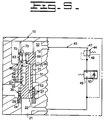
- FIG. 3-6 Other embodiments of a pressure compensating flow amplifying poppet valve 10 of the present invention are disclosed in Figs. 3-6. It is noted that the same reference numerals of the first embodiment are used to designate similarly constructed counterpart elements of these embodiments.
- the compensating passage 51 connects the cylindrical bore 13 with the outlet port 21 and the compensating valve 54 is formed by a slot 57 provided in the spool portion 28 of the valve element 12.
- the slot 57 is in continuous communication with the control chamber 32. Communication through the compensating passage 51 is blocked by the spool portion 28 when the end portion 34 is seated against the valve seat 22.
- Fig. 4 is similar to the embodiment of Fig. 3 with the exception that the establishing means 45 includes having the end portion 34 of the valve element 12 axially separated from the spool portion 29 by a reduced diameter portion 58, the valve seat 22 axially spaced from the ports 27 by an annular chamber 59 formed in the sleeve 24, and the compensating passage 51 connecting the bore 13 with the annulus 59.
- the compensating passage 51, the orifice 53, and a compensating valve 62 are disposed within the valve element 12. More specifically, the compensating valve 62 includes a poppet valve 63 having a piston 64 slidably disposed in an axial bore 66 and defines an actuating chamber 67 in communication with the inlet port 19 through an opening 68. A conical valve portion 69 of the poppet valve 63 is biased against a valve seat 71 by a spring 72 disposed in a chamber 73 open to the control chamber 32.
- the compensating passage 51 connects the bore 66 adjacent the valve seat 71 with the outlet port 21.
- the valve means 44 includes a fixed orifice 74 disposed in the regulating passage 47 and a pressure regulating valve 76 also disposed in the regulating passage 47 upstream of the orifice 74 to controllably vary the pressure drop across the fixed orifice 74.
- the compensating valve 54 is built into the regulating valve 76 and is disposed in the passage 51 of the compensating flow path 46 similar to the embodiment of Fig. 1.
- actuation of the poppet valve 10 is initiated by initially controllably moving the compensating valve 54 from the "A" position to the "B" position.
- Movement of the compensating valve 54 between the “A” and “B” positions modulatably controls the fluid passing through the passage 51 while the orifice 53 generally limits the amount of fluid that can pass through the passage 51 of the flow path 46.
- flow through the regulating valve 49 at the "B" position is still blocked.
- the fluid flow through the passage 51 is fairly low and generally does not generate a pressure drop sufficient to cause the valve element 12 to move upwardly to unseat the end portion 34 from the valve seat 22. Such low flow is referred to as impending flow.
- the spool portion 29 begins uncovering the ports 27 establishing fluid flow through the main flow regulating orifice 35 from the inlet port 19 to the outlet port 21.
- the upward movement of the valve element 12 and thus the degree of opening of the ports 27 is determined by the flow between the inlet port 19 and the control chamber 32 which in turn is modulatably controlled by the degree of opening of the flow regulating valve 49.
- the flow through the slots 37 equals the aggregate flow through the passages 47 and 51.
- the flow through the main orifice 35 is a proportional amount greater than the flow through the regulating orifice 50.
- the pressure reducing valve 48 functions in its usual manner to maintain a constant pressure drop across the regulating valve 49.
- the combination of the compensating orifice 53 and the compensating valve 54 in the flow path 46 disposed in parallel with the pressure reducing valve 48 and the regulating valve 54 makes the poppet valve substantially fully compensated.
- the fluid flow through the inlet and outlet ports remains substantially constant at a given setting of the regulating valve 49 regardless of pressure differentials between the inlet and outlet ports 19,21.
- the size of the compensating orifice 53 will be slightly less than the aggregate area "a" of the slots 37 that is always open.
- the size relationship between the orifice 53 and the aggregate area "a” can be varied to compensate for closing flow forces acting on the valve element 12 and the amount of fluid leaking between the valve element and the bore 13.
- the size of the compensating orifice may be slightly less than, equal to, or slightly greater than the open area "a" of the slots.
- the size of the compensating orifice is preferably selected so that the end portion 34 remains seated when the compensating valve is at the "B" or "C” position and the fluid flow through the passage 51 is limited by the compensating orifice.
- outlet flow from the outlet port 21 can be purposely made to increase or decrease with increasing pressure drop between the inlet and outlet ports by changing the size of the compensating orifice 53 relative to the area "a" of the control slots 37 which is always open.
- actuation of the poppet valve 10 to the open position is initiated by opening the flow regulating orifice 50 of the regulating valve 49.
- the valve element 12 moves upwardly to unseat the end portion 34 from the seat 22 and the slot 57 communicated with the compensating passage 51.
- a portion of the impending flow passes through the compensating passage 51 and the rest passes through the regulating passage 47.
- Increasing the regulating flow through the regulating orifice causes the valve element 12 to continue moving upwardly.
- the fixed orifice 53 limits the fluid flow through the passage 51.
- the spool portion 29 begins uncovering the modulating ports 27 thereby allowing fluid flow from the inlet port 19 to pass through the ports 27 to the outlet port 21.
- the pressure in the control chamber 32 equals the pressure in the inlet port 19.
- the poppet valve 63 is thus urged to the closed position shown by the spring 72.
- the regulating orifice 50 of the regulating valve 49 is initially opened to initiate regulating fluid flow through the regulating passage 47, the pressure in the control chamber 32 decreases due to the pressure drop across the slots 37.
- the poppet valve 63 opens allowing fluid flow from the control chamber 32 through the compensating passage 51 and the orifice 53 to the outlet port 21.
- the poppet valve 63 will become fully open.
- the compensating orifice 53 limits the amount of fluid that can pass through the passage 51 at the open position of the compensating valve 53. After the maximum flow rate through the passage 51 has been reached and with some additional regulating flow, the valve element 12 moves upwardly unseating the end portion 34 from the valve seat 22 and eventually the spool portion 29 will uncover the ports 27 to initiate the main flow between the inlet port 19 through the ports 27 to the outlet port 21.
- Operation of the embodiment of Fig. 6 is initiated by moving the combined pressure regulating valve 76 and the compensating valve 54 simultaneously.
- the initial movement of the compensating valve 54 permits fluid to flow through the compensating passage 51 from the control chamber 32 to the outlet port 21.
- the fluid flow rate through the passage 51 matches the size of the fixed orifice 53 so that further opening of the compensating valve 54 has no effect on fluid flow through the passage 51.
- the pressure regulating valve 76 opens to allow fluid flow through the regulating passage 47 to create a pressure drop between the inlet port 19 and the control chamber 32.
- valve element 12 initially moves upwardly sufficient to unseat the end portion 34 from the valve seat 22 with the spool portion 29 subsequently uncovering the ports 27 to initiate fluid flow from the inlet port 19 to the outlet port 21.
- the pressure regulating valve 76 is operative to controllably vary the pressure drop across the fixed orifice 74 in proportion to the input force applied to the regulating valve for moving it to the open position.
- the structure of the present invention provides an improved pressure compensating flow amplifying poppet valve which makes the poppet valve substantially fully pressure compensated. This is accomplished by providing a compensating valve and compensating orifice in a compensating passage disposed in parallel with the valve means in the regulating flow passage such that the small flow through the compensating passage essentially equals the amount of flow that can pass through the slots in the main valve element before the main flow is established between the inlet and outlet ports.
Landscapes
- Engineering & Computer Science (AREA)
- Physics & Mathematics (AREA)
- Fluid Mechanics (AREA)
- Mechanical Engineering (AREA)
- General Engineering & Computer Science (AREA)
- Safety Valves (AREA)
- Flow Control (AREA)
Claims (21)
- Druckkompensiertes flußverstärkendes Sitzventil (10); das folgendes aufweist:Einen Einlaßanschluß (19);Einen Auslaßanschluß (21);Eine zylindrische Bohrung (13);Ein langgestrecktes Ventilelement (12) mit einem ersten Kolbenteil (28), und zwar gleitend angeordnet in der Bohrung (13), wodurch eine Steuerkammer (32) definiert wird, wobei das Ventilelement (12) beweglich ist zwischen einer geschlossenen Position, in der der Einlaßanschluß (19) von dem Auslaßanschluß (21) abgeblockt bzw. abgeschnitten ist, und einer offenen Position, in der eine Hauptflußregulierungszumeßöffnung (35) zwischen den Einlaß- und Auslaßanschlüssen (19, 21) eingerichtet bzw. gebildet ist, wobei der erste Kolbenteil (28) eine variable Zumeßöffnung (36) zwischen dem Einlaßanschluß (19) und der Steuerkammer (32) aufweist;Flußregulierungsdurchlaßmittel (43), die die Steuerkammer (32) mit dem Auslaßanschluß (21) verbinden; undVentilmittel (44) zum steuerbaren Regulieren des Strömugsmittelflusses durch die Flußregulierungdurchlaßmittel (43), gekennzeichnet durch:Mittel (45) zum Einrichten bzw. Aufbauen eines begrenzten Kompensationsflußpfades (46) von der Steuerkammer (32) zum Auslaßanschluß (21), und zwar parallel zu den Flußregulierungsdurchlaßmitteln (43), wobei die Einrichtungsmittel (45) eine Kompensationszumeßöffnung (53), die im Kompensationsflußpfad (46) angeordnet ist, und ein Kompensationsventil (54, 62) aufweisen, das beweglich ist zwischen einer variablen offenen Position zum Steuern des Strömungsmittelflusses durch den Kompensationsflußpfad (46) und einer geschlossenen Position, in der Strömungsmittelfluß durch den Kompensationsflußpfad blockiert wird.
- Flußverstärkendes Sitzventil (10) nach Anspruch 1, wobei die Kompensationszumeßöffnung (53) eine Maximalströmungsfläche bzw. einen Maximalflußquerschnitt einrichtet bzw. vorsieht, um Strömungsmittelfluß durch den Kompensationsflußpfad (46) in der offenen Position des Druckkompensationsventils (54) zu begrenzen.
- Flußverstärkendes Sitzventil (10) nach Anspruch 2, das einen ringförmigen Ventilsitz (22) aufweist, der zwischen den Einlaß- und Auslaßanschlüssen (19, 21) angeordnet ist, wobei das Ventilelement (12) einen Endteil (34) besitzt, der dichtend mit dem Ventilsitz (22) in der geschlossenen Position des Ventilelementes (12) im Eingriff steht.
- Flußverstärkendes Sitzventil (10) nach Anspruch 3, wobei entweder die Ventilsitze (22) oder der Endteil (34) eine Kegelform besitzen.
- Flußverstärkendes Sitzventil (10) nach Anspruch 3, das eine zweite zylindrische Bohrung (14) koaxial mit der ersten Bohrung (13) aufweist und eine Vielzahl von Anschlüssen (27), die den Einlaßanschluß (21) mit der zweiten Bohrung (14) verbinden, und wobei das Ventilelement (22) einen zweiten Kolbenteil (29) aufweist, der gleitend in der zweiten Bohrung (14) angeordnet ist, wobei der zweite Kolbenteil (29) und die Anschlüsse (27) zusammenarbeiten, um die Hauptflußregulierungszumeßöffnung (35) zu definieren, wenn das Ventilelement (12) in der offenen Position ist.
- Flußverstärkendes Sitzventil (10) nach Anspruch 5, wobei die variable Zumeßöffnung (36) einen sich axial erstreckenden Schlitz (37) aufweist, der im ersten Kolbenteil (28) angeordnet ist und in dauernder Verbindung mit dem Einlaßanschluß (19) ist.
- Flußverstärkendes Sitzventil (10) nach Anspruch 6, wobei die Anschlüsse (27) axial vom Ventilsitz (22) beabstandet sind, und wobei eine Bewegung des Ventilelementes (12) in die offene Position eine Verbindung dahindurch aufbaut.
- Flußverstärkendes Sitzventil (10) nach Anspruch 7, wobei der sich axial erstreckende Schlitz (37) einen Minimalströmungsquerschnitt besitzt, der immer zur Steuerkammer (32) hin offen ist, und wobei die Kompensationszumeßöffnung (53) einen Querschnitt besitzt, der im Wesentlichen gleich dem Minimalströmungsquerschnitt ist.
- Flußverstärkendes Sitzventil (10) nach Anspruch 7, wobei die Ventilmittel (44) ein Flußregulierungsventil (49) aufweisen, das in den Strömungsregulierungsdurchlaßmitteln (43) angeordnet ist, und beweglich ist zwischen einer geschlossenen Position, in der die Verbindung durch die Flußregulierungsdurchlaßmittel (43) hindurch blokkiert ist, und einer stufenlos variablen offenen Position, die variable Verbindung durch die Flußregulierungsdurchlaßmittel (43) einrichtet bzw. schafft, und ein Druckminderungsventil (48), das in den Flußregulierungsdurchlaßmitteln (43) angeordnet ist, und zwar in aufeinanderfolgender Flußbeziehung mit dem Flußregulierungsventil 49 zum Aufrechterhalten eines im Wesentlichen konstanten Druckabfalls über das Flußregulierungsventil hinweg in seiner offenen Position.
- Flußverstärkendes Sitzventil (10) nach Anspruch 9, wobei der Kompensationsflußpfad (46) einen Kompensationsdurchlaß (51) aufweist, der die Steuerkammer (32) mit dem Auslaßanschluß (21) verbindet, wobei die Kompensationszumeßöffnung (53) und das Kompensationsventil (54) im Kompensationsdurchlaß angeordnet sind.
- Flußverstärkendes Sitzventil (10) nach Anspruch 10, wobei die Bewegung des Flußregulierungsventils (49) und des Druckkompensationsventils (54) sequentiell bzw. aufeinander folgend ist, wobei das Kompensationsventil (54) sich zuerst öffnet und eine Position erreicht, um einen Maximalströmungsmittelfluß durch den Kompensationsdurchlaß (51) einzurichten bzw. zu bewirken, bevor das Flußregulierungsventil (49) sich öffnet.
- Flußverstärkendes Sitzventil (10) nach Anspruch 7, wobei der Kompensationsflußpfad (46) einen Kompensationsdurchlaß (51) aufweist, der die erste Bohrung (13) mit dem Auslaßanschluß (21) verbindet, und wobei das Kompensationsventil (54) den ersten Kolbenteil (28) und einen Strömungsmittelflußregulierungsdurchlaß (57) im ersten Kolbenteil (28) in dauernder Verbindung mit der Steuerkammer (32) aufweist.
- Flußverstärkendes Sitzventil (10) nach Anspruch 12, wobei der Regulierungsdurchlaß (57) vom Kompensationsdurchlaß (51) abgeblockt ist, wenn das Ventilelement (12) in der geschlossenen Position ist, und in Verbindung mit dem Kompensationsdurchlaß (51) ist, bevor das Ventilelement (12) seine offene Position erreicht.
- Flußverstärkendes Sitzventil (10) nach Anspruch 13, wobei die Ventilmittel (44) ein Flußregulierungsventil (49) aufweisen, das in den Flußregulierungsdurchlaßmitteln (43) angeordnet ist, und beweglich ist zwischen einer geschlossenen Position, in der die Verbindung durch die Flußregulierungsdurchlaßmittel (43) blockiert ist, und einer stufenlos variablen offenen Position, wobei eine variable Verbindung durch die Flußregulierungsdurchlaßmittel (43) aufgebaut wird, und ein Druckminderungsventil das in den Flußregulierungsdurchlaßmitteln (43) angeordnet ist, und zwar in aufeinanderfolgender Flußbeziehung mit dem Flußregulierungsventil (49) zum Aufrechterhalten eines im Wesentlichen konstanten Druckabfalls über das Flußregulierungsventil an seiner offenen Position.
- Flußverstärkendes Sitzventil (10) nach Anspruch 7, wobei der Kompensationsflußpfad 46 Mittel aufweist zum Definieren einer ringförmigen Kammer bzw. Ringkammer (59), die vom Auslaßanschluß (21) abgeblockt wird, und zwar in der geschlossenen Position des Ventilelementes (12), und die mit dem Auslaßanschluß in der geöffneten Position des Ventilelementes (12) in Verbindung steht, und einen Kompensationsdurchlaß (51), der die erste Bohrung (13) mit der Ringkammer (59) verbindet, und wobei das Kompensationsventil (54) den ersten Kolbenteil (28) und einen Strömungsmittelflußregulierungsdurchlaß (57) im ersten Kolbenteil in dauernder Verbindung mit der Steuerkammer (32) aufweist.
- Flußverstärkendes Sitzventil (10) nach Anspruch 15, wobei der Regulierungsdurchlaß (57) vom Kompensationsdurchlaß (51) abgeblockt wird, wenn das Ventilelement (12) in der geschlossenen Position ist, und in Verbindung mit dem Kompensationsdurchlaß (51) ist, bevor das Ventilelement (12) seine offene Position erreicht.
- Flußverstärkendes Sitzventil (10) nach Anspruch 16, wobei die Ventilmittel (44) ein Flußregulierungsventil (49) aufweisen, das in den Flußregulierungsdurchlaßmitteln (43) angeordnet ist, und beweglich ist zwischen einer geschlossenen Position, in der die Verbindung durch die Flußregulierungsdurchlaßmittel (43) blockiert ist, und einer stufenlos variablen offenen Position, die eine variable Verbindung durch die Flußregulierungdurchlaßmittel (43) einrichtet bzw. schafft, und ein Druckminderungsventil, das in den Flußregulierungsdurchlaßmitteln (43) angeordnet ist, und zwar in aufeinanderfolgender Flußbeziehung mit dem Flußregulierungsventil (49) zum Aufrechterhalten eines im Wesentlichen konstanten Druckabfalls über das Regulierungsventil in seiner offenen Position.
- Flußverstärkendes Sitzventil (10) nach Anspruch 7, wobei der Kompensationsflußpfad (46) einen Kompensationsdurchlaß (51) im Ventilelement (12), und wobei er in dauernder Verbindung mit dem Auslaßanschluß (21) ist, und wobei das Kompensationsventil (62) eine Bohrung (66) im Ventilelement (12) aufweist, und ein Sitzventil (63) aufweist, das in der Bohrung (66) des Ventilelementes (12) angeordnet ist, wobei das Sitzventil (63) die Verbindung zwischen der Steuerkammer (32) und dem Kompensationsdurchlaß (51) in seiner geschlossenen Position blockiert, und eine Verbindung zwischen der Steuerkammer (32) und dem Kompensationsdurchlaß (51) in seiner geöffneten Position aufgebaut bzw. einrichtet.
- Flußverstärkendes Sitzventil (10) nach Anspruch 18, wobei folgendes vorgesehen ist: Ein Ventilsitz (71) benachbart zur Bohrung (66) im Ventilelement (12), ein konischer Teil bzw. Kegelteil (69) in dichtendem Eingriff mit dem Ventilsitz (71) in der geschlossenen Position des Kompensationsventils (62), und eine Feder (72), die federnd das Kompensationsventil (62) in die geschlossene Position drückt.
- Flußverstärkendes Sitzventil (10) nach Anspruch 19, wobei das Sitzventil (63) einen Kolben (64) aufweist, der gleitend in der Bohrung (66) des Ventilelementes (12) angeordnet ist, wobei eine Betätigungskammer (67) definiert wird, und eine Öffnung (68), die den Einlaßanschluß (21) mit der Betätigungskammer (67) verbindet.
- Flußverstärkendes Sitzventil (10) nach Anspruch 7, wobei die Ventilmittel (44) eine feste Zumeßöffnung (74) aufweisen, die in den Flußregulierungsdurchlaßmitteln (43) angeordnet ist, und ein Druckregulierungsventil (76), das in Serie bzw. in Reihe angeordnet ist mit der festen Zumeßöffnung (74) und betätigbar bzw. betreibbar ist, um einen variablen Druckabfall über die feste Zumeßöffnung (74) proportional zu einer Eingangs- bzw. Eingabekraft aufrecht zu erhalten, die auf das Druckregulierungsventil angewandt wird.
Applications Claiming Priority (3)
| Application Number | Priority Date | Filing Date | Title |
|---|---|---|---|
| US754092 | 1985-07-15 | ||
| US07/754,092 US5137254A (en) | 1991-09-03 | 1991-09-03 | Pressure compensated flow amplifying poppet valve |
| PCT/US1991/008282 WO1993005303A1 (en) | 1991-09-03 | 1991-11-12 | Pressure compensated flow amplifying poppet valve |
Publications (2)
| Publication Number | Publication Date |
|---|---|
| EP0602036A1 EP0602036A1 (de) | 1994-06-22 |
| EP0602036B1 true EP0602036B1 (de) | 1996-05-29 |
Family
ID=25033457
Family Applications (1)
| Application Number | Title | Priority Date | Filing Date |
|---|---|---|---|
| EP92904925A Expired - Lifetime EP0602036B1 (de) | 1991-09-03 | 1991-11-12 | Druckkompensiertes strömungsverstärkendes tellerventil |
Country Status (6)
| Country | Link |
|---|---|
| US (1) | US5137254A (de) |
| EP (1) | EP0602036B1 (de) |
| JP (1) | JP3090275B2 (de) |
| AU (1) | AU1250892A (de) |
| DE (1) | DE69119914T2 (de) |
| WO (1) | WO1993005303A1 (de) |
Cited By (1)
| Publication number | Priority date | Publication date | Assignee | Title |
|---|---|---|---|---|
| WO2017202485A1 (de) * | 2016-05-25 | 2017-11-30 | Hydac System Gmbh | Ventilvorrichtung |
Families Citing this family (38)
| Publication number | Priority date | Publication date | Assignee | Title |
|---|---|---|---|---|
| US5207059A (en) * | 1992-01-15 | 1993-05-04 | Caterpillar Inc. | Hydraulic control system having poppet and spool type valves |
| US5421545A (en) * | 1993-09-03 | 1995-06-06 | Caterpillar Inc. | Poppet valve with force feedback control |
| US5645263A (en) * | 1993-10-04 | 1997-07-08 | Caterpillar Inc. | Pilot valve for a flow amplyifying poppet valve |
| JP3685923B2 (ja) * | 1998-04-21 | 2005-08-24 | 日立建機株式会社 | 配管破断制御弁装置 |
| US6089528A (en) * | 1998-12-18 | 2000-07-18 | Caterpillar Inc. | Poppet valve control with sealing element providing improved load drift control |
| US6047944A (en) * | 1999-02-25 | 2000-04-11 | Caterpillar Inc. | Poppet with a flow increasing element for limiting movement thereof in a poppet valve |
| EP1143151B1 (de) * | 1999-10-20 | 2007-01-03 | Hitachi Construction Machinery Co., Ltd. | Rohrbruch steuerventil vorrichtung |
| US6557822B1 (en) * | 2000-11-21 | 2003-05-06 | Caterpillar Inc. | Dynamically stable flow amplifying poppet valve |
| US6769252B2 (en) | 2001-12-10 | 2004-08-03 | Caterpillar Inc | Fluid system having variable pressure relief |
| US6694859B2 (en) | 2002-03-28 | 2004-02-24 | Caterpillar Inc | Variable pressure relief valve |
| JP4160530B2 (ja) * | 2004-04-28 | 2008-10-01 | 日立建機株式会社 | 制御弁装置及び圧力回路 |
| US7293579B2 (en) * | 2004-07-08 | 2007-11-13 | Caterpillar Inc. | Poppet valve arrangements |
| US7204084B2 (en) * | 2004-10-29 | 2007-04-17 | Caterpillar Inc | Hydraulic system having a pressure compensator |
| US7243493B2 (en) * | 2005-04-29 | 2007-07-17 | Caterpillar Inc | Valve gradually communicating a pressure signal |
| US7204185B2 (en) * | 2005-04-29 | 2007-04-17 | Caterpillar Inc | Hydraulic system having a pressure compensator |
| US7194856B2 (en) * | 2005-05-31 | 2007-03-27 | Caterpillar Inc | Hydraulic system having IMV ride control configuration |
| US7302797B2 (en) * | 2005-05-31 | 2007-12-04 | Caterpillar Inc. | Hydraulic system having a post-pressure compensator |
| US7258058B2 (en) * | 2005-08-31 | 2007-08-21 | Caterpillar Inc | Metering valve with integral relief and makeup function |
| US7331175B2 (en) * | 2005-08-31 | 2008-02-19 | Caterpillar Inc. | Hydraulic system having area controlled bypass |
| US7210396B2 (en) * | 2005-08-31 | 2007-05-01 | Caterpillar Inc | Valve having a hysteretic filtered actuation command |
| US20070045584A1 (en) * | 2005-08-31 | 2007-03-01 | Diamond Power International, Inc. | Low loss poppet valve for a cleaning device and a method of delivering a cleaning fluid therewith |
| US20100043418A1 (en) * | 2005-09-30 | 2010-02-25 | Caterpillar Inc. | Hydraulic system and method for control |
| US7614336B2 (en) * | 2005-09-30 | 2009-11-10 | Caterpillar Inc. | Hydraulic system having augmented pressure compensation |
| US7320216B2 (en) * | 2005-10-31 | 2008-01-22 | Caterpillar Inc. | Hydraulic system having pressure compensated bypass |
| KR100800081B1 (ko) * | 2006-08-29 | 2008-02-01 | 볼보 컨스트럭션 이키프먼트 홀딩 스웨덴 에이비 | 굴삭기용 옵션장치의 유압회로 |
| DE602006006676D1 (de) * | 2006-09-01 | 2009-06-18 | Parker Hannifin Ab | Ventilanordnung |
| DE502006008678D1 (de) * | 2006-12-05 | 2011-02-17 | Festo Ag & Co Kg | Softstart-Ventileinrichtung |
| US8479504B2 (en) * | 2007-05-31 | 2013-07-09 | Caterpillar Inc. | Hydraulic system having an external pressure compensator |
| US7621211B2 (en) * | 2007-05-31 | 2009-11-24 | Caterpillar Inc. | Force feedback poppet valve having an integrated pressure compensator |
| US20080295681A1 (en) * | 2007-05-31 | 2008-12-04 | Caterpillar Inc. | Hydraulic system having an external pressure compensator |
| US20110017310A1 (en) * | 2007-07-02 | 2011-01-27 | Parker Hannifin Ab | Fluid valve arrangement |
| EP2241764B1 (de) * | 2009-04-17 | 2011-08-31 | HAWE Hydraulik SE | Sitzventil mit Umlaufventil- und Druckwaagefunktion |
| US8684037B2 (en) | 2009-08-05 | 2014-04-01 | Eaton Corportion | Proportional poppet valve with integral check valve |
| US8631650B2 (en) | 2009-09-25 | 2014-01-21 | Caterpillar Inc. | Hydraulic system and method for control |
| US8291934B2 (en) * | 2010-01-20 | 2012-10-23 | Eaton Corporation | Proportional valve assembly |
| US8770543B2 (en) | 2011-07-14 | 2014-07-08 | Eaton Corporation | Proportional poppet valve with integral check valves |
| CN112443527B (zh) * | 2020-12-10 | 2023-11-07 | 徐州阿马凯液压技术有限公司 | 一种高流量精度流量放大阀 |
| CN114396497B (zh) * | 2021-12-31 | 2024-05-24 | 浙江大学温州研究院 | 一种具有恒定流量输出的被动微阀及其方法 |
Family Cites Families (9)
| Publication number | Priority date | Publication date | Assignee | Title |
|---|---|---|---|---|
| US3175800A (en) * | 1961-06-20 | 1965-03-30 | Int Harvester Co | Hydraulic control system and unloading valve therefor |
| US3561488A (en) * | 1969-07-01 | 1971-02-09 | Sanders Associates Inc | Fluid flow control valve |
| DE3132909A1 (de) * | 1981-08-20 | 1983-03-03 | Hans-Gebhard Krines | "ventilvorrichtung, insbesondere fuer druckgiessmaschinen |
| SE439342C (sv) * | 1981-09-28 | 1996-11-18 | Bo Reiner Andersson | Ventilanordning för styrning av en linjär eller roterande hydraulmotor |
| DE3246738C2 (de) * | 1982-09-28 | 1987-02-05 | Dr. H. Tiefenbach Gmbh & Co, 4300 Essen | Mit Eigenmedium gesteuertes Hydraulikventil mit einstellbarem Durchlaßquerschnitt |
| DE3343620C2 (de) * | 1983-12-02 | 1986-09-04 | Glyco-Antriebstechnik Gmbh, 6200 Wiesbaden | Steuerbares 2-Wege-Ventil für eine Druck- und Stromregelung eines Flüssigkeitsstroms |
| AU603907B2 (en) * | 1987-06-30 | 1990-11-29 | Hitachi Construction Machinery Co. Ltd. | Hydraulic drive system |
| IN170798B (de) * | 1988-05-12 | 1992-05-23 | Hitachi Construction Machinery | |
| US4846216A (en) * | 1988-07-05 | 1989-07-11 | Robert E. Raymond | Fluid power valve device |
-
1991
- 1991-09-03 US US07/754,092 patent/US5137254A/en not_active Expired - Lifetime
- 1991-11-12 EP EP92904925A patent/EP0602036B1/de not_active Expired - Lifetime
- 1991-11-12 JP JP50517792A patent/JP3090275B2/ja not_active Expired - Fee Related
- 1991-11-12 AU AU12508/92A patent/AU1250892A/en not_active Abandoned
- 1991-11-12 WO PCT/US1991/008282 patent/WO1993005303A1/en not_active Ceased
- 1991-11-12 DE DE69119914T patent/DE69119914T2/de not_active Expired - Fee Related
Cited By (3)
| Publication number | Priority date | Publication date | Assignee | Title |
|---|---|---|---|---|
| WO2017202485A1 (de) * | 2016-05-25 | 2017-11-30 | Hydac System Gmbh | Ventilvorrichtung |
| CN109477499A (zh) * | 2016-05-25 | 2019-03-15 | Hydac系统和服务有限公司 | 阀装置 |
| CN109477499B (zh) * | 2016-05-25 | 2020-10-30 | Hydac系统和服务有限公司 | 阀装置 |
Also Published As
| Publication number | Publication date |
|---|---|
| AU1250892A (en) | 1993-04-05 |
| JP3090275B2 (ja) | 2000-09-18 |
| EP0602036A1 (de) | 1994-06-22 |
| WO1993005303A1 (en) | 1993-03-18 |
| US5137254A (en) | 1992-08-11 |
| JPH07503083A (ja) | 1995-03-30 |
| DE69119914T2 (de) | 1996-10-02 |
| DE69119914D1 (de) | 1996-07-04 |
Similar Documents
| Publication | Publication Date | Title |
|---|---|---|
| EP0602036B1 (de) | Druckkompensiertes strömungsverstärkendes tellerventil | |
| US5421545A (en) | Poppet valve with force feedback control | |
| US5645263A (en) | Pilot valve for a flow amplyifying poppet valve | |
| US5878647A (en) | Pilot solenoid control valve and hydraulic control system using same | |
| US5868059A (en) | Electrohydraulic valve arrangement | |
| US3722543A (en) | Pressure compensated control valve | |
| US8424836B2 (en) | Bidirectional force feedback poppet valve | |
| EP0559903A4 (en) | Valve device | |
| US4462566A (en) | Pressure compensated flow control system | |
| US4461314A (en) | Electrohydraulic valve | |
| JP3703265B2 (ja) | 油圧制御装置 | |
| US4327763A (en) | Dual control input flow control valve | |
| EP0231876B1 (de) | Hydraulikdruck-Steuerung | |
| WO1993009350A1 (en) | Pressure compensated flow amplifying poppet valve | |
| JPS6033446Y2 (ja) | 圧力制御弁装置用パイロツト圧調整弁 | |
| US5876184A (en) | Electrohydraulic pressure regulating valve | |
| US4246934A (en) | Remotely controlled load responsive valves | |
| JPS6347583A (ja) | ホ−ルデイングバルブ | |
| EP0102960A4 (de) | Regelventil für fluidum mit druckausgleich und einstellbarkeit des höchstdebits. | |
| CA1181658A (en) | Dual control input flow control valve | |
| JPH087458Y2 (ja) | 積層形減圧弁 | |
| JP3298899B2 (ja) | 負荷感応形制御装置 | |
| JPS5855448Y2 (ja) | シ−ト形流量調整弁装置 | |
| EP0113708B1 (de) | Doppelt gesteuertes eintrittregelventil | |
| JP3727750B2 (ja) | 油圧制御装置 |
Legal Events
| Date | Code | Title | Description |
|---|---|---|---|
| PUAI | Public reference made under article 153(3) epc to a published international application that has entered the european phase |
Free format text: ORIGINAL CODE: 0009012 |
|
| 17P | Request for examination filed |
Effective date: 19940204 |
|
| AK | Designated contracting states |
Kind code of ref document: A1 Designated state(s): BE DE FR GB IT SE |
|
| 17Q | First examination report despatched |
Effective date: 19950412 |
|
| GRAH | Despatch of communication of intention to grant a patent |
Free format text: ORIGINAL CODE: EPIDOS IGRA |
|
| GRAA | (expected) grant |
Free format text: ORIGINAL CODE: 0009210 |
|
| AK | Designated contracting states |
Kind code of ref document: B1 Designated state(s): BE DE FR GB IT SE |
|
| PG25 | Lapsed in a contracting state [announced via postgrant information from national office to epo] |
Ref country code: IT Free format text: LAPSE BECAUSE OF FAILURE TO SUBMIT A TRANSLATION OF THE DESCRIPTION OR TO PAY THE FEE WITHIN THE PRE;WARNING: LAPSES OF ITALIAN PATENTS WITH EFFECTIVE DATE BEFORE 2007 MAY HAVE OCCURRED AT ANY TIME BEFORE 2007. THE CORRECT EFFECTIVE DATE MAY BE DIFFERENT FROM THE ONE RECORDED.SCRIBED TIME-LIMIT Effective date: 19960529 Ref country code: FR Effective date: 19960529 Ref country code: BE Effective date: 19960529 |
|
| REF | Corresponds to: |
Ref document number: 69119914 Country of ref document: DE Date of ref document: 19960704 |
|
| PG25 | Lapsed in a contracting state [announced via postgrant information from national office to epo] |
Ref country code: SE Effective date: 19960829 |
|
| EN | Fr: translation not filed | ||
| PLBE | No opposition filed within time limit |
Free format text: ORIGINAL CODE: 0009261 |
|
| STAA | Information on the status of an ep patent application or granted ep patent |
Free format text: STATUS: NO OPPOSITION FILED WITHIN TIME LIMIT |
|
| 26N | No opposition filed | ||
| PGFP | Annual fee paid to national office [announced via postgrant information from national office to epo] |
Ref country code: GB Payment date: 20010926 Year of fee payment: 11 |
|
| REG | Reference to a national code |
Ref country code: GB Ref legal event code: IF02 |
|
| PG25 | Lapsed in a contracting state [announced via postgrant information from national office to epo] |
Ref country code: GB Free format text: LAPSE BECAUSE OF NON-PAYMENT OF DUE FEES Effective date: 20021112 |
|
| GBPC | Gb: european patent ceased through non-payment of renewal fee | ||
| PGFP | Annual fee paid to national office [announced via postgrant information from national office to epo] |
Ref country code: DE Payment date: 20081128 Year of fee payment: 18 |
|
| PG25 | Lapsed in a contracting state [announced via postgrant information from national office to epo] |
Ref country code: DE Free format text: LAPSE BECAUSE OF NON-PAYMENT OF DUE FEES Effective date: 20100601 |