EP0602852B1 - Système et procédé de commande de tensions dans un appareil d'impression - Google Patents
Système et procédé de commande de tensions dans un appareil d'impression Download PDFInfo
- Publication number
- EP0602852B1 EP0602852B1 EP93309683A EP93309683A EP0602852B1 EP 0602852 B1 EP0602852 B1 EP 0602852B1 EP 93309683 A EP93309683 A EP 93309683A EP 93309683 A EP93309683 A EP 93309683A EP 0602852 B1 EP0602852 B1 EP 0602852B1
- Authority
- EP
- European Patent Office
- Prior art keywords
- voltage
- substrate
- exposing
- radiation power
- substep
- Prior art date
- Legal status (The legal status is an assumption and is not a legal conclusion. Google has not performed a legal analysis and makes no representation as to the accuracy of the status listed.)
- Expired - Lifetime
Links
- 238000000034 method Methods 0.000 title claims description 26
- 239000000758 substrate Substances 0.000 claims description 35
- 230000005855 radiation Effects 0.000 claims description 27
- 238000007599 discharging Methods 0.000 claims description 12
- 238000000151 deposition Methods 0.000 claims description 8
- 108091008695 photoreceptors Proteins 0.000 description 22
- 238000010586 diagram Methods 0.000 description 11
- 238000012937 correction Methods 0.000 description 7
- 238000012545 processing Methods 0.000 description 7
- 230000008859 change Effects 0.000 description 5
- 238000005259 measurement Methods 0.000 description 5
- 230000008021 deposition Effects 0.000 description 4
- 230000000694 effects Effects 0.000 description 4
- 230000005684 electric field Effects 0.000 description 4
- 230000008569 process Effects 0.000 description 4
- 230000004044 response Effects 0.000 description 4
- 238000012360 testing method Methods 0.000 description 4
- 238000012886 linear function Methods 0.000 description 3
- 230000003287 optical effect Effects 0.000 description 2
- 239000007787 solid Substances 0.000 description 2
- 238000012546 transfer Methods 0.000 description 2
- 230000002411 adverse Effects 0.000 description 1
- 230000004075 alteration Effects 0.000 description 1
- 238000013459 approach Methods 0.000 description 1
- 230000015572 biosynthetic process Effects 0.000 description 1
- 238000004364 calculation method Methods 0.000 description 1
- 238000012512 characterization method Methods 0.000 description 1
- 238000004140 cleaning Methods 0.000 description 1
- 239000003086 colorant Substances 0.000 description 1
- 230000001419 dependent effect Effects 0.000 description 1
- 238000011161 development Methods 0.000 description 1
- 238000004519 manufacturing process Methods 0.000 description 1
- 239000000463 material Substances 0.000 description 1
- 239000011159 matrix material Substances 0.000 description 1
- 230000009291 secondary effect Effects 0.000 description 1
- 230000001629 suppression Effects 0.000 description 1
Images






Classifications
-
- H—ELECTRICITY
- H04—ELECTRIC COMMUNICATION TECHNIQUE
- H04N—PICTORIAL COMMUNICATION, e.g. TELEVISION
- H04N1/00—Scanning, transmission or reproduction of documents or the like, e.g. facsimile transmission; Details thereof
- H04N1/23—Reproducing arrangements
- H04N1/29—Reproducing arrangements involving production of an electrostatic intermediate picture
- H04N1/295—Circuits or arrangements for the control thereof, e.g. using a programmed control device, according to a measured quantity
-
- G—PHYSICS
- G03—PHOTOGRAPHY; CINEMATOGRAPHY; ANALOGOUS TECHNIQUES USING WAVES OTHER THAN OPTICAL WAVES; ELECTROGRAPHY; HOLOGRAPHY
- G03G—ELECTROGRAPHY; ELECTROPHOTOGRAPHY; MAGNETOGRAPHY
- G03G15/00—Apparatus for electrographic processes using a charge pattern
- G03G15/02—Apparatus for electrographic processes using a charge pattern for laying down a uniform charge, e.g. for sensitising; Corona discharge devices
- G03G15/0266—Arrangements for controlling the amount of charge
-
- G—PHYSICS
- G03—PHOTOGRAPHY; CINEMATOGRAPHY; ANALOGOUS TECHNIQUES USING WAVES OTHER THAN OPTICAL WAVES; ELECTROGRAPHY; HOLOGRAPHY
- G03G—ELECTROGRAPHY; ELECTROPHOTOGRAPHY; MAGNETOGRAPHY
- G03G15/00—Apparatus for electrographic processes using a charge pattern
- G03G15/02—Apparatus for electrographic processes using a charge pattern for laying down a uniform charge, e.g. for sensitising; Corona discharge devices
- G03G15/0291—Apparatus for electrographic processes using a charge pattern for laying down a uniform charge, e.g. for sensitising; Corona discharge devices corona discharge devices, e.g. wires, pointed electrodes, means for cleaning the corona discharge device
-
- G—PHYSICS
- G03—PHOTOGRAPHY; CINEMATOGRAPHY; ANALOGOUS TECHNIQUES USING WAVES OTHER THAN OPTICAL WAVES; ELECTROGRAPHY; HOLOGRAPHY
- G03G—ELECTROGRAPHY; ELECTROPHOTOGRAPHY; MAGNETOGRAPHY
- G03G15/00—Apparatus for electrographic processes using a charge pattern
- G03G15/04—Apparatus for electrographic processes using a charge pattern for exposing, i.e. imagewise exposure by optically projecting the original image on a photoconductive recording material
- G03G15/04036—Details of illuminating systems, e.g. lamps, reflectors
- G03G15/04045—Details of illuminating systems, e.g. lamps, reflectors for exposing image information provided otherwise than by directly projecting the original image onto the photoconductive recording material, e.g. digital copiers
Definitions
- This invention relates to system and method of controlling voltages in a printing apparatus, and more particularly to a system and method of controlling voltages in a printing apparatus employing a charged substrate and toner.
- a method of voltage control is disclosed in PATENT ABSTRACTS OF JAPAN, vol. 16, no. 540 (P-1450) 10 th November 1992 & JP-A-04 204 763(MINOLTA CAMERA Co), 27 th July 1992.
- halftone cells the image to be reproduced is partitioned into mutually exclusive areas called "halftone cells," each containing a number of pixels.
- halftone cells are used with a developable image printer, gray levels are simulated by exposing a subset of the total number of pixels in a haiftone cell, to attract toner to the exposed pixels. The pixels are too small for a viewer to perceive individual pixels, and the viewer instead perceives a gray level corresponding to the percentage of halftone cell area that is covered with toner.
- Numerous physical conditions within the developable image printer affect various aspects of the appearance of a halftone cell A variation in a single physical condition may cause a variation in multiple aspects a cell's appearance.
- the present invention provides a method of operating a reproduction system including a substrate and means for depositing toner onto the substrate, comprising the steps of receiving a first input parameter value N1; receiving a second input parameter value N2; receiving a third input parameter value N3; charging the depositing means to a first voltage; charging the substrate to produce a second voltage, such that a difference between the second voltage and the first voltage is N1; discharging selected areas of the substrate to produce a third voltage, such that a difference between the third voltage and the first voltage is N2, and a ratio between a function of the second voltage and a function of the third voltage is N3.
- the invention further provides a printing apparatus according to claim 10 of the appended claims.
- Fig 1 is a diagram of a printing apparatus of a first embodiment of the invention.
- Fig. 2 is a diagram of a halftone cell.
- Fig. 3 is a diagram of another halftone cell.
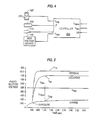
- Fig 4 is diagram of the controller for the printing apparatus of Fig. 1.
- Fig. 5 is a graph illustrating voltages employed by the printing system of Fig. 1.
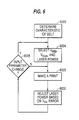
- Fig 6 is a flow diagram showing an operation of the first embodiment of the present invention.
- Fig. 7 is a graph showing data acquired by the printing apparatus of Fig. 1.
- Fig. 8 is a flow diagram showing the process of Fig. 6 in more detail.
- Fig. 9 is a graph showing a relationship between substrate charge voltage and laser exposure power in the printer apparatus of Fig. 1.
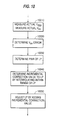
- Fig. 10 is a flow diagram showing the process of Fig. 6 in more detail.
- Fig. 11 is a graph showing a step input response of the printer of Fig. 1.
- Fig. 12 is a graph showing an effect of the printing apparatus of Fig. 1.
- Fig. 13 is a diagram of a printing apparatus of a second embodiment of the invention.
- Fig. 14 is a diagram of a printing apparatus of a third embodiment of the invention.
- Fig. 15 is a diagram of another halftone cell.
- Fig. 1 shows a printing apparatus 1000 of a first embodiment of the present invention.
- Photoreceptor belt 1010 is entrained around rollers 1014.
- rollers 1014 is rotated by a motor (not shown) via by suitable means such as a belt drive.
- suitable means such as a belt drive.
- the driven roller advances belt 1010 in the direction of arrow 1012 through the various processing stations disposed around the movement path of belt 1010.
- Corotrons 1022 and 1024 operate to charge belt 1010 to a uniform potential.
- Raster scanning laser 1032 exposes belt 1010 to a pattern of light to render a latent image.
- Developing station 1037 deposits toner on belt 1010.
- Bias voltage source 1100 charges developing station 1037.
- Charge sensor 1115 senses a charge on belt 1010.
- Controller 1500 controls voltages in the preferred printer, as described in detail later.
- the area of the belt 1010 is exposed to a pretransfer light from a lamp (not shown) to reduce the attraction between belt 1010 and the toner deposited by developer 1037.
- a corotron 1046 charges a sheet of paper, from paper tray 1082, to an appropriate magnitude so that the paper is tacked to belt 1010 and the toner attracted from belt 1010 to the paper.
- detack corotron 1048 charges the paper to an opposite polarity to detack the paper from belt 1010.
- the paper then passes to fuser 1052 where the toner is fused into the paper with heat and pressure.
- the paper then advances to output section 1190, or to tray 1066 allowing the paper to return to belt 1010 for printing an image on an opposite side of the paper.
- Fig. 2 shows a highly magnified halftone cell 2000 having 9 pixels 2010-2090.
- laser 1032 exposes none of the pixels in the cell resulting in the cell shown in Fig. 2.
- laser 1032 exposes some of the pixels in the cell to attract toner to the exposed pixels.
- laser 1032 exposes all pixels in the cell to attract toner to the exposed pixels.
- the combination of voltages employed within printer 1000 has an effect on the production of intermediate levels of gray. This effect results from certain phenomena that occur at an interface between an exposed pixel and an unexposed pixel. Depending on the combination of voltages, an unexposed pixel may contain various amounts of toner in an area near an interface with an exposed pixel, thereby affecting the perceived gray level.
- Fig. 3 shows a highly magnified halftone cell in which laser 1032 has exposed 3 of the 9 pixels to produce an intermediate gray level.
- Laser 1032 has exposed pixels 3010, 3020 and 3050 to attract toner to these exposed pixels.
- unexposed pixels 3040, 3070, 3080, 3090, 3060 and 3030 contain toner resulting from the exposure of pixels 3010, 3020 and 3050.
- Controller 1500 includes a general purpose computer executing a controller program. Controller 1500 controls a charge on belt 1010 by controlling corotrons 1022 and 1024 in accordance with a parameter V ddp , described below. Controller 1500 also controls a power of laser 1032 in accordance with a parameter LP, and controls bias voltage source 1100 in accordance with a parameter V bias , described below. Controller 1500 receives input parameters V clean , V dev and DR described below, and an output of charge sensor 1115.
- the parameter V clean received by controller 1500 controls a voltage difference between belt 1010, after charging by corotrons 1022 and 1024, and the rollers in developer 1037.
- An electric field produced by this voltage difference is sometimes called the "cleaning field," because this electric field tends to suppress the deposition of background toner on white pixels, such as pixel 2090 in Fig. 2.
- Printer 1000 initially sets V clean to 100 volts to suppress the deposition of background while providing adequate reproduction of grey levels close to white.
- the parameter V dev received by controller 1500 controls a voltage difference between belt 1010, after exposure by laser 1032, and the rollers in developer 1037.
- An electric field produced by this voltage difference is sometimes called the "development field," because this electric field tends to promote the deposition of toner on exposed pixels.
- V rsl is a residual voltage obtained when the photoreceptor is maximally discharged by light. V rsl is reached when additional exposure power increases cause negligible additional voltage discharge.
- the parameter DR received by controller 1500 specifies the discharge ratio in printer 1000.
- the discharge ratio is a factor determining the amount of toner deposited near an edge in an unexposed pixels, such as pixel 3030 in Fig. 3, resulting from exposure of an adjacent pixel, such as pixel 3020.
- Printer 1000 initially sets DR to 0.1 to produce an amount of toner in a cell that is a roughly linear function of the percentage of exposed pixels in the cell.
- FIG. 5 shows voltages employed by printer 1000 to achieve latent image formation.
- An electrostatic voltmeter placed 1.2 seconds after charging would measure the indicated V ddp and V ex .
- V rsl is a physical characteristic of the particular materials used for belt 1010.
- V rsl is measured by controller 1500, as described later.
- the discharge ratio may be conceptualized as corresponding t the location of a range, defined by V clean and V dev , relative to the V rsl . In Fig. 5, the discharge ratio is approximately 0.16.
- Fig. 6 shows a processing of controller 1500 to set a belt charge V ddp , a laser power LP and a V bias in response to the received input parameters V clean , V dev , and DR. Certain characteristics of belt 1010 are determined (step 6002). Step 6002 is preferably performed upon the power-up of printer 1000, before images on paper are produced.
- Fig. 7 shows data acquired by controller 1500 in step 6002.
- a matrix is developed by performing measurements at different values of V ddp and V ex .
- Each of the 10 curves of Fig. 7 represents data collected at a certain constant exposure power of laser 1032.
- V ex V ex .
- Controller 1500 uses the data of Fig 7 to set a laser 1032 exposure power LP to achieve the V ex that results in the specified V dev , V clean and DR. Controller 1500 effectively constrains V ex to be on the line of constant DR, relative to the residual curve, shown in Fig. 7. This line of constant DR correlates V ex values with V ddp values. Each intersection point of the line of constant DR with any of the 10 curves of constant exposure power gives a guide to the appropriate laser 1032 exposure power LP for a given V ddp . For each intersection a pair of power, charge values is obtained.
- Controller 1500 calculates a new line of constant discharge ratio each time step 6004 is performed.
- the printing apparatus makes prints (Step 6020), and adjusts laser power (Step 6030). If one or more of the input parameters V clean , V dev or DR change (step 6035), controller 1500 performs step 6004 again.
- Laser 1032 is configured as a raster output scanner (ROS) capable of varying exposure power quickly to a number of values in the time that it would normally take to print an image.
- the data shown in Fig. 7 is the V ex result of 10 exposure powers measured at each of 16 V ddp levels in 16 passes of the photoreceptor, one pass for each V ddp level.
- the top curve in Fig. 7 corresponds a laser power that discharges belt 1010 to a residual voltage meaning that higher laser powers do not cause further discharge of belt 1010 within the exposure time of laser 1032.
- the top curve corresponds to laser powers that result in the residual voltage V rsl .
- This residual voltage is somewhat dependent on V ddp , an embellishment on the equations above that will be described later.
- Fig. 8 shows a processing of step 6002 of Fig. 6 in more detail.
- Fig. 8 shows a processing of controller 1500 to collect the data shown in Fig. 7.
- Initial substrate charge and laser powers are selected (Steps 8010 and 8020). The substrate is exposed with the currently selected laser power and the resulting discharged voltage measured by charge sensor 1115 V ex is stored. If laser powers remain (Step 8040), a next laser power is selected (Step 8050) and a new exposed and measuring step is performed. If no laser powers remain, it is determined whether any values for V ddp remain (Step 8060) and if other values of V ddp remain a new value for V ddp is set (Step 8070) and control returns to Step 8020.
- controller 1500 performs the steps of charging the substrate to each of a plurality of predetermined voltages; exposing, for each predetermined voltage, the substrate to each of a plurality of predetermined radiation powers; measuring, for each radiation power, a charge on the substrate after the exposing step; and determining a radiation power by using a result of the measuring step to interpolate between two of the plurality of predetermined radiation powers.
- printer 1000 exposes belt 1010 with the determined radiation power.
- V ex there will be error in V ex which may result from changes in the photoreceptor characteristics with age or environment that have occurred since step 6002 was performed.
- Another error source is small deviations of real photoreceptor behavior from the behavior predicted by the mathematical curve fit described above.
- An error feedback calculation adjusts the exposure power to minimize V ex error and compensate for these errors.
- an imaginary vertical line at the measured V ddp can be drawn. This line also intersects the lines of constant laser power and each intersection can be used to create LP, V ex pairs.
- a functional fit using V ex as the independent variable allows a power correction to be calculated that will return V ex to zero error This power correction value is adjusted on each revolution of belt 1010 in accordance with the measured error
- Printer 1000 may be configured with a wide variety of photoreceptors and exposure sources.
- a preferred embodiment of the invention configures printer 1000 with an organic infrared sensitive photoreceptor exposed by an infrared laser diode source
- V ex is substantially a linear function of V ddp at constant laser power.
- V rsl a 0 (v ddp ) + b 0
- V ex V ddp [DR(1-a 0 ) + a 0 ] + b 0 (1-DR)
- V ddp ,i [b l - b 0 (1-DR)]/[a 0 - a l + DR(1-a 0 )] - over all LP
- Fig. 9 shows a relationship between V ddp and laser power LP for a particular DR.
- V ddp pairs substantially fit to a quadratic equation, as shown in Fig. 9. The intersection points as seen in Fig 7 are used to generate 5 pairs of LP, V ddp .
- Controller 1500 employs feedback to readjust the setting of LP, thereby compensating for the error introduced by the divergence and for error introduced by physical changes occurring after the initial setting of LP
- Fig. 10 shows a processing of step 6030 of Fig. 6 in more detail
- Charge sensor 1115 measures an actual V ddp , and an actual V ex (Step 10010).
- the measured V ddp is used to determine a target V ex to achieve the discharge ratio DR, thereby determining a (Step 10020).
- a pair of laser powers that yield V ex values that include the actual V ex at the actual V ddp is determined (Step 10030).
- the preferred method includes the step of exposing the substrate to the determined radiation power; a second measuring step of measuring a voltage on the substrate after the exposing step; and redetermining a radiation power in accordance with the second measuring step.
- the redetermining of the radiation power compensates for the changes and maintains a low V ex error.
- Fig. 11 shows a response of controller 1500 to a step change at the DR input.
- the discharge ratio computed from measurements taken at an electrostatic voltmeter is plotted along with the DR input to controller 1500.
- the DR input was changed in the middle of a 32 print run. Also shown is the V ex error in volts, which indicates that there was a period of approximately three prints at the start of the run were the results of steps 10010-10050 converged to achieve substantially zero V ex error.
- controller 1500 used the data of Fig. 7 to follow the DR input. Small variations in V ex error are evident as the feedback control processing of steps 10010-10050 adjusted to the new DR input.
- Fig. 12 shows three curves relating a percentage of pixels exposed in a cell, on the horizontal axis, with an amount of toner deposited in the cell, on the vertical axis. These three curves were each produced by a 5th order polynomial fit to experimental data. Comparing the two curves of constant Vclean and changing DR shows that the effect of a change in DR is to alter the middle of the curve while leaving the endpoints unchanged. In contrast, a change in V clean at a constant DR affects mainly the highlight end of the curve, thereby demonstrating that controller 1500 can control the curve shape substantially independently of black level optical density.
- Printer 1000 may adjust DR to maintain a 50% halftone dot density, and may adjust V dev to maintain solid area tone density. Printer 1000 might also adjust V clean to maintain a certain suppression of background. Printer 1000 may perform automatic adjustment of these parameters in response to physical changes in printer 1000 caused by, for example, a change in room humidity. Printer 1000 may perform automatic adjustment of these parameters by exposing test patches of the belt 1010 with laser 1032 and developing the test patches with developer 1037. Subsequently, an amount of toner on the test patches is measured. The test patches are on an interdocument gap on belt 1010 so that the normal printing of paper is not adversely affected by the adjustment process.
- Fig. 13 shows a schematic diagram of a printing apparatus of a second embodiment of the present invention, including a visible light sensitive inorganic photoreceptor 13020, charge corotron 13022, laser 13032, mirror 13034, and controller 13500.
- a first electrostatic volt meter (ESV1) 13040 opposes photoreceptor 13020 at a location 0.176 seconds downstream from a reference location.
- Cyan developer 13045 is located 0.407 seconds downstream from the reference location
- second electrostatic voltmeter (ESV2) 13050 is located 0.622 downstream form the reference location
- yellow developer 13055 is located 0.792 seconds downstream from the reference location
- magenta developer 13060 is located 1.073 seconds downstream from the reference location
- black developer 13065 is located 1.361 seconds downstream from the reference location
- pre-transfer electrostatic voltmeter 13070 is located at 1.549 seconds downstream from the reference location.
- Optimized color densitometer 13075 is located adjacent pre-transfer electrostatic voltmeter 13070.
- photoreceptor 13020 is rotated four times, one time for each color, and a single copy sheet is brought into contact with photoreceptor 13020 four times. On each rotation, only one of cyan developer 13045, yellow developer 13055, magenta developer 13060, or black developer 13065 is activated.
- ESV2 13050 allows for a prediction of charge decay, by taking a measurement that is compared to a measurement taken by ESV1 13040.
- Controller 13500 includes four independent subcontrollers, one for each color. Each subcontroller uses a common set of set photoreceptor characterization data, such as the data shown in Fig. 7. Each subcontroller has a respective constant discharge ratio line, since each color may have a different DR set point. Each color will also have a different charge voltage V ddp at the measurement point of electrostatic voltmeter 13050.
- Fig. 14 shows a printing apparatus of a third embodiment of the present invention, including a raster input section 14015, and image processing section 14017, a raster output section 14032, which includes a laser, a mirror 14034, a photoreceptor 14010, a corotron 14022, and electrostatic voltmeter 14050, developer 14045, developer 14055, developer 14060, developer 14065, a paper tray 14082, an output section 14190, and a controller 14500.
- a raster input section 14015 and image processing section 14017
- a raster output section 14032 which includes a laser, a mirror 14034, a photoreceptor 14010, a corotron 14022, and electrostatic voltmeter 14050, developer 14045, developer 14055, developer 14060, developer 14065, a paper tray 14082, an output section 14190, and a controller 14500.
- the preferred embodiments of the present invention provide a method to adjust voltages to allow relatively independent control of toner quantities for black, white, and intermediate density level cells.
- a controller translates three xerographic parameters, V dev , V clean , and DR, into appropriate control of the physical xerographic elements of a photoreceptor charging device, developer bias and laser exposure intensity.
- the DR parameter controls the optical density of intermediate grey levels, without substantial secondary effects on solid area density or background toner deposition.
- the charging level should be altered for any reason, such as an alteration of V dev or V clean , the exposure intensity is correspondingly altered to maintain DR.
- This independent control facilitates automation of the printing process, allowing print quality to remain constant when factors such as room humidity vary.
- Fig. 15 shows an alternative half-tone cell arrangement including 36 pixels per cell. Other cell arrangements are possible, including cell arrangements having more than 100 pixels per cell.
Landscapes
- Physics & Mathematics (AREA)
- Engineering & Computer Science (AREA)
- Plasma & Fusion (AREA)
- General Physics & Mathematics (AREA)
- Multimedia (AREA)
- Signal Processing (AREA)
- Control Or Security For Electrophotography (AREA)
- Electrostatic Charge, Transfer And Separation In Electrography (AREA)
- Color Electrophotography (AREA)
- Dot-Matrix Printers And Others (AREA)
- Laser Beam Printer (AREA)
- Developing For Electrophotography (AREA)
- Control Of Exposure In Printing And Copying (AREA)
Claims (10)
- Procédé de mise en oeuvre d'un système de reproduction comprenant un substrat et un moyen destiné à déposer du toner sur le substrat, comprenant les étapes consistant à :recevoir une première valeur de paramètre en entrée N1,recevoir une seconde valeur de paramètre en entrée N2,recevoir une troisième valeur de paramètre en entrée N3,charger le moyen de dépôt à une première tension,charger le substrat afin de produire une seconde tension, de sorte qu'une différence entre la seconde tension et la première tension soit N1,décharger des zones sélectionnées du substrat pour produire une troisième tension, de sorte qu'une différence entre la troisième tension et la première tension soit N2, et un rapport entre une fonction de la seconde tension et une fonction de la troisième tension soit N3.
- Procédé selon la revendication 1, dans lequel l'étape de décharge comprend la sous-étape consistant à exposer le substrat à un rayonnement.
- Procédé selon la revendication 1 ou 2, dans lequel l'étape consistant à charger le substrat comprend la sous-étape consistant à charger le substrat de sorte que la seconde tension est (1) une fonction de (N1 + N2)/(1 - N3), ou (2) une fonction de (N1 + N2)/(1 - N3) + une tension résiduelle.
- Procédé selon la revendication 1, 2 ou 3, dans lequel le procédé comprend en outre les étapes consistant àcharger le substrat afin de produire chacune d'une multitude de tensions prédéterminées,exposer pour chaque tension prédéterminée, le substrat à chacune d'une multitude de puissances de rayonnement prédéterminées,mesurer pour chaque puissance de rayonnement, une tension sur le substrat après l'étape d'exposition, etdéterminer une puissance de rayonnement conformément à l'étape de mesure, etdans lequel l'étape de décharge comprend la sous-étape consistant à exposer le substrat à la puissance de rayonnement déterminée.
- Procédé selon la revendication 4, dans lequel l'étape de détermination comprend la sous-étape consistant à
déterminer la puissance de rayonnement en utilisant un résultat de l'étape de mesure afin d'interpoler entre deux puissances parmi la multitude de puissances de rayonnement prédéterminées. - Procédé selon l'une quelconque des revendications 1, 2 ou 3, dans lequel le procédé comprend en outre les étapes consistant àcharger le substrat afin de produire chaque tension parmi une multitude de tensions prédéterminées,exposer, pour chaque tension prédéterminée, le substrat à chacune d'une multitude de puissances de rayonnement prédéterminées,une première étape de mesure consistant à mesurer, pour chaque puissance de rayonnement, une tension sur le substrat après l'étape d'exposition, etdéterminer une puissance de rayonnement conformément à la première étape de mesure, et dans lequel l'étape de décharge comprend la sous-étape consistant àexposer le substrat à une puissance de rayonnement déterminée, et dans lequel le procédé comprend en outre les étapes consistant enune seconde étape de mesure consistant à mesurer une tension sur le substrat après l'étape d'exposition, etdéterminer à nouveau une puissance de rayonnement conformément à la seconde étape de mesure, et dans lequel l'étape de décharge comprend en outre la sous-étape consistant àexposer le substrat à la puissance de rayonnement à nouveau déterminée.
- Procédé selon la revendication 1, 2 ou 3 comprenant en outre l'étape consistant à déterminer une puissance de rayonnement, dans lequel l'étape de décharge comprend la sous-étape consistant àexposer le substrat à la puissance de rayonnement déterminée, et dans lequel le procédé comprend en outre les étapes consistant enmesurer une tension sur le substrat après l'étape d'exposition, etdéterminer à nouveau une puissance de rayonnement conformément à l'étape de mesure, et dans lequel l'étape de décharge comprend en outre la sous-étape consistant àexposer le substrat à la puissance de rayonnement à nouveau déterminée.
- Procédé selon l'une quelconque des revendications précédentes, dans lequel l'étape de décharge comprend la sous-étape consistant à
décharger les zones sélectionnées de façon à ce qu'un rapport entre la seconde tension moins une tension de référence et la troisième tension moins la tension de référence soit N3. - Procédé selon l'une quelconque des revendications 1 à 7, dans lequel l'étape de décharge comprend la sous-étape consistant à
décharger les zones sélectionnées de sorte qu'un rapport entre la seconde tension moins une tension résiduelle et la troisième tension moins la tension résiduelle soit N3, la tension résiduelle correspondant à une tension minimum qui résulterait d'une décharge des zones sélectionnées par le rayonnement. - Appareil d'impression programmable lorsqu'il est programmé de façon appropriée pour mettre en oeuvre le procédé de l'une quelconque des revendications précédentes.
Applications Claiming Priority (2)
| Application Number | Priority Date | Filing Date | Title |
|---|---|---|---|
| US991402 | 1992-12-16 | ||
| US07/991,402 US5367361A (en) | 1992-12-16 | 1992-12-16 | System and method for controlling voltages of elements in an electrostatic printing apparatus |
Publications (3)
| Publication Number | Publication Date |
|---|---|
| EP0602852A2 EP0602852A2 (fr) | 1994-06-22 |
| EP0602852A3 EP0602852A3 (fr) | 1994-12-14 |
| EP0602852B1 true EP0602852B1 (fr) | 1996-12-04 |
Family
ID=25537190
Family Applications (1)
| Application Number | Title | Priority Date | Filing Date |
|---|---|---|---|
| EP93309683A Expired - Lifetime EP0602852B1 (fr) | 1992-12-16 | 1993-12-03 | Système et procédé de commande de tensions dans un appareil d'impression |
Country Status (4)
| Country | Link |
|---|---|
| US (1) | US5367361A (fr) |
| EP (1) | EP0602852B1 (fr) |
| JP (1) | JP3380821B2 (fr) |
| DE (1) | DE69306369T2 (fr) |
Families Citing this family (7)
| Publication number | Priority date | Publication date | Assignee | Title |
|---|---|---|---|---|
| US5854699A (en) * | 1993-07-30 | 1998-12-29 | Gte Laboratories Incorporated | Multiplexed subcarrier control in wavelength division multiplexed broadband networks |
| DE19859094C2 (de) * | 1998-12-21 | 2001-11-29 | Oce Printing Systems Gmbh | Verfahren zum Drucken mit einem Multilevel-Zeichengenerator sowie Druck- oder Kopiervorrichtung |
| EP1142299B1 (fr) * | 1998-12-21 | 2003-02-19 | Océ Printing Systems GmbH | Dispositif d'impression fonctionnant avec au moins trois echelons de brillance et procede a mettre en oeuvre pour fixer des parametres d'impression |
| US6483998B2 (en) * | 2000-06-30 | 2002-11-19 | Kyocera Mita Corporation | Electrostatic image-forming apparatus controlled to compensate for film thinning |
| US6321043B1 (en) | 2000-12-12 | 2001-11-20 | Xerox Corporation | Control of halftone and solid area image quality by way of a halftone discharge ratio |
| US20070247426A1 (en) * | 2006-04-24 | 2007-10-25 | Vorst Adrian Van Der | Pointing device for navigating three dimensional space using multiple finger actuated sensors |
| JP6955670B2 (ja) * | 2017-09-08 | 2021-10-27 | 京セラドキュメントソリューションズ株式会社 | 画像形成装置およびトナー量算出方法 |
Family Cites Families (11)
| Publication number | Priority date | Publication date | Assignee | Title |
|---|---|---|---|---|
| US4248524A (en) * | 1977-07-11 | 1981-02-03 | Canon Kabushiki Kaisha | Method of and apparatus for stabilizing electrophotographic images |
| JP2954593B2 (ja) * | 1987-12-14 | 1999-09-27 | 株式会社リコー | 画像形成装置の作像制御方法 |
| US5153609A (en) * | 1989-05-09 | 1992-10-06 | Canon Kabushiki Kaisha | Image forming apparatus |
| JP2769574B2 (ja) * | 1989-08-02 | 1998-06-25 | 石原産業株式会社 | 電子写真画像形成方法 |
| JPH0389269A (ja) * | 1989-08-31 | 1991-04-15 | Mita Ind Co Ltd | 感光体の表面電位調整装置 |
| JP2985290B2 (ja) * | 1990-11-30 | 1999-11-29 | ミノルタ株式会社 | デジタル画像形成装置 |
| US5119131A (en) * | 1991-09-05 | 1992-06-02 | Xerox Corporation | Electrostatic voltmeter (ESV) zero offset adjustment |
| US5227270A (en) * | 1991-09-05 | 1993-07-13 | Xerox Corporation | Esv readings of toner test patches for adjusting ird readings of developed test patches |
| US5223897A (en) * | 1991-09-05 | 1993-06-29 | Xerox Corporation | Tri-level imaging apparatus using different electrostatic targets for cycle up and runtime |
| US5138378A (en) * | 1991-09-05 | 1992-08-11 | Xerox Corporation | Electrostatic target recalculation in a xerographic imaging apparatus |
| US5208632A (en) * | 1991-09-05 | 1993-05-04 | Xerox Corporation | Cycle up convergence of electrostatics in a tri-level imaging apparatus |
-
1992
- 1992-12-16 US US07/991,402 patent/US5367361A/en not_active Expired - Lifetime
-
1993
- 1993-12-02 JP JP30310193A patent/JP3380821B2/ja not_active Expired - Fee Related
- 1993-12-03 EP EP93309683A patent/EP0602852B1/fr not_active Expired - Lifetime
- 1993-12-03 DE DE69306369T patent/DE69306369T2/de not_active Expired - Fee Related
Also Published As
| Publication number | Publication date |
|---|---|
| DE69306369D1 (de) | 1997-01-16 |
| JP3380821B2 (ja) | 2003-02-24 |
| JPH06236098A (ja) | 1994-08-23 |
| US5367361A (en) | 1994-11-22 |
| EP0602852A3 (fr) | 1994-12-14 |
| EP0602852A2 (fr) | 1994-06-22 |
| DE69306369T2 (de) | 1997-06-12 |
Similar Documents
| Publication | Publication Date | Title |
|---|---|---|
| US5471313A (en) | Method and control system architecture for controlling tone reproduction in a printing device | |
| US5774761A (en) | Machine set up procedure using multivariate modeling and multiobjective optimization | |
| EP0308491B1 (fr) | Commande de traitement dynamique pour machines electrostatographiques | |
| US8606133B2 (en) | Image forming apparatus | |
| EP0535655A2 (fr) | Appareil électrophotographique comprenant des moyens de contrôle de l'image | |
| JPH06332280A (ja) | 現像剤の経時劣化によるトナー濃度ドリフトに対する自動補償方法 | |
| JP3026630B2 (ja) | 電子写真プロセス制御装置 | |
| US5749022A (en) | Charging apparatus and method for use in image forming device | |
| JPH052305A (ja) | 画像形成装置 | |
| US4853738A (en) | Color quality improvements for electrophotographic copiers and printers | |
| EP0602852B1 (fr) | Système et procédé de commande de tensions dans un appareil d'impression | |
| EP0517905B1 (fr) | Commande de processus électrostatographique couleur au moyen de caracteristiques de développement toner | |
| US5839020A (en) | Method and apparatus for controlling production of full productivity accent color image formation | |
| US6771912B1 (en) | Systems and methods for generating photo-induced discharge curves | |
| US5666590A (en) | Developer set up using residual toner voltage reading | |
| JP3214515B2 (ja) | 感光体の表面電圧を測定する方法 | |
| US5631728A (en) | Process control for electrophotographic recording | |
| JPH06110285A (ja) | 画像形成装置 | |
| JPH03233576A (ja) | ディジタル複写装置の調整方法 | |
| JPH0535104A (ja) | トナー濃度制御方法 | |
| US7688340B2 (en) | System and method for controlling the lower power bound for a raster output scanner in a color xerographic printer | |
| EP0616704B1 (fr) | Regulation automatique de densite pour un systeme de tirage d'epreuves electrophotographiques | |
| JPH01234862A (ja) | 画像形成装置の制御方法 | |
| JPH052306A (ja) | 画像形成装置 | |
| JPH052303A (ja) | 画像形成装置 |
Legal Events
| Date | Code | Title | Description |
|---|---|---|---|
| PUAI | Public reference made under article 153(3) epc to a published international application that has entered the european phase |
Free format text: ORIGINAL CODE: 0009012 |
|
| AK | Designated contracting states |
Kind code of ref document: A2 Designated state(s): DE FR GB |
|
| PUAL | Search report despatched |
Free format text: ORIGINAL CODE: 0009013 |
|
| AK | Designated contracting states |
Kind code of ref document: A3 Designated state(s): DE FR GB |
|
| 17P | Request for examination filed |
Effective date: 19950614 |
|
| GRAG | Despatch of communication of intention to grant |
Free format text: ORIGINAL CODE: EPIDOS AGRA |
|
| 17Q | First examination report despatched |
Effective date: 19960618 |
|
| GRAH | Despatch of communication of intention to grant a patent |
Free format text: ORIGINAL CODE: EPIDOS IGRA |
|
| GRAH | Despatch of communication of intention to grant a patent |
Free format text: ORIGINAL CODE: EPIDOS IGRA |
|
| GRAA | (expected) grant |
Free format text: ORIGINAL CODE: 0009210 |
|
| AK | Designated contracting states |
Kind code of ref document: B1 Designated state(s): DE FR GB |
|
| REF | Corresponds to: |
Ref document number: 69306369 Country of ref document: DE Date of ref document: 19970116 |
|
| ET | Fr: translation filed | ||
| PLBE | No opposition filed within time limit |
Free format text: ORIGINAL CODE: 0009261 |
|
| STAA | Information on the status of an ep patent application or granted ep patent |
Free format text: STATUS: NO OPPOSITION FILED WITHIN TIME LIMIT |
|
| 26N | No opposition filed | ||
| REG | Reference to a national code |
Ref country code: GB Ref legal event code: IF02 |
|
| REG | Reference to a national code |
Ref country code: GB Ref legal event code: 746 Effective date: 20050809 |
|
| PGFP | Annual fee paid to national office [announced via postgrant information from national office to epo] |
Ref country code: FR Payment date: 20081212 Year of fee payment: 16 |
|
| PGFP | Annual fee paid to national office [announced via postgrant information from national office to epo] |
Ref country code: DE Payment date: 20081127 Year of fee payment: 16 |
|
| PGFP | Annual fee paid to national office [announced via postgrant information from national office to epo] |
Ref country code: GB Payment date: 20081203 Year of fee payment: 16 |
|
| GBPC | Gb: european patent ceased through non-payment of renewal fee |
Effective date: 20091203 |
|
| REG | Reference to a national code |
Ref country code: FR Ref legal event code: ST Effective date: 20100831 |
|
| PG25 | Lapsed in a contracting state [announced via postgrant information from national office to epo] |
Ref country code: FR Free format text: LAPSE BECAUSE OF NON-PAYMENT OF DUE FEES Effective date: 20091231 |
|
| PG25 | Lapsed in a contracting state [announced via postgrant information from national office to epo] |
Ref country code: DE Free format text: LAPSE BECAUSE OF NON-PAYMENT OF DUE FEES Effective date: 20100701 |
|
| PG25 | Lapsed in a contracting state [announced via postgrant information from national office to epo] |
Ref country code: GB Free format text: LAPSE BECAUSE OF NON-PAYMENT OF DUE FEES Effective date: 20091203 |