EP0603793A2 - Electrolyte solide organique et dispositif électrochrome utilisant cet électrolyte - Google Patents
Electrolyte solide organique et dispositif électrochrome utilisant cet électrolyte Download PDFInfo
- Publication number
- EP0603793A2 EP0603793A2 EP93120527A EP93120527A EP0603793A2 EP 0603793 A2 EP0603793 A2 EP 0603793A2 EP 93120527 A EP93120527 A EP 93120527A EP 93120527 A EP93120527 A EP 93120527A EP 0603793 A2 EP0603793 A2 EP 0603793A2
- Authority
- EP
- European Patent Office
- Prior art keywords
- group
- solid electrolyte
- polymer
- organic solid
- acids
- Prior art date
- Legal status (The legal status is an assumption and is not a legal conclusion. Google has not performed a legal analysis and makes no representation as to the accuracy of the status listed.)
- Withdrawn
Links
Images
Classifications
-
- H—ELECTRICITY
- H01—ELECTRIC ELEMENTS
- H01M—PROCESSES OR MEANS, e.g. BATTERIES, FOR THE DIRECT CONVERSION OF CHEMICAL ENERGY INTO ELECTRICAL ENERGY
- H01M6/00—Primary cells; Manufacture thereof
- H01M6/14—Cells with non-aqueous electrolyte
- H01M6/18—Cells with non-aqueous electrolyte with solid electrolyte
- H01M6/181—Cells with non-aqueous electrolyte with solid electrolyte with polymeric electrolytes
-
- G—PHYSICS
- G02—OPTICS
- G02F—OPTICAL DEVICES OR ARRANGEMENTS FOR THE CONTROL OF LIGHT BY MODIFICATION OF THE OPTICAL PROPERTIES OF THE MEDIA OF THE ELEMENTS INVOLVED THEREIN; NON-LINEAR OPTICS; FREQUENCY-CHANGING OF LIGHT; OPTICAL LOGIC ELEMENTS; OPTICAL ANALOGUE/DIGITAL CONVERTERS
- G02F1/00—Devices or arrangements for the control of the intensity, colour, phase, polarisation or direction of light arriving from an independent light source, e.g. switching, gating or modulating; Non-linear optics
- G02F1/01—Devices or arrangements for the control of the intensity, colour, phase, polarisation or direction of light arriving from an independent light source, e.g. switching, gating or modulating; Non-linear optics for the control of the intensity, phase, polarisation or colour
- G02F1/15—Devices or arrangements for the control of the intensity, colour, phase, polarisation or direction of light arriving from an independent light source, e.g. switching, gating or modulating; Non-linear optics for the control of the intensity, phase, polarisation or colour based on an electrochromic effect
- G02F1/1514—Devices or arrangements for the control of the intensity, colour, phase, polarisation or direction of light arriving from an independent light source, e.g. switching, gating or modulating; Non-linear optics for the control of the intensity, phase, polarisation or colour based on an electrochromic effect characterised by the electrochromic material, e.g. by the electrodeposited material
- G02F1/1523—Devices or arrangements for the control of the intensity, colour, phase, polarisation or direction of light arriving from an independent light source, e.g. switching, gating or modulating; Non-linear optics for the control of the intensity, phase, polarisation or colour based on an electrochromic effect characterised by the electrochromic material, e.g. by the electrodeposited material comprising inorganic material
- G02F1/1525—Devices or arrangements for the control of the intensity, colour, phase, polarisation or direction of light arriving from an independent light source, e.g. switching, gating or modulating; Non-linear optics for the control of the intensity, phase, polarisation or colour based on an electrochromic effect characterised by the electrochromic material, e.g. by the electrodeposited material comprising inorganic material characterised by a particular ion transporting layer, e.g. electrolyte
-
- H—ELECTRICITY
- H01—ELECTRIC ELEMENTS
- H01B—CABLES; CONDUCTORS; INSULATORS; SELECTION OF MATERIALS FOR THEIR CONDUCTIVE, INSULATING OR DIELECTRIC PROPERTIES
- H01B1/00—Conductors or conductive bodies characterised by the conductive materials; Selection of materials as conductors
- H01B1/06—Conductors or conductive bodies characterised by the conductive materials; Selection of materials as conductors mainly consisting of other non-metallic substances
- H01B1/12—Conductors or conductive bodies characterised by the conductive materials; Selection of materials as conductors mainly consisting of other non-metallic substances organic substances
- H01B1/122—Ionic conductors
Definitions
- This invention relates to a composition of an organic solid electrolyte and a coloring-discoloring device or color developing -changing device resorting to electrochromism as the principle of operation thereof, which incorporates therein the organic solid electrolyte.
- electrochromism refers to the phenomenon of a reversible change in color or the transmittance of light caused by the oxidation-reduction reaction occurring on the surface or in the neighborhood of an electrode in response to the application of voltage thereto, for example.
- Organic solid electrolytes are fulfilling an important role as an electrolyte for batteries and as an electrolyte for electrochromic devices.
- the conventional organic solid electrolytes are not fully satisfactory in terms of performance quality, productivity, and price and, therefore, are usable only in limited applications as compared with liquid electrolytes.
- the color developing-changing devices which use electrochromism are in need of electrolytes excelling in ionic conductivity because their speed of coloration and decoloration is varied by the performance quality of electrolyte used.
- the organic solid electrolytes which have been reported to the art to date include those using a polyether as a substrate (published Japanese Patent Application, KOKAI (Early Publication) No. SHO 63-76,273), those using a TCNQ salt (7,7,8,8-tetracyano-p-quinodimethane) (published Japanese Patent Application, KOKAI No. SHO 63-173,314), those using an organopolysiloxane (published Japanese Patent Application, KOKAI No. HEI 2-80,462), and those using a polyethylene glycol (published Japanese Patent Application, KOKAI No. HEI 2-138,364), for example.
- the color developing-changing devices which operate on the principle of electrochromism have mainly used liquid propylene carbonate as an electrolyte.
- Propylene carbonate is an excellent electrolyte which has high voltage for inducing electrolysis and possesses ability to dissolve a large amount of salt.
- the device uses such a liquid electrolyte as propylene carbonate, however, it requires to be sealed most tightly because the liquid electrolyte is liable to leak.
- a solid electrolyte is used, the ionic conductivity thereof is low and the operation of coloration and decoloration consumes a long time, though the possibility of leakage is nil. Since the solid electrolyte, therefore, must be shaped in the form of a thin film, the desirability of this organic solid electrolyte possessing excellent processability has been finding growing recognition.
- the conventional organic solid electrolytes mentioned above allow no easy selection of a suitable solvent and suffer from inferior processability on account of high melting points.
- the electrochromic devices using organochromophoric materials are not easily worked at high temperatures.
- the fabrication of these devices at elevated temperatures proves undesirable because the chromophoric materials yield to decomposition and degradation.
- the use of polyethylene glycol which has prevailed to date as a substrate for electrolyte is at a disadvantage in lacking strength and necessitating a support for the retention of shape.
- the use of polyethylene oxide, for example entails the disadvantage that the ionic conductivity is degraded and the operation of coloration and decoloration is hindered in consequence of the advance of crystallization.
- an object of the present invention to provide an organic solid electrolyte which is easy to process, excellent in ionic conductivity, easy to procure commercially, and inexpensive.
- Another object of the present invention is to provide an electrochromic device using such an organic solid electrolyte.
- the present invention provides an organic solid electrolyte which is characterized by using a monosaccharide represented by the general formula: (CH2O)n wherein n is an integer of 5 to 7, or a derivative thereof as a substrate or part of the substrate of electrolyte.
- a coloring-discoloring device or color developing-changing device resorting to electrochromism as the principle of operation thereof.
- the device comprises a transparent electrode, a counter electrode, and an electrochromic substance and an electrolyte both interposed between the transparent electrode and the counter electrode, the electrolyte being the organic solid electrolyte mentioned above.
- An organic solid electrolyte according to the present invention uses a monosaccharide having 5 to 7 carbon atoms or derivatives thereof such as sugar alcohols obtained by the reduction thereof or aldonic acids, uronic acids, or saccharic acids obtained by the oxidation thereof as a substrate or part of the substrate for electrolyte.
- the term "monosaccharide” refers to substances which cannot be easily divided into simpler saccharides by hydrolysis and have a chemical formula: (CH2O)n. Of the substances which have this chemical formula, those having 5, 6, and 7 for the variable "n” in the formula are called pentose, hexose, and heptose. These monosaccharides are widely distributed in nature and form important resources. These monosaccharides invariably possess a primary alcohol at one end thereof. They are divided into aldoses and ketoses by the groups at the other end thereof. The aldoses possess a formyl group at the other end thereof. The ketoses possess a primary alcohol at the other end thereof and a carbonyl group halfway along the length of a chain.
- the sugar alcohols are obtained by reducing corresponding monosaccharides.
- the aldonic acids are obtained by oxidizing the aldehyde group of aldoses into a carboxyl group.
- the aldouronic acids are obtained by oxidizing the ⁇ -alcohol group of aldoses into a carboxyl group, the ketouronic acids by oxidizing the ⁇ -alcohol group of ketoses into a carboxyl group, and the 2-ketoaldonic acids by oxidizing a primary alcohol into a carboxyl group.
- the saccharic acids are obtained by oxidizing corresponding monosaccharides thereby converting the alcohol groups at the opposite ends thereof each into a carboxyl group.
- the aldopentoses which are aldoses of pentose have four pairs of eight stereoisomers inclusive of the D and L forms and the ketopentoses which are ketoses of pentose have two pairs of four stereoisomers.
- the aldopentoses include ribose, arabinose, lyxose, and xylose and the ketopentoses include ribulose and xylulose.
- the sugar alcohols which originate inpentoses are called pentitols and include arabitol, xylitol, and adonitol.
- the saccharic acids include xylosaccharic acid, ribosaccharic acid, and arabosaccharic acid.
- the hexoses include eight pairs of 16 stereoisomers in aldohexoses and four pairs of eight stereoisomers in ketohexoses.
- the aldohexoses include galactose, talose, altrose, allose, glucose, idose, mannose, and gulose and the ketohexoses include tagatose, psicose, sorbose, and fructose.
- the hexitols which are sugar alcohols of hexose include talitol, sorbitol, mannitol, iditol, allodulcitol, and dulcitol.
- the saccharic acids of hexose include mannosaccharic acid, glucosaccharic acid, idosaccharic acid, talomucic acid, alomucic acid, and mucic acid.
- the heptoses include 16 pairs of 32 stereoisomers in aldoheptoses and eight pairs of 16 stereoisomers in ketoheptoses.
- Marked examples of aldoheptoses are D-glycero-D-gloheptose D-glycero-D-idoheptose, D-glycero-D-galacto-heptose, D-glycero-D-manno-heptose, L-glycero-L-galacto-heptose, D-glycero-L-mannoheptose, D-glycero-L-gluco-heptose, D-glycero-L-galacto-heptose, and D-glycero-L-talo-heptose.
- ketoheptoses are sedoheptulose, perseulose, D-gluco-heptulose, L-gluco-heptulose, and D-manno-heptulose.
- the heptitols which are sugar alcohols of heptose include theoretically possible 16 isomers of which 13 isomers have been confirmed.
- heptitols are glycerogloheptitol, D-glycero-D-ido-heptitol, L-glycero-L-ido-heptitol, D-glycero-D-galacto-heptitol, L-glycero-L-galacto-heptitol, D-glycero-D-manno-heptitol D-glycero-D-gluco-heptitol, L-glycero-L-gluco-heptitol, D-glycero-L-gluco-heptitol, L-glycero-D-gluco-heptitol, glyceroidoheptitol, glyceroalloheptitol, and D-glycero-D-altro-heptitol.
- the aldonic acids of heptose include 32 stereoisomers. Marked examples of these stereoisomers are D-glycero-D-gluco-heptonic acid, D-glycero-D-ido-heptonic acid, D-glycero-D-galacto-heptonic acid, D-glycero-D-manno-heptonic acid, L-glycero-L-galacto-heptonic acid, D-glycero-L-manno-heptonic acid, D-glycero-L-galacto-heptonic acid, and D-glycero-L-talo-heptonic acid.
- These monosaccharides and derivatives thereof have many hydroxyl groups in the molecule thereof and, therefore, are capable of dissolving numerous salts.
- the salts which can be dissolved therein have no particular restriction except for the requirement that they should be capable of ionic dissociation.
- Such salts exhibit good solubility in monosaccharides and derivatives thereof.
- This ability is ideally manifested particularly by alkali metal salts such as, for example, LiClO4, KClO4, NaClO4, LiBF4, KBF4, NaBF4, LiAsF6, KAsF6, NaAsF6, KSCN, LiSCN, NaSCN, LiCF3SO3, KCF3SO3, NaCF3SO3, LiBr, NaBr and KBr.
- lithium perchlorate for example, the monosaccharide or a derivative thereof produces a mixture which allows preparation of a transparent thin film even when the amount of this metal salt exceeds 50% by weight based on the amount of the mixture.
- the monosaccharides and derivatives thereof mentioned above exhibit solubility in water and permit manufacture of electrolytic films thereof by the casting of aqueous solutions thereof.
- a transparent organic solid electrolyte having good ionic conductivity may be produced by preparing an aqueous solution containing a salt and said monosaccharides or derivatives thereof, casting the solution on a suitable substrate, and effecting vacuum drying while heating the casted coating.
- arabinose, xylose, ribulose, idose, psicose, and fructose are soluble in alcohols and allow manufacture of their films by the casting of alcohol solutions thereof.
- the melting points of the monosaccharides and derivatives thereof are generally below 200°C. Thus, they can be manufactured into films by being molten and mixed with a salt.
- the monosaccharides or derivatives thereof may be used as carried on a porous substance or as dispersed in a suitable matrix substance. Since they excel in compatibility with polysaccharides, they may be used as mixed with polysaccharides. Further, they may be used in the form of mixtures thereof with various saccharides such as sucrose, gluten, and agar or in the form of mixtures thereof with polyvinyl alcohol.
- the application of a monosaccharide or a derivative thereof to a color developing-changing device which operates on the principle of electrochromism can be advantageously realized by previously having an electrochromic substance deposited on a transparent electrode, optionally having an oxidation-reduction substance deposited on a counter electrode, and then having a solid electrolyte using the monosaccharide or derivative thereof as a substrate for electrolyte interposed between the two electrodes mentioned above and joined tightly thereto.
- the aforementioned solid electrolyte which uses the monosaccharide or derivative thereof as the substrate inherently possesses adhesive force enough to fix the opposite electrodes in place and, therefore, allow impartation of an ideal color-generating ability to the produced device without requiring interposition of any special support between the electrodes.
- ITO indium tin oxide
- an electrode as metal or carbon electrode which is commonly used in electrochemical devices may be used as the counter electrode.
- an electroconductive polymer having a chromophoric group may be advantageously used in the present invention.
- the chromophoric group-containing polymer include, but are not limited to: conjugated aromatic polymers such as phenylene polymer, naphthalene polymer, anthracene polymer, and azulene polymer; conjugated heterocyclic polymers such as thiophene polymer, alkylthiophene polymer, selenophene polymer, pyrrole polymer, pyridine polymer, and furan polymer; heteroatom-containing conjugated polymers such as aniline polymer; polymers having a ⁇ electron conjugated group such as ferrocene and phthalocyanine in the side chain thereof; combinations thereof; modifications thereof obtained by introducing an alkyl group or a similar thereinto as a side chain thereof such as 3 - alkyl thiophene
- An aqueous solution containing 15% by weight of mannitol and 15% by weight of lithium perchlorate was prepared and spread on an ITO (indium tin oxide) glass plate by the use of a spin coater.
- the spread solution on the glass plate was left drying in a vacuum drier at 70°C for 30 hours.
- a transparent film about 1 ⁇ m in thickness was obtained consequently.
- the plate was subjected to vacuum deposition of gold to form an electrode of gold on the thin film. When a potential of about 1 volt was applied between the gold electrode and the ITO glass plate to determine the electroconductivity of the thin film, the electroconductivity was found to be 2.6 x 10 ⁇ 8 Scm ⁇ 1.
- aqueous solution containing 15% by weight of mannitol and 15% by weight of lithium perchlorate was prepared and dropped on an ITO glass plate coated in advance with polydodecyl thiophene.
- the ITO glass plate thus coated with the solution and another ITO glass plate tightly joined thereto were together left drying in a vacuum drier at 70°C for 40 hours, to produce an electrochromic device.
- the device consequently obtained assumed a red color.
- a potential of 3 volts was applied to the device with the ITO electrode coated with polydodecyl thiophene on the plus side, the device changed color to blue.
- this application of the same potential to the device was repeated, this time with said electrode on the minus side, the device changed color to red.
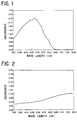
- a visible spectrum obtained before the application of the potential is shown in Fig. 1 and a visible spectrum obtained immediately after the application of the potential in Fig. 2.
- Sorbitol was molten at a temperature of about 105°C.
- a solution containing 60% by weight of lithium perchlorate (No. 3 - 1), 40% by weight of potassium thiocyanate (No. 3 - 2), 30% by weight of lithium tetrafluoroborate (No. 3 - 3), or 50% by weight of lithium trifluoromethane sulfonate (No. 3 - 4) was prepared.
- the content of salt in each solution corresponds to the maximum solubility in which the transparency of a solid electrolyte can be maintained.
- the prepared solution was applied to a platinum plate, cooled, and thereafter dried in a vacuum drier at a normal temperature for 48 hours.
Landscapes
- Physics & Mathematics (AREA)
- Chemical & Material Sciences (AREA)
- Nonlinear Science (AREA)
- Chemical Kinetics & Catalysis (AREA)
- Electrochemistry (AREA)
- General Physics & Mathematics (AREA)
- Inorganic Chemistry (AREA)
- Optics & Photonics (AREA)
- Spectroscopy & Molecular Physics (AREA)
- Engineering & Computer Science (AREA)
- Manufacturing & Machinery (AREA)
- General Chemical & Material Sciences (AREA)
- Electrochromic Elements, Electrophoresis, Or Variable Reflection Or Absorption Elements (AREA)
Applications Claiming Priority (2)
| Application Number | Priority Date | Filing Date | Title |
|---|---|---|---|
| JP357936/92 | 1992-12-25 | ||
| JP35793692 | 1992-12-25 |
Publications (2)
| Publication Number | Publication Date |
|---|---|
| EP0603793A2 true EP0603793A2 (fr) | 1994-06-29 |
| EP0603793A3 EP0603793A3 (en) | 1995-11-08 |
Family
ID=18456703
Family Applications (1)
| Application Number | Title | Priority Date | Filing Date |
|---|---|---|---|
| EP93120527A Withdrawn EP0603793A3 (en) | 1992-12-25 | 1993-12-20 | Organic solid electrolyte and coloring-discoloring device using the same. |
Country Status (2)
| Country | Link |
|---|---|
| US (1) | US5419854A (fr) |
| EP (1) | EP0603793A3 (fr) |
Cited By (1)
| Publication number | Priority date | Publication date | Assignee | Title |
|---|---|---|---|---|
| EP0654708A1 (fr) * | 1993-08-23 | 1995-05-24 | Konica Corporation | Composition solide pour le traitement de matériaux photographiques à l'halogénure d'argent sensibles à la lumière |
Families Citing this family (8)
| Publication number | Priority date | Publication date | Assignee | Title |
|---|---|---|---|---|
| CA2163065C (fr) * | 1994-11-22 | 2003-07-29 | Takaya Sato | Pile possedant un electrolyte polymerique solide, conducteur ionique; procede de fabrication |
| US5795453A (en) * | 1996-01-23 | 1998-08-18 | Gilmartin; Markas A. T. | Electrodes and metallo isoindole ringed compounds |
| US5830341A (en) * | 1996-01-23 | 1998-11-03 | Gilmartin; Markas A. T. | Electrodes and metallo isoindole ringed compounds |
| US5825526A (en) * | 1996-04-24 | 1998-10-20 | Minnesota Mining And Manufacturing Company | Tape for use in manufacturing electrochromic devices |
| US5774255A (en) * | 1996-09-23 | 1998-06-30 | Mcdonnell Douglas Corporation | Adaptive infrared modulator |
| DE19824185A1 (de) * | 1998-05-29 | 1999-12-02 | Bayer Ag | Elektrochrome Anordnung auf Basis von Poly-(3,4-ethylendioxy-thiophen)-Derivaten in Kombination mit einer Lithiumniobat-Gegenelektrode |
| DE19824215A1 (de) * | 1998-05-29 | 1999-12-02 | Bayer Ag | Elektrochrome Anordnung auf Basis von Poly-(3,4-ethylendioxy-thiophen)-Derivaten in der elektrochromen und der ionenspeichernden Funktionsschicht |
| CN113140787B (zh) * | 2021-03-23 | 2022-08-19 | 上海电气集团股份有限公司 | 一种宽温度范围固态电解质及其应用 |
Family Cites Families (9)
| Publication number | Priority date | Publication date | Assignee | Title |
|---|---|---|---|---|
| JPS6376273A (ja) * | 1986-09-18 | 1988-04-06 | Yuasa Battery Co Ltd | 高分子固体電解質 |
| JPH0777182B2 (ja) * | 1987-01-12 | 1995-08-16 | 和光純薬工業株式会社 | 固体電解コンデンサ |
| JPH0280462A (ja) * | 1988-09-16 | 1990-03-20 | Toray Dow Corning Silicone Co Ltd | イオン導電性材料およびその製造方法 |
| JP2559822B2 (ja) * | 1988-09-22 | 1996-12-04 | 株式会社ユアサコーポレーション | 高分子固体電解質 |
| JP2790467B2 (ja) * | 1988-11-18 | 1998-08-27 | 日本カーリット株式会社 | 高分子固体電解質及びその製造法 |
| US5223353A (en) * | 1990-03-16 | 1993-06-29 | Ricoh Company, Ltd. | Solid electrolyte, electrochemical device including the same and method of fabricating the solid electrolyte |
| JP3154746B2 (ja) * | 1991-06-07 | 2001-04-09 | 信越化学工業株式会社 | 有機固体電解質 |
| FR2687405A1 (fr) * | 1992-02-13 | 1993-08-20 | Inst Nat Polytech Grenoble | Materiau macromoleculaire a base de polysaccharides et materiau a conduction ionique le contenant. |
| EP0675894B1 (fr) * | 1992-12-23 | 2002-07-10 | Mitsubishi Chemical Corporation | Polymere conducteur d'ions et additifs pour electrolyte |
-
1993
- 1993-12-20 EP EP93120527A patent/EP0603793A3/en not_active Withdrawn
- 1993-12-21 US US08/170,805 patent/US5419854A/en not_active Expired - Fee Related
Cited By (1)
| Publication number | Priority date | Publication date | Assignee | Title |
|---|---|---|---|---|
| EP0654708A1 (fr) * | 1993-08-23 | 1995-05-24 | Konica Corporation | Composition solide pour le traitement de matériaux photographiques à l'halogénure d'argent sensibles à la lumière |
Also Published As
| Publication number | Publication date |
|---|---|
| EP0603793A3 (en) | 1995-11-08 |
| US5419854A (en) | 1995-05-30 |
Similar Documents
| Publication | Publication Date | Title |
|---|---|---|
| US9164345B2 (en) | Stable electrochromic module | |
| EP0169442B1 (fr) | Dispositif électro-optique | |
| EP1348045B1 (fr) | Dispositifs electrochromiques pour polymeres conjugues stables comprenant des liquides ioniques | |
| EP2202826B1 (fr) | Électrolytes de polymère et dispositifs les contenant | |
| DE3880120T2 (de) | Leitfähige Polymere von mit Äthergruppierung substituierten aromatischen heterocyclischen Verbindungen, Verfahren zu deren Herstellung, Vorrichtung enthaltend diese Polymere, und Monomere die ermöglichen solche Polymere zu gewinnen. | |
| EP2719702B1 (fr) | Élément électrochrome | |
| KR102149672B1 (ko) | 전기변색 소자 | |
| FR2596566A1 (fr) | Polymeres conducteurs derives de 3-alkylthiophenes, procede pour leur fabrication et dispositifs electroconducteurs les contenant | |
| CN1015628B (zh) | 制备导电的带取代基的聚异硫茚类方法 | |
| US9535304B2 (en) | Stable electrochromic module | |
| Dian et al. | Electrochemical synthesis of polythiophenes and polyselenophenes | |
| US5419854A (en) | Organic solid electrolyte and coloring-discoloring device using the same | |
| CN108251099A (zh) | 一种光照下可凝胶化且自修复的电致变色溶液及其应用 | |
| US7808691B2 (en) | Green electrochromic materials | |
| JP3464513B2 (ja) | 全固体エレクトロクロミック素子及びその製造方法 | |
| KR20090029982A (ko) | 전기변색 고분자 나노튜브의 제조방법 및 이를 이용한전기변색 소자 | |
| KR101857051B1 (ko) | 산화 그래핀 보호층 포함 전기변색용 전극필름, 이의 제조방법 및 산화 그래핀 보호층 포함 전극필름을 포함하는 전기변색 소자 | |
| CN108251100A (zh) | 一种室温下可凝胶化且自修复的电致变色溶液及其应用 | |
| EP3945363B1 (fr) | Élément électrochromique et son procédé de commande | |
| Moore et al. | Electrochromic properties of electrodeposited lutetium diphthalocyanine thin films | |
| US7298541B2 (en) | Green electrochromic (EC) material and device | |
| JPH07175092A (ja) | 新規有機固体電解質及び該固体電解質を用いた発色・変色素子 | |
| KR102688221B1 (ko) | 전기 변색 조성물 및 이를 포함하는 전기 변색 소자 | |
| CN115894872B (zh) | 一种含氟电致变色聚合物及其制备方法和应用 | |
| KR20210051342A (ko) | 전기변색소자 |
Legal Events
| Date | Code | Title | Description |
|---|---|---|---|
| PUAI | Public reference made under article 153(3) epc to a published international application that has entered the european phase |
Free format text: ORIGINAL CODE: 0009012 |
|
| AK | Designated contracting states |
Kind code of ref document: A2 Designated state(s): DE FR GB IT |
|
| RAP1 | Party data changed (applicant data changed or rights of an application transferred) |
Owner name: YKK CORPORATION |
|
| PUAL | Search report despatched |
Free format text: ORIGINAL CODE: 0009013 |
|
| AK | Designated contracting states |
Kind code of ref document: A3 Designated state(s): DE FR GB IT |
|
| 17P | Request for examination filed |
Effective date: 19960212 |
|
| 17Q | First examination report despatched |
Effective date: 19961223 |
|
| STAA | Information on the status of an ep patent application or granted ep patent |
Free format text: STATUS: THE APPLICATION IS DEEMED TO BE WITHDRAWN |
|
| 18D | Application deemed to be withdrawn |
Effective date: 19980106 |