EP0604051A1 - Câble à fibres optiques comprenant des substances de blocage d'eau et antigel - Google Patents
Câble à fibres optiques comprenant des substances de blocage d'eau et antigel Download PDFInfo
- Publication number
- EP0604051A1 EP0604051A1 EP93309752A EP93309752A EP0604051A1 EP 0604051 A1 EP0604051 A1 EP 0604051A1 EP 93309752 A EP93309752 A EP 93309752A EP 93309752 A EP93309752 A EP 93309752A EP 0604051 A1 EP0604051 A1 EP 0604051A1
- Authority
- EP
- European Patent Office
- Prior art keywords
- cable
- optical fiber
- antifreeze
- core
- constituent
- Prior art date
- Legal status (The legal status is an assumption and is not a legal conclusion. Google has not performed a legal analysis and makes no representation as to the accuracy of the status listed.)
- Withdrawn
Links
Images

Classifications
-
- G—PHYSICS
- G02—OPTICS
- G02B—OPTICAL ELEMENTS, SYSTEMS OR APPARATUS
- G02B6/00—Light guides; Structural details of arrangements comprising light guides and other optical elements, e.g. couplings
- G02B6/44—Mechanical structures for providing tensile strength and external protection for fibres, e.g. optical transmission cables
- G02B6/4401—Optical cables
- G02B6/4429—Means specially adapted for strengthening or protecting the cables
- G02B6/44384—Means specially adapted for strengthening or protecting the cables the means comprising water blocking or hydrophobic materials
-
- G—PHYSICS
- G02—OPTICS
- G02B—OPTICAL ELEMENTS, SYSTEMS OR APPARATUS
- G02B6/00—Light guides; Structural details of arrangements comprising light guides and other optical elements, e.g. couplings
- G02B6/44—Mechanical structures for providing tensile strength and external protection for fibres, e.g. optical transmission cables
- G02B6/4401—Optical cables
- G02B6/4429—Means specially adapted for strengthening or protecting the cables
- G02B6/443—Protective covering
- G02B6/4432—Protective covering with fibre reinforcements
- G02B6/4433—Double reinforcement laying in straight line with optical transmission element
-
- G—PHYSICS
- G02—OPTICS
- G02B—OPTICAL ELEMENTS, SYSTEMS OR APPARATUS
- G02B6/00—Light guides; Structural details of arrangements comprising light guides and other optical elements, e.g. couplings
- G02B6/44—Mechanical structures for providing tensile strength and external protection for fibres, e.g. optical transmission cables
- G02B6/4401—Optical cables
- G02B6/4429—Means specially adapted for strengthening or protecting the cables
- G02B6/44386—Freeze-prevention means
Definitions
- This invention relates to an optical fiber cable which includes waterblocking and freeze preventing provisions.
- water may enter the cable because of damage to the cable which compromises its integrity.
- lightning and rodent attacks or mechanical impacts may cause openings in the sheath system of the cable to occur, allowing water to enter and, if not controlled, to move longitudinally along the cable into splice closures, for example.
- a metallic shield which often times is used to protect a metallic conductor cable against lightning and rodent attacks is provided with a sealed longitudinal seam.
- a filling material comprising a mixture of a hydrophobic powder in the form of water repellent treated calcium carbonate and a hydrophilic powder in the form of at least one high molecular weight resin rapidly hydratable to form a viscous solution. See U.S. 4,002,819.
- Waterblocking provisions inside the core may be other than a filling material. See U.S. 4,946,237.
- a longitudinally extending waterblocking member inside a core tube may take several forms. For example, it may comprise a laminate comprising a powder captured between two tapes. Or, it may comprise a substrate tape which is impregnated with a material. When exposed to water, the impregnating material reacts, swells, and causes the tape to prevent the passage of water through the sheath system toward the core and its migration in a direction longitudinally along the cable.
- the impregnating material comprises a film of a water swelling or so-called superabsorbent material.
- a tape may be treated with a coating comprising a superabsorbent material.
- the waterblocking provisions within the core may comprise one or more yarns which have been impregnated with a superabsorbent material or which comprise superabsorbent fibers.
- the waterblocking provisions in the core may comprise a waterblocking tape, which may engage an inner surface of the core tube, and a waterblocking yarn or yarns.
- optical fiber cables have made great inroads into the communications cable market. Although for slightly different reasons, undesired moisture may also detrimentally affect the operation of an optical fiber cable as well. For example, the formation of and retention of ice around the optical fibers provide a microbending crushing effect which is known to increase undesirably the attenuation. However, even when efforts are made to prevent water ingress, sheath damage may provide pathway for water into cable and upon freezing, attenuation problems will still result. Additionally, it has been found that the use of a superabsorbent tape in an optical fiber cable core may result in an increased microbending loss in the fibers because of freezing of the activated superabsorbent gel.
- Another problem relates to the use of riser cables which connect interoffice and intercity trunks.
- indoor optical fiber cables are all air core while outdoor cables include filling materials in the core to provide resistance to water penetration.
- outdoor cables include filling materials in the core to provide resistance to water penetration.
- the use of one cable to extend from an outside manhole and on into a building would result in substantial cost savings because of the elimination of the need for additional splice locations.
- the cable In order to use one length of cable to extend from a splice location in a manhole outside a building into the building and then to distribution points, the cable must include suitable waterblocking and freeze prevention provisions to satisfy outside requirements which do not compromise the fire retardance properties of the cable needed for internal building use.
- optical fiber cable which includes a single compositional powder blend capable of providing dual functions by protecting against the flow of water along the cable as well as protecting the optical fibers against a freezing environment. Also desirable is a cable which has sufficient flame retardance so that the cable may be used inside buildings such as in risers, for example.
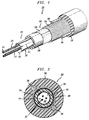
- a communications cable which may incorporate the features of the present invention and is designated generally with the numeral 20 and which has a longitudinal axis 21. It includes a core 22 comprising one or more units 24-24 of optical fibers 25-25 which may be buffered with an outer layer of polyvinyl chloride (PVC), for example. Each of the units 24-24 is wrapped with a binder ribbon 27.
- the core 22 includes a carrier member 26 which is disposed within a tubular member 28 referred to as a core tube of a sheath system 32.
- the core tube 28 is enclosed by a metallic shield 34 and an outer plastic jacket 38.
- the sheath system 32 also includes two diametrically opposed strength members 36-36.
- the carrier matter 26 is a spunbonded non-woven polyester tape material and includes a web structure comprised of randomly-arranged fibers which are bonded primarily at the filament crossovers. Continuity of the fibers of the web, while not necessary to the invention, will provide the web with an increased tensile strength.
- the fibers may be formed of any plastic resin, or other appropriate material which has the capability of maintaining its shape in the presence of the temperatures encountered during the extrusion of the core tube 28.
- the fibers of the web structure are arranged so that air cells or pockets are formed.
- a polyethylene terephthalate fiber product, formed into a web structure as described above has been identified under the registered trademark "Reemay” by the E. I. du Pont de Nemours and Company, Incorporated of Wilmington, Del.
- the Reemay® web structure is available in various thicknesses and densities from Reemay, Inc. of Old Hickory, Tennessee.
- the properties of Reemay tapes are further defined and described in Bulletin R-1, dated March, 1986, entitled “Properties and Processing of Reemay Spunbonded Polyester” from E. I. du Pont de Nemours and Company, Incorporated, Wilmington, Delaware.
- the tape which is to be impregnated may be a nylon spunbonded fabric, non-woven glass, polypropylene melt blown non-woven fabric, polyurethane spunbonded fabric or TCF cellulose fabric, for example.
- the carrier tape 26 of this invention also acts as a thermal barrier not only during the extrusion of the core tube 28 but also during the extrusion of the jacket 38. As the jacket 38 is extruded over the shield 34, heat is available for transfer into the optical fiber core.
- the carrier tape 26 of the cable 20 has the ability to insulate against the heat caused by the extrusion of the core tube and the jacket.
- the stiffness of the body of the material which comprises the tape is controlled by a combination of factors such as the number of fibers per unit volume, thickness of the material, size of the fibers and the amount and type of binder used in the material.
- Increasing the thickness of the material obviously increases the cost of the material per unit of surface area of cable covered.
- Increasing the number of the fibers per unit volume or increasing the amount of binder tends to increase the ability of the material to delay heat transfer.
- At least three factors, 1) formability of the carrier tape 26, 2) cost of the tape, and 3) insulative capability of the tape should be considered and balanced in providing the proper material for use in a particular cable.
- the spunbonded polyester tape may combine the thermal, chemical and mechanical properties of polyester fibers with a spunbonded structure to provide a tape which is suitable for use in a communications cable. These properties include a relatively high tensile strength and elongation, excellent tear strength, and resistance to temperatures which might be expected in a burning building and which may reach values as high as about 2000°F.
- the cables of this invention include waterblocking and antifreeze materials, insulation and jacketing materials, such as polyvinyl chloride, for example, which result in passage of Underwriters Laboratories test UL 1666 for riser cable. In each sample tested, the flame height was substantially less than the allowable 336 cm over a one minute time duration.
- a single compositional blend is developed as a mixture of an antifreeze material with a superabsorbent powder.
- the blend of the present invention may then be applied to a tape substrate by spraying or any other well-known application method.
- the composition of blend may also be applied via electronic deposition directly onto the transmission medium, the sheath system or the core tube.
- compositional blends of this application provide a single substance capable of both blocking the flow of water/moisture within a cable, as well as preventing freezing of various constituents which may be located within the cable. Since one material achieves both of the desired functions, the processing time is substantially shortened by the elimination of having to separately treat each tape with both an antifreeze material and then later separately treat the tape with a superabsorbent material.
- the water soluble material, or mixture of water soluble materials, which prevents the freezing of water or moisture within the cable includes polyethylene glycol.
- other materials which are suitable as an antifreeze constituent include polypropylene glycol, dimethyl sulfoxide and sodium or potassium chloride. The latter material is used presently in powder form as a de-icer on roads.
- Superabsorbents are hydrophilic materials which can absorb and retain water without dissolution in the fluid being absorbed. See J. C. Djock and R. E. Knd "Review of Synthetic and Starch-Graft Copolymer Superabsorbents" prepared for the Absorbent Products Conference held November 16-17, 1983 in San Antonio, Texas and incorporated by reference hereinto. Properties such as enzyme stability, biodegradability, absorbent capacity and rate of uptake are used to characterize a superabsorbent material.
- One of the early superabsorbents was a saponified starch graft polyacrylonitrile copolymer. See U.S. patent 3,425,971. The above-identified patent discloses saponifying starch-graft polyacrylonitrile copolymers with aqueous bases.
- the two major superabsorbents which are available today are cellulosic or starch-graft copolymers and synthetic superabsorbents.
- synthetic superabsorbents There are two major broad classes of synthetic superabsorbents. These are the polyelectrolytes and the non-electrolytes. The polyelectrolytes are the most important and fall into several classes. Of these, the polyacrylic acid-based superabsorbents are most common. As with cellulosic-graft copolymer superabsorbents, the capacity of synthetic superabsorbents decreases with increasing salinity.
- the polyacrylic acid class of superabsorbents includes both homopolymers and copolymers of acrylic acids and acrylate salts.
- the monomer units usually are polymerized to produce a water-soluble polymer which is then rendered insoluble by ionic and/or covalent cross-linking.
- Cross-linking of the polymer may be accomplished with a multivalent cation, radiation, or with a cross-linking agent.
- the absorbency of the product is determined by the number of ionizable groups, usually carboxylates, and the cross-linking density.
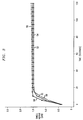
- FIG. 3 depicts the swellability results of a compositional blend which includes one particular superabsorbent material, namely polysodium acrylate, as effected by varying amounts of an antifreeze material, namely polyethylene glycol.
- maximum swell height was achieved with a carrier tape having only superabsorbent powder, with no antifreeze material, positioned between two substrate tapes.
- curve identified as element 50 on FIG. 3 tracks results for this example where polysodium acrylate superabsorbent is in distilled water.
- Curve 52 present results of a compositional blend which includes polysodium acrylate with 5% polyethylene glycol.
- curve 54 presents results of a blend which combine polysodium acrylate with 80% polyethylene glycol.
- each of tapes which included superabsorbent and antifreeze materials achieved less total swell height than that of the tape which included superabsorbent only, they result in a faster rate-of-rise, while meeting the minimum swell height requirements of 0.5 cm in 60 seconds.
- the rate-of-rise characteristic of a given blend is a more critical parameter in gauging the actual effectiveness of preventing the ingress of water within the cable core than is the ultimate total swell height achieved.
- Other tests may be run including combining slightly different superabsorbent or antifreeze constituents. However, due to wide range in the ratios of constituents used in the results set forth herein, it is believed that similar advantageous results may be predictably obtained without departing from the scope of the present invention.
- Each of the tapes also may be provided with resistance to microbial growth.
- Non-cellulosic tapes are used and the superabsorbent materials are microbial resistant. See U. S. Patent 5,020,875 which is incorporated by reference hereinto.
- the tapes thus far have been polyester non-woven tapes, it also is possible to utilize between two tapes which are wood pulp derivatives. These perform equally as well as the others described except that fungus growth is experienced.
- such cellulosic tapes are treated with antimicrobial resistant material such as Intersept antimicrobial resistant material as marketed by Interface Research Corporation or TK100 material which is marketed by Calgon Corporation.
- a cable from a manhole into a building and up a riser shaft.
- a cable not only must include waterblocking and antifreeze provisions for the outside portion of the use but also must have sufficiently low flame retardance and smoke generation properties.
- the cable 20 may extend from an outside manhole 70 into a building 72 and up a riser shaft.
- a cable 80 which is suitable for installation between a manhole and a distribution point within a building includes a core 82 comprising a plurality of optical fibers 83-83 which may be in ribbon form (not shown) and a laminate 85.
- the laminate 85 comprises two tapes treated with the compositional blend of the present invention.
- a tubular member 87 Enclosing the foregoing is a tubular member 87.
- a strength member system which includes an inner layer 90 comprising relatively flexible rovings and an outer layer 92 comprising at least some rod-like strength members.
- a jacket 94 made of a plastic material which is flame retardant is disposed about the strength member system.
- a tape 96 which has been treated or laminated to include only a waterblocking function may be interposed between the tubular member 87 and the strength member system.
Landscapes
- Physics & Mathematics (AREA)
- General Physics & Mathematics (AREA)
- Optics & Photonics (AREA)
- Laying Of Electric Cables Or Lines Outside (AREA)
- Insulated Conductors (AREA)
Applications Claiming Priority (2)
| Application Number | Priority Date | Filing Date | Title |
|---|---|---|---|
| US07/994,569 US5410629A (en) | 1992-12-22 | 1992-12-22 | Optical fiber cable which includes waterblocking and freeze preventing provisions |
| US994569 | 1992-12-22 |
Publications (1)
| Publication Number | Publication Date |
|---|---|
| EP0604051A1 true EP0604051A1 (fr) | 1994-06-29 |
Family
ID=25540809
Family Applications (1)
| Application Number | Title | Priority Date | Filing Date |
|---|---|---|---|
| EP93309752A Withdrawn EP0604051A1 (fr) | 1992-12-22 | 1993-12-06 | Câble à fibres optiques comprenant des substances de blocage d'eau et antigel |
Country Status (7)
| Country | Link |
|---|---|
| US (1) | US5410629A (fr) |
| EP (1) | EP0604051A1 (fr) |
| JP (1) | JPH06243734A (fr) |
| AU (1) | AU660861B2 (fr) |
| CA (1) | CA2107983A1 (fr) |
| MX (1) | MX9308008A (fr) |
| NZ (1) | NZ250482A (fr) |
Cited By (1)
| Publication number | Priority date | Publication date | Assignee | Title |
|---|---|---|---|---|
| CN104898246A (zh) * | 2014-01-02 | 2015-09-09 | 常熟市谷雷特机械产品设计有限公司 | 一种电力网或通信网用层绞结构自承式光缆及其制造方法 |
Families Citing this family (13)
| Publication number | Priority date | Publication date | Assignee | Title |
|---|---|---|---|---|
| DE19652762A1 (de) | 1996-12-18 | 1998-08-06 | Henkel Kgaa | Quellbarer Schmelzklebstoff |
| US5838864A (en) * | 1997-04-30 | 1998-11-17 | Lucent Technologies Inc. | Optical cable having an improved strength system |
| US6304701B1 (en) | 1998-03-27 | 2001-10-16 | Corning Cable Systems Llc | Dry fiber optic cable |
| DE19859728A1 (de) | 1998-12-23 | 2000-06-29 | Henkel Kgaa | Wasserquellbarer Schmelzklebstoff |
| JP4626797B2 (ja) * | 2002-11-12 | 2011-02-09 | 株式会社豊田中央研究所 | 燃料電池システム |
| US8104247B2 (en) * | 2003-11-12 | 2012-01-31 | Margaret Henderson Hasse | Disposable roof covering |
| US7630605B2 (en) * | 2007-06-26 | 2009-12-08 | Corning Cable Systems Llc | Optical fiber assemblies having relatively low-levels of water-swellable powder and methods therefor |
| US7916989B2 (en) | 2008-07-31 | 2011-03-29 | Corning Cable Systems Llc | Optical fiber assemblies having a powder or powder blend at least partially mechanically attached |
| EP2318872B1 (fr) | 2008-08-15 | 2013-03-20 | Corning Cable Systems LLC | Ensembles de fibres optiques et procédés et appareil de fabrication associés |
| CN102136320A (zh) * | 2010-12-21 | 2011-07-27 | 苏州雅典娜科技有限公司 | 一种新型防覆冰输电线缆 |
| US8412012B2 (en) * | 2011-09-06 | 2013-04-02 | Ofs Fitel, Llc | Compact, low-cost outside plant or indoor/outdoor cables |
| CN107195366A (zh) * | 2017-06-30 | 2017-09-22 | 江苏华亚电缆有限公司 | 一种防水防冻悬挂式水泵用橡套电缆 |
| WO2023135808A1 (fr) * | 2022-01-17 | 2023-07-20 | 住友電気工業株式会社 | Câble à fibre optique |
Citations (3)
| Publication number | Priority date | Publication date | Assignee | Title |
|---|---|---|---|---|
| JPS6215510A (ja) * | 1985-07-15 | 1987-01-23 | Japan Vilene Co Ltd | 走水防止型光ファイバーケーブル |
| JPS63172887A (ja) * | 1987-01-13 | 1988-07-16 | Shimizu Constr Co Ltd | 空気熱源ヒ−トポンプ用屋外熱交換器 |
| JPH05140138A (ja) * | 1991-11-26 | 1993-06-08 | Nippon Kayaku Co Ltd | エポキシ樹脂、樹脂組成物及び硬化物 |
Family Cites Families (9)
| Publication number | Priority date | Publication date | Assignee | Title |
|---|---|---|---|---|
| US3425971A (en) * | 1966-03-02 | 1969-02-04 | Us Agriculture | Salt-resistant thickeners comprising base-saponified starch-polyacrylonitrile graft copolymers |
| US4002819A (en) * | 1976-06-14 | 1977-01-11 | Northern Electric Company Limited | Water blocked electric cables |
| US4176240A (en) * | 1978-05-30 | 1979-11-27 | Bell Telephone Laboratories, Incorporated | Filled electrical cable |
| CA1299412C (fr) * | 1986-09-19 | 1992-04-28 | Nobuhiro Akasaka | Cable de fibres optiques muni d'un dispositif empechant l'eau de se repandre a l'interieur de la gaine |
| US4909592A (en) * | 1988-09-29 | 1990-03-20 | American Telephone And Telegraph Company, At&T Bell Laboratories | Communication cable having water blocking provisions in core |
| US4946237A (en) * | 1989-06-30 | 1990-08-07 | At&T Bell Laboratories | Cable having non-metallic armoring layer |
| US5138685A (en) * | 1990-01-23 | 1992-08-11 | At&T Bell Laboratories | Communications cable having microbial resistant water blocking provisions |
| US5179611A (en) * | 1990-07-17 | 1993-01-12 | Tokai Rubber Industries, Ltd. | Optical fiber cable having a water absorptive member |
| US5321788A (en) * | 1992-06-29 | 1994-06-14 | At&T Bell Laboratories | Optical fiber cable which includes waterblocking and freeze preventing provisions |
-
1992
- 1992-12-22 US US07/994,569 patent/US5410629A/en not_active Expired - Fee Related
-
1993
- 1993-10-07 CA CA002107983A patent/CA2107983A1/fr not_active Abandoned
- 1993-12-06 EP EP93309752A patent/EP0604051A1/fr not_active Withdrawn
- 1993-12-06 AU AU52191/93A patent/AU660861B2/en not_active Ceased
- 1993-12-15 MX MX9308008A patent/MX9308008A/es not_active IP Right Cessation
- 1993-12-16 NZ NZ250482A patent/NZ250482A/en unknown
- 1993-12-20 JP JP5344605A patent/JPH06243734A/ja active Pending
Patent Citations (3)
| Publication number | Priority date | Publication date | Assignee | Title |
|---|---|---|---|---|
| JPS6215510A (ja) * | 1985-07-15 | 1987-01-23 | Japan Vilene Co Ltd | 走水防止型光ファイバーケーブル |
| JPS63172887A (ja) * | 1987-01-13 | 1988-07-16 | Shimizu Constr Co Ltd | 空気熱源ヒ−トポンプ用屋外熱交換器 |
| JPH05140138A (ja) * | 1991-11-26 | 1993-06-08 | Nippon Kayaku Co Ltd | エポキシ樹脂、樹脂組成物及び硬化物 |
Non-Patent Citations (3)
| Title |
|---|
| PATENT ABSTRACTS OF JAPAN vol. 11, no. 189 (P - 587) 18 June 1987 (1987-06-18) * |
| PATENT ABSTRACTS OF JAPAN vol. 12, no. 442 (M - 766) 21 November 1988 (1988-11-21) * |
| PATENT ABSTRACTS OF JAPAN vol. 17, no. 513 (C - 1111) 16 September 1993 (1993-09-16) * |
Cited By (2)
| Publication number | Priority date | Publication date | Assignee | Title |
|---|---|---|---|---|
| CN104898246A (zh) * | 2014-01-02 | 2015-09-09 | 常熟市谷雷特机械产品设计有限公司 | 一种电力网或通信网用层绞结构自承式光缆及其制造方法 |
| CN104898246B (zh) * | 2014-01-02 | 2017-12-08 | 国网江西省电力公司赣东北供电分公司 | 一种电力网或通信网用层绞结构自承式光缆及其制造方法 |
Also Published As
| Publication number | Publication date |
|---|---|
| MX9308008A (es) | 1994-08-31 |
| US5410629A (en) | 1995-04-25 |
| NZ250482A (en) | 1997-05-26 |
| AU660861B2 (en) | 1995-07-06 |
| CA2107983A1 (fr) | 1994-06-23 |
| JPH06243734A (ja) | 1994-09-02 |
| AU5219193A (en) | 1994-07-07 |
Similar Documents
| Publication | Publication Date | Title |
|---|---|---|
| US5321788A (en) | Optical fiber cable which includes waterblocking and freeze preventing provisions | |
| US5138685A (en) | Communications cable having microbial resistant water blocking provisions | |
| US4815813A (en) | Water resistant communications cable | |
| US5082719A (en) | Water resistant communications cable | |
| US4867526A (en) | Water resistant communications cable | |
| US4909592A (en) | Communication cable having water blocking provisions in core | |
| US5410629A (en) | Optical fiber cable which includes waterblocking and freeze preventing provisions | |
| US5131064A (en) | Cable having lightning protective sheath system | |
| EP0342855B1 (fr) | Câble résistant aux attaques des animaux | |
| US4913517A (en) | Communication cable having water blocking strength members | |
| US6487347B2 (en) | Indoor/outdoor optical cables | |
| US5146046A (en) | Cable having waterblocking provisions between layers of relatively rigid and supple materials | |
| US4938560A (en) | Animal-resistant cable | |
| EP0439277A1 (fr) | Câble de communication ayant des réserves résistant aux microbes pour bloquer l'eau | |
| JP2001188153A (ja) | 遮水性および難燃性のファイバを内蔵するケーブル | |
| KR100307858B1 (ko) | 수류차단장치와냉동방지장치를갖는광섬유케이블 | |
| JPH0578647A (ja) | 遮水用材料及びこれを用いたケーブル |
Legal Events
| Date | Code | Title | Description |
|---|---|---|---|
| PUAI | Public reference made under article 153(3) epc to a published international application that has entered the european phase |
Free format text: ORIGINAL CODE: 0009012 |
|
| AK | Designated contracting states |
Kind code of ref document: A1 Designated state(s): DE FR GB |
|
| 17P | Request for examination filed |
Effective date: 19941208 |
|
| 17Q | First examination report despatched |
Effective date: 19961024 |
|
| STAA | Information on the status of an ep patent application or granted ep patent |
Free format text: STATUS: THE APPLICATION IS DEEMED TO BE WITHDRAWN |
|
| 18D | Application deemed to be withdrawn |
Effective date: 19970506 |