EP0604329A2 - Procédé de sélection de niveaux de sortie pour demi-teintes à plusiers niveaux en présence d'un dispositif d'affichage instable - Google Patents
Procédé de sélection de niveaux de sortie pour demi-teintes à plusiers niveaux en présence d'un dispositif d'affichage instable Download PDFInfo
- Publication number
- EP0604329A2 EP0604329A2 EP93420494A EP93420494A EP0604329A2 EP 0604329 A2 EP0604329 A2 EP 0604329A2 EP 93420494 A EP93420494 A EP 93420494A EP 93420494 A EP93420494 A EP 93420494A EP 0604329 A2 EP0604329 A2 EP 0604329A2
- Authority
- EP
- European Patent Office
- Prior art keywords
- tone transfer
- system tone
- level
- unstable
- levels
- Prior art date
- Legal status (The legal status is an assumption and is not a legal conclusion. Google has not performed a legal analysis and makes no representation as to the accuracy of the status listed.)
- Withdrawn
Links
Images



Classifications
-
- G—PHYSICS
- G06—COMPUTING OR CALCULATING; COUNTING
- G06T—IMAGE DATA PROCESSING OR GENERATION, IN GENERAL
- G06T5/00—Image enhancement or restoration
- G06T5/90—Dynamic range modification of images or parts thereof
- G06T5/92—Dynamic range modification of images or parts thereof based on global image properties
Definitions
- the present invention is directed to the field of multi-level halftoning and, more particularly, to a process for choosing multiple output density levels to be utilized by multi-level halftoning in the presence of an unstable output device.
- bi-tonal halftoning the appearance of intermediate shades of gray are created by a spatial modulation of black and white.
- U.S. Patent No. 4,547,811 addresses multi-level halftoning techniques.
- the '811 patent relates to a method and apparatus for gray level processing, wherein images with less gray levels and many gray levels are reproduced in high quality.
- U.S. Patent No. 4,792,979 to Nomura et al relates to a method and apparatus for correcting the gradation of an image represented by image data.
- the present invention is a process for selecting output levels for multi-level halftones in the presence of an unstable device. More specifically, the present invention is a process for choosing multiple output density levels to be used by a multi-level halftoning algorithm in the presence of an unstable device. This process optimizes the performance and capabilities of a given multi-level half-tone algorithm by specifying output levels whose instability has a minimal impact on image quality.
- a process for selecting output levels for multi-level halftones in the presence of an unstable output device comprises the steps of: defining a function which quantifies undesirable mean level image artifacts for an unstable display device and then choosing density levels which minimize the function.
- the present invention relates to a process for choosing multiple output density levels to be utilized by a multi-level halftoning algorithm in the presence of an unstable display device.
- Multi-level halftoning creates the appearance of intermediate tones by the spatial modulation of more than two tones, i.e., black, white, and one or more shades of gray.
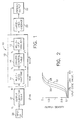
- Fig. 1 illustrates an N-level display device or system 10 employing a multi-level halftoning printer 12.
- the multi-level printer 12, a multi-level halftone 14, and a printer control table 16 are shown as an output device 18 capable of printing N unique large-area densities.
- the output of the printer 12 must be processed through a large-area average box 20, indicative of integration over a large area, to determine the average density for evaluating an actual system tone transfer.
- the output of the printer 12 also provides a printed output 22.
- a calibration table such as output calibration table 24, precedes the N-level output device 18 in order to achieve the target system tone transfer function between input image data 26 and the average density printed output 22.
- the dynamic resolution of the input 26 is usually greater than N, i.e., 2 L > N.
- the multi-level halftone algorithm 14 creates a spatially modulated M-level output signal where N > M.
- N M
- M M
- y i K bits wide where M ⁇ 2 K .
- the display device 10 prints each pixel independently of those around it with a density that corresponds to the pixel code value y i .
- the printer control table 16 is built to minimize system artifacts such as contouring and noise.
- this approach assumes that all the density levels provided by the display device will be reasonably stable.
- regions of the display device's density tone scale will often fluctuate due to factors such as component wear and changing environmental conditions.
- a printer tone transfer function of the multi-level printer 12 may consist of a typical s-shape, as indicated by solid curve 28.
- the printer tone transfer function 28 is measured from the input of the printer 12 to the output of the printer 12, as the printer 12 represents the unstable component in the system 10. Over the life of the printer 12, the printer tone transfer function may fluctuate to either of the extremes represented by the dotted lines 30 and 32.
- a function which quantifies undesirable mean level image artifacts for the unstable display device 10.
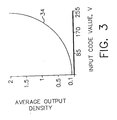
- One means for defining the function involves the identification of a target system tone transfer curve which specifies the average output density for each input level as processed by the system 10 of Fig. 1. Assuming L to be equal to eight, where L is usually a given system parameter, a target system tone transfer curve 34 will usually be non-linear, as illustrated in Fig. 3. Even though the input code value v along the horizontal axis in Fig. 3 is a discrete quantity, the curve 34 is shown as a continuous curve for the sake of simplicity, which extends out to the output of the large-area average of box 20 in Fig. 1.
- an actual system tone transfer will vary within some envelope, as indicated in Fig. 9.
- the actual shape of the envelope will depend on the nature of the multi-level halftone algorithm 14, the physical characteristics of the display substrate and display toners or inks, and the entries in the printer control table 16 which are to be optimized. This is accomplished by defining the function that is to be minimized, as described in more detail later.
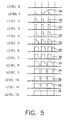
- Figs. 4 and 5 Two approaches to rendering the thirteen levels are shown in Figs. 4 and 5.
- Fig. 4 illustrates rendering the thirteen levels, form Level 0 to Level 12, with a minimum amount of modulation
- Fig. 5 illustrates rendering the thirteen levels, form Level 0 to Level 12, with a maximum amount of modulation.
- Figs. 4 and 5 shown cross-sections of a segment of a waveform 36, where the waveform is equal to zero at Level 0 and equal to one at Level 12.
- Figs. 4 and 5 show two extremes for going from a waveform of zero to a waveform of one. From Figs. 4 and 5, it is obvious that the amount of modulation affects which of the M available density levels is used to synthesize the N output levels, thereby impacting the amount of variation that a tonally unstable pixel may have on any one of the N average output levels.
- the physical characteristics of the hardcopy display device will also affect the shape of the instability envelope, due to the interaction of the modulated multi-level halftone image with the paper and toners.
- R d i the paper spread function and multiple internal reflection.
- the actual average density for a given display technology will usually be bounded by the two extremes given in Equations (1) and (2).
- the large-area average of box 20 in Fig. 1 is either measured or predicted, if possible, by models such as Equations (1) or (2).
- Table 1 below lists the entries for the printer control table 16 as well as the associated densities, assuming the printer tone transfer curve 28 of Fig. 2.
- the actual system tone transfer curve may be anywhere within the envelope depicted in Fig. 9. Dotted step curves 44 and 46 indicate the actual system tone transfer curves representative of the printer 12 operating at its extremes.
- the target tone transfer curve 28 is overlaid thereon for purposes of comparison.
- a A (v i ) is the actual system tone transfer assuming that the printer 12 is operating at variation extreme 44 of Fig. 9
- a B (v i ) is the actual system tone transfer assuming that the printer 12 is operating at variation extreme 46 of Fig. 9.
- the output calibration table 24 is specified so that when it is cascaded with the multi-level halftone algorithm 14, the printer control table 16, the multi-level printer 12 operating at its nominal setting, and the large-area average of box 20, there is minimum squared-error between the nominal system tone transfer and the target system tone transfer.
- the output calibration table 24 as determined in the first step above is cascaded with the multi-level halftone algorithm 14, the printer control table 16, variation extreme 44 of the multi-level printer 12, and the large-area average of box 20, to specify A A (v i ), the actual system tone transfer when the printer 12 is operating at variation extreme 44.
- the output calibration table 24 as determined in the first step above is cascaded with the multi-level halftone algorithm 14, the printer control table 16, variation extreme 46 of the multi-level printer 12, and the large-area average of box 20, to specify A B (v i ), the actual system tone transfer when the printer 12 is operating at variation extreme 46.
- the objective specified in Equation (3) is calculated, using the target system tone transfer 34, A A (v i ), and A B (v i ).
- the present invention provides for a process of choosing multiple output density levels to be utilized by a multi-level halftoning algorithm in the presence of an unstable output device.
- the process involves defining a function which quantifies the undesirable image artifacts.
- the process is carried out by choosing density levels which minimize the function. The result will depend on the specific multi-level halftone algorithm used, the micro and macro characteristics of the display device, and the nature of the display device instability.
- the present invention is useful in the field of multi-level halftoning and has the advantage of optimizing the performance of an unstable display device.
- the optimization process involves the selection of output levels for multi-level halftones in the presence of an unstable display device.
- the process has the advantage of optimizing performance and capabilities of a given multi-level halftone algorithm by specifying the output levels whose instability has a minimal impact on image quality. Consequently, the actual system tone transfer of a printing device is optimally stabilized and matched to a target system tone transfer even though the system contains unstable components. It is a further advantage that this is accomplished without adding additional components to the system or putting additional performance constraints on the unstable components.
Landscapes
- Physics & Mathematics (AREA)
- General Physics & Mathematics (AREA)
- Engineering & Computer Science (AREA)
- Theoretical Computer Science (AREA)
- Image Processing (AREA)
- Facsimile Image Signal Circuits (AREA)
- Color, Gradation (AREA)
- Dot-Matrix Printers And Others (AREA)
Applications Claiming Priority (2)
| Application Number | Priority Date | Filing Date | Title |
|---|---|---|---|
| US995841 | 1992-12-23 | ||
| US07/995,841 US5452403A (en) | 1992-12-23 | 1992-12-23 | Process for selecting output levels for multi-level halftone in the presence of an unstable display device |
Publications (2)
| Publication Number | Publication Date |
|---|---|
| EP0604329A2 true EP0604329A2 (fr) | 1994-06-29 |
| EP0604329A3 EP0604329A3 (fr) | 1994-10-12 |
Family
ID=25542267
Family Applications (1)
| Application Number | Title | Priority Date | Filing Date |
|---|---|---|---|
| EP19930420494 Withdrawn EP0604329A3 (fr) | 1992-12-23 | 1993-12-13 | Procédé de sélection de niveaux de sortie pour demi-teintes à plusiers niveaux en présence d'un dispositif d'affichage instable. |
Country Status (3)
| Country | Link |
|---|---|
| US (1) | US5452403A (fr) |
| EP (1) | EP0604329A3 (fr) |
| JP (1) | JPH06350853A (fr) |
Families Citing this family (9)
| Publication number | Priority date | Publication date | Assignee | Title |
|---|---|---|---|---|
| JP3585990B2 (ja) * | 1995-05-01 | 2004-11-10 | 富士写真フイルム株式会社 | 画像処理方法 |
| US6977752B1 (en) * | 1995-08-07 | 2005-12-20 | Electronics For Imaging, Inc. | Method and apparatus for determining toner level in electrophotographic print engines |
| US6657741B1 (en) * | 1995-08-07 | 2003-12-02 | Tr Systems, Inc. | Multiple print engine system with selectively distributed ripped pages |
| US6035103A (en) * | 1995-08-07 | 2000-03-07 | T/R Systems | Color correction for multiple print engine system with half tone and bi-level printing |
| US7046391B1 (en) * | 1995-08-07 | 2006-05-16 | Electronics For Imaging, Inc. | Method and apparatus for providing a color-balanced multiple print engine |
| US6208431B1 (en) | 1998-03-31 | 2001-03-27 | International Business Machines Corporation | Method of eliminating artifacts in display devices |
| US6215562B1 (en) * | 1998-12-16 | 2001-04-10 | Electronics For Imaging, Inc. | Visual calibration |
| US6842266B1 (en) * | 2000-02-25 | 2005-01-11 | Xerox Corporation | Systems and methods that determine an image processing system tone reproduction curve |
| US7102789B2 (en) * | 2001-09-17 | 2006-09-05 | Sharp Laboratories Of America, Inc. | Method for rendering an image comprising multi-level pixels |
Family Cites Families (17)
| Publication number | Priority date | Publication date | Assignee | Title |
|---|---|---|---|---|
| US3953668A (en) * | 1975-05-27 | 1976-04-27 | Bell Telephone Laboratories, Incorporated | Method and arrangement for eliminating flicker in interlaced ordered dither images |
| US4389672A (en) * | 1981-02-02 | 1983-06-21 | Bell Telephone Laboratories, Incorporated | Display of pseudo-gray scale picture signals on multilevel displays |
| GB2103449B (en) * | 1981-06-29 | 1985-05-30 | Nippon Telegraph & Telephone | Method and apparatus for gray level signal processing |
| JPS60165873A (ja) * | 1984-02-09 | 1985-08-29 | Dainippon Screen Mfg Co Ltd | 網点発生器のアドレス発生方法 |
| US4651287A (en) * | 1984-06-14 | 1987-03-17 | Tsao Sherman H | Digital image processing algorithm for output devices with discrete halftone gray scale capability |
| JPS6342575A (ja) * | 1986-08-08 | 1988-02-23 | Dainippon Screen Mfg Co Ltd | 階調変換方法およびその装置 |
| US4924322A (en) * | 1988-03-18 | 1990-05-08 | Matsushita Electric Industrial Co., Ltd. | Bi-level image display signal processing apparatus |
| JPH01277055A (ja) * | 1988-04-28 | 1989-11-07 | Dainippon Screen Mfg Co Ltd | 多値描画のためのラスターデータ生成方法 |
| US5146548A (en) * | 1988-06-24 | 1992-09-08 | Moore Business Forms, Inc. | Method and apparatus for optimizing and storing contone images for subsequent half-toning and merging with text |
| US5014333A (en) * | 1988-07-21 | 1991-05-07 | Eastman Kodak Company | Image processor with smooth transitioning between dither and diffusion processes |
| US5003496A (en) * | 1988-08-26 | 1991-03-26 | Eastman Kodak Company | Page memory control in a raster image processor |
| US4962542A (en) * | 1988-08-29 | 1990-10-09 | Eastman Kodak Company | Method for reducing artifacts in error diffused images |
| US4920501A (en) * | 1988-10-19 | 1990-04-24 | Eastman Kodak Company | Digital halftoning with minimum visual modulation patterns |
| US5051844A (en) * | 1989-01-30 | 1991-09-24 | Eastman Kodak Company | Digital halftoning with error diffusion |
| US5070413A (en) * | 1989-10-10 | 1991-12-03 | Eastman Kodak Company | Color digital halftoning with vector error diffusion |
| US5260806A (en) * | 1990-08-29 | 1993-11-09 | E. I. Du Pont De Nemours And Company | Process for controlling tone reproduction |
| US5111310A (en) * | 1990-12-04 | 1992-05-05 | Research Technologies Corporation, Inc. | Method and apparatus for halftone rendering of a gray scale image using a blue noise mask |
-
1992
- 1992-12-23 US US07/995,841 patent/US5452403A/en not_active Expired - Lifetime
-
1993
- 1993-12-13 EP EP19930420494 patent/EP0604329A3/fr not_active Withdrawn
- 1993-12-22 JP JP5323941A patent/JPH06350853A/ja active Pending
Also Published As
| Publication number | Publication date |
|---|---|
| US5452403A (en) | 1995-09-19 |
| EP0604329A3 (fr) | 1994-10-12 |
| JPH06350853A (ja) | 1994-12-22 |
Similar Documents
| Publication | Publication Date | Title |
|---|---|---|
| US5818604A (en) | High precision gradation compensation for stochastic screening | |
| US5053866A (en) | Method and an associated apparatus for calibrating a color digital hardcopy device | |
| US6118547A (en) | Image processing method and apparatus | |
| US5159470A (en) | Image processing method and apparatus with reduction of granular noise, etc. | |
| EP0621723B1 (fr) | Procédé de correction de données d'images à points de demi-teinte et appareil de traitement d'images utilisant cette correction | |
| EP0717551A2 (fr) | Dispositif de traitement d'image | |
| EP0591274B1 (fr) | Systeme ameliore a diffusion d'erreur | |
| EP0255949A2 (fr) | Procédé et appareil pour corriger la gradation d'une image représentée par des données d'image | |
| JPH08107500A (ja) | 高/低輝度画像域の均質な応答を利用した誤差拡散ハーフトーン処理システム及び方法 | |
| US5289294A (en) | Image processing apparatus | |
| US6330075B1 (en) | Image processing method and apparatus | |
| JPH05219377A (ja) | 画像内画素値量子化方法 | |
| JPH07299932A (ja) | 中間調スクリーニング処理における印字システムの伝達特性の補償方法 | |
| US5493416A (en) | Method combining error diffusion and traditional halftoning with arbitrary screen orientation | |
| EP0978997B1 (fr) | Appareil et procédé de formation d'image | |
| US5760920A (en) | System and method for generating calibrated dither matrices | |
| US5452403A (en) | Process for selecting output levels for multi-level halftone in the presence of an unstable display device | |
| US6690389B2 (en) | Tone modifying dithering system | |
| JP3030981B2 (ja) | 中間調画像再現方法及びその装置 | |
| US6717700B1 (en) | Method and system for adjusting binary images | |
| EP1292114B1 (fr) | Systéme et procédé pour la correction de gamma d'images en demi teintes | |
| US5436736A (en) | Image processing apparatus | |
| US6097502A (en) | Multilevel screening for color laser printer | |
| JPH08265566A (ja) | 網目スクリーンの作成方法 | |
| EP0382581B1 (fr) | Appareil de traitement d'images |
Legal Events
| Date | Code | Title | Description |
|---|---|---|---|
| PUAI | Public reference made under article 153(3) epc to a published international application that has entered the european phase |
Free format text: ORIGINAL CODE: 0009012 |
|
| AK | Designated contracting states |
Kind code of ref document: A2 Designated state(s): DE FR GB |
|
| PUAL | Search report despatched |
Free format text: ORIGINAL CODE: 0009013 |
|
| AK | Designated contracting states |
Kind code of ref document: A3 Designated state(s): DE FR GB |
|
| 17P | Request for examination filed |
Effective date: 19950323 |
|
| 17Q | First examination report despatched |
Effective date: 19981126 |
|
| STAA | Information on the status of an ep patent application or granted ep patent |
Free format text: STATUS: THE APPLICATION IS DEEMED TO BE WITHDRAWN |
|
| 18D | Application deemed to be withdrawn |
Effective date: 19990407 |