EP0604926B1 - Verfahren zur Herstellung von geschäumten Dichtungen aus Polyorganosiloxan-Zusammensetzungen - Google Patents
Verfahren zur Herstellung von geschäumten Dichtungen aus Polyorganosiloxan-Zusammensetzungen Download PDFInfo
- Publication number
- EP0604926B1 EP0604926B1 EP93120866A EP93120866A EP0604926B1 EP 0604926 B1 EP0604926 B1 EP 0604926B1 EP 93120866 A EP93120866 A EP 93120866A EP 93120866 A EP93120866 A EP 93120866A EP 0604926 B1 EP0604926 B1 EP 0604926B1
- Authority
- EP
- European Patent Office
- Prior art keywords
- composition
- organopolysiloxane
- silicon
- bonded
- parts
- Prior art date
- Legal status (The legal status is an assumption and is not a legal conclusion. Google has not performed a legal analysis and makes no representation as to the accuracy of the status listed.)
- Expired - Lifetime
Links
Images
Classifications
-
- C—CHEMISTRY; METALLURGY
- C08—ORGANIC MACROMOLECULAR COMPOUNDS; THEIR PREPARATION OR CHEMICAL WORKING-UP; COMPOSITIONS BASED THEREON
- C08J—WORKING-UP; GENERAL PROCESSES OF COMPOUNDING; AFTER-TREATMENT NOT COVERED BY SUBCLASSES C08B, C08C, C08F, C08G or C08H
- C08J9/00—Working-up of macromolecular substances to porous or cellular articles or materials; After-treatment thereof
- C08J9/30—Working-up of macromolecular substances to porous or cellular articles or materials; After-treatment thereof by mixing gases into liquid compositions or plastisols, e.g. frothing with air
-
- C—CHEMISTRY; METALLURGY
- C08—ORGANIC MACROMOLECULAR COMPOUNDS; THEIR PREPARATION OR CHEMICAL WORKING-UP; COMPOSITIONS BASED THEREON
- C08J—WORKING-UP; GENERAL PROCESSES OF COMPOUNDING; AFTER-TREATMENT NOT COVERED BY SUBCLASSES C08B, C08C, C08F, C08G or C08H
- C08J9/00—Working-up of macromolecular substances to porous or cellular articles or materials; After-treatment thereof
- C08J9/02—Working-up of macromolecular substances to porous or cellular articles or materials; After-treatment thereof using blowing gases generated by the reacting monomers or modifying agents during the preparation or modification of macromolecules
-
- C—CHEMISTRY; METALLURGY
- C08—ORGANIC MACROMOLECULAR COMPOUNDS; THEIR PREPARATION OR CHEMICAL WORKING-UP; COMPOSITIONS BASED THEREON
- C08J—WORKING-UP; GENERAL PROCESSES OF COMPOUNDING; AFTER-TREATMENT NOT COVERED BY SUBCLASSES C08B, C08C, C08F, C08G or C08H
- C08J2383/00—Characterised by the use of macromolecular compounds obtained by reactions forming in the main chain of the macromolecule a linkage containing silicon with or without sulfur, nitrogen, oxygen, or carbon only; Derivatives of such polymers
- C08J2383/04—Polysiloxanes
Definitions
- the present invention relates to a method for fabricating gaskets from foamable organosiloxane compositions.
- the resultant foam gaskets can be used on the sealing surfaces of automobile parts and electric/electronic components.
- Organosiloxane compositions that foam while curing hereafter foamable organosiloxane compositions, are well known and are used as sealants for perforated parts in nuclear power stations. Because of limited storage stability under ambient conditions, this type of composition is generally stored in two parts, typically referred to as base and curing agent. When desired, a foam is produced by mixing the two parts thereby initiating simultaneous foaming and curing reactions.
- a disadvantage of this patent publication is that when the two liquid parts of a foamable organosiloxane composition are mixed in an enclosed system, a foam gasket having uniform, small cells is not always obtained. In particular, foam having nonuniform cells is the only product obtained using high-viscosity foamable organosiloxane compositions.
- a foamable organosiloxane composition When a foamable organosiloxane composition is used to fabricate foam gaskets, it is first extruded into a bead after mixing in a mixer, and after extrusion it must maintain this bead shape until foaming has begun. The maintenance of a high viscosity is therefore required with the result that a foam gasket having uniform cells cannot be obtained.
- An objective of the present invention is to provide a stable method for fabricating large quantities of foam gaskets with uniformly small cells.
- Gaskets exhibiting a homogeneous distribution of uniformly small cells can be fabricated from a curable, foamable organosiloxane composition by injecting a controlled volume of an inert gas into either the base portion or the curing agent portion of a foamable organosiloxane composition, or a mixture of the ingredients from these portions, and blending the ingredients in a mixer to obtain a finely divided dispersion of the gas in the composition.
- This invention provides a method for fabricating foam gaskets, said method comprising the sequential steps of
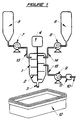
- FIG. 1 is a diagrammatic view of a preferred device for implementing the present method.
- 1 refers to a mixing chamber, whose interior is equipped with rotating blades 2 and a nozzle 3 .
- the interior of this mixing chamber 1 is connected to storage tanks 5 and 6 through pipes 13 and 14 .
- Each of pipes 13 and 14 is provided with a metering pump in an arbitrary position.
- Also connected to mixing chamber 1 is a pipe 15 equipped with a pressure-regulating valve 11 and metering pump 9 .
- Part A also referred to as the base portion of the foamable organosiloxane composition, is stored in tank 5 and part B, referred to the curing agent portion of the foamable organosiloxane composition is stored in tank 6 .
- Parts A and B are metered out, separately transported, and introduced into mixing chamber 1 by pumps 7 and 8 , respectively. Simultaneous with the introduction of parts A and B into the mixing chamber 1 , a specified quantity of gas is introduced into the mixing chamber through the action of metering pump 9 with pressure regulation by pressure-regulating valve 11 . Parts A, B and the gas are then mixed by the rotating blades 2 . The resultant liquid mixture containing the gas as finely dispersed bubbles is extruded through the nozzle 3 at the bottom of mixing chamber 1 onto the seal region of the substrate 12 . This extruded liquid mixture is then cured and foamed, at ambient temperature or by heating, to produce the foam gasket.
- the gas introduced into the mixing chamber can be, for example, air, nitrogen, argon, and the like, but the use of air is prefered.
- the gas is introduced into the mixing chamber under a pressure of from 1 to 7 kg/cm 2 .
- the amount of gas added is critical to the foam structure of the cured gasket, and must be maintained within the range of from 1 to 50 mL per 100 g of the foamable composition resulting from the blending of parts A and B, preferably within the range of 5 to 30 mL per 100 g of the mixture of parts A and B added to the mixing chamber.
- the number of cells in the composition is small and hence the expansion ratio will be low.
- the cells become very large when the amount added exceeds 50 mL per gram of foamable composition, and uniform microscopic cell structure can no longer be obtained.
- the average diameter of the cells in gaskets prepared in accordance with the present method preferably does not exceed 1 millimeter.
- the foamable organosiloxane composition used in accordance with the present method preferably comprises
- Ingredient A contains at least 2 silicon-bonded alkenyl radicals in each molecule, which are exemplified by vinyl, allyl, and hexenyl.
- the non-alkenyl organic groups in this ingredient are one or more species of substituted or unsubstituted monovalent hydrocarbon radicals, excluding aliphatically unsaturated radicals.
- suitable radicals include C 1 - C 6 alkyl radicals such as methyl, ethyl, propyl, and butyl; aryl radicals such as phenyl and tolyl; and any of these radicals in which all or a portion of the carbon-bonded hydrogen atoms have been replaced by substituents such as halogen and cyano group.
- substituted hydrocarbon radicals are chloromethyl, trifluoropropyl, and cyanoethyl.
- Ingredient A generally has a linear molecular structure, but may contain small quantities of branched- or resin-form organopolysiloxane.
- the viscosity of this ingredient is generally from 100 to 100,000 mm2/5 (centistokes).
- Ingredient B of the present compositions is an organopolysiloxane containing at least 1 silicon-bonded silanol group in each molecule.
- Ingredient B functions as a foaming agent for the composition by reacting with ingredient F, the organohydrogensiloxane, to produce hydrogen gas.
- This organopolysiloxane functions as both a crosslinker and a foaming agent when it contains 3 or more silanol groups.
- Ingredient B may have a linear, cyclic, or three-dimensional network structure, or it may be a mixture of such structures.
- the silicon-bonded silanol groups may be present at the molecular chain terminals or along the molecular chain.
- Ingredient C of the present compositions is an alcohol containing at least 1 carbon-bonded hydroxyl group. There are no specific restrictions on the type of alcohols that can be present as ingredient C. Together with ingredient B, ingredient C also functions as a foaming agent for the composition by reacting with the organohydrogenpolysiloxane, ingredient F, to produce hydrogen gas. Ingredient F additionally reduces the viscosity of the curable organosiloxane composition.
- Specific alcohols that can be used as ingredient C include n-propanol, n-butanol, 1,4-butanediol, 1,4-pentanediol, ethylene glycol, 1,3-propanediol, 1,5-hexanediol, propylene glycol, diethylene glycol, benzyl alcohol, octanol, 2-ethylhexanol, and isopropanol.
- a single alcohol or a mixture of two or more alcohols can be present in the foamable organosiloxane compositions of this invention.
- the organopolysiloxane of ingredient D is optional, and is used as a foam regulator or "profoamer” to adjust the foaming properties of the present compositions.
- This organopolysiloxane contains at least one group per molecule with the following general formula C n F 2n+1 R where n represents an integer from 1 to 10, R represents an alkylene radical such as methylene, ethylene, propylene or butylene.
- ingredient D examples include CF 3 -CH 2 CH 2 group-containing dimethylpolysiloxane, C 2 F 5 -CH 2 CH 2 group-containing dimethylpolysiloxane, C 3 F 7 -CH 2 CH 2 group-containing dimethylpolysiloxane, and C 8 F 17 -CH 2 CH 2 CH 2 group-containing dimethylpolysiloxane.
- concentration of ingredient D in the present compositions is from 0 to 20 parts by weight per 100 parts of ingredient A, preferably from 0.5 to 15 parts by weight per 100 weight parts of ingredient A.
- Ingredient E is a platinum group metal catalyst that accelerates the addition reaction between ingredients A and F and the dehydrogenation reaction between ingredient F and ingredients B and C.
- This catalyst is exemplified by chloroplatinic acid, chloroplatinic acid/olefin complexes, and chloroplatinic acid/divinylsiloxane complexes.
- spherical microparticulate catalysts made from a silicone resin containing at least 0.01 weight% (as platinum metal atoms) of platinum catalyst.
- the softening point of the silicone resin is from 50° C to 200° C and the particle diameter of the spherical microparticulate catalyst is from 0.01 to 10 micrometers.
- These spherical microparticulate catalysts are particularly preferred because they can lengthen the time between the mixing of parts A and B of the present compositions and the occurrence of viscosity rise and/or gelation of the composition.
- Ingredient F of the present compositions is an organohydrogenpolysiloxane that serves as a crosslinker for ingredient A, and also generates hydrogen gas by reacting with ingredients B and C.
- the molecular configuration of ingredient F can be straight-chain or cyclic.
- the concentration of ingredient F in the present compositions is equivalent to a range of from 0.5:1 to 50:1 for the molar ratio of (a) silicon-bonded hydrogen atoms contained in ingredient F to (b) the sum of the number of moles of alkenyl radicals in ingredient A plus the number of moles of hydroxyl groups in ingredients B and C.
- the curable, foamable organosiloxane compositions made in accordance with the present method are packaged in the form of a two-part compositions consisting of a base portion and a curing agent portion.
- the base portion is prepared by blending to homogeneity the required quantities of ingredients A, C and E with optional ingredients B and D, when these optional ingredients are present.
- the curing agent portion is prepared by mixing the required quantities of ingredients A and F to homogeneity.
- the foaming and curing reactions develop simultaneously, either at room temperature or with heating, to yield an elastomeric foam.
- the foamable organosiloxane composition of the present invention can contain one or more of the following optional ingredients, so long as these ingredients do not interfere with achieving the objectives of the present invention: fillers such as fumed silica, precipitated silica, titanium dioxide, aluminum oxide, aluminum hydroxide, quartz powder, talc, crushed mineral silica, zinc oxide, and calcium carbonate; fibrous fillers such as glass fibers, mineral fibers, and organic fibers; colorants such as dyes and pigments; heat stabilizers such as iron oxide red, carbon black, and cerium oxide; cold-resistance agents; adhesion promoters such as silane coupling agents; and platinum catalyst inhibitors such as methylbutynol.
- fillers such as fumed silica, precipitated silica, titanium dioxide, aluminum oxide, aluminum hydroxide, quartz powder, talc, crushed mineral silica, zinc oxide, and calcium carbonate
- fibrous fillers such as glass fibers, mineral fibers, and organic fibers
- colorants such as dyes and
- Part A of a curable, foamable organosiloxane composition was prepared by blending the following ingredients to homogeneity: 100 parts of a dimethylvinylsiloxy-terminated dimethylpolysiloxane exhibiting a degree of polymerization (DP) of approximately 500 and a viscosity of 15,000 cs (15x10 -3 m 2 /sec.), 50 parts of a silanol-terminated dimethylpolysiloxane exhibiting a DP of 50 and a viscosity of 100 cs (1x10 -4 m 2 /sec), 5 parts of n-propanol, as a profoamer, 10 parts of the reaction product of C 8 F 17 (CH 2 ) 2 Si(CH 3 ) 2 Cl and a silanol-containing organopolysiloxane resin, 1 part of a chloroplatinic acid/divinyltetramethyldisiloxane complex catalyst, and 10 parts of fumed silica with
- Part B of a curable, foamable organosiloxane composition of this invention was prepared by mixing the following ingredients to homogeneity: 100 parts of the dimethylvinylsiloxy-terminated dimethylpolysiloxane used in part A, 10 parts of a trimethylsiloxy-terminated methylhydrogen-polysiloxane with a DP of approximately 30, and 5 parts fumed silica with specific surface area of 200 m 2 /g.
- Parts A and B of the composition were placed in storage tanks 5 and 6 , respectively, shown in Figure 1, and were then separately transported in equal amounts by pumps 7 and 8 into the interior of mixing chamber 1 .
- Air regulated to a pressure of 2 kg/cm 2 was simultaneously injected at the reported rate by pump 9 into the interior of mixing chamber 1 .
- Rotatable blades 2 were rotated at approximately 1,000 rpm in order to finely disperse the air in the mixture while at the same time blending parts A and B.
- the gas/liquid mixture generated in the mixing chamber was passed through nozzle 3 and was extruded as a bead with a diameter of 5 mm onto the seal region of an automotive dust cover made of polypropylene. This bead formed a foam gasket in three minutes by foaming while curing.
- Table 1 reports the quantity of gas added, the results from measurement of the foam density of the final cured foam, the average cell diameters of two samples, and the results of an examination of the condition of the foam.
- the sample prepared by introducing 51.6 mL of air into the foamable composition is outside the scope of the present invention and is included for comparative purposes.
- Table 1 quantity of air mL/ 100 g A + B combined parts A + B condition of the foam Appearance Of Cells Density (g/cm 3 ) Cell Size (mm) 3.1 0.40 fair 6.5 0.37 fair 13.2 0.34 excellent 18.1 0.34 excellent 25.5 0.34 0.3 excellent 31.2 0.34 excellent 38.7 0.34 somewhat coarse 45.2 0.31 somewhat coarse 51.6 * 0.28 1.5 coarse * Included for comparative purposes
- This composition was extruded from the nozzle into a bead by the same procedure as in Example 1. In this example, 25.5 mL air was added per 100 g of the A + B liquid mixture.
- the gasket was fabricated by foaming and curing by heating the dust cover for 5 minutes in an oven at 100°C.
- the average diameter of the cells in the resulting foam was 0.3 mm and the size distribution was uniform.
- Part A of a curable foamable organosiloxane composition was prepared by blending the following ingredients to homogeneity into 100 parts of a dimethylvinylsiloxy-terminated dimethylpolysiloxane exhibiting a DP of 600, a viscosity of 3,000 cs (3x10 -3 m 2 /sec), 30 parts of a silanol-terminated dimethylpolysiloxane exhibiting DP of 110 and viscosity of 100 cs (1x10 -4 m 2 /sec), 8 parts n-propyl alcohol, 10 parts of the reaction product of C 8 F 17 (CH 2 ) 2 Si(CH 3 ) 2 Cl and a silanol-containing organopolysiloxane resin, and 1 part of a chloroplatinic acid/ divinyltetramethyldisiloxane complex.
- Part B of the composition was prepared by mixing the following ingredients to homogeneity: a total of 130 parts of the mixture of the two silanol-terminated dimethylpolysiloxanes used in part A and 30 parts of a trimethylsiloxy-terminated methylhydrogenpolysiloxane with a DP of approximately 30.
- a curable, foamable organosiloxane composition was prepared as described in Example 1 and was extruded through the nozzle to fill half the height of the sealing groove on a plastic lamp cover.
- the lamp cover was held at room temperature, and the foam gasket was formed in 3 minutes by the simultaneous development of foaming and curing.
- Air was introduced into the mixing chamber at a concentration of 13.2 mL per 100 g of the combined weight of parts A and B.
- the average diameter of the cells in the resulting foam was 0.1 mm. and the size distribution was uniform.
Landscapes
- Chemical & Material Sciences (AREA)
- Engineering & Computer Science (AREA)
- Materials Engineering (AREA)
- Health & Medical Sciences (AREA)
- Chemical Kinetics & Catalysis (AREA)
- Medicinal Chemistry (AREA)
- Polymers & Plastics (AREA)
- Organic Chemistry (AREA)
- Manufacture Of Porous Articles, And Recovery And Treatment Of Waste Products (AREA)
- Casting Or Compression Moulding Of Plastics Or The Like (AREA)
- Molding Of Porous Articles (AREA)
- Application Of Or Painting With Fluid Materials (AREA)
- Compositions Of Macromolecular Compounds (AREA)
Claims (5)
- Verfahren zur Herstellung von Schaumdichtungen, wobei dieses Verfahren folgende aufeinanderfolgende Schritte umfaßt:1) Einmessen der Bestandteile einer härtbaren, aufschäumbaren Organosiloxanzusammensetzung in Form eines Grundanteils und eines Härtungsmittelanteils in eine Mischkammer, worin die Zusammensetzung, die durch Vereinigen dieses Grundanteils und des Härtungsmittels gebildet wird, durch Reaktion von an Silicium gebundenen Wasserstoffatomen mit Hydroxylgruppen aufschäumt und mittels einer Hydrosililierungsreaktion aushärtet,2) Vermischen dieses Grundanteils mit diesem Härtungsmittel anteil in dieser Mischkammer, um diese aufschäumbare Zusammensetzung auszubilden,3) Extrudieren von dieser Mischkammer durch eine Öffnung auf den Dichtungsbereich eines Substrats und4) Aufschäumen- und Härtenlassen dieser Zusammensetzung, wodurch eine Dichtung mit einer homogenen Verteilung von einheitlich kleinen Zellen ausgebildet wird,wobei vor der Extrusion der Zusammensetzung ein inertes Gas in einer Menge äquivalent zu 1 bis 50 ml Gas pro 100 g dieser Zusammensetzung eingespritzt und über die gesamte Zusammensetzung einheitlich verteilt wird.
- Verfahren nach Anspruch 1, wobei diese Organopolysiloxanzusammensetzung enthält:(A) 100 Gewichtsteile eines Organopolysiloxans mit wenigstens zwei an Silicium gebundenen Alkenylgruppen in jedem Molekül,(B) 0 bis 100 Gewichtsteile eines Organopolysiloxans, das wenigstens eine an Silicium gebundene Silanolgruppe in jedem Molekül enthält,(C) 1 bis 20 Gewichtsteile eines Alkohols, der wenigstens eine an Kohlenstoff gebundene Hydroxylgruppe enthält,(D) 0 bis 20 Gewichtsteile eines Organopolysiloxans, das eine an Silicium gebundene CnF2n+1R-Gruppe enthält, wobei n eine ganze Zahl von 1 bis 10 ist und R ein Alkylenrest ist,(E) eine Menge eines Platingruppenmetallkatalysators, die ausreicht, um das Aufschäumen und Härten dieser Zusammensetzung zu katalysieren, und(F) eine Menge eines Organohydrogenpolysiloxans, um ein Molverhältnis von an Silicium gebundenen Wasserstoffatomen in dieser Zusammensetzung zu der Summe der Molzahl von Alkenylgruppen in Bestandteil A plus der Molanzahl von Hydroxylgruppen in den Bestandteilen B und C in einem Bereich von 0,5:1 bis 50:1 zu ergeben.
- Verfahren nach Anspruch 2, wobei dieser Härtungsmittelanteil Organohydrogenpolysiloxan und zusätzliches alkenylhaltiges Organopolysiloxan enthält.
- Verfahren nach Anspruch 1, wobei der mittlere Zellendurchmesser in dieser Dichtung 1 mm nicht überschreitet.
- Verfahren nach Anspruch 3, wobei der Platingruppenmetallkatalysator einen kugelförmigen, feinteiligen Katalysator enthält, der aus Siliconharz hergestellt ist, das wenigstens 0,01 Gew.-% (als Platinmetallatome) eines Platingruppenmetallkatalysators enthält, wobei der Erweichungspunkt des Siliconharzes 50°C bis 200°C beträgt und der Teilchendurchmesser des kugelförmigen, feinteiligen Katalysators 0,01 bis 10 µm beträgt.
Applications Claiming Priority (2)
| Application Number | Priority Date | Filing Date | Title |
|---|---|---|---|
| JP361140/92 | 1992-12-28 | ||
| JP4361140A JPH06200066A (ja) | 1992-12-28 | 1992-12-28 | ガスケット発泡体の形成方法 |
Publications (2)
| Publication Number | Publication Date |
|---|---|
| EP0604926A1 EP0604926A1 (de) | 1994-07-06 |
| EP0604926B1 true EP0604926B1 (de) | 1996-10-02 |
Family
ID=18472361
Family Applications (1)
| Application Number | Title | Priority Date | Filing Date |
|---|---|---|---|
| EP93120866A Expired - Lifetime EP0604926B1 (de) | 1992-12-28 | 1993-12-24 | Verfahren zur Herstellung von geschäumten Dichtungen aus Polyorganosiloxan-Zusammensetzungen |
Country Status (6)
| Country | Link |
|---|---|
| US (1) | US5391336A (de) |
| EP (1) | EP0604926B1 (de) |
| JP (1) | JPH06200066A (de) |
| CA (1) | CA2112311C (de) |
| DE (1) | DE69305152T2 (de) |
| MX (1) | MX9400160A (de) |
Families Citing this family (17)
| Publication number | Priority date | Publication date | Assignee | Title |
|---|---|---|---|---|
| JPH0912764A (ja) * | 1995-06-27 | 1997-01-14 | Toray Dow Corning Silicone Co Ltd | シリコーン発泡体の製造方法 |
| JP3841914B2 (ja) * | 1997-02-28 | 2006-11-08 | 東レ・ダウコーニング株式会社 | 発泡ガスケットの形成方法 |
| US5981610A (en) * | 1997-11-17 | 1999-11-09 | Shin-Etsu Chemical Co. Ltd. | Injection molding silicone rubber compositions |
| GB2334956A (en) * | 1998-03-04 | 1999-09-08 | Canning Plc W | Forming an expanded polymer gasket in situ |
| WO2001029457A1 (en) * | 1999-10-15 | 2001-04-26 | Siemens Canada Limited | Method to create a hot melt form for use with an air induction assembly |
| JP3748025B2 (ja) * | 2000-02-08 | 2006-02-22 | 信越化学工業株式会社 | シリコーンゴムの圧縮永久歪を低減させる方法 |
| DE10062659B4 (de) * | 2000-12-15 | 2005-09-22 | Demag Ergotech Gmbh | Aufschäummittelbeladungs- und Mischvorrichtung |
| US6595525B2 (en) | 2001-01-25 | 2003-07-22 | Glen D. Schmidt | Attachable sealant bead and strip for use with a vehicle part |
| JP4721385B2 (ja) * | 2001-07-02 | 2011-07-13 | キヤノン株式会社 | 射出成形機への樹脂材料の供給方法及び装置 |
| EP1461101A4 (de) * | 2001-12-07 | 2005-02-09 | Glaxo Group Ltd | Dosierventil und pharmazeutisches dosieraerosol und verfahren dafür |
| US9086149B2 (en) * | 2006-11-17 | 2015-07-21 | Changzhou Sanyou Dior Insulation Materials Manufacturing Co., Ltd. | Clip equipped, elongated flexible polymer gaskets |
| EP2545103B1 (de) * | 2010-03-09 | 2016-09-14 | University Of Virginia Patent Foundation | Viskoelastische silikonkautschukzusammensetzungen |
| WO2013023174A1 (en) | 2011-08-10 | 2013-02-14 | University Of Virginia Patent Foundation | Viscoelastic silicone rubber compositions |
| CN103965640A (zh) * | 2013-12-05 | 2014-08-06 | 宁波银瑞有机硅科技发展有限公司 | 一种发泡液体硅橡胶及其制备方法 |
| CN105331117A (zh) * | 2015-11-17 | 2016-02-17 | 镇江高美新材料有限公司 | 发泡液体硅橡胶及其制备方法 |
| JP7451027B2 (ja) * | 2019-10-29 | 2024-03-18 | 信越化学工業株式会社 | 液状シリコーンゴム組成物及びシリコーンゴムスポンジ |
| CN112248437B (zh) * | 2020-09-02 | 2021-11-23 | 清华大学 | 硅橡胶液体3d打印供料及挤出装置以及3d打印设备 |
Family Cites Families (14)
| Publication number | Priority date | Publication date | Assignee | Title |
|---|---|---|---|---|
| US4032502A (en) * | 1975-10-10 | 1977-06-28 | Dow Corning Corporation | Organosiloxane compositions for liquid injection |
| DE2713181A1 (de) * | 1977-03-25 | 1978-10-05 | Kabel Metallwerke Ghh | Verfahren zur herstellung geschaeumter materialien |
| US4340709A (en) * | 1980-07-16 | 1982-07-20 | General Electric Company | Addition curing silicone compositions |
| FR2497524B1 (de) * | 1981-01-07 | 1985-12-13 | Rhone Poulenc Spec Chim | |
| US4391765A (en) * | 1982-06-25 | 1983-07-05 | Dow Corning Corporation | Microwave cured silicone elastomeric foam |
| US4473667A (en) * | 1982-06-25 | 1984-09-25 | Dow Corning Corporation | Elastomeric foam |
| US4839122A (en) * | 1983-09-26 | 1989-06-13 | Libbey-Owens-Ford Co. | Reaction injection molding of window gasket |
| US4528354A (en) * | 1984-04-25 | 1985-07-09 | Mcdougal John R | Process and composition for the manufacture of products from silicone rubber |
| US4547529A (en) * | 1985-03-25 | 1985-10-15 | Dow Corning Corporation | Storage stable, foamable two-part polyorganosiloxane compositions |
| US4590222A (en) * | 1985-10-16 | 1986-05-20 | Dow Corning Corporation | Lower density silicone elastomeric foam |
| US4792425A (en) * | 1985-12-23 | 1988-12-20 | Libbey-Owens-Ford Co. | Method of making a windshield and leaf screen assembly |
| JPH0721079B2 (ja) * | 1989-09-06 | 1995-03-08 | 株式会社スリーボンド | ガスケット発泡体の形成方法 |
| JP2916179B2 (ja) * | 1989-11-17 | 1999-07-05 | 東レ・ダウコーニング・シリコーン株式会社 | 加熱硬化性オルガノポリシロキサン組成物 |
| JP3197582B2 (ja) * | 1991-07-30 | 2001-08-13 | 東レ・ダウコーニング・シリコーン株式会社 | シリコーンエラストマーフォームの製造方法及びその製造装置 |
-
1992
- 1992-12-28 JP JP4361140A patent/JPH06200066A/ja active Pending
-
1993
- 1993-12-23 US US08/173,312 patent/US5391336A/en not_active Expired - Fee Related
- 1993-12-23 CA CA002112311A patent/CA2112311C/en not_active Expired - Fee Related
- 1993-12-24 EP EP93120866A patent/EP0604926B1/de not_active Expired - Lifetime
- 1993-12-24 DE DE69305152T patent/DE69305152T2/de not_active Expired - Fee Related
-
1994
- 1994-01-03 MX MX9400160A patent/MX9400160A/es unknown
Also Published As
| Publication number | Publication date |
|---|---|
| DE69305152D1 (de) | 1996-11-07 |
| DE69305152T2 (de) | 1997-04-17 |
| JPH06200066A (ja) | 1994-07-19 |
| EP0604926A1 (de) | 1994-07-06 |
| CA2112311A1 (en) | 1994-06-29 |
| CA2112311C (en) | 2002-01-01 |
| US5391336A (en) | 1995-02-21 |
| MX9400160A (es) | 1994-07-29 |
Similar Documents
| Publication | Publication Date | Title |
|---|---|---|
| US5391336A (en) | Method for fabricating foam gaskets | |
| US5614563A (en) | Method for the preparation of silicone foam | |
| EP1070746B1 (de) | Formbare Siliconschaumgummizusammensetzung, Siliconschaumgummi und Verfahren zur Herstellung | |
| EP0309722A1 (de) | Härtbare Harzzusammensetzung, die Siloxankautschuk in Form von Mikropartikeln enthält | |
| EP0416516B1 (de) | Verfahren zur Herstellung einer geschäumten Dichtung | |
| JP3628935B2 (ja) | シリコーンゴムスポンジ形成性組成物、シリコーンゴムスポンジおよびそれらの製造方法 | |
| US5019295A (en) | Foamable silicone rubber composition | |
| US5900438A (en) | Thermosetting foamable organopolysiloxane composition and process of curing the same | |
| EP0821027B1 (de) | Silikon-Schaumgummi Zusammensetzung und Verfahren zur Herstellung eines Schwammes aus Silikongummi | |
| US4824616A (en) | Method for the production of spherical silicone gel particles | |
| CA2095572A1 (en) | Process for the continuous production of liquid silicone rubbers | |
| JP3841914B2 (ja) | 発泡ガスケットの形成方法 | |
| US6359026B1 (en) | Method for producing silicone foams | |
| EP0826723A2 (de) | Silikongummischaumstoffzusammensetzung und Herstellungsverfahren dafür | |
| US5175171A (en) | Method and apparatus for the preparation of silicone elastomer foams | |
| EP0683211B1 (de) | Thixotrope verschäumbare Orangosiloxan-Zusammensetzungen | |
| EP1156081B1 (de) | Siliconschaumgummi-Zusammensetzung, Siliconschaumgummi und Verfahren zu seiner Herstellung | |
| EP0324411A2 (de) | Verfahren zur Herstellung von Silikongelsphären | |
| US20240343875A1 (en) | The preparation of foamed silicone products | |
| JPH06107950A (ja) | 加熱硬化性オルガノポリシロキサン組成物 | |
| JPH09124816A (ja) | シリコーン発泡体の製造方法 | |
| EP0495566A2 (de) | Verbesserte schwer entflammbare Siliconschäume | |
| JPH08156003A (ja) | シリコーンフォームの製造方法 | |
| MXPA96002465A (en) | Method for the preparation of silic foam | |
| JPH08259720A (ja) | シリコーン発泡体の製造方法 |
Legal Events
| Date | Code | Title | Description |
|---|---|---|---|
| PUAI | Public reference made under article 153(3) epc to a published international application that has entered the european phase |
Free format text: ORIGINAL CODE: 0009012 |
|
| AK | Designated contracting states |
Kind code of ref document: A1 Designated state(s): DE FR GB |
|
| 17P | Request for examination filed |
Effective date: 19940812 |
|
| GRAG | Despatch of communication of intention to grant |
Free format text: ORIGINAL CODE: EPIDOS AGRA |
|
| GRAH | Despatch of communication of intention to grant a patent |
Free format text: ORIGINAL CODE: EPIDOS IGRA |
|
| 17Q | First examination report despatched |
Effective date: 19960212 |
|
| GRAH | Despatch of communication of intention to grant a patent |
Free format text: ORIGINAL CODE: EPIDOS IGRA |
|
| GRAA | (expected) grant |
Free format text: ORIGINAL CODE: 0009210 |
|
| RAP1 | Party data changed (applicant data changed or rights of an application transferred) |
Owner name: DOW CORNING TORAY SILICONE COMPANY LTD. |
|
| AK | Designated contracting states |
Kind code of ref document: B1 Designated state(s): DE FR GB |
|
| REF | Corresponds to: |
Ref document number: 69305152 Country of ref document: DE Date of ref document: 19961107 |
|
| ET | Fr: translation filed | ||
| PLBE | No opposition filed within time limit |
Free format text: ORIGINAL CODE: 0009261 |
|
| STAA | Information on the status of an ep patent application or granted ep patent |
Free format text: STATUS: NO OPPOSITION FILED WITHIN TIME LIMIT |
|
| 26N | No opposition filed | ||
| PGFP | Annual fee paid to national office [announced via postgrant information from national office to epo] |
Ref country code: DE Payment date: 20011112 Year of fee payment: 9 |
|
| PGFP | Annual fee paid to national office [announced via postgrant information from national office to epo] |
Ref country code: FR Payment date: 20011114 Year of fee payment: 9 |
|
| PGFP | Annual fee paid to national office [announced via postgrant information from national office to epo] |
Ref country code: GB Payment date: 20011115 Year of fee payment: 9 |
|
| REG | Reference to a national code |
Ref country code: GB Ref legal event code: IF02 |
|
| PG25 | Lapsed in a contracting state [announced via postgrant information from national office to epo] |
Ref country code: GB Free format text: LAPSE BECAUSE OF NON-PAYMENT OF DUE FEES Effective date: 20021224 |
|
| PG25 | Lapsed in a contracting state [announced via postgrant information from national office to epo] |
Ref country code: DE Free format text: LAPSE BECAUSE OF NON-PAYMENT OF DUE FEES Effective date: 20030701 |
|
| GBPC | Gb: european patent ceased through non-payment of renewal fee |
Effective date: 20021224 |
|
| PG25 | Lapsed in a contracting state [announced via postgrant information from national office to epo] |
Ref country code: FR Free format text: LAPSE BECAUSE OF NON-PAYMENT OF DUE FEES Effective date: 20030901 |
|
| REG | Reference to a national code |
Ref country code: FR Ref legal event code: ST |