EP0605099A2 - Reconnaissance de texte utilisant des modèles stochastiques bi-dimensionnels - Google Patents
Reconnaissance de texte utilisant des modèles stochastiques bi-dimensionnels Download PDFInfo
- Publication number
- EP0605099A2 EP0605099A2 EP93309222A EP93309222A EP0605099A2 EP 0605099 A2 EP0605099 A2 EP 0605099A2 EP 93309222 A EP93309222 A EP 93309222A EP 93309222 A EP93309222 A EP 93309222A EP 0605099 A2 EP0605099 A2 EP 0605099A2
- Authority
- EP
- European Patent Office
- Prior art keywords
- superstate
- probability
- text element
- model
- superstates
- Prior art date
- Legal status (The legal status is an assumption and is not a legal conclusion. Google has not performed a legal analysis and makes no representation as to the accuracy of the status listed.)
- Granted
Links
Images


Classifications
-
- G—PHYSICS
- G06—COMPUTING OR CALCULATING; COUNTING
- G06F—ELECTRIC DIGITAL DATA PROCESSING
- G06F18/00—Pattern recognition
- G06F18/20—Analysing
- G06F18/29—Graphical models, e.g. Bayesian networks
- G06F18/295—Markov models or related models, e.g. semi-Markov models; Markov random fields; Networks embedding Markov models
Definitions
- This invention relates to optical text recognition and more specifically to robust methods of recognizing characters or words regardless of impediments such as font differences or poor document reproduction.
- HMMs hidden Markov models
- Optical recognition of text is often hampered by the use of multiple fonts or different character sizes, blurred documents, distorted characters and other impediments. Accordingly, it is desirable to improve recognition methods to be robust regardless of such impediments.
- pseudo two-dimensional hidden Markov models are used to represent text elements, such as characters or words. Observation vectors for each text element are based on pixel maps obtained by optical scanning. A character is represented by a pseudo two-dimensional HMM having a number of superstates, with each superstate having at least one state. In a preferred embodiment, the superstates represent horizontal slices through the text element.
- Text elements are compared with such models by using the Viterbi algorithm, first in connection with the states in each superstate, then the superstates themselves, to calculate the probability that a particular model represents the text element.
- Parameters for the models are generated by training routines.
- Embodiments are also disclosed having greater tolerance to deterministic image transformations relating to such factors as scale, translation, slant, and rotation.
- a further embodiment is disclosed for identifying keywords in a body of text.
- a first pseudo two dimensional HMM is created for the keyword and a second such model is created for all other extraneous words that may appear in the text.
- Each word in the text is compared with both models, again using the Viterbi algorithm, to calculate probabilities that the model represents the subject word. If the probability for the keyword is greater than that for the extraneous words, the subject word is identified as being the keyword. Preprocessing steps for reducing the number of words to be compared are also disclosed.
- FIG. 1 shows a pixel map of a character together with a corresponding state diagram for a pseudo two-dimensional HMM.
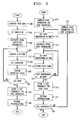
- FIG. 2 is a flow chart showing the operation of a computer programmed to compare a pixel map for a text element with a pseudo two-dimensional HMM in accordance with the invention.
- FIG. 3 is a flow chart showing the procedure for creating a pseudo two-dimensional HMM.
- FIG. 4 is a flow chart showing a procedure for spotting keywords in accordance with the invention.
- Text elements such as characters or words, to be recognized in accordance with the invention will typically be part of a larger body of textual and graphical material on a page.
- the page has been optically scanned and that a text element to be recognized has been captured as a sequence of pixels generated by a conventional raster scan of the text element.
- Many techniques for performing such operations are well known to those skilled in the art. For example, see the articles "Global-to-local layout analysis" by H. Baird in the Proceedings of the IAPR Workshop on Syntactic and Structural Pattern Recognition, France, September 1988 and "Document Image Analysis” by S. Srihari and G. Zack in the Proceedings of the 8th International Conference on Pattern Recognition, Paris, October 1986.
- Such pixel sequences for known text elements are used to "train" HMMs representing such elements.
- the pixel sequence for an unknown text element is then compared with the model to determine the probability that the model represents such unknown text element.
- FIG. 1 shows a pixel map 100 of the character "h" together with a corresponding state diagram 200 for a pseudo two-dimensional HMM for such character.
- the model is termed a "top-down, left-right” model because it depicts the sequence of states resulting from a conventional raster scan of the pixel map. It is called a "pseudo" two-dimensional model because it is not ergodic - that is, it is not a fully-connected two-dimensional network.
- superstate 210-214 Five “superstates” 210-214 are shown in state diagram 200. Such superstates correspond respectively to the five horizontal regions 110-114 in pixel map 100. Note that all the rows of pixels in a given one of regions 110-114 are the same. Within each superstate 210-214, the various horizontal "states" possible in the rows of the corresponding region in the pixel map are shown. For example, superstate 211 includes three states 220-222 representing the white, black and white pixels respectively in the rows of region 111.
- Permitted transitions between superstates are denoted by arrows such as 230 and 231. Arrows such as 232 indicate that a transition can occur from a superstate to itself. Similarly, transitions between states are denoted by arrows such as 240 and 241 and transitions to the same state by arrows such as 242.
- state diagram 200 An alternative to the structure of the model represented by state diagram 200 is a model using superstates representing vertical slices.
- typical printed characters usually consist of horizontal strokes and vertical or slanted strokes, depending on the font.
- an "italic" font will have slanted strokes.
- superstates representing horizontal slices it is possible to represent both fonts with the same models, except when the basic structure of the character differs from one font to the other.
- superstates representing vertical slices may be useful. One such application will be described below in conjunction with character rotations.
- the sum of all the probabilities of transition from a state to another state or back to the same state must equal 1.
- a transition probability is associated with each transition from state 210 indicated by arrows 230, 231 and 232.
- the sum of the transition probabilities from a state to another state is the reciprocal of the duration of the state, measured in number of pixels.
- the length of a white or black horizontal segment in a raster scan of the pixel map is represented by the associated transition probability; a long segment corresponds to a state with low transition probability to the next state; a short segment corresponds to a state with high transition probability.
- the same principles also apply to superstates. In the absence of noise, the probability of observing a black pixel in a certain state will be 0 or 1, but noise causes the actual values to be different from such values.
- the data structure used to represent a basic pseudo two- dimensional hidden Markov model consists of: the number of superstates (N v ), initial probabilities for the superstates (II v ), superstate transition probabilities (A v ), and, for each superstate: the number of states in the superstate (N h ), initial probabilities for the states (II h ), state transition probabilities within the superstate (A h ), observation probabilities for each state in the superstate (B h ).
- such data structure can be augmented with data for the probability densities of state durations, such as the mean and standard deviation for a Gaussian distribution.
- the observations for a text element are based on the pixels.
- the simplest kind of observation is binary, that is, whether the pixel is black or white.
- Other kinds of observations can include additional information, such as transition or position information. When such additional information is included, each observation can be a vector quantity representing several different components. An example of such an observation vector will be given below in conjunction with the explanation of keyword recognition.
- the structure of a pseudo two-dimensional HMM encodes the topology of its associated character.
- the graph representing the model such as state diagram 200
- the line adjacency graph (LAG) for a character such as is described in the article entitled "A Vectorizer and Feature Extractor for Document Recognition” by T. Pavlidis in Computer Vision, Graphics and Image Processing, Vol. 35, pp. 11-127, 1986.
- the transition probabilities in the HMM encode shape information.
- features such as serifs, which can cause different fonts for the same character to have drastically different LAGs, can be conveniently represented in a single HMM having enough states and superstates to cover all the features by simply allowing some states or superstates to be skipped for characters not having such features
- Pseudo two-dimensional HMMs can be thought of as elastic templates because they allow for distortion in two dimensions, thus significantly increasing the robustness of the model. For example, vertical distortion, as often occurs in facsimile transmission, can be accommodated by the methods of the invention.
- the Viterbi algorithm is a well-known dynamic programming method that can be used for calculating the probability that a particular HMM is a match for a given sequence of observations.
- Such algorithm is widely used in speech recognition, for example, see the article entitled "A tutorial on Hidden Markov Models and Selected Applications in Speech Recognition" by L. Rabiner in Proceedings of the IEEE, Vol. 77, pp. 257-286, February 1989 and has also been used in text recognition, as described in EP-A-551739 mentioned above.
- the probability ⁇ of being in each state of the HMM is calculated for each observation, resulting in an NxT array, usually called a "trellis,” of probabilities where N is the number of states and T is the number of observations in the sequence.
- the highest such probability P* after the last observation in the sequence is used as the "score" for the HMM in regard to the sequence of observations.
- the process of tracking the sequence of states to determine the best path through the model is known as segmentation.
- an array of backpointers is also maintained so that the actual state sequence can be reconstructed for postprocessing steps, such as postprocessing to introduce state duration densities as will be described below.
- the final probability for the HMM can be chosen to be the maximum probability calculated after the last observation: where the final state associated with P* is:
- such state will be state N.
- the maximum probability after the last observation is associated with a state other than state N.
- the Viterbi algorithm is used repeatedly for the superstates and the states within each superstate.
- Such HMMs are thus treated as nested one-dimensional models rather than truly two-dimensional.
- FIG. 2 is a flow chart showing the operation of a computer programmed to compare a pixel map for a text element, such as a character or word, with a pseudo two-dimensional HMM, in which the superstates represent horizontal slices.
- Steps 300-307 show the main routine, which uses the Viterbi algorithm to calculate the maximum probability for the text element from probabilities P* that a particular row of pixels belongs in a particular superstate.
- Steps 301 and 304 of the main routine each use a subroutine, shown in steps 310-318, that uses the Viterbi algorithm for each superstate to calculate such probabilities P* for each row. It is assumed that the observations making up the pixel map and the various parameters for the HMMs are stored in appropriate memory areas in the computer performing the calculations.
- the observations for the first row are addressed (step 300). Then the subroutine (steps 310-318) is performed using such observations.
- the HMM state parameters N h , ⁇ h , A h and B h for the first superstate are addressed (step 310), then the first observation in the current row is retrieved (step 311) and the initial state probabilities for the superstate are calculated (step 312) using the appropriate parameters ⁇ h and B h and equation (1).
- the next observation in the current row is retrieved (step 313) and the next set of state probabilities is calculated (step 314) using the appropriate parameters N h , A h and B h and equation (3) to extend the best paths through the states.
- step 315 After the last observation in the row (step 315), the probability P* for such row and the current superstate is the last probability calculated for the final state in the row, not the maximum probability calculated after the last observation (step 316). However, as described above in conjunction with equations (5) and (6), the probability calculated for the final state after the last observation will typically be the maximum probability.
- An optional postprocessing step (step 317) is indicated, which can be used for various refinements to the method of the invention, as will be described below.
- step 318 If there are still more superstates (step 318), the state parameters of the next superstate are addressed (step 319) and steps 311-318 are repeated for the current row and the next superstate. Thus, the subroutine returns a probability P* for the current row and each superstate.
- the initial superstate probabilities are calculated from the HMM superstate parameters ⁇ v and B v and equation (1) using such returned probabilities P* for observations O1 (step 302). Then the next row is addressed (step 303), the subroutine is repeated (step 304), and the best paths through the superstates are then extended by calculating the next set of superstate probabilities (step 305) using equation (3), the appropriate HMM parameters N h , A h and B h and the probabilities P* returned by the subroutine for observations O t . If there are still more rows (step 306), steps 303, 304 and 305 are repeated for the next row.
- the ultimate likelihood score that the HMM represents the text element being compared is the last probability evaluated for the final superstate (step 307).
- an optional postprocessing step (step 308) is indicated for refinements to be explained. It will be clear that the above-described method can also be used for HMMs in which the superstates represent vertical slices. In such cases, references to "rows" can be replaced with references to "columns”.
- the parameters ⁇ , A and B can be estimated for a pseudo two-dimensional HMM by using the segmental k-means algorithm described in the article entitled "A Segmental k-Means Training Procedure for Connected Word Recognition Based on Whole Word Reference Patterns” by L. Rabiner, J. Wilpon and B. Juang, AT&T Tech J., Vol. 65, pp. 21-36, May 1986.
- FIG. 3 is a flow chart showing the procedure for creating a pseudo two-dimensional HMM. First, the structure of the model, that is, the number of superstates and states in each superstate, is determined (step 350).
- the three adjacent rows in region 111 each have two transitions and the same number of black and white pixels, corresponding to a superstate having three states.
- the row in region 112 also has two transitions, but with significantly different numbers of black and white pixels than the rows in region 111, so the row in region 112 forms its own superstate.
- the parameters for the model are initialized (step 351). This can be done arbitrarily or by using parameters derived from the sample used to create the structure.
- the values of the parameters can be reestimated by "training" the model using representative samples of the text elements being modeled (tokens) in the form such elements are likely to take in the text to be recognized (step 352).
- An observation sequence (pixel map) is created for each token, and the Viterbi algorithm is then used for segmentation of the observation sequence with respect to the model (step 353).
- the parameters are then updated in accordance with histograms of the results of the segmentation (step 354).
- ⁇ i number of tokens starting from state S i total number of tokens
- a ij number of transitions from state S i state S j total number of transitions starting from state S i
- b i (p) number of observations of p in state S i total number of observations
- the Viterbi algorithm is used to calculate a likelihood for each token with respect to the model, and such likelihoods for all tokens are combined (probabilities are multiplied, log probabilities are added) to provide an overall likelihood of the effectiveness of the model with respect to the tokens (step 355).
- the training procedure is complete (step 357). If not, the training procedure is repeated.
- a typical method of determining convergence is to compare the overall likelihoods from step 355 for successive iterations. If the difference is small, indicating that the parameters have not changed significantly during the last iteration, then convergence can be assumed.
- the parameters II h , A v and B v for the superstates and the parameters II h , A h and B h for the states within the superstates can all be determined by this method.
- observation for each pixel has been assumed to be a simple binary function, that is, black or white.
- additional information with each observation with various components, making up the observation, forming an observation vector.
- a more specific example of such an observation vector will be described below in conjunction with keyword recognition.
- significant improvement in performance can be achieved by introducing more elaborate state duration densities into the HMMs.
- Segmentation into states is first accomplished using the parameters II, A and B as described above, then the scores calculated during segmentation are adjusted in a postprocessing step using the backpointers from array ⁇ to retrieve parameters for a more appropriate probability density for each state in the best path.
- An example of such adjustment is to replace the self-transition probabilities for each state with Gaussian state duration probability densities.
- N can be greater than the number of tokens.
- a given superstate can only be entered once for each token. Accordingly, when such equations are used for superstates, N is equal to the number of tokens.
- the adjustment can be performed repeatedly on P* using the mean and standard deviation for each state passed through in turn. If P* is expressed as a logarithm, the adjustment can be accomplished by converting the adjustments to logarithmic form, summing such logarithmic adjustments for each state passed through and then adding the total adjustment to logP*.
- X is the number of pixels in each row
- x is the horizontal coordinate of a pixel
- Y is the number of rows
- y is the vertical coordinate of a pixel
- N x is the number of horizontal states in a given superstate
- i identifies a state
- N y is the number of superstates
- j identifies a superstate
- a ii is the self-transition probability for a state
- d is the observed state duration in pixels
- d0 is the mean state duration in pixels
- ⁇ is the standard deviation for state duration
- S x is the sequence of states passed through in a superstate
- S y is the sequence of superstates passed through.
- Equation 14 represents the adjustment that would be made during postprocessing step 317.
- p x (y,j) is the adjusted log likelihood function in which self-transition probabilities have been replaced by Gaussian state-duration densities. Since states can be skipped, the number of states in S x (y,j) can be less than N x (j).
- Equation 15 represents the adjustment that would be made during postprocessing step 308.
- p y is the adjusted log likelihood function in which self-transition probabilities have been replaced by Gaussian superstate-duration densities. Again, since superstates can be skipped, the number of superstates in S y can be less than N y .
- HMMs Pseudo two-dimensional HMMs also lend themselves to applications in which it is necessary to compensate for size differences, translations or slants between an unknown text element and models with which such text element is compared. While the HMMs described above allow some flexibility in the size of the recognized text element, they are not truly size-independent. One approach that can be taken to cope with variability in size is to use multiple HMMs representing different sizes of each text element. Unfortunately, the use of multiple HMMs increases search time significantly because the Viterbi algorithm must be used, as described above, for each HMM. However, a more general approach can be taken in which a single HMM is adjusted by a scaling parameter calculated to maximize the log likelihood. The scaling parameter is determined from the actual state durations and mean state durations as will be described. As will also be described, translation and slant parameters can be applied in a similar manner.
- Such scaling, translation and slant parameters are preferably applied in two stages in a manner similar to which the state-duration densities are adjusted as described above. That is, such parameters relating to state probability calculations are applied as part of optional postprocessing step 317 and such factors relating to superstate probability calculations are applied as part of optional postprocessing step 308. Such two-stage application improves the superstate segmentation because the probabilities on which such superstate segmentation is based are then more accurately represented. As will be seen from the following explanations of the scaling, translation and slant parameters, a still more accurate final probability can be achieved by means of a second postprocessing step as part of step 308.
- the scaling, translation and slant parameters obtained by the methods to be described can be useful for other purposes.
- the scaling and slant parameters obtained for characters scanned can be used to specify the size and kind of font for such typesetting.
- Equation (14) is modified as follows to incorporate such scaling parameter:
- equations (19) and (23) achieve both state-duration density replacement and scaling compensation.
- j s is a simplified notation indicating the superstate j associated with row y for the best path.
- d x (1,3,8) means the duration of state 1 of superstate 3 for row 8, where the probability for row 8 calculated during step 305 was highest for superstate 3.
- ⁇ x (y,j) are the best estimates of the scaling parameter that can be obtained with the information available at the time step 317 is performed.
- ⁇ given by equation (20) is a more accurate estimate. Therefore, performance can be improved if a second postprocessing step is added during step 308. To be able to perform this step, it is necessary to save in memory the values of ⁇ x (y,j) and d x (i,y,j).
- the improved probability p' y is given by:
- equation (24) substitutes the overall scaling ⁇ for the preliminary scaling parameters ⁇ x .
- a given HMM will typically produce the correct segmentation within a scaling range of approximately 4:1; therefore its is possible to cover a large range with a few models. For example, three models will cover a range of 64:1, which is usually sufficient for typical documents.
- a procedure similar to that described above for scaling can be applied to compensate for translations wherein a text element is displaced in the x and/or the y direction from the position in which such text element is expected.
- equations (26) and (28) achieve both state-duration density replacement and translation compensation.
- t x (y,j) are the best estimates of the horizontal translation parameter obtainable at the time step 317 is performed, and a more accurate probability can be achieved by performing a second postprocessing step during step 308 by evaluating: and then finding p' y as follows:
- slant parameters can be applied to compensate for text elements that are slanted to some degree.
- the slant parameter m is the tangent of the slant angle. In this case, there is
- a second postprocessing step can refine the accuracy of probability p y .
- the values of m(yj) are the best estimates obtainable during step 317; however m is more accurate since it is based on all the information available during step 308. As was the case for scaling and translations, it is necessary to save the values of m(y,j), d x (1,j,y) and d x (N x ,j,y).
- the modified value p' y is then given by:
- the pixel map is then deslanted by the angle (arctan m) found for the chosen HMM.
- deslanting can be accomplished by shifting pixels appropriately: in rows if the chosen HMM has superstates representing horizontal slices or in columns if the chosen HMM has superstates representing vertical slices.
- the other HMM is evaluated again on the deslanted pixel map with the score again adjusted by the slant parameter to obtain the final score.
- FIG. 4 is a flow chart showing the use of the method of the invention to recognize a keyword in text.
- An unknown word to be analyzed is entered (step 400) and preprocessed by a nonlinear filter to reduce noise while retaining character sharpness and connectivity (step 401). Such filtering is described in EP-A-551739 mentioned above.
- the unknown word is then prechecked against known characteristics of the keyword to eliminate words unlikely to be the keyword (step 402). This operation can be performed by comparing distinctive word shapes for both the unknown word and the keyword, for example, word width, ratio of width to height and numbers of ascenders and descenders. Because training routines as described above will be used to generate pseudo two-dimensional HMMs for recognizing keywords, as will be explained, such training routines can also be used to obtain the required information about word shapes.
- Thresholds can be set with a tolerance, say ⁇ 20%, to allow for variation. For example, if the width of the keyword in the training set is between 20 and 30 pixels, then any unknown word with a width smaller than 16 pixels or larger than 36 pixels will be considered as an extraneous word. Prechecking narrows the recognition procedure to a small subset of the total search space.
- An unknown word that passes the prechecking step is then compared against two pseudo two-dimensional HMMs using the Viterbi algorithm as described above in the explanation of FIG. 2.
- One of the HMMs is for the keyword; the other is for all extraneous words, that is, words that can pass the prechecking step but are not the keyword.
- two scores are calculated for the unknown word: one with respect to the keyword (KW score), the other with respect of all extraneous words (EW score)(step 403).
- the unknown word is considered a keyword if the KW score is higher than the EW score (step 405). Such procedure is repeated until all the keywords are found (step 406).
- the first component is the pixel value itself, representing instantaneous information.
- the value of such first component can be 0 or 1.
- the second component is derived from three adjacent pixels along the same row, centered on the current pixel, representing transitional information.
- the value of the second component is determined by considering such three pixels to be a binary number; thus, such value can range from 0 to 7.
- the third and fourth components are chosen to include global information about a pixel; that is, the relative position of the pixel in its row and column, respectively.
- the value of the third component is obtained by dividing the pixel location in the row by the length of the row and quantizing it into one of ten uniform levels, thus, such value can range from 0 to 9.
- the lengths of rows can be different, as the starting and ending points of a row are defined as the first and last black pixels, respectively.
- the value of the fourth component is obtained similarly by the length of the column, again resulting in a range from 0 to 9. All columns are specified as being the same height. Many other ways of specifying the elements of observation vectors are possible, the ones described have been found suitable for the keyword recognition problem.
- the probability of occurrence b i of a particular observation vector O in state i can be expressed as the product of the probabilities of occurrence of each of the components m in the observation vector in such state.
- a histogram is kept for each component, and the estimates of the parameters b im (p) are given by the number of vectors in state S i having observation p in the mth component divided by the number of vectors in state S i .
- the pseudo two-dimensional HMMs used to represent the keyword and the extraneous words are formed with a number of superstates in the vertical direction, each superstate having a number of states in the horizontal direction.
- the HMM for the keyword is determined by the topology of the word. Again, the transitions allowed are limited to right-to-left and top-down, with skipping one state or skipping one superstate allowed to cover cases in which words are badly deformed.
- the parameters for the keyword HMM and the extraneous word HMM are estimated in a training procedure using the segmental k-means algorithm described above in conjunction with FIG. 3.
- the keyword HMM and the extraneous-word HMM are trained with tokens representing the keyword and extraneous words, respectively.
- the described method of identifying keywords has been evaluated on a computer simulated data base.
- the word "node” was chosen as the keyword and a set of four-letter extraneous words, some being arbitrary letter combinations, having a similar shape to that of "node” was selected; for example, “abed,” “cook,” “fume,” “iamb,” “mina” and “alum.”
- Such words could all pass prechecking step 402 in FIG. 4.
- Various clean examples of all these words were prepared using different point sizes and typefaces, including slanted versions. Then degraded examples were prepared by convolving clean examples with two-dimensional Gaussian functions and introducing random noise.
- the performance of the pseudo two-dimensional HMM of the invention was compared with that of one-dimensional HMM.
- Table I shows the sizes of the training and testing sets and the recognition accuracy of the one-dimensional and pseudo two-dimensional HMMs.
- the pseudo two-dimensional HMM performs much better in terms of size- and slant-independence.
- size normalization was used for the one-dimensional approach, which resulted in distortion of the data and the poorer performance.
Landscapes
- Engineering & Computer Science (AREA)
- Data Mining & Analysis (AREA)
- Theoretical Computer Science (AREA)
- Computer Vision & Pattern Recognition (AREA)
- Bioinformatics & Cheminformatics (AREA)
- Bioinformatics & Computational Biology (AREA)
- Artificial Intelligence (AREA)
- Evolutionary Biology (AREA)
- Evolutionary Computation (AREA)
- Physics & Mathematics (AREA)
- General Engineering & Computer Science (AREA)
- General Physics & Mathematics (AREA)
- Life Sciences & Earth Sciences (AREA)
- Character Discrimination (AREA)
- Image Analysis (AREA)
Applications Claiming Priority (2)
| Application Number | Priority Date | Filing Date | Title |
|---|---|---|---|
| US98102892A | 1992-11-24 | 1992-11-24 | |
| US981028 | 1992-11-24 |
Publications (3)
| Publication Number | Publication Date |
|---|---|
| EP0605099A2 true EP0605099A2 (fr) | 1994-07-06 |
| EP0605099A3 EP0605099A3 (fr) | 1995-01-18 |
| EP0605099B1 EP0605099B1 (fr) | 2001-09-05 |
Family
ID=25528043
Family Applications (1)
| Application Number | Title | Priority Date | Filing Date |
|---|---|---|---|
| EP93309222A Expired - Lifetime EP0605099B1 (fr) | 1992-11-24 | 1993-11-18 | Reconnaissance de texte utilisant des modèles stochastiques bi-dimensionnels |
Country Status (5)
| Country | Link |
|---|---|
| US (1) | US5787198A (fr) |
| EP (1) | EP0605099B1 (fr) |
| JP (1) | JP3121717B2 (fr) |
| CA (1) | CA2108536C (fr) |
| DE (1) | DE69330708T2 (fr) |
Families Citing this family (21)
| Publication number | Priority date | Publication date | Assignee | Title |
|---|---|---|---|---|
| US5933525A (en) * | 1996-04-10 | 1999-08-03 | Bbn Corporation | Language-independent and segmentation-free optical character recognition system and method |
| EP0932897B1 (fr) * | 1997-06-26 | 2003-10-08 | Koninklijke Philips Electronics N.V. | Procede gere par la machine et dispositif de traduction d'un texte source organise par mots en un texte cible organise par mots |
| US6118890A (en) * | 1997-11-12 | 2000-09-12 | International Business Machines Corporation | System and method for broad classification of biometric patterns |
| CA2375355A1 (fr) * | 2002-03-11 | 2003-09-11 | Neo Systems Inc. | Systeme et methode de reconnaissance de caracteres |
| US20040024598A1 (en) * | 2002-07-03 | 2004-02-05 | Amit Srivastava | Thematic segmentation of speech |
| US20040006628A1 (en) * | 2002-07-03 | 2004-01-08 | Scott Shepard | Systems and methods for providing real-time alerting |
| US7292977B2 (en) * | 2002-10-17 | 2007-11-06 | Bbnt Solutions Llc | Systems and methods for providing online fast speaker adaptation in speech recognition |
| US20040243531A1 (en) * | 2003-04-28 | 2004-12-02 | Dean Michael Anthony | Methods and systems for representing, using and displaying time-varying information on the Semantic Web |
| US7689037B2 (en) | 2004-10-22 | 2010-03-30 | Xerox Corporation | System and method for identifying and labeling fields of text associated with scanned business documents |
| US7687151B2 (en) | 2005-04-12 | 2010-03-30 | General Electric Company | Overlay for repairing spline and seal teeth of a mated component |
| US8280719B2 (en) * | 2005-05-05 | 2012-10-02 | Ramp, Inc. | Methods and systems relating to information extraction |
| US7623725B2 (en) * | 2005-10-14 | 2009-11-24 | Hewlett-Packard Development Company, L.P. | Method and system for denoising pairs of mutually interfering signals |
| US7582078B2 (en) * | 2006-02-14 | 2009-09-01 | Boston Scientific Scimed, Inc. | Medical device employing liquid crystal block copolymers and method of making the same |
| US8131536B2 (en) * | 2007-01-12 | 2012-03-06 | Raytheon Bbn Technologies Corp. | Extraction-empowered machine translation |
| US7890539B2 (en) * | 2007-10-10 | 2011-02-15 | Raytheon Bbn Technologies Corp. | Semantic matching using predicate-argument structure |
| US8379937B1 (en) | 2008-09-29 | 2013-02-19 | Videomining Corporation | Method and system for robust human ethnicity recognition using image feature-based probabilistic graphical models |
| US8472726B2 (en) | 2011-01-07 | 2013-06-25 | Yuval Gronau | Document comparison and analysis |
| US8472727B2 (en) | 2011-01-07 | 2013-06-25 | Yuval Gronau | Document comparison and analysis for improved OCR |
| CN102982330B (zh) * | 2012-11-21 | 2016-12-21 | 新浪网技术(中国)有限公司 | 文字图像中字符识别方法和识别装置 |
| US11042898B2 (en) * | 2014-03-18 | 2021-06-22 | Staples, Inc. | Clickstream purchase prediction using Hidden Markov Models |
| US10528649B2 (en) * | 2016-09-29 | 2020-01-07 | Adobe Inc. | Recognizing unseen fonts based on visual similarity |
Family Cites Families (12)
| Publication number | Priority date | Publication date | Assignee | Title |
|---|---|---|---|---|
| US4155072A (en) * | 1976-12-17 | 1979-05-15 | Ricoh Company, Ltd. | Character recognition apparatus |
| US4227177A (en) * | 1978-04-27 | 1980-10-07 | Dialog Systems, Inc. | Continuous speech recognition method |
| US4783804A (en) * | 1985-03-21 | 1988-11-08 | American Telephone And Telegraph Company, At&T Bell Laboratories | Hidden Markov model speech recognition arrangement |
| US4977599A (en) * | 1985-05-29 | 1990-12-11 | International Business Machines Corporation | Speech recognition employing a set of Markov models that includes Markov models representing transitions to and from silence |
| US4754489A (en) * | 1985-10-15 | 1988-06-28 | The Palantir Corporation | Means for resolving ambiguities in text based upon character context |
| US4805225A (en) * | 1986-11-06 | 1989-02-14 | The Research Foundation Of The State University Of New York | Pattern recognition method and apparatus |
| US5075896A (en) | 1989-10-25 | 1991-12-24 | Xerox Corporation | Character and phoneme recognition based on probability clustering |
| US5020112A (en) * | 1989-10-31 | 1991-05-28 | At&T Bell Laboratories | Image recognition method using two-dimensional stochastic grammars |
| US5105470A (en) * | 1990-03-12 | 1992-04-14 | International Business Machines Corporation | Method and system for recognizing characters |
| US5199077A (en) * | 1991-09-19 | 1993-03-30 | Xerox Corporation | Wordspotting for voice editing and indexing |
| US5321773A (en) * | 1991-12-10 | 1994-06-14 | Xerox Corporation | Image recognition method using finite state networks |
| US5438630A (en) * | 1992-12-17 | 1995-08-01 | Xerox Corporation | Word spotting in bitmap images using word bounding boxes and hidden Markov models |
-
1993
- 1993-10-15 CA CA002108536A patent/CA2108536C/fr not_active Expired - Fee Related
- 1993-11-18 DE DE69330708T patent/DE69330708T2/de not_active Expired - Lifetime
- 1993-11-18 EP EP93309222A patent/EP0605099B1/fr not_active Expired - Lifetime
- 1993-11-24 JP JP05315765A patent/JP3121717B2/ja not_active Expired - Fee Related
-
1994
- 1994-10-25 US US08/329,047 patent/US5787198A/en not_active Expired - Lifetime
Non-Patent Citations (4)
| Title |
|---|
| COMPUTER VISION, GRAPHICS AND IMAGE PROCESSING, vol.35, 1986 pages 111 - 27 T PAVLIDIS 'A vectorizer and feature extractor for document recognition' * |
| ICASSP-92 IEEE INT. CONF. ON ACOUSTICS, SPEECH AND SIGNAL PROCESSING, vol.2, 23 March 1992, SAN FRANCISCO, CA pages 97 - 100, XP356946 L D WILCOX ET M A BUSH 'Training and search algorithms for an interactive wordspotting system' * |
| IEEE TRANSACTIONS ON PATTERN ANALYSIS AND MACHINE INTELLIGENCE, vol.13, no.11, November 1991, NEW YORK NY pages 1172 - 84, XP243536 Y. HE ET AL '2-D shape classification using Hidden Markov Model' * |
| PROC. OF THE 11TH INT. CONF. ON PATTERN RECOGNITION, 30 August 1992, THE HAGUE, NL pages 116 - 9 C B BOSE ET S KUO 'Connected and degraded text recognition using hidden markov model' * |
Also Published As
| Publication number | Publication date |
|---|---|
| CA2108536A1 (fr) | 1994-05-25 |
| JPH06215188A (ja) | 1994-08-05 |
| US5787198A (en) | 1998-07-28 |
| JP3121717B2 (ja) | 2001-01-09 |
| EP0605099A3 (fr) | 1995-01-18 |
| CA2108536C (fr) | 2000-04-04 |
| DE69330708T2 (de) | 2002-07-11 |
| DE69330708D1 (de) | 2001-10-11 |
| EP0605099B1 (fr) | 2001-09-05 |
Similar Documents
| Publication | Publication Date | Title |
|---|---|---|
| EP0605099B1 (fr) | Reconnaissance de texte utilisant des modèles stochastiques bi-dimensionnels | |
| US5754695A (en) | Degraded gray-scale document recognition using pseudo two-dimensional hidden Markov models and N-best hypotheses | |
| El-Yacoubi et al. | An HMM-based approach for off-line unconstrained handwritten word modeling and recognition | |
| CN116258874B (zh) | 基于深度条件扩散网络的sar识别数据库样本姿态扩充方法 | |
| US5321768A (en) | System for recognizing handwritten character strings containing overlapping and/or broken characters | |
| EP2383678A1 (fr) | Procédé et système de reconnaissance manuscrite | |
| EP0550865A2 (fr) | Méthode de reconnaissance automatique d'écriture manuscrite à méthode Markov cachée avec des paramètres continus | |
| Agazzi et al. | Connected and degraded text recognition using planar hidden Markov models | |
| Chen et al. | Word spotting in scanned images using hidden Markov models | |
| El Abed et al. | The IFN/ENIT-database-a tool to develop Arabic handwriting recognition systems | |
| Elms et al. | The advantage of using an HMM-based approach for faxed word recognition | |
| Wicht et al. | Deep learning features for handwritten keyword spotting | |
| Liou et al. | Handprinted character recognition based on spatial topology distance measurement | |
| Kuo et al. | Machine vision for keyword spotting using pseudo 2D hidden Markov models | |
| US8340428B2 (en) | Unsupervised writer style adaptation for handwritten word spotting | |
| Saabni et al. | Keyword searching for Arabic handwritten documents | |
| Retsinas et al. | An alternative deep feature approach to line level keyword spotting | |
| Yanikoglu et al. | Off-line cursive handwriting recognition using style parameters | |
| Chen et al. | A comparison of discrete and continuous hidden Markov models for phrase spotting in text images | |
| Connell | A comparison of hidden Markov model features for the recognition of cursive handwriting | |
| Shridhar et al. | Segmentation-based cursive handwriting recognition | |
| Wang et al. | Multi-branch and two-pass HMM modeling approaches for off-line cursive handwriting recognition | |
| Lu et al. | Word searching in document images using word portion matching | |
| Yen et al. | Degraded gray-scale text recognition using pseudo-2D hidden Markov models and N-best hypotheses | |
| Yen et al. | Degraded documents recognition using pseudo 2-D hidden Markov models in gray-scale images |
Legal Events
| Date | Code | Title | Description |
|---|---|---|---|
| PUAI | Public reference made under article 153(3) epc to a published international application that has entered the european phase |
Free format text: ORIGINAL CODE: 0009012 |
|
| AK | Designated contracting states |
Kind code of ref document: A2 Designated state(s): DE FR GB IT |
|
| PUAL | Search report despatched |
Free format text: ORIGINAL CODE: 0009013 |
|
| AK | Designated contracting states |
Kind code of ref document: A3 Designated state(s): DE FR GB IT |
|
| 17P | Request for examination filed |
Effective date: 19950706 |
|
| 17Q | First examination report despatched |
Effective date: 19990816 |
|
| GRAG | Despatch of communication of intention to grant |
Free format text: ORIGINAL CODE: EPIDOS AGRA |
|
| GRAG | Despatch of communication of intention to grant |
Free format text: ORIGINAL CODE: EPIDOS AGRA |
|
| GRAH | Despatch of communication of intention to grant a patent |
Free format text: ORIGINAL CODE: EPIDOS IGRA |
|
| GRAH | Despatch of communication of intention to grant a patent |
Free format text: ORIGINAL CODE: EPIDOS IGRA |
|
| GRAA | (expected) grant |
Free format text: ORIGINAL CODE: 0009210 |
|
| AK | Designated contracting states |
Kind code of ref document: B1 Designated state(s): DE FR GB IT |
|
| PG25 | Lapsed in a contracting state [announced via postgrant information from national office to epo] |
Ref country code: IT Free format text: LAPSE BECAUSE OF FAILURE TO SUBMIT A TRANSLATION OF THE DESCRIPTION OR TO PAY THE FEE WITHIN THE PRE;WARNING: LAPSES OF ITALIAN PATENTS WITH EFFECTIVE DATE BEFORE 2007 MAY HAVE OCCURRED AT ANY TIME BEFORE 2007. THE CORRECT EFFECTIVE DATE MAY BE DIFFERENT FROM THE ONE RECORDED.SCRIBED TIME-LIMIT Effective date: 20010905 |
|
| REF | Corresponds to: |
Ref document number: 69330708 Country of ref document: DE Date of ref document: 20011011 |
|
| REG | Reference to a national code |
Ref country code: GB Ref legal event code: IF02 |
|
| ET | Fr: translation filed | ||
| PLBE | No opposition filed within time limit |
Free format text: ORIGINAL CODE: 0009261 |
|
| 26N | No opposition filed | ||
| PGFP | Annual fee paid to national office [announced via postgrant information from national office to epo] |
Ref country code: DE Payment date: 20091120 Year of fee payment: 17 |
|
| PGFP | Annual fee paid to national office [announced via postgrant information from national office to epo] |
Ref country code: GB Payment date: 20091119 Year of fee payment: 17 Ref country code: FR Payment date: 20091201 Year of fee payment: 17 |
|
| GBPC | Gb: european patent ceased through non-payment of renewal fee |
Effective date: 20101118 |
|
| REG | Reference to a national code |
Ref country code: FR Ref legal event code: ST Effective date: 20110801 |
|
| REG | Reference to a national code |
Ref country code: DE Ref legal event code: R119 Ref document number: 69330708 Country of ref document: DE Effective date: 20110601 Ref country code: DE Ref legal event code: R119 Ref document number: 69330708 Country of ref document: DE Effective date: 20110531 |
|
| PG25 | Lapsed in a contracting state [announced via postgrant information from national office to epo] |
Ref country code: DE Free format text: LAPSE BECAUSE OF NON-PAYMENT OF DUE FEES Effective date: 20110531 |
|
| PG25 | Lapsed in a contracting state [announced via postgrant information from national office to epo] |
Ref country code: FR Free format text: LAPSE BECAUSE OF NON-PAYMENT OF DUE FEES Effective date: 20101130 |
|
| PG25 | Lapsed in a contracting state [announced via postgrant information from national office to epo] |
Ref country code: GB Free format text: LAPSE BECAUSE OF NON-PAYMENT OF DUE FEES Effective date: 20101118 |