EP0605417B1 - Garniture d'etancheite impermeable et pouvant etre abrasee, et procede de production - Google Patents
Garniture d'etancheite impermeable et pouvant etre abrasee, et procede de production Download PDFInfo
- Publication number
- EP0605417B1 EP0605417B1 EP91920603A EP91920603A EP0605417B1 EP 0605417 B1 EP0605417 B1 EP 0605417B1 EP 91920603 A EP91920603 A EP 91920603A EP 91920603 A EP91920603 A EP 91920603A EP 0605417 B1 EP0605417 B1 EP 0605417B1
- Authority
- EP
- European Patent Office
- Prior art keywords
- liner
- matrix
- pores
- metal
- infiltrate
- Prior art date
- Legal status (The legal status is an assumption and is not a legal conclusion. Google has not performed a legal analysis and makes no representation as to the accuracy of the status listed.)
- Expired - Lifetime
Links
- 238000000034 method Methods 0.000 title claims description 22
- 238000004519 manufacturing process Methods 0.000 title claims description 4
- 229910052751 metal Inorganic materials 0.000 claims abstract description 54
- 239000002184 metal Substances 0.000 claims abstract description 54
- 239000000463 material Substances 0.000 claims abstract description 24
- 230000008595 infiltration Effects 0.000 claims abstract description 21
- 238000001764 infiltration Methods 0.000 claims abstract description 21
- 230000035699 permeability Effects 0.000 claims abstract description 21
- 239000007788 liquid Substances 0.000 claims abstract description 19
- 230000007423 decrease Effects 0.000 claims abstract description 14
- 229910044991 metal oxide Inorganic materials 0.000 claims abstract description 5
- 150000004706 metal oxides Chemical class 0.000 claims abstract description 5
- 239000011159 matrix material Substances 0.000 claims description 46
- 239000011148 porous material Substances 0.000 claims description 41
- 239000004005 microsphere Substances 0.000 claims description 17
- 150000003839 salts Chemical class 0.000 claims description 12
- 239000007789 gas Substances 0.000 claims description 11
- 239000000243 solution Substances 0.000 claims description 11
- 238000010438 heat treatment Methods 0.000 claims description 10
- KRVSOGSZCMJSLX-UHFFFAOYSA-L chromic acid Substances O[Cr](O)(=O)=O KRVSOGSZCMJSLX-UHFFFAOYSA-L 0.000 claims description 6
- AWJWCTOOIBYHON-UHFFFAOYSA-N furo[3,4-b]pyrazine-5,7-dione Chemical compound C1=CN=C2C(=O)OC(=O)C2=N1 AWJWCTOOIBYHON-UHFFFAOYSA-N 0.000 claims description 5
- 150000002739 metals Chemical class 0.000 claims description 5
- 239000006260 foam Substances 0.000 claims description 4
- 239000000126 substance Substances 0.000 claims description 4
- 239000006185 dispersion Substances 0.000 claims description 3
- 238000001035 drying Methods 0.000 claims description 3
- 238000005187 foaming Methods 0.000 claims description 3
- 239000007864 aqueous solution Substances 0.000 claims description 2
- 238000001816 cooling Methods 0.000 claims description 2
- 239000002904 solvent Substances 0.000 claims description 2
- 150000002736 metal compounds Chemical class 0.000 claims 5
- 150000001450 anions Chemical class 0.000 claims 1
- QVGXLLKOCUKJST-UHFFFAOYSA-N atomic oxygen Chemical compound [O] QVGXLLKOCUKJST-UHFFFAOYSA-N 0.000 claims 1
- 239000002131 composite material Substances 0.000 claims 1
- KBJMLQFLOWQJNF-UHFFFAOYSA-N nickel(ii) nitrate Chemical compound [Ni+2].[O-][N+]([O-])=O.[O-][N+]([O-])=O KBJMLQFLOWQJNF-UHFFFAOYSA-N 0.000 claims 1
- 239000001301 oxygen Substances 0.000 claims 1
- 229910052760 oxygen Inorganic materials 0.000 claims 1
- 239000011236 particulate material Substances 0.000 claims 1
- 239000002243 precursor Substances 0.000 claims 1
- 230000007704 transition Effects 0.000 claims 1
- 230000003247 decreasing effect Effects 0.000 abstract description 9
- 230000001965 increasing effect Effects 0.000 abstract description 7
- 239000000835 fiber Substances 0.000 description 30
- 239000000843 powder Substances 0.000 description 24
- PXHVJJICTQNCMI-UHFFFAOYSA-N nickel Substances [Ni] PXHVJJICTQNCMI-UHFFFAOYSA-N 0.000 description 11
- 230000006872 improvement Effects 0.000 description 5
- 239000000919 ceramic Substances 0.000 description 4
- WGLPBDUCMAPZCE-UHFFFAOYSA-N Trioxochromium Chemical compound O=[Cr](=O)=O WGLPBDUCMAPZCE-UHFFFAOYSA-N 0.000 description 3
- 229910000856 hastalloy Inorganic materials 0.000 description 3
- 230000001771 impaired effect Effects 0.000 description 3
- 230000001788 irregular Effects 0.000 description 3
- 238000002844 melting Methods 0.000 description 3
- 230000008018 melting Effects 0.000 description 3
- 229910000480 nickel oxide Inorganic materials 0.000 description 3
- GNRSAWUEBMWBQH-UHFFFAOYSA-N oxonickel Chemical compound [Ni]=O GNRSAWUEBMWBQH-UHFFFAOYSA-N 0.000 description 3
- XLYOFNOQVPJJNP-UHFFFAOYSA-N water Substances O XLYOFNOQVPJJNP-UHFFFAOYSA-N 0.000 description 3
- IJGRMHOSHXDMSA-UHFFFAOYSA-N Atomic nitrogen Chemical compound N#N IJGRMHOSHXDMSA-UHFFFAOYSA-N 0.000 description 2
- 239000004604 Blowing Agent Substances 0.000 description 2
- 230000000903 blocking effect Effects 0.000 description 2
- 239000011248 coating agent Substances 0.000 description 2
- 238000000576 coating method Methods 0.000 description 2
- 230000000694 effects Effects 0.000 description 2
- 230000003993 interaction Effects 0.000 description 2
- 229910052759 nickel Inorganic materials 0.000 description 2
- 230000008569 process Effects 0.000 description 2
- 239000002002 slurry Substances 0.000 description 2
- 229910045601 alloy Inorganic materials 0.000 description 1
- 239000000956 alloy Substances 0.000 description 1
- 238000005219 brazing Methods 0.000 description 1
- -1 cermets Substances 0.000 description 1
- 150000003841 chloride salts Chemical class 0.000 description 1
- 229910000423 chromium oxide Inorganic materials 0.000 description 1
- 238000001246 colloidal dispersion Methods 0.000 description 1
- 150000001875 compounds Chemical class 0.000 description 1
- 230000007812 deficiency Effects 0.000 description 1
- 230000001419 dependent effect Effects 0.000 description 1
- 230000006866 deterioration Effects 0.000 description 1
- 238000009826 distribution Methods 0.000 description 1
- 230000002708 enhancing effect Effects 0.000 description 1
- 230000003628 erosive effect Effects 0.000 description 1
- 230000001747 exhibiting effect Effects 0.000 description 1
- 239000000945 filler Substances 0.000 description 1
- 238000010304 firing Methods 0.000 description 1
- 229920002457 flexible plastic Polymers 0.000 description 1
- 150000004678 hydrides Chemical class 0.000 description 1
- 238000005470 impregnation Methods 0.000 description 1
- 238000010348 incorporation Methods 0.000 description 1
- 238000011835 investigation Methods 0.000 description 1
- QSHDDOUJBYECFT-UHFFFAOYSA-N mercury Chemical compound [Hg] QSHDDOUJBYECFT-UHFFFAOYSA-N 0.000 description 1
- 229910052753 mercury Inorganic materials 0.000 description 1
- 239000002923 metal particle Substances 0.000 description 1
- 150000002823 nitrates Chemical class 0.000 description 1
- 229910052757 nitrogen Inorganic materials 0.000 description 1
- 239000002245 particle Substances 0.000 description 1
- 230000035515 penetration Effects 0.000 description 1
- 229920003023 plastic Polymers 0.000 description 1
- 239000004033 plastic Substances 0.000 description 1
- 238000002459 porosimetry Methods 0.000 description 1
- 238000010998 test method Methods 0.000 description 1
- 229910052723 transition metal Inorganic materials 0.000 description 1
- 229910000314 transition metal oxide Inorganic materials 0.000 description 1
- 150000003624 transition metals Chemical class 0.000 description 1
- 238000009736 wetting Methods 0.000 description 1
Images

Classifications
-
- B—PERFORMING OPERATIONS; TRANSPORTING
- B22—CASTING; POWDER METALLURGY
- B22F—WORKING METALLIC POWDER; MANUFACTURE OF ARTICLES FROM METALLIC POWDER; MAKING METALLIC POWDER; APPARATUS OR DEVICES SPECIALLY ADAPTED FOR METALLIC POWDER
- B22F3/00—Manufacture of workpieces or articles from metallic powder characterised by the manner of compacting or sintering; Apparatus specially adapted therefor ; Presses and furnaces
- B22F3/24—After-treatment of workpieces or articles
- B22F3/26—Impregnating
-
- F—MECHANICAL ENGINEERING; LIGHTING; HEATING; WEAPONS; BLASTING
- F01—MACHINES OR ENGINES IN GENERAL; ENGINE PLANTS IN GENERAL; STEAM ENGINES
- F01D—NON-POSITIVE DISPLACEMENT MACHINES OR ENGINES, e.g. STEAM TURBINES
- F01D11/00—Preventing or minimising internal leakage of working-fluid, e.g. between stages
- F01D11/08—Preventing or minimising internal leakage of working-fluid, e.g. between stages for sealing space between rotor blade tips and stator
- F01D11/12—Preventing or minimising internal leakage of working-fluid, e.g. between stages for sealing space between rotor blade tips and stator using a rubstrip, e.g. erodible. deformable or resiliently-biased part
-
- Y—GENERAL TAGGING OF NEW TECHNOLOGICAL DEVELOPMENTS; GENERAL TAGGING OF CROSS-SECTIONAL TECHNOLOGIES SPANNING OVER SEVERAL SECTIONS OF THE IPC; TECHNICAL SUBJECTS COVERED BY FORMER USPC CROSS-REFERENCE ART COLLECTIONS [XRACs] AND DIGESTS
- Y02—TECHNOLOGIES OR APPLICATIONS FOR MITIGATION OR ADAPTATION AGAINST CLIMATE CHANGE
- Y02T—CLIMATE CHANGE MITIGATION TECHNOLOGIES RELATED TO TRANSPORTATION
- Y02T50/00—Aeronautics or air transport
- Y02T50/60—Efficient propulsion technologies, e.g. for aircraft
Definitions
- This invention relates to the production of an abradable seal liner for use in turbomachinery.
- the liner material which exhibits a superior combination of abradability and decreased permeability to gas flow, is produced by infiltrating the pores of a rigid, skeleton structure with a liquid containing a high melting point metal which binds to the skeleton structure.
- the efficiency of gas turbine engines is, to a great degree, dependent on the clearance between the free ends of the rotating component and the surrounding casing.
- a variety of abradable linings have been employed, so that the rotating component can cut a groove into the abradable lining with minimal damage to the rotor blades.
- the abradable lining can be constructed from a variety of rubber-like materials to provide the desired tight operating clearance.
- stage temperatures such as those present in the compressor and turbine sections of the engine, rubber-like materials can no longer be employed.
- high melting point materials such as metals, cermets or ceramics must be employed.
- Dense (non-porous) metals, cermets, or ceramics can not provide the desired degree of abradability, since the amount of energy required to cut a groove into the dense material and the amount of wear on the blade tips would be much too great. Therefore, the art has generally resorted to various low density metallic or ceramic linings to provide the requisite abradability.
- Abradable metal linings are generally, (i) sprayed onto the casing or (ii) bonded, e.g. by brazing, to the casing.
- the latter abradable liner materials are produced from rigid, skeleton-like matrix structures, i.e. structures having pores therein, such as honeycomb, or sinter bonded particulate metals (powders or fibers).
- porous liners will generally exhibit density ratios (ratio of the density of the structure to the absolute density of the metal used in the structure - expressed in percent) of about 15 to about 35%.
- density ratios ratio of the density of the structure to the absolute density of the metal used in the structure - expressed in percent
- EP-A-0 187 612 describes a porous powder metal seal material, the erosion resistance of which is increased in that a metal containing liquid is applied, which penetrate the surface pores only. A thin layer is thereby formed and subsequently heat cured.
- the products produced by these patented processes are subject to a similar deficiency, i.e., substantially decreased leakage is only achieved by using unduly large amounts of metal powders - resulting in a high density liner with poor rub characteristics (abradability), associated therewith.
- porous metal skeleton-like structures even those with comparatively fine pores
- pore includes any small opening, such as the cells of honeycomb structures
- the liquid may be in the form of a molten salt of the metal, a solution containing an effective amount of the metal or a colloidal dispersion containing an effective amount of the metal in elementary or combined form.
- the liquid is a molten salt
- viscosity increase is achieved by permitting the liquid to cool and solidify, while if the liquid is a solution or a sol viscosity is increased by drying.
- the infiltrated structure will, in any event, be heated in air, nitrogen, etc., at an elevated temperature to cause the infiltrated metal to convert to a stable compound (depending on the atmosphere employed) and to favor bonding to the skeleton structure. It has been found, using a preferred embodiment of this technique, that infiltration of small amounts of insitu-formed, transition metal oxides, can nevertheless plug or otherwise fill the pores to a degree which achieves at least an order of magnitude decrease in the permeability of the liner material.
- the resultant liner materials in addition to their use as abradable seals, will have utility as clutch plates, brake pads, etc.
- Figure 1 is a photomicrograph (surface appearance at 195x) of a conventional, unfilled fiber metal matrix which shows the degree of porosity existing in a fiber metal matrix having a density ratio of 21%.
- Figure 2 is a photomicrograph (surface at 653x) of a similar fiber metal matrix filled with Ni powders.
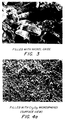
- Figure 3 is a photomicrograph (surface at 643x) of a fiber metal matrix filled with nickel oxide, to block the inter-connecting pores of the structure.
- the amount of nickel oxide resulted in only a moderate increase in the density of the material.
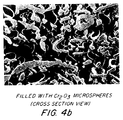
- Figures 4(a) and (b) are photomicrographs of a similar fiber metal segment filled with chromium oxide microspheres.
- Figure 4(a) at a magnification of 55x shows the extent of microsphere coverage at the surface of the segment, while Figure 4(b) at 344x, is a cut, through the center of the segment - showing how the spheres (the thin, arcuate lines) bridge the fibers which define the pores of the matrix, thus blocking the pores.
- Figure 1 is a photomicrograph of a conventional sinter-bonded, fiber metal liner segment, showing the degree of porosity and interconnecting air passages which normally exist in such liners.
- the fibers in such liners exhibit irregular shapes, but have diameters which normally fall within the range of 5 to 25 microns and aspect ratios of 50 to 80:1. Similar, fiber metal segments were filled using three different methods, described in greater detail in the three examples below.
- the first product, Figure 2 is similar to that suggested in U.S. Patent 3,519,282, in which a slurry of fine nickel powders was forced into the open pore structure, dried and heated to bond the powders to each other, and to the fibers.
- Examples 2 and 3 utilized methods in accord with the instant invention, in which a liquid containing the desired metal is employed to achieve uniform infiltration throughout the entire metal matrix. Thereafter, the infiltrated metal is heated in air such that the resulting oxidic material either: (i) blocks the interconnecting passageways to achieve materially decreased permeability, without completely filling the pores or (ii) substantially fills the pores with oxidic microspheres to achieve an even greater decrease in leakage.
- Permeability or leakage is evaluated by forcing compressed air through the test specimen and measuring the degree of blockage.
- Compressed air at 69 KPa (gauge) is delivered at a rate of 10.38 L/min through an open metal tube (0.64 cm I.D.) having flexible plastic tubing at the end thereof to effect a reasonably tight seal with the surface of the material being evaluated.
- Some degree of leakage is nevertheless noted, even for impermeable materials, due to the nonconformance of the plastic tip with a rough surface.
- the degree of blockage is noted on a flow gauge.
- the conventional material gives average readings of 10.2 L/min indicating very minor blockage.
- the test apparatus consists of an air turbine which drives the blade tip (simulating the blades encountered in turbine engines).
- the turbine can be operated at up to 48,000 rpm - corresponding to a surface velocity of the rotor element of 305 m/s.
- the abradable specimen is mounted on a motorized table which moves at a controlled rate and controlled depth of penetration into the rotor element.
- the motorized table is instrumented to measure face loads, rotor speed loss and torque resulting from the rub interaction.
- the torque developed during the rub is the product of the rotor mass moment of inertia and the rotor deceleration; while the rub energy is a function of speed lost during the interaction.
- a conventional, fiber metal matrix (shown in Figure 1) was tested using a Coulter Porometer. It was found that the pore size distribution varied from about 2 to 40 microns, with a majority of the pores being greater than 4 microns. This is significant because of the availability of nickel powders with an average particle size of 4 microns. Ni powders offer the possibility of a good match with the Ni based alloy (HASTELLOY X) of the fiber metal matrix.
- U.S. Patent 3,519,282 suggests that permeability of sintered, fiber metal matrixes can be substantially decreased by infiltration of metal powders; although this patent is silent as to how such infiltration may be achieved. Infiltration was achieved, utilizing an ultrasonic gun.
- a sheet segment of the sintered, fiber metal matrix was horizontally supported and immersed in a bath of water.
- a Ni-powder slurry 50 g Ni in 100 ml of water
- an ultrasonic gun was then scanned over the entire surface of the sheet to enhance infiltration of the powders.
- the sheet was then turned, so that the other surface faced upward and the procedure was repeated - resulting in a weight increase of only 19% (due to incomplete filling, particularly in the midsection of the sheet).
- the resultant product, shown in Figure 2 was evaluated to determine the decrease in permeability achieved by the infiltration of Ni powders.
- the conventional, unfilled material exhibits only minor blockage with readings of 10.2 L/min.
- the best of the Ni powder infiltrated samples exhibited only a minor decrease in leakage - with a reading of 9.7 L/min. Because of the meager improvement in impermeability, quantitative abradability tests were not run. However, a cursory test showed a marked decrease in abradability.
- the fiber metal segment is oxidized in air at 538°C for 20 minutes.
- the segment is removed from the bath, drained, dried in an oven set at 80°C for 40 minutes and fired by placing it in a furnace set at 720°C for 7 minutes.
- the resulting product is substantially completely filled with microspheres of chromic oxide.
- Figure 4(a) shows the extent of microsphere coverage on the surface of the fiber metal segment; while Figure 4(b) is a cut taken from the center of the filled segment, which shows how the spheres block the channels of the matrix.
- the hollowness (i.e., sphere diameter to wall thickness) of the microspheres is evidenced in Figure 4(b), by comparing the thickness of the irregular fibers (normally within the range of 5 to 25 microns) to the wall thickness of the microspheres.
- the resulting products exhibit a leakage of less than 1.4 L/min - due primarily, as noted above, to leakage between the nonconforming tip and the irregular surface of the specimen. Even though the product exhibited a weight increase of about 28%, the thin wall character and friability of the microspheres, coupled with the lubricity of the chromic oxide coating over a substantial portion of the fibers, resulted in a product exhibiting improved abradability as evidenced from the results reported in the Table.
- the capability of such substances to foam may be based, for example, on: the incorporation of a blowing agent in the solution or sol, or the entrapped solvent (e.g. water) may itself act as a blowing agent - as in the case of chromic acid.
- a blowing agent e.g. water
- the entrapped solvent e.g. water
- U. S. Patent 4,349,456 (Col. 4, lines 6-54) lists a variety of materials with the potential not only to foam, but to form oxidic microspheres.
- Chromic acid is particularly preferred for HASTELLOY X fibers, because of its effectiveness in reacting with the HASTELLOY X - enhancing, (i) the abradability of the sintered fiber metal matrix, and (ii) the interfacial bond between the metal fibers and the ceramic filler.
Landscapes
- Engineering & Computer Science (AREA)
- Mechanical Engineering (AREA)
- Manufacturing & Machinery (AREA)
- General Engineering & Computer Science (AREA)
- Powder Metallurgy (AREA)
- Turbine Rotor Nozzle Sealing (AREA)
Abstract
Claims (20)
- Un procédé pour la réalisation d'une garniture d'étanchéité abradable pour turbomachine, ladite garniture comprenant une matrice squelettale rigide dont les pores sont au moins partiellement remplis d'un métal ou d'un composé métallique à l'effet de réduire sensiblement la perméabilité aux gaz de la garniture dans des applications à haute température, le procédé comprenant les opérations consistantà infiltrer de manière sensiblement complète les pores de ladite matrice avec un produit d' infiltration liquide renfermant une quantité efficace d'un métal, ledit liquide présentant une viscosité suffisamment basse pour pénétrer adéquatement dans les pores de la matrice, ladite infiltration étant suffisante pour que, par chauffage, la perméabilité à l'air de la garniture se trouve réduite à moins de 50 % de celle de la matrice non infiltrée,à empêcher le produit d'infiltration de s'échapper de la matrice,à chauffer la matrice infiltrée pendant une durée et à une température suffisantes pour faire former au produit d'infiltration un dérivé qui est stable aux hautes températures considérées et adhère au matériau de la matrice, de sorte qu'il remplisse les pores ou en obture les passages à un degré suffisant pour assurer ladite réduction de perméabilité à l'air de la garniture.
- Le procédé de la revendication 1 dans lequel ledit liquide est un sel fondu contenant le métal, et l'échappement du produit d'infiltration est empêché par refroidissement du sel fondu.
- Le procédé de la revendication 2, dans lequel ledit chauffage est conduit à une température et pendant une durée suffisantes pour chasser le composant anionique dudit sel.
- Le procédé de la revendication 3, dans lequel ledit produit d'infiltration est essentiellement constitué de nitrate de nickel.
- Le procédé de la revendication 1, dans lequel ledit chauffage est opéré dans une atmosphère oxygénée pendant une durée suffisante pour former un oxyde métallique.
- Le procédé de la revendication 5, dans lequel ledit métal est choisi parmi les éléments de transition.
- Un procédé pour la production d'un matériau de garniture abradable pour turbomachine, comprenant une matrice squelettale rigide dont les pores sont au moins partiellement remplis par un métal ou un composé métallique à l'effet de réduire sensiblement la perméabilité aux gaz de la garniture dans des applications à haute température, le procédé comprenant les opérations consistantà infiltrer de manière sensiblement complète les pores de ladite matrice avec une solution ou une dispersion renfermant une quantité efficace d'au moins un métal, à l'état d'élément ou sous forme combinée, ladite solution ou dispersion ayant une viscosité suffisamment basse pour pénétrer adéquatement dans les pores de la matrice, ladite infiltration étant suffisante pour que, par chauffage, la perméabilité à l'air de la garniture se trouve réduite à moins de 50 % de celle de la matrice non infiltrée,à empêcher le produit d'infiltration de s'échapper de la matrice,à chauffer la matrice infiltrée dans des conditions propres à expanser en mousse le produit d'infiltration et à lui faire former un dérivé qui : (i) est stable aux hautes températures considérées et (ii) adhère au matériau de la matrice, de sorte qu'il en remplisse les pores à un degré suffisant pour assurer ladite réduction de perméabilité aux gaz de la garniture.
- Le procédé de la revendication 7, dans lequel on empêche 1' échappement du produit d'infiltration par séchage de la matrice infiltrée à une température et une pression suffisantes pour chasser une majeure partie du solvant.
- Le procédé de la revendication 8, dans lequel ledit séchage est conduit de manière à transformer ledit produit d'infiltration en une substance géliforme capable de s'expanser en mousse lorsqu'on la chauffe rapidement à une température élevée.
- Le procédé de la revendication 9, dans lequel ledit chauffage est suffisamment rapide pour transformer la substance géliforme en des microsphères ou des cellules fermées qui remplissent les pores de ladite structure.
- Le procédé de la revendication 10, dans lequel lesdits pores présentent en majorité un diamètre effectif inférieur à 40 µm.
- Le procédé de la revendication 10, dans lequel ledit produit d'infiltration est une solution aqueuse d'acide chromique.
- Le procédé de la revendication 8, dans lequel ladite infiltration est suffisante pour que, par chauffage, la perméabilité à l'air de la garniture devienne inférieure d'au moins 1 ordre de grandeur à celle de la matrice non infiltrée.
- Une garniture abradable, réalisée à partir d'un matériau composite, comprenant une matrice squelettale rigide dont les pores sont au moins partiellement remplis d'une matière particulaire, caractérisée en ce que lesdits pores sont remplis de manière sensiblement complète d'un composé métallique expansé, formé par le dégagement de gaz par un précurseur géliforme, le degré dudit remplissage étant suffisant pour réduire la perméabilité à l'air de la garniture à moins de 50 % de celle de la matrice non remplie.
- La garniture abradable de la revendication 14, dans laquelle ledit composé métallique est sous forme de microsphères creuses.
- La garniture abradable de la revendication 15, dans laquelle les pores sont reliés entre eux par des passages présentant un diamètre effectif sensiblement inférieur à celui desdits pores et à celui desdites microsphères.
- La garniture abradable de la revendication 16, dans laquelle ladite matrice est composée de particules métalliques frittées.
- La garniture abradable de la revendication 17, dans laquelle lesdites particules métalliques présentent en majorité un diamètre de 5 à 25 µm et un rapport d'effilement de 50:1 à 80:1.
- La garniture abradable de la revendication 18, dans laquelle ledit composé métallique est un oxyde métallique, ledit oxyde ayant été expansé par dégagement de gaz.
- La garniture abradable de la revendication 19, dans laquelle ledit oxyde métallique est sous forme de microsphères creuses.
Applications Claiming Priority (3)
| Application Number | Priority Date | Filing Date | Title |
|---|---|---|---|
| US764204 | 1977-01-31 | ||
| US07/764,204 US5350557A (en) | 1991-09-23 | 1991-09-23 | Impermeable, abradable seal and method for the production thereof |
| PCT/US1991/008285 WO1993006342A1 (fr) | 1991-09-23 | 1991-11-12 | Garniture d'etancheite impermeable et pouvant etre abrasee, et procede de production |
Publications (2)
| Publication Number | Publication Date |
|---|---|
| EP0605417A1 EP0605417A1 (fr) | 1994-07-13 |
| EP0605417B1 true EP0605417B1 (fr) | 1997-03-05 |
Family
ID=25069995
Family Applications (1)
| Application Number | Title | Priority Date | Filing Date |
|---|---|---|---|
| EP91920603A Expired - Lifetime EP0605417B1 (fr) | 1991-09-23 | 1991-11-12 | Garniture d'etancheite impermeable et pouvant etre abrasee, et procede de production |
Country Status (6)
| Country | Link |
|---|---|
| US (1) | US5350557A (fr) |
| EP (1) | EP0605417B1 (fr) |
| JP (1) | JPH07501865A (fr) |
| CA (1) | CA2109797A1 (fr) |
| DE (1) | DE69125036T2 (fr) |
| WO (1) | WO1993006342A1 (fr) |
Cited By (2)
| Publication number | Priority date | Publication date | Assignee | Title |
|---|---|---|---|---|
| EP1013890A2 (fr) | 1998-12-16 | 2000-06-28 | Rolls-Royce Deutschland GmbH | Joint abradable pour turbomachines |
| DE102008019331A1 (de) * | 2008-04-16 | 2009-10-22 | Rolls-Royce Deutschland Ltd & Co Kg | Einlaufdichtung für den Kompressor eines Gasturbinentriebwerks |
Families Citing this family (10)
| Publication number | Priority date | Publication date | Assignee | Title |
|---|---|---|---|---|
| US6365222B1 (en) | 2000-10-27 | 2002-04-02 | Siemens Westinghouse Power Corporation | Abradable coating applied with cold spray technique |
| WO2004039849A2 (fr) * | 2002-10-29 | 2004-05-13 | E.I. Du Pont De Nemours And Company | Copolymere d'ethylene a greffe contenant du fluor et procede de preparation correspondant |
| US8017240B2 (en) * | 2006-09-28 | 2011-09-13 | United Technologies Corporation | Ternary carbide and nitride thermal spray abradable seal material |
| GB0822416D0 (en) | 2008-12-10 | 2009-01-14 | Rolls Royce Plc | A seal and a method of manufacturing a seal |
| US9598972B2 (en) * | 2010-03-30 | 2017-03-21 | United Technologies Corporation | Abradable turbine air seal |
| WO2014025573A1 (fr) * | 2012-08-09 | 2014-02-13 | United Technologies Corporation | Matières de scellage nanocellulaire |
| KR20150060960A (ko) * | 2012-10-05 | 2015-06-03 | 지멘스 악티엔게젤샤프트 | 가스 터빈 블레이드 처리 방법 및 상기 블레이드를 포함한 가스 터빈 |
| EP3068997B1 (fr) | 2013-11-11 | 2021-12-29 | Raytheon Technologies Corporation | Joint d'étanchéité segmenté pour moteur à turbine à gaz |
| US10634055B2 (en) | 2015-02-05 | 2020-04-28 | United Technologies Corporation | Gas turbine engine having section with thermally isolated area |
| US9920652B2 (en) | 2015-02-09 | 2018-03-20 | United Technologies Corporation | Gas turbine engine having section with thermally isolated area |
Family Cites Families (11)
| Publication number | Priority date | Publication date | Assignee | Title |
|---|---|---|---|---|
| CA727556A (en) * | 1966-02-08 | S. Hill James | Method of making metal bodies incorporated with non-metallic refractory material and product thereof | |
| US3519282A (en) * | 1966-03-11 | 1970-07-07 | Gen Electric | Abradable material seal |
| US3407061A (en) * | 1967-05-04 | 1968-10-22 | Whittaker Corp | Metal coating process |
| US3844011A (en) * | 1970-12-21 | 1974-10-29 | Gould Inc | Powder metal honeycomb |
| US3748105A (en) * | 1971-02-25 | 1973-07-24 | Allegheny Ludlum Ind Inc | Corrosion resistant powder metal parts |
| US3741734A (en) * | 1971-10-04 | 1973-06-26 | Gen Electric | Metal products and process of preparation |
| US4139376A (en) * | 1974-02-28 | 1979-02-13 | Brunswick Corporation | Abradable seal material and composition thereof |
| US4349456A (en) * | 1976-04-22 | 1982-09-14 | Minnesota Mining And Manufacturing Company | Non-vitreous ceramic metal oxide microcapsules and process for making same |
| US4155755A (en) * | 1977-09-21 | 1979-05-22 | Union Carbide Corporation | Oxidation resistant porous abradable seal member for high temperature service |
| US4251272A (en) * | 1978-12-26 | 1981-02-17 | Union Carbide Corporation | Oxidation resistant porous abradable seal member for high temperature service |
| EP0187612B1 (fr) * | 1984-12-24 | 1990-09-12 | United Technologies Corporation | Joint d'étanchéité abrasable ayant une résistance élevée à l'érosion |
-
1991
- 1991-09-23 US US07/764,204 patent/US5350557A/en not_active Expired - Fee Related
- 1991-11-12 WO PCT/US1991/008285 patent/WO1993006342A1/fr not_active Ceased
- 1991-11-12 DE DE69125036T patent/DE69125036T2/de not_active Expired - Fee Related
- 1991-11-12 CA CA002109797A patent/CA2109797A1/fr not_active Abandoned
- 1991-11-12 JP JP4500167A patent/JPH07501865A/ja active Pending
- 1991-11-12 EP EP91920603A patent/EP0605417B1/fr not_active Expired - Lifetime
Cited By (2)
| Publication number | Priority date | Publication date | Assignee | Title |
|---|---|---|---|---|
| EP1013890A2 (fr) | 1998-12-16 | 2000-06-28 | Rolls-Royce Deutschland GmbH | Joint abradable pour turbomachines |
| DE102008019331A1 (de) * | 2008-04-16 | 2009-10-22 | Rolls-Royce Deutschland Ltd & Co Kg | Einlaufdichtung für den Kompressor eines Gasturbinentriebwerks |
Also Published As
| Publication number | Publication date |
|---|---|
| EP0605417A1 (fr) | 1994-07-13 |
| US5350557A (en) | 1994-09-27 |
| WO1993006342A1 (fr) | 1993-04-01 |
| DE69125036D1 (de) | 1997-04-10 |
| DE69125036T2 (de) | 1997-10-09 |
| CA2109797A1 (fr) | 1993-04-01 |
| JPH07501865A (ja) | 1995-02-23 |
Similar Documents
| Publication | Publication Date | Title |
|---|---|---|
| US5350557A (en) | Impermeable, abradable seal and method for the production thereof | |
| EP1272441B1 (fr) | Procede de fabrication d'un revetement resistant a l'erosion et aux temperatures elevees, et materiau contenant des formes geometriques creuses compactees | |
| US4094673A (en) | Abradable seal material and composition thereof | |
| US4741973A (en) | Silicon carbide abrasive particles having multilayered coating | |
| US4139376A (en) | Abradable seal material and composition thereof | |
| EP1244605B1 (fr) | Revetement et materiau resistant a l'erosion sous de hautes temperatures, renfermant des structures geometriques creuses et serrees | |
| US3975165A (en) | Graded metal-to-ceramic structure for high temperature abradable seal applications and a method of producing said | |
| US3342563A (en) | Cellular material and method for making | |
| EP0192162B1 (fr) | Composites céramique-métal | |
| CA1042641A (fr) | Fabrication d'elements composites pour aubes de turbines | |
| EP0254667B1 (fr) | Méthode pour l'adhérence de matériau granuleux à des pointes d'aube | |
| JP4149374B2 (ja) | アブレイダブルシールシステム | |
| US5024884A (en) | Abradable seal having particulate erosion resistance | |
| US20030080477A1 (en) | Method for making a high temperature erosion resistant material containing compacted hollow geometric shapes | |
| US4759957A (en) | Porous metal structures made by thermal spraying fugitive material and metal | |
| CA1230017A (fr) | Elements metalliques a structure poreuse obtenus par projection simultanee de metal et de plastique fondus | |
| US6663776B2 (en) | High strength SiC filter and method for the manufacture thereof | |
| EP0712821A1 (fr) | Matériau céramique poreux et procédé pour sa préparation et unité de soupape | |
| CN112334601A (zh) | 用于制造可磨层的方法 | |
| US3891009A (en) | High-temperature heat-insulating structure | |
| US4049428A (en) | Metal porous abradable seal | |
| WO1995021319A1 (fr) | Joints abradables en nid-d'abeilles | |
| US3383207A (en) | Method for making cellular material | |
| KR20020074851A (ko) | 개포형 금속포움 제조방법 | |
| JPH01167282A (ja) | セラミツクス多孔体 |
Legal Events
| Date | Code | Title | Description |
|---|---|---|---|
| PUAI | Public reference made under article 153(3) epc to a published international application that has entered the european phase |
Free format text: ORIGINAL CODE: 0009012 |
|
| 17P | Request for examination filed |
Effective date: 19940324 |
|
| AK | Designated contracting states |
Kind code of ref document: A1 Designated state(s): DE ES FR GB IT |
|
| 17Q | First examination report despatched |
Effective date: 19940712 |
|
| GRAG | Despatch of communication of intention to grant |
Free format text: ORIGINAL CODE: EPIDOS AGRA |
|
| GRAH | Despatch of communication of intention to grant a patent |
Free format text: ORIGINAL CODE: EPIDOS IGRA |
|
| GRAH | Despatch of communication of intention to grant a patent |
Free format text: ORIGINAL CODE: EPIDOS IGRA |
|
| GRAA | (expected) grant |
Free format text: ORIGINAL CODE: 0009210 |
|
| AK | Designated contracting states |
Kind code of ref document: B1 Designated state(s): DE ES FR GB IT |
|
| PG25 | Lapsed in a contracting state [announced via postgrant information from national office to epo] |
Ref country code: IT Free format text: LAPSE BECAUSE OF FAILURE TO SUBMIT A TRANSLATION OF THE DESCRIPTION OR TO PAY THE FEE WITHIN THE PRE;WARNING: LAPSES OF ITALIAN PATENTS WITH EFFECTIVE DATE BEFORE 2007 MAY HAVE OCCURRED AT ANY TIME BEFORE 2007. THE CORRECT EFFECTIVE DATE MAY BE DIFFERENT FROM THE ONE RECORDED.SCRIBED TIME-LIMIT Effective date: 19970305 Ref country code: ES Free format text: THE PATENT HAS BEEN ANNULLED BY A DECISION OF A NATIONAL AUTHORITY Effective date: 19970305 Ref country code: FR Effective date: 19970305 |
|
| REF | Corresponds to: |
Ref document number: 69125036 Country of ref document: DE Date of ref document: 19970410 |
|
| EN | Fr: translation not filed | ||
| PGFP | Annual fee paid to national office [announced via postgrant information from national office to epo] |
Ref country code: GB Payment date: 19971027 Year of fee payment: 7 |
|
| PGFP | Annual fee paid to national office [announced via postgrant information from national office to epo] |
Ref country code: DE Payment date: 19971211 Year of fee payment: 7 |
|
| PLBE | No opposition filed within time limit |
Free format text: ORIGINAL CODE: 0009261 |
|
| STAA | Information on the status of an ep patent application or granted ep patent |
Free format text: STATUS: NO OPPOSITION FILED WITHIN TIME LIMIT |
|
| 26N | No opposition filed | ||
| PG25 | Lapsed in a contracting state [announced via postgrant information from national office to epo] |
Ref country code: GB Free format text: LAPSE BECAUSE OF NON-PAYMENT OF DUE FEES Effective date: 19981112 |
|
| GBPC | Gb: european patent ceased through non-payment of renewal fee |
Effective date: 19981112 |
|
| PG25 | Lapsed in a contracting state [announced via postgrant information from national office to epo] |
Ref country code: DE Free format text: LAPSE BECAUSE OF NON-PAYMENT OF DUE FEES Effective date: 19990901 |