EP0605749A1 - Verfahren zur hydroponischen Anzucht von Pflanzen und Einrichtung zur Durchführung dieses Verfahrens - Google Patents
Verfahren zur hydroponischen Anzucht von Pflanzen und Einrichtung zur Durchführung dieses Verfahrens Download PDFInfo
- Publication number
- EP0605749A1 EP0605749A1 EP93100150A EP93100150A EP0605749A1 EP 0605749 A1 EP0605749 A1 EP 0605749A1 EP 93100150 A EP93100150 A EP 93100150A EP 93100150 A EP93100150 A EP 93100150A EP 0605749 A1 EP0605749 A1 EP 0605749A1
- Authority
- EP
- European Patent Office
- Prior art keywords
- nutrient solution
- substrate
- plants
- sprinkling
- distributor
- Prior art date
- Legal status (The legal status is an assumption and is not a legal conclusion. Google has not performed a legal analysis and makes no representation as to the accuracy of the status listed.)
- Granted
Links
- 238000000034 method Methods 0.000 title claims abstract description 18
- 235000015097 nutrients Nutrition 0.000 claims abstract description 35
- 239000000758 substrate Substances 0.000 claims abstract description 23
- 239000012080 ambient air Substances 0.000 claims abstract description 8
- 239000000443 aerosol Substances 0.000 claims abstract description 4
- 235000016709 nutrition Nutrition 0.000 claims description 2
- 230000035764 nutrition Effects 0.000 claims description 2
- QVGXLLKOCUKJST-UHFFFAOYSA-N atomic oxygen Chemical compound [O] QVGXLLKOCUKJST-UHFFFAOYSA-N 0.000 description 4
- 229910052760 oxygen Inorganic materials 0.000 description 4
- 239000001301 oxygen Substances 0.000 description 4
- 230000000694 effects Effects 0.000 description 2
- 235000013311 vegetables Nutrition 0.000 description 2
- 230000004308 accommodation Effects 0.000 description 1
- 239000003570 air Substances 0.000 description 1
- 238000010276 construction Methods 0.000 description 1
- 125000004122 cyclic group Chemical group 0.000 description 1
- 201000010099 disease Diseases 0.000 description 1
- 208000037265 diseases, disorders, signs and symptoms Diseases 0.000 description 1
- 230000008020 evaporation Effects 0.000 description 1
- 238000001704 evaporation Methods 0.000 description 1
- 230000002349 favourable effect Effects 0.000 description 1
- 235000013305 food Nutrition 0.000 description 1
- 230000014759 maintenance of location Effects 0.000 description 1
- 238000004519 manufacturing process Methods 0.000 description 1
- 230000008092 positive effect Effects 0.000 description 1
- 239000002244 precipitate Substances 0.000 description 1
- 239000002002 slurry Substances 0.000 description 1
- 239000002344 surface layer Substances 0.000 description 1
- 229920002554 vinyl polymer Polymers 0.000 description 1
- 238000009736 wetting Methods 0.000 description 1
Images
Classifications
-
- A—HUMAN NECESSITIES
- A01—AGRICULTURE; FORESTRY; ANIMAL HUSBANDRY; HUNTING; TRAPPING; FISHING
- A01G—HORTICULTURE; CULTIVATION OF VEGETABLES, FLOWERS, RICE, FRUIT, VINES, HOPS OR SEAWEED; FORESTRY; WATERING
- A01G31/00—Soilless cultivation, e.g. hydroponics
- A01G31/02—Special apparatus therefor
-
- A—HUMAN NECESSITIES
- A01—AGRICULTURE; FORESTRY; ANIMAL HUSBANDRY; HUNTING; TRAPPING; FISHING
- A01G—HORTICULTURE; CULTIVATION OF VEGETABLES, FLOWERS, RICE, FRUIT, VINES, HOPS OR SEAWEED; FORESTRY; WATERING
- A01G31/00—Soilless cultivation, e.g. hydroponics
-
- A—HUMAN NECESSITIES
- A01—AGRICULTURE; FORESTRY; ANIMAL HUSBANDRY; HUNTING; TRAPPING; FISHING
- A01G—HORTICULTURE; CULTIVATION OF VEGETABLES, FLOWERS, RICE, FRUIT, VINES, HOPS OR SEAWEED; FORESTRY; WATERING
- A01G31/00—Soilless cultivation, e.g. hydroponics
- A01G31/02—Special apparatus therefor
- A01G31/065—Special apparatus therefor with means for recycling the nutritive solution
-
- Y—GENERAL TAGGING OF NEW TECHNOLOGICAL DEVELOPMENTS; GENERAL TAGGING OF CROSS-SECTIONAL TECHNOLOGIES SPANNING OVER SEVERAL SECTIONS OF THE IPC; TECHNICAL SUBJECTS COVERED BY FORMER USPC CROSS-REFERENCE ART COLLECTIONS [XRACs] AND DIGESTS
- Y02—TECHNOLOGIES OR APPLICATIONS FOR MITIGATION OR ADAPTATION AGAINST CLIMATE CHANGE
- Y02P—CLIMATE CHANGE MITIGATION TECHNOLOGIES IN THE PRODUCTION OR PROCESSING OF GOODS
- Y02P60/00—Technologies relating to agriculture, livestock or agroalimentary industries
- Y02P60/20—Reduction of greenhouse gas [GHG] emissions in agriculture, e.g. CO2
- Y02P60/21—Dinitrogen oxide [N2O], e.g. using aquaponics, hydroponics or efficiency measures
Definitions
- the invention relates to a method for hydroponic cultivation of plants in living and public spaces and to a device for performing the method.
- a method for the aerous-aqueous cultivation of plants is known (SU, A, 1319793), which includes their accommodation and retention in vegetation vessels which are designed in the form of horizontally lying tubes with holes in the walls for receiving plants.
- a nutrient solution is fed in via the tubes with a certain periodicity, with subsequent drainage of the same and keeping the plants without solution.
- the known method has significant disadvantages; in particular, the use of pipes as vegetation vessels creates inconveniences when using the device under domestic conditions. In addition, it is impossible for them to monitor the development of plants, which can lead to disease and shrinkage of the plants. This is due in particular to the fact that in the period when the tubes are filled with the nutrient solution the plants are inevitably hungry for oxygen, which has a negative effect on their development and ultimately on their productivity.
- JP, B, 60-40807 Also known are a method and a device for hydroponic cultivation of plants (JP, B, 60-40807), the device containing a vegetation container with nutrient solution and with a device for oxygen saturation of the nutrient medium in the vegetation vessel. Despite the fact that this device improves the oxygen supply to the root system of the plants, it does not remedy a disadvantage which is related to the possible decay of the root system constantly immersed in the solution.
- a device for hydroponic cultivation of plants is also known (SU, A, 917805), which contains a nutrient solution collector, a pump and a vegetation container with a drain pipe, in the upper part of which a nutrient solution distributor is arranged, which is designed as a perforated tube on the lower side, the pump being connected on the one hand to the nutrient solution distributor and on the other hand to the nutrient solution collector.
- a disadvantage of this device is the uneven moistening of the substrate, which is the result of the fact that it only occurs along the land sides of the container without the solution having to be fed in, and the possible blockage of the holes in the tube because of a gap-free method of feeding the nutrient solution to the substrate.
- watering in self-flow most of the nutrients are deposited in the form of a precipitate in the nutrient solution supply system.
- the object of the invention is to eliminate the disadvantages mentioned above, in particular to improve the growth of the plants and to increase their productivity while at the same time simplifying the construction of the device.
- the object of the invention is achieved in that the supply of the nutrient solution is achieved by aerosol sprinkling the surface of the substrate with a sprinkling periodicity and duration depending on the temperature of the ambient air.
- the sprinkling is carried out for 50 to 70 seconds with an interval of 10-14 minutes.
- sprinkling is carried out for 30 to 50 seconds with an interval of 6-10 minutes, and at a temperature above 29 o C - for 10 to 30 seconds with an interval of 2-6 minutes .
- the inventive method for hydroponic cultivation of plants is carried out with the aid of a device in which a perforated tube, which is located in the upper part of a vegetation container, is arranged at a certain distance from the substrate surface, the total area of the holes on the tube being smaller than that Cross-sectional area of a drain pipe is.
- the holes made on the lower side of the tube be successively at an angle of about 45 o to one side and the other from a vertical plane are directed from, which runs centrally along the tube.
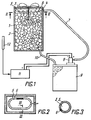
- the device for growing plants contains a vegetation container 1, in which a plant is accommodated, which is held therein by means of a substrate 2. At the top, the container is closed with a lid 3 through which the part of the plants located above the earth is passed. In the upper part of the wall of the container 1 there is an opening for a tube 4 which feeds the nutrient solutions to a distributor 5 which is at a certain distance from the surface of the substrate 2.
- the distributor 5 is rigidly attached to the cover 3 and is in the form of a polyvinyl tube, on the lower side of which holes 6 are provided.
- the holes 6 are o disposed at an angle of about 45 with respect to a centrally along the tube extending plane and alternately to the one and the other side of this plane with respect directed.
- the tube 4 is connected by means of a flexible hose 7 to a pump 8 which conveys the nutrient solution from a collector 9, while in the bottom of the vegetation container 1 there is an outflow opening through which a drain pipe 10 is guided which is connected to the nutrient solution collector 9 stands.
- a program control device 11 is connected to the pump 8.
- Thermocouples 12, which are connected to the program control device 11, are arranged inside the vegetation container 1 and at the window where the device is installed.
- the cultivation of plants takes place in the device according to the invention as follows.
- the seedlings of plants are accommodated in the vegetation container 1 and held therein by means of the substrate 2 with which the entire container 1 is filled. Keramsite, for example, can be used as the substrate.
- the over part of the plants located on the earth is passed through the cover 3, with which the container 1 is closed from above.
- the nutrient solution distributor 5 is attached to the lid 3 and comes to a certain distance from the surface of the substrate 2 after the lid 3 has been attached.
- the distance between the lid and the surface of the substrate 2 is chosen such that the nutrient solution jets which emerge from the holes present on the lower side of the tube of the distributor 5 strike the surface of the substrate 2 without loss of pressure head and a finely dispersed nutrient medium medium upon impact form, which not only moistens the surface layer of the substrate, but also penetrates the entire depth and maintains the substrate in a moist state.
- the program control device 11 operates in the cyclic operating mode according to one of the three selected programs in the automatic variant depending on the climatic conditions and the ambient temperature.
- the command for switching the wetting regime of the substrate 2 in the container 1 comes from the thermocouples 12, which are connected to the program control device 11.
- the program control device 11 switches on one of the programs depending on the ambient temperature, the pump 8 starting to deliver the nutrient solution via the distributor 5.
- the pump 8 conveys the nutrient solution for 60 seconds, after which it is switched off for 12 minutes.
- the excess nutrient solution is returned to the collector via the drain pipe 10 and the root system receives the food in the form of an aerosol nutrient medium. Then the cycle repeats. If the ambient temperature has changed, the device starts to work in a different operating state.
- the cultivation of vegetables by the method according to the invention precludes flooding of the root system with the solution because the cross section of the drain pipe is larger than the total area of the holes on the perforated pipe of the distributor 5.
- the use of the device according to the invention offers the possibility of combining the nutrition of the root system with the nutrient solution and atmospheric oxygen, which has a positive effect on the development of a plant and its productivity.
- the application of the described invention makes it possible to increase the yield capacity of plants by 20 to 30% compared to the known methods and devices for hydroponic cultivation of plants.
- the device described is much easier to manufacture, which reduces its price.
- the transparent design of the front plate with a decorative curtain to protect it from light makes it possible to observe the development of the root system and the supply of the nutrient solution and to intervene in the event of any unforeseen deviations.
- the method according to the invention and the system for its implementation are intended for growing vegetables in greenhouses and in living rooms and can certainly be operated by a family living in these rooms.
Landscapes
- Life Sciences & Earth Sciences (AREA)
- Environmental Sciences (AREA)
- Hydroponics (AREA)
Abstract
Description
- Die Erfindung bezieht sich auf ein Verfahren zur hydroponischen Anzucht von Pflanzen in Wohn- und öffentlichen Räumen und auf eine Einrichtung zur Durchführung des Verfahrens.
- Es ist ein Verfahren zur aerisch-wäßrigen Anzucht von Pflanzen bekannt (SU, A, 1319793), das ihre Unterbringung und Festhaltung in Vegetationsgefäßen umfaßt, welche in Form von horizontal liegenden Rohren mit Löchern in den Wänden zur Aufnahme von Pflanzen ausgebildet sind. Über die Rohre wird mit einer bestimmten Periodizität eine Nährlösung unter nachfolgendem Abfluß derselben und Halten der Pflanzen ohne Lösung zugefuhrt.
- Das bekannte Verfahren weist wesentliche Nachteile auf; im besonderen schafft der Einsatz von Rohren als Vegetationsgefäße Unbequemlichkeiten bei Verwendung der Einrichtung unter häuslichen Verhältnissen. Außerdem ist es bei ihnen unmöglich, die Entwicklung von Pflanzen zu überwachen, was zur Erkrankung und zum Eingehen der Pflanzen führen kann. Dies hängt insbesondere damit zusammen, daß in der Periode der Füllung der Rohre mit der Nährlösung unvermeidlich ein Sauerstoffhunger der Pflanzen entsteht, was sich auf deren Entwicklung und letzten Endes auf die Ertragfähigkeit negativ auswirkt.
- Bekannt sind auch ein Verfahren und eine Einrichtung zur hydroponischen Anzucht von Pflanzen (JP, B, 60-40807), wobei die Einrichtung einen Vegetationsbehälter mit Nährlösung und mit einer Vorrichtung zur Sauerstoffsättigung des Nährmediums im Vegetationsgefäß enthält. Trotzdem bei dieser Einrichtung die Sauerstoffzufuhr zum Wurzelsystem der Pflanzen verbessert ist, ist in ihr ein Nachteil nicht behoben, der mit dem möglichen Verfaulen des in die Lösung ständig eingetauchten Wurzelsystems zusammenhängt.
- Es ist außerdem eine Einrichtung zur hydroponischen Anzucht von Pflanzen bekannt (SU, A, 917805), die einen Nährlösungs-Sammler, eine Pumpe und einen Vegetationsbehalter mit Abflußrohr enthält, in dessen oberem Teil ein Nährlösungs-Verteiler angeordnet ist, der als auf der unteren Seite gelochtes Rohr ausgebildet ist, wobei die Pumpe einerseits mit dem Nährlösungs-Verteiler und andererseits mit dem Nährlösungs-Sammler verbunden ist.
- Einen Nachteil dieser Einrichtung bildet die ungleichmäßige Befeuchtung des Substrats, was die Folge davon ist, daß sie nur längs der landen Seiten des Behälters ohne Zwangszuführung der Lösung geschieht, sowie die eventuelle Verstopfung der Löcher im Rohr wegen eines spaltfreien Verfahrens der Nährlösungszuführung zum Substrat. Beim Begießen im Selbstfluß lagert sich überdies der größte Teil von Nährstoffen in Form eines Niederschlags im Nährlösungs-Zufuhrsystem ab.
- Aufgabe der Erfindung ist es, die obengenannten Nachteile zu beseitigen, im besonderen das Wachstum der Pflanzen zu verbessern und ihre Ertragfähigkeit unter gleichzeitiger Vereinfachung der Konstruktion der Einrichtung zu steigern.
- Die Aufgabe der Erfindung wird dadurch gelöst, daß man die Zuführung der Nährlösung durch Aerosolberieselung der Oberfläche des Substrats mit einer Berieselungsperiodizität und -dauer in Abhängigkeit von der Temperatur der Umgebungsluft zustandebringt. Für den Fall, daß die Temperatur der Umgebungsluft in den Grenzen von 18 bis 22oC liegt, führt man dabei die Berieselung während 50 bis 70 Sekunden mit einem Intervall von 10-14 Minuten durch. Bei einer Umgebungslufttemperatur von 23 bis 29oC nimmt man die Berieselung während 30 bis 50 Sekunden mit einem Intervall von 6-10 Minuten vor, und bei einer Temperatur über 29oC - während 10 bis 30 Sekunden mit einem Intervall von 2-6 Minuten.
- Das erfindungsgemäße Verfahren zur hydroponischen Anzucht von Pflanzen wird mit Hilfe einer Einrichtung durchgeführt, bei der ein gelochtes Rohr, das sich im oberen Teil eines Vegetationsbehälters befindet, in einem gewissen Abstand von der Substratoberfläche angeordnet ist, wobei die Gesamtfläche der Löcher am Rohr kleiner als die Querschnittsfläche eines Abflußrohres ist.
- Um den Effekt des Verspritzens der Närlösung zu erhöhen, die über das Rohr zugeführt wird und in Form von Strahlen durch dessen Löcher auf die Oberfläche des Substrats austritt, wird es vorgeschlagen, daß die auf der unteren Seite des Rohres angebrachten Löcher nacheinander unter einem Winkel von etwa 45o nach der einen und der anderen Seite von einer Vertikalebene aus gerichtet sind, die mittig längs des Rohres verläuft.
- Die Erfindung wird mit Hilfe von Zeichnungen ausführlicher erläutert, in denen eine erfindungsgemäße Einrichtung zur hydroponischen Anzucht von Pflanzen dargestellt ist, wo es zeigt:
- Fig. 1 die erfindungsgemäße Einrichtung im teilweisen Schnitt;
- Fig. 2 eine Ansicht nach Linie II - II von Fig. 1;
- Fig. 3 einen Schnitt des Verteilerrohres nach Linie III - III der Fig. 2.
- Die Einrichtung zur Anzucht von Pflanzen enthält einen Vegetationsbehälter 1, in dem eine Pflanze untergebracht wird, welche mit Hilfe eines Substrats 2 darin festgehalten ist. Oben ist der Behälter mit einem Deckel 3 verschlossen, durch den der über der Erde befindliche Teil der Pflanzen hindurchgeführt ist. Im oberen Teil der Wand des Behälters 1 ist eine Öffnung fur ein Rohr 4 vorhanden, das die Nährlösunge einem Verteiler 5 zuführt, welcher sich in einem gewissen Abstand von der Oberfläche des Substrats 2 befindet. Der Verteiler 5 ist am Deckel 3 starr befestigt und in Form eines Polyvinylrohres ausgeführt, auf dessen unterer Seite Löcher 6 vorgesehen sind. Die Löcher 6 sind unter einem Winkel von etwa 45o in bezug auf eine mittig längs des Rohres verlaufende Ebene angeordnet und wechselweise nach der einen und der anderen Seite bezüglich dieser Ebene gerichtet. Das Rohr 4 ist mittels eines flexiblen Schlauchs 7 mit einer Pumpe 8 verbunden, welche die Nährlösung aus einem Sammler 9 fördert, während im Boden des Vegetationsbehälters 1 eine Ausflußöffnung vorhanden ist, durch die ein Abflußrohr 10 geführt ist, das mit dem Nährlösungssammler 9 in Verbindung steht. An die Pumpe 8 ist eine Programmsteuereinrichtung 11 angeschlossen.
- Innerhalb des Vegetationsbehalters 1 und am Fenster, wo die Einrichtung aufgestellt wird, sind Thermopaare 12 angeordnet, die mit der Programmsteuereinrichtung 11 verbunden sind.
- Die Anzucht von Pflanzen geht in der erfindungsgemäßen Einrichtung folgenderweise vonstatten.
- Im Vegetationsbehälter 1 werden die Setzlinge von Pflanzen untergebracht und darin mittels des Substrats 2 festgehalten, mit welchem der ganze Behälter 1 ausgefüllt wird. Als Substrat kann beispielsweise Keramsit verwendet werden. Der über der Erde befindliche Teil der Pflanzen ist durch den Deckel 3 hindurchgeführt, mit dem der Behälter 1 von oben her verschlossen wird. Am Deckel 3 ist der Nährlösungs-Verteiler 5 befestigt, der nach der Befestigung des Deckels 3 in einem gewissen Abstand von der Oberfläche des Substrats 2 zu stehen kommt. Der Abstand zwischen dem Deckel und der Oberfläche des Substrats 2 wird solcherweise gewählt, daß die Nährlösungsstrahlen, welche aus den auf der unteren Seite des Rohres des Verteilers 5 vorhandenen Löchern austreten, ohne Druckhöhenverlust auf die Oberfläche des Substrats 2 aufschlagen und beim Aufschlag ein feindisperses Nährlösungsmedium bilden, das nicht nur die Oberflächenschicht des Substrats befeuchtet, sondern auch auf dessen gesamte Tiefe eindringt und das Substrat in feuchtem Zustand unterhält.
- Ein sich bildender Nährlösungsüberschuß fließt über das Abflußrohr 10 in den Sammler 9 zurück. Da die Gesamtfläche sämtlicher Löcher, durch welche die Nährlösung zugeführt wird, kleiner als der Querschnitt des Abflußrohres 10 ist, wird gewährleistet, daß der Vegetationsbehälter 1 nicht mit der Lösung gefüllt wird, sondern nur das Substrat befeuchtet, was sich auf die Entwicklung der Pflanzen günstig auswirkt.
- Die Programmsteuereinrichtung 11 arbeitet in der zyklischen Betriebsart nach einem der drei gewählten Programme in der automatischen Variante in Abhängigkeit von den klimatischen Verhältnissen und der Umgebungstemperatur. Der Befehl für die Umschaltung des Befeuchtungsregimes des Substrats 2 im Behälter 1 kommt von den Thermopaaren 12, die mit der Programmsteuereinrichtung 11 in Verbindung stehen.
- Bei der Arbeit der Anlage schaltet die Programmsteuereinrichtung 11 eines der Programme je nach der Umgebungstemperatur ein, wobei die Pumpe 8 beginnt, die Nährlösung über den Verteiler 5 zu fördern. Bei einer Temperatur von z.B. 20oC fördert die Pumpe 8 die Nährlösung während 60 Sekunden, wonach sie für 12 Minuten abgeschaltet wird. Der Nährlösungsüberschuß wird über das Abflußrohr 10 in den Sammler zurückgeführt, und das Wurzelsystem erhält die Nahrung in Form eines Aerosolnährmediums. Dann wiederholt sich der Zyklus. Wenn sich die Umgebungstemperatur verändert hat, beginnt die Einrichtung in einem anderen Betriebszustand zu arbeiten.
- Je höher die Umgebungstemperatur ist, um so intensiver findet die Verdampfung der Feuchtigkeit über das Laub statt. Hieraus ergibt sich die Notwendigkeit einer zusätzlichen häufigeren Berieselung des Substrats mit der Nährlösung bei kleineren Intervallen, damit das Wurzelsystem die Ernährung mit Luft und Lösung besser aufnimmt.
- Die Anzucht von Gemüse nach dem erfindungsgemäßen Verfahren schließt eine Überflutung des Wurzelsystems mit der Lösung aus, weil der Querschnitt des Abflußrohres größer als die Gesamtfläche der Löcher am gelochten Rohr des Verteilers 5 ist. Der Einsatz der erfindungsgemäßen Einrichtung bietet die Möglichkeit, die Ernährung des Wurzelsystems mit der Nährlösung und dem Luftsauerstoff zu vereinigen, was sich auf die Entwicklung einer Pflanze und deren Ertragfähigkeit positiv auswirkt.
- Die Anwendung der beschriebenen Erfindung gestattet es, die Ertragfähigkeit von Pflanzen gegenüber den bekannten Verfahren und Einrichtungen zur hydroponischen Anzucht von Pflanzen um 20 bis 30% zu steigern.
- Darüber hinaus ist die geschilderte Einrichtung viel einfacher in der Herstellung, was seinen Preis verringert. Die durchsichtige Ausführung der Frontplatte mit einem Ziervorhang zum Schutz vor Lichteinwirkung erlaubt es, die Entwicklung des Wurzelsystems und die Zuführung der Nährlösung zu beobachten und bei irgendwelchen unvorhergesehenen Abweichungen operativ einzugreifen.
- Das erfindungsgemäße Verfahren und die Anlage zu seiner Durchführung sind zur Anzucht von Gemüse in Treibhäusern sowie in Wohnräumen bestimmt und können durchaus von einer in diesen Räumen wohnenden Familie bedient werden.
Claims (6)
- Verfahren zur hydroponischen Anzucht von Pflanzen in einem mit einem Substrat ausgefüllten Vegetationsbehälter mit der Zuführung einer Nährlösung in die Zone der Wurzelernährung, dadurch gekennzeichnet, daß man die Zuführung der Nährlösung durch Aerosolberieselung der Oberfläche des Substrats mit einer Berieselungsperiodizität und -dauer in Abhängigkeit von der Temperatur der Umgebungsluft zustandebringt.
- Verfahren nach Anspruch 1, dadurch gekennzeichnet, daß man bei einer Temperatur der Umgebungsluft von 18 bis 22oC die Berieselung während 50 bis 70 Sekunden mit einem Intervall von 10-14 Minuten durchführt.
- Verfahren nach Anspruch 1, dadurch gekennzeichnet, daß man bei einer Temperatur der Umgebungsluft von 23 bis 29oC die Berieselung während 30 bis 50 Sekunden mit einem Intervall von 6-10 Minuten durchführt.
- Verfahren nach Anspruch 1, dadurch gekennzeichnet, daß man bei einer Temperatur der Umgebungsluft über 29oC die Berieselung während 10 bis 30 Sekunden mit einem Intervall von 2-6 Minuten durchführt.
- Einrichtung zur hydroponischen Anzucht von Pflanzen, die einen Nährlösungs-Sammler (9), eine Pumpe (8) und einen Vegetationsbehälter (1) mit Abflußrohr (10) enthält, in dessen oberem Teil ein Nährlösungs-Verteiler (5) angeordnet ist, der als unten gelochtes Rohr ausgebildet ist, wobei die Pumpe einerseits mit dem Nährlösungs-Verteiler (5) und andererseits mit dem Nährlösungs-Sammler (9) verbunden ist, dadurch gekennzeichnet, daß das gelochte Rohr in einem Abstand von der Oberfläche des Substrats angeordnet ist und die Gesamtfläche der Löcher am Rohr des Verteilers (5) die Querschnittsfläche des Abflußrohres (10) unterschreitet.
- Einrichtung nach Anspruch 5, dadurch gekennzeichnet, daß die Löcher am Rohr des Verteilers (5) nacheinander unter einem Winkel von etwa 45o nach der einen oder der anderen Seite von einer Vertikalebene aus angeordnet sind.
Priority Applications (9)
| Application Number | Priority Date | Filing Date | Title |
|---|---|---|---|
| CA002085659A CA2085659C (en) | 1992-12-17 | 1992-12-17 | Hydroponics process and device |
| CN93100054A CN1088726A (zh) | 1992-12-17 | 1993-01-01 | 植物溶液培育法及其所用装置 |
| DE59307391T DE59307391D1 (de) | 1992-12-17 | 1993-01-07 | Verfahren zur hydroponischen Anzucht von Pflanzen und Einrichtung zur Durchführung dieses Verfahrens |
| ES93100150T ES2107561T3 (es) | 1992-12-17 | 1993-01-07 | Procedimiento para el cultivo hidroponico de plantas y dispositivo para la realizacion de este procedimiento. |
| DK93100150.7T DK0605749T3 (da) | 1992-12-17 | 1993-01-07 | Fremgangsmåde til hydroponisk plantekultur samt indretning til udøvelse af fremgangsmåden. |
| EP93100150A EP0605749B1 (de) | 1992-12-17 | 1993-01-07 | Verfahren zur hydroponischen Anzucht von Pflanzen und Einrichtung zur Durchführung dieses Verfahrens |
| AT93100150T ATE158136T1 (de) | 1992-12-17 | 1993-01-07 | Verfahren zur hydroponischen anzucht von pflanzen und einrichtung zur durchführung dieses verfahrens |
| US08/400,261 US5501037A (en) | 1992-12-17 | 1995-02-28 | Hydroponics process and device |
| GR970403110T GR3025461T3 (en) | 1992-12-17 | 1997-11-25 | Process for hydroponic culture of plants and device for carrying out said process. |
Applications Claiming Priority (4)
| Application Number | Priority Date | Filing Date | Title |
|---|---|---|---|
| CA002085659A CA2085659C (en) | 1992-12-17 | 1992-12-17 | Hydroponics process and device |
| CN93100054A CN1088726A (zh) | 1992-12-17 | 1993-01-01 | 植物溶液培育法及其所用装置 |
| EP93100150A EP0605749B1 (de) | 1992-12-17 | 1993-01-07 | Verfahren zur hydroponischen Anzucht von Pflanzen und Einrichtung zur Durchführung dieses Verfahrens |
| US08/400,261 US5501037A (en) | 1992-12-17 | 1995-02-28 | Hydroponics process and device |
Publications (2)
| Publication Number | Publication Date |
|---|---|
| EP0605749A1 true EP0605749A1 (de) | 1994-07-13 |
| EP0605749B1 EP0605749B1 (de) | 1997-09-17 |
Family
ID=27426994
Family Applications (1)
| Application Number | Title | Priority Date | Filing Date |
|---|---|---|---|
| EP93100150A Expired - Lifetime EP0605749B1 (de) | 1992-12-17 | 1993-01-07 | Verfahren zur hydroponischen Anzucht von Pflanzen und Einrichtung zur Durchführung dieses Verfahrens |
Country Status (9)
| Country | Link |
|---|---|
| US (1) | US5501037A (de) |
| EP (1) | EP0605749B1 (de) |
| CN (1) | CN1088726A (de) |
| AT (1) | ATE158136T1 (de) |
| CA (1) | CA2085659C (de) |
| DE (1) | DE59307391D1 (de) |
| DK (1) | DK0605749T3 (de) |
| ES (1) | ES2107561T3 (de) |
| GR (1) | GR3025461T3 (de) |
Cited By (4)
| Publication number | Priority date | Publication date | Assignee | Title |
|---|---|---|---|---|
| WO2001093660A3 (en) * | 2000-06-05 | 2002-08-15 | Chen Fook Siow | A container |
| FR2935221A1 (fr) * | 2008-09-02 | 2010-03-05 | Jean Claude Rey | Dispositif de culture hors-sol, support de ce dispositif et procede de mise en oeuvre de ce dispositif. |
| US8726568B2 (en) * | 2007-11-20 | 2014-05-20 | Daniel J. Wilson | Apparatus for growing living organisms |
| USD858345S1 (en) | 2018-01-18 | 2019-09-03 | Sequoia Garden Supply, Inc. | Hydroponic growing container |
Families Citing this family (23)
| Publication number | Priority date | Publication date | Assignee | Title |
|---|---|---|---|---|
| US5826374A (en) * | 1996-06-17 | 1998-10-27 | Baca; Brian A | Hydroponic garden apparatus |
| US5860247A (en) * | 1997-08-26 | 1999-01-19 | Newby; John C. | Gas driven hydroponic system with a liquid pump outlet pipe connected to a variable buoyant float |
| US6070359A (en) * | 1998-05-26 | 2000-06-06 | Liu; Shan Pu | Flower pot structure with a natural water supply system |
| WO2003011010A2 (en) * | 2001-07-30 | 2003-02-13 | Richard Joseph Billette | Improved hydroponic pot with a root prune window |
| NL1024448C2 (nl) * | 2003-10-03 | 2005-04-05 | Johannes Petrus Jozef Van Os | Wortelhouder. |
| EP1691599A4 (de) * | 2003-11-19 | 2008-08-20 | Mark R Prescott | Pflanzenzuchtbehälter |
| US7774980B2 (en) * | 2006-11-28 | 2010-08-17 | George Pierce Nottingham | Hydromulch container medium |
| US8250809B2 (en) * | 2009-09-11 | 2012-08-28 | Robert Simmons | Apparatus for aeroponically growing and developing plants |
| US8225549B2 (en) * | 2009-09-11 | 2012-07-24 | Robert Scott Simmons | Apparatus for aeroponically growing and developing plants |
| FI20110247A0 (fi) | 2011-07-22 | 2011-07-22 | Niko Rainer Jaervinen | Kasvipohjainen biosuodatin ilmapohjaisten haihtuvien orgaanisten yhdisteiden ja mikrobien poistamiseen |
| US20130071902A1 (en) * | 2011-09-20 | 2013-03-21 | Aquatech Bioenergy LLC | Method and system for collecting water from an aquatic cell |
| CN102972271A (zh) * | 2012-11-29 | 2013-03-20 | 天津市星河系科技有限公司 | 一种使萝卜富含多种微量元素的方法 |
| EP2982239A4 (de) * | 2013-04-03 | 2016-11-23 | Mitsui Chemicals Inc | Pflanzenanbausystem, anbauverfahren damit und herstellungsverfahren dafür |
| US11957086B2 (en) | 2013-10-04 | 2024-04-16 | Charles E. Ankner | Cultivation systems and methods for improvement of plant bast fibers of plants from the family cannabaceae sensu stricto |
| US9622426B2 (en) | 2013-10-04 | 2017-04-18 | Charles E. Ankner | Method of improving the growth and production output of plants of the family Cannabaceae sensu stricto |
| CN104585003A (zh) * | 2014-12-11 | 2015-05-06 | 陈程 | 一种提高胡萝卜有机硒含量的无土栽培方法 |
| CN104839001B (zh) * | 2015-04-29 | 2019-01-01 | 北京市农林科学院蔬菜研究中心 | 一种封闭式生态槽无土栽培系统及其应用 |
| US11089740B2 (en) | 2015-05-26 | 2021-08-17 | Delos Living Llc | Green wall modular system |
| US10729080B2 (en) * | 2017-05-05 | 2020-08-04 | Benjamin Jon Staffeldt | Vertical aeroponic growing apparatus |
| US11457577B1 (en) * | 2018-03-03 | 2022-10-04 | Wanjun Gao | System and method for maintaining temperature stability of plant roots in an aeroponics grow unit |
| US11229169B2 (en) | 2018-07-23 | 2022-01-25 | The Green Room L.L.C. | Hydroponic growth system |
| US20230354759A1 (en) * | 2021-04-30 | 2023-11-09 | Hyon Choi | Hydroponic plant growth towers using pvc |
| US20230165201A1 (en) * | 2021-12-01 | 2023-06-01 | William James Hausauer | Pot with integrated irrigation |
Citations (5)
| Publication number | Priority date | Publication date | Assignee | Title |
|---|---|---|---|---|
| US2810988A (en) * | 1954-09-17 | 1957-10-29 | Chin John | Method of sprouting beans |
| DE1256471B (de) * | 1965-07-16 | 1967-12-14 | Vyzk Ustav Zemedelskych Stroju | Einrichtung fuer die hydroponische Pflanzenkultur, insbesondere von Gruenfutter |
| EP0363168A2 (de) * | 1988-10-04 | 1990-04-11 | Labbate Climate Control Systems Inc. | Rechnergesteuertes Einspritzdüngungssystem |
| EP0380734A1 (de) * | 1988-02-16 | 1990-08-08 | OCS, Inc. | Auf Dampfspannungsdefizit basierendes Bewässerungssystem für ein Gewächshaus |
| EP0500484A1 (de) * | 1991-02-19 | 1992-08-26 | Premel Cabic | Verfahren und Vorrichtung zum Regeln der Temperatur für eine Gemüsekultur |
Family Cites Families (4)
| Publication number | Priority date | Publication date | Assignee | Title |
|---|---|---|---|---|
| US4332105A (en) * | 1976-07-26 | 1982-06-01 | Adi-Aeroponics Growth Ltd. | Apparatus and method for plant growth in aeroponic conditions |
| SU917805A1 (ru) * | 1980-01-14 | 1982-04-07 | Предприятие П/Я А-7523 | Вегетационный сосуд |
| JPS6040807A (ja) * | 1983-08-12 | 1985-03-04 | 田上 勇 | クランプのナツトとその製造方法 |
| SU1319793A1 (ru) * | 1984-09-26 | 1987-06-30 | Мытищинский Совхоз Декоративного Садоводства Управления Лесопаркового Хозяйства Мосгорисполкома | Способ аэроводного выращивани растений |
-
1992
- 1992-12-17 CA CA002085659A patent/CA2085659C/en not_active Expired - Fee Related
-
1993
- 1993-01-01 CN CN93100054A patent/CN1088726A/zh active Pending
- 1993-01-07 ES ES93100150T patent/ES2107561T3/es not_active Expired - Lifetime
- 1993-01-07 AT AT93100150T patent/ATE158136T1/de not_active IP Right Cessation
- 1993-01-07 EP EP93100150A patent/EP0605749B1/de not_active Expired - Lifetime
- 1993-01-07 DE DE59307391T patent/DE59307391D1/de not_active Expired - Fee Related
- 1993-01-07 DK DK93100150.7T patent/DK0605749T3/da active
-
1995
- 1995-02-28 US US08/400,261 patent/US5501037A/en not_active Expired - Fee Related
-
1997
- 1997-11-25 GR GR970403110T patent/GR3025461T3/el unknown
Patent Citations (5)
| Publication number | Priority date | Publication date | Assignee | Title |
|---|---|---|---|---|
| US2810988A (en) * | 1954-09-17 | 1957-10-29 | Chin John | Method of sprouting beans |
| DE1256471B (de) * | 1965-07-16 | 1967-12-14 | Vyzk Ustav Zemedelskych Stroju | Einrichtung fuer die hydroponische Pflanzenkultur, insbesondere von Gruenfutter |
| EP0380734A1 (de) * | 1988-02-16 | 1990-08-08 | OCS, Inc. | Auf Dampfspannungsdefizit basierendes Bewässerungssystem für ein Gewächshaus |
| EP0363168A2 (de) * | 1988-10-04 | 1990-04-11 | Labbate Climate Control Systems Inc. | Rechnergesteuertes Einspritzdüngungssystem |
| EP0500484A1 (de) * | 1991-02-19 | 1992-08-26 | Premel Cabic | Verfahren und Vorrichtung zum Regeln der Temperatur für eine Gemüsekultur |
Cited By (8)
| Publication number | Priority date | Publication date | Assignee | Title |
|---|---|---|---|---|
| WO2001093660A3 (en) * | 2000-06-05 | 2002-08-15 | Chen Fook Siow | A container |
| US8726568B2 (en) * | 2007-11-20 | 2014-05-20 | Daniel J. Wilson | Apparatus for growing living organisms |
| US8915016B2 (en) | 2007-11-20 | 2014-12-23 | Daniel J. Wilson | Methods for growing living organisms |
| US9258953B2 (en) | 2007-11-20 | 2016-02-16 | Daniel J. Wilson | Apparatus for growing living organisms |
| US9277696B2 (en) | 2007-11-20 | 2016-03-08 | Daniel J. Wilson | Methods for growing living organisms |
| FR2935221A1 (fr) * | 2008-09-02 | 2010-03-05 | Jean Claude Rey | Dispositif de culture hors-sol, support de ce dispositif et procede de mise en oeuvre de ce dispositif. |
| WO2010026535A1 (fr) * | 2008-09-02 | 2010-03-11 | Jean-Claude Rey | Dispositif de culture hors-sol et procede de mise en oeuvre de ce dispositif |
| USD858345S1 (en) | 2018-01-18 | 2019-09-03 | Sequoia Garden Supply, Inc. | Hydroponic growing container |
Also Published As
| Publication number | Publication date |
|---|---|
| DK0605749T3 (da) | 1997-10-27 |
| CA2085659C (en) | 1998-08-18 |
| DE59307391D1 (de) | 1997-10-23 |
| US5501037A (en) | 1996-03-26 |
| ES2107561T3 (es) | 1997-12-01 |
| ATE158136T1 (de) | 1997-10-15 |
| CN1088726A (zh) | 1994-07-06 |
| EP0605749B1 (de) | 1997-09-17 |
| GR3025461T3 (en) | 1998-02-27 |
| CA2085659A1 (en) | 1994-06-18 |
Similar Documents
| Publication | Publication Date | Title |
|---|---|---|
| EP0605749B1 (de) | Verfahren zur hydroponischen Anzucht von Pflanzen und Einrichtung zur Durchführung dieses Verfahrens | |
| DE3780614T2 (de) | Verfahren und anlage zur pflanzenaufzucht in einem kontrollierten klima. | |
| DE2744143C2 (de) | Verwendung eines Behälters zur Anzucht und Kultur von Pflanzen | |
| DE3225263C2 (de) | Einrichtung zur Haltung von Pflanzen mit einer ein geschlossenes System bildenden Pflanzsäule | |
| DE3152806C2 (de) | Verfahren zur Aufzucht einer Pflanze und Beutel zur Durchführung des Verfahrens | |
| DE2455219A1 (de) | Vorrichtung zur produktion von pflanzen | |
| DE2539552A1 (de) | Hydro-pflanzgefaess | |
| DE9112058U1 (de) | Behälter für die Einzelpflanzung von Orchideen | |
| EP0387971A2 (de) | Verfahren und Vorrichtung zur Züchtung von Chicorée oder dergleichen und Wanne für eine solche Vorrichtung | |
| WO1981003411A1 (fr) | Procede et dispositif de commande d'alimentation d'eau a des plantes | |
| JPH0546260U (ja) | 植物栽培装置 | |
| DE112022000709T5 (de) | Vorrichtung zur automatisierten kultivierung von pflanzen | |
| DE3829192A1 (de) | Ebbe-flut-dochtbewaesserung von pflanzen in pflanzgefaessen | |
| DE4208954A1 (de) | Verfahren und vorrichtung zum produktionsgartenbau von kulturen | |
| DE8702204U1 (de) | Schutz- und Abdeckfolie für die Land- und Forstwirtschaft für einseitigen Flüssigkeitsdurchgang | |
| EP0321741A1 (de) | Verfahren und Vorrichtung zur Kultur von durch vegetative Vermehrung erzeugter Pflanzenstecklinge | |
| EP0979603A1 (de) | Verfahren und Vorrichtung zur Algenkultivierung | |
| DE2430477A1 (de) | Verfahren zur schaumstoff-naehrloesungskultur von pflanzen | |
| DE938631C (de) | Keimkasten | |
| DE2709793A1 (de) | Verfahren und vorrichtung zur vollautomatischen bewaesserung und/oder duengung gaertnerischer kulturen | |
| EP0195824A1 (de) | Verfahren und vorrichtung zum hydroponischen züchten von pflanzen | |
| DE1256471B (de) | Einrichtung fuer die hydroponische Pflanzenkultur, insbesondere von Gruenfutter | |
| DE8814990U1 (de) | Vorrichtung zur Ebbe-Flut-Docht- oder Mattenbewässerung von Pflanzen | |
| DE2044821A1 (de) | Verfahren zur Anzucht von physiologisch und morphologisch hochwertigen Pflanzen in Gewächshäusern | |
| DE2900455A1 (de) | Verfahren zur zuechtung von mykorrhiza-pilzen und zuchtbehaelter zur durchfuehrung desselben |
Legal Events
| Date | Code | Title | Description |
|---|---|---|---|
| PUAI | Public reference made under article 153(3) epc to a published international application that has entered the european phase |
Free format text: ORIGINAL CODE: 0009012 |
|
| 17P | Request for examination filed |
Effective date: 19930107 |
|
| AK | Designated contracting states |
Kind code of ref document: A1 Designated state(s): AT BE CH DE DK ES FR GB GR IT LI LU NL SE |
|
| 17Q | First examination report despatched |
Effective date: 19960410 |
|
| GRAG | Despatch of communication of intention to grant |
Free format text: ORIGINAL CODE: EPIDOS AGRA |
|
| GRAH | Despatch of communication of intention to grant a patent |
Free format text: ORIGINAL CODE: EPIDOS IGRA |
|
| GRAH | Despatch of communication of intention to grant a patent |
Free format text: ORIGINAL CODE: EPIDOS IGRA |
|
| GRAA | (expected) grant |
Free format text: ORIGINAL CODE: 0009210 |
|
| AK | Designated contracting states |
Kind code of ref document: B1 Designated state(s): AT BE CH DE DK ES FR GB GR IT LI LU NL SE |
|
| PG25 | Lapsed in a contracting state [announced via postgrant information from national office to epo] |
Ref country code: GR Free format text: LAPSE BECAUSE OF FAILURE TO SUBMIT A TRANSLATION OF THE DESCRIPTION OR TO PAY THE FEE WITHIN THE PRESCRIBED TIME-LIMIT Effective date: 19970917 Ref country code: FR Free format text: THE PATENT HAS BEEN ANNULLED BY A DECISION OF A NATIONAL AUTHORITY Effective date: 19970917 |
|
| REF | Corresponds to: |
Ref document number: 158136 Country of ref document: AT Date of ref document: 19971015 Kind code of ref document: T |
|
| REG | Reference to a national code |
Ref country code: CH Ref legal event code: NV Representative=s name: PATENTANWAELTE SCHAAD, BALASS, MENZL & PARTNER AG Ref country code: CH Ref legal event code: EP |
|
| GBT | Gb: translation of ep patent filed (gb section 77(6)(a)/1977) |
Effective date: 19970922 |
|
| REF | Corresponds to: |
Ref document number: 59307391 Country of ref document: DE Date of ref document: 19971023 |
|
| REG | Reference to a national code |
Ref country code: DK Ref legal event code: T3 |
|
| ET | Fr: translation filed | ||
| REG | Reference to a national code |
Ref country code: ES Ref legal event code: FG2A Ref document number: 2107561 Country of ref document: ES Kind code of ref document: T3 |
|
| ITF | It: translation for a ep patent filed | ||
| PG25 | Lapsed in a contracting state [announced via postgrant information from national office to epo] |
Ref country code: LU Free format text: LAPSE BECAUSE OF NON-PAYMENT OF DUE FEES Effective date: 19980107 Ref country code: GB Free format text: LAPSE BECAUSE OF NON-PAYMENT OF DUE FEES Effective date: 19980107 Ref country code: AT Free format text: LAPSE BECAUSE OF NON-PAYMENT OF DUE FEES Effective date: 19980107 |
|
| PG25 | Lapsed in a contracting state [announced via postgrant information from national office to epo] |
Ref country code: SE Free format text: LAPSE BECAUSE OF NON-PAYMENT OF DUE FEES Effective date: 19980108 Ref country code: ES Free format text: LAPSE BECAUSE OF NON-PAYMENT OF DUE FEES Effective date: 19980108 |
|
| REG | Reference to a national code |
Ref country code: GR Ref legal event code: FG4A Free format text: 3025461 |
|
| PG25 | Lapsed in a contracting state [announced via postgrant information from national office to epo] |
Ref country code: LI Free format text: LAPSE BECAUSE OF NON-PAYMENT OF DUE FEES Effective date: 19980131 Ref country code: CH Free format text: LAPSE BECAUSE OF NON-PAYMENT OF DUE FEES Effective date: 19980131 Ref country code: BE Free format text: LAPSE BECAUSE OF NON-PAYMENT OF DUE FEES Effective date: 19980131 |
|
| PG25 | Lapsed in a contracting state [announced via postgrant information from national office to epo] |
Ref country code: DK Free format text: LAPSE BECAUSE OF NON-PAYMENT OF DUE FEES Effective date: 19980202 |
|
| PLBE | No opposition filed within time limit |
Free format text: ORIGINAL CODE: 0009261 |
|
| STAA | Information on the status of an ep patent application or granted ep patent |
Free format text: STATUS: NO OPPOSITION FILED WITHIN TIME LIMIT |
|
| BERE | Be: lapsed |
Owner name: ALDOKIMOV VYACHESLAV ANATOLIEVICH Effective date: 19980131 Owner name: ALDOKIMOV IVAN ANATOLIEVICH Effective date: 19980131 Owner name: ALDOKIMOV ANATOLY SEMENOVICH Effective date: 19980131 |
|
| PG25 | Lapsed in a contracting state [announced via postgrant information from national office to epo] |
Ref country code: NL Free format text: LAPSE BECAUSE OF NON-PAYMENT OF DUE FEES Effective date: 19980801 |
|
| GBPC | Gb: european patent ceased through non-payment of renewal fee |
Effective date: 19980107 |
|
| 26N | No opposition filed | ||
| REG | Reference to a national code |
Ref country code: CH Ref legal event code: PL |
|
| NLV4 | Nl: lapsed or anulled due to non-payment of the annual fee |
Effective date: 19980801 |
|
| PG25 | Lapsed in a contracting state [announced via postgrant information from national office to epo] |
Ref country code: DE Free format text: LAPSE BECAUSE OF NON-PAYMENT OF DUE FEES Effective date: 19981001 |
|
| EUG | Se: european patent has lapsed |
Ref document number: 93100150.7 |
|
| REG | Reference to a national code |
Ref country code: FR Ref legal event code: ST |
|
| REG | Reference to a national code |
Ref country code: DK Ref legal event code: EBP |
|
| REG | Reference to a national code |
Ref country code: ES Ref legal event code: FD2A Effective date: 20020916 |
|
| PG25 | Lapsed in a contracting state [announced via postgrant information from national office to epo] |
Ref country code: IT Free format text: LAPSE BECAUSE OF NON-PAYMENT OF DUE FEES;WARNING: LAPSES OF ITALIAN PATENTS WITH EFFECTIVE DATE BEFORE 2007 MAY HAVE OCCURRED AT ANY TIME BEFORE 2007. THE CORRECT EFFECTIVE DATE MAY BE DIFFERENT FROM THE ONE RECORDED. Effective date: 20050107 |