EP0606661A1 - Octahydrophenanthrenderivate - Google Patents
Octahydrophenanthrenderivate Download PDFInfo
- Publication number
- EP0606661A1 EP0606661A1 EP93121161A EP93121161A EP0606661A1 EP 0606661 A1 EP0606661 A1 EP 0606661A1 EP 93121161 A EP93121161 A EP 93121161A EP 93121161 A EP93121161 A EP 93121161A EP 0606661 A1 EP0606661 A1 EP 0606661A1
- Authority
- EP
- European Patent Office
- Prior art keywords
- cis
- ethyl
- rac
- octahydro
- mol
- Prior art date
- Legal status (The legal status is an assumption and is not a legal conclusion. Google has not performed a legal analysis and makes no representation as to the accuracy of the status listed.)
- Granted
Links
- 0 *CC[C@]12c3ccccc3CC[C@@]1(*)CCCC2 Chemical compound *CC[C@]12c3ccccc3CC[C@@]1(*)CCCC2 0.000 description 3
Classifications
-
- C—CHEMISTRY; METALLURGY
- C07—ORGANIC CHEMISTRY
- C07D—HETEROCYCLIC COMPOUNDS
- C07D213/00—Heterocyclic compounds containing six-membered rings, not condensed with other rings, with one nitrogen atom as the only ring hetero atom and three or more double bonds between ring members or between ring members and non-ring members
- C07D213/02—Heterocyclic compounds containing six-membered rings, not condensed with other rings, with one nitrogen atom as the only ring hetero atom and three or more double bonds between ring members or between ring members and non-ring members having three double bonds between ring members or between ring members and non-ring members
- C07D213/04—Heterocyclic compounds containing six-membered rings, not condensed with other rings, with one nitrogen atom as the only ring hetero atom and three or more double bonds between ring members or between ring members and non-ring members having three double bonds between ring members or between ring members and non-ring members having no bond between the ring nitrogen atom and a non-ring member or having only hydrogen or carbon atoms directly attached to the ring nitrogen atom
- C07D213/60—Heterocyclic compounds containing six-membered rings, not condensed with other rings, with one nitrogen atom as the only ring hetero atom and three or more double bonds between ring members or between ring members and non-ring members having three double bonds between ring members or between ring members and non-ring members having no bond between the ring nitrogen atom and a non-ring member or having only hydrogen or carbon atoms directly attached to the ring nitrogen atom with hetero atoms or with carbon atoms having three bonds to hetero atoms with at the most one bond to halogen, e.g. ester or nitrile radicals, directly attached to ring carbon atoms
- C07D213/62—Oxygen or sulfur atoms
- C07D213/63—One oxygen atom
- C07D213/64—One oxygen atom attached in position 2 or 6
-
- A—HUMAN NECESSITIES
- A61—MEDICAL OR VETERINARY SCIENCE; HYGIENE
- A61K—PREPARATIONS FOR MEDICAL, DENTAL OR TOILETRY PURPOSES
- A61K31/00—Medicinal preparations containing organic active ingredients
- A61K31/13—Amines
- A61K31/135—Amines having aromatic rings, e.g. ketamine, nortriptyline
-
- A—HUMAN NECESSITIES
- A61—MEDICAL OR VETERINARY SCIENCE; HYGIENE
- A61P—SPECIFIC THERAPEUTIC ACTIVITY OF CHEMICAL COMPOUNDS OR MEDICINAL PREPARATIONS
- A61P25/00—Drugs for disorders of the nervous system
-
- A—HUMAN NECESSITIES
- A61—MEDICAL OR VETERINARY SCIENCE; HYGIENE
- A61P—SPECIFIC THERAPEUTIC ACTIVITY OF CHEMICAL COMPOUNDS OR MEDICINAL PREPARATIONS
- A61P25/00—Drugs for disorders of the nervous system
- A61P25/08—Antiepileptics; Anticonvulsants
-
- A—HUMAN NECESSITIES
- A61—MEDICAL OR VETERINARY SCIENCE; HYGIENE
- A61P—SPECIFIC THERAPEUTIC ACTIVITY OF CHEMICAL COMPOUNDS OR MEDICINAL PREPARATIONS
- A61P25/00—Drugs for disorders of the nervous system
- A61P25/18—Antipsychotics, i.e. neuroleptics; Drugs for mania or schizophrenia
-
- A—HUMAN NECESSITIES
- A61—MEDICAL OR VETERINARY SCIENCE; HYGIENE
- A61P—SPECIFIC THERAPEUTIC ACTIVITY OF CHEMICAL COMPOUNDS OR MEDICINAL PREPARATIONS
- A61P25/00—Drugs for disorders of the nervous system
- A61P25/24—Antidepressants
-
- A—HUMAN NECESSITIES
- A61—MEDICAL OR VETERINARY SCIENCE; HYGIENE
- A61P—SPECIFIC THERAPEUTIC ACTIVITY OF CHEMICAL COMPOUNDS OR MEDICINAL PREPARATIONS
- A61P25/00—Drugs for disorders of the nervous system
- A61P25/26—Psychostimulants, e.g. nicotine, cocaine
-
- A—HUMAN NECESSITIES
- A61—MEDICAL OR VETERINARY SCIENCE; HYGIENE
- A61P—SPECIFIC THERAPEUTIC ACTIVITY OF CHEMICAL COMPOUNDS OR MEDICINAL PREPARATIONS
- A61P25/00—Drugs for disorders of the nervous system
- A61P25/28—Drugs for disorders of the nervous system for treating neurodegenerative disorders of the central nervous system, e.g. nootropic agents, cognition enhancers, drugs for treating Alzheimer's disease or other forms of dementia
-
- A—HUMAN NECESSITIES
- A61—MEDICAL OR VETERINARY SCIENCE; HYGIENE
- A61P—SPECIFIC THERAPEUTIC ACTIVITY OF CHEMICAL COMPOUNDS OR MEDICINAL PREPARATIONS
- A61P37/00—Drugs for immunological or allergic disorders
-
- A—HUMAN NECESSITIES
- A61—MEDICAL OR VETERINARY SCIENCE; HYGIENE
- A61P—SPECIFIC THERAPEUTIC ACTIVITY OF CHEMICAL COMPOUNDS OR MEDICINAL PREPARATIONS
- A61P9/00—Drugs for disorders of the cardiovascular system
-
- A—HUMAN NECESSITIES
- A61—MEDICAL OR VETERINARY SCIENCE; HYGIENE
- A61P—SPECIFIC THERAPEUTIC ACTIVITY OF CHEMICAL COMPOUNDS OR MEDICINAL PREPARATIONS
- A61P9/00—Drugs for disorders of the cardiovascular system
- A61P9/10—Drugs for disorders of the cardiovascular system for treating ischaemic or atherosclerotic diseases, e.g. antianginal drugs, coronary vasodilators, drugs for myocardial infarction, retinopathy, cerebrovascula insufficiency, renal arteriosclerosis
-
- C—CHEMISTRY; METALLURGY
- C07—ORGANIC CHEMISTRY
- C07C—ACYCLIC OR CARBOCYCLIC COMPOUNDS
- C07C215/00—Compounds containing amino and hydroxy groups bound to the same carbon skeleton
- C07C215/42—Compounds containing amino and hydroxy groups bound to the same carbon skeleton having amino groups or hydroxy groups bound to carbon atoms of rings other than six-membered aromatic rings of the same carbon skeleton
-
- C—CHEMISTRY; METALLURGY
- C07—ORGANIC CHEMISTRY
- C07C—ACYCLIC OR CARBOCYCLIC COMPOUNDS
- C07C215/00—Compounds containing amino and hydroxy groups bound to the same carbon skeleton
- C07C215/46—Compounds containing amino and hydroxy groups bound to the same carbon skeleton having hydroxy groups bound to carbon atoms of at least one six-membered aromatic ring and amino groups bound to acyclic carbon atoms or to carbon atoms of rings other than six-membered aromatic rings of the same carbon skeleton
- C07C215/48—Compounds containing amino and hydroxy groups bound to the same carbon skeleton having hydroxy groups bound to carbon atoms of at least one six-membered aromatic ring and amino groups bound to acyclic carbon atoms or to carbon atoms of rings other than six-membered aromatic rings of the same carbon skeleton with amino groups linked to the six-membered aromatic ring, or to the condensed ring system containing that ring, by carbon chains not further substituted by hydroxy groups
- C07C215/52—Compounds containing amino and hydroxy groups bound to the same carbon skeleton having hydroxy groups bound to carbon atoms of at least one six-membered aromatic ring and amino groups bound to acyclic carbon atoms or to carbon atoms of rings other than six-membered aromatic rings of the same carbon skeleton with amino groups linked to the six-membered aromatic ring, or to the condensed ring system containing that ring, by carbon chains not further substituted by hydroxy groups linked by carbon chains having two carbon atoms between the amino groups and the six-membered aromatic ring or the condensed ring system containing that ring
-
- C—CHEMISTRY; METALLURGY
- C07—ORGANIC CHEMISTRY
- C07C—ACYCLIC OR CARBOCYCLIC COMPOUNDS
- C07C215/00—Compounds containing amino and hydroxy groups bound to the same carbon skeleton
- C07C215/68—Compounds containing amino and hydroxy groups bound to the same carbon skeleton having amino groups bound to carbon atoms of six-membered aromatic rings and hydroxy groups bound to acyclic carbon atoms or to carbon atoms of rings other than six-membered aromatic rings of the same carbon skeleton
- C07C215/70—Compounds containing amino and hydroxy groups bound to the same carbon skeleton having amino groups bound to carbon atoms of six-membered aromatic rings and hydroxy groups bound to acyclic carbon atoms or to carbon atoms of rings other than six-membered aromatic rings of the same carbon skeleton with rings other than six-membered aromatic rings being part of the carbon skeleton
-
- C—CHEMISTRY; METALLURGY
- C07—ORGANIC CHEMISTRY
- C07C—ACYCLIC OR CARBOCYCLIC COMPOUNDS
- C07C217/00—Compounds containing amino and etherified hydroxy groups bound to the same carbon skeleton
- C07C217/54—Compounds containing amino and etherified hydroxy groups bound to the same carbon skeleton having etherified hydroxy groups bound to carbon atoms of at least one six-membered aromatic ring and amino groups bound to acyclic carbon atoms or to carbon atoms of rings other than six-membered aromatic rings of the same carbon skeleton
- C07C217/56—Compounds containing amino and etherified hydroxy groups bound to the same carbon skeleton having etherified hydroxy groups bound to carbon atoms of at least one six-membered aromatic ring and amino groups bound to acyclic carbon atoms or to carbon atoms of rings other than six-membered aromatic rings of the same carbon skeleton with amino groups linked to the six-membered aromatic ring, or to the condensed ring system containing that ring, by carbon chains not further substituted by singly-bound oxygen atoms
- C07C217/60—Compounds containing amino and etherified hydroxy groups bound to the same carbon skeleton having etherified hydroxy groups bound to carbon atoms of at least one six-membered aromatic ring and amino groups bound to acyclic carbon atoms or to carbon atoms of rings other than six-membered aromatic rings of the same carbon skeleton with amino groups linked to the six-membered aromatic ring, or to the condensed ring system containing that ring, by carbon chains not further substituted by singly-bound oxygen atoms linked by carbon chains having two carbon atoms between the amino groups and the six-membered aromatic ring or the condensed ring system containing that ring
-
- C—CHEMISTRY; METALLURGY
- C07—ORGANIC CHEMISTRY
- C07C—ACYCLIC OR CARBOCYCLIC COMPOUNDS
- C07C219/00—Compounds containing amino and esterified hydroxy groups bound to the same carbon skeleton
- C07C219/24—Compounds containing amino and esterified hydroxy groups bound to the same carbon skeleton having esterified hydroxy groups or amino groups bound to carbon atoms of rings other than six-membered aromatic rings of the same carbon skeleton
-
- C—CHEMISTRY; METALLURGY
- C07—ORGANIC CHEMISTRY
- C07C—ACYCLIC OR CARBOCYCLIC COMPOUNDS
- C07C2603/00—Systems containing at least three condensed rings
- C07C2603/02—Ortho- or ortho- and peri-condensed systems
- C07C2603/04—Ortho- or ortho- and peri-condensed systems containing three rings
- C07C2603/22—Ortho- or ortho- and peri-condensed systems containing three rings containing only six-membered rings
- C07C2603/26—Phenanthrenes; Hydrogenated phenanthrenes
Definitions
- the present invention relates to the compounds defined at the outset and pharmaceutically acceptable acid addition salts as therapeutic agents, medicaments containing such a compound or a salt thereof, the preparation of such medicaments, the use of the compounds and salts defined at the outset as neuroprotectives, in particular in the treatment or prevention of ischemia, hypoglycemia, hypoxia, cerebral vasospasm, spasticity, trauma, hemorrhage, infections (viral, bacterial, amoebic, prional), epileptic seizures, autoimmune diseases, withdrawal symptoms, Alzheimer's disease, Parkinson's disease, amyotrophic lateral sclerosis, Huntington's disease, morbidity cerebellar atrophy, spinal cord injury, schizophrenia, depression, anxiety, addiction, pain, autism and mental retardation, the use of the compounds and salts defined at the outset for the production of medicaments, furthermore the new compounds and salts as such as well as processes and intermediates for the preparation of these new compounds and salts.
- lower denotes compounds or radicals having at most 7, preferably at most 4, carbon atoms.
- alkyl denotes straight chain or branched saturated hydrocarbon residues such as methyl, ethyl, propyl and the like.
- alkoxy denotes alkyl groups bonded via an oxygen atom in the sense of the above definition, such as methoxy and the like.
- cycloalkyl denotes cyclic saturated hydrocarbon radicals, such as cyclopropyl or cyclobutyl.
- aryl denotes six-membered, aromatic, optionally substituted cyclic radicals bonded via a carbon atom, such as, for example, an optionally substituted phenyl radical, where lower alkyl groups can be used as substituents, and also includes heteroaryl radicals, i.e. for example heterocycles containing one to three nitrogen atoms, which can be unsubstituted or substituted by lower alkyl, nitro, halogen or amino, such as a pyridyl group.
- aryl methoxy denotes methoxy groups substituted by optionally substituted phenyl, such as benzyloxy.
- alkanoyl denotes alkyl groups bonded via a carbonyl group in the sense of the above definition, and in particular includes lower alkanoyl groups such as acetyl or propionyl and the like.
- heteroaryloxy denotes heteroaryl radicals bonded via an oxygen atom.
- arylmethylamino denotes an amino group which is substituted by methyl, the methyl group in turn being substituted by aryl, such as, for example, benzylamino.
- halogen means fluorine, chlorine, bromine and iodine.
- salts include salts with inorganic and organic acids such as hydrochloric acid, hydrobromic acid, nitric acid, sulfuric acid, phosphoric acid, citric acid, formic acid, fumaric acid, maleic acid, acetic acid, succinic acid, tartaric acid, methanesulfonic acid, p-toluenesulfonic acid and the like.
- Such salts can be readily prepared by any person skilled in the art in view of the prior art and considering the nature of the compound to be salted.
- the compounds according to the invention can exist as enantiomers, otherwise different diastereomers are possible.
- the invention includes all possible stereoisomers as well Mixtures thereof, especially racemates.
- R1 and R2 can advantageously independently of one another hydrogen or optionally substituted by C3 ⁇ 6 ⁇ cycloalkyl lower alkyl, R3 hydrogen or alkanoyl, R4 and R5 each represent halogen or one hydrogen and the other halogen, heteroaryloxy, lower alkoxy or hydroxy.
- Preferred compounds of the formula I are those in which R1 and R2 are lower alkyl, R3 is hydrogen, and R4 and R5 are each hydrogen or one is hydrogen and the other is halogen or hydroxy.
- Particularly preferred compounds of the formula I are rac-cis-4b- (2-dimethylamino-ethyl) -4b, 5,6,7,8,8a, 9,10-octahydro-phenanthrene-8a-ol; rac-cis-3-chloro-4b- (2-dimethylamino-ethyl) -4b, 5,6,7,8,8a, 9,10-octahydro-phenanthrene-8a-ol; (-) - cis-3-chloro-4b- (2-dimethylamino-ethyl) -4b, 5,6,7,8,8a, 9,10-octahydro-phenanthren-8a-ol; (+) - cis-3-Chloro-4b- (2-dimethylamino-ethyl) -4b, 5,6,7,8,8a, 9,10-octahydro-phenanthren-8a-ol and rac-cis-4b- (2-d
- compounds of the formula I can be prepared in which R1, R2 and R3 are hydrogen and R4 and R5 are both halogen or one hydrogen and the other halogen, lower alkoxy or aryloxy.
- This is done by reducing a compound of formula II, wherein R41 and R51 both represent halogen or one hydrogen and the other halogen, lower alkoxy or aryloxy, for example with lithium aluminum hydride or lithium borohydride or similar reducing agents in the presence of inert solvents such as dioxane or THF or the like inert solvents; the reaction is then carried out with an aqueous alkali hydroxide solution, such as, for example, NaOH solution.
- the reduction is preferably carried out in a temperature range from room temperature to the reflux temperature of the reaction mixture, the procedure advantageously being carried out at the reflux temperature.
- compounds of formula I can be prepared, in which one of R1 and R2 is hydrogen and the other optionally substituted by aryl or C3 ⁇ 6-cycloalkyl lower alkyl, or R1 and R2 each optionally substituted by aryl or C3 ⁇ 6-cycloalkyl lower alkyl, R3 hydrogen and R4 and R5 both represent hydrogen or halogen or one hydrogen and the other halogen, lower alkoxy or aryloxy.
- the reactive derivatives of the corresponding carboxylic acids are preferably suitable for the acylation.
- the acylation takes place in the presence of a base.
- Suitable bases are, for example, amines such as triethylamine, pyridine and the like.
- the reaction is preferably carried out in a temperature range from about room temperature to the reflux temperature of the reaction mixture, the procedure advantageously being carried out at room temperature.
- the formyl group can be introduced, for example, by reacting a compound of the formula Ia with a mixture of ethyl formate and formic acid; the mixture mentioned also serves as a solvent.
- the reaction is preferably carried out at the reflux temperature of the reaction mixture.
- a suitable reducing agent is, for example, lithium aluminum hydride.
- the reduction is carried out in inert organic solvents, for example THF or similar solvents.
- the reaction temperature is preferably in a temperature range from room temperature to the reflux temperature, preferably at the reflux temperature of the reaction mixture.
- a compound of the formula Ia in one step, for example by treatment with a mixture of an aqueous formic acid solution and an aqueous formaldehyde solution; this mixture also serves as a solvent.
- the reaction mixture is preferably operated at the reflux temperature.
- compounds of formula I can be prepared, wherein R1 and R2 optionally substituted by aryl or C3 ⁇ 6-cycloalkyl lower alkyl, R3 alkanoyl and R4 and R5 both hydrogen or halogen or one hydrogen and the other halogen, lower alkoxy or aryloxy.
- R1 and R2 optionally substituted by aryl or C3 ⁇ 6-cycloalkyl lower alkyl, R3 alkanoyl and R4 and R5 both hydrogen or halogen or one hydrogen and the other halogen, lower alkoxy or aryloxy.
- R11 and R21 are lower alkyl optionally substituted by aryl or C3 ⁇ 6-cycloalkyl and R und2 and R52 above Have meaning, implements.
- the reactive carboxylic acid derivatives used are, for example, the corresponding carboxylic acid chlorides, which are expediently prepared from the corresponding carboxylic acids by means of thionyl chloride in the presence of a small amount of N, N-dimethylformamide in toluene.
- the corresponding imidazolides can also be prepared by treating the carboxylic acid with 1,1'-carbonyldiimidazole in an inert solvent, such as, for example, N, N-dimethylformamide.
- the reactive carboxylic acid derivative is reacted with a compound of the formula Ib in the presence of a base.
- Suitable bases are, for example, amines such as triethylamine, pyridine and the like.
- the reaction is preferably carried out in a temperature range from about room temperature to the reflux temperature of the reaction mixture, the procedure advantageously being carried out at room temperature.
- compounds of the formula I can be prepared in which R1, R2 and R3 have the above meaning and one of R4 and R5 is hydrogen and the other is hydroxyl.
- a compound of formula III wherein R1, R2 and R3 are as defined above and one of R43 and R53 is hydrogen and the other is arylmethoxy, is hydrogenated in the presence of a catalyst such as a palladium catalyst.
- a catalyst such as a palladium catalyst.
- Lower alcohols such as methanol or ethanol are preferred as solvents. It is preferred to work at room temperature.
- compounds of the formula I can be prepared in which R1 and R2 are as defined above and R3 is hydrogen and one of R4 and R5 is hydrogen and the other amino.
- a compound of formula IV in which R1 and R2 have the above meaning and one of R44 and R54 is hydrogen and the other arylmethylamino is hydrogenated in the presence of a catalyst, for example a palladium catalyst.
- a catalyst for example a palladium catalyst.
- solvents preferably lower alcohols such as methanol or ethanol. It is preferably carried out at room temperature and a pressure of about 50 bar.
- compounds of the formula I can be prepared in which R1, R2 and R3 have the above meaning and one of R4 and R5 is hydrogen and the other is heteroaryloxy.
- This process variant is preferably carried out by treating a compound of formula Ic, in which R1, R2 and R3 have the above meaning and one of R45 and R55 is hydrogen and the other is hydroxy, with a reactive heteroaryl derivative, for example a heteroaryl halide such as 2-bromo-pyridine or the like carried out.
- suitable solvents are pyridine or similar solvents which are inert under the reaction conditions.
- the reaction mixture is preferably operated at the reflux temperature.
- compounds of the formula I can be converted into pharmaceutically acceptable acid addition salts.
- Both salts with inorganic and salts with organic acids can be considered.
- Examples of such salts are hydrochlorides, hydrobromides, nitrates, sulfates, phosphates, citrates, formates, fumarates, maleates, acetates, succinates, tartrates, methanesulfonates, p-toluenesulfonates and the like.
- These salts can be prepared by methods known per se and familiar to any person skilled in the art.
- R41 and R51 each represent halogen or one hydrogen and the other halogen, lower alkoxy or aryloxy.
- tetralones of the general formula A are known or can be prepared analogously to the known synthetic routes. New tetralones were made as follows:
- a compound of the formula B is obtained by reacting a tetralone of the formula A with a base such as, for example, potassium tert-butoxide in a suitable organic solvent, preferably THF, and then reacting it with 1,4-dibromobutane.
- a base such as, for example, potassium tert-butoxide
- THF a suitable organic solvent
- 1,4-dibromobutane 1,4-dibromobutane.
- This reaction is preferably carried out under a protective gas atmosphere low temperatures, preferably in a temperature range from about -50 ° C to about -80 ° C.
- the compounds of the formula B are treated with (triphenylphosphonio) methanide under a protective gas atmosphere, compounds of the formula C being formed.
- (Triphenylphosphonio) methanide is preferably generated in situ from a methyltriphenylphosphonium halide / alkali amide mixture in an inert solvent such as THF at room temperature.
- the desired compound of the formula II is obtained by reacting a compound of the formula C with chlorosulfonyl isocyanate in a suitable solvent, for example an ether, under a protective gas atmosphere and at a low temperature, preferably at about -50 ° C. to about -80 ° C.
- a suitable solvent for example an ether
- the compounds of formula II used as intermediates are new and also a subject of the present invention, and the same applies to analogs of compounds of formula II, but in which one of R von1 and R51 is hydrogen and the other is arylmethoxy or arylcarbonylamino. Furthermore, the intermediate products of the formulas III and IV are new and likewise the subject of the present invention.
- the compounds of the formula I and rac-cis-4b- (2-amino-ethyl) - 4b, 5,6,7,8,8a, 9,10-octahydro-phenanthren-8a-ol have a pharmacological effect Activity as a non-competitive NMDA antagonist.
- the compounds of formula I or rac-cis-4b- (2-amino-ethyl) - 4b, 5,6,7,8,8a, 9,10-octahydro-phenanthren-8a-ol and their pharmaceutically usable acid addition salts can be used as neuroprotectives, in particular for the treatment or prevention of ischemia, hypoglycemia, hypoxia, cerebral vasospasms, spasticity, trauma, hemorrhage, infections (viral, bacterial, amoebic, prional), epileptic seizures, autoimmune diseases, alzheimer's disease , Parkinson's disease, amyotrophic lateral sclerosis, Huntington's disease, poisoning, Olivoponto-cerebellar atrophy, spinal cord injury, schizophrenia, depression, anxiety, addiction, pain, autism and mental retardation.
- the compounds of formula I and rac-cis-4b- (2-amino-ethyl) -4b, 5,6,7,8,8a, 9,10-octahydro-phenanthrene-8a-ol and their pharmaceutically usable salts can be used as Remedies, for example in the form of pharmaceutical preparations, are used.
- the pharmaceutical preparations can be administered enterally, such as orally, for example in the form of tablets, coated tablets, dragées, hard and soft gelatin capsules, solutions, emulsions or suspensions, nasally, for example in the form of nasal sprays, or rectally, for example in the form of suppositories.
- Administration can also take place parenterally, such as subcutaneously, intramuscularly or intravenously, for example in the form of injection solutions.
- the compounds and their pharmaceutically acceptable salts can be processed with pharmaceutically inert, inorganic or organic excipients to produce tablets, coated tablets, coated tablets and hard gelatin capsules.
- excipients can be used, for example, for tablets, Use dragees and hard gelatin capsules, lactose, corn starch or derivatives thereof, talc, stearic acid or its salts, etc.
- Suitable excipients for soft gelatin capsules are, for example, vegetable oils, waxes, fats, semi-solid and liquid polyols etc.
- suitable excipients are, for example, water, polyols, sucrose, invert sugar, glucose, etc.
- excipients are, for example, water , Alcohols, polyols, glycerin, vegetable oils, etc.
- suitable excipients are, for example, natural or hardened oils, waxes, fats, semi-liquid or liquid polyols, etc.
- the pharmaceutical preparations can also contain preservatives, solubilizers, viscosity-increasing substances, stabilizers, wetting agents , Emulsifiers, sweeteners, colorants, flavoring agents, salts for changing the osmotic pressure, buffers, coating agents or antioxidants. They can also contain other therapeutically valuable substances.
- compounds of the general formula I and rac-cis-4b- (2-amino-ethyl) -4b, 5,6,7,8,8a, 9,10-octahydro-phenanthren-8a-ol and their pharmaceutically acceptable ones can be used
- Use acid addition salts as neuroprotectives especially in the treatment or prevention of ischemia, hypoglycemia, hypoxia, cerebral vasospasm, spasticity, trauma, hemorrhage, infections (viral, bacterial, amoebic, prional), epileptic seizures, autoimmune diseases, Alzheimer's disease symptoms, Parkinson's disease symptoms, Alzheimer's disease, Parkinson's disease symptoms, Parkinson's disease symptoms, Alzheimer's disease, Parkinson's disease symptoms Disease, amyotrophic lateral sclerosis, Huntington's disease, poisoning, Olivoponto-cerebellar atrophy, spinal cord injury, schizophrenia, depression, anxiety, addiction, pain, autism and mental retardation.
- the dosage can vary within wide limits and must of course be adapted to the individual
Landscapes
- Chemical & Material Sciences (AREA)
- Organic Chemistry (AREA)
- Health & Medical Sciences (AREA)
- Veterinary Medicine (AREA)
- Public Health (AREA)
- Engineering & Computer Science (AREA)
- Medicinal Chemistry (AREA)
- Bioinformatics & Cheminformatics (AREA)
- Pharmacology & Pharmacy (AREA)
- Life Sciences & Earth Sciences (AREA)
- Animal Behavior & Ethology (AREA)
- General Health & Medical Sciences (AREA)
- Chemical Kinetics & Catalysis (AREA)
- General Chemical & Material Sciences (AREA)
- Nuclear Medicine, Radiotherapy & Molecular Imaging (AREA)
- Neurology (AREA)
- Biomedical Technology (AREA)
- Neurosurgery (AREA)
- Psychiatry (AREA)
- Epidemiology (AREA)
- Heart & Thoracic Surgery (AREA)
- Pain & Pain Management (AREA)
- Cardiology (AREA)
- Urology & Nephrology (AREA)
- Immunology (AREA)
- Hospice & Palliative Care (AREA)
- Vascular Medicine (AREA)
- Organic Low-Molecular-Weight Compounds And Preparation Thereof (AREA)
- Acyclic And Carbocyclic Compounds In Medicinal Compositions (AREA)
- Pharmaceuticals Containing Other Organic And Inorganic Compounds (AREA)
- Nitrogen Condensed Heterocyclic Rings (AREA)
- Agricultural Chemicals And Associated Chemicals (AREA)
Abstract
Description
- Die vorliegende Erfindung betrifft tricyclische Octahydrophenanthrenderivate, und zwar Verbindungen der allgemeinen Formel
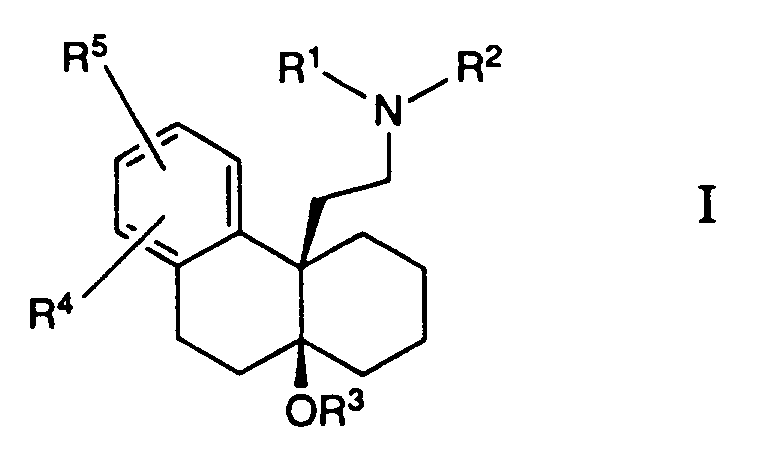
worin - R¹ und R²
- unabhängig voneinander Wasserstoff oder gegebenenfalls durch Aryl oder C₃₋₆₋Cycloalkyl substituiertes niederes Alkyl;
- R⁴ und R⁵
- entweder beide Wasserstoff oder beide Halogen, oder das eine Wasserstoff und das andere Halogen, Hydroxy, niederes Alkoxy, Aryloxy oder Amino und
- R³
- Wasserstoff oder - falls keine primäre(n) oder sekundäre(n) Aminogruppe(n) vorhanden ist (sind) - Alkanoyl bedeuten,
- Diese Verbindungen sind neu, mit Ausnahme von rac-cis-4b-(2-Amino-ethyl)-4b,5,6,7,8,8a,9,10-octahydrophenanthren-8a-ol, und es hat sich gezeigt, dass sie wertvolle pharmakodynamische Eigenschaften als nicht-kompetitive NMDA-Antagonisten besitzen, so dass sie als Neuroprotectiva verwendet werden können, insbesondere zur Behandlung oder Verhütung von Ischämie, Hypoglykämie, Hypoxie, cerebralen Gefässpasmen, Spastizität, Trauma, Hemorrhagie, Infektionen (viral, bakteriell, amöbisch, prional), epileptischen Anfällen, autoimmunen Erkrankungen, Entzugssymptomen, Alzheimerscher Krankheit, Parkinsonscher Krankheit, amyotropher Lateralsclerose, Morbus Huntington, Vergiftungen, Olivoponto-cerebellarer Atrophie, Rückenmarkverletzung, Schizophrenie, Depressionen, Angstzuständen, Abhängigkeit, Schmerzen, Autismus und mentaler Retardierung.
- Gegenstand der vorliegenden Erfindung sind die eingangs definierten Verbindungen und pharmazeutisch annehmbaren Säureadditionssalze als therapeutische Wirkstoffe, Arzneimittel, enthaltend eine solche Verbindung oder ein Salz davon, die Herstellung solcher Arzneimittel, die Verwendung der eingangs definierten Verbindungen und Salze als Neuroprotectiva, insbesondere bei der Behandlung oder Verhütung von Ischämie, Hypoglykämie, Hypoxie, cerebralen Gefässpasmen, Spastizität, Trauma, Hemorrhagie, Infektionen (viral, bakteriell, amöbisch, prional), epileptischen Anfällen, autoimmunen Erkrankungen, Entzugssymptomen, Alzheimerscher Krankheit, Parkinsonscher Krankheit, amyotropher Lateralsclerose, Morbus Huntington,Vergiftungen, Olivoponto-cerebellarer Atrophie, Rückenmarkverletzung, Schizophrenie, Depressionen, Angstzuständen, Abhängigkeit, Schmerzen, Autismus und mentaler Retardierung, die Verwendung der eingangs definierten Verbindungen und Salze zur Herstellung von Arzneimitteln, weiterhin die neuen unter den eingangs definierten Verbindungen und Salzen als solche sowie Verfahren und Zwischenprodukte für die Herstellung dieser neuen Verbindungen und Salze.
- Der Ausdruck "nieder" bezeichnet Verbindungen oder Reste mit höchstens 7, vorzugsweise höchstens 4 Kohlenstoffatomen.
- Der Ausdruck "Alkyl" bezeichnet gradkettige oder verzweigte gesättigte Kohlenwasserstoffreste wie Methyl, Ethyl, Propyl und dergleichen.
- Der Ausdruck "Alkoxy" bezeichnet über ein Sauerstoffatom gebundene Alkylgruppen im Sinne der vorstehenden Definition, wie Methoxy und dergleichen.
- Der Ausdruck "Cycloalkyl" bezeichnet cyclische gesättigte Kohlenwasserstoffreste, wie beispielsweise Cyclopropyl oder Cyclobutyl.
- Der Ausdruck "Aryl" bezeichnet über ein Kohlenstoffatom gebundene sechsgliedrige, aromatische, gegebenenfalls substituierte cyclische Reste, wie beispielsweise einen gegebenenfalls substituierten Phenylrest, wobei als Substituenten niedere Alkylgruppen in Betracht kommen können, und schliesst auch Heteroarylreste ein, d.h. beispielsweise ein bis drei Stickstoffatome enthaltende Heterocyclen, welche unsubstituiert oder durch niederes Alkyl, Nitro, Halogen oder Amino substituiert sein können, wie beispielsweise eine Pyridyl-Gruppe.
- Der Ausdruck "Arylmethoxy" bezeichnet durch gegebenenfalls substituiertes Phenyl substituierte Methoxygruppen, wie beispielsweise Benzyloxy.
- Der Ausdruck "Alkanoyl" bezeichnet über eine Carbonylgruppe gebundene Alkylgruppen im Sinne der vorstehenden Definition, und umfasst insbesondere niedere Alkanoylgruppen wie Acetyl oder Propionyl und dergleichen.
- Der Ausdruck "Heteroaryloxy" bezeichnet über ein Sauerstoffatom gebundene Heteroarylreste.
- Der Ausdruck "Arylmethylamino" bezeichnet eine Aminogruppe, welche durch Methyl substituiert ist, wobei die Methylgruppe ihrerseits durch Aryl substituiert ist, wie beispielsweise Benzylamino.
- Der Ausdruck "Halogen" bedeutet Fluor, Chlor, Brom und Iod.
- Der Ausdruck "pharmazeutisch annehmbare Säureadditionssalze" umfasst Salze mit anorganischen und organischen Säuren, wie Salzsäure, Bromwasserstoffsäure, Salpetersäure, Schwefelsäure, Phosphorsäure, Zitronensäure, Ameisensäure, Fumarsäure, Maleinsäure, Essigsäure, Bernsteinsäure, Weinsäure, Methansulfonsäure, p-Toluolsulfonsäure und dergleichen. Solche Salze können im Hinblick auf den Stand der Technik und unter Berücksichtigung der Natur der in ein Salz zu überführenden Verbindung durch jeden Fachmann ohne weiteres hergestellt werden.
- Falls in Formel I keines der Symbole R¹ bis R⁵ ein Asymmetriezentrum aufweist, können die erfindungsgemässen Verbindungen als Enantiomere vorliegen, andernfalls sind verschiedene Diastereomere möglich. Die Erfindung umfasst sämtliche möglichen Stereoisomeren sowie auch Gemische davon, insbesondere Racemate.
- In Formel I können zweckmässigerweise R¹ und R² unabhängig voneinander Wasserstoff oder gegebenenfalls durch C₃₋₆₋Cycloalkyl substituiertes niederes Alkyl, R³ Wasserstoff oder Alkanoyl, R⁴ und R⁵ jeweils Halogen oder das eine Wasserstoff und das andere Halogen, Heteroaryloxy, niederes Alkoxy oder Hydroxy bedeuten.
- Bevorzugt sind Verbindungen der Formel I worin R¹ und R² niederes Alkyl, R³ Wasserstoff, und R⁴ und R⁵ jeweils Wasserstoff, oder das eine Wasserstoff und das andere Halogen oder Hydroxy bedeuten.
- Besonders bevorzugte Verbindungen der Formel I sind
rac-cis-4b-(2-Dimethylamino-ethyl)-4b,5,6,7,8,8a,9,10-octahydro-phenanthren-8a-ol;
rac-cis-3-Chloro-4b-(2-dimethylamino-ethyl)-4b,5,6,7,8,8a,9,10-octahydro-phenanthren-8a-ol;
(-)-cis-3-Chloro-4b-(2-dimethylamino-ethyl)-4b,5,6,7,8,8a,9,10-octahydro-phenanthren-8a-ol;
(+)-cis-3-Chloro-4b-(2-dimethylamino-ethyl)-4b,5,6,7,8,8a,9,10-octahydro-phenanthren-8a-ol und
rac-cis-4b-(2-Dimethylamino-ethyl)-4b,5,6,7,8,8a,9,10-octahydro-phenanthren-3,8a-diol. - Weitere bevorzugte Verbindungen der Formel I sind
rac-cis-4b-(2-Amino-ethyl)-3-fluoro-4b,5,6,7,8,8a,9,10-octahydro-phenanthren-8a-ol;
rac-cis-4b-(2-Amino-ethyl)-3-chloro-4b,5,6,7,8,8a,9,10-octahydro-phenanthren-8a-ol;
rac-cis-4b-(2-Amino-ethyl)-3-bromo-4b,5,6,7,8,8a,9,10-octahydro-phenanthren-8a-ol;
rac-cis-4b-(2-Amino-ethyl)-4b,5,6,7,8,8a,9,10-octahydro-phenanthren-3,8a-diol;
(+)-cis-4b-(2-Amino-ethyl)-4b,5,6,7,8,8a,9,10-octahydro-phenanthren-3,8a-diol;
(-)-cis-4b-(2-Amino-ethyl)-4b,5,6,7,8,8a,9,10-octahydro-phenanthren-3,8a-diol;
rac-cis-4b-(2-Dimethylamino-ethyl)-3-fluoro-4b,5,6,7,8,8a,9,10-octahydro-phenanthren-8a-ol;
rac-cis-4b-(2-Dimethylamino-ethyl)-3-methoxy-4b,5,6,7,8,8a,9,10-octahydro-phenanthren-8a-ol;
Essigsäure rac-cis-4b-(2-dimethylamino-ethyl)-3-fluoro-4b,5,6,7,8,8a,9,10-octahydro-phenanthren-8a-yl ester;
Essigsäure rac-cis-3-chloro-4b-(2-dimethylamino-ethyl)-4b,5,6,7,8,8a,9,10-octahydro-phenanthren-8a-yl ester;
rac-cis-4b-(2-Amino-ethyl)-3-chloro-1-fluoro-4b,5,6,7,8,8a,9,10-octahydro-phenanthren-8a-ol. - Die neuen Octahydrophenanthrenderivate der eingangs definierten Formel I und deren Salze können erfindungsgemäss dadurch hergestellt werden, dass man
- a) zur Herstellung einer Verbindung der Formel I, worin R¹, R² und R³ je Wasserstoff und R⁴ und R⁵ beide Halogen oder das eine Wasserstoff und das andere Halogen, niederes Alkoxy oder Aryloxy bedeuten, eine Verbindung der allgemeinen Formel

reduziert, oder - b) zur Herstellung einer Verbindung der Formel I, worin eines von R¹ und R² Wasserstoff und das andere gegebenenfalls durch Aryl oder C₃₋₆-Cycloalkyl substituiertes niederes Alkyl, oder R¹ und R² je gegebenenfalls durch Aryl oder C₃₋₆-Cycloalkyl substituiertes niederes Alkyl, R³ Wasserstoff und R⁴ und R⁵ beide Wasserstoff oder Halogen, oder das eine Wasserstoff und das andere Halogen, niederes Alkoxy oder Aryloxy bedeuten,
eine Verbindung der allgemeinen Formel
an der primären Aminogruppe entsprechend mono- oder disubstituiert; oder - c) zur Herstellung einer Verbindung der Formel I, worin R¹ und R² gegebenenfalls durch Aryl oder C₃₋₆-Cycloalkyl substituiertes niederes Alkyl, R³ Alkanoyl und R⁴ und R⁵ beide Wasserstoff oder Halogen oder das eine Wasserstoff und das andere Halogen, niederes Alkoxy oder Aryloxy bedeuten, eine Verbindung der allgemeinen Formel

mit einer eine Alkanoyl-Gruppe liefernden Verbindung behandelt, oder - d) zur Herstellung einer Verbindung der Formel I, worin eines von R⁴ und R⁵ Wasserstoff und das andere Hydroxy bedeutet,
eine Verbindung der allgemeinen Formel
in Gegenwart eines Katalysators hydriert, oder - e) zur Herstellung einer Verbindung der Formel I, worin R¹ und R² obige Bedeutung besitzen, R³ Wasserstoff und eines von R⁴ und R⁵ Wasserstoff und das andere Amino bedeuten,
eine Verbindung der allgemeinen Formel
in Gegenwart eines Katalysators hydriert, oder - f) zur Herstellung einer Verbindung der Formel I, worin R¹, R² und R³ obige Bedeutung besitzen und eines von R⁴ und R⁵ Wasserstoff und das andere Heteroaryloxy bedeutet,
eine Verbindung der allgemeinen Formel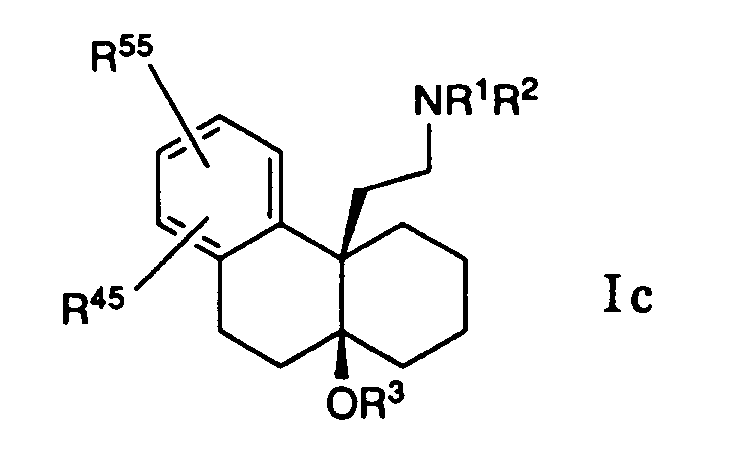
mit einer Verbindung der Formel X-Z, worin Z eine Abgangsgruppe und X Heteroaryl bedeuten, behandelt, - g) erwünschtenfalls ein erhaltenes Diastereomerengemisch und/oder Racemat auftrennt, und/oder
- h) erwünschtenfalls eine erhaltene Verbindung der Formel I in ein pharmazeutisch annehmbares Salz überführt.
- Gemäss Verfahrensvariante a) können Verbindungen der Formel I hergestellt werden, worin R¹, R² und R³ Wasserstoff und R⁴ und R⁵ beide Halogen oder das eine Wasserstoff und das andere Halogen, niederes Alkoxy oder Aryloxy bedeuten. Dies erfolgt durch Reduktion einer Verbindung der Formel II, worin R⁴¹ und R⁵¹ beide Halogen oder das eine Wasserstoff und das andere Halogen, niederes Alkoxy oder Aryloxy bedeuten, beispielsweise mit Lithiumaluminiumhydrid oder Lithiumborhydrid oder ähnlichen Reduktionsmitteln in Gegenwart inerter Lösungsmittel wie beispielsweise Dioxan oder THF oder ähnlichen inerten Lösungsmitteln; anschliessend erfolgt Umsetzung mit wässriger Alkalihydroxid-Lösung, wie beispielsweise NaOH-Lösung. Die Reduktion wird vorzugsweise in einem Temperaturbereich von Raumtemperatur bis zur Rückflusstemperatur des Reaktionsgemisches durchgeführt, wobei man zweckmässigerweise bei der Rückflusstemperatur arbeitet.
- Gemäss Verfahrensvariante b) können Verbindungen der Formel I hergestellt werden, worin eines von R¹ und R² Wasserstoff und das andere gegebenenfalls durch Aryl oder C₃₋₆-Cycloalkyl substituiertes niederes Alkyl, oder R¹ und R² je gegebenenfalls durch Aryl oder C₃₋₆-Cycloalkyl substituiertes niederes Alkyl, R³ Wasserstoff und R⁴ und R⁵ beide Wasserstoff oder Halogen oder das eine Wasserstoff und das andere Halogen, niederes Alkoxy oder Aryloxy bedeuten.
- Dies kann dadurch bewerkstelligt werden, dass man eine Verbindung der Formel Ia, worin R⁴² und R⁵² beide Wasserstoff oder Halogen oder das eine Wasserstoff und das andere Halogen, niederes Alkoxy oder Aryloxy bedeuten, an der primären Aminogruppe entsprechend mono- oder disubstituiert. Dies kann z. B. so erfolgen, dass man die Verbindungen der Formel Ia mit einer Verbindung acyliert, welche eine gegebenenfalls durch Aryl oder C₃₋₆-Cycloalkyl substituierte Alkanoylgruppe oder eine Formylgruppe oder eine über eine Carbonylgruppe gebundene Arylgruppe oder eine über eine Carbonylgruppe gebundene C₃₋₆-Cycloalkylgruppe ergibt, und diese anschliessend reduziert, worauf man die so erhaltene Verbindung gegebenenfalls erneut mit einer Verbindung acyliert, welche eine gegebenenfalls durch Aryl oder C₃₋₆-Cycloalkyl substituierte Alkanoylgruppe oder eine Formylgruppe oder eine über eine Carbonylgruppe gebundene Arylgruppe oder eine über eine Carbonylgruppe gebundene C₃₋₆-Cycloalkylgruppe ergibt, und diese anschliessend reduziert. Die in der Verbindung der Formel Ia vorhandene Hydroxygruppe wird dabei ebenfalls acyliert, bei der nachfolgenden Reduktion jedoch wieder freigesetzt.
- Zur Acylierung eignen sich bevorzugt die reaktiven Derivate der entsprechenden Carbonsäuren, beispielsweise Carbonsäurechloride, welche man vorzugsweise mittels Thionylchlorid in Gegenwart einer geringen Menge an N,N-Dimethylformamid in Toluol herstellt. Die Acylierung erfolgt in Gegenwart einer Base. Als Basen eignen sich beispielsweise Amine wie Triethylamin, Pyridin und dergleichen. Die Reaktion wird vorzugsweise in einem Temperaturbereich von etwa Raumtemperatur bis zur Rückflusstemperatur des Reaktionsgemisches durchgeführt, wobei man zweckmässigerweise bei Raumtemperatur arbeitet.
- Die Formylgruppe kann beispielsweise durch Umsetzung einer Verbindung der Formel Ia mit einem Gemisch aus Ameisensäureethylester und Ameisensäure eingeführt werden; das erwähnte Gemisch dient gleichzeitig als Lösungsmittel. Die Reaktion wird vorzugsweise bei der Rückflusstemperatur des Reaktionsgemisches durchgeführt.
- Als Reduktionsmittel eignet sich beispielsweise Lithiumaluminiumhydrid. Die Reduktion wird in inerten organischen Lösungsmitteln, beispielsweise THF oder ähnlichen Lösungsmitteln durchgeführt. Die Reaktionstemperatur liegt vorzugsweise in einem Temperaturbereich von Raumtemperatur bis zur Rückflusstemperatur, wobei vorzugsweise bei der Rückflusstemperatur des Reaktionsgemisches gearbeitet wird.
- Man kann auch eine Verbindung der Formel Ia in einem Schritt dimethylieren, beispielsweise durch Behandeln mit einer Mischung aus wässriger Ameisensäurelösung und wässriger Formaldehyd-Lösung; diese Mischung dient gleichzeitig als Lösungsmittel. Bevorzugt wird bei der Rückflusstemperatur der Reaktionsmischung gearbeitet.
- Gemäss Verfahrensvariate c) können Verbindungen der Formel I hergestellt werden, worin R¹ und R² gegebenenfalls durch Aryl oder C₃₋₆-Cycloalkyl substituiertes niederes Alkyl, R³ Alkanoyl und R⁴ und R⁵ beide Wasserstoff oder Halogen oder das eine Wasserstoff und das andere Halogen, niederes Alkoxy oder Aryloxy bedeuten. Dies kann dadurch bewerkstelligt werden, dass man beispielsweise ein in an sich bekannter Weise hergestelltes reaktives Derivat einer entsprechenden Carbonsäure mit einer Verbindung der Formel Ib, worin R¹¹ und R²¹ gegebenenfalls durch Aryl oder C₃₋₆-Cycloalkyl substituiertes niederes Alkyl bedeuten und R⁴² und R⁵² obige Bedeutung besitzen, umsetzt. Als reaktive Carbonsäurederivate verwendet man beispielsweise die entsprechenden Carbonsäurechloride, welche man aus den entsprechenden Carbonsäuren zweckmässigerweise mittels Thionylchlorid in Gegenwart einer geringen Menge an N,N-Dimethylformamid in Toluol herstellt. Es können auch die entsprechenden Imidazolide durch Behandeln der Carbonsäure mit 1,1'-Carbonyl-diimidazol in einem inerten Lösungsmittel, wie beispielsweise N,N-Dimethylformamid hergestellt werden. Die Umsetzung des reaktionsfähigen Carbonsäurederivats mit einer Verbindung der Formel Ib erfolgt in Gegenwart einer Base. Als Basen eignen sich beispielsweise Amine wie Triethylamin, Pyridin und dergleichen. Die Reaktion wird vorzugsweise in einem Temperaturbereich von etwa Raumtemperatur bis zur Rückflusstemperatur des Reaktionsgemisches durchgeführt, wobei man zweckmässigerweise bei Raumtemperatur arbeitet.
- Gemäss Verfahrensvariante d) können Verbindungen der Formel I hergestellt werden, worin R¹, R² und R³ obige Bedeutung besitzen und eines von R⁴ und R⁵ Wasserstoff und das andere Hydroxy bedeutet.
- Bei dieser Reaktion wird eine Verbindung der Formel III, worin R¹, R² und R³ obige Bedeutung besitzen und eines von R⁴³ und R⁵³ Wasserstoff und das andere Arylmethoxy bedeutet, in Gegenwart eines Katalysators wie beispielsweise eines Palladium-Katalysators hydriert. Als Lösungsmittel eignen sich bevorzugt niedere Alkohole wie beispielsweise Methanol oder Ethanol. Es wird bevorzugt bei Raumtemperatur gearbeitet.
- Gemäss Verfahrensvariante e) können Verbindungen der Formel I hergestellt werden, worin R¹ und R² obige Bedeutung besitzen und R³ Wasserstoff und eines von R⁴ und R⁵ Wasserstoff und das andere Amino bedeuten. Hierzu wird eine Verbindung der Formel IV, worin R¹ und R² obige Bedeutung besitzen und eines von R⁴⁴ und R⁵⁴ Wasserstoff und das andere Arylmethylamino bedeutet, in Gegenwart eines Katalysators, beispielsweise eines Palladium-Katalysators, hydriert. Als Lösungsmittel eignen sich bevorzugt niedere Alkohole wie beispielsweise Methanol oder Ethanol. Es wird bevorzugt bei Raumtemperatur und einem Druck von etwa 50 bar gearbeitet.
- Gemäss Verfahrensvariante f) können Verbindungen der Formel I hergestellt werden, worin R¹, R² und R³ obige Bedeutung besitzen und eines von R⁴ und R⁵ Wasserstoff und das andere Heteroaryloxy bedeutet. Diese Verfahrensvariante wird vorzugsweise durch Behandeln einer Verbindung der Formel Ic, worin R¹, R² und R³ obige Bedeutung besitzen und eines von R⁴⁵ und R⁵⁵ Wasserstoff und das andere Hydroxy bedeutet, mit einem reaktionsfähigen Heteroarylderivat, beispielsweise einem Heteroarylhalogenid wie 2-Brom-pyridin oder dergleichen durchgeführt. Als Lösungsmittel eignen sich beispielsweise Pyridin oder ähnliche unter den Reaktionsbedingungen inerte Lösungsmitteln. Es wird bevorzugt bei der Rückflusstemperatur der Reaktionsmischung gearbeitet.
- Die Auftrennung von Diastereomerengemischen und/oder die Aufspaltung von Racematen gemäss Verfahrensvariante g) kann nach allgemein üblichen Methoden erfolgen, wobei es zweckmässig sein kann, dies nicht erst bei Verbindungen der Formel I durchzuführen, sondern bereits auf einer früheren Synthesestufe, z.B. auf der Stufe der Verbindungen der Formel III oder IV.
- Gemäss Verfahrensvariante h) können Verbindungen der Formel I in pharmazeutisch annehmbare Säureadditionssalze übergeführt werden. Es kommen dabei sowohl Salze mit anorganischen als auch Salze mit organischen Säuren in Betracht. Beispiele derartiger Salze sind Hydrochloride, Hydrobromide, Nitrate, Sulfate, Phosphate, Citrate, Formiate, Fumarate, Maleate, Acetate, Succinate, Tartrate, Methansulfonate, p-Toluolsulfonate und dergleichen. Diese Salze können nach an sich bekannten und jedem Fachmann geläufigen Methoden hergestellt werden.
- Die als Ausgangsstoffe verwendeten Verbindungen der Formel II können beispielsweise gemäss dem nachfolgenden Reaktionsschema und der daran anschliessenden Erläuterung der verschiedenen Reaktionen hergestellt werden.

R⁴¹ und R⁵¹ bedeuten beide jeweils Halogen oder das eine Wasserstoff und das andere Halogen, niederes Alkoxy oder Aryloxy. - Die Tetralone der allgemeinen Formel A sind bekannt oder können analog zu den bekannten Synthesewegen hergestellt werden. Neue Tetralone wurden folgendermassen hergestellt:
-
- a) Orthometallierung von 1,2,3,4-Tetrahydro-naphthalen-1-ol mit Butyllithium und N,N,N',N'-Tetramethylethylendiamin (TMEDA) in Hexan gemäss der in Synthesis 1981, 59 beschriebenen Methode;
- b) Quenchen mit Hexachlorethan nach V. Snieckus, Chem. Rev. 1990, 90, 879;
- c) Jones-Oxidation.
-
- a) Bromierung von 4-Chloro-2-fluorotoluol mit N-Bromsuccinimid in Tetrachlorkohlenstoff in Anwesenheit katalytischer Mengen Dibenzoylperoxid;
- b) Oxidation zum Aldehyd gemäss der in Tetr. Letters 1990, 31, 4825 beschriebenen Methode;
- c) Wittig-Reaktion mit 2-(1,3-Dioxan-2-yl)-ethyl-triphenyl-phosphoniumbromid und Kaliumtertbutylat in DMSO/THF;
- d) Hydrierung des Alkens mit Pd-C-Katalysator(10%ig) in THF bei RT unter Normaldruck;
- e) Ketalspaltung zum Aldehyd mit Cr(III)chlorid in 4N wässriger Salzsäure gemäss der in Synthesis, 1979, 132 beschriebenen Methode;
- f) Oxidation mit Kaliumpermanganat und Natriumdihydrogenphosphat in tert-Butanol gemäss der in Tetr. Letters 1986, 27, 4537 beschriebenen Methode;
- g) Cyclisierung mit Polyphosphorsäure bei ca. 100°C.
-
- a) Wittig Reaktion von 2,4-Dichlorobenzaldehyd mit 2-(1,3-Dioxan-2-yl)-ethyl-triphenyl-phosphoniumbromid und Kalium-tert-butylat in DMSO/THF;
- b) Hydrierung des Alkens mit Pd-C-Katalysator(10%ig) in THF bei Raumtemperatur unter Normaldruck;
- c) Ketalspaltung zum Aldehyd mit Cr(III)chlorid in 4N wässriger Salzsäure gemäss der in Synthesis, 1979, 132 beschriebenen Methode;
- d) Oxidation mit Kaliumpermanganat und Natriumdihydrogenphosphat in tert-Butanol gemäss der in Tetr. Letters 1986, 27, 4537 beschriebenen Methode;
- f) Cyclisierung mit Polyphosphorsäure bei ca. 100°C.
- Die Verbindung entsprechend der allgemeinen Formel II, worin aber R⁴¹ und R⁵¹ jeweils Wasserstoff bedeutet, ist bekannt, vgl. Tetr. Letters 1969, 1889. Analog hierzu lassen sich Verbindungen der allgemeinen Formel II herstellen, worin R⁴¹ und R⁵¹ die oben angegebene Bedeutung haben:
- Durch Umsetzung eines Tetralons der Formel A mit einer Base wie beispielsweise Kalium-tert-butanolat in einem geeigneten organischen Lösungsmittel, vorzugsweise THF, und anschliessende Umsetzung mit 1,4-Dibrombutan erhält man eine Verbindung der Formel B. Diese Umsetzung erfolgt vorzugsweise unter Schutzgasatmosphäre bei tiefen Temperaturen, bevorzugt in einem Temperaturbereich von etwa -50°C bis etwa - 80°C.
- Die Verbindungen der Formel B werden mit (Triphenylphosphonio)methanid unter Schutzgasatmosphäre behandelt, wobei Verbindungen der Formel C entstehen. (Triphenylphosphonio)methanid wird bevorzugt in situ aus einem Methyltriphenylphosphoniumhalogenid/Alkaliamid-Gemisch in einem inerten Lösungsmitel wie beispielsweise THF bei Raumtemperatur erzeugt.
- Durch Umsetzung einer Verbindung der Formel C mit Chlorsulfonylisocyanat in einem geeigneten Lösungsmittel, beispielsweise einem Ether, unter Schutzgasatmosphäre und bei tiefer Temperatur, bevorzugt bei etwa -50°C bis etwa - 80°C, erhält man die gewühschte Verbindung der Formel II.
- Zur Herstellung von Verbindungen der Formel III geht man analog vor, allerdings ausgehend von Analoga von Verbindungen der Formel A, worin eines von R⁴¹ und R⁵¹ Wasserstoff und das andere Arylmethoxy bedeutet; anschliessend geht man analog zu Verfahrensvariante a) und gegebenenfalls b) und allenfalls c) vor.
- Die Synthese einer Verbindung der Formel IV beginnt abweichend von den oben beschriebenen Methoden nach folgendem Schema:

- a) Zuerst wird eine Verbindung der Formel B' mit einem Nitrierungsmittel, beispielsweise mit einem Schwefelsäure/Salpetersäure-Gemisch behandelt. Als Lösungsmittel dient zweckmässigerweise Schwefelsäure, und die Reaktion erfolgt vorzugsweise bei der Rückflusstemperatur des Reaktionsgemisches.
- b) Die so erhaltene Nitro-spiro-Verbindung der Formel D wird in einem inerten Lösungsmittel wie beispielsweise THF bei der Rückflusstemperatur des Reaktionsgemisches in Gegenwart eines geeigneten Katalysators, beispielsweise eines Pd/C-Katalysators, hydriert.
- c) Die Amino-Verbindung der Formel E wird in einem inerten Lösungsmittel, vorzugsweise einem Ether, mit Methyllithium, behandelt. Vorzugsweise wird bei der Rückflusstemperatur gearbeitet.
- d) Die Verbindung der Formel F wird mit geeigneten Mitteln, beispielsweise mit Jod, zur entsprechenden Methylen-Verbindung der Formel G dehydratisiert.
- e) Durch Umsetzung der Verbindung der Formel G mit einem Arylcarbonsäurederivat, beispielsweise Benzoylchlorid, in Gegenwart einer Base wie beispielsweise Triethylamin in einem inerten Lösungsmittel wie THF oder ähnlichen Lösungsmitteln, erhält man eine Verbindung der Formel H. Zur entsprechenden Verbindung IV gelangt man durch Umsetzung mit Chlorsulfonylisocyanat und anschliessende Reduktion mit Lithiumaluminiumhydrid, worauf gegebenenfalls analog zu Verfahrensvariante b) vorgegangen wird.
- Die als Zwischenprodukte verwendeten Verbindungen der Formel II sind neu und ebenfalls Gegenstand der vorliegenden Erfindung, und dasselbe gilt für Analoga von Verbindungen der Formel II, worin aber eines von R⁴¹ und R⁵¹ Wasserstoff und das andere Arylmethoxy oder Arylcarbonylamino bedeutet. Weiterhin sind auch die Zwischenprodükte der Formeln III und IV neu und ebenfalls Gegenstand der vorliegenden Erfindung.
- Wie bereits eingangs erwähnt besitzen die Verbindungen der Formel I sowie rac-cis-4b-(2-Amino-ethyl)- 4b,5,6,7,8,8a,9,10-octahydro-phenanthren-8a-ol eine pharmakologische Aktivität als nicht-kompetitive NMDA-Antagonisten. Auf Grund dieser Aktivität können die Verbindungen der Formel I oder rac-cis-4b-(2-Amino-ethyl)- 4b,5,6,7,8,8a,9,10-octahydro-phenanthren-8a-ol und deren pharmazeutisch verwendbaren Säureadditionssalze als Neuroprotectiva verwendet werden, insbesondere zur Behandlung oder Verhütung von Ischämie, Hypoglykämie, Hypoxie, cerebralen Gefässpasmen, Spastizität, Trauma, Hemorrhagie, Infektionen (viral, bakteriell, amöbisch, prional), epileptischen Anfällen, autoimmunen Erkrankungen, Entzugssymptomen, Alzheimerscher Krankheit, Parkinsonscher Krankheit, amyotropher Lateralsclerose, Morbus Huntington,Vergiftungen, Olivoponto-cerebellarer Atrophie, Rückenmarkverletzung, Schizophrenie, Depressionen, Angstzuständen, Abhängigkeit, Schmerzen, Autismus und mentaler Retardierung.
- Die pharmakologische Aktivität einiger erfindungsgemässer Verbindungen sowie von rac-cis-4b-(2-Amino-ethyl)- 4b,5,6,7,8,8a,9,10-octahydro-phenanthren-8a-ol wurde in vitro nach der in Europ. J. Pharmacol. 135, 261 (1987) beschriebenen Methode festgestellt. Nach dieser Methode (nämlich dem 3H-MK801 (Dizocilpin)-Bindungstest) ermittelt man die Hemmung der Bindung von Dizocilpin an den spezifischen Bindungsstellen im Ratten-Cortex durch die jeweiligen Testsubstanzen. Man bezeichnet als IC₅₀ ("50% inhibiting concentration") diejenige Konzentration der jeweiligen Testsubstanz, welche eine 50-proz. Hemmung der spezifischen Bindung von Dizocilpin an die spezifischen Bindungstellen im Ratten-Cortex bewirkt.
- Die so ermittelte Aktivität einiger erfindungsgemässer Verbindungen wird aus den in der folgenden Tabelle aufgeführten IC₅₀-Werten ersichtlich; ausserdem erhält die Tabelle Angaben über deren Toxizität (niedrigste letale Dosis = LLD an der Maus, p.o.).
Testsubstanz [³H]-MK801 Binding, IC₅₀ [nM/l] Toxizität LLD (mg/kg) rac-cis-4b-(2-Amino-ethyl)-3-chloro-4b,5,6,7,8,8a,9,10-octahydro-phenanthren-8a-ol hydrochlorid 84.7 500 rac-cis-4b-(2-Amino-ethyl)-3-chloro-1-fluoro-4b,5,6,7,8,8a,9,10-octahydro-phenanthren-8a-ol hydrochlorid 107 1000 rac-cis-4b-(2-Amino-ethyl)-4b,5,6,7,8,8a, 9,10-octahydro-phenanthren-3,8a-diol hydrochlorid 73.4 1000 rac-cis-4b-(2-Dimethylamino-ethyl)-4b,5,6,7,8,8a,9,10-octahydro-phenanthren-8a-ol hydrochlorid 453 - (-)-cis-3-Chloro-4b-(2-dimethylamino-ethyl)-4b,5,6,7,8,8a,9,10-octahydro-phenanthren-8a-ol hydrochlorid 254 375 rac-cis-4b-(2-Amino-ethyl)-4b,5,6,7,8,8a, 9,10-octahydro-phenanthren-8a-ol hydrochlorid 93 250 - Die Verbindungen der Formel I sowie rac-cis-4b-(2-Amino-ethyl)-4b,5,6,7,8,8a,9,10-octahydro-phenanthren-8a-ol und deren pharmazeutisch verwendbare Salze können als Heilmittel, z.B. in Form pharmazeutischer Präparate, Verwendung finden. Die pharmazeutischen Präparate können enteral, wie oral, z.B. in Form von Tabletten, Lacktabletten, Dragees, Hart- und Weichgelatinekapseln, Lösungen, Emulsionen oder Suspensionen, nasal, z.B. in Form Nasensprays, oder rektal, z.B. in Form von Suppositorien, verabreicht werden. Die Verabreichung kann auch parenteral, wie subcutan, intramuskulär oder intravenös, z.B. in Form von Injektionslösungen, erfolgen. Zur Herstellung von Tabletten, Lacktabletten, Dragees und Hartgelatinekapseln können die Verbindungen sowie ihre pharmazeutisch verwendbaren Salze mit pharmazeutisch inerten, anorganischen oder organischen Excipientien verarbeitet werden. Als solche Excipientien kann man z.B. für Tabletten, Dragees und Hartgelatinekapseln, Laktose, Maisstärke oder Derivate davon, Talk, Stearinsäure oder deren Salze etc. verwenden. Für Weichgelatinekapseln eignen sich als Excipientien z.B. vegetabile Öle, Wachse, Fette, halbfeste und flüssige Polyole etc. Zur Herstellung von Lösungen und Syrupen eignen sich als Excipientien z.B. Wasser, Polyole, Saccharose, Invertzucker, Glukose etc. Für Injektionslösungen eignen sich als Excipientien z.B. Wasser, Alkohole, Polyole, Glycerin, vegetabile Öle, etc. Für Suppositorien eignen sich als Excipientien z.B. natürliche oder gehärtete Öle, Wachse, Fette, halbflüssige oder flüssige Polyole etc. Die pharmazeutischen Präparate können daneben noch Konservierungsmittel, Lösungsvermittler, viskositätserhöhende Stoffe, Stabilisierungsmittel, Netzmittel, Emulgiermittel, Süssmittel, Färbemittel, Aromatisierungsmittel, Salze zur Veränderung des osmotischen Druckes, Puffer, Überzugsmittel oder Antioxidantien enthalten. Sie können auch noch andere therapeutisch wertvolle Stoffe enthalten.
- Erfindungsgemäss kann man Verbindungen der allgemeinen Formel I sowie rac-cis-4b-(2-Amino-ethyl)- 4b,5,6,7,8,8a,9,10-octahydro-phenanthren-8a-ol und deren pharmazeutisch annehmbare Säureadditionssalze als Neuroprotectiva verwenden, insbesondere bei der Behandlung oder Verhütung von Ischämie, Hypoglykämie, Hypoxie, cerebralen Gefässpasmen, Spastizität, Trauma, Hemorrhagie, Infektionen (viral, bakteriell, amöbisch, prional), epileptischen Anfällen, autoimmunen Erkrankungen, Entzugssymptomen, Alzheimerscher Krankheit, Parkinsonscher Krankheit, amyotropher Lateralsclerose, Morbus Huntington, Vergiftungen, Olivoponto-cerebellarer Atrophie, Rückenmarkverletzung, Schizophrenie, Depressionen, Angstzuständen, Abhängigkeit, Schmerzen, Autismus und mentaler Retardierung. Die Dosierung kann innerhalb weiter Grenzen variieren und ist natürlich in jedem einzelnen Fall den individuellen Gegebenheiten anzupassen. Bei oraler Verabreichung liegt die tägliche Dosis in einem Bereich von etwa 50 - 500 mg , wobei aber die obere Grenze auch überschritten werden kann, wenn sich dies als angezeigt erweisen sollte.
- Die nachfolgenden Beispiele dienen der näheren Erläuterung der vorliegenden Erfindung. Sie sollen deren Umfang jedoch in keiner Weise beschränken. Sämtliche Temperaturen sind in Celsiusgraden angegeben.
-
- 1.1. Zu einer Lösung von 32.0 g 7-Fluoro-1,2,3,4-tetrahydro-naphthalen-1-on (0.19 Mol) in 320 ml THF unter Argonbegasung gab man portionsweise bei -78°C 43.7 g Kalium tert-Butylat (0.39 Mol) zu. Man rührte 2 St bei - 78°C nach und tropfte dann eine Lösung von 40 ml 1,4-Dibrombutan (73 g, 0.338 Mol) in 40 ml THF zu. Das Kühlbad wurde entfernt und man rührte 16 St bei RT nach. Man fügte Wasser zu, schüttelte mit Ether aus, wusch die organische Phase mit einer gesättigten wässrigen Kochsalzlösung, trocknete über MgSO₄, filtrierte ab, engte ein und chromatographierte den Rückstand über Kieselgel mit Toluol. Das Produkt wurde durch eine 20 cm Vigreux Säule destilliert. Ausbeute: 29.4 g (76%) 7'-Fluoro-3'4'-dihydro-spiro[cyclopentan-1,2'(1'H)-naphthalen]-1'-on als farblose Flüssigkeit; Sdp. 98-102°C/0.11 Torr.
- 1.2. 123 g Methyltriphenylphosphoniumbromid/Natriumamid-Gemisch (0.29 Mol) wurden während ³/₄ St in 500 ml THF bei RT unter Argon gerührt. Zu der gelben Suspension tropfte man eine Lösung von 29.4 g 7'-Fluoro-3'4'-dihydro-spiro[cyclopentan-1,2'(1'H)-naphthalen]-1'-on (0.13 Mol) in 50 ml THF zu und rührte dann 18 St nach. Man fügte Wasser zu, schüttelte mit Ether aus, wusch die organische Phase mit einer gesättigten wässrigen Kochsalzlösung, trocknete über MgSO₄, filtrierte ab, engte ein und chromatographierte den Rückstand über Kieselgel mit Toluol. Ausbeute: 26.3 g (90%) 7'-Fluoro-1'-methylen-3'4'-dihydro-spiro[cyclopentan-1,2'(1'H)-naphthalen] als farblose Flüssigkeit.
MS: m/e (% Basis peak) = 216 (C₁₅H₁₇F⁺, 20), 175 (100), 159 (24), 147 (16), 133 (15), 109(4). - 1.3. Zu einer Lösung von 26.3 g 7'-Fluoro-1'-methylen-3'4'-dihydro-spiro[cyclopentan-1,2'(1'H)-naphthalen] (0.12 Mol) in 250 ml Ether bei -78°C unter Argonbegasung tropfte man eine Lösung von 12.9 ml Chlorsulfonylisocyanat (0.15 Mol) in 40 ml Ether zu. Man rührte 15 min bei -78°C, liess zur RT erwärmen und rührte noch 15 St. Das entstandene Kristallisat wurde abgenutscht, mit Ether gewaschen und i.Vak. getrocknet. Ausbeute: 27.1 g (62%) rac-cis-8-Fluoro-1,2,4,5-tetrahydro-3a,9b-butano-naphtho[2,1-b]furan-2-yliden-sulfamoylchlorid [(E) oder (Z) oder (E/Z)-Gemisch] als gelbliche Kristalle; Schmp. 161-162°C.
- 1.4. 14,4 g (0,38 Mol) Lithiumaluminiumhydrid wurden in 300 ml Dioxan unter Argon suspendiert. Man tropfte eine Lösung aus 27.1 g rac-cis-8-Fluoro-1,2,4,5-tetrahydro-3a,9b-butano-naphtho[2,1-b]furan-2-yliden-sulfamoylchlorid [(E) oder (Z) oder (E/Z)-Gemisch] (0.076 Mol) in 300 ml THF zu und kochte 17 St unter Rückfluss. Vorsichtig tropfte man nacheinander bei RT 15 ml Wasser, 15 ml einer 15 prozentigen wässrigen NaOH Lösung, und 45 ml Wasser zu, so dass ein völlig weisser Niederschlag entstand. Nach Filtrieren und Einengen wurde der Rückstand über Kieselgel mit Methanol/Ammoniak 9:1 chromatographiert. Das Produkt wurde in Acetonitril umkristallisiert. Ausbeute: 14.4 g (67%) rac-cis-4b-(2-Amino-ethyl)-3-fluoro-4b,5,6,7,8,8a,9,10-octahydro-phenanthren-8a-ol als weisse Kristalle; Schmp. 148-149°C.
- 1.5. rac-cis-4b-(2-Amino-ethyl)-3-fluoro-4b,5,6,7,8,8a,9,10-octahydro-phenanthren-8a-ol (0.81 g, 0.003 Mol) wurde in 10 ml Methanol gelöst. Man tropfte eine 4.89 N ethanolische HCl-Lösung (0.63 ml, 0.003 Mol) zu und engte ein. Der Rückstand kristallisierte aus Ether. Ausbeute: 0.68 g (74%) rac-cis-4b-(2-Amino-ethyl)-3-fluoro-4b,5,6,7,8,8a,9,10-octahydro-phenanthren-8a-ol hydrochlorid als weisse Kristalle; Schmp. 233-235°C.
-
- 2.1. Zu einer Lösung von 31.7 g 7-Chloro-1,2,3,4-tetrahydro-naphthalen-1-on (0.17 Mol) in 500 ml THF unter Argonbegasung gab man portionsweise bei -78°C 39.4 g Kalium tert-Butylat (0.35 Mol) zu. Man rührte 2 St bei - 78°C nach und tropfte dann eine Lösung von 35.8 ml 1,4-Dibrombutan (65.4 g, 0.3 Mol) in 100 ml THF zu. Das Kühlbad wurde entfernt und man rührte 16 St bei RT nach. Man fügte Wasser zu, schüttelte mit Ether aus, wusch die organische Phase mit einer gesättigten wässrigen Kochsalzlösung, trocknete über MgSO)₄, filtrierte ab, engte ein und chromatographierte den Rückstand über Kieselgel mit Hexan/Toluol 1:1. Ausbeute: 29.8 g (86%) 7'-Chloro-3'4'-dihydro-spiro[cyclopentan-1,2'(1'H)-naphthalen]-1'-on als farblose Flüssigkeit.
MS: m/e (% Basis peak) = 234 (C₁₄H₁₅ClO⁺, 22), 193 (100), 165 (12), 152 (19), 124 (19),89(18). - 2.2. 116 g Methyltriphenylphosphoniumbromid/Natriumamid-Gemisch (0.494 Mol) wurden während ³/₄ St in 1 l THF bei RT unter Argon gerührt. Zu der gelben Suspension tropfte man eine Lösung von 29.8 g 7'-Chloro-3'4'-dihydro-spiro[cyclopentan-1,2'(1'H)-naphthalen]-1'-on (0.127 Mol) in 100 ml THF zu und rührte dann 18 St nach. Man fügte Wasser zu, schüttelte mit Ether aus, wusch die organische Phase mit einer gesättigten wässrigen Kochsalzlösung, trocknete über MgSO₄, filtrierte ab, engte ein und chromatographierte den Rückstand über Kieselgel mit Toluol. Ausbeute: 26.1 g (88%) 7'-Chloro-1'-methylen-3'4'-dihydro-spiro[cyclopentan-1,2'(1'H)-naphthalen] als farblose Flüssigkeit.
MS: m/e (% Basis peak) = 232 (C₁₅H₁₇Cl⁺, 21), 217 (5), 191 (100), 175 (12), 153 (8), 141(8),115(10). - 2.3. Zu einer Lösung von 26.1 g 7'-Chloro-1'-methylen-3'4'-dihydro-spiro[cyclopentan-1,2'(1'H)-naphthalen] (0.11 Mol) in 260 ml Ether bei -78°C unter Argonbegasung tropfte man eine Lösung von 11.9 ml Chlorsulfonylisocyanat (0.13 Mol) in 30 ml Ether zu. Man rührte 15 min bei -78°C, liess zur RT erwärmen und rührte noch 15 St. Das entstandene Kristallisat wurde abgenutscht, mit Ether gewaschen und i. Vak. getrocknet. Ausbeute: 26.2 g (63%) rac-cis-8-Chloro-1,2,4,5-tetrahydro-3a,9b-butano-naphtho[2,1-b]furan-2-yliden-sulfamoylchlorid [(E) oder (Z) oder (E/Z)-Gemisch] als gelbliche Kristalle; Schmp. 192-194°C.
- 2.4. 13.3 g (0,35 Mol) Lithiumaluminiumhydrid wurden in 350 ml Dioxan unter Argon suspendiert. Man tropfte eine Lösung aus 26.2 g rac-cis-8-Chloro-1,2,4,5-tetrahydro-3a,9b-butano-naphtho[2,1-b]furan-2-yliden-sulfamoylchlorid [(E) oder (Z) oder (E/Z)-Gemisch] (0.070 Mol) in 800 ml THF zu und kochte 16 St unter Rückfluss. Vorsichtig tropfte man nacheinander bei ∼40°C 70 ml Essigester, 14 ml Wasser, 14 ml einer 15 prozentigen wässrigen NaOH Lösung, und 42 ml Wasser zu, so dass ein völlig weisser Niederschlag entstand. Nach Filtrieren und Einengen wurde der Rückstand über Kieselgel mit Methanol/Ammoniak 99:1 chromatographiert. Das Produkt wurde in Ether suspendiert, abgenutscht, mit Ether gewaschen und i. Vak. getrocknet. Ausbeute: 6.9 g (35%) rac-cis-4b-(2-Amino-ethyl)-3-chloro-4b,5,6,7,8,8a,9,10-octahydro-phenanthren-8a-ol als weisse Kristalle; Schmp. 143-145°C.
- 2.5. rac-cis-4b-(2-Amino-ethyl)-3-chloro-4b,5,6,7,8,8a,9,10-octahydro-phenanthren-8a-ol (1.54 g, 0.0055 Mol) wurde in 50 ml Methanol gelöst. Man tropfte eine 4.89 N ethanolische HCl-Lösung (1.12 ml, 0.0055 Mol) zu und engte ein. Der Rückstand kristallisierte aus Ether. Ausbeute: 1.56 g (90%) rac-cis-4b-(2-Amino-ethyl)-3-chloro-4b,5,6,7,8,8a,9,10-octahydro-phenanthren-8a-ol hydrochlorid als weisse Kristalle; Schmp. 280-282°C.
-
- 3.1. Zu einer Lösung von 14.2 g 7-Bromo-1,2,3,4-tetrahydro-naphthalen-1-on (0.063 Mol) in 250 ml THF unter Argonbegasung gab man portionsweise bei -78°C 14.2 g Kalium tert-Butylat (0.126 Mol) zu. Man rührte 2 St bei - 78°C nach und tropfte dann eine Lösung von 12.7 ml 1,4-Dibrombutan (23.1 g, 0.107 Mol) in 250 ml THF zu. Das Kühlbad wurde entfernt und man rührte 16 St bei RT nach. Man fügte Wasser zu, schüttelte mit Ether aus, wusch die organische Phase mit einer gesättigten wässrigen Kochsalzlösung, trochnete über MgSO₄, filtrierte ab, engte ein und chromatographierte den Rückstand über Kieselgel mit Toluol. Ausbeute: 9.81 g (56%) 7'-Bromo-3'4'-dihydro-spiro[cyclopentan-1,2'(1'H)-naphthalen]-1'-on als gelbliches Öl.
MS: m/e (% Basis peak) = 278, 280 (C₁₄H₁₅BrO⁺, 21), 237, 239 (100), 196, 198 (17), 168, 170 (20) ,128, 130( 18), 89 (34). - 3.2. 38.1 g Methyltriphenylphosphoniumbromid/Natriumamid Gemisch (0.091 Mol) wurden während ³/₄ St in 380 ml THF bei RT unter Argon gerührt. Zu der gelben Suspension tropfte man eine Lösung von 11.7 g 7'-Bromo-3'4'-dihydro-spiro[cyclopentan-1,2'(1'H)-naphthalen]-1'-on (0.042 Mol) in 140 ml THF zu und rührte dann 18 St nach. Man fügte Wasser zu, schüttelte mit Ether aus, wusch die organische Phase mit einer gesättigten wässrigen Kochsalzlösung, trocknete über MgSO₄, filtrierte ab und engte ein. Der Rückstand wurde über Kieselgel mit Petrolether chromatographiert. Ausbeute: 8.42 g (77%) 7'-Bromo-1'-methylen-3'4'-dihydro-spiro[cyclopentan-1,2'(1'H)-naphthalen] als gelbliches Öl.
MS: m/e (% Basis peak) = 276, 278 (C₁₅H₁₇Br⁺, 19), 235, 237 (100), 219, 221 (8), 156 (20), 141 (23), 128 (27), 115 (26). - 3.3. Zu einer Lösung von 8.42 g 7'-Bromo-1'-methylen-3'4'-dihydro-spiro[cyclopentan-1,2'(1'H)-naphthalen] (0.029 Mol) in 85 ml Ether bei -78°C unter Argonbegasung tropfte man eine Lösung von 3.02 ml Chlorsulfonylisocyanat (0.034 Mol) in 30 ml Ether zu. Man rührte 15 min bei -78°C, liess zu RT erwärmen und rührte noch 16 St nach. Das entstandene Kristallisat wurde abgenutscht, mit Ether gewaschen und i. Vak. getrocknet. Ausbeute: 5.08 g (42%) rac-cis-8-Bromo-1,2,4,5-tetrahydro-3a,9b-butano-naphtho[2,1-b]furan-2-yliden-sulfamoylchlorid [(E) oder (Z) oder (E/Z)-Gemisch] als gelbliche Kristalle; Schmp. 195-197°C.
- 3.4. 1.19 g ( 0,054 Mol) Lithiumborhydrid wurden in 95 ml Dioxan unter Argon suspendiert. Man tropfte eine Lösung aus 5.08 g rac-cis-8-Bromo-1,2,4,5-tetrahydro-3a,9b-butano-naphtho[2,1-b]furan-2-yliden-sulfamoylchlorid [(E) oder (Z) oder (E/Z)-Gemisch] (0.012 Mol) in 250 ml THF zu und kochte 16 St unter Rückfluss. Vorsichtig tropfte man nacheinander bei RT 1.2 ml Wasser, 1.2 ml einer 15 prozentigen wässrigen NaOH Lösung, und 3.6 ml Wasser zu, so dass ein völlig weisser Niederschlag entstand. Nach Filtrieren und Einengen wurde der Rückstand über Kieselgel mit Isopropylalkohol/Ammoniak 19:1 chromatographiert. Das Produkt kristallisierte aus Acetonitril. Ausbeute: 1.29 g (33%) rac-cis-4b-(2-Amino-ethyl)-3-bromo-4b,5,6,7,8,8a,9,10-octahydro-phenanthren-8a-ol als weisse Kristalle; Schmp. 135-136°C.
- 3.5. rac-cis-4b-(2-Amino-ethyl)-3-bromo-4b,5,6,7,8,8a,9,10-octahydro-phenanthren-8a-ol (0.57 g, 0.0017Mol) wurde in 20 ml Methanol gelöst. Man tropfte eine 4.89 N ethanolische HCl-Lösung (0.36 ml, 0.0017 Mol) zu und engte ein. Der Rückstand kristallisierte aus Ethanol/Ether. Ausbeute: 0.23 g (37%) rac-cis-4b-(2-Amino-ethyl)-3-bromo-4b,5,6,7,8,8a,9,10-octahydro-phenanthren-8a-ol hydrochlorid als weisse Kristalle; Schmp. 283-286°C.
-
- 4.1. Zu einer Lösung von 12.3 g 7-Iodo-1,2,3,4-tetrahydro-naphthalen-1-on (0.045 Mol) in 200 ml THF unter Argonbegasung gab man portionsweise bei -78°C 10.2 g Kalium tert-Butylat (0.090 Mol) zu. Man rührte 2 St bei - 78°C nach und tropfte dann eine Lösung von 9.25 ml 1,4-Dibrombutan (16.9 g, 0.078 Mol) in 25 ml THF zu. Das Kühlbad wurde entfernt und man rührte 16 St bei RT nach. Man fügte Wasser zu, schüttelte mit Ether aus, wusch die organische Phase mit einer gesättigten wässrigen Kochsalzlösung, trocknete über MgSO₄, filtrierte ab, engte ein und chromatographierte den Rückstand über Kieselgel mit Toluol. Ausbeute: 8.67 g (59%) 7'-Iodo-3'4'-dihydro-spiro[cyclopentan-1,2'(1'H)-naphthalen]-1'-on als farblose Flüssigkeit.
MS: m/e (% Basis peak) = 326 (C₁₄H₁₅IO⁺, 30), 285 (100), 243 (14), 21 (12), 89 (14). - 4.2. 24.4 g Methyltriphenylphosphoniumbromid/Natriumamid-Gemisch (0.058 Mol) wurden während ³/₄ St in 200 ml THF bei RT unter Argon gerührt. Zu der gelben Suspension tropfte man eine Lösung von 7.19 g 7'-Iodo-3'4'-dihydro-spiro[cyclopentan-1,2'(1'H)-naphthalen]-1'-on (0.027 Mol) in 50 ml THF zu und rührte dann 18 St nach. Man fügte Wasser zu, schüttelte mit Ether aus, wusch die organische Phase mit einer gesättigten wässrigen Kochsalzlösung, trocknete über MgSO₄, filtrierte ab und engte ein. Der Rückstand wurde über Kieselgel mit Toluol chromatographiert. Ausbeute: 8.16 g (95%) 7'-Iodo-1'-methylen-3'4'-dihydro-spiro[cyclopentan-1,2'(1'H)-naphthalen] als gelbliches Öl.
MS: m/e (% Basis peak) = 324 (C₁₅H₁₇I⁺, 25), 283 (100), 156 (11), 141 (15), 128 (16), 115 (15). - 4.3. Zu einer Lösung von 8.16 g 7'-Iodo-1'-methylen-3'4'-dihydro-spiro[cyclopentan-1,2'(1'H)-naphthalen] (0.025 Mol) in 80 ml Ether bei -78°C unter Argonbegasung tropfte man eine Lösung von 2.6 ml Chlorsulfonylisocyanat (0.030 Mol) in 20 ml Ether zu. Man rührte 15 min bei -78°C, liess zur RT erwärmen und rührte noch 16 St nach. Das entstandene Kristallisat wurde abgenutscht, mit Ether gewaschen und i. Vak. getrocknet. Ausbeute: 6.64 g (57%) rac-cis-1,2,4,5-Tetrahydro-8-iodo-3a,9b-butano-naphtho[2,1-b]furan-2-yliden-sulfamoylchlorid [(E) oder (Z) oder (E/Z)-Gemisch] als gelbliche Kristalle; Schmp.190-192°C.
- 4.4. 1.53 g ( 0,07 Mol) Lithiumborhydrid wurden in 100 ml Dioxan unter Argon suspendiert. Man tropfte eine Lösung aus 6.38 g rac-cis-1,2,4,5-Tetrahydro-8-iodo-3a,9b-butano-naphtho[2,1-b]furan-2-yliden-sulfamoylchlorid [(E) oder (Z) oder (E/Z)-Gemisch] (0.014 Mol) in 100 ml THF zu und kochte 2 St unter Rückfluss. Vorsichtig tropfte man nacheinander bei RT 1.5 ml Wasser, 1.5 ml einer 15 prozentigen wässrigen NaOH Lösung, und 4.5 ml Wasser zu, so dass ein völlig weisser Niederschlag entstand. Nach Filtrieren und Einengen wurde der Rückstand über Kieselgel mit Methanol/Ammoniak 99:1 chromatographiert. Das Produkt wurde in Ether suspendiert, abgenutscht, mit Ether gewaschen und i. Vak. getrocknet. Ausbeute: 1.43 g (28%) rac-cis-4b-(2-Amino-ethyl)-3-iodo-4b,5,6,7,8,8a,9,10-octahydro-phenanthren-8a-ol als weisse Kristalle; Schmp. 144-146°C.
- 4.5. rac-cis-4b-(2-Amino-ethyl)-3-iodo-4b,5,6,7,8,8a,9,10-octahydro-phenanthren-8a-ol (1.39 g, 0.0037 Mol) wurde in 40 ml Methanol gelöst. Man tropfte eine 4.89 N ethanolische HCl-Lösung (0.78 ml, 0.0037 Mol) zu und engte ein. Der Rückstand kristallisierte aus Ethanol/Ether. Ausbeute: 1.26 g (83%) rac-cis-4b-(2-Amino-ethyl)-3-iodo-4b,5,6,7,8,8a,9,10-octahydro-phenanthren-8a-ol hydrochlorid als weisse Kristalle; Schmp. 271-273°C.
-
- 5.1. Zu einer Lösung von 99.5 g 7-Benzyloxy-1,2,3,4-tetrahydro-naphthalen-1-on (0.39 Mol) in 1 l THF unter Argonbegasung gab man portionsweise bei -78°C 88.5 g Kalium tert-Butylat (0.79 Mol) zu. Man rührte 2 St bei - 78°C nach und tropfte dann eine Lösung von 80 ml 1,4-Dibrombutan (146 g, 0.67 Mol) in 100 ml THF zu. Das Kühlbad wurde entfernt und man rührte 16 St bei RT nach. Man fügte Wasser zu, schüttelte mit Ether aus, wusch die organische Phase mit einer gesättigten wässrigen Kochsalzlösung, trocknete über MgSO₄, filtrierte ab, engte ein und chromatographierte den Rückstand über Kieselgel mit Hexan/Essigester 9:1. Nach kräftigem Rühren in Hexan erhielt man eine Suspension, die abgenutscht und i. Vak. getrocknet wurde. Ausbeute: 48.5 g (77%) 7'-Benzyloxy-3'4'-dihydro-spiro[cyclopentan-1,2'(1'H)-naphthalen]-1'-on als weisse Kristalle ; Schmp.61-63°C.
- 5.2. 84.9 g Methyltriphenylphosphoniumbromid/Natriumamid-Gemisch (0.2 Mol) wurden während ³/₄ St in 840 ml THF bei RT unter Argon gerührt. Zu der gelben Suspension tropfte man eine Lösung von 28.6 g 7'-Benzyloxy-3'4'-dihydro-spiro[cyclopentan-1,2'(1'H)-naphthalen]-1'-on (0.093 Mol) in 100 ml THF zu und rührte dann 18 St nach. Man fügte Wasser zu, schüttelte mit Ether aus, wusch die organische Phase mit einer gesättigten wässrigen Kochsalzlösung, trocknete über MgSO₄, filtrierte ab und engte ein. Das Produkt wurde mittels eines Kugelrohr-Apparates destilliert. Ausbeute: 28.7 g (100%) 7'-Benzyloxy-1'-methylen-3'4'-dihydro-spiro[cyclopentan-1,2'(1'H)-naphthalen] als farblose Flüssigkeit; Sdp. 230-250°C/0.04 Torr.
- 5.3. Zu einer Lösung von 25.7 g 7'-Benzyloxy-1'-methylen-3'4'-dihydro-spiro[cyclopentan-1,2'(1'H)-naphthalen] (0.084 Mol) in 300 ml Ether bei -78°C unter Argonbegasung tropfte man eine Lösung von 8.5 ml Chlorsulfonylisocyanat (0.097 Mol) in 50 ml Ether zu. Man rührte 15 min bei -78°C und liess innerhalb 1 St zur RT erwärmen. Das entstandene Kristallisat wurde abgenutscht, mit Ether gewaschen und i. Vak. getrocknet. Ausbeute: 26.6 g (70%) rac-cis-8-Benzyloxy-1,2,4,5-tetrahydro-3a,9b-butano-naphtho[2,1-b]furan-2-yliden-sulfamoylchlorid [(E) oder (Z) oder (E/Z)-Gemisch] als gelbliche Kristalle; Schmp.191-192°C.
- 5.4. 22,4 g (0,59 Mol) Lithiumaluminiumhydrid wurden in 800 ml Dioxan unter Argon suspendiert. Man tropfte eine Lösung aus 52.7 g rac-cis-8-Benzyloxy-1,2,4,5-tetrahydro-3a,9b-butano-naphtho[2,1-b]furan-2-yliden-sulfamoylchlorid [(E) oder (Z) oder (E/Z)-Gemisch] (0.12 Mol) in 2.2 l THF zu und kochte 24 St unter Rückfluss. Vorsichtig tropfte man nacheinander bei RT 22.4 ml Wasser, 22.4 ml einer 15 prozentigen wässrigen NaOH Lösung, und 67.2 ml Wasser zu, so dass ein völlig weisser Niederschlag entstand. Nach Filtrieren und Einengen wurde der Rückstand über Kieselgel mit Methanol chromatographiert. Das Produkt wurde aus Acetonitril umkristallisiert und i. Vak. getrocknet. Ausbeute: 18.7 g (45%) rac-cis-4b-(2-Amino-ethyl)-3-benzyloxy-4b,5,6,7,8,8a,9,10-octahydro-phenanthren-8a-ol als weisse Kristalle; Schmp. 162-163°C.
- 5.5. 29 g rac-cis-4b-(2-Aminoethyl)-3-benzyloxy-4b,5,6,7,8,8a,9,10-octahydro-phenanthren-8a-ol (0.0825 Mol) wurden in 550 ml Ameisensäureethylester und 35 ml Ameisensäure gelöst. Man kochte das Gemisch 130 St unter Rückfluss, engte ein und chromatographierte über Kieselgel mit Methanol/Ammoniak 19:1. Das Produkt kristallisierte aus THF/Acetonitril. Ausbeute: 17.6 g (56%) rac-cis-N-[2-(6-Benzyloxy-10a-hydroxy-1,2,3,4,4a,9,10,10a-octahydro-phenanthren-4a-yl)-ethyl]-formamid als weisse Kristalle; Schmp. 137-138°C.
- 5.6. 4,8 g (0.12 Mol) Lithiumaluminiumhydrid wurden in 600 ml THF unter Argon suspendiert. Man tropfte eine Lösung aus 17.6 g rac-cis-N-[2-(6-Benzyloxy-10a-hydroxy-1,2,3,4,4a,9,10,10a-octahydro-phenanthren-4a-yl)-ethyl]-formamid (0.046 Mol) in 200 ml THF zu und kochte 5 St. unter Rückfluss. Vorsichtig tropfte man ein Gemisch von 20 ml Wasser und 100 ml THF zu, so dass ein völlig weisser Niederschlag entstand. Nach Filtrieren und Einengen wurde der Rückstand über Kieselgel mit CH₂Cl₂/Methanol/Ammoniak 90:9:1 chromatographiert. Das Produkt kristallisierte aus heissem Hexan. Ausbeute: 13.1 g (77%) rac-cis-3-Benzyloxy-4b-(2-methylamino-ethyl)-4b,5,6,7,8,8a,9,10-octahydro-phenanthren-8a-ol als weisse Kristalle; Schmp. 107-109°C.
- 5.7. Man löste 2.04 g rac-cis-3-Benzyloxy-4b-(2-methylamino-ethyl)-4b,5,6,7,8,8a,9,10-octahydro-phenanthren-8a-ol (0.005 Mol) in 150 ml Ethanol. Nach Zugabe von 0.55 g 10 prozentigem Pd-C Katalysator wurde das Gemisch während 1 St bei RT unter 1 Atm hydriert. Man filtrierte und engte ein. Das Produkt kristallisierte aus Methanol. Ausbeute: 1.04 g (68%) rac-cis-4b-(2-Methylamino-ethyl)-4b,5,6,7,8,8a,9,10-octahydro-phenanthren-3,8a-diol als weisse Kristalle; Schmp. 200-201°C.
- 5.8. rac-cis-4b-(2-Methylamino-ethyl)-4b,5,6,7,8,8a,9,10-octahydro-phenanthren-3,8a-diol (1 g, 0.0036 Mol) wurde in 25 ml Methanol gelöst. Man tropfte eine 1 N ethanolische HCl-Lösung (3.65 ml, 0.0036 Mol) zu und engte ein. Der Rückstand kristallisierte aus Ethanol. Ausbeute: 0.58 g (51%) rac-cis-4b-(2-Methylamino-ethyl)-4b,5,6,7,8,8a,9,10-octahydro-phenanthren-3,8a-diol hydrochlorid als weisse Kristalle; Schmp. 215-216°C.
-
- 6.1. Zu einer Lösung von 30 g 7-Methoxy-1,2,3,4-tetrahydro-naphthalen-1-on (0.17 Mol) in 350 ml THF unter Argonbegasung gab man portionsweise bei -78°C 38.2 g Kalium tert-Butylat (0.34 Mol) zu. Man rührte 2 St bei - 78°C nach und tropfte dann eine Lösung von 34.2 ml 1,4-Dibrombutan (62.4 g, 0.289 Mol) in 150 ml THF zu. Das Kühlbad wurde entfernt und man rührte 16 St bei RT nach. Man fügte Wasser zu, schüttelte mit Ether aus, wusch die organische Phase mit einer gesättigten wässrigen Kochsalzlösung, trocknete über MgSO₄, filtrierte ab, engte ein und chromatographierte den Rückstand über Kieselgel mit Hexan/Ether 3:2. Das Produkt wurde durch eine 20 cm Vigreux Säule destilliert. Ausbeute: 32 g (82%) 3'4'-Dihydro-7'-methoxy-spiro-[cyclopentan-1,2'(1'H)-naphthalen]-1'-on als farblose Flüssigkeit; Sdp.140°C/5Torr.
- 6.2. 100 g Methyltriphenylphosphoniumbromid/Natriumamid-Gemisch (0.24 Mol) wurden während ³/₄ St in 500 ml THF bei RT unter Argon gerührt. Zu der gelben Suspension tropfte man eine Lösung von 46 g 3'4'-Dihydro-7'-methoxyspiro-[cyclopentan-1,2'(1'H)-naphthalen]-1'-on (0.20 Mol) in 100 ml THF zu und rührte dann 18 St nach. Man fügte Wasser zu, schüttelte mit Ether aus, wusch die organische Phase mit einer gesättigten wässrigen Kochsalzlösung, trocknete über MgSO₄, filtrierte ab und engte ein. Der Rückstand wurde in 300 ml heissem Hexan suspendiert, auf 0°C abgekühlt und abfiltriert (der Filterkuchen besteht aus Triphenylphosphinoxid). Das Produkt wurde über Kieselgel mit Hexan/Ether 3:2 chromatographiert und durch eine 20 cm Vigreux Säule destilliert. Ausbeute: 33 g (72%) 7'-Methoxy-1'-methylen-3'4'-dihydro-spiro[cyclopentan-1,2'(1'H)-naphthalen] als farblose Flüssigkeit; Sdp. 155°C/9 Torr.
- 6.3. Zu einer Lösung von 33 g 7'-Methoxy-1'-methylen-3'4'-dihydro-spiro[cyclopentan-1,2'(1'H)-naphthalen] (0.145 Mol) in 300 ml Ether bei -78°C unter Argonbegasung tropfte man 15.2 ml Chlorsulfonylisocyanat (0.173 Mol) zu. Man rührte 15 min bei -78°C und liess innerhalb 1 St zur RT erwärmen. Das entstandene Kristallisat wurde abgenutscht, mit Ether gewaschen und i. Vak. getrocknet. Ausbeute: 24 g (45%) rac-cis-1,2,4,5-Tetrahydro-8-methoxy-3a,9b-butano-naphtho[2,1-b]furan-2-yliden-sulfamoylchlorid [(E) oder (Z) oder (E/Z)-Gemisch] als gelbliche Kristalle; Schmp. 152-153°C.
- 6.4. 2.57 g (0,068 Mol) Lithiumaluminiumhydrid wurden in 80 ml Dioxan unter Argon suspendiert. Bei ∼45°C tropfte man eine Lösung aus 5 g rac-cis-1,2,4,5-Tetrahydro-8-methoxy-3a,9b-butano-naphtho[2,1-b]furan-2-yliden-sulfamoylchlorid [(E) oder (Z) oder (E/Z)-Gemisch] (0.014 Mol) in 80 ml THF zu und kochte 1¹/₂ St unter Rückfluss. Vorsichtig tropfte man nacheinander bei RT 2.6 ml Wasser, 3.0 ml einer 15 prozentigen wässrigen NaOH Lösung, und 2.6 ml Wasser zu, so dass ein völlig weisser Niederschlag entstand. Nach Filtrieren und Einengen wurde das Produkt aus Hexan/Ether kristallisiert. Ausbeute: 2.3 g (62%) rac-cis-4b-(2-Amino-ethyl)-3-methoxy-4b,5,6,7,8,8a,9,10-octahydro-phenanthren-8a-ol als weisse Kristalle; Schmp. 103-106°C.
-
- 7.1. Zu einer Lösung von 26.8 g 5-Benzyloxy-1,2,3,4-tetrahydro-naphthalen-1-on (0.106 Mol) in 270 ml THF unter Argonbegasung gab man portionsweise bei -78°C 20.3 g Kalium tert-Butylat (0.181 Mol) zu. Man rührte 2 St bei - 78°C nach und tropfte dann eine Lösung von 25.2 ml 1,4-Dibrombutan (45.9 g, 0.212 Mol) in 60 ml THF zu. Das Kühlbad wurde entfernt und man rührte 16 St bei RT nach. Man fügte Wasser zu, schüttelte mit Ether aus, wusch die organische Phase mit einer gesättigten wässrigen Kochsalzlösung, trocknete über MgSO₄, filtrierte ab, engte ein und chromatographierte den Rückstand über Kieselgel mit Hexan/Essigester 9:1. Ausbeute: 11.8 g (36%) 5'-Benzyloxy-3'4'-dihydro-spiro-[cyclopentan-1,2'(1'H)-naphthalen]-1'-on als festes Material ; Schmp. 67-70°C.
- 7.2. 61.6 g Methyltriphenylphosphoniumbromid/Natriumamid-Gemisch (0.148 Mol) wurden während ³/₄ St in 600 ml THF bei RT unter Argon gerührt. Zu der gelben Suspension tropfte man eine Lösung von 20.5 g 5'-Benzyloxy-3'4'-dihydro-spiro[cyclopentan-1,2'(1'H)-naphthalen]-1'-on (0.0672 Mol) in 200 ml THF zu und rührte dann 18 St nach. Man fügte Wasser zu, schüttelte mit Ether aus, wusch die organische Phase mit einer gesättigten wässrigen Kochsalzlösung, trocknete über MgSO₄, filtrierte ab, engte ein und chromatographierte den Rückstand über Kieselgel mit Hexan/Ether 3:1. Ausbeute: 19.8 g (97%) 5'-Benzyloxy-1'-methylen-3'4'-dihydro-spiro-[cyclopentan-1,2'(1'H)-naphthalen] als gelbliches Öl.
MS: m/e (% basis peak) = 304 (C₂₂H₂₄O⁺, 8,5), 263 (17), 212 (2), 171 (1), 115 (2), 91 (100). - 7.3. Zu einer Lösung von 1.80 g 5'-Benzyloxy-1'-methylen-3'4'-dihydro-spiro[cyclopentan-1,2'(1'H)-naphthalen] (0.0059 Mol) in 20 ml Ether bei -78°C unter Argonbegasung tropfte man eine Lösung von 0.62 ml Chlorsulfonylisocyanat (0.0071 Mol) in 10 ml Ether zu. Man rührte 15 min bei -78°C und liess innerhalb 1 St zur RT erwärmen. Das entstandene Kristallisat wurde abgenutscht, mit Ether gewaschen und i. Vak. getrocknet. Ausbeute: 1.2 g (46%) rac-cis-6-Benzyloxy-1,2,4,5-tetrahydro-3a,9b-butano-naphtho[2,1-b]furan-2-yliden-sulfamoylchlorid [(E) oder (Z) oder (E/Z)-Gemisch] als weissliche Kristalle; Schmp. 167-168°C.
- 7.4. 7.0 g (0,185 Mol) Lithiumaluminiumhydrid wurden in 185 ml Dioxan unter Argon suspendiert. Man tropfte eine Lösung aus 16.5 g rac-cis-6-Benzyloxy-1,2,4,5-tetrahydro-3a,9b-butano-naphtho[2,1-b]furan-2-yliden-sulfamoylchlorid [(E) oder (Z) oder (E/Z)-Gemisch] (0.037 Mol) in 340 ml THF zu und kochte 19 St unter Rückfluss. Vorsichtig tropfte man nacheinander bei ∼40°C 50 ml Essigester, 7 ml Wasser, 14 ml einer 15 prozentigen wässrigen NaOH Lösung, und 7 ml Wasser zu, so dass ein völlig weisser Niederschlag entstand. Nach Filtrieren und Einengen wurde der Rückstand über Kieselgel mit Methanol/Ammoniak chromatographiert. Das Produkt wurde in Ether suspendiert, abgenutscht, mit Ether gewaschen und i. Vak. getrocknet. Ausbeute: 3.8 g (29%) rac-cis-4b-(2-Amino-ethyl)-1-benzyloxy-4b,5,6,7,8,8a,9,10-octahydro-phenanthren-8a-ol als weisse Kristalle; Schmp. 164-165°C.
- 7.5. Man löste 3.8 g rac-cis-4b-(2-Amino-ethyl)-1-benzyloxy-4b,5,6,7,8,8a,9,10-octahydro-phenanthren-8a-ol (0.0109 Mol) in 100 ml Methanol. Nach Zugabe von 0.6 g 10 prozentigem Pd-C Katalysator wurde das Gemisch während 16 St bei RT unter 1 Atm hydriert. Man filtrierte und engte ein. Ausbeute: 2.9 g (90%) rac-cis-4b-(2-Amino-ethyl)-4b,5,6,7,8,8a,9,10-octahydro-phenanthren-1,8a-diol als weisser Schaum.
- 7.6. rac-cis-4b-(2-Amino-ethyl)-4b,5,6,7,8,8a,9,10-octahydro-phenanthren-1,8a-diol (2.9 g, 0.0097 Mol) wurde in 60 ml Ethanol gelöst. Man tropfte eine 5 N ethanolische HCl-Lösung (2.3 ml, 11.6 Mol) zu und engte ein. Nach kräftigem Rühren in Ether erhielt man eine Suspension, die abgenutscht und i. Vak. getrocknet wurde. Ausbeute: 2.85 g (88%) rac-cis-4b-(2-Amino-ethyl)-4b,5,6,7,8,8a,9,10-octahydro-phenanthren-1,8a-diol hydrochlorid als weisse Kristalle (88%) mit Schmp. 244-246°C.
-
- 8.1. Zu einer Lösung von 5.0 g 6-Benzyloxy-1,2,3,4-tetrahydro-naphthalen-1-on (0.0198 Mol) in 50 ml THF unter Argonbegasung gab man portionsweise bei -78°C 3.8 g Kalium tert-Butylat (0.0338 Mol) zu. Man rührte 2 St bei - 78°C nach und tropfte dann eine Lösung von 4.7 ml 1,4-Dibrombutan (8.55 g, 0.0396 Mol) in 50 ml THF zu. Das Kühlbad wurde entfernt und man rührte 16 St bei RT nach. Man fügte Wasser zu, schüttelte mit Ether aus, wusch die organische Phase mit einer gesättigten wässrigen Kochsalzlösung, trocknete über MgSO₄, filtrierte ab, engte ein und chromatographierte den Rückstand über Kieselgel mit Toluol. Das Produkt wurde aus Hexan/ Ether umkristallisiert und i. Vak. getrocknet. Ausbeute: 2.0 g (33%) 6'-Benzyloxy-3'4'-dihydro-spiro-[cyclopentan-1,2'(1'H)-naphthalen]-1'-on als weisse Kristalle; Schmp. 79-81°C.
- 8.2. 5.9 g Methyltriphenylphosphoniumbromid/Natriumamid-Gemisch (0.0143 Mol) wurden während ³/₄ St in 60 ml THF bei RT unter Argon gerührt. Zu der gelben Suspension tropfte man eine Lösung von 2.0 g 6'-Benzyloxy-3'4'-dihydro-spiro-[cyclopentan-1,2'(1'H)-naphthalen]-1'on (0.0065 Mol) in 20 ml THF zu und rührte dann 18 St nach. Man fügte Wasser zu, schüttelte mit Ether aus, wusch die organische Phase mit einer gesättigten wässrigen Kochsalzlösung, trocknete über MgSO₄, filtrierte ab, engte ein und chromatographierte den Rückstand über Kieselgel mit Hexan/Ether 9:1. Ausbeute: 1.8 g (91%) 6'-Benzyloxy-1'-methylen-3'4'-dihydro-spiro[cyclopentan-1,2'(1'H)-naphthalen] als gelblicher Feststoff; Schmp. 64-65°C.
- 8.3. Zu einer Lösung von 1.8 g 6'-Benzyloxy-1'-methylen-3'4'-dihydro-spiro[cyclopentan-1,2'(1'H)-naphthalen] (0.0059 Mol) in 60 ml Ether bei -78°C unter Argonbegasung tropfte man eine Lösung von 0.62 ml Chlorsulfonylisocyanat (0.0071 Mol) in 10 ml Ether zu. Man rührte 15 min bei -78°C und liess innerhalb 1 St zur RT erwärmen. Das Gemisch wurde eingeengt und der entstandene Schaum aus Ether umkristallisiert. Ausbeute: 1.3 g (49%) rac-cis-7-Benzyloxy-1,2,4,5-tetrahydro-3a,9b-butano-naphtho[2,1-b]furan-2-yliden-sulfamoylchlorid [(E) oder (Z) oder (E/Z)-Gemisch] als weisse Kristalle; Schmp. 155-157°C.
- 8.4. 8.6 g (0,227 Mol) Lithiumaluminiumhydrid wurden in 230 ml Dioxan unter Argon suspendiert. Man tropfte eine Lösung aus 20.3 g rac-cis-7-Benzyloxy-1,2,4,5-tetrahydro-3a,9b-butano-naphtho[2,1-b]furan-2-yliden-sulfamoylchlorid [(E) oder (Z) oder (E/Z)-Gemisch] (45.3 Mol) in 600 ml Dioxan zu und kochte 24 St unter Rückfluss. Vorsichtig tropfte man nacheinander bei ∼40°C 60 ml Essigester, 9 ml Wasser, 9 ml einer 15 prozentigen wässrigen NaOH Lösung, und 18 ml Wasser zu, so dass ein völlig weisser Niederschlag entstand. Nach Filtrieren und Einengen wurde der Rückstand über Kieselgel mit Methanol/Ammoniak 19:1 chromatographiert. Das Produkt wurde in Ether suspendiert, abgenutscht, mit Ether gewaschen und i. Vak. getrocknet. Ausbeute: 2.1 g (13%) rac-cis-4b-(2-Amino-ethyl)-2-benzyloxy-4b,5,6,7,8,8a,9,10-octahydro-phenanthren-8a-ol als weisse Kristalle; Schmp. 125-128°C.
- 8.5. Man löste 2.8 g rac-cis-4b-(2-Amino-ethyl)-2-benzyloxy-4b,5,6,7,8,8a,9,10-octahydro-phenanthren-8a-ol (0.008 Mol) in 80 ml Methanol. Nach Zugabe von 0.28 g 10 prozentigem Pd-C Katalysator wurde das Gemisch während 16 St bei RT unter 1 Atm hydriert. Man filtrierte und engte ein. Ausbeute: 2.0 g (96%) rac-cis-4b-(2-Amino-ethyl)-4b,5,6,7,8,8a,9,10-octahydro-phenanthren-2,8a-diol als weisser Schaum.
- 8.6. rac-cis-4b-(2-Amino-ethyl)-4b,5,6,7,8,8a,9,10-octahydro-phenanthren-2,8a-diol (2.0 g, 0.067 Mol) wurde in 40 ml Methanol gelöst. Man tropfte eine 5 N ethanolische HCl-Lösung (1.6 ml, 0.008 Mol) zu und engte ein. Ausbeute: 2.3 g (97%) rac-cis-4b-(2-Amino-ethyl)-4b,5,6,7,8,8a,9,10-octahydro-phenanthren-2,8a-diol hydrochlorid als weisser Schaum.
MS: m/e (% Basis peak) = 261 (C₁₆H₂₃NO₂⁺,16), 217 (43), 199 (79), 187 (31), 173 (20), 157 (37), 133 (20), 107 (22), 45 (90), 30 (100). -
- 9.1. Zu einer Lösung von 1.3 g 8-Benzyloxy-1,2,3,4-tetrahydro-naphthalen-1-on (0.005 Mol) in 15 ml THF unter Argonbegasung gab man portionsweise bei -78°C 0.95 g Kalium tert-Butylat (0.085 Mol) zu. Man rührte 2 St bei - 78°C nach und tropfte dann eine Lösung von 1.2 ml 1,4-Dibrombutan (2.15 g, 0.010 Mol) in 6 ml THF zu. Das Kühlbad wurde entfernt und man rührte 16 St bei RT nach. Man fügte Wasser zu, schüttelte mit Ether aus, wusch die organische Phase mit einer gesättigten wässrigen Kochsalzlösung, trocknete über MgSO₄, filtrierte ab, engte ein und chromatographierte den Rückstand über Kieselgel mit Hexan/Essigester 9:1. Ausbeute: 0.5 g (33%) 8'-Benzyloxy-3'4'-dihydro-spiro[cyclopentan-1,2'(1'H)-naphthalen]-1'-on als gelbliche Flüssigkeit.
MS: m/e (% Basis peak) = 306 (C₂₁H₂₂O₂⁺, 10), 288 (1), 265 (2), 224 (6), 197 (3), 159 (6),91(100). - 9.2. 69 g Methyltriphenylphosphoniumbromid/Natriumamid-Gemisch (0.166 Mol) wurden während ³/₄ St in 700 ml THF bei RT unter Argon gerührt. Zu der gelben Suspension tropfte man eine Lösung von 20.3 g 8'-Benzyloxy-3'4'-dihydro-spiro[cyclopentan-1,2'(1'H)-naphthalen]-1'-on (0.0663 Mol) in 200 ml THF zu und rührte dann 18 St nach. Man fügte Wasser zu, schüttelte mit Ether aus, wusch die organische Phase mit einer gesättigten wässrigen Kochsalzlösung, trocknete über MgSO₄, filtrierte ab, engte ein und chromatographierte den Rückstand über Kieselgel mit Hexan. Ausbeute: 11.2 g (55%) 8'-Benzyloxy-1'-methylen-3'4'-dihydro-spiro[cyclopentan-1,2'(1'H)-naphthalen] als gelbliche Flüssigkeit.
MS: m/e (% Basis peak) = 304 (C₂₂H₂₄O⁺, 5.6), 263 (3.2), 222 (39), 213 (27), 200 (10), 131, (79), 91, (100). - 9.3. Zu einer Lösung von 1.80 g 8'-Benzyloxy-1'-methylen-3'4'-dihydro-spiro[cyclopentan-1,2'(1'H)-naphthalen] (0.0059 Mol) in 60 ml Ether bei -78°C unter Argonbegasung tropfte man eine Lösung von 0.62 ml Chlorsulfonylisocyanat (0.0071 Mol) in 6 ml Ether zu. Man rührte 15 min bei -78°C und liess innerhalb 1 St zur RT erwärmen. Das entstandene Kristallisat wurde abgenutscht, mit Ether gewaschen und i. Vak. getrocknet. Ausbeute: 1.2 g (46%) rac-cis-9-Benzyloxy-1,2,4,5-tetrahydro-3a,9b-butano-naphtho[2,1-b]furan-2-yliden-sulfamoylchlorid [(E) oder (Z) oder (E/Z)-Gemisch] als weissliche Kristalle; Schmp. 135-137°C.
- 9.4. 4.4 g (0,116 Mol) Lithiumaluminiumhydrid wurden in 115 ml Dioxan unter Argon suspendiert. Man tropfte eine Lösung aus 10.3 g rac-cis-9-Benzyloxy-1,2,4,5-tetrahydro-3a,9b-butano-naphtho[2,1-b]furan-2-yliden-sulfamoylchlorid [(E) oder (Z) oder (E/Z)-Gemisch] (0.0231 Mol) in 200 ml Dioxan/THF 1:1 zu und kochte 20 St unter Rückfluss. Vorsichtig tropfte man nacheinander bei ∼40°C 50 ml Essigester, 4 ml Wasser, 4 ml einer 15 prozentigen wässrigen NaOH Lösung, und 12 ml Wasser zu, so dass ein völlig weisser Niederschlag entstand. Nach Filtrieren und Einengen wurde der Rückstand über Kieselgel mit Methanol/Ammoniak 9:1 chromatographiert. Eine Probe wurde aus Ether/Hexan bei -20°C umkristallisiert. Ausbeute: 3.55 g (44%) rac-cis-4b-(2-Amino-ethyl)-4-benzyloxy-4b,5,6,7,8,8a,9,10-octahydro-phenanthren-8a-ol als weisser Schaum und weisse Kristalle; Schmp. 106-108°C.
- 9.5. Man löste 3.5 g rac-cis-4b-(2-Amino-ethyl)-4-benzyloxy-4b,5,6,7,8,8a,9,10-octahydro-phenanthren-8a-ol (0.00995 Mol) in 100 ml Methanol. Nach Zugabe von 0.35 g 10 prozentigem Pd-C Katalysator wurde das Gemisch während 70 St bei RT unter 1 Atm hydriert. Man filtrierte und engte ein. Ausbeute: 2.66 g (100%) rac-cis-4b-(2-Amino-ethyl)-4b,5,6,7,8,8a,9,10-octahydro-phenanthren-4,8a-diol als weisser Schaum.
MS: m/e (% Basis peak) = 261 (C₁₆H₂₃NO₂⁺, 18), 244 (14), 226 (29), 199 (46), 187 (30), 173 (21), 157 (23), 145 (25), 133 (21), 30 (100). - 9.6. rac-cis-4b-(2-Amino-ethyl)-4b,5,6,7,8,8a,9,10-octahydro-phenanthren-4,8a-diol (2.66 g, 0.0101 Mol) wurde in 60 ml Ethanol gelöst. Man tropfte eine 5 N ethanolische HCl-Lösung (2.5 ml, 0.0125 Mol) zu und engte ein. Der Rückstand kristallisierte aus Ethanol. Ausbeute: 2.62 g (87%) rac-cis-4b-(2-Amino-ethyl)-4b,5,6,7,8,8a,9,10-octahydro-phenanthren-4,8a-diol hydrochlorid als weisse Kristalle; Schmp. 248-249°C.
-
- 10.1. Zu einer Lösung von 75.6 g 5-Chloro-1,2,3,4-tetrahydro-naphthalen-1-on (0.419 Mol) in 760 ml THF unter Argonbegasung gab man portionsweise bei -78°C 93.8 g Kalium tert-Butylat (0.837 Mol) zu. Man rührte 2 St bei - 78°C nach und tropfte dann eine Lösung von 84 ml 1,4-Dibrombutan (134 g, 0.711 Mol) in 350 ml THF zu. Das Kühlbad wurde entfernt und man rührte 16 St bei RT nach. Man fügte Wasser zu, schüttelte mit Ether aus, wusch die organische Phase mit einer gesättigten wässrigen Kochsalzlösung, trocknete über MgSO₄, filtrierte ab, engte ein und chromatographierte den Rückstand über Kieselgel mit Hexan/Toluol 1:1. Ausbeute: 54.4 g (55%) 5'-Chloro-3'4'-dihydro-spiro[cyclopentan-1,2'(1'H)-naphthalen]-1'-on als farbloses Öl.
MS: m/e (% Basis peak) = 234 (C₁₄H₁₅ClO⁺, 21), 193 (100), 165 (13), 152 (21), 124 (14), 89 (14). - 10.2. 211 g Methyltriphenylphosphoniumbromid/Natriumamid-Gemisch (0.506 Mol) wurden während ³/₄ St in 1 l THF bei RT unter Argon gerührt. Zu der gelben Suspension tropfte man eine Lösung von 54.4 g 5'-Chloro-3'4'-dihydro-spiro[cyclopentan-1,2'(1'H)-naphthalen]-1'-on (0.232 Mol) in 500 ml THF zu und rührte dann 18 St nach. Man fügte Wasser zu, schüttelte mit Ether aus, wusch die organische Phase mit einer gesättigten wässrigen Kochsalzlösung, trocknete über MgSO₄, filtrierte ab, engte ein und chromatographierte den Rückstand über Kieselgel mit Petrolether. Ausbeute: 40.5 g (75%) 5'-Chloro-1'-methylen-3'4'-dihydro-spiro[cyclopentan-1,2'(1'H)-naphthalen] als gelbliches Öl.
MS: m/e (% Basis peak) = 232 (C₁₅H₁₇Cl⁺, 18), 191 (100), 175 (13), 155 (8), 141 (10), 128 (10), 115 (11). - 10.3. Zu einer Lösung von 40.5 g 5'-Chloro-1'-methylen-3'4'-dihydro-spiro[cyclopentan-1,2'(1'H)-naphthalen] (0.173 Mol) in 300 ml Ether bei -78°C unter Argonbegasung tropfte man eine Lösung von 18.2 ml Chlorsulfonylisocyanat (0.209 Mol) in 180 ml Ether zu. Man rührte 15 min bei -78°C und liess innerhalb 1 St zur RT erwärmen. Das entstandene Kristallisat wurde abgenutscht, mit Ether gewaschen und i. Vak. getrocknet. Ausbeute: 37.2 g (58%) rac-cis-6-Chloro-1,2,4,5-tetrahydro-3a,9b-butano-naphtho[2,1-b]furan-2-yliden-sulfamoylchlorid [(E) oder (Z) oder (E/Z)-Gemisch] als gelbliche Kristalle; Schmp.179-181°C.
- 10.4. 9,7 g (0,0447) Lithiumborhydrid wurden in 200 ml Dioxan unter Argon suspendiert. Man tropfte eine Lösung aus 37.2 g rac-cis-6-Chloro-1,2,4,5-tetrahydro-3a,9b-butano-naphtho[2,1-b]furan-2-yliden-sulfamoylchlorid [(E) oder (Z) oder (E/Z)-Gemisch] (0.099 Mol) in 550 ml THF zu und kochte 18 St unter Rückfluss. Vorsichtig tropfte man nacheinander bei ∼40°C 10 ml Wasser, 10 ml einer 15 prozentigen wässrigen NaOH Lösung, und 30 ml Wasser zu, so dass ein völlig weisser Niederschlag entstand. Nach Filtrieren und Einengen wurde der Rückstand über Kieselgel mit Methanol/Ammoniak (19:1) chromatographiert. Das Produkt wurde aus heissem Acetonitril umkristallisiert. Ausbeute: 6.9 g (25%) rac-cis-4b-(2-Amino-ethyl)-1-chloro-4b,5,6,7,8,8a,9,10-octahydro-phenanthren-8a-ol als weisse Kristalle; Schmp. 161-162°C.
- 10.5. rac-cis-4b-(2-Amino-ethyl)-1-chloro-4b,5,6,7,8,8a,9,10-octahydro-phenanthren-8a-ol (6.9 g, 0.0248 Mol) wurde in 200 ml THF gelöst. Man tropfte eine 5 N ethanolische HCl-Lösung (10 ml, 0.05 Mol) zu und nutschte die entstandene Suspension ab. Das Produkt wurde aus Ethanol/Ether umkristallisiert. Ausbeute: 6.7 g (85%) rac-cis-4b-(2-Amino-ethyl)-1-chloro-4b,5,6,7,8,8a,9,10-octahydro-phenanthren-8a-ol hydrochlorid als weisse Kristalle; Schmp. 269-271°C.
-
- 11.1. Zu einer Lösung von 40 g 6-Chloro-1,2,3,4-tetrahydro-naphthalen-1-on (0.221 Mol) in 400 ml THF unter Argonbegasung gab man portionsweise bei -78°C 42.2 g Kalium tert-Butylat (0.377 Mol) zu. Man rührte 2 St bei - 78°C nach und tropfte dann eine Lösung von 52.4 ml 1,4-Dibrombutan (95.6 g, 0.443 Mol) in 260 ml THF zu. Das Kühlbad wurde entfernt und man rührte 16 St bei RT nach. Man fügte Wasser zu, schüttelte mit Ether aus, wusch die organische Phase mit einer gesättigten wässrigen Kochsalzlösung, trocknete über MgSO₄, filtrierte ab, engte ein und chromatographierte den Rückstand über Kieselgel mit Hexan/Essigester 9:1. Das Produkt kristallisierte aus Hexan bei - 50°C. Ausbeute: 15 g (29%) 6'-Chloro-3'4'-dihydro-spiro[cyclopentan-1,2'(1'H)-naphthalen]-1'-on als weisse Kristalle; Schmp.31-33°C.
- 11.2. 97.6 g Methyltriphenylphosphoniumbromid/Natriumamid-Gemisch (0.235 Mol) wurden während ³/₄ St in 1 l THF bei RT unter Argon gerührt. Zu der gelben Suspension tropfte man eine Lösung von 25 g 6'-Chloro-3'4'-dihydro-spiro[cyclopentan-1,2'(1'H)-naphthalen]-1'-on (0.107 Mol) in 250 ml THF zu und rührte dann 18 St nach. Man fügte Wasser zu, schüttelte mit Ether aus, wusch die organische Phase mit einer gesättigten wässrigen Kochsalzlösung, trocknete über MgSO₄, filtrierte ab und engte ein. Der Rückstand wurde in 1 l heissem Hexan suspendiert, auf 0°C abgekühlt und abfiltriert (der Filterkuchen besteht aus Triphenylphosphinoxid). Das Produkt wurde über Kieselgel mit Hexan chromatographiert. Ausbeute: 22.7 g (92%) 6'-Chloro-1'-methylen-3'4'-dihydro-spiro[cyclopentan-1,2'(1'H)-naphthalen] als gelbliche Flüssigkeit.
MS: m/e (% Basis peak) = 232 (C₁₅H₁₇Cl⁺, 14), 191 (100), 175 (11), 153 (9), 141 (10), 128 (12), 115 (14). - 11.3 Zu einer Lösung von 22.6 g 6'-Chloro-1'-methylen-3'4'-dihydro-spiro[cyclopentan-1,2'(1'H)-naphthalen] (0.0971 Mol) in 230 ml Ether bei -78°C unter Argonbegasung tropfte man eine Lösung von 10.2 ml Chlorsulfonylisocyanat (0.117 Mol) in 100 ml Ether zu. Man rührte 15 min bei -78°C und liess innerhalb 1 St zur RT erwärmen. Das entstandene Kristallisat wurde abgenutscht, mit Ether gewaschen und i. Vak. getrocknet. Ausbeute: 14.2 g (39%) rac-cis-7-Chloro-1,2,4,5-tetrahydro-3a,9b-butano-naphtho[2,1-b]furan-2-yliden-sulfamoylchlorid [(E) oder (Z) oder (E/Z)-Gemisch] als weisse Kristalle; Schmp.123-125°C.
- 11.4. 7,2 g (0,189 Mol) Lithiumaluminiumhydrid wurden in 190 ml Dioxan unter Argon suspendiert. Man tropfte eine Lösung aus 14.1 g rac-cis-7-Chloro-1,2,4,5-tetrahydro-3a,9b-butano-naphtho[2,1-b]furan-2-yliden-sulfamoylchlorid [(E) oder (Z) oder (E/Z)-Gemisch] (0.0376 Mol) in 280 ml THF zu und kochte 20 St unter Rückfluss. Vorsichtig tropfte man nacheinander bei ∼40°C 7 ml Wasser, 14 ml einer 15 prozentigen wässrigen NaOH Lösung, und 7 ml Wasser zu, so dass ein völlig weisser Niederschlag entstand. Nach Filtrieren und Einengen wurde der Rückstand über Kieselgel mit Methanol/Ammoniak chromatographiert. Das Produkt kristallisierte aus heissem Acetonitril. Ausbeute: 3.6 g (34%) rac-cis-4b-(2-Amino-ethyl)-2-chloro-4b,5,6,7,8,8a,9,10-octahydro-phenanthren-8a-ol als weisse Kristalle; Schmp.119-120°C.
- 11.5 rac-cis-4b-(2-Amino-ethyl)-2-chloro-4b,5,6,7,8,8a,9,10-octahydro-phenanthren-8a-ol (3.6 g, 0.0129 Mol) wurde in 70 ml Ethanol gelöst. Man tropfte eine 5 N ethanolische HCl-Lösung (10 ml, 0.05 Mol) zu und engte ein. Der Rückstand kristallisierte aus Isopropylalkohol/Ether. Ausbeute: 3.9 g (96%) rac-cis-4b-(2-Amino-ethyl)-2-chloro-4b,5,6,7,8,8a,9,10-octahydro-phenanthren-8a-ol hydrochlorid als weisse Kristalle; Schmp. 248-250°C.
-
- 12.1. Zu einer Lösung von 17.2 g 8-Chloro-1,2,3,4-tetrahydro-naphthalen-1-on (0.0952 Mol) in 170 ml THF unter Argonbegasung gab man portionsweise bei -78°C 18.2 g Kalium tert-Butylat (0.162 Mol) zu. Man rührte 2 St bei - 78°C nach und tropfte dann eine Lösung von 22.5 ml 1,4-Dibrombutan (41.1 g, 0.190 Mol) in 120 ml THF zu. Das Kühlbad wurde entfernt und man rührte 62 St bei RT nach. Man fügte Wasser zu, schüttelte mit Ether aus, wusch die organische Phase mit einer gesättigten wässrigen Kochsalzlösung, trocknete über MgSO₄, filtrierte ab, engte ein und chromatographierte den Rückstand über Kieselgel mit Hexan/Ether 4:1. Das Produkt kritallisierte aus Hexan bei -78°C. Ausbeute: 6.6 g (30%) 8'-Chloro-3'4'-dihydro-spiro[cyclopentan-1,2'(1'H)-naphthalen]-1'-on als weisse Kristalle; Schmp.26-27°C.
- 12.2. 52.3 g Methyltriphenylphosphoniumbromid/Natriumamid Gemisch (0.126 Mol) wurden während ³/₄ St in 500 ml THF bei RT unter Argon gerührt. Zu der gelben Suspension tropfte man eine Lösung von 13.4 g 8'-Chloro-3'4'-dihydro-spiro[cyclopentan-1,2'(1'H)-naphthalen]-1'-on (0.057 Mol) in 130 ml THF zu und rührte dann 18 St nach. Man fügte Wasser zu, schüttelte mit Ether aus, wusch die organische Phase mit einer gesättigten wässrigen Kochsalzlösung, trocknete über MgSO₄, filtrierte ab und engte ein. Der Rückstand wurde in 300 ml heissem Hexan suspendiert, auf 0°C abgekühlt und abfiltriert (der Filterkuchen besteht aus Triphenylphosphinoxid). Das Produkt wurde eingeengt und über Kieselgel mit Hexan chromatographiert. Ausbeute: 9.4 g (71%) 8'-Chloro-1'methylen-3'4'-dihydro-spiro[cyclopentan-1,2'(1'H)-naphthalen] als farblose Flüssigkeit.
MS: m/e (% Basis peak) = 232 (C₁₅H₁₇Cl⁺, 32), 217 (5), 191 (100), 175 (17), 164 (29), 141 (16), 129 (21), 115 (26). - 12.3. Zu einer Lösung von 9.4 g 8'-Chloro-1'-methylen-3'4'-dihydro-spiro[cyclopentan-1,2'(1'H)-naphthalen] (0.0404 Mol) in 100 ml Ether bei -78°C unter Argonbegasung tropfte man eine Lösung von 4.2 ml Chlorsulfonylisocyanat (0.0481 Mol) in 50 ml Ether zu. Man rührte 15 min bei -78°C, liess innerhalb 1 St zur RT erwärmen und engte ein. Ein Nebenprodukt kristallisierte aus Ether, das abgenutscht wurde. Aus der Mutterlauge kristallisierte dann das Produkt in Ether. Ausbeute: 2.80 g (19%) rac-cis-9-Chloro-1,2,4,5-tetrahydro-3a,9b-butano-naphtho[2,1-b]furan-2-yliden-sulfamoylchlorid [(E) oder (Z) oder (E/Z)-Gemisch] als weisse Kristalle; Schmp. 110-112°C.
- 12.4. 1,42 g (0,0374 Mol) Lithiumaluminiumhydrid wurden in 40 ml Dioxan unter Argon suspendiert. Man tropfte eine Lösung aus 2.8 g rac-cis-9-Chloro-1,2,4,5-tetrahydro-3a,9b-butano-naphtho[2,1-b]furan-2-yliden-sulfamoylchlorid [(E) oder (Z) oder (E/Z)-Gemisch] (0.0748 Mol) in 30 ml THF zu und kochte 22 St unter Rückfluss. Vorsichtig tropfte man nacheinander bei ∼40°C 1 ml Wasser, 2 ml einer 15 prozentigen wässrigen NaOH Lösung, und 4 ml Wasser zu, so dass ein völlig weisser Niederschlag entstand. Nach Filtrieren und Einengen wurde der Rückstand über Kieselgel mit Methanol/Ammoniak 9:1 chromatographiert. Das Produkt wurde in Ether suspendiert, abgenutscht, mit Ether gewaschen und i. Vak. getrocknet. Ausbeute: 1.40 g (67%) rac-cis-4b-(2-Amino-ethyl)-4-chloro-4b,5,6,7,8,8a,9,10-octahydro-phenanthren-8a-ol als weisse Kristalle; Schmp. 112-116°C.
- 12.5. rac-cis-4b-(2-Amino-ethyl)-4-chloro-4b,5,6,7,8,8a,9,10-octahydro-phenanthren-8a-ol (1.35 g, 0.00482 Mol) wurde in 40 ml Ethanol gelöst. Man tropfte eine 5 N ethanolische HCl-Lösung (1.0 ml, 0.005 Mol) zu und engte ein. Der Rückstand kristallisierte aus Acetonitril. Ausbeute: 1.25 g (82%) rac-cis-4b-(2-Amino-ethyl)-4-chloro-4b,5,6,7,8,8a,9,10-octahydro-phenanthren-8a-ol hydrochlorid als weisse Kristalle; Schmp. 248-250°C.
-
- 13.1. Zu einer Lösung von 35.2 g 7-Chloro-5-fluoro-1,2,3,4-tetrahydro-naphthalen-1-on (0.177 Mol) in 350 ml THF unter Argonbegasung gab man portionsweise bei -78°C 33.8 g Kalium tert-Butylat (0.301 Mol) zu. Man rührte 2 St bei -78°C nach und tropfte dann eine Lösung von 41.9 ml 1,4-Dibrombutan (76.5 g, 0.354 Mol) in 200 ml THF zu. Das Kühlbad wurde entfernt und man rührte 16 St bei RT nach. Man fügte Wasser zu, schüttelte mit Ether aus, wusch die organische Phase mit einer gesättigten wässrigen Kochsalzlösung, trocknete über MgSO₄, filtrierte ab, engte ein und chromatographierte den Rückstand über Kieselgel mit Hexan/Toluol 7:3. Ausbeute: 18.4 g (42%) 7'-Chloro-5'-fluoro-3'4'-dihydro-spiro[cyclopentan-1,2'(1'H)-naphthalen]-1'-on als gelbliche Flüssigkeit.
MS: m/e (% Basis peak) = 252 (C₁₄H₁₄ClFO⁺, 19), 211 (100), 183 (14), 170 (15), 142 (22), 107 (19), 81 (16). - 13.2. 36.5 g Methyltriphenylphosphoniumbromid/Natriumamid Gemisch (0.0875 Mol) wurden während ³/₄ St in 400 ml THF bei RT unter Argon gerührt. Zu der gelben Suspension tropfte man eine Lösung von 18.4 g 7'-Chloro-5'-fluoro-3'4'-dihydro-spiro[cyclopentan-1,2'(1'H)-naphthalen]-1'-on (0.0729 Mol) in 180 ml THF zu und rührte dann ³/₄ St nach. Man fügte Wasser zu, schüttelte mit Ether aus, wusch die organische Phase mit einer gesättigten wässrigen Kochsalzlösung, trocknete über MgSO₄, filtrierte ab und engte ein. Der Rückstand wurde in 300 ml heissem Hexan suspendiert, auf 0°C abgekühlt und abfiltriert (der Filterkuchen besteht aus Triphenylphosphinoxid). Das Produkt wurde eingeengt und über Kieselgel mit Hexan chromatographiert. Ausbeute: 17.4 g (95%) 7'-Chloro-5'-fluoro-1'-methylen-3'4'-dihydro-spiro[cyclopentan-1,2'(1'H)-naphthalen] als farblose Flüssigkeit.
MS: m/e (% Basis peak) = 250 (C₁₅H₁₆ClF⁺, 20), 209 (100), 193 (20), 174 (10), 159 (13), 146(16),133(15). - 13.3. Zu einer Lösung von 5.0 g 7'-Chloro-5'-fluoro-1'-methylen-3'4'-dihydro-spiro[cyclopentan-1,2'(1'H)-naphthalen] (0.0199 Mol) in 50 ml Ether bei -78°C unter Argonbegasung tropfte man eine Lösung von 1.9 ml Chlorsulfonylisocyanat (0.0219 Mol) in 20 ml Ether zu. Man rührte 15 min bei -78°C und liess innerhalb 1 St zur RT erwärmen. Das Gemisch wurde eingeengt und das Produkt kristallisierte aus Ether. Ausbeute: 2.85 g (37%) rac-cis-8-Chloro-6-fluoro-1,2,4,5-tetrahydro-3a,9b-butano-naphtho[2,1-b]furan-2-yliden-sulfamoylchlorid [(E) oder (Z) oder (E/Z)-Gemisch] als weissliche Kristalle; Schmp. 195-200°C.
- 13.4. 1,3 g (0,0347 Mol) Lithiumaluminiumhydrid wurden in 35 ml Dioxan unter Argon suspendiert. Man tropfte eine Lösung aus 2.7 g rac-cis-8-Chloro-6-fluoro-1,2,4,5-tetrahydro-3a,9b-butano-naphtho[2,1-b]furan-2-yliden-sulfamoylchlorid [(E) oder (Z) oder (E/Z)-Gemisch] (0.0069 Mol) in 100 ml THF zu und kochte 16 St unter Rückfluss. Vorsichtig tropfte man nacheinander bei ∼40°C 1.3 ml Wasser, 2.6 ml einer 15 prozentigen wässrigen NaOH Lösung, und 3.9 ml Wasser zu, so dass ein völlig weisser Niederschlag entstand. Nach Filtrieren und Einengen wurde der Rückstand über Kieselgel mit Methanol/Ammoniak 49:1 chromatographiert. Das Produkt kristallisierte aus Acetonitril. Ausbeute: 0.6 g (29%) rac-cis-4b-(2-Amino-ethyl)-3-chloro-1-fluoro-4b,5,6,7,8,8a,9,10-octahydro-phenanthren-8a-ol als weisse Kristalle; Schmp. 158-162°C.
- 13.5. rac-cis-4b-(2-Amino-ethyl)-3-chloro-1-fluoro-4b,5,6,7,8,8a,9,10-octahydro-phenanthren-8a-ol (3.7 g, 0.0124 Mol) wurde in 90 ml Ethanol gelöst. Man tropfte eine 5 N ethanolische HCl-Lösung (2.95 ml, 0.0149 Mol) zu und engte ein. Der Rückstand kristallisierte aus Ethanol. Ausbeute: 3.83 g (92%) rac-cis-4b-(2-Amino-ethyl)-3-chloro-1-fluoro-4b,5,6,7,8,8a,9,10-octahydro-phenanthren-8a-ol hydrochlorid als weisse Kristalle; Schmp. 316-317°C.
-
- 14.1. Zu einer Lösung von 18 g 5,7-Dichloro-1,2,3,4-tetrahydro-naphthalen-1-on (0.0837 Mol) in 180 ml THF unter Argonbegasung gab man portionsweise bei -78°C 16 g Kalium tert-Butylat (0.142 Mol) zu. Man rührte 2 St bei -78°C nach und tropfte dann eine Lösung von 19.8 ml 1,4-Dibrombutan (36.1 g, 0.167 Mol) in 100 ml THF zu. Das Kühlbad wurde entfernt und man rührte 16 St bei RT nach. Man fügte Wasser zu, schüttelte mit Ether aus, wusch die organische Phase mit einer gesättigten wässrigen Kochsalzlösung, trocknete über MgSO₄, filtrierte ab, engte ein und chromatographierte den Rückstand über Kieselgel mit Hexan/Essigester 9:1. Ausbeute: 7.9 g (35%) 5',7'-Dichloro-3'4'-dihydro-spiro[cyclopentan-1,2'(1'H)-naphthalen]-1'-on als gelbliche Flüssigkeit.
MS: m/e (% Basis peak) = 268 (C₁₄H₁₄Cl₂O⁺, 24), 227 (100), 186 (19), 158 (24), 123 (29), 81 (20). - 14.2. 41.5 g Methyltriphenylphosphoniumbromid/Natriumamid-Gemisch (0.0997 Mol) wurden während ³/₄ St in 410 ml THF bei RT unter Argon gerührt. Zu der gelben Suspension tropfte man eine Lösung von 12.2 g 5',7'-Dichloro-3'4'-dihydro-spiro[cyclopentan-1,2'(1'H)-naphthalen]-1'-on (0.0453 Mol) in 60 ml THF zu und rührte dann 62 St nach. Man fügte Wasser zu, schüttelte mit Ether aus, wusch die organische Phase mit einer gesättigten wässrigen Kochsalzlösung, trocknete über MgSO₄, filtrierte ab, engte ein und chromatographierte den Rückstand über Kieselgel mit Hexan. Ausbeute: 9.75 g (81%) 5',7'-Dichloro-1'-methylen-3'4'-dihydro-spiro[cyclopentan-1,2'(1'H)-naphthalen] als farblose Flüssigkeit.
MS: m/e (% Basis peak) = 266 (C₁₅H₁₆Cl₂⁺, 18), 225 (100), 209 (12), 190 (13), 175 (8), 163 (10), 152 (10) - 14.3. Zu einer Lösung von 14.9 g 5',7'-Dichloro-1'-methylen-3'4'-dihydro-spiro[cyclopentan-1,2'(1'H)-naphthalen] (0.0556 Mol) in 150 ml Ether bei -78°C unter Argonbegasung tropfte man eine Lösung von 5.84 ml Chlorsulfonylisocyanat (0.0669 Mol) in 20 ml Ether zu. Man rührte 15 min bei -78°C und liess innerhalb 1 St zur RT erwärmen. Das entstandene Kristallisat (Nebenprodukt) wurde abgenutscht und die Mutterlauge in Ether kristallisiert. Ausbeute: 4.82 g (21%) rac-cis-6,8-Dichloro-1,2,4,5-tetrahydro-3a,9b-butano-naphtho[2,1-b]furan-2-yliden-sulfamoylchlorid [(E) oder (Z) oder (E/Z)-Gemisch] als gelbliche Kristalle; Schmp. 180-184°C.
- 14.4. 2,06 g (0,0543 Mol) Lithiumaluminiumhydrid wurden in 50 ml Dioxan unter Argon suspendiert. Man tropfte eine Lösung aus 4.48 g rac-cis-6,8-Dichloro-1,2,4,5-tetrahydro-3a,9b-butano-naphtho[2,1-b]furan-2-yliden-sulfamoylchlorid [(E) oder (Z) oder (E/Z)-Gemisch] (0.011 Mol) in 50 ml THF zu und kochte 17 St unter Rückfluss. Vorsichtig tropfte man nacheinander bei ∼40°C 2.1 ml Wasser, 2.1 ml einer 15 prozentigen wässrigen NaOH Lösung, und 6.3 ml Wasser zu, so dass ein völlig weisser Niederschlag entstand. Nach Filtrieren und Einengen wurde der Rückstand über Kieselgel mit Methanol/Ammoniak (99:1) chromatographiert. Das Produkt wurde in Ether suspendiert, abgenutscht, mit Ether gewaschen und i. Vak. getrocknet. Ausbeute: 1.08 g (31%) rac-cis-4b-(2-Amino-ethyl)-1,3-dichloro-4b,5,6,7,8,8a,9,10-octahydro-phenanthren-8a-ol als weisse Kristalle; Schmp. 169-171°C.
- 14.5. rac-cis-4b-(2-Amino-ethyl)-1,3-dichloro-4b,5,6,7,8,8a,9,10-octahydro-phenanthren-8a-ol (1.11 g, 0.00353 Mol) wurde in 30 ml Methanol gelöst. Man tropfte eine 4.89 N ethanolische HCl-Lösung (0.72 ml, 0.00353 Mol) zu und engte ein. Der Rückstand kristallisierte aus Methanol/Ether. Ausbeute: 1.09 g (88%) rac-cis-4b-(2-Amino-ethyl)-1,3-dichloro-4b,5,6,7,8,8a,9,10-octahydro-phenanthren-8a-ol hydrochlorid als weisse Kristalle; Schmp. 303-305°C.
-
- 15.1. Zu einer Lösung von 27.9 g 6,7-Dichloro-1,2,3,4-tetrahydro-naphthalen-1-on (0.13 Mol) in 280 ml THF unter Argonbegasung gab man portionsweise bei -78°C 24.7 g Kalium tert-Butylat (0.22 Mol) zu. Man rührte 2 St bei - 78°C nach und tropfte dann eine Lösung von 30.7 ml 1,4-Dibrombutan (56 g, 0.26 Mol) in 150 ml THF zu. Das Kühlbad wurde entfernt und man rührte 16 St bei RT nach. Man fügte Wasser zu, schüttelte mit Ether aus, wusch die organische Phase mit einer gesättigten wässrigen Kochsalzlösung, trocknete über MgSO₄, filtrierte ab, engte ein und chromatographierte den Rückstand über Kieselgel mit Hexan/Toluol 3:2. Ausbeute: 17.8 g (51%) 6',7'-Dichloro-3'4'-dihydro-spiro[cyclopentan-1,2'(1'H)naphthalen]-1'-on als gelbliche Flüssigkeit.
MS: m/e (% Basis peak) = 268 (C₁₄H₁₄Cl₂O⁺, 18), 227 (100), 186 (15), 158 (12), 123 (11), 81 (11). - 15.2. 5.0 g Methyltriphenylphosphoniumbromid/Natriumamid-Gemisch (0.012 Mol) wurden während ³/₄ St in 50 ml THF bei RT unter Argon gerührt. Zu der gelben Suspension tropfte man eine Lösung von 2.7 g 6',7'-Dichloro-3'4'-dihydro-spiro[cyclopentan-1,2'(1'H)-naphthalen]-1'-on (0.010 Mol) in 30 ml THF zu und rührte dann 1¹/₂ St nach. Man fügte Wasser zu, schüttelte mit Ether aus, wusch die organische Phase mit einer gesättigten wässrigen Kochsalzlösung, trocknete über MgSO₄, filtrierte ab und engte ein. Der Rückstand wurde über Kieselgel mit Hexan/CH₂Cl₂ chromatographiert. Ausbeute: 2.4 g (90%) 6'7'-Dichloro-1'-methylen-3'4'-dihydro-spiro[cyclopentan-1,2'(1'H)-naphthalen] als gelbliche Flüssigkeit.
MS: m/e (% Basis peak) = 266 (C₁₅H₁₆Cl₂⁺, 15), 225 (100), 209 (9), 190 (9), 175 (6), 162 (7), 152 (8), 139 (6). - 15.3 Zu einer Lösung von 2.3 g 6'7'-Dichloro-1'-methylen-3'4'-dihydro-spiro[cyclopentan-1,2'(1'H)-naphthalen] (0.0088 Mol) in 25 ml Ether bei -78°C unter Argonbegasung tropfte man eine Lösung von 0.92 ml Chlorsulfonylisocyanat (0.0206 Mol) in 10 ml Ether zu. Man rührte 15 min bei -78°C und liess innerhalb 1 St zur RT erwärmen. Das Gemisch wurde eingeengt und das Produkt kristallisierte aus Ether. Ausbeute: 1.65 g (46%) rac-cis-7,8-Dichloro-1,2,4,5-tetrahydro-3a,9b-butano-naphtho[2,1-b]furan-2-yliden-sulfamoylchlorid [(E) oder (Z) oder (E/Z)-Gemisch] als weissliche Kristalle; Schmp. 188-190°C.
- 15.4. 0,74 g (0,0196 Mol) Lithiumaluminiumhydrid wurden in 20 ml Dioxan unter Argon suspendiert. Man tropfte eine Lösung aus 1.6 g rac-cis-7,8-Dichloro-1,2,4,5-tetrahydro-3a,9b-butano-naphtho[2,1-b]furan-2-yliden-sulfamoylchlorid [(E) oder (Z) oder (E/Z)-Gemisch] (0.00391 Mol) in 16 ml THF zu und kochte 22 St unter Rückfluss. Vorsichtig tropfte man nacheinander bei ∼40°C 0.8 ml Wasser, 1.6 ml einer 15 prozentigen wässrigen NaOH Lösung, und 1.6 ml Wasser zu, so dass ein völlig weisser Niederschlag entstand. Nach Filtrieren und Einengen wurde der Rückstand über Kieselgel mit Methanol/Ammoniak 49:1 chromatographiert. Das Produkt wurde in Ether suspendiert, abgenutscht, mit Ether gewaschen und i. Vak. getrocknet. Ausbeute: 0.64 g (52%) rac-cis-4b-(2-Amino-ethyl)-2,3-dichloro-4b,5,6,7,8,8a,9,10-octahydro-phenanthren-8a-ol als weisse Kristalle; Schmp. 189-191°C.
- 15.5. rac-cis-4b-(2-Amino-ethyl)-2,3-dichloro-4b,5,6,7,8,8a,9,10-octahydro-phenanthren-8a-ol (2.4 g, 0.00763 Mol) wurde in 75 ml Ethanol gelöst. Man tropfte eine 5 N ethanolische HCl-Lösung (2 ml, 0.010 Mol) zu und engte ein. Der Rückstand kristallisierte aus Ethanol/Ether. Ausbeute: 2.3 g (86%) rac-cis-4b-(2-Amino-ethyl)-2,3-dichloro-4b,5,6,7,8,8a,9,10-octahydro-phenanthren-8a-ol hydrochlorid als weisse Kristalle; Schmp. 290-295°C.
-
- 16.1. Man löste 2.5 g rac-cis-4b-(2-Aminoethyl)-3-benzyloxy-4b,5,6,7,8,8a,9,10-octahydro-phenanthren-8a-ol (0.0071 Mol) in 50 ml THF und tropfte bei 25°C unter Argon eine Lösung von 5.07 ml Essigsäurechlorid (0.071 Mol) in 10 ml THF zu. Das Gemisch wurde 1 St. unter Rückfluss gekocht, dann auf Wasser gegossen und mit Ether ausgeschüttelt. Man trocknete die organische Phase mit MgSO₄, filtrierte ab, engte ein und chromatographierte den Rückstand über Kieselgel mit Essigester. Das Produkt wurde aus Ether umkristallisiert. Ausbeute: 1.56 g (56%) rac-cis-N-[2-(6-Benzyloxy-10a-hydroxy-1,2,3,4,4a,9,10,10a-octahydro-phenanthren-4a-yl)-ethyl]-acetamid als weisse Kristalle; Schmp. 178-179°C.
- 16.2. 0.29 g (0,0077 Mol) Lithiumaluminiumhydrid wurden in 30 ml THF unter Argon suspendiert. Man tropfte eine Lösung aus 1.5 g rac-cis-N-[2-(6-Benzyloxy-10a-hydroxy-1,2,3,4,4a,9,10,10a-octahydro-phenanthren-4a-yl)-ethyl]-acetamid (0.0038 Mol) in 30 ml THF zu und kochte 3 St. unter Rückfluss. Vorsichtig tropfte man bei 5°C 0.9 ml eines 2:1 Gemisches NaOH 28%/Wasser zu, so dass ein völlig weisser Niederschlag entstand. Nach Filtrieren und Einengen wurde der Rückstand über Kieselgel mit Acetonitril chromatographiert. Das Produkt kristallisierte aus Ether. Ausbeute: 0.98 g (68%) rac-cis-3-Benzyloxy-4b-(2-ethylamin-ethyl)-4b,5,6,7,8,8a,9,10-octahydro-phenanthren-8a-ol als weisse Kristalle; Schmp.108-110°C.
- 16.3. Man löste 1.63 g rac-cis-3-Benzyloxy-4b-(2-ethylamino-ethyl)-4b,5,6,7,8,8a,9,10-octahydro-phenanthren-8a-ol (0.0043 Mol) in 80 ml THF, fügte 0.64 ml (0.0046 Mol) Triethylamin zu, und tropfte bei 25°C unter Argon eine Lösung von 0.32 ml Essigsäurechlorid (0.0045 Mol) in 5 ml THF zu. Das Gemisch wurde 1¹/₂ St. unter Rückfluss gekocht, dann auf Wasser gegossen und mit Ether ausgeschüttelt. Man trocknete die organische Phase mit MgSO₄, filtrierte ab, engte ein und chromatographierte den Rückstand über Kieselgel mit THF. Ausbeute: 2.09 g (100%) rac-cis-N-[2-(6-Benzyloxy-10a-hydroxy-1,2,3,4,4a,9,10,10a-octahydro-phenanthren-4a-yl)ethyl]-N-ethyl-acetamid als gelbliches Öl.
MS: m/e (% Basis peak) = 421 (C₂₇H₃₅NO₃⁺, 0.6), 312 (2.4), 290 (6.6), 225 (5.6), 199 (3.6), 115 (85), 100 (29), 91 (100), 58 (56). - 16.4. 0,73 g (0,019 Mol) Lithiumaluminiumhydrid wurden in 50 ml THF unter Argon suspendiert. Man tropfte eine Lösung aus 2.0 g rac-cis-N-[2-(6-Benzyloxy-10a-hydroxy-1,2,3,4,4a,9,10,10a-octahydro-phenanthren-4a-yl)ethyl]-N-ethyl-acetamid (0.0047 Mol) in 20 ml THF zu und kochte 1¹/₂ St. unter Rückfluss. Vorsichtig tropfte man nacheinander bei RT 20 ml Essigester, 0.7 ml Wasser, 0.7 ml einer 15 prozentigen wässrigen NaOH Lösung, und 2.1 ml Wasser zu, so dass ein völlig weisser Niederschlag entstand. Nach Filtrieren und Einengen wurde der Rückstand über Kieselgel mit THF chromatographiert. Ausbeute: 1.56 g (81%) rac-cis-3-Benzyloxy-4b-(2-diethylamino-ethyl)-4b,5,6,7,8,8a,9,10-octahydro-phenanthren-8a-ol als gelbliches Öl.
MS: m/e (% Basis peak) = 407 (C₂₇H₃₇NO₂⁺, 0.42), 145 (33), 86 (77), 57 (100). - 16.5. Man löste 1.51 g rac-cis-3-Benzyloxy-4b-(2-diethylamin-ethyl)-4b,5,6,7,8,8a,9,10-octahydro-phenanthren-8a-ol (0.0037 Mol) in 150 ml Ethanol. Nach Zugabe von 0.15 g 10 prozentigem Pd-C Katalysator wurde das Gemisch während 1 St bei RT unter 1 Atm hydriert. Man filtrierte, engte ein und chromatographierte über Kieselgel mit Methanol. Das Produkt kristallisierte aus Ether. Ausbeute: 0.91 g (78%) rac-cis-4b-(2-Diethylamino-ethyl)-4b,5,6,7,8,8a,9,10-octahydro-phenanthren-3,8a-diol als weisse Kristalle; Schmp. 197-199°C.
- 16.6. rac-cis-4b-(2-Diethylamino-ethyl)-4b,5,6,7,8,8a,9,10-octahydro-phenanthren-3,8a-diol (0.96 g, 0.003 Mol) wurde in 25 ml Methanol gelöst. Man tropfte eine 4.89 N ethanolische HCl-Lösung (0.61 ml, 0.003 Mol) zu und engte ein. Der Rückstand kristallisierte aus Acetonitril. Ausbeute: 0.98 g (92%) rac-cis-4b-(2-Diethylamino-ethyl)-4b,5,6,7,8,8a,9,10-octahydro-phenanthren-3,8a-diol hydrochlorid als weisse Kristalle; Schmp. 155-157°C.
-
- 17.1. Man löste 1.22 g rac-cis-3-Benzyloxy-4b-(2-ethylamino-ethyl)-4b,5,6,7,8,8a,9,10-octahydro-phenanthren-8a-ol (0.003 Mol) in 100 ml Methanol. Nach Zugabe von 0.35 g 10 prozentigem Pd-C Katalysator wurde das Gemisch während 2 St bei RT unter 1 Atm hydriert. Man filtrierte, engte ein und chromatographierte über Kieselgel mit Ethanol. Nach Einengen erhielt man einen weissen Festkörper. Ausbeute: 0.80 g (86%) rac-cis-4b-(2-Ethylamino-ethyl)-4b,5,6,7,8,8a,9,10-octahydro-phenanthren-3,8a-diol; Schmp. 189-191°C.
- 17.2. rac-cis-4b-(2-Ethylamino-ethyl)-4b,5,6,7,8,8a,9,10-octahydro-phenanthren-3,8a-diol (0.8 g, 0.0027 Mol) wurde in 40 ml Methanol gelöst. Man tropfte eine 4.89 N ethanolische HCl-Lösung (0.56 ml, 0.0027 Mol) zu und engte ein. Der Rückstand kristallisierte aus Ethanol/Ether. Ausbeute: 0.76 g (84%) rac-cis-4b-(2-Ethylamino-ethyl)-4b,5,6,7,8,8a,9,10-octahydro-phenanthren-3,8a-diol hydrochlorid als weisse Kristalle; Schmp. 219-221°C.
-
- 18.1. Man löste 2.5 g rac-cis-4b-(2-Aminoethyl)-3-benzyloxy-4b,5,6,7,8,8a,9,10-octahydro-phenanthren-8a-ol (0.0071 Mol) in 50 ml THF und tropfte bei 25°C unter Argon eine Lösung von 1.24 ml Propionsäurechlorid (0.014 Mol) in 5 ml THF zu. Das Gemisch wurde 1 St. unter Rückfluss gekocht. Man engte ein und chromatographierte den Rückstand über Kieselgel mit Essigester. Das Produkt wurde aus Ether umkristallisiert. Ausbeute: 1.75 g (60%) rac-cis-N-[2-(6-Benzyloxy-10a-hydroxy-1,2,3,4,4a,9,10,10a-octahydro-phenanthren-4a-yl)-ethyl]-propionamid als weisse Kristalle; Schmp. 154-155°C.
- 18.2. 0,18 g (0,0047 Mol) Lithiumaluminiumhydrid wurden in 30 ml THF unter Argon suspendiert. Man tropfte eine Lösung aus 0.5 g rac-cis-N-[2-(6-Benzyloxy-10a-hydroxy-1,2,3,4,4a,9,10,10a-octahydro-phenanthren-4a-yl)-ethyl]-propionamid (0.0012 Mol) in 10 ml THF zu und kochte 2 St. unter Rückfluss. Vorsichtig tropfte man bei 25°C 0.9 ml eines 2:1 Gemisches NaOH 28%/Wasser zu, so dass ein völlig weisser Niederschlag entstand. Nach Filtrieren und Einengen wurde der Rückstand über Kieselgel mit Ethanol chromatographiert. Das erhaltene Festkörper wurde 15 St. in Hexan kräftig gerührt, abgenutscht und i. Vak. getrocknet. Ausbeute: 0.36 g (81%) rac-cis-3-Benzyloxy-4b-(2-propylamino-ethyl)-4b,5,6,7,8,8a,9,10-octahydro-phenanthren-8a-ol als weisse Kristalle; Schmp. 99-101°C.
- 18.3. Man löste 1.14 g rac-cis-3-Benzyloxy-4b-(2-propylamino-ethyl)-4b,5,6,7,8,8a,9,10-octahydro-phenanthren-8a-ol (0.0029 Mol) in 100 ml Methanol. Nach Zugabe von 0.25 g 10 prozentigem Pd-C Katalysator wurde das Gemisch während 1 St bei RT unter 1 Atm hydriert. Man filtrierte, engte ein und chromatographierte über Kieselgel mit Ethanol. Das Produkt kristallisierte aus Ether. Ausbeute: 0.66 g (75%) rac-cis-4b-(2-Propylamino-ethyl)-4b,5,6,7,8,8a,9,10-octahydro-phenanthren-3,8a-diol als weisse Kristalle; Schmp. 185-187°C.
- 18.4. rac-cis-4b-(2-Propylamino-ethyl)-4b,5,6,7,8,8a,9,10-octahydro-phenanthren-3,8a-diol (0.66 g, 0.0021 Mol) wurde in 30 ml Methanol gelöst. Man tropfte eine 4.89 N ethanolische HCl-Lösung (0.44 ml, 0.0021 Mol) zu und engte ein. Der Rückstand kristallisierte aus Acetonitril. Ausbeute: 0.58 g (78%) rac-cis-4b-(2-Propylamino-ethyl)-4b,5,6,7,8,8a,9,10-octahydro-phenanthren-3,8a-diol hydrochlorid als weisse Kristalle; Schmp. 182-184°C.
-
- 19.1. Man löste 2.5 g rac-cis-4b-(2-Aminoethyl)-3-benzyloxy-4b,5,6,7,8,8a,9,10-octahydro-phenanthren-8a-ol (0.0071 Mol) in 50 ml THF und tropfte bei 25°C unter Argon eine Lösung von 1.3 ml Cyclopropancarbonsäurechlorid (0.0142 Mol) in 5 ml THF zu. Das Gemisch wurde 1 St. unter Rückfluss gekocht, dann auf Wasser gegossen und mit Ether ausgeschüttelt. Man trocknete die organische Phase mit MgSO₄, filtrierte ab, engte ein und chromatographierte den Rückstand über Kieselgel mit Essigester. Nach Einengen erhielt man einen weissen Festkörper. Ausbeute: 2.0 g (67%) rac-cis-N-[2-(6-Benzyloxy-10a-hydroxy-1,2,3,4,4a,9,10,10a-octahydro-phenanthren-4a-yl)-ethyl]-cyclopropancarboxamid; Schmp. 176-178°C.
- 19.2. 0.67 g ( 0.0178 Mol) Lithiumaluminiumhydrid wurden in 120 ml THF unter Argon suspendiert. Man tropfte eine Lösung aus 1.87 g rac-cis-N-[2-(6-Benzyloxy-10a-hydroxy-1,2,3,4,4a,9,10,10a-octahydro-phenanthren-4a-yl)-ethyl]-cyclopropancarboxamid (0.0044 Mol) in 30 ml THF zu und kochte 1¹/₂ St. unter Rückfluss. Vorsichtig tropfte man bei RT 3.6 ml eines 2:1 Gemisches NaOH 28%/Wasser zu, so dass ein völlig weisser Niederschlag entstand. Nach Filtrieren und Einengen wurde der Rückstand über Kieselgel mit Ethanol chromatographiert. Das Produkt kristallisierte aus heissem Hexan. Ausbeute: 1.85 g (100%) rac-cis-3-Benzyloxy-4b-(2-cyclopropylmethylamino-ethyl)-4b,5,6,7,8,8a,9,10-octahydro-phenanthren-8a-ol als gelbliches Öl.
MS: m/e (% Basis peak) = 405 (C₂₇H₃₅NO₂⁺, 6.2), 349 (1.3), 296 (6.1) 290 (6.6), 217 (17), 199 (13), 98 (22), 91 (100), 84 (65), 55 (38). - 19.3. Man löste 1.73 g rac-cis-3-Benzyloxy-4b-(2-cyclopropylmethylamino-ethyl)-4b,5,6,7,8,8a,9,10-octahydro-phenanthren-8a-ol (0.0042 Mol) in 40 ml Methanol. Nach Zugabe von 0.46 g 10 prozentigem Pd-C Katalysator wurde das Gemisch während 1 St bei RT unter 1 Atm hydriert. Man filtrierte, engte ein und chromatographierte über Kieselgel mit Ethanol. Das Produkt kristallisierte aus Ether. Ausbeute: 0.59 g (44%) rac-cis-4b-(2-Cyclopropylmethylamino-ethyl)-4b,5,6,7,8,8a,9,10-octahydro-phenanthren-3,8a-diol als weisse Kristalle; Schmp. 167-169°C.
- 19.4. rac-cis-4b-(2-Cyclopropylmethylamino-ethyl)-4b,5,6,7,8,8a,9,10-octahydro-phenanthren-3,8a-diol (1 g, 0.003 Mol) wurde in 40 ml Methanol gelöst. Man tropfte eine 4.89 N ethanolische HCl-Lösung (0.65 ml, 0.003 Mol) zu und engte ein. Der Rückstand kristallisierte aus Ether. Ausbeute: 1.02 g (91%) rac-cis-4b-(2-Cyclopropylmethylamino-ethyl)-4b,5,6,7,8,8a,9,10-octahydro-phenanthren-3,8a-diol hydrochlorid als weisse Kristalle; Schmp. 207-209°C.
-
- 20.1. Man löste 3.0 g rac-cis-4b-(2-Aminoethyl)-3-benzyloxy-4b,5,6,7,8,8a,9,10-octahydro-phenanthren-8a-ol (0.0085 Mol) in 50 ml THF, fügte 1.3 ml (0.0094 Mol) Triethylamin zu, und tropfte bei 25°C unter Argon eine Lösung von 1.13 g Cyclobutancarbonsäurechlorid (0.0094 Mol) in 5 ml THF zu. Das Gemisch wurde 1 St. unter Rückfluss gekocht, dann auf Wasser gegossen und mit CH₂Cl₂ ausgeschüttelt. Man trocknete die organische Phase mit MgSO₄, filtrierte ab, engte ein und chromatographierte den Rückstand über Kieselgel mit Essigester. Man erhielt ein kristallines Material, das in Ether suspendiert, dann abgenutscht und i. Vak. getrocknet wurde. Ausbeute: 3.15 g (85%) rac-cis-N-[2-[6-Benzyloxy-10a-hydroxy-1,2,3,4,4a,9,10,10a-octahydro-phenanthren-4a-yl)-ethyl]-cyclobutancarboxamid als weisse Kristalle; Schmp. 111-113°C.
- 20.2 1,08 g (0,0286 Mol) Lithiumaluminiumhydrid wurden in 120 ml THF unter Argon suspendiert. Man tropfte eine Lösung aus 3.1 g rac-cis-N-[2-[6-Benzyloxy-10a-hydroxy-1,2,3,4,4a,9,10,10a-octahydro-phenanthren-4a-yl]-ethyl]-cyclobutancarboxamid (0.0071 Mol) in 20 ml THF zu und kochte 1¹/₂ St. unter Rückfluss. Vorsichtig tropfte man bei 10°C 5.9 ml eines 2:1 Gemisches NaOH 48% Wasser zu, so dass ein völlig weisser Niederschlag entstand. Nach Filtrieren und Einengen wurde der Rückstand über Kieselgel mit Acetonitril chromatographiert. Das Produkt wurde im Kugelrohr destilliert. Ausbeute: 3.16 g (100%) rac-cis-3-Benzyloxy-4b-(2-cyclobutylmethylamino-ethyl)-4b,5,6,7,8,8a,9,10-octahydro-phenanthren-8a-ol als gelbliches Öl; Sdp. 250°C/0.04 Torr.
MS: m/e (% Basis peak) = 419 (C₂₈H₃₇NO₂⁺, 7.4), 363 (1.9), 346 (6.3), 308 (6.5), 290 (9), 217 (23), 199 (15), 157 (5.5), 112 (24), 98 (56), 91 (100). - 20.3. Man löste 3.1 g rac-cis-3-Benzyloxy-4b-(2-cyclobutylmethylamino-ethyl)-4b,5,6,7,8,8a,9,10-octahydro-phenanthren-8a-ol (0.0074 Mol) in 100 ml Ethanol. Nach Zugabe von 0.4 g 10 prozentigem Pd-C Katalysator wurde das Gemisch während 1 St bei RT unter 1 Atm hydriert. Man filtrierte, engte ein und chromatographierte über Kieselgel mit Ethanol. Das Produkt kristallisierte aus Ether. Ausbeute: 1.56 g (69%) rac-cis-4b-(2-Cyclobutylmethylamino-ethyl)-4b,5,6,7,8,8a,9,10-octahydro-phenanthren-3,8a-diol als weisse Kristalle; Schmp. 140-142°C.
- 20.4. rac-cis-4b-(2-Cyclobutylmetbylamino-ethyl)-4b,5,6,7,8,8a,9,10-octahydro-phenanthren-3,8a-diol (1.52 g, 0.0046 Mol) wurde in 50 ml Methanol gelöst. Man tropfte eine 4.89 N ethanolische HCl-Lösung (0.94 ml, 0.0046 Mol) zu und engte ein. Der Rückstand kristallisierte aus Ethanol/Ether. Ausbeute: 1.62 g (96%) rac-cis-4b-(2-Cyclobutylmethylamino-ethyl)-4b,5,6,7,8,8a,9,10-octahydro-phenanthren-3,8a-diol hydrochlorid als weisse Kristalle; Schmp. 210-212°C.
-
- 21.1 Man löste 2.0 g rac-cis-4b-(2-Aminoethyl)-3-benzyloxy-4b,5,6,7,8,8a,9,10-octahydro-phenanthren-8a-ol (0.0057 Mol) in 50 ml THF und tropfte bei 25°C unter Argon eine Lösung von 1.5 ml Phenylessigsäurechlorid (0.0113 Mol) in 5 ml THF zu. Das Gemisch wurde 1¹/₂ St. unter Rückfluss gekocht. Man engte ein und chromatographierte den Rückstand über Kieselgel mit CH₂Cl₂/Essigester 1:1. Das Produkt wurde in Ether suspendiert, abfiltriert,und i. Vak. getrocknet. Ausbeute: 1.5 g (56%) rac-cis-N-[2-(6-Benzyloxy-10a-hydroxy-1,2,3,4,4a,9,10,10a-octahydro-phenanthren-4a-yl)-ethyl]-phenylacetamid als weisse Kristalle; Schmp. 114-116°C.
- 21.2. 0,5 g (0,013 Mol) Lithiumaluminiumhydrid wurden in 40 ml THF unter Argon suspendiert. Man tropfte eine Lösung aus 1.55 g rac-cis-N-[2-(6-Benzyloxy-10a-hydroxy-1,2,3,4,4a,9,10,10a-octahydro-phenanthren-4a-yl)-ethyl]-phenylacetamid (0.0033 Mol) in 15 ml THF zu und kochte 1¹/₂ St. unter Rückfluss. Vorsichtig tropfte man bei RT 1.8 ml eines 2:1 Gemisches NaOH 28%/Wasser zu, so dass ein völlig weisser Niederschlag entstand. Nach Filtrieren und Einengen wurde der Rückstand über Kieselgel mit Ethanol chromatographiert. Ausbeute: 0.66 g (44%) rac-cis-3-Benzyloxy-4b-(2-phenethylamino-ethyl)-4b,5,6,7,8,8a,9,10-octahydro-phenanthren-8a-ol als gelbliches Öl.
MS: m/e (% Basis peak) = 445 (C₃₁H₃₇NO₂⁺, 1.75), 364 (26), 346 (48), 289 (11), 134 (13), 105 (24), 91 (100), 58 (19), 44 (20). - 21.3. Man löste 0.66 g rac-cis-3-Benzyloxy-4b-(2-phenethylamino-ethyl)-4b,5,6,7,8,8a,9,10-octahydro-phenanthren-8a-ol (0.0014 Mol) in 60 ml Ethanol. Nach Zugabe von 0.16 g 10 prozentigem Pd-C Katalysator wurde das Gemisch während 1¹/₂ St bei RT unter 1 Atm hydriert. Man filtrierte, engte ein und chromatographierte über Kieselgel mit Ethanol. Das Produkt kristallisierte aus Hexan. Ausbeute: 0.29 g (56%) rac-cis-4b-(2-Phenethylamino-ethyl)-4b,5,6,7,8,8a,9,10-octahydro-phenantbren-3,8a-diol als weisse Kristalle ; Schmp. 82-84°C.
- 21.4. rac-cis-4b-(2-Phenethylamino-ethyl)-4b,5,6,7,8,8a,9,10-octahydro-phenanthren-3,8a-diol (0.15 g, 0.0004 Mol) wurde in 10 ml Methanol gelöst. Man tropfte eine 4.89 N ethanolische HCl-Lösung (0.084 ml, 0.0004 Mol) zu und engte ein. Der Rückstand kristallisierte aus Ether. Ausbeute: 0.16 g (100%) rac-cis-4b-(2-Phenethylamino-ethyl)-4b,5,6,7,8,8a,9,10-octahydro-phenanthren-3,8a-diol hydrochlorid als weisse Kristalle; Schmp. 160-162°C.
-
- 22.1. Man löste 5.5 g rac-cis-4b-(2-Aminoethyl)-3-methoxy-4b,5,6,7,8,8a,9,10-octahydro-phenanthren-8a-ol (0.020 Mol) in 40 ml CH₂Cl₂, fügte 3.35 ml Triethylamin (0.024 Mol) zu, und tropfte bei 0°C unter Argon 1.7 ml Essigsäurechlorid (0.024 Mol) zu. Das Gemisch wurde 1 St. unter Rückfluss gekocht, dann auf Wasser gegossen und mit Ether ausgeschüttelt. Man trocknete die organische Phase mit MgSO₄, filtrierte ab, engte ein und chromatographierte den Rückstand über Kieselgel mit CH₂Cl₂/Methanol 10:1. Das Produkt wurde aus Ether umkristallisiert. Ausbeute: 2.7 g (43%) rac-cis-N-[2-(10a-Hydroxy-6-methoxy-1,2,3,4,4a,9,10,10a-octahydro-phenanthren-4a-yl)-ethyl]-acetamid als weisse Kristalle.
MS: m/e (% Basis peak) = 317 (C₁₉H₂₇NO₃⁺, 2.4), 299 (3.4), 240 (8), 213 (68), 171 (15), 121 (18), 87 (100). - 22.2. 3.16 g (0.084 Mol) Lithiumaluminiumhydrid wurde in 60 ml Dioxan unter Argon suspendiert. Man tropfte eine Lösung aus 5.3 g rac-cis-N-[2-(10a-Hydroxy-6-methoxy-1,2,3,4,4a,9,10,10a-octahydro-phenanthren-4a-yl)-ethyl]-acetamid (0.017 Mol) in 60 ml THF zu und kochte 20 St. unter Rückfluss. Vorsichtig tropfte man nacheinander bei RT 3.2 ml Wasser, 3.5 ml einer 15 prozentigen wässrigen NaOH Lösung, und 3.2 ml Wasser zu, so dass ein völlig weisser Niederschlag entstand. Nach Filtrieren und Einengen wurde der Rückstand über Kieselgel mit CH₂Cl₂/Methanol 10:1 chromatographiert. Das Produkt kristallisierte aus heissem Hexan. Ausbeute: 5.0 g (98%) rac-cis-4b-(2-Ethylamino-ethyl)-3-methoxy-4b,5,6,7,8,8a,9,10-octahydro-phenanthren-8a-ol als weisse Kristalle.
MS: m/e (% Basis peak) = 303 (C₁₉H₂₉NO₂⁺, 13), 232 (39), 214 (16), 171 (6), 121 (5), 58 (100). - 22.3. rac-cis-4b-(2-Ethylamino-ethyl)-3-methoxy-4b,5,6,7,8,8a,9,10-octahydro-phenanthren-8a-ol (5.0 g, 0.016 Mol) wurde in 50 ml Ether gelöst. Man leitete HCl-Gas ein und engte ein. Der Rückstand kristallisierte aus Ether. Ausbeute: 5.0 g (88%) rac-cis-4b-(2-Ethylamino-ethyl)-3-methoxy-4b,5,6,7,8,8a,9,10-octahydro-phenanthren-8a-ol hydrochlorid als weisse Kristalle; Schmp. 217-219°C.
-
- 23.1. Man löste 8.2 g rac-cis-4b-(2-Aminoethyl)-3-methoxy-4b,5,6,7,8,8a,9,10-octahydro-phenanthren-8a-ol (0.0298 Mol) in 60 ml THF, fügte 5 ml Triethylamin (0.0357 Mol) zu, und tropfte bei 25°C unter Argon 3.1 ml Cyclopropancarbonsäurechlorid (0.0357 Mol) zu. Das Gemisch wurde 1 St. unter Rückfluss gekocht, dann auf Wasser gegossen, mit Ether ausgeschüttelt und mit einer 1N wässriger HCl Lösung gewaschen. Man trocknete die organische Phase mit MgSO₄, filtrierte ab und engte ein. Ausbeute: 10 g (97%) rac-cis-N-[2-(10a-Hydroxy-6-methoxy-1,2,3,4,4a,9,10,10a-octahydro-phenanthren-4a-yl)-ethyl]-cyclopropancarboxamid als rohes Material.
MS: m/e (% Basis peak) = 343 (C₂₁H₂₉NO₃⁺, 2.6), 325 (4.3), 255 (16), 240 (14), 213 (100), 171 (41), 121 (31), 113 (100), 98 (76), 69 (79). - 23.2. 1,1 g (0,029 Mol) Lithiumaluminiumhydrid wurden in 20 ml THF unter Argon suspendiert. Man tropfte eine Lösung aus 2.0 g rac-cis-N-[2-(10a-Hydroxy-6-methoxy-1,2,3,4,4a,9,10,10a-octahydro-phenanthren-4a-yl)-ethyl]-cyclopropancarboxamid (0.006 Mol) in 20 ml THF zu und kochte 20 St. unter Rückfluss. Vorsichtig tropfte man nacheinander bei RT 1.1 ml Wasser, 1.5 ml einer 15 prozentigen wässrigen NaOH Lösung, und 1.1 ml Wasser zu, so dass ein völlig weisser Niederschlag entstand. Nach Filtrieren und Einengen wurde der Rückstand über Kieselgel mit Ethanol chromatographiert. Das Produkt kristallisierte aus heissem Hexan. Ausbeute: 1.4 g (73%) rac-cis-4b-(2-Cyclopropylmethylamino-ethyl)-3-methoxy-4b,5,6,7,8,8a,9,10-octahydro-phenanthren-8a-ol als weisse Kristalle.
MS: m/e (% Basis peak) = 329 (C₂₁H₃₁NO₂⁺, 24), 232 (65), 214 (37), 171 (12), 121 (13), 99 (17), 84 (100), 55 (58). - 23.3. rac-cis-4b-(2-Cyclopropylmethylamino-ethyl)-3-methoxy-4b,5,6,7,8,8a,9,10-octahydro-phenanthren-8a-ol (6.4 g, 0.019 Mol) wurde in 70 ml Ether gelöst. Man leitete HCl-Gas ein und engte ein. Der Rückstand kristallisierte aus CH₂Cl₂/Ether. Ausbeute: 4.6 g (54%) rac-cis-4b-(2-Cyclopropylmethylamino-ethyl)-3-methoxy-4b,5,6,7,8,8a,9,10-octahydro-phenanthren-8a-ol hydrochlorid als weisse Kristalle; Schmp. 180-182°C.
-
- 24.1. Man löste 4.0 g rac-cis-4b-(2-Aminoethyl)-3-methoxy-4b,5,6,7,8,8a,9,10-octahydro-phenanthren-8a-ol (0.0145 Mol) in 30 ml CH₂Cl₂, fügte 2.4 ml Triethylamin (0.0174 Mol) zu, und tropfte bei 0°C unter Argon 1.8 ml Cyclobutancarbonsäurechlorid (0.0174 Mol) zu. Das Gemisch wurde 20 St. bei RT gerührt, dann auf Wasser gegossen, mit Ether ausgeschüttelt und mit einer 1N wässriger HCl Lösung gewaschen. Man trocknete die organische Phase mit MgSO₄, filtrierte ab, engte ein und chromatographierte den Rückstand über Kieselgel mit CH₂Cl₂/Methanol 10:1. Ausbeute: 3.7 g (70%) rac-cis-N-[2-(10a-Hydroxy-6-methoxy-1,2,3,4,4a,9,10,10a-octahydro-phenanthren-4a-yl)-ethyl]-cyclobutancarboxamid als Öl.
MS: m/e (% Basis peak) = 357 (C₂₂H₃₁NO₃⁺, 4.9), 339 (2.6), 240 (14), 214 (30), 171 (11), 159 (9), 127 (100), 72 (48), 56 (61). - 24.2 3,45 g (0,091 Mol) Lithiumaluminiumhydrid wurden in 70 ml Dioxan unter Argon suspendiert. Man tropfte eine Lösung aus 6.5 g rac-cis-N-[2-(10a-Hydroxy-6-methoxy-1,2,3,4,4a,9,10,10a-octahydro-phenanthren-4a-yl)-ethyl]-cyclobutancarboxamid (0.018 Mol) in 80 ml THF zu und kochte 20 St. unter Rückfluss. Vorsichtig tropfte man nacheinander bei RT 3.5 ml Wasser, 4.5 ml einer 15 prozentigen wässrigen NaOH Lösung, und 3.5 ml Wasser zu, so dass ein völlig weisser Niederschlag entstand. Man filtriete und engte ein. Ausbeute: 6.2 g (98%) rac-cis-4b-(2-Cyclobutylmethylamino-ethyl)-3-methoxy-4b,5,6,7,8,8a,9,10-octahydro-phenanthren-8a-ol als rohes farbloses Öl.
MS: m/e (% Basis peak) = 343 (C₂₂H₃₃NO₂⁺, 33), 270 (17), 232 (81), 214 (40), 171 (16), 159 (12), 147 (9), 121 (17), 98 (100). - 24.3. rac-cis-4b-(2-Cyclobutylmethylamino-ethyl)-3-methoxy-4b,5,6,7,8,8a,9,10-octahydro-phenanthren-8a-ol (6.2 g, 0.018 Mol) wurde in 100 ml Ether gelöst. Man leitete HCl-Gas ein und engte ein. Der Rückstand kristallisierte aus CH₂Cl₂/Ether. Ausbeute: 5.7g (83%) rac-cis-4b-(2-Cycloburylmethylamino-ethyl)-3-methoxy-4b,5,6,7,8,8a,9,10-octahydro-phenanthren-8a-ol hydrochlorid als weisse Kristalle; Schmp. 156-158°C.
-
- 25.1. 2.2 g rac-cis-4b-(2-Aminoethyl)-4b,5,6,7,8,8a,9,10-octahydro-phenanthren-8a-ol (0.009 Mol) wurden in 10 ml einer 85 prozentigen wässrigen Ameisensäurelösung gelöst. Man gab 3 ml einer 37 prozentigen wässrigen Formaldehydlösung zu und kochte das Gemisch 16 St unter Rückfluss. Man kühlte auf RT ab, goss auf 50 ml Wasser, stellte mit 50 ml 4N NaOH basisch, schüttelte mit CH₂Cl₂ aus, wusch die organische Phase mit einer gesättigten wässrigen Kochsalzlösung, trocknete über MgSO₄, filtrierte ab, engte ein und chromatographierte über Kieselgel mit Essigester/Methanol 1:4. Ausbeute: 1.23 g (50 %) rac-cis-4b-(2-Dimethylamino-ethyl)-4b,5,6,7,8,8a,9,10-octahydro-phenanthren-8a-ol als gelbliches zähes Öl.
MS: m/e (% Basis peak) = 273 (C₁₈H₂₇NO⁺, 5.0), 217 (2.3), 184 (2.3), 129 (2.9), 128 (2.9), 91 (2.3), 72 (4), 58 (100). - 25.2. rac-cis-4b-(2-Dimethylamino-ethyl)-4b,5,6,7,8,8a,9,10-octahydro-phenanthren-8a-ol (1.2 g, 0.00439 Mol) wurde in 30 ml Essigester gelöst. Man tropfte eine 4.8 N ethanolische HCl-Lösung (1.05 ml, 4.83 Mol) zu, wobei das Produkt auskristallisierte. Ausbeute: 1.17 g (86%) rac-cis-4b-(2-Dimethylamino-ethyl)-4b,5,6,7,8,8a,9,10-octahydro-phenanthren-8a-ol hydrochlorid als weisse Kristalle; Schmp. 161-164°C.
-
- 26.1. 10 g rac-cis-4b-(2-Aminoethyl)-3-fluoro-4b,5,6,7,8,8a,9,10-octahydro-phenanthren-8a-ol (0.038 Mol) wurden in 28 ml einer 85 prozentigen wässrigen Ameisensäurelösung gelöst. Man gab 5.6 ml einer 37 prozentigen wässrigen Formaldehydlösung zu und kochte das Gemisch 16 St unter Rückfluss. Man kühlte auf RT ab, goss auf 50 ml Wasser, stellte mit 2N NaOH basisch, schüttelte mit CH₂Cl₂ aus, wusch die organische Phase mit einer gesättigten wässrigen Kochsalzlösung, trocknete über MgSO₄, filtrierte ab, engte ein und chromatographierte über Kieselgel mit CH₂Cl₂/Methanol/Ammoniak 90:9:1. Ausbeute: 2.34 g (49%) rac-cis-4b-(2-Dimethylamino-ethyl)-3-fluoro-4b,5,6,7,8,8a,9,10-octahydro-phenanthren-8a-ol als gelbliches Öl.
MS: m/e (% Basis peak) = 291 (C₁₈H₂₆FNO⁺, 2.3), 235 (0.4), 159 (1.9), 146 (1.4), 133 (1.55), 72 (4), 58 (100). - 26.2. rac-cis-4b-(2-Dimethylamino-ethyl)-3-fluoro-4b,5,6,7,8,8a,9,10-octahydro-phenanthren-8a-ol (2.81 g, 0.0096 Mol) wurde in 50 ml Ethanol gelöst. Man tropfte eine 4.89 N ethanolische HCl-Lösung (1.96 ml, 0.0096 Mol) zu und engte ein. Der Rückstand kristallisierte aus Ether. Ausbeute: 2.73 g (86%) rac-cis-4b-(2-Dimethylamino-ethyl)-3-fluoro-4b,5,6,7,8,8a,9,10-octahydro-phenanthren-8a-ol hydrochlorid als weisse Kristalle; Schmp. 194-196°C.
-
- 27.1. 6.9 g rac-cis-4b-(2-Aminoethyl)-3-chloro-4b,5,6,7,8,8a,9,10-octahydro-phenanthren-8a-ol (0.024 Mol) wurden in 18.1 ml einer 85 prozentigen wässrigen Ameisensäurelösung gelöst. Man gab 3.63 ml einer 37 prozentigen wässrigen Formaldehydlösung zu und kochte das Gemisch 16 St unter Rückfluss. Man kühlte auf RT ab, goss auf 50 ml Wasser, stellte mit 2N NaOH basisch, schüttelte mit CH₂Cl₂ aus, wusch die organische Phase mit einer gesättigten wässrigen Kochsalzlösung, trocknete über MgSO₄, filtrierte ab, engte ein und chromatographierte über Kieselgel mit CH₂Cl₂/Methanol 10:1. Das Produkt wurde im Kugelrohr destilliert. Ausbeute: 4.41 g (58%) rac-cis-3-Chloro-4b-(2-dimethylamino-ethyl)-4b,5,6,7,8,8a,9,10-octahydro-phenanthren-8a-ol als farbloses Öl (58%); Sdp. 220-230°C/0.01 Torr.
MS: m/e (% Basis peak) = 307 (C₁₈H₂₆ClNO⁺, 2.3), 251 (0.75), 128 (1.1), 115 (1), 72 (4.5), 58 (100). - 27.2. rac-cis-3-Chloro-4b-(2-dimethylamino-ethyl)-4b,5,6,7,8,8a,9,10-octahydro-phenanthren-8a-ol (3.56 g, 0.011 Mol) wurde in 60 ml Methanol gelöst. Man tropfte eine 4.89 N ethanolische HCl-Lösung (2.36 ml, 0.011 Mol) zu und engte ein. Der Rückstand kristallisierte aus Ethanol/Ether. Ausbeute: 3.43 g (86%) rac-cis-3-Chloro-4b-(2-dimethylamino-ethyl)-4b,5,6,7,8,8a,9,10-octahydro-phenanthren-8a-ol hydrochlorid als weisse Kristalle; Schmp. 240-242°C.
-
- 28.1. Man löste 2.0 g rac-cis-4b-(2-Amino-ethyl)-3-benzyloxy-4b,5,6,7,8,8a,9,10-octahydro-phenanthren-8a-ol (0.0057 Mol) in 40 ml Ethanol. Nach Zugabe von 0.4 g 10 prozentigem Pd-C Katalysator wurde das Gemisch während 1 St bei RT unter 1 Atm hydriert. Man filtrierte und engte ein. Das Produkt kristallisierte aus Acetonitril. Ausbeute: 1.31 g (88,5%) rac-cis-4b-(2-Amino-ethyl)-4b,5,6,7,8,8a,9,10-octahydro-phenanthren-3,8a-diol als weisse Kristalle; Schmp. 141-143°C(Zers.).
- 28.2. rac-cis-4b-(2-Amino-ethyl)-4b,5,6,7,8,8a,9,10-octahydro-phenanthren-3,8a-diol (1.76 g, 0.0067 Mol) wurde in 30 ml THF gelöst. Man tropfte eine 4.89 N ethanolische HCl-Lösung (1.38 ml, 0.0067 Mol) zu und engte ein. Der Rückstand kristallisierte aus THF/Ether. Ausbeute: 1.74 g (87%) rac-cis-4b-(2-Amino-ethyl)-4b,5,6,7,8,8a,9,10-octahydro-phenanthren-3,8a-diol hydrochlorid als weisse Kristalle; Schmp. 130-132°C.
-
- 29.1. Ein Gemisch von 1.39 g rac-cis-4b-(2-Amino-ethyl)-4b,5,6,7,8,8a,9,10-octahydro-phenanthren-3,8a-diol (0.00531 Mol), 1.22 ml 2-Brompyridin (1.98 g, 0.0125 Mol), 1.05 g Kaliumcarbonat (0.0076 Mol) und 125 mg Kupferpulver (0.00197 Mol) wurde 48 Stunden in 100 ml Pyridin unter Rückfluss gekocht. Nach Einengen chromatographierte man über Kieselgel mit Methanol/Ammoniak 19:1. Das Produkt wurde in Acetonitril umkristallisiert. Ausbeute: 0.77 g (43%) rac-cis-4b-(2-Amino-ethyl)-3-(pyridin-2-yloxy)-4b,5,6,7,8,8a,9,10-octahydro-phenanthren-8a-ol als beige Kristalle; Schmp. 157-159°C
- 29.2. rac-cis-4b-(2-Amino-ethyl)-3-(pyridin-2-yloxy)-4b,5,6,7,8,8a,9,10-octahydro-phenanthren-8a-ol (1.09 g, 0.00322 Mol) wurde in 20 ml Methanol gelöst. Man tropfte eine 4.89 N ethanolische HCl-Lösung (0.66 ml, 0.00323 Mol) zu und engte ein. Der Rückstand kristallisierte aus Ethanol/Ether. Ausbeute: 1.04 g (86%) rac-cis-4b-(2-Amino-ethyl)-3-(pyridin-2-yloxy)-4b,5,6,7,8,8a,9,10-octahydro-phenanthren-8a-ol hydrochlorid als weisse Kristalle; Schmp. 170-172°C.
-
- 30.1. 1.8 g rac-cis-4b-(2-Amino-ethyl)-3-(pyridin-2-yloxy)-4b,5,6,7,8,8a,9,10-octahydro-phenanthren-8a-ol (0.00532 Mol) wurden in 6 ml einer 85 prozentigen wässrigen Ameisensäurelösung gelöst. Man gab 1.8 ml einer 37 prozentigen wässrigen Formaldehydlösung zu und kochte das Gemisch 2¹/₂ St unter Rückfluss. Man kühlte auf RT ab, goss auf 50 ml Wasser, stellte mit 27 ml 4N NaOH basisch, schüttelte mit CH₂Cl₂ aus, wusch die organische Phase mit einer gesättigten wässrigen Kochsalzlösung, trocknete über MgSO₄, filtrierte ab, engte ein und chromatographierte über Kieselgel mit Methanol. Ausbeute: 1.6 g (82%) rac-cis-4b-(2-Dimethylamino-ethyl)-3-(pyridin-2-yloxy)-4b,5,6,7,8,8a,9,10-octahydro-phenanthren-8a-ol als gelbliches Öl.
MS: m/e (% Basis peak) = 366 (C₂₃H₃₀N₂O₂⁺, 3.9), 295 (3.7), 278 (7.2), 141 (1.0), 128 (1.7), 115 (2.2), 72 (6.5), 58 (100). - 30.2. rac-cis-4b-(2-Dimethylamino-ethyl)-3-(pyridin-2-yloxy)-4b,5,6,7,8,8a,9,10-octahydro-phenanthren-8a-ol (1.6 g, 0.00437 Mol) wurde in 30 ml Essigester gelöst. Man tropfte eine 4.78 N ethanolische HCl-Lösung (1.0 ml, 0.00478 Mol) zu, wobei das Produkt auskristallisierte. Ausbeute: 1.62 g (92%) rac-cis-4b-(2-Dimethylamino-ethyl)-3-(pyridin-2-yloxy)-4b,5,6,7,8,8a,9,10-octahydro-phenanthren-8a-ol hydrochlorid als weisse Kristalle; Schmp. 209-210°C.
-
- 31.1. 1 g rac-cis-4b-(2-Aminoethyl)-3-benzyloxy-4b,5,6,7,8,8a,9,10-octahydro-phenanthren-8a-ol (0.00284 Mol) wurden in 2 ml einer 85 prozentigen wässrigen Ameisensäurelösung gelöst. Man gab 0.4 ml einer 37 prozentigen wässrigen Formaldehydlösung zu und kochte das Gemisch 4 St unter Rückfluss. Man kühlte auf RT ab, goss auf 20 ml Wasser, stellte mit 2N NaOH basisch, schüttelte mit Ether aus, wusch die organische Phase mit Wasser, trocknete über Na₂SO₄, filtrierte ab, engte ein,und chromatographierte über Kieselgel mit Methanol und Methanol/Ammoniak 9:1. Ausbeute: 0.74 g (69%) rac-cis-3-Benzyloxy-4b-(2-dimethylamino-ethyl)-4b,5,6,7,8,8a,9,10-octahydro-phenanthren-8a-ol als hellgelbes Öl.
MS: m/e (% Basis peak) = 379 (C₂₅H₃₃NO₂⁺, 7.4), 308 (5.8), 288 (4.5), 217 (9), 91 (25), 58 (100) - 31.2. Man löste 2.75 g rac-cis-3-Benzyloxy-4b-(2-dimethylamino-ethyl)-4b,5,6,7,8,8a,9,10-octahydro-phenanthren-8a-ol (0.0072 Mol) in 80 ml THF, fügte 2.2 ml Triethylamin (0.015 Mol) zu, und tropfte bei 25°C unter Argon eine Lösung von 1.1 ml Essigsäurechlorid (0.015 Mol) in 5 ml THF zu. Das Gemisch wurde 2 St. unter Rückfluss gekocht, dann auf Wasser gegossen und mit CH₂Cl₂ ausgeschüttelt. Man trocknete die organische Phase mit MgSO₄, filtrierte ab, engte ein und chromatographierte den Rückstand über Kieselgel mit Methanol. Ausbeute: 2 g (66%) Essigsäure rac-cis-3-benzyloxy-4b-(2-dimethylamino-ethyl)-4b,5,6,7,8,8a,9,10-octahydro-phenanthren-8a-yl ester als gelbliches Öl.
MS: m/e (% Basis peak) = 421 (C₂₇H₃₅NO₃⁺, 0.9), 362 (1.4), 290 (3), 270 (2.8), 199 (7.1), 91 (26), 58 (100). - 31.3. Man löste 2.34 g Essigsäure rac-cis-3-benzyloxy-4b-(2-dimethylamino-ethyl)-4b,5,6,7,8,8a,9,10-octahydro-phenanthren-8a-yl ester (0.0055 Mol) in 20 ml Methanol. Nach Zugabe von 0.23 g 10 prozentigem Pd-C Katalysator wurde das Gemisch während 2 St bei RT unter 1 Atm hydriert. Man filtrierte, engte ein und chromatographierte über Kieselgel mit Methanol/Ammoniak 19:1. Das Produkt kristallisierte aus Ether. Ausbeute: 1.84 g (90%) Essigsäure rac-cis-4b-(2-dimethylamino-ethyl)-3-hydroxy-4b,5,6,7,8,8a,9,10-octahydro-phenanthren-8a-yl ester als weisse Kristalle; Schmp. 229-230°C.
- 31.4. Essigsäure rac-cis-4b-(2-dimethylamino-ethyl)-3-hydroxy-4b,5,6,7,8,8a,9,10-octahydro-phenanthren-8a-yl ester (0.95 g, 0.0029 Mol) wurde in 50 ml Methanol gelöst. Man tropfte eine 4.89 N ethanolische HCl-Lösung (0.6 ml, 0.0029 Mol) zu und engt ein. Der Rückstand kristallisierte aus Ether. Ausbeute: 0.97 g (91%) Essigsäure rac-cis-4b-(2-dimethylamino-ethyl)-3-hydroxy-4b,5,6,7,8,8a,9,10-octahydro-phenanthren-8a-yl ester hydrochlorid als weisse Kristalle; Schmp. 222-224°C.
-
- 32.1. Man löste 0.6 g rac-cis-3-Benzyloxy-4b-(2-dimethylamino-ethyl)-4b,5,6,7,8,8a,9,10-octahydro-phenanthren-8a-ol (0.00158 Mol) in 20 ml Methanol. Nach Zugabe von 0.1 g 10 prozentigem Pd-C Katalysator wurde das Gemisch während 1 St bei RT unter 1 Atm hydriert. Man filtrierte, engte ein und chromatographierte über Kieselgel mit Methanol . Das Produkt kristallisierte aus Ether. Ausbeute: 0.33 g (72%) rac-cis-4b-(2-Dimethylamino-ethyl)-4b,5,6,7,8,8a,9,10-octahydro-phenanthren-3,8a-diol als weisse Kristalle; Schmp. 189-190°C.
- 32.2. rac-cis-4b-(2-Dimethylamino-ethyl)-4b,5,6,7,8,8a,9,10-octahydro-phenanthren-3,8a-diol (2.2 g, 0.0076 Mol) wurde in 100 ml Methanol gelöst. Man tropfte eine 4.89 N ethanolische HCl-Lösung (1.55 ml, 0.076 Mol) zu und engte ein. Der Rückstand kristallisierte aus Methanol/Ether. Ausbeute: 2.4 g (97%) rac-cis-4b-(2-Dimethylamino-ethyl)-4b,5,6,7,8,8a,9,10-octahydro-phenanthren-3,8a-diol als weisse Kristalle; Schmp. 222-224°C°C.
-
- 33.1. Man löste 1.4 g rac-cis-3-Benzyloxy-4b-(2-dimethylamino-ethyl)-4b,5,6,7,8,8a,9,10-octahydro-phenanthren-8a-ol (0.0037 Mol) in 20 ml THF, fügte 1.11 ml Triethylamin (0.0079 Mol) zu, und tropfte bei 25°C unter Argon eine Lösung von 0.86 ml Buttersäurechlorid (0.0082 Mol) in 5 ml THF zu. Das Gemisch wurde 3 St. unter Rückfluss gekocht, dann auf Wasser gegossen und mit CH₂Cl₂ ausgeschüttelt. Man trocknete die organische Phase mit MgSO₄, filtrierte ab und engte ein. Ausbeute: 1.59 g (96%) Buttersäure rac-cis-3-benzyloxy-4b-(2-dimethylamino-ethyl)-4b,5,6,7,8,8a,9,10-octahydro-phenanthren-8a-yl ester als braunes Öl.
MS: m/e (% Basis peak) = 449 (C₂₉H₃₉NO₃⁺, 1.2), 362 (3.1), 334 (1.5), 290 (6.6), 270 (4.9), 199 (9.5), 149 (3), 141 (4.5), 91 (39), 73 (13), 58 (100). - 33.2. Man löste 1.59 g Buttersäure rac-cis-3-Benzyloxy-4b-(2-dimethylamino-ethyl)-4b,5,6,7,8,8a,9,10-octahydro-phenanthren-8a-yl ester (0.0035 Mol) in 20 ml Methanol. Nach Zugabe von 0.16 g 10 prozentigem Pd-C Katalysator wurde das Gemisch während 1.5 St bei RT unter 1 Atm hydriert. Man filtrierte, engte ein und chromatographierte über Kieselgel mit MeOH. Das Produkt kristallisierte aus Ether. Ausbeute: 0.87 g (70%) Buttersäure rac-cis-4b-(2-dimethylamino-ethyl)-3-hydroxy-4b,5,6,7,8,8a,9,10-octahydro-phenanthren-8a-yl ester als weisse Kristalle; Schmp. 158-160°C.
- 33.3. Buttersäure rac-cis-4b-(2-dimethylamino-ethyl)-3-hydroxy-4b,5,6,7,8,8a,9,10-octahydro-phenanthren-8a-yl ester (0.9 g, 0.0025 Mol) wurde in 30 ml Methanol gelöst. Man tropfte eine 4.89 N ethanolische HCl-Lösung (0.51 ml, 0.0025 Mol) zu und engte ein. Der Rückstand kristallisierte aus Acetonitril/Ether. Ausbeute: 0.92 g (95%) Buttersäure rac-cis-4b-(2-dimethylamino-ethyl)-3-hydroxy-4b,5,6,7,8,8a,9,10-octahydro-phenanthren-8a-yl ester hydrochlorid als weisse Kristalle; Schmp. 210-212°C.
-
- 34.1. 2.0 g rac-cis-4b-(2-Aminoethyl)-3-methoxy-4b,5,6,7,8,8a,9,10-octahydro-phenanthren-8a-ol (0.0072 Mol) wurden in 5.1 ml einer 85 prozentigen wässrigen Ameisensäurelösung gelöst. Man gab 1 ml einer 37 prozentigen wässrigen Formaldehydlösung zu und kochte das Gemisch 16 St unter Rückfluss. Man kühlte auf RT ab, goss auf 5 ml Wasser, stellte mit 8 ml 2N NaOH basisch, schüttelte mit Essigester aus, wusch die organische Phase mit einer gesättigten wässrigen Kochsalzlösung, trocknete über MgSO₄, filtrierte ab, engte ein und chromatographierte über Kieselgel mit Essigester/Methanol/Ammoniak 90:9:1. Ausbeute: 0.99 g (45%) rac-cis-4b-(2-Dimethylamino-ethyl)-3-methoxy-4b,5,6,7,8,8a,9,10-octahydro-phenanthren-8a-ol als gelbliches Öl.
MS: m/e (% Basis peak) = 303 (C₁₉H₂₉NO₂⁺, 4), 232 (9), 214 (3.5), 58 (100). - 34.2. rac-cis-4b-(2-Dimethylamino-ethyl)-3-methoxy-4b,5,6,7,8,8a,9,10-octahydro-phenanthren-8a-ol (0.99 g, 0.0032 Mol) wurde in 10 ml Ethanol gelöst. Man tropfte eine 4.89 N ethanolische HCl-Lösung (0.67 ml, 0.0032 Mol) zu und engte ein. Der Rückstand kristallisierte aus Acetonitril/Ether. Ausbeute: 0.9 g (82%) rac-cis-4b-(2-Dimethylamino-ethyl)-3-methoxy-4b,5,6,7,8,8a,9,10-octahydro-phenanthren-8a-ol hydrochlorid als weisse Kristalle; Schmp. 159-161°C.
-
- 35.1. 4.5 g rac-cis-4b-(2-Aminoethyl)-2,3-dichloro-4b,5,6,7,8,8a,9,10-octahydro-phenanthren-8a-ol (0.0143 Mol) wurden in 16 ml einer 85 prozentigen wässrigen Ameisensäurelösung gelöst. Man gab 3.0 ml einer 37 prozentigen wässrigen Formaldehydlösung zu und kochte das Gemisch 19 St unter Rückfluss. Man kühlte auf RT ab, goss auf 100 ml Wasser, stellte mit 120 ml 4N NaOH basisch, schüttelte mit CH₂Cl₂ aus, wusch die organische Phase mit einer gesättigten wässrigen Kochsalzlösung, trocknete über MgSO₄, filtrierte ab, engte ein und chromatographierte über Kieselgel mit Isopropylalkohol/Essigester 3:1. Ausbeute: 1.5 g (31%) rac-cis-2,3-Dichloro-4b-(2-dimethylamino-ethyl)-4b,5,6,7,8,8a,9,10-octahydro-phenanthren-8a-ol als gelbliches Öl.
MS: m/e (% Basis peak) = 341 (C₁₈H₂₅Cl₂NO⁺, 1.0), 117 (5.3), 72 (4), 58 (100). - 35.2. rac-cis-2,3-Dichloro-4b-(2-dimethylamino-ethyl)-4b,5,6,7,8,8a,9,10-octahydro-phenanthren-8a-ol (1.5 g, 0.00438 Mol) wurde in 30 ml Ethanol gelöst. Man tropfte eine 5 N ethanolische HCl-Lösung (1.0 ml, 0.005 Mol) zu und engte ein. Der Rückstand kristallisierte aus Isopropylalkohol/Ether. Ausbeute: 1.22 g (74%) rac-cis-2,3-Dichloro-4b-(2-dimethylamino-ethyl)-4b,5,6,7,8,8a,9,10-octahydro-phenanthren-8a-ol hydrochlorid als weisse Kristalle; Schmp. 211-215°C.
-
- 36.1. Man löste 2.34 g rac-cis-4b-(2-Dimethylamino-ethyl)-3-fluoro-4b,5,6,7,8,8a,9,10-octahydro-phenanthren-8a-ol (0.008 Mol) in 50 ml THF, fügte 5 ml Triethylamin (0.036 Mol) zu, und tropfte bei 25°C unter Argon eine Lösung von 2.5 ml Essigsäurechlorid (0.035 Mol) in 5 ml THF zu. Das Gemisch wurde 4 St. unter Rückfluss gekocht, dann auf Wasser gegossen und mit CH₂Cl₂ ausgeschüttelt. Man trocknete die organische Phase mit MgSO₄, filtrierte ab, engte ein und chromatographierte den Rückstand über Kieselgel mit Methanol. Ausbeute: 1.69 g (63%) Essigsäure rac-cis-4b-(2-dimethylamino-ethyl)-3-fluoro-4b,5,6,7,8,8a,9,10-octahydro-phenanthren-8a-yl ester als gelbliches Öl.
MS: m/e (% Basis peak) = 333 (C₂₀H₂₈FNO₂⁺, 0.25), 274 (2.3), 202 (1.4), 159 (3.2), 146 (1.6), 133 (1.65), 109 (1.05), 73 (5), 71 (4) 58 (100). - 36.2. Essigsäure rac-cis-4b-(2-dimethylamino-ethyl)-3-fluoro-4b,5,6,7,8,8a,9,10-octahydro-phenanthren-8a-yl ester (1.69 g, 0.005 Mol) wurde in 40 ml Ethanol gelöst. Man tropfte eine 4.89 N ethanolische HCl-Lösung (1.03 ml, 0.005 Mol) zu und engte ein. Der Rückstand kristallisierte aus Ether. Ausbeute: 1.25 g (67%) Essigsäure rac-cis-4b-(2-dimethylamino-ethyl)-3-fluoro-4b,5,6,7,8,8a,9,10-octahydro-phenanthren-8a-yl ester hydrochlorid als weisse Kristalle; Schmp. 203-205°C.
-
- 37.1. Man löste 2.5 g rac-cis-3-Chloro-4b-(2-dimethylamino-ethyl)-4b,5,6,7,8,8a,9,10-octahydro-phenanthren-8a-ol (0.008 Mol) in 50 ml THF, fügte 5 ml Triethylamin (0.035 Mol) zu, und tropfte bei 25°C unter Argon eine Lösung von 2.5 ml Essigsäurechlorid (0.035 Mol) in 10 ml THF zu. Das Gemisch wurde 2 St. unter Rückfluss gekocht, dann auf Wasser gegossen und mit Essigester ausgeschüttelt. Man trocknete die organische Phase mit MgSO₄, filtrierte ab, engte ein und chromatographierte den Rückstand über Kieselgel mit Methanol. Ausbeute: 1.62 g (57%) Essigsäure rac-cis-3-chloro-4b-(2-dimethylamino-ethyl)-4b,5,6,7,8,8a,9,10-octahydro-phenanthren-8a-yl-ester als gelbliches Öl.
MS: m/e (% Basis peak) = 349 (C₂₀H₂₈ClNO₂⁺, 0.35), 290 (2.8), 218 (2.1), 175 (2.2), 149 (3.5), 97 (6), 85 (7), 83 (8), 71 (16), 58 (100). - 37.2. Essigsäure rac-cis-3-chloro-4b-(2-dimethylamino-ethyl)-4b,5,6,7,8,8a,9,10-octahydro-phenanthren-8a-yl ester (1.76 g, 0.005 Mol) wurde in 30 ml Ethanol gelöst. Man tropfte eine 4.89 N ethanolische HCl-Lösung (1.02 ml, 0.005 Mol) zu und engte ein. Der Rückstand kristallisierte aus Ether. Ausbeute: 1.57 g (81%) Essigsäure rac-cis-3-chloro-4b-(2-dimethylamino-ethyl)-4b,5,6,7,8,8a,9,10-octahydro-phenanthren-8a-yl ester hydrochlorid als weisse Kristalle; Schmp. 192-194°C.
-
- 38.1. Man löste 2.0 g rac-cis-3-Chloro-4b-(2-dimethylamino-ethyl)-4b,5,6,7,8,8a,9,10-octahydro-phenanthren-8a-ol (0.0065 Mol) in 50 ml THF, fügte 2 ml Triethylamin (0.014 Mol) zu, und tropfte bei 25°C unter Argon eine Lösung von 1.5 ml Buttersäurechlorid (0.014 Mol) in 5 ml THF zu. Das Gemisch wurde 3 St. unter Rückfluss gekocht, dann auf Wasser gegossen und mit Essigester ausgeschüttelt. Man trocknete die organische Phase mit MgSO₄, filtrierte ab, engte ein und chromatographierte den Rückstand über Kieselgel mit Methanol. Ausbeute: 2.02 g (82%) Buttersäure rac-cis-3-chloro-4b-(2-dimethylamino-ethyl)-4b,5,6,7,8,8a,9,10-octahydro-phenanthren-8a-yl ester als gelbliches Öl.
MS: m/e (% Basis peak) = 377 (C₂₂H₃₂ClNO₂⁺, 0.3), 290 (3.7), 218 (1.5), 183 (1.4), 73 (7.5), 71 (6.5), 58 (100). - 38.2. Buttersäure rac-cis-3-chloro-4b-(2-dimethylamino-ethyl)-4b,5,6,7,8,8a,9,10-octahydro-phenanthren-8a-yl ester (2.47 g, 0.0065 Mol) wurde in 40 ml Ethanol gelöst. Man tropfte eine 4.89 N ethanolische HCl-Lösung (1.33 ml, 0.0065 Mol) zu und engte ein. Der Rückstand kristallisierte aus Ether. Ausbeute: 2.2 g (82%) Buttersäure rac-cis-3-chloro-4b-(2-dimethylamino-ethyl)-4b,5,6,7,8,8a,9,10-octahydro-phenanthren-8a-yl ester hydrochlorid als weisse Kristalle; Schmp. 164-166°C.
-
- 39.1. Zu einer Suspension von 7.14 g (-)-2,2'-(1,1'-Binaphthyl)-phosphorsäure (0.0205 Mol) in 900 ml Aceton gab man 12 g rac-cis-4b-(2-Amino-ethyl)-3-benzyloxy-4b,5,6,7,8,8a,9,10-octahydro-phenanthren-8a-ol (0.0341 Mol) in 500 ml Aceton zu. Nach Erwärmen am Rückfluss erhielt man eine farblose Lösung, die bei Raumtemperatur kristallisierte. Nach drei weiteren Umkristallisierungen aus Methanol/Isopropylalkohol 1:1 erhielt man 4.74 g weisse Kristalle; Schmp. 293-295°C.
Man löste diese Kristalle in 200 ml Wasser, stellte mit einer wässrigen 28 prozentigen Natriumhydroxidlösung basisch, filtrierte, schüttelte mit CH₂Cl₂ aus, wusch die organische Phase mit Wasser, trocknete über Na₂SO₄, filtrierte ab und engte ein. Der Rückstand kristallisierte aus Acetonitril/Ether. Ausbeute: 1.67 g (14%) (+)-cis-4b-(2-Amino-ethyl)-3-benzyloxy-4b,5,6,7,8,8a,9,10-octahydro-phenanthren-8a-ol als weisse Kristalle; Schmp. 124-125°C und [α]
- 39.2. Man löste 1.57 g (+)-cis-4b-(2-Amino-ethyl)-3-benzyloxy-4b,5,6,7,8,8a,9,10-octahydro-phenanthren-8a-ol (0.00446 Mol) in 60 ml Ethanol. Nach Zugabe von 0.35 g 10 prozentigem Pd-C Katalysator wurde das Gemisch während 1 St bei RT unter 1 Atm hydriert. Man filtrierte und engte ein. Das Produkt kristallisierte aus Acetonitril. Ausbeute: 1.0 g (86%) (+)-cis-4b-(2-Amino-ethyl)-4b,5,6,7,8,8a,9,10-octahydro-phenanthren-3,8a-diol als weisse Kristalle; Schmp. 186-188°C und [α]

- 39.3. (+)-cis-4b-(2-Amino-ethyl)-4b,5,6,7,8,8a,9,10-octahydro-phenanthren-3,8a-diol (0.96 g, 0.0037 Mol) wurde in 30 ml Methanol gelöst. Man tropfte eine 4.89 N ethanolische HCl-Lösung (0.75 ml, 0.0037 Mol) zu und engte ein. Der Rückstand kristallisierte aus Ether. Ausbeute: 1.07 g (98%) (+)-cis-4b-(2-Amino-ethyl)-4b,5,6,7,8,8a,9,10-octahydro-phenanthren-3,8a-diol hydrochlorid als weisse Kristalle; Schmp. 109-111°C. [α]

-
- 40.1. Zu einer Suspension von 3.68 g (+)-2,2'-(1,1'-Binaphthyl)-phosphorsäure (0.0106 Mol) in 460 ml Aceton gab man 6.18 g rac-cis-4b-(2-Amino-ethyl)-3-benzyloxy-4b,5,6,7,8,8a,9,10-octahydro-phenanthren-8a-ol (0.0176 Mol) in 250 ml Aceton zu. Nach Erwärmen am Rückfluss erhielt man eine farblose Lösung, die bei Raumtemperatur kristallisierte. Nach drei weiteren Umkristallisierungen aus Methanol/Isopropylalkohol 1:1 erhielt man 5.29 g weisse Kristalle; Schmp. 291-293°C.
Man löste diese Kristalle in 300 ml Wasser, stellte mit einer wässrigen 28 prozentigen Natriumhydroxidlösung basisch, filtrierte, schüttelte mit CH₂Cl₂ aus, wusch die organische Phase mit Wasser, trocknete über Na₂SO₄, filtrierte ab und engte ein. Man chromatographierte über Kieselgel mit Methanol und kristallisierte den Rückstand aus Acetonitril/Ether. Ausbeute: 2.63 g (42%) (-)-cis-4b-(2-Amino-ethyl)-3-benzyloxy-4b,5,6,7,8,8a,9,10-octahydro-phenanthren-8a-ol als weisse Kristalle ; Schmp. 124-125°C und [α]
- 40.2. Man löste 2.94 g (-)-cis-4b-(2-Amino-ethyl)-3-benzyloxy-4b,5,6,7,8,8a,9,10-octahydro-phenanthren-8a-ol (0.00758 Mol) in 100 ml Methanol. Nach Zugabe von 0.7 g 10 prozentigem Pd-C Katalysator wurde das Gemisch während 1 St bei RT unter 1 Atm hydriert. Man filtrierte und engte ein. Das Produkt kristallisierte aus Acetonitril. Ausbeute: 1.67 g (84%) (-)-cis-4b-(2-Amino-ethyl)-4b,5,6,7,8,8a,9,10-octahydro-phenanthren-3,8a-diol als weisse Kristalle (84%); Schmp. 185-187°C und [α]

- 40.3. (-)-cis-4b-(2-Amino-ethyl)-4b,5,6,7,8,8a,9,10-octahydro-phenanthren-3,8a-diol (1.84 g, 0.007 Mol) wurde in 20 ml Methanol gelöst. Man tropfte eine 4.89 N ethanolische HCl-Lösung (1.44 ml, 0.007 Mol) zu und engte ein. Der Rückstand kristallisierte aus Ether. Ausbeute: 1.93 g (92%) (-)-cis-4b-(2-Amino-ethyl)-4b,5,6,7,8,8a,9,10-octahydro-phenanthren-3,8a-diol hydrochlorid als weisse Kristalle; Schmp. 115-117°C. [α]

-
- 41.1. Zu einer Lösung von 20 g 3'4'-Dihydro-spiro[cyclopentan-1,2'(1'H)-naphthalen]-1'-on in 60 ml Schwefelsäure tropfte man langsam 14 ml eines Gemisches Schwefelsäure/Salpetersäure 65% 1:1 zu. Nach 2 St. Rühren bei RT goss man das Gemisch auf 200 g Eis, schüttelte mit Ether aus, wusch mit einer gesättigten wässrigen NaHCO₃ Lösung und mit Wasser, trocknete auf Na₂SO₄, filtrierte, engte ein und chromatographierte über Kieselgel mit Cyclohexan / Essigester 9:1. Ausbeute: 12.7 g (52%). Eine Probe wurde aus heissem Isopropylether umkristallisiert und ergab 7'-Nitro-3'4'-dihydro-spiro[cyclopentan-1,2'(1'H)-naphthalen]-1'-on als weisse Kristalle mit Schmp. 69-70°C.
- 41.2. Man löste 7.04 g 7'-Nitro-3'4'-dihydro-spiro[cyclopentan-1,2'(1'H)-naphthalen]-1'-on (0.0287 Mol) in 100 ml THF. Nach Zugabe von 1 g 10 prozentigem Pd-C Katalysator wurde das Gemisch während ³/₄ St bei RT unter 1 Atm hydriert. Man filtrierte, engte ein und chromatographierte über Kieselgel mit CH₂Cl₂. Das Produkt kristallisierte aus n-Hexan. Ausbeute: 4.95 g (80%) 7'-Amino-3'4'-dihydro-spiro[cyclopentan-1,2'(1'H)-naphthalen]-1'-on als beige Kristalle; Schmp. 78-80°C.
- 41.3. Zu einer Lösung von 8.28 g 7'-Amino-3'4'-dihydro-spiro[cyclopentan-1,2'(1'H)-naphthalen]-1'-on (0.0385 Mol) in 100 ml trocknem Ether gab man bei 0°C 100 ml einer 1.6N Lösung von Methyllithium in Hexan (0.16 Mol) und rührte 2 St. bei RT. Man goss die Suspension auf 200 g Eis, schüttelte mit Ether aus, wusch mit Wasser, trocknete mit Na₂SO₄, filtrierte, engte ein und chromatographierte über Kieselgel mit Ether. Das Produkt wurde aus Isopropylether umkristallisiert. Ausbeute: 4.47 g (50%) (RS)-7'-Amino-1'-methyl-3'4'-dihydro-spiro[cyclopentan-1,2'(1'H)-naphthalen]-1'-ol als beige Kristalle; Schmp. 119-120°C.
- 41.4. Eine Lösung von 4.27 g (RS)-7'-Amino-1'-methyl-3'4'-dihydro-spiro[cyclopentan-1,2'(1'H)-naphthalen]-1'-ol (0.0185 Mol) und 0.47 g Jod (0.00185 Mol) in 150 ml Toluol wurde ¹/₄ St. unter Rückfluss gekocht. Man kühlte ab, wusch mit Wasser, trocknete mit Na₂SO₄, filtrierte, engte ein und chromatographierte über Kieselgel mit CH₂Cl₂. Das Produkt wurde durch eine 10 cm Vigreux Säule destilliert. Ausbeute: 2.51 g 1'-Methylen-3'4'-dihydro-spiro[cyclopentan-1,2'(1'H)-naphthalen]-7'-amin als farbloses Öl; Sdp. 113-115°C/0.08 Torr.
- 41.5. Zu einer Lösung von 6.0 g 1'-Methylen-3'4'-dihydro-spiro[cyclopentan-1,2'(1'H)-naphthalen]-7'-amin (0.0281 Mol) und 4.2 ml Triethylamin (3.13 g, 0.0309 Mol) in 150 ml Toluol in 100 ml THF gab man unter Eiskühlung 3.6 ml Benzoylchlorid (4.35 g, 0.0309 Mol) und kochte dann 2 St. unter Rückfluss. Zur abgekühlten Lösung goss man 100 ml Wasser. Man schüttelte mit Ether aus, wusch mit Wasser, trocknete mit Na₂SO₄, filtrierte, engte ein und chromatographierte über Kieselgel mit CH₂Cl₂. Der erhaltene Festkörper wurde 2 St. in Ether kräftig gerührt, abgenutscht und i. Vak. getrocknet. Ausbeute: 6.98 g (78%) N-[1'-Methylen-3'4'-dihydro-spiro[cyclopentan-1,2'(1'H)-naphthalen]-7'-yl]-benzamid als weisser Festkörper; Schmp. 160-161°C.
- 41.6. Zu einer Lösung von 6.98 g N-[1'-Methylen-3'4'-dihydro-spiro[cyclopentan-1,2'(1'H)-naphthalen]-7'-yl]-benzamid (0.022 Mol) in 70 ml THF bei -78°C unter Argonbegasung tropfte man eine Lösung von 2.3 ml Chlorsulfonylisocyanat (3.73 g, 0.0264 Mol) in 5 ml THF zu. Man rührte noch 15 min bei -78°C und liess innerhalb 1 St zur RT erwärmen. Nach 36 St. wurde die Lösung eingeengt. Ausbeute: 17.9 g rac-cis-8-Benzamido-1,2,4,5-tetrahydro-3a,9b-butano-naphtho[2,1-b]furan-2-ylidene-sulfamoylchlorid [(E) oder (Z) oder (E/Z)-Gemisch] als gelbes Öl, das direkt in die nächste Stufe eingesetzt wurde. Eine Probe wurde aus Essigester/Hexan umkristallisiert und ergab weisse Kristalle; Schmp. 185-187°C.
- 41.7. 6,8 g (0.18 Mol) Lithiumaluminiumhydrid wurden in 250 ml Dioxan unter Argon suspendiert. Man tropfte eine Lösung aus 17.9 g rohem rac-cis-8-Benzamido-1,2,4,5-tetrahydro-3a,9b-butano-naphtho[2,1-b]furan-2-ylidene-sulfamoylchlorid [(E) oder (Z) oder (E/Z)-Gemisch] (0.022 Mol) in 250 ml THF zu und kochte 24 St. unter Rückfluss. Vorsichtig tropfte man nacheinander bei ∼40°C 70 ml Essigester, 7 ml Wasser, 7 ml einer 15 prozentigen wässrigen NaOH Lösung und 21 ml Wasser zu, so dass ein völlig weisser Niederschlag entstand. Nach Filtrieren und Einengen wurde der Rückstand über Kieselgel mit Methanol und Methanol/Ammoniak 9:1 chromatographiert. Das Produkt wurde in Ether suspendiert, abgenutscht, mit Ether gewaschen und i. Vak. getrocknet. Ausbeute: 2.58 g (33%) rac-cis-4b-(2-Amino-ethyl)-3-benzylamino-4b,5,6,7,8,8a,9,10-octahydrophenanthren-8a-ol als weisse Kristalle; Schmp. 152-154°C.
- 41.8. Man löste 3.0 g rac-cis-4b-(2-Amino-ethyl)-3-benzylamino-4b,5,6,7,8,8a,9,10-octahydro-phenanthren-8a-ol (0.00856 Mol) in 300 ml Ethanol. Nach Zugabe von 1.5 g 10 prozentigem Pd-C Katalysator wurde das Gemisch während 20 St bei RT unter 50 Bar hydriert. Man filtrierte, engte ein und chromatographierte über Kieselgel mit Methanol/Ammoniak 9:1. Das Produkt wurde aus Ethanol/Ether umkristallisiert. Ausbeute: 1.5 g rac-cis-3-Amino-4b-(2-amino-ethyl)-4b,5,6,7,8,8a,9,10-octahydro-phenanthren-8a-ol als weisse Kristalle; Schmp. 160-162°C.
- 41.9. rac-cis-3-Amino-4b-(2-amino-ethyl)-4b,5,6,7,8,8a,9,10-octahydro-phenanthren-8a-ol (1.5 g, 0.00576 Mol) wurde in 30 ml Ethanol gelöst. Man tropfte eine 4.89 N ethanolische HCl-Lösung (1.18 ml, 5.77 Mol) zu, filtrierte über Norit und engte ein. Der Rückstand wurde 48 St. in Ether kräftig geschüttelt, abgenutscht und i. Vak. getrocknet. Ausbeute: 1.32 g (77%) rac-cis-3-Amino-4b-(2-amino-ethyl)-4b,5,6,7,8,8a,9,10-octahydro-phenanthren-8a-ol hydrochlorid als beiger, amorpher Festkörper; Schmp. 105-107°C.
-
- 42.1. Zu einer Suspension von 7.0 g (+)-2,2'-(1,1'-Binaphthyl)-phosphorsäure (0.0201 Mol) in 500 ml Aceton gab man eine Lösung von 9.37g rac-cis-4b-(2-Amino-ethyl)-3-chloro-4b,5,6,7,8,8a,9,10-octahydro-phenanthren-8a-ol (0.0304 Mol) in 100 ml Aceton zu. Nach leichtem Erwärmen erhielt man eine hellgelbe Lösung, die eingeengt wurde.
Der amorphe Rückstand wurde in 1 l heissem Essigester gelöst, dekantiert und bei Raumtemperatur kristallisiert. Nach drei weiteren Umkristallisierungen aus Ethanol erhielt man 4.01 g weisse Kristalle; Schmp. 166-168°C.
Man löste diese Kristalle in 150 ml Wasser, stellte mit einer wässrigen 2N Natriumhydroxidlösung basisch, filtrierte, schüttelte mit CH₂Cl₂ aus, wusch die organische Phase mit Wasser, trocknete über Na₂SO₄, filtrierte ab und engte ein. Ausbeute: 1.86 g (20%) (-)-cis-3-Chloro-4b-[2-(dimethylamino-ethyl)-4b,5,6,7,8,8a,9,10-octahydro-phenanthren-8a-ol als hellgelbes Öl mit [α]
- 42.2. (-)-cis-3-Chloro-4b-(2-dimethylamino-ethyl)-4b,5,6,7,8,8a,9,10-octahydro-phenanthren-8a-ol (1.78 g, 0.0058 Mol) wurde in 50 ml Ethanol gelöst. Man tropfte eine 4.89 N ethanolische HCl-Lösung (1.18 ml, 0.0058 Mol) zu und engte ein. Der Rückstand kristallisierte aus Ethanol/Ether. Ausbeute: 1.67 g (84%) (+)-cis-3-Chloro-4b-(2-dimethylamino-ethyl)-4b,5,6,7,8,8a,9,10-octahydro-phenanthren-8a-ol hydrochlorid als weisse Kristalle; Schmp. 225-227°C. [α]

-
- 43.1. Zu einer Suspension von 7.74 g (-)-2,2'(1,1'-Binaphthyl)-phosphorsäure (0.0222 Mol) in 550 ml Aceton gab man 10.4 g rac-cis-4b-(2-Amino-ethyl)-3-chloro-4b,5,6,7,8,8a,9,10-octahydro-phenanthren-8a-ol (0.0337 Mol) in 100 ml Aceton zu. Nach leichtem Erwärmen erhielt man eine hellgelbe Lösung, die eingeengt wurde.
Der amorphe Rückstand (18.8 g) wurde in 560 ml heissem Essigester gelöst, dekantiert und bei Raumtemperatur kristallisiert. Nach drei weiteren Umkristallisierungen aus Ethanol erhielt man 5.01 g weisse Kristalle; Schmp. 166-168°C.Man löste diese Kristalle in 200 ml Wasser, stellte mit einer wässrigen 2N Natriumhydroxidlösung basisch, filtrierte, schüttelte mit CH₂Cl₂ aus, wusch die organische Phase mit Wasser, trocknete über Na₂SO₄, filtrierte ab und engte ein. Ausbeute: 2.3 g (22%) (+)-cis-3-Chloro-4b-(2-dimethylamino-ethyl)-4b,5,6,7,8,8a,9,10-octahydro-phenanthren-8a-ol als hellgelbes Öl mit [α]
- 43.2. (+)-cis-3-Chloro-4b-(2-dimethylamino-ethyl)-4b,5,6,7,8,8a,9,10-octahydro-phenanthren-8a-ol (2.22 g, 0.007 Mol) wurde in 50 ml Ethanol gelöst. Man tropfte eine 4.89 N ethanolische HCl-Lösung (1.47 ml, 0.007 Mol) zu und engte ein. Der Rückstand kristallisierte aus Ethanol/Ether. Ausbeute: 2.11 g (85%) (-)-cis-3-Chloro-4b-(2-dimethylamino-ethyl)-4b,5,6,7,8,8a,9,10-octahydro-phenanthren-8a-ol hydrochlorid als weisse Kristalle; Schmp. 225-226°C. [α]

-
- 44.1 Zu einer Lösung von 50 g 1,2,3,4-Tetrahydronaphthalen-1-on (0.34 Mol) in 700 ml THF unter Argonbegasung gab man portionsweise bei -78°C 76.7 g Kalium tert-Butylat (0.68 Mol) zu. Man rührte 2 St bei -78°C nach und tropfte dann eine Lösung von 70 ml 1,4-Dibrombutan (128 g, 0.59 Mol) in 150 ml THF zu. Das Kühlbad wurde entfernt und man rührte 16 St bei RT nach. Man fügte Wasser zu, schüttelte mit Ether aus, wusch die organische Phase mit einer gesättigten wässrigen Kochsalzlösung, trocknete über MgSO₄, filtrierte ab, engte ein und chromatographierte den Rückstand über Kieselgel mit Hexan/Toluol 2:1. Das Produkt wurde durch eine 20 cm Vigreux Säule destilliert. Ausbeute: 29.6 g (76%) 3'4'-Dihydro-spiro[cyclopentan-1,2'(1'H)-naphthalen]-1'-on als farblose Flüssigkeit; Sdp. 92-94°C/0.08 Torr.
- 44.2. 134 g Methyltriphenylphosphoniumbromid/Natriumamid-Gemisch (0.32 Mol) wurden während ³/₄ St in 700 ml THF bei RT unter Argon gerührt. Zu der gelben Suspension tropfte man eine Lösung von 29.5 g 3'4'-Dihydro-spiro[cyclopentan-1,2'(1'H)-naphthalen]-1'-on (0.147 Mol) in 200 ml THF zu und rührte dann 18 St nach. Man fügte Wasser zu, schüttelte mit Ether aus, wusch die organische Phase mit einer gesättigten wässrigen Kochsalzlösung, trocknete über MgSO₄, filtrierte ab, engte ein und chromatographierte den Rückstand über Kieselgel mit Toluol. Das Produkt wurde durch eine 20 cm Vigreux Säule destilliert. Ausbeute: 26.6 g (91%) 1'-Methylen-3'4'-dihydro-spiro[cyclopentan-1,2'(1'H)-naphthalen] als farblose Flüssigkeit; Sdp. 78-79°C/0.09 Torr.
- 44.3. Zu einer Lösung von 22 g 1'-Methylen-3'4'-dihydro-spiro[cyclopentan-1,2'(1'H)-naphthalen] (0.111 Mol) in 200 ml Ether bei -78°C unter Argonbegasung tropfte man eine Lösung von 11.6 ml Chlorsulfonylisocyanat (0.133 Mol) in 30 ml Ether zu. Man rührte 15 min bei -78°C und liess innerhalb 1 St zur RT erwärmen. Das entstandene Kristallisat wurde abgenutscht, mit Ether gewaschen und i. Vak. getrocknet. Ausbeute: 31.7 g (84%) rac-cis-1,2,4,5-Tetrahydro-3a,9b-butano-naphtho[2,1-b]furan-2-yliden-sulfamoylchlorid [(E) oder (Z) oder (E/Z)-Gemisch] als gelbliche Kristalle; Schmp. 141-144°C.
- 44.4 18.4 g (0.48 Mol) Lithiumaluminiumhydrid wurden in 500 ml Dioxan unter Argon suspendiert. Man tropfte eine Lösung aus 32.9 g rac-cis-1,2,4,5-Tetrahydro-3a,9b-butano-naphtho[2,1-b]furan-2-yliden-sulfamoylchlorid [(E) oder (Z) oder (E/Z)-Gemisch] (0.097 Mol) in 300 ml THF zu und kochte 1¹/₂ St unter Rückfluss. Vorsichtig tropfte man bei RT 60 ml eines 2:1 Gemisches NaOH 28%/Wasser zu, so dass ein völlig weisser Niederschlag entstand. Nach Filtrieren und Einengen wurde der Rückstand über Kieselgel mit Methanol chromatographiert. Das Produkt kristallisierte aus Acetonitril. Ausbeute: 9.9 g (42%) rac-cis-4b-(2-Amino-ethyl)-4b,5,6,7,8,8a,9,10-octahydro-phenanthren-8a-ol als weisse Kristalle; Schmp. 157-158°C.
- 44.5. 5 g (0.024 Mol) rac-cis-4b-(2-Amino-ethyl)-4b,5,6,7,8,8a,9,10-octahydro-phenanthren-8a-ol wurden in 100 ml Methanol gelöst. Dann tropfte man 4.9 ml (0.024 Mol) einer 4.89N ethanolischen HCl-Lösung zu und engte ein. Der Rückstand kristallisierte aus Ether. Ausbeute: 5.71 g (84%) rac-cis-4b-(2-Amino-ethyl)-4b,5,6,7,8,8a,9,10-octahydro-phenanthren-8a-ol hydrochlorid als weisse Kristalle; Schmp. 222-224°C.
Claims (16)
- Verbindungen der allgemeinen Formel
 R¹ und R² unabhängig voneinander Wasserstoff oder gegebenenfalls durch Aryl oder C₃₋₆₋Cycloalkyl substituiertes niederes Alkyl;R⁴ und R⁵ entweder beide Wasserstoff oder beide Halogen, oder das eine Wasserstoff und das andere Halogen, Hydroxy, niederes Alkoxy, Aryloxy oder Amino undR³ Wasserstoff oder - falls keine primäre(n) oder sekundäre(n) Aminogruppe(n) vorhanden ist (sind) - Alkanoyl bedeuten,sowie pharmazeutisch verwendbare Salze von Verbindungen der Formel I mit Säuren; mit Ausnahme von rac-cis-4b-(2-Amino-ethyl)- 4b,5,6,7,8,8a,9,10-octahydro-phenanthren-8a-ol.
- Verbindungen gemäss Anspruch 1, worin R¹ und R² unabhängig voneinander Wasserstoff oder gegebenenfalls durch C₃₋₆₋Cycloalkyl substituiertes niederes Alkyl, R³ Wasserstoff oder Alkanoyl und R⁴ und R⁵ jeweils Halogen oder das eine Wasserstoff und das andere Halogen, Heteroaryloxy, niederes Alkoxy oder Hydroxy bedeuten.
- Verbindungen gemäss Anspruch 1, worin R¹ und R² niederes Alkyl, R³ Wasserstoff und R⁴ und R⁵ jeweils Wasserstoff oder das eine Wasserstoff und das andere Halogen oder Hydroxy bedeuten.
- rac-cis-4b-(2-Dimethylamino-ethyl)-4b,5,6,7,8,8a,9,10-octahydro-phenanthren-8a-ol.
- rac-cis-3-Chloro-4b-(2-dimethylamino-ethyl)-4b,5,6,7,8,8a,9,10-octahydro-phenanthren-8a-ol.
- (-)-cis-3-Chloro-4b-(2-dimethylamino-ethyl)-4b,5,6,7,8,8a,9,10-octahydro-phenanthren-8a-ol.
- (+)-cis-3-Chloro-4b-(2-dimethylamino-ethyl)-4b,5,6,7,8,8a,9,10-octahydro-phenanthren-8a-ol.
- rac-cis-4b-(2-Dimethylamino-ethyl)-4b,5,6,7,8,8a,9,10-octahydro-phenanthren-3,8a-diol.
- rac-cis-4b-(2-Amino-ethyl)-3-fluoro-4b,5,6,7,8,8a,9,10-octahydro-phenanthren-8a-ol;
rac-cis-4b-(2-Amino-ethyl)-3-chloro-4b,5,6,7,8,8a,9,10-octahydro-phenanthren-8a-ol;
rac-cis-4b-(2-Amino-ethyl)-3-bromo-4b,5,6,7,8,8a,9,10-octahydro-phenanthren-8a-ol;
rac-cis-4b-(2-Amino-ethyl)-4b,5,6,7,8,8a,9,10-octahydro-phenanthren-3,8a-diol;
(+)-cis-4b-(2-Amino-ethyl)-4b,5,6,7,8,8a,9,10-octahydro-phenanthren-3,8a-diol;
(-)-cis-4b-(2-Amino-ethyl)-4b,5,6,7,8,8a,9,10-octahydro-phenanthren-3,8a-diol;
rac-cis-4b-(2-Dimethylamin-ethyl)-3-fluoro-4b,5,6,7,8,8a,9,10-octahydro-phenanthren-8a-ol;
rac-cis-4b-(2-Dimethylamino-ethyl)-3-methoxy-4b,5,6,7,8,8a,9,10-octahydro-phenanthren-8a-ol;
Essigsäure rac-cis-4b-(2-dimethylamin-ethyl)-3-fluoro-4b,5,6,7,8,8a,9,10-octahydro-phenanthren-8a-yl ester;
Essigsäure rac-cis-3-chloro-4b-(2-dimethylamino-ethyl)-4b,5,6,7,8,8a,9,10-octahydro-phenanthren-8a-yl ester;
rac-cis-4b-(2-Amino-ethyl)-3-chloro-1-fluoro-4b,5,6,7,8,8a,9,10-octahydro-phenanthren-8a-ol. - Verbindungen der allgemeinen Formeln

sowie Analoga von Verbindungen der Formel II, worin aber eines von R⁴¹ und R⁵¹ Wasserstoff und das andere Arylmethoxy oder Arylcarbonylamino bedeutet. - Verbindungen nach einem der Ansprüche 1-9 und rac-cis-4b-(2-Amino-ethyl)-4b,5,6,7,8,8a,9,10-octahydro-phenanthren-8a-ol sowie pharmazeutisch annehmbare Säureadditionssalze davon zur Anwendung als therapeutische Wirkstoffe.
- Verbindungen nach einem der Ansprüche 1-9 und rac-cis-4b-(2-Amino-ethyl)-4b,5,6,7,8,8a,9,10-octahydro-phenanthren-8a-ol sowie pharmazeutisch annehmbare Säureadditionssalze davon zur Anwendung als neuroprotective Wirkstoffe zur Behandlung oder Verhütung von Ischämie, Hypoglykämie, Hypoxie, cerebralen Gefässpasmen, Spastizität, Trauma, Hemorrhagie, Infektionen (viral, bakteriell, amöbisch, prional), epileptischen Anfällen, autoimmunen Erkrankungen, Entzugssymptomen, Alzheimerscher Krankheit, Parkinsonscher Krankheit, amyotropher Lateralsclerose, Morbus Huntington, Vergiftungen, Olivoponto-cerebellarer Atrophie, Rückenmarkverletzung, Schizophrenie, Depressionen, Angstzuständen, Abhängigkeit, Schmerzen, Autismus und mentaler Retardierung.
- Verfahren zur Herstellung von Verbindungen gemäss einem der Ansprüche 1-9, dadurch gekennzeichnet, dass mana) zur Herstellung einer Verbindung der Formel I, worin R¹, R² und R³ je Wasserstoff und R⁴ und R⁵ beide Halogen oder das eine Wasserstoff und das andere Halogen, niederes Alkoxy oder Aryloxy bedeuten, eine Verbindung der allgemeinen Formel

reduziert, oderb) zur Herstellung einer Verbindung der Formel I, worin eines von R¹ und R² Wasserstoff und das andere gegebenenfalls durch Aryl oder C₃₋₆-Cycloalkyl substituiertes niederes Alkyl, oder R¹ und R² je gegebenenfalls durch Aryl oder C₃₋₆-Cycloalkyl substituiertes niederes Alkyl, R³ Wasserstoff und R⁴ und R⁵ beide Wasserstoff oder Halogen oder das eine Wasserstoff und das andere Halogen, niederes Alkoxy oder Aryloxy bedeuten,
eine Verbindung der allgemeinen Formel
an der primären Aminogruppe entsprechend mono- oder disubstituiert; oderc) zur Herstellung einer Verbindung der Formel I, worin R¹ und R² gegebenenfalls durch Aryl oder C₃₋₆-Cycloalkyl substituiertes niederes Alkyl, R³ Alkanoyl und R⁴ und R⁵ beide Wasserstoff oder Halogen oder das eine Wasserstoff und das andere Halogen, niederes Alkoxy oder Aryloxy bedeuten, eine Verbindung der allgemeinen Formel
mit einer eine Alkanoyl-Gruppe liefernden Verbindung behandelt, oderd) zur Herstellung einer Verbindung der Formel I, worin eines von R⁴ und R⁵ Wasserstoff und das andere Hydroxy bedeutet,
eine Verbindung der allgemeinen Formel
in Gegenwart eines Katalysators hydriert, odere) zur Herstellung einer Verbindung der Formel I, worin R¹ und R² die in Anspruch 1 angegebene Bedeutung besitzen, R³ Wasserstoff und eines von R⁴ und R⁵ Wasserstoff und das andere Amino bedeuten,
eine Verbindung der allgemeinen Formel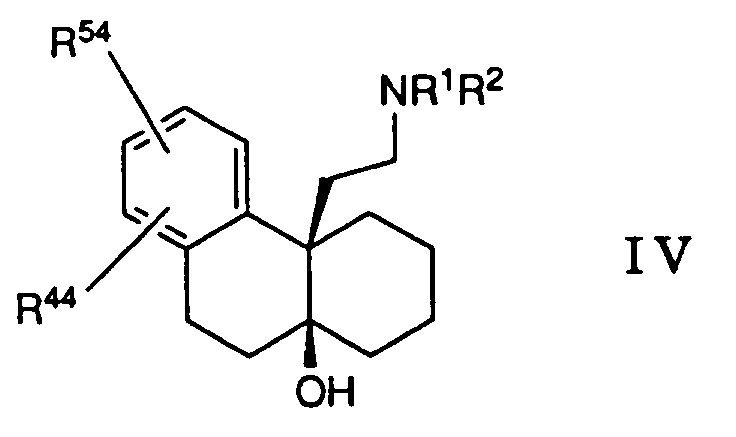
in Gegenwart eines Katalysators hydriert, oderf) zur Herstellung einer Verbindung der Formel I, worin R¹, R² und R³ die in Anspruch 1 angegebene Bedeutung besitzen und eines von R⁴ und R⁵ Wasserstoff und das andere Heteroaryloxy bedeutet, eine Verbindung der allgemeinen Formel
mit einer Verbindung der Formel X-Z, worin Z eine Abgangsgruppe und X Heteroaryl bedeuten, behandelt,g) erwünschtenfalls ein erhaltenes Diastereomerengemisch und/oder Racemat auftrennt, und/oderh) erwünschtenfalls eine erhaltene Verbindung der Formel I in ein pharmazeutisch annehmbares Salz überführt. - Arzneimittel, insbesondere zur Behandlung oder Verhütung von Ischämie, Hypoglykämie, Hypoxie, cerebralen Gefässpasmen, Spastizität, Trauma, Hemorrhagie, Infektionen (viral, bakteriell, amöbisch, prional), epileptischen Anfällen, autoimmunen Erkrankungen, Entzugssymptomen, Alzheimerscher Krankheit, Parkinsonscher Krankheit, amyotropher Lateralsclerose, Morbus Huntington, Vergiftungen, Olivoponto-cerebellarer Atrophie, Rückenmarkverletzung, Schizophrenie, Depressionen, Angstzuständen, Abhängigkeit, Schmerzen, Autismus und mentaler Retardierung, enthaltend eine Verbindung nach einem der Ansprüche 1-9 oder rac-cis-4b-(2-Amino-ethyl)-4b,5,6,7,8,8a,9,10-octahydro-phenanthren-8a-ol oder ein pharmazeutisch annehmbares Säureadditionssalz davon und ein therapeutisch inertes Trägermaterial.
- Verwendung von Verbindungen nach einem der Ansprüche 1-9 sowie von rac-cis-4b-(2-Amino-ethyl)-4b,5,6,7,8,8a,9,10-octahydrophen-anthren-8a-ol und von pharmazeutisch anwendbaren Säureadditionssalzen davon bei der Behandlung oder Verhütung von Krankheiten, insbesondere als Neuroprotectiva bei der Behandlung oder Verhütung von Ischämie, Hypoglykämie, Hypoxie, cerebralen Gefässpasmen, Spastizität, Trauma, Hemorrhagie, Infektionen (viral, bakteriell, amöbisch, prional), epileptischen Anfällen, autoimmunen Erkrankungen, Entzugssymptomen, Alzheimerscher Krankheit, Parkinsonscher Krankheit, amyotropher Lateralsclerose, Morbus Huntington, Vergiftungen, Olivoponto-cerebellarer Atrophie, Rückenmarkverletzung, Schizophrenie, Depressionen, Angstzuständen, Abhängigkeit, Schmerzen, Autismus und mentaler Retardierung,
- Verwendung von Verbindungen nach einem der Ansprüche 1-9 sowie von rac-cis-4b-(2-Amino-ethyl)-4b,5,6,7,8,8a,9,10-octahydrophen-anthren-8a-ol oder von pharmazeutisch anwendbaren Säureadditionssalzen davon zur Herstellung von neuroprotectiven Mitteln zur Behandlung oder Verhütung von Ischämie, Hypoglykämie, Hypoxie, cerebralen Gefässpasmen, Spastizität, Trauma, Hemorrhagie, Infektionen (viral, bakteriell, amöbisch, prional), epileptischen Anfällen, autoimmunen Erkrankungen, Entzugssymptomen, Alzheimerscher Krankheit, Parkinsonscher Krankheit, amyotropher Lateralsclerose, Morbus Huntington, Vergiftungen, Olivoponto-cerebellarer Atrophie, Rückenmarkverletzung, Schizophrenie, Depressionen, Angstzuständen, Abhängigkeit, Schmerzen, Autismus und mentaler Retardierung.
Applications Claiming Priority (2)
| Application Number | Priority Date | Filing Date | Title |
|---|---|---|---|
| CH123/93 | 1993-01-15 | ||
| CH12393 | 1993-01-15 |
Publications (2)
| Publication Number | Publication Date |
|---|---|
| EP0606661A1 true EP0606661A1 (de) | 1994-07-20 |
| EP0606661B1 EP0606661B1 (de) | 1997-03-12 |
Family
ID=4179785
Family Applications (1)
| Application Number | Title | Priority Date | Filing Date |
|---|---|---|---|
| EP93121161A Expired - Lifetime EP0606661B1 (de) | 1993-01-15 | 1993-12-31 | Octahydrophenanthrenderivate |
Country Status (22)
| Country | Link |
|---|---|
| US (1) | US5385947A (de) |
| EP (1) | EP0606661B1 (de) |
| JP (1) | JP2505978B2 (de) |
| KR (1) | KR940018355A (de) |
| CN (1) | CN1097727A (de) |
| AT (1) | ATE150001T1 (de) |
| AU (1) | AU668442B2 (de) |
| BR (1) | BR9400082A (de) |
| CA (1) | CA2111138A1 (de) |
| CZ (1) | CZ8694A3 (de) |
| DE (1) | DE59305763D1 (de) |
| DK (1) | DK0606661T3 (de) |
| ES (1) | ES2099362T3 (de) |
| FI (1) | FI940147A7 (de) |
| GR (1) | GR3023581T3 (de) |
| HU (1) | HUT69688A (de) |
| IL (1) | IL108307A0 (de) |
| NO (1) | NO180630C (de) |
| NZ (1) | NZ250652A (de) |
| PL (1) | PL301905A1 (de) |
| UY (1) | UY23718A1 (de) |
| ZA (1) | ZA94103B (de) |
Cited By (8)
| Publication number | Priority date | Publication date | Assignee | Title |
|---|---|---|---|---|
| WO1997003661A1 (en) * | 1995-07-24 | 1997-02-06 | University Of Florida Research Foundation, Incorporated | Use of non-estrogen polycyclic phenol compounds for the manufacture of a medicament for conferring neuroprotection to cells |
| US5859001A (en) * | 1996-01-11 | 1999-01-12 | University Of Florida Research Foundation, Inc. | Neuroprotective effects of polycyclic phenolic compounds |
| US6197833B1 (en) | 1995-07-24 | 2001-03-06 | Apollo Biopharmaceutics, Inc. | Neuroprotective effects of polycyclic phenolic compounds |
| US6319914B1 (en) | 1993-11-05 | 2001-11-20 | Apollo Biopharmaceuticals, Inc. | Cytoprotective effect of polycyclic phenolic compounds |
| WO2003016261A1 (de) * | 2001-08-16 | 2003-02-27 | Grünenthal GmbH | Substituierte octahydrophenanthren-verbindungen und ihre verwendung als nmda-antagonsisten |
| WO2002053522A3 (en) * | 2001-01-04 | 2004-01-08 | Karobio Ab | Novel estrogen receptor ligands and methods i |
| US7294885B2 (en) | 2004-03-31 | 2007-11-13 | Infineon Technologies Ag | Reverse blocking semiconductor component with charge compensation |
| CZ305733B6 (cs) * | 2014-08-26 | 2016-02-24 | Ăšstav organickĂ© chemie a biochemie AV ÄŚR, v.v.i. | Amfifilní sloučeniny s neuroprotektivními účinky |
Families Citing this family (9)
| Publication number | Priority date | Publication date | Assignee | Title |
|---|---|---|---|---|
| EP0676196A1 (de) * | 1993-10-13 | 1995-10-11 | Otsuka Pharmaceutical Co., Ltd. | Stickstoffmonoxid-synthese-inhibitoren |
| US6362226B2 (en) | 1999-12-08 | 2002-03-26 | Vanderbilt University | Modulation of in vivo glutamine and glycine levels in the treatment of autism |
| JP2005506292A (ja) * | 2001-03-08 | 2005-03-03 | エモリー ユニバーシティ | pHに依存するNMDAレセプターアンタゴニスト |
| SG162724A1 (en) * | 2005-05-25 | 2010-07-29 | Janssen Pharmaceutica Nv | Process for preparing <alpha s, beta r>-6-bromo-alpha-[2-<dimethylamino>ethyl]-2-methoxy-alpha-1-naphthalenyl-beta-phenyl-3-quinolineethanol |
| DE102005044817A1 (de) * | 2005-09-20 | 2007-03-22 | Sanofi-Aventis Deutschland Gmbh | Substituierte 4-Phenyltetrahydroisochinoline, Verfahren zu ihrer Herstellung, ihre Verwendung als Medikament, sowie sie enthaltendes Medikament |
| KR20100045983A (ko) | 2007-06-29 | 2010-05-04 | 에모리 유니버시티 | 신경보호를 위한 nmda 수용체 길항물질 |
| BR112013033777A2 (pt) * | 2011-03-15 | 2016-09-13 | Abbvie Inc | moduladores de receptor de hormônio nuclear |
| TW201422590A (zh) | 2012-09-07 | 2014-06-16 | Abbvie Inc | 雜環核激素受體調節劑 |
| EP2935284A4 (de) | 2012-12-21 | 2016-04-27 | Abbvie Inc | Heterocyclische nuklearhormonrezeptormodulatoren |
Citations (1)
| Publication number | Priority date | Publication date | Assignee | Title |
|---|---|---|---|---|
| EP0388977A2 (de) * | 1989-03-23 | 1990-09-26 | Warner-Lambert Company | Polycyclische Amine zur Verwendung als Zerebrovaskulärer Wirkstoff |
Family Cites Families (2)
| Publication number | Priority date | Publication date | Assignee | Title |
|---|---|---|---|---|
| US4317910A (en) * | 1978-03-20 | 1982-03-02 | E. R. Squibb & Sons, Inc. | Benzo-cyclitolamines |
| US5180736A (en) * | 1989-03-23 | 1993-01-19 | Warner-Lambert Company | Polycyclic amines useful as cerebrovascular agents |
-
1993
- 1993-12-10 CA CA002111138A patent/CA2111138A1/en not_active Abandoned
- 1993-12-31 DK DK93121161.9T patent/DK0606661T3/da not_active Application Discontinuation
- 1993-12-31 EP EP93121161A patent/EP0606661B1/de not_active Expired - Lifetime
- 1993-12-31 ES ES93121161T patent/ES2099362T3/es not_active Expired - Lifetime
- 1993-12-31 DE DE59305763T patent/DE59305763D1/de not_active Expired - Fee Related
- 1993-12-31 AT AT93121161T patent/ATE150001T1/de not_active IP Right Cessation
-
1994
- 1994-01-07 ZA ZA94103A patent/ZA94103B/xx unknown
- 1994-01-10 AU AU53114/94A patent/AU668442B2/en not_active Ceased
- 1994-01-10 HU HU9400056A patent/HUT69688A/hu unknown
- 1994-01-10 IL IL10830794A patent/IL108307A0/xx unknown
- 1994-01-10 NZ NZ250652A patent/NZ250652A/en unknown
- 1994-01-11 JP JP6001244A patent/JP2505978B2/ja not_active Expired - Lifetime
- 1994-01-12 FI FI940147A patent/FI940147A7/fi unknown
- 1994-01-12 BR BR9400082A patent/BR9400082A/pt not_active Application Discontinuation
- 1994-01-13 CN CN94100624A patent/CN1097727A/zh active Pending
- 1994-01-14 KR KR1019940000559A patent/KR940018355A/ko not_active Withdrawn
- 1994-01-14 PL PL94301905A patent/PL301905A1/xx unknown
- 1994-01-14 NO NO940143A patent/NO180630C/no unknown
- 1994-01-14 UY UY23718A patent/UY23718A1/es unknown
- 1994-01-14 CZ CZ9486A patent/CZ8694A3/cs unknown
- 1994-05-31 US US08/252,131 patent/US5385947A/en not_active Expired - Fee Related
-
1997
- 1997-05-29 GR GR970401229T patent/GR3023581T3/el unknown
Patent Citations (1)
| Publication number | Priority date | Publication date | Assignee | Title |
|---|---|---|---|---|
| EP0388977A2 (de) * | 1989-03-23 | 1990-09-26 | Warner-Lambert Company | Polycyclische Amine zur Verwendung als Zerebrovaskulärer Wirkstoff |
Non-Patent Citations (1)
| Title |
|---|
| DOYLE T W; CONWAY: "N-Chlorosulfonyl isocyanate-olefin adduct: cyclization via oxygen in the ambident anion", TETRAHEDRON LETT. (TELEAY); 69; (23); PP.1889-92 * |
Cited By (8)
| Publication number | Priority date | Publication date | Assignee | Title |
|---|---|---|---|---|
| US6319914B1 (en) | 1993-11-05 | 2001-11-20 | Apollo Biopharmaceuticals, Inc. | Cytoprotective effect of polycyclic phenolic compounds |
| WO1997003661A1 (en) * | 1995-07-24 | 1997-02-06 | University Of Florida Research Foundation, Incorporated | Use of non-estrogen polycyclic phenol compounds for the manufacture of a medicament for conferring neuroprotection to cells |
| US6197833B1 (en) | 1995-07-24 | 2001-03-06 | Apollo Biopharmaceutics, Inc. | Neuroprotective effects of polycyclic phenolic compounds |
| US5859001A (en) * | 1996-01-11 | 1999-01-12 | University Of Florida Research Foundation, Inc. | Neuroprotective effects of polycyclic phenolic compounds |
| WO2002053522A3 (en) * | 2001-01-04 | 2004-01-08 | Karobio Ab | Novel estrogen receptor ligands and methods i |
| WO2003016261A1 (de) * | 2001-08-16 | 2003-02-27 | Grünenthal GmbH | Substituierte octahydrophenanthren-verbindungen und ihre verwendung als nmda-antagonsisten |
| US7294885B2 (en) | 2004-03-31 | 2007-11-13 | Infineon Technologies Ag | Reverse blocking semiconductor component with charge compensation |
| CZ305733B6 (cs) * | 2014-08-26 | 2016-02-24 | Ăšstav organickĂ© chemie a biochemie AV ÄŚR, v.v.i. | Amfifilní sloučeniny s neuroprotektivními účinky |
Also Published As
| Publication number | Publication date |
|---|---|
| PL301905A1 (en) | 1994-07-25 |
| HU9400056D0 (en) | 1994-05-30 |
| UY23718A1 (es) | 1994-07-06 |
| US5385947A (en) | 1995-01-31 |
| NO180630B (no) | 1997-02-10 |
| BR9400082A (pt) | 1994-08-02 |
| EP0606661B1 (de) | 1997-03-12 |
| CZ8694A3 (en) | 1994-08-17 |
| NO940143D0 (no) | 1994-01-14 |
| HUT69688A (en) | 1995-09-28 |
| ZA94103B (en) | 1994-08-19 |
| NZ250652A (en) | 1995-10-26 |
| GR3023581T3 (en) | 1997-08-29 |
| DE59305763D1 (de) | 1997-04-17 |
| FI940147L (fi) | 1994-07-16 |
| AU668442B2 (en) | 1996-05-02 |
| NO180630C (no) | 1997-05-21 |
| NO940143L (no) | 1994-07-18 |
| JPH06234711A (ja) | 1994-08-23 |
| FI940147A0 (fi) | 1994-01-12 |
| CA2111138A1 (en) | 1994-07-16 |
| IL108307A0 (en) | 1994-04-12 |
| FI940147A7 (fi) | 1994-07-16 |
| ATE150001T1 (de) | 1997-03-15 |
| ES2099362T3 (es) | 1997-05-16 |
| AU5311494A (en) | 1994-07-21 |
| KR940018355A (ko) | 1994-08-16 |
| JP2505978B2 (ja) | 1996-06-12 |
| DK0606661T3 (da) | 1997-09-01 |
| CN1097727A (zh) | 1995-01-25 |
Similar Documents
| Publication | Publication Date | Title |
|---|---|---|
| EP0606661B1 (de) | Octahydrophenanthrenderivate | |
| DE69129282T2 (de) | Imidderivate, ihre Herstellung und Verwendung | |
| DE69800896T2 (de) | 8-substituierte-1,3,8-Triazaspiro[4,5]decan-4-onderivate | |
| DE3719924A1 (de) | 8-substituierte 2-aminotetraline | |
| EP0306871B1 (de) | 3,7-Diazabicyclo [3,3,1] nonan-Verbindungen sowie Verfahren zu ihrer Herstellung und diese Verbindungen enthaltende Arzneimittel | |
| EP0657426A2 (de) | Tricyclische Pyrrol-Derivate | |
| DE60225433T2 (de) | Verfahren zur herstellung von 1,3-substituierte indene und aryl-annellierte azapolycyclische verbindungen | |
| DE69914594T2 (de) | Aryl-annellierte azapolycyclische verbindungen | |
| CH631985A5 (de) | Verfahren zur herstellung von diazepinderivaten. | |
| EP1444206B1 (de) | Substituierte benzo[b]azepin-2-on-verbindungen als schmerzmittel | |
| EP0777481A1 (de) | Verwendung von n-substituierten phenothiazinen | |
| DE69417573T2 (de) | Tricyclische derivate und phamazeutische zusammensetzungen die sie enthalten | |
| DE9101348U1 (de) | Trizyklisch-zyklische Amine als neue Cholinesterease-Inhibitoren | |
| EP0548664A1 (de) | 2,3,3a,4,5,9b-Hexahydro-1H-benzo[e]indol-Derivate | |
| DE69214586T2 (de) | Methanoanthracene als Dopaminantagonisten | |
| CH642967A5 (de) | Neue pyrimidoisochinolin-derivate, verfahren zu ihrer herstellung und diese enthaltende pharmazeutische praeparate. | |
| DE3875031T2 (de) | Substituierte dibenzocycloheptenimine. | |
| CH638784A5 (de) | Verfahren zur herstellung neuer phenylazacycloalkane. | |
| DE2840770C2 (de) | ||
| EP0472166A1 (de) | Tricyclische Pyridonderivate | |
| CH556837A (de) | Verfahren zur herstellung neuer spiroindanpyrrolidinderivate. | |
| DE2526966A1 (de) | Tricyclische alkylaminverbindungen, verfahren zu ihrer herstellung und sie enthaltende mittel | |
| EP0388977A2 (de) | Polycyclische Amine zur Verwendung als Zerebrovaskulärer Wirkstoff | |
| US5434159A (en) | 6,11-cyclyl-1,2,3,4,5,6,11,11a-octahydrobenzo[b]quinolines and compositions and method of use thereof | |
| DD149664A5 (de) | Verfahren zur herstellung von 1,1'-biphenyl-2-yl-alkylamin-derivaten |
Legal Events
| Date | Code | Title | Description |
|---|---|---|---|
| PUAI | Public reference made under article 153(3) epc to a published international application that has entered the european phase |
Free format text: ORIGINAL CODE: 0009012 |
|
| 17P | Request for examination filed |
Effective date: 19931231 |
|
| AK | Designated contracting states |
Kind code of ref document: A1 Designated state(s): AT BE CH DE DK ES FR GB GR IE IT LI LU MC NL PT SE |
|
| 17Q | First examination report despatched |
Effective date: 19951229 |
|
| GRAG | Despatch of communication of intention to grant |
Free format text: ORIGINAL CODE: EPIDOS AGRA |
|
| GRAH | Despatch of communication of intention to grant a patent |
Free format text: ORIGINAL CODE: EPIDOS IGRA |
|
| GRAH | Despatch of communication of intention to grant a patent |
Free format text: ORIGINAL CODE: EPIDOS IGRA |
|
| GRAA | (expected) grant |
Free format text: ORIGINAL CODE: 0009210 |
|
| AK | Designated contracting states |
Kind code of ref document: B1 Designated state(s): AT BE CH DE DK ES FR GB GR IE IT LI LU MC NL PT SE |
|
| REF | Corresponds to: |
Ref document number: 150001 Country of ref document: AT Date of ref document: 19970315 Kind code of ref document: T |
|
| REG | Reference to a national code |
Ref country code: CH Ref legal event code: EP |
|
| REF | Corresponds to: |
Ref document number: 59305763 Country of ref document: DE Date of ref document: 19970417 |
|
| REG | Reference to a national code |
Ref country code: IE Ref legal event code: FG4D Free format text: 72687 |
|
| REG | Reference to a national code |
Ref country code: ES Ref legal event code: FG2A Ref document number: 2099362 Country of ref document: ES Kind code of ref document: T3 |
|
| ITF | It: translation for a ep patent filed | ||
| GBT | Gb: translation of ep patent filed (gb section 77(6)(a)/1977) |
Effective date: 19970516 |
|
| ET | Fr: translation filed | ||
| REG | Reference to a national code |
Ref country code: PT Ref legal event code: SC4A Free format text: AVAILABILITY OF NATIONAL TRANSLATION Effective date: 19970408 |
|
| REG | Reference to a national code |
Ref country code: GR Ref legal event code: FG4A Free format text: 3023581 |
|
| REG | Reference to a national code |
Ref country code: DK Ref legal event code: T3 |
|
| PGFP | Annual fee paid to national office [announced via postgrant information from national office to epo] |
Ref country code: PT Payment date: 19971105 Year of fee payment: 5 |
|
| PGFP | Annual fee paid to national office [announced via postgrant information from national office to epo] |
Ref country code: IE Payment date: 19971106 Year of fee payment: 5 |
|
| PGFP | Annual fee paid to national office [announced via postgrant information from national office to epo] |
Ref country code: BE Payment date: 19971110 Year of fee payment: 5 |
|
| PGFP | Annual fee paid to national office [announced via postgrant information from national office to epo] |
Ref country code: SE Payment date: 19971111 Year of fee payment: 5 |
|
| PGFP | Annual fee paid to national office [announced via postgrant information from national office to epo] |
Ref country code: CH Payment date: 19971216 Year of fee payment: 5 |
|
| PGFP | Annual fee paid to national office [announced via postgrant information from national office to epo] |
Ref country code: GR Payment date: 19971217 Year of fee payment: 5 |
|
| PGFP | Annual fee paid to national office [announced via postgrant information from national office to epo] |
Ref country code: LU Payment date: 19971224 Year of fee payment: 5 |
|
| PGFP | Annual fee paid to national office [announced via postgrant information from national office to epo] |
Ref country code: DK Payment date: 19971229 Year of fee payment: 5 |
|
| PGFP | Annual fee paid to national office [announced via postgrant information from national office to epo] |
Ref country code: AT Payment date: 19971230 Year of fee payment: 5 |
|
| PGFP | Annual fee paid to national office [announced via postgrant information from national office to epo] |
Ref country code: NL Payment date: 19971231 Year of fee payment: 5 |
|
| PLBE | No opposition filed within time limit |
Free format text: ORIGINAL CODE: 0009261 |
|
| STAA | Information on the status of an ep patent application or granted ep patent |
Free format text: STATUS: NO OPPOSITION FILED WITHIN TIME LIMIT |
|
| 26N | No opposition filed | ||
| PGFP | Annual fee paid to national office [announced via postgrant information from national office to epo] |
Ref country code: FR Payment date: 19981209 Year of fee payment: 6 |
|
| PGFP | Annual fee paid to national office [announced via postgrant information from national office to epo] |
Ref country code: ES Payment date: 19981218 Year of fee payment: 6 |
|
| PGFP | Annual fee paid to national office [announced via postgrant information from national office to epo] |
Ref country code: MC Payment date: 19981221 Year of fee payment: 6 |
|
| PG25 | Lapsed in a contracting state [announced via postgrant information from national office to epo] |
Ref country code: LU Free format text: LAPSE BECAUSE OF NON-PAYMENT OF DUE FEES Effective date: 19981231 Ref country code: LI Free format text: LAPSE BECAUSE OF NON-PAYMENT OF DUE FEES Effective date: 19981231 Ref country code: IE Free format text: LAPSE BECAUSE OF NON-PAYMENT OF DUE FEES Effective date: 19981231 Ref country code: GR Free format text: LAPSE BECAUSE OF NON-PAYMENT OF DUE FEES Effective date: 19981231 Ref country code: DK Free format text: LAPSE BECAUSE OF NON-PAYMENT OF DUE FEES Effective date: 19981231 Ref country code: CH Free format text: LAPSE BECAUSE OF NON-PAYMENT OF DUE FEES Effective date: 19981231 Ref country code: BE Free format text: LAPSE BECAUSE OF NON-PAYMENT OF DUE FEES Effective date: 19981231 Ref country code: AT Free format text: LAPSE BECAUSE OF NON-PAYMENT OF DUE FEES Effective date: 19981231 |
|
| PGFP | Annual fee paid to national office [announced via postgrant information from national office to epo] |
Ref country code: GB Payment date: 19981231 Year of fee payment: 6 |
|
| PG25 | Lapsed in a contracting state [announced via postgrant information from national office to epo] |
Ref country code: SE Free format text: LAPSE BECAUSE OF NON-PAYMENT OF DUE FEES Effective date: 19990101 |
|
| PGFP | Annual fee paid to national office [announced via postgrant information from national office to epo] |
Ref country code: DE Payment date: 19990108 Year of fee payment: 6 |
|
| BERE | Be: lapsed |
Owner name: F. HOFFMANN-LA ROCHE A.G. Effective date: 19981231 |
|
| PG25 | Lapsed in a contracting state [announced via postgrant information from national office to epo] |
Ref country code: PT Free format text: LAPSE BECAUSE OF NON-PAYMENT OF DUE FEES Effective date: 19990630 |
|
| PG25 | Lapsed in a contracting state [announced via postgrant information from national office to epo] |
Ref country code: NL Free format text: LAPSE BECAUSE OF NON-PAYMENT OF DUE FEES Effective date: 19990701 |
|
| REG | Reference to a national code |
Ref country code: CH Ref legal event code: PL |
|
| NLV4 | Nl: lapsed or anulled due to non-payment of the annual fee |
Effective date: 19990701 |
|
| REG | Reference to a national code |
Ref country code: PT Ref legal event code: MM4A Free format text: LAPSE DUE TO NON-PAYMENT OF FEES Effective date: 19990630 |
|
| PG25 | Lapsed in a contracting state [announced via postgrant information from national office to epo] |
Ref country code: GB Free format text: LAPSE BECAUSE OF NON-PAYMENT OF DUE FEES Effective date: 19991231 |
|
| PG25 | Lapsed in a contracting state [announced via postgrant information from national office to epo] |
Ref country code: ES Free format text: LAPSE BECAUSE OF NON-PAYMENT OF DUE FEES Effective date: 20000101 |
|
| PG25 | Lapsed in a contracting state [announced via postgrant information from national office to epo] |
Ref country code: MC Free format text: LAPSE BECAUSE OF NON-PAYMENT OF DUE FEES Effective date: 20000630 |
|
| GBPC | Gb: european patent ceased through non-payment of renewal fee |
Effective date: 19991231 |
|
| PG25 | Lapsed in a contracting state [announced via postgrant information from national office to epo] |
Ref country code: FR Free format text: LAPSE BECAUSE OF NON-PAYMENT OF DUE FEES Effective date: 20000831 |
|
| REG | Reference to a national code |
Ref country code: DK Ref legal event code: EBP |
|
| PG25 | Lapsed in a contracting state [announced via postgrant information from national office to epo] |
Ref country code: DE Free format text: LAPSE BECAUSE OF NON-PAYMENT OF DUE FEES Effective date: 20001003 |
|
| REG | Reference to a national code |
Ref country code: FR Ref legal event code: ST |
|
| REG | Reference to a national code |
Ref country code: ES Ref legal event code: FD2A Effective date: 20010113 |
|
| PG25 | Lapsed in a contracting state [announced via postgrant information from national office to epo] |
Ref country code: IT Free format text: LAPSE BECAUSE OF NON-PAYMENT OF DUE FEES;WARNING: LAPSES OF ITALIAN PATENTS WITH EFFECTIVE DATE BEFORE 2007 MAY HAVE OCCURRED AT ANY TIME BEFORE 2007. THE CORRECT EFFECTIVE DATE MAY BE DIFFERENT FROM THE ONE RECORDED. Effective date: 20051231 |