EP0606684A1 - Verfahren zur Fehlerbeseitigung bei Anwendungen für eine grafische Benutzeroberfläche - Google Patents
Verfahren zur Fehlerbeseitigung bei Anwendungen für eine grafische Benutzeroberfläche Download PDFInfo
- Publication number
- EP0606684A1 EP0606684A1 EP93250324A EP93250324A EP0606684A1 EP 0606684 A1 EP0606684 A1 EP 0606684A1 EP 93250324 A EP93250324 A EP 93250324A EP 93250324 A EP93250324 A EP 93250324A EP 0606684 A1 EP0606684 A1 EP 0606684A1
- Authority
- EP
- European Patent Office
- Prior art keywords
- window
- application program
- halted
- copy
- display screen
- Prior art date
- Legal status (The legal status is an assumption and is not a legal conclusion. Google has not performed a legal analysis and makes no representation as to the accuracy of the status listed.)
- Granted
Links
Images

Classifications
-
- G—PHYSICS
- G06—COMPUTING OR CALCULATING; COUNTING
- G06F—ELECTRIC DIGITAL DATA PROCESSING
- G06F11/00—Error detection; Error correction; Monitoring
- G06F11/36—Prevention of errors by analysis, debugging or testing of software
- G06F11/3698—Environments for analysis, debugging or testing of software
Definitions
- This invention relates generally debugging facilities for use with digital data processors and, in particular, to debugging facilities for use with application programs having simultaneously displayed screen window areas.
- Application programs that are written toward windowed and graphical capabilities of operating systems often contain specialized programming to paint the contents of the application windows. Examples of such specialization include programming to construct graphs, charts, or complex diagrams related to specific domains of knowledge. In effect, what is drawn, or painted, within an application's window is specific to the application, and is independent of the operating system.
- debugger One function of a debugger is to enable an application to be stopped at selected places in its programming in order to observe various execution states of the application.
- An application which is so operated upon by a debugger is referred to herein as a "debuggee".
- debuggee An application which is so operated upon by a debugger.
- the visual content of the debuggee's window(s) is not available to contribute important information that is relevant to the debugging of the application.
- U.S. Patents are exemplary of various program debugging and/or windowing systems: U.S. Patent 4,589,068 “Segmented Debugger” (Heinen, Jr.); U.S. Patent 4,703,446 “Data Processing Unit Diagnosis Control Apparatus” (Momose); U.S. Patent 4,720,778 “Software Debugging Analyzer” (Hall et al.); U.S. Patent 4,872,167 “Method for Displaying Program Executing Circumstances and an Apparatus Using the Same” (Maezawa et al.); U.S.
- Patent 4,885,717 System for Graphically Representing Operation of Object-Orientated Programs
- U.S. Patent 4,941,102 Two-Step Debugger for Expert Systems
- U.S. Patent 4,943,968 Method of Displaying Execution Trace in a Logic Programming Language Processing System” (Hirose et al.)
- U.S. Patent 5,038,348 Apparatus for Debugging a Data Flow Program” (Yoda et al.); and commonly assigned U.S. Patent 5,050,105 “Direct Cursor-Controlled Access to Multiple Application Programs and Data” (Peters).
- a first method is employed with a data processing system of a type that has a plurality of application programs, wherein application programs are capable of having at least one display screen window associated therewith.
- the method manages a display screen window of an application program that is halted and includes the following steps.
- a debugger operates to (a) copy the informational content of a window of the halted application program; (b) create a second window, referred to herein as a shadow window, to be in registration with the window of the halted application program such that the window of the halted application program is hidden from the view of an observer of the display screen; (c) paint the second window with the copy of the informational content of the halted application program; and (d) in response to a message to re-paint the second window, re-paint the second window with the copy of the informational content of the halted application program.
- the step of painting preferably includes a preliminary step of invalidating portions of the copy that correspond to any obscured portions of the window of the halted application program, such as by setting the invalidated portions of the copy to a predetermined color.
- a second method is also employed with a data processing system of a type that has a plurality of application programs, wherein application programs are capable of having at least one display screen window associated therewith.
- the second method manages a display screen window of an application program that is halted and includes the following steps.
- the debugger operates to (a) initialize a screen image buffer and copy to the buffer the window(s) of the halted application program; (b) intercept a window re-paint message that is directed to the halted application program; and (c) re-paint the display screen window of the halted application program with the copy of the window that corresponds to the window of the halted application program that is to be re-painted.
- obscured portions of the window may be invalidated before being re-painted.
- the invention also provides embodiments of application debuggers that operate in accordance with the foregoing methods.
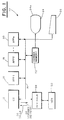
- Fig. 1 is a block diagram of a data processing system 10 that operates in accordance with this invention.
- System 10 includes an operating system (OS) 12 that is coupled, via a logical bus 14, to a plurality of application programs designated APP1 16, APP2 18 and APPn 20.
- OS operating system
- screen memory 22 Also coupled to bus 14 is a screen memory 22 having an output that provides display data to a display monitor 24 having a display screen 24a.
- a keyboard 26 provides a data entry function for use by an operator of the system 10.
- the system 10 further includes a debugging application program (DEBUGGER) 28.
- the debugger 28 is coupled to an associated memory (MEM) 30, the use of which is described below.
- MEM associated memory
- each application program 16-20 and the debugging application program 28 are embodied in assemblages of computer instructions that are stored within a system memory.
- the OS 12 schedules the execution of the various application programs such that the application programs appear to run concurrently.
- each application program is capable of owning and displaying information within at least one window that appears upon the display screen 24.
- a window is considered to be a predetermined area of the display screen 24a.
- a window of one application program may partially or totally overlie a window of one or more other application programs.
- Predetermined window-related calls are made by the application programs 16-20 and 28 to the OS 12 over the logical bus 14, and window-related messages are received by the applications over the logical bus 14 from the OS 12.
- the OS 12 may be embodied in an operating system known as OS/2 (OS/2 is a registered trademark of the International Business Machines Corporation).
- OS/2 is a registered trademark of the International Business Machines Corporation.
- the predetermined OS 12 window-related calls and messages are detailed below.
- teaching of this invention is not limited for use with any one particular type of operating system.
- the debugger 28 is assumed to include facilities for providing calls to the OS 12 for halting a specified one of the application programs 16-20, for stepping the halted application program, for running the halted application program, and for performing other conventional debugging functions.
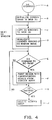
- the debugger 28 is responsive to the debuggee application (DA) being halted (Block A), at the end of a step or run command, for acquiring a screen image from the screen memory 22 (Block B).
- the debugger 28 then generates OS 12 calls to query the OS 12 for size and location information of all the debuggee's windows. For each of debuggee windows, the debugger 28 then makes a copy in MEM 30 of the current contents of that window (Block C).
- portions of the debuggee window may be covered by other windows. Since it is impossible to construct the application's intentions in painting the covered regions, the covered regions of the debuggee's windows are preferably invalidated in the MEM 30 copy by coloring each covered region with some pre-selected color (Block D).
- the debugger 28 creates a window in registration with the debuggee window. That is, the debugger creates a window of equal size and display screen position that is adjacent to the window z-order of the corresponding debuggee window (Blocks E and F).
- the window or windows that are thus created by the debugger 28 are referred to herein as "shadow windows". Ordering refers to the fact that each window is located on a separate logical image plane within the screen memory 22, with the planes being stacked from back to front along a z-axis (depth). As such, the shadow window is inserted between the debuggee window plane and a plane that is located closer to the observer.
- the shadow windows so created are owned by the debugger 28 and are thus not halted. Each debuggee window is fully covered by a corresponding shadow window and, consequently, is not required to be re-painted.
- the debugger 28 next paints the shadow window with the contents of the corresponding debuggee application window that is stored within MEM 30 (Block G), including any invalidated portion or portions thereof.
- the debugger responds to an OS 12 message to re-paint a shadow window and uses the saved MEM 30 image of the corresponding debuggee window to perform the re-painting (Block I).
- a re-paint message may be generated by the OS 12 upon the deletion of another application's window that had been created to partially or completely overlie the location of the shadow window, which also coincides with the location of the debuggee's window.
- the removal of the overlying window of the other application would conventionally result in the partial or total destruction of the information content within the debuggee window.
- the debuggee window is totally covered by the shadow window, the debuggee window is effectively isolated from any user actions that would trigger a re-paint command for the debuggee window.
- the OS 12 will not generate re-paint messages for the debuggee window, but will instead generate re-paint messages of the overlying shadow window.
- the shadow windows thus serve as surrogates for the debuggee windows. The effect is that the user continues to observe the image of the debuggee window or windows at the point at which the debuggee application was halted, and the ghosting problem referred to above is eliminated.
- the debugger 28 determines that the debuggee application has been restarted, and then deletes all shadow windows for the previously halted application. Deleting the shadow windows exposes the underlying application windows, it being assumed that the previously halted application is once more capable of re-painting its associated window or windows.
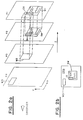
- Figs. 2a and 2b illustrate the effect of the operation of the method of the invention at Block G of Fig. 3.
- image plane 1 P1
- image plane 3 P3
- W2 partially overlies W1, resulting in the creation of an obscured area (OA) in W1.
- the shadow window (SW) that is created by the debugger 28 for W1 is shown displayed at image plane P2, with SW having an invalid area (IA) that corresponds to the OA of W1.
- the SW displays the information that was present within W1 at the time that APP1 16 was stopped (Block A of Fig.
- the displayed information being retrieved from MEM 30 by the debugger 28 during the execution of Block G of Fig. 3.
- the SW is located nearer to the observer than is W1, and is positioned so as to overlie and completely hide from the observer's view the information within W1.
- P4 has a window (W3) that is associated with APPn 20. W3 does not overlie any other windows of the display screen 24a.
- Fig. 2b illustrates the display screen image that is viewed by the observer, it being assumed that W2 is no longer being displayed by APP2 18.
- the observer views the information content of the SW and not W1, in that W1 is located behind the SW.
- another application such as APP2 16
- the debugger 28 will, in response to a re-paint message from the OS 12, re-paint the SW with the stored information for W1.
- the problem of the ghosting effect is overcome.
- the Full-Image method is based on an assumption that the debugger 28 intercepts from the logical bus 14 all OS 12 generated debuggee window re-paint messages.
- the debugger 28 is responsive to the debuggee application (DA) being halted (Block A) for initializing the screen buffer stored in MEM 30 to, for example, the color selected for invalidated window portions (Block B).
- the debugger 28 queries the OS 12 for size and location information of all the debuggee's windows and, at Block C, copies the debuggee window or windows to the screen buffer in MEM 30. Any required debuggee window invalidation is performed at Block D, as described above for the corresponding block of Fig. 3.
- the debugger 28 When the debugger 28 intercepts a re-paint message for a debuggee window (Block E), the debugger 28 cross-references the window area to be re-painted with the window image bitmap stored in MEM 30, and uses that part of the bitmap to paint directly to the image displayed on the display screen 24a in the region where the debuggee window resides (Block F). As such, the debugger 28 maintains a copy of the debuggee window or windows and assumes the task of re-painting the debuggee windows during the time that the debuggee is halted.
- the debugger 28 deletes the copy of the debuggee window image that is stored within the MEM 30.
- the debugger 28 employs several operating system calls to determine the required information for the display screen windows. These OS/2 calls, and the information returned to the caller, are documented in a publication entitled OS/2 Technical Library-Presentation Manager Programming Reference Volume II, version 2.00 (S10G-6265-00).
- OS/2 calls employed by the debugger 28 are as follows. OS/2 CALL FUNCTION WinBeginEnumWindow (pg. 8-16) Query Parent and Z-ordering of Windows WinEndEnumWindow (pg.
- the debugger 28 is responsive to the WM_PAINT message that is received from OS/2 when a window must be re-painted.
- the WM_PAINT message is described at page 12-47 in a publication entitled: OS/2 Technical Library-Presentation Manager Programming Reference Volume III, version 2.00 (S10G-6272-00).
- the choice between the shadow window and full-image methods is dependent upon the ability of the debugger 28 to intercept the debuggee's WM_PAINT messages from the OS 12. If the debugger 28 cannot intercept for the debuggee which areas of the screen to paint, the shadow window method is preferred. If the debugger 28 can intercept directly the debuggee's WM_PAINT request message from the OS 12, then the full-image method is preferred. It should be noted that the shadow window method has the side-effect that when the shadow windows are eliminated and control is given back to the debuggee, a full-window re-paint message is generated by the OS 12 for all the debuggee windows (i.e. the windows have been "uncovered"). This may potentially perturb the application environment more than would be the case using the full-image technique.
Landscapes
- Engineering & Computer Science (AREA)
- Theoretical Computer Science (AREA)
- Computer Hardware Design (AREA)
- Quality & Reliability (AREA)
- Physics & Mathematics (AREA)
- General Engineering & Computer Science (AREA)
- General Physics & Mathematics (AREA)
- Debugging And Monitoring (AREA)
- Digital Computer Display Output (AREA)
- User Interface Of Digital Computer (AREA)
- Image Generation (AREA)
Applications Claiming Priority (2)
| Application Number | Priority Date | Filing Date | Title |
|---|---|---|---|
| US85993A | 1993-01-05 | 1993-01-05 | |
| US859 | 1993-01-05 |
Publications (2)
| Publication Number | Publication Date |
|---|---|
| EP0606684A1 true EP0606684A1 (de) | 1994-07-20 |
| EP0606684B1 EP0606684B1 (de) | 1997-10-22 |
Family
ID=21693321
Family Applications (1)
| Application Number | Title | Priority Date | Filing Date |
|---|---|---|---|
| EP93250324A Expired - Lifetime EP0606684B1 (de) | 1993-01-05 | 1993-11-25 | Verfahren zur Fehlerbeseitigung bei Anwendungen für eine grafische Benutzeroberfläche |
Country Status (8)
| Country | Link |
|---|---|
| US (1) | US5515493A (de) |
| EP (1) | EP0606684B1 (de) |
| JP (1) | JP2528615B2 (de) |
| KR (1) | KR970005459B1 (de) |
| CN (1) | CN1053975C (de) |
| AT (1) | ATE159598T1 (de) |
| CA (1) | CA2105055C (de) |
| DE (1) | DE69314763T2 (de) |
Cited By (3)
| Publication number | Priority date | Publication date | Assignee | Title |
|---|---|---|---|---|
| US5926638A (en) * | 1996-01-17 | 1999-07-20 | Nec Corporation | Program debugging system for debugging a program having graphical user interface |
| AU765342B2 (en) * | 2000-02-11 | 2003-09-18 | Canon Kabushiki Kaisha | Fill table optimisation for high speed colour rendering |
| US7555723B1 (en) | 1999-05-04 | 2009-06-30 | British Telecommunications | GUI for selective copying of data |
Families Citing this family (19)
| Publication number | Priority date | Publication date | Assignee | Title |
|---|---|---|---|---|
| US6173315B1 (en) * | 1996-03-29 | 2001-01-09 | Intel Corporation | Using shared data to automatically communicate conference status information within a computer conference |
| US5974249A (en) * | 1997-03-24 | 1999-10-26 | Symantec Corporation | Zero footprint method and apparatus for expanding allocated memory space of a process using a virtual memory area |
| US6009440A (en) * | 1997-09-19 | 1999-12-28 | Mci Communications Corporation | Method and system for automatic object refresh |
| US5911060A (en) * | 1997-09-26 | 1999-06-08 | Symantec Corporation | Computer method and apparatus for unfreezing an apparently frozen application program being executed under control of an operating system |
| US6009258A (en) * | 1997-09-26 | 1999-12-28 | Symantec Corporation | Methods and devices for unwinding stack of frozen program and for restarting the program from unwound state |
| US6631480B2 (en) | 1999-11-10 | 2003-10-07 | Symantec Corporation | Methods and systems for protecting data from potential corruption by a crashed computer program |
| US6662310B2 (en) | 1999-11-10 | 2003-12-09 | Symantec Corporation | Methods for automatically locating url-containing or other data-containing windows in frozen browser or other application program, saving contents, and relaunching application program with link to saved data |
| US6630946B2 (en) | 1999-11-10 | 2003-10-07 | Symantec Corporation | Methods for automatically locating data-containing windows in frozen applications program and saving contents |
| KR100681115B1 (ko) * | 1999-11-24 | 2007-02-08 | 주식회사 케이티 | 통신시스템에서의 그래픽 화면 처리 속도 향상 방법 |
| US6850257B1 (en) * | 2000-04-06 | 2005-02-01 | Microsoft Corporation | Responsive user interface to manage a non-responsive application |
| US7380218B2 (en) * | 2003-03-27 | 2008-05-27 | International Business Machines Corporation | Method and apparatus for managing windows |
| JP4458929B2 (ja) * | 2003-07-16 | 2010-04-28 | キヤノン株式会社 | プログラム間通信装置、プログラム間通信方法、コンピュータ読み取り可能な記録媒体およびプログラム |
| US7386807B2 (en) * | 2004-05-17 | 2008-06-10 | Microsoft Corporation | System and method for monitoring application response and providing visual treatment |
| US7549087B2 (en) * | 2005-03-29 | 2009-06-16 | Microsoft Corporation | User interface panel for hung applications |
| US7613957B2 (en) * | 2005-04-06 | 2009-11-03 | Microsoft Corporation | Visual indication for hung applications |
| CN101923468A (zh) * | 2010-08-13 | 2010-12-22 | 中兴通讯股份有限公司 | 一种重绘微件的方法及装置 |
| CN105204716B (zh) * | 2015-09-15 | 2019-06-25 | 联想(北京)有限公司 | 信息处理方法及电子设备 |
| CN111627338B (zh) * | 2020-06-28 | 2021-09-21 | 武汉天马微电子有限公司 | 仿形模组、曲面显示屏的制作方法及其贴合系统 |
| CN114168021B (zh) * | 2022-01-30 | 2022-06-21 | 浙江口碑网络技术有限公司 | 信息展示方法和装置 |
Citations (1)
| Publication number | Priority date | Publication date | Assignee | Title |
|---|---|---|---|---|
| EP0470322A1 (de) * | 1990-08-07 | 1992-02-12 | BULL HN INFORMATION SYSTEMS ITALIA S.p.A. | Nachrichtenorientierte Fehlerbeseitigungsverfahren |
Family Cites Families (17)
| Publication number | Priority date | Publication date | Assignee | Title |
|---|---|---|---|---|
| EP0108520B1 (de) * | 1982-10-11 | 1990-03-28 | Fujitsu Limited | Verfahren zur Steuerung von in einer Datenverarbeitungsanlage für Kartenbilddarstellungen angezeigten Bildfenstern |
| US4589068A (en) * | 1983-10-03 | 1986-05-13 | Digital Equipment Corporation | Segmented debugger |
| US4703446A (en) * | 1984-07-03 | 1987-10-27 | Nec Corporation | Data processing unit diagnosis control apparatus |
| US4720778A (en) * | 1985-01-31 | 1988-01-19 | Hewlett Packard Company | Software debugging analyzer |
| EP0223557A3 (de) * | 1985-11-15 | 1989-04-05 | Data General Corporation | Anzeigesteuerung in einem Datenverarbeitungssystem |
| JPS62282328A (ja) * | 1986-02-21 | 1987-12-08 | Hitachi Ltd | 多重画面制御方式 |
| CA1268557A (en) * | 1986-04-01 | 1990-05-01 | Mikio Tomioka | Method for displaying program executing circumstances and an apparatus using the same |
| US4885717A (en) * | 1986-09-25 | 1989-12-05 | Tektronix, Inc. | System for graphically representing operation of object-oriented programs |
| US4943968A (en) * | 1987-03-04 | 1990-07-24 | Hitachi, Ltd. | Method of displaying execution trace in a logic programming language processing system |
| US4903218A (en) * | 1987-08-13 | 1990-02-20 | Digital Equipment Corporation | Console emulation for a graphics workstation |
| US5050105A (en) * | 1988-01-26 | 1991-09-17 | International Business Machines Corporation | Direct cursor-controlled access to multiple application programs and data |
| US5038348A (en) * | 1988-07-01 | 1991-08-06 | Sharp Kabushiki Kaisha | Apparatus for debugging a data flow program |
| US4941102A (en) * | 1988-09-16 | 1990-07-10 | International Business Machines Corporation | Two-step debugger for expert systems |
| US5289574A (en) * | 1990-09-17 | 1994-02-22 | Hewlett-Packard Company | Multiple virtual screens on an "X windows" terminal |
| US5204947A (en) * | 1990-10-31 | 1993-04-20 | International Business Machines Corporation | Application independent (open) hypermedia enablement services |
| JPH04205024A (ja) * | 1990-11-29 | 1992-07-27 | Toshiba Corp | グラフィクス制御装置 |
| US5363483A (en) * | 1992-10-28 | 1994-11-08 | Intellution, Inc. | Updating objects displayed in a computer system |
-
1993
- 1993-08-27 CA CA002105055A patent/CA2105055C/en not_active Expired - Fee Related
- 1993-11-25 EP EP93250324A patent/EP0606684B1/de not_active Expired - Lifetime
- 1993-11-25 AT AT93250324T patent/ATE159598T1/de active
- 1993-11-25 DE DE69314763T patent/DE69314763T2/de not_active Expired - Fee Related
- 1993-12-14 JP JP5313197A patent/JP2528615B2/ja not_active Expired - Lifetime
- 1993-12-20 KR KR1019930028548A patent/KR970005459B1/ko not_active Expired - Fee Related
-
1994
- 1994-01-04 CN CN94100131A patent/CN1053975C/zh not_active Expired - Fee Related
-
1995
- 1995-10-10 US US08/541,936 patent/US5515493A/en not_active Expired - Fee Related
Patent Citations (1)
| Publication number | Priority date | Publication date | Assignee | Title |
|---|---|---|---|---|
| EP0470322A1 (de) * | 1990-08-07 | 1992-02-12 | BULL HN INFORMATION SYSTEMS ITALIA S.p.A. | Nachrichtenorientierte Fehlerbeseitigungsverfahren |
Non-Patent Citations (1)
| Title |
|---|
| ALLAN TUCHMAN ET AL.: "Run-time Visualization of Program Data", PROCEEDINGS OF VISUALIZATION '91, 25 October 1991 (1991-10-25), SAN DIEGO, CA, pages 255 - 261 * |
Cited By (3)
| Publication number | Priority date | Publication date | Assignee | Title |
|---|---|---|---|---|
| US5926638A (en) * | 1996-01-17 | 1999-07-20 | Nec Corporation | Program debugging system for debugging a program having graphical user interface |
| US7555723B1 (en) | 1999-05-04 | 2009-06-30 | British Telecommunications | GUI for selective copying of data |
| AU765342B2 (en) * | 2000-02-11 | 2003-09-18 | Canon Kabushiki Kaisha | Fill table optimisation for high speed colour rendering |
Also Published As
| Publication number | Publication date |
|---|---|
| US5515493A (en) | 1996-05-07 |
| JP2528615B2 (ja) | 1996-08-28 |
| JPH06236249A (ja) | 1994-08-23 |
| CN1092879A (zh) | 1994-09-28 |
| CN1053975C (zh) | 2000-06-28 |
| KR970005459B1 (ko) | 1997-04-16 |
| ATE159598T1 (de) | 1997-11-15 |
| DE69314763T2 (de) | 1999-04-08 |
| CA2105055C (en) | 1998-06-16 |
| DE69314763D1 (de) | 1997-11-27 |
| EP0606684B1 (de) | 1997-10-22 |
| CA2105055A1 (en) | 1994-07-06 |
| KR940018746A (ko) | 1994-08-18 |
Similar Documents
| Publication | Publication Date | Title |
|---|---|---|
| EP0606684B1 (de) | Verfahren zur Fehlerbeseitigung bei Anwendungen für eine grafische Benutzeroberfläche | |
| US6668370B1 (en) | Synchronous execution of object-oriented scripts and procedural code from within an interactive test facility | |
| KR100278327B1 (ko) | 공유 오프-스크린 메모리를 제공하기 위한 방법 및 장치 | |
| US5465362A (en) | Object-oriented view-system for displaying information in a windowing environment | |
| US6351766B1 (en) | Front end navigator tool for automatically retrieving referenced URL links on distributed files for performing debugging, editing and browsing functions on distributed files | |
| US5544301A (en) | Object-oriented view layout system | |
| US5214780A (en) | Synchronized journaling system | |
| US6026362A (en) | Tool and method for diagnosing and correcting errors in a computer program | |
| US5321807A (en) | Accelerated graphics display method | |
| US6016474A (en) | Tool and method for diagnosing and correcting errors in a computer program | |
| CA2118201C (en) | Photon windowing kernel | |
| US6047123A (en) | Methods for recording a compilable graphics call trace | |
| EP0734552B1 (de) | Objektorientiertes aufgabensicheres rahmenwerk | |
| DE3855289T2 (de) | Maus-Zeiger mit umschaltbarem Emulations-Betriebsmodus | |
| US5615326A (en) | Object-oriented viewing framework having view grouping | |
| US5737559A (en) | Object-oriented view hierarchy framework | |
| CA1305556C (en) | Application exit for potentially pickable primitives in a graphics system | |
| US5524199A (en) | Object-oriented view system with background processing of update request | |
| US5524200A (en) | Object-oriented non-rectilinear viewing framework | |
| Cargill | Pi: A case study in object-oriented programming | |
| US20030221188A1 (en) | Debugging apparatus and method | |
| KR20030015230A (ko) | 개선된 컴퓨터 시스템 | |
| JP3372106B2 (ja) | プログラムデバッグ装置 | |
| JP2788353B2 (ja) | タスクトレース方法 | |
| JP3130884B2 (ja) | デバッグ装置およびデバッグ方法 |
Legal Events
| Date | Code | Title | Description |
|---|---|---|---|
| PUAI | Public reference made under article 153(3) epc to a published international application that has entered the european phase |
Free format text: ORIGINAL CODE: 0009012 |
|
| AK | Designated contracting states |
Kind code of ref document: A1 Designated state(s): AT BE CH DE ES FR GB IT LI NL SE |
|
| 17P | Request for examination filed |
Effective date: 19941125 |
|
| 17Q | First examination report despatched |
Effective date: 19960524 |
|
| GRAG | Despatch of communication of intention to grant |
Free format text: ORIGINAL CODE: EPIDOS AGRA |
|
| GRAH | Despatch of communication of intention to grant a patent |
Free format text: ORIGINAL CODE: EPIDOS IGRA |
|
| GRAH | Despatch of communication of intention to grant a patent |
Free format text: ORIGINAL CODE: EPIDOS IGRA |
|
| GRAA | (expected) grant |
Free format text: ORIGINAL CODE: 0009210 |
|
| AK | Designated contracting states |
Kind code of ref document: B1 Designated state(s): AT BE CH DE ES FR GB IT LI NL SE |
|
| PG25 | Lapsed in a contracting state [announced via postgrant information from national office to epo] |
Ref country code: NL Free format text: LAPSE BECAUSE OF FAILURE TO SUBMIT A TRANSLATION OF THE DESCRIPTION OR TO PAY THE FEE WITHIN THE PRESCRIBED TIME-LIMIT Effective date: 19971022 Ref country code: LI Free format text: LAPSE BECAUSE OF FAILURE TO SUBMIT A TRANSLATION OF THE DESCRIPTION OR TO PAY THE FEE WITHIN THE PRESCRIBED TIME-LIMIT Effective date: 19971022 Ref country code: IT Free format text: LAPSE BECAUSE OF FAILURE TO SUBMIT A TRANSLATION OF THE DESCRIPTION OR TO PAY THE FEE WITHIN THE PRE;WARNING: LAPSES OF ITALIAN PATENTS WITH EFFECTIVE DATE BEFORE 2007 MAY HAVE OCCURRED AT ANY TIME BEFORE 2007. THE CORRECT EFFECTIVE DATE MAY BE DIFFERENT FROM THE ONE RECORDED.SCRIBED TIME-LIMIT Effective date: 19971022 Ref country code: ES Free format text: THE PATENT HAS BEEN ANNULLED BY A DECISION OF A NATIONAL AUTHORITY Effective date: 19971022 Ref country code: CH Free format text: LAPSE BECAUSE OF FAILURE TO SUBMIT A TRANSLATION OF THE DESCRIPTION OR TO PAY THE FEE WITHIN THE PRESCRIBED TIME-LIMIT Effective date: 19971022 Ref country code: BE Free format text: LAPSE BECAUSE OF FAILURE TO SUBMIT A TRANSLATION OF THE DESCRIPTION OR TO PAY THE FEE WITHIN THE PRESCRIBED TIME-LIMIT Effective date: 19971022 Ref country code: AT Free format text: LAPSE BECAUSE OF FAILURE TO SUBMIT A TRANSLATION OF THE DESCRIPTION OR TO PAY THE FEE WITHIN THE PRESCRIBED TIME-LIMIT Effective date: 19971022 |
|
| REF | Corresponds to: |
Ref document number: 159598 Country of ref document: AT Date of ref document: 19971115 Kind code of ref document: T |
|
| REG | Reference to a national code |
Ref country code: CH Ref legal event code: EP |
|
| REF | Corresponds to: |
Ref document number: 69314763 Country of ref document: DE Date of ref document: 19971127 |
|
| REG | Reference to a national code |
Ref country code: CH Ref legal event code: NV Representative=s name: CARL O. BARTH C/O IBM CORPORATION ZURICH INTELLECT |
|
| PG25 | Lapsed in a contracting state [announced via postgrant information from national office to epo] |
Ref country code: SE Effective date: 19980122 |
|
| ET | Fr: translation filed | ||
| NLV1 | Nl: lapsed or annulled due to failure to fulfill the requirements of art. 29p and 29m of the patents act | ||
| REG | Reference to a national code |
Ref country code: CH Ref legal event code: PL |
|
| PLBE | No opposition filed within time limit |
Free format text: ORIGINAL CODE: 0009261 |
|
| 26N | No opposition filed | ||
| PGFP | Annual fee paid to national office [announced via postgrant information from national office to epo] |
Ref country code: DE Payment date: 19981120 Year of fee payment: 6 |
|
| PGFP | Annual fee paid to national office [announced via postgrant information from national office to epo] |
Ref country code: GB Payment date: 19991028 Year of fee payment: 7 |
|
| PG25 | Lapsed in a contracting state [announced via postgrant information from national office to epo] |
Ref country code: DE Free format text: LAPSE BECAUSE OF NON-PAYMENT OF DUE FEES Effective date: 20000901 |
|
| PG25 | Lapsed in a contracting state [announced via postgrant information from national office to epo] |
Ref country code: GB Free format text: LAPSE BECAUSE OF NON-PAYMENT OF DUE FEES Effective date: 20001125 |
|
| GBPC | Gb: european patent ceased through non-payment of renewal fee |
Effective date: 20001125 |
|
| PGFP | Annual fee paid to national office [announced via postgrant information from national office to epo] |
Ref country code: FR Payment date: 20011116 Year of fee payment: 9 |
|
| PG25 | Lapsed in a contracting state [announced via postgrant information from national office to epo] |
Ref country code: FR Free format text: LAPSE BECAUSE OF NON-PAYMENT OF DUE FEES Effective date: 20030731 |
|
| REG | Reference to a national code |
Ref country code: FR Ref legal event code: ST |